HAL Id: hal-01780322
https://hal.archives-ouvertes.fr/hal-01780322
Submitted on 27 Apr 2018
HAL is a multi-disciplinary open access
archive for the deposit and dissemination of
sci-entific research documents, whether they are
pub-lished or not. The documents may come from
teaching and research institutions in France or
abroad, or from public or private research centers.
L’archive ouverte pluridisciplinaire HAL, est
destinée au dépôt et à la diffusion de documents
scientifiques de niveau recherche, publiés ou non,
émanant des établissements d’enseignement et de
recherche français ou étrangers, des laboratoires
publics ou privés.
Tensor coding for three-hop MIMO relay systems
Danilo Sousa, Gérard Favier, Carlos Alexandre Rolim Fernandes
To cite this version:
Danilo Sousa, Gérard Favier, Carlos Alexandre Rolim Fernandes. Tensor coding for three-hop MIMO
relay systems. IEEE Symp. on Computers and Communications (ISCC’2018), Jun 2018, Natal, Brazil.
�hal-01780322�
Tensor coding for three-hop MIMO relay systems
Danilo S. Rocha
Department of TeleinformaticsEngineering
Federal University of Ceará (UFC) Fortaleza, Brazil
Gérard Favier
I3S Laboratory, CNRS University of Côte d’Azur (UCA)Sophia Antipolis, France [email protected]
C. Alexandre R. Fernandes
Department of TeleinformaticsEngineering
Federal University of Ceará (UFC) Fortaleza, Brazil
Abstract—A three-hop AF MIMO relay system with tensor
coding at the source and the relays is considered in this paper. The signals received at destination form a fifth-order tensor that satisfies a high-order nested Tucker decomposition, characterized by the concatenation of three Tucker models. We propose a receiver based on an alternating least square algorithm to jointly estimate the symbol matrix and the channels of each hop. Monte Carlo simulation results are provided to illustrate the behavior of the proposed system and of the semi-blind receiver. These simulation results show a performance closest to the one of the zero-forcing receiver, yielding a significant SER improvement due to the relay-assisted link when compared to the direct link.
Keywords—MIMO systems; nested Tucker decomposition; semi-blind receivers; tensor coding; tensor models; three-hop relaying.
I. INTRODUCTION
The exploitation of multiple-input multiple-output (MIMO) relay systems has been prominent in the development of new signal processing techniques for 5G communication systems. In the last two decades, the application of tensor models to wireless systems [1]-[2] has allowed the processing of multimodal signals exploiting several diversities like space, time and coding diversities [3]-[6]. In addition, tensor models have interesting uniqueness properties that allow the design of semi-blind receivers, presenting advantages over other approaches that require the use of training sequences [7]-[8].
In the context of cooperative networks [5]-[6],[9]-[10], the use of tensor coding at the transmitting nodes and an amplify-and-forward (AF) relaying protocol (where the relay retransmits data without decoding) leads to received signals that form high-order tensors. A tensor space-time coding (TSTC) was introduced in [3] and applied to a non-cooperative MIMO system, allowing spreading and multiplexing the transmitted symbols, in both space and time domains. In [5], TSTC at the source and the relay was applied to a two-hop MIMO relay system whose signals received at destination satisfy a fourth-order tensor model based on a nested Tucker decomposition (NTD). In [6]-[9], three-hop MIMO systems were addressed exploiting the structure of a Khatri-Rao space-time (KRST) coding to derive semi-blind receivers based on parallel factor (PARAFAC) models. However, there are still few results on tensor approaches for multi-hop scenarios.
In this paper, we propose a three-hop AF MIMO relay system with tensor coding at the source and the relays, which yields a received signals model that satisfies a fifth-order NTD
[5]. This system generalizes two other systems introduced in [5] and [6] by the use of links assisted by multiple relays and tensor coding, respectively. Considering the coding tensors known at destination, we propose an alternating least squares (ALS)-based semi-blind receiver to jointly estimate the symbols and the individual channels. We provide Monte Carlo simulation results to illustrate the impact of design parameters on the system performance and the behavior of the proposed receiver in terms of symbol-error-rate (SER), normalized mean square error (NMSE) of the estimated channels and speed of convergence. The simulation results show a significant performance improvement in the estimation of symbols and channels when compared with the estimation based on signals received with the direct link.
Notation: Scalars, column vectors, matrices and tensors of
order higher than two are denoted by lowercase , , ⋯ , boldface lowercase , , ⋯ , boldface uppercase , , ⋯ and calligraphic , ℬ, ⋯ letters, respectively. and denote the transpose and the Moore-Penrose pseudo-inverse of . Given a fourth-order tensor ∈ ℂ × × × , the third-order tensor × × is a contracted form obtained by combining two modes of , where , , , ! is any permutation of "#, "$, "%, "&!. The matrix ' × denotes a tall unfolding of whose the entries are (),*,+,,= .' × /)0# 1 *0# 1+,,. The Kronecker product is denoted by ⊗ and the operator vec ∙ transforms a matrix into a column vector by stacking the columns of its matrix argument.
Given two tensors ∈ ℂ ×⋯×7 and ℬ ∈ ℂ8 ×⋯×89 such that the last mode of is equal to the first mode of ℬ, i.e. ":= ;#, we define the following contraction operation
< = × ℬ ∈ ℂ ×⋯×=> ×8 ×⋯×8?, (1)
where the entries of the tensor < are given by
@A ,⋯,A=> ,B ,⋯,B?= C A ,⋯,A= A=,B ,⋯,B? =
A=D# .
(2)
II. THREE-HOP MIMO RELAY SYSTEM
We consider a three-hop MIMO relay system composed of a source (S), two relays (R1 and R2) and a destination (D), as
illustrated in Fig. 1. ) denotes the number of antennas at node G, with G ∈ 0,1,2,3!, and the superscripts L or M are used for
The authors would like to thank CAPES, CNPq and COFECUB for the financial support of this research. Danilo S. Rocha is supported by CAPES/PDSE/Process nº 88881.135513/2016-01.
receiving or transmitting antennas. The nodes indexed by G = 0 and G = 3 correspond to the source and the destination, respectively.
The transmission is carried out in three steps. In the first one, the source sends the coded data to R1. Then, in the second one,
R1 transmits the received information to R2. Finally, R2 forwards
the signals to the destination. In this transmission scheme, we make the following assumptions:
• the source and the relays encode the signals to be transmitted by means of a TSTC [3];
• the relays operate in half-duplex mode and use the AF protocol, retransmitting the received signals without decoding;
• synchronization is at the symbol level; • all the channels are frequency-flat fading.
In the sequel, we describe the signal models for all the steps of transmission. Additive white Gaussian noises (AWGN) are omitted to simplify the presentation.
Let us define the symbol matrix N ∈ ℂ ×O, where P is the number of data streams transmitted at each symbol period Q, with Q = 1, ⋯ , , where is the number of symbols per data stream. The coding tensor <R ∈ ℂ ST×US×O used by the source
leads to the coded signals R = < R ×%N ∈ ℂ ST×US× .
Considering the channel matrix V) ∈ ℂ WXY × WT between the
nodes G and G + 1, the tensor of signals received at the relay R1
satisfies the following Tucker model
# = R ×
#VR
= <R ×#VR ×%N ∈ ℂ Y×US× . (3)
The relays reencode the received signals by means of a coding tensor <) ∈ ℂ WT×UW× WY, for G ∈ 1,2!. The signals coded at the relay R1 define the tensor [# = < # ×% # ∈
ℂ T×U ×US× to be transmitted to the relay R2. The signals
received at the relay R2 can be written as follows
$ = [ # ×
#V# = \<# ×% #] ×#V# = \< # ×
#V#] ×% # ∈ ℂ Y×U ×US× . (4) The tensor (4) satisfies a fourth-order NTD, or NTD(4), defined in [5]. Analogously, R2 encodes $ and forwards the
coded signals to the destination
% = \< $ ×#V$ ] ×% $ ∈ ℂ Y×U ×U ×US× . (5)
From the received signals (4)-(5), we define the following Tucker models
^# = <# ×
#V# ∈ ℂ Y×U × Y , (6) ^$ = < $ ×#V$ ∈ ℂ Y×U × Y, (7) and we rewrite the received signals tensor % as the following fifth-order NTD
% = ^$ ×
%^ # ×% #. (8)
The entries of the tensor % are given by
(+%Y,_ ,_ ,_S,,= C C C C C C ℎ+$Y,+T O aD# ST +STD# Y +YD# T +TD# Y +YD# T +TD# ∙ @+$T,_ ,+Yℎ+#Y,+T@+#T,_ ,+Yℎ+RY,+ST@+RTS,_S,ab,,a . (9)
III. ALS RECEIVER
In this section, we develop an ALS-based semi-blind receiver to estimate the symbols and the channel matrices.
A. Three-hop system
We now establish four matrix unfoldings of the tensor % of signals received via relay-assisted link that will be used to derive the LS cost functions of the ALS algorithm for estimating the unknown matrices V$ , V#, VR and N. We assume that the coding tensors < $, < # and < R are known at the destination.
From (8), we define the auxiliary tensors
# = ^$ ×%^ # ∈ ℂ Y×U ×U × Y, (10) $ = ^ # ×
% # ∈ ℂ Y×U ×US× , (11) such that we can rewrite % as
% = ^ $ ×% $ = # ×% #. (12)
By combining some modes of %, we define three contracted forms of % satisfying a Tucker-(2,3) model
YU U ×US× % = # ×# Y U U × Y # = < R × # #YU U × YVR ×%N , (13) YU ×U ×US % = ^# ×#c Y U × Y $ × %'U#S × Y = < # ×#c Y U × Y $ V# ×%' US × Y # , (14)
Fig. 1. Three-hop MIMO relay system.
S R1 R2 D 1 2 1 2 1 2 1 2 1 2 1 2
Y×U ×U US % = ^ $ × % U US × Y $ = < $ × #V$ ×% U U$ S × Y , (15) where 'U#S × Y and c$YU × Y are matrix unfoldings of # and ^ $, and Y
U U × Y
#
and U U$ S × Y are unfoldings of # and $, given by YU U × Y # = dc YU × Y $ ⨂f Ug c#YU × Y , (16) U US × Y $ = df U⨂'US × Y # g c U# Y× Y . (17) Taking tall mode-1 unfoldings of (13)-(15) and a tall mode-3 unfolding of (13), we get respectively
'U%S × YU U = hfUS⨂NijUSO× ST R d YU U × Y # VRg , (18) 'U U% S × YU = dfU ⊗ 'US × Y # g j U# Y× Tdc$YU × YV#g , (19) 'U U U% S × Y = dfU ⊗ U U$ S × Yg jU$ Y× TV$ , (20) ' %YU U US× = d #YU U × YVR ⊗ fUSg j STUS×O R N . (21)
Equations (20)-(21) are useful to estimate V$ and N, while (18)-(19) can be used to estimate VR and V# under vectorized form. Indeed, applying the property vec j = j ⊗
vec to (18) and (19) gives
k%YU U US = vec l'U%S × YU Um = d #YU U × Y⊗ n\fUS⊗ N]jUSO× ST R op vec lVR m, (22) k%YU U US = vec l'U U% S × YUm = dc$YU × Y⊗ nlfU ⊗ 'U#S × Ym jU# Y× Top vec lV# m. (23) Note that the vectorizations in (22)-(23) perform the same mode combinations of %, thus producing the same vector.
The ALS receiver consists of alternately minimizing (in an iterative way) the LS cost functions derived from (20)-(23) with respect to V$, N, V R and V#, respectively. The algorithm is
summarized in Table I, where qM denotes the iteration number and the matrices 'rU U U
S × Y % , 'r YU U US× % and ks YU U US % are noisy versions of 'U U U S × Y % , ' YU U US× % and k YU U US % , respectively.
The uniqueness of NTD models was discussed in [5]. It is ensured by the knowledge of the core tensors (<R, <# and <$) at the destination, and the unknown factors are affected only by scaling ambiguities, i.e. t = u , where t is an alternative solution for the matrix factor to be estimated. These ambiguities are eliminated by assuming a priori knowledge of one pilot symbol and one channel coefficient in two of the three hops. We assume the knowledge of b#,#, ℎ#,## and ℎ#,#$.
Thus, to eliminate the scaling ambiguities on the estimated parameters, we use the following equations
Nv ← uNNv (24) Vx$ ← u V Vx$ (25) Vx# ← u V Vx# (26) VxR ← \u NuV uV ]0#VxR, (27) where uN= b#,#⁄ , ub̂#,# V = ℎ#,#${ℎv#,#$ and uV = ℎ#,##{ℎv#,##.
TABLEI. ALS RECEIVER FOR RELAY-ASSISTED LINK
1. Randomly initialize NvA|DR, VxA|DR# and VxA|DRR . 2. qM = qM + 1.
3. Update the tensors A|#, ^A|# and A|$ using (3), (6) and (17). 4. Calculate the LS estimate of V$:
\VxA|$] = ldfU ⊗ lxU US × Y $ m A|gjU Y× T $ m 'r U U US × Y %
5. Update the tensors ^A|$ and A|# using (7) and (16). 6. Calculate the LS estimate of N:
NvA|= ldlx#YU U × Ym A|VxA|0# R ⊗ f USgj STUS×O R m 'r YU U US× %
7. Calculate the LS estimate of VR: vec lVxA|R m = dlx YU U × Y # m A|⊗ \fUS⊗ NvA|]jUSO× ST R g ks YU U US %
8. Update the tensor A|# using (3). 9. Calculate the LS estimate of V#:
vec lVxA|# m = nlcx$YU × Ym A|⊗ }dfU ⊗ l'xUS × Y # m A|g jU Y× T # po ks YU U US %
10. Return to step 2 until convergence.
11. Eliminate the scaling ambiguities using (24)-(27). 12. Project the estimated symbols onto the symbol alphabet.
The system identifiability depends on the uniqueness of the LS solutions. For computing the pseudo-inverses in Table I, their arguments must be left-invertible, i.e. they must be full column rank. This implies the following necessary conditions
~R≥ max n R | P , PR|, #a o , ~#≥ max n # a $a, $a #ao ~$≥ $a⁄ %a, #a≥ R|, ≥ P. (28) B. One-hop system
For the sake of comparison, we consider a one-hop system using TSTC at the source. In this subsection, we present this system and develop the corresponding ALS receiver to compare with the proposed three-hop system. We assume a one-hop MIMO system where the same encoded signals R = <R ×
%N are sent directly from the source to the destination through the channel VR↦% ∈ ℂ Y× ST. The signals received at
destination satisfy a Tucker–(2,3) model
R↦% = <R ×#VR↦% ×%N ∈ ℂ Y×US× , (29)
which can be written in scalar form as
(+R↦%Y,_S,,= C C ℎ+R↦%Y,+ST@+ S T,_S,a R b ,,a O aD# ST +STD# . (30)
We consider tall mode-1 and -3 unfoldings of this Tucker model 'UR↦%S × Y= hfUS⊗ NijUSO× ST
R VR↦% , (31)
' R↦%YUS× = hVR↦% ⊗ fUSij STUS×O
R N .
(32) From these unfoldings, we propose a two-step ALS-based algorithm minimizing two LS cost functions built from (31)-(32), with respect to VR↦% and N, respectively. The ALS receiver for the direct link is summarized in Table II.
The uniqueness of the Tucker model is ensured by the knowledge of the core tensor < R at the destination. The estimated parameters are affected by scaling ambiguities that can be eliminated by assuming a priori knowledge of one pilot symbol (b#,#). The ambiguities on the estimated parameters are eliminated using the following relations:
Nv ← uNNv (33)
VxR↦% ← uN 0#VxR↦% , (34) where uN= b#,#⁄ . b̂#,#
The left-invertibility of the pseudo-inverse arguments in the algorithm of Table II requires the following conditions:
~R≥ max n R |
P , PR|o, % a≥
R|, ≥ P. (35)
IV. SIMULATION RESULTS
Monte Carlo simulations were performed to illustrate the behavior of the proposed receiver. The performance is evaluated in terms of symbol-error-rate (SER) and channel normalized mean square error (NMSE) versus symbol energy to noise spectral density ratio („…⁄ ). R
The simulations results were averaged over 2.5 × 10& Monte Carlo runs. The transmitted symbols were randomly generated from a unit energy 4-QAM alphabet. The elements of the coding tensors have unit amplitude and random phase drawn from a uniform distribution between 0 and 2π. Each tensor <) was multiplied by a fixed scalar gain so that the mean power at each transmission is controlled. Thus, the coding tensors become <) ← ˆ‰) <) , for G ∈ 0,1,2!, with ‰) given by:
‰R = ~ P⁄ R| , (36) ‰# = ~ #a #| ~ uŠ+ R ⁄ , (37) ‰$ = ~ $a $| ~ uŠ+ R ⁄ , (38)
where ~ , uŠ and R are the transmission power, channel attenuation and noise variance, respectively. For the three-hop system, we use ~ = ~|‹|Œ*⁄ , where ~3 |‹|Œ* is the power fixed for the system and arbitrarily chosen equal to 1. In the case of the single-hop system, we keep the system total power and we assume ~ = ~|‹|Œ* at the source in order to compare the systems.
Additive white Gaussian noise tensors were simulated at each receiving node with the same noise variance R for all nodes. At each Monte Carlo run, R was fixed according to the desired „…⁄ value. R
TABLEII. ALS RECEIVER FOR DIRECT LINK
1. Randomly initialize NvA|DR. 2. qM = qM + 1.
3. Calculate the LS estimate of VR↦%: \VxA|R↦%] = lhf
US⊗ NvA|0#ijUSO× ST
R m 'r US × Y
R↦%
4. Calculate the LS estimate of N: NvA|= lhVxA|R↦% ⊗ fUSij STUS×O
R m 'r
YUS×
R↦%
5. Return to step 2 until convergence.
6. Eliminate the scaling ambiguities using (33)-(34). 7. Project the estimated symbols onto the symbol alphabet.
The channels are assumed flat-fading and quasi-static, with i.i.d. (independent and identically distributed) complex Gaussian entries with unit variance. The channel attenuation uŠ depends on the distance • between two nodes, taking into account an exponential path-loss model, i.e. uŠ= 1 •⁄ . The & distance • (between relays, source and destination) was considered the same and equal to ŽR⁄ , where Ž3 R is the distance of the direct link (source-destination) arbitrarily chosen equal to 1.
The impact of the choice of the design parameters was evaluated in the case of perfect channel knowledge using a zero-forcing (ZF) receiver, derived from step 6 of the algorithm in Table I and given by:
Nv = }d #YU U × YVR⨂fUSg j STUS×O
R p 'r
YU U US×
% (39)
For all the simulations, we have considered a same number of receive and transmit antennas at the relays, i.e. )a= )|. The design parameter values used in the simulations are indicated above each figure.
As a first result, we show the impact of the number P of data streams on symbol estimation performance. Fig. 2 shows the SER versus „…⁄ for P ∈ 2,4,8!. As expected, one can note R an increase of the SER when the value of P is increased. However, a greater number of data streams improves the spectral efficiency by sending more symbols in the same time block.
Fig. 3 shows the SER versus „…⁄ for different time-R spreading lengths ~R, ~# and ~$ of the coding tensors. The significant gain of the configuration ~R, ~#, ~$ = 4,2,2 shows that it is more efficient to have higher time-spreading at the nodes closest to the source. This result comes from the fact that the time-spreading at these nodes is repeated by all the nodes, improving the transmission.
Fig. 4 shows the SER versus „…⁄ for different numbers of R antennas. One can note better results when increasing the number of antennas at the nodes closest to the source. These results corroborate the conclusions obtained in [5] concerning a greater efficiency in the exploitation of the space diversity at the source. This is due to the dependency of the coding tensors of each node with respect to the number of antennas. As expected, the case 4,4,4,4 yields better performance than all the other cases, due to a greater number of antennas globally used at the source, the relays and the destination, while the case 2,2,2,2 provides the biggest SER among the tested configurations.
The next results evaluate the performance of the proposed semi-blind ALS receiver. Fig. 5 shows the SER
versus „…⁄ for the proposed receiver with the three-hop R
scenario (Table I) and for the ALS receiver of the direct link (Table II). One can conclude that the proposed three-hop system provides a significant gain over the estimation with the one-hop link. That comes from the multiple TST coding and from the fact that for the three-hop system the path-loss of each hop is smaller than the one of the single-hop system, due to the proportionality of the path-loss to •&. For a fixed SER value (100%), it can be observed that the „…⁄ gap is around R
5 dB and 20 dB for the ALS receivers of the three-hop and one-hop systems, respectively, when compared with the ZF receiver. Despite this degradation, the proposed semi-blind ALS receiver has for advantages on the ZF receiver not to require a training sequence and also to allow a joint estimation of the symbols and the channels.
Fig. 6 shows the number of iterations versus „…⁄ needed R to achieve the convergence with the iterative receivers. One can note the fastest convergence of the three-hop link for low „…⁄ R
Fig. 2. ZF receiver performance for different numbers of data stream.
Fig. 3. ZF receiver performance for different values of ~R, ~# and ~$.
values, showing the advantage of the cooperative network in an adverse situation. However, for high „…⁄ values, the smaller R number of parameters to be estimated in the direct link increases the speed of convergence, overcoming the one obtained with the relay-assisted link.
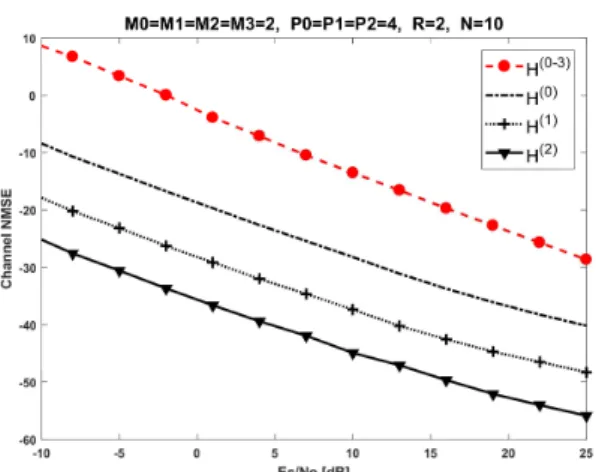
In order to evaluate the estimation of the individual channels, Fig. 7 shows the channel NMSE versus „…⁄ for all the hops R of the relay system. The NMSE has been computed as:
‘„ = 1’ C l“V+”− Vx+”“–$ ‖V{ +”‖–$m +”
, (40) with ˜@ = 1, ⋯ , ’, ’ corresponding to the number of Monte Carlo runs, and ‖∙‖– being the Frobenius norm. One can note that the channel estimation is improved for the nodes closest to the destination. Moreover, we can conclude that the channel estimation is better with the cooperative link than with the direct link.
V. CONCLUSION
We have proposed a three-hop AF MIMO relay system with tensor space-time coding (TSTC) at the source and the relays. The signals received at the destination form a fifth-order tensor that satisfies a nested Tucker decomposition. We have derived a semi-blind receiver based on a four-step ALS algorithm that jointly estimates the symbols and the channels. Simulation results have shown the performance of the proposed three-hop system is better than that of the direct link. Perspectives of this work include an extension to the case with > 2 relays and the development of a closed-form receiver.
REFERENCES
[1] N.D. Sidiropoulos, G.B. Giannakis and R. Bro, “Blind PARAFAC receivers for DS-CDMA systems,” IEEE Trans. Signal Process., vol. 48, pp. 810–823, 2000.
[2] A.L.F. de Almeida, G. Favier, J.P.C.L. da Costa and J.C.M. Mota, “Overview of tensor decompositions with applications to communications,” in Signals and Images: Advances and Results in Speech, Estimation, Compression, Recognition, Filtering, and Processing, CRC book, chapter 12, pp. 325-356, 2016.
[3] G. Favier, M.N. Costa, A.L.F. de Almeida and J.M.T. Romano, “Tensor space-time (TST) coding for MIMO wireless communication systems,” Signal Process., vol. 92 (4), pp. 1079–1092, 2012.
[4] G.T. de Araújo and A.L.F. de Almeida, “Closed-form channel estimation for MIMO space-time coded systems using a fourth-order tensor-based receiver,” Circuit Syst. Signal Process., 2017
[5] G. Favier, C.A.R. Fernandes and A.L.F. de Almeida, “Nested Tucker tensor decomposition with application to MIMO relay systems using tensor space–time coding (TSTC),” Signal Process., vol. 128, pp. 318– 331, 2016.
[6] W.C. Freitas Jr., G. Favier and A.L.F. de Almeida, “Sequential closed-form semi-blind receiver for space-time coded multi-hop relaying systems,” IEEE Signal Process. Letters, vol. 24 (12), pp. 1773–1777, 2017.
[7] C.W.R. Chiong, Y. Rong, and Y. Xiang, “Channel training algorithms for two-way MIMO relay systems,” IEEE Trans. Signal Process., vol. 61 (16), pp. 3988-3998, 2013.
[8] F. Gao, T. Cui, and A. Nallanathan, “On channel estimation and optimal training design for amplify and forward relay networks,” IEEE Trans. Wireless Comm., vol. 7 (5), pp. 1907-1916, 2008.
[9] Y. Liu, S. Li, X. Mu and J. Zhang, “Tenor-based semi-blind channel estimation for three-hop MIMO relay systems,” in Int. Conf. Wireless Comm. Signal Process. (WCSP), 2015.
[10] L.R. Ximenes, G. Favier, A.L.F. de Almeida, “Semi-blind receivers for non-regenerative cooperative MIMO communications based on nested PARAFAC modeling,” IEEE Trans. Signal Process., vol. 63, pp. 4985– 4998, 2015.
Fig. 5. SER performance for the proposed ALS receiver.
Fig. 6. Convergence of the proposed ALS receiver.