Distributed Sequential Consensus in Networks: Analysis
of Partially Connected Blockchains with Uncertainty
The MIT Faculty has made this article openly available. Please share
how this access benefits you. Your story matters.
Citation
Prieto-Castrillo, Francisco et al. "Distributed Sequential Consensus
in Networks: Analysis of Partially Connected Blockchains with
Uncertainty." Complexity 2017 (November 2017): 4832740 © 2017
Francisco Prieto-Castrillo et al
As Published
https://doi.org/10.1155/2017/4832740
Publisher
Hindawi Publishing Corporation
Version
Final published version
Citable link
http://hdl.handle.net/1721.1/112142
Terms of Use
Creative Commons Attribution
Distributed Sequential Consensus in Networks: Analysis of
Partially Connected Blockchains with Uncertainty
Francisco Prieto-Castrillo,
1,2,3Sergii Kushch,
3and Juan Manuel Corchado
31Media Laboratory, Massachusetts Institute of Technology, Cambridge, MA 02139-4307, USA 2Harvard T. H. Chan School of Public Health, Harvard University, Boston, MA 02115, USA
3BISITE Research Group, University of Salamanca, Edificio Multiusos I+D+i, 37008 Salamanca, Spain
Correspondence should be addressed to Francisco Prieto-Castrillo; [email protected]
Received 9 July 2017; Revised 13 September 2017; Accepted 10 October 2017; Published 1 November 2017 Academic Editor: Dimitri Volchenkov
Copyright © 2017 Francisco Prieto-Castrillo et al. This is an open access article distributed under the Creative Commons Attribution License, which permits unrestricted use, distribution, and reproduction in any medium, provided the original work is properly cited.
This work presents a theoretical and numerical analysis of the conditions under which distributed sequential consensus is possible when the state of a portion of nodes in a network is perturbed. Specifically, it examines the consensus level of partially connected blockchains under failure/attack events. To this end, we developed stochastic models for both verification probability once an error is detected and network breakdown when consensus is not possible. Through a mean field approximation for network degree we derive analytical solutions for the average network consensus in the large graph size thermodynamic limit. The resulting expressions allow us to derive connectivity thresholds above which networks can tolerate an attack.
1. Introduction
Trust is usually conceived as the additive aggregation of reliable pieces. However, when it comes to cyber-security or privacy requirements, the challenge is how to collaboratively create trust out of uncertain sources in a networked envi-ronment [1–6]. A remarkable success story of this approach is Bitcoin [7]. In Bitcoin, trust is built by a set of agents—
miners—which collaborates in sequencing blocks of
transac-tions in a chain. Blockchain (BC) is the underpinning technol-ogy of Bitcoin, a protocol in which miners compete to solve a computationally expensive problem, known as Proof-of-Work (POW) [8]. The miners’ results are then assembled together in a distributed data chain. The outcomes are only embedded in the final version of the chain after consensus, which is only reached if the order relationships are consistent. POW is a proxy of trust and, hence, reliability increases as the chain grows; it is incrementally more difficult to revert—hack—the chain since this requires increasing computing power. Thus, although each agent generates insecure information locally, the resulting aggregate becomes more and more reliable over time.
Recently however, these advantages have also caused concerns about how the BC paradigm can be exported to domains other than cryptocurrency, such as the Internet-of-Things (IoT) or Wireless Sensor Networks (WSN) [9, 10]. This difficulty arises from the limitations of the BC architecture, which hamper the possibility of extending it to small devices (e.g., sensors). Sensors, in particular, lack the computing power to perform POW. An even more challenging fact is that BC requires full connectivity to operate (which is unfeasible for WSNs). Therefore, the question at issue is how to design blockchains without POW and partial connectivity while maintaining robustness to failures and attacks.
Distributed consistency is not a novel concept. In [11] the authors analyse the consistency of distributed databases by using algorithms which are closely related to epidemio-logical models [12]. Two information diffusion mechanisms, antientropy and rumor mongering, happen to be particularly useful for modelling distributed consistency. Antientropy regularises entries in the databases while rumor monger-ing updates the last information content from neighbour instances. This trade-off between ordered and random infec-tion allow the authors to find exponential epidemic growth
by using a mean field approach. The concept of diffusion in partially connected networks is treated rigorously in [13] in the context of glassy relaxation. Here, the geometrical aspects of the return probability of a Markovian hypercube walk are also analysed using mean field theory.
The effect of graph topology on information spreading has been extensively discussed in the literature (e.g., [14–16]). However, the model in [16] (a random graph superposed to a ring lattice) is particularly relevant to our discussion, since it ensures a minimum connectivity while maintaining the
small-world property (i.e., high clustering coefficient and
small characteristic path length [17]).
In [18] the general distributed consensus problem is described;𝑛 nonfailing sites out of 𝑚 choices have to decide on a common valueV. The authors of that study found that the key components for consensus breakdown are asynchronicity and failure, which both inject uncertainty into the system at different scales. Distributed consensus in networks is also analysed in [19], where the authors address the most impor-tant applications of the concept, such as clock synchronisa-tion in WSNs. The authors introduce the average consensus as the limit to which initial states converge, provided this limit is equal to the averaged initial values. Interestingly, a randomised consensus protocol (where only a fraction of sites needs to agree on a value) is shown to be more robust against crash than a deterministic algorithm [20].
When consensus is not reached, systems usually break down. From the point of view of control theory, a number of interesting results have been obtained in studies focused on this issue, for example, [19], aimed at self-healing the system momentously after failure. However, security and resilience are multidimensional objects which can be tackled more consistently through a complex systems approach [21, 22]. For instance, [23] proposes a phone call model where 𝑛 players broadcast rumors randomly among their partners. The authors study the effect of node failure and concentrate on an interesting result; if failure patterns are random, 𝐹 crashing nodes result in only𝑂(𝐹) uninformed players with high probability. The work also shows that any randomised rumor spreading algorithm running for 𝑂(log 𝑛) rounds requires𝑂(𝑛) transmissions. This is consistent with what we know from network science [24]; random failures do not spread so easily. The model considered in [25] consists of 𝑛 sites running processes asynchronously where failures are modelled as a Bernoulli process. In [26] the problem is set in terms of a voter model and an invasion process; agreed values are exported from a set of sites but imported errors infect the rest of nodes.
When it comes to blockchain implementations, [27] anal-yses information propagation in the Bitcoin network. This work highlights the limitations of the synchronisation mech-anisms in BC and the system’s weaknesses under attack. Here, the communication network is modelled as a random graph with a mean degree of ≈32 and it is found that the block verification process can majorly contribute to delay propagation and inconsistency. In their experiments the authors show that the probability distribution of the rate at which nodes learn about a block has a long tail. This means that there is a nonnegligible portion of nodes which does
not receive information timely. The effect is equivalent to considering an incomplete consensus network. A typical example of organised attack in the BC is the so-called
selfish-mine strategy. This consists of a subset of nodes which
diffuse information partially to targets, instead of distributing updates homogeneously [28]. In [29] a Markov chain model is used to analyse the selfish-mine strategy in Bitcoin. This and other block-withholding behaviour can have a devastating effect on the performance if the dishonest community is around half the size of the network.
All these works provide key insights into the problem of network resilience, diffusion, and consensus from dif-ferent perspectives. However, to the authors’ knowledge, a mathematical model of partially connected blockchains is still missing. Therefore, in this paper we make a theoretical and numerical analysis of the conditions under which a distributed sequential consensus is possible. In concrete, we examine the consensus level of partially connected block-chains under failure/attack events. To this end, we develop stochastic models for both verification probability once an error is detected and network breakdown when consensus is not possible. The resulting expressions allow us to derive connectivity thresholds above which networks can tolerate attack.
The paper is organised as follows. In Section 2 we for-mulate the problem. The results obtained in the study are presented in Section 3. Finally, we present the conclusions obtained from our research and discuss the possibilities for future work in Section 5.
2. Problem Formulation
Blockchains can be conceived as dynamical distributed databases whose constituents (blocks) are collaboratively and incrementally built by a set of agents. There are three key factors in this process: (a) how information spreads, (b) how consensus can be achieved, and (c) how errors affect the overall performance. We elaborate on these elements below.
2.1. Partial Connectivity in Consensus Networks. From a
network perspective we consider a Peer-to-Peer (P2P) infras-tructure with two types of nodes: communication sites and processing sites, miners (Figure 1). Users connected to nodes can launch transactions to other users in the network. If a group of users{1, 2, 3, 4} is involved in a transaction arrange-ment, one or more miners can attempt to verify the intended transactions and if successful, pack them into a block. This problem can be conceived as the interplay of three graphs: communication, transactions, and miners. As stressed, the usual BC protocol takes the full graph for granted, which is not always possible; there may either be failures or intentional attacks on a portion of the network. However, it is unlikely for a network to get disconnected under normal operation. Hence, graph connectedness is a reasonable lower bound assumption (particularly in the case of sensor networks and IoT). This leads us to consider the network proposed in [16]; ̃
𝐺 = R ∪ 𝐺, consisting of a random graph 𝐺 superposed to a ring lattice R. This model still exhibits the
Miners consensus network P2P communication network (c) (a) (b) Transactions Comm. node Miner 4 4 4 5 5 3 3 6 6 2 2 2 1 1 1 3 4 2 5 13 34 35 23
Figure 1: Schematic of nodes, transactions, and layers in the blockchain problem. A subset of the communication P2P nodes (a) are sites responsible for block processing, miners (light blue circles). When a user intends to make a transaction (b) to another user (dark blue lines) with weight𝜔13, the miner consensus network (c) needs to reach a consensus. However, the full connectivity of the miners’ graph is not guaranteed as there can be attacks (red line) or failures (thin black lines).
requirements of minimum connectivity found in WSNs and other networked systems such as computer networks [30].
At this point it seems that information spreading in the BC can be reduced to the well-known problem of diffusion on graphs. This area is vastly covered in the literature (see, e.g., [13]). However, BC diffusion holds some subtleties under the hood as we show below.
2.2. Why Order Matters: Sequential Diffusion. At every
trans-action arrangement, the ordering of each operation in the set is a key factor. Consider the simple arrangement shown in Figure 1(b), which represents four possible transactions. These can be formalised as the directed links 𝐸 = {𝑒13, 𝑒34, 𝑒23, 𝑒35} shown in the graph. There are |𝐸|! ways to
sort this set but not all of them are consistent. The type of consistency we refer to is that which avoids the
double-spending problem. Take two possible order relationships⪯1
and⪯2implemented by the bijections𝑇1,2 : 𝐸 → N. They result in (𝐸, ⪯1) : 𝑇1(𝑒13) = 1, 𝑇1(𝑒34) = 2, 𝑇1(𝑒23) = 3, 𝑇1(𝑒35) = 4, (𝐸, ⪯2) : 𝑇2(𝑒13) = 1, 𝑇2(𝑒34) = 2, 𝑇2(𝑒35) = 3, 𝑇2(𝑒23) = 4. (1)
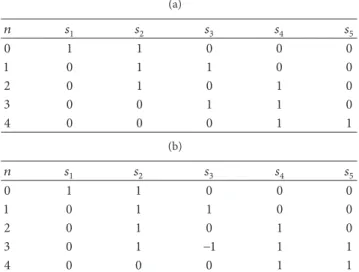
Table 1: Evolution of states in the transaction graph shown in Figure 1(b) obtained by iterating (1)𝑛 = 1, . . . , 4 steps for ⪯2(a) and ⪯2(b) orderings. The initial state is𝑆(0) = (1, 1, 0, 0, 0) and 𝜔(𝑛) = 1, ∀𝑛. The order relationship ⪯2induces the double spending effect.
(a) 𝑛 𝑠1 𝑠2 𝑠3 𝑠4 𝑠5 0 1 1 0 0 0 1 0 1 1 0 0 2 0 1 0 1 0 3 0 0 1 1 0 4 0 0 0 1 1 (b) 𝑛 𝑠1 𝑠2 𝑠3 𝑠4 𝑠5 0 1 1 0 0 0 1 0 1 1 0 0 2 0 1 0 1 0 3 0 1 −1 1 1 4 0 0 0 1 1
The first ordering does not induce any inconsistency but the ordered set(𝐸, ⪯2) violates the double spend constraint depending on the weights 𝜔𝑖𝑗. If we label by 𝑆(𝑛) = (𝑠1(𝑛), 𝑠2(𝑛), 𝑠3(𝑛), 𝑠4(𝑛)) the state vector at step 𝑛, a transi-tion, say𝑒13, results in the update equation:Δ𝑆13= −𝜔13𝑢1𝐿13 where 𝑢1 represents the row-base vector(1, 0, 0, 0) and 𝐿𝑖𝑗 is the graph Laplacian corresponding to the transaction sub-graph𝑔𝑖𝑗 = ({𝑖, 𝑗}, 𝑒𝑖𝑗). The ordering allows writing compact update equations as
𝑆 (𝑛 + 1) = 𝑆 (𝑛) − 𝜔 (𝑛) 𝑋 (𝑛) 𝐿 (𝑛) , (2) where 𝜔(𝑛), 𝑋(𝑛), and 𝐿(𝑛) represent transaction weights, base vectors, and graph Laplacians for each transaction. In Table 1, we show the evolution of states in the case𝜔(𝑛) = 1, ∀𝑛 with initial state 𝑆(0) = (1, 1, 0, 0, 0) for ⪯1 and ⪯2. Notice that for⪯2node 3 has ran out of values at step 2 but it still intends to perform a transaction to node 5 at step 3. This is like having a balance of $10 in a bank account and spending it twice by sending $10 to two different recipients. When it comes to measurements in WSNs (say energy consumption data) avoiding these inconsistencies is imperative [31]. If a miner attempted to pack these transactions along with⪯2 into a block, he will reach an inconsistency. These order constraints make the BC diffusion different to regular graph diffusion [13]. In fact, BC protocol ensures that double-spending paradoxes cannot occur by imposing constraints such as𝑠𝑘(𝑛) ≥ 0, ∀𝑘, 𝑛. An example of this is the distributed ledger in Bitcoin [27]. The next question is how this ordering couples with failures in the network.
2.3. Attack and Failure in Consensus Dynamics. Blockchain
technology copes with the above restrictions efficiently by elevating the transaction order relationships to the block scale. Thus, every block (which can hold one or more transactions) in the resulting blockchain builds on top of
s1 s2 s3 s4 s5 s6 E 0 1 2 3 4 5 6 1 0 1 2 2 2 5 6 2 0 1 2 3 3 3 6 4 00 00 00 33 44 55 55 5 0 1 1 E 4 5 6 6 0 1 2 2 2 5 6 3 0 0 2 3 4 5 5 ni i (a) s1 s2 s3 s4 s5 s6 E 0 1 2 3 4 5 6 1 0 1 2 2 2 2 5 6 2 0 1 2 3 3 3 3 6 4 00 00 00 E 1 4 55 55 5 0 1 1 1 1 4 5 5 6 0 1 2 2 2 2 5 6 3 0 0 2 3 3 4 4 4 ni i 3∗ (b)
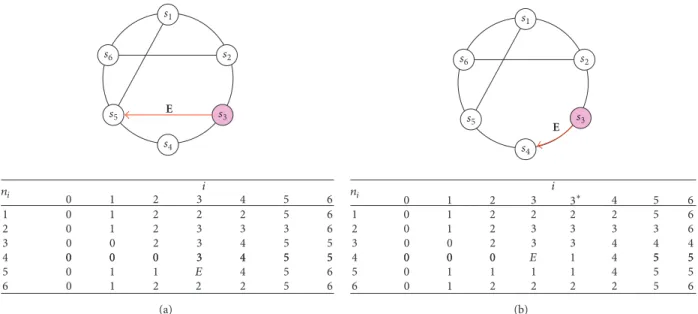
Figure 2: Two ways for error propagation in the miners consensus network: to a nonneighboring node (a) and to the next block solver (b). The tables summarise the blockchain dynamics in a cycle. Rows represent sites and columns represent iterations. In the first case, the error (represented as𝐸) cannot be restored and it persists in the blockchain. In the second case, an additional recovery step 3∗can restore the error to the agreed value of1.
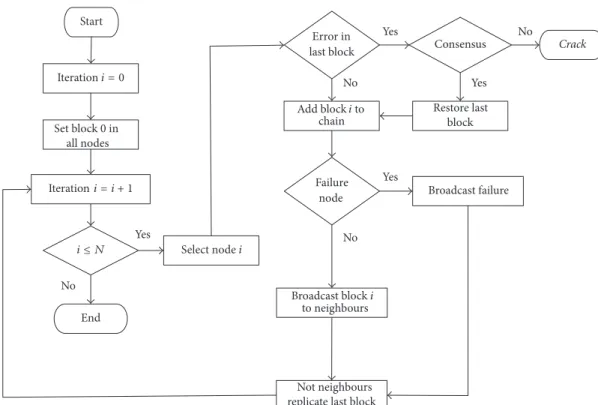
the preceding block to preserve sequential diffusion. This strategy can however be used by dishonest users to create massive damage in the network. Consider the case depicted in Figure 2 where 6 miners collaborate to build a blockchain. Without loss of generality we can label the miners according to the order of their block resolution (it is very unlikely that two miners solve a block at the same time and, if this happens, BC would still sort the resulting blocks in order with high probability [20]). Node 3 is a failure node; it sends an error/attack to either a nonneighboring node (a) or to a miner who happens to be the one solving the next block (b). Below each graph, we also show the evolution of the chain. In this schematic, rows represent sites and columns represent iterations within the cycle. A row stands for the local instance of the chain at a given site and a column represents the collective blockchain built up to a given step. The blockchain is constructed as follows. At step0 all sites own the0-genesis block. At step 𝑖 if miner 𝑛𝑖finds no error in the last block of his local instance of the chain he solves the next block and broadcasts the solution to neighbours. The nonreached sites simply replicate their state. However, if the sending site is a failure node, it will broadcast a failure to one of his neighbours. In this case, if the affected block finds the error in his solving step, he still has a chance to restore the block upon consensus from his acquaintances. In case this consensus is not possible the blockchain breaks down. This flow is depicted in Figure 3.
Both situations shown in Figure 2 trigger different phe-nomena and have different effects in the overall network performance. In the first case, the error (represented as𝐸 in the table) has no chance of being restored and it persists in the blockchain. However, in the second case an additional recovery step3∗can restore the error to the agreed value of 1. Notice also that since the network is not fully connected
there are sites that lack state updates and their local instances of the chain are not synchronised. This limits the information spreading in the network as we show in the next section.
We highlight the fact that, in the Bitcoin implementation, miners asynchronously relay blocks and transactions as soon as they either receive or mine them [32]. In our case agents hold received blocks and transmit their knowledge to neigh-bours sequentially. In Figure 4 we compare the sequence diagrams for both models in the case of three miners (for the sake of simplicity we have only considered one thread per miner. Since mining times are much larger than relay times, splitting mining and relay processes in two threads would not affect the conclusions of this comparison). Without loss of generality miners𝑆1−3will solve blocks𝑏1−3in first, second, and third order. In the Bitcoin blockchain implementation (a) the processes of mining and the relay of blocks have different timescales;≈10 minutes for mining and a few seconds for block forwarding. However in a context where POW is absent (b), the mining lags tend to zero and the processes of mining, verification, and relay converge. In (a) if site 𝑆1 at time𝑡1 sends a block𝑏1to𝑆2, this miner will forward it to𝑆3after a short verification lag 𝑡2. Then,𝑆2 will release𝑏2 after a big mining delay. However, in (b), since there is no POW, 𝑆2 will broadcast𝑏2 to neighbours pretty soon at epoch 𝑡2. This enables saving time and reducing the network traffic considerably.
2.4. Mathematical Model. By putting all these facts together,
we obtain a minimum blockchain model that captures the dynamics described above: (a) partial connectivity, (b) sequential diffusion, and (c) failure spreading. Below we develop a stochastic process analysis to examine the averaged network performance under different conditions.
Start Set block 0 in all nodes End No Error in
last block Consensus Crack
Restore last block Failure node Broadcast block i to neighbours Broadcast failure Not neighbours replicate last block
Yes No No Yes Yes No Yes Iterationi = i + 1 Iterationi = 0 chain Add blocki to i ≤ N Select nodei
Figure 3: Blockchain dynamics workflow. At step0 all sites own the 0-genesis block. At step 𝑖 if miner 𝑛𝑖finds no error in the last block of his local instance of the chain he solves the next block and broadcasts the solution to neighbours. The nonreached sites simply replicate their state. However, if the sending site is a failure node, it will broadcast a failure to one of his neighbours. In this case, if the affected block finds the error in his solving step, he still has a chance to restore the block upon consensus from his acquaintances. In case this consensus is not possible the blockchain collapses.
(a) (b)
(c)
Verify & relay Mine & relay Verify & mine & relay
S1 S2 S3 S1 S2 S3 S1 S2 S3 b1 b1 b1 b1 b1 b2 b1b2 b1b2 b1b2 b2b3 b1b2 b1b2 b1b2b3 b1b2b3 b1b2b3 b1b2b3 t1 t2 t3
Figure 4: Sequence diagram comparison between Bitcoin blockchain (a) and the sequential model proposed in this work (b) for a simple miners network (c). In (a) if site 𝑆1 at time𝑡1 sends a block𝑏1to𝑆2, this miner will forward it to𝑆3after a short verification lag𝑡2. Then,𝑆2will release𝑏2after a much larger mining delay. In (b) however, since there is no POW,𝑆2will broadcast𝑏2to neighbours pretty soon at epoch𝑡2.
With the graph model of size𝑁 described in Section 2.1 we represent each information block (or measure state in
general) at site 𝑛𝛼 at the 𝑖th iteration as 𝑠𝛼(𝑖). As stressed above, all sites start from the 0-genesis block:𝑠𝛼(0) = 0, ∀𝛼. Then, following the flow depicted in Figure 3, at iteration𝑖 node𝑛𝑖, checks its state and adds a block to the chain. We collect the number of sites matching the current block in the variable𝑋𝑖, which is equal to the node degree𝑘𝑖plus a noise term𝜎𝑖 ∈ {0, 1}. If 𝑛𝑖 sends an error signal to𝑛𝑖+1 which cannot be reverted to the state𝑠𝑖+1(𝑖) = 𝑖, then 𝜎𝑖 = 0 and 𝜎𝑖= 1 in any other case. The performance ratio per iteration 𝑚𝑖 = 𝑋𝑖/𝑁= (𝑘𝑖 + 𝜎𝑖)/𝑁 is a measure of the consensus level reached at step𝑖. Depending on whether consensus is reached or not the whole chain may collapse. In an ensemble of chainsΩ we define both the failure and matching random variables𝐹 : Ω → {0, 1}, 𝑀 : Ω → 𝑅, and 𝜔 → 𝑀(𝜔) = (1 − 𝐹(𝜔)) ∑𝑁𝑖=1𝑚𝑖/𝑁, respectively. 𝐹 = 1 in case there is one or more steps where consensus is not possible. Hence the ensemble mean for𝑀 can be expressed as
⟨𝑀⟩ = 𝑘 + 𝜎𝑁 (1 − 𝑃𝐹) , (3) where𝑘 = 2 + 𝑝(𝑁 − 3)—with 𝑝 as connection probability— represents the network average degree,𝜎 ≡ ∑𝑁𝑖=1𝜎𝑖/𝑁, and 𝑃𝐹 = 𝑃(“𝐹 = 1”) stands for the failure probability. Since a chain failure can only happen after verification,𝑃𝐹= 𝑃𝐹|𝑉𝑃𝑉, where𝑃𝑉= 𝑃(“𝑉”) is the verification probability and 𝑃𝐹|𝑉= 𝑃(“𝐹” | “𝑉”) the respective conditional probability.
0 0,1 0,3 0,5 0,7 0,9 1 50 60 70 80 90 100 0,0 0,2 0,4 0,6 0,8 1,0 F rac tio n o f v er ifica tio n s Simulation 1 − ?RJ(−/p) 100% 70% 40% % extra links
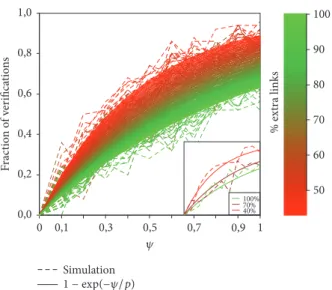
Figure 5: Exponential behaviour of the verification probability. As the ratio of attacking nodes increases, verifications grow exponen-tially. Graph connectivity decreases the verification rate. The inset shows the lower and upper connectivity bounds (40% and 100%) along with an intermediate connectivity of 70%.
Notice that even in the failure-free case there is an upper bound in the mean efficiency𝑀0 = (1/𝑁 )(𝑘 + 𝜎) imposed by the lack of full connectivity (full connectivity and full recovery with𝜎 = 1 would result in the limit ⟨𝑀⟩ = 1 (i.e., 100% efficiency)). Hence, both size and connectivity limit network performance due to the partial sequential diffusion, specific for the BC architecture. Next, we look into chain failure probability.
Firstly, it is clear that failure can only happen when at iter-ation𝑖 the last block of node 𝑛𝑖+1is an error state. This requires (a) the emisor node to be an attack node with probability𝜓 and (b) the receiving node is indeed𝑛𝑖+1. Since connections in 𝐺 are uniformly random, the verification probability at step 𝑖 can be expressed as 𝑃𝑉(𝑖) = 𝜓/𝑘𝑖. Also, because the chain is verified if at least one step needs verification, consequently the probability of blockchain verification is
𝑃𝑉= 1 −∏𝑁
𝑖=1
(1 − 𝜓
𝑘𝑖) . (4)
3. Main Results
3.1. Mean Field Approximation for the Chain Verification Prob-ability. By using a mean field approximation [11] we replace
node degree by the mean network degree𝑘. In this case, for large𝑁, 𝑃𝑉renders
𝑃𝑉= 1 − exp (−𝜓𝑝) . (5) In Figure 5 we compare expression (5) with Monte Carlo simulation. For a ring lattice of size𝑁 = 60 we generated 105 synthetic networks with increasing connections and attack strength until graph saturation. Each experimental point (50
runs with the same parameters) represents the fraction of networks that reported a verification step. As the ratio of attacking nodes increases verifications grow exponentially, like the epidemics in [11]. As expected, graph connectivity (measured with the percentage of additional links until saturation) decreases the verification rate.
It is important to provide this estimate because a large number of verification steps translate directly to cost and efficiency in real implementations. Next, we investigate in detail the probability of a chain failure after a verification step.
3.2. Network Consensus Mechanisms. As stressed, if node𝑛𝑖
sends an error code to node𝑛𝑖+1at iteration𝑖, there is a chance for node𝑛𝑖+1to revert this error provided that the consensus reached among its neighbours is over a given threshold. The problem can be formulated as follows. Let𝑈𝑗 represent the neighbours of node𝑛𝑗. Notice that, at iteration 𝑖, nodes in ̃
𝑈𝑖+1 ≡ {𝑖} ∪ (𝑈𝑖+1 ∩ 𝑈𝑖) have value 𝑖 while the remaining
nodes in𝑈𝑖+1 can attain any value from the setΓ ≡ {𝐸} ∪ {0, 1, . . . , 𝑖 − 1}. Given a consensus threshold 𝑧 ∈ N, let 𝜒 ≡ max𝛾∈Γ{∑𝑥∈𝑈𝑖+11𝛾(𝑥)} denote the maximum frequency of values in𝑈i+1which are different than𝑖. There is agreement when
max{𝑈𝑖+1∩ 𝑈𝑖 + 1,𝜒} ≥ ⌊𝑘𝑖+1
𝑧 ⌋ , (6) where the notation⌊𝑥⌋ stands for the floor value of 𝑥 ∈ R. Notice that𝑧 = 2 defines a simple majority based consensus among the𝑈𝑖+1sites.
Consequently, inspired by the antientropy and rumor mongering concepts [11], we split the consensus problem of (6) in two mechanisms: clustering and random infection (we use the mathematical epidemiology terminology for infected nodes as those receiving a given state. Notice that in our case infection is not necessarily a negative phenomenon unless the broadcasted quantity is an attack). In the former,𝑛𝑖+1 neighbours get an update from𝑛𝑖to value𝑖. In the latter case 𝑛𝑖+1neighbours eventually agree on a value ̸= 𝑖 arriving from other sites different than𝑛𝑖 or from their own replications along the preceding steps in the blockchain cycle.
Notice that the number of symbols inΓ increases with the number of iterations. Therefore, it is increasingly less likely to reach consensus by random infection. On the other hand, the link consensus mechanism does not decrease with the iterations. Hence, the link consensus will dominate over random consensus in the thermodynamic limit𝑁 ≫ 1. For a reasonable network size (say 𝑁 > 50) this enables us to neglect the random term contribution to the failure probability. Below we elaborate more on this stochastic approximation.
3.3. Stochastic Network Failure in the Thermodynamic Limit.
As demonstrated before, cluster consensus occurs when there are at least⌊𝑘𝑖+1/𝑧⌋ sites out of 𝑘𝑖+1− 1 possible nodes (the −1 term is because site𝑛𝑖already holds an𝑖 state) with state 𝑖. Equivalently, it can be assumed that𝑛𝑖is connected to at least ⌊𝑘𝑖+1/𝑧⌋ nodes in 𝑈𝑖+1 \ {𝑖}. In this way, we can model the process as a Bernoulli trial (akin to [25]) where the success
variable follows the binomial∼𝐵(𝑘𝑖+1 − 1, 𝑝). The resulting failure probability renders
𝑃𝐹|𝑉(𝑖, 𝑧) = ⌊𝑘𝑖+1/𝑧⌋ ∑ 𝑥=0 ( 𝑘𝑖+1− 1 𝑥 ) 𝑝𝑥(1 − 𝑝) 𝑘𝑖+1−1−𝑥. (7)
Since the blockchain failure probability can be expressed as 𝑃𝐹= 1 −∏𝑁
𝑖=1
(1 − 𝑃𝐹(𝑖, 𝑧)) , (8) by using (8) and (3) and 𝑃𝐹(𝑖, 𝑧) = 𝑃𝑉(𝑖)𝑃𝐹|𝑉(𝑖, 𝑧) = 𝜓𝑃𝐹|𝑉(𝑖, 𝑧)/𝑘𝑖we arrive to the expression
⟨𝑀⟩ = 𝑀𝑜exp 𝑁 ∑ 𝑖=1 log(1 −𝜓𝑃𝐹|𝑉(𝑖, 𝑧) 𝑘𝑖 ) . (9) Now, provided that the quantity𝜓𝑃𝐹|𝑉(𝑖, 𝑧)/𝑘𝑖is small com-pared to1, we approximate the logarithm in the last expres-sion by its first-order series expanexpres-sion. By implementing the same mean field approximation as for𝑃𝑉in the preceding section we obtain the equation
⟨𝑀𝑀𝐹⟩ = 𝑀𝑜exp(−𝜓
𝑝𝑃𝐹|𝑉𝑀𝐹(𝑧)) , (10)
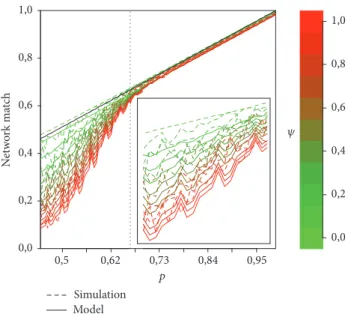
where𝑃𝐹|𝑉𝑀𝐹(𝑧) denotes the corresponding mean field approx-imation for𝑃𝐹|𝑉(𝑖, 𝑧). In Figure 6 we show the mean field approximation to the blockchain performance measured as the average network consensus for𝑁 = 60 and 𝑧 = 2. As for𝑃𝑉we generated105synthetic networks with increasing connections and attack strength until graph saturation. For each network instance, we monitored the number of sites with value𝑖 at iteration 𝑖 within the blockchain cycle. This gives us an empirical estimate for the network match per iteration 𝑚𝑖. Then, we averaged the𝑚𝑖quantities over the cycle, which
results into a measure for the network performance (i.e., consensus level). Finally, we obtain the mean value of this quantity from our Monte Carlo dataset. Each experimental point represents 50 runs with the same parameters.
Notice that 100% performance—blockchain limit—can only be achieved for full connectivity 𝑝 → 1. The 𝑀𝑜 upper bound (black straight line) limits the network match for partial connectivity; as we increase the link probability the performance increases according to (10). Also, stronger attack strategies (larger𝜓 values) result in lower performance as expected.
A remarkable result in Figure 6 is that beyond a critical value of connectivity𝑝𝑐; consensus is only limited by infor-mation spreading and not by failure. This fact motivates us to look closely at possible estimates of𝑝𝑐.
3.4. Estimate for the Attack Tolerance Critical Connectivity.
Noticing that 𝑃𝐹|𝑉𝑀𝐹(𝑧) is nothing else than the cumulative distribution function for the binomial𝐵(𝑘 − 1, 𝑝), we use the normal approximation for the binomial distribution as
𝑃𝐹|𝑉𝑀𝐹(𝑧) ≈1 2[1 + 𝐸𝑟𝑓 (𝐴 (𝑝))] , (11) 0,5 0,62 0,73 0,84 0,95 0,0 0,2 0,4 0,6 0,8 1,0 N et w o rk ma tch Simulation Model p 1,0 0,8 0,6 0,4 0,2 0,0
Figure 6: Mean field approximation to the blockchain performance for𝑁 = 60 and 𝑧 = 2. Starting from the complete graph limit in the top right corner, as connectivity𝑝 decreases and attack strength 𝜓 increases, the network match decreases according to (10). The black line represents the𝑀𝑜upper bound limit. The vertical dotted line at 𝑝 = 0.66 represents an estimate (see the last part of Section 3.3) for the limit⟨𝑀⟩ → 𝑀0where performance starts to be independent of𝜓. The inset shows a zoom for the cut 𝑝 ∈ [0.5, 0.6].
where𝐸𝑟𝑓(𝑥) is the error function and
𝐴 (𝑝, 𝑧) = ⌊𝑘/𝑧⌋ − 𝑝 (𝑘 − 1)
(2𝑝 (1 − 𝑝) (𝑘 − 1))1/2. (12) If𝜖 ∈ R denotes a small quantity, we inquire the conditions under which⟨𝑀⟩ tends to 𝑀0, or more specifically|⟨𝑀⟩ − 𝑀0| ≤ 𝜖𝑀0. To this end, we derive conditions for equality in this expression from (11) and (12). Also, by using the log(1 − 𝜖) ≈ −𝜖 approximation, the following condition holds:
𝐴 (𝑝, 𝑧) = 𝐸𝑟𝑓−1(2𝑝𝜖
𝜓 − 1) . (13) In the large𝑁 limit 𝑘 ≈ 𝑝𝑁 and also assuming ⌊𝑘/𝑧⌋ ≈ 𝑘/𝑧, 𝐴(𝑝, 𝑧) can be approximated as
𝐴 (𝑝, 𝑧) ≈ 1 − 𝑝𝑁 + 𝑁/𝑧
√2𝑁(1 − 𝑝) . (14) From (14) one could attempt to solve (13) for𝜖, 𝑁, 𝑝, and 𝜓. But this is not possible because the function 𝐸𝑟𝑓−1(𝑥 − 1)
diverges for 𝑥 = 0. Still, an interesting case occurs when 𝜖 = 𝜓/(2𝑝). At this limit, (13) only makes sense if 𝐴(𝑝, 𝑧) vanishes, or, the equivalent, if 𝑝 = 𝑝∗ ≡ (1/𝑧 + 1/𝑁). However, this value does not provide the asymptotic limit we are looking for.
If we express𝜖 in terms of 𝛼 ∈ N through the rescaling 𝜖 ≡ 𝜓/(𝑝𝛼) and we also rewrite (13) in terms of 𝑝 − 𝑝∗ we
obtain
𝑝 − 𝑝∗
√1 − 𝑝 = Φ (𝛼) , (15) where we have introduced the function: Φ(𝛼) ≡ (2/𝑁)1/2𝐸𝑟𝑓−1(1 − 2/𝛼).
An operative approximation is possible by considering Φ(𝛼)2 ≪ 1. Then, by using the corresponding solution 𝑝 ≈
𝑝∗+ Φ(𝛼) and for large 𝑁 we find
𝑝𝑐= 1 𝑧+ √ 2 𝑁𝐸𝑟𝑓−1(1 − 2 𝛼) . (16) This is nothing more than a useful parametrisation of (13). For 𝛼 = 2 we recover the case 𝑝𝑐 = 𝑝∗. However, larger𝛼 values
allow us to explore the limit⟨𝑀⟩ → 𝑀0closely. For instance, for𝛼 = 10, 𝑁 = 60, and 𝑧 = 2 we arrive at the solution 𝑝𝑐 = 0.66. This means that, for maximum attach strength (𝜓 = 1), beyond 𝑝 = 𝑝𝑐, the percentage of the deviation of ⟨𝑀⟩ from 𝑀0with respect to𝑀0is lower than 15%. By setting other attack tolerance thresholds the𝑝𝑐value can be adjusted in different realisations of the blockchain network. The value 𝑝𝑐 = 0.66 represented in Figure 6 can then be conceived as
a reasonable threshold for minimum network connectivity ensuring attack tolerance with the above parameters.
4. Proof-of-Concept Example
Notice that the mathematical model addressed in this work abstracts the specifics about transactions, blocks, network architectures, communication protocols, and so on. The implementer must therefore provide definitions for (a) what is a transaction, (b) criterion for consistent ordering of transactions (this is equivalent to defining the analogous to the double-spending problem), (c) how transactions can be packed into blocks, and (d) how is the information spread over the network. When these specifications are provided there are at least two possible scenarios where the findings addressed in this work can be applied: Wireless Sensor Net-works and the Internet-of-Things.
As stressed, there are fundamental discrepancies between the proposed model and the current blockchain protocol implementation in cryptocurrencies. In particular, in our approach the information is not transmitted immediately to the miners once blocks are created; it is sequentially diffused as shown in Figure 4. This has its pros and cons depending on the application domain.
When there is no Proof-of-Work requirement the block mining lags tend to zero and the verification and generation delays become comparable. This way the blockchain con-struction speed is dominated by network latency. Therefore, in the absence of POW, one can reschedule agent’s diffusion to save network operations. In the following example we show a proof-of-concept example in the IoT domain where we compare our model with an asynchronous diffusion scheme akin to the conventional blockchain implementation. In the context of IoT consider the problem of human mobility
tracking where two individuals leave rooms A and B to reach rooms D, E through hall C (Figure 7). Five presence sensors A–D are continuously capturing data of the form 𝑥𝑖= {𝑆ID, 𝑡, V} where 𝑆IDidentifies the sensor,𝑡 represent the measurement time, andV ∈ {0, 1} stands for the presence event. Measures are collected at Δ𝑇 intervals and then checked for consistency. Within Δ𝑇, time is split into 𝛿𝑡 length subintervals. These quantities represent the minimum displacement time between home areas or any other relevant time scale. In general they will be functions of the sensor sam-pling rates. Therefore, we discretise the continuous variable𝑡 into measurement epochs𝑛 implicitly defined as
0 ≤ (𝛿𝑡
Δ𝑇) 𝑡 − 𝑛 ≤ 1. (17) This allows preprocessing raw data𝑥𝑖into a datasetD with entries of the form{𝑆ID, 𝑛} ∈ D, where we also drop V = 0 values. Maintaining our cryptocurrency metaphor, we define
transactions as ordered pairs inD × D: 𝑒𝑛𝑘𝑋𝑌 ≡ ((𝑋, 𝑛), (𝑌, 𝑘)).
For instance,𝑒12AC = ((A, 1), (C, 2)) represents the movement of a person from room A at epoch1 to the hall C at epoch 2. Some transactions do not represent real movement (e.g.,𝑒22AB). A possible criterion for the validness of a transaction𝑒𝑛𝑘𝑋𝑌is 𝑋 ̸= 𝑌 if 𝑘 > 𝑛. This restricts the type of movements allowed in a specific way, but any other criterion can also be defined.
Next we define a 𝑝𝑎𝑡ℎ 𝑃 as an ordered sequence of transactions. If 𝐸 denotes the set of possible transactions among the measurements inD collected in Δ𝑇, consider two possible paths:
𝑃 : (𝑒01AC, 𝑒12CD, 𝑒23BC, 𝑒34CE) ,
𝑃: (𝑒01AC, 𝑒12CD, 𝑒23CE, 𝑒34BC) . (18) Both paths represent the movement of two individuals from A, B to D, E. However,𝑃is not consistent, since the person in B intends to move from C to E before reaching C.
Since we neglect POW, we can consider blocks containing one transaction only which can therefore be generated imme-diately. The order criterion provides means for building the information chain avoiding the type of order inconsistencies commented above.
We also consider a minimal set of three distributed agents (miners in our analogy) which will build the chain. Depend-ing on the network architecture and the communication protocol the information flow among agents can be defined in different ways. However, the model provided in Section 2 allows a considerable reduction of network operations which is more amenable for an IoT implementation. In the bot-tom panel of Figure 7 we use simplified sequence diagrams to compare the information flow of blockchain (a) and sequential diffusion (b) models as we did in Figure 4. In the lower part, we have also included a summary of the local information stored at each node.
Without loss of generality the mining ordering can be mapped to nodes 1–3 (again, as in Figure 4, we use a single thread for verification and mining processes in the nodes, since mining times are much larger than verification times).
A A D D B B E E C C M1 M2 M3 (a) (b) M2 M1 M1 M2 M3 M1 M2 M3 M3 M2 M1 M3 2 3 4 6 7 8 9 10 11 13 14 15 12 5 1
Verify & relay Mine & relay
Verify & mine & relay 1 2 3 4 5 6 7 8 9 10 11 e01 AC e01 AC e01AC e01 AC e01 AC e01 AC e01AC eAC01 e01AC e01 AC e01AC e01AC e01 AC e01AC e01AC e01 AC e01 AC e01 AC e01AC e01AC eAC01 e01AC e01AC e01 AC e12CD e12 CDe23BC e23 BC e23 BC e23BC e23BC e23 BC e23BC e23BC e23BCe34CE e 23 BCe34CE e23BCe34CE e34CE e34CE e34 CE e34 CE e23 BCe34CE e23BCe34CE e23BCe34CE eCD12 e 12 CD e12CD e12 CD e12CD e12CD e12 CD e12 CD e12CD e12CD e12 CD e12 CD e12CD e12 CD e12CD e01ACeCD12 e01 ACe12CD e01ACe12CD e12 CD e12CD
Figure 7: Schematic of a possible application of the model developed in this work. Five presence sensors monitor the movement from rooms A, B to D, E (top left panel). A minimal network of three distributed agents—miners (top right panel)—build consistent orderer aggregations of measurements. In the bottom panel we compare the sequence diagrams from the real blockchain and the sequential model.
In (a), first𝑀1extracts and validates transaction𝑒01ACfrom 𝐸 and broadcasts the corresponding block to the network (1-2). After validating the block,𝑀2in turn forwards it to𝑀3 (3-4). At a later time,𝑀2 validates𝑒12CD, adds it to its local copy(5), and distributes the information among other nodes (6, 7). Next node 3 has itself mined 𝑒23BC (8) which is then validated and sent to the network (9–11). Finally, node 1 only finds it consistent to add𝑒34CEto its local chain(12) and then it broadcasts the information to the network for its validation and transmission (13–15).
However in the sequential diffusion model (b), as stressed, agents do not immediately forward transactions/ blocks as they receive them; nodes propagate information when they generate new blocks. In the absence of POW, agents can synchronise to save unnecessary communication processes. This way, node 2 does not forward𝑒AC01 (2) to node 3 after receiving it from node 1 (1); the information is sent when packing𝑒12CD(3) and so on. This reduces the network traffic considerably. When a miners round is completed node 𝑀2sends a sync message (dotted line from 8to 9) to the next
first mining node (𝑀1in this case) until there are no more transactions to verify. If there are𝑁𝑀agents and transactions, the number of messages grows as𝑂(𝑁𝑀2 ) in (a) and as ∑𝑁𝑀
𝑖 𝑘𝑖
in (b), where𝑘𝑖 is the degree of each node in the agents’ network. The maximum overhead is attained for the full graph where𝑘𝑖= 𝑁𝑀− 1 and both models coincide.
Since WSNs and IoT have in general very low battery capacities, this dramatically limits the size of network traffic. Therefore the model addressed here can add value to these situations.
5. Summary and Discussion
In this paper we have analysed, both theoretically and numer-ically, the conditions under which distributed sequential consensus is possible in presence of partial connectivity and uncertainty. A minimum sequential diffusion model consisting of the superposition of a ring lattice with a random graph along with ordered infection rules allowed us to capture key blockchain elements: partial connectivity, sequential diffusion, and failure spreading.
In our setting a mean field approximation for network degree was helpful in deriving closed-form expressions for the probability of chain verification once errors are detected. We found that verifications grow exponentially with attack. As expected, graph connectivity reduces verification rates. This is a remarkable result because a large number of veri-fication steps translate directly to cost and efficiency in real implementations.
We have also provided expressions for the probability of network breakdown when consensus is not possible. To this end, we have investigated analytically the constituents of the consensus problem in blockchains. We found that clustering dominates over random infection in the large network size limit. This allowed us to derive an expression for the average network performance as a function of connectivity and failure strength. We validated this expression by Monte Carlo simulation. As expected, 100% performance—blockchain limit—can only be achieved for full connectivity. Further-more, there is an upper bound for network match for partial connectivity. Stronger attack strategies result in lower perfor-mance.
The resulting expressions allow us to derive connectivity thresholds above which networks can tolerate attack. Beyond that, lower bound consensus is only limited by information spreading and not by failure. A set of reasonable assumptions and algebraic manipulations allowed us to derive operational expressions for this bound. Specifically, for𝑁 = 60 simple majority based consensus, we arrived at the solution;𝑝𝑐 = 0.66. This means that in a scenario with maximum attach strength, beyond𝑝𝑐, the percentage deviation of blockchain consensus with respect to the upper connectivity bound is lower than 15%.
Clearly this contribution is just a first step in the under-standing of partially connected blockchains; the problem still needs further elaboration in order to foster more robust implementations. For instance, we have neglected some com-munication issues such as delay or bandwidth limitations. In a future work we will research other topological models such
as scale-free and spatial networks with heterogeneous links. Multiplex networks will also allow us to inquire into different attack patterns and the possible counterattacking strategies.
Conflicts of Interest
The authors declare that they have no conflicts of interest.
Acknowledgments
This research was partially supported by the Regional Min-istry of Education from Castilla y Le´on (Spain) and the European Social Fund under the MOVIURBAN project with Ref. SA070U16.
References
[1] S. Seebacher and R. Sch¨uritz, “Blockchain Technology as an Enabler of Service Systems: A Structured Literature Review,” in Exploring Services Science, vol. 279 of Lecture Notes in Business Information Processing, pp. 12–23, Springer International Pub-lishing, Cham, 2017.
[2] S. Amini, F. Pasqualetti, and H. Mohsenian-Rad, “Dynamic Load Altering Attacks Against Power System Stability: Attack Models and Protection Schemes,” IEEE Transactions on Smart Grid, pp. 1-1.
[3] S. Sicari, A. Rizzardi, L. A. Grieco, and A. Coen-Porisini, “Secu-rity, privacy and trust in Internet of Things: the road ahead,” Computer Networks, vol. 76, pp. 146–164, 2015.
[4] H. Menashri and G. Baram, “Critical infrastructures and their interdependence in a cyber attack - the case of the u.s,” Military and Strategic Affairs, vol. 7, no. 1, p. 22, 2015.
[5] R. Roman, J. Zhou, and J. Lopez, “On the features and challenges of security and privacy in distributed internet of things,” Computer Networks, vol. 57, no. 10, pp. 2266–2279, 2013. [6] A. Chakravorty, T. Wlodarczyk, and C. Rong, “Privacy
preserv-ing data analytics for smart homes,” in Proceedpreserv-ings of the 2nd IEEE Security and Privacy Workshops, SPW 2013, pp. 23–27, usa, May 2013.
[7] S. Nakamoto, Bitcoin: A Peer-to-Peer Electronic Cash System, https://bitcoin.org/en/.
[8] A. Gervais, G. O. Karame, K. W¨ust, V. Glykantzis, H. Ritzdorf, and S. ˇCapkun, “On the security and performance of Proof of Work blockchains,” in Proceedings of the 23rd ACM Conference on Computer and Communications Security, CCS 2016, pp. 3–16, aut, October 2016.
[9] A. Dorri, S. S. Kanhere, R. Jurdak, and P. Gauravaram, “Block-chain for IoT security and privacy: The case study of a smart home,” in Proceedings of the 2017 IEEE International Confer-ence on Pervasive Computing and Communications Workshops (PerCom Workshops), pp. 618–623, Kona, Big Island, HI, USA, March 2017.
[10] M. Swan, Blueprint for a New Economy, O’Reilly Media, 1st edition, 2015.
[11] A. Demers, D. Greene, C. Hauser, W. Irish, and J. Larson, “Epi-demic algorithms for replicated database maintenance,” in Proceedings of the the sixth annual ACM Symposium, pp. 1–12, Vancouver, British Columbia, Canada, August 1987.
[12] A. Vespignani, “Modelling dynamical process in complex socio-technical systems,” Nature Physics, vol. 8, no. 1, pp. 32–39, 2012.
[13] A. J. Bray and G. J. Rodgers, “Diffusion in a sparsely connected space: a model for glassy relaxation,” Physical Review. B. Con-densed Matter. Third Series, vol. 38, no. 16, part A, pp. 11461– 11470, 1988.
[14] D. J. Watts and S. H. Strogatz, “Collective dynamics of ’small-world’ networks,” Nature, vol. 393, no. 6684, pp. 440–442, 1998. [15] M. E. Newman and D. J. Watts, “Renormalization group analysis of the small-world network model,” Physics Letters A, vol. 263, no. 4-6, pp. 341–346, 1999.
[16] R. Monasson, “Diffusion, localization and dispersion relations on “small-world” lattices,” The European Physical Journal B, vol. 12, no. 4, pp. 555–567, 1999.
[17] H. Mehlhorn and F. Schreiber, “Small-world property (encyclo-pedia of systems biology),” in Encyclo(encyclo-pedia of Systems Biology, W. Dubitzky, O. Wolkenhauer, K.-H. Cho, and H. Yokota, Eds., pp. 1957–1959, Springer, NY, USA, 2013.
[18] R. Guerraoui, M. Hurfinn, A. Mostefaoui, R. Oliveira, M. Ray-nal, and A. Schiper, “Consensus in Asynchronous Distributed Systems: A Concise Guided Tour,” in Advances in Distributed Systems, vol. 1752 of Lecture Notes in Computer Science, pp. 33– 47, Springer Berlin Heidelberg, Berlin, Heidelberg, 2000. [19] A. Babaee and M. Draief, “Distributed Binary Consensus in
Dynamic Networks,” in Information Sciences and Systems 2013, vol. 264 of Lecture Notes in Electrical Engineering, pp. 57–65, Springer International Publishing, Cham, 2013.
[20] R. Wattenhofer, The Science of the Blockchain, CreateSpace Independent Publishing Platform, 2016.
[21] D. Braha, A. A. Minai, and Y. Bar-Yam, Complex Engineered Sys-tems, New England Complex Systems Institute series on com-plexity, Springer, Berlin, Heidelberg, 2006.
[22] J. Scheffran, “The complexity of security,” Complexity, vol. 14, no. 1, pp. 13–21, 2008.
[23] R. Karp, C. Schindelhauer, S. Shenker, and B. Vocking, “Ran-domized rumor spreading,” in Proceedings of the 41st Annual Symposium on Foundations of Computer Science, pp. 565–574. [24] R. Albert, H. Jeong, and A.-L. Barab´asi, “Error and attack
toler-ance of complex networks,” Nature, vol. 406, no. 6794, pp. 378– 382, 2000.
[25] F. P. Junqueira and K. Marzullo, “Synchronous consensus for dependent process failures,” in Proceedings of the 23th IEEE International Conference on Distributed Computing Systems, pp. 274–283, usa, May 2003.
[26] V. Sood, T. Antal, and S. Redner, “Voter models on heteroge-neous networks,” Physical Review E: Statistical, Nonlinear, and Soft Matter Physics, vol. 77, no. 4, Article ID 041121, 2008. [27] C. Decker and R. Wattenhofer, “Information propagation in the
Bitcoin network,” in Proceedings of the 13th IEEE International Conference on Peer-to-Peer Computing, IEEE P2P 2013, ita, September 2013.
[28] I. Eyal and E. G. Sirer, “Majority Is Not Enough: Bitcoin Mining Is Vulnerable,” in Financial Cryptography and Data Security, vol. 8437 of Lecture Notes in Computer Science, pp. 436–454, Springer Berlin Heidelberg, Berlin, Heidelberg, 2014.
[29] J. G¨obel, H. P. Keeler, A. E. Krzesinski, and P. G. Taylor, “Bitcoin blockchain dynamics: The selfish-mine strategy in the presence of propagation delay,” Performance Evaluation, vol. 104, pp. 23– 41, 2016.
[30] F. Prieto-Castrillo, A. Astillero, and M. Bot´on-Fern´andez, “A Stochastic Process Approach to Model Distributed Computing on Complex Networks,” Journal of Grid Computing, vol. 13, no. 2, pp. 215–232, 2015.
[31] J. Bajo, J. F. De Paz, G. Villarrubia, and J. M. Corchado, “Self-organizing architecture for information fusion in distributed sensor networks,” International Journal of Distributed Sensor Networks, vol. 2015, Article ID 231073, 13 pages, 2015.
[32] A. M. Antonopoulos, astering Bitcoin: Unlocking Digital Crypto-Currencies, O’Reilly Media, Inc., 1st edition, 2014.