HAL Id: inria-00383343
https://hal.inria.fr/inria-00383343v4
Submitted on 15 May 2009
HAL is a multi-disciplinary open access
archive for the deposit and dissemination of
sci-entific research documents, whether they are
pub-lished or not. The documents may come from
teaching and research institutions in France or
abroad, or from public or private research centers.
L’archive ouverte pluridisciplinaire HAL, est
destinée au dépôt et à la diffusion de documents
scientifiques de niveau recherche, publiés ou non,
émanant des établissements d’enseignement et de
recherche français ou étrangers, des laboratoires
publics ou privés.
Good edge-labelling of graphs
Julio Araújo, Nathann Cohen, Frédéric Giroire, Frédéric Havet
To cite this version:
Julio Araújo, Nathann Cohen, Frédéric Giroire, Frédéric Havet. Good edge-labelling of graphs.
[Re-search Report] RR-6934, INRIA. 2009, pp.16. �inria-00383343v4�
a p p o r t
d e r e c h e r c h e
ISRN
INRIA/RR--6934--FR+ENG
Thème COM
Good edge-labelling of graphs
J. Araujo — N. Cohen — F. Giroire — F. Havet
N° 6934
J. Araujo , N. Cohen , F. Giroire , F. Havet
Th`eme COM — Syst`emes communicants Projets Mascotte
Rapport de recherche n° 6934 — May 15, 2009 — 19 pages
Abstract: A good edge-labelling of a graph G is a labelling of its edges such that, for any ordered pair of vertices (x, y), there do not exist two paths from x to y with increasing labels. This notion was introduced in [?] to solve wavelength assignment problems for specific categories of graphs. In this paper, we aim at characterizing the class of graphs that admit a good labelling. First, we exhibit infinite families of graphs for which no such edge-labelling can be found. We then show that deciding if a graph admits a good edge-edge-labelling is NP-complete. Finally, we give large classes of graphs admitting a good edge-labelling: forests, C3-free outerplanar graphs, planar graphs of girth at least 6, subcubic {C3, K2,3}-free
graphs.
Key-words: graph theory, complexity, edge-labelling, planar graphs, matching-cut, chan-nel assignment.
Bon ´
etiquetages des arˆ
etes des graphes
R´esum´e : Un bon ´etiquetage des arˆetes d’un graphe est un ´etiquetage de ses arˆetes tel que, pour toute paire de sommets (x, y), il n’existe pas deux chemins de x vers y dont les ´etiquettes sont croissantes. Cette notion a ´et´e introduite dans [?] pour r´esoudre des probl`emes d’allocation de fr´equence pour des classes particuli`eres de graphes. Dans cet article, nous tentons de caract´eriser la classe des graphes qui admettent un bon ´etiquetage. Tout d’abord, nous produisons des familles infinies de graphes pour lesquelles aucun bon ´etiquetage n’existe. Nous montrons par la suite que le probl`eme de d´ecider si un graphe admet un bon ´etiquetage est NP-Complet. Finalement, nous donnons de larges classes de graphes admettant un bon ´etiquetage : les forˆets, les graphes sans triangles, les graphes planaires de maille au moins 6, les graphes subcubiques sans triangles ni K2,3
Mots-cl´es : th´eorie des graphes, complexit´e, coloration d’arˆetes, graphes planaires, coupe parallle, allocation de fr´equence.
Good edge-labelling of graphs
J. Araujo, N. Cohen, F. Giroire and F. Havet
May 15, 2009
A good edge-labelling of a graph G is a labelling of its edges such that, for any ordered pair of vertices (x, y), there do not exist two paths from x to y with increasing labels. This notion was introduced in [2] to solve wavelength assignment problems for specific categories of graphs. In this paper, we aim at characterizing the class of graphs that admit a good edge-labelling. First, we exhibit infinite families of graphs for which no such edge-labelling can be found. We then show that deciding if a graph admits a good edge-labelling is NP-complete. Finally, we give large classes of graphs admitting a good edge-labelling: forests, C3-free outerplanar graphs, planar graphs of girth at least 6, subcubic graphs.
1
Introduction
A classical and widely studied problem in WDM (Wavelength Division Multiplexing) net-works is the Routing and Wavelength Assignment (RWA) problem [8, 9, 1]. It consists in finding routes, and their associated wavelength as well, to satisfy a set of traffic requests while minimising the number of used wavelengths. This is a difficult problem which is, in general, NP-hard. Thus, it is often split into two distinct problems: First, routes are found for the requests. Then, in a second step, these routes are taken as an input. Wavelengths must be associated to them in such a way that two routes using the same fiber do not have the same wavelength. The last problem can be reformulated as follows: Given a digraph and a set of dipaths, corresponding to the routes for the requests, find the minimal number of wavelengths w needed to assign different wavelengths to dipaths sharing an edge. This problem can be seen as a colouring problem of the conflict graph which is defined as follows: It has one vertex per dipath and two vertices are linked by an edge if their corresponding dipaths share an edge. In [2], Bermond et al. studied the RWA problem for UPP-DAG which are acyclic digraphs (or DAG) in which there is at most one dipath from one ver-tex to another. In such digraph the routing is forced and thus the unique problem is the wavelength assignment one.
In their paper, they introduce the notion of good edge-labelling. An edge-labelling of a graph G is a function φ : E(G) → R. A path is increasing if the sequence of its edge labels is non-decreasing. An edge-labelling of G is good if, for any two distinct vertices u, v, there is at most one increasing (u, v)-path. Bermond et al. [2] showed that the conflict graph of a
4 J. Araujo & N. Cohen & F. Giroire & F. Havet
set of dipaths in a UPP-DAG has a good edge-labelling. Conversely, for any graph admitting a good edge-labelling one can exhibit a family of dipaths on a UPP-DAG whose conflict graph is precisely this graph. Bermond et al. [2] then use the existence of graphs with a good edge-labelling and large chromatic number to prove that there exist sets of requests on UPP-DAGs with load 2 (an edge is shared by at most two paths) requiring an arbitrarily large number of wavelengths.
To obtain other results on this problem, it may be useful to identify the good graphs which admit a good labelling and the bad ones which do not. Bermond et al.[2] noticed that C3 and K2,3 are bad. J.-S. Sereni [11] asked whether every {C3, K2,3}-free graph (i.e., with
no C3nor K2,3 as a subgraph) is good. In Section 3, we answer this question in the negative.
We give an infinite family of bad graphs none of which is the subgraph of another.
Furthermore, in Section 4, we prove that determining if a graph has a good edge-labelling is NP-complete using a reduction of Not-All-Equal 3-SAT.
In Section 5, we show large classes of good graphs: forests, C3-free outerplanar graphs,
planar graphs of girth at least 6. To do so, we use the notion of critical graph which is a bad graph every proper subgraph of which is good. Clearly, a good edge-labelling of a graph induces a good edge-labelling of all its subgraphs. So every bad graph must contain a critical subgraph. We establish several properties of critical graphs. In particular, we show that they have no matching-cut. Hence, a result of Farley and Proskurowski [6] (Theorem 16) implies that a critical graph G has a least 3
2|V (G)| −32 edges unless G is C3 or K2,3.
In Section 6, we use the characterization of graphs with no matching-cut and§3
2|V (G)| −32
¨ edges given by Bonsma [3] to slightly improve this result. We show that a critical graph G has a least 3
2|V (G)| −12 edges unless G is C3 or K2,3.
Finally, we present avenues for future research.
2
Preliminaries
In this section, we give some technically useful propositions. Their proof are straightforward and left to the reader.
A path is decreasing if the sequence of its edge labels is non-increasing. Then, a path u1u2. . . uk is decreasing if and only if its reversal ukuk−1. . . u1 is increasing. Hence an
edge-labelling is good if and only if for any two distinct vertices u, v, there is at most one decreasing (u, v)-path. Equivalently, an edge-labelling is good if and only if for any two distinct vertices u, v, there is at most one increasing (u, v)-path and at most one decreasing (u, v)-path.
Let x and y be two vertices of G. Two distinct (x, y)-paths P and Q are independent if V (P ) ∩ V (Q) = {x, y}. Observe that in an edge-labelled graph G, there are two vertices (u, v) with two increasing (u, v)-paths if and only if there are two vertices (u, v) with two increasing independent (u, v)-paths. Hence the definition of good edge-labelling may be expressed in terms of independent paths.
Proposition 1 An edge-labelling is good if and only if for any two distinct vertices u and v, there are no two increasing independent (u, v)-paths.
As above the definition may also be in terms of decreasing independent paths.
Proposition 2 Let G be a graph. Then the following assertions are equivalent:
(i) G admits a good edge-labelling in R;
(ii) G admits an injective good edge-labelling;
(iii) G admits a good edge-labelling in R ∪ {−∞, +∞};
(iv) G admits a good edge-labelling in Z.
In the paper, we sometimes use these propositions without referring explicitly to them.
3
Bad graphs
A path of length one is both increasing and decreasing, and a path of length two is either increasing or decreasing. So C3has clearly no good edge-labelling. Also K2,3 does not admit
a good edge-labelling since there are three paths of length two between the two vertices of degree 2. Hence, in any edge-labelling, two of them are increasing or two of them are decreasing.
Extending this idea, we now construct an infinite family of bad graphs, none of which is the subgraph of another. The construction of this family is based on the graphs Hk defined
below. These graphs play the same role as a path of length two because they have two vertices u and v such that any good edge-labelling of Hk has either a (u, v)-increasing path
or a (v, u)-increasing path.
For any integer k ≥ 3, let Hk be the graph defined by
V (Hk) = {u, v} ∪ {ui | 1 ≤ i ≤ k} ∪ {vi | 1 ≤ i ≤ k},
E(Hk) = {uui | 1 ≤ i ≤ k} ∪ {uivi | 1 ≤ i ≤ k} ∪ {viv | 1 ≤ i ≤ k},
∪{viui+1 | 1 ≤ i ≤ k}
with uk+1= u1. See Figure 1.
Observe that the graph Hk has no K2,3 as a subgraph.
Proposition 3 Let k ≥ 3. For every good edge-labelling, the graph Hk has either an
in-creasing (u, v)-path or an inin-creasing (v, u)-path.
Proof: Suppose, by way of contradiction, that Hk has a good edge-labelling φ having no
increasing (u, v)-path and no increasing (v, u)-path. By Proposition 2, we may assume that φ is injective.
A key component in this proof is the following observation which follows easily from the fact that φ is good.
Observation 3.1 If x1x2x3x4x1 is a 4-cycle. Then, either φ(x4x1) < φ(x1x2), φ(x2x3) <
6 J. Araujo & N. Cohen & F. Giroire & F. Havet u u u u u u u u u u u u u u r r r r r r u v v1 v2 v3 vk−1 vk−2 vk u1 u2 u3 uk−1 uk−2 uk Figure 1: Graph Hk
By symmetry, we may assume that φ(uu1) < φ(u1v1). By Observation 3.1, φ(v1u2) <
φ(uu2) and φ(uu1) < φ(uu2). Then, since vv1u2v1u is not increasing, φ(u2v1) < φ(v1v).
Again by Observation 3.1, φ(v2v) < φ(u2v2). Thus since uu2v2v is not increasing φ(uu2) <
φ(u2v2).
Applying the same reasoning iteratively, we obtain that φ(uu2) < φ(uu3) and φ(uu3) <
φ(u3v3) And so on, iteratively, φ(uu1) < φ(uu2) < · · · < φ(uuk) < φ(uu1), a contradiction.
¤
For convenience we denote by H2 the path of length 2 with end vertices u and v. Let
i, j, k be three integers greater than 1. The graph Ji,j,kis the graph obtained from disjoint
copies of Hi, Hj and Hk by identifying the vertices u of the three copies and the vertices v
of the three copies.
Proposition 4 Let i, j, k be three integers greater than 1. Then Ji,j,k is bad.
Proof: Suppose, by way of contradiction, that Ji,j,k admits a good edge-labelling. By
Proposition 3, in each of the subgraphs Hi, Hj and Hk, there is either an increasing (u,
v)-path or an increasing (v, u)-v)-path. Hence in Ji,j,k, there are either two increasing (u, v)-paths
or two increasing (v, u)-paths, a contradiction. ¤
4
NP -completeness
In this section, we prove that it is an N P -complete problem to decide if a graph admits a good edge-labelling. We give a reduction from the NOT-ALL-EQUAL (NAE) 3-SAT Problem [10] which is defined as follows:
Instance: A set V of variables and a collection C of clauses over V such that each clause has exactly 3 literals.
Question: Is there a truth assignment such that each clause has at least one true and at least one false literal?
Theorem 5 The following problem is NP-complete. Instance: A graph G.
Question: Does G have a good edge-labelling?
Proof: We will actually reduce to the NAE 3-SAT Problem without repetition (i.e. a variable appears at most once in each clause) which is equivalent to NAE 3-SAT Problem (with repetition). (For each variable x, we introduce two other variables y and z. Then the second (third) occurrence of x in a clause is replaced by y (z). Then, x, y, z are forced to have the same truth assignment by adding ¯x ∨ y ∨ z, x ∨ ¯y ∨ z, and x ∨ y ∨ ¯z to the instance.) Let V = {x1, . . . , xn} and C = {C1, . . . , Cm} be an instance I of the NAE 3-SAT Problem
without repetition. We shall construct a graph GI in such a way that I has an answer yes
for the NAE 3-SAT Problem if and only if G has a good edge-labelling.
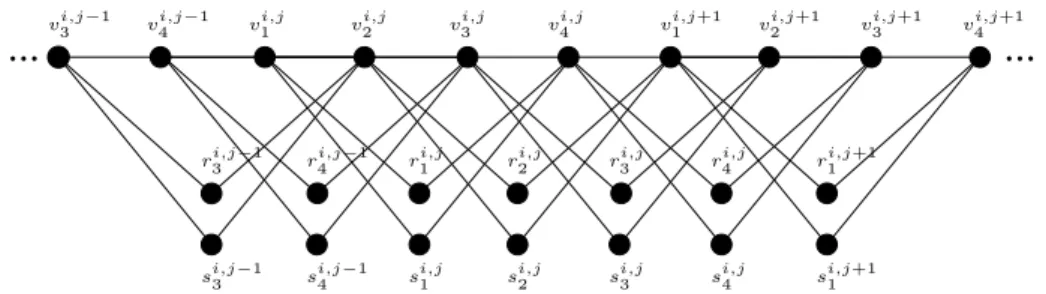
For each variable xi, 1 ≤ i ≤ n, we create a variable graph V Gi defined as follows (See
Figure 2.):
V (V Gi) = {vi,jk | 1 ≤ j ≤ m, 1 ≤ k ≤ 4} ∪ {ri,jk | 1 ≤ j ≤ m, 1 ≤ k ≤ 4}
∪{si,jk | 1 ≤ j ≤ m, 1 ≤ k ≤ 4}.
E(V Gi) = {vi,jk vi,jk+1| 1 ≤ j ≤ m, 1 ≤ k ≤ 3} ∪ {v4i,jvi,j+11 | 1 ≤ j ≤ m − 1}
∪{vi,jk ri,jk | 1 ≤ j ≤ m, 1 ≤ k ≤ 4} ∪ {vi,jk si,jk | 1 ≤ j ≤ m, 1 ≤ k ≤ 4} ∪{vi,j4 ri,j1 | 1 ≤ j ≤ m} ∪ {vi,j+1k r
i,j
k+1 | 1 ≤ j ≤ m − 1, 1 ≤ k ≤ 3}
∪{vi,j4 si,j1 | 1 ≤ j ≤ m} ∪ {vi,j+1k si,jk+1 | 1 ≤ j ≤ m − 1, 1 ≤ k ≤ 3}. For each clause Cj = l1∨ l2∨ l3, 1 ≤ j ≤ m, we create a clause graph CGj defined as
follows (See Figure 3.):
V (CGj) = {cj, bj1, bj2, bj3}
E(CGj) = {cjbj1, cjbj2, cjbj3}
Now, for each literal lk, 1 ≤ k ≤ 3, if lk is the non-negated variable xi, we identify bjk, cj
and bjk+1 (index k is taken modulo 3) with v1i,j, vi,j2 and v3i,j, respectively. Otherwise, if lk
8 J. Araujo & N. Cohen & F. Giroire & F. Havet
...
v...
i,j+1
1 vi,j+12 vi,j+13 vi,j+14
r1i,j+1 ri,j4 si,j4 si,j+11 ri,j3 si,j3 si,j2 ri,j2 vi,j4 v3i,j vi,j2 vi,j1 r1i,j si,j1 vi,j−13 vi,j−14 ri,j−13 r4i,j−1 si,j−13 si,j−14
Figure 2: The variable graph V Gi
bj2
bj1
cj
bj3
Figure 3: The clause graph CGj.
Let us first show that, if GI has a good edge-labelling φ, then there is a truth assignment
such that each clause of I has at least one true literal and at least one false literal. By Proposition 2, we may assume that φ is injective.
Claim 5.1 Let 1 ≤ i ≤ n. If φ(vi,11 v2i,1) < φ(vi,12 vi,13 ) then φ(vi,j1 vi,j2 ) < φ(v2i,jvi,j3 ) for all 1 ≤ j ≤ m.
Proof: By induction on j. A path of length two is necessarily increasing or decreasing. Now v1i,jis joined to vi,j4 by two paths of length two via r1i,jand si,j1 . Since φ is good, one of these two paths is increasing and the other one is decreasing. In addition, the path vi,j1 vi,j2 vi,j3 v4i,j
is neither increasing nor decreasing so φ(vi,j2 vi,j3 ) > φ(vi,j3 vi,j4 ).
Applying three times this reasoning, we derive φ(vi,j3 vi,j4 ) < φ(vi,j4 vi,j+11 ), φ(vi,j4 vi,j+11 ) > φ(vi,j+11 vi,j+12 ) and finally φ(vi,j+11 vi,j+12 ) < φ(v2i,j+1v3i,j+1). ¤ Hence we define the truth assignment Λ by Λ(xi) = true if φ(vi,11 v2i,1) < φ(vi,12 v3i,1) and
Λ(xi) = f alse otherwise.
Let us show that each clause Cj has at least one true literal or one false literal. Set
Cj = l1∨ l2∨ l3. First observe that, by construction, for all 1 ≤ k ≤ 3, lk is true if φ(bjkcj) <
φ(bjk+1cj) and l
kis false otherwise. Now the three literals are not all true otherwise, φ(bj1cj) <
φ(bj2cj) < φ(bj3cj) < φ(bj1cj), a contradiction. And they are not all false, otherwise φ(bj1cj) >
φ(bj2cj) > φ(bj
3cj) > φ(bj1cj), a contradiction. Hence Cj has at least one true literal and one
false literal.
Reciprocally, let us now show that, if there is a truth assignment Λ such that each clause of I has at least one true literal and at least one false literal, then GI has a good edge-labelling.
The idea is to find a good edge-labelling φ satisfying the following property (?): If Λ(xi) = true, φ(v1i,jv2i,j) < φ(vi,j2 v3i,j) for all 1 ≤ j ≤ m and if Λ(xi) = f alse, φ(v1i,jv2i,j) >
φ(vi,j2 vi,j3 ) for all 1 ≤ j ≤ m.
Let Cj= l1∨ l2∨ l3 be clause. To satisfy (?), we must label the edges of V Gj such that
φ(bjkcj) < φ(bj
k+1cj) if lk is true and φ(b j
kcj) > φ(b j
k+1cj) if lk is false. As Cj has at least
one true and one false literal, there is a unique way to label the three edges cjbj
k, 1 ≤ k ≤ 3,
with {−1, 0, +1} so that the condition (?) is fulfilled.
Let us now extend this edge-labelling to the remaining edges of each of the variable graphs V Gi. First, for all 1 ≤ j ≤ m and 1 ≤ k ≤ 4, assign −3 and +3 alternatively on
the edges of the cycle of length four containing both ri,jk and si,jk so that φ(vi,jk ri,jk ) = −3. Then, if Λ(xi) = true, set φ(vi,j3 , v4i,j) = −2 and φ(v4i,j, vi,j+11 ) = 2 for all 1 ≤ j ≤ m, and, if
Λ(xi) = f alse, set φ(v3i,j, vi,j4 ) = 2 and φ(vi,j4 , v1i,j+1) = −2 for all 1 ≤ j ≤ m.
We claim that φ is a good edge-labelling of GI. Suppose, by way of contradiction, that
there is a pair of vertices (x, y) such that two independent increasing (x, y)-paths P1and P2
exist.
A set of two independent paths starting at a vertex of R = {ri,jk | 1 ≤ j ≤ m, 1 ≤ k ≤ 4} ∪ {si,jk | 1 ≤ j ≤ m, 1 ≤ k ≤ 4} contains one increasing path (the one starting with
10 J. Araujo & N. Cohen & F. Giroire & F. Havet
the edge labelled −3) and one decreasing path (the one starting with the edge labelled 3). Hence x and y are not in R.
In addition, the union of P1and P2cannot be one of the four-cycles formed by the edges
incident to ri,jk and si,jk for some i,j and k.
Without loss of generality, we may assume that P1 is at least as long has P2. As cycles
formed by two graphs GVi and GVj are of length at least 6, P1 has length at least 3. Now
one can see that P1 may not contains any vertex of R because every path of length at least
3 with no end in R is not increasing (nor decreasing).
Hence P1must contain at least three consecutive edges on one of the paths Qi= V Gi−R.
So P1 is not increasing, a contradiction. ¤
Remark 6 A standard dynamic programming approach yields a polynomial-time algorithm to decide if a graph of bounded tree-width has a good edge-labelling. It suffices to store if there is a good edge-labelling such that the ordering of edge labels corresponds to a given order (for all possible orderings of edges in the bag (there are at most
³
k(k+1)
2
´
! of them). However, we do not know what is the complexity of the problem when restricted to planar graphs.
Problem 7 Does there exist a polynomial-time algorithm that decides if a given planar graph has a good edge-labelling?
5
Classes of good graphs
Recall that a graph G is critical if it is bad but each of its proper subgraph is good. To prove that every graph in a class C closed under subgraphs has a good edge-labelling, it suffices to prove that C contains no critical graph.
Lemma 8 Every critical graph is 2-connected.
Proof: Suppose by way of contradiction that a critical graph has a cut-vertex x. Let C1, . . . , Ck be the components of G − x and Gi= G[Ci∪ {x}], 1 ≤ i ≤ k. As G is critical,
each of the Giadmits a good edge-labelling. Then the union of these edge-labellings form a
good edge-labelling of G because there are two independent (u, v)-paths in G only if there exists i, 1 ≤ i ≤ k, so that u and v are in V (Gi). This contradicts the fact that G has no
good edge-labelling. ¤
Corollary 9 Every forest F admits a good edge-labelling.
Proof: No forest contains a non-trivial 2-connected subgraph, and so contains no critical
subgraph. ¤
Let G = (V, E) be a graph. An edge-2-cut of G is a set of two adjacent vertices u and v such that G − {u, v} has more connected components than G.
Lemma 10 Let G be a connected graph and {u, v} an edge-2-cut in G so that G − {u, v} has two connected components C1 and C2. If GhC1∪ {u, v}i and GhC2∪ {u, v}i have a good
edge-labelling then G has a good edge-labelling.
Proof: Let φ1and φ2 be good edge-labellings of GhC1∪ {u, v}i and GhC2∪ {u, v}i
respec-tively such that φ1(uv) = φ2(uv).
Then the union of φ1 and φ2 is a good edge-labellign of G. Indeed, suppose by way of
contradiction, that there exists x and y and two indepedent increasing (x, y)-paths P1 and
P2. W. l. o. g. , we may assume that x ∈ V (G1). At least of the path, say P1, contains at
least one edge e1 in E(G2) \ {uv} since φ1 is good.
Assume first that y ∈ V (G1). Then P1must go through u and v. Let Q2be the shortest
(u, v)-subpath of P containing e1. Then Q2 is either increasing or decreasing. Hence since
uv is both increasing and decreasing, there are either two increasing paths or two decreasing paths in G2. This contradicts the fact that φ2is good.
Assume now that y ∈ C2. Then since P1 and P2 are independent without loss of
gener-ality, P1 goes through u and P2 goes through v. Let Q1 be the (x, u)-subpath of P1, R1 be
the (u, y)-subpath of P1, let Q2be the (x, v)-subpath of P2 and R2be the (v, y)-subpath of
P2.
If φ(uv) is larger than the label of the last edge of Q1then R1uv and R2are two increasing
paths in G1, a contradiction. If not φ(uv) is smaller than the abel of the first edge of R1
and vuR1and R2are two increasing paths in G2, a contradiction.
¤ Let G = (V, E) be a graph. An edge-cut is a set of edge between a set of vertices S and its complement S. Formally, for any S ⊂ V , the edge-cut [S, S] is the set {uv ∈ E | u ∈ S and v ∈ S). An edge cut which is also a matching is called a matching-cut.
Lemma 11 Let G be a graph and [S, S] a matching-cut in G. If GhSi and GhSi have a good edge-labelling then G has a good edge-labelling.
Proof: Let φ1be a good edge-labelling of GhSi and φ2be a good edge-labelling of GhSi (in
R). Then the edge-labelling φ of G defined by φ(e) = φ1(e) if e ∈ E(GhSi), φ(e) = φ2(e) if
e ∈ E(GhSi) and φ(e) = +∞ if e ∈ [S, S] is good.
Indeed, suppose by way of contradiction, that it is not good. Then there exist two vertices u and v and two independent increasing (u, v)-paths P1 and P2. Since φ1 and φ2
are good, then without loss of generality, we may assume that u ∈ S and v ∈ S. For i = 1, 2 Pi contains an edge of viwi in [S, S]. Now as v1w1 and v2w2 are labelled +∞ and incident
to no edges labelled +∞, v1w1 must be the last edge of P1and v2w2the last edge of P2. So
12 J. Araujo & N. Cohen & F. Giroire & F. Havet
Corollary 12 A critical graph has no matching-cut.
Corollary 13 Every C3-free outerplanar graph admits a good edge-labelling.
Proof: An easy result of Eaton and Hull [5] states that a C3-free outerplanar graph has
either a 1-vertex or two adjacent 2-vertices. This implies that it has a matching-cut. Hence by Corollary 12 no C3-free outerplanar graph is critical, which yields the result. ¤
A graph is subcubic if every vertex has degree at most three.
Lemma 14 Every subcubic {C3, K2,3}-free graph has a matching cut.
Proof: Let G be a subcubic graph {C3, K2,3}. If G has no cycle, then every edge forms a
matching-cut. Suppose now that G has a cycle. Let C be a cycle of smallest length in G. If C is a connected component of G (in particular if C = G) then any pair of non-adjacent edges of C form a matching-cut.
If not, let us show that [V (C), V (C)] is a matching cut. Let e1= x1y1 and e2= x2y2 be
two distinct edges in this set with x1, x2∈ V (C). Then x16= x2 because these two vertices
have degree (at most) 3 and two neighbours in V (C). Suppose by way of contradiction that y1= y2. Then x1 and x2 are not adjacent since G is C3-free. Furthermore, there the
two (x1, x2)-paths along C are of length at most 2 otherwise C would not be a smallest
cycle. Hence C is a cycle of length 4 and the graph induced by V (C) ∪ {y1} is a K2,3, a
contradiction. ¤
Corollary 12 and Lemma 14 immediately implies that the sole subcubic critical graphs are C3 and K2,3.
Corollary 15 Every subcubic {C3, K2,3}-free graph has a good edge-labelling.
Farley and Proskurowski [6] proved that every (multi)graph G on n vertices with less than 3
2(n − 1) edges has a matching-cut.
Theorem 16 (Farley and Proskurowski [6]) Let G be a multigraph. If |E(G)| < 3
2|V (G)|− 3
2 then G has a matching-cut.
Corollary 12 and Theorem 16 yield immediately the following.
Corollary 17 Every critical graph has at least§3
2|V (G)| −32
¨ edges.
Corollary 18 Every planar graph of girth at least 6 has a good edge-labelling. Proof: It is well known that a planar graph G with girth at least 6 has at most 3
2|V (G)| − 3
edges. Indeed, recall the Euler’s formula for a connected planar graph G: |V (G)| − |E(G)| + |F (G)| = 2, with |F (G)| the number of faces of G. Now, as G has girth at least 6, 6|F (G)| ≤ 2|E(G)|. Thus 12 − 6|V (G)| + 6|E(G)| = 6|F (G)| ≤ 2|E(G)|. Hence |E(G)| ≤ 3
2|V (G)| − 3.
Thus no planar graph of girth 6 is critical by Corollary 17. ¤
6
Good edge-labelling of ABC-graphs
Corollary 17 states that every critical graph has at least§3
2(|V (G)| − 1)
¨
edges. This is tight since if G is C3 or K2,3 then |E(G)| =
§3
2(|V (G)| − 1)
¨
. We will now show that those two graphs are the unique critical ones satisfying this equality.
Farley and Proskurowski [6] constructed a class of multigraphs G called ABC-graphs with no matching-cut having§3
2(|V (G)| − 1)
¨
edges. The definition of ABC-graphs is based on the following three operations:
An A-operation on vertex u introduces vertices v and w and edges uv, uw and vw.
A B-operation on edge uv introduces vertices w1and w2 and edges uw1, vw1, uw2and
vw2, and removes edge uv.
A C-operation on vertices u and v (u = v is allowed) introduces vertex w and edges uw and vw.
Note that the C-operation is the only operation that can introduce parallel edges. An ABC-graph is a graph that can be obtained from K1 with a sequence of A- and
B-operations and at most one C-operation.
It is easy to check that ABC-graphs have no matching-cut. In addition, solving a conjec-ture of Farley and Proskurowski [6], Bonsma [3, 4] showed that they are the unique extremal examples, i.e., satisfying |E(G)| =§3
2(|V (G)| − 1)
¨ .
Theorem 19 (Bonsma [3, 4]) Let G be a graph with such that |E(G)| =§3
2(|V (G)| − 1)
¨ . Then G has no matching-cut if and only if G is an ABC-graph.
Observe that the C-operation is the only one that changes the parity of the order. Hence an ABC-graph with an odd number of vertices is obtained from K1 with a sequence of
A-and B-operations A-and no C-operation.
Proposition 20 Let G be a graph obtained from a graph H by a B-operation on some edge uv. If H has a good edge-labelling then G has a good edge-labelling.
Proof: Let φ be a good edge-labelling of H. By Proposition 2, we may assume that φ is injective. Moreover, we may assume that φ is integer-valued and φ(uv) = 0. Hence setting φ(uw1) = φ(w2v) = 12 and φ(uw2) = φ(xw1) = −12, we obtain a good edge-labelling of G.
¤
Lemma 21 Let G be a 2-connected ABC-graph with an odd number of vertices. If G /∈ {C3, K2,3} then G has a good edge-labelling.
Proof: As every A-operation (with the exception of the transition K1 → C3) creates a
14 J. Araujo & N. Cohen & F. Giroire & F. Havet
C3 at any edge creates a K2,3 and a B-operation on K2,3 at any edge creates the graph G1
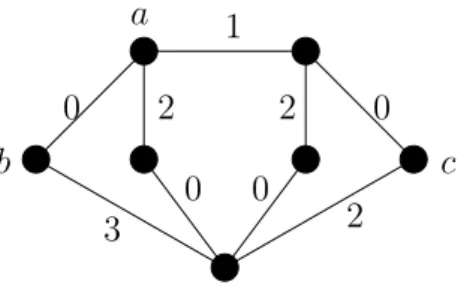
depicted in Figure 4. Now this graph admits a good edge-labelling (See Figure 4). Hence an easy induction and Proposition 20 implies the result because if G /∈ {C3, K2,3} then it is
obtained from G1 with a sequence of B-operations. ¤
1
0
c
a
3
0
2
2
0
0
2
b
Figure 4: The graph G1 and a good edge-labelling
Corollary 22 Let G be an ABC-graph with an odd number of vertices. If G is {C3, K2,3
}-free then G is good.
We now would like to prove an analogous statement to the one of Corollary 22 but for ABC-graphs with an even number of vertices.
Let G be a graph and x, y be two distinct vertices of G. An (x, y)-better edge-labelling of G is an good edge-labelling of G such that there is no increasing (x, y)-path. Clearly, if x and y are adjacent or if x and y have two neighbours in common then G has no (x, y)-better edge labelling. A graph is friendly if it has a good-edge labelling and for any pair (x, y) of non-adjacent vertices with at most one neighbour in common there exists an (x, y)-better edge-labelling.
Proposition 23 Let G be a graph obtained from a graph H by a B-operation on some edge uv. If H is friendly then G is friendly.
Proof: Let w1, w2 be the vertices created by the B-operation. Let x and y be two
non-adjacent vertices of G having at most one neighbour in common. Then |{x, y}∩{w1, w2}| ≤ 1.
Suppose first that {x, y} ∩ {w1, w2} = ∅. Then x and y are not adjacent in H.
Assume first that they have at most one commom neighbour in H. Let φ be an integer-valued (x, y)-better edge-labelling of H such that φ(uv) = 0. Setting φ(uw1) =
φ(w2v) = 12 and φ(uw2) = φ(vw1) = −12, we obtain an (x, y)-better edge-labelling of
H.
Assume now that x and y have two common neighbours in H. As they do not have two common neighbours in G, we can suppose w.l.o.g. that x = u and N (x)∩N (y) = {v, w}
for some vertex w. Let φ be a good edge-labelling of H. By Proposition 2, we may assume that φ is integer-valued and φ(uv) = 0. Moreover, free to consider −φ, we may assume that φ(vy) > 0, so uvy is increasing. Hence in H \ uv there is no increasing (u, y)-path. Moreover there is no increasing (u, v)-path (resp. increasing (v, u)-path) in H \ uv, otherwise there would be two such paths on H because uv (resp. vu) is an increasing path of H. Hence setting φ(uw1) = φ(w2v) = +∞ and
φ(uw2) = φ(xw1) = −∞, we obtain an (x, y)-better edge-labelling of H.
Suppose now that |{x, y} ∩ {w1, w2}| = 1. Without loss of generality, we may assume
that x = w1and y is not adjacent to v.
Assume first that v and y have at most one common neighbour in H. Let φ be a (v, y)-better edge-labelling of H. Then in H \ uv, there is no increasing (u, v)-path nor increasing (v, u)-path. Hence setting φ(uw1) = φ(w2v) = +∞ and φ(uw2) =
φ(xw1) = −∞, we obtain an (w1, y)-better edge-labelling of H. Indeed there is no
incresing (w1, y)-path, through u since φ(uw1) = +∞, nor through v since there is no
increasing (v, y)-path in H.
Assume now that v and y have two common neighbours in H.
– Suppose that y is adjacent to u. Let φ be a good edge-labelling of H. By Proposition 2, we may assume that φ is injective and integer-valued and φ(uv) = 0.
Setting φ(uw1) = φ(w2v) = 12 and φ(uw2) = φ(xw1) = −12, we obtain a a
(w1, y)-better edge-labelling of H. In addition, free to consider −φ, we may
assume that φ(uy) < 0 and so φ(uy) ≤ −1. Setting φ(uw1) = φ(w2v) = −12 and
φ(uw2) = φ(vw1) = 12, we obtain a (w1, y)-better edge-labelling of H. Indeed
suppose for a contradiction that there is a (w1, y)-increasing path P :
* If u is the second vertex of P then P − u is an increasing (u, y). Since φ(uy) ≤ −1, P is not uy. So there are two increasing (u, y)-paths in H a contradiction.
* If v is the second vertex of P then the path in H obtained from P by replacing w1 with u is an increasing (u, y)-path because the labels of the
edges of P are positive. This path is distinct from uy, a contradiction.
– Suppose that y is not adjacent to u. Let t1and t2be the two common neighbours
of v and y. Let φ be a good edge-labelling of H. By Proposition 2, we may assume that φ is injective and integer-valued and φ(uv) = 0. Moreover, without loss of generality, we may assume that vt1y is increasing and vt2y is decreasing. In
addition, free to consider −φ, we may assume that φ(vt1) < 0 and so φ(vt1) ≤
−1. Setting φ(uw1) = φ(w2v) = 12 and φ(uw2) = φ(xw1) = −12, we obtain a
(w1, y)-better edge-labelling of H. Indeed suppose for a contradiction that there
16 J. Araujo & N. Cohen & F. Giroire & F. Havet
* If v is the second vertex of P then P − w1 is an increasing (v, y). Since
φ(vt1) ≤ −1, P is not vt1y. So there are two increasing (v, t)-path in H a
contradiction.
* If u is the second vertex of P then the path in H obtained from P by replacing w1 with v is an increasing (v, y)-path because the labels of the
edges of P are positive. This path is distinct from vt1y, a contradiction.
¤ One can now generalise Lemma 21.
Lemma 24 Let G be a 2-connected ABC-graph with an odd number of vertices. If G /∈ {C3, K2,3} then G is friendly.
Proof: Similarly as in the proof of Lemma 21, it suffices to prove that G1 is friendly. Then
an easy induction and Proposition 23 yield the result.
Let x and y be two vertices of G1 that are not adjacent and that have at most one
neighbour in common, and let φ be the labelling of G1 given in Figure 4 : φ or −φ is a
(x, y)-better edge labelling. ¤
Corollary 25 Every {C3, K2,3}-free ABC-graph with an odd number of vertices is friendly.
Proof: Let x and y be two non-adjacent vertices of G having at most one common neighbour. Assume first that x and y are in a same connected 2-component C. By Lemma 24, C has an (x, y)-better labelling and, by Corollary 22, G \ E(C) has a good edge-labelling. The union of these two edge-labellings is clearly an (x, y)-better labelling of G.
Suppose now that the 2-connected components containing x do not contain y. Let G1 be the graph induced by the union of the 2-connected components containing x and
G2= G \ E(G1). By Corollary 22, the two graphs G1 and G2 admit good edge-labellings
φ1 and φ2, respectively. Free to add a huge number to all the labels of φ1, we may assume
that min{φ1(e) | e ∈ E(G1)} > max{φ2(e) | e ∈ E(G2)}. Then the union of φ1 and φ2 is
an (x, y)-better labelling of G. ¤
Lemma 26 Let G be an ABC-graph with an even number of vertices. If G is {C3, K2,3}-free
then G is good.
Proof: We prove this lemma by induction on the number of vertices (or equivalently the number of A-, B- or C-operations). An even ABC-graph is obtained from K1with a sequence
of A- and B-operations and exactly one C-operation. If G is not 2-connected then we get the result as in the proof of Lemma 8. So we may assume that G is 2-connected. In this case there can be no A-operation made after a C-operation. Consider a sequence of operations such that the C-operation is done as late as possible.
If the C-operation is the ultimate one, say it is done on u and v, and introduces w. Note that u 6= v since G has no multiple edges. Since G is {C3, K2,3}-free then u and v are not
adjacent and u and v have at most one neighbour in common. Hence by Corollary 25, G − w admits a (u, v)-better edge-labelling φ (in R). Setting φ(uw) = −∞ and φ(wv) = +∞ we obtain a good edge-labelling of G.
If the C-operation is the penultimate one, then it is followed by a B-operation on one of the introduced edges. These two operations together may be seen as a single one on u and v that introduces the vertices t1, t2and w and the edges ut1, ut2, t1w, t2w and wv.
Note that u and v are not adjacent since G is K2,3-free. Assume first that u and v have
at most one neighbour in common. By Corollary 25, G − {t1, t2, w} admits a (u, v)-better
edge-labelling φ. Let M be the maximum value of φ. Then setting φ(ut1) = φ(t2w) = −∞,
φ(ut2) = φ(t1w) = M + 1 and φ(vw) = M + 2, we obtain a good edge-labelling of G.
Assume now that u and v have at least two common neighbours. Since G is K2,3
-free, then u and v have exactly two common neighbours x1 and x2. By Corollary 22,
G − {t1, t2, w} admits a good edge-labelling φ. By Proposition 2, we may assume that φ
is injective. Without loss of generality, we may suppose that φ(vx1) > φ(vx2). Let us set
φ(ut1) = φ(t2w) = +∞, φ(ut2) = φ(t1ww) = −∞ and φ(vw) = 12(φ(vx1) + φ(vx2)). We
claim that φ is a good edge-labelling of G. Indeed suppose, by way of contradiction, that it is not the case. Then there exist two vertices a and b and two independent increasing (a, b)-paths P1 and P2. Since φ is a good edge-labelling of G − {t1, t2, w} one of these two
paths, say P1 must go through w. Moreover since φ(t1w) = −∞ and φ(t2w) = +∞ w, and
d(w) = 3, then either wt1is the first edge of P1or t2w is the last edge of P1. Free to consider
−φ instead of φ, we may assume that we are in the first case. So P1= (w, t1, u), because
φ(ut1) = +∞. Now the first edge of P2is wv. Hence Q2= P2−w is an increasing (v, u)-path
and vx2is not the first edge of Q2since φ(wv) > φ(vx2). Note that by Observation 3.1, vx2u
is increasing because φ(vx1) > φ(vx2). So, in G−{t1, t2, w}, there are two distinct increasing
(v, u)-paths. This contradicts the fact that φ is a good edge-labelling of G − {t1, t2, w}.
If there are exactly two B-operations after the C-operation, and if u and v are not adjacent then by the induction hypothesis and Proposition 20, G has a good edge-labelling. If u and v are adjacent, then uv is an edge-2-cut. Let C1be the component of G − {u, v} containing
w (i.e., the set of vertices added with the C-operations and the following B-operations). Let G1 = GhC1∪ {u, v}i and G2 = GhV (G) \ C1i. Note that G1 is obtained from a triangle
by performing two B-operations and thus is the graph G1 depicted Figure 4 which has a
good edge-labelling. Similarly, G2 is the graph G taken before peforming the C-operation,
is so{C3, K2,3}-free and by Corollary 22 has a good edge-labelling. Hence by Lemma 10, G
has a good edge-labelling.
If there are at least three B-operations after the C-operation, then by the induction hypothesis and Lemma 20, G has a good edge-labelling. ¤
Corollary 22 and Lemma 26 immediately yield the following.
18 J. Araujo & N. Cohen & F. Giroire & F. Havet
7
Conclusions and further research
The average degree of a graph G is Ad(G) =
P
v∈V (G)d(v)
|V (G)| =
2|E(G)|
|V (G)|
Theorem 27 implies that for any c < 3 there is a finite number of critical graphs with average degree at most c. Actually, we conjecture that the only ones are C3 and K2,3.
Conjecture 28 Let G be a critical graph. Then Ad(G) ≥ 3 unless G ∈ {C3, K2,3}.
More generally for any c < 4, we conjecture the following.
Conjecture 29 For any c < 4, there exists a finite list of graphs L such that if G is a critical graph with Ad(G) ≤ c then G ∈ L.
The constant 4 in the above conjecture would be tight. Indeed, for all k, the graph J2,2,k
defined in Section 3 is critical: it is bad according to Proposition 4. Moreover one can easily show that for any edge e, Hk\ e has a good edge-labelling with no (u, v)-increasing path and
no (v, u)-increasing (just follow the constraint as in the proof of Proposition 3). Extending this labelling by labelling the two H2with −∞ and +∞ so that one of them is an increasing
(u, v)-path and the other one an increasing (v, u)-path we obtain a good edge-labelling of J2,2,k\ e. Furthermore Ad(J2,2,k) = 8k+82k+4= 4 − k+24 . Last, one can easily see that if k 6= k0
then J2,2,k is not a subgraph of J2,2,k0.
Theorem 27 says that if a graph has no dense subgraphs then it has a good edge-labelling. On the opposite direction one may wonder what is the minimum density ensuring a graph to be bad. Or equivalently,
Problem 30 What is the maximum number g(n) of edges of a good graph on n vertices? Clearly we have g(n) = ex(n, C) where C is the set of critical graphs. As K2,3 is critical
then g(n) ≤ ex(n, K2,3) =√12n3/2+ O(n4/3) by a result of F¨uredi [7].
The hypercubes show that g is super-linear. Indeed the hypercube Hk is obtained from
two disjoints copies of Hk−1 by adding a perfect matching between them. Hence an easy
induction and Lemma 11 shows that Hkhas a good edge-labelling. Since Hk has 2k vertices
and 2k−1k edges, g(2k) ≥ 2k−1k, so g(n) ≥ 1 2n log n.
References
[1] Bala, K., and Stern, T. Algorithms for routing in a linear lightwave network. In IEEE INFOCOM’91. Proceedings. Tenth Annual Joint Conference of the IEEE Com-puter and Communications Societies. Networking in the 90s. (1991), pp. 1–9.
[2] Bermond, J.-C., Cosnard, M., and P´erennes, S. Directed acyclic graphs with unique path property. Tech. Rep. RR-6932, INRIA, May 2009.
[3] Bonsma, P. A characterization of extremal graphs with no matching-cut. In Pro-ceedings of the European conference on combinatorics, graph theory and applications (EuroComb 05) (Nancy, 2005), Discrete Mathematics and Theoretical Computer Sci-ence Proceedings AE, pp. 135–138.
[4] Bonsma, P. A characterization of extremal graphs with no matching-cut. Tech. Rep. Memorandum 1769, University of Twente, 2005.
[5] Eaton, N., and Hull, T. Defective list colorings of planar graphs. Bull. Inst. Combin. Appl 25 (1999), 79–87.
[6] Farley, A., and Proskurowski, A. Extremal graphs with no disconnecting match-ing. In Proceedings of the second West Coast conference on combinatorics, graph theory, and computing (1984), pp. 153–165.
[7] F¨uredi, Z. New asymptotics for bipartite Tur´an numbers. J. Combin. Theory Ser. A 75, 1 (1996), 141–144.
[8] Mukherjee, B. Optical communication networks. McGraw-Hill New York, 1997.
[9] Ramaswami, R., and Sivarajan, K. Routing and wavelength assignment in all-optical networks. IEEE/ACM Transactions on Networking (TON) 3, 5 (1995), 489– 500.
[10] Schaefer, T. J. The complexity of satisfiability problems. In STOC ’78: Proceedings of the tenth annual ACM symposium on Theory of computing (New York, NY, USA, 1978), ACM, pp. 216–226.
Unité de recherche INRIA Sophia Antipolis
2004, route des Lucioles - BP 93 - 06902 Sophia Antipolis Cedex (France)
Unité de recherche INRIA Futurs : Parc Club Orsay Université - ZAC des Vignes 4, rue Jacques Monod - 91893 ORSAY Cedex (France)
Unité de recherche INRIA Lorraine : LORIA, Technopôle de Nancy-Brabois - Campus scientifique 615, rue du Jardin Botanique - BP 101 - 54602 Villers-lès-Nancy Cedex (France)
Unité de recherche INRIA Rennes : IRISA, Campus universitaire de Beaulieu - 35042 Rennes Cedex (France) Unité de recherche INRIA Rhône-Alpes : 655, avenue de l’Europe - 38334 Montbonnot Saint-Ismier (France) Unité de recherche INRIA Rocquencourt : Domaine de Voluceau - Rocquencourt - BP 105 - 78153 Le Chesnay Cedex (France)
Éditeur
INRIA - Domaine de Voluceau - Rocquencourt, BP 105 - 78153 Le Chesnay Cedex (France)
http://www.inria.fr ISSN 0249-6399