HAL Id: cea-02431800
https://hal-cea.archives-ouvertes.fr/cea-02431800
Submitted on 19 Feb 2020HAL is a multi-disciplinary open access archive for the deposit and dissemination of sci-entific research documents, whether they are pub-lished or not. The documents may come from teaching and research institutions in France or abroad, or from public or private research centers.
L’archive ouverte pluridisciplinaire HAL, est destinée au dépôt et à la diffusion de documents scientifiques de niveau recherche, publiés ou non, émanant des établissements d’enseignement et de recherche français ou étrangers, des laboratoires publics ou privés.
Investigation of single pit propagation on 316L stainless
steel
S. Heurtault, R. Robin, F. Rouillard, V. Vivier
To cite this version:
S. Heurtault, R. Robin, F. Rouillard, V. Vivier. Investigation of single pit propagation on 316L stainless steel. NACE CORROSION 2016, Mar 2016, Vancouver, Canada. �cea-02431800�
NACE 2016- Vancouver- Canada
Investigation of single pit propagation on 316L stainless steel
Stephane Heurtault,a,b Raphaël Robin,b Fabien Rouillard,b Vincent Viviera,*a LISE-CNRS-UMR 8235, Université Pierre et Marie Curie, Paris, France b LECNA – CEA, DEN, DPC, SCCME, Gif-sur-Yvette, France
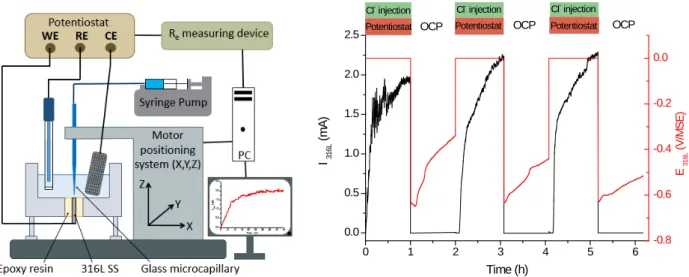
Pitting corrosion of stainless steel in chloride electrolyte is difficult to study experimentally since it results in a random succession of single or multiple events at the metal surface. To overcome these difficulties, a flow microdevice allowing the formation of a single pit at a given location on the alloy surface has been developed1. This electrochemical setup consists of a glass microcapillary connected to a syringe filled with chloride solution (Fig. 1 - left) permitting to finely control the amount of chloride ions in the vicinity of the pit.
This work aims at bringing new insight on the pit propagation description on 316L stainless steel. In a first step, the propagation phase is investigated and a particular attention is paid to the description of both radial and deep evolutions2. The use of different characterizing techniques, such as optical and SEM observations, Electrochemical Impedance Spectroscopy, Raman Microspectroscopy, and ICP analyses of the electrolytic solution, permitted to highlight the influences of the applied potential, the temperature of the electrolyte, the solution chemistry and the amount of chloride ions released. Then in the case of a pit repassivation, the possibilities to restart the propagation as a function of Cl- supply and applied potential are investigated since the experimental device permits to perform pitting cycles on a single pit (Fig. 1 – right).
Figure 1: Electrochemical device developed for generating a single pit (left) and example of alterning the propagation and repassivation by opening the circuit and stopping the Cl- injection for
a single pit generated with the setup (right).
[1] N. Aouina, F. Balbaud-Celerier, F. Huet, S. Joiret, H. Perrot, F. Rouillard, V. Vivier, A flow microdevice for studying the initiation and propagation of a single pit, Corrosion Science 62 (2012) 1- 4. [2] S. Heurtault, R. Robin, F. Rouillard, V. Vivier, Initiation and propagation of a single pit on stainless steel using a local probe technique, Faraday Discussions 180 (2015) 267-282.
Keywords: pitting corrosion, local electrochemistry, single event, cycle.
0 1 2 3 4 5 6 0.0 0.5 1.0 1.5 2.0
2.5 OCP OCP OCP
I 316L
(
mA
)
Time (h)
Potentiostat Potentiostat Potentiostat
Cl injection Cl injection Cl injection -0.8 -0.6 -0.4 -0.2 0.0 E 316L ( V/ M SE)