HAL Id: inria-00070259
https://hal.inria.fr/inria-00070259
Submitted on 19 May 2006
HAL is a multi-disciplinary open access
archive for the deposit and dissemination of
sci-entific research documents, whether they are
pub-lished or not. The documents may come from
teaching and research institutions in France or
abroad, or from public or private research centers.
L’archive ouverte pluridisciplinaire HAL, est
destinée au dépôt et à la diffusion de documents
scientifiques de niveau recherche, publiés ou non,
émanant des établissements d’enseignement et de
recherche français ou étrangers, des laboratoires
publics ou privés.
Improper colouring of (random) unit disk graphs
Ross J. Kang, Tobias Müller, Jean-Sébastien Sereni
To cite this version:
Ross J. Kang, Tobias Müller, Jean-Sébastien Sereni. Improper colouring of (random) unit disk graphs.
[Research Report] RR-5761, INRIA. 2005, pp.18. �inria-00070259�
ISRN INRIA/RR--5761--FR+ENG
a p p o r t
d e r e c h e r c h e
Thème COM
Improper colouring of (random) unit disk graphs
Ross J. Kang — Tobias Müller — Jean-Sébastien Sereni
N° 5761
Ross J. Kang
∗, Tobias Müller
†, Jean-Sébastien Sereni
‡Thème COM — Systèmes communicants Projets Mascotte
Rapport de recherche n° 5761 — Novembre 2005 — 18 pages
Abstract: For any graph G, the k-improper chromatic number χk(G) is the smallest number
of colours used in a colouring of G such that each colour class induces a subgraph of maximum degree k. We investigate the ratio of the k-improper chromatic number to the clique number for unit disk graphs and random unit disk graphs to generalise results of [11, 8] and [10] where only proper colouring was considered.
Key-words: improper colouring, unit disk graph, random graph, chromatic number, radio channel assignment, clique number
This work was partially supported by Région Provence-Alpes-Côte D’Azur.
∗This author is partially supported by NSERC of Canada and the Commonwealth Scholarship
Commis-sion (UK). E-mail: [email protected].
† This author is partially supported by EPSRC, the Department of Statistics, Bekker-la-Bastide
fonds, Dr. Hendrik Muller’s Vaderlandsch fonds, and Prins Bernhard Cultuurfonds. E-mail: [email protected].
‡ This author is partially supported by the European project FET-CRESCCO. E-mail:
Coloration impropre des graphes (aléatoires)
d’intersection de disques unitaires
Résumé : Pour tout graphe G, le nombre chromatique k-impropre est le plus petit nombre de couleurs nécessaires pour colorer les sommets de G de sorte que chaque classe de couleur induise un sous-graphe de degré maximum au plus k. Nous étudions le rapport entre le nombre chromatique k-impropre et la taille d’une plus grande clique pour les graphes d’intersection de disques unitaires et les graphes aléatoires d’intersection de disques unitaires. Nos résultats généralisent des résultats précédents concernant la coloration propre [11, 8, 10]. Mots-clés : coloration impropre, graphe d’intersection de disques, graphe aléatoire, nombre chromatique, assignation de fréquences, clique
1
Introduction
Given a set V of points in the plane and a distance threshold r > 0, we let G(V, r) denote the following graph. The vertex set is V and distinct vertices are joined by an edge whenever the Euclidean distance between them is less than r. Any graph isomorphic to such a graph is called a unit disk graph. The study of the class of unit disk graphs stems partly from applications in communication networks. In particular, the problem of finding a proper vertex-colouring – in which the vertices of a graph are coloured so that adjacent vertices do not receive the same colour – of a given unit disk graph is closely associated with the so-called frequency allocation problem [2]. Consult [6] for a more general treatment of this important problem.
[11, 8, 10] and [12] investigated the chromatic number χ for unit disk graphs in two related cases. The first case is the asymptotic limit of χ where V is countably infinite and the distance threshold r approaches infinity: for countable sets V with finite upper density, the ratio of chromatic number over clique number approaches 2√3/π as r → ∞ [11]. The second case is the asymptotic behaviour of χ for unit disk graphs based on randomly chosen points in the plane (where the distance threshold r approaches 0 as the number of points n approaches infinity). The papers [8, 10] establish almost sure (and in probability) convergence results for these random instances of unit disk graphs.
In this paper, we are also interested in vertex colourings of unit disk graphs; however, we partially relax the condition that any two vertices with the same colour may not be adjacent. Recall that, given an arbitrary colouring, a colour class is a set of vertices all assigned the same colour. Given k ≥ 0, we say that a graph is k-improper colourable if there is a colouring in which each colour class induces a subgraph with maximum degree at most k. We wish to find the minimum number χk of colours used in such a colouring. Note that
proper colouring is just 0-improper colouring and hence χ = χ0. Our aim, in this paper, is
to determine χk for unit disk graphs in the two cases mentioned above.
The problem of k-improperly colouring unit disk graphs arises in practice for instance when modelling certain satellite communications problems. More precisely, Alcatel Indus-tries proposed the following problem: a satellite sends information to receivers on earth, each of which listens on a frequency. Technically, it is impossible to focus the signal sent by the satellite exactly on a receiver, so part of the signal is spread in an area around it creating noise for other receivers nearby and listening on the same frequency. A receiver is able to distinguish the signal directed to it from the noise it picks up if the sum of the noise does not exceed a certain threshold T . The problem is to assign frequency to the receivers in such a way that each receiver can obtain its dedicated signal properly. We consider the fundamental case where the noise areas at receivers are disks and where the “noise relation” is symmetric (that is, if a receiver u is in the noise area of a receiver v, then v is in the noise area of u). We assume that the radius r of a disk and the intensity I of the noise created by a signal are independent of the frequency and the receiver. Hence, to distinguish its signal from noises, a receiver must be in the noise area of at most k = bT/Ic receivers listening on the same frequency. We define a noise graph: the vertices are the receivers and we put an edge between u and v if u is in the noise area of v (and hence v in the noise area of u). Note
4 Kang, Müller & Sereni
that, according to the assumptions, the noise graph is a unit disk graph. The frequencies are represented by colours, so a valid assignment of frequencies to receivers is represented by a k-improper colouring and we aim to minimise the portion of radio spectrum used, i.e. find χk. The reader can refer to [4, 5] for further study of this problem.
Before going further, we must review and introduce some basic terminology and proper-ties. We denote the maximum degree of G by ∆(G). A clique is a set of pairwise adjacent vertices; the clique number ω(G) is the maximum number of vertices in a clique of G. An in-dependent set is a set of pairwise non-adjacent vertices; the independence number α(G) is the maximum number of vertices in an independent set of G. Recall that |V (G)|/α(G) ≤ χ(G). An analogous lower bound on χk(G) is as follows. A k-dependent set is a set of vertices
whose induced subgraph has maximum degree at most k; the k-dependence number αk(G)
is the maximum number of vertices in a k-dependent set of G. Proposition 1 For any graph G and k ≥ 0, χk(G) ≥ |V (G)|/αk(G)
We leave the straightforward proof to the reader. Also recall that ω(G) ≤ χ(G) ≤ ∆(G) + 1 for any graph G. The following proposition shows that these bounds generalise to χk(G) in an appropriate sense (recalling that ω(G) ≤ χ(G)):
Proposition 2 For any graph G and k ≥ 0, lχ(G)k+1
m
≤ χk(G) ≤l∆(G)+1 k+1
m .
The second inequality is a corollary of a result due to Lovász [7]. To see that the first inequality holds, note that any colour class in a k-improper colouring induces a subgraph of maximum degree at most k and hence can be partitioned into k + 1 independent sets.
Under the asymptotic models of unit disk graphs considered in this paper the lower bound in Proposition 2 more or less gives the right answer. We will see that in both models (k + 1)χk approaches χ (in an appropriate sense, with some small exceptions). We mention
here that under the standard asymptotic model for general graphs, i.e. the Erdős-Rényi G(n, p) random graph model, there is qualitatively different behaviour. The perhaps rather counterintuitive result that, for k = o(ln n) and p fixed, χk(G(n, p))/χ(G(n, p)) → 1 almost
surely as n → ∞ has been proved [9] (recall that if Z, Z1, Z2, . . . are random variables then
we say that Zn tends to Z almost surely if P(Zn→ Z) = 1).
We note that the clique number of a unit disk graph can be found in polynomial time by means of an O(n4.5) algorithm [1] and even when an explicit representation in the plane
is not available [16]. In contrast, the problem of finding the chromatic number of unit disk graphs is NP-complete [1]. Recent work [3] shows that the same holds for the k-improper chromatic number χk, for any fixed k. Furthermore, by the above two propositions and
since ∆(G) ≤ 6ω − 6 for any unit disk graph G (to see this, consider that each π/3-sector of a unit disk induces a clique), we have a heuristic for χk with approximation ratio 6. Except
for the case k = 0 (where [13] gives a 3-approximation), 6 is the best known approximation ratio for χk.
The paper is divided as follows. In Sections 2 and 3, we consider the extensions of [11], stating definitions and results, then later giving some indication to the proofs. Similarly,
in Sections 4 and 5, we analyse improper colouring for random geometric graphs to extend results of [8] and [10].
2
Asymptotically, improperly colouring unit disk graphs
This section discusses our extensions of [11]. Let V be any countable set of points in the plane. For x > 0, let f (x) be the supremum of the ratio |V ∩ S|/x2 over all open (x × x)
squares S with sides aligned with the axes. The upper density of V is σ+(V ) = inf
x>0f (x).
Theorem 1 ([11]) Let V be a countable non-empty set of points in the plane with upper density σ+(V ) = σ. Then ω(G(V, r))/r2≥ σπ/4 and χ(G(V, r))/r2≥ σ√3/2 for any r > 0;
and, as r → ∞, we have ∆(G(V, r))/r2→ σπ, ω(G(V, r))/r2→ σπ/4 and χ(G(V, r))/r2→ σ√3/2.
Note that 2√3/π ≈ 1.103. We extend this theorem as follows.
Theorem 2 Let V be a countable non-empty set of points in the plane with upper density σ+(V ) = σ. Then χk(G(V, r))/r2 ≥ σ
√ 3/2
k+1 for any r > 0 and, as r → ∞, we have
(k + 1)χk(G(V, r))/r2→ σ√3/2 if k = o(r).
In particular the following holds:
Corollary 1 Let V ⊆ R2 be a set with upper density 0 < σ < ∞ and suppose k satisfies
k = o(r). Then
(k + 1)χk(G(V, r))
χ(G(V, r)) → 1, as r → ∞.
It also holds that, for any countable set V of points in the plane with finite positive upper density, the ratio of χk(G(V, r)) to ω(G(V, r))/(k + 1) tends to 2√3/π as r approaches
infinity. We have allowed k to vary as a function of r, but this does not detriment our results.
McDiarmid and Reed also tighten the upper bounds in Theorem 1 for the case where the points are approximately uniformly spread over the plane. Given a set V of points in the plane, a cell structure of V with density σ and radius ρ is a family (Cv : v ∈ V ) of sets
that partition the plane and such that each Cv has area 1/σ and is contained in a ball of
radius ρ about v.
Theorem 3 ([11]) Let the set V of points in the plane have a cell structure with density σ and radius ρ. Then, for any r > 0, we have ω(G(V, r)) ≤ (σπ/4)(r + 2ρ)2 and χ(G(V, r)) <
((σ√3/2)1/2(r + 2ρ) + (2/√3) + 1)2. Thus, (combined with Theorem 1), ω(G(V, r)) =
6 Kang, Müller & Sereni
We extend this theorem as follows.
Theorem 4 Let the set V of points in the plane have a cell structure with density σ and radius ρ. Then, for any r > 0,
χk(G(V, r)) < ((σ√3/2)1/2(r + 2ρ) + (2/√3) + 1)
((σ√3/2)1/2(r + 2ρ) + (2/√3) + 2k + 1)/(k + 1). Thus, (k + 1)χk(G(V, r)) = (σ√3/2)r2+ O(kr) as r → ∞.
The key to all of the above theorems is the special case when V is the triangular lattice T , which is defined as the integer linear combinations of the vectors a = (1, 0) and b = (1/2,√3/2). Let GT denote the graph whose vertex set is T and two vertices adjacent
whenever they are at distance 1 from each other. Note that the Dirichlet-Voronoï cells of the set T constitute a cell structure with density 2/√3 and radius 1/√3, and hence Theorem 4 above gives good bounds on χk(G(V, r)). However, we can obtain better results,
and, indeed, for k = 0, there is an exact result.
For any r > 0, let ˆr be the minimum distance between two points in T subject to that distance being at least r (i.e. ˆr is the least value of (x2+ xy + y2)1/2 greater than or equal
to r so that x, y are non-negative integers). Note that r ≤ ˆr ≤ dre, and the value of ˆr2 can be computed in O(r) arithmetic operations.
Theorem 5 ([11]) For any r > 0, χ(G(T, r)) = ˆr2.
Consult [11] for the origin of this result. Unfortunately, when we consider k-improper colouring, we do not obtain an exact result such as Theorem 5, but we have a good bound: Theorem 6 For any r > 0 and k ≥ 0,
χk(G(T, r)) ≤ dreµ» dre − 1k + 1 ¼ + 1 ¶ <(r + 1)(r + 2k + 1) k + 1 ; furthermore, if r < d(k + 1)/2e, then χk(G(T, r)) ≤ d2r/√3e.
3
Proofs for Section 2
As mentioned in Section 2, the main results rest on the special case when V is the set of points on the triangular lattice T so we will first focus our attention here:
Proof of Theorem 6. We just need to exhibit a k-improper colouring of T that satisfies the bound. It turns out that a strict tiling of T – a colouring such that each colour class is a translate v + T0 of some sublattice T0 of T – suffices. We can describe such a colouring
succinctly by using one of its “tiles” – a finite subset V0⊆ T such that V0+ T0 both covers
and packs T .
Let us first define the tile V0 and the sublattice T0. Set x0= (k + 1)µ» dre − 1 k + 1 ¼ + 1 ¶ and y0= dre.
We define V0 to be all points xa + yb such that (0, 0) ≤ (x, y) < (x
0, y0) and T0 to be all
integer linear combinations of x0a and y0b. Clearly, V0+ T0 both covers and packs T .
Define V0
i,j= {(i0, j) | i(k+1) ≤ i0 ≤ (i+1)(k+1)−1} for (0, 0) ≤ (i, j) < (x0/(k +1), y0)
and assign each of the V0
i,js a distinct colour. By the choice of x0 and y0, it is simple to see
that this extends to a k-improper colouring of T and a simple calculation shows that the number of colours is as given.
The “furthermore” condition implies that a colouring with one colour per row of T suffices and hence we need at most d2r/√3e colours. 2 Now, for the lower bound of Theorem 2 (and hence of Theorem 4), it is possible to mimic the approach given in [11] by establishing a lower bound on a k-improper analogue of the stability quotient – the maximum over all induced subgraphs H ⊆ G of |V (H)|/α(H) – however, it suffices to apply Proposition 2 to Theorem 1. We just need to prove upper bounds. It is possible to generalise the arguments of [11].
Let us recall a definition from [11]. Given two sets A and B of points in the plane, and w > 0, we say that a function φ : A → B is w-wobbling if the Euclidean distance d(a, φ(a)) is at most w for each a ∈ A. Observe that, if there is a w-wobbling injection from A into B, then χk(G(A, r)) ≤ χk(G(B, r + 2w)) for any r > 0.
Proof of Theorem 2. We will simply apply the proof of Lemma 11 in [11]. Let ε > 0. We wish to show that χk(G)/r2≤ (σ + ε)√3/{2(k + 1)}. First, we set T0to be T scaled so that
its density is (σ + ε/2), i.e. let T0= γ−1T where γ = ((σ + ε/2)√3/2)1/2.
Let S denote the half-open unit square S = {(x, y) | 0 ≤ x, y < 1}. For any x sufficiently large, every translate of the square xS contains at least (σ + ε/4)x2points of T0 and at most
this number of points of V . If we partition the plane into a square grid with side length x, then for each grid square X there is a w-wobbling injection from V ∩ X into T0∩ X
where w =√2x. We may patch these injections together to obtain a w-wobbling injection φ : V → T0.
Now, using Theorem 6, we obtain
χk(G(V, r)) ≤ χk(G(T0, r + 2w)) = χk(G(T, γ(r + 2w)))
< (γ(r + 2w) + 1)(γ(r + 2w) + 2k + 1)/(k + 1) < (σ + ε)√3/{2(k + 1)}
if r is sufficiently large. 2
Proof of Theorem 4. We will apply the proof of (3) in Theorem 2 in [11]. We first recall that the cells of the triangular lattice T constitute a cell structure with density 2/√3 and
8 Kang, Müller & Sereni
radius 1/√3. Now ¡3 4
¢1/4
σ1/2V has the same density 2/√3, but has radius ¡3 4 ¢1/4 σ1/2ρ. By Lemma 13 of [11], ¡3 4 ¢1/4
σ1/2V and T are w-close – there is a w-wobbling bijection
between them – where w = 1/√3 +¡3 4
¢1/4
σ1/2ρ and hence, for any r > 0,
χk(G(V, r)) = χk à G à µ 3 4 ¶1/4 σ1/2V,µ 3 4 ¶1/4 σ1/2ρ !! ≤ χk(G(T, D)) where D =¡3 4 ¢1/4 σ1/2r + 2w =¡3 4 ¢1/4 σ1/2(r + 2ρ) + √2 3, whence, χk(G(V, r)) ≤ χk(G(T, D)) < (D + 1)(D + 2k + 1) k + 1 . by Theorem 6. 2
4
Improper colouring of random unit disk graphs
This section discusses our generalisations of [8] and [10]. We consider graphs Gnobtained as
follows. We pick vertices X1, . . . , Xn ∈ R2 at random (i.i.d. according to some probability
distribution ν on R2) and we set G
n = G({X1, . . . , Xn}, r(n)), where we assume we are
given a sequence of distances r(n) that satisfies r(n) → 0 as n → ∞. We will allow any choice of ν that has a bounded density. We are interested in the behaviour of the clique number, the chromatic number, and the k-improper chromatic number of Gn as n grows
large.
In this model, the distance r(n) plays a role similar to that of p(n) in the Erdős-Rényi G(n, p) model. Depending on the choice of r(n), qualitatively different types of behaviour can be observed. We prefer to describe the various cases in terms of the quantity r2n,
because r2n can be considered a measure of the average degree of the graph. Intuitively,
this should be obvious. (Consider for instance the case ν is uniform on [0, 1]2, so that the
probability of an edge between X1and X2is ≈ πr2 when r is small and the expected degree
of X1is therefore ≈ π(n−1)r2.) For a somewhat more rigorous treatment of the relationship
between nr2and the average degree, see [10].
In this section we will we only consider the case when the parameter k is fixed. It is however possible to generalise the proofs to growing k as long as k does not grow too quickly. The results fully extend to arbitrary norm and dimension, i.e. the case when points are drawn from some distribution on Rd (just replace 2 by d in what follows) and an arbitrary norm is
used to measure the distance between points. However, the scope of this paper is unit disk graphs on the plane.
The following result was alluded to in the introduction. Let us say that the sequence r(n) with r → 0 satisfies the condition (∗) if either nr2 À ln(n) or nr2 ∼ t ln(n) for some
t ∈ (0, ∞) or n−² ¿ nr2¿ ln(n) for all ² > 0.
Theorem 7 For k ≥ 0 fixed and Gn as before the following holds:
(i) If r satisfies the condition (∗) then (k + 1)χk(G
n)
χ(Gn) → 1 almost surely;
(ii) If nr2¿ n−² for some ² > 0 then
P µ χk(Gn) ∈ ½» χ(Gn) k + 1 ¼ ,» χ(Gn) k + 1 ¼ + 1 ¾
for all but finitely many n ¶
= 1.
This following proposition shows that the two point range for χk(G
n) in item (ii) cannot
be reduced in general:
Proposition 3 If k ≥ 1 is fixed and r is chosen so that nr2 = γn− 1
m(k+1) for some γ >
0, m ∈ N∗, then there exists a c = c(γ, m) ∈ (0, 1) such that
P µ χk(Gn) = » χ(Gn) k + 1 ¼ + 1 ¶ → c. When nr2¿ n−² for some ² > 0 then it can be shown that χk(G
n) will remain bounded
in the sense that P(χk(G
n) ≤ m for all but finitely many n) = 1 for some m = m(²).
Thus, proposition 3 shows that when nr2 ¿ n−², almost sure convergence of the ratio
(k + 1)χk(G
n)/χ(Gn) to 1 does not hold in general.
In contrast it was shown in [10] that for proper colouring it holds that P(χ(Gn) =
ω(Gn) for all but finitely many n) = 1 whenever nr2¿ n−² for some ² > 0.
It follows from the proof of Theorem 7 that when nr2¿ n−²for some ² > 0 then there
ex-ists a sequence m(n) such that P(χk(G
n) ∈ {m(n), m(n) + 1} for all but finitely many n) =
1. Thus the probability distribution of χkbecomes concentrated on two consecutive integers
as n grows large in the sense that P(χk(G
n) ∈ {m(n), m(n) + 1}) → 1.
This phenomenon (of the probability measure becoming concentrated on two consecu-tive integers) is dubbed focusing in [14, 15] and is well known to occur for various graph parameters in Erdős-Rényi random graphs. Recently, one of the authors proved a conjecture of Penrose stating that when nr2 ¿ ln n then the clique number becomes focused and the
same was shown to hold for the chromatic number ([12]). The proof can be easily adapted to also yield the analogous result for improper colouring: if nr2¿ ln(n) then there exists a
sequence m(n) such that P(χk(G
n) ∈ {m(n), m(n) + 1}) → 1.
5
Proofs for Section 4
10 Kang, Müller & Sereni
Theorem 8 ([10]) If nr2¿ n−² for some ² > 0 then the following hold:
(i) There exists a sequence m(n) such that P(ω(Gn) ∈ {m(n), m(n) + 1} and ∆(Gn) ∈
{m(n), m(n) − 1} for all but finitely many n) = 1; (ii) P(χ(Gn) = ω(Gn) for all but finitely many n) = 1.
Theorem 7, item (ii) is an easy consequence of this last theorem:
Proof of Theorem 7, item (ii). It follows from item (i) that when nr2¿ n−² then
P(∆(Gn) ∈ {ω(Gn), ω(Gn) − 1} for all but finitely many n) = 1. Combining this with part (ii) of Theorem 8, we see that also
P(χ(Gn) = ω(Gn) and ∆(Gn) ≤ ω(Gn) for all but finitely many n) = 1. Now note that if χ(Gn) = ω(Gn) and ∆(Gn) ≤ ω(Gn) then Proposition 2 gives
» χ(Gn) k + 1 ¼ ≤ χk(Gn) ≤ » χ(Gn) + 1 k + 1 ¼ ≤» χ(Gk + 1n) ¼ + 1,
which concludes the proof. 2
For the proof of Proposition 3 we will rely on some results from Chapter 3 of [15]. Recall that if Z, Z0 are two integer valued random variables then their total variational distance is
defined as
dT V(Z, Z0) = sup
A⊆Z|P(Z ∈ A) − P(Z 0∈ A)|.
Proposition 4 ([15]) Let H be a connected unit disk graph with l ≥ 2 vertices, let N denote the number of induced subgraphs of Gn isomorphic to H and let Z be a poisson variable with
mean EN . The following hold:
(i) There exists a constant µ = µ(H) > 0 such that EN ∼ µnlr2(l−1);
(ii) There exists a constant c = c(H) such that dT V(N, Z) ≤ cnr2.
Proposition 5 ([15]) Let H1, . . . , Hs be non-isomorphic connected unit disk graphs with
l ≥ 2 vertices. Let Ni denote the number of induced subgraphs of Gn isomorphic to Hi. Let
µ1, . . . , µmbe as given by part (i) of Proposition 4. Suppose that nr2∼ γn−
1
l−1 with γ > 0.
Let Z1, . . . , Zs be independent poisson variables with EZi= γl−1µi. Then
(N1, . . . , Ns)−→d (Z1, . . . , Zs).
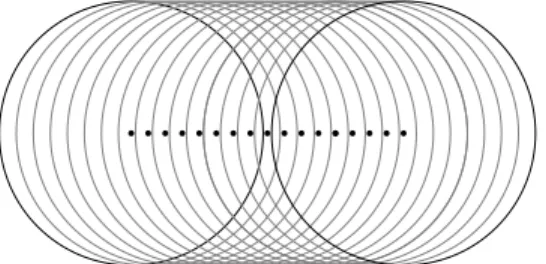
Figure 1: For Proposition 3, H = Km(k+1)+1\e satisfies ω(H) = m(k+1) and χk(H) = m+1.
Proof of Proposition 3. By part (ii) of Theorem 8 it suffices to consider P(χk(G n) =
lω(G
n)
k+1
m
+ 1), as P(χ(Gn) 6= ω(Gn)) → 0. Set l = m(k + 1) + 1. By choice of r(n) we have
that nlr2(l−1)= γl−1, and that nl+1r2l→ 0, nl−1r2(l−2) → ∞. If we denote the order of the
largest component of Gn by L(Gn) then Proposition 4 implies that
P(ω(Gn) ≥ l − 1, L(Gn) ≤ l) → 1.
To see this let N be the number of induced subgraphs of Gn isomorphic to Kl−1 and let
N0 be the number of connected subgraphs of order l + 1. Part (i) of Proposition 4 gives
EN0 = O(nl+1r2l) = o(1), so that
P(L(Gn) > l) = P(N0 > 0) ≤ EN0 = o(1).
On the other hand EN = Ω(nl−1r2(l−2)) → ∞, and using part (ii) of Proposition 4 we get:
P(ω(Gn) < l − 1) = P(N = 0) = exp[−EN] + o(1) = o(1).
Let H1, . . . , Hs be all non-isomorphic connected unit disk graphs of order l that satisfy
χk(H
i) = m + 1 yet Hi is not (isomorphic to) Kl. There exists at least one such graph, the
unit disk graph H := G({( i
l−1, 0) : i = 0, . . . , l − 1}, 1) (depicted in figure 5). This is simply
the complete graph on l vertices with one edge removed. To see that there is no k-improper colouring of H with m colours, note that its vertices can be partitioned into a clique of size l − 1 = m(k + 1) and a vertex v0which is adjacent to all but one of the other nodes. If there
were a k-improper colouring with m colours then every colour would have to occur k + 1 ≥ 2 times amongst the vertices of the clique. Hence whichever of the m colours we assign to v0
there will be a node in the clique adjacent to k + 1 nodes of the same colour.
Let N0 be the number of induced subgraphs of Gn isomorphic to Kl and let Ni be the
number of induced subgraphs isomorphic to Hi. Observe that if both ω(Gn) ≥ l − 1 and
L(Gn) ≤ l hold then χk(Gn) =
lχ(G
n)
k+1
m
+ 1 holds if and only if N0= 0 and Ni > 0 for some
12 Kang, Müller & Sereni
P(χk(Gn) =» χ(Gn) k + 1
¼
+ 1) = P(N0= 0 and Ni> 0 for some 1 ≤ i ≤ s) + o(1).
Using Proposition 5 we may therefore conclude that P(χk(Gn) =» χ(Gn)
k + 1 ¼
+ 1) → e−µ0γl−1(1 − e−(µ1+···+µs)γl−1),
for some µ0, . . . , µs> 0. 2
The proof of item (i) of Theorem 7 relies on some results from [10] that were developed to study the behaviour of χ(Gn).
One important ingredient to the proof is the connection between graph colouring and integer linear programming. Recall that the chromatic number of a graph G is the optimum value of the following integer linear program (ILP for short):
min 1Tx
subject to Ax ≥ 1,
x ≥ 0, x integers,
where A is the vertex-independent set incidence matrix of G. This is a (0, 1)-matrix whose rows are indexed by the vertices of G and whose columns correspond to all possible indepen-dent sets in G. It has aij = 1 if vertex viis in the independent set corresponding to the j-th
column and aij = 0 otherwise. Now, given a nonnegative integer vector b = (b1, . . . , bn), let
the graph G0 be obtained from G by replacing vertex v
i∈ G by a clique of size bi and the
vertices in the cliques corresponding to vi and vj are joined in G0 if and only if vi and vj
are joined in G. Then χ(G0) is the objective value of the following ILP:
min 1Tx
subject to Ax ≥ b,
x ≥ 0, x integers Furthermore χk(G0) does not exceed the objective value of the ILP:
min 1Tx
subject to (k + 1)Ax ≥ b, x ≥ 0, x integers
This is because taking k + 1 copies of a each node in a stable set in G gives a k-dependent set in G0 (but not every k-dependent set can be constructed in this way of course).
As mentioned in Section 4 we assume that the probability measure ν on the plane used to generate the Xi has a bounded density function f . Let us denote the essential supremum
of f by fmax, i.e.:
fmax:= sup{t : |{x : f(x) > t}| > 0},
where |.| denotes the Lebesgue measure. We say that a measurable set A ⊆ R2 has a small
neighbourhood if lim²&0|A²| = |A| where A² denotes A + B(0; ²).
For ϕ a bounded, nonnegative function with essential supremum 0 < ϕmax < ∞ and
bounded support that satisfies the regularity conditon that {x : ϕ(x) > t} has a small neighbourhood for all t, let us define the random variable Mϕ as:
Mϕ:= max x∈R2 n X i=1 ϕµ Xi− x r ¶ .
It turns out that the random variables Mϕ play an important role when studying the
(k-improper) chromatic number of Gn, see [10].
Proposition 6 ([10]) If ϕ is as above then the following hold: (i) If nr2¿ ln(n) yet nr2À n−² for all ² > 0 then
Mϕ
ln(n)/ ln³ln(n)nr2
´ → ϕmax almost surely;
(ii) If nr2À ln(n) then Mϕ nr2 → fmax Z R2 ϕ(x)dx almost surely; (iii) If nr2∼ t ln(n) for some t ∈ (0, ∞) then
Mϕ
nr2 → fmax
Z
R2
ϕ(x)eϕ(x)sdx almost surely, where s = s(ϕ, t) ≥ 0 solves Z R2 (sϕ(x)eϕ(x)s− eϕ(x)s+ 1)dx = 1 tfmax .
Proof of Theorem 7, item (i). We will first derive an upper bound on χk(G
n). To this
end, let us consider the graphs G0
n constucted as follows. Dissect R2 into squares of side ²r.
14 Kang, Müller & Sereni
p ∈ R2let us denote by N (p) the number of points in the square with lower left-hand corner
p, i.e.:
N (p) := |{X1, . . . , Xn} ∩ (p + [0, ²r)2)|.
We will now consider the graph G0
n, constructed by replacing each point p of Γ by a clique of
size N (p). Note that Gn is a subgraph of G0n, so in particular χk(Gn) ≤ χk(G0n). Let us fix
K > 0 (large) such that ² divides K. For p ∈ ²rZ2, let us denote by H
pthe subgraph of Gn
induced by the points in p + [0, Kr)2and let H0
p denote the corresponding subgraph of G0n.
Let A be the vertex-independent set incidence matrix of the subgraph ΓK of Γ induced by
the points of Γ inside [0, Kr)2. By previous observations we know that χk(H0
p) is no more
than the value of the ILP
min 1Tx
subject to Ax ≥ b(p)/(k + 1), x ≥ 0, x integers ,
where b(p) = (N1(p), . . . , Nm(p)) is the (random) vector whose entries are the number of
points in each of the squares p + pi+ [0, ²r)2for pi∈ [0, Kr)2∩²rZ2. Let us now consider the
LP-relaxation of this program (we drop the condition that the variables need to be integers) and let us denote by M (p) the optimum value of this LP. We remark that as A depends only on ² and K, there is a constant c = c(K, ²) such that χ(H0
p) ≤ M(p) + c(K, ²), because
rounding up all the variables of a feasible point of the LP-relaxation gives a feasible point of the ILP. By LP -duality M (p) is also equal to the value of the program
max k+11 bTy
subject to ATy ≤ 1,
y ≥ 0.
This formulation has the advantage that "the randomness has been moved into the objective function". The polytope defined by ATy ≤ 1 depends only on ², K and its vertices y
1, . . . , ym
are in principle known. We can write L(p) = k+11 maxiyiTb(p). Now note that the yi
correspond to functions in a natural way. Let ϕi : R2 → [0, 1] be the function which is
0 outside [0, K)2 and has value (y
i)j on the square x + [0, ²)2 if the j-th coordinate of yi
corresponds to the square p + rx + [0, ²r)2. Then
yiTb(p) = n X j=1 ϕi µ Xj− p r ¶ . Thus for all p we have
χ(Hp0) ≤
1
k + 1i=1,...,mmax Mϕi+ c(K, ²).
This shows that not only H0
p can be coloured with this many colours for any p ∈ ²rZ2,
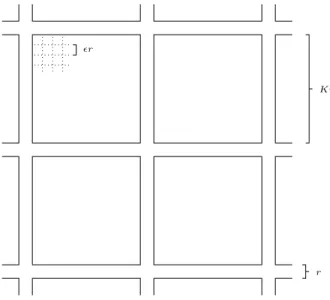
but also the subgraph of Gninduced by the points in the set Wp:= p+[0, Kr)2+(K +1)rZ2
(depicted in figure 5). To see this note that if x ∈ p + [0, Kr)2+ (K + 1)rz, y ∈ p + [0, Kr)2+
(K + 1)rz0 for z 6= z0∈ Z2 then kx − y k≥ r.
Kr
r ²r
Figure 2: Artists impression of the sets Wp.
We may assume without loss of generality that K ∈ N. Now consider the collection of all Wp with p ∈ r{0, . . . , K}2. Note each small square q + [0, ²r)2, (q ∈ ²rZ2), is covered by
exactly K2 of the (K + 1)2sets W
pconsidered.
Let us now consider the graphs G0
n,p which are obtained by replacing each point q of
Γ ∩ Wpby a clique of size
lN (q)
K2
m
rather than N (q). The subgraph G0
n,pcan be k-improperly
coloured with no more than
max p 1 k + 1maxi µ» N1(p) K2 ¼ , . . . ,» Nm(p) K2 ¼¶ ·yi+ c(K, ²) ≤ 1 (k + 1)K2maxi Mφi+ c(K, ²) + m
colours. The colourings of the G0
n,p can be combined to give a colouring of Gn with a total
of 1 k + 1 µ K + 1 K ¶2 max i=1,...,mMφi+ (K + 1) 2(c(K, ²) + m) colours.
16 Kang, Müller & Sereni
Next we wish to lower bound χ(Gn). For x ∈ R2 consider the subgraph Hx of Gn
induced by the points in the square x + [0, rK1−²1+²√√2 2)
2. Let us further dissect this square
into subsquares of side ²r1−²1+²√√2
2 in the obvious way and let Γ 0
K be the graph with vertices
the lower lefthand corners of these subsquares and an edge p ∼ q if k p − q k< r(1 − ²√2). Note that Γ0
K is in fact isomorphic to ΓK and in particular has the same vertex-independent
set incidence matrix A. Let H0
x be the graph we get by replacing a vertex of Γ0K by the
number of points in the corresponding subsquare of side ²r1−²√2
1+²√2. Note Hx0 is a subgraph of
Gn and χ(Hx0) is at least the objective value of the linear program
max b0(x)Ty
subject to ATy ≤ 1,
y ≥ 0,
where b0(x) is the vector with the number of points in each of the side ²r1−²√2
1+²√2 squares. The
vertices y1, . . . , ym of the polytope are still the same. However, they now correspond to the
sums n X j=1 ϕ0 i µ Xj− x r ¶ , where we set ϕ0 i(x) := ϕi ³ 1+²√2 1−²√2x ´
. Maximising over all choices of x ∈ R2we get
χ(Gn) ≥ max i=1,...,mMϕ0i.
To finish the proof note that by Proposition 6 we have that almost surely Mϕi, Mϕ0i → ∞
and lim supMϕi
Mϕ0 i ≤³1+²√2 1−²√2 ´2 . It follows that 1 ≤ lim sup(k + 1)χ k(G n) χ(Gn) ≤ µ K + 1 K ¶2Ã 1 + ²√2 1 − ²√2 !2 ,
and letting ², K → ∞ now gives the result. 2
6
Conclusion
In Sections 2 and 3, we studied the asymptotic behaviour of χk when r → ∞ and V is
countably infinite. For these results, the bound in Theorem 6 suffices; however, we would be interested to know an exact expression for χk(G(T, r)) for any k and r. In Sections 4
and 5, we studied the k-improper chromatic number of random unit disk graphs. A very
important issue that we have not yet studied in this respect is the rates of convergence of our results.
In both cases, we have seen that χk is well-approximated by the lower bound of
Proposi-tion 2. This behaviour differs from that of dense Erdős-Rényi G(n, p) random graphs, where χk/χ approaches 1 almost surely. Due to the motivating application in satellite
communi-cations, we have focused upon the case with Euclidean norm and dimension two (i.e. unit disk graphs); however, we note here that our results naturally generalise to arbitrary norm and higher dimensions.
A major purpose of this study was to gain insight into the problem of finding the k-improper chromatic number of unit disk graphs. As mentioned in the introduction, the best polynomial approximation for χk is 6 (and 3 for k = 0). The results of this paper imply
for fixed k that, given randomly generated instances Gn, the polynomial computable value
ω(Gn)/(k + 1) multiplied by the factor 2
√
3/π (which is quite smaller than 6) is a reasonable approximation for the k-improper chromatic number when n is large enough.
References
[1] B. N. Clark, C. J. Colbourn, and D. S. Johnson. Unit disk graphs. Discrete Math., 86(1-3):165–177, 1990.
[2] W. K. Hale. Frequency assignment: Theory and applications. IEEE Proceedings, 68(12):1497–1514, dec 1980.
[3] F. Havet, R. J. Kang, and J.-S. Sereni. Improper colouring of unit disk graphs. In Pro-ceedings of the 7th International Conference on Graph Theory, volume 22 of Electronic Notes in Discrete Mathematics, pages 123–128. Elsevier, October 2005.
[4] F. Havet and J.-S. Sereni. Channel assignment and improper choosability of graphs. In Proceedings of the 31st Workshop on Graph-Theoretic Concepts in Computer Science (WG’05), volume 3787 of Lecture Notes in Computer Science. Springer Verlag, June 2005. To appear.
[5] F. Havet and J.-S. Sereni. Improper choosability of graphs and maximum average degree. J. Graph Theory, 2005. To appear.
[6] R. Leese and S. Hurley, editors. Methods and Algorithms for Radio Channel Assignment. Oxford Lecture Series in Mathematics and Its Applications. Oxford University Press, Oxford, 2002.
[7] L. Lovász. On decompositions of graphs. Studia Sci. Math. Hungar., 1:237–238, 1966. [8] C. J. H. McDiarmid. Random channel assignment in the plane. Random Structures
18 Kang, Müller & Sereni
[9] C. J. H. McDiarmid and R. J. Kang. The t-improper chromatic number of random graphs. Manuscript.
[10] C. J. H. McDiarmid and T. Müller. On the chromatic number of random geometric graphs. Manuscript.
[11] C. J. H. McDiarmid and B. Reed. Colouring proximity graphs in the plane. Discrete Math., 199(1-3):123–137, 1999.
[12] T. Müller. On two point concentration in random geometric graphs. Manuscript. [13] R. Peeters. On coloring j-unit sphere graphs. Technical Report FEW 512, Economics
Department, Tilburg University, 1991.
[14] M. D. Penrose. Focusing of the scan statistic and geometric clique number. Adv. in Appl. Probab., 34(4):739–753, 2002.
[15] M. D. Penrose. Random Geometric Graphs. Oxford University Press, Oxford, 2003. [16] V. Raghavan and J. Spinrad. Robust algorithms for restricted domains. J. Algorithms,
48(1):160–172, 2003. Twelfth Annual ACM-SIAM Symposium on Discrete Algorithms (Washington, DC, 2001).
Unité de recherche INRIA Futurs : Parc Club Orsay Université - ZAC des Vignes 4, rue Jacques Monod - 91893 ORSAY Cedex (France)
Unité de recherche INRIA Lorraine : LORIA, Technopôle de Nancy-Brabois - Campus scientifique 615, rue du Jardin Botanique - BP 101 - 54602 Villers-lès-Nancy Cedex (France)
Unité de recherche INRIA Rennes : IRISA, Campus universitaire de Beaulieu - 35042 Rennes Cedex (France) Unité de recherche INRIA Rhône-Alpes : 655, avenue de l’Europe - 38334 Montbonnot Saint-Ismier (France) Unité de recherche INRIA Rocquencourt : Domaine de Voluceau - Rocquencourt - BP 105 - 78153 Le Chesnay Cedex (France)