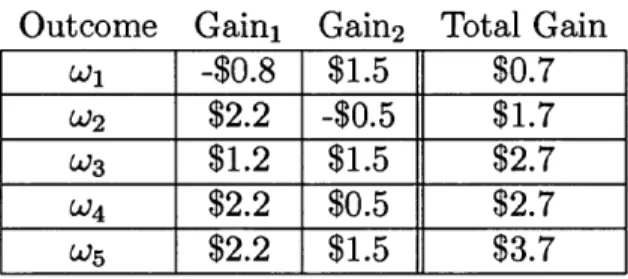
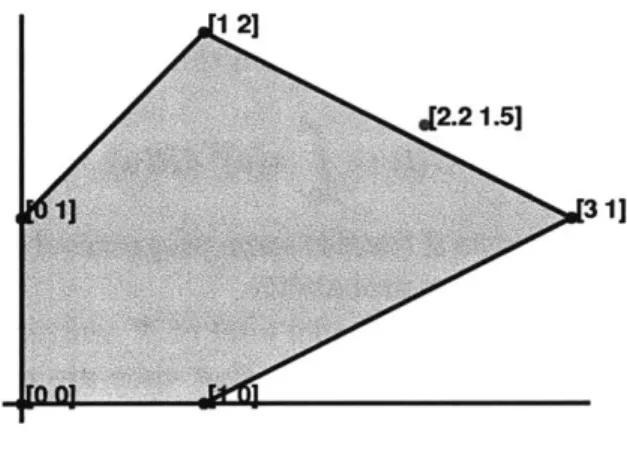
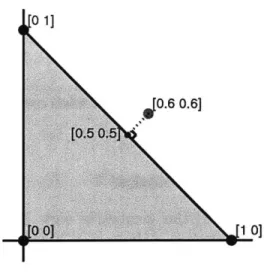
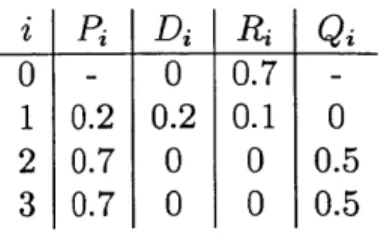
Coherent Approximation of Distributed Expert
Assessments
by
Peter B. Jones
B.S., Electrical and Computer Engineering Brigham Young University, 2002
S.M., Electrical Engineering and Computer Science Massachusetts Institute of Technology, 2005
ARCHNES
MASSACHUSETS INSTiTWJEOF TECHNOLOGY
JUN 17 2011
LIBRARIES
Submitted to the Department of Electrical Engineering and Computer Science in partial fulfillment of the requirements for the degree of
Doctor of Philosophy in Electrical Engineering and Computer Science at the
MASSACHUSETTS INSTITUTE OF TECHNOLOGY June 2011
@
Massachusetts Institute of Technology 2011. All rights reserved.Author ...
no -+ r m --"eering and Computer Science May 20, 2011
Certified by...
Professor ot Electrical Engineering
Certified by...
Associate Professor i l1
Accepted by...
... Sanjoy K. Mitter and Engineering Systems, MIT Thesis Supervisor
Venkatesh Saligrama Engineering, Boston University Thesis Supervisor
Leslie Kolodziejski Graduate Officer
Coherent Approximation of Distributed Expert Assessments
by
Peter B. Jones
Submitted to the Department of Electrical Engineering and Computer Science on May 20, 2011, in partial fulfillment of the
requirements for the degree of
Doctor of Philosophy in Electrical Engineering and Computer Science
Abstract
Expert judgments of probability and expectation play an integral role in many sys-tems. Financial markets, public policy, medical diagnostics and more rely on the ability of informed experts (both human and machine) to make educated assessments of the likelihood of various outcomes. Experts however are not immune to errors in judgment (due to bias, quantization effects, finite information or many other factors). One way to compensate for errors in individual judgments is to elicit estimates from multiple experts and then fuse the estimates together. If the experts act sufficiently independently to form their assessments, it is reasonable to assume that individual errors in judgment can be negated by pooling the experts' opinions.
Determining when experts' opinions are in error is not always a simple matter. However, one common way in which experts' opinions may be seen to be in error is through inconsistency with the known underlying structure of the space of events. Not only is structure useful in identifying expert error, it should also be taken into account when designing algorithms to approximate or fuse conflicting expert assess-ments. This thesis generalizes previously proposed constrained optimization methods for fusing expert assessments of uncertain events and quantities. The major develop-ment consists of a set of information geometric tools for reconciling assessdevelop-ments that are inconsistent with the assumed structure of the space of events.
This work was sponsored by the U.S. Air Force under Air Force Contract FA8721-05-C-0002. Opinions, interpretations, conclusions, and recommendations are those of the authors and are not necessarily endorsed by the United States Government.
Thesis Supervisor: Sanjoy K. Mitter
Title: Professor of Electrical Engineering and Engineering Systems, MIT Thesis Supervisor: Venkatesh Saligrama
Acknowledgments
It has given me enormous pleasure to have worked with and studied under Sanjoy Mitter for the past six years, first as a Master's and then as a Doctoral Student. His erudition is unparalleled, and his ability to leap from philosophy to mathematics to physics, sometimes within a single sentence, is one that I particularly admire. Beyond his intellectual mentorship, I particularly appreciate his willingness to engage in broader discussions of political and social significance. While our opinions haven't always coincided, I feel we've always been able to cohere on a view of the significant "moral dimension."
The role Venkatesh Saligrama has played as co-advisor of my Doctoral work is extremely appreciated. Beyond his own significant academic abilities, he brought to our frequent discussions an ability to see beyond theory to the real-world applications. He also often served as interpreter, being able to clarify complicated (and at times convoluted) arguments into more accessible ideas. I will always fondly recall sitting in Sanjoy's office as Venkatesh and Sanjoy seemingly effortlessly flew through an immensely diverse set of subjects, finding the interrelations as they went.
I'd also like to acknowledge the support and help of Devavrat Shah who served as the third member of my committee. His gentle critiques of my work served as an extremely useful corrective, providing an objective sounding board against which to develop and debate the ideas generated in my meetings with my advisors.
My time in the Laboratory for Information and Decision Systems has been ab-solutely wonderful. I deeply appreciate all the interactions with faculty, post-docs, students, staff and visiting scholars. I'm particularly cognizant of the great debt I owe to the friendship and help provided by Vincent Tan, Lav Varshney, Mukul Agarwal, Alex Olshevsky, Mesrob Ohannessian, Julius Kusuma, Hari Narayanan, Emily Fox, Jason Johnson, Kush Varshney, Matt Johnson, Venkat Chandrasekaran, Parikshit Shah, and Noah Stein. I'm especially grateful for feedback on early drafts of this thesis given by Vincent, Lav, and Julius.
Lincoln Laboratory has exhibited a huge amount of faith in me, providing me not only the financial ability to pursue my doctorate, but intellectual, social and emotional support as well. The Lincoln Scholars Committee, particularly Bill Keicher, Ken Estabrook and Jennifer Watson, not only made the choice to provide me with financial support, but did an admirable job of keeping me focused and on track. I particularly wish to acknowledge Michael Hurley who served not only as my Lincoln Mentor, but was often the first sounding board for concepts I was developing. The strong support of my Group Leaders, particularly Gary Condon who shepherded me through the Lincoln Scholars process, is very appreciated. The other members of Group 104 have given me frequent helpful advice and feedback on various developments, particularly Edward Kao, Andy Wang, Matt Daggett, Larry Bush, Ari Kobren, Rhonda Philips, and all the members of the CAMEL group.
My parents, Monti and Greg Jones, endowed me not only with the desire and drive to obtain the best education I could but with the abilities to achieve those goals.
Finally, this thesis owes more to my wife Cami than perhaps anyone else. She has been unwavering in her support for me, sacrificing years of her life for this goal. Over
the past seven years she sometimes had to function practically as a single parent when I disappeared for conferences, or spent mornings, afternoons and evenings working on a writing deadline. Her love and support mean the world to me.
Contents
1 Introduction
1.1 M otivation . . . . 1.2 Distributed Detection and Estimation . . . . 1.2.1 Distributed Filtering and Consensus 1.2.2 Of Indian Villagers and Elephants . . 1.2.3 Consistency vs. Consensus . . . . 1.3 Coherence . . . . 1.3.1 Probabilistic Coherence . . . . 1.3.2 Coherence in Philosophy . . . .
1.3.3 Coherence in Political Science . . . .
1.3.4 Coherence in Cognitive Linguistics . 1.3.5 Coherence in Economics and Finance 1.4 Thesis Outline and Major Contributions . .
2 Background 2.1 Introduction . . . . 2.2 What is Probability . . . . 2.2.1 Classical . . . . 2.2.2 Frequentist . . . . 2.2.3 Necessary . . . . 2.2.4 Subjective . . . . 2.2.5 Other Representations of 2.3 What is an Assessment... 2.3.1 Mathematical Model 2.3.2 Assessments . . . . 2.4 What is Coherence . . . . 2.4.1 Probabilistic Coherence 2.4.2 Coherence and Arbitrage
Uncertainty
2.4.3 Coherence of Non-Characteristic Random Variables . . . . 2.4.4 Arbitrage and Coherence for Non-characteristic Random
Vari-ables . . . . 2.5 Approximation and Approximation Cost . . . .
3 Coherent Approximation
3.1 Introduction . . . .. . . . . 3.1.1 Non-optimization Methods of Assessment Fusion . . . . 3.2 Coherent Approximation Principle . . . . 3.2.1 Monadic Structure . . . . 3.2.2 Suboptimal Approximation . . . . 3.3 Divergence-based Coherent Approximation . . . . 3.3.1 Opinion Deformation and Sanov's Theorem . . . . 3.3.2 Coherent Approximation of Probability Mass Functions . . . . 3.4 Alternative Formulation of the CAP . . . . 3.4.1 Criticisms of the CAP . . . . 3.4.2 An Information Geometric Reformulation of the CAP... 3.4.3 IGCAP Solution as an MAP estimate . . . . 3.4.4 Alternative Minimax Cost . . . . 3.4.5 Application of the Conditional Limit Theorem . . . . 3.5 Properties of the IGCAP . . . . 3.5.1 Solution Uniqueness and Coherence . . . . 3.5.2 Computation of IGCAP . . . . 3.5.3 Comparisons of IGCAP to Other Coherent Approximation
For-m ulations . . . . 3.5.4 Extension to Non-Characteristic Random Variables . . . . 3.5.5 Market clearing and general utilities . . . . 3.6 Exchangeability and Coherence . . . . 3.6.1 Characteristic Matrices with Matched Exchangeability
Con-straints . . . . 3.6.2 Non-additivity of Marginal Constraints: A Counterexample . . 3.7 Markovianity and Coherence . . . .
3.7.1 Another Example of Non-Additivity of Structural Constraints . . . . 3.7.2 Complete Event Sets . . . . 3.8 Conclusion . . . . 3.8.1 Future Work . . . . 4 Dynamic Coherent Approximation
4.1 Introduction . . . . 4.1.1 Information Integration . . . . 4.1.2 Previous Work . . . . 4.2 Subjective Likelihood Functions . . . . 4.2.1 Motivating Example . . . . 4.2.2 Mathematical Model . . . . 4.3 Probability Convergence for Single Assessors . . 4.3.1 Matched Likelihood Functions . . . . 4.3.2 Mismatched Likelihood Functions . . . .
4.4 Multiple Assessors with Structural Constraints . 4.4.1 Step-wise Coherence . . . . Combining Types of . . . . 72 . . . . 73 75 . . . . 75 . . . . 76 . . . . 78 . . . . 78 . . . . 79 . . . . 79 . . . . 80 . . . . 81 . . . . 8 1 . . . . 82 . . . . 82 41 41 42 43 44 46 47 47 48 52 52 53 53 56 57 58 58 59
4.4.2 Asymptotic Coherence . . . . 4.5 Coherence with Only Finitely Many Observations . . . . 4.5.1 Sparse Coherent Approximation . . . . 4.6 Asymptotic Coherence Simulation . . . . 4.6.1 Conclusions about Asymptotic Coherence . . . . 4.7 Fusing Conditional and Unconditional Assessments via IGCAP .
4.7.1 Conditional Assessments Generate Line ar Fa
4.7.2 IGCAP with Conditional Assessments . . . 4.8 Coherent Approximation on Markov-varying States
4.8.1 Mathematical Notation . . . . 4.8.2 Bayesian Filtering . . . . 4.9 Filtering Without an Observation Model...
4.9.1 Distributed Posterior State Estimate .
4.9.2 Max of Divergences Cost Structure... 4.10 Bayesian Filtering Simulation . . . . 4.11 Conclusions . . . .
5 Distributed Coherent Risk Assessment
5.1 Introduction . . . . 5.1.1 Background . . . . 5.1.2 Coherent Approximation of Risk Measures . 5.2 Coherence and Risk Measures . . . . 5.2.1 Mathematical Model . . . . 5.2.2 Coherent Risk Measures . . . . . .
5.2.3 Convex Risk Measures . . . . 5.3 Minimum Convex Extensions of VaR . . . .
5.3.1 Minimal Convex Extension of VaR... 5.4 Risk Measures under Divergence of Opinion . .
5.4.1 Risk Measure Continuity . . . . 5.4.2 5.4.3 5.5 Fusing 5.5.1 5.5.2 5.5.3
Robustness of some VaR-like Risk Measures Robustness of other Convex Risk Measures Risk Assessments . . . . Mathematical Notation . . . . Coherent Risk Assessments . . . . Improved Fusion using Assessment Bounds . 5.6 Coherent Fusion of Mutually Incoherent Risk Assess 5.6.1 Detecting Incoherence . . . .
5.6.2 Fusion of Incoherent Risk Assessments . . .
milies . . . . 88 . . . . 88 . . . . 91 . . . . 91 . . . . 92 . . . . 93 . . . . 95 . . . . 96 . . . . 97 . . . . 99 101 . . . . . 101 . . . . . 101 . . . . . 102 . . . . . 103 . . . . . 103 . . . . . 103 . . . . . 104 . . . . . 105 . . . . . 107 . . . . . 108 . . . . . 108 . . . . . 110 . . . . . 110 . . . . . 113 . . . . . 113 . . . . . 114 . . . . . 116 ments . . . . 117 . . . . 117 . . . . 120 5.6.3 Potential Criticisms of Applying IGCAP to Coherent Risk
As-sessm ent . . . . 5.7 Conclusion . . . . 82 84 85 86 87 87 121 122
6 Knightian risk and outcome indeterminacy
6.1 Introduction .. . .. .. .. . .. . .. . . . . 6.2 Structural Uncertainty . . . . . 6.2.1 Uncertainty and Indeterminacy . . . . 6.2.2 Background . . . . 6.3 Minimal Structural Revision to Induce Coherence . . . . 6.3.1 Minimal Revision of Characteristic Matrices . . . . 6.3.2 Minimal Bases for Probabilistic Assessments . . . . 6.4 Structural Revision in Cases of Indeterminacy . . . . 6.4.1 Defining Non-deterministic Output Matrices . . . . 6.4.2 Dual Program for the CAP . . . . 6.4.3 Lagrangian Dual . . . . 6.4.4 Fenchel Dual . . . . 6.4.5 A Geometric Interpretation of the Dual . . . . 6.4.6 Dual Program for the IGCAP . . . . 6.4.7 Dual Program for Reversed-Divergence Cost Function . 6.4.8 Import of Relaxed Structure in Cases of Indeterminacy 6.5 Conclusion . . . . 7 Conclusion 7.1 Coherent Approximation . . . . 7.1.1 Contributions . . . . 7.1.2 Future Work. . . . . . . . . . . . . . . . . . . . . 7.2 Concluding Remarks . . . . . . . . . . . . . . . . . . . .
A Ramsey, de Finetti, and Savage
A.1 Introduction . . . . A.2 Ram sey . . . . A.3 de Finetti . . . . A .4 Savage . . . . A.5 Discussion . . . . B Simulation Code
B.1 Subjective Likelihood Simulation . . . . B.2 Bayesian Filtering Simulation . . . .
123 123 124 125 125 126 126 127 129 129 130 131 131 132 133 135 137 138 139 139 139 142 143 145 145 145 146 147 148 151 151 153
List of Figures
2-1 Coherent hull of outcomes . . . . 33
2-2 Convex hull of outcomes for non-characteristic random vector . . . . 37
3-1 Coherent Approximation of an Incoherent Assessment . . . . 44
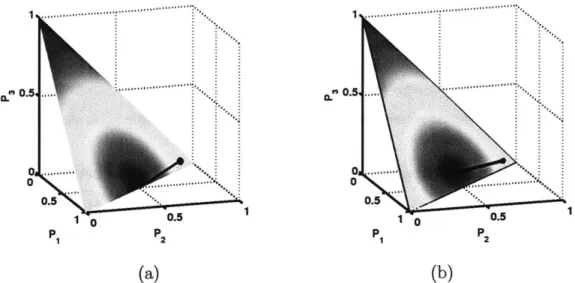
3-2 Optimal coherent revisions for example under (a) quadratic cost and (b) binary information divergence cost . . . . 50
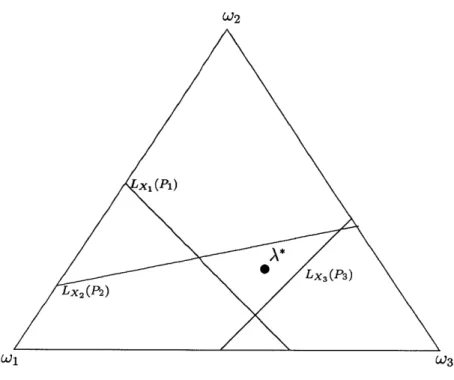
3-3 Graphical view of IGCAP . . . . 54
3-4 Failure of maximum entropy approximation . . . . 62
3-5 Feasible marginals under a combination of coherence and exchange-ability constraints . . . . 68
3-6 Feasible Sets under joint coherence and Markov constraints for four graphical structures . . . . 70
3-7 Markov graphs for Figure 3-6 . . . . 70
3-8 An example of outlier identification for coherent approximation . . . 74
4-1 Incoherence in futures prices for two InTrade contracts . . . . 76
4-2 The relationship between observation and outcome simplices . . . . . 85
4-3 Equivalent decision boundaries under various likelihood model frame-w orks . . . . 86
4-4 Comparison of mean-square errors as a function of the number of ob-servations under four different estimation techniques . . . . 87
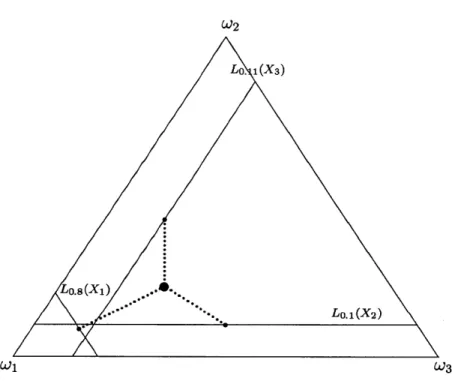
4-5 Linear family associated with a conditional assessment . . . . 89
4-6 Graphical depiction of a Hidden Markov Model . . . . 92
4-7 Graphical depiction of Bayesian filtering with assessments of unknown conditioning . . . . 96
4-8 Performance of IGCAP for Bayesian filtering . . . . 98
5-1 Linear families generated by risk assessments . . . . 115
5-2 Incoherent risk assessments . . . . 118
List of Tables
2.1 Gains under a Dutch Book wager . . . . 31 2.2 Gains under incoherent pricing . . . . 36 3.1 Optimal coherent approximation to quadratic approximation example 49 4.1 Estimation error statistics for four algorithms . . . . 99
Chapter 1
Introduction
* 1.1 Motivation
A supercomputer called Multivac plays a central role in a series of short stories by Isaac Asimov. Multivac processes phenomenal amounts of data and outputs proba-bilities of various events of social significance. As a result of Multivac's accuracy of prediction, society is largely able to eradicate crime. In the story "All the Troubles of the World" Asimov presents a scenario in which a certain man is predicted with high probability to commit a murder. Police, acting to avert the crime, engage in an escalating series of actions, including detention, investigation, and questioning. However, each action simply increases Multivac's assessed probability of the crime occurring. The crime is eventually averted (in the nick of time), by the realization that the system's representational systems were incapable of discriminating between the father and his minor son. This fictional story points out real difficulties of large scale probabilistic inference involving autonomy, bias, and what probability really means.
A similar theme is evoked, more sinisterly, in Philip K. Dick's "The Minority Report," in which three mutant humans act as oracles of future crime. Termed 'precogs,' the mutants' predictions of future events help curtail crime. However the predictions are not absolute, and occasionally one of the three precogs has a different vision from the others, termed a 'minority report.' The police division charged with acting on the precogs' visions chooses to ignore the minority reports, resulting in troubling outcomes where truth is sacrificed in the interest of efficiency.
These themes of eradicating evil through super-human foresight are certainly en-tertaining (as evidenced by the success of recent Hollywood movies based on each of the short stories), but reality is not science fiction. However, in an instance of fiction prefiguring reality, 'predictive policing' was the theme of a 2009 National Institute of Justice symposium. As data on crime proliferates and as high-dimensional inference improves, science fiction is moving closer to reality. With this increased predictive capability comes the same challenges for those decision makers tasked with acting on expert advice in risky situations that were illuminated by the fictional stories: what action to take when experts (human or artificial) express uncertainty, when the advice of one expert contradicts or is inconsistent with that of another, and how to deal with fundamental representational limits of expert systems.
the outcome of our actions is to gather recommendations and evaluations from groups of experts (sometimes called Subject Matter Experts, or SMEs, in the literature). For example:
" A military commander, prior to engaging in a strategic action, will request input from his senior officers
* An individual, diagnosed with a deadly illness, will consult multiple doctors " A company, wishing to protect its communications network, may employ
mul-tiple commercial Intrusion Detection and Prevention Systems (IDPSs)
" A police detective, investigating a series of thefts, will consult other detectives, data mining algorithms working on a variety of databases, and profiling spe-cialists to identify the culprit
As a general model, each expert provides an assessment of some event. Assess-ments may be qualitative, as in the case of the commander's senior officers, or quan-titative, as in the case of the IDPSs. Events may be future (forecasting) or past (forensics). Experts may be human (doctors, officers, etc.) or machine (IDPSs, data mining algorithms, etc.). They may assess a single event or many. Each may be asked to assess the same set of events, or each may be asked to assess a different, but related, set of events.
The central question we address in this thesis is how to reconcile uncertain, incon-sistent expert assessments. For now, the term 'inconincon-sistent' can be taken loosely to mean logically irreconcilable, although more technical definitions will follow. When a decision maker receives conflicting assessments he must employ some method to reconcile them. He may:
" Reject some assessments out of hand, based on exogenous (reputation, com-plexity, etc.) or endogenous (internal consistency, neighbor nearness) criteria " Modify some or all assessments until they become consistent with prior beliefs
and then update his beliefs
* Update his beliefs with the inconsistent assessments, and then perform revision to create consistency
Recognizing that the right method of reconciliation may be situation dependent, we will develop some general principles for reconciling inconsistent assessments in a variety of situations.
* 1.2 Distributed Detection and Estimation
From an engineering perspective, the problem of reconciling diverse assessments is related to the problem of distributed detection and estimation. The fusion challenge is to create a rule that incorporates the information from the distributed assessments while obeying fundamental constraints that may exist in the world.
The sister problems of distributed and decentralized detection have received much attention in the academic engineering literature, particularly in the context of the design of sensor networks. An excellent overview of the subject is given in [1]. Early work by Tenney [2,3], Tsistiklis [4-6], Varshney [7] and others has grown into a robust community.
One particularly fruitful area of research has been on belief dynamics in networks. See particularly [8-10]. The challenges of coming to a consensus on a state of the world under limited and time-varying communication has been applied to cooperative ve-hicle dynamics [11, 12], distributed function computation [13], leader election [14,15], clock synchronization [16,17] and more. The consensus literature focuses primarily on engineered solutions to the problem of convergence on a single value across the network.
In contrast to previous literature, in this thesis we will focus on the estimation of a set of consistent values rather than a single consensus value. Also, the engineering focus on limitations imposed by constrained communications in networks in relation is left largely to future work.
* 1.2.1 Distributed Filtering and Consensus
A natural outgrowth of the decentralized detection literature has been to consider estimating the state of a time-varying process. Optimal filtering theory [18], with early developments by Wiener [19], Kalman [20] and Kalman and Bucy [21] devel-oped statistical methods for estimating process states given a sequence of uncertain observations.
Attempts to generalize optimal filtering to the decentralized (indicating geographic diversity but no communication network constraints) and distributed (both geograph-ically diverse and communication constrained) settings [22-25] has produced general-ized algorithms for estimating the time-varying state of a centrally observable process. Assumed, however, in all these treatments is a single, globally agreed-upon dynamical model. The problem of how to do optimal distributed filtering when observational experts dissent on the proper model specifications has not been addressed in the literature.
N 1.2.2 Of Indian Villagers and Elephants
A classic example used in much of the distributed detection and estimation literature, is of observationally limited villagers (either blind or in the dark, depending on the telling) who must ascertain the nature and characteristics of an elephant. I take the following account from a classic text by the Sufi poet Rumi:
Some Hindoos were exhibiting an elephant in a dark room, and many people collected to see it. But as the place was too dark to permit them to see the elephant, they all felt it with their hands, to gain an idea of what it was like. One felt its trunk, and declared that the beast resembled a water-pipe; another felt its ear, and said it must be a large fan; another its leg, and thought it must be a pillar; another felt its back, and declared
the beast must be like a great throne. According to the part which each felt, he gave a different description of the animal.
(The Masnavi, by Rumi, tr. by E.H. Whinfield, [1898])
Many lessons can (and have) been derived from this simple tale, but in the context of distributed detection and estimation the story is used to illustrate the difficulty of us-ing multiple observations to construct a complete picture of the observed object. Key to our conception of distributed assessment is this picture of a single phenomenon that is being perceived in a limited way by a distributed set of assessors, each attempting to explicate his local observation as faithfully as possible.
U
1.2.3 Consistency vs. ConsensusMuch of the previous engineering literature in distributed detection and estimation has focused on the consensus question. The two questions most often asked are: given a distributed set of assessors, each observing the same phenomenon, when and how can their beliefs about the phenomenon converge to a single, global belief.
Such a model is excellent when the phenomenon under observation is sufficiently confined that experts can extend their local knowledge to an assessment of the phe-nomenon as a whole, or when locality conditions on the phephe-nomenon itself result
in separability guarantees among the groups of assessors. However, in an entan-gled world with phenomena that are 'elephant' sized, a broader criteria needs to be
adopted.
We suggest that the appropriate question in a global environment with "large" phenomena is consistency. To strain the elephant analogy, suppose we have two ex-perts trying to classify an unknown animal. One expert, using keen scientific intellect, takes the animal's temperature under various external conditions. The temperature remains constant to within a threshold, and the expert proclaims, "this animal is warm-blooded." The second expert, observing mating and reproduction, states that "this animal's young are hatched from eggs." Both of these statements represent 'soft' decisions about the identity of the animal (i.e. they don't uniquely identify the ani-mal, but narrow the set somewhat). The assessments are consistent with one another in the sense that there exist animals that are both warm-blooded and whose young hatch from eggs. In essence, if there exists at least one animal consistent with the decisions of all the assessors, then the assessments are consistent.
The goal of distributed systems for detection, estimation and assessment should be to make consistent rather than consensus decisions.
* 1.3 Coherence
The fundamental concept to which this thesis will speak is coherence. With respect to assessments, coherence is the requirement that assessments be consistent with one another, that they cohere. In terms of the Indian story of the elephant, the various statements of the villagers were coherent because an object exists (an elephant) with all the assessed characteristics. Had no such object existed, the assessments would have been incoherent.
Coherence can be viewed as a relaxation of the concept of consensus. If the object or event under assessment is identical across all assessors, then to be internally coherent, all the assessments must be the same. However, if the assessors are working locally, as opposed to globally, their assessments may differ (as per the elephant example). But this does not represent a de facto falsification of the assessments; rather, such falsification would depend on the (non)existence of an object or event that exhibited all assessed local behaviors.
Coherence-like concepts, as will be shown, are prevalent in many academic dis-ciplines where they are often contrasted with foundationalist approaches. Concepts of coherence are often (but not always) associated with ideas of subjectivism, non-rationality, and systemic thinking while fundamentalist views are focused on objec-tivisim, rationality, and axiomatization. The tension between these two viewpoints, objective/foundational versus subjective/coherent, can be seen in many different aca-demic fields.
In the following cross-disciplinary development we do not attempt to give a com-plete view of any one topic. We recognize that many of the covered fields have rich and deep findings not included in these brief summaries, and that even through the limited lens of coherence, none of these caricatures constitute a complete picture. Together, however, they indicate the pervasiveness of the dichotomy between foundationalism and coherentism.
* 1.3.1 Probabilistic Coherence
In his seminal work on probability theory [26], de Finetti defined a concept of prob-abilistic coherence. Probprob-abilistic coherence will be the fundamental concept in our theoretical development, and we leave a lengthy discussion of its principles to Chap-ter 2. Here we will refer briefly to the theory, its motivations and implications.
Early approaches to probability theory were based on a frequentist notion that a probability encodes an average long-term outcome of some repeatable trial. In this approach to probability, the values reflect a fundamental truth about objective re-ality. However, this theory of probability is insufficient to explicate how probability may be used to represent non-repeatable events. This shortcoming of the frequen-tist/objectivist view of probability led to a subjectivist approach, pioneered by Ram-sey [27], de Finetti [26], and Savage [28]. Generally speaking, the subjectivist view of probability was that a probability is an encoding of personal uncertainty about the outcome of an event. The coherence principle, posited by de Finetti but drawing on earlier work by Ramsey, states that probabilities when viewed as odds must not allow a risk-free gamble to be made against them. This so-called "Dutch book" argument views probabilities not as representative of long run averages, but as a system of consistent beliefs.
* 1.3.2 Coherence in Philosophy
A fundamental objective of philosophy is to explicate the concept of 'truth,' including what is meant when we claim a proposition is true, and how we justify such belief.
One class of theories of truth is referred to as "Coherence Theories" [29]. Coherence theories have been espoused by such philosophers as Leibniz, Spinoza, Hegel, Bradley, Blanshard, Neurath, Hempel, Dummett, and Putnam. Generally, these theories "ac-count for the truth of a proposition as arising out of a relationship between that proposition and other propositions." The core principle of coherentism is that truth arise not from agreement with 'objective reality' (which a coherentist may dispute is a meaningful concept), but through internal cohesion within a belief set.
Epistemology
Due to some degree to prominent criticisms of the coherentist view of truth (particu-larly by Russell [30]), modern coherentists have shifted from coherence as an attempt to define truth to coherence as a method of justifying epistemic statements. In this strain of philosophical coherentism, an individual's belief system is justifiable only if it is internally consistent. A stronger version of justificational coherentism states that coherence is both necessary and sufficient to justify belief.
Analytic Philosophy
One of the most important innovators in analytic philosophy in the 20th century was Ludwig Wittgenstein. In his Tractatus Logico-Philosophicus [31], he states "Wovon man nicht sprechen kann, dariiber muss man schweigen." Translation: whereof man can not speak, he must keep silent. Wittgenstein argued that man's necessarily finite descriptive ability was insufficient to describe the infinite variety of experience of reality. As such, the set of truths that can be communicated (and hence verified by examination) is a small subset of the total set of truths.
The concept of verifiability was taken up by Wittgenstein's sometime friend and collaborator, and a founding member of the influential Vienna Circle, Waismann. In his 1946 paper "Verifiability," [32] Waismann espouses a very Wittegenstein-ian view of the limits of verifiable truth. He coins the term "open texture" to refer to the diversity of ways in which the same language can be justifiably applied. In [33], Hilary Putnam takes up the discussion of open texture as a challenge to the computational reductionist view of language and truth. The strict rules of logic and computation are insufficient to span the breadth of infinite experience and meaning
Philosophy of Science
Perhaps the two most currently influential philosophies of scientific progress are those of Karl Popper [34,35] and Thomas Kuhn [36]. Popper's view, first posited as a counter to the logical positivism of the Vienna Circle (of which Friedrich Waismann was a member), is that scientific theories should be treated critically. In Logik der
Forschung [34] he proposed falsifiability as the fundamental invariant of scientific knowledge. This was in contrast to the positivists, who believed in constructive empiricism rather than destructive empiricism. However, like the positivists, Popper's theory of falsifiability is a fundamentalist view of science, that scientific knowledge
In contrast, Kuhn's proposition in The Structure of Scientific Revolutions of 'revolutionary science' in which old modes of thinking are rapidly replaced by new paradigms is premised on the idea that scientific progress is not solely dependent on rational comparison, but can be strongly influenced by gestalt shift. Underlying this premise is the idea that there is something akin to taste in the scientific endeavor, which is only possible if scientific knowledge exhibits a degree of openness, or porosity.
Philosophy of Law
The concept of porosity, related to the 'open texture' of Waismann, was fundamental in HLA Hart's formulation of legal positivism [37]. The theory of legal positivism views legal structures as reflective not of fundamental truths, but as an outgrowth of social development. Although not explicit in Hart's formulation, a coherentist view of law would suggest that a law base is justified not by its reflection of reality, nor by its consequences, but by its internal consistency.
* 1.3.3 Coherence in Political Science
In [38] evidence is given for an objectivist/subjectivist divide within political theory. Specifically, the author proposes what he refers to as the 'economic' and 'sociological' schools of thought within political science. By 'economic' he means rational, founda-tional and axiomatic in nature and by 'sociological' he means irrafounda-tional (or at least arational), systems-centric and coherent in nature. The author suggests the modern sociological approach has its roots in Hegel, Coleridge, and other European theorists responding to the excesses of the French Revolution, and he points to Talcott Parsons as its primary modern purveyor.
* 1.3.4 Coherence in Cognitive Linguistics
Perhaps the most influential figure in 20th century linguistics has been Noam Chom-sky. Among his many contributions is the formulation of the concept of Universal Grammar [39] as the common structural basis for all spoken language, introduced in the 1950s and early 1960s. At the time, this theory displaced the then dominant behaviourist view of language as a learned (rather than innate) set of rules of com-munication. The heart of Chomsky's development of the universal grammar is the concept of Deep Structure, an overarching conceptual framework from which multi-ple grammatical constructs can be derived. In this sense it is an absolutist view of linguistics, relying on a common structure, or first principle for its motive effect.
In response to dissatisfaction with Chomsky's theory, several influential linguists (including some of Chomsky's former students) developed a theory of generative se-mantics, which posited that any universal grammar was insufficiently complex to account for the variety of linguistic constructs. This led, in turn, to the development of the concept of cognitive 'frames' [40,41] which are, in the words of Charles Fillmore, that which "identifies the experience as a type and gives structure and coherence -in short, meaning - to the points and relationships, the objects and events, within the experience." Cognitive frames are collections of concepts which form meaning through
interrelation rather than deriving meaning from atomic rules. A key cognitive devel-opmental step, according to the theory, is the ability to switch frames, which creates a new structure for understanding and interpreting experience.
1.3.5 Coherence in Economics and Finance
Perhaps nowhere is the concept of coherence and distributed consistency more impor-tant that in economics. The law of one price [42] and the closely related Efficient Mar-ket Hypothesis [43] and Arbitrage Pricing Theory [44] are essentially consistency prin-ciples on the assessment of financial worth of assets, including commodities, stocks, options, etc. Furthermore, the concepts of distributed equilibrium in games [45-47] can be seen as strategic coherence.
Despite its centrality (or, likely, because of it), the ability of these coherence prin-ciples to describe real economic behavior has frequently been brought into question. The seminal work of Kahneman and Tversky [48,49] introduced the field of Prospect Theory which demonstrates empirically that coherent pricing frequently fails to hold, and suggests psychological and behavioral models as alternatives to expected utility models. Their work started a cascade of results and the establishment of the field of behavioral economics [50] which explores the various ways in which human economic assessments violate the principle of coherence.
The psychological and behavioral realities such as loss aversion, bounded ratio-nality, cognitive biases, herd behavior, and the impact of distributed information, are exactly why the coherent approximation principles developed in this thesis are necessary. If assessments were coherently generated then no approximation would be necessary. But given the wealth of empirical evidence to the contrary, for expert assessments to be maximally useful to decision makers, systematic techniques for approximating 'true' values given incoherent assessments must be developed.
N 1.4 Thesis Outline and Major Contributions
This thesis will develop methods for combining or approximating expert assessments coherently. The major contributions include:
" The formulation and justification of an Information Geometric Coherent Ap-proximation Principle (IGCAP) and a comparison with other methods of co-herent approximation (Chapter 3)
* The development of mechanisms for coherently approximating sequences of as-sessments generated by mismatched likelihood models (Chapter 4)
" An application of IGCAP to perform approximate Bayesian filtering based on an incoherent sequence of expert assessments (Chapter 4)
" A method for coherently fusing the outputs of a distributed risk assessment process based on the IGCAP (Chapter 5)
* An alternative interpretation of incoherence as a structural limitation and two suggested methods for relaxing the structure accordingly (Chapter 6)
First, in Chapter 2, we summarize the subjective view of probability theory, from which the concept of probabilistic coherence naturally emerges. We give more firm mathematical definitions to the concepts of 'probability', 'assessment', and 'coherence' and provide both a historical perspective on some of the issues and expand on the philosophy justifying the focus on coherence as a fundamental principle of assessment.
Then, in Chapter 3 we state, critique, and generalize the Coherent Approximation Principle (CAP), a method previously suggested in the literature for coherently ap-proximating incoherent assessments. We investigate a single-shot problem, in which a set of experts generate assessments of some set of events, and analyze the computabil-ity and cost-behavior of the CAP for the problem. We introduce an alternative formu-lation, termed the Information Geometric CAP (IGCAP), justify it via a particular assessor model, and analyze its behavior in various regimes. Finally, we consider the impact on the set of coherent assessments of additional structural constraints.
Next, in Chapter 4 we switch from a static assessment problem to a dynamic one. In this case, the problem is to define a method for approximating sequences of potentially incoherent assessments with coherent ones. We analyze three distinct sequential problems: the Subjective Likelihood (SL) model, Conditional Assessments (CA) model, and Markov Chain (MC) model. In SL, two definitions of coherent like-lihood functions are proposed and one is shown to be strictly weaker than the other. Then, based on the asymptotic coherence definition, an approximation method is introduced which preserves the predictive uncertainty of the incoherent assessment. We verify the efficacy of the approximation method in simulation. In CA we analyze the problem of coherently approximating mixtures of conditional and unconditional assessments, and demonstrate how the information geometric formulation of IGCAP allows conditional and unconditional assessments to be fused. We also demonstrate an equivalence between applying IGCAP to conditional assessments and applying conditioning to IGCAP approximations of unconditional assessments. Finally in MC we develop an approximate method of Bayesian filtering when observations and like-lihood models are observable only through the distributed assessments of a set of incoherent assessors.
We then turn our attention to the role of subjectivity and coherence in financial markets. In Chapter 5 we review the principles of coherent and convex risk mea-sures and analyze the minimal convex extension of the popular Value-at-Risk (VaR) risk measure. We then analyze the robustness of several risk measures (coherent, convex, and non-convex) to small variations in the probability distribution over out-comes. Finally we employ the IGCAP developed in earlier chapters to the problem of approximating coherently a distributed risk assessment, and then analyze a similar problem of fusing risk assessments across a global financial enterprise.
In the penultimate chapter, Chapter 6, we revise the assumption that an incoher-ent assessmincoher-ent need be coherincoher-ently approximated. Instead we suggest two mechanisms by which the assessment is not in error, but the assumed structure is insufficient to describe the phenomenon under assessment. For each of these mechanisms we develop
an associated method for minimally relaxing the structural constraints such that the assessment becomes coherent under the relaxed structure.
Finally, in Chapter 7, we will summarize the main developments of the thesis, particularly the new contributions, provide thoughts on future applications and ex-tensions, and attempt to place the work in a broader academic context.
Chapter 2
Background
* 2.1 Introduction
In this chapter we set the stage for the technical developments to come. The funda-mental task we set for ourselves is one of justification.
E 2.2 What is Probability
Probability, as a concept, is both accessible to children in their earliest stages of mathematical development and simultaneously a source of perpetual disagreement among the extremely wise and learned.
Fundamentally, probability is a way of expressing uncertainty about the outcome of some event. While there is a notion of 'qualitative' probability, in general we restrict probability to mean a quantitative expression of uncertainty. By convention,
a probability is a number between zero and one that expresses something about the nature of a not-yet-determined event.
Within this framework, there is ample room for disagreement about the precise nature of probability. Indeed, how to interpret probability has long been a contentious issue and several schools of thought have arisen over the years. We give here a summary account here of four major historical schools of interpretation of the term 'probability.' More complete accounts can be found in [28,51,52].
N 2.2.1 Classical
The classical view of probability arose in the work of Fermat, the Bernoullis (Jakob and Daniel), Pascal and de Moivre. David [53] terms this view "the mathematical theory of arrangements" and explains the classical view of probability as follows:
The probability of an event happening is, in a general way, then, the ratio of the number of ways in which the event may happen, divided by the total number of ways in which the event may or may not happen.
Thus, when asking the probability of a spin of the roulette wheel or the roll of a die or the flip of a coin, the probability is determined by the cardinality of the set of possible outcomes and the cardinality of the set of outcomes where the event of interest occurs, or obtains. The fundamental invariant in the classical view is one
of symmetry: the set of possible outcomes is defined by repeated division until the remaining atoms are symmetric.
Significant objections, both practical and philosophical, can be raised to the clas-sical view. One practical objection has to do with the connection between reality and theory. For probability to have an operational meaning, it must be translated into something with physical meaning, but the classical basis of probability in symmetric outcomes, while based in the physical nature, doesn't have an immediate physical implication. Another objection, more philosophical, is how to interpret symmetry consistently. In an example given in [54], when uniformly distributed dice are re-placed with bones, as in the ancient Mediterranean culture, how to appropriately understand the set of atomic, or symmetric, outcomes is unclear.
N 2.2.2 Frequentist
The frequentist (sometimes objectivist, mathematical, numerical or statistical) school of thought supplanted the classical view in the early 1900s. Influential proponents of the frequentist view include Richard von Mises [55, 56], R.A. Fisher [57], Jerzey Neyman and Egon Pearson
[58].
The fundamental invariant of the frequentist school is the repeated trial of some experiment. In the frequentist school of thought, probability is the limit as the number of repeated trials goes to infinity of the frequency of occurrence of the event of interest.An obvious limitation of the frequentist view of probability is that it only allows probabilities to be ascribed to events which are subjectable to repeated trial. This limitation is at odds with natural language, where it is perfectly natural to assert that it's somewhat probable the Red Sox will win the World Series this year. The 2011 Major League Baseball season will only be played once and is not amenable to repeated trial. However, the ascription of probability to such an uncertain event seems quite natural to most people.
A further technical limitation of the frequentist view is in the definition of a re-peated trial. What is meant, exactly, when one refers to a rere-peated trial? Certainly if a trial is repeated exactly then the outcome will be identical (ignoring quantum ef-fects). If a coin is tossed from exactly the same point with exactly the same rotational force and caught in exactly the same position, under exactly the same environmental conditions, physics would suggest the outcome will be precisely the same. It seems obvious that by 'repeated trial' what is meant is a sequence of trials which are deemed 'close enough'. But frequentist probability theory gives no guide for how to differen-tiate between experiments which are sufficiently similar to be considered repetitions and those that aren't.
* 2.2.3 Necessary
The necessary, or logical, view of probability is perhaps the least understood, and cer-tainly the least developed. Originally proposed by Keynes [59] and further developed by Carnap [60], the necessary view of probability holds that probability represents
The use of the identifier "logical" (used by Keynes in his Treatise on Probability) suggests a strong connection between this theory and the work in analytic philoso-phy of Bertrand Russell and Alfred Whitehead. Indeed, one author refers to Keynes' development of probability as "a lineal descendant of Russell and Whitehead's
Prin-cipia Mathematica" [61]. However the project was never fully realized, and Keynes recognized himself that the mechanisms derived in the theory would be difficult to bring into practice. Carnap's attempt at further development met with similar chal-lenges, and the logical view of probability remains largely of philosophical rather than practical importance.
U
2.2.4 SubjectiveThe subjectivist school of probability was set forth partially as an answer to the problem of ascribing probability to a non-repeatable event. Subjectivism interprets probabilities not as long-run frequencies of events, but as statements of internal un-certainty of an event's outcome by individuals. Early proponents of the subjectivist view of probability included Frank Ramsey [27] and Bruno de Finetti [26]. The beginning of a widespread acceptance of subjectivist probability theory as a viable alternative to the frequentist approach can probably be traced to Savage's seminal development [28,62] and the influential work of Richard Jeffreys [63].
Subjectivism is not without its critics, or its valid critiques. One criticism is that there is no framework within the subjectivist model to refute probabilities that are at odds with observed frequencies of repeated events. For example, given a six-sided die one knows (via physical inspection or repeated observation) to be uniformly balanced, there is no subjectivist reason to reject an assessment that places unequal probability on the six possible outcomes of a randomizing throw. As a result of this perceived short-coming, subsequent authors were at some pains to attempt to unite subjectivist and objectivist views of probability [64-66]. The kernel of thought that runs through such attempts seems to be that there exist "true" probabilities of events, and probability assessments ought to reflect such probabilities in a meaningful way.
One result of this combined view of subjective and objective probability is the perception of subjective probabilities as "noisy" measurements of the objective prob-abilities of events. This suggests that in order to determine the objective probprob-abilities, one could collect a set of subjective probabilities across a population and appropri-ately fuse them in order to generate an improved estimate of some true world state.
Another possible way to reconcile objectivist and subjectivist views of probability theory is to view them as, respectively, time-average and ensemble-average interpre-tations of events. In the frequentist view, an event space is visited repeatedly and a time average is taken of when an event achieves. In the subjectivist view, when the event space cannot be revisited, subjects mentally construct an ensemble of the event and report (hopefully accurately) the ensemble average outcome of the experiment.
Despite the criticisms of the subjectivist view, it seems to offer the best framework for interpreting probability as it applies to natural usage. The conceptualization which underlies de Finetti and Ramsey's original development of probabilities as points of indifference to wagers on uncertain events will be employed throughout this thesis
when it is necessary to fundamentally define probability.
* 2.2.5 Other Representations of Uncertainty
Probability is not the only proposed mathematical representation of uncertainty. Sev-eral other methods have been proposed, including upper and lower probabilities, Dempster-Shafer theory, possibility theory, fuzzy sets and fuzzy logic, and many more. Each of these methods has been introduced in order to address some per-ceived shortcoming of the probability framework. While the identified shortcomings of probability are indeed valid, the proposed solutions often suffer from their own shortcomings. Furthermore, the increased complexity of most of these theories has limited their practical applicability. They certainly may play a role in certain appli-cations, but they won't be the primary focus of this thesis. For further discussion and references, see [67,68].
N 2.3 What is an Assessment
Now that we have settled on an understanding of what is meant by 'probability,' we next move to a definition of the concept of 'assessment.' Informally, an assessment is some value that is representative of all the possible outcomes of an uncertain quantity. This may also be termed a valuation or, in a limited sense, an expectation or (in de Finetti's terms) a prevision, although the concept of assessment is more general than that of prevision, as will be explained in Section 2.4.
* 2.3.1 Mathematical Model
To formalize the concept of an assessment, we need to introduce some mathematical concepts and notation. In this section we introduce mathematical notation that will be used throughout the thesis.
Outcomes
We denote by Q the set of all possible outcomes, where each outcome (in the case where Q is countable) is sometimes referred to as an atom. This set is defined by the problem at hand. So, for instance, if our interest is in the outcome of the 2011 World Series, we might consider a set of 32 atoms, with one atom representing each of the MLB teams that might potentially win the World Series. The outcome space Q is also referred to at times as the sample space, or the event space.
The definition of the outcome space is not unique. To expand on the World Series example, we could instead define the set of outcomes by the events Team A defeats Team B. Under this new definition, there would be 32 * 16 possible outcomes corre-sponding to each of the possible winning teams defeating a team from the opposing league. We may also want to include an outcome for there being no winner of the World Series, if the season is unexpectedly cut short as happened in 1993. Further-more, by taking conjunctions of outcomes of interest with other outcomes (e.g. 'Cubs win the World Series and I eat Grape Nuts for breakfast next Tuesday') the outcome
space can be made arbitrarily large. The correct choice of outcome space plays a significant role in the ascription of probability by demarking the considered outcomes from the unconsidered (and perhaps inconsiderable) outcomes. We won't have much to say further about the importance of the proper definition of the outcome space, but recognize the non-trivial nature of its proper definition for any given problem.
Assumption 2.1. We will generally assume in the sequel that our outcome space is
finite with |J| = N < 00 and will specifically note any instances where we generalize
this assumption.
In general we will associate with Q a sigma-algebra F and thus (Q, F) is a
mea-surable space. Given Assumption 2.1, F is generally understood to be the power set 2Q.
Events
Next, we define an event (denoted by A) as a subset of outcomes (A _ 9). In the case when Q is infinite the definition of event needs to be handled with more care, by specifying first a sigma-algebra on Q and then defining an event as a measurable set. However, since our default is Assumption 2.1, the question of measurability will largely be moot.
As an example of an event, turning again to the World Series outcome space, we might identify event A as 'the winning team is from the American League'. This event A would thus include all w
C
9 s.t. the event is satisfied. For instance, all w corresponding to the Red Sox winning the World Series would belong to event A, as would all w corresponding to the Yankees winning the World Series.Random Variables
A random variable X is defined as a mapping from Q to R (again, neglecting questions of measurability given assumptions of finiteness). When it is clear from context, we will suppress the argument of the random variable, denoting it as X rather than X(w). An event A can be identified with its characteristic (or indicator) random variable
1A 0 OV.w
Simple random variables are those which take on only finitely many values. Equiv-alently, any simple random variable X can be represented as
M
X = ZxilAt
i=1
for some finite set of events. By Assumption 2.1, we will be dealing only with simple random variables.
For a set of random variables
{Xi}_
1, we will denote the random vector createdby the random variables as
X1 X X2
XM
Thus as a random vector, X is a mapping from Q to RM. For a random vector X we define the outcome matrix X = [xig] as xip = Xi(w3). Thus xig is the realization of
random variable Xi under outcome w,. When X is a characteristic random variable (meaning for all i,
j,
xij E {0, 1}), we will refer to X as the characteristic matrix and sometimes denote it by x.The set of unique outcomes for a random variable X will be called its 'alphabet' and denoted X. For random vectors, the alphabet is the set of unique outcome vectors. As such, for a random vector X, X C X1 0 X2 0 -9 0
XM-U
2.3.2 AssessmentsWe can now give a mathematical definition of an assessment. Given an outcome matrix X E X C RMxN, an assessment P is simply a mapping from X to the real numbers RM. As with random variables, when it is not needed for clarity we will suppress the random variable argument, denoting assessments merely as P rather than
P(X). Also, when dealing with characteristic random variables, we will sometimes
denote the assessment as P(A), which should be taken to mean P(1A).
Mathematical expectation is an example of an assessment. Given a personal probability distribution
Q
over the set of outcomes, the expectation is a mapping from the set of possible outcomes of a random variable X to the real numbers given by the equationEQ[X] = ZQ{wi}X(Wo)
While we leave the mathematical definition deliberately loose, in practical terms an assessment is an attempt to summarize in some way the set of outcomes of the random variable. As such, we generally take P(X) E [min xi, maxx] where xi is a realization of the random variable X. An equivalent way of saying this is that
generally for an assessment P(X), ]A E [0, 1]N s.t. E> Ai = 1 and P(X) = XA.
It is important to note that this general assumption about assessments is stated for a single random variable. We will generalize and strengthen this assumption when we introduce the concept of coherence in Section 2.4.
* 2.4 What is Coherence
In Section 2.3 we mathematically defined an assessment as a mapping from a set of possible outcomes of a random vector of length M to the vector set of real numbers RM. Here we introduce a fundamental property of assessments, called coherence. We begin by considering only characteristic random vectors, and then expand the discussion to all simple random variables.
E 2.4.1 Probabilistic Coherence
Coherence is perhaps the central tenet of subjectivist probability theory. Denote a vector of assessments of events A1,A2, .. .,AM as P(Ai), i = 1, 2,. . ., M. In de Finetti's formulation [26], this set of assessments is said to be coherent if and only if there does not exist a wager at the odds given by the assessments such that a non-negative outcome is guaranteed and a positive outcome is possible (a so-called Dutch Book). Savage [28] eschews the gambling narrative, relying on von Neumann-Morgenstern style utility theory combined with a few foundational axioms about preference among actions, but arrives at the same conclusions. In both cases, the subsequent theory (probability theory for de Finetti and decision theory for Sav-age) relies on this philosophical principle: incoherent assessments are fundamentally flawed. A more complete development of the similitaries and differences between de Finetti and Savage's theoretical developments can be found in Appendix A.
We follow de Finetti in identifying coherent assessments of characteristic random variables as probabilities.
Definition 2.1. A probability is a coherent assessment of a characteristic random
variable.
Returning to our favorite World Series example, suppose I were asked to generate an assessment of the two events A1 =
{A
National League team wins the World Series} and A2 ={An American League team wins the World Series}. We take asthe outcome space =
{wi,
W2, W3}
where wi corresponds to an NL team winning, W2 corresponds to an AL team winning and w3 corresponds to no team winning (forwhatever reason). We can thus define the outcome matrix of events Ai as 1 0 01
[0 1 0 Suppose we have the following assessment of events Ai
[0.6 0.6
or equivalently 3 : 2 odds for both events. A wise bettor chooses to take the short side of both sets of odds, at a dollar a piece (meaning he pays $2 if the event does occur but receives $3 if it does not). We now calculate the payoffs under each possible outcome, which are summarized in Table 2.1. Under wi (an NL team wins) the bettor
Outcome Gaini Gain2 Total Gain
W1 -$2 $3 $1
W2 $3 -$2 $1
W3 $2 $3 $5