Influence of Bloodmeal Source on Reproductive Output of the
Potential West Nile Vector, Culex theileri (Diptera: Culicidae)
BERNA DEMIRCI,1,2ESRA DURMAZ,3
ANDBULENT ALTEN4
J. Med. Entomol. 51(6): 1312Ð1316 (2014); DOI: http://dx.doi.org/10.1603/ME13197
ABSTRACT Culex theileriTheobald (Diptera: Culicidae) has a wide Afrotropical, southern Palae-arctic, northern Oriental, and European distribution. It is mainly considered as a mammophilic mosquito and also feeds on birds and serves as a vector for various zoonotic diseases including West Nile virus. Despite its broad distribution and evidence indicating that Cx. theileri is a competent vector of human and domestic animal pathogens, basic biological and ecological features of this species have not been well investigated. We evaluated the impact of bloodmeal source (human, chicken, cow, and a double bloodmeal such as human and cow or chicken and cow and mixed bloodmeals [cow, chicken, and human] via artiÞcial feeding) on fecundity, hatching rates, developmental times, and viability from egg to adult for laboratory colonized Cx. theileri. Fecundity in mosquitoes that took a chicken bloodmeal, a double bloodmeal and mixed bloodmeals was signiÞcantly higher than in females fed on a single cow or single human blood. This is the Þrst study about the bloodmeal sources effect on laboratory-reared Cx. theileri populations and these Þndings contribute to our understanding of the impact of bloodmeal source on reproduction in Cx. theileri. As it is known that Cx. theileri is a vector for West Nile virus, the potential impacts of bloodmeal source on virus transmission are discussed. KEY WORDS Culex theileri, West Nile virus, fecundity, bloodmeal source, multiple feeding
Anautogenous female mosquitoes require the protein from blood to develop eggs (Clements 1992). Accord-ing to Briegel (1990), blood-feedAccord-ing has a crucial role in a female mosquitoÔs reproductive success, as most species require bloodmeal to obtain amino acids from erythrocytes and plasma protein digestion to synthe-size yolk proteins for egg production. Laboratory stud-ies have shown that host blood source affects the gonotrophic cycle (Mather and DeFoliart 1983). The size of a bloodmeal from different sources varies and results in signiÞcant differences in number of eggs laid per female (Taylor and Hurd 2001, Roitberg and Gordon, 2005). These variations have been attributed to differ-ences in protein and amino acid content of the blood-meals (Prasad 1987). Blood feeding on different host species (double meal) during a single gonotrophic cycle is a common mosquito behavior (Edman and Downe 1964, Xue and Edman 1991, Xue et al. 1995). Because multiple bloodmeals are an important con-tribution to mosquito Þtness, and in some cases are essential for reproduction, in female Anopheline spe-cies, multiple bloodmeals are important components of the reproductive strategy (Briegel and Horler 1993). At emergence, a proportion of mosquitoes,
es-pecially small females, lack metabolic energy reserves to initiate previtellogenesis, and hence need blood as a nutritional source for essential metabolic processes (Scott and Takken 2012). Also, because a double bloodmeal increases the number of host contact events by a single female, such behavior in the mos-quito populations can affect their vectorial capacity (Scott et al. 1993).
Culex theileri Theobald has a wide Afrotropical, southern Palearctic, northern Oriental, and European distribution. It is mainly considered a mammophilic mosquito that also feeds on birds (Alcaide et al. 2009, Munoz et al. 2012, Oso´rio et al. 2012). Cx. theileri is naturally infected with West Nile virus, Rift Valley fever virus, and Sindbis virus in South Africa (Jupp et al. 1966, Mclntosh et al. 1967, Harbach 1988). In Iran, females were found to be naturally infected with third-stage larvae of Dirofilaria immitis (Leidy) (Azari-Hamidianet al. 2009). Field and laboratory stud-ies veriÞed that the specstud-ies is a natural vector of D. immitisin Maderia Island, Portugal (Santa-Ana et al. 2006). In Iraq, Cx. theileri has been implicated in West Nile virus transmission (Abul-Hab 1967).
In Europe, it has been reported from Portugal, Spain, France, Italy, Yugoslavia, Greece, Hungary, Bulgaria, and Ukraine (Becker et al. 2003), and it is one of the most common mosquito species in Turkey. The larvae occur in spring in ßooded meadows, stagnant or slowly moving streams, ditches, rock pools, drains, swamps, rice Þelds, and in artiÞcial containers. Larvae can also be found in highly polluted water (Aitken
1Department of Biology, Faculty of Science, Kafkas University,
36100 Kars, Turkey.
2Corresponding author, e-mail: [email protected]. 3Department of Ecology and Evolution, University of Lausanne,
UNIL Sorge, Le Biophore, CH-1015 Lausanne, Switzerland.
4Department of Biology, Faculty of Science, Hacettepe University,
06800 Beytepe Ankara, Turkey.
1954, Ramos et al. 1977) and can tolerate a range of salinity, from fresh or slightly saline water from 2 to 16.6 g NaCl/liter and pH 5.5Ð9.5 (Ramos et al. 1977). Cx. theilerihas a very wide distribution in permanent breeding sites in the eastern part of Turkey and it prefers natural habitats in rural areas with large larval breeding sites (Simsek 2004, Aldemir et al. 2010).
Despite its broad distribution and evidence indicat-ing that Cx. theileri is a competent vector of human and domestic animal pathogens, the basic biological and ecological aspects of this species have not been well investigated. This study was carried out to elucidate the inßuence of different bloodmeal sources on fe-cundity, hatching rates, developmental times, and vi-ability from egg to adult for laboratory colonized Cx. theilerispecies. This is the Þrst study about the inßu-ence of bloodmeal sources on reproductive success of Cx. theileriand this information will improve our un-derstanding of how bloodmeal source affects survi-vorship and fecundity in a mosquito population. It will also allow more precise assessments about the trans-mission risk of mosquito-borne disease agents to hu-mans and animals.
Materials and Methods
Establishment of Populations. Mosquito trapping was conducted in northeastern Turkey. Sampling in-cluded sites located along the Aras River and Kars Plateau. The study area is on the way of one of the worldÕs biggest bird migration routes and every year millions of birds migrate from Russia and Caucasus to Middle East and Africa using the river deltas, ßood plains, or lakes in this region as resting and mating areas. In August 2011, we established a colony of Cx. theileriwith blood-fed adults from this area. Cx. theileri adults were collected from cattle and sheep barns using mouth aspirators and New Jersey light traps containing 40-Watt light bulbs. On each trapping night, Þve to seven light traps were placed in each of the sampling localities. New Jersey light traps were placed 1.5 m above ground, and they were operated from 1800 to 0600 hours. Field-collected live adults (blood-fed or gravid) were cooled to 4⬚C and then transferred to the laboratory. The identiÞcation of the species were done by following the keys and descrip-tions of Schaffner et al. (2001).
Cx. theileripopulations reared in the laboratory con-ditions with a temperature of 27 ⫾ 2⬚C, 70 ⫾ 5% relative humidity, and a photoperiod of 12:12 (L:D) h. Dawn and dusk phases were simulated with automat-ically dimmed ßuorescent bulbs activated between 0600 Ð 0700 and 1800 Ð1900 hours. Fed and gravid adults were kept in separate cloth cages and were fed with 10% sucrose solution. Larvae were reared in poly-ethylene containers (20 by 40 cm) Þlled with water of 5 cm depth (Briegel et al. 2003). For colony mainte-nance, females were blood-fed weekly on rabbits.
Mosquito Feeding. For bloodmeal sources, chicken, human, and cow were used to conduct single, double, and multiple blood-feeding experiments. For single blood feeding each type of blood (Human “hu,” cow
“cw,” and chicken “chi”) used separately. For double feeding, the binary combinations of each blood type (human⫹ chicken “hu ⫹ chi”, human ⫹ cow “hu ⫹ cw,” chicken⫹cow “chi ⫹ cw”) were used. For mixed feeding, we mixed all types of blood (human⫹ cow ⫹ chicken “hu⫹ cw ⫹ chi”) and all these experiments were performed three times.
Six- to ten-day-old Cx. theileri females were starved 24 h before experiments. Bloodmeals were offered artiÞcially through a membrane (lamb intestine). Blood was warmed to 37⬚C by circulating water bath through a glass-jacketed feeder. The feeding mem-brane placed on the top of the mosquito cages, allow-ing females to feed through the mesh. In a sallow-ingle blood feeding, the membrane was Þlled with 6 ml of chicken, cow, or human blood. In double or multiple blood feedings, the membrane was Þlled with equal volume of each blood type. After each blood-feeding experi-ment, successfully fed mosquitoes were aspirated from the cages and cultured individually in 25-ml glass vials Þlled with 5 ml of distilled water at the bottom as oviposition site.
After oviposition, the eggs were transferred to poly-ethylene containers (20 by 40 cm) Þlled with water (5 cm in depth) at a density of 100 larvae per container. Larvae were fed twice daily with Tetramin Þsh food. Each day data were collected on number of oviposited eggs for each female. Also, for each blood treatment, 15 females were followed to determine the develop-ment of the eggs, egg hatching, preadult period, and pupation and maturation ratio.
Determination of Reproductive Output and Statis-tical Analysis. Oviposition rate was determined as the proportion of engorged mosquitoes that eventually laid eggs. Fecundity was determined as the total num-ber of eggs laid per mosquito. Egg hatching rate was estimated as the proportion of eggs hatched per mos-quito. Preadult period was deÞned as the length of time that an egg requires to emerge as an adult. Pu-pation rate was deÞned as the proportion of Þrst-instar larvae that developed to the pupal stage. Maturation rate was deÞned as the proportion of eggs that became adults.
Statistical analyses for data collected were carried out using Statistica software version 7.1. One-way analysis of variance and DuncanÕs multiple compari-sons were performed to calculate the signiÞcance level.
Results
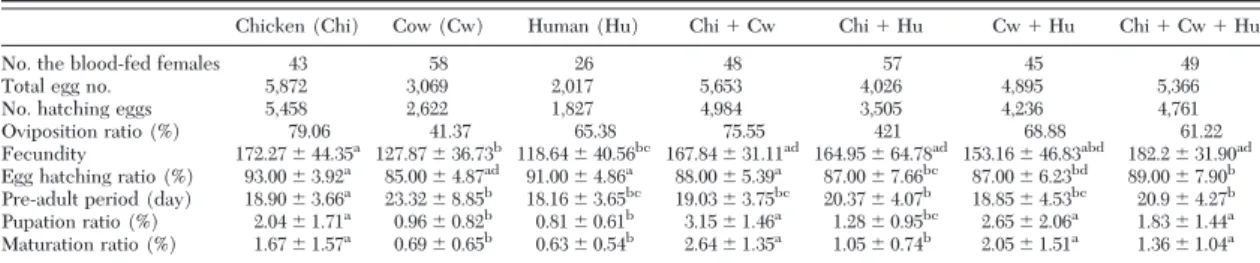
Table 1 shows the results from blood-feeding treat-ments. Oviposition rate was varied across the blood-meal sources and most favored by chicken bloodblood-meal and chicken⫹ cow double bloodmeal (mean ⫽ 79.06 and 75.55%, respectively). However, the groups of mosquitoes fed with cow bloodmeal and chicken⫹ human double bloodmeal had the least number of individuals that oviposited (mean⫽ 41.37 and 42.1%, respectively). Fecundity varied signiÞcantly across bloodmeal sources (Table 1). It was signiÞcantly higher in mosquitoes fed on double and multiple hosts
compared with be fed on single hosts accept chicken (Table 1). Egg hatching rate in the mosquitoes was gen-erally high (between 85 and 93%), where it was differed signiÞcantly across some bloodmeal sources (Table 1). Preadult period was differed signiÞcantly across some bloodmeal sources (Table 1), where it was signiÞ-cantly longest in mosquitoes fed on cow bloodmeal (23.32⫾ 8.85 d) and chicken ⫹ human double blood-meal (20.37 ⫾ 4.07 d). Pupation rate was differed signiÞcantly across some bloodmeal sources and was higher in mosquitoes fed on chicken⫹ cow double bloodmeal and human ⫹ cow double bloodmeal (mean ⫽ 3.15 and 2.65%, respectively). Maturation rate was signiÞcantly lower in mosquitoes fed on cow, human, and chicken⫹ human bloodmeal (Table 1).
Discussion
Our results show that a bloodmeal source affects reproductive output in laboratory-reared Cx. theileri populations. These Þndings agree with previous re-ports that show a strong positive correlation between a bloodmeal source and mosquito reproductive output especially fecundity (Clements 1992, Islam and Fer-dousi 1999, Richards et al. 2010, Oleyemi et al. 2011). Fecundity, pupation rate, and maturation ratio in mos-quitoes that took a single chicken bloodmeal or a double or mixed bloodmeals were higher than in fe-males fed on a single cow or single human blood.
According to Briegel and Horler (1993), multiple bloodmeals improve reproductive success and may be reproductive enhancement strategy in Anopheles spp. Our results are in agreement with Briegel and Horler (1993). Similar Þndings about the positive correlation between multiple bloodmeals and reproductive suc-cess reported in Aedes albopictus (Skuse) by Xue et al. 2009. Multiple feeding not only increases the mosquito fecundity but also increases the risk of pathogen trans-mission because of multiple host contacts by an in-fected mosquito during a single gonotrophic cycle.
Fecundity was signiÞcantly higher in Cx. theileri mosquitoes fed on single chicken than in mosquitoes fed on single cow or human. A similar inßuence of chicken blood on fecundity and fertility rates of Culex pipiens quinquefasciatusSay was reported by Richards et al. 2010. In addition, Culex tarsalis Coquillet showed higher fecundity when fed on chickens compared with guinea pigs or snakes (Downe and Archer 1975).
Chicken blood contains nucleated blood cells, while mammalian blood contains anucleated cells, which has been hypothesized to inßuence fecundity that nucle-ated cells contain more nutrition (Bennett 1970, Downe and Archer 1975). Also, these results may be derived from the difference of the energetic costs of digestion. These costs would include secretion of en-zymes, the metabolism of the blood components, the excretion of the toxic by-products, and the heat in-crement of feeding (Clements 1992). Even if the base nutritional value of blood from different host sources is similar, the energetic costs of digesting it might not be. Blood digestion requires a substantial expenditure of energy; the metabolic rate of the mosquito Cx. tarsalis,for example, doubles when it is consuming blood in comparison with when it is consuming sugar water (Gray and Bradley 2003). The time required to digest blood can also vary among host species; for example, Cx. tarsalis digests the blood of its preferred chicken hosts at a faster rate than it digests blood from rodents (Downe and Archer, 1975). Thus, these Þnd-ings maybe because of different rates of digestion and nutrition for different blood sources.
However, the energy cost of digestion is not the only parameter that determines energetic efÞciency of foraging and ultimately of host selection by a par-asite. Other expenditures associated with foraging ac-tivities include searching for the host, feeding site selection for piercing the skin of the host and obtain-ing a bloodmeal, time required for a bloodmeal, and surviving antiparasitic grooming effort of a host. For example, Bennet, 1970 showed that Aedes aegypti (L.) produced more eggs when fed on avian than fed on mammalian even though it primarily is a human feeder. Even though these artiÞcial bloodmeal deliv-ery systems are an important tool for laboratory stud-ies where the use of animals is not possible, these studies should consider that the bloodmeal source, whether delivered via animal or artiÞcial method, may affect physiological processes leading to reproduction in laboratory colonized mosquitoes and could inßu-ence results. In addition, these laboratory studies gen-erally did not include all host species that the target mosquito fed upon in nature and/or only looked at one component of mosquito Þtness, which may not be indicative of their total lifetime reproductive success. Overall, this is the Þrst experimental study about the inßuence of bloodmeal sources on reproductive
out-Table 1. Results from the blood-feeding experiments
Chicken (Chi) Cow (Cw) Human (Hu) Chi⫹ Cw Chi⫹ Hu Cw⫹ Hu Chi⫹ Cw ⫹ Hu
No. the blood-fed females 43 58 26 48 57 45 49
Total egg no. 5,872 3,069 2,017 5,653 4,026 4,895 5,366
No. hatching eggs 5,458 2,622 1,827 4,984 3,505 4,236 4,761
Oviposition ratio (%) 79.06 41.37 65.38 75.55 421 68.88 61.22
Fecundity 172.27⫾ 44.35a 127.87⫾ 36.73b 118.64⫾ 40.56bc 167.84⫾ 31.11ad 164.95⫾ 64.78ad 153.16⫾ 46.83abd 182.2⫾ 31.90ad
Egg hatching ratio (%) 93.00⫾ 3.92a 85.00⫾ 4.87ad 91.00⫾ 4.86a 88.00⫾ 5.39a 87.00⫾ 7.66bc 87.00⫾ 6.23bd 89.00⫾ 7.90b
Pre-adult period (day) 18.90⫾ 3.66a 23.32⫾ 8.85b 18.16⫾ 3.65bc 19.03⫾ 3.75bc 20.37⫾ 4.07b 18.85⫾ 4.53bc 20.9⫾ 4.27b
Pupation ratio (%) 2.04⫾ 1.71a 0.96⫾ 0.82b 0.81⫾ 0.61b 3.15⫾ 1.46a 1.28⫾ 0.95bc 2.65⫾ 2.06a 1.83⫾ 1.44a
Maturation ratio (%) 1.67⫾ 1.57a 0.69⫾ 0.65b 0.63⫾ 0.54b 2.64⫾ 1.35a 1.05⫾ 0.74b 2.05⫾ 1.51a 1.36⫾ 1.04a
Summarized results from three replicates are shown for each treatment. Values followed by same superscript letter in a row are not signiÞcantly different at P⫽ 0.05 level of signiÞcance.
put of the potential West Nile vector Cx. theileri. These results should be considered of interest in transmission of West Nile virus by Cx. theileri. West Nile virus is a zoonotic pathogen that is primarily transmitted between birds and mosquitoes, particularly Culex species, and is also transmitted to mammals, including horses and humans (Kramer and Bernard 2001, Campell et al. 2002). In Europe, West Nile virus circulation exhibits rural and urban cycles of transmission. Because avian population distribution has a critical inßuence in West Nile virus transmission and rural foci of West Nile infections are mainly situated in wetland ecosystems (river deltas or ßood plains), wild and domestic birds in these areas are the main reservoirs that may amplify the virus spread by migratory birds (Malkinson and Banet 2002).
The sampling area included sites located along the Aras River and Kars Plateau. This area is on the way of one of the worldÕs biggest bird migration routes and every year millions of birds migrate from Russia and Caucasus to Middle East and Africa using the river deltas, ßood plains, or lakes in this region as resting and mating areas. When we consider the higher repro-ductive success of Cx. theileri that fed on chicken blood and multiple hosts, we suggest that this mos-quito may play an important role in amplifying West Nile virus in this bird migration region. As Cx. theileri is a vector organism for West Nile virus and co-occur with potential host species in the same region, the importance of this bird migration area is critical. Therefore, the vectorial capacity of Cx. theileri and potential risks of spreading West Nile virus arising from bird migration should be considered and moni-tored more carefully in the future in the study area.
Acknowledgments
This research was conducted according to principles stated in the “Guide for the Care and Use of Laboratory Animals.” This study is a part of B.D. Ph.D. thesis.
References Cited
Abul-Hab, J. 1967. Larvae of culicine mosquitoes in North
Iraq. Bull. Entomol. Res. 57: 279 Ð284.
Aitken, T.H.G. 1954. The Culicidae of Sardinia and Corsica
(Diptera). Bull. Entomol. Res. 45: 437Ð 494.
Alcaide, M., C. Rico, S. Ruiz, R. Soriguer, J. Muno˜z, and J. Figuerola. 2009. Disentangling vector-borne
transmis-sion networks: a universal DNA barcoding method to identify vertebrate hosts from arthropod bloodmeals. PLoS One 4: e7092.
Aldemir, A., H. Bedir, B. Demirci, and B. Alten. 2010. Biting
activity of mosquito species (Diptera: Culicidae) in the Turkey-Armenia border area, Ararat Valley, Turkey. J. Med. Entomol. 47: 22Ð27.
Azari–Hamidian, S., M. R. Yaghoobi–Ershadi, E. Javadian, M. R. Abai, I. Mobedi, Y. M. Linton, and R. E. Harbach. 2009. Distribution and ecology of mosquitoes in a focus
of diroÞlariasis in northwestern Iran, with the Þrst Þnding of Þlarial larvae in naturally infected local mosquitoes. Med. Vet. Entomol. 23: 111Ð121.
Becker, N., D. Petric´, M. Zgomba, C. Boase, C. Dahl, J. Lane, and A. Kaiser. 2003. Mosquitoes and their control.
Klu-wer Academic/Plenum Publishers, New York.
Bennet, G. F. 1970. The influence of the blood meal type on the fecundity of Aedes aegypti (Stegomyia) L. (Diptera:
Culicidae). Can. J. Zool. 48: 539 Ð543.
Briegel, H. 1990. Metabolic relationship between female
body size, reserves, and fecundity of Aedes aegypti. J. In-sect. Physiol. 36: 165Ð172.
Briegel, H., and E. Horler. 1993. Multiple blood meals as a
reproductive strategy in Anopheles (Diptera: Culicidae). J. Med Entomol. 30: 975Ð985.
Briegel, H., T. Gut, and A. O. Lea. 2003. Sequential
depo-sition of yolk components during oogenesis in an insect, Aedesaegypti (Diptera: Culicidae). J. Insect Physiol. 49: 249 Ð260.
Clements, A. N. 1992. Development, nutrition and
repro-duction. I. In The biology of mosquitoes. Chapman & Hall, London, UK.
Downe, A.E.R., and J. A. Archer. 1975. Effects of different
bloodmeal sources on digestion and egg production in
Culex tarsalisCoq (Diptera:Culicidae). J. Med. Entomol. 12: 431Ð 437.
Edman, J. D., and A.E.R. Downe. 1964. Host-blood sources
and multiplefeeding habits of mosquitoes in Kansas. Mosq. News 24: 155Ð160.
Gray, E. M., and T. J. Bradley. 2003. Metabolic rate in female
Culex tarsalis(Diptera: Culicidae): age, size, activity, and feeding effects. J. Med. Entomol. 40: 903Ð911.
Harbach, R. E. 1988. The mosquitoes of the subgenus Culex
in southwestern Asia and Egypt (Diptera: Culicidae). Contrib. Am. Entomol. Inst. 24: 1Ð240.
Islam, M. S., and Z. Ferdousi. 1999. Effect of bloodÐmeals
from different vertebrates on the reproductive attributes in the mosquito Culexquinquefasciatussay (Diptera: Cu-licidae). J. Asiat. Soc. Bangladesh Sci. 25: 315Ð325.
Jupp, P. G., B. M. Mclntosh, and R. G. Brown. 1966.
Labo-ratory transmission experiments with West Nile and Sind-bis viruses and Culex (Culex) theileri Theobald. S. Afr. J. Med. Sci. 31: 95Ð97.
Kramer, L. D., and K. A. Bernard. 2001. West Nile virus in
the western hemisphere. Curr. Opin. Infect. Dis. 14: 519 Ð 525.
Malkinson, M., and C. Banet. 2002. The role of birds in the
ecology of West Nile Virus in Europe and Africa. Curr. Top. Microbiol. Immunol. 267: 309 Ð322.
Marshall, A. G. 1981. The ecology of ectoparasitic insects.
Academic, London, United Kingdom.
Mather, T. N., and G. R. DeFoliart. 1983. Effect of host
blood source on the gonotrophiccycle of Aedes triseriatus. Am. J. Trop. Med. Hyg. 32: 189 Ð193.
Mclntosh, B. M., P. G. Jupp, D. B. Dickinson, G. M. McGil-livary, and J. Sweetnam. 1967. Ecological studies on
Sindbis and West Nile viruses in South Africa. I. Viral activity as revealed by infection of mosquitoes and sen-tinel fowls. S. Afr. J. Med. Sci. 32: 1Ð14.
Munoz, J., S. Ruiz, R. C. Soriguer, M. Alcaide, D. S. Viana, D. Roiz, A. Vazquez, and J. Figuerola. 2012. Feeding
pat-terns of potential West Nile virus transmission vectors in Southwest Spain. PLoS One 7: e39549.
Oleyemi, I. K., A. T. Ande, G. Danlami, and U. Abdullahi. 2011. Inßuence of blood meal type on reproductive
per-formance of the malaria vector, Anopheles gambiaes. s (Diptera: Culicidae). J. Entomol. 8: 459 Ð 467.
Oso´rio, H. C., L. Ze´–Ze´, and J. M. Alves. 2012. Host-feeding
patterns of Culex pipiens and other potential mosquito vectors (Diptera: Culicidae) of West Nile virus
(Flavi-viridae) collected in Portugal. J. Med. Entomol. 49: 717Ð 721.
Prasad, R. S. 1987. Nutrition and reproduction in
haema-tophagous arthropods. Proc. Anim. Sci. 96: 253Ð273.
Ramos, H. C., H. Ribeiro, C. A. Pires, and R. A. Capela. 1977.
Research on the mosquitoes of Portugal (Diptera, Culic-idae). II-The mosquitoes of the Algarve. Ann. Inst. Hyg. Med. Trop., 5: 237Ð256.
Richards, S. L., S. L. Anderson, and S. A Yost. 2010. Effects
of blood meal source on the reproduction of Culex pipiens
quinquefasciatus(Diptera: Culicidae). J. Vector Ecol. 37: 1Ð7.
Roitberg, B. D., and I. Gordon. 2005. Does another blood
meal-fecundity curve, curve? J. Vector Ecol. 30: 83Ð 86.
Santa-Ana, M., M. Khadem, and R. Capela. 2006.
Naturalin-fection of Culex theileri (Diptera: Culicidae) with
Diro-filaria immitis(Nematoda: Filarioidea) on Madeira Is-land, Portugal. J. Med. Entomol. 43: 104 Ð106.
Schaffner, F., G. Angel, B. Geoffroy, J. P. Hervy, A. Rhaiem, and J. Brunhes. 2001. Les moustiquesdO˜ Europe (The
mosquitoes of Europe), CD-ROM. Institut deRecherche pour Development/EID MediterraneÕ e. Montpellier, France.
Scott, T. W., and W. Takken. 2012. Feeding strategies of
anhropophilic mosquitoes result in increased risk of pathogen transmission. Trends Parazitoloji. 28(3): 114 Ð 121.
Scott, T. W., G. G. Lorenz, P. H. Amerasinghe, P. Reiter, J. D. Edman. 1993. Detection of multiple blood feeding in
Aedes aegypti (Diptera: Culicidae) during a single gonotrophic cycle using a histologic technique. J. Med Entomol. 30: 94 Ð99.
Simsek, F. M. 2004. Seasonal larval and adult population
dynamics and breeding habitat diversity of Culex theileri Theobald, 1903 (Diptera: Culicidae) in the Golbasi Dis-trict, Ankara, Turkey. Turk J. Zool. 28: 337Ð344.
Taylor, P. J., and H. Hurd. 2001. The inßuence of host
haematocrit on the blood feeding success of Anopheles
stephensi:implications for enhanced malaria transmission. Parasitology 122: 491Ð 496.
Xue, R. D., and J. D. Edman. 1991. Multiple blood feeding
of mosquitoes and inßuencing factors, a review, pp. 137Ð 155. In Y. -X. Yu (ed.), Contributions on blood-sucking dipterous insects, vol. 3. Shanghai Science & Technology, Shanghai, PeopleÕs Republic of China.
Xue, R. D., J. D. Edman, and T. W. Scott. 1995. Age and body
size effects on blood meal size and multiple blood feeding by Aedes aegypti (Diptera: Culicidae). J. Med Entomol. 32: 471Ð 474.
Xue, R. D., D. R. Barnard, and A. Ali. 2009. Inßuence of
multiple blood meals on gonotrophic dissociation and Fecundity in Aedes albopictus. J. Am. Mos. Control Assoc. 25: 504 Ð507.