HAL Id: inria-00501882
https://hal.inria.fr/inria-00501882
Submitted on 13 Jul 2010
HAL is a multi-disciplinary open access
archive for the deposit and dissemination of
sci-entific research documents, whether they are
pub-lished or not. The documents may come from
teaching and research institutions in France or
abroad, or from public or private research centers.
L’archive ouverte pluridisciplinaire HAL, est
destinée au dépôt et à la diffusion de documents
scientifiques de niveau recherche, publiés ou non,
émanant des établissements d’enseignement et de
recherche français ou étrangers, des laboratoires
publics ou privés.
Component based approach using OMNeT++ for Train
Communication Modeling
Juan-Carlos Maureira, Paula Uribe, Olivier Dalle, Jorge Anaya, Takeshi Asahi
To cite this version:
Juan-Carlos Maureira, Paula Uribe, Olivier Dalle, Jorge Anaya, Takeshi Asahi. Component based
approach using OMNeT++ for Train Communication Modeling. ITS-T 2009, INRETS, Oct 2009,
Lille., France. �inria-00501882�
Component based approach using OMNeT++ for
Train Communication Modeling
Juan-Carlos Maureira
‡, Paula Uribe
‡INRIA - Sophia Antipolis
Email:{jcmaurei, puribejo}@sophia.inria.fr
Olivier Dalle
INRIA - Sophia Antipolis Email: [email protected]
Takeshi Asahi
†, Jorge Amaya
†Center for Mathematical Modeling Universidad de Chile
Email:{tasahi, jamaya}@dim.uchile.cl
Abstract—This paper reports on our experience in using OMNeT++ to develop a network simulator focused on railway environments. Common design problems are analyzed, making emphasis on radio communication models. Scalability issues are raised when modeling the large topologies that are associated with railway communications. Our conclusions point out that model reusability must be reinforced and that a component-based design must be adopted in order to build a tool for generating valuable performance results.
Index Terms—OMNeT++, discrete event simulation, modeling, train communication
I. INTRODUCTION
Building network simulations is a complex problem because networks involve numerous layers and technologies, and tak-ing into account all this complexity in simulation models often results in too much computational complexity. Abstraction is a common process to reduce the system complexity, enabling an easier implementation of the model and reducing computation costs. Nevertheless, the risk of this practice is to neglect sensitive details that may drive researchers to misleading conclusions. Therefore, a difficult problem is to decide how much abstraction is required to obtain usable results from a network simulated model. In a railway context, where wireless communication could be used to provide train to ground connectivity, this problem is even more difficult, since wireless communication is more complex to be modeled in simulations. In this paper, we report on our experience and conclusions about the requirements when developing a network simulator focused on railway environments. Our discussion is based on the experience we gained developing network simulations in the context of the InteGRail project, using the OMNeT++ simulator. While this network simulator is useful to get a rough idea about railways communications with several networking technologies, we realize that, to obtain valid results using simulation, a more careful approach must be used. In this work, we evaluate the relevance of using a particular network modeling framework, the INET Framework, designed atop the OMNeT++ simulator. This framework provides wired and wireless models, as well as higher level protocols such as IP, TCP and UDP. We review its characteristics in order to
‡On leave from CMM - Universidad de Chile.
†These co-authors have been supported by FONDAP and by Basal
CONICYT-Chile Program.
This work has been partially done as a part of InteGRail, Project PL 012526, European Commission, VI Framework Program.
evaluate all the required elements to model a railway scenario, in terms of radio communications, protocols, scalability and mobility.
This paper is organized as follows: in the next Section, we provide a short description of OMNeT++ and we describe its companion INET network modeling framework. In Section III we analyze the railway networking scenario within the simulation context, putting emphasis on the radio model requirements needed to obtain valid results; we also analyze scalability issues when large topologies are simulated, with special emphasis in mobility issues. In Section IV, we summa-rize our first experience in building a simulation model focused on railway scenarios and, finally, in Section V, we contrast our first experience against our current experience in simulating networking system in railway scenarios, converging to this component based approach to model train communication systems.
II. OMNET++ANDNETWORKMODELS
In this section, we briefly describe the OMNeT++ simu-lation framework. Following, we discuss the INET network modeling framework and its main features. In particular, we discuss the INET current validation status, based on the literature and our own experience.
A. The OMNeT++ Simulator
OMNeT++ [1] is a C++ based discrete event simulator designed to model communication networks and distributed systems. It allows to simulate models in which the entities communicate with each other by means of messages. These entities are implemented by means of component and may have a hierarchical structure. The model of the system is spec-ified using a proprietary, rich featured, architecture description language, called NED. This language allows the specification of a system in terms of simple modules (atomic systems), com-pound modules (composed by other atomic/comcom-pound mod-ules), and a set of gates/links handling the communications between these modules. The communication between modules is ruled by a channel model, allowing a customizable repre-sentation of the message exchange. Additionally, it provides an extensible instrumentation of atomic modules and channels, allowing the gathering of data (series of measurements-vectors and scalars values - metrics) during the simulation. The behaviour of atomic modules and channels is implemented in
C++ by extending the OMNeT++ object hierarchy class tree. It supports experiment setup and replication. The Random Num-ber Generator (RNG) is also customizable, having as default the Mersenne Twister RNG, which uses the MT19937 RNG by Makoto Matsumoto[2]. The Linear Congruential Generator (LCG32)[3] is also available. OMNeT++ also provides an optimistic parallel simulation[4] kernel, allowing to scale the simulation to large models by means of partitioning the system (the set of components) along different CPUs. It is worth to mention that to simulate a system in a parallel way, the RNG must be revisited in order to generate a unique sequence of random numbers for all the processors[5].
B. Networking Models
OMNeT++ has gained popularity in the last few years when studying networking problems. A variety of public-domain models have emerged from this popularity: the INET Framework, MiXiM[6] and the Mobility Framework (MF), just to mention a few. Currently, the INET Framework is the only networking model, from the models built on top of OM-NeT++, that provides several high-level networking protocols (Applications, IP, TCP, UDP, among others), in addition to the wired and wireless physical layers provided by MiXim and MF as well. The results delivered by the high-level protocols and wired physical layer seems to be reasonable when compared to simple real experimentation. However, their validity still needs to be further evaluated for complex models. Regarding wireless physical layer model, a heedful review must be done. When modeling radio communications in simulation, several false axioms are usually assumed [7]. Postulates such as the
world has a flat surface, the propagation radius is circular and the communication is symmetrical are some of them. Nevertheless, some of these postulates may affect simulation results more than others, depending on how the propagation, interference and reception models reflect them. INET’s inter-ference model is represented by an additive model, considering all the on-going transmissions to calculate the SNR along the packet reception. Thus, an SNR vector is evaluated to determine when a packet (or part of it) is lost due to a low SNR. The INET’s default propagation model is the classical
Free Space Pathloss model, but the Two-ray (with ground reflection) model is also included. Additionally, Zitterbart et al.[8] have introduced probabilistic propagation models, but into the Mobility Framework model, not in the INET model. However, these models could be adjusted to be used in INET as well. Regarding the INET’s propagation model, it assumes a circular propagation area and symmetrical communications1 by default. But, nowadays, there are some INET’s branches that are already supporting asymmetric communication and interference-dependent coverage area. An important element of the INET’s radio model is the Channel Controller module. This module is an abstraction of the radio channel communi-cation, being in charge of representing the radio propagation between nodes, providing all the required information for radio
1”If you hear me, I can hear you”
devices (PHY module) to use the interference and reception model, and keeping records of all the on-going transmissions in a certain time.
There are not many studies in the current literature2 that
focus on the validation of INET radio models. In [9], the authors present an empirical validation of the MF radio model in the context of Wireless Sensor Networks (WSN). In [10], the author compares the accuracy of the MF 802.11 radio model against Bianchi’s theoretical model[11]. Nevertheless, we highlight the work presented by Bredel and Bergner[12] on the accuracy of the IEEE 802.11g radio model in INET. They drove an extensive measurement study on a highly controlled environment (almost interference free), measuring metrics like throughput, delay and packet inter-arrival time. They contrasted these metrics against similar ones obtained from simulating the same scenario. They pointed out that results on throughput and delay were statistically similar for long observation times in most of the cases they studied. But, they noticed a difference on the packet inter-arrival time distribution, evidencing differences on the packet scheduling policy. These differences could invalidate studies where this kind of metric is relevant, such as rare event problems, or short observation times. Finally, regarding the interference model accuracy, we can mention the work presented in[13], where the authors attempt to improve the INET’s additive interference model by including real traces of wireless packets in order to generate an interfering background traffic, achieving an interaction between the simulated system and an external scenario, characterized by the packet traces.
Summarizing, in our experience, the INET Framework pro-vides a reliable and extensible implementation of applications and protocols, reasonably modeled down-to the data-link layer. However, we acknowledge that the physical layer, specially radio models, could (and should) be always been questioned due to its level of abstraction in radio propagation, interference and reception models. In this matter, we can say that the validation of the INET Framework is still an open issue. However, the previously presented works are a good signal of how reasonable are the results produced by the INET Framework when simulating long periods of time, such as a train trip. Additionally, it is also reasonable to consider real interfering scenarios by including packet traces into the simulated scenario.
III. NETWORKING IN ARAILWAYSCENARIO
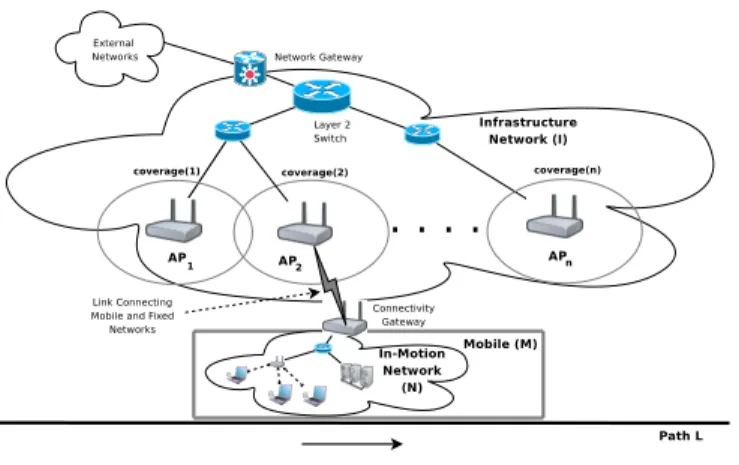
Within a railway scenario, we define “networking” as the need to exchange traffic between an in-motion network (on-board the train) and a fixed infrastructure network. The Fig.1 helps to depict the scenario.
Several ways to address this communication issue are pro-posed: Satellites, UMTS 3G, Wifi, WiMax, or a combination of them, where each solution presents its corresponding ad-vantages and disadad-vantages. Studying such solutions experi-mentally is feasible, but not as easy as simulations.
Fig. 1. The Railway Scenario
The most common networking problem in this scenario is the so-called Handover Problem. In the Fig.1, the gateway device placed on-board the mobile M must switch the link from one AP(i) to the next one while M is traveling along the path L. When a single technology is used, this problem is known as Horizontal Handover, while between different technologies, it is called Vertical Handover. In the following, we analyze the radio model, mobility issues, and scalability constraints of INET when studyng these kinds of problems in a railway scenario.
A. Radio Models
Radio models are usually described in terms of three main components: propagation, interference and reception models. Modeling accurately all of them is computationally too expensive and, on the other hand, an over-simplified model may lead to misleading conclusions based on non-realistic representations. As stated in the previous section, the INET networking model provides a basic and extensible radio model, which is composed by: two propagation models (the Free Space Pathloss model and the Two-Ray model); an additive interference model (capable of handling collisions by adding the transmission power of all the coexisting wireless communications to the received power); and a reception model (capable of calculating the BER according to the BPSK, 16-QAM and 256-16-QAM modulation techniques). The validation of these models was already discussed in the II-B section.
In order to describe in more detail the network within a railway simulated scenario, we first list some of the main characteristics:
• Large simulation times (Train trips usually take hours). • Large geographical areas are traversed by the train; • The in-motion network (on-board) connects to the fixed
infrastructure network through a wireless link;
• Usually, the train travels at high-speed (over 120 Km/h); • The infrastructure network is placed close to the train
path and is assumed to be internally connected by a combination of wireless and wired links, depending on the distance to the backbone nodes;
• Traffic exchange between the in-motion network and the
external networks is bi-directional;
• Metrics commonly used are the overall system
through-put, end-to-end delay and connection continuity. In this context, since the studied metrics are related to the overall system performance, our experience told us that every possible error induced by the physical radio models is negli-gible compared to the potential misestimations caused by the
Media Access Control Methods (MAC), handover algorithms or even the infrastructure network topology. Therefore, as a first step we propose to focus the design and the implemen-tation of the simulator on a more accurate description of the MAC and the handover algorithms, instead of implementing an extremely detailed radio physical layer model, such as ray-tracing methods[14].
Towards the analysis of our approach to radio modeling, we will refer to the IEEE 802.11 radio technology, focusing on interference and mobility issues. For this case of study, there are two possible scenarios: urban, where the interference is high and the mobility is low, and sub-urban, where the interference is low and the mobility is high. In the first scenario, real traces of interfering traffic can be injected to the simulation[13], so as to achieve a better model reflecting reality. Also, the Free Space Pathloss model is able to describe the radio propagation properly, since the IEEE 802.11 Access Points are assumed to be located close to the railway, avoiding obstacles between the train radio and the infrastructure. On the second scenario, studies presented in [15], [16] and [17] have shown successful wireless connections with a single AP, when the mobile is traveling up-to 180 Km/h, without modifying the IEEE 802.11 protocol. Thus, the only issue is the handover frequency at high-speed, that is currently being studied.
Finally, we emphasize that buggy MACs or handover algo-rithms could produce bigger errors on simulation results than radio models.
B. Mobility
Train Mobility is one of the easiest issues to solve in OMNeT++. However, it must be analyzed carefully, since it does not follow exactly the same constructors as wireless host mobility. Wireless mobility is normally related to providing movement (linear, constant speed, circular, grid, etc.) to a host that contains wireless devices. Obviously, a parallel can be established between the host and the train, since both have wireless devices communicating with a fixed infrastructure network. But, wireless mobility elements by themselves are not sufficient to describe a train mobility in all its nature. Elements such as variable speed (including full stops), in-tersections (when several routes are present), and railway network topologies are required to depict completely a railway scenario.
We define train mobility as the description of a train route within a Railway Network. The Railway Network is composed by a set of single railway paths connected each other by means of intersections. Along each single railway path, the train must be able to change its speed, or even make a full stop
for a certain duration (i.e. at a train station). Additionally, at an intersection, the train must be able to decide which path it must follow in order to follow its route. Thus, all these concepts must be reflected into the simulated scenario in a comprehensible and scalable way.
We propose two new modules within the simulated railway scenario: the RailwayScenarioManager and the
RailwayMobil-ity. The first one is in charge of describing the railway network, providing the intersections and railway topology. This module is placed inside the simulated playground (similar to the
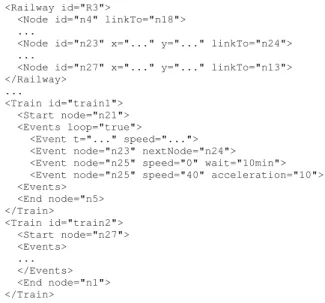
ChannelController), since its operation is related to the whole simulation scope. On the other hand, the RailwayMobility module is placed inside each train, being in charge of moving the train along the railway and processing pre-defined events such as the variation of the speed or the decision of the route. Figure 2 depicts the placement of these modules within the simulation scenario.
Fig. 2. RailwayScenarioManager and RailwayMobility placement within the simulated scenario.
The RailwayScenarioManager builds a railway network rep-resentation based on an input XML-file defining each railway path by means of geo-referenced, unique-id nodes sequence (as is shown in the figure 2). Intersections are described using common node-ids in multiple single paths. It is worth to mention that a node requires to be geo-referenced only one time. The RailwayMobility Module uses the same XML-file to define the starting point of the train on the network and a sequence of events affecting the train route, such as speed changes or routing decisions. The input XML-file looks like this:
<Railway id="R1">
<Node id="n1" x="..." y="..." linkTo="n2"> ...
<Node id="n4" x="..." y="..." linkTo="n5"> ...
<Node id="n8" x="..." y="..." linkTo="n1> </Railway>
<Railway id="R2">
<Node id="n9" x="..." y="..." linkTo="n10"> ...
<Node id="n13" x="..." y="..." linkTo="n14" linkTo="n15"> ...
<Node id="n14" x="..." y="..." linkTo="n23"> <Node id="n17" x="..." y="..." linkTo="n5"> </Railway>
<Railway id="R3">
<Node id="n4" linkTo="n18"> ...
<Node id="n23" x="..." y="..." linkTo="n24"> ...
<Node id="n27" x="..." y="..." linkTo="n13"> </Railway> ... <Train id="train1"> <Start node="n21"> <Events loop="true"> <Event t="..." speed="..."> <Event node="n23" nextNode="n24"> <Event node="n25" speed="0" wait="10min"> <Event node="n25" speed="40" acceleration="10"> <Events> <End node="n5> </Train> <Train id="train2"> <Start node="n27"> <Events> ... </Events> <End node="n1"> </Train>
Railways can be defined as a set of nodes, connected by a set of links (similar to a Directed Graph). Each node has the
linkToattribute, which indicates the next node and therefore, the railway direction. I.e., a train coming from node n14 to node n23, can only follow the n24 direction, since R3 defines an unique direction from n23 to n24. A train coming from n27 to n13, instead, can decide between the n14 and n15 directions.
Each train defines a starting/ending node, and a set of events to be triggered at a certain time (t attribute), or when a certain node is visited (node attribute). Each event can set several parameters at the same time, such as speed and acceleration. There are some train actions that depend on more than one parameter. For example, if we want to indicate a train stop, both, the speed and the wait time parameters must be specified (speed = 0 and wait = 10min, for instance). Otherwise, if only the speed parameter is specified, the train will remain on that node forever.
Events can define cycles, which means that when all the defined events have been triggered, the train can start again, allowing the definition of loops in the train route.
Summarizing, the defined modules and the description lan-guage of scenarios and train events, in conjunction with the mobility features of OMNeT++ can describe fully a railway scenario, with multiple trains/railway networks in an intuitive easy way.
C. Scalability and Large Topologies
Simulated railway scenarios normally involve large topolo-gies and a per-packet detail in order to analyze the overall system performance. These two issues, in conjunction with a fine mobility (in a meter resolution), requires special at-tention when designing a simulator. The amount of events to be handled by the simulation core and the amount of memory involved in representing thousands of objects may lead the simulation study to the infeasibility. In this direction, we analyze the capabilities of OMNeT++ of handling large simulations.
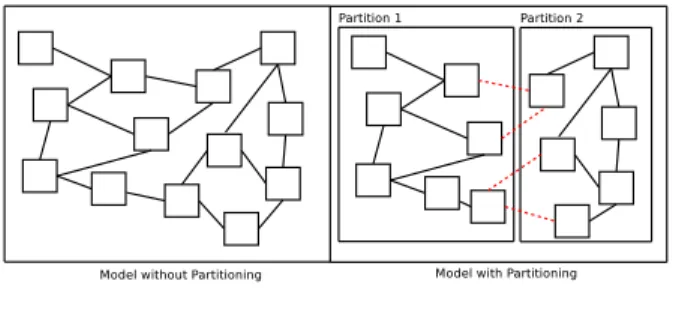
As we mentioned in the section II-A, OMNeT++ is equipped with a parallel simulation kernel. This feature allows to split a large model into “partitions” in order to assign them to different processors. The Fig.3 illustrates the model partitioning. All the links between modules that reside in different partitions (red dashed links) are implemented by OMNeT++ in MPI, providing an efficient way to communicate modules across CPUs.
Fig. 3. Model Partitioning
It is worth to mention three important aspects in model partitioning. One aspect is when parallel simulation is used, a synchronization algorithm must be selected in order to keep synchronized each partition in time, and avoid to execute events in a wrong sequence of time. On this, OMNeT++ pro-vides the Null-Message-Algorithm to synchronize the Future Event Set on each CPU. This is an optimistic algorithm, and it is discussed with more detail in [18]. The other aspect is how to perform partitioning. The natural option is a per-node partition (as is depicted in the Fig.3), but a rol-based partitioning approach can also be used. This approach sets in the same partition all the components that need to be communicated more often, so that, they will use the same RNG to perform randomization of replicas. In this way, we state the third aspect, the RNG in parallel simulations. As we mentioned earlier [5], simulation is about randomization of experiments to be able to study a factor effect on the system. When a single simulation cannot be exactly reproduced with the same RNGs setting, the simulation is not valid. So, when parallel simulation is used, this issue is not easy to solve. Thus, role-based partitioning could be a way to address this problem. Summarizing, large topologies can be simulated and exe-cuted in OMNeT++ within a human time-scale. It is worth to mention that a parallel simulation is not focused on perfor-mance, but on making the experiment runnable.
IV. OUR FIRSTIMPLEMENTEDMODEL
Under the InteGRail project (www.integrail.info), a basic railway communication model was implemented. The main objective of this first implementation was to evaluate in a coarse mode various communication architectures, technolo-gies and algorithms related to railway communication (train to ground and vice verse), without dealing directly with issues like detailed network stack on each particular technology. The simulator design and implementation was focused on providing a very simple and parametric radio model, in order
to emulate radio features implemented on back-end protocols, such as GSM or WiFi by providing a set of parameters and Media Access Methods (TDMA, FTDMA, CDMA), duplexing techniques, Doppler effect, fading channels, multi-Path packet receiving. The simulator was designed to test several network selector algorithms in a multi-technology environment on-board the train, considering parameters such as reception sig-nal and delay to the infrastructure. The simulator is functiosig-nal, although there is no validation of the radio model and it does not consider an interference model. Thus, when evaluating its results on testing a network selector algorithm, we realized that a more accurate modeling of higher protocols such as IP, TCP or UDP is more relevant than the lower physical layers in order to have better results on metrics that the network selector required. Additionally, we realized that the vertical and horizontal handover considered in this simulator may not be sufficiently accurate, since accessing times in GSM networks and OSI layer 3 addressing delays are completely ignored.
In summary, this experience showed us the direction to take when designing simulation models focused on railways environment. Throughout this development, the priorities on the important implementation aspects were clarified when searching a continuous connectivity between an in-motion network and a fixed one. Further efforts, specially when using the INET Framework have reported us more usable results when studying these sort of problems.
V. CONCLUSIONS ANDFURTHERWORK
This paper reports on our experience in using OMNeT++ to develop a network simulator focused on railway environments. While we think that it is very usable, our conclusions can not be extended when using other simulators. Thus, our conclusions are two-fold: on one side, what we learned from experience in terms of simulator design; and on the other side, how we can exploit this experience for future designs of network simulators in railway communication studies.
Our first experience on designing a network simulator focused on railway environments has shown several important points to consider. First, the simulation tool must provide various abstraction levels in order to address the model from multiple points of view. Second, radio models are important, but errors induced by them might not be so important, com-pared to those induced by higher level algorithms, such as MAC algorithms, handover algorithms or transport protocols. Third, to represent the train mobility, extra elements are required in order to depict correctly common train behaviours, such as train routes, speed changes, stops and intersections. Fourth, scalability of the model is important to simulate large scenarios over long simulated times and to generate representative results of the overall system performance.
Towards the accomplishment of all these points, we have realized that the reusability of models is a requirement. Implementing all the OSI networking layers in order to have the required elements to properly describe a railway scenario is an enormous effort, in terms of time and experimentation.
Model reusability could help us to provide an already validated network model, and to extend it, to implement the extra ele-ments required to model our scenario. This way, we can focus on modeling the communication within a railway scenario, rather than on having a suitable networking model.
Going further in this direction, we realized that OMNeT++ provides all the simulation constructors to properly support the model abstraction and scalability issues above mentioned. Furthermore, the INET networking model is robust and exten-sible enough to allow us to implement all the extra elements and to replace simulation components if needed in order to build a simulator centered on a railway scenario.
This component-based approach, in conjunction with OM-NeT++ and INET, has being used in other studies related to railway scenarios, achieving good results, from the model development and use points of view, when measuring the overall system’s performance.
Some additional work can be done by studying the model partitioning when large scenarios are involved. We propose that the role-based partition approach would be reasonable when solving the partitioning, but the RNG issues and the cost of the communication between a large number of distributed CPUs is clearly a field to address as further work.
VI. ACKNOWLEDGMENTS
The authors would like to thank everyone who helped us to write this paper. This work was partly founded by the IST-FET AEOLUS project and CONICYT Chile.
REFERENCES
[1] A. Varga and R. Hornig, “An overview of the omnet++ simulation environment,” in Simutools ’08: Proceedings of the
1st international conference on Simulation tools and techniques for communications, networks and systems & workshops, ICST, Brussels, Belgium, Belgium, 2008, pp. 1–10. [Online]. Available: http://portal.acm.org/citation.cfm?id=1416222.1416290
[2] M. Matsumoto and T. Nishimura, “Mersenne twister: a 623-dimensionally equidistributed uniform pseudo-random number genera-tor,” ACM Trans. Model. Comput. Simul., vol. 8, no. 1, pp. 3–30, 1998. [3] D. E. Knuth, Art of Computer Programming, Volume 2: Seminumerical
Algorithms (3rd Edition) (Art of Computer Programming Volume 2). Addison-Wesley Professional, November 1997.
[4] T. Phan and R. Bagrodia, “Optimistic simulation of parallel message-passing applications,” in PADS ’01: Proceedings of the fifteenth
work-shop on Parallel and distributed simulation. Washington, DC, USA: IEEE Computer Society, 2001, pp. 173–181.
[5] C. J. K. Tan, “On parallel pseudo-random number generation,” in ICCS
’01: Proceedings of the International Conference on Computational Sciences-Part I. London, UK: Springer-Verlag, 2001, pp. 589–596. [6] A. K¨opke, M. Swigulski, K. Wessel, D. Willkomm, P. T. K. Haneveld,
T. E. V. Parker, O. W. Visser, H. S. Lichte, and S. Valentin, “Simulating wireless and mobile networks in omnet++ the mixim vision,” in
Simu-tools ’08: Proceedings of the 1st international conference on Simulation tools and techniques for communications, networks and systems & workshops. ICST, Brussels, Belgium, Belgium: ICST (Institute for Computer Sciences, Social-Informatics and Telecommunications Engi-neering), 2008, pp. 1–8.
[7] D. Kotz, C. Newport, R. S. Gray, J. Liu, Y. Yuan, and C. Elliott, “Ex-perimental evaluation of wireless simulation assumptions,” in MSWiM
’04: Proceedings of the 7th ACM international symposium on Modeling, analysis and simulation of wireless and mobile systems. New York, NY, USA: ACM, 2004, pp. 78–82.
[8] A. Kuntz, F. Schmidt-Eisenlohr, O. Graute, H. Hartenstein, and M. Zit-terbart, “Introducing probabilistic radio propagation models in omnet++ mobility framework and cross validation check with ns-2,” in Simutools
’08: Proceedings of the 1st international conference on Simulation tools and techniques for communications, networks and systems & workshops. ICST, Brussels, Belgium, Belgium: ICST (Institute for Computer Sci-ences, Social-Informatics and Telecommunications Engineering), 2008, pp. 1–7.
[9] U. M. Colesanti, C. Crociani, and A. Vitaletti, “On the accuracy of omnet++ in the wireless sensornetworks domain: simulation vs. testbed,” in PE-WASUN ’07: Proceedings of the 4th ACM workshop
on Performance evaluation of wireless ad hoc, sensor,and ubiquitous networks. New York, NY, USA: ACM, 2007, pp. 25–31.
[10] B. Jang, “Wireless mac protocol design and analysis,” PhD in Computer Science, INorth Carolina State University, 2009.
[11] G. Bianchi, L. Fratta, and M. Oliveri, “Performance evaluation and enhancement of the csma/ca mac protocol for 802.11 wireless lans,” in
Personal, Indoor and Mobile Radio Communications, 1996. PIMRC’96., Seventh IEEE International Symposium on, vol. 2, Oct 1996, pp. 392– 396 vol.2.
[12] M. Bredel and M. Bergner, “On the accuracy of ieee 802.11g wireless lan simulations using omnet++,” in Simutools ’09: Proceedings of the 2nd
International Conference on Simulation Tools and Techniques. ICST, Brussels, Belgium, Belgium: ICST (Institute for Computer Sciences, Social-Informatics and Telecommunications Engineering), 2009, pp. 1– 5.
[13] J.-C. Maureira, O. Dalle, and D. Dujovne, “Generation of realistic 802.11 interferences in the omnet++ inet framework based on real traffic measurements,” in Simutools ’09: Proceedings of the 2nd International
Conference on Simulation Tools and Techniques. ICST, Brussels, Belgium, Belgium: ICST (Institute for Computer Sciences, Social-Informatics and Telecommunications Engineering), 2009, pp. 1–8. [14] F. Aguado Agelet, A. Formella, J. Hernando Rabanos, F. Isasi de
Vicente, and F. Perez Fontan, “Efficient ray-tracing acceleration tech-niques for radio propagation modeling,” Vehicular Technology, IEEE
Transactions on, vol. 49, no. 6, pp. 2089–2104, Nov 2000.
[15] R. Gass, J. Scott, and C. Diot, “Measurements of in-motion 802.11 networking,” in Mobile Computing Systems and Applications, 2006.
WMCSA ’06. Proceedings. 7th IEEE Workshop on, Aug. 2006, pp. 69– 74.
[16] J. Ott and D. Kutscher, “Drive-thru internet: Ieee 802.11b for ”automo-bile” users,” in INFOCOM 2004. Twenty-third AnnualJoint Conference
of the IEEE Computer and Communications Societies, vol. 1, March 2004, pp. –373.
[17] T. Tse, “Study of high-speed wireless data transmissions for railroad operation,” Federal Railroad Administration - Office of Research and Development, Tech. Rep. RR07-10, April 2007.
[18] A. Varga, A. Y. S¸ekercio˘glu, and G. K. Egan, “A Practical Efficiency Criterion for the Null-Message-Algorithm,” in Proceedings of European