PEOPLE’S DEMOCRATIC REPUBLIC OF ALGERIA
MINISTRY OF HIGHER EDUCATION AND SCIENTIFIC RESEARCH
University Abdelhamid Ibn Badis – Mostaganem
Faculty of Letters and Arts
Department Of English
Submitted by: Benmostefa Salima Supervised by: Dr. Aoumeur Hayat
Dissertation submitted in fulfillment of the requirements of Master’s Degree
in Sociolinguistics and Gender Studies
Board of Examiners
Mm. Heirech Faiza President University of Mostaganem Mm. Bendoukha F. Zohra Examiner University of Mostaganem
Academic Year: 2016/2017
Title
Sexism in EFL Textbooks
An Analysis of ‘Spotlight’ the Third Year Middle School
Textbook
I
Dedications
I would especially like to thank my ever supportive and loving mother and so grateful for my father’s continuous motivation. Together, they are the solid foundation on which I was and am still
able to stand.
I simply cannot forget to pass thanks my friends especially Malika and Nassima for their assistance throughout this undertaking, and
II
Acknowledgments
So much has happened throughout the process of preparing this work and while looking back at previous papers and resources, I see how amazing the journey has been. I could not have done it without the experiences of peers, supervision of teachers, and support from my family and friends.
A special thank goes to my supervisor Dr. Aoumeur Hayat for her guidance and support. She has allowed me the luxury of being able to proceed with my work. Thank you for the meticulous care you showed in reading my work at various stages of its development.
Finally, I want to thank Sociolinguistics and Gender Studies’ teachers for offering me the delightful occasion to continue my Master studies throughout this wonderful major, which opened my eyes towards several issues.
III
Abstract
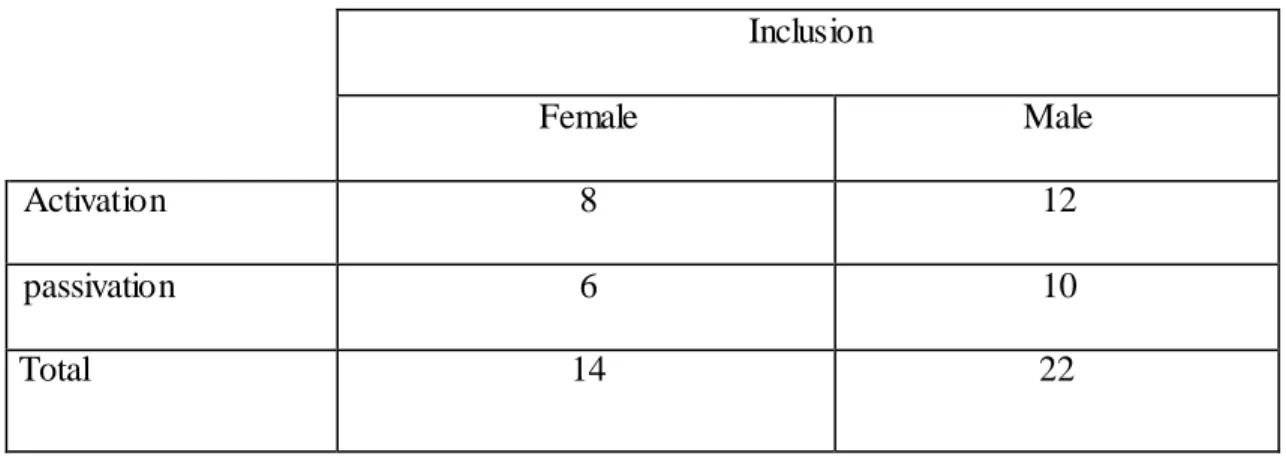
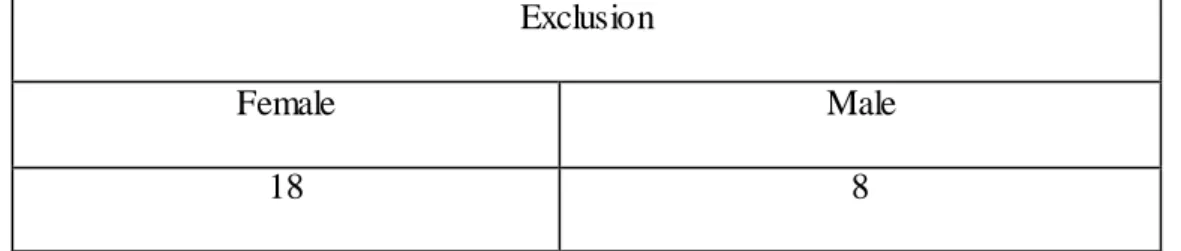
With the rising interest in gender studies, several studies were made especially in academic discourse to investigate gender bias in language, since this latter in no more considered as simply a means of communication. In spite of the claims that efforts are made and significant procedures are taken to realize the dream of gender equality. Biased educational materials in one way or in another still exist. There was a worthy background which indicated that the language used in textbooks transmits gender bias over women. In this connection, this study adds an interesting further proof that highlight the sexist quality of schoolbook language by using Van Leeuwen’s sociosemantic approach which encompasses several categories in order to depict how woman is portrayed. Findings show that the number of female’s inclusion in activities is nearly the half of male’s inclusion. Furthermore, the marginalization action faces female more than two times of the amount of male elimination. Concerning visibility, also women are less visible and are nominated with labels which carry a negative impression. Nevertheless, there were other terms which are opposed to the findings and give a positive credit to women such as positive adjectives and action verbs. Likewise, female representation as active member was more than passive member, and also females’ names precede males’ ones in some passages.
IV
List of Abbreviations:
CDA Critical Discourse Analysis
CL Critical linguistics
SFL Systematic Functional Linguistics
FCDA Feminist Critical Discourse Analysis
WHO World Health Organization
V List of tables:
3.1. Table 1: the male and the female inclusion
3.2. Table 2: the male and female exclusion
3.3. Table 3: the male and female visibility
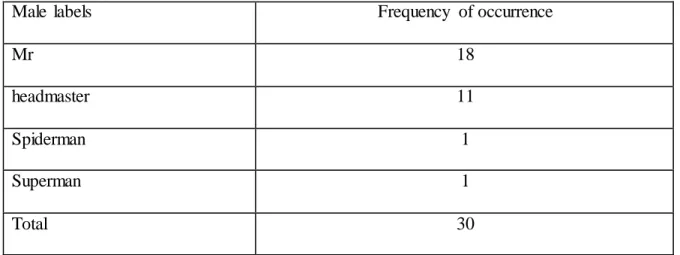
3.4. Table 4: frequency of occurrence of male labels
VI
Contents
Dedications……….……….I Acknowledgments………..………...………..II Abstract………..………..…………...…III List of Abbreviations………..IV List of Tables………V Contents………….………..……….………...…….VI General Introduction……….……….………...………….……….1Chapter One: Literature Review
1.1. Introduction………..………..…31.2. Background……….………...3
1.3.Critical DiscourseAnalysis: overview…..……….…...7
1.3.1.Aims of CDA ………..……….………...10
1.3.2.Principles of CDA………...10
1.4. Gender in Discourse …...………...………...11
1.4.1. Feminist CDA ………..12
1.4.1. Problematizing of the Concepts of Sex and Gender………...……..13
1.4.2. Gender Roles. ………..….………16
1.5. Power Relations in Discourse………...………17
1.5.1. Feminist Post-stucturalist Discourse Analyses (FPDA) ...………17
1.6. Ideology in Discourse ………..……….………19
1.6.1. Gender Ideologies ……….………21
1.7. Conclusion………..………...22
Chapter Two: Sexism in English 2.1. Introduction………..23
2.2. Sexism in Language……….23
2.2.1. Sexism in English Language……….24
VII
2.4. Forms of Sexism in English……….……….………27
2.4.1. Titles for Males and Females.………...…………..………27
2.4.1. Titles for Males and Females…..………..28
2.4.2 Generics ………28
2.4.3 Adding a Modifier to an Occupational Noun………28
2.4.4. Formulating Feminine Nouns by Adding Suffixes………..29
2.4.5. Sexual Connotations………..30
2.4.6 Negative Impression………...31
2.5. Factors of Sexism in English ……….…32
2.5.1. Religious Factor…………..………..32
2.5.2. Physiological Factor……….…32
2.5.3. Social Factor……….………33
2.5.4. Psychological Factor………33
2.6 Conclusion………..34
Chapter Three: Van Leeuwen Model and Sexism 3.1. Introduction……….33
3.2. Methodology………33
3.2.1. The corpus of study………..33
3.2.2. The research Tool……….33
3.3. Theoretical Model of the Study………..34
3.3.1. Exclusion………..34
3.3.2. Inclusion………34
3.3.2.1. Activation/passivation………34
3.3.3. Adjectives………..35
3.3.4Visibility/ Famous figures……….………….…….….35
3.3.5. Order of mention …………..………35
3.4. Data analysis and findings………...….37
3.5. Discussion of the findings……….……...40
VIII
3.7. Conclusion………43
General Conclusion ………..…………45 Bibliography
General
General Introduction
1
We as social beings are in need of a governed and conventional system called language to deal with our peers. So far, language was seen simply as device to deliver information, and cannot be studied as a separated branch. However, De Saussure and Chomsky changed this view towards language by creating an approach which studies it as a detached discipline and as a system of signs. Studies developed over and over, by the 1970 it emerges a new creative branch which is Critical Discourse Analysis (CDA) which gave another dimension for the study of language. In other words, CDA is concerned mainly with language as an instrument to convey social control and procedures. The last advance made in language studies is the marriage between Feminist movement and Critical Discourse Analysis to give birth to feminist critical discourse analysis (FCDA) which is a new moderated version of CDA made by feminists. It tries to apply CDA from a feminine angle.
Since the middle of the 70s, the connection between language and gender has been a main interest within women's movement. One of the debatable points raised by the branch of FCDA is sexism in language, which shows gender bias that a speaker or a writer makes while using a language. Sexism can reach women as well as men; however, Feminism as a movement shed light on sexism mainly against women, and neglect sexism against men. Feminist researchers resisted against patriarchy and masculine control over women that is present in language since this latter is said to be man-made. Nevertheless, though the passing of decades of feminist awareness-raising, sexism in language still exist, and its existence is due to societal gender bias.
As a social phenomenon, language is associated with social attitude that is why reducing sexism in language leads us to overcome gender inequality, this motivates me to investigate sexism in academic discourse since this latter is a very influential instrument
General Introduction
2
which engraves and naturalizes gender bias, hence, evaluating them offers a chance for change towards the better. In this connection, the following research objectives are put forwards:
1. Does sexism exist in EFL textbooks?
2. If yes, to what extent sexism exists in academic discourse particularly in EFL 3rd year secondary school textbook?
school textbooks are seen as an instrument of educating as well as teaching the cultural norms that govern each society to the new generations, in addition to that patriarchy still exist in Algerian culture. Therefore, based on the given factors, my hypothesis is that sexism in English language exists in EFL third year secondary school textbook.
This work will be conducted throughout three chapters. ‘Literature review’ is the first section in which you came across a background which incorporates significant former studies about sexism in textbooks, and highlights several concepts such as critical discourse analysis, gender and power relations. ‘Sexism in English’ is the second chapter which clarifies the issue of sexism. This section revolves around definition of sexism, its forms and factors. Finally, the third chapter is an analytical section in which the emphasis is put on the analysis of some passages taken from Algerian EFL third year middle school textbook by using Van Leeuwen model of sociosemantic.
Chapter
One
Chapter One Literature Review
3
1.1. Introduction
Contemporary studies of sociolinguistics, from the late 20th century forward paid more attention to the study of gender as a field of investigation, moving from the general concept of sex to the specific notion of gender. This shift paved the way for interesting and remarkable studies which shed light on other aspect of social issues, and gave birth to other notions such as sexism which is the reflection of societal thought and ideologies throughout language, be it academic or nonacademic. Sexism is the central point of this paper, in this later the first chapter begins by laying out the theoretical dimensions of the research and former studies done in the same area of investigation, besides an overview of critical discourse analysis provided simultaneously with other related concepts.
1.2. Background
Since the 90’s forward researchers have been interested in criticizing EFL/ESL textbooks, as a contributor in the socialization process, for the interference of cultural and social biases. They examine gender bias that may exist in EFL textbooks; this issue has recently brought zeal among researchers. Quite a lot of researchers after conducting their research found that textbooks were used as a tool to propagate and transfer cultural and social biases. While a variety of investigations in the topic of sexism have been suggested, this paper will use the study first suggested by Babaii and Ansary (2003) who examined to which extent English language is sexist in two teaching textbooks: the first edition of Right Path to English as well as the second edition (Birjandi & Soheili, 1999) which are generally designed for Iranian secondary school students. They found out that sexism exist in these two textbooks so that they can be considered as sexist; the fact that leads to constructing a restricted and indefensible depiction of females in the mind of EFL students in Iran. Also, Amal Saleh, Sajjadi, and Yarmohammadi (2006) inspected the manner of
using language in the Iranian EFL textbooks of high school by using the framework of van Leeuwen (1996) and Halliday’s model of transitivity (2004). Outcomes of this study revealed the ignorance of females in those textbooks. Furthermore, the amount and the nature of activities which classify and plan the involvement of either males or females were considerably unalike in the sense that customary roles as care giver or as the doer of the indoor domestic chores were frequently connected with the women. Correspondingly, parallel conclusions were deduced in different contexts also. For example, Tietz (2007) examined around nineteen textbooks, eight of them were ‘financial accounting textbooks’, the other eight were ‘managerial accounting’ ones, and the last three textbooks were of principles. They were addressed to the US student of college level. She came up with the result that the appearance of male characters is more than female characters in textbooks. Additionally, women were portrayed as passive and locate more often in house setting; whereas men were depicted as active and exist mostly in ‘occupational positions’. As an extension to what has been stated before, in Jordanian context, Hamdan (2008), Tietz (2007), and Mukundan and Nimehchisalem (2008) conducted a study to analyze the nine most important features of gender. They point out that
visibility in photos and illustrations, visibility in the text at the level of word and sentence, topic domination, jobs and occupations, firstness, grammatical function (e.g., subject), attributed personal traits (e.g., adjectives), leisure-activity types, and masculine generic conception in Action Pack Series from Grade One to Nine taught in the basic stage schools in Jordan. (Hamdan, 2008)
Hamdan discovered that in the nine investigated aspects, the illustration of males is more numerous when comparing with females.
Lately, Davatgarzadeh and Sahragard (2010) studied the third edition of reading texts of Interchange by using CDA viewpoint in order to examine the linguistic depiction of female and male as social actors and of gender identities construction. Results exposed that the woman was represented as “powerful social actors” and her location was not more often related to house and domestic settings. In the same context, Yaghoubi and Jahan (2012) devoted a study about conversations in the four volumes of the third Edition of the Interchange series. Remarkably, the results found were diverse from the former ones; that of Davatgarzadeh and Sahragard (2010). They pointed out that representation of gender in conversations would be portrayed equally with regard to the percentage of talks, conversation opening, total of words per turn, and complication of discourse across female and male contributors in the discussions. Finally, Birjandi and Amini (2012) tested sexism using four categorizations of “visibility, firstness, generic masculine vocabulary, sex-linked occupations”. Their conclusions ensure the existence of sexism in high school English textbooks of Iran.
Ghorbani (2009, p. 4) mentioned that Cincotta (1978, p. 60), on the association between gender identity and bias in textbooks, stated that the influence of standard French textbook on sex-role construction can be clarified through a small number of examples which accompany children along their career of the formal education. Hartman and Judd (1978, pp. 384-385) made a survey of many TESOL textbooks and discovered that “women suffered from low visibility”. They calculated the sex-related “proper names, titles or non-generic pronouns” and indicated in the results that, generally, the total of male mentions is more than the female’s ones. As an example, the percentage of female and male mentions in one of the accounts that Judd and Hartman studied was 37% for females and 63% for males. They also reported that stereotypical gender roles associated with women mostly turn around household and babysitting. Women’s house chores were
presented in terms of preparing food, doing laundry, and changing diapers. On the other hand, men were portrayed repairing the car, clipping the lawn and/or changing electrical bulbs. In their conclusion they indicated that since the phenomenon of sexism is brought into English language, there is no doubt that textbooks, counting ESL writings, copy this practice for the students (p. 390) and it continue propagating and reinforcing the inferiority of women’s rank and could which can be avoided with only a slight energy, "(p. 390). Hellinger (1980) put three ELT textbooks under examination and scrutinized 131 passages. She discovered that over 93% of the passages are associated with male characters. The same study revealed that 80% of the participants in the speaking process were males with small contribution of female within "serious, successful, or important" exercises and roles, and men were frequently displayed in occupational roles. She as well stated that “presence of intellectual or other achievements of women are ignored, downgraded or described as exceptional.”(p. 250). Carroll and Kowitz (1994, p. 69) conducted a research which revealed how sexism explicitly exist in EFL/ESL writings. According to their conclusions, they pointed out that "male pronouns are more common than female pronouns, ranging from 2.55 – 3.85 to 1". Correspondingly, from the twenty two adjectives that they examined, they found out that eighteen of them were allocated to men, whereas merely nine of them were allocated for women. And the adjectives that were used to describe woman and men together were only six.
The first part of the present chapter delivers a literature review of extensive studies conducted by several researchers in several contexts upon the issue of sexism in EFL as well as ESL textbooks, by using critical discourse analysis (CDA) as an instrument which helps to depict such practice. CDA is an approach which is interested in uncovering the real truth hidden under the surface of the linguistic form.
1.3. Critical Discourse Analysis: Overview
Recent linguistic series of studies led to the emergence of CDA which has turn out to be the common label for a special methodology to the study of writings and speech, which is interested in the association of society with discourse, so it is problematic-oriented rather than structure-problematic-oriented.
Bukhari and Xiaoyang (2013) stated that in the early 1980s, a collection of linguists and literary theorists at the University of East Angelia played a central role in the emergence of CDA which is derived from critical linguistics (CL) (Fowler et. al., 1979; Kress & Hodges, 1979). CL’s major concept was Systematic Functional Linguistics (SFL) brought by Halliday. (CL) was a starting point for (CDA). The Critical Linguists started to use CL as an investigation process (Fowler et. al., 1979; Fowler, 1991). Trew a specialist of CL, initiated to isolate ideology in speech, and to unveil the manifestation of ideology and ideological practices as a ‘system of linguistic characteristics and process’. This objective accelerates the development of CL’s analytical implements based on (FSL) (Fowler et. al., 1979; Fowler, 1991). Halliday (1978) assumed that language indicates three functions; ideational, interpersonal, and textual. The ideational function discusses the speakers’ experiences and familiarity of the world and its phenomena, while the interpersonal function intended to integrate the behavior of the speaker and his or her assessment of the phenomena called into question, and to create an association between the producer and the receiver of discourse. The third function could be regarded as instrument for the two former functions. The textual function of language allows the speakers to construct writings which are realized by receivers. Moreover, textual function permits to establish the connection between the structural form of discourse and the co-text and con-text in which it took place (Fairclough, 1995b).
Critical discourse analysis can be regarded as an academic tool to challenge wrong social believes, as well as to go beyond the classical archaic views of the structural components of language. As Deborah Tannen (2015) pointed out that CDA may be considered as a response against the dominant formal often “asocial” or “uncritical” paradigms of the 1960s and 1970s, for instance in structural and generative linguistics as well as later text grammars and Conversation Analysis”. CDA is analytical research discourse which principally studies the manner ‘social-power abuse and inequality’ are legitimized, naturalized, and reproduced by talk and text in the political and social settings. With such rebellious enquiry, critical discourse specialists take a categorical stance and hence want to comprehend, interpret, and eventually rebel against social unfairness. This is the reason why CDA may be categorized as a ‘social movement of politically committed discourse analysts’.
More specifically, according to Bukhari and Xiaoyang (2013), Djik (1998) claimed that Critical Discourse Analysis (CDA) is a discipline which the linguist uses to analyze the inscribed and vocal discourses in order to investigate the comprehensive sources of ‘power’, ‘dominance inequality ‘and ‘bias’. It gives a critical evaluation of how these digressive sources are preserved and repeated within particular political, social, and historical situations. Furthermore, Fairclough’s view in 1999 is that CDA is a discourse analysis which intended to systematically discover usually ambiguous connections of causality and determination between (1) digressive ‘events’, practices and writings, and (2) broader cultural and social constructions, processes and associations; in order to examine how these texts, exercises, and events reveal power and ideologically portray the associations of fights over strength; and how they unveil the opaqueness of these attachments between ‘discourse’ and ‘society itself’ as an instrument for safeguarding authority and supremacy. In simple words, CDA’s intention is to uncover or to make
transparent the hidden connections between ‘discourse practices’ and social structures, so that any layperson can recognize. The history of CDA reveals that it witnessed several theoretical developments for instance Van Djik (Socio-Cognitive Model), Wodak (Discourse Sociolinguistic), Leeuwen (Social Semiotics Model) and Fairclough (Critical Discourse Analysis).
Lehtonen (2007) montioned that according to Jørgensen and Phillips (2004) from social and cultural theory perspective, CDA is distinguished by its intention towards an attentive linguistic reading of writings. Additionally, CDA is interested in the association between writings and socio-cultural settings, according to Fairclough (1989) the word ‘critical’ in the naming of this method designates an approach that pursues showing up the associates that might be veiled from other people, for instance the associations which occur among language, power and ideology (cited in Sunderland and Litosseliti 2002). Moreover, CDA, unlike purely linguistic models, is built upon the idea that discourse text analysis alone is not satisfactory; as it does not celebrate the connections merely among writings, structures, and societal and cultural processes; therefore there is a call for an interdisciplinary perception which establish the combination of social and textual analysis. (Lehtonen, 2007)
1.3.1. Aims of CDA
CDA successfully attracted the attention of researchers, and becomes a significant instrument of research in the field of social investegations because of its usefulness as a connector of discourse asocial and mainly political discourse. Dijk (2015) developped the following overall objectives of critical studies on discourse:
It emphasizes first and foremost on social issues and political concerns rather than the simple study of the structural shaping of discourse apart from their social and political frame.
More specifically, CDA is analytical research discourse which principally studies the manner ‘social-power (dominance) abuse and inequality’ in society are legitimized, naturalized, and reproduced by talk and text in the political and social settings.
“The aim of CDA is to identify, through analysis, the particular linguistic, semiotic and inter-discursive features of texts, which are all part of processes of social change.” (Østergaard, 2004, p.7)
Østergaard (2004) mentioned that one of the major interests of CDA is to uncover the relation of discourse with power relations, that is to say that analysis search for realizing how discourse is utilized to exercise power. In other words to find answers for these questions; how is the discourse placed or standing? Whose benefits this standing is serving? Whose benefits are excluded? What are the outcomes of this standing?
1.3.2. Principles of CDA
CDA have several principles which were summarized by Fairclough and Wodak (1997 as follow
1 CDA addresses social problems.
2 Power relations are discursive.
3 Discourse constitutes society and culture.
4 Discourse does ideological work.
6 The link between text and society is mediated.
7 Discourse analysis is interpretative and explanatory.
8 Discourse is a form of social action. CDA addresses social problems.
CDA is a modern approach of analyzing and interpreting the hidden ideologies of dominance, discrimination, power and control which are covered by the linguistic form of discourse. This approach played a significant role in many domains especially politics; in which researchers were able to examine and criticize political speeches. One of the interesting fields that CDA contributes in is Gender; since CDA is concerned with social issues and gender starkly turned out to be classified as a social problem because it results of gender inequality and abuse.
1.4. Gender in Discourse:
Associating the study of CDA with the field of gender resulted in the use of CDA as an instrument to depict gender bias since it reveals power relations and ideologies hidden in the authors’ writings. Lazar (2005) pointed out that Dijk (2015) in the book of “critical discourse analysis” stated that one broad field of critical research on discourse and language that primarily was not conducted within a CDA perception is that of gender. In several manners, the work of feminists on discourse has turn out to be model for plentiful CDA; principally since numerous works obviously tackle social inequity and supremacy, to the extent that there is nowadays a branch of feminist CDA. Tannen (1994a, 1994c) provided comparison and discussion with an approach that stresses differences based on culture rather than inequality and power. In Tannen (1994b) it is indicated that several possessions of digressive dominance for an examination of gender variances at work. While investigation on discourse and gender firstly concentrated on the expected
differences between gender groups in writing and conversation (for example using diminutives or tag questions by females), a supplementary critical approach gives an exceptional care to male’s authority and control in conversations, interpreted in particular acts like interruptions and control over topic opening and shift. Contemporary research highlights that gender differences (if any) are carefully correlated to additional features of the “social and communicative context – such as the social class, status, or role of participants (Eckert and Ginet 2003; see also Macaulay 2004; Dijk 2008a)”. By incident, it is notable that, even though critical discourse investigations of race and gender are numerous, there exist at this time very few critical studies on governing and rebellious social-class discourse far from sociolinguistics and stylistics (…). Accordingly, Willott, Grifin, and Torrance (2001) demonstrate how crimes of economic criminals of white collar are legitimated in terms of class prestige in a jail context with inferior position prisoners.
1.4.1. Feminist CDA
Lehtonen ( 2007) introduces Feminist CDA as a sub-branch of the wider branch of CDA which has been recently progressed. The fact that leads to the need for feminist CDA According to Lazar (2005 p.2-3) is the neglect and the discard of the analysis of gender by a significant theorists such as Fairclough and Van Dijk, and the application of studies previously conducted in the domain of CDA in gender frame work, in other words; to introduce CDA from feminist perspective in order to give birth to a an innovative
approach. These two approaches overlap in one area which is critical orientation. Feminist discourse analysts have entitled the process of analyzing discourse critically and from a feminist perspective as ‘demystification’ or ‘denaturalization’. Feminist CDA is therefore a political and critical approach which is committed to openly emancipate, raise the
1.4.1.1. Problematizing The Concepts of Sex and Gender
The question of sex or gender was raised in the 20th century because old sociolinguists used the term gender as an equivalent to sex as Archer and Lloyd (2002) revealed in the book of “sex and gender” that even though elder dictionaries indicates that ‘gender’ was only utilized as correspondent to ‘sex’ in a humorous way, it has currently absolutely substituted ‘sex’ in politically accurate discourse, unless it is used with reference to sexuality (such as in ‘the sex act’). Accordingly, when the question is about whether an individual is a man or woman, it is now expected the use of ‘gender’ rather than ‘sex’. Numerous psychologists usually utilize the expression ‘gender differences’ rather than ‘sex differences’. So before defining gender we should frame what is sex, afterwards the difference between sex and gender.
Almost all linguists now agree on the definition of sex as biologically oriented term Newman (2016) brings up the definition of the term “sex” as biological-based differences which classifies people into “males and females” in terms of “genitalia and genetic.” Simply speaking, sex emphasizes biological characteristics which means when we talk about sex we talk about male and female, and about their physical appearance. Carny et-al (2003) pointed out in their book “gender studies, terms and debates” that sex is determined as being natural aspect of any human being. This leads us to deduce that the previous view of sex was that the differences between males and females are natural, in other words, since they are different in their appearance, they are obviously different in any other aspect and never similar.
On the other hand, Newman (2016) provided a study in which he challenged the view of fixedness of sex with another reality which existed and still exist in our society. He mentioned that sometimes an individual is defined genetically to belong to one particular
sex category; either male or female; however he or she adopt non adequate behavior which does not cooperate with his or her genetic sex. It is referred to these persons as “transgender, non-binary or gender-nonconforming.” This leads us to question the notion of ‘gender’, and to what extent it differs from the notion of ‘sex’. To supplement, Mill (2011) proposed in his article ‘Sex difference vs gender difference? Oh I’m so confused’ that “Manual Publication of the American Psychological Association” stated that gender is a social aspect which is retrieved from culture. It is a term utilized to refer to women and men as social groups. On the other hand, Sex is biological. It is used to deliver biological differences as a major feature. Additionally the ‘World Health Organization’ suggested that sex denotes the biological and physiological features which describe men and women, while gender discusses roles, behaviors, activities, and attributes constructed by society which are said to be proper for men and women. Generally speaking, "sex" is biological-based characteristics, unlike "gender" which refers to how persons and society perceive sexuality and the changeable concepts of masculinity and femininity as social factors.
Investigation in the field of gender increased the use of the term gender rather than ‘sex’ because of its fluidity. Archer& Lloyd (2002) indicated that earlier dictionaries provided ‘gender’ solely as corresponding term for ‘sex’. Furthermore, Reeves & Sally Baden (2000) in the book of ‘Gender and Development: Concepts and Definitions’ stated in their article that the early 1970s and the late 1960s witnessed the question and the appearance of the concept of gender progressively in ‘professional literature of the social sciences’ which helps to distinguish features of life as being ‘social rather than biological’. The term gender according to Newman (2016) denotes the view of ‘sexuality’ and the fluid notions of femininity and masculinity in relation to individuals and society. In other words, how society designs masculine and feminine behaviors as separate, nearly opposite to each
other, and changeable. Newman also mentioned the definition of gender given by the World Health Organization (WHO)
"Gender refers to the socially constructed characteristics of women and men - such as norms, roles and relationships of and between groups of women and men. It varies from society to society and can be changed." (Newman, 2016, p. 6)
FCDA aims to challenge expectations and assumptions of gender that are considered as common and taken for granted through demonstrating how these norms are ideological and hide and naturalize power inequality and differential (Lazar 2005, p.7, Sunderland and Litosseliti 2002, p. 19, Talbot 1995, p. 151). The third-wave of feminism and
post-structuralist theories had a great impact on the consideration of the notion of gender from a feminist CDA outlook. Gender comes to be a fluid sphere with numerous variables which is therefore constructed upon a collection of feminine and masculine identities (…) inside and across persons which belong to the same biological category. Discourse partially introduces these identities. (Lazar 2005; Sunderland and Litosseliti 2002) Gender can be regarded as one of many characteristics which contribute in the constructing of identity such as class, age, ethnicity, sexual identity – and with power relationships, accordingly women and men do not adopt gender in similar manners for everywhere (Lazar 2005; Sunderland and Litosseliti 2002). The central concern of feminist CDA is to highlight the empirical investigations, and how gender is essentially resembled in trustworthy texts and settings, As well as the depictions of gender identities and gendered power relations in particular discourse and their precized contexts rather than providing an general theory of gender (Lazar 2005; Sunderland and Litosseliti 2002).
1.4.2Gender roles
In our daily life we as, social beings, can notice that there is a kind of devision of labor between females and males. Gender role is the result of culture and society. It defines the way males and females should think, talk, wear, and behave in any particular context according to a ‘gender schema’ (CliffsNotes, 2016). Approximately said Archer & Lloyd (2002, p. 52), in all famous societies the division of labor exists among men and women. It takes variant forms, even though there are specific mutual subjects (Wood and Eagly, 2001). In the social sciences there is a claim that the source of this social issue is the ideology of patriarchy, and male dominance over women. Newman (2016) illustrated that gender roles appear obviously and severely in patriarchal societies. For example, in Saudi Arabia, the gender role associated with woman is being a housekeeper; she is obedient to men and not given certain liberties for instance driving.
The social role theory of Eagly likewise highlighted that sex variances in personality and attitudes are retrieved from the division of gender roles (Eagly, 1987, 1995a, 1995b; Eagly et al., 2000). These sex variances were considered as a result of a “social structure” which claims to divide the role of males and females into “full-time paid” external job and “unpaid” internal job. Since these roles are designed according to particular different anticipations of “different psychological characteristics”. Once more, these features are shortened as “instrumental for the masculine role and expressive for the feminine role”. (Archer & Lloyd, 2002, p. 53)
1.5.
Power relations in discourse
From the elements that CDA tries to spot is how power is distributed on social actors within a certain text. Balan (2012) stated that commonly, power is recognized as being the capability of an agent to execute his or her desire over the desire of the weak, or
the capability to impose on them to do things they do not have the will to do, in other words, it is a sort of abuse from the powerful over the powerless. In this meaning, power can be acknowledged as proprietorship, as something preserved by individuals who are in powerful status. However, Foucault argued this view and demonstrated that power cannot be possession, but rather something that acts and displays itself in particular manner; it can be seen more likely as a strategy than a ownership, researchers must examine power as something which circulates, or as something which operates only under the form of a chain . . . ‘Power is employed and exercised through a netlike association . . . Individuals are the vehicles of power, not its points of application’.
1.5.1. Feminist Post-stucturalist Discourse Analyses (FPDA)
The association of gender and discourse leads to the emergence of a recent approach to the study of spoken discourse. Feminist post-structuralist discourse analysis is a significant approach which evaluates the importance of gender within discourse in in terms of the challenging and intertextualized ways which the speaker uses to construct his or her identity.
Baxter (2003) declared in her paper “Positioning gender in discourse: a feminist research methodology” that feminist Post-structuralist Discourse Analysis (FPDA) can be identified as 'a feminist approach for studying the ways identities, relationships and positions are negotiated by the speakers themselves in their societies depending on the ways they are positioned by ‘interwoven discourses’. FPDA has two diverse extents: Post-structuralist Discourse Analysis (PDA) and FPDA. The post-Post-structuralist dimension of FPDA is intensely discussed by Foucault's (1972, p. 49) in his assumption that discourses as practices which systematically shape the object they are speaking of. FPDA considers that repetitive verbal communications in the schoolroom, whether formally evaluated or as
part of informal education, are intertwined with a network of social and institutional discourses. According to this assumption, discourses serve as an instrument for establishing the balance of power relations between or among speakers. Therefore, the post-structuralist approach of FPDA demand from researchers to identify the way different forms of discourse operates to position utterers variously in terms of powerful and powerless, and more often the shift from one position to another during brief time. Additionally, the expression of 'powerfully positioned' within a particular conversational context should always be kept to interpretation. FPDA promotes the significance of numerous-authored accounts inside discourse analysis, hence it tolerates challenging perspectives, and creates place for research participants along with those of analysts.
The feminist dimension of FPDA requests analysts to highlight the social classification of gender in terms of the manner in which power relations are made up through verbal communications. It emphasizes the ongoing procedures by which females are portrayed as ‘less powerful than males’ in various learning settings. It also identifies the existence of a certain positions when institutional discourses work in backward ways to portray girls as being submissive and boys as being controllers. Nevertheless, FPDA as an incorporated approach contests any naïve understanding about perceiving girls as helpless fatalities in the classroom. Rather, it suggests that learners of both sex categories embrace several and often opposing ‘subject positions’ as talkers. FPDA proposes that there are certain educational environments or instants in a class when speakers of female category took a more powerful position than male speakers, and the reverse may be accurate in other situations.
Hence, the primary task of FPDA is to focus on crucial discourses on gender as they are conveyed and implemented inside precise, limited situations. It encompasses understanding how challenging discourse portrays speakers as comparatively powerful,
powerless or a mixture of both. It emphasizes instants of power in female contacts with others, while recognizing the remaining intolerant encouragements of particular institutional discourses on gender relations in the schoolroom.
1.6.
Ideology in discourse
Ideology is a widely used term especially in political domain; it generally refers to an arrangement of ideas and beliefs which design a particular group of people. The web site spaknotes (2017) mentioned in the article of “political ideologies and styles, What Is an Ideology?” that an ideology is a group of beliefs that influence our point of view on the world. Therefore, our ideology can be identified as the most closely believed set of principles and emotions, and it is regarded like the screen that precise the way by which we perceive everybody and everything. Indeed, these views are mostly so close to us that we do not recognize that they took place in our lives, we modestly consider our beliefs as being natural and clearly correct. Religion is considered one category of ideology, and religious principles influences individuals’ perspectives.
Additionally Miles (1991) supplemented that an ideology can be recognized as the cognitive device or the central program which produces the set of behaviors that aim at reproducing optimal individuals; both in dominance situations as well as that of struggle ones.
Eckert & McConnell (2003) indicated that ideology can be identified as an arrangement of principles by which people justify, represent, and back up their attitudes, as well as understand and judge those of others.
Bourdieu (1977b) referred to the set of principles and dispositions that are developed by an individual as a product of her or his growing experience in a specific
society as habitus. People anywhere they live will perceive and experience several situations, encounter several people, and augment multiple skills and knowledge. And they will participate in different discussions; listen to different talk and discourses. (…) When we talk about this later, we are referring to a specific account (history) of conversation around one idea or combination of ideas. Accordingly when we speak of a gender discourse, or various gender discourses, we are referring to the functioning of a particular collection of thoughts about gender in some subdivision or subdivisions of society. (Eckert & McConnell, 2003)
1.6.1. Gender ideologies
Eckert & McConnell (2003) mentioned that gender ideology is the set of beliefs that serve at managing contribution of individuals in the gender classification, besides justifying and explaining that contribution. Gender ideologies diversity occurs with regard to such beliefs as the rule which classifies male and female, the origins, the justice, the naturalness. Some people receive and agree on differences as natural, and as justified; or as the compulsory justification of inequality. Ideology, and discourse are indistinguishable (Foucault, 1972), both are transmitter of people’s interest in a certain social situation. Some researchers like Eagleton preserve the notion of ideology for a discourse which occurs in a power struggle settings. Eagleton (1991, p. 8) claims that “A dispute in the breakfast-time between a wife and her husband, the discussion turns around “who exactly allowed the toast to turn that grotesque shade of black” is not necessarily ideological; it is so once, for instance, there exist an engagement of sexual power problems, or gender roles views and so forth.” Gender discourses is not revealed only in obvious speaking about gender. If a group of people joke frequently about men’s ineptness in the kitchen, women’s competence as cooks turned out to be the focal point, along with men’s incompetence in
the kitchen. The fact that these subjects appear in joking lends them an established status – a status as old information rather than as a new topic, naturalizing the relation between gender and kitchen activity. The consequences carry well beyond the home kitchen. Preparing coffee is what is expected from the assistants in a workplace, if the female assistant prepared a bad coffee is expected to be regarded as more incapable than a male assistant. It will be seen as abnormal for a woman to be incompetent to do her “natural” job, whereas, people will excuse the male in the same context and the same circumstances for the reason that he is doing an “unnatural” function. A male who prepare food at home or contributes in taking care of the kid (except being a single father) often receive others empathy and support more than a woman: she is simply performing one her duties while he will be perceived as breaking the norms and doing something beyond the expectations.
1.7. Conclusion
In view of all that has been stated as far as this, one may notice that the first chapter of this research paper involved a large volume of available studies that have recently been conducted within different contexts to examine sexist discourse by means of conceptual and linguistic analyses. The results hold a common view that ESL as well as ESL textbooks incorporate many examples which indicate sexism. Moreover, the present section encompasses an overview about CDA, and how this later contributes in the recent feminist movement as a means of revealing inequality and gender bias, and how CDA leads to the emergence of gender as anew field of investigations by uncovering gender inequality, ideology, and power relation in discourse.
Chapter
Two
Chapter Two Sexism in English
22
2.1. Introduction
As mentioned in the previous chapter, studies in FCDA, in the field of gender, as a research area, offer other perceptions of society members, and delve deeply into details of ideologies and power relations especially between men and women. These studies come up with the results that writings perpetuate gender bias or the so-called sexism in English. This chapter involves overview about sexism in language, and more specifically English as sexist language mainly against women.
2.2. Sexism in Language
“As a phenomenon of society, sexism is reflected through language that expresses bias in favor of one sex and treats the other one in a discriminatory manner” (Mucchi-Faina, 2015). It means that sexism in language is gender bias which means to exclude one gender either men or women when talking about a topic that is related to both sexes. This can happen consciously or unconsciously. When it is unconsciously, the gender bias in language can be reflected to be the product of socialization process. Some people use, repeat, and normalize sexist language until the speaker produces it unconsciously in a situation where men are the norm and women are the "other". Moreover, Holmes (2001) explains that sexism in language is “the way language expresses both negative and positive stereotypes of both women and men”. According to Reeves and Baden (2000), gender discrimination is “the systematic, unfavorable treatment of individuals on the basis of their gender, which denies their rights opportunities or resources”
Chapter Two Sexism in English
23 2.2.1. Sexism in English Language
The history of the development of English language denotes that sexism against women is due to the large contribution of men in the creation of new words as (Lei, 2006) noted in his study “The Sexism in English and Its Rebuilding”, (…) that many male-central expressions with sexist's connotation emerged during the period of English developing. During the 14th century, Chaucer, who is perceived as being ‘the Father of English language’, generated a large amount of terms; afterwards, Milton and Shakespeare competitively created other neologies. They were strongly present in the flourishing movement of English vocabulary, simultaneously; the negative aspect that they full filled English with couldn't be discounted. These well-known male's contribution in English (…), accelerated the widespread transmission of sexism in language (Mucchi-Faina, 2015)
2.3.
Sexism Against Women
In the past women (a word that still means "lesser" in our society, while “man” is a high-status term) have been looked on as the weaker sex, they are supposed to stay at home, viewed as powerless, and generally inferior to men, while this later is regarded as the center in both family and society. To understand better sexism in language against women; Kleinman (2007) indicated that the philosopher Douglas Hofstadter wrote an article in 1986 called "A Person Paper on Purity in Language”, and he makes a comparison of sexist language by establishing an analogy with race. He imagines a fantasy world in which generics are based on ethnicity instead of gender. In this world, it would exist discrimination of color, people would make use of such expressions "freshwhite," "chairwhite" and yes, "you whiteys." Individuals of color (they take the same place as women in the real world) would hear "all whites are created equal" and be estimated to feel
Chapter Two Sexism in English
24
involved. Switching "white" with "man" makes it easy to see why the use of "man" for all human beings is mistaken. However, women are expected to feel pleased by "freshman," "chairman" and "you guys." All around this planet, women are almost hold unequally and her life is given less consideration mainly for the reason of her sexual category, and the distinct “access to power and control in all institutional” world. Inside the family, females may encounter exclusion concerning the distribution of domestic incomes counting food, occasionally pushes to advanced underfeeding and ‘mortality indicators for women’. (…). At its extreme level, gender segregation can lead to the privilege of the son rather than the daughter, conveyed in the act of ‘sex selective abortion’ or ‘female feticide’. In the labor market, they receive unequal salary and occupational segregation or exclusion. The misrepresentation and the absence of women’s voice demonstrate and spread exclusion from “decisions making” authorities in a community or a government, like for instance the “access to public services”, education and “health care” or inequitable regulations. The law keeps propagating gender discrimination, although it is said to be “gender-neutral”, regarding that it is the product of cultural norms which are uploaded by “oppressive gender ideologies”. Even when gender equality ideologies are defended by constitutional or national legal requirements, the preference in practice is given to religious or other ordinary regulations that offer priority to men. Nonetheless, if the law, when transformed with women’s contribution, is joined to other strategies such as capacity-building to overwhelmed boundaries to claiming rights; it can be an effective instrument for challenging discrimination. According to Nordquist (2016) Sexist language also presents stereotypes of both males and females-since stereotypes are consistent mental representation that are commonly held by members of a group and that represents an over simplified belief, intolerant attitude, or trusting judgment-. Sometimes it is used to the give
Chapter Two Sexism in English
25
minus to males, but usually to disadvantage females. This sexism is viewed generally in all languages. In English, Robin Lakoff (1975) provides the example of 'master' versus 'mistress' to highlight the point that there are dissimilar or even unfair connotations that are embedded beyond these two matching terms. 'Master' has strong and powerful connotations, while 'mistress' has a negative and bad impression.
Sexist language also includes the depiction of women in the position of passive object rather than active subject, such as on the basis of their appearance ('a blonde') or domestic roles ('a mother of two') when similar depictions in similar contexts would not be made of men. These representations of women trivialize their lives and place an extra level of personal judgment on them. (Jule, 2008)
Jule wanted to say that women were not allowed to trespass man’s world, their job is to remain passive, take care of the house and nursing children like a serving machine. Consider also the expression ‘house wife’; we never come across the expression house husband. This gives the impression that house management is only woman’s work and never man’s concern. Lakoff (1973), one of the pioneer innovators who use critical discourse analysis to demonstrate discrimination, quite a few years before investigated the way in which women were symbolized in written and verbal English. She discovered that women were marginalized and reflected as helpless at the level of their speaking as well as the way by which they were addressed.
Reeves and Baden (2000) also mentioned CEDAW which is a convention made in 1979, it calls for the eradication of all discriminatory practices, and considered women’s rights as human rights. This was a “key tool” for Feminists to strengthen their “struggle” against
Chapter Two Sexism in English
26
segregation phenomenon, by “pushing governments” to accomplish these internationally acknowledged canons.
2.4.
Forms of Sexism in English
Sexism in language mainly against women take different forms, Lei (2006) explain how this phenomenon can be represented through language. He assumed that such sexual usage of words that refer to female is typical North American English, it exist more than two hundred and twenty words which refer to a “sexually promiscuous woman”, whereas only twenty four terms which refer to “sexually promiscuous men”, and London school children had a full vocabulary list of insult terms for girls, mainly related to sexual comportment, but very little specifically for boys.
2.4.1. Titles for Males and Females
One of the sexist features is when a woman is single her title is ‘Miss’; however when she got married her title will be ‘Mrs’; as if she is the property of the man whom she got married with. In other words, when woman is linked to a man; in any way and whoever was he; she cannot be treated as an independent person, she is considered nearly like the stuff of the house. According to Lei (2006) the reason behind using Mrs and Miss is to show whether she is married or not. What we deduce from this is that woman is considered as sex object, whenever she is single she is an opportunity, while man is called Mr whether married or not. Additionally, Yang ( 2014) supplemented that the label of Mr is used for males without looking for their marital status, however, Mrs and Miss are by tradition designed for females in order to indicate whether they are married or not, with the connotations that Miss is for single females and Mrs is for married ones (Mills & Mullany, 2011). This means that women’s marital status is unequally marked by a number of words
Chapter Two Sexism in English
27
(Sigley & Holmes, 2002). More specifically, Rovano (1991) enhances that using Miss or Mrs denotes a “male-connection”, in other words, “the daughter of or ‘the wife of’ respectively”.
2.4.2 Generics
Also the use of the word “mankind”, stated Lei (2006), to refer to the entire universe of human beings, and the use of gender-specific labels can slightly influence sexism as well as our thought and anticipations about gender roles for the sexes such as Congressman, fireman, doctor, professor, engineer and lawyer to refer to an occupation, women that occupies such kind of jobs were address as 'Sir' or refer to them as 'he' or 'him'. Additionally Holmes and Sigley (2001) brings up the concept of “pseudo-generics” to refer to such form of generics for the reason that they have double meaning, which may make the hearer think that the speaker is referring to males only. Lei added also that supposing as if all the subjects of all sentences in a paragraph are males. If we consider the statement “Each student chose his own topic for his dissertation”; we clearly notice that it leads the reader to recognize that all the students who are concerned with dissertation were males, even though there is a probability that half of them were female.
2.4.3 Adding a Modifier to an Occupational Noun
Litosseliti (2006) explained that this linguistic form of sexism encompasses attaching particular occupational nouns with gendered pre-modifier (e.g. male nurse or woman doctor), which draws a special attention to the sex of that individual It also demonstrates the normality of the inclusion of one sex within particular job as well as the exceptionality of the other sex.
Chapter Two Sexism in English
28
2.4.4. Formulating Feminine Nouns by Adding Suffixes
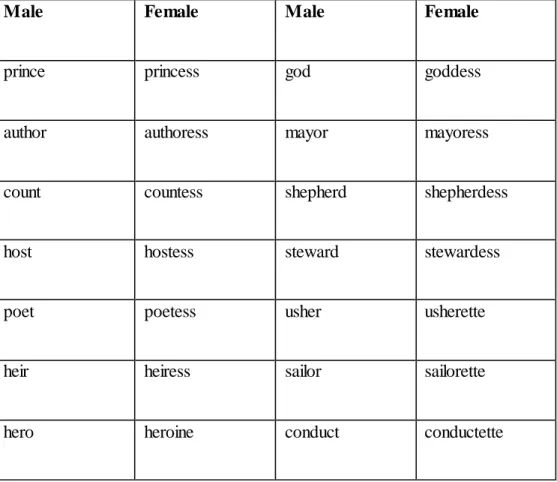
Sexism in language can also be shown when formulating feminine gender nouns which can only be achieved by adding a particular bound morpheme to the masculine noun (Lei, 2006). The table below provides us with more examples:
Table 1: adding a suffix to create female noun
Lei (2006) clarified that generally the suffix “ess” is used to minimize things. So, using it to produce feminine nouns is for the sake of minimizing woman’s status. The word “governor” refers to “a person selected to govern a region or state, while when it is adapted into feminine character, it will be “governess”, and we notice that the role is reduced into nursing. If we consider the act of deriving feminine nouns from masculine ones by only adding suffixes like “ette”, “ess”, and ”trix” we know that women position is dependent or
Male Female Male Female
prince princess god goddess
author authoress mayor mayoress
count countess shepherd shepherdess
host hostess steward stewardess
poet poetess usher usherette
heir heiress sailor sailorette
Chapter Two Sexism in English
29
from men’s status, so that they cannot be independent. Holmes (2001) pointed out that numerous words in English portrays of females as being “deviant, abnormal or subordinate” ( p.306) by taking into account that the male is the norm and the base form and adding suffixes like ‘ess, -ette’, in order to create terms allocated to female, particularly for occupational nouns. The addition of a suffix makes females weakens
females’ professional status and empowered males. (Sigley & Holmes, 2002)
2.4.5. Sexual Connotations
The word “master” signifies “host” while the feminine word “mistress” has the superficial significance “hostess”. Nonetheless in a point of fact, its connotative meaning is lady friend who is utilized as sex object to amuse males at night clubs. In the following sentence “He grew tired of his wife and went out for a mistress”; we will certainly realize that “mistres” can never be his wife (Lei, 2006). As we can notice that mistress and hostess are given sexual connotations. Far from the connotation of a woman who invites people to a celebration for hostess, and a woman who occupies an authoritative position (Yang, 2014)
If we consider the following examples:
a) Mary hopes to meet an eligible bachelor.
b) Bill hopes to meet an eligible spinster
(Lakoff, 1975) claimed that adjectives such as bachelor spinster are viewed differently, spinster is a feminine adjective uploaded by the negative connotations of an unfavorable woman which is getting older without being married, indicating that “she is old unwanted goods”. The fact of being unmarried is generally linked to several reasons like being sick
Chapter Two Sexism in English
30
or being not qualified, while bachelor gives the impression of never loosed man, and an opportunity for any girl. Additionally, Lei (2006) illustrated this form of sexism with other examples such as when the word “tramp” is applied on males, it gives the meaning of a person who is homeless and without job. However, when it comes to females the meaning changes to indicate that she is a prostitute. Moreover, the word “professional” for males refers to a person qualified or skilled in one of the professions. When we say “he is a professional”, he may be supposed to be a boxer, however when we say “she is a professional”, she is probably a prostitute. Also, the expressions “The man in the street” and “The woman in the street” are in the same situation, nonetheless the former one gives the impression that the man is an ordinary person; but the latter one may show that the woman is a prostitute as if the street is reserved only for men and a forbidden place for women.
2.4.6 Negative Impression
The words “man” “woman” “girl” “boy”, we refer to an adult male as man but we refer to a young male as boy. We refer to an adult female as woman, and we refer to a young female as girl. But we can also call an adult female a girl, this may mean that female do not fully grown up may be till they got married means till they became linked to fully grown up person who is man. The word “shrew” derived from the name of a small but especially cruel animal, its definition in Oxford Advanced Learner’s Dictionary is “bad-tempered, scolding woman,” but the term shrewd taken from the same root is defined as “having or showing a right decision and common intellect.” and exemplified by the phrase “a shrewd businessman.” (Lei, 2006)