AI algorithms, price discrimination and collusion:
a technological, economic and legal perspective
Axel Gautier1 · Ashwin Ittoo1 · Pieter Van Cleynenbreugel2 © Springer Science+Business Media, LLC, part of Springer Nature 2020
Abstract
In recent years, important concerns have been raised about the increasing capabili-ties of pricing algorithms to make use of artificial intelligence (AI) technologies. Two issues have gained particular attention: algorithmic price discrimination (PD) and algorithmic tacit collusion (TC). Although the risks and opportunities of both practices have been explored extensively in the literature, neither has yet been observed in the actual practice. As a result, there remains much confusion as to the ability of algorithms to engage in potentially harmful behavior with respect to price discrimination and collusion. In this article, we embed the economic and legal lit-erature on these topics in a technological grounding to provide a more objective account of the capabilities of current AI technologies to engage in price discrimina-tion and collusion. We argue that attendiscrimina-tion to these current technological capabilities should more directly inform on-going discussions on the urgency to reform legal rules or enforcement practices governing algorithmic PD and TC.
Keywords AI · Tacit collusion · Price discrimination · Economics · Competition · Markets · GDPR · Machine learning · Deep learning · Reinforcement learning JEL Classification C · D · K2 · K4 · L
We thank the handling editor and the reviewers for their helpful remarks and suggestions.This research was funded through the ARC grant for Concerted Research Actions, financed by the French-speaking Community of Belgium.
* Ashwin Ittoo [email protected]
Axel Gautier [email protected]
Pieter Van Cleynenbreugel [email protected]
1 HEC Liège, LCII, University of Liège, Liège, Belgium 2 Faculty of Law, LCII, University of Liège, Liège, Belgium
1 Introduction
The advent of artificial intelligence (AI)1 algorithms has opened up a growing
and dynamic area of law and economic research (Van Cleynenbreugel 2020). The increased self-learning and extensive data processing capabilities of these technolo-gies and the potential harm that they can cause to consumers and societal welfare are used as starting points for proposals to modify current legal rules and enforcement practices. It cannot be denied that the increasing amounts of available data coupled with the improvements in AI algorithms can potentially change firms’ behavior in the market. Better knowledge about consumers and the use of AI-enabled pric-ing algorithms may facilitate personalized pricpric-ing by firms. In addition, the better observability and predictability of competitors’ behavior and the ability of AI algo-rithms to react almost instantaneously may facilitate coordination on the market. The two phenomena described above are commonly referred to as algorithmic price discrimination (PD) and algorithmic tacit collusion (TC). In recent years, they have not only received significant attention from the research community but have also been in the limelight of mainstream media.
Price discrimination consists in charging different consumers different prices for the same or similar products. Heightened concerns over algorithmic price discrimi-nation practices are related to the massive volumes of personal data disclosed by consumers online. Compared to traditional demographic data, these data could offer a significantly richer trove of valuable information used by sellers to set prices. AI algorithms could exploit these data to generate accurate profiles of consumers and to acquire a deeper understanding of their purchase behaviors (preferences, needs, or dislikes) (Woodcock 2019). Such information is then incorporated in marketing or pricing applications for personalized prices (and personalized product recommen-dations). It is therefore often posited that the use of AI-enabled pricing algorithms and access to rich datasets of consumer behavior will enable a finer-grained price discrimination. In fact, several models proposed in scientific literature have indeed been shown to be able to price discriminate at a finer degree of granularity (Shiller
2014; Ban and Keskin 2017; Dubé and Misra 2018).
Collusion takes place “when firms use strategies that embody a reward–punish-ment scheme which rewards a firm for abiding by the supracompetitive outcome and punishes it for departing from it” (Harrington 2018). It has been submitted that AI technologies could have the ability to analyze and oversee the market at an unprec-edented scale, scrutinizing competitors’ behavior and making rapid price changes to adapt to the environment (Ezrachi and Stucke 2016). In this context, a commonly proposed hypothesis in the competition policy literature is that over a reasonably long time horizon, by repeatedly interacting with each other and their environ-ment, pricing algorithms can learn how to implement collusive strategies based on 1 Our usage of the term “AI” focuses on machine learning algorithms, which is by far the predominant
form of AI deployed in real-life applications. It also includes econometrics and optimization methods, which are closely related to machine learning and have the similar goal of learning from data or their environment.
reward and punishment schemes, leading to supracompetitive prices. Furthermore, these algorithms would be able to sustain collusive outcomes without human pric-ing intervention. This type of algorithmic collusion, unlike that implemented by traditional cartels, involves no explicit collusive agreement. The algorithms them-selves are neither programmed with the intention of collusion nor biased to favor the formation of cartels. Instead, they adopt a collusive strategy through autonomous decision-making. This is what is referred to as algorithmic tacit collusion (Ezrachi and Stucke 2016). Some of the algorithms proposed in the recent scientific literature can effectively learn how to implement collusive strategies over a sufficiently long period (Calvano et al. 2018b).
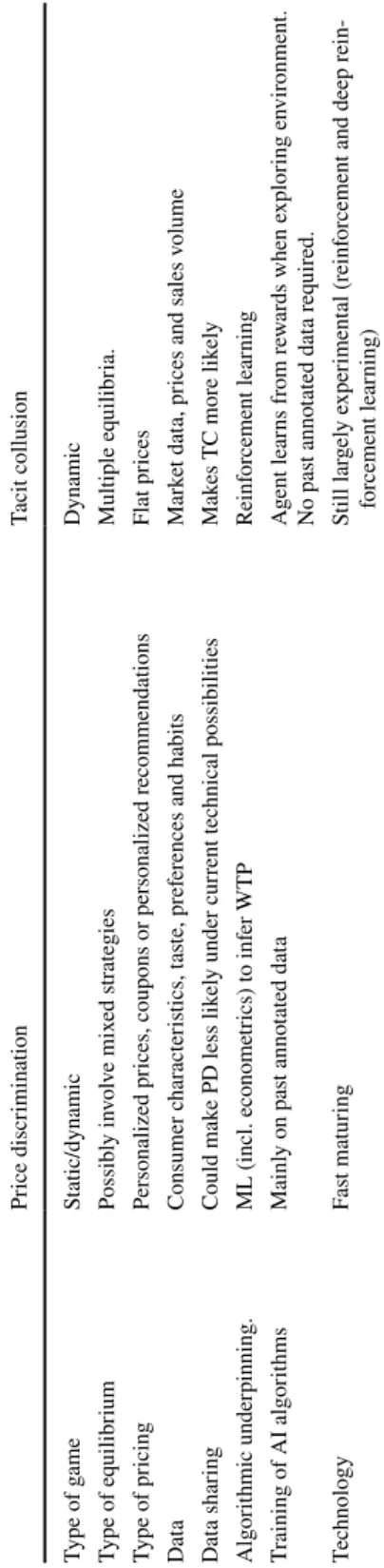
Even though both PD and TC require the intensive use of data and advanced AI algorithms, they will not necessarily emerge on the same type of market. The eco-nomic literature has recognized indeed that PD is not a factor facilitating collusion (Liu and Serves 2007; Colombo 2010; Helfrich and Herweg 2016).
With PD, prices will be closer to the consumer’s willingness to pay (WTP). At the intensive margin, consumers will pay a higher price and have a lower surplus. At the extensive margin, there could be demand expansion and the global impact of PD depends on the relative importance of these two effects. With TC, prices will be supracompetitive, increasing firms’ profits and reducing consumer surplus. As both practices may affect consumers, they call for closer attention from antitrust enforcers or regulatory bodies.
Although the risks and opportunities of both practices have been explored in the literature and in experiments, neither has been observed in practice (real life). As noted by Schwalbe (2019), most studies have addressed the issues of algorith-mic PD and TC predominantly from a legal and econoalgorith-mic perspective, treating the algorithms as “mysterious blackboxes”. The present contribution ambitions to reach beyond this ‘algorithms as mysterious blackboxes’ status quo. To do so, we analyze the legal and economic literature on AI PD and TC directly against the background of the evolving computer science literature in the AI-subfields of machine learn-ing and reinforcement learnlearn-ing. This analysis is expected to yield a more objective account of the current capabilities of AI technologies to implement PD and TC, and contribute to better evaluating the urgency of legal or regulatory reform advocated by others.
More particularly, we review the state-of-the-art AI methods that are key to make algorithmic PD and TC a reality. In terms of PD, it cannot be denied that algorithms have been shown to collude and to achieve fine-grained PD in confined, theoretical (research/experimental) settings. However, we also submit that there is a technical chasm between the models proposed in the literature, which can implement finer-grained PD, and the tools currently deployed in practice (Sect. 2). In the same way, the extent to which algorithms, proposed in literature, can collude in real life, and autonomously, largely remains unanswered (Sect. 3).
On the basis of these technological observations, we identify a gap between the theory (models proposed in research) and real life practice of algorithmic PD and TC (Sect. 4). We submit that the presence of this gap needs to be taken into account more explicitly when proposing legal or regulatory reforms. We believe that changes to legal or regulatory frameworks should address the current technological
possibilities rather than being merely speculative. In the context of algorithmic PD and TC, our contribution somewhat counter-intuitively shows that the legal frame-works in place prove sufficiently protective in the current state of technology. In that respect, we call for regulatory reform that is more clearly in line with what the tech-nology one wants to regulate is actually capable of.
2 Algorithmic price discrimination
A fundamental issue that has often been overlooked in debates surrounding algorith-mic PD is whether AI algorithms can currently enable finer-grained PD than before. In this section, we question whether there remain technical impediments hindering the implementation of these pricing strategies in real-markets.
To answer this question, we briefly revisit the main economic classifications of price discrimination (Sect. 2.1). We subsequently describe some well-known reported real-life instances where there is strong evidence suggesting that major e-commerce vendors have engaged in PD (Sect. 2.2). To complement these studies, we provide an overview of several recent investigations commissioned by regulatory agencies that experimentally assess the prevalence of PD among e-commerce ven-dors (Sect. 2.3), and of the mechanisms traditionally used to establish PD (Sect. 2.4). Next, we review how AI methods have contributed to fine-tuning PD (Sect. 2.5). This analysis enables us to claim that important technical limitations to the deploy-ment of PD models for finer-grained PD still remain in practice (Sect. 2.6).
2.1 Price discrimination in theory
In basic economic theory, two preconditions have traditionally been identified as necessary for price discrimination to take place. First, firms should have the ability to set their prices. This means that a firm must have some market power or at least the possibility of charging differentiated prices (Stole 2003). Second, because goods are sold at different prices, discrimination is sustainable only if consumers cannot engage in arbitrage. The consumer buying the good at a lower price must be unable to resell it to another who is offered it at a higher price (Woodcock 2019).
The economic literature distinguishes three categories of PD depending on the information the firm has on consumers (Belleflamme and Peitz 2015). There is a major distinction between third degree PD (and its extreme form, 1st-degree PD) and 2nd-degree PD. In the former, the firm is able to infer information about con-sumers WTP from observable and verifiable consumer features; in the latter, the firm cannot and, therefore, has to propose a menu of options, which opens the way to personal arbitrage.
First degree PD (or personalized pricing) corresponds to the case where the firm has access to complete information on each consumer, which enables it to infer the consumer’s willingness to pay and to propose a personalized price. Even when hav-ing but partial information, the firm can still use this to partition consumers accord-ing to their observable features on their willaccord-ingness to pay (e.g. region, age, gender,
income), and charge different prices to different consumer groups. This form of pric-ing is known as third degree price discrimination (or group pricpric-ing). In both person-alized and group pricing, the firm uses the observable information on consumers to tailor its price or, more generally, its offer, and extract more surplus. It is generally acknowledged that more information on consumers allows a finer segmentation of consumers.
Second degree PD is based on a different logic. Here, rather than observing an individual’s features, the firm offers different packages (combinations of price and quantity/quality) and the consumers self-select their preferred option.
The use of algorithms, based on AI technologies, could facilitate the emergence of finer-grained PD (tending towards first-degree), or at least help firms to optimize the menu of options that they propose to consumers, as well as the pricing of these options. Questions remain, however, as to what extent current technological possi-bilities allow for such finer-grained price discrimination to take place. The follow-ing sections show that theory and practice remain somewhat disconnected in this respect.
2.2 Real life reported instances of price discrimination in the digital economy In practice, there exist different tools to implement price discrimination online. First, firms can profile consumers and display different prices accordingly. This practice could be facilitated either by asking consumers to identify themselves, by cookies identifying them or by the caching mechanisms available in most web browsers. (Cahn et al. 2016). This information could be exploited subsequently for person-alization, through targeted ads, product/service recommendations and personalized pricing. Information on identified regular consumers, ZIP code or OS type can be used to segment consumers. Alternatively, firms can display a flat price online but offer targeted coupons to consumers. Second, firms can display personalized rec-ommendations and present different price and product combinations to different consumers.2 There is evidence supporting that rank in algorithmic search influences
click-through rates (Ghose and Yang 2009). As consumers often click on the highly-ranked links or products (i.e. those displayed at the top of lists or search results) presented to them, personalized recommendations can be an effective tool to price discriminate between them.
One of the best-known reported PD cases in practice is that of Amazon, in which a user noticed that the price of a DVD offered to him dropped from $26.24 to $22.74 after he deleted cookies identifying him as a regular customer. This “DVD case” created much outrage among other customers. Amazon attributed the price differ-ence to random price tests, and eventually refunded all customers who had paid the higher price (Cavallo 2018). In another similar incident, a consumer observed that mahjong tiles were priced at $79.99 in her shopping cart, when a few minutes 2 In the case of new products, consumers may not be aware of their willingness to pay. Personalized
recommendations (based on recommender systems and AI methods) may help consumers realize their preferences. Marketing techniques, such as A/B testing, can also help in these situations.
earlier, they were on offer at $54.99. Subsequently, upon clearing her browsing his-tory, the product was priced at $59.99 (Townley et al. 2017).
A study by Propublica, a US-based non-profit organization, revealed that The Princeton Review used information on ZIP codes to determine the price of its online SAT courses. Since ZIP codes are often a proxy for ethnicity, this resulted in some ethnic groups being charged a higher price than others. For example, in ZIP codes dominated by a specific ethnic group, the course price ranged between $7 200 and $8 400 respectively, while in other ZIP codes where this same group was a minority (and a different ethnic group was the majority), the course was offered for $6 600.3
Another case of PD based on ZIP codes involved Staples. As described in a Wall Street Journal (WSJ)4 report, the Staples e-commerce website randomized between
showing a high price and a low price to users based on their ZIP codes. For instance, the same stapler could cost either $15.79 or $14.29, depending on the user’s ZIP code. Furthermore, consumers living within a 20-mile radius of rival stores (e.g. OfficeMax and Office Depot) were offered discounted prices. This resulted in con-sumers from rural areas, most of whom would be worse-off, paying higher prices than their better-off urban counterparts.5
Another instance of price discrimination has been the personalization of the product ranking displayed to consumers. Travelocity was found to provide different search results for users of Safari web browsers on iOS devices, who were shown dif-ferent hotels and in difdif-ferent order from those shown to users of Chrome on Android and Safari on OS X. Furthermore, iOS users were shown prices that were lower (by ~ 15% on Travelocity) than for other users (Hannak et al. 2014). Market anal-ysis of Orbitz, another online travel agent, revealed that Mac users were likely to spend $20-$30 more per hotel night than their PC-using counterparts. Furthermore, Orbitz’s analysis showed that the probability of Mac users booking a 4- or 5-star hotel was around 40% higher than the corresponding probability for PC users.6
Con-sequently, Orbitz began personalizing search results of Mac users by placing more expensive options higher up in the ranked-lists of hotels. After the case was made public, Orbitz terminated the use of the personalization algorithm (Hannak et al.
2014).
In the retail sector, Home Depot was found to price discriminate against mobile users, who were steered towards more expensive products compared to desktop users. Discrimination was also observed across mobile users. Android users were served with 24 results following a search, while iOS users were served 48 search results. Furthermore, the search results provided to these different groups were also different, with close to zero overlap between them (Hannak et al. 2014).
4 https ://tinyu rl.com/llu4t 9d. 5 https ://tinyu rl.com/yaryj q76. 6 https ://tinyu rl.com/k8hkf gv. 3 https ://tinyu rl.com/h4y6c qp.
2.3 Experimental assessment of price discrimination practice
Beyond these specific examples, the extent to which PD practices are implemented in practice and on a more general scale remains largely unknown. For this reason, some regulators have tried to assess their prevalence empirically by conducting ghost shopping experiments.
The Austrian Chamber of Labor (Arbeiterkammer Wien) conducted a large-scale study to examine the prevalence of PD across 33 e-commerce vendors, including Amazon, Lufthansa, AirBerlin, Austrian, Opodo, Booking.com and Heine. Their e-commerce sites were accessed on various devices, e.g. desktops, laptops and notebooks (Windows, Apple), iPads, and smartphones (including those running on different operating systems) in various places in Austria and Germany. The experi-ment was conducted in March 2017 and revealed substantial price variations across devices along with price differences across time and between the two countries (Competition and Markets Authority Report, 2018).
The DG Justice of the European Union commissioned research investigating the extent of PD in EU member states (DG Justice 2018). The research was a mystery shopping exercise in four online markets (airline tickets, hotels, sports shoes, and TVs). Their study revealed the prevalence of personalized ranking of online offers in more than half of the visited e-commerce websites. They, however, found no sub-stantial evidence of price discrimination across EU member states nor in the four markets considered.
The study in Reinartz et al. (2017) (as part of a larger effort of the German Expert
Council for Consumer Affairs, Federal Minister of Justice and Consumer Protec-tion) found that PD based on user characteristics (e.g. demographics) and
operat-ing systems was apparent for packaged tours at the higher end of the price spec-trum. Such price differentiation, though, could be empirically demonstrated neither for lower-priced tours nor for other market sectors (consumer electronics, sporting goods and garden furniture). On the basis of these findings, the Expert Council con-cluded that PD in practice was “verifiable only in isolated cases”.
The United Kingdom Competition and Markets Authority (CMA) conducted an investigation, aimed at collecting prima facie evidence on the existence of PD. Its analysis particularly determined whether prices varied in response to a number of variables, such as operating systems, logged versus anonymous search, direct versus indirect assess to e-commerce sites, geographical location (within the UK) and past purchasing history. Very little evidence suggesting the practice of price discrimina-tion was found during the experiments. However, variadiscrimina-tions in search results were observed across different users based on the variables listed above (Competition and Markets Authority Report, 2018).
2.4 Mechanisms of price discrimination
Despite the limited evidence on the existence of PD in real-life markets, there is huge potential for PD based on AI algorithms and data. In this section, we briefly
explain the main techniques for extracting information from consumer data. Algo-rithms play an important role in price discrimination in helping to cluster custom-ers into homogeneous groups and to estimate their willingness to pay. We briefly explain these two concepts below.
Third-degree PD is made possible by increasingly sophisticated customer parti-tions into segments or clusters. Datasets often record many consumer features and large databases have millions of consumer records. Many consumers, however, will exhibit similarities so that they can be clustered into segments.
The basic principle of clustering algorithms is to compute the similarity between different data points, and then partition the data points based on their similarity. Two data points whose similarity exceeds a user-defined threshold are assigned to the same cluster.
The objective of clustering algorithms is to generate clusters so as to maximize
intra-cluster similarity and minimize inter-cluster similarity. These criteria are
satis-fied when each cluster contains data points that are maximally similar to each other, and minimally similar to data points in other clusters. After identifying the clusters, a firm can then determine how much to charge each consumer in each of the differ-ent segmdiffer-ents.
The aim is to determine whether a consumer, i, is willing to pay a given price ti,
for a given product (or service). The seller can modify the price across consumers or consumer groups. By way of illustration (and for mathematical convenience), we consider a specific case of the discrete choice model, in which consumer responses,
yi, are either “1” or “0” (i.e. a dichotomous choice model), respectively indicating
whether they are willing to pay ti or not.
For each consumer, the firm has access to data pertaining to their socio-economic and demographic background, such as age, gender, region, occupation, income level and education level, i.e. the so-called explanatory variables.
If, we assume that the willingness to pay (WTP) of consumer i can be expressed as a linear model (Lopez-Feldman 2012), we can write:
In this equation, zi is a vector of independent (explanatory) variables. The
impor-tance of each variable is captured in the coefficient β and ui is known as an error
term (to account for “noise” in the measurement).
It is expected that consumer i will agree to pay a price of ti if ti is less than his/her
WTP. Specifically,
The corresponding probability can be expressed as
WTPi ( zi, ui ) = zi𝛽 + ui WTPi> ti
This estimated probability is usually solved using a probit or logit regression.7
To price discriminate, a firm will first generate clusters of similar consumers. As explained above, the similarity is computed on the basis of the distance between the consumers’ attributes, encoded in vectors of independent variables, such as age, gender, and income. Once the consumers have been segmented into clusters, the firm then computes the probability that each segment will purchase a product at a given price. Since each cluster consists of consumers with similar attributes (inde-pendent variables), their purchasing probability (at a given price) will be very simi-lar or vary within a small range. Conversely, the purchasing probabilities of consum-ers across distinct clustconsum-ers will differ. The firm then can charge different prices to the distinct consumer groups, resulting in group pricing. More data and more powerful algorithms obviously lead to finer grained consumer segmentation. In particular, in addition to socio-demographic information, the advent of the web and social media platforms has enabled firms to harvest a trove of customer behavioral information. This can easily be garnered from the customers’ online interactions, and be mined to extract pertinent behavioral information, such as their browsing patterns, likes, dis-likes and product preferences. The incorporation of behavioral information in more advanced models proposed in the scientific literature yields a more refined estimate of the WTP of consumers.
2.5 Algorithms for price discrimination: overview of the scientific literature Several scientific studies have investigated the ability of algorithms to offer refined techniques to compute the best prices to apply to consumers or consumer groups. These studies attempt to estimate a more “precise” value for the WTP of more nar-rowly-defined consumer clusters. To compute such estimates, they exploit not only classical demographic variables but also behavioral ones, such as consumers’ brows-ing behavior, purchasbrows-ing patterns and preferences garnered from consumers’ online activity. This information is fed to machine learning and econometric methods so as to obtain a more refined estimate of purchasing probabilities.
Shiller (2014) proposed a model estimating the probability that an individ-ual subscribes to a specific package on Netflix. The subscription probabilities are inferred using a probit regression from a dataset of nearly 5000 variables, encompassing demographic and behavioral variables. Experimental evaluations revealed that personalizing prices based on demographics alone led to relatively insignificant increases in profits, amounting to 0.8%. Conversely, the jump in profits was more impressive when additional behavioral variables, such as
P(yi= 1|zi) = P(WTPi> ti)
= P(zi𝛽 + 𝜇i> ti)
= P(ui> ti− zi𝛽)
7 If instead of a 1 (yes)/0(no) response, consumers can also rank their preferences at a given bid price ti,
frequency of web site visits and time spent browsing, were included in the mod-els. Profits in this case were estimated to be around 12% higher than what could be achieved without PD, with some consumers paying almost twice the price paid by others.
Chen et al. (2015) developed a general model implementing PD. A decision maker observes a set of consumer attributes, known as ‘the context’. Based on this context, the decision maker chooses one type of action from a predefined set of possible actions, for instance altering the prices. Once the action is taken, she observes the outcome, i.e. whether a product is purchased or not. Repeating these actions, the objective is to train the algorithm to select the action that max-imizes rewards given the context. The interactions between the context, actions and outcomes are learnt by a logit regression, and are expressed as conditional probabilities, i.e. the probability of an outcome given the action chosen and the context. An expected revenue (the reward) is computed from the estimated prob-abilities. This enables the seller to infer the price that consumers are willing to pay for products, to charge these consumers accordingly, and subsequently to maximize the rewards. Experimental evaluations performed on both simulated data and real-life transactional data (airline tickets) showed that the proposed model for determining the price consumers are willing to pay, and charging them accordingly, led to an increase in revenue compared to a single best price strategy.
The model for personalized pricing presented in Ban and Keskin (2017) oper-ates on the basis of the same premises. The proposed model learnt the impact of consumer features on product demand and used this information in pricing deci-sions to maximize revenue over time. The relationship between product demand and pricing was established using a lasso regression method. The authors showed that their approach to personalized pricing achieved the best perfor-mance compared to other standard classical pricing strategies, such as myopic pricing, pricing for the average customer, and segment-then-optimize policies akin to third-degree PD based on consumer clusters.
Dubé and Misra (2018) posited that consumers’ price sensitivities could be characterized by a vector of observable attributes (features). The goal for a seller was then to statistically learn about demand from heterogeneous consumers. The authors proposed a method for an extreme (refined) form of third degree PD. Two machine learning methods were employed in this study: a lasso regression to select only those consumer features that have a statistically significant influ-ence on demand, and a logistic regression for approximating the firm’s uncer-tainty about demand. The proposed model was implemented and evaluated in a business-to-business pricing application that optimizes the price charged to each prospective new consumer of a recruiting firm. The application was trained using experimental data to learn the relationship between price sensitivity and consumer characteristics. The trained model was then applied to a sample of new consumers, and the benefits of using the recommended prices (from the model) were evaluated against a status-quo price. The model showed that per-sonalized prices could lead to large profit increases.
2.6 Is AI enabling finer‑grained PD?
From the foregoing discussion, there is no strong evidence showing that firms are actually implementing finer-grained PD in practice. From the reported PD cases and market investigations conducted by various agencies (Sects. 2.2 and 2.3), it appears that only traditional forms of PD, based on socio-demographical characteristics (e.g. OS/device, region), are common. From a technological perspective, such PD imple-mentations do not require sophisticated AI-based methods. Instead, they can be straightforwardly implemented using traditional clustering algorithms or rule-based (IF–THEN-ELSE) methods (e.g. IF OS = Mac THEN price = price * 1.5).
Conversely, experiments reported in scientific studies (Sect. 2.5) have shown that the use of sophisticated machine learning/econometric methods coupled with con-sumer data, and in particular, data pertaining to behavioral information, can enable firms to price individual consumers more accurately. This results in a finer-grained PD and is often translated into growth in expected profits. Consequently, there still remains a gap between PD implementations in practice and the models developed in scientific experiments.
3 Algorithmic tacit collusion (TC)
Another phenomenon that attracted the attention of policy makers and scholars is that of algorithmic tacit collusion (TC). In this section, we provide an overview of the recent literature based on state-of-the-art machine learning methods, and offer a scientific account of the propensity of algorithmic agents to form collusive agree-ments. Our analysis leads us to claim that there remain important limitations hinder-ing the deployment, in practice, of advanced machine learnhinder-ing methods for algo-rithms to learn how to collude autonomously.
TC takes place when AI algorithms learn how to collude in an autonomous or near-autonomous manner, involving minimal or no human intervention (Sect. 3.1). A conjecture put forward in several pieces of legal scholarship in this respect is that advances in (machine learning) algorithms and their prevalence in pricing applica-tions, coupled with the availability of massive volumes of data, will render TC sus-tainable in markets even without significant levels of oligopoly concentration (Ezra-chi and Stucke 2017) (Sect. 3.2). However, to date, while some scientific studies have shown that algorithms can collude or facilitate collusion under specific con-straints, there have been no real-life reported cases of algorithmic tacit collusion (Sect. 3.3). As a result, there exists a gap between theory and practice in the context of TC as well (Sect. 3.4).
3.1 The economics of tacit collusion
In a static environment, the market equilibrium is a Nash equilibrium where each firm’s strategic choice (price, quantity, etc.) is the best reply to the competitors’ own.
The competitiveness of the market equilibrium depends on specific factors, such as the nature of competition (price vs. quantity), the number of firms, and the degree of product differentiation. The idea behind any kind of collusion (explicit or tacit) is that a collective and coordinated deviation from the Nash behavior can lead to higher profits. If such a deviation from the static Nash behavior is achieved by an explicit coordination by firms, then colluding firms are part of a cartel, which is pro-hibited under competition law.
Alternatively, coordination can be achieved without communication, and it can emerge as an outcome of a repeated game. In this case, collusion is tacit. To be sus-tainable, tacit collusion requires some ways of explicit coordination, for instance, information exchange, to monitor the competitors’ behavior.
Collusive equilibria in repeated games are supported by grim-trigger strategies of the like “player i plays the collusive outcome at period t, if all the other players have played the collusive outcome at all the previous periods and returns to the static Nash behavior otherwise”. This equilibrium is based on threats and rewards. If a firm adopts “good” behavior by playing the collusive outcome, it will be rewarded as collusion will continue for the next period (the carrot); if a firm adopts a “bad” behavior by deviating (profitably) from the collusive outcome, it will be punished as the industry will return to the static Nash equilibrium (the stick). A credible punish-ment mechanism is the cornerstone of a collusive outcome.8 It must be sufficiently
severe to offset the benefits of a unilateral deviation and it must be optimal for the firms to carry on the punishment when a firm deviated (Garces-Tholon et al. 2009).
Supported by such strategies, tacit collusion can emerge as a subgame perfect Nash equilibrium in an infinitely repeated oligopoly game. The literature on tacit collusion has focused on the conditions guaranteeing that a collusive equilibrium exists and is stable (d’Aspremont and Gabszewicz 1986), while the policy litera-ture has focused on the facilitating factors, such as symmetry between firms, mar-ket transparency, multi marmar-ket competition, and likelihood of entry (Motta 2004, chapter 4).
Empirically identifying tacit collusion is a challenging task as, contrary to cartels, there is no explicit legal evidence to attest its existence. Furthermore, it is difficult to infer collusion from market data. For this reason, there is little evidence document-ing the importance of the phenomenon.
The experimental economic literature shows that collusive outcomes are hard to achieve even in laboratory experiments. In particular, Huck et al. (2004) performed a meta-analysis covering 20 laboratory experiments of Cournot games. They showed that coordination is rare in markets where there are more than two firms. Fonseca and Normann (2012) reported similar results for Bertrand oligopolies with prices close to marginal cost for four firms, despite a general belief that collusive outcomes are more likely in Bertrand type of games than in Cournot types (Suetens and Potter
2007). Cost asymmetries make collusion even less likely (see for instance Fischer and Normann 2019). Many experiments have shown that firms fail to coordinate 8 A similar mechanism of threats and rewards is also necessary to implement an explicit coordinated
without pre-play communication (Fonseca and Normann 2012). The empirical and experimental literature corroborates the idea that coordination without communica-tion is far from being obvious, even in laboratory experiments where many environ-mental variables are controlled for.
3.2 Algorithmic collusion
The term “algorithmic collusion” lends itself to several interpretations, and a clear distinction needs to be made between two situations. The first situation concerns
algorithmic explicit collusion, where algorithms implement an existing collusive
strategy potentially defined or agreed upon by humans. A classic example of algo-rithmic explicit collusion is the “Amazon poster case”.9 In this case, Trod Ltd had
agreed with GB Eye not to undercut prices for posters and frames sold by each party on the Amazon Marketplace (via Amazon UK) from 24 March 2011 to 1 July 2015. This agreement was implemented using automated pricing software. Trod and GB Eye also communicated regularly to ensure that the agreement was stable and to deal with technical issues pertaining to the pricing software. To do so, the algorithms had been programed to react in a predictable manner with the view of enforcing a cartel agreement, conceived by humans.
The second situation concerns algorithmic tacit collusion. In this situation, algo-rithms did not need programing explicitly to enter in collusion. Nevertheless, col-lusive arrangements may emerge tacitly without any form of explicit agreement from the algorithms’ actions, such as by adjusting prices in trying to optimize a profit-making objective. In this situation, human intervention is minimal or com-pletely inexistent. Ezrachi and Stucke (2015) elaborate on three schemes via which algorithms could tacitly collude: hub and spoke, predictable agent and autonomous agent.
In the hub and spoke model, several competing firms (the spokes) delegate their pricing decision to the same intermediary (the hub), who can coordinate the prices of the spokes. We do not consider such price coordination as algorithmic tacit
collu-sion for the following two reasons. First, the spokes would have to collude by
coor-dinating on their choice of the hub. What could happen is that even if there is no explicit coordination within the hub, the hub and spoke structure could lead to price parallelism, as the hub would use the same market data and algorithms for the pric-ing decisions of all its client firms. However, this would likely require some kind of communication transforming the hub and spoke scenario into one of explicit collu-sion. No new competition law problems would emerge (Schwalbe 2019). Second, if there is a single large pricing hub, explicit price coordination by the hub would be considered an abusive practice falling under Article 102 TFEU or as a decision taken by an association of undertakings falling within Article 101 TFEU. In both cases, the algorithm plays a minor role. As stated in Ohlhausen (2017), “If the word
‘algorithm’ can be replaced by the phrase ‘a guy named Bob’”, then algorithms can be dealt with in the same way as in a traditional hub-spoke cartel.
The predictable agent scheme involves the use of pricing algorithms, which react to external factors, but in a predictable manner. These algorithms have limited abil-ity to learn and to act autonomously since their responses are often based on hard-coded rules, as in “win-continue lose-reverse” or “match low price/tit for tat” algo-rithms. An algorithm implementing the predictable agent scheme is that proposed in Zhou et al. (2018), which relies on a zero-determinant (ZD) strategy in an iterated prisoner’s dilemma (IPD) setting. ZD strategies are a type of probabilistic and con-ditional strategies, which makes it possible to unilaterally set the expected payoff of an opponent in an IPD setting, irrespective of the opponent’s strategy (coercive strategies), or else to set the ratio between the player’s and their opponent’s expected payoff (extortionate strategies) (Adami and Hintze 2013). The outcomes of such coordination remain unclear (Schwalbe 2019). There is a potential risk of the algo-rithms spiraling out of control, as illustrated by the “Making of a Fly” textbook case, in which constant adjustments by the pricing algorithms of competitors caused the book’s price to skyrocket to more than $23 million.10
The autonomous agent scheme involves pricing algorithms, designed to maximize (or minimize) objective, such as profits (or losses). If these algorithms are based on sophisticated machine learning paradigms, then they can experiment with various actions (e.g. increase prices) to determine the optimal policy, which satisfies their objectives. Collusion emerges when the algorithms determine that their (joint) profit is maximized when they coordinate their prices in the absence of any predefined agreement and this outcome is supported by a credible punishment mechanism.11
This scenario exhibits a “higher degree of fit” with the notion of algorithmic tacit collusion (TC). It also implements “complete” TC, alleviating the need for human intervention or the injection of human knowledge in its operations. A key question to be asked, however, is the extent to which such a scenario is likely or even possible from a technical point of view.
3.3 The likelihood of algorithmic tacit collusion in the autonomous agent scenario
Against the theoretical background sketched above, this section reviews recent studies investigating whether algorithms can learn how to collude tacitly, and aims at a deeper understanding of the underlying mechanisms of algorithmic tacit col-lusion. We do not include recent research on the emergence of collaboration and competition between agents (e.g. Leibo et al. 2017; Lerer and Peysakhovich 2017;
10 https ://tinyu rl.com/yd2yg k84.
11 Supracompetitive prices are not enough to attest the existence of TC. Brown and MacKay (2019)
show that the use of algorithms for pricing modifies the nature of the pricing game. Through the possibil-ity of reacting almost instantaneously to changes in the environment, the use of algorithms by some firms changes a simultaneous pricing game into a sequential one, leading to higher prices. There, however, is no collusion behind that.
Peysakhovich and Lerer 2017; Crandall et al. 2018) as they do not specifically address TC. Nor do we include studies based on finite state automata, as their popu-larity has gradually waned over the years, and they have been replaced by and out-performed by more modern approaches, including those based on machine learning. For an overview of finite state automata methods, we refer the reader to Schwalbe (2019). Our focus, instead, is on studies investigating AI techniques for algorithmic collusion. The predominant technique in these studies is reinforcement learning.
Reinforcement learning (RL) exhibits several properties that make it especially convenient to study the interaction of profit maximizing algorithms (Ittoo and Petit
2017). First, it is a based on trial-and-error, involving a pricing algorithm experi-menting with its environment and various strategies before finding the optimal one. Second, there is an exploration versus exploitation tradeoff, enabling algorithms to mimic pricing tradeoffs faced by oligopolists. In addition, model-free RL methods alleviate the need for models of the markets, e.g. demand functions or competitors’ cost functions. Over the years, RL has become a de facto approach for investigating TC.
Q-learning is a popular (model-free) RL method. It involves an algorithmic agent (agent) in a given environment, consisting of several states. In each state, the agent performs an action according to its strategy (for the current state), and receives a corresponding reward. In the successor state, the agent then chooses the best action. The action is selected according to an action-value function, which is subsequently updated depending on the reward received.
One of the first studies investigating algorithmic collusion is that of Waltman and Kaymak (2008). They showed that Q-learning agents (algorithms) could tacitly collude in the setting of a Cournot oligopoly. Later studies, however, and that of Izquierdo and Izquierdo (2015) in particular, demonstrated that the results achieved by Waltman and Kaymak (2008) were brittle, and broke down in the presence of small perturbations in costs, prices and other parameters. More recently, Klein (2018) demonstrated that simple Q-learning agents could learn how to collude by achieving supracompetitive profits in stylized environment with sequential prices. In their first set of experiments, a Q-learning agent played against a fixed strategy, implemented as a myopically optimizing competitor that always undercut. Initially, both algorithms (the Q-learning agent and the competitor) benefited from the explo-ration strategy of the Q-learning algorithm. This mutual benefit, however, gradu-ally diminished as the Q-learning algorithm acquired a more informed view of the environment over time, and started to optimize its instantaneous profits. Eventually, both algorithms learnt to coordinate their behavior so as to exploit the dynamics of Edgeworth price cycles, resulting into substantially higher profits than under com-petition. In the second part of the experiments, two Q-learning algorithms competed against each other. Similarly, they learnt to coordinate their behavior and achieved even higher profits.
In their preliminary experiments, Calvano et al. (2018a) pitted two Q-learning algorithms against each other to determine if they reached a cooperative equilibrium in a stage game, where the unique Nash equilibrium is to “choose low price”. Their environment was designed to capture the idea that for a collusion to be sustainable, firms should resist their temptation to undercut their rivals and to achieve short-term
profits. Their results revealed that after several iterations, both Q-learning algorithms achieved a high level of collusion. Reported profits gains were 70% of the maximum possible gains after 1000 iterations. The gains increased further with a large number of iterations, amounting to 85% (of the max. gain) after 100 000 iterations.
In their subsequent study, Calvano et al. (2018b) provided additional evidence that Q-learning algorithms could systematically learn to play sophisticated collu-sive strategies. They particularly allowed several Q-learning algorithms to interact in a Bertrand oligopoly setting, with logit demand and fixed marginal cost. Despite the absence of theoretical guarantees that convergence can occur in the presence of more than two agents, their experiments revealed that convergence was achieved in 99.9% cases. Furthermore, the algorithms charged supracompetitive prices, result-ing in supracompetitive profits. Prices were not as high as they would have been in a monopoly, but were superior to those under the Bertrand-Nash equilibrium. In addition, price dispersion was low and firms tended to price symmetrically. They also simulated cheating by manually lowering the price of an algorithm over a given time period. Interestingly, a punishment mechanism, as in classical collusive agree-ments emerged, i.e. algorithms punished defections. The punishagree-ments inflicted were proportional to the extent of the deviations and lasted for a finite time period, before reverting to prices close to the pre-deviation prices.
3.4 Is AI enabling TC?
There is scant evidence that, in practice, firms are implementing pricing algorithms that can learn autonomously how to collude. Among the three forms of algorithmic collusion presented by Ezrachi and Stucke (2015), we discussed how only the auton-omous agent actually qualified as an instance of TC. Instead, the hub and spoke and predictable agent forms qualify as examples of explicit collusion. The main (if not the only) case of algorithmic collusion reported to date, the “Amazon poster case”, is one of explicit (and not tacit) collusion as the algorithms were programed to execute a set of predictable actions (e.g. not to undercut competitors’ prices). At the same time, recent scientific results have shown that algorithms can learn how to collude and implement punishment mechanisms in an autonomous manner. Despite these theoretical possibilities, their implementation in practice still lags behind what turned out to be possible in an experimental setting.
4 Technical challenges and their impact on economic and legal policymaking
In the previous sections, we described how algorithms could implement (i) finer-grained PD and (ii) TC. Yet, at the same time, we also showed that these forms of PD and TC are not (yet) likely to have been implemented in practice. This could be attributed to the gap between experimental research and experimental settings in which these algorithms have been developed and evaluated, and the real-world
environments where they are to be implemented in practice. In most cases, the sophisticated algorithms developed in the scientific literature cannot be directly transposed to real-world environments due to various challenges and constraints pre-sent in such environments.
In this section, our aim is to analyze and explain the gap between theory and practice by focusing on current technological challenges and limits in terms of machine learning. These limits, we submit, need to be embedded more firmly in current economic and legal policy debates. Such embedding calls into question the urgency of legal reform. Moreover, the regulatory frameworks in place are seem-ingly quite ready to accommodate PD and TC methods that can be implemented given the current state of technological developments.
We focus on the technical challenges causing or maintaining the gap between the-ory and practice for algorithmic PD (Sect. 4.1) and TC (Sect. 4.2). We also discuss the impact of these challenges on economic and legal policies currently in place or under consideration. In light of these observations, we are able to offer an overview of the differences between and the challenges encountered by both algorithmic PD and TC (Sect. 4.3) before offering our general conclusions in this respect (Sect. 4.4). 4.1 Price discrimination: technical challenges and economic and legal policy
responses
Despite the real possibilities for price discrimination, there remain various technical challenges (Sect. 4.1.1). These, together with the economic and legal frameworks currently in place, are likely to limit the real-life emergence of algorithmic price discrimination (Sect. 4.1.2).
4.1.1 Technical challenges
The models for PD proposed in the scientific literature do not adequately deal with a number of longstanding algorithmic challenges. The first one pertains to the high-dimensionality of the data. Consumer features in the proposed PD models are encoded in high-dimensional vectors, with each dimension (vector element) corresponding to an attribute (e.g. age, price paid in the past). These vectors tend to be sparse, with a huge proportion of elements having “0” values (as it is not always possible to collect information on all attributes on all consumers). However, processing such high-dimen-sional vectors is computationally expensive, requiring huge amounts of memory and computational time—an issue referred to as the “curse of dimensionality”.
Furthermore, the sparse nature of the vectors makes it difficult to accurately assess the impact of specific consumer features on demand. Ban and Keskin (2017) com-pletely overlooked the issue of high-dimensionality. Shiller (2014) and Chen et al. (2015) addressed it using a stepwise feature selection procedure, involving the grad-ual incorporation of additional features in the models until a drop in performance (predictive accuracy) was observed. These methods, though, tend to be computa-tionally expensive. It is doubtful whether such procedures will scale up in real-life, dynamic scenarios. Dubé and Misra (2018) addressed this issue using the lasso
regression to select the most predictive features. Lasso performs feature selection by pushing many of the coefficients (associated to specific features) to zero. For some applications, however, this approach of reducing coefficients to zero might prove too drastic and could discard otherwise meaningful features. Furthermore, given a set of highly correlated features, lasso tends to select only one of the features, discarding all others. An alternative to the lasso could be the elastic net regression, which performs less drastic penalization and does not suffer from the issue of correlated features.
Another algorithmic shortcoming pertains to the supervised learning para-digm employed by theoretical PD models. Supervised learning involves training a machine learning algorithm on past data, which have been annotated/labeled with the information of interest, such as whether a customer has purchased a product at a given price. However, with the possible exception of pre-processed datasets pur-chased from brokers, most data, generated by or harvested from common online sources are originally unlabeled. Subsequently, they have to be manually prepared and annotated to make them amenable for supervised learning. As can be expected, such a manual annotation is costly and error-prone.
One approach that could be adopted to alleviate the aforementioned issue in acquiring information on consumer WTP is auction mechanisms, in which bidders (consumers) explicitly reveal the price they would be willing to pay for a product. This information, together with other available consumer features, would constitute a reliable source of labeled data for training supervised learning methods. Varian (2009) adopted this approach to determine the value that advertisers are willing to pay in the context of search engine advertisements (SEA). However, even though auction mechanisms represent an efficient means to acquire labeled data, the data would be limited in scope as it would be applicable only to those consumers that have participated in online auctions (with eBay as the prototypical example). Fur-thermore, to maintain its competitive advantage, an auctioneer (auctioning platform) might not disclose or even sell information acquired about its consumers. Therefore, firms would have to implement their own auctioning mechanisms in order to obtain information on consumers’ WTP (or pay a high price to acquire such information). Also, the risk with auctions is that consumers generally bid at prices below their WTP. Machine learning models trained on such data would fail to predict the true WTP of consumers, which is more relevant for firms as it ensures higher profits.
An alternative solution to supervised learning could be reinforcement learning (RL). RL presents an attractive basis for pricing models as it does not require any explicit knowledge of consumer purchasing behavior. Rana and Oliveira (2015) proposed an RL approach for dynamic pricing at peak/off-peak hours or at specific days of the week for interdependent products. Their RL approach was implemented using Q-learning, where states correspond to the available inventory for each prod-uct (service), actions correspond to price changes and state transitions specify how the actions affect transitions from one state to another. Experimental evaluations revealed that the RL-based approach for dynamic pricing increased revenue com-pared to a fixed pricing policy. Furthermore, the proposed model learnt good poli-cies (revenues started to increase) after a reasonable number of (training) episodes. The authors did not specify the actual time taken to arrive at these policies, and whether the training time would be acceptable in practice.
An overlooked aspect in the proposed models concerns their scalability. Most mod-els are based on machine learning techniques, which at their core are optimization problems (e.g. finding the set of consumer features to optimally price discriminate). Mathematically, these problems cannot be solved in polynomial time (known as NP-hard problems approximated using heuristics). Nevertheless, determining the best heu-ristics is challenging as it involves searching the space of all possible combinations of (consumer) features (and corresponding values), and selecting that combination which maximizes some objective (or minimizes an error). As can be expected, this issue is compounded in real world datasets. These datasets are larger, noisier and contain many more features than the experimental ones on which the models were evaluated (Lee et al. 2006). Furthermore, current studies report neither on the models’ run time, and in particular, on the time taken to train (i.e. to fit) the models over the available (experimental) datasets, nor on the necessary pre-processing steps required to trans-form available data into a trans-format amenable for their (computational) analysis.
One solution to avoid these issues is to rely on cloud platforms offering “machine learning pipelines as a service”, such as Amazon Web Services,12 Microsoft
Azure,13 Google14 or SalesForce CRM.15 While relying on cloud computing services
offers several advantages, it also entails a number of drawbacks. Firms would have to delegate sensitive information, such as pricing strategy and consumer data to third parties. Another issue could be the cost of subscribing to a cloud provider and using the available machine learning services. This cost could vary according to the usage frequency, the data volume processed or the amount of processor time consumed. In addition, the solutions offered by most cloud providers are generally limited to classical machine learning applications, such as customer segmentation (which is at the basis of 3rd-degree PD). The advanced algorithms for finer-grained PD, as
devel-oped in the scientific literature, will typically not be available as cloud services. It is also worth mentioning that these cloud service providers are often platforms sell-ing or providsell-ing a number of additional services (Google, AWS), often competsell-ing with other firms on specific markets (Amazon marketplace or Google Flights). It is highly unlikely that these other firms would allow their (much larger) competitors to access their data and to process it using their machine learning services.16 It is
there-fore reasonable to expect that while large companies with a solid digital backbone and advanced IT infrastructure (e.g. Google, Amazon) would be able to adequately address the scalability issue, it would be much more difficult for smaller companies, with far fewer resources in terms of digital maturity and IT infrastructure, to scale up. However, over the years, the costs of data storage17 and processing18 have been
sloping downward. Therefore, it is reasonable to expect that the scalability issue will 12 https ://tinyu rl.com/ov3ul p8.
13 https ://tinyu rl.com/jtb8q sq. 14 https ://tinyu rl.com/y9xsq 5bh. 15 https ://tinyu rl.com/6yrby 4.
16 These larger platforms are also known for biasing the recommendations they make towards their
own products. The European Commission has considered this practice to be anticompetitive in relation to Google Shopping services, see European Commission, 27 June 2017, Case 39,740, Google Search (Shopping). See https ://tinyu rl.com/ycpyr qqb.
17 https ://tinyu rl.com/ybaat qjn. 18 https ://tinyu rl.com/y7akx k7w.
be resolved in a foreseeable future. However, it should be noted that scaling up is by itself not a sufficient condition to enable firms to better price discriminate via advanced algorithms. The longstanding algorithmic challenges remain a far more important prerequisite to be resolved first.
Another challenge is that most firms lack the appropriate technological infrastruc-ture, such as electronic price tags in retail, required to get insights into customer behavior or predicting the WTP of individual customers (Reinartz et al. 2017). Currently, firms might not have sufficient incentives to invest in such technological infrastructure as there are no guarantees that these investments would yield addi-tional profits, or whether the profits would outweigh the investment cost. However, the advent of RFID19 technologies should enable most firms to equip themselves
with state-of-the-art digital retail and sales infrastructure in the short term. Such an infrastructure would often comprise of components, including electronic price tags and electronic shelf labels. However, as with scalability, the availability of such components and digital infrastructure is by itself insufficient to enable firms to better price discriminate.
Finally, while the assumptions made in the scientific literature (e.g. a unique seller, unlimited inventory of a single product, sequential arrival of consumers) are important to ensure the tractability of the proposed algorithms, it remains to be seen how these assumptions can be relaxed or adequately formalized for implementation in real-world applications.
4.1.2 Economic and legal policymaking against the background of technical challenges
Supposing even that some of the aforementioned fundamental, longstanding chal-lenges could be overcome, personalized pricing is not yet guaranteed, as price dis-crimination does not necessarily and always represent an economic equilibrium. In a monopolistic environment, information on consumers is valuable for the firm, which can increase its profits by price discrimination (Bergemann et al. 2015). Further-more, additional information leading to a finer and more granular consumer segmen-tation leads to higher profits for the firm (Belleflamme and Peitz 2015 chapter 8). This may no longer be true in a competitive context. When detailed information on consumers is available, firms will compete for each and every one of them; each con-sumer becomes a market in its own right. Access to information, therefore, would intensify competition by making each firm’s demand more elastic (see Stole 2003). Eventually, price discrimination may not survive competition. This, for example, is the case in Belleflamme et al. (2019), where firms have information about the same set of consumers. In this case, firms cannot escape the Bertrand paradox and apply marginal cost pricing to all consumers. In differentiated product models, firms can compete with personalized prices. In this case, though, competition is still intensi-fied by the use of personalized pricing (see e.g. Thisse and Vives (1988) for a loca-tion model, and Stole (2003) for a general model) compared to uniform pricing, 19 https ://tinyu rl.com/ycq5b xse.
although firms may not be able to extract all consumer surplus. When firms have access to different sets of data, many papers show that a price discrimination equi-librium could exist (Belleflamme et al. 2019; Montes et al. 2018).
It therefore follows that the amount and structure of the data available to firms determine the equilibrium prices and profits. This entails that how data are pro-duced, traded and acquired is critical for firms. Retailers should decide whether to acquire data (or processed information), and data acquisition is part of the competi-tive process. Datasets available from brokers, such as comScore, can be considered standard. Thus, competing firms, which purchase such data, will all be on a level-playing field. Liu and Serfes (2004) show that firms are in a prisoner’s dilemma situation about deciding to acquire information at the expense of their profits. Data brokers should also decide which data they sell and to whom. Several papers show that data brokers are better off if they sell exclusive datasets (Montes et al. 2018) or different ones (Belleflamme et al. 2019; Bounie et al. 2018) to consumers. Data brokers can extract more information from retailing firms when they compete with asymmetric data. In such a scenario, it is apparent that the firm having access to the data will be better equipped to implement finer-grained PD. Consequently, we can expect that firms will engage in intensified competition in the data market.
In such a competition context, the susceptibility of algorithms to prediction errors and the inherent stochasticity of machine learning models may decrease competition among firms in a market, as even with the same dataset, different algorithms can produce different consumer segmentations.
Finally, the real-life cases of PD reported in mainstream media have raised con-sumer awareness of how the personal data that they reveal on online platforms can be exploited in pricing decisions. Consequently, they now act strategically and regu-late their online behavior in order to distort the personal data that they disclose or hinder its harvesting (Townley et al. 2017). Such actions render personalized pricing more difficult, even in the context of differentiated products, where consumers can offer different data to different producers or sellers. Consumers may also prevent data from being revealed to firms. By investing in data protection, consumers can limit access to their data. Montes et al. (2018) and Belleflamme and Vergote (2016) have models where information disclosure by consumers is a strategic choice.
The legal framework in place at the European Union level would further stimu-late such competition. This framework thus could have an additional chilling effect on the emergence of price discrimination strategies. In the EU, data protection law has been upgraded and updated with the general data protection regulation or GDPR (Regulation 2016/679). Enacted on 25 May 2018, the GDPR at first sight imposes a dense regulatory framework on businesses, which seemingly discourages a true market in data.
As a matter of substance, the GDPR determines that data can only be collected for specified, explicit and legitimate purposes but not further processed in a manner that is incompatible with these purposes. The use of data, besides, is limited to these purposes (art. 6). In essence, the GDPR sets up a regime based on consent. The transfer of data from one operator to another is above all possible when a data sub-ject explicitly asks for this (art. 20). In contrast, transferring data without the subsub-ject knowing it, is considered an infringement of the GDPR principles.
Upon closer analysis, the ambition of the GDPR is precisely to ensure the free movement of data across the different European Union Member States. The Reg-ulation even acknowledges this at great length, indicating that the free movement of personal data within the Union shall be neither restricted nor prohibited if all requirements of GDPR have been complied with (art. 1(3)). In practice, it turns out that compliance with the GDPR, as such, would not stop a market for data from flourishing, and this for two reasons. First, the requirement for obtaining consent from data subjects appears to have been satisfied relatively swiftly. It suffices to highlight how rapidly any Google or Facebook user consents to these businesses transferring their personal data by ticking some boxes when logging in or making an account. Although the GDPR states that users must understand that they consent to their data being used, most users do not think twice before giving their consent. Sec-ond, GDPR enforcement is entrusted to different national data protection supervi-sors. In this respect, the sanctions and deterrence mechanisms in place, in particular, target businesses that have no measures allowing individuals access to and control over their data. Once individuals have consented to their data being transferred, the threat of sanctions alone would not effectively stop data controllers and processors from transferring data. Data protection authorities, besides, have limited time and resources, so their priorities remain to be seen: one can only fear that they would be too busy investigating the failure of data processors to ensure individuals’ access to their own data to oversee the flow of data. So, again, the mere presence of sanctions does not automatically rule out the persistence or emergence of a market in data.
It follows from the foregoing discussion that, although the GDPR inevitably imposes new obligations on businesses controlling or processing data, it does not as such limit the emergence of a market in data. The emergence of such a market would be pro-competitive and limit the possibility for competing firms to price discrimi-nate as long as the technical challenges outlined above remain unaddressed.
4.2 Tacit collusion: technical challenges and economic and legal policy responses The literature review presented above (Sect. 3.3) appears to provide scientific and empirical evidence supporting the hypothesis that algorithms can learn to collude tacitly. However, the collusive behavior of most (if not all) algorithms discussed were assessed in strict, laboratory and experimental (lab) settings. Such settings can be considered, at best, an artificial manifestation of the various intricacies actually present in the real world.
As explained below (Sect. 4.2.1), it is unlikely that sophisticated machine learn-ing-based pricing algorithms can be effectively deployed in real-world highly com-petitive markets, with a large number of differentiated products and low-barriers to entry (in some industry), at least in the near future. This corroborates the findings of other researchers, such as the Competition and Markets Authority (CMA Report 2018) and Schwalbe (2019), which also report that “algorithmic collusion currently seems (far more) difficult to achieve” Schwalbe (2019).
To the extent that these real-life scenarios are unlikely to be implemented, the need for significant modifications to antitrust policy or laws would appear somewhat premature (Sect. 4.2.2).
4.2.1 Technical challenges
Real world markets are characterized by the presence of multiple agents, simulta-neously exploring and learning about their environments. Past studies (Tan 1993; Tesauro and Kephart 2002) have shown that classical Q-learning algorithms could be deployed in multi-agent environments. It is well-known, though, that multi-agent settings pose several challenges to Q-learning (Ittoo and Petit 2017; Klein 2018; Lowe et al. 2017; Foerster et al. 2018), as discussed below.
The first issue, which pertains to scalability, is the explosion in space require-ments as the number of agents grows. As demonstrated in Ittoo and Petit (2017), for an environment described by m states, consisting of n agents, and where each agent can perform A possible actions, the total space requirements is nmAn, which is
expo-nential to the number of agents. The experiments of Calvano et al. (2018b) showed that increasing the number of agents from n = 2 to n = 3 and n = 4 led to a drastic explosion of the Q-matrix’s size, from 3375 to around 50,000, and over 750,000 entries. However, scalability being tangential to their study, the authors did not dis-cuss how it could affect the deployment of their methods. Scalability issues can lead to such high memory and processing time requirements that they are unreasonable and beyond the reach of most firms.
In addition, the presence of multiple agents makes the environment non-station-ary. As an illustration, consider an agent (agent A) exploring its environment to learn about the values of its actions in certain states. This exploration affects the reward signals of other (competitor) agents, affecting how they update the utility of each state-action pair, which in turn, affects Agent A’s learning procedure. Each agent’s policy (action sequence) changes as training progresses. The environment becomes non-stationary from the perspective of any individual agent in such a way that is not explainable by changes in the agent’s own policy. Agents are confronted with a “shoot a moving target” problem (Ittoo and Petit 2017; Klein 2018; Lowe et al. 2017). Some recent studies investigating cooperation and competition between agents have proposed various mechanisms to deal with the non-stationarity issue (Foerster et al. 2018). However, most of this research tends to overlook the issue of non-stationarity as it considers it orthogonal to the game-theoretic focus (e.g. coop-eration and competition). Furthermore, the mechanisms proposed to deal with non-stationarity are specific to agents that rely on deep reinforcement learning, such as deep Q-learning (where a deep neural network is used to approximate the Q-values). They are not generalizable to classical Q-learning, which is the paradigm underlying most (if not all) current research on algorithmic collusion.
Non-stationary environment presents learning stability challenges. Specifically, there are no theoretical guarantees that Q-learning agents converge to a collusive or competitive equilibrium in a non-stationary environment (Lowe et al. 2017; Ittoo and Petit 2017) consisting of at least two (n > = 2) agents. Multiple interacting agents (n > = 2) may still converge, such as in Klein (2018) with n = 2 agents, and