arXiv:1010.0179v1 [astro-ph.EP] 1 Oct 2010
October 4, 2010
Transiting exoplanets from the
CoRoT
space mission
⋆
XV. CoRoT-15b: a brown dwarf transiting companion
Bouchy, F.
1,2, Deleuil, M.
3, Guillot, T.
4, Aigrain, S.
5, Carone, L.
6, Cochran, W.D.
7, Almenara, J.M.
8,9, Alonso, R.
10,
Auvergne, M.
11, Baglin, A.
11, Barge, P.
3, Bonomo, A. S.
3, Bord´e, P.
12, Csizmadia, Sz.
13, De Bondt, K.
3, Deeg, H.J.
8,9,
D´ıaz, R.F.
1, Dvorak, R.
14, Endl, M.
7, Erikson, A.
13, Ferraz-Mello, S.
15, Fridlund, M.
16, Gandolfi, D.
16,17, Gazzano,
J.C.
3, Gibson, N.
5, Gillon, M.
18, Guenther, E.
17, Hatzes, A.
17, Havel, M.
4, H´ebrard, G.
1, Jorda, L.
3, L´eger, A.
12, Lovis,
C.
10, Llebaria, A.
3, Lammer, H.
19, MacQueen, P.J.
7, Mazeh, T.
20, Moutou, C.
3, Ofir, A.
20, Ollivier, M.
12, Parviainen,
H.
8,9, P¨atzold, M.
6, Queloz, D.
10, Rauer, H.
13,21, Rouan, D.
11, Santerne, A.
3, Schneider, J.
22, Tingley, B.
8,9, and
Wuchterl, G.
17(Affiliations can be found after the references)
Received ; accepted
ABSTRACT
We report the discovery by the CoRoT space mission of a transiting brown dwarf orbiting a F7V star with an orbital period of 3.06 days. CoRoT-15b has a radius of 1.12+0.30
−0.15RJup, a mass of 63.3±4.1 MJup, and is thus the second transiting companion lying in the theoretical mass domain of brown dwarfs. CoRoT-15b is either very young or inflated compared to standard evolution models, a situation similar to that of M-dwarfs stars orbiting close to solar-type stars. Spectroscopic constraints and an analysis of the lightcurve favors a spin period between 2.9 and 3.1 days for the central star, compatible with a double-synchronisation of the system.
Key words.brown dwarfs - planetary systems - low-mass - techniques: photometry - techniques: radial velocities - techniques: spectroscopic
1. Introduction
The CoRoT space mission (Baglin et al. 2009), in operation since the start of 2007 and extended to the end of 2013, is de-signed to find transiting exoplanets. A natural product of this mission is that any object with size of Jupiter or lower that transits its host star can be detected. This includes stellar and sub-stellar companions such as M-dwarfs and brown dwarfs (BDs). In the mass-radius diagram of transiting companions or-biting solar-type stars, there is up until now only one known brown-dwarf, CoRoT-3b (Deleuil, et al. 2008), located in the gap in mass between planetary and low-mass star companions
1. Determination of the physical properties of such objects are
fundamental to understand the link between the population of planets and low-mass stars and to distinguish the formation and evolution processes of the two populations.
We report in this paper the discovery of a new transiting brown-dwarf by CoRoT established and characterized thanks to ground-based follow-up observations. CoRoT-15b, with an esti-mated radius of 1.12 RJup and an estimated mass of 63.3 MJup,
orbits in 3.06 days an F-type dwarf with solar metallicity.
⋆ The CoRoT space mission, launched on December 27th 2006,
has been developed and is operated by CNES, with the contribution of Austria, Belgium, Brazil , ESA (RSSD and Science Programme), Germany and Spain. Observations made with HARPS spectrograph at ESO La Silla Observatory (184.C-0639).
1 After submission of our manuscript, Johnson et al. (2010) reported the discovery of the transiting brown dwarf LHS6343C with a radius of 0.996 ± 0.026 RJupand a mass of 70.6 ± 2.7 MJup.
2.
CoRoT
observationsSRa02 was the seventh field observed with CoRoT in the second year after its launch. It corresponds to the third short run and was located towards the so-called galactic anti-center direction. This run started on 2008 October 11 and ended on 2008 November 12, constituting of a total of 31.7 days of almost-continuous ob-servations.
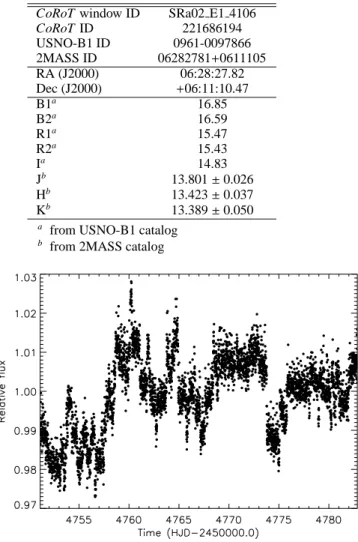
More than 30 multi-transiting candidates for planets were found among the 10265 targets of the SRa02 field. About half of them were clearly identified as binaries from light-curve analy-sis and around tenth of high priority planet-size candidates were selected in this short run including SRa02 E1 4106 afterwards called CoRoT-15. The various ID of this target, including coor-dinates and magnitudes are listed in table 1.
3.
CoRoT
light curve analysisCoRoT-15, with an estimated V magnitude close to 16, is lo-cated at the faint end of the stellar population observed by
CoRoT . In this magnitude domain, the signal is not sufficient
to split the photometric aperture in three colors and the ex-tracted lightcurve, also called white lightcurve, is monochro-matic (Llebaria & Guterman 2006). The sampling rate was at 512 seconds during the whole run and not oversampled to 32 sec-onds since this candidate was not identified with the alarm mode (Surace et al. 2008). Fig. 1 shows the lightcurve of CoRoT-15 delivered by the N2 data levels pipeline. This lightcurve is quite noisy and is affected by several high energy particles impacts which result in hot pixels as well as possible stellar variability.
Table 1. IDs, coordinates and magnitudes.
CoRoT window ID SRa02 E1 4106
CoRoT ID 221686194 USNO-B1 ID 0961-0097866 2MASS ID 06282781+0611105 RA (J2000) 06:28:27.82 Dec (J2000) +06:11:10.47 B1a 16.85 B2a 16.59 R1a 15.47 R2a 15.43 Ia 14.83 Jb 13.801 ± 0.026 Hb 13.423 ± 0.037 Kb 13.389 ± 0.050
a from USNO-B1 catalog b from 2MASS catalog
Fig. 1. Raw light curve of CoRoT-15.
A first analysis of the lightcurve (LC), based on a trapezoidal fit to each individual transit, reveals periodic transits with depth of 0.68% and a period of 3.0608±0.0008 days.
Since the CoRoT lightcurve is relatively noisy, no meaning-ful limits to either the visible-light albedo of the companion nor to its dayside surface temperature could be established.
From the raw lightcurve, we tried to estimate the stellar ro-tation period. We filtered out variations with timescales shorter than 15 data points (∼2.13h) to reduce sensitivity to the satel-lite orbital effects and other short term variations, and we then removed the transits. The computed LS periodogram appears to be quite noisy and affected by low-level discontinuities in the lightcurve. There is tentative evidence of a possible rotational modulation at either 2.9, 3.1 or 6.3 days in the light curve, but the data does not enable us to estimate the period more precisely or to distinguish between these values.
4. Ground-based observations 4.1. Ground-based Photometric follow-up
Ground-based photometry was performed with the aim of refin-ing the target ephemeris, to verify that none of its closest con-taminant stars correspond to an eclipsing binary and to deter-mine the contamination from nearby stars inside CoRoT ’s pho-tometric aperture mask (Deeg et al. 2009). CoRoT-15 was
ob-served during a transit event on 2010 January 13 with time-series photometry at the IAC80 telescope, from HJD 2455209.480 to .676. The resultant lightcurve was not sufficiently precise to identify the expected transit on the target, due to photometric errors introduced by the presence of thin cirrus. However, the absence of large brightness variations in the neighboring stars al-lowed us to exclude nearby eclipsing binaries as a source of the signals that were observed by CoRoT . The contamination factor was derived from a measure of the distance and brightness of the nearby stars on a subset of these IAC80 R-filter images ob-tained with the best seeing of that night (1.7 arcsec). Ten nearby stars were identified, with six of them contaminating the CoRoT window aperture with a flux level that amounts to 1.9±0.3% of the main target flux. We checked furthermore that none of the known nearby stars is bright enough to be contaminating eclips-ing binaries. The image of the sky around CoRoT-15 is shown in Fig. 2.
!
"
#$%&'()* $
Fig. 2. The image of the sky around CoRoT-15 (star in the
cen-tre). Left: R-filter image with a resolution of 1.7” taken with the IAC80 telescope. Right: Image taken by CoRoT , at the same scale and orientation. The jagged outline in its centre is the pho-tometric aperture mask; indicated are also CoRoT ’s x and y im-age coordinates and positions of nearby stars which are in the Exo-Dat (Deleuil et al 2009) database.
4.2. Radial velocity follow-up
Radial velocity (RV) observations of CoRoT-15 were performed with the HARPS spectrograph (Mayor et al. 2003) based on the 3.6-m ESO telescope (Chile) as part of the ESO large program 184.C-0639 and with the HIRES spectrograph (Vogt et al. 1994) based on the 10-m Keck-1 telescope as part of NASA’s key sci-ence project to support the CoRoT mission.
HARPS was used with the observing mode obj AB, with-out simultanenous thorium in order to monitor the Moon back-ground light on the second fiber. The exposure time was set to 1 hour. A set of 9 spectra was recorded between November 24th 2009 and February 21th 2010. We reduced HARPS data and computed RVs with the pipeline based on the cross-correlation techniques (Baranne et al. 1996; Pepe et al. 2002). The signal-to-noise ratio (SNR) per pixel at 550 nm is in the range 3 to 7.8 for this faint target. It corresponds to the faint end in magnitude for HARPS follow-up observations. Radial velocities were obtained by weighted cross-correlation with a numerical G2 mask.
HIRES observations were performed with the red cross-disperser and the I2-cell to measure RVs. We used the 0.861”
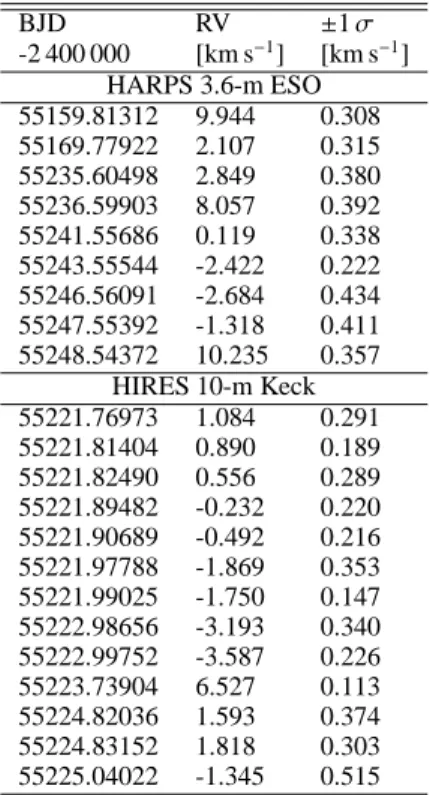
Table 2. Radial velocity measurements of CoRoT-15 obtained
by HARPS and HIRES. BJD is the Barycentric Julian Date.
BJD RV ±1 σ -2 400 000 [km s−1] [km s−1] HARPS 3.6-m ESO 55159.81312 9.944 0.308 55169.77922 2.107 0.315 55235.60498 2.849 0.380 55236.59903 8.057 0.392 55241.55686 0.119 0.338 55243.55544 -2.422 0.222 55246.56091 -2.684 0.434 55247.55392 -1.318 0.411 55248.54372 10.235 0.357 HIRES 10-m Keck 55221.76973 1.084 0.291 55221.81404 0.890 0.189 55221.82490 0.556 0.289 55221.89482 -0.232 0.220 55221.90689 -0.492 0.216 55221.97788 -1.869 0.353 55221.99025 -1.750 0.147 55222.98656 -3.193 0.340 55222.99752 -3.587 0.226 55223.73904 6.527 0.113 55224.82036 1.593 0.374 55224.83152 1.818 0.303 55225.04022 -1.345 0.515
contamination of the HIRES spectra by scattered moon light was significant for this faint target, but the 7” tall decker allowed us to properly correct for the background light. Three spectra without the Iodine cell were obtained on 2010 december 2 and january 9. These 3 spectra were co-added to serve as stellar template for the RV measurements, and to be used for the determination of stellar parameters (see Sect. 4.3). Over a 4-night run from 2010 January 25 to January 28 we have collected 13 spectra of CoRoT-15 with the I2-cell. The average SNR of the spectra with the I2-cell range
from 13 to 22 (per pixel) in the iodine region from 500-620 nm. Differential radial velocities were computed using the Austral Doppler code (Endl et al. 2000). Nine RV measurements were made during a transit event on 2010 January 25 but were not sen-sitive enough to detect the signature of the Rossiter-McLaughlin effect expected to have, for this high rotating star, an amplitude of about 100 m s−1.
The HARPS and HIRES radial velocities are given in Table 2. The two sets of relative radial velocities were simul-taneously fitted with a Keplerian model, with the epoch and pe-riod of the transit being fixed at the CoRoT value and with an adjusted offset between the two different instruments. No sig-nificant eccentricity was found and we decided to set it to zero. We found a systematic shift in phase using the CoRoT period of P=3.0608 days. It comes from the fact that the quite large uncertainty on the CoRoT period (69 seconds) may introduce after one year a systematic shift of more than 2 hours. When we adjust the period with the RVs fixing the transit epoch as de-termined from CoRoT lightcurve Tt=54753.5570 ± 0.0028, the best solution is obtained for P=3.06039 ± 0.00014 days and a semi-amplitude K=7.376 ± 0.090 km s−1. The dispersion of the
residuals is 0.325 km s−1 and the reduced χ2 is 0.90. The joint
analysis of the photometric and RV data, presented in Section 5, does not change significantly the results. Figure 3 shows all the radial velocity measurement after subtracting the RV offset and phase folded to the updated orbital period.
Fig. 3. Phase-folded radial velocity measurements of CoRoT-15
with HARPS (dark circle) and HIRES (open triangle)
4.3. spectral classification
Three HIRES spectra of CoRoT-15 were acquired without the iodine cell. Each spectrum was set in the barycentric rest frame, cleaned from cosmic rays and from the moon reflected light. The co-addition of these 3 spectra results in a master spectrum cov-ering the wavelength range from 4100 Å to 7800 Å with a SNR per element of resolution in the continuum ranging from 20 at 5300 Å up to 70 at 6820 Å. The 9 co-added HARPS spectra unfortunately did not permit to reach a better SNR.
From the analysis of a set of isolated lines, we derived a
v sin i of 19 ± 2 km s−1. The spectroscopic analysis was
car-ried out using the same methodology as for the previous CoRoT planets and described in details in Bruntt et al. (2010). However, the moderate SNR of the master spectrum of this faint target, combined to the marked rotational broadening of the spectral lines prevented an accurate measurement of the star’s photo-spheric parameters. The derived stellar parameters are reported in Table 3.
Following Santos et al. (2002) methodology, we also esti-mated the v sin i and an [Fe/H] index from the HARPS cross-correlation average parameters (FWHM and surface). Assuming a B − V of 0.5, we estimated the v sin i of the target to be 16±1 km s−1 an [Fe/H] index close to zero (solar metallicity)
in agreement with the spectral analysis.
5. System parameters
The time span of the CoRoT light curve is relatively short, and the RV data was collected on year later. Jointly analysing the two datasets therefore yields significantly improved constraints on the period P and time of transit centre Ttr. To do this, we used
a Metropolis-Hastings Markov Chain Monte Carlo (MCMC) al-gorithm (see appendix 1 of Tegmark et al. 2004 for a general description of MCMC algorithms and Winn et al. 2008 and ref-erences therein for a detailed description of their application to transits). This has the added advantage of yielding full posterior probability distributions for the fitted parameters, ensuring that the effects the well known degeneracy between the orbital incli-nation i and system scale a/R⋆ (which leads to highly skewed probability distributions for these parameters, as well as for the radius ratio Rc/R⋆) are properly taken into account in the final uncertainties.
The light curve was first pre-processed to remove out-of-transit variability as follows. Outliers were identified using an iterative non-linear filter (see Aigrain et al. 2009), and a straight line was fitted to the region around each transit. The effect of contamination reported in section 4.1 was taken into account by subtracting a constant amount of flux equal to 1.9% of the mean flux from the light curve. Each section of the light curve was thus normalised, and a visual check was performed to ensure that no residual discontinuities affected the preprocessed light curve. The photometric uncertainties were then estimated from the out-of-transit scatter in the preprocessed light curve section around each transit. The light curve was modeled using the for-malism of Mandel & Agol (2002). Given the relatively low SNR of the transits, we opted to fix the quadratic limb-darkening pa-rameters uaand ubat the values given by Sing et al. (2010) for
the star’s effective temperature, gravity and metallicity (adopted values: ua = 0.32, ub = 0.30). The RV data were modelled
us-ing a Keplerian orbit with eccentricity fixed at zero, since the data show no evidence for a significant eccentricity. The rela-tive zero-point of the HARPS and HIRES velocities, δV0, was
allowed to vary freely. The parameters of the MCMC were thus
P, Ttr, Rc/R⋆, a/R⋆, the radial velocity semi amplitude K, the systemic radial velocity Vsysand δV0.
After an initial chain of 105steps to adjust the MCMC step
sizes for each parameter, we ran 10 MCMC chains of 105steps,
each with different starting points. The convergence of the chains was checked using the Geldman-Rubin statistic (Geldman & Rubin 1992, Brooks & Geldman 1997). The chains were then combined (after discarding the first 10% of each chain, where the MCMC is settling from its starting point) to produce poste-rior probability distributions for each parameters. We report in Table 3 the median of the probability distribution for each pa-rameter2. To estimate uncertainties for each parameter, we
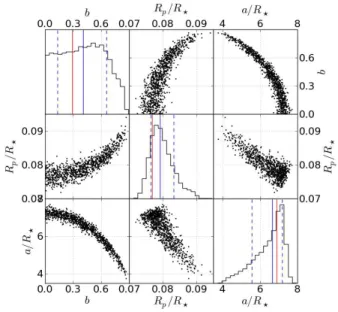
com-puted the range of values which encloses 68.5% of the proba-bility distribution (rejecting 16.25% at each extremum). Our un-certainties thus correspond to 68.5% confidence intervals, just as classical 1-σ uncertainties do for a Gaussian distribution. The best-fit transit model is shown superimposed on the folded light curve in Figure 4. To highlight the correlations between b, Rp/R⋆ and a/R⋆, and explain the rather large resulting uncertainties, we also show the posterior probability distributions and 2-D pro-jections of the combined MCMC chain for these parameters in Figure 5.
We used the photospheric parameters from spectral analysis and the stellar density derived from the transit modeling to de-termine the star’s fundamental parameters in the (Teff, M⋆1/3/R⋆) space. Using STAREVOL evolution tracks (Palacios, private com.), we find the stellar mass to be M⋆= 1.32 ± 0.10 M⊙ and the stellar radius R⋆ = 1.46+0.31−0.14 R⊙, with an age in the range 1.14–3.35 Gyr. This infers a surface gravity of log g = 4.23+0.12
−0.20,
in good agreement with the spectroscopic value.
Calculations using CESAM (Morel & Lebreton 2008, see also Guillot & Havel 2010) confirm these solutions. The age constraints, 1.9±1.7 Gyr, are however extremely weak, and yield
2 The choice of which statistic to report is a somewhat tricky one. When the distributions are (close to) Gaussian, the median, most prob-able and best-fit values coincide. When the distributions are skewed, as in the case of b for example, the median, most probable and best-fit values can differ signficiantly. Whilst the best best-fit value maximises the merit function for the particular dataset being analysed, it has no special physical meaning. We adopt the value which divides the proba-bility distribution in half, namely the median, as it is arguably the most physically meaningful.
Fig. 4. Folded, detrended light curve of CoRoT-15 (top),
show-ing the best fit transit model (red solid line) and residuals (bot-tom).
Fig. 5. Selected posterior probability distributions and
two-dimensional correlations for the transit fit. The panels along the diagonal show single-parameter posterior probability distribu-tions for b, Rp/R⋆ and a/R⋆. The red, blue, and dashed blue vertical lines indicate the location of the best-fit, median and the limits of the 68.5% confidence interval for each parameter. The off-diagonal panels show, for each pair of parameters, scat-ter plots of 1000 points randomly selected from the combined MCMC chain. The density of the points approximates the joint posterior probability distribution.
possible pre-main sequence solutions with extremely young ages.
We derived for the transiting companion Mc=63.3±4.1 MJup
and Rc=1.12+0.30 −0.15RJup.
Table 3. Star and companion parameters.
Parameters Value
Transit epoch Ttr[HJD] 2454753.5608±0.0011 Orbital period P [days] 3.06036±0.00003 Transit duration dtr[h] 3.24±0.1 Orbital eccentricity e 0 (fixed) Semi-amplitude K [ km s−1] 7.36±0.11 Systemic velocity V0 har ps[ km s−1] 2.23±0.11 Systemic velocity V0 hires[ km s−1] 1.09±0.07
Radius ratio Rc/R⋆ 0.0788+0.0039−0.0029 Scaled semi-major axis a/R⋆ 6.68+0.49−1.04 Impact parameter b 0.38+0.25 −0.26 M1/3⋆ /R⋆[solar units] 0.75+0.05−0.12 Stellar density ρ⋆[g cm−3] 0.60+0.13−0.28 Inclination i [deg] 86.7+2.3 −3.2 Effective temperature Te f f[K] 6350±200 Surface gravity log g [dex] 4.3±0.2 Metallicity [Fe/H] [dex] 0.1±0.2 Rotationl velocity v sin i [ km s−1] 19±2
Spectral type F7V
Star mass [M⊙] 1.32±0.12
Star radius [R⊙] 1.46+0.31−0.14
Distance of the system [pc] 1270±300 Orbital semi-major axis a [AU] 0.045+0.014 −0.010 Companion mass Mc[MJup] 63.3±4.1 Companion radius Rc[RJup] 1.12+0.30−0.15 Companion density ρc[g cm−3] 59+37−32 Equilibrium temperature Teqper[K] 1740+120−190
6. Discussion and Conclusion
CoRoT-15b is one of the rare transiting companion that lies in the theoretical mass domain of brown dwarfs (13-75 MJup, if one adopts the present IAU convention). Contrary to CoRoT-3b (Deleuil et al. 2008) that is located in the overlapping region be-tween the massive planet and the brown-dwarf domain, CoRoT-15b is well in the mass domain of BDs. Expanding a bit the mass domain, one can easily include in this ensemble the high mass ”planets” (M ≥ 10 MJup) XO-3b (Johns-Krull et al. 2008)
and WASP-18b (Hellier et al. 2009), and in the M-dwarf regime, OGLETR122b (Pont et al. 2005a) 123b (Pont et al. 2006) -106b (Pont et al. 2005b), and HAT-TR-205-013 (Beatty et al. 2007). Interestingly, all these objects are found to orbit F-type stars (see also Deleuil et al. 2008), with one exception: OGLE-TR-122b orbits a G-type dwarf but has a much longer orbital period (7.3 days compared to less than 4.3 days for all other ob-jects).
Early- and mid-F-type dwarfs have the particularity of be-ing fast rotators, independently of their age (Nordstrom et al. 1997), a consequence of a small or inexistent outer convective zone, weak stellar winds, and reduced losses of angular momen-tum. The tides raised on a star by its close-in companion (planet, brown dwarf or star) have long been known to pause a threat to its survival (e.g. P¨atzold & Rauer 2002). This is true when the star’s spin is slower than the orbital period of the companion, a common situation for close-in exoplanets. However, massive-enough companions have the possibility of spinning-up the star and may escape engulfment if the total angular momentum of the system is above a critical value (Levrard et al. 2009). Even
in that case however, magnetic braking in the central star (e.g. see Barker & Ogilvie 2009) will lead to a loss of angular mo-mentum that will be transferred to the orbit of the companion through tides and lead to orbital decay. We thus propose that close-in massive planets, brown dwarf or M-dwarf can survive when orbiting early or mid F-type dwarfs but that they tend to be engulfed by G-type (or late F-type) dwarfs. In the case of CoRoT-15, we thus expect that the star should be above ∼ 1.25 M⊙to avoid efficient spin-down, and that the system should be at or close to double-synchronisation (i.e. the spin period of the star should be close to the orbital period of its companion).
10 100 Mass [MJup] 0.0 0.5 1.0 1.5 2.0 2.5 3.0 Radius [R Jup ] CoRoT-15b CoRoT-3b XO-3b WASP-18b OGLE-TR-123b OGLE-TR-122b OGLE-TR-106b HAT-TR-205-013 Cm Dra B Cm Dra A 5 Ga 0.5 Ga
brown dwarfs stars
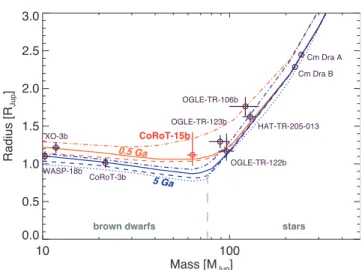
Fig. 6. Masses and radii of eclipsing brown-dwarfs and
low-mass stars (circles with error bars, as labeled) compared to the-oretical mass-radius relations (lines). The lines correspond to isochrones of 0.5 (upper orange lines) and 5 Ga (lower blue lines), respectively. The dashed lines are calculated for isolated brown-dwarfs and low-mass stars. The plain lines include the effect of irradiation with Teq = 1800 K. The dash-dotted lines
include irradiation and account for a 50% coverage of the photo-sphere with low-temperature spots (see text). A 5 Ga isochrone for isolated brown dwarfs/M stars from Baraffe et al. (2003) is shown for comparison (dotted line).
It is interesting to see that given the v sin i and stellar ra-dius determinations, the projected spin period of the central star is P/sini∗ = 3.9+0.8−1.1days. An LS periodogram shows the
pres-ence of many peaks possibly due to low-level discontinuities in the lightcurve. The most robust peak compatible with the v sin i determination lies between 0.32 and 0.34 cycles/day, and may thus be linked to a stellar spin period between 2.9 and 3.1 days. The CoRoT-15 system thus appears to be indeed close to double-synchronous. Further observations of the system and in particu-lar a precise determination of the stelparticu-lar spin period would be a powerful mean of understanding the dynamical evolution of this system. Coupled to studies of similar systems, this may also yield strong constraints on the on the tidal dissipation factor in F-type dwarfs.
CoRoT-15b is also extremely interesting for its size in com-parison with other objects in this mass range, and of evolution tracks for hydrogen-helium brown dwarfs and stars. Figure 6 shows that it appears inflated compared to standard evolution tracks for these kind of objects (Baraffe et al. 2003), although it may be compatible with a young age if the true size is at the lower-end of the one inferred from our measurements. However, we notice that the same problem arises for OGLE-TR-123b,
OGLE-TR-106b and, but to a lesser extent, HAT-TR-205-013.3
The two other known brown dwarfs with direct radius measure-ments, discovered in the 2MASS J05352184-0546085 eclipsing binary system (Stassun et al. 2006), have very large radii (5.0 and 6.5 RJup) but related to the very young age of the system (∼
1 Myr), still in the earliest stages of gravitational contraction. In order to examine possible solutions to this puzzle (other than a systematic overestimation of the inferred sizes for the systems known thus far), we calculate evolution tracks using CEPAM (Guillot & Morel 1995), but adding the dominant ther-monuclear reaction cycle, namely the pp-chain (see Burrows & Liebert 1993). The atmospheric boundary condition is adjusted to the Baraffe et al. (2003) evolution tracks, using the analytical solution of Guillot (2010), and values of the thermal and visible mean opacities, κth= 0.04 cm2g−1and κv = 0.024 cm2g−1. The
model shows that irradiation effects, although quite significant for Jupiter-like planets have rather small consequences in the brown dwarf regime, and become completely negligible in the stellar regime. We also test the possibility that these inflated sizes may be explained by the presence of cold spots on the brown dwarf, similarly to a mechanism proposed to explain that M-type star in close-in binaries also appear inflated (Chabrier et al. 2007). As shown in Fig. 6, this mechanism works only in com-bination with a young age for the system, and with a rather large fraction (∼50%) of the photosphere covered with spots. An alter-native possibility is that irradiated atmospheres are much more opaque than usually thought, possibly a consequence of photo-chemistry and disequilibrium photo-chemistry. A solar metallicity was assumed for the brown-dwarf models displayed in Fig. 6. We tested the effect of metallicity on the mean molecular mass and the opacity but did not find significant change in the radius.
In any case, this shows that CoRoT-15b is a crucial object to understand both the dynamical and physical evolution of gi-ant planets, brown-dwarfs and low-mass stars. Further observa-tions aiming at obtaining more accurate spectra of the star would be highly desirable. Although this is a challenging measurement given the faintness of the target, measurement of secondary tran-sits in the infrared would be extremely interesting because they would inform us on this rare heavily irradiated brown dwarf at-mosphere.
Acknowledgements. The authors wish to thank the staff at ESO La Silla
Observatory for their support and for their contribution to the success of the HARPS project and operation. HIRES data presented herein were ob-tained at the W.M. Keck Observatory from telescope time allocated to the NASA through the agency’s scientific partnership with the California Institute of Technology and the University of California. The French team wish to thank the Programme National de Plan´etologie (PNP) of CNRS/INSU and the French National Research Agency (ANR-08-JCJC-0102-01) for their continu-ous support to our planet search program. The team at IAC acknowledges sup-port by grant ESP2007- 65480-C02-02 of the Spanish Ministerio de Ciencia e Innovaci´on. The German CoRoT Team (TLS and the University of Cologne) acknowledges DLR grants 50OW0204, 50OW0603, and 50QP07011. MG ac-knowledges support from the Belgian Science Policy Office in the form of a Return Grant. SA & NG acknowledge support from STFC standard grand ST/G002266. FB acknowledges the continuous support of PLS-230371.
References
Aigrain, S., Pont, F., Fressin, F., et al. 2009, A&A, 506, 425
Baglin A., Auvergne M., Barge P., et al., 2009, Transiting Planets, Proceedings of the International Astronomical Union, IAU Symposium, 253, 71 Baraffe, I.; Chabrier, G.; Barman, T.S., et al., 2003, A&A, 402, 701 Baranne, A., Queloz, D., Mayor, M., et al. 1994, A&AS, 119, 373
3 The recent discovery of the transiting brown dwarf LHS6343C by Johnson et al. (2010) also points to an inflated companion.
Barker ,A., & Ogilvie, G.I., 2009, in Cosmic Magnetic Fields: From Planets, to Stars and Galaxies, Proceddings of the International Astronomical Union, IAU Symposium, 259, 295
Beatty, T.,G., Fernandez, J.M., Latham, D.W., et al. 2007, ApJ, 663, 573 Brooks, S. P. & Geldman, A., 1997, Journal of Computational and Graphical
Statistics, 7, 434
Bruntt, H., Deleuil, M., Fridlund, M., et al., 2010, A&A, 519, 51 Burrows, A. & Liebert, J. 1993, RvMP, 65, 301
Chabrier, G., Gallardo, J., & Baraffe, I. 2007, A&A, 472, L17 Deeg, H., Gillon, M., Shporer, A., et al., 2009, A&A, 506 343 Deleuil, M., Deeg, H., Alonso, R., et al., 2008, A&A, 491, 889 Endl, M., K ¨urster, M., Els, S., 2000, A&A, 362, 585
Geem, Z. W., Kim, J. H., Loganathan, G. V. 2001, Simulation Vol. 76, 60 Gelman, A. & Rubin, D. B., 1992, Statistical Science, 7, 457
Guillot, T. & Morel, P., 1995, A&AS, 109, 109 Guillot, T. 2010, A&A, in press (arXiv:1006.4702) Guillot & Havel 2010, A&A, submitted
Hellier ,C., Anderson, D.R, Cameron, A.C., et al. 2009, Nature, 460, 1098 Johnson, J.A., Apps, K., Gazak, J.Z., et al., 2010, ApJ, submitted
Johns-Krull, C.M., McCullough, P.R., Burke, C.J., et al., 2008, ApJ, 677, 657 Levrard, B., Winisdoerffer, C., Chabrier, G., et al. 2009, ApJ, 692, L9 Llebaria, A., & Guterman, P., 2006, in ESA Special Publication, 1306, 293 Mandel, K., & Agol, E. 2002, ApJ 580, L171
Mayor, M., Pepe, F., Queloz, D., et al. 2003, The Messenger, 114, 20 Morel, P., & Lebreton, Y., 2008, Ap&SS, 316, 61
Nordstrom, B., Stefanik, R.P., Latham, D.W., et al., 1997, A&ASS, 126, 21 P¨atzold, M., & Rauer, H., 2002, ApJ, 568, L117
Pepe, F., Mayor, M., Galland, F., et al., 2002, A&A, 388, 632 Pont, F., Melo, C.H.F., Bouchy, F., et al., 2005, A&A, 433, L21 Pont, F., Bouchy, F., Melo, C., et al., 2005, A&A, 438, 1123 Pont, F., Moutou, C., Bouchy, F., et al. 2006, A&A, 447, 1035 Santos, N.C., Mayor, M., Naef, D., et al., 2002, A&A, 392, 215 Sing, D.K., 2010, A&A, 510, 21
Stassun, K.G., Mathieu, R.D., & Valenti, J.A., 2006, Nature, 440, 311 Surace, C., Alonso, R., Barge, P., et al., 2008, SPIE Conf. Series, 7019, 111 Tegmark, M., Strauss, M.A., Blanton, M.R., et al., 2004, Physical Review D,
Vol. 69, Issue 10, 103501
Vogt, S.S., Allen, S.L., Bigelow, B.C., et al. 1994, SPIE, 2198, 362 Winn, J.N., Holman, M.J., Torres, G., et al. 2008, ApJ, 683, 1076
1 Institut d’Astrophysique de Paris, UMR7095 CNRS, Universit´e
Pierre & Marie Curie, 98bis Bd Arago, 75014 Paris, France 2 Observatoire de Haute Provence, CNRS/OAMP, 04870 St Michel
l’Observatoire, France
3 Laboratoire d’Astrophysique de Marseille, 38 rue Fr´ed´eric Joliot-Curie, 13388 Marseille cedex 13, France
4 Universit´e de Nice-Sophia Antipolis, CNRS UMR 6202, Observatoire de la Cˆote d’Azur, BP 4229, 06304 Nice Cedex 4, France
5 Department of Physics, Denys Wilkinson Building Keble Road, Oxford, OX1 3RH
6 Rheinisches Institut f¨ur Umweltforschung an der Universit¨at zu K¨oln, Aachener Strasse 209, 50931, Germany
7 McDonald Observatory, The University of Texas, Austin, TX 78712, USA
8 Instituto de Astrofosica de Canarias, E-38205 La Laguna, Tenerife, Spain
9 Departamento de Astrof´ısica, Universidad de La Laguna, E-38200 La Laguna, Tenerife, Spain
10 Observatoire de l’Universit´e de Gen`eve, 51 chemin des Maillettes, 1290 Sauverny, Switzerland
11 LESIA, UMR 8109 CNRS, Observatoire de Paris, UPMC, Universit´e Paris-Diderot, 5 place J. Janssen, 92195 Meudon, France 12 Institut d’Astrophysique Spatiale, Universit´e Paris XI, F-91405
Orsay, France
13 Institute of Planetary Research, German Aerospace Center, Rutherfordstrasse 2, 12489 Berlin, Germany
14 University of Vienna, Institute of Astronomy, T¨urkenschanzstr. 17, A-1180 Vienna, Austria
15 IAG, University of Sao Paulo, Brazil
16 Research and Scientific Support Department, ESTEC/ESA, PO Box 299, 2200 AG Noordwijk, The Netherlands
17 Th¨uringer Landessternwarte, Sternwarte 5, Tautenburg 5, D-07778 Tautenburg, Germany
18 University of Li`ege, All´ee du 6 aoˆut 17, Sart Tilman, Li`ege 1, Belgium
19 Space Research Institute, Austrian Academy of Science, Schmiedlstr. 6, A-8042 Graz, Austria
20 School of Physics and Astronomy, Raymond and Beverly Sackler Faculty of Exact Sciences, Tel Aviv University, Tel Aviv, Israel 21 Center for Astronomy and Astrophysics, TU Berlin, Hardenbergstr.
36, 10623 Berlin, Germany
22 LUTH, Observatoire de Paris, CNRS, Universit´e Paris Diderot; 5 place Jules Janssen, 92195 Meudon, France