Relevé polarimétrique d’étoiles candidates pour des disques de débris
par Amélie Simon Département de physique Faculté des arts et des sciences
Mémoire présenté à la Faculté des études supérieures en vue de l’obtention du grade de
Maître ès sciences (M.Sc.) en physique
Août, 2010
c
Ce mémoire intitulé:
Relevé polarimétrique d’étoiles candidates pour des disques de débris
présenté par:
Amélie Simon
a été évalué par un jury composé des personnes suivantes: Serge Demers, président-rapporteur
Pierre Bastien, directeur de recherche Gilles Fontaine, membre du jury
Le relevé DEBRIS est effectué par le télescope spatial Herschel. Il permet d’échantillonner les disques de débris autour d’étoiles de l’environnement solaire. Dans la première partie de ce mémoire, un relevé polarimétrique de 108 étoiles des candidates de DEBRIS est présenté. Utilisant le polarimètre de l’Observatoire du Mont-Mégantic, des observations ont été effec-tuées afin de détecter la polarisation due à la présence de disques de débris. En raison d’un faible taux de détection d’étoiles polarisées, une analyse statistique a été réalisée dans le but de comparer la polarisation d’étoiles possédant un excès dans l’infrarouge et la polarisation de celles n’en possédant pas. Utilisant la théorie de diffusion de Mie, un modèle a été construit afin de prédire la polarisation due à un disque de débris. Les résultats du modèle sont cohérents avec les observations.
La deuxième partie de ce mémoire présente des tests optiques du polarimètre POL-2, construit à l’Université de Montréal. L’imageur du télescope James-Clerk-Maxwell passe de l’instrument SCUBA à l’instrument SCUBA-2, qui sera au moins cent fois plus rapide que son prédécesseur. De même, le polarimètre suit l’amélioration et un nouveau polarimètre, POL-2, a été installé sur SCUBA-2 en juillet 2010. Afin de vérifier les performances optiques de POL-2, des tests ont été exécutés dans les laboratoires sub-millimétriques de l’Université de Western Ontario en juin 2009 et de l’Université de Lethbridge en septembre 2009. Ces tests et leurs implications pour les observations futures sont discutés.
Mots clés : diffusion — étoiles : individuelles (HR 8799, HD 115404) — instrumentation : polarimètres — matière circumstellaire — polarisation — relevés
The DEBRIS survey, being performed by the space telescope Herschel, is an unbiased sampling of the debris disks candidates in the solar neighbourhood. In the first part of this thesis, a ground-based polarimetric survey of 108 DEBRIS candidate stars is presented. Using the polarimeter, “La Belle et la Bete,” at the Mont-Megantic Observatory, observations were carried out in order to detect polarization induced by the presence of a debris disk. Due to a low rate of detection, a statistical analysis was performed to compare the polarization between stars owning a debris disk with stars without one. Using Mie scattering theory, a basic model was constructed to estimate the level of polarization produced by dust grains in a debris disk. The results of this model are consistent with our observations.
The second part of the thesis presents the optical tests of the polarimeter POL-2, built at Université de Montréal. The James Clerk-Maxwell-Telescope imager SCUBA has been upgra-ded to SCUBA-2, which is more than one hundred times faster than its predecessor with 500 times more pixels. Likewise, the polarimeter follows the improvement as a new polarimeter, POL-2, was installed on SCUBA-2 in July 2010. In order to verify the optical performance of POL-2, tests were completed at the submillimeter laboratories at the University of Western Ontario in June 2009, and the University of Lethbridge in September 2009. These tests and their implications for future observations are discussed.
Key words : circumstellar matter — instrumentation: polarimeters — scattering — stars: individual (HR 8799, HD 115404) — surveys — polarization
Sommaire i
Abstract ii
Table des matières iii
Liste des tableaux vi
Liste des figures vii
Abréviations viii
Sigles ix
Remerciements xi
1 Introduction 1
1.1 Relevé polarimétrique d’étoiles candidates pour des disques de débris . . . 1
1.1.1 Les disques de débris du système solaire . . . 1
1.1.2 Véga, première étoile extra-solaire possédant des corps solides . . . 2
1.1.3 La formation de disques de débris . . . 3
1.1.4 Planètes et disques de débris . . . 4
1.1.5 Relevés de disques de débris . . . 5
1.1.6 Le télescope spatial Herschel . . . 5
1.1.8 Le relevé DEBRIS . . . 6
1.1.9 La polarimétrie de disques de débris . . . 7
1.2 POL-2, un nouveau polarimètre pour le JCMT . . . 8
1.2.1 Le relevé SUNS . . . 8
1.2.2 L’instrument POL-2 . . . 9
1.3 Présentations des articles et des annexes . . . 9
1.4 Contributions à l’article et aux rapports . . . 10
2 Polarimetric Survey 11 2.1 Abstract . . . 12 2.2 Introduction . . . 12 2.3 Observational Results . . . 15 2.3.1 Observations . . . 15 2.3.2 Results . . . 16 2.4 Discussion . . . 17 2.4.1 HD 115404 . . . 18
2.4.2 Stars with Detected Polarization Over 2σ and Known Debris Disks or Planets . . . 18
2.4.3 HR 8799 . . . 19
2.5 Models . . . 20
2.6 Statistical Comparison . . . 22
2.7 Conclusion and Further Prospects . . . 24
3 Tests optiques du polarimètre POL-2 43 3.1 Présentation de l’instrument . . . 43
3.2 Tests à l’UWO en 2007 et 2008 . . . 46
3.3 Tests à l’UWO en juin 2009 . . . 46
3.4 Tests à l’UOL en septembre 2009 . . . 47
3.5 Acceptation finale de POL-2 comme instrument du JCMT et installation au télescope . . . 48
4 Conclusion 52
Bibliographie 54
Annexe A 59
A Data Analysis of Polarization Measurements 59
A.1 Introduction . . . 60
A.2 Instrumental Polarization . . . 61
A.3 Reference Angle . . . 62
A.4 Averaging Mutiple Observations of the Same Star . . . 63
Annexe B 65 B Guide to Analyze Data 65 B.1 Retrieve the Information from the ".res" File and Retrieve the Standards Ob-served During the Run . . . 66
B.2 Analysis of the Results . . . 68
B.3 Particular Cases . . . 69
Annexe C 70
C Optical Tests of the POL-2 Polarimeter at the University of Western
Onta-rio 70
Annexe D 84
2.1 Stars Observed with a Polarization Over 2σ. . . 32
2.2 Stars Observed with a Polarization Under 2σ . . . 33
2.2 Stars Observed with a Polarization Under 2σ . . . 34
2.2 Stars Observed with a Polarization Under 2σ . . . 35
2.2 Stars Observed with a Polarization Under 2σ . . . 36
2.3 Polarization Measurement of HR 8799. . . 36
2.4 Parameters of the Disks in the Preferred Model of Su et al. (2005). . . 37
2.5 Results of the Comparison Between the Polarization of Stars Owning a Debris Disk with Stars without One. . . 37
2.1 Frequency distribution of the normalized Stokes parameter Q/I, for all stars. . 25
2.2 Frequency distribution of the normalized Stokes parameter U/I, for all stars. . 26
2.3 Polarization as a function of the grain radius for HR 8799 . . . 27
2.4 Mass of the disk determined as a function of the grain radius . . . 28
2.5 Mass of the disk determined as a function of the distance of silicate grains . . . 29
2.6 Comparison of polarization in the Heiles catalog for DEBRIS + DUNES stars with and without infrared excess . . . 30
2.7 Comparison of polarization for DEBRIS stars with and without infrared excess in this survey . . . 31
3.1 Schéma de la position de POL-2 sur SCUBA-2 . . . 49
3.2 Photo du polarimètre installé sur le cryostat . . . 50
3.3 Schéma du polarimètre POL-2 . . . 51
CCD Charged Coupled Device
CHARA The Center for High Angular Resolution Astronomy
DEBRIS Disc Emission via a Bias-free Reconnaissance in the Infrared/Submillimetre FTS Fourier Tranform Spectrometer
FWHM Full Width at Half Maximum HDPE High Density PolyEthylene
IRAS Infrared Astronomical Satellite ISO Infrared Space Observatory JCMT James Clerk Maxwell Telescope
PACS Photodetector Array Camera and Spectrometer RPM Rotation Per Minute
SCUBA Submillimetre Common-User Bolometer Array SPIRE Spectral and Photometric Imaging Receiver
STIS Space Telescope Imaging Spectrograph SUNS SCUBA-2 Unbiased Nearby Stars
UOL University of Lethbridge UWO University of Western Ontario
Å Ångström Md Mass du disque MJ Masse de Jupiter MT Masse terrestre M⊙ Masse solaire
Je tiens à remercier tous mes collègues de travail : Rémi Fahed pour avoir répondu avec brio à toutes mes questions, Noemi Giammichele pour son aide généreuse, Cassandra Bolduc pour sa bonne humeur, Marie-Michèle Limoges pour avoir donné de son temps si généreusement, Sandie Bouchard pour son aide précieuse en galactique, Mathieu Vick pour ses bleuets frais, Antoine de la Chevrotière pour ses décorations d’un goût certain, Patrick Ingraham pour avoir patiemment corrigé mon anglais, Lison Malo pour la générosité de son temps, Marilyn Latour d’être ma colocataire durant les conférences, Marie-Eve Naud pour ses bons conseils, ainsi que tous les autres qui ont pris le temps de répondre à mes questions et qui m’ont aidée à avancer ce projet. Merci à Emilie Storer pour son excellent travail. Merci aux techniciens de l’Observatoire du Mont-Mégantic : Pierre-Luc Lévesque, Ghislain Turcotte, Bernard Malenfant. Merci à Pierre Bastien pour sa disponibilité, sa patience et merci de m’avoir permis de faire cette maîtrise. Merci à mes proches qui m’ont encouragée tout au long de cette maîtrise. Merci à mes parents qui m’ont permis d’avoir un rêve et de le poursuivre. Merci à Volny de m’avoir encouragée à faire des études, mais qui viendrait me voir même si j’étais devenue coiffeuse à Carpentras. Merci à ma famille pour leur compréhension lors de mes nombreuses absences aux évènements familiaux pour cause d’observations, de conférences... Merci tout particulièrement à ma grand-mère Denise pour sa bonne humeur, son grand coeur. Merci à mes grands-parents Mitsou et André qui me suivent de loin mais auxquels je pense beaucoup. Et enfin, un grand merci à Pierre Olivier, attentionné, sensible, drôle, généreux. Merci de m’aider à atteindre mon rêve, merci d’être à mes côtés quand j’en ai le plus besoin, merci pour tous les moments de bonheur partagés.
Introduction
1.1 Relevé polarimétrique d’étoiles candidates pour des disques
de débris
Les disques de débris sont des disques circumstellaires formés de particules de poussières, éventuellement de planétésimaux et ils ne contiennent que peu ou pas de gaz. Ils sont typique-ment constitués de grains de poussière de 1 à 100 µm et sont situés entre 10 et 100 UA de leur étoile hôte. Ils absorbent une partie de l’énergie stellaire dans l’UV et irradient celle-ci dans l’infrarouge, ayant des températures à l’équilibre entre 50 et 120 K.
1.1.1 Les disques de débris du système solaire
Le système solaire possède trois disques de ce type : la ceinture de Kuiper, la ceinture d’astéroïdes et le nuage zodiacal. La ceinture de Kuiper s’étend au delà de l’orbite de Neptune, entre 30 et 55 UA. Elle est principalement composée de petits corps et trois planètes naines y ont été détectées : Pluton, Matemake et Haumea. Sa masse est estimée à 10−1M
⊕ (Delsanti & Jewitt 2006). La ceinture d’astéroïdes est située entre l’orbite de Mars et celle de Jupiter à environ 3 UA. Elle est constituée de la majorité des astéroïdes connus. Elle possède une planète naine : Cérès. Sa masse totale est évaluée à 6 × 10⁻⁴ M
⊕ (Krasinsky et al. 2002). Le nuage zodiacal, responsable de la lumière zodiacale, s’étend jusqu’à environ 3 UA et a une masse d’approximativement 10−9 M
détectés jusqu’à présent ressemblent à la ceinture de Kuiper, mais avec plusieurs magnitudes de poussières en plus. Les instruments actuels ne nous permettent pas de détecter des disques de débris aussi ténus que ceux du système solaire.
1.1.2 Véga, première étoile extra-solaire possédant des corps solides
Le premier disque de débris extra-solaire a été découvert autour de Véga en 1984 par Au-mann et al. (d’où le nom d’étoiles de type Véga pour les étoiles possédant un disque de débris). C’est lors d’observations routinières de calibration de Véga, que l’équipe d’IRAS découvrit que cette étoile avait une émission dans les longueurs d’ondes infrarouges bien supérieures à l’émis-sion due à la photosphère uniquement. IRAS est un télescope spatial de 0.57 m lancé en 1983, ayant pour mission de réaliser un relevé complet du ciel dans les bandes infrarouges centrées sur 12, 25, 60 et 100 µm. Véga (aussi nommée α Lyrae) est une étoile A0V d’environ 10 000 K, c’est une étoile de calibration photométrique de l’hémisphère nord. Elle a été observée comme telle par IRAS, dans un mode de calibration qui était plus précis que dans le cas d’observations faites lors du relevé du ciel.
En extrapolant l’émission d’un corps noir à 10 000 K, Aumann et al. (1984) ont conclu que l’excès observé par rapport à l’émission de la photosphère seule est de 16 à 100 µm. Aucun excès n’avait été détecté jusqu’à des longueurs d’ondes de 20 µm jusqu’alors. Puisque la perte de masse de l’étoile est inférieure à 10−12M
⊙an−1, ils ont déduit que la source de cet excédent était des poussières en équilibre thermique avec l’étoile. En modélisant cet excès, ils ont conclu que les grains de poussière étaient à 85 UA de l’étoile, qu’ils avaient un rayon de l’ordre du millimètre et qu’ils possédaient une température de 85 K. Ils ont d’abord inféré que cet excès provenait d’un disque protoplanétaire mais une étude plus approfondie des étoiles Véga, Fo-malhaut et β Pictoris a résulté en l’excitante découverte que ces objets étaient les premières étoiles de la séquence principale, mis à part notre soleil, qui possèdent des matériaux solides, sans avoir une perte de masse significative (Gillett 1986).
de Su et al. (2005). Ils en ont déduit qu’il s’étend de 70 à 815 UA, les particules ont une taille entre 1 et 50 µm et la masse totale des poussières du disque serait de 3×10⁻³ M
⊕. Il est intéressant de noter qu’environ dix ans avant la première détection de planètes extra-solaires nous avions des preuves indirectes de la présence de corps rocheux autour d’étoiles autre que le soleil.
1.1.3 La formation de disques de débris
Une partie de la lumière de l’étoile est absorbée par les particules de poussière et ré-émise sous forme de radiation infrarouge. Cette émission provoque une chute en spirale des particules vers le Soleil et leur destruction, connue sous le nom d’effet Poynting-Robertson. Lorsque le disque de débris est dense, ce qui est le cas pour la plupart des disques détectés jusqu’à ce jour, les grains de poussières ont une grande probabilité d’entrer en collision les uns avec les autres. Si la trajectoire d’un grain de poussière est trop perturbée, il sera éjecté du disque par la pression de radiation. Ainsi, les disques de débris ont une durée de vie courte, jusqu’à dix millions d’années. Cependant, ils sont présents autour d’étoiles de tout âge, ce qui im-plique la présence d’un mécanisme continuel de remplissage du disque (Backman & Paresce 1993). Celui-ci est la collision de planétésimaux et la sublimation de comètes (Williams & Wetherill (1994), Wyatt & Dent (2002), Thébault & Augereau (2007)). Ces processus dyna-miques créant ces disques contiennent des informations sur la présence de corps rocheux. La distribution spatiale du disque, sa forme et les caractéristiques des poussières le constituant sont autant d’informations sur les planétésimaux, sur l’évolution du système et sur la possible présence de planètes.
Observer des disques de débris est un outil précieux pour étudier les corps solides autour d’étoiles et pour comprendre la dynamique des systèmes planétaires (voir Wyatt (2008), Krivov (2010) pour des revues récentes). Par exemple, s’il y avait une production continue de pous-sières formant un disque tel qu’observé autour de Véga durant l’intégralité de sa vie, une masse initiale de planétésimaux de plusieurs centaines de fois la masse de Jupiter serait nécessaire. Il est plus probable que la poussière observée autour de Véga provienne d’une collision récente
de comètes ou d’astéroïdes de masses moyennes. Le disque de Véga serait donc relativement jeune par rapport à l’étoile et devrait disparaître en l’absence de nouvelles collisions (Su et al. 2005).
1.1.4 Planètes et disques de débris
Il est possible d’utiliser les disques de débris résolus pour inférer la présence de planètes qui perturbent le disque. Des observations de Véga au télescope CHARA, réseau de six télescopes de 1 m de diamètre, au Mont Wilson (USA), ont permis de détecter un anneau intérieur de poussières, à 8 UA. Ces poussières seraient la preuve de perturbations dynamiques existant au sein du système. Ce qui pourrait être dû à un intense bombardement cométaire ou mé-téoritique, comparable au grand bombardement tardif et pourrait donc être la preuve de la présence d’un système planétaire (Absil et al. 2006). De plus, des irrégularités dans le disque suggèrent la présence d’au moins une exoplanète, probablement de la taille de Neptune, en orbite autour de l’étoile. Celle-ci aurait migré de 40 UA à 65 UA en 56 millions d’années et au-rait alors perturbé le disque en y créant des surdensités (Wyatt 2003). Le disque de β Pictoris a été résolu par l’instrument STIS du télescope spatial Hubble (Heap et al. 2000). Le disque est gauchi, ce phénomène peut être expliqué par la présence d’une planète, d’une masse de 4 MJ, si elle est à 10 UA et si l’étoile a 20 millions d’années. Une conclusion équivalente peut être produite pour l’étoile Fomalhaut (Kalas et al. 2005).
Beichman et al. (2005) ont décelé une corrélation entre la présence de planètes et celle de disques de débris. Cependant, ce résultat est controversé car il n’a pas été confirmé par Kóspál et al. (2009) ou Bryden et al. (2009). Dans tous les cas, pour les disques résolus, leur grande extension suggère la présence de planétésimaux qui perturbent le disque (Backman & Paresce 1993). Puisque la formation planétaire a une incidence sur les disques de débris (Wyatt 2008), dans le cas de notre système solaire, les disques de la ceinture de Kuiper et de la ceinture d’astéroïdes ont évolué avec le temps : ils étaient beaucoup plus massifs par le passé (Stern (1996), O’Brien et al. (2007)) et leur position aurait pu changer à travers les âges (Gomes et al. (2005), Thommes et al. (2007)).
Afin d’aiguiser les modèles de disques de débris, de contraindre leur évolution, et de connaître leurs caractéristiques, nous avons besoin d’un relevé non-biaisé. Ce sera possible grâce au relevé DEBRIS du télescope spatial Herschel.
1.1.5 Relevés de disques de débris
Entre la parution de la découverte du disque de débris autour de Véga en 1984 et la parution de la première revue sur les disques de débris en 1993 par Backman, environ 100 étoiles, de tous types et de tous âges, étaient déjà cataloguées comme possédant des disques circumstellaires. En 2002, dernière date à laquelle la base de données de disque de débris de l’Observatoire Royal d’Edimbourg a été mis à jour, 900 étoiles possédaient un disque de débris. Des relevés effectués dans les longueurs d’ondes infrarouges, principalement grâce aux télescopes IRAS, ISO et Spitzer, il est apparu qu’environ 15% des étoiles de la séquence principale possède un disque circumstellaire (Backman & Paresce (1993), Plets & Vynckier (1999)). Cependant, cette fraction pourrait être aussi grande que 25% car il existe des évidences de la présence de disques de débris trop froids pour avoir été détectés par les relevés dans les longueurs d’ondes infrarouge. Par exemple, Wyatt (2003) ont observé 22 étoiles dans les longueurs d’ondes sub-millimétriques, à 850 µm, au télescope du JCMT. Trois d’entre elles possèdent des disques de débris, disques qui n’avaient pas encore été détectés par les télescopes IRAS et ISO. Selon leur estimation, 9 à 14% des étoiles pourraient posséder des disques non détectables dans les longueurs d’ondes infrarouges. Lestrade et al. (2006) sont arrivés à une conclusion équivalente. Une telle proportion d’étoiles qui possèdent des disques de débris en font un sujet incontournable.
1.1.6 Le télescope spatial Herschel
Herschel est un télescope spatial de l’Agence Spatiale Européenne, il possède le plus grand miroir construit pour un télescope spatial, avec un diamètre de 3.5 m. Lancé avec succès le 14 mai 2009, il est désormais au deuxième point de Lagrange du système Terre-Soleil. Observant dans les longueurs d’ondes infrarouges et sub-millimétriques, entre 55 et 671 µm, il est refroidi
de manière passive à une température de 85 K. Les principaux objectifs scientifiques de Her-schel sont : l’examen de la formation des galaxies dans l’univers primitif et de son évolution, l’examen de la création des étoiles et de leur interaction avec le milieu interstellaire, l’observa-tion de la composil’observa-tion des atmosphères à la surface des comètes, des planètes et des satellites et l’examen de la chimie moléculaire de l’univers. Herschel possède trois instruments, un spec-tromètre à haute résolution : HIFI et deux caméras/spectrographes à résolution moyenne : PACS et SPIRE (Pilbratt et al. 2010).
1.1.7 Les instruments PACS et SPIRE
PACS est à la fois un spectromètre et un imageur. Il utilise deux grilles de photoconduc-teurs de 16×25 pixels pour de la spectroscopie de champ intégral et deux grilles de bolomètres de 16×32 et de 32×64 pixels pour de l’imagerie photométrique. Dans le mode photométrique, il observe simultanément dans deux bandes : à 60-85 µm ou à 85-125 µm et à 125-210 µm avec un champ de 1.75�×3.5�(Poglitsch et al. 2010).
L’instrument SPIRE est un spectromètre et un photomètre. Le spectromètre a un champ d’opération allant de 194 à 671 µm. Le champ est presque circulaire, avec un diamètre de 2.6’. Le mode photométrique opère simultanément dans trois bandes spectrales à 250, 350 et 500 µm, il utilise des bolomètres qui sont refroidis à 0.3 K. Le champ de vue est de 4�×8�(Griffin et al. 2010).
Ce sont les modes photométriques qui vont être utilisés pour le relevé DEBRIS.
1.1.8 Le relevé DEBRIS
Un des projets clés d’Herschel est le relevé DEBRIS, relevé limité par le flux. Il consiste en 446 étoiles de l’environnement proche du Soleil. Les cibles ont été sélectionnées selon leur dis-tance et leur type spectral, ce sont les ≈90 étoiles les plus proches, dans le champ d’Herschel, de chaque type spectral A, F, G, K et M. Pour une description du relevé DEBRIS voir : Mat-thews et al. 2010b, en préparation, pour la sélection des cibles voir Phillips et al. (2010). Les
observations sont réalisées à 100 µm et 160 µm utilisant l’instrument PACS (Poglitsch et al. 2010) avec un suivi d’environ 100 cibles à 250, 350 et 500 µm avec l’instrument SPIRE (Griffin et al. 2010). Les cibles ont été sélectionnées de la même façon pour le relevé SUNS du JCMT (à 850 µm) et le relevé DEBRIS, 356 étoiles sont en commun entre ces deux relevés (Phillips et al. (2010), Matthews et al. (2007)). Le télescope spatial Spitzer a déjà permis d’observer 196 des cibles de DEBRIS (Matthews et al. 2010b, en préparation). Ainsi, la couverture spectrale peut aller de 24 à 850 µm pour certaines étoiles. Les étoiles les plus éloignées sont à 9, 16, 21, 24 et 46 pc pour les étoiles M, K, G, F et A respectivement.
Observer dans l’environnement proche du soleil fournit un échantillon qui couvre une large gamme de paramètres stellaires pour lesquels une littérature riche existe déjà. La probabilité de trouver des disques sera plus grande, ainsi que de les résoudre dans l’espace. Puisque les cibles sont seulement sélectionnées grâce à leur distance et leur type spectral, l’échantillon DEBRIS n’est pas biaisé. Il permettra de contraindre les propriétés des disques en fonction de l’âge de l’étoile, de sa masse stellaire, de sa métallicité, de la présence de planètes, de la morphologie du système, de la multiplicité... Les premiers résultats de DEBRIS sont donnés dans l’article de Matthews et al. (2010a) qui rend compte de disques résolus spatialement par Herschel.
Nous avons utilisé la liste des cibles de DEBRIS pour le relevé polarimétrique effectué à l’Observatoire du Mont-Mégantic. Ainsi, nous tirons partie de la sélection minutieuse des étoiles faite par l’équipe de DEBRIS et l’observation en polarimétrie peut apporter des contraintes supplémentaires sur les disques.
1.1.9 La polarimétrie de disques de débris
La plupart des disques de débris ont été détectés grâce à un excès de flux dans les longueurs d’ondes infrarouge/sub-millimétrique par rapport au flux photosphérique de l’étoile. L’excès de flux provient des poussières chauffées par l’étoile qui vont émettre de la radiation thermique. Cependant, les disques de débris peuvent aussi être détectés par polarimétrie car la poussière
du disque diffuse la lumière et la polarise. La polarisation est un indicateur de la forme, de la taille et de la composition des grains. Une telle polarisation a déjà été trouvée autour de disques résolus, tel le disque de l’étoile β Pictoris (Gledhill et al. (1991), Wolstencroft et al. (1995), Tamura et al. (2006)) et celui de AU Microscopii (Graham et al. 2007). La polarisation de disques de débris a aussi été détectée autour d’étoiles possédant des disques circumstellaires non résolus : Bhatt & Manoj (2000) ont comparé la polarisation d’étoiles avec de la matière circumstellaire avec celles qui n’ont pas de disques. Oudmaijer et al. (2001), Eritsyan et al. (2002), Tamura & Fukagawa (2005), Chavero et al. (2006) et Wiktorowicz et al. (2010) ont présenté des mesures polarimétriques d’étoiles avec des excès dans l’infrarouge.
1.2 POL-2, un nouveau polarimètre pour le JCMT
La partie instrumentale de ce mémoire consiste en des tests optiques effectués pour vérifier le bon fonctionnement du polarimètre POL-2. Les tests en laboratoire et la rédaction des rapports de ces tests ont été effectués dans le cadre de ma maîtrise.
1.2.1 Le relevé SUNS
La sélection des cibles pour les relevés SUNS du télescope JCMT et DEBRIS du télescope Herschel a été faite de la même manière. Le relevé SUNS devait initialement comprendre les 100 étoiles les plus proches, dans le champ du JCMT, de chaque type spectral A, F, G, K et M. Cependant, la construction et la mise en route de SCUBA-2 ont été retardées et il est possible qu’une partie des cibles du relevé SUNS ne puisse être observée par manque de temps. Pour les cibles observées par le JCMT et Herschel, une large couverture spectrale allant de 100 à 850 µm permettra d’avoir de précieuses contraintes sur les disques de débris. De plus, le JCMT a été doté d’un polarimètre : POL-2, construit à l’Université de Montréal. Il sera possible de détecter la polarisation de la lumière due aux poussières des disques de débris, si ce dernier est assez massif.
1.2.2 L’instrument POL-2
POL-2 est un polarimètre constitué de deux polariseurs en grilles et d’une lame demi-onde achromatique. Les polariseurs servent d’analyseur et de calibrateur. La lame demi-onde tourne continuellement permettant de faire des observations rapides et de s’affranchir des fluctuations de l’atmosphère. Ceci est possible grâce à SCUBA-2, qui peut observer jusqu’à 500 fois plus rapidement que son prédecesseur SCUBA et qui possède un détecteur de type CCD avec en-viron 10 000 pixels.
Des tests optiques du polarimètre POL-2 ont été effectués afin de vérifier s’il satisfaisait les attentes portées aux instruments du JCMT. Ces tests ont fait parti de ma maîtrise et ils sont présentés dans les annexes C et D.
1.3 Présentations des articles et des annexes
Dans ce mémoire, nous présenterons dans une première partie les aspects observationnel et théorique qui constituent ma maîtrise : l’article rendant compte des observations polarimé-triques d’étoiles du relevé DEBRIS, au télescope de l’Observatoire du Mont-Mégantic (Québec, Canada), voir la section 2. Une mise en contexte est donnée dans la section 2.2, les observations sont présentées dans la section 2.3.1. Les résultats sont donnés dans la section 2.3.2, ils seront discutés dans la section 2.4. Une étude de la littérature a été effectuée afin de comparer la po-larisation d’étoiles avec des disques de débris et celles sans détection d’excès dans l’infrarouge, voir la section 2.6. Une étude équivalente avait déjà été effectuée par Bhatt & Manoj (2000). L’annexe A est un guide pour analyser des données polarimétriques et dans l’annexe B le cas particulier des données du polarimètre la Belle et la Bête est discuté.
Nous poursuivrons par la partie instrumentale du mémoire qui consiste aux tests en labo-ratoire du polarimètre POL-2, qui est installé au JCMT, voir section 3. POL-2 est présenté dans la section 3.1. Les tests sont décrits dans les sections 3.2, 3.3 et 3.4. Les annexes C et D consistent aux rapports des tests optiques effectués dans les laboratoires sub-millimétriques
de l’Université de Western Ontario (UWO) et de l’Université de Lethbridge (UOL).
1.4 Contributions à l’article et aux rapports
Avant d’observer avec le polarimètre la Belle et la Bête, il a fallu remonter l’instrument, activité à laquelle j’ai participé, et faire quelques réparations. Lors de ma maîtrise, j’ai observé à l’Observatoire du Mont-Mégantic en trois séries, totalisant 25 nuits, dont 5 nuits claires. J’ai été accompagnée du Pr. Pierre Bastien durant la première série, puis j’ai observé seule pour les autres. J’ai créé un programme IDL pour analyser les données. Il pourra être utilisé dans le futur, notamment par M. Daniel Sarrazin qui continuera le projet et observera le reste des cibles de DEBRIS que je n’ai pu observées durant ma maîtrise. J’ai écrit des guides pour analyser les données, ils sont donnés dans les annexes A et B. Ils ont été utilisés par Mlle Kirthika Mohan pour analyser des observations que le Pr. Pierre Hily-Blant de l’Université de Grenoble et le Pr. Edith Falgarone de l’Ecole Normale Supérieure de Paris sont venus prendre au télescope du Mont-Mégantic avec la Belle et la Bête, en mars 2010.
J’ai produit la totalité de l’article, avec l’aide du Pr. Pierre Bastien, principalement sur les questions de modélisation de la polarisation dû à la présence d’un disque de débris. La recherche dans la littérature d’articles portant sur les étoiles possédant une polarisation im-portante et sur les relevés de disques de débris a été faite par Mlle Emilie Storer, notamment pour permettre la comparaison statistique donnée dans la section 2.6.
J’ai participé aux tests à l’UWO et l’UOL en 2009 et j’ai écrit les rapports donnés en annexes C et D avec l’aide du Pr. Pierre Bastien et du Pr. Martin Houde de l’UWO pour modéliser les ondes stationnaires présentes dans 2. J’ai participé à l’installation de POL-2 sur SCUBA-POL-2, au JCMT à Hawaï, en juillet POL-2010.
Polarimetric Survey of Candidate
Stars for Debris Disks
A. Simon1, P. Bastien1, E. Storer1
To be submitted to The Astronomical Journal August 2010
1. Département de Physique, Université de Montréal, C.P. 6128, Succ. Centre-Ville, Montréal, Québec H3C 3J7, Canada.
2.1 Abstract
We present the first part of a polarimetric survey done at the 1.6 m Ritchey-Chrétien te-lescope of the Mont-Mégantic Observatory. We observed 109 stars with the purpose of finding polarization due to circumstellar matter. The observations were done in a wide band centered on 7660 Å. Our targets, which are a sample of the Herschel telescope survey DEBRIS, are the closest stars evenly distributed along the spectral types A, F, G, K and M (furthest one at 46 pc). They were selected only according to their distance, the survey is then unbiased as the neighbouring stars span all existing characteristics of main-sequence stars. We also obser-ved HR 8799 since it is a star of particular interest (three resolobser-ved planets, two circumstellar disks and a halo). Of all the stars we observed, only one had a polarization detected above 3σ (HD 115404) and 14 stars were measured with a polarization between 2σ and 3σ. This lack of detection can be explained by the expected low polarization induced by debris disks, by the fact that polarization diminishes when inclination decreases (face-on disks do not polarize light) and by the fraction of expected debris disks (25%).
Key words: circumstellar matter — scattering — stars: individual (HR 8799, HD 115404)
— surveys — polarization
2.2 Introduction
The first large unbiased survey of debris disks was carried out by the Infrared Astronomical Satellite (IRAS). It was found that ≈ 15% of main-sequence stars host debris disks (Backman & Paresce (1993), Plets & Vynckier (1999)). However, this fraction might be as high as 25% since there is evidence for a population of disks too cold to have been detected in the infrared (Wyatt (2003), Lestrade et al. (2006), Rhee et al. (2007)). Such a high proportion of stars hosting disks makes them a necessary subject of study. Their shape is indicative of the history of the system. Disks are found around stars at every age but their lifetime is shorter than that of the hosting star, due to the Poynting-Robertson effect and radiation pressure. However,
debris disks are still present due to replenishment mechanisms that continuously feed dust to the debris disks (Backman & Paresce 1993). These mechanisms are collisions between planete-simals and sublimation of comets (Williams & Wetherill (1994), Wyatt & Dent (2002)). Hence, observing debris disks is an important way to infer the presence of solid bodies around stars and to understand the dynamics of planetary systems (see Wyatt (2008), Krivov (2010) for recent reviews). Moreover, Beichman et al. (2005) found a correlation between the presence of debris disks and the presence of planets. However, it is still a subject of debate as this trend was not confirmed by Kóspál et al. (2009). In any case, for spatially-resolved disks, their wide extension indicates that planetesimals are present and perturb the disk (Backman & Paresce 1993). To clarify this question and to sharpen models of debris disks, an unbiased survey is needed, and should give us useful information about the characteristics of debris disks and their host stars. Such a survey is being carried out by the Herschel telescope with DEBRIS (Disc Emission via a Bias-free Reconnaissance in the Infrared/Submillimeter).
The space telescope Herschel observes at submillimeter wavelengths. Its Open Time Key Program DEBRIS is a flux-limited survey which consists of the 446 nearest stars, evenly dis-tributed along the spectral types A, F, G, K and M. For a description of the DEBRIS survey see: Matthews et al. (2010b, in preparation), for the target selection, see: Phillips et al. (2010). The observation runs at 100 µm and 160 µm using the PACS instrument (Photodetector Ar-ray Camera and Spectrometer, Poglitsch et al. (2010)) with follow-up of around 100 targets at 250, 350 and 500 µm with the SPIRE instrument (Spectral and Photometric Imaging Receiver, Griffin et al. (2010)). As many as 356 stars are in common with the JCMT (James Clerk Max-well Telescope) SCUBA-2 Unbiased Nearby Stars (SUNS) survey at 850 µm (Phillips et al. (2010), Matthews et al. (2007)). To date, 196 of the targets have been observed with the MIPS or IRS instrument of Spitzer (Matthews et al. 2010b, in preparation). Hence the spectral cove-rage would span from 24 to 850 µm for these stars. Distances of the farthest stars are 9, 16, 21, 24 and 46 pc for the M, K, G, F and A stars respectively. Observing in the close environment around the sun provides a sample covering a wide range of stellar parameters for which a rich li-terature already exists. It also maximizes the possibility of finding disks and spatially resolving
them. As the targets are only selected by their distances, the DEBRIS sample is unbiased and it will give us statistical information about how debris disks properties vary as a function of age, stellar mass, metallicity, presence of planets, system morphology, multiplicity, etc. The firsts results of DEBRIS are given in: Matthews et al. (2010a) with spatially resolved disks observed.
Most disks are found by an excess of flux in the infrared/submillimeter wavelengths com-pared to the stellar photospheric flux. This flux excess comes from dust heated by the star and that emits thermal emission (first discovery was made with IRAS around Vega (Aumann et al. 1984)). But debris disks can also be detected by polarimetry as dusty disks scatter and polarize stellar light. Polarization is an indicator of shape, size and composition of the grains. Such polarization has already been measured in spatially resolved disks such as the Beta Pic-toris disk (Gledhill et al. (1991), Wolstencroft et al. (1995), Tamura et al. (2006)) and the AU Microscopii disk (Graham et al. (2007)). Polarization has also been observed on non-spatially resolved disks: Bhatt & Manoj (2000) compared polarization of stars with circumstellar mat-ter and those that are devoid of such matmat-ter ; Oudmaijer et al. (2001), Eritsyan et al. (2002), Tamura & Fukagawa (2005), Chavero et al. (2006) and Wiktorowicz et al. (2010) presented polarization measurements of stars with infrared excess.
In this paper we present the first part of a polarimetric survey of the DEBRIS stars in order to get useful information provided by detection in polarization (orientation of the disk on the plane of the sky, information about the grains...). We will discuss the observations and the data reduction in section 2.3, we will then look at the properties of the stars with the highest polarization in section 2.4. By a search of polarization and infrared measurements in the literature, we will statistically compare polarization of stars with debris disks with stars without such disks in section 2.6. A model of polarization induced by dust is given in section 2.5. We will end with a discussion on the results we found in section 2.7.
2.3 Observational Results
2.3.1 ObservationsThe observations were made at the 1.6 m Ritchey-Chrétien telescope of the Mont-Mégantic Observatory (OMM), based in Quebec, Canada. We observed during three runs between 2009 December 1 and 2010 March 3. We used a 8.18�� aperture, all multiple stars we ob-served were integrated at the same time in the 8.18�� aperture. We used a broadband red filter, RG645 which yields a bandpass centered on 7660 Å and with a FWHM of 2410 Å. Polarization was measured with "La Belle et la Bête" instrument which is a two-channel photoelectric pola-rimeter. It uses a Wollaston prism as analyzer, a Pockels cell operated at 125 Hz as modulator, and a quarter wave plate.
The data were calibrated for polarization efficiency with a prism (between 75% and 83%), for instrumental polarization using unpolarized standards and for the zero point of position angle, using polarized standard stars. More information about the instrument and the method of observation can be found in Manset & Bastien (1995). We observed unpolarized standards for each run and we used the same ones as PlanetPol (Lucas et al. 2009). The polarized standards we observed come from Turnshek et al. (1990) and from the PlanetPol polarized standard stars (Hough et al. 2006).
In order to have a sigma error of 0.04%, we adjusted the integration time according to the magnitude of the star. Errors were calculated from photon statistics and also include the error due to calibration mentioned above. The errors are in the range 0.02% to 0.12% (with a mean of 0.04%). The uncertainty on the angle of the polarization vector was computed with:
∆θ = 28.65 ∆P
P .
The data were pre-analyzed by the computer "La Belle" while observing. The rest of the analysis was automated using IDL programs created for this purpose. Of the 297 stars that are visible from the observatory, 108 were observed for this analysis. We also observed the
star HR 8799 even if it is not included in the DEBRIS survey, as it is a target of particular interest: it hosts three resolved planets (Marois et al. 2008) and debris disks (Su et al. (2009), Reidemeister et al. (2009)).
2.3.2 Results
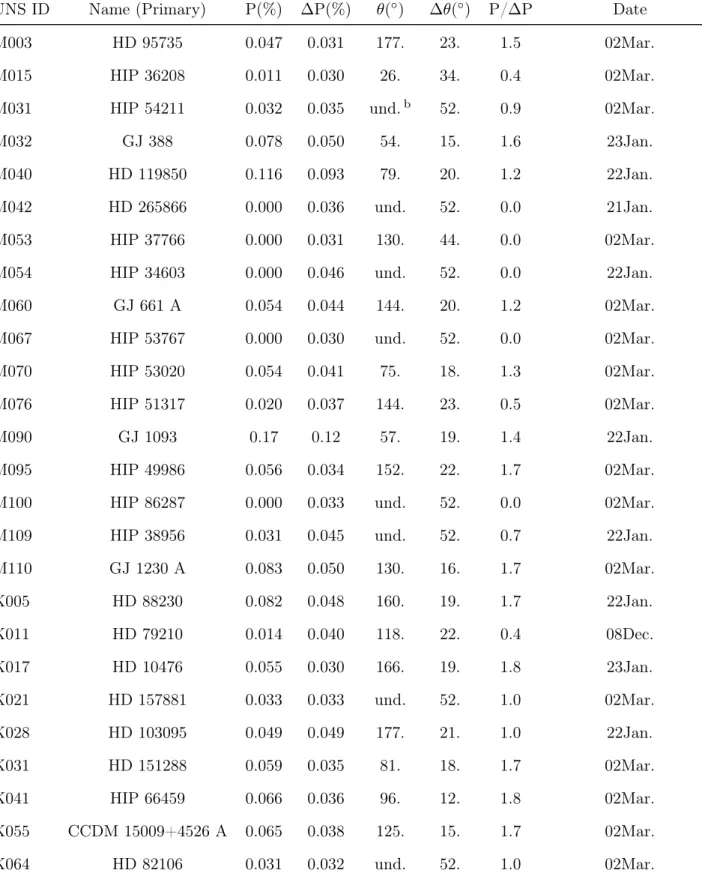
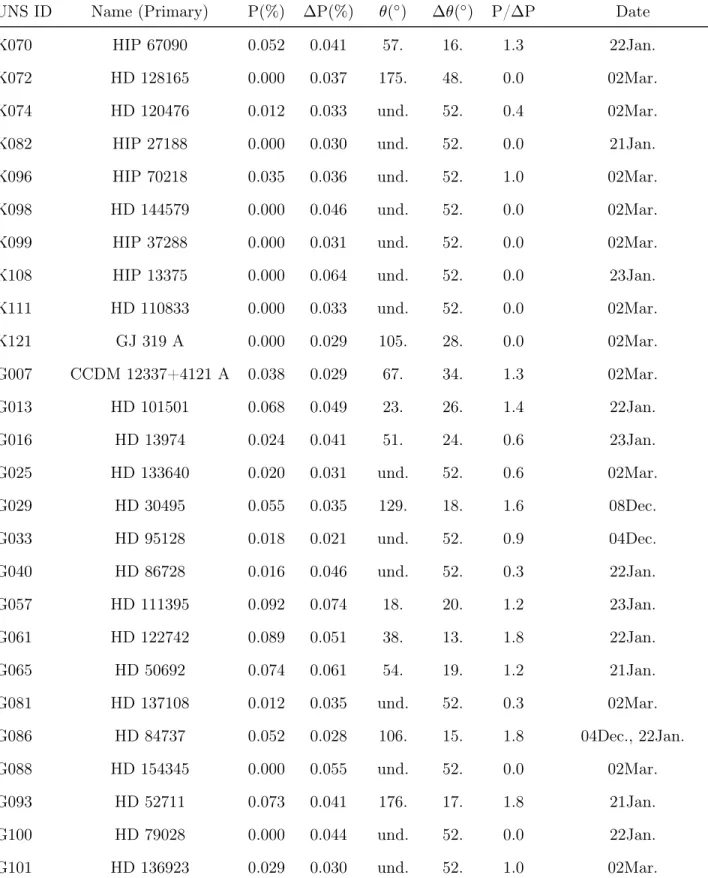
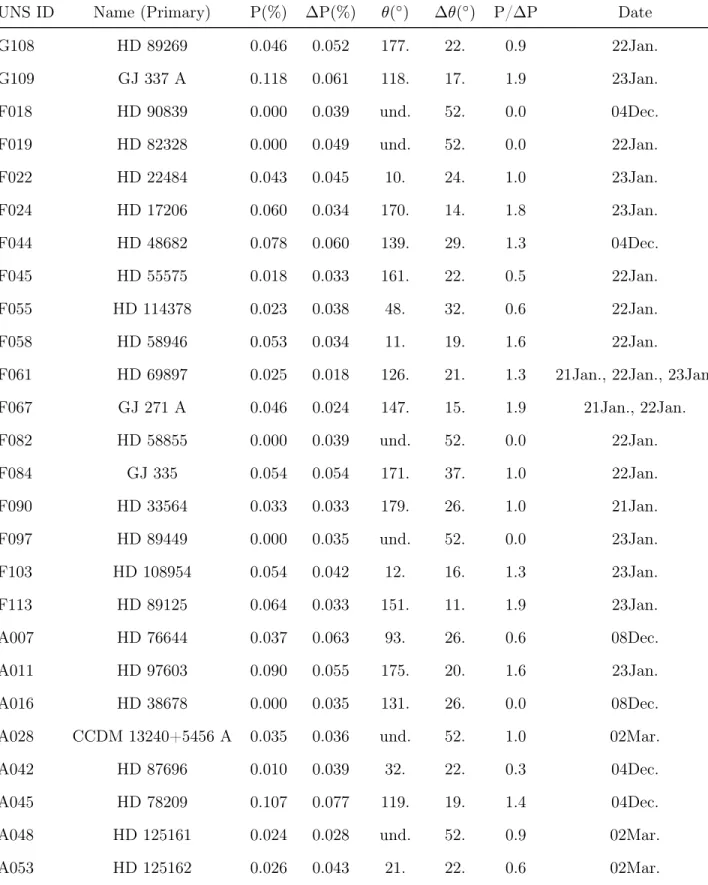
All targets from the DEBRIS survey are nearby stars and the furthest one is at 46 pc. The interstellar polarization is negligible for such distances (Piirola (1977), Leroy (1993), Lu-cas et al. (2009)), hence the polarization we measured is intrinsic to the stars. Column 1 of Tables 2.1 and 2.2 is the identification given for the SUNS and DEBRIS surveys, the first letter represents its spectral type and the number is a zero-padded running number increasing with distance in each subsample, these identifiers are referred to by the acronym UNS, standing for Unbiased Nearby Stars, as in the SUNS survey name. Column 2 is the name of the primary star, the choice of name is generally in the order of preference: HD, HIP, GJ, LHS, NLTT, TYC, PPM, CCDM , other catalogue name, 2MASS (Phillips et al. 2010). The other columns represent the polarization measured, its uncertainty, the position angle of the polarization vector and its uncertainty. When the error on the angle of the polarization vector is larger than 52◦, it is in fact undefined. Finally, the last column of the tables is the date when the polarization was measured. When we observed a certain star many times, the result given is the weighted mean of the measurements. A database with other informations on the targets (magnitude, distance, spectral type, etc) will be available online (Matthews et al., 2010b in preparation).
We found 15 stars with a polarization between 2 and 3σ (see Table 2.1). The stars with an observed polarization under 2σ are given in Table 2.2. The instrument works in such a way that there is a redundancy in the measurements of the Stokes parameters: measurements were done at 0◦, 45◦, 90◦ and 135◦ from a certain reference. Hence measurements at 0◦ and 90◦ for example should give approximately the same results. We compared the data between 0◦ and 90◦ and between 45◦ and 135◦, for the measurement detected above 3σ and the ones between 2
and 3σ. Measurements are coherent, but not strongly correlated. We are looking at very small polarization and additional observations of HD 115404 and of the measurements between 2 and 3σ should be done to confirm these results.
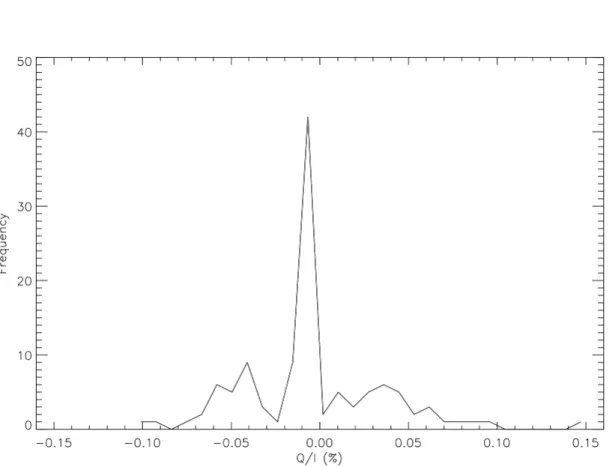
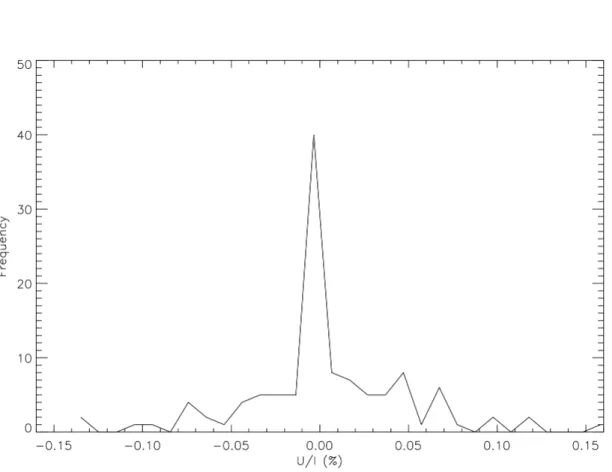
We plotted the number of stars with a given Q/I and U/I, see figures 2.1 and 2.2. Firstly, we can verify that the instrumental polarization is well determined, if such is the case, we should have a peak around 0. We see that it is the case for U/I but Q/I has an offset of -0.01%. It is nonetheless smaller than the error on the determination of the instrumental po-larization, therefore it is compatible with 0%. A very strong peak around 0 is seen in both figures, with two bumps around that peak. This indicates that the errors were larger on cer-tain nights than on others. It is indeed the case as we had some problems with one of the two photomultipliers during some nights and we had to use only half of the data. Finally, we can not clearly conclude about the presence of polarized stars which would stand in the wings of the peak.
We observed the star HR 8799 even if it is not a target of the DEBRIS survey. Results are given in Table 2.3.
2.4 Discussion
We have made a coherent census of polarization due to debris disks for 109 stars. We have only one detection above 3σ and 14 measurements above 2σ. This low rate of detection could be explained by many factors: only 25% of stars of the DEBRIS survey are expected to have debris disks (Matthews et al. 2010b, in preparation) ; in a face-on disk the polarization vector will cancel out (small fraction of disks have favourable inclination for detection) and we have error on the measurement of around 0.04%, which seems to be at the limit of detection (see section 2.5). Moreover, we used an 8.18�� aperture centered on the star, therefore the unpolarized light from the star is integrated at the same time as the polarized light from the disk. That decreases very significantly the polarization detected, for example β Pictoris has been found to be 15% polarized if the star is hidden (Gledhill et al. 1991) but through a whole
aperture, the intrinsic polarization was measured to be 0.2% (Krivova et al. 2000). Hence, we might overlook debris disks because of the mean error on polarization in our survey is too large.
2.4.1 HD 115404
The only detection we found is on HD 115404, which is a K2.5 V star (Gray et al. 2003). No debris disks have been found around that star by infrared/submillimeter excess yet.
2.4.2 Stars with Detected Polarization Over 2σ and Known Debris Disks or Planets
HD 75732, also known as 55 Cancri hosts five planets: 55 Cnc b (Marcy & Butler 1996), 55 Cnc c (Marcy et al. 2002), 55 Cnc d (Marcy et al. 2002), 55 Cnc e (McArthur et al. 2004) and 55 Cnc f (Fischer et al. 2008). A debris disk has been reported by Trilling & Brown (1998), but its existence has been put into question by Schneider et al. (2001).
HD 120136, also known as τ Bootis, hosts one planet (Butler et al. 1997).
Lucas et al. (2009) have made polarization measurements of these two stars in order to find a variable polarization due to the presence of planets very close to the host stars. They found a polarization around 10−6. Hence, HD 75732 and HD 120136 are very likely not polarized at the level measured in this survey. They found that the polarization of HD 75732 is very stable at a level of 10−6, showing no sign of the periodic variations that would be expected if a short-period planet were detected. They also found large scatter, 7.0 × 10⁻⁶ in the Stokes parameter U/I for HD 120136, but no indication for the expected periodicity. The polarization induced by a hot Jupiter is expected to be at the level of 10−5 - 10−6 (Hough et al. 2006).
HD 106591 has a debris disk: Su et al. (2006) found an infrared excess at 24 and 70 µm, four times higher than the flux coming only from the photosphere, using the Multiband Imaging Photometer for Spitzer (MIPS). Unfortunately no model has been computed yet to deduce the
distance of the dust from the star or its mass.
HD 98231 is a double star, it has already been observed by Herschel, which found a submilli-meter excess on the primary star (Brenda Matthews, private communication). The preliminary models of blackbody leads to a disk with a radius of 0.021 AU.
HD 60179 is also a double star with a debris disk detected by Herschel (Brenda Matthews, private communication). The radius of the disk would be of 0.067 AU.
2.4.3 HR 8799
We observed the star HR 8799 and found a small polarization of 0.07% at 2.8 times the error. This star is particularly interesting since it hosts three resolved planets (Marois et al. 2008) and three debris disks. Confirmation of this detection and observations in other wave-length bands would give us better constraints on the debris disks.
Su et al. (2009) and Reidemeister et al. (2009) modeled the infrared/submillimeter excess of HR 8799 and found that this star hosts three debris disks: an inner warm disk, a planete-simal disk and a halo. For the characteristics of the disks in the preferred model of Su et al. (2005), see Table 2.4. The first column represents the parameters of the disks: Rin and Rout stand for the inner and outer radii of the ring respectively, amin and amax for the minimum and maximum radii of the grains and Md for the mass of the disk.
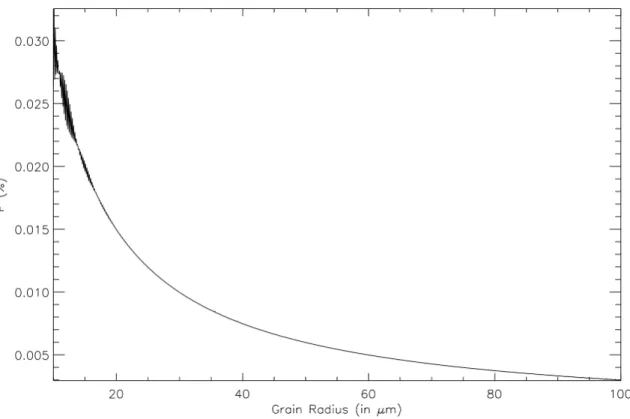
Using the model described in section 2.5, we estimate the polarization expected for such disks. For the inner disk, the polarization would be 0.02%, supposing that all the dust grains are at a distance of 6 AU and have a radius of 0.1 µm. For the planetesimal disk, the polarization could be as high as 1% if all particles have a radius of 1 µm and are at a distance of 90 AU. If the halo is totally symmetric around the star, it would not polarize the light. For the variation of polarization as a function of the radius of the grains in the planetesimal disk, see Figure 2.3.
In that figure, all grains are assumed to be astronomical silicates of a certain radius, at 90 AU from the star with a scattering angle of 90◦. For future work, a model with a ring and a distribution of grain radius should be used. The small inclination of the ring should also be taken into account as it has a strong impact on polarization. For the same debris disk, we would see a different polarization for an inclined disk than for an edge-on disk; the polarization of a disk inclined at 23◦ is 15% of the value of the polarization of the same disk seen edge-on (see equation 2.6).
2.5 Models
Using the Mie scattering theory, we were able to constrain the mass of the disks. For all models, we assumed that: all grains are astronomical silicates, they are at a certain distance from the star; they have a certain radius and that the scattering angle is 90◦. This angle is approximately the angle at which the polarization is maximal and corresponds to all grains being at 90◦ from the line of sight. We should keep in mind that the dust is in reality distri-buted along a ring and that the angle of inclination of the disk has a strong influence on the polarization we would detect.
We modeled the grains with astronomical silicates and took the complex refractive index given in Draine (1985), at 0.80 µm: m = n + ik with n = 1.71 and k = 0.0297. We computed numerically the Van de Hulst intensities, i1 and i2 for each grain radius and scattering angle.
Having those, we can estimate the polarization with:
P = Pdust N Ic I�+ Ic
. (2.1)
Knowing that the polarization of one grain is given by:
Pdust=
i1− i2
and:
Ic = I�
i1− i2
2k2R2. (2.3)
Combining equations 2.1 and 2.3, we then have:
P = Pdust N � i1− i2 2k2R2 1 +i1− i2 2k2R2 � , (2.4)
with: Ic and I� the intensities of the cloud and the star respectively, k the wavenumber, R the distance from the star and N the number of grains. The number of grains and the mass M of the disk are linked by:
M = ρ V N, (2.5)
with ρ the density of the grain (we used the value of 3 g.cm−3 for astronomical silicates) and V the volume of a grain.
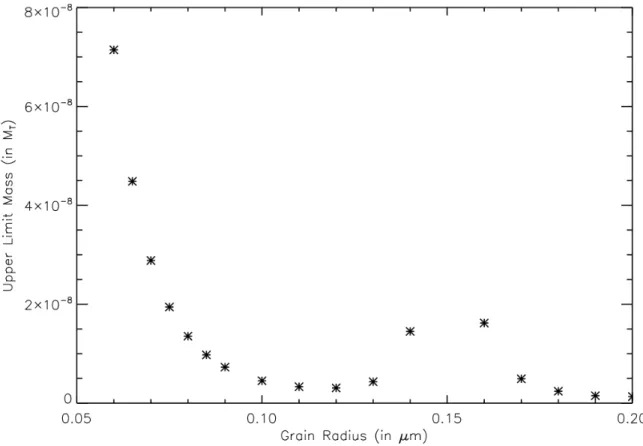
To put upper limit constraints on the mass of the disk, we assume a polarization detected at a level of 0.1%, which is the upper limit that we have on most of our measurements. The polarization induced by debris disks will approximately decrease as the square of their distance from the star, see equation 2.4. Therefore, in this survey we are more sensitive to hot debris disks such as the zodiacal cloud in our solar system. Fixsen & Dwek (2002) estimated that the grain radii of the zodiacal cloud range from 0.01 µm to 1 cm, decreasing exponentially. We then use a grain radius of 0.1 µm (but see Figure 2.4 for the influence of grain radius on the mass, for a debris disk at 1 AU).
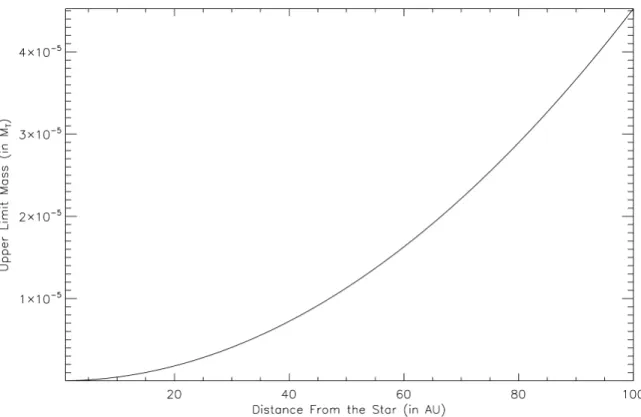
We assume that all grains are at 1 AU, as for the zodiacal cloud the density of grains decreases quickly when the distance from the star is superior to 3 AU (Ipatov & Mather 2006) (but see Figure 2.5 for the influence of the distance on the mass of the disk.
With all these assumptions, we found a mass of the disk of 4.5 × 10⁻⁹M
⊕. The model was computed with conservative assumptions that would tend to find the disk massive, in order to
have a realistic mass upper limit. As the zodiacal cloud mass is between 0.33 - 1.81 × 10⁻⁹ M⊕, we indeed are at the limit of sensitivity of the instrument, if extrasolar hot debris disks resemble the zodiacal cloud.
Single scattering by Mie particles in optically thin envelopes around a star has been consi-dered in the past and can be applied in the context of our paper. Bastien (1987) analytically studied the properties of different geometries. For an azimuthally symmetric but otherwise arbitrary density distribution, the polarization is proportionnal to sin2i as long as grains are relatively small compared to the wavelength, i.e., x = ka = 2π/λa < 2.0, where a is the grain radius. For a plane disk, the polarization is given by (Bastien 1987):
P ∝ 15 4 [N
�(sin i)2] ¯F
22, (2.6)
where N’ is an integral over the radial density distribution in the disk, and ¯F22 is real and depends on the scattering phase function (Simmons 1982). ¯F22also determines the wavelength dependence of the polarization. The position angle normally is perpendicular to the disk, except for a possible change by π/2 when ¯F22 changes sign. In all cases, we see that there is a strong, sine square, dependence on the inclination.
2.6 Statistical Comparison
Since we measured small polarization levels in our sample of debris disks candidates, we compare statistically the distributions of two samples: 1) polarization measurements from the Heiles catalogue, and 2) our measurements including 4 stars observed by Bhatt & Manoj (2000) (hereafter B&M). As we are looking at nearby stars, the submillimeter/infrared excess measured, compared to the photosphere, comes from dust around those stars. We assume that the presence of submillemeter/infrared excess is a reliable indicator of the presence of debris disks.
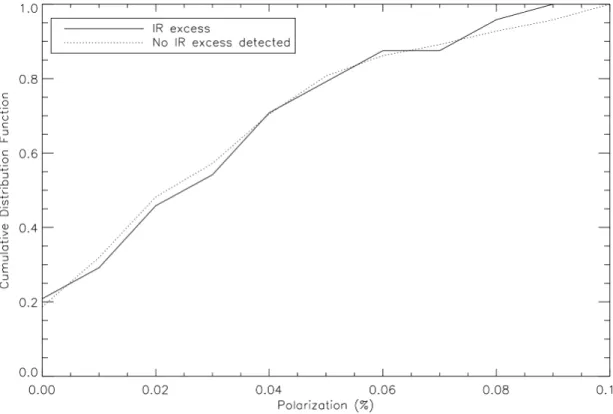
from the DEBRIS and SUNS surveys (629 stars). We found polarization measurements for 189 stars. We searched for infrared measurements for these 189 stars in the following papers: Su et al. (2006), Beichman et al. (2006), Trilling et al. (2008). We then compared the polarization between stars that are known to have debris disks with the ones where no debris disks have been found. The results are given in Figure 2.6. No significant differences have been found on the polarization between stars with and without infrared excess. The mean polarization of stars that are known to host debris disks and for stars where no debris disks have been detected is given in table 2.5. No significant difference has been found between the two groups.
B&M did the same comparison for 61 stars and they found a greater polarization for vega-like stars. They observed 27 stars and 34 come from the Heiles catalog (2000). Error on measurements in the Heiles catalog are around 0.1% and could be as high as 0.3%. For that matter, as the error on the polarizarion measurements of B&M are small (mean: 0.06%), we include them in the following analysis:
2) We made the same comparison for our polarization sample, adding 4 stars observed by B&M that are parts of the DEBRIS sample. Three of them have been detected in polarization: HD 102647 at 0.15±0.05%, HD 109085 at 0.38±0.04% and HD 115892 at 0.18±0.06%. In addition to the stars observed in submillimeter/infrared in papers: Su et al. (2006), Beichman et al. (2006), Trilling et al. (2008), we add the preliminary measurements by Herschel (Brenda Matthews, private communication). Of the 108 stars of the DEBRIS sample we observed, 17 stars have already been observed with Herschel. The preliminary results show that 2 of these 17 stars have a debris disk. Only 10 stars we observed have infrared/submillimeter excess, for the other 98, no excess have been discovered yet. Hence, we compared the polarization of 14 stars with infrared/submillimeter excess with 98 stars where no excess have been found (see Figure 2.7). In that figure, we see a difference in polarization between stars having an infrared excess and those which have none. We used an extension of the chi-square goodness-of-fit test in order to test if the two samples are statistically different. The coefficient of contingency, ranging from 0 to 1 measures the degree of dependence between two samples, the larger the
value, the greater the degree of dependance. We found 0.08 within our sample. The mean polarization for stars without detected infrared excess and for those with a debris disk is given in table 2.5. The mean polarization is greater for stars having infrared excess compared to stars having none, but the deviation on the mean does not permit us to conclude that there is a statistically significant difference between the two samples. These results are an indication that more detections should be found with a small increase on the measurement precision and with observing the remaining 186 stars of the DEBRIS sample visible from the OMM.
2.7 Conclusion and Further Prospects
We performed a coherent census of polarization due to debris disks for 109 stars. Only one detection over 3σ and 14 measurements between 2σ and 3σ have been found. This low rate of detection could be explained by many factors: the small fraction of expected debris disks, their random inclination that will not always be favourable and the error on the measurements. By modeling polarization due to debris disks, we have found upper limit constraints on the mass of the debris disks. We did a statistical comparison of polarization of stars that have debris disks with stars where none have been found, we see a statistical difference between the two samples. We can conclude that we are at the limit of the sensitivity to detect polarization due to debris disks and increasing the precision on future measurements should lead to more detections.
The authors wish to sincerely thank the telescope operators at the Mont-Mégantic Obser-vatory, Pierre-Luc Lévesque, Bernard Malenfant and Ghislain Turcotte. We also would like to thank Rémi Fahed and Lison Malo for their precious help, Marie-Michèle Limoges for a careful reading of this manuscript and David Lafrenière for insightful discussions on HR 8799. This research has made use of the SIMBAD database and the VizieR catalog access tool, operated at CDS, Strasbourg, France.
Figure2.3 – Polarization as a function of the grain radius for HR 8799. We used characteristics of the preferred model of Su et al. (2005).
Figure 2.4 – Mass of the disk determined as a function of the grain radius, for an assumed observed polarization of 0.1%. Other assumptions are given in the text.
Figure 2.5 – Mass of the disk determined as a function of the distance of silicate grains of 0.1 µm. Other assumptions are given in the text.
Figure 2.6 – Comparison of polarization in the Heiles Catalog for stars with and without infrared excess. The polarization is given as a function of the fractional number of stars with observed polarization lower than a given value. Solid line represents stars with infrared excess and dashed line stars without.
Figure 2.7 – Comparison of polarization for stars with and without infrared excess in this survey and the one of B&M. The polarization is given as a function of the fractional number of stars with observed polarization lower than a given value. Solid line represents stars with infrared excess and dashed line stars without.
Table2.1 – Stars Observed with a Polarization Over 2σ.
UNS ID Name (Primary) P(%) ∆P(%) θ(◦) ∆θ(◦) P/∆P Distance (pc) Date K046 HD 115404 0.152 0.043 8.4 7.4 3.5 11.095 ± 0.090 22Jan. M069 GJ 3522 0.103 0.036 79. 11. 2.8 6.772 ± 0.091 02Mar. K056 HD 97101 0.053 0.024 135. 10. 2.2 11.96 ± 0.12 04Dec. K060 HD 75732 0.099 0.042 136. 11. 2.4 12.46 ± 0.10 21Jan. K086 GJ 400 A 0.070 0.029 132. 13. 2.4 13.90 ± 0.32 04Dec. K092 HD 110315 0.098 0.049 88. 14. 2.0 19.18 ± 0.12 22Jan. G094 HD 78366 0.166 0.075 150. 14. 2.2 8.368 ± 0.055 21Jan. F004 HD 98231 0.070 0.032 28. 15. 2.2 15.622 ± 0.049 04Dec. F036 HD 120136 0.079 0.038 74. 15. 2.1 6.772 ± 0.091 22Jan. F040 GJ 332 A 0.071 0.028 54. 13. 2.6 16.06 ± 0.17 08Dec. F120 HD 101177 0.145 0.049 45. 10. 2.9 23.20 ± 0.39 22Jan. F121 HD 100180 0.124 0.063 47. 17. 2.0 23.33 ± 0.66 08Dec. A006 HD 60179 0.067 0.025 179. 10. 2.7 14.01 ± 0.41 08Dec. A026 HD 106591 0.084 0.033 169. 13. 2.5 24.688 ± 0.085 23Jan. A032 HD 103287 0.058 0.027 170.2 9.0 2.1 25.51 ± 0.26 23Jan.
Table2.2: Stars Observed with a Polarization Under 2σ
UNS ID Name (Primary) P(%) ∆P(%) θ(◦) ∆θ(◦) P/∆P Date
M003 HD 95735 0.047 0.031 177. 23. 1.5 02Mar.
M015 HIP 36208 0.011 0.030 26. 34. 0.4 02Mar.
M031 HIP 54211 0.032 0.035 und.b 52. 0.9 02Mar.
M032 GJ 388 0.078 0.050 54. 15. 1.6 23Jan.
M040 HD 119850 0.116 0.093 79. 20. 1.2 22Jan.
M042 HD 265866 0.000 0.036 und. 52. 0.0 21Jan.
M053 HIP 37766 0.000 0.031 130. 44. 0.0 02Mar.
M054 HIP 34603 0.000 0.046 und. 52. 0.0 22Jan.
M060 GJ 661 A 0.054 0.044 144. 20. 1.2 02Mar.
M067 HIP 53767 0.000 0.030 und. 52. 0.0 02Mar.
M070 HIP 53020 0.054 0.041 75. 18. 1.3 02Mar.
M076 HIP 51317 0.020 0.037 144. 23. 0.5 02Mar.
M090 GJ 1093 0.17 0.12 57. 19. 1.4 22Jan.
M095 HIP 49986 0.056 0.034 152. 22. 1.7 02Mar.
M100 HIP 86287 0.000 0.033 und. 52. 0.0 02Mar.
M109 HIP 38956 0.031 0.045 und. 52. 0.7 22Jan.
M110 GJ 1230 A 0.083 0.050 130. 16. 1.7 02Mar. K005 HD 88230 0.082 0.048 160. 19. 1.7 22Jan. K011 HD 79210 0.014 0.040 118. 22. 0.4 08Dec. K017 HD 10476 0.055 0.030 166. 19. 1.8 23Jan. K021 HD 157881 0.033 0.033 und. 52. 1.0 02Mar. K028 HD 103095 0.049 0.049 177. 21. 1.0 22Jan. K031 HD 151288 0.059 0.035 81. 18. 1.7 02Mar. K041 HIP 66459 0.066 0.036 96. 12. 1.8 02Mar. K055 CCDM 15009+4526 A 0.065 0.038 125. 15. 1.7 02Mar. K064 HD 82106 0.031 0.032 und. 52. 1.0 02Mar.
Table2.2: Stars Observed with a Polarization Under 2σ
UNS ID Name (Primary) P(%) ∆P(%) θ(◦) ∆θ(◦) P/∆P Date
K070 HIP 67090 0.052 0.041 57. 16. 1.3 22Jan.
K072 HD 128165 0.000 0.037 175. 48. 0.0 02Mar.
K074 HD 120476 0.012 0.033 und. 52. 0.4 02Mar.
K082 HIP 27188 0.000 0.030 und. 52. 0.0 21Jan.
K096 HIP 70218 0.035 0.036 und. 52. 1.0 02Mar.
K098 HD 144579 0.000 0.046 und. 52. 0.0 02Mar.
K099 HIP 37288 0.000 0.031 und. 52. 0.0 02Mar.
K108 HIP 13375 0.000 0.064 und. 52. 0.0 23Jan.
K111 HD 110833 0.000 0.033 und. 52. 0.0 02Mar. K121 GJ 319 A 0.000 0.029 105. 28. 0.0 02Mar. G007 CCDM 12337+4121 A 0.038 0.029 67. 34. 1.3 02Mar. G013 HD 101501 0.068 0.049 23. 26. 1.4 22Jan. G016 HD 13974 0.024 0.041 51. 24. 0.6 23Jan. G025 HD 133640 0.020 0.031 und. 52. 0.6 02Mar. G029 HD 30495 0.055 0.035 129. 18. 1.6 08Dec. G033 HD 95128 0.018 0.021 und. 52. 0.9 04Dec. G040 HD 86728 0.016 0.046 und. 52. 0.3 22Jan. G057 HD 111395 0.092 0.074 18. 20. 1.2 23Jan. G061 HD 122742 0.089 0.051 38. 13. 1.8 22Jan. G065 HD 50692 0.074 0.061 54. 19. 1.2 21Jan. G081 HD 137108 0.012 0.035 und. 52. 0.3 02Mar. G086 HD 84737 0.052 0.028 106. 15. 1.8 04Dec., 22Jan. G088 HD 154345 0.000 0.055 und. 52. 0.0 02Mar. G093 HD 52711 0.073 0.041 176. 17. 1.8 21Jan. G100 HD 79028 0.000 0.044 und. 52. 0.0 22Jan. G101 HD 136923 0.029 0.030 und. 52. 1.0 02Mar.
Table2.2: Stars Observed with a Polarization Under 2σ
UNS ID Name (Primary) P(%) ∆P(%) θ(◦) ∆θ(◦) P/∆P Date
G108 HD 89269 0.046 0.052 177. 22. 0.9 22Jan. G109 GJ 337 A 0.118 0.061 118. 17. 1.9 23Jan. F018 HD 90839 0.000 0.039 und. 52. 0.0 04Dec. F019 HD 82328 0.000 0.049 und. 52. 0.0 22Jan. F022 HD 22484 0.043 0.045 10. 24. 1.0 23Jan. F024 HD 17206 0.060 0.034 170. 14. 1.8 23Jan. F044 HD 48682 0.078 0.060 139. 29. 1.3 04Dec. F045 HD 55575 0.018 0.033 161. 22. 0.5 22Jan. F055 HD 114378 0.023 0.038 48. 32. 0.6 22Jan. F058 HD 58946 0.053 0.034 11. 19. 1.6 22Jan.
F061 HD 69897 0.025 0.018 126. 21. 1.3 21Jan., 22Jan., 23Jan.
F067 GJ 271 A 0.046 0.024 147. 15. 1.9 21Jan., 22Jan. F082 HD 58855 0.000 0.039 und. 52. 0.0 22Jan. F084 GJ 335 0.054 0.054 171. 37. 1.0 22Jan. F090 HD 33564 0.033 0.033 179. 26. 1.0 21Jan. F097 HD 89449 0.000 0.035 und. 52. 0.0 23Jan. F103 HD 108954 0.054 0.042 12. 16. 1.3 23Jan. F113 HD 89125 0.064 0.033 151. 11. 1.9 23Jan. A007 HD 76644 0.037 0.063 93. 26. 0.6 08Dec. A011 HD 97603 0.090 0.055 175. 20. 1.6 23Jan. A016 HD 38678 0.000 0.035 131. 26. 0.0 08Dec.
A028 CCDM 13240+5456 A 0.035 0.036 und. 52. 1.0 02Mar.
A042 HD 87696 0.010 0.039 32. 22. 0.3 04Dec.
A045 HD 78209 0.107 0.077 119. 19. 1.4 04Dec.
A048 HD 125161 0.024 0.028 und. 52. 0.9 02Mar.
Table2.2: Stars Observed with a Polarization Under 2σ
UNS ID Name (Primary) P(%) ∆P(%) θ(◦) ∆θ(◦) P/∆P Date
A056 HD 56537 0.050 0.031 39. 12. 1.6 08Dec.
A065 CCDM 15278+2906 A 0.028 0.031 148. 56. 0.9 02Mar.
A066 HD 104513 0.025 0.042 und. 52. 0.6 22Jan.
A067 HD 14055 0.084 0.047 18. 21. 1.8 08Dec. A068 HD 91312 0.029 0.040 122. 19. 0.7 04Dec. A069 HD 112413 0.031 0.042 109. 22. 0.7 02Mar. A074 HD 79439 0.124 0.071 60. 16. 1.7 08Dec. A078 HD 184006 0.101 0.051 133. 16. 2.0 02Mar. A079 HD 102124 0.020 0.029 8. 30. 0.7 02Mar.
A082 HD 71155 0.000 0.043 und. 52. 0.0 22Jan.
A083 HD 80081 0.029 0.031 und. 52. 1.0 21Jan.
A086 HD 13161 0.022 0.039 und. 52. 0.6 23Jan.
A087 HD 95608 0.033 0.032 86. 16. 1.0 23Jan.
A110 HD 89021 0.039 0.054 und. 52. 0.7 22Jan.
A127 HD 140436 0.000 0.033 und. 52. 0.0 02Mar.
aAngle is undefined when the ratio P/∆P is too low.
Table2.3 – Polarization Measurement of HR 8799.
Name P(%) ∆P(%) θ(◦) ∆θ(◦) P/∆P Distance(pc) Date HR 8799 0.070 0.025 95.5 8.9 2.8 39.4 ± 0.1 08Dec.
Table2.4 – Parameters of the Disks in the Preferred Model of Su et al. (2005). Parameters Inner Warm Disk Planetesimal Disk Halo
Rin(AU) 6 90 300
Rout (AU) 15 300 1000
amin(µm) 1.5 10 1
amax(µm) 4.5 1000 10
Md(M⊕) 1.1 × 10⁻⁶ 1.2 × 10⁻¹ 1.9 × 10⁻²
Table 2.5 – Results of the Comparison Between the Polarization of Stars Owning a Debris Disk with Stars without One.
Heiles Catalog | OMM and B&M samples
Mean σ Number Mean σ Number
With Debris Disks 0.034% 0.037% 24 0.092% 0.054% 14 Without Debris Disks 0.040% 0.043% 165 0.047% 0.039% 98
Aumann, H. H., et al. 1984, ApJ, 278, L23
Backman, D. E., & Paresce, F. 1993, in Protostars and Planets III, ed. E. H. Levy & J. I. Lunine (Tucson, AZ: Univ. Arizona Press), 1253
Bastien, P. 1987, ApJ, 317, 231
Beichman, C. A., et al. 2005, ApJ, 622, 1160 Beichman, C. A., et al. 2006, ApJ, 652, 1674 Bhatt, H. C., & Manoj, P. 2000, A&A, 362, 978 Bryden, G., et al. 2006, ApJ, 636, 1098
Burns, J. A., Lamy, P. L., & Soter, S. 1979, Icarus, 40, 1
Butler, R. P., Marcy, G. W., Williams, E., Hauser, H., & Shirts, P. 1997, ApJ, 474, L115 Chavero, C., Gómez, M., Whitney, B. A., & Saffe, C. 2006, A&A, 452, 921
Dohnanyi, J. S. 1969, J. Geophys. Res., 74, 2531 DEBRIS Collaboration, et al. 2010, arXiv:1005.5147 Draine, B. T. 1985, ApJS, 57, 587
Eritsyan, M. A., Hovhannessian, R. K., & Hovhannessian, E. R. 2002, Astrophysics, 45, 25 Fischer, D. A., et al. 2008, ApJ, 675, 790
Fixsen, D. J., & Dwek, E. 2002, ApJ, 578, 1009
Gledhill, T. M., Scarrott, S. M., & Wolstencroft, R. D. 1991, MNRAS, 252, 50P Graham, J. R., Kalas, P. G., & Matthews, B. C. 2007, ApJ, 654, 595
Gray, R. O., Corbally, C. J., Garrison, R. F., McFadden, M. T., & Robinson, P. E. 2003, AJ, 126, 2048
Griffin, M. J., et al. 2010, arXiv:1005.5123 Heiles, C. 2000, AJ, 119, 923
Høg, E., et al. 2000, A&A, 355, L27
Hough, J. H., Lucas, P. W., Bailey, J. A., Tamura, M., Hirst, E., Harrison, D., & Bartholomew-Biggs, M. 2006, PASP, 118, 1302
Ipatov, S. I., & Mather, J. C. 2006, Advances in Space Research, 37, 126 Korhonen, T., & Reiz, A. 1986, A&AS, 64, 487
Kóspál, Á., Ardila, D. R., Moór, A., & Ábrahám, P. 2009, ApJ, 700, L73 Krivov, A. V. 2010, Research in Astronomy and Astrophysics, 10, 383 Krivova, N. A., Krivov, A. V., & Mann, I. 2000, ApJ, 539, 424
Leroy, J. L. 1993, A&AS, 101, 551
Lestrade, J.-F., Wyatt, M. C., Bertoldi, F., Dent, W. R. F., & Menten, K. M. 2006, A&A, 460, 733
Lucas, P. W., Hough, J. H., Bailey, J. A., Tamura, M., Hirst, E., & Harrison, D. 2009, MNRAS, 393, 229
Mann, I., Köhler, M., Kimura, H., Cechowski, A., & Minato, T. 2006, A&A Rev., 13, 159 Manset, N., & Bastien, P. 1995, PASP, 107, 483
Marcy, G. W., & Butler, R. P. 1996, ApJ, 464, L147
Marcy, G. W., Butler, R. P., Fischer, D. A., Laughlin, G., Vogt, S. S., Henry, G. W., & Pourbaix, D. 2002, ApJ, 581, 1375
Marois, C., Macintosh, B., Barman, T., Zuckerman, B., Song, I., Patience, J., Lafrenière, D., & Doyon, R. 2008, Science, 322, 1348
Matthews, B. C., et al. 2007, PASP, 119, 842 Matthews, B. C., et al. 2010a, A&A, 518, L135 McArthur, B. E., et al. 2004, ApJ, 614, L81 Moro-Martín, A., et al. 2007, ApJ, 658, 1312 Najita, J., & Williams, J. P. 2005, ApJ, 635, 625 Oudmaijer, R. D., et al. 2001, A&A, 379, 564 Perry, C. L., & Johnston, L. 1982, ApJS, 50, 451
Phillips, N. M., Greaves, J. S., Dent, W. R. F., Matthews, B. C., Holland, W. S., Wyatt, M. C., & Sibthorpe, B. 2010, MNRAS, 403, 1089
Piirola, V. 1977, A&AS, 30, 213
Plets, H., & Vynckier, C. 1999, A&A, 343, 496 Poglitsch, A., et al. 2010, arXiv:1005.1487
Reidemeister, M., Krivov, A. V., Schmidt, T. O. B., Fiedler, S., Müller, S., Löhne, T., & Neuhäuser, R. 2009, A&A, 503, 247
Rhee, J. H., Song, I., Zuckerman, B., & McElwain, M. 2007, ApJ, 660, 1556
Schneider, G., Becklin, E. E., Smith, B. A., Weinberger, A. J., Silverstone, M., & Hines, D. C. 2001, AJ, 121, 525