Psychological Science 24(9) 1854 –1859 © The Author(s) 2013 Reprints and permissions:
sagepub.com/journalsPermissions.nav DOI: 10.1177/0956797613479610 pss.sagepub.com
Research Report
Working memory (WM) is a cognitive system that allows the brief maintenance of information in an active and accessible state in the mind, and it is thought to be cru-cial within such major domains as language, reasoning, and learning (e.g., Baddeley, 2012). Typically, across these domains, the relevant information is serially orga-nized, and the maintenance of serial order has been rec-ognized as a critical feature of WM (Marshuetz, 2005).
An increasing number of researchers have claimed that WM is strongly attention based, defending the view that WM emerges from attentional processes operating on long-term memory representations (e.g., Cowan, 1995; Postle, 2006). However, so far, the various models of WM for serial order (e.g., Burgess & Hitch, 1999; Henson, 1998) have not followed up on this develop-ment and do not specifically emphasize attentional pro-cesses. Conversely, more general models of WM (e.g., Oberauer & Hein, 2012) acknowledge an important role for attentional factors but do not explicitly account for serial order. In the current study, we aimed to bridge these literatures.
Spatial selective attention improves visual processing at attended versus unattended locations (e.g., Johnston,
McCann, & Remington, 1995). Earlier studies have shown a link between spatial selective attention and visuo- spatial WM as stimulus processing improves at memo-rized locations compared with nonmemomemo-rized locations (e.g., Awh & Jonides, 2001; Theeuwes, Kramer, & Irwin, 2011). Moreover, Nobre et al. (2004) demonstrated that such spatial selective attention has an internal equivalent, in the sense that people can perform an attentional search over internal spatial representations—the latter being grounded in largely the same neural substrate as external spatial attention.
We hypothesized that serial-order WM is intrinsically linked to spatial attention: The selection of relevant information from a serial-order representation in WM is driven by an attentional search across an internal space.
Corresponding Authors:
Jean-Philippe van Dijck, Department of Experimental Psychology, Ghent University, Henri Dunantlaan 2, 9000 Ghent, Belgium E-mail: [email protected]
Elger L. Abrahamse, Department of Experimental Psychology, Ghent University, Henri Dunantlaan 2, 9000 Ghent, Belgium
E-mail: [email protected]
Spatial Attention Interacts With
Serial-Order Retrieval From Verbal
Working Memory
Jean-Philippe van Dijck
1, Elger L. Abrahamse
1,
Steve Majerus
2, and Wim Fias
11Department of Experimental Psychology, Ghent University, and 2Department of
Psychology: Cognition and Behavior, University of Liège
Abstract
The ability to maintain the serial order of events is recognized as a major function of working memory. Although general models of working memory postulate a close link between working memory and attention, such a link has so far not been proposed specifically for serial-order working memory. The present study provided the first empirical demonstration of a direct link between serial order in verbal working memory and spatial selective attention. We show that the retrieval of later items of a sequence stored in working memory—compared with that of earlier items— produces covert attentional shifts toward the right. This observation suggests the conceptually surprising notion that serial-order working memory, even for nonspatially defined verbal items, draws on spatial attention.
Keywords
attention, short-term memory
Although this hypothesis is conceptually surprising, some indications for it exist. First, several studies have indi-cated the involvement of selective attention—although not specifically spatially defined—in the efficient mainte-nance of serial order in WM (e.g., Majerus et al., 2012; Majerus, Heiligenstein, Gautherot, Poncelet, & Van der Linden, 2009). Second, it was recently demonstrated that brief sequences of words serially stored in WM are linked to space: Items from the beginning of such a sequence facilitated left-hand responses during the retention inter-val, whereas items from the end of the sequence facili-tated right-hand responses, even when serial position was not relevant during retention (van Dijck & Fias, 2011). Although this study clearly demonstrated a link between serial information and spatial processing, it does not allow any conclusion about the nature of this link and about whether it involves spatial attention per se.
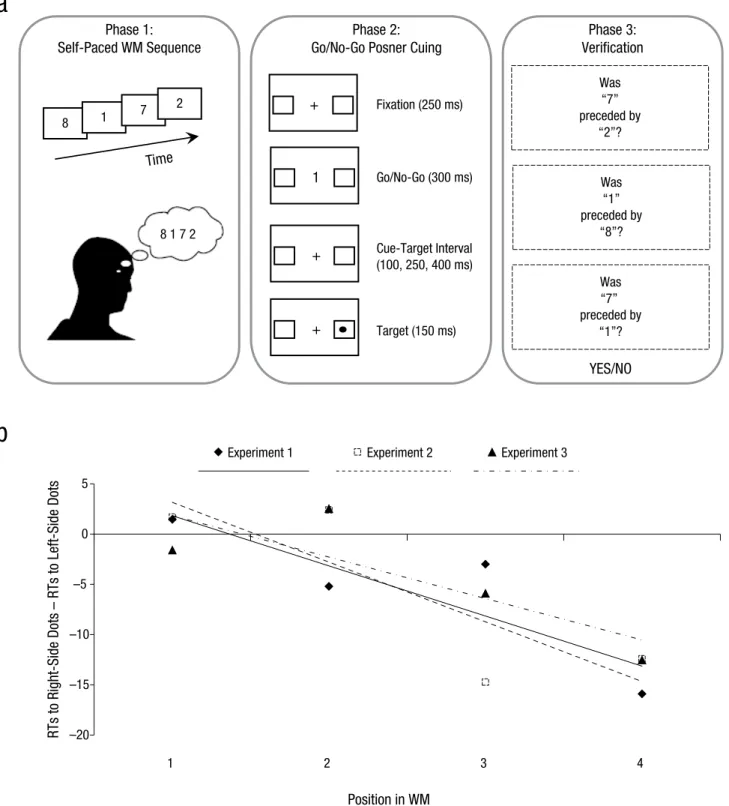
To test our hypothesis, we explored the effect of the retrieval of serially stored items from WM on perfor-mance in a typical spatial-attention-cuing task (Posner, 1980; see Fig. 1a). Although both the verbal and spatial domains can involve serial order, the most convincing demonstration of such an effect would be with centrally presented verbal items (given that visuo-spatial informa-tion necessarily implies spatial processing). Three experi-ments were conducted using digits, which are frequently used in investigations of verbal WM. In each experiment, participants memorized four successively and centrally presented digits in the order of presentation (Phase 1). During the retention interval, they performed a speeded dot-detection task in which dots appeared randomly at the left or right sides of the screen (Phase 2). A digit was presented before each dot as a go/no-go cue; digits from the WM sequence cued go trials, whereas other digits cued no-go trials. Finally, serial-order knowledge was tested to ensure that the sequence was accurately main-tained over the retention interval (Phase 3).
Because spatial-attention processes underlying WM strongly interface with external spatial attention (e.g., Awh & Jonides, 2001; Nobre et al., 2004), we hypothesized that the retrieval of these serially stored WM items would be paralleled by shifts in external attention—based on WM position—that would subsequently enhance the percep-tual processing of the dots appearing on the attended location. Thus, we predicted an increasing advantage in detecting right-side dots with increasing WM position.
Experiment 1
Participants
Twenty-four students (19 female, 5 male; mean age = 23 years, SD = 3.13; all native Dutch speakers) from Ghent University participated.1
Stimuli and method
An experimental session contained 36 blocks of three phases each. Phase 1 involved the central, self-paced serial presentation of four digits (0.45°; digits, which were pseudorandomly sampled from 1 to 8 were bal-anced across WM positions for Blocks 1–32 and ran-domly determined for the remaining 4 blocks). After a rehearsal period (2,500 ms), the speeded dot-detection task (Phase 2) started with the presentation of a central fixation cross (0.25°) centered between two rectangles (1° × 0.67°; 3.20° eccentricity). After 250 ms, a digit (unin-formative about dot location) replaced the fixation cross for 300 ms. Participants were instructed to fixate this cen-tral location throughout Phase 2. To optimize the time window for observing attentional modulation, we mixed cue-target intervals (CTIs) of 100, 250, and 400 ms.
Next, the target (a white dot; 0.5° × 0.5°) appeared in one of the rectangles for 150 ms. To ensure WM access, we had participants respond only to trials on which digits from the WM sequence appeared (go trials), with a right-hand key press on a response device aligned to body midline. The response deadline and intertrial interval (ITI) were 700 and 250 ms, respectively. To discourage anticipatory responding, we considered trials with a response during dot presentation (< 150 ms) to be no-response trials (no no-response was recorded and the ITI was initiated only after a 700-ms penalty), and we included catch trials in which digit presentation was not followed by a target. Each block contained 20 trials. Each digit was presented twice followed by a dot; the memo-rized digits were additionally presented once, followed by a catch trial.
Finally, in Phase 3, we verified sequence maintenance with participants’ responses to three questions about serial order (e.g., “Kwam 1 voor 8?”, Dutch for “Was 1 preceded by 8?”). These questions were on the three pos-sible pairs of subsequent WM items, the order of which either did or did not correspond to the order of the WM sequence (items were vertically arranged to avoid any horizontal association). The factors CTI, WM position, and dot location were fully crossed (12 measurements per condition).
Results and discussion
Trials from WM sequences with accurate serial-order ver-ification (on average, 33.22 of 36 sequences) and correct go trials (accuracy on the dot-detection task was 94%, 99%, and 98% for the go, no-go, and catch trials, respec-tively) were considered. The mean reaction time (RT) was 314 ms (SD = 46).
Each participant’s mean RTs were computed for each condition and subjected to a 3 × 4 × 2 repeated measures
Was “1” preceded by “8”? Was “7” preceded by “1”? Was “7” preceded by “2”? YES/NO –20 –15 –10 –5 0 5 1 2 3 4
RTs to Right-Side Dots – RTs to Left-Side Dots
Position in WM
Experiment 1 Experiment 2 Experiment 3
Phase 1: Self-Paced WM Sequence 1 + + + Fixation (250 ms) Go/No-Go (300 ms) Cue-Target Interval (100, 250, 400 ms) Target (150 ms) Phase 2: Go/No-Go Posner Cuing
Phase 3: Verification Time 8 1 7 2 8 1 7 2
a
b
Fig. 1. Task design (a) and results (b) of Experiment 1. In each experimental session (a), Phase 1 involved the presentation of four digits from 1 to 8. After a rehearsal period, Phase 2 began with the presentation of a central fixation cross centered between two rectangles. After 250 ms, a digit replaced the fixation cross for 300 ms; participants fixated this central location throughout Phase 2. Following a cue-target interval, the target appeared in one of the rectangles for 150 ms. This series of events repeated for each trial in Phase 2. Finally, in Phase 3, we verified sequence maintenance with participants’ responses to three questions about the serial order of the presented numbers. The graph (b) shows differences between reaction times (RTs) to right- and left-side dots as a function of working memory (WM) sequence position and experiment.
analysis of variance (ANOVA) with CTI (100, 250, 400 ms), WM position (1, 2, 3, 4), and dot location (left, right) as within-subjects variables (see Table 1). Greenhouse-Geisser correction was applied when appropriate. This
analysis revealed main effects of CTI, F(1.44, 33.14) = 15.55, p < .001, ηp2 = .403, and WM position, F(2.75,
63.23) = 13.55, p < .001, ηp2 = .371. A polynomial contrast
ηp2 = .622, in the main effect of WM position, suggesting
serial scanning. The CTI × WM Position interaction, F(4.01, 92.27) = 4.12, p = .004, ηp2 = .152, indicated
that the linear increase was present only with CTIs of 100 ms, F(1, 23) = 35.74, p < .001, ηp2 = .608, and 250 ms,
F(1, 23) = 14.18, p = .001, ηp2 = .381. In addition, the WM
Position × Dot Location interaction, F(2.39, 54.95) = 3.01, p = .049, ηp2 = .116, indicated the crucial association
between serial order in WM and spatial attention. A poly-nomial contrast of WM position in its interaction with dot location revealed a linear relationship, F(1, 23) = 6.20, p = .020, ηp2 = .212. The RT advantage in detecting
right-side over left-right-side dots increased by an average of 4.99 ms per WM position (see Fig. 1b for RT differences per WM position), which confirmed our prediction that a digit’s WM position modulates dot-detection performance.
Experiment 2
Although dot-detection performance is typically not driven by saccadic eye movements (Fischer, Castel, Dodd, & Pratt, 2003; Pratt, Spalek, & Bradshaw, 1999), Experiment 2 was conducted to ensure that the results obtained in Experiment 1 could be attributed to covert shifts of attention. We recorded the electrooculogram (EOG) to detect and exclude trials with horizontal saccades. Furthermore, it has previously been shown that numbers (when not explicitly memorized) can shift spatial attention (Fischer et al., 2003). To exclude the possibility that the interaction between WM position and dot location was driven by digit magni-tude, we fully balanced digit magnitude across WM posi-tions in Experiment 2.
Participants
Nineteen students (17 female, 2 male; mean age = 22 years, SD = 2.60; all native Dutch speakers) from Ghent University participated.
Stimuli and method
This experiment’s stimuli, setup, and design were similar to those of Experiment 1, with the following exceptions: (a) Horizontal EOG was recorded using the BioSemi ActiveTwo system (BioSemi, Amsterdam, The Netherlands; electrodes placed on the left and right canthus); (b) 40 sequences were presented, allowing for numerical mag-nitude to be manipulated orthogonally to WM position; (c) CTIs were normally distributed around an average of 250 ms (SD = 58; visual inspection of the data from Experiment 1 indicated that the effect was most consis-tent at the 250-ms CTI, so in Experiment 2, we aimed to increase the number of observations without losing the temporal unpredictability of target onset); (d) because virtually no anticipatory responses were made in Experiment 1 (3 out of 6,337 trials), responses were allowed during dot presentation, followed by a regular ITI; and (e) the response deadline was set to 1,000 ms, and the ITI was set to 50, 150, 250, 350, or 450 ms (ITIs were unpredictable on each trial and were presented an equal amount of times across the experiment) in order to optimize the design for continuous electroencephalo-gram recordings (not reported here). In total, 800 trials were performed, equally balanced across conditions.
Results
Correct go trials were considered (accuracy on the dot-detection task was 97%, 99%, and 98% for the go, no-go, and catch trials, respectively) from correctly verified WM sequences (on average, 38.26 of 40 sequences) but only when no horizontal saccades (abrupt level devia-tions from baseline in the horizontal EOG, derived from visual inspection; occurred on 3% of the correct go tri-als) occurred between the onset of the cue and the registration of the response. The mean RT was 357 ms (SD = 42).
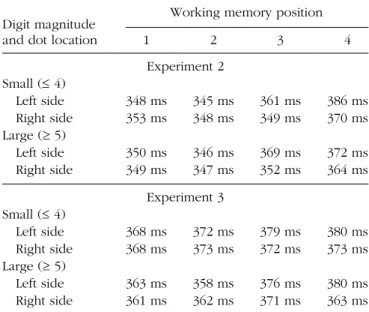
Each participant’s mean RTs were computed for each condition and subjected to a 2 × 4 × 2 repeated measures ANOVA with digit magnitude (≤ 4, ≥ 5), WM position (1, 2, 3, 4), and dot location (left, right) as within-subjects variables (see Table 2). This analysis revealed main effects of WM position, F(2.02, 36.34) = 18.81, p < .001, ηp2 =
.511, and dot location, F(1, 18) = 7.52, p = .013, ηp2 = .295.
A linear trend was observed in the effect of WM position, F(1, 18) = 29.57, p < .001, ηp2 = .622. We replicated the
crucial association between serial order in WM and spa-tial attention, as WM position interacted with dot loca-tion, F(3, 54) = 4.03, p = .012, ηp2 = .183. Again, a linear
relationship was observed, F(1, 18) = 5.02, p = .038, ηp2 =
.218. The RT advantage in detecting right-side over left-side dots increased by an average of 5.94 ms per WM position (see Fig. 1b). No effects of digit magnitude were found, ps > .170, which indicated that the interaction
Table 1. Results from Experiment 1: Weighted Average Reaction Times for All Cue-Target Intervals and Conditions Cue-target
interval and dot location
Working memory position
1 2 3 4 100 ms Left side 318 ms 319 ms 325 ms 355 ms Right side 316 ms 315 ms 335 ms 341 ms 250 ms Left side 293 ms 296 ms 311 ms 325 ms Right side 296 ms 295 ms 300 ms 298 ms 400 ms Left side 315 ms 316 ms 321 ms 316 ms Right side 319 ms 306 ms 314 ms 309 ms
between WM position and dot location was indepen - dent from the numerical magnitude of the memorized numbers.
Experiment 3
In Experiments 1 and 2, only right-handed responses were used during dot detection. To exclude the possibil-ity that the effects from these experiments were mere accidental side effects of right-hand responding, we con-ducted a final experiment with vocal responses. This response modality has the additional advantage that it is not spatially defined (as is the case with manual responses) and, thus, does not provide any hint for spa-tial coding by itself.
Participants
Twenty-one students (12 female, 9 male; mean age = 23 years, SD = 4.51; all native Dutch speakers) from Ghent University participated.
Stimuli and method
This experiment’s stimuli, setup, and design were similar to those of Experiment 2 except that during dot detec-tion, vocal responses were used (“ja,” Dutch for “yes”). Because of technical limitations of the voice-key device, only RTs of less than 801 ms were recorded.
Results
Trials from WM sequences with accurate serial-order ver-ification (on average, 37.19 of 40 sequences) and correct go trials (accuracy on the dot-detection task was 94%, 99%, and 99% for the go, no-go, and catch trials, respec-tively) were considered. The mean RT was 370 ms (SD = 59).
A 2 × 4 × 2 repeated measures ANOVA with digit mag-nitude (≤ 4, ≥ 5), WM position (1, 2, 3, 4), and dot loca-tion (left, right) as within-subjects variables (see Table 2) revealed main effects of digit magnitude, F(1, 20) = 12.29, p = .002, ηp2 = .381, and WM position, F(2.14, 42.77) =
3.91, p = .025, ηp2 = .163. A linear trend was observed in
the effect of WM position, F(1, 20) = 7.17, p = .014, ηp2 =
.264. The interaction between WM position and dot loca-tion was significant, F(3, 60) = 3.11, p = .033, ηp2 = .134.
Again, a linear relationship was observed, F(1, 20) = 9.63, p = .006, ηp2 = .325. The RT advantage in detecting
right-side over left-right-side dots increased by an average of 4.12 ms per WM position (see Fig. 1b), replicating the obser-vation that a digit’s WM position modulates the speed of dot detection in a context in which no manual responses were required. Interactions with digit magnitude were not significant, ps > .40.
General Discussion
The relative speed of detecting left- and right-side dots in a selective-attention task was modulated by the retrieval of serially organized verbal items in WM. Specifically, the later the position being retrieved from WM during the dot-detection task, the faster the dot-detection response for right-side relative to left-side dots. This is the first empirical demonstration of a direct link between serial order in verbal WM and spatial attention: Retrieving a WM item induced (covert) attention shifts based on its WM position. This finding prompts the intriguing notion that serial order in verbal WM is intrinsically spatial in nature, such that maintaining serial order results in a spa-tially defined representation, and that spatial attention is involved in searching within this representation.
The current study opens new perspectives on the rep-resentation of serial order in WM by directly associating it with spatial attention. At the same time, it suggests new questions to be explored. First, whereas our results show a clear link with spatial attention at the level of retrieval (indicating a spatially defined representation), it remains to be determined whether spatial attention is involved also at the encoding level. Second, future research should explore to what extent the link between serial order and spatial attention proposed here is also involved in visuo-spatial WM and how this relation interacts with the more typical spatial-attention processes involved there.
Table 2. Results from Experiments 2 and 3: Weighted Aver-age Reaction Times for All Dot-Magnitude and Dot-Location Conditions
Digit magnitude and dot location
Working memory position
1 2 3 4 Experiment 2 Small (≤ 4) Left side 348 ms 345 ms 361 ms 386 ms Right side 353 ms 348 ms 349 ms 370 ms Large (≥ 5) Left side 350 ms 346 ms 369 ms 372 ms Right side 349 ms 347 ms 352 ms 364 ms Experiment 3 Small (≤ 4) Left side 368 ms 372 ms 379 ms 380 ms Right side 368 ms 373 ms 372 ms 373 ms Large (≥ 5) Left side 363 ms 358 ms 376 ms 380 ms Right side 361 ms 362 ms 371 ms 363 ms
In conclusion, the current findings indicate that WM for serial order—even for nonspatially defined verbal items—is grounded in spatial attention. This result fits well with and broadens the scope of the general view that WM functions emerge from the directing of attention to long-term memory representations (Cowan, 1995; Postle, 2006), and it will challenge serial-order-coding theories to consider attention as a core ingredient. On a more general note, our results also indicate that the typi-cally upheld separation between the verbal and spatial domains (e.g. Baddeley, 1986; Paivio, 1986) may some-times prevent what may be a fruitful crossover of mecha-nisms from one domain to the other.
Author Contributions
J.-P. van Dijck and E. L. Abrahamse contributed equally in the development of the study concept, the collection and analyses of the data, and the drafting of the manuscript, and should be considered as joint first authors. All authors contributed to the study design and the interpretation of the results. S. Majerus and W. Fias provided critical revisions. All authors approved the final version of the manuscript for submission.
Acknowledgments
The authors thank Boris Ketels and Carsten Bundt for assisting with data collection.
Declaration of Conflicting Interests
The authors declared that they had no conflicts of interest with respect to their authorship or the publication of this article.
Funding
E. L. Abrahamse was supported by the Netherlands Organization for Scientific Research (Grant 446-10-025) and the Research Foundation Flanders (Grant 12C4712N). This work was sup-ported by the Ghent University Multidisciplinary Research Partnership’s Integrative Neuroscience of Behavioral Control Consortium and by Grant P7/11 from the Interuniversity Attraction Poles Program of the Belgian Federal Government.
Note
1. In Experiments 1 and 2, data from 1 participant were dis-carded because these participants’ overall mean RTs and stan-dard deviations were more than 2.5 stanstan-dard deviations from the group means.
References
Awh, E., & Jonides, J. (2001). Overlapping mechanisms of attention and spatial working memory. Trends in Cognitive
Sciences, 5, 119–126.
Baddeley, A. (1986). Working memory. Oxford, England: Clarendon.
Baddeley, A. (2012). Working memory: Theories, models, and controversies. In S. T. Fiske, D. L. Schacter, & S. E. Taylor (Eds.), Annual review of psychology (Vol. 63, pp. 1–29). Palo Alto, CA: Annual Reviews.
Burgess, N., & Hitch, G. (1999). Memory for serial order: A network model of the phonological loop and its timing.
Psychological Review, 106, 551–581.
Cowan, N. (1995). Attention and memory: An integrated
frame-work (Vol. 26). New York, NY: Oxford University Press.
Fischer, M. H., Castel, A. D., Dodd, M. D., & Pratt, J. (2003). Perceiving numbers causes spatial shifts of attention.
Nature Neuroscience, 6, 555–556.
Henson, R. N. A. (1998). Short-term memory for serial order: The start-end model. Cognitive Psychology, 36, 73–137. Johnston, J. C., McCann, R. S., & Remington, R. W. (1995).
Chronometric evidence for two types of attention.
Psychological Science, 6, 365–369.
Majerus, S., Attout, L., D’Argembeau, A., Degueldre, C., Fias, W., Maquet, P., . . . Balteau, E. (2012). Attention sup-ports verbal short-term memory via competition between dorsal and ventral attention networks. Cerebral Cortex, 22, 1086–1097.
Majerus, S., Heiligenstein, L., Gautherot, N., Poncelet, M., & Van der Linden, M. (2009). Impact of auditory selective atten-tion on verbal short-term memory and vocabulary devel-opment. Journal of Experimental Child Psychology, 103, 66–86.
Marshuetz, C. (2005). Order information in working memory: An integrative review of evidence from brain and behavior.
Psychological Bulletin, 131, 323–339.
Nobre, A. C., Coull, J. T., Maquet, P., Frith, C. D., Vandenberghe, R., & Mesulam, M. M. (2004). Orienting attention to loca-tions in perceptual versus mental representaloca-tions. Journal
of Cognitive Neuroscience, 16, 363–373.
Oberauer, K., & Hein, L. (2012). Attention to information in working memory. Current Directions in Psychological
Science, 21, 164–169.
Paivio, A. (1986). Mental representations: A dual coding
approach. New York, NY: Oxford University Press.
Posner, M. I. (1980). Orienting of attention. Quarterly Journal of
Experimental Psychology, 32, 3–25.
Postle, B. R. (2006). Working memory as an emergent property of the mind and brain. Neuroscience, 139, 23–38.
Pratt, J., Spalek, F., & Bradshaw, J. L. (1999). The time to detect targets at inhibited and noninhibited locations: Preliminary evidence for attentional momentum. Journal
of Experimental Psychology: Human Perception and Performance, 23, 730–746.
Theeuwes, J., Kramer, A. F., & Irwin, D. (2011). Attention on our mind: The role of spatial attention in visual working memory. Acta Psychologica, 137, 248–251.
van Dijck, J.-P., & Fias, W. (2011). A working memory account for spatial numerical associations. Cognition, 119, 114–119.