HAL Id: hal-00717325
https://hal.archives-ouvertes.fr/hal-00717325
Submitted on 12 Jul 2012
HAL is a multi-disciplinary open access
archive for the deposit and dissemination of sci-entific research documents, whether they are pub-lished or not. The documents may come from teaching and research institutions in France or abroad, or from public or private research centers.
L’archive ouverte pluridisciplinaire HAL, est destinée au dépôt et à la diffusion de documents scientifiques de niveau recherche, publiés ou non, émanant des établissements d’enseignement et de recherche français ou étrangers, des laboratoires publics ou privés.
A DSP based H.264/SVC decoder for a multimedia
terminal
Fernando Pescador, David Samper, Mickaël Raulet, Eduardo Juarez, César
Sanz
To cite this version:
Fernando Pescador, David Samper, Mickaël Raulet, Eduardo Juarez, César Sanz. A DSP based H.264/SVC decoder for a multimedia terminal. Consumer Electronics (ICCE), 2011 IEEE Interna-tional Conference on, Jan 2011, Las Vegas, United States. pp.401 -402, �10.1109/ICCE.2011.5722651�. �hal-00717325�
>Paper ID <
Abstract—In this paper, the implementation of a DSP based
video decoder compliant with the H.264/SVC standard (14496-10 Annex G) is presented. A PC-based decoder implementation has been ported to a commercial DSP. Performance optimizations have been carried out improving the initial version performance about 32% and reaching real time for CIF sequences. Moreover, conformance tests have been done using different H.264/SVC streams. This decoder will be the core of a multimedia terminal that will trade off energy against quality of experience.
I. INTRODUCTION
In the last years, a speed-up in the deployment of all kinds of telecommunication networks supporting multimedia services and applications has been produced in many parts of the world. In this context, the consumer multimedia terminals play a central role. In these terminals, video decoding is one of the most demanding tasks in terms of computational load and energy consumption.
The Scalable Video Coding (SVC) techniques [1] can be used in multimedia terminals to achieve a trade-off between quality and energy consumption. Though SVC techniques have been defined in most video coding standards [2][3][4], the SVC capabilities included in H.264 [4] have overcome the ones in former standards.
In PccMuTe* project, our research is focused on the energy and power consumption control in multimedia terminals. A multimedia terminal prototype with a DVB-H receiver, an H.264/SVC decoder and an audio decoder is going to be used to validate the experiments. In this context, the H.264/SVC decoder will be used to achieve a trade-off between quality and energy consumption. The multimedia terminal architecture is based on a commercial chip having a General Propose Processor (GPP) and a DSP [5].
Up to now, the available SVC decoder implementations are restricted to the PC domain [6][7][8]. We have ported the Open SVC decoder (OSD) [8] to the DSP and applied the methodologies proposed in [9][10] to reduce its decoding time. The real-time performance has been reached for CIF sequences. Up to the best of our knowledge, no other H.264/SVC decoder based on DSP has been reported.
In this paper, a DSP implementation of a real-time H.264/SVC decoder is explained. The H.264/SVC standard
*PccMuTe: Power Consumption Control in Multimedia Terminal is a research project supported by the Spanish Ministry of Science and Technology under grant TEC2009-14672-C02-01.
F. Pescador, D. Samper, E. Juarez and C. Sanz are with the Electronic and Microelectronic Design Group (GDEM) at the Universidad Politécnica de
Madrid, Spain. ({pescador, dsamper, ejuarez, [email protected]}). M. Raulet
is with Institut d’Electronique et de Télécommunications (IETR). INSA Rennes, France (mraulet [email protected])
and the OSD are outlined in section II. In section III, the porting of the decoder to the DSP and the speed optimization are described. In section IV, the results of the profiling tests are discussed. Finally, section V concludes the paper.
II. THEH.264/SVCSTANDARD
Recently, an SVC algorithm was standardized as an annex of H.264 [4][6]. In this standard, the video compression is performed by generating a unique hierarchical bit-stream with several layers with different resolutions, frame-rates, and qualities. There are a base layer and several enhancements layers. The base layer provides basic quality. The enhancement layers provide improved quality, but increasing the computational load and energy consumption. Since the energy consumption depends on the particular layer to decode, an H.264/SVC decoder is a solution suitable for managing the energy consumption.
The OSD is a C-language Baseline Profile H.264/SVC decoder supporting all tools to deal with spatial, temporal and quality scalabilities. It is based on a fully compliant H.264 baseline decoder with all the tools of the Main Profile except interlaced coding and the weighted prediction. The OSD has been developed for a PC environment and its performance is up to 50 times faster than the JVSM 9.16 decoder [11].
III. DSPIMPLEMENTATION
A. DSP architecture
The commercial processor selected to implement the mobile terminal [5] consists of two processing cores, a GPP and a DSP. The GPP processor [12] is aimed to run a generic Operating System while the latter, a DSP core based on the C64+ family [13], is adequate to implement an H.264/SVC decoder using its architecture optimized for video processing.
B. Porting and optimization
It is worth noting that the OSD has been developed for a PC-based platform. The changes made to adapt the OSD to the DSP were presented in [14]. In the work presented in this paper, the decoder performance has been measured using several standard sequences and profiling tools. The modules having the highest computational load have been identified. The methodologies presented in [9][10] have been applied to reduce the number of CPU cycles needed to decode an H.264/SVC stream. Table I includes all modules that have been optimized and the percentage of improvement obtained.
Moreover the DMA controllers have been used to improve the data movement between internal and external memory during the motion compensation process. The performance has been improved in 5% in average.
A DSP Based H.264/SVC Decoder for a Multimedia Terminal
F. Pescador, Member IEEE, D. Samper, M. Raulet, Member IEEE, E. Juarez, Member IEEE and C. Sanz, Member IEEE
TABLEI
OPTIMIZED MODULES AND IMPROVEMENT ACHIEVED.
MODULE IMPROVEMENT
UPSAMPLING LUMA & CHROMA 72.4% CABAC COEFFICIENTS EXTRACTION 58.1%
DEBLOCKING FILTER 8.1%
MOTION COMPENSATION INTERPOLATION 26.0%
IICT 75.9%
IV. TESTS
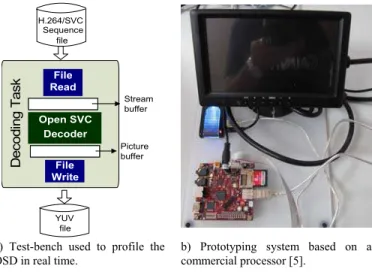
A set of tests has been carried out to verify the decoder conformance and to measure its performance. The test-bench is shown in Fig. 1-a. First, a test stream is read from a file and written into a stream buffer allocated in external memory. Then, the decoder reads the stream from this memory, decodes it on a picture basis and writes the decoded picture into a buffer. The picture is also written into a file.
The test-bench has been executed in the prototype board used in PccMute project (see Fig. 1-b). This prototype is based on a commercial board [15] that contains the processor mentioned in section III.A.
Sequence file D e c o d in g T a s k ReadFile Picture buffer H.264/SVC Open SVC Decoder File Write file YUV Stream buffer
a) Test-bench used to profile the OSD in real time.
b) Prototyping system based on a commercial processor [5].
Fig. 1. Test-bench used to optimize the OSD.
In order to assess the decoder performance with the test-bench depicted in Fig. 1, several well-known video sequences (Foreman, News, Stefan, Mobile, etc.) have been encoded using a commercial H.264/SVC encoder [16]. Three 9-layer streams have been generated for each sequence. The layer structure of each stream consists of all the possible combinations among three spatial resolutions (CIF, QCIF, and subQCIF) and three frame-rates (24, 12, and 6 fps). In addition, each sequence has been encoded with three bit-rates (0.5, 1.0, and 2.0 Mbps).
As far as the codec parameters to generate the test sequences concern, the GOP size equals 16 progressive frames, the CABAC is used for entropy coding, the deblocking filter is active, all possible macroblock partitions are enabled for intra- and inter-prediction, three reference frames are allowed, and 3 B-frames are coded for each I-frame
Table II contains the profiling results for the Foreman sequence that is the worst case among the tested sequences. The results of the un-optimized and optimized decoder
performance are shown for each layer expressed in frames per second processed by the DSP working at 600 MHz. In the columns associated with the optimized version the percentage of improvement is included between brackets. These results demonstrate that real time performance has been achieved for all the layers of the generated streams.
TABLEII
OSD PERFORMANCE BEFORE AND AFTER THE OPTIMIZATION PROCESS.
0.5 Mbps 1 Mbps 2 Mbps
UNOPT OPT UNOPT OPT UNOPT OPT
subQCIF 2.6 1.9 (23%) 3.5 2.5 (26%) 5.2 3.6 (29%) QCIF 7.5 5.2 (27%) 9.3 6.2 (29%) 12.9 8.1 (35%) 6 fps CIF 22.9 15.2 (31%) 26.5 16.9 (34%) 33.1 19.9 (37%) subQCIF 4.8 3.2 (31%) 6.4 4.2 (34%) 9.3 5.7 (36%) QCIF 15.1 10.6 (27%) 18.3 12.1 (31%) 24.8 15.6 (34%) 12 fps CIF 46.3 31.5 (29%) 34.8 34.8 (31%) 63.1 40.1 (34%) subQCIF 9.2 6.0 (33%) 12.3 7.5 (37%) 17.9 10.4 (40%) QCIF 31.0 22.3 (25%) 37.3 25.5 (30%) 50.8 32.1 (34%) 24 fps CIF 97.0 69.3 (26%) 107.1 74.3 (28%) 128.6 84.8 (31%)
V. CONCLUSION&FUTUREWORK
An H.264/SVC decoder based on a commercial DSP has been implemented by porting the OSD software from the PC to the DSP environment. Several optimizations techniques have been applied to reach real time performance for CIF sequences. Up to the best of our knowledge, no other H.264/SVC decoder based on DSP has been reported. This optimized decoder will be used in a multimedia terminal to trade-off between quality and energy consumption.
REFERENCES
[1] J-R Ohm, "Advances in Scalable Video Coding". Proceedings of the IEEE, vol. 93, nº 1 pp. 42-56, Jan. 2005.
[2] ISO/IEC 13818-2 (ITU-T Rec. H.262). Generic coding of moving pictures and associated audio information: Video. 1995.
[3] ISO/IEC 14496-2. Information technology. Coding of audio visual objects. Part 2: Video. 1998.
[4] ISO14496-10. Information technology. Coding of audio-visual objects. Part 10: Advanced Video Coding. December 2005.
[5] Texas Instruments. OMAP DSPs. http://focus.ti.com/docs/prod/ folders/print/omap3530.html.
[6] Joint Scalable Video Model JSVM-19, ISO/IEC JTC1/SC29/WG11 ITU-T SG16 Q.6, N9212, 2010.
[7] IMEC press release. http://www.imec.be/wwwinter/ mediacenter/en/SVC_2008.shtml.
[8] Institut d’Electronique et de Télécommunications (IETR). INSA Rennes. http://sourceforge.net/projects/opensvcdecoder/
[9] F. Pescador, C. Sanz, M.J. Garrido, E. Juárez and D. Samper. “A DSP Based H.264 Decoder for a Multi-Format IP Set-Top Box”. IEEE Trans. on Consumer Electronics Vol. 54, Issue 1, Feb. 2008 pp. 145-153. [10] F. Pescador, G. Maturana, M.J. Garrido, E. Juárez y C. Sanz “An H.264
video decoder based on a DM6437 DSP”. IEEE Trans on Consumer Electronics. Vol. 55, Nº 1. Pp. 205-212. February 2009.
[11] M. Blestel and M. Raulet. “Open SVC Decoder: a flexible SVC library” ACM Multimedia 2010, Open Source Software Competition Program. [12] An ARM, Cortex-A8 Technical Reference Manual, ARM DDI 0344J
rev: r3p2. http://infocenter.arm.com/.
[13] Texas Instruments, TMS320C64x/C64x+ DSP CPU and Instruction Set, SPRU732H, Oct 2008. http://focus.ti.com/lit/ug/spru732h/spru732h.pdf [14] F. Pescador, D. Samper, M.J. Garrido, E. Juárez and M. Blestel. "A DSP
based SVC IP STB using Open SVC Decoder". Int. Symposium on Consumer Electronics. Braunschweig Germany, 7-10 June 2010. [15] BeagleBoard System Reference Manual Rev. C4, December 2009,
htttp://beagleboard.org/static/BBSRM_latest.pdf.
[16] Mainconcept SVC Scalable Video Coding. http://www.mainconcept.com/ products/sdks/video/svc.html.