HAL Id: hal-03203166
https://hal.archives-ouvertes.fr/hal-03203166
Submitted on 20 Apr 2021
HAL is a multi-disciplinary open access
archive for the deposit and dissemination of
sci-entific research documents, whether they are
pub-lished or not. The documents may come from
teaching and research institutions in France or
abroad, or from public or private research centers.
L’archive ouverte pluridisciplinaire HAL, est
destinée au dépôt et à la diffusion de documents
scientifiques de niveau recherche, publiés ou non,
émanant des établissements d’enseignement et de
recherche français ou étrangers, des laboratoires
publics ou privés.
OSIRIS: A Minimum Data Set for Data Sharing and
Interoperability in Oncology
Julien Guerin, Yec’Han Laizet, Vincent Le Texier, Laetitia Chanas, Bastien
Rance, Florence Koeppel, Francois Lion, Sophie Gourgou, Anne-Laure
Martin, Manuel Tejeda, et al.
To cite this version:
Julien Guerin, Yec’Han Laizet, Vincent Le Texier, Laetitia Chanas, Bastien Rance, et al.. OSIRIS: A
Minimum Data Set for Data Sharing and Interoperability in Oncology. JCO Clinical Cancer
Infor-matics, ASCO, 2021, 5, pp.256-265. �10.1200/CCI.20.00094�. �hal-03203166�
DATA ARCHITECTURE AND MODELS
original
reports
OSIRIS: A Minimum Data Set for Data Sharing and
Interoperability in Oncology
Julien Gu ´erin, MSc1; Yec’han Laizet, PhD2,3; Vincent Le Texier, MSc4; Laetitia Chanas, PhD1,5,6; Bastien Rance, PhD7,8; Florence Koeppel, PhD9; François Lion, MSc10; Sophie Gourgou, PhD11; Anne-Laure Martin, PharmD12; Manuel Tejeda, MSc13; Maud Toulmonde, MD, PhD14; St ´ephanie Cox, PhD15; Elisabeth Hess, PhD16; Marina Rousseau-Tsangaris, PhD15;
Vianney Jouhet, MD, PhD17,18; and Pierre Saintigny, MD, PhD15,19,20
abstract
PURPOSEMany institutions throughout the world have launched precision medicine initiatives in oncology, and a large amount of clinical and genomic data is being produced. Although there have been attempts at data sharing with the community, initiatives are still limited. In this context, a French task force composed of Integrated Cancer Research Sites (SIRICs), comprehensive cancer centers from the Unicancer network (one of Europe’s largest cancer research organization), and university hospitals launched an initiative to improve and accelerate retrospective and prospective clinical and genomic data sharing in oncology.MATERIALS AND METHODS For 5 years, the OSIRIS group has worked on structuring data and identifying technical solutions for collecting and sharing them. The group used a multidisciplinary approach that included weekly scientific and technical meetings over several months to foster a national consensus on a minimal data set.
RESULTSThe resulting OSIRIS set and event-based data model, which is able to capture the disease course, was built with 67 clinical and 65 omics items. The group made it compatible with the HL7 Fast Healthcare In-teroperability Resources (FHIR) format to maximize inIn-teroperability. The OSIRIS set was reviewed, approved by a National Plan Strategic Committee, and freely released to the community. A proof-of-concept study was carried out to put the OSIRIS set and Common Data Model into practice using a cohort of 300 patients.
CONCLUSIONUsing a national and bottom-up approach, the OSIRIS group has defined a model including a minimal set of clinical and genomic data that can be used to accelerate data sharing produced in oncology. The model relies on clear and formally defined terminologies and, as such, may also benefit the larger international community. JCO Clin Cancer Inform 5:256-265. © 2021 by American Society of Clinical Oncology
Creative Commons Attribution Non-Commercial No Derivatives 4.0 License
INTRODUCTION
Most national and international funding agencies have acknowledged the importance of making clin-ical and genomic data publicly available to obtain enough information1 for correlative studies on bio-markers associated with response to specific targeted immunotherapies.
A large amount of cancer genomics data has been provided to the scientific community through significant national and international collaborations (ie, the CIT re-search program,2 the Cancer Genome Atlas [TCGA],3 and the International Cancer Genome Consortium [ICGC]4). Although these data sets are freely available, researchers and clinicians face major obstacles using them because of (1) a lack of standards regarding ge-nomic data characterization and quality5and (2) limited clinical data in particular related to disease outcomes. Despite these obstacles, the number of data sharing ini-tiatives continues to grow. Several international
data-sharing networks have recently emerged to help re-searchers get access to clinical and genomic data in ge-nomic cancer medicine. For examples, international networks such as PCORnet,6OHDSI Research Network,7 GENIE,8BRCA Exchange from GA4GH7,9CancerLinQ,10 ORIEN,11and ICGC ARGO,12and European networks such as Europe lung cancer data collection13and the German Cancer Consortium (DKTK)14are some important initiatives in thisfield. Although such initiatives are interesting, access to full data is restricted to consortium members or lacks relevant clinical information to link genomic alterations with clinical benefit under specific drugs.
Between 2011 and 2013, precision medicine was becoming pervasive and Integrated Cancer Research (SIRICs) sites in France conducted molecular profiling clinical trials (eg, SHIVA, MOSCATO, and ProfiLER). These clinical trials meant a radical paradigm shift by providing innovative therapies guided by genomic alterations identified in a tumor. The idea in 2013 was to link multiple SIRIC-program clinical trials to reach a
ASSOCIATED CONTENT Appendix Data Supplement Author affiliations and support information (if applicable) appear at the end of this article. Accepted on January 19, 2021 and published at ascopubs.org/journal/ ccion March 15, 2021: DOIhttps://doi. org/10.1200/CCI.20. 00094
critical number of patients, which would enable a mean-ingful analysis. To empower the joint analysis of these trials, a common minimal data set along with a Common Data Model (CDM) was needed to reach our goal. We wanted a CDM to be modular, limited in size and agile, extensible beyond clinical and genomic data, and able to capture the longitudinal changes associated with disease progression and resistance to therapeutic interventions.
In this context, the OSIRIS (Interoperability and data sharing of clinical and biological data in oncology) initiative15was launched in 2015 to address data hetero-geneity with four major commitments: (1) using a bottom-up approach by keeping the OSIRIS set as minimal as possible, (2) reaching a national consensus from all stakeholders involved in cancer research, (3) using inter-nationally established terminologies as much as possible, andfinally (4) defining implementation rules to guarantee data consistency of the OSIRIS set across institutions. A French national task force composed of Comprehensive Cancer Centers from the Unicancer network,16 University Hospitals, and the eight SIRICs was formed under the auspices of the French Institut National du Cancer (INCa).17 Herein, we propose a minimum set of clinical and genomic data relevant to thefield of precision medicine in oncology, a data model that allows us to capture the disease course, including therapy response and toxicity. OSIRIS was com-pared with other similar initiatives such as mCODE18and OMOP19and was tested in a set of 300 patients included in six different multicentric studies as a proof-of-concept.
MATERIALS AND METHODS
CDM: Identification of the Data Concepts
The goal of the CDM was to share a set of standardized, extensible data concepts (eg, patient, tumor events, treatment, response evaluation, and adverse event) that enabled con-sistency of both data and their meaning across applications.
The group focused its efforts on (1) providing a comprehensive resource of cancer event–based data and their temporal re-lationships, that is, to help clinicians discover longitudinal changes associated with disease progression and resistance to therapeutic interventions; (2) creating a modular and exten-sible data model, that is, to integrate omics data from different experiments on the same samples (vertical integration) or across studies on the same variables (horizontal integration); and (3) creating the technical conditions for interoperability. Minimum Data Set: Standardization and Interoperability of the Data Elements
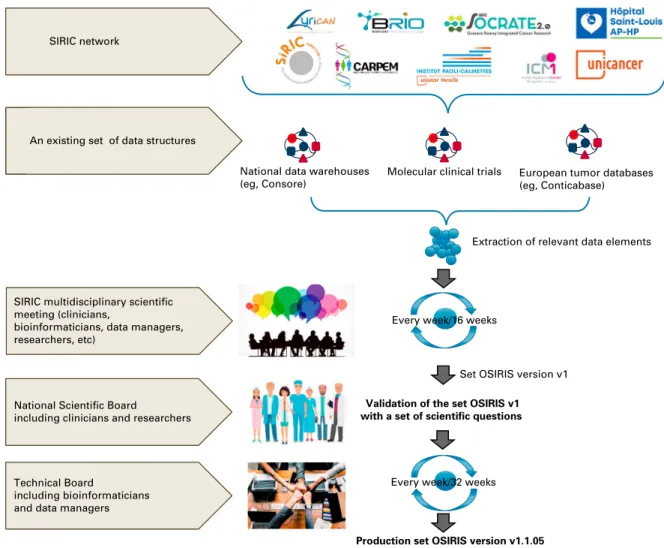
A data set was defined as a collection of variables, such as the gender and age of a patient, with a list of possible values for each of them. Each variable is called a Data Element (DE), and the list of possible values a Code List (CL). To define a minimum set of valuable DEs at the national level, our ap-proach was based on the following steps: (1) identifying the most relevant items based on a 2015 Institut Curie data model, the experience of the Unicancer network of com-prehensive cancer centers with Consore,20,21the case report forms of precision medicine clinical trials promoted by participating institutions, and the national database Conticabase22-27; (2) extracting the DEs of those clinical trials; (3) identifying and comparing the most relevant DEs; andfinally, (4) standardizing the CLs of the Common Data Elements (CDEs) using appropriate international terminol-ogies when possible (Fig 1). To ensure the accuracy and quality of data collected through the different studies, the OSIRIS group used an adapted data collection strategy that focused on a limited number of mandatory CDEs to facilitate structured data extraction and limit missing data.
Identification of French Genomic-Driven Clinical Trials and National Databases and Extraction of the DEs Major clinical trials were conducted in France28 using tar-geted sequencing to identify actionable alterations and
CONTEXT
Key Objective
How can we improve standardization of clinical and genomic data to improve data sharing and interoperability by capturing the disease course in the context of precision medicine in Oncology?
Knowledge Generated
We propose an event-based data model of a minimal set of clinical and genomic items using international standards and terminologies enabling a strong interoperability. OSIRIS common data model is modular and extensible to other types of data.
Relevance
OSIRIS was developed in the context of large precision medicine clinical trials to incorporate the longitudinal changes associated with disease progression and resistance to therapeutic interventions. It could also provide an effective real-world data ecosystem by developing a data standard, which, if used, could improve the compatibility, quality, and consistency of electronic health record. In both cases, OSIRIS may facilitate the application of artificial intelligence and enhance su-pervised machine learning and data science in the context of clinical care and clinical research.
assign therapy to patients with refractory cancers. Data from these clinical trials are of high quality but sorely lack the standards to enable data sharing across institutions. Six broad clinical trials (Table 1) were selected as a case study to extract the DEs.
Identification and Comparison of the Most Relevant DEs To define a set of CDEs representing a minimal data set to answer scientific and medical questions, the OSIRIS group used a multidisciplinary approach including oncologists, medical informatics specialists, bioinformaticians, epide-miologists, biostatisticians, and regulatory specialists in iteration planning meetings. This method provided different perspectives and prompted extensive discussions to select the most relevant DEs.37 After a year of weekly iteration meetings, the OSIRIS group reached a consensus. Validation of the CDE
A national board composed of clinicians and translational researchers in oncology and data protection officers first examined whether the CDEs were compliant with the
General Data Protection Regulation38 and the National Commission for Data Protection and Liberties (CNIL-France).39They oversaw the centralization of common sci-entific questions from different medical specialties and cancer pathologies (eg, identification of actionable genomic alterations, identification of rare recurrent genetic alterations, and understanding genetic trajectories). Common scientific questions that emerged can be classified into three broad categories: (1) clinical and biological cohorts, (2) descriptive and functional translational studies, and (3) interventional clinical trials. Then, national board proceeded to ensure that the OSIRIS CDEs could answer those questions.
Standardizing the CLs of the CDE
CL standardization was a prerequisite step to ensure greater interoperability of the OSIRIS set. A technical board composed of bioinformaticians and data managers was responsible for identifying the most relevant international and national terminologies (eg, CCAM code of the medical act). Most of the CDEs were mapped to these terminologies (Table 2). For some CDEs, the group created its own
Extraction of relevant data elements
Validation of the set OSIRIS v1 with a set of scientific questions
Production set OSIRIS version v1.1.05 SIRIC network
An existing set of data structures
European tumor databases (eg, Conticabase) Molecular clinical trials
National data warehouses (eg, Consore)
SIRIC multidisciplinary scientific meeting (clinicians,
bioinformaticians, data managers, researchers, etc)
National Scientific Board
including clinicians and researchers
Technical Board
including bioinformaticians and data managers
Every week/32 weeks
Set OSIRIS version v1 Every week/16 weeks
FIG 1. The overall methodology used to deliver thefirst release of the OSIRIS set. During several months, weekly meetings of several national groups (SIRIC multidisciplinary group and scientific and technical boards) were held to release the first version of the OSIRIS set. SIRIC, Integrated Cancer Research Sites.
Gu ´erin et al
terminologies for terms that did not have yet a common standard definition (eg, biomarker code, sample origin, and panel name). Genomic CDEs were based on Fast Healthcare Interoperability Resources (FHIR) v3 genomic items when available (eg, AminoAcidChange, DNAR-egionName, and GenomicSourceClass).
Validation of the OSIRIS Set
To validate this approach, the group federated retrospective data to assess afirst cohort of 300 patients included in six clinical trials. Minor functional changes, such as modifying a CDE or supplementing a CL, were needed to strengthen the model.
RESULTS
OSIRIS CDM
Afirst version of the CDM (v1) was released in 2018,40 which formed the basis of discussion for the SIRIC
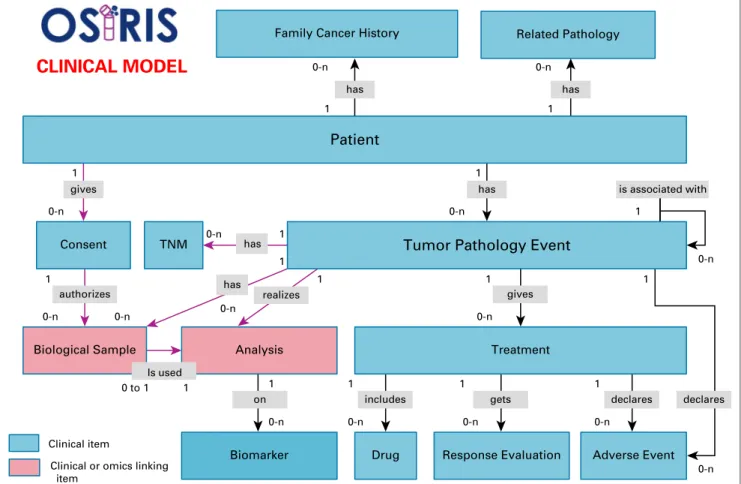
multidisciplinary scientific meetings and, later, for the technical board meetings. Several institutions tested the model (ie, completeness level and inconsistency rate), and the group proposed and implemented substantial revisions through functional analysis and data integration feedback. This helped establish a reliable, robust, and comprehensive model to describe cancer.Figure 2shows the clinical data model with the CDEs and the relationships between them. Given that health data change over time, the OSIRIS group focused its efforts on modeling an event-based temporal data model. Each DE of the OSIRIS CDM is linked to a particular TumorPathologyEvent (TPE) (ie, Primary, Re-current, and Metastatic tumor) concept. Each TPE occurs not only over a period of time but also relative to the time of another TPE to follow the course of the disease precisely. Patient follow-up represented on a timeline (ie, Analysis and Treatment concepts) is another key element of the TABLE 1. List of the Clinical Trials Used to Extract DEs
NCT Number Title Acronym Type of Tumor
No. Patients NCT0253464929 Fighting cancer by matching molecular alterations and drugs in early
phase trials
BIP Locally advanced or metastatic cancer
4,500 NCT0177440930 Program to establish the genetic and immunologic profile of patient’s tumor for
all types of advanced cancer
ProfiLER31 All types of advanced cancer
4,357 NCT0156601932 Molecular screening for cancer treatment optimization MOSCATO Any cancer in the
metastatic phase
2,150 NCT0229999933 SAFIR02_Breast—Efficacy of genome analysis as a therapeutic decision tool
for patients with metastatic Breast cancer
SAFIR02_ Breast Metastatic breast cancer 1,462 NCT0177145834
A randomized phase II trial comparing therapy based on tumor molecular profiling versus conventional therapy in patients with refractory cancer
SHIVA35
All refractory tumors 742 NCT0234215836
Identifying molecular alterations to guide individualized treatment in advanced solid tumors
PERMED01 Locally advanced or metastatic cancer
460
NOTE. This table describes the clinical trials of precision medicine through molecular profiling initiated by the organization centers of the OSIRIS group. These studies were used to extract, compare, and select the data elements, a necessary precondition for defining the OSIRIS set and its event-based data model.
Abbreviation: DE, data element.
TABLE 2. Main International and National Terminologies Used in the OSIRIS Set
Data Domain National and International Ontologies and Terminologies
Patient characteristics Fast Healthcare Interoperability Resources (FHIR, 3rd edition) Unified Medical Language System (UMLS)
WHO classification (performance status)
Disease characteristics International Classification of Disease for Oncology (ICD-O-3, 3rd edition)
International Statistical Classification of Diseases and Related Health Problems (ICD, 10th edition) UICC TNM Classification of Malignant Tumors
Drug Anatomical Therapeutic Chemical Classification System (ATC, 5th level) Adverse events Common Terminology Criteria for Adverse Events (CTCAE, 5th edition)
Response evaluation RECIST, version 1.1
Medical act Classification of the French Social Security (National Health Service) Genomic concepts Logical Observation Identifiers Names and Codes (LOINC)
HL7 Fast Healthcare Interoperability Resources (HL7 FHIR)
NOTE. The OSIRIS set relies on international and national terminologies to facilitate interoperability with other common data models. For each data domain (eg, Patient and Disease characteristics), we use one or more terminologies when necessary.
model, and derived concepts such as AdverseEvent, ResponseEvaluation, and Biomarker are also included. Rules were defined when the time of a TPE is incomplete or uncertain by looking at the timeline of the follow-up care plan. This provides a high-quality OSIRIS-formatted data set required for training machine learning models to ad-dress questions like relapse prediction and covers the necessary topics for patient similarity identification.41 To date, the model covers the description of solid tumors and minor changes will be needed to handle hematological tumors.
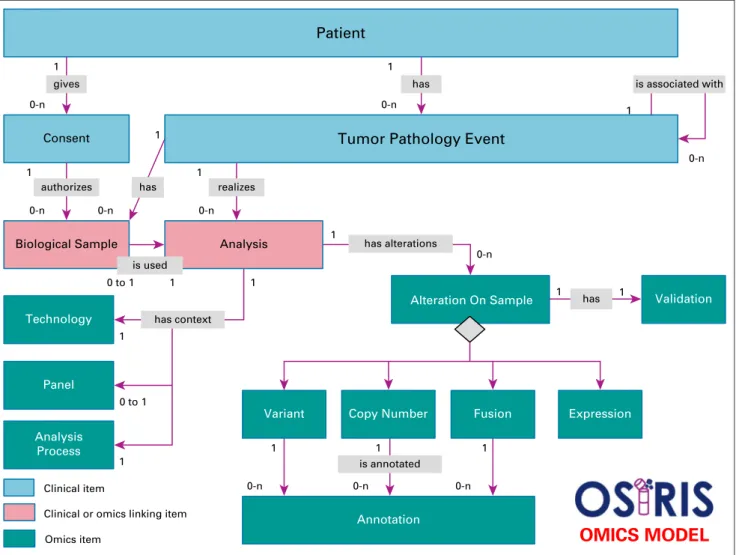
Genomics is an integral component and is considered as a separate and distinct type of analysis in the data model as shown inFigure 3. All analysis concepts are linked to the clinical model using the TumorPathologyEvent concept as a key component. Some concepts define the analysis itself to ensure reproducibility, tracking provenance, and context of the results (ie, sequencing technology, target panel, and bioinformatics pipeline including analysis parameters), whereas others give a confidence level of the predictions (ie, validation) or variant annotation for cancer diagnosis (ie, annotation). The AlterationOnSample class is an umbrella concept of shared attributes common to the different types
of genomic alterations. Entities related to this generic concept enable the storage of specific alteration data type. To date, the data model covers copy number alterations, fusions, gene expression data, and somatic mutations. The flexibility of the model is a major asset to easily add new omics data (eg, epigenetic and proteomic data) that will allow multiomics layer integration.
The OSIRIS Set
Once the OSIRIS set reached a steady state in terms of its semantic content, afirst version (1.1.05) was released in February 2019. This current release, built on an event-based data model, describes a minimum data set that allows capture of the disease course longitudinally. This release, freely available to the community on GitHub,42 consists of a minimal data set of 67 clinical and 65 omics items (described in the Data Supplement) required and validated by the national scientific board. CLs are based on international and national terminologies, com-plemented by their own terminologies for terms that do not yet have a common standard definition. The Data Sup-plement presents precisely the list of possible values for each DE.
Patient
Tumor Pathology Event
Family Cancer History Related Pathology
Treatment
Drug Response Evaluation Adverse Event Analysis Biological Sample Biomarker Consent has has 0-n 1 0-n 1 gives 1 0-n has 0-n 1 authorizes 0-n 1 realizes 0-n 1 gives 1 0-n on 0-n 1
includes gets declares
0-n 1 0-n 1 0-n 1 is associated with 1 0-n Is used 1 0 to 1 has 1 0-n 1 0-n declares TNM 0-n has 1 Clinical item
Clinical or omics linking item
CLINICAL MODEL
FIG 2. OSIRIS clinical data model. Thisfigure shows the OSIRIS event–based clinical data model to follow the disease course longitudinally. For each event type (primary tumor and local and metastatic relapse), the response and adverse events of a treatment are associated. Moreover, any analysis carried out on a sample (imaging, omics, biology, pathologic examination) is also linked to a specific event.
Gu ´erin et al
As a proof-of-concept, clinical and genomic data from 300 patients included in six different clinical trials were used to allow basic descriptive statistics. As a result of these sta-tistics, there is much heterogeneity of the clinical CDEs being used within each clinical trial. Some clinical concepts are well represented (ie, Patient, BiologicalSample, TumorPathologyEvent, Treatment, AdverseEvent, and Drug), whereas others are hardly used (ie, Family-CancerHistory and RelatedPathology). By comparing the CDE terminologies, substantial clinical differences were found. For instance, some French pathologists rely on a national multiaxial terminology (Association pour le Développement de l’Informatique en Cytologie et Anatomie Pathologique, ADICAP), whereas others use the interna-tional standard ICD-O-3 (Internainterna-tional Classification of Diseases for Oncology) to standardize pathology reports. Translating ADICAP codes to ICD-O-3 was necessary, and a quality control program was applied to assess data quality, correcting errors and adding missing data. All the clinical
trials used targeted next-generation sequencing (NGS) as a tool for precision medicine, which ensured the consistent use of the genomic concepts. Variability in genomic data reporting was observed, rooted in the wide variety of NGS technologies and analysis tools with no emphasis on in-teroperability. Genetic reports provided by the different stakeholders often result in a partial or heterogeneous description of genomic alterations (eg, the reference se-quence of single nucleotide variants is not always properly reported). We noted as well a variability of the metadata that add further clinical interpretation of variants (ie, cross-references to external databases and precomputed in silico algorithm-based predictions). To ensure the sus-tainability, expandability, and interoperability of the OSIRIS set with other systems, the first release was made com-patible with the growing health information exchange standard HL7 FHIR in June 2020. For instance, the ge-nomic CDM was mapped to FHIR v4 gege-nomic resources. The new resource, MolecularSequence, was used for Patient
Tumor Pathology Event
Analysis Biological Sample Consent 1 0-n 0-n 1 0-n 1 0-n 1 Analysis Process Panel Technology is used 1 0 to 1 Alteration On Sample
Variant Copy Number Fusion Expression
Validation Annotation is associated with 1 0-n has alterations 1 0-n is annotated 1 1 1 0-n 0-n 0-n has 1 1
OMICS MODEL
has context 1 1 0 to 1 1 1 0-n Clinical itemClinical or omics linking item Omics item
gives has
realizes
authorizes has
FIG 3. OSIRIS omics data model. Thanks to an object-oriented model, the omics concepts were designed to be scalable and modular. The model uses inheritance to store common (ie, AlterationOnSample concept) and specific attributes of various kinds of genomic alterations. Each genomic alteration is annotated for cancer diagnosis (ie, Annotation concept) along with the confidence level of the prediction (ie, validation concept).
annotating data with external repositories and the existing resources such as Observation. In the Data Supplement, OSIRIS was compared with other similar initiatives such as mCODE and OMOP.
List of Structured Flat Files to Share Data
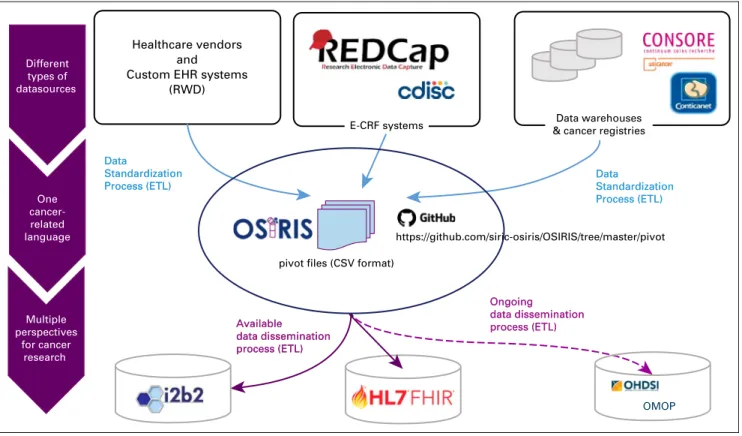
To share the OSIRIS set, each participating institution generated a list of structuredflat files in comma separated format (“.csv”). The layout, content, and coding of eighteen flat files were standardized43 to structure data in each center. Theflat files follow the relational OSIRIS CDM to be directly interoperable with any third-party software and readable by the clinicians. By providing a single entry point, any data source can be processed and represented in our data model (described in Appendix Fig A1). For instance, we used these files to store real-world data (RWD) either to complete the OSIRIS set for clinical data (ie, FamilyCancerHistory and RelatedPathology concepts) or to integrate genomics data not used to guide targeted therapy. To ensure the correct use of the CDEs, OSIRIS users must follow the DE specification guideline and carry out the necessary checks to guarantee compliance therewith.44
DISCUSSION
Within the context of the SIRIC efforts and supported by INCa, a need to enhance data sharing in genomic-driven clinical trials to clinicians and translational researchers was identified. The OSIRIS project emerged in 2015 to find creative, technological, and regulatory solutions for im-proving standardization and data sharing at the national level.
We identified common challenges to promote data sharing in precision medicine,45 which led to the constitution of three working groups (ie, regulatory and data policy, data standards, and technical data sharing solutions). Gover-nance required transparent decision making, and this transparency offers a constructive basis for engagement with new institutions.
The group emphasized the value of data collected within the context of clinical trials and beyond. For example, ar-tificial intelligence (AI) projects have emerged over the past few years and rely heavily on standardized data sets to train and validate statistical models, which could be provided by the OSIRIS data set. Moreover, OSIRIS provides an effective RWD ecosystem by developing a data standard, which, if used, could improve the compatibility, quality, and con-sistency of Electronic Health Record.
The OSIRIS set is a useful standardization tool for clinical cancer research data within the SIRIC research network. Since it relies on already established terminologies, it may also be useful within the context of a larger international community across different networks. In addition, the OSIRIS set greatly facilitates data model harmonization and
data integration with other repositories. At an international level, data interoperability in health care is a major chal-lenge and some standards have emerged such as FHIR (Fast Healthcare Interoperability Resources).45FHIR is the latest HL7 (Health Level 7’s) healthcare data representation standard for data exchange by (1) using established code sets (eg, LOINC, SNOMED CT, and ICD-9/-10) or (2) FHIR-specific value sets to maximize standardization. Moreover, FHIR offers the ability for individual users and organizations to build extensions to capture data that are not explicitly defined by HL7.46Accordingly, the group adopted its data model to bring it in line with this international standard. We profiled the overlap and gaps between the OSIRIS schema (version 1.1.05) and the corresponding FHIR resources (version 4.0.1).
The main values of the OSIRIS set and its event-based data model are the following: (1) a minimum data set organized as a temporal model of cancer events enabling the data longitudinal search; (2) an original blend of clinical and omics concepts; (3) a data model designed to be scalable and modular to integrate other specific ter-minology aspects according to localization, treatment (eg, radiation therapy), and other types of biological and omics analysis (eg, proteomic); and (4) the OSIRIS set that relies mostly on international terminologies. Some limitations remain and must be addressed by the OSIRIS group. For instance, OSIRIS does not provide data quality checks of thesefiles that could be run against an OSIRIS CDM in-stance. In 2019, OMOP developed a Data quality Dashboard47based on the Kahn Framework, which uses a system of categories and contexts that represent strate-gies for assessing data quality. This framework could be used to provide quality metrics as (1) conformity of the OSIRIS CDM specifications and (2) level of completeness of the OSIRIS set. Another limitation of OSIRIS is the lack of procedure to follow the different versions of the ter-minologies used. This task is necessary to reproduce different analysis done on different versions of the OSIRIS set. Versioning the data for reproducible analysis is not an easy task in a fast-movingfield, which requires ongoing updating and comparison of the different versions. To ensure the dissemination of the OSIRIS set, INCa pro-motes its use in clinical trials and data sharing projects (eg, React-4kids network) that they fund. The OSIRIS set may also be useful in projects involving healthcare data storage and retrieval (eg, Health Data Hub48and in the French Genomic Medicine Plan 202549as part of the Data Collector and Analyzer).
To date, the OSIRIS consortium is working on (1) the set and CDM’s evolution, (2) improved interoperability with international standards (eg, OMOP), andfinally (3) training support and advice to all stakeholders interested in using the OSIRIS set.
Gu ´erin et al
AFFILIATIONS
1Direction des Donn ´ees, Institut Curie, Paris, France
2Bioinformatics and AI Unit, Institut Bergoni ´e, Bordeaux, France 3INSERM U1218—ACTION Unit, Bordeaux, France
4Synergie Lyon Cancer, Platform of Bioinformatics Gilles Thomas, Centre L ´eon B ´erard, Lyon, France
5Institut Curie, PSL Research University, INSERM U900, Paris, France 6CBIO-Centre for Computational Biology, MINES ParisTech, PSL Research University, Paris, France
7INSERM, Centre de Recherche des Cordeliers, UMRS 1138, Paris Descartes, Sorbonne Paris Cit ´e University, Paris, France
8Hˆopital Europ´een Georges Pompidou, AP-HP, Universit´e Paris Descartes, Paris, France
9Direction de la Recherche, Gustave Roussy Cancer Campus, Villejuif, France
10Direction de la Transformation Num ´erique et des Syst `emes d’Information, Gustave Roussy Cancer Campus, Villejuif, France 11Institut du cancer de Montpellier, Univ Montpellier, Montpellier, France 12Unicancer, Paris, France
13Pˆole Data—DSIO, Institut Paoli-Calmettes, Marseille, France 14Department of Medical Oncology, Institut Bergonie, Bordeaux, Aquitaine, France
15Department of Translational Research and Innovation, Centre L ´eon B ´erard, Lyon, France
16Direction de la Recherche Biom ´edicale, Centre de Recherche, Institut Curie, Paris, France
17Service d’Information M´edicale—IAM Unit, Pˆole de Sant´e Publique, CHU de Bordeaux, Bordeaux, France
18INSERM, Bordeaux Population Health, UMR 1219—ERIAS Unit, Bordeaux University, Bordeaux, France
19Univ Lyon, Universit ´e Claude Bernard Lyon 1, INSERM 1052, CNRS 5286, Centre L ´eon B ´erard, Cancer Research Center of Lyon, Lyon, France 20Department of Medical Oncology, Centre L ´eon B ´erard, Lyon, France
CORRESPONDING AUTHOR
Julien Gu ´erin, MSc, Direction des Donn ´ees, Institut Curie, 25 rue Ulm, Paris 75005, France; e-mail: [email protected].
EQUAL CONTRIBUTION
J.G., Y.L., and V.L.T. contributed equally to this work.
SUPPORT
OSIRIS (GrOupe inter-SIRIC sur le paRtage et l’Int ´egration des donn ´eeS clinico-biologiques en canc ´erologie) was supported by the Institut National du Cancer (INCa_12600).
AUTHOR CONTRIBUTIONS
Conception and design: Julien Gu ´erin, Yec’han Laizet, Vincent Le Texier, Laetitia Chanas, François Lion, Sophie Gourgou, Anne-Laure Martin,
Manuel Tejeda, Elisabeth Hess, Marina Rousseau-Tsangaris, Vianney Jouhet, Pierre Saintigny
Provision of study materials or patients: Yec’han Laizet, François Lion, Sophie Gourgou, Anne-Laure Martin, Pierre Saintigny, Julien Gu ´erin, Vincent Le Texier
Collection and assembly of data: Julien Gu ´erin, Yec’han Laizet, Vincent Le Texier, Laetitia Chanas, Bastien Rance, Florence Koeppel, Sophie Gourgou, Manuel Tejeda, Maud Toulmonde, Vianney Jouhet
Data analysis and interpretation: Yec’han Laizet, Vincent Le Texier, Sophie Gourgou, Manuel Tejeda, Maud Toulmonde, St ´ephanie Cox, Pierre Saintigny, Julien Gu ´erin
Manuscript writing: All authors Final approval of manuscript: All authors
Accountable for all aspects of the work: All authors
AUTHORS’ DISCLOSURES OF POTENTIAL CONFLICTS OF INTEREST
The following represents disclosure information provided by authors of this manuscript. All relationships are considered compensated unless otherwise noted. Relationships are self-held unless noted. I = Immediate Family Member, Inst = My Institution. Relationships may not relate to the subject matter of this manuscript. For more information about ASCO’s conflict of interest policy, please refer towww.asco.org/rwcorascopubs. org/cci/author-center.
Open Payments is a public database containing information reported by companies about payments made to US-licensed physicians (Open Payments).
Vincent Le Texier
Travel, Accommodations, Expenses: Roche/Genentech Sophie Gourgou
Consulting or Advisory Role: Celgene, Roche Elisabeth Hess
Stock and Other Ownership Interests: Sanofi, GENFIT, Innate Pharma Pierre Saintigny
Honoraria: HTG Molecular Diagnostics, Inivata, Archer, Bristol-Myers Squibb, Roche Molecular Diagnostics
Research Funding: Roche, AstraZeneca, Novartis, Bristol-Myers Squibb Travel, Accommodations, Expenses: Illumina, Bristol-Myers Squibb, AstraZeneca, Roche
No other potential conflicts of interest were reported.
ACKNOWLEDGMENT
The authors thank the patients included in the clinical trials used in the proof of concept. OSIRIS acknowledges the eight SIRICs (Integrated Cancer Research Site) funded by INCa, DGOS, and Inserm.
REFERENCES
1. Lawrence MS, Stojanov P, Mermel CH, et al: Discovery and saturation analysis of cancer genes across 21 tumor types. Nature 505:495–501, 2014 2. CIT Program. Carte d’Identit ´e des Tumeurs—Accueil.https://cit.ligue-cancer.net/
3. The Cancer Genome Atlas Program. National Cancer Institute.https://www.cancer.gov/about-nci/organization/ccg/research/structural-genomics/tcga, 2018 4. International Cancer Genome Consortium.https://icgc.org/, 2019
5. Learned K, Durbin A, Currie R, et al: Barriers to accessing public cancer genomic data. Sci Data 6:98, 2019
6. PCORnet®: The National Patient-Centered Clinical Research Network.
https://www.pcori.org/research-results/pcornet%C2%AE-national-patient-centered-clinical-research-network, 2014
7. OHDSI: Observational Health Data Sciences and Informatics.https://www.ohdsi.org/
8. Micheel CM, Sweeney SM, LeNoue-Newton ML, et al: American Association for Cancer Research Project genomics evidence neoplasia information exchange: From inception tofirst data release and beyond-lessons learned and member institutions’ perspectives. JCO Clin Cancer Inform 2:1–14, 2018
10. Rubinstein SM, Warner JL: CancerLinQ: Origins, implementation, and future directions. JCO Clin Cancer Inform 2:1–7, 2018 11. ORIEN: Oncology Research Information Exchange Network.http://oriencancer.org/, 2019
12. ICGC ARGO: Home. ICGC ARGO.https://www.icgc-argo.org/
13. Rich A, Beckett P, Baldwin D: Status of lung cancer data collection in Europe. JCO Clin Cancer Inform 2:1–12, 2018
14. Lablans M, Schmidt EE, ¨Uckert F: An architecture for translational cancer research as exemplified by the German Cancer Consortium. JCO Clin Cancer Inform 2:1–8, 2018
15. OSIRIS: A National Data Sharing Project.https://en.e-cancer.fr/OSIRIS-a-national-data-sharing-project, 2020 16. UNICANCER.http://www.unicancer.fr/en, 2020
17. The French National Cancer Institute:https://en.e-cancer.fr/, 2020
18. mCODE: Minimal Common Oncology Data Elements.https://mcodeinitiative.org/
19. Overhage JM, Ryan PB, Reich CG, et al: Validation of a common data model for active safety surveillance research. J Am Med Inform Assoc 19:54–60, 2012 20. Heudel P, Livartowski A, Arveux P, et al: The ConSoRe project supports the implementation of big data in oncology. Bull Cancer 103:949–950, 2016 21. UNICANCER: Big Data Analysis of Clinical Records for Cancer Care.http://www.unicancer.fr/sites/default/
files/big-data-analysis-clinical-records-paper-ConSoRe-white-paper.pdf
22. Boughzala-Bennadji R, Stoeckle E, Le P ´echoux C, et al: Localized myxofibrosarcomas: Roles of surgical margins and adjuvant radiation therapy. Int J Radiat Oncol Biol Phys 102:399–406, 2018
23. Penel N, Coindre JM, Giraud A, et al: Presentation and outcome of frequent and rare sarcoma histologic subtypes: A study of 10,262 patients with localized visceral/soft tissue sarcoma managed in reference centers. Cancer 124:1179–1187, 2018
24. Le Guellec S, Chibon F, Ouali M, et al: Are peripheral purely undifferentiated pleomorphic sarcomas with MDM2 amplification dedifferentiated liposarcomas? Am J Surg Pathol 38:293–304, 2014
25. Le Guellec S, Decouvelaere A-V, Filleron T, et al: Malignant peripheral nerve sheath tumor is a challenging diagnosis: A systematic pathology review, im-munohistochemistry, and molecular analysis in 160 patients from the French Sarcoma Group Database. Am J Surg Pathol 40:896–908, 2016 26. Szablewski V, Neuville A, Terrier P, et al: Adult sinonasal soft tissue sarcoma: Analysis of 48 cases from the French Sarcoma Group database. Laryngoscope
125:615–623, 2015
27. Cassier PA, Kantor G, Bonvalot S, et al: Adjuvant radiotherapy for extremity and trunk wall atypical lipomatous tumor/well-differentiated LPS (ALT/WD-LPS): A French Sarcoma Group (GSF-GETO) study. Ann Oncol 25:1854–1860, 2014
28. Nowak F, Soria JC, Calvo F: Tumour molecular profiling for deciding therapy—The French initiative. Nat Rev Clin Oncol 9:479–486, 2012
29. Institut Bergoni ´e: Bergonie Institut Profiling: Fighting Cancer by Matching Molecular Alterations and Drugs in Early Phase Trials.https://clinicaltrials.gov/ct2/ show/NCT02534649, 2020
30. Smart Patients: Program to Establish the Genetic and Immunologic Profile of Patient’s Tumor for All Types of Advanced Cancer. ClinicalTrials.gov.https:// clinicaltrials.gov/ct2/show/NCT01774409, 2020
31. Tr ´edan O, Wang Q, Pissaloux D, et al: Molecular screening program to select molecular-based recommended therapies for metastatic cancer patients: Analysis from the ProfiLER trial. Ann Oncol 30:757–765, 2019
32. Institut Gustave Roussy: Molecular Screening for Cancer Treatment Optimization. ClinicalTrials.gov.https://clinicaltrials.gov/ct2/show/NCT01566019, 2019 33. UNICANCER: SAFIR02_Breast: Efficacy of Genome Analysis as a Therapeutic Decision Tool for Patients With Metastatic Breast Cancer. ClinicalTrials.gov.
https://clinicaltrials.gov/ct2/show/NCT02299999, 2019
34. Institut Curie: A Randomized Phase II Trial Comparing Therapy Based on Tumor Molecular Profiling Versus Conventional Therapy in Patients With Refractory Cancer. ClinicalTrials.gov.https://clinicaltrials.gov/ct2/show/NCT01771458, 2019
35. Le Tourneau C, Delord J-P, Gonçalves A, et al: Molecularly targeted therapy based on tumour molecular profiling versus conventional therapy for advanced cancer (SHIVA): A multicentre, open-label, proof-of-concept, randomised, controlled phase 2 trial. Lancet Oncol 16:1324–1334, 2015
36. Institut Paoli-Calmettes: Identifying Molecular Alterations to Guide Individualized Treatment in Advanced Solid Tumors. ClinicalTrials.gov.https://clinicaltrials. gov/ct2/show/NCT02342158, 2019
37. Choi BCK, Pak AWP: Multidisciplinarity, interdisciplinarity and transdisciplinarity in health research, services, education and policy: 1. Definitions, objectives, and evidence of effectiveness. Clin Invest Med 29:14, 2006
38. General Data Protection Regulation (GDPR): Official Legal Text. General Data Protection Regulation (GDPR).https://gdpr-info.eu/, 2020 39. Homepage. CNIL.https://www.cnil.fr/en/home, 2020
40. siric-osiris/OSIRIS. GitHub.https://github.com/siric-osiris/OSIRIS/blob/master/documentation/MPD_OSIRIS_model_v1.1.05.png, 2020
41. Seligson ND, Warner JL, Dalton WS, et al: Recommendations for patient similarity classes: Results of the AMIA 2019 workshop on defining patient similarity. J Am Med Inform Assoc 27:1808-1812, 2020
42. siric-osiris: siric-osiris/OSIRIS.https://github.com/siric-osiris/OSIRIS, 2020
43. siric-osiris/OSIRIS: GitHub.https://github.com/siric-osiris/OSIRIS/tree/master/pivot, 2020
44. siric-osiris: siric-osiris/OSIRIS.https://github.com/siric-osiris/OSIRIS/blob/master/documentation/OSIRIS_Conventions_alimentation_v1.0_EN.pdf, 2020 45. Texier VL, Henda N, Cox S, et al: Data sharing in the era of precision medicine: A scientometric analysis. Precision Cancer Med 2, 2019 46. HL7: Index—FHIR v4.0.1.https://www.hl7.org/fhir/, 2019
47. GitHub: OHDSI/DataQualityDashboard. Observational Health Data Sciences and Informatics.https://github.com/OHDSI/DataQualityDashboard, 2020 48. Health Data Hub, Plateforme Des Donn ´ees De Sant ´e, France: Healthdatahub.https://www.health-data-hub.fr?lang=en, 2020
49. L ´evy Y: Genomic medicine 2025: France in the race for precision medicine. Lancet 388:2872, 2016
n n n Gu ´erin et al
APPENDIX
pivot files (CSV format) Different types of datasources One cancer-related language Multiple perspectives for cancer research Data Standardization Process (ETL) Data Standardization Process (ETL) OMOP Available data dissemination process (ETL) Available data dissemination process (ETL) Data Standardization Process (ETL) Data Standardization Process (ETL) Data warehouses & cancer registries Healthcare vendors
and Custom EHR systems
(RWD) E-CRF systems Ongoing data dissemination process (ETL) Ongoing data dissemination process (ETL) https://github.com/siric-osiris/OSIRIS/tree/master/pivot
FIG A1. Description of the use of the OSIRIS structuredflat files. We use the OSIRIS flat files as an entry point to standardize data from different data sources (ie, EHRs, eCRFs, data warehouses, and cancer registries). These pivotfiles are then used to facilitate interoperability with other standards. For instance, we used them to construct ETLs with I2B2 CDM instances and the FHIR API. API, application programming interface; CDM, Common Data Model; EHR, Electronic Health Record; ETL, extract, transform, and load; FHIR, Fast Healthcare Interoperability Resources.