Discovering and Analyzing My Compositional Language:
Developing a Personal Style Without Severing Ties to Classical Music
par Eliazer Kramer
Faculté de Musique
Mémoire présenté à la Faculté de musique En vue de l’obtention du grade de
Maîtrise en musique
Option composition instrumentale
Avril 2017
Résumé
Ce mémoire de maîtrise présente une analyse et une discussion de cinq compositions réalisées pendant mes études. Les œuvres sont pour piano solo, soprano et piano, trombone et piano, quatuor à cordes et quintette à vent.
L'objectif de ce projet était de développer mon langage musical et d'observer les différentes influences qui le caractérisent. Pour ce faire, certaines des pièces ont été composées avec des contraintes de modes ou de techniques spécifiques, tandis que d'autres ont été composées librement. J'observe beaucoup d'influences de ma formation en tant que pianiste, en particulier celles de Scriabine, de Chostakovitch et de Prokofiev. De plus, je discute de l'influence que la musique juive a eue sur moi et comme je l’utilise dans ma musique.
Abstract
This paper presents an analysis and discussion of five compositions I wrote during my master’s studies. The works are for solo piano, voice and piano, trombone and piano, string quartet, and wind quintet.
The objective of this project was to develop my musical language and to observe the different influences that characterize it. To achieve this, some of the pieces were restricted using specific modes or techniques, while others remained freely composed. I observe many influences from my formation as a pianist, particularly those of Scriabin, Shostakovich, and Prokofiev.
Additionally, I discuss the influence that Jewish music has had on me and how I use elements of it in my music.
Table of Contents
Résumé ... i
Abstract ... ii
List of Tables ... v
List of Figures ... vi
List of Terms and Abbreviations ... xi
Supporting Material ... xii
Acknowledgements ... xiii
Introduction ... 1
Influence of Jewish Music ... 3
Chapter 1. Portraits ... 4
Background ... 4
1. Wind Over Fallen Soldiers ... 5
2. Je rêve de marionettes ... 13
3. Folk Song ... 9
4. Something Eerie ... 14
5. Nuit empoisonnée ... 19
Chapter 2. Trois mélodies sur des poèmes de Nelligan ... 23
Background ... 23
1. Quelqu’un pleure dans le silence. ... 24
2. Le berceau de la Muse ... 27
3. Soir d’hiver ... 31
Chapter 3. Wind Quintet ... 36
Background ... 36 1. Movement I ... 37 i. Exposition ... 38 ii. Development ... 42 iii. Recapitulation... 45 2. Movement II ... 47 3. Movement III ... 54 Chapter 4. Lamentation ... 60
Background ... 64
i. Choice of Scales ... 64
ii. Form ... 67
iii. Motifs and Themes ... 68
1. Movement I ... 73 i. Introduction ... 73 ii. Section A ... 74 iii. Section B ... 78 iv. Section C ... 80 2. Movement II ... 81 3. Movement III ... 83 i. Section E ... 83 ii. Section F ... 85 iii. Section G ... 87 4. Movement IV ... 90 i. Coda ... 91 Conclusion ... 94 Bibliography ... 96
List of Tables
Table 0.1: List of the pieces analyzed in this paper and their method of composition ... 2
Table 1.1: The pieces that make up Portraits and their respective restrictions ... 4
Table 1.2: Formal analysis of “Wind Over Fallen Soldiers” ... 5
Table 1.3: Formal analysis of “Folk Song” ... 9
Table 1.4: Formal analysis of “Je rêve de marionettes” ... 13
Table 2.1: The structure of “Quelqu’un pleure dans le silence” ... 24
Table 2.2: Formal analysis of “Le berceau de la Muse” ... 27
Table 2.3: Formal analysis of “Soir d’hiver” ... 31
Table 3.1: Formal analysis of the exposition of movement I ... 38
Table 3.2: Formal analysis of the recapitulation ... 45
Table 3.3: Formal analysis of movement II ... 47
Table 4.1: Formal analysis of Lamentation ... 60
Table 5.1: Formal analysis of String Quartet ... 68
Table 5.2: Modes used in the introduction of String Quartet ... 73
Table 5.3: The fugal elements in section A of String Quartet ... 74
Table 5.4: Formal analysis and points of interest of section B ... 78
Table 5.5: Formal analysis of the second movement of String Quartet ... 81
Table 5.6: Formal analysis of the third movement ... 83
Table 5.7: Analysis of section E ... 83
Table 5.8: Analysis of section F ... 85
Table 5.9: Analysis of section G ... 87
Table 5.10: Analysis of the fourth movement ... 90
List of Figures
Figure 1.1: The wind motif at T0 ... 5
Figure 1.2: The wind motif at T3 ... 5
Figure 1.3: Foreshadowing of the march ... 6
Figure 1.4: The march ... 6
Figure 1.5: Allusion to wind in m. 22 ... 6
Figure 1.6: Additional foreshadowing ... 6
Figure 1.7: Half cadence in m. 31 ... 7
Figure 1.8: The wind motif ... 7
Figure 1.9: Measure 1 of “Feux d'artifice” ... 7
Figure 1.10: Measures 1-4 of Prokofiev’s “Montecchi and Capuletti” ... 7
Figure 1.11: Measures 27-28 (the march) of “Wind Over Fallen Soldiers” ... 8
Figure 1.12: The arpeggiated Am6 chord ... 8
Figure 1.13: The arpeggiated G-sharp minor chord in “Une barque sur l'océan” in measures 42-43... 8
Figure 1.14: Dorian mode on A and the acoustic scale on C ... 9
Figure 1.15: Measures 21-22 of section B ... 9
Figure 1.16: Harmonic colouring using B-natural in section A ... 10
Figure 1.17: The final statement of the A theme ... 10
Figure 1.18: Harmonic analysis showing the plagal movement in the A theme ... 11
Figure 1.19: Countermelody in the alto (in red) and figuration that suggests percussion and clapping ... 11
Figure 1.20: The end of section B ... 11
Figure 1.21: Perfect fifths in the left-hand accompaniment of Brahms' first piano concerto (m. 91-92) ... 12
Figure 1.22: Change of harmony in Brahms (m. 93-94) ... 12
Figure 1.23: Change of harmony in “Folk Song” ... 12
Figure 1.24: The disjointed movements of the puppets ... 13
Figure 1.25: “Something Eerie’s” twelve-tone row ... 14
Figure 1.26: Formal analysis of “Something Eerie” ... 14
Figure 1.27: The first statement of the series and the melodic motif that ensues ... 14
Figure 1.28: Measure 6 of “Something Eerie”... 15
Figure 1.29: Measure 7 of “Something Eerie”... 15
Figure 1.30: Measures 8-9 ... 15
Figure 1.31: The beginning of section B: entry of the ostinato and new pitch groupings ... 15
Figure 1.32: The transposed ostinato ... 16
Figure 1.33: Eruption of the series ... 16
Figure 1.34: Thirty-second note motif in measures 6-7 ... 17
Figure 1.36: First two measures of “Something Eerie” ... 17
Figure 1.37: Last two measures of “Something Eerie”... 17
Figure 1.38: Measure 88 of Scriabin's Piano Sonata No. 9 Op. 68 ... 18
Figure 1.39: Formal analysis of “Nuit empoisonnée” ... 19
Figure 1.40: Motivic, harmonic, and formal analysis of “Nuit empoisonnée’s” opening period . 20 Figure 1.41: Rhythmic motif inspired by Scriabin's Black Mass sonata ... 20
Figure 1.42: Measures 25-26 of Scriabin's Black Mass sonata showing the source of inspiration (the right hand) for the rhythmic motif in “Nuit empoisonnée” ... 20
Figure 1.43: The end of the first thematic transformation ... 21
Figure 1.44: The different elements of section B ... 21
Figure 1.45: Interruption of a trill by a fragment of the x motif in section C. ... 22
Figure 1.46: Reference to Scriabin in the left hand ... 22
Figure 1.47: Measure 8 of Scriabin's Black Mass sonata showing the source of inspiration ... 22
Figure 1.48: The climax of “Nuit empoisonnée” ... 22
Figure 2.1: The vocal range of the cycle. ... 23
Figure 2.2: The piano ostinato that begins “Quelqu’un pleure dans le silence” ... 24
Figure 2.3: Change in the pitch material in measures 16-21 ... 25
Figure 2.4: The last four measures of “Quelqu’un pleure dans le silence” ... 25
Figure 2.5: The vocal part of “Quelqu’un pleure dans le silence” (the measures of silence before and between the verses are not included) ... 26
Figure 2.6: The opening measures of “Le berceau de la Muse” ... 27
Figure 2.7: Measures 14-28 of “Le berceau de la Muse” ... 28
Figure 2.8: The atonal section of “Le berceau de la Muse” ... 29
Figure 2.9: Rhythmic variety to the accompaniment through succession of eighth notes ... 29
Figure 2.10: The snow motif ... 32
Figure 2.11: Reduction and harmonic analysis of the snow motif ... 32
Figure 2.12: The accompaniment in the beginning of section B of “Soir d’hiver” ... 33
Figure 2.13: The beginning of the dialogue between voice and piano ... 33
Figure 2.14: The first two lines of the poem set to melody ... 34
Figure 2.15: The third and fourth lines of the poem set to melody ... 34
Figure 2.16: The first occurrence of ... 35
Figure 2.17: The second occurrence ... 35
Figure 2.18: The third occurrence ... 35
Figure 2.19: The fourth occurrence ... 35
Figure 2.20: The vocal part of section C ... 35
Figure 3.1: Opening motif of movement I ... 37
Figure 3.2: Measure 27 of movement III: the origin of the opening motif ... 37
Figure 3.3: The opening phrase of movement I ... 38
Figure 3.4: The secondary theme, as well as its variation. ... 39
Figure 3.6: The five-note cluster chord... 39
Figure 3.7: The ostinato in the bassoon ... 40
Figure 3.8: The three statements of the atonal melody ... 40
Figure 3.9: The coda of the exposition ... 41
Figure 3.10: Transformation of the exposition’s material ... 42
Figure 3.11: A combination of material from the tonal and atonal sections in the development suggesting the influence of Prokofiev. ... 43
Figure 3.12: Rhythmic variation in the ostinato ... 43
Figure 3.13: The climax of the development ... 44
Figure 3.14: The first four measures of the “atonal” section in the recapitulation ... 45
Figure 3.15: The end of movement I ... 46
Figure 3.16: Analysis of section A of movement II ... 47
Figure 3.17: A reduction of the five-note chord as found in m. 41 of movement I, and m. 3 and m. 6 of movement II, respectively. Some of the notes are written enharmonically for the sake of clarity. ... 48
Figure 3.18: The two-bar ostinato as played by the clarinet and bassoon ... 48
Figure 3.19: The first four measures of the flute's solo in Wind Quintet ... 48
Figure 3.20: Measure two of L’oiseau blessé ... 48
Figure 3.21: The flute's ostinato ... 49
Figure 3.22: The combination of the three ostinatos ... 49
Figure 3.23: The combination of all the ostinatos ... 49
Figure 3.24: The entry of the French horn and analysis of the y motif ... 50
Figure 3.25: The main theme of movement III ... 50
Figure 3.26: The beginning of section C ... 50
Figure 3.27: The conclusion of section C ... 51
Figure 3.28: The last three measures of A′ ... 52
Figure 3.29: The accumulation of the ostinatos in section B′ ... 52
Figure 3.30: The end of the coda ... 53
Figure 3.31: Formal analysis of movement III ... 54
Figure 3.32: The opening theme (w) of the third movement of Wind Quintet ... 54
Figure 3.33: Measures 1-5 of the third movement of Rachmaninoff’s Piano Concerto No. 3 Op. 30... 55
Figure 3.34: The first statement of the second theme (x) ... 55
Figure 3.35: The combination of the two themes in the French horn ... 55
Figure 3.36: The end of section A ... 56
Figure 3.37: A partial reduction of the opening of section B (most of the notes are written enharmonically to those in the score) ... 56
Figure 3.38: The motivic transformation between the opening material (m. 1-7) and the theme of section C (m. 42-45) ... 57
Figure 3.40: The marriage of the three sections ... 58
Figure 3.41: The climax and ending of the third movement ... 59
Figure 4.1: The introduction and x motif of Lamentation ... 60
Figure 4.2: The first-half of the trombone's phrase with the piano accompaniment ... 61
Figure 4.3: Measures 42-45 of Lamentation ... 61
Figure 4.4: Extract from the trombone’s cadenza ... 62
Figure 4.5: The consequent in section A' ... 62
Figure 4.6: The closing measures of Lamentation ... 63
Figure 5.1 Phrygian dominant on D ... 64
Figure 5.2: The two symmetrical groups of the Messiaen’s fourth mode ... 65
Figure 5.3: The similarities between Messiaen's fourth mode and the Phrygian dominant scale 65 Figure 5.4: Messiaen's third mode of limited transposition ... 65
Figure 5.5: Comparison of Messiaen's third mode (starting on scale degree 2) and the Phrygian dominant scale ... 66
Figure 5.6: The four-possible transposition of mode 3 ... 66
Figure 5.7: The six-possible transpositions of mode 4 ... 67
Figure 5.8: The first four measures of String Quartet, centered on G ... 68
Figure 5.9: The last four measures of String Quartet, centered on C ... 68
Figure 5.10: The x theme ... 69
Figure 5.11: The z theme ... 69
Figure 5.12: The y motif as played by the cello in measures 14-15 ... 69
Figure 5.13: The first four notes of the Phrygian dominant scale ... 69
Figure 5.14: The y motif as played by the first violin in measure 1-8 ... 70
Figure 5.15: The y motif as played by the viola in measures. 34-35 ... 70
Figure 5.16: Similarities between x and y in m.26 and m. 34-35, respectively ... 70
Figure 5.17: Similarities between x and y motif in m. 28 and m. 34, respectively ... 70
Figure 5.18: The occurrence of the y motif within the x theme ... 71
Figure 5.19: Measures 44-47 as played by the second violin ... 71
Figure 5.20: An extended sequence of the y motif on T2 of mode 3 ... 71
Figure 5.21: A fragmented variant of the y motif ... 71
Figure 5.22: The w motif (coloured red) seen in a descending mode 3 ... 72
Figure 5.23: Motif w as played by the viola in the first eight measures of String Quartet ... 72
Figure 5.24: Deviation from T1 of mode 4 in the form of an appoggiatura in the first violin ... 73
Figure 5.25: Harmonic analysis of the end the introduction ... 74
Figure 5.26: The different entries of the fugue and the pizzicato lines that are a tritone below their arrival note ... 75
Figure 5.27: The episodic material in measures 48-52 ... 76
Figure 5.28: Fragment of the y motif accompanied by accented chords ... 76
Figure 5.29: Measures 74-79 ... 77
Figure 5.31: Melodic material introduced by the violins following the introduction of section B
... 79
Figure 5.32: Transition to section C (m. 121-122) ... 79
Figure 5.33: The w motif signaling the end of section B ... 79
Figure 5.34: Points of interest in section C ... 80
Figure 5.35: The rhythmic ostinato of the z theme between measures 137-147 ... 80
Figure 5.36: The climax and end of movement I ... 80
Figure 5.37: An analysis of the first nine measures of movement II showing non-harmonic tones and the y motif ... 81
Figure 5.38: The codetta of movement II ... 82
Figure 5.39: The transition between the first and second phrases in movement III ... 84
Figure 5.40: The final phrase of section E ... 84
Figure 5.41: Measures 5-8 of Scriabin's Black Mass sonata ... 85
Figure 5.42: Measures 233-244 (the last two measures of section E in String Quartet) ... 85
Figure 5.43: The different motifs, transpositions of mode 3, and accompaniment patterns found within section G ... 86
Figure 5.44: The acceleration of the w motif in the second violin in measures 261-264 ... 86
Figure 5.45: The half cadence at the end of movement III ... 87
Figure 5.46: Half cadence in the introduction of String Quartet ... 87
Figure 5.47: The tonic-dominant gestures and the modulation from F-sharp minor to C minor between the third and fourth phrases ... 88
Figure 5.48: The modulation from F-sharp minor to C minor in the dance from movement I .... 88
Figure 5.49: The change in arrangement between within the first phrase and the direct modulation at the beginning of the second phrase ... 89
Figure 5.50: The apparition of the z theme in the cello ... 90
Figure 5.51: The imitative passage in movement IV ... 91
List of Terms and Abbreviations
ANT: AnticipationFrench sixth chord: A chord with the sonority of a dominant seventh and a flat fifth (regardless of its harmonic function).
m.: Measure
NT: Neighbouring tone PT: Passing tone
T0-T11: In regards to a scale, T0 refers to its transposition starting on C, T1 refers to it starting on C-sharp, T2 on D, etc. In regards to a motif or a theme, T1 refers to its transposition one semitone higher, T2 one whole-tone higher, etc.
Supporting Material
Scores
1. Portraits2. Trois mélodies sur des poèmes de Nelligan 3. Wind Quintet
4. Lamentation 5. String Quartet
USB Key
1. Portraits (video and score)
Piano: Philippe Prud’homme
2. Trois mélodies sur des poèmes de Nelligan (video and score)
Soprano: Élodie Bouchard Piano: Eliazer Kramer
3. Wind Quintet (audio simulation and score) 4. Lamentation (video and score)
Trombone: Evrim Can Dogan Piano: Eliazer Kramer
Acknowledgements
I would like to thank my teachers, Denis Gougeon and François-Hugues Leclair for guiding me throughout my master’s and for helping me develop as a composer.
Thank you to all the musicians whom I consulted with and who performed my music. Élodie Bouchard and Marianne Chapdelaine contributed much to my knowledge of voice, Evrim Can Dogan and Matthew Russell were of invaluable help in writing for the trombone, and Philippe Prud’homme cannot be thanked enough for his masterful playing and for allowing me to experience my piano pieces as an audience member.
Thank you to my father, Mendel Kramer, for helping me edit this document, and thank you to my partner, Erica Cervin, for her brutally honest feedback.
Finally, I would like to thank Luce Beaudet, who fought for my right to take De l’analyse
harmonique tonale à l’improvisation d’accompagnements as a special subject with her. Although this course did not have any direct connection with the work discussed in this thesis, the
knowledge that I gained from Mme. Beaudet has unquestionably increased the quality of my compositions and has allowed me to experience music in new and enrichening ways.
Introduction
The path leading to my enrollment as a graduate student in instrumental composition is both an anomaly and the only approach that I could have envisioned myself taking. It therefore seems appropriate to begin this paper by describing the road I have taken, both to give the reader a better understanding of my influences and to offer her deeper insight into my musical development.
The most significant way that my academic background differs from that of my peers is in the absence of a bachelor’s in composition. This is not due to any feat of intellectual acumen but rather to my lengthy studies in classical piano performance: my bachelor’s degree was divided between the Conservatoire de Musique de Montréal and the Musikhögskolan i Piteå in Sweden, my master’s degree is from the University of Gothenburg but was extended by one year of supplementary studies at the Sibelius Academy in Helsinki, and finally, my piano studies were concluded with a Diplôme d'études professionnelles approfondies (D.E.P.A.) at the University of Montreal in 2015.
As my musical upbringing was centred on performing music, I did not have much experience creating it. Moreover, my training as a performer was almost devoid of contemporary music: my repertoire did not usually travel far into the twentieth century, although some of the composers for whom I have the most affection, Scriabin, Prokofiev, and Shostakovich, for instance, were active during that period.
Despite majoring in performance, I was able to take lessons in composition when the bureaucracy of higher education allowed for it. I had my first formal composition lessons at Vanier College in my final year of CEGEP and following this, took two years of composition lessons while completing my bachelor’s in Sweden in 2009-2011. I did not study composition again until my return to Montreal in 2014, when I enrolled in the course, Techniques modernes de composition, during my final year of piano tuition. This course, which involved composing short pieces through the restriction of scales or compositional techniques, expanded my horizons and laid the framework for the five pieces analyzed in this paper.
The pieces presented in this thesis are divided between ones that were composed using restrictions and ones that were freely-composed. When I began my master’s, I was concerned that my compositions would simply be extensions of the music that I had performed, and though I recognize that outside influences are inevitable, I believe the only way to develop a unique voice is through constant exploration. In Techniques modernes de composition, I had already learned that composing with unfamiliar scales could lead to an increased sophistication in my writing, so I decided to write pieces using modes1 with which I was not well acquainted. I also chose to write pieces without restrictions so I could observe my unfiltered musical impulses and see if my style was developing through the other compositions. Throughout the analysis, I also observe the influence of specific classical music works on both categories of pieces.
Table 0.1: List of the pieces analyzed in this paper and their method of composition
1 One of the pieces is restricted by dodecaphony rather than a mode.
Piece Free/Restrictions
Portraits (solo piano) Restrictions
Trois mélodies sur de poèmes de Nelligan (soprano and piano)
Free
Wind Quintet Free
Lamentation (trombone and piano) Free
Influence of Jewish Music
As a child, I attended a Jewish primary school and was exposed to Jewish music at a very young age through prayers and the traditional songs we sang. Despite my inability to sustain an
unwavering note and my disenchantment with the inherent religious aspect of the songs, it was my first memorable contact with music. The affinity I felt for it eventually led to my discovery and appreciation of klezmer music, the musical tradition of Ashkenazic Jews.2, 3
I can only assume that the attraction klezmer music first held for me was a result of its
connection with the melodies of Jewish prayers. The virtuosity it displays provides a refreshing sense of lunacy absent from the sorrowful prayers and songs that so resonated with me (perhaps their attraction mirrored the misery of going to school). In the analysis of my compositions, I use the terms Jewish music and klezmer music interchangeably to describe the union of two
influences that has manifested itself in my music. I should stress that neither one is due to any significant amount of practice or research: I have never played klezmer music and I stopped singing Jewish songs after elementary school. Both, however, are rooted in my childhood and mark the beginning of my musical development.
2 Feldman Walter Zev. Klezmer: Music, History, and Memory. Oxford Scholarship Online: 2016, p. 1. 3Although klezmer music bears many similarities to the “melodies and modal usage of Ashkenazic prayer,”
(Feldman 2016, 16) its main function was to accompany Jewish weddings (Feldman 2016, 3), and so it is no surprise that that dance music comprised much of its repertoire (Feldman 2016, 216). The word “klezmer” is rooted “the Hebrew term klei-zemer or ‘vessels of song’ referring to musical instruments” (Feldman 2016, 62).
Chapter 1. Portraits
Background
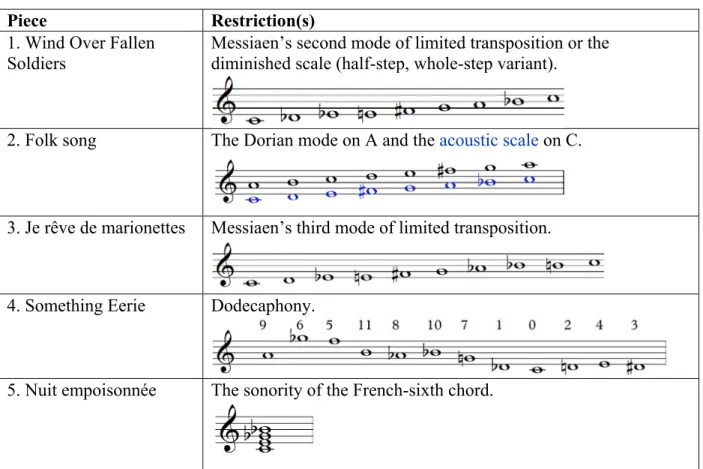
Portraits is a set of five pieces for solo piano. The pieces are centered around the use of a specific scale(s), apart from “Something Eerie,” which is dodecaphonic, and “Nuit
empoisonnée,” whose focus is the sonority of the French sixth chord. Most of the pieces are in binary form (ABA′)4, and take from one and a half to three minutes to perform.
Table 1.1: The pieces that make up Portraits and their respective restrictions
Aside from, “Je rêve de marionnettes,” all the pieces were composed during the first semester of my master’s studies. “Je rêve de marionettes” was written the year before as one of the weekly assignments for the course Techniques modernes de composition which led to the conception of Portraits. I reasoned that imposing restrictions on my pieces would help develop my musical language and that writing for piano would smooth my transition into compositions studies.
4 Although in binary form, I refer to them as having three sections to differentiate A from A′.
Piece Restriction(s)
1. Wind Over Fallen Soldiers
Messiaen’s second mode of limited transposition or the diminished scale (half-step, whole-step variant).
2. Folk song The Dorian mode on A and the acoustic scale on C.
3. Je rêve de marionettes Messiaen’s third mode of limited transposition.
4. Something Eerie Dodecaphony.
1. Wind Over Fallen Soldiers
“Wind Over Fallen Soldiers” is based solely on Messiaen’s second mode of limited
transposition, or the diminished scale. Apart from m. 28-30, in which the right hand contains material from a diminished scale starting on C-sharp, the entire piece is centered on the diminished scale starting on C.
The piece portrays gusts of wind on a battlefield through the contrast between the two outer sections (A and A′) and the middle section (B) of the piece. The outer sections are characterized by their representation of wind, while the middle section is marked by its military nature, a march.
Table 1.2: Formal analysis of “Wind Over Fallen Soldiers”
A B A′
m. 1-25 m. 26-37 m. 38-51
Mode 2 on C Mode 2 on C*
*In m. 28-30 mode 2 on C-sharp is played by the right hand
Mode 2 on C Wind motif: m. 1-6 Nostalgic theme (N): m. 7-12 Wind motif: m. 13-17 Variation on N: m. 18-25 March: m. 26-34 Transition: m. 35-37 Variation on N: m. 38-42 Short recitative: m. 43 Wind motif: m. 44-51:
The piece begins with a motif intended to portray wind. It consists of a rapid succession of notes (T0), which after being transposed up a minor third (T3), succeeds at outlining the entire
diminished scale.
Figure 1.1: The wind motif at T0 Figure 1.2: The wind motif at T3
In m. 7-12 a change of tempo introduces a slow and nostalgic atmosphere that alternates between the metres of 3/4 and 4/4, and the chords of A minor with an added major sixth (Am6) and E-flat minor. The harmony of this section outlines the diminished scale’s most characteristic interval, the tritone, while m. 11-12 contain a descending perfect fifth (B-flat to E-flat), a device that foreshadows the march in section B.
Measures 13-17 are a reprise of the beginning wind motif, albeit an octave lower. Following this, the material of the nostalgic section is developed in m. 18-25, and an arpeggiated Am6 chord in m. 22/25 further alludes to wind. A more blatant suggestion of the ominous middle section occurs in m. 21/24.
Figure 1.5: Allusion to wind in m. 22 Figure 1.6: Additional foreshadowing
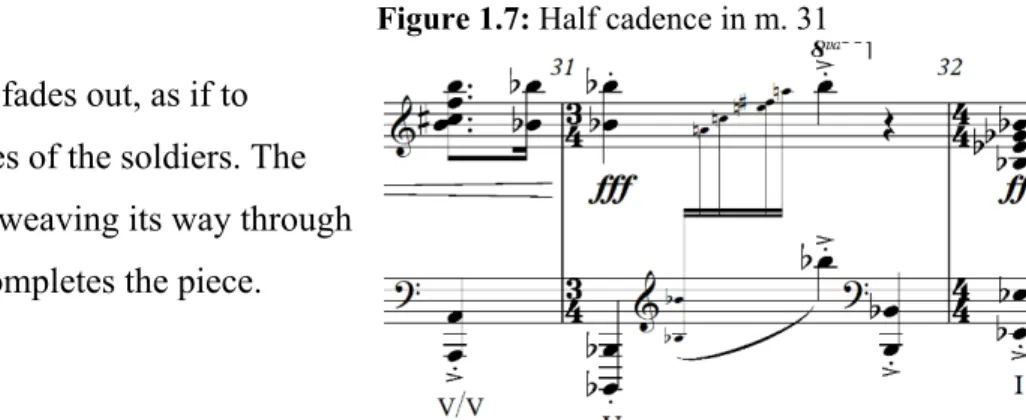
The middle section, or the grotesque march stands in stark contrast with the outer sections. Not only does it differ through its violent dynamics and dissonant chords, but it is also the only part of the piece in which there is a modulation from the original diminished scale. The tritone is outlined again, this time through an ostinato found in the left hand. A clear influence of classical music is found in the half-cadence in m. 31.
Figure 1.7: Half cadence in m. 31
The section gradually fades out, as if to suggest the fading lives of the soldiers. The wind then takes over, weaving its way through the fallen ones, and completes the piece.
Though I did not intentionally imitate any composers in writing this piece, the influence of French and Russian music is evident. Strangely, most of the compositions to which I can draw parallels are ones I have neither played nor know well. For instance, the wind motif is
reminiscent of the beginning of Debussy’s prelude for piano, “Feux d’artifice.”
Figure 1.8: The wind motif Figure 1.9: Measure 1 of “Feux d'artifice”5
The march in the middle section is at least rhythmically similar to Prokofiev’s “Montecchi and Capuletti” from his Romeo and Juliette suite.
Figure 1.10: Measures 1-4 of Prokofiev’s “Montecchi and Capuletti”6
5Claude Debussy. “Feux d’artifice in” Preludes Book 2,(Paris: Durand et Cie, 1913), p. 66, accessed April 21,
2017, International Music Score Library Project, http://ks.imslp.info/files/imglnks/usimg/d/dd/IMSLP00510-Debussy_-_Preludes__Book_2.pdf
6 Sergei Prokovief. “Десятъ Пъес из балета „Ромео и Джульетта“,” in S. Prokofiev: Collected Works, vol.3 (Собрание сочинений), ed. Levon Atovmyan. (Moscow: Muzgiz, 1956), p. 27, accessed April 21, 2017,
International Music Score Library Project,
http://petruccilibrary.ca/linkhandler.php?path=/imglnks/caimg/6/68/IMSLP00435-Prokofiev_-_Romeo_And_Julieta__Op_75.pdf
Figure 1.11: Measures 27-28 (the march) of “Wind Over Fallen Soldiers”
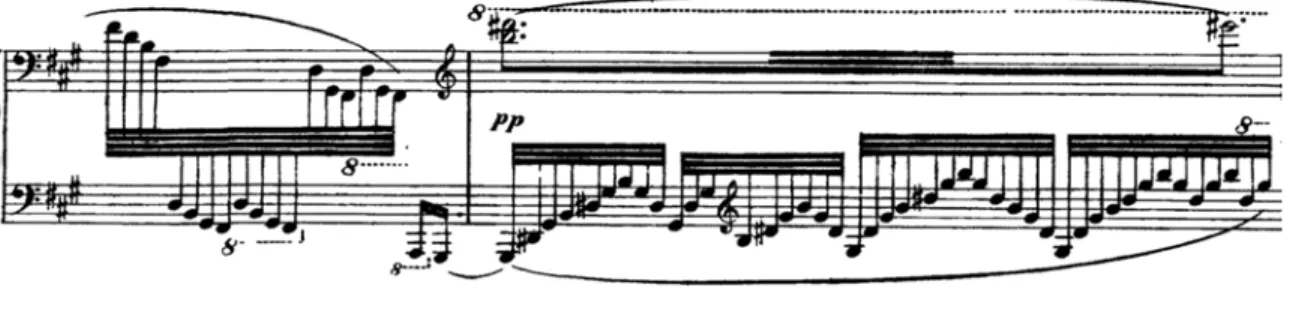
Perhaps the most obvious influence shows itself in comparing the arpeggiated Am6 chords in “Wind Over Fallen Soldiers” with similar figurations in Ravel’s “Une barque sur l’océan.” At various places in “Une barque sur l’océan,” the left hand arpeggiates a G-sharp minor chord, while the right-hand tremolos between the third, fifth, and an added major sixth of the chord. In “Wind Over Fallen Soldiers,” almost the reverse occurs: an Am6 chord is arpeggiated in the right hand, while the left-hand tremolos between the tonic, third, and major sixth of the chord. While this similarity was unintentional, it is not coincidental: in the year before composing Portraits, I had listened to “Une barque sur l’océan” several times in the orchestration class that I was attending. There must have been some residue left in my ear.
Figure 1.12: The arpeggiated Am6 chord
Figure 1.13:7 The arpeggiated G-sharp minor chord in “Une barque sur l'océan” in measures 42-43
7 Maurice Ravel. Une barque sur l’océan in “Mirroirs,” (Paris: E. Demets, 1906), p. 18, accessed April 21, 2017,
International Music Score Library Project,
2. Folk Song
“Folk Song” consists of three sections, in which the first uses the pitches of the Dorian mode on A, and the remaining two use pitches of the acoustic scale on C. The piece juxtaposes two different styles of folk music and portrays a group of folk musicians performing. The outer sections are calm and are meant to sound like Irish or English folk music, while the middle one is temperamental and is reminiscent of Eastern European folk music.
Table 1.3: Formal analysis of “Folk Song”
An interesting feature of the two scales is that there is only one note that is not common to both: the B-natural found in A Dorian and the B-flat found in C acoustic.
Figure 1.14: Dorian mode on A and the acoustic scale on C
This distinction, while small, is very important to the structure of the piece, and is highlighted in the B section, where the B-flat is repeated persistently.
Figure 1.15: Measures 21-22 of section B
A B A′
m. 1-20 m. 21-27 m. 28-36
Dorian mode on A Acoustic scale on C Acoustic scale on C Theme A: m. 1-10 Transition: m. 11-12 Theme A: m. 13-20 Theme B: m. 21-24 Transition: m. 25-27 Theme A: m. 28-36
In contrast, the B-natural is only heard three times in the A section. The melody that is presented throughout the section (theme A) is devoid of it; the B-natural is only used for harmonic
colouring.
Figure 1.16: Harmonic colouring using B-natural in section A
The arrival of B-flat in the penultimate measure of A′ (see Figure 1.17) seeks to unify the three sections of the piece. As a second scale degree was otherwise never heard in the A theme, its appearance as the note that distinguishes section B provides a resolution to the contrasting parts. Furthermore, because B-natural is never present in the A theme, the ending of the piece may leave one wondering about the “Dorian nature” of section A.
Figure 1.17: The final statement of the A theme
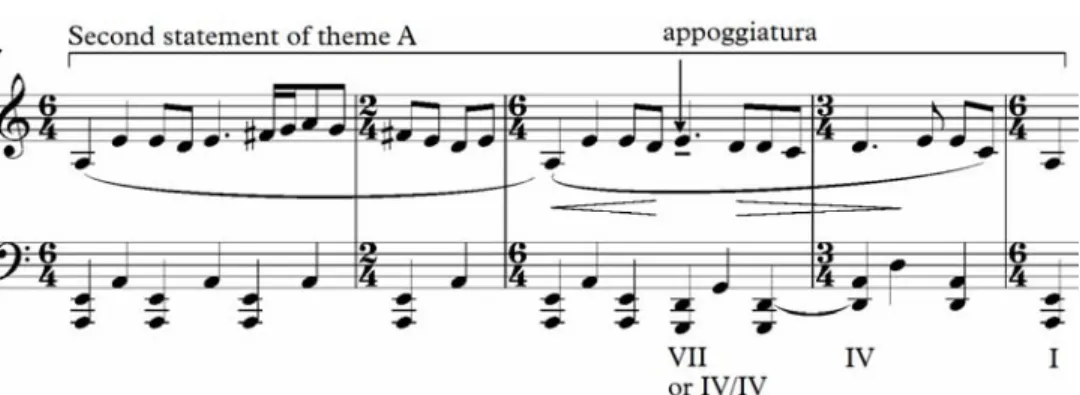
The harmonic language of the piece is very simple. In the outer sections, the bass mimics the droning sound of bagpipes or the open fifths of a string instrument. A plagal cadence (IV-I) links the repetition of each four-bar statement of theme A. In every second statement of the theme, a VII chord (or IV/IV8) is articulated before the cadence, resulting in an emphasis of the plagal movement.
8 IV of IV
Figure 1.18: Harmonic analysis showing the plagal movement in the A theme
A countermelody in the alto voice is introduced in m. 13-21 and provides additional seasoning to the established harmonies. The change of figuration in the bass (the addition of eighth-notes) is meant to simulate the sound of percussion, and the addition of the perfect fourth in the left hand on the last beat of m. 18 is intended to give the impression of clapping (is also occurs in m. 19/20).
Figure 1.19: Countermelody in the alto (in red) and figuration that suggests percussion and clapping
The harmony in the first four measures of section B is simply an accumulation of all the notes of the acoustic scale. Conversely, m. 25-27 wind down as the cluster chords are progressively thinned out, while an altered dominant seventh chord (the sonority of C French sixth) is arpeggiated in the left hand.
It is difficult to link any specific pieces as a source of inspiration or influence for “Folk Song.” I have listened so little to Irish and English folk music that it is hard to confirm whether the outer sections even reflect them. The melody was conceived while improvising at the piano, without a point of reference. The accompaniment and metre, on the other hand, may have been inspired by Brahms’ Piano Concerto no.1 in D minor, which I had performed a week before writing “Folk Song.” Similarities can be found between the metres of the pieces (the first movement of the concerto is also in 6/4) and the perfect fifths in the left-hand accompaniment (Figure 1.21). It is interesting to note that in the piano concerto, the first change of harmony in the solo piano is to a IV chord (G minor) with the fifth in the bass (Figure 1.22). Similarly, in the sixth bar of “Folk Song,” the first change of harmony is to the function IV (D minor, with the third omitted) with the fifth in the bass (Figure 1.26).
Figure 1.21:9 Perfect fifths in the left-hand accompaniment of Brahms' first piano concerto (m. 91-92)
Figure 1.22:10 Change of harmony in Brahms (m. 93-94)
Figure 1.23: Change of harmony in “Folk
Song”
The insistent nature of section B is likely due to my admiration of Shostakovich and Prokofiev. The music of these composers often contains motifs that are violent in nature or themes that build up to a brutal climax through their persistence and repetition. The development selection in the first movement of Prokofiev’s sixth piano sonata (op. 82) and the invasion theme of
Shostakovich’s Leningrad Symphony (op. 60) are two examples of this that come to mind.
9 Johannes Brahms. “Konzert n. 1” in Johannes Brahms: Sämtliche Werke, Band 6 (Leipzig: Breitkopf & Härtel,
1926-27), p. 7, accessed February 20, 2017, International Music Score Library Project, http://ks.petruccimusiclibrary.org/files/imglnks/usimg/0/05/IMSLP03190-Brahms-Op015fs.pdf
3. Je rêve de marionettes
As this piece was not composed during my master’s studies, I will not discuss it in detail. It is the shortest piece of the set and exclusively uses Messiaen’s third mode of limited transposition starting on C.
The piece is in 7/4 and attempts to invoke the image of marionettes dancing. The form of the piece is as follows:
Table 1.4: Formal analysis of “Je rêve de marionettes”
A B A′ m. 1-8 m. 9-11 m. 12-20 Introduction: m. 1-2 Theme A: m. 3-8 Theme B Theme A: m. 12-16 Outro: 17-20
The metre of the piece and the use of accents represent the disjointed movements of the puppets.
4. Something Eerie
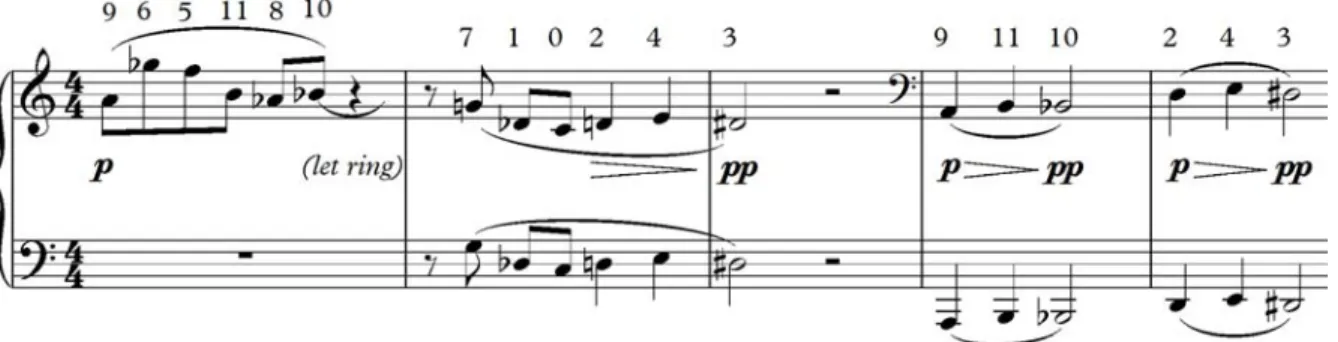
“Something Eerie” is a dodecaphonic piece based on the following twelve-tone series: [9, 6, 5, 11, 8, 10, 7, 1, 0, 2, 4, 3].11 The piece does not use any permutations of the series and is liberal in its approach to serialism: notes of the series are often repeated, overlapped, alternated between, and sometimes left out.
Figure 1.25: “Something Eerie’s” twelve-tone row
Figure 1.26: Formal analysis of “Something Eerie”
A B A′
m. 1-9 m. 10-22 m. 23-26
After the series is first stated, a melodic motif is presented in the bass using the notes [9, 11, 10] and [2,4,3].
Figure 1.27: The first statement of the series and the melodic motif that ensues
This motif, while seeming to break the mold of the series, is actually an anticipation of the next two measures, in which the series is grouped as [9, 6, 5], [11, 8, 10] and [10, 7] (Figure 1.28) and [1, 0, 2], [2, 4] and [3, 9] (Figure 1.29). While composing the piece, I allowed myself to overlap the endings and beginnings of groups of pitches within the series. For instance, [1, 0, 2] and [2, 4] (see Figure 1.29) or [1, 0, 2, 4] and [2, 4, 3, 9] (see Figure 1.30).
Figure 1.28: Measure 6 of “Something Eerie” Figure 1.29: Measure 7 of “Something Eerie”
Following this, the [9, 11, 10] and [2, 4, 3] motifs are extended by one note, becoming [9, 11, 10, 7] and [2, 4, 3, 9] in the left hand, while its rhythmic values are diminished. The transformed motif is accompanied by trills in the right hand which consist of pitches from the thirty-second note pattern found in the previous two measures, m. 6/7. The resulting grouping of the series is [9, 6, 5, 11], [8, 10, 7], [1, 0, 2, 4], [2, 4, 3, 9], and [4,3, 9].
Figure 1.30: Measures 8-9
A tempo change follows and an ostinato consisting of [9, 8, 10] is heard in the left hand. The right hand then produces part of the series and repeats it with an extension to its penultimate note. Thus, upon the entry of the right hand, the pitch groupings are [9, 6], [5, 11, 8, 10], [8, 10, 7], followed by [1, 0, 2, 4] after the repletion of the first groupings.
The ostinato is then transposed up a diminished fourth to [1, 0, 2], and the right hand plays a similar pattern to before starting in the middle of the series. Ignoring the ostinato, the following fragment of the series is heard two times: [10, 7, 1, 0, 2, 4, 3].
Figure 1.32: The transposed ostinato
The series then erupts into a pattern of sextuplets, allowing an entire statement of the row in a single bar. The left hand continues to play the notes of the previous ostinato, [1, 0, 2], until it joins the right hand in a third and final statement of the series. Following this, the interval of a tritone (between D-sharp and A) is repeated, mimicking its occurrence in m. 9 (last two measure of Figure 1.33).
The thirty-second note motif belonging to the right hand in m. 6-7 is then repeated in the left hand in m. 23-24. This time, however, the pattern ascends, as if to suggest the reflection of m. 6-7 (compare Figure 1.34 and Figure 1.35).
Figure 1.34: Thirty-second note motif in measures 6-7
Figure 1.35: Thirty-second note motif in measures 23-24
Following this, the first two measures of the piece are revisited. The first half of the row rather than the second now appears in parallel octaves to provide further mirror-like imagery, and the omission of the last pitch of the series concludes the piece on a note of tension (compare Figure 1.36 and Figure 1.37).
Figure 1.36: First two measures of “Something Eerie”
I chose dodecaphony as a compositional technique to challenge myself to write in a style foreign to me. Perhaps I would have delved into more unknown territory had I not been so liberal with my use of the twelve-tone row, nevertheless, I believe I achieved a musical aesthetic that would not have been available otherwise. Although the method of composition is taken from the Second Viennese school, the influence of Russian music has a stronger presence in this work. The percussive nature of the middle section is once again suggestive of Shostakovich and Prokofiev. Furthermore, the thirty-second note motif in m. 6, 7, 23, and 24, bears resemblance (even if only visually) to m. 87-91 (Figure 1.38) of Scriabin’s Piano Sonata No. 9 Op. 68 (Black Mass), a piece which I had performed one week before writing “Something Eerie.”
Figure 1.38: 12 Measure 88 of Scriabin's Piano Sonata No. 9 Op. 68
12 Alexander Scriabin. “Piano Sonata no. 9” in A.N. Skryabin: Polnoe sobranie sochinenii dlia fortepiano, vol. 3,
(Moscow: Muzgiz, 1953. Reissue Muzyka, 1972), p.7, accessed April 21, 2017, International Music Score Library Project, http://ks.petruccimusiclibrary.org/files/imglnks/usimg/2/28/IMSLP01909-Scrison9.pdf
5. Nuit empoisonnée
“Nuit empoisonnée” is the final and most freely-composed piece of the cycle. The only guideline I set for myself was to make use of the sonority of the French sixth chord (a dominant seventh chord with a flattened fifth). Since this chord comprises four of the six notes needed for a whole-tone scale, passages that outline it inevitably occur throughout the piece.
Of all the pieces in Portraits, “Nuit empoisonnée” is the one most influenced by a specific composer and work: Scriabin and his Black Mass sonata. The constant use of trills and the
ascending or descending movements that accompany them are derived from this sonata. Even the title of the piece pays tribute to Scriabin, who writes, “avec une douceur de plus en plus
caressante et empoisonnée,” in m. 97 of his sonata.
The piece is an experiment in thematic and motivic transformation, likely inspired by Liszt. Very little material is introduced after the opening bars, making the form of the piece more difficult to unpack.
Figure 1.39: Formal analysis of “Nuit empoisonnée”
A B C A′ m. 1-15 m. 16-21 m. 22-43 m. 44-52 Opening theme: m. 1-7 Transformation 1: m. 8-15 Transformation 2:
m. 16-21 Transformation 3: m. 22-27 Quotation from section A: m. 28-29 Transformation 3 (re): m. 30-37 Climax: m. 39-43 Closing theme: m. 44-52
“Nuit empoisonnée” begins with a seven-bar period consisting of a three-bar antecedent and a four-bar consequent. Within these, are three motifs, x, y, and y′, which are the source of material of the piece. Although the harmony is quite rich, it can be reduced to very basic formulas. Figure 1.40 provides a motivic analysis of the first phrase with a reduction of the harmony in the bottom staff (the French sixth chords are labeled “alt” to conserve space):
Figure 1.40: Motivic, harmonic, and formal analysis of “Nuit empoisonnée’s” opening period
The next eight bars contain a constant trill and variations on or fragments of the motifs from the opening period. A rhythmic motif of a dotted eighth note preceded or followed by a falling or rising gesture consisting of three thirty-second note triplets is an intentional reference to a similar pattern found throughout Scriabin’s Black Mass sonata (compare Figure 1.41 and Figure 1.45).
Figure 1.41: Rhythmic motif inspired by Scriabin's Black Mass sonata
Figure 1.42:13 Measures 25-26 of Scriabin's Black Mass sonata showing the source of inspiration (the right hand) for the rhythmic motif in “Nuit empoisonnée”
13 Ibid., p. 2.
After the introduction of this motif, the first transformation of the theme finishes in a similar manner to the opening period, with y′ followed by x.
Figure 1.43: The end of the first thematic transformation
Section B contains a minor shift in tempo, a shift in register, and the addition a broken chord accompaniment pattern (sometimes in the form of a French-sixth chord, as in Figure 1.44), similar to the one found in m. 87-91 of Scriabin’s ninth piano sonata (Figure 1.38). The
rhythmic pattern inspired by Scriabin is extended and allows for a complete whole-tone scale to be heard. This motif eventually becomes the main source of direction in the subsequent section.
Figure 1.44: The different elements of section B
Section C is distinguished by its liveliness and arpeggiated French-sixth chords. In the
beginning, fragments of the x motif interrupt trills in the right hand (Figure 1.45), and the left hand makes another reference Scriabin through the alternation between notes constituting a tritone (Figure 1.46).
Figure 1.45: Interruption of a trill by a fragment of the x motif in section C.
Figure 1.46: Reference to Scriabin in the left
hand
Figure 1.47:14 Measure 8 of Scriabin's Black
Mass sonata showing the source of inspiration
A short quotation from section A interrupts the established character in m. 28-29, and then a sequence of trills and arpeggiated chords in acceleration take the listener to a thundering statement of y′ in the climax of the piece (Figure 1.48). “Nuit empoisonnée” ends with a nine-bar recollection of the opening theme, with a tonal focus on D rather than A.
Figure 1.48: The climax of “Nuit empoisonnée”
14 Ibid., p. 1
Chapter 2. Trois mélodies sur des poèmes de Nelligan
Background
I had begun developing an interest in French art song one year prior to beginning my master’s after taking a seminar on it during my piano studies; I thought that composing a song cycle using French poems presented another opportunity to combine my knowledge as a performer with my desire to create music. I wanted to contrast Portraits by composing without imposed restrictions and I wanted to see if my compositional instincts had matured. It did not take me long, however, to realize that setting poems to music is hardly composing without restrictions: the rhythm and melody of the vocal part are inextricably linked to the text, the form of the piece should be influenced by the form of the poem, and the imagery in the poem may define the piano accompaniment.
I decided to use poems by Nelligan after my composition teacher at the time, François-Hugues Leclair, suggested I read his poetry. I had never heard of Nelligan but upon reading his works, I was convinced that their morbid themes and dark subject matter would compliment the style of music I enjoy writing. I chose the poems based on my appreciation of them and the potential I saw for them to be set to music. The poems are:
1) “Quelqu’un pleure dans le silence.” 2) “Le berceau de la Muse.”
3) “Soir d’hiver.”
The entire duration of the cycle is approximately nine minutes; the first two songs are roughly half the length of the third. While I am satisfied with each individual song, I do not think the set is well-balanced. I would eventually like to compose a fourth song (to begin the cycle with) with a length of three or four minutes, so that the two shorter pieces are balanced between two longer ones. The songs are for female voice and encompass the following range:
1. Quelqu’un pleure dans le silence.
Quelqu'un pleure dans le silence Morne des nuits d'avril;Quelqu'un pleure la somnolence Longue de son exil;
Quelqu'un pleure sa douleur Et c'est mon coeur!15
Table 2.1: The structure of “Quelqu’un pleure dans le silence”
Introduction (piano) First two lines Interlude (piano) Last four lines
m. 1-7 m. 7-13 m. 16-21 m. 21-31
The concept for this piece stems from the similarities between the poem and the musical gesture of a crescendo. While this comparison may seem ironic, as the poem describes someone who is crying in silence, the three statements of “Quelqun’un pleure” are marked by an increase in intensity as the narrator progresses from “dans le silence” to “la somnolence” and finally to “sa douleur.” The resulting form of the composition is thus a continuous flow music that increases in dynamics and emotions in parallel with the text. This is obviously a personal interpretation of the poem, one could certainly set it to music in a very convincing way by highlighting silence and by emphasizing the inner pain of the narrator.
For most of the song, the accompaniment is an ostinato: just as the words “quelqu’un pleure” return after every two lines, the accompaniment figure repeats every two bars. The piano is meant to signify the narrator’s crying, with the left hand representing her sighs and the right hand portraying her teardrops.
Figure 2.2: The piano ostinato that begins “Quelqu’un pleure dans le silence”
15 Émile Nelligan, Poésies complètes 1896-1941, prepared by Réjean Robidoux and Paul Wyczynski. Montréal:
The pitch material changes during a piano interlude in m. 16-21, as the left hand strikes the notes A and G. During this passage, the music becomes more dissonant through the addition of notes in the right and left hands, as it foreshadows the climax of the piece.
Figure 2.3: Change in the pitch material in measures 16-21
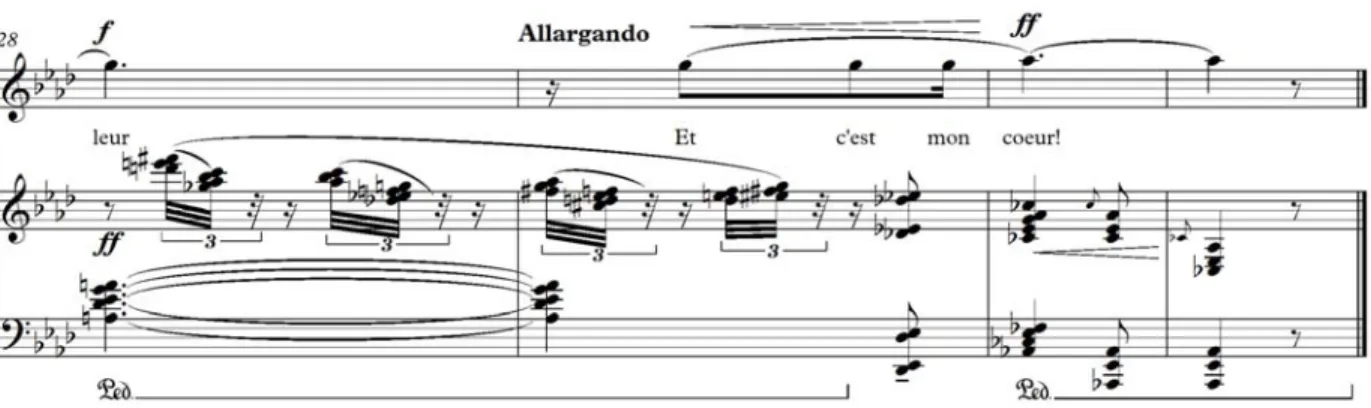
Following this, the accompaniment returns to its original ostinato for four measures until providing a thicker and more dissonant statement of the material from m. 16-21. In m. 28, a French-sixth chord is heard in the left hand, while clusters are played by the right hand. At this point, the tears from the beginning of the piece have transformed into the throbbing beats of the narrator’s heart. The piece ends on an A-flat minor chord, establishing a V-I relationship between the ostinato of beginning and the end of the piece.
Figure 2.4: The last four measures of “Quelqu’un pleure dans le silence”
The vocal part separates the first two lines of the poems from the last four for a couple of
reasons. Firstly, by isolating the first two lines, the image of silence (at least in the singer’s part) is emphasized. Secondly, by compressing the last four lines together, the intensification of the text is demonstrated.
Figure 2.5: The vocal part of “Quelqu’un pleure dans le silence” (the measures of silence before and
between the verses are not included)
Any difficulties in writing the vocal line were mainly a result of misunderstanding the prosody. The first draft of the piece contained many melodic contours that put false stresses on the words. As it stands, the word, “somnolence” in m. 23-24 is not written in a way that emphasizes the accented part of the word (somnolence). While I think that the longer note value on “len” makes mispronunciation unlikely, the singer may want to compensate for its possibility through her phrasing. Furthermore, it may seem strange that the article, le, is emphasized in m. 9. Indeed, I did not see any reason to stress le other then to create a melodic line that satisfied me.
Admittedly, being unaware of this awkwardness is an oversight and suggests that in the future I should pay more attention to the text before turning it into melody.
2. Le berceau de la Muse
De mon berceau d’enfant j’ai fait l’autre berceau Où ma Muse s’endort dans des trilles d’oiseau, Ma Muse en robe blanche, ô ma toute maîtresse ! Oyez nos baisers d’or aux grands soirs familiers… Mais chut ! j’entends déjà la mégère Détresse À notre seuil faisant craquer ses noirs souliers !16
Table 2.2: Formal analysis of “Le berceau de la Muse”
A (tonal) B (atonal) m. 1-28 m. 29-40
“Le berceau de la Muse” attracted me because of the emotional polarity between its first four and last two lines. The poem begins joyously with the narrator expressing adoration for his muse, however, its uplifting atmosphere is ruptured when the words “Mais chut” appear and the image of Death at the narrator’s doorstep concludes the poem. Highlighting this contrast was an
important goal of mine in setting the poem to music. I saw to accomplish this by mirroring the change with a shift from tonal to atonal writing. The first part of the song is written in the style of a Berceuse: it is in 6/817 and is in D-flat major, as are Chopin’s Berceuse op. 57 and Liszt’s Berceuse S. 174.
In the first fifteen measures of the piece, the accompaniment is a repeated four-bar phrase which travels from tonic to dominant over a tonic pedal. Its rhythm is meant to portray the image of a cradle rocking.
Figure 2.6: The opening measures of “Le berceau de la Muse”
16 Ibid., p. 41.
The pattern changes slightly after “trilles d’oiseau,” when the pedal ceases and the piano responds to the singer with trills of its own. An imperfect cadence occurs on the first beat of m. 19 to allow for a more convincing arrival of the tonic in m. 24. Upon the return of the main theme, the accompaniment blossoms from the cradle-like rhythm into arpeggiated eighth notes. From m. 24-26, the time signature changes to 9/8 to allow for further expansion and a dialogue between the accompaniment and voice.
The listener is put into a state of suspense when the accompaniment vanishes on the word “chut” in m. 28 after playing a dominant on the previous beat. The resolution never comes, as the piano begins the atonal section in m. 29 with a rolled a bitonal chord (Am7 over A-flat major) before the singer sings “J’entends déjà la mégère Détresse.” An A-flat minor chord with a major seventh marks the end of this line in m. 32. These two chords remain the basis for the harmony until the end of the piece. The cradle-like rhythm is shared between the singer and the piano until the accompaniment takes it over in the last three bars.
Figure 2.8: The atonal section of “Le berceau de la Muse”
In the tonal section, the vocal line generally outlines the harmonies of the accompaniment and provides some rhythmic variety to it when succession of eighth notes are heard.
The vocal contour in the atonal section may have been influenced by the atonal solfege exercises that I studied many years ago in Modus Novus by Lars Edlund. My intention was to create an atmosphere that is unsettling and chilling, which is certainly how I would characterize my experience as an undergraduate student during the countless hours of studying Edlund’s book. The piece, in all its brevity and simplicity, was my first attempt to meld traditional and modern styles of writing. While it would certainly be possible to set “Le berceau de la Muse” to music in a purely modern or traditional way, I believe that choosing to proceed as I did is justified by the text of the poem. Moreover, it fulfills my goals as a composer to mix and explore the colours from the palette of musical experience I have acquired throughout my education.
3. Soir d’hiver
Ah ! comme la neige a neigé ! Ma vitre est un jardin de givre. Ah ! comme la neige a neigé ! Qu’est-ce que le spasme de vivre À la douleur que j’ai, que j’ai. Tous les étangs gisent gelés,
Mon âme est noire ! où-vis-je ? où vais-je ? Tous ses espoirs gisent gelés :
Je suis la nouvelle Norvège
D’où les blonds ciels s’en sont allés. Pleurez, oiseaux de février,
Au sinistre frisson des choses, Pleurez, oiseaux de février,
Pleurez mes pleurs, pleurez mes roses, Aux branches du genévrier.
Ah ! comme la neige a neigé ! Ma vitre est un jardin de givre. Ah ! comme la neige a neigé ! Qu’est-ce que le spasme de vivre À tout l’ennui que j’ai, que j’ai …18
Despite having been completely unaware that “Soir d’hiver” is one of Nelligan’s best known poems, I was immediately enthralled upon discovering it. Its portrayal of depression and
desolation through repetition and reference to winter inspired me to set it to music. It is the only poem in which I took liberties with the text: I added four extra repetitions of the words “que j’ai” at the end of the piece, to show the never-ending misery of the narrator. I believe that Nelligan’s use of an ellipsis at the end of the poem also suggests this eternal struggle.
The poem is comprised of four stanzas, in which the fourth is nearly identical to the first.19 Thus, before writing a note of music, I decided that the song’s form would be ABCA'.
Table 2.3: Formal analysis of “Soir d’hiver”
A B C A'
m. 1-16 m. 17-30 m. 31-41 m. 42-58
“Soir d’hiver” begins with a three-chord motif that is the source of the accompaniment material for sections A and A'; it also returns periodically throughout the piece. The motif is meant to represent the slow and steady falling of snow flakes that one may see in the wake of a blizzard. After all, in the poem it has already snowed and thus the fury of the storm passed. On another level, the repetitiveness of the motif is meant to symbolize the perennial suffering of the narrator. I intended the musical language of “Soir d’hiver” to be less traditional than my usual writing: I wanted to challenge myself to be innovative and thought a style less rooted in tonality would better portray the angst of the narrator. In writing the “snow motif,” I made the simple choice of consecutively compressing the chords in the right hand and performing the opposite operation in the left hand. Upon discovering a combination that I was satisfied with, I thought that I had achieved my goal: I had successfully broken through the shackles of tonality and created a motif that not only had symbolic meaning, but was also pleasing to the ear.
Figure 2.10: The snow motif
Despite the motif’s only amounting to one bar of music, it was a great source of pride for me because, in my view, it was the first concrete example of my development as a composer. Shortly after finishing the piece, however, I decided to analyse the motif and discovered it could be reduced the following:
Figure 2.11: Reduction and harmonic analysis of the snow motif
I had successfully reproduced one of the most common chord progressions in all of western music.
The accompaniment in the beginning of section B is more stagnant: the unchanging chord in the right hand seeks to portray the frozen ponds recited in the first line of the second stanza, while the flurry of grace notes before them suggests snow dancing in the wind over the frozen bodies of water.
Figure 2.12: The accompaniment in the beginning of section B of “Soir d’hiver”
The music becomes more active when the singer sings “où-vis-je? où vais-je?” until the climax
of the piece is attained on the word, “Norvège.”
Section C begins with the return of the snow motif. On the anacrusis to m. 34, the singer begins a melody that outlines the mode of B Phrygian. The accompaniment becomes less dissonant and establishes B as the tonal centre, although not initially in the Phrygian mode. In m. 37, the piano takes over the melody and in m. 38, a dialogue occurs between the two instruments. During the dialogue, the piano portrays gusts of wind through arpeggiated chords. The section ends in m. 42 with the return of the snow motif.
The last section of the piece contains minor alterations from the first. It ends with the snow motif making a progressive descent into the lowest register of the piano, while the singer repeats “que j’ai.” The singer is indicated to sing each repetition with increased amounts of airflow until arriving at a whisper for the final pair.
The vocal part of “Soir d’hiver” is characterized by its contrast of stationary and melodic lines. It was important to portray the narrator’s emptiness and the stillness of winter through static
melodies, but also to represent her internal struggle through bursts of expression. For instance, the singer’s first two lines are nearly monotonous because they are intended to mirror the image of frost (Figure 2.14). However, when life is likened to a spasm in the fourth line, more shape is given to the melody to produce a greater effect (Figure 2.15).
Figure 2.14: The first two lines of the poem set to melody
Figure 2.15: The third and fourth lines of the poem set to melody
While reading “Soir d’hiver,” I was struck by the three repetitions of the line, “Ah! comme la neige a neigé.” As a result of the impression it left on me, I wanted to associate it with a
returning melodic figure throughout the piece. To avoid banality, I varied the final interval that occurs on the word neigé during the first and final repetitions. I reasoned that this would result in a more dramatic effect when the final “Ah! comme la neige a neigé” is sung because the listener
Figure 2.16: The first occurrence of
"Ah! comme la neige a neigé!"
Figure 2.17: The second occurrence
Figure 2.18: The third occurrence Figure 2.19: The fourth occurrence
The most expressive section of the piece is arguably C: the monotony present in the other sections is abandoned and replaced by a nostalgic melody that expands and contracts in a typically romantic manner. Its extroversion is propelled by the piano accompaniment which bursts into a swarm of arpeggiated chords. Varying the style of writing allows the listener a moment to refresh her ear before returning to the material that generated the earlier parts of the piece. Furthermore, it gives greater depth and meaning to the end of the piece, in which the narrator confirms the perpetuity of her situation.
Figure 2.20: The vocal part of section C
Chapter 3. Wind Quintet
Background
Flute, oboe, clarinet, bassoon, French horn.
After finishing the first draft of my songs on Nelligan’s poems, I resolved to write a piece for a chamber music ensemble with a view to exploring the different instruments of the symphonic orchestra. In addition, I was determined to see how I composed when writing purely for instruments that I could not play. Because I had very little experience writing for wind
instruments and because of their distinct personalities, I reasoned that writing for wind quintet would greatly assist my development as a composer.
As a pianist, I have had the opportunity to accompany several of the instruments that form a traditional wind quintet. Of these, my work with the bassoon has by far been the most extensive. While I cannot make any specific connections with Wind Quintet and any of the pieces I
accompanied, my collaboration with bassoonists has underlined the instrument’s potential for humour and virtuosity. In addition, my work with clarinetists has made me aware of their disposition to playing flurries of notes in cadenza-spirited warmups.
I did not initially intend to write a three-movement piece: my goal was to create a single-movement work with features of klezmer music. Furthermore, I wanted to continue to explore composing pieces with starkly contrasting sections as I did in “Le berceau de la Muse.” Until this point in my master’s, the pieces I had written were all less than five minutes long, and so I
challenged myself to write one that was at least six minutes long. Although my attempt to achieve these objectives resulted in a composition that I was satisfied with, I could not help but feel that its rondo-like qualities made it seem like the final movement of a multimovement work. Due to its liveliness, I thought that preceding it with a slower movement would make it feel complete. When I finished the next movement, I was convinced that it had the characteristics of a second movement, and so I decided to write a third movement, which in turn is the first
movement of the piece. The first movement can be seen to have a sonata form and as mentioned, the third movement can be likened to a rondo.
1. Movement I
The first movement is approximately five minutes long, and plays with contrasts between tonal and atonal writing. While composing it, I chose to use elements from the third and second movements to ensure the coherence of the entire quintet. For instance, the clarinet’s opening motif, which is a group of four thirty-second notes followed by a staccato eighth-note, is derived from a rhythmically identical motif that is heard in the same instrument in m. 27 of the third movement (Figure 3.1), the opening material of the first movement occurs on a tonic pedal, while the opening material of the third movement is on a dominant pedal, both movements are in F minor, and both contain sudden contrasts.
Figure 3.1: Opening motif of movement I Figure 3.2: Measure 27 of movement III: the
origin of the opening motif
Whereas the exposition of a movement in traditional sonata form will typically include a primary and secondary theme, separated by transitional material and followed by a codetta,20 the
exposition of Wind Quintet is born of the contrast between its tonal and atonal sections. Yet, on a micro level, one can also see some of the characteristics of a traditional exposition in the first section of the piece.
20William E Caplin. Analyzing Classical Form (Oxford University Press, USA, 2013), p. 270, accessed April 11,
i. Exposition
Table 3.1: Formal analysis of the exposition of movement I
Exposition (m. 1-64)
Tonal section (m 1.-40) Atonal section (m. 41-52) Codetta (m. 53-64) Primary theme (P): m. 1-8
Transitional material: m. 20-24 Secondary theme (S): m. 25-32 (4+4)
Transition: m. 41-42
The first movement begins with an eight-bar period or the primary theme, consisting of a four-bar antecedent and consequent. The arrangement differs in the four-four-bar pair, with the oboe stating the melody of the antecedent and the flute assuming it in the consequent.
Following two measures of repose, the theme is restated with changes to the arrangement and accompaniment; the French horn states the antecedent and the oboe states the consequent. A direct modulation to the sub-dominant or B-flat minor follows and a short transitional section brings the listener to the statement of the secondary theme by the bassoon. The four-bar theme is then reiterated in parallel thirds by the flute and oboe before being varied and combined with the primary theme in m. 33-40.
Figure 3.4: The secondary theme, as well as its variation.
A shift to 12/16 and a sudden change of character provide a two-bar transition (m. 41-42) to the atonal section of the movement. The transition presents a rhythmic motif (Figure 3.5), x, and a five-note cluster chord that is constructed of three semitones with tritones above the two upper semitones (Figure 3.6). The chord is derived from m. 6 of the second movement, where it occurs at a different transposition (one semitone higher) and with different voicing. In its first
occurrence (in movement I), the clarinet and flute trill a tritone apart, on C and F-sharp,
respectively. This is derived from m. 139-140 of the third movement, where the same trill occurs over a different harmony. The rhythmic motif is not always identical in its replications
throughout the movement but is identifiable by its consistent long, longer, short, short rhythm (the last rhythmic value sounds shorter than the first because it is played staccato).