Majure Finance
Research Paper
Academic Year 2018 – 2019
What is the impact of “Buy-and-Build” Private Equity strategies
on LBO Value Creation?
Case Study on the Buyout of Berlin Packaging by Investcorp
Ali Haider Minhas
Under the Supervision of:
Professor Patrick Legland
Acknowledgments
I want to express my sincere gratitude to Professor Patrick Legland for his guidance, motivation, and patient supervision without which I could not have written this research paper. Professor Legland was always available to provide advice, and he provided me with significant autonomy when it came to the approach I adopted in writing this paper.
In addition to this, I want to mention the support I received from my late grandmother throughout my academic endeavours and this research paper in particular. Without her profound belief in me and her emotional support, achieving these academic credentials would have been an unfathomable task.
Abstract
This paper aims to examine value creation in the context of “Buy-and-Build” strategies in Private Equity led Leveraged Buyouts and identify whether any particular levers of value creation are of greater importance in the case of “Buy-and-Build” LBOs. The paper starts by providing an overview of the Private Equity industry before moving on to a review of the current literature on the topic of value creation in traditional Private Equity led LBOs and in the case of “Buy-and-Build” transactions. The theoretical part of this paper culminates by combining the conventional levers of value creation with empirical research on “Buy-and-Build” strategies and developing a framework to analyze value creation in the case of “Buy-and- Build” transactions. Moreover, this research paper posits a hypothesis which states that the success of Buy-and-Build LBO transactions highly depends on the independent ability and experience of the platform company’s management team to carry out and integrate add on acquisitions. Finally, the validity of this hypothesis is explored and substantiated in a case study about the Buyout of Berlin Packaging by Investcorp.
Table of Contents
Introduction……….. 6
I. Overview of Private Equity……….... 9
a. Definition of Private Equity………...9
b. Structure of Private Equity Funds………...9
c. Different types of Private Equity Strategies………..11
d. Historical Development of the Private Equity Industry……….12
e. Current Trends in Private Equity………...13
II. Overview of Leveraged Buyouts……….16
a. Description of LBOs………16
b. Main Players in an LBO Transaction……….17
III. Literature Review of Value Creation in Traditional Leveraged Buyouts…………..19
a. Michael Jensen (1989): Eclipse of the Public Corporation………...19
b. Gottschalg & Berg (2005): Dimensions of Value Generation in Buyouts………..22
b. Gottschalg & Berg (2005): Levers of Value Generation in Buyouts………...26
IV. Measuring Value Creation……….34
V. Literature Review of Value Creation in Buy & Build Private Equity strategies……41
a. Overview of “Buy-and-Build” strategies……….41
b. Empirical Research: BCG & HHL Leipzig (2016)………45
c. Borell & Hegger: Value Creation Through PE-backed M&A (2013)………..47
VII. Choice of Case Study………56
VIII. Case Study: Investcorp’s “Buy-and-Build” of Berlin Packaging……….58
a. Overview of Platform Company: Berlin Packaging………58
b. Acquisition by Private Equity Firm: Investcorp………..60
c. Executing the “Buy-and-Build” Strategy………..61
d. Exit and Returns………..68
e. What made the LBO successful? – Analysis of Value Drivers………....70
Conclusion...……….84
Bibliography..………..86
6
Introduction
A few Private Equity funds in the US started conducting Leveraged Buyout transactions (historically known as “bootstrapping”) back in the 1970s, and now the Private Equity industry has reached a global scale with record amounts of fundraising in 2019. According to Preqin, this year commenced with 3,749 Private Equity funds across the world entering the fundraising process, which is up 63% from the start of last year. As a result of this surge in fundraising, Private Equity funds have built up a significant amount of dry powder (un-invested capital) and are under a lot of pressure to do deals. Due to these developments, returns in the Private Equity asset class, although still quite robust, have started to revert towards public market average returns. However, it is essential to note that “Top Quartile Funds” in Private Equity still consistently outperform other asset classes by a significant margin. Therefore, more so than before, it is vital for investors in Private Equity funds to understand the ability of these funds to create value as the private markets space gets more and more crowded.
The ability of Private Equity firms to create value and the mechanisms used to achieve this goal are deeply contested issues amongst academics. The 2008 Global Financial Crisis significantly damaged the popular view of the overall Finance industry, and the Private Equity industry also bore the brunt of this negative attitude. The most prevalent criticism of Private Equity firms is that they tend to transfer value to themselves by initiating drastic cost-cutting measures in their portfolio companies which render them uncompetitive in the long-run and adversely affect other stakeholders such as employees, customers, suppliers, and the broader society in which the business operates.
However, others argue that while this may have been true in the past, in contemporary times, Private Equity firms must create value in their portfolio companies through operational improvements and by kick-starting growth. The reliance on financial leverage as a critical driver of returns has significantly reduced due to the
7
commoditization of debt financing, low interest rates and increased competition to buy quality assets.
One value creation strategy employed by Private Equity firms is called a “Buy-and-Build” strategy whereby the Private Equity firm acquires a base company and makes several smaller acquisitions through that company resulting in a combined entity that generates higher value than the distinct assets. According to Bain & Company’s Global Private Equity Report for 2019, the “Buy-and-Build” strategy is gaining prevalence amongst Private Equity players and is employed to mitigate the effect of higher purchase multiples and reduce the dependence on leverage to generate returns.
In this research paper, we examine how Private Equity firms use “Buy-and-Build” strategies to create value in the context of LBO transactions. We begin by giving an overview of Private Equity, including definitions of key terms, how Private Equity funds are structured, the history of Private Equity, and the state of Private Equity in contemporary times. Then, we briefly explain the concept of Leveraged Buyouts, paying keen attention to the major players involved in each LBO transaction. Having understood the idea behind Private Equity and the mechanism underlying Leveraged Buyouts, we examine the currently available literature on the topic of value creation in traditional Leveraged Buyouts. In this section, we primarily focus on the work of Michel Jensen (1989) and Gottschalg & Berg (2005), while referencing other authors to clarify the topic at hand further. After this, we go over the methods used to measure value creation for different participants in an LBO. We explore both traditional ways proposed by academics of corporate finance and the practical measures used by Private Equity professionals. In each case, we discuss the advantages and drawbacks of each method. After this, we look at empirical research conducted by BCG & HHL (2016) and Borell & Hegger (2013) in the context of “Buy-and-Build” Leveraged Buyouts. We then combine their findings with the traditional framework of value creation proposed by Gottschalg & Berg to come up with a comprehensive framework for looking at value creation in the context of “Buy-and-Build” LBOs. In addition to this, we come up with our hypothesis
8
proposing that the pre-LBO experience and skill set of management teams of platform companies is the most crucial factor enabling value creation in the context of “Buy-and-Build” LBOs.
Finally, we apply our comprehensive value creation framework and test our hypothesis in the context of Berlin Packaging’s “Buy-and-Build” LBO by Investcorp in 2007. As a result of our analysis our theory regarding management teams was validated as the management team of Berlin Packaging had engaged in three “Buy-and-Build” operations prior to the LBO led by Investcorp, and the skill set developed by the management team due to their prior experience had enabled the swift integration of additional add on acquisitions during the LBO.
9
I. Overview of Private Equity
a. Definition
Private Equity investing can be defined as a form of investing where: “Private Equity funds invest long-term capital in private (or, at times, public) companies in return for an equity stake that is not freely tradable on a public market” (Claudia Zeisberger, Michael Prahl and Bowen White, 2017).1
This definition represents a comprehensive assessment of Private Equity as it accounts for instances of “take-private” transactions (delisting of public companies) and it is broad enough to include various types of investment strategies such as Venture Capital, Growth Equity and Traditional Leveraged Buyouts.
b. Structure of Private Equity Funds
“A Private Equity fund is a stand-alone investment vehicle managed by a PE firm on behalf of a group of investors” (Claudia Zeisberger, Michael Prahl and Bowen White, 2017).2
The majority of Private Equity Funds are set up as closed-end Limited Partnerships, and fund managers manage these investment vehicles as “blind-pools”. Academics and practitioners use the term “blind-pool” because although investors in Private Equity Funds have an agreement over the broad mandate of the Fund, the Private Equity firm has overall discretion to choose specific investments.
Moreover, these closed-end funds have a limited life-span (typically ten years), and investors are required to commit capital for the entire life-span of the fund.
1 Mastering Private Equity pg.5 (Claudia Zeisberger, Michael Prahl and Bowen White, 2017) 2 Mastering Private Equity pg.6 (Claudia Zeisberger, Michael Prahl and Bowen White, 2017)
10
Key participants in a Private Equity fund include the following:
- Private Equity Firm: This is a firm that has expertise in executing a Private Equity investment strategy. Private Equity firms raise and manage independent investment vehicles called Private Equity investment funds through a separate but legally affiliated entity: the GP. Members of the Private Equity firm hold key decision-making positions in the GP for all funds raised by the firm. The logic behind having the GP as a separate legal entity is to isolate the Private Equity firm from any liabilities on the fund. Examples of Private Equity firms include Blackstone, Ardian and Apax Partners.
- Limited Partners (LPs): LPs are passive investors in a Private Equity fund and typically contribute the largest share of capital in the fund. LPs are purely financial investors and do not get involved in the day-to-day operations of the fund or its investment decisions. LPs commit to a certain amount of capital which is “drawn down” by the Private Equity fund over the life-span of the fund. Typical LPs in Private Equity funds include private and public pension funds, endowments, insurance companies, banks, corporations, family offices, and fund of funds.
- General Partner (GP): The GP is responsible for the management of all aspects of the Private Equity fund and has a fiduciary duty towards the investors in the fund. The GP has the discretion to make investment decisions in line with the fund’s broad mandate, as illustrated in the LPA (Limited Partnership Agreement). The GP – which contains the PE firm’s partners and senior managers – will typically commit their capital in the fund to align the GP’s interest with the LP’s of the Private Equity Fund. To ensure that the GP has “skin in the game”, the GP invests around 1% - 5 % of the total capital raised for the fund. Moreover, the GP is usually paid a management fee by the Private Equity fund for taking responsibility for managing the fund. This fee usually amounts to around 1.5% - 2.0% of the committed capital of the fund during the investment period (often the rate is lower following the investment period/it is calculated based on invested capital).
11
Private Equity firms base their business model on raising capital from investors (LPs), investing this capital in target companies, selling these investments (often many years later), and returning the proceeds from these investments to the LPs while keeping a certain percentage, called “carried interest” (usually 20%) of the total profits for the GP.
c. Different Types of Private Equity Strategies
The various types of investment strategies can be categorized according to the life-cycle stage of the target company and/or whether the stake being acquired by the investor is a majority/minority stake.
The three major types of Private Equity are defined below:
- “Venture Capital funds are minority investors betting on the future growth of early-stage companies— defined as pre-profit, often pre-revenue and at times even pre-product start-ups” (Claudia Zeisberger, Michael Prahl and Bowen White, 2017). 3
- “Growth Equity funds invest in fast-growing businesses (which have moved beyond the start-up stage) in exchange for a minority equity stake” (Claudia Zeisberger, Michael Prahl and Bowen White, 2017). 4
- Traditional Private Equity has usually referred to instances where “Buyout funds acquire controlling equity stakes in companies that allow them to restructure the targets’ financial, governance, and operational characteristics” (Claudia Zeisberger, Michael Prahl and Bowen White, 2017). 5
This focus of this paper will be on the classical form of Private Equity, which is Buyout Funds that engage in Leveraged Buyouts (LBOs).
“A Leveraged Buyout (LBO) is the acquisition of a company, division, business, or collection of assets (“target”) using debt to finance a large portion of the purchase price”,
3 Mastering Private Equity pg.19 (Claudia Zeisberger, Michael Prahl and Bowen White, 2017) 4 Mastering Private Equity pg.33 (Claudia Zeisberger, Michael Prahl and Bowen White, 2017) 5 Mastering Private Equity pg.43 (Claudia Zeisberger, Michael Prahl and Bowen White, 2017)
12
while the remaining portion is in the form of Equity by the Private Equity fund (Rosenbaum & Pearl, 2009). 6
d. Historical Development of the Private Equity Industry
Although Private Equity has gained widespread prominence in recent decades, we can trace the invest investment strategies associated with Private Equity to the beginning of the 21st century with JP Morgan’s $ 480m leveraged buyout of Carnegie Steel Corporation in 1901.
While Private Equity remained in the shadows of the overall financial ecosystem for most of the 21st century, it started gaining traction in the 1970s through the development of the Venture Capital industry in the United States. Furthermore, due to the weak stock market and overall recession in the 1970s, the IPO and M&A market collapsed, and these Venture Capital firms developed alternative investment strategies (Kaiser & Westarp, 2010). These new investment strategies focused on carving out poorly diversified conglomerates by carrying out leveraged buyouts (formerly known as “bootstrapping”) of the divisions within these large companies. By the end of the 1970s, Private Equity firms which were dedicated to leveraged buyouts were founded. One famous example is the founding of KKR, one of the most successful buyout firms, in 1976.
The 1980s saw a rapid growth in the development and globalization of the Private Equity industry. A significant impetus for this growth was the removal of specific regulations that restricted pension funds from investing in Private Equity vehicles. Moreover, the capital gains tax in the US was lowered from 20% in 1981 from 49.5% in 1978. As a result of these catalysts, capital commitments to Private Equity funds reached $3.5bn between 1980 and 1982. This increase was two-and-a-half times higher than capital commitments over the 1970s (Kaiser & Westarp, 2010). In addition to this, the development of the high-yield “junk bond” debt market in the 1980s increased the capability of buyout funds to lever up their investments, thereby facilitating the increase in Private Equity activity.
13
Finally, Private Equity became internationalized as GPs raised funds in the UK, Canada, Australia and Continental Europe.
After the boom period of the 1980s, the Private Equity industry encountered its first slump during the recessionary period of the 1990s. This recession resulted in a significant retraction in the “junk bond” market, which further hurt the Private Equity industry. The late 1990s saw improved growth in the economy and Private Equity, especially the subset of the Venture Capital industry, began to grow again with the advent of the internet boom. This re-birth was followed by another retraction in 2001 as the internet bubble burst, resulting in a significant correction in the Venture Capital industry, with rippling effects in the overall Private Equity industry. However, the Private Equity industry quickly recovered from this due to the presence of low interest rates and the innovation of structured finance products such as Collateralized Debt Obligations (CLOs) that increased the availability of debt financing (Kaiser & Westarp, 2010). 7
Finally, the period of the 2000s saw an institutionalization of Private Equity with the development of large Private Equity firms such as Blackstone and Carlyle. Also, although the Private Equity industry experienced a slump during the Financial Crisis in 2008, it started recovering quickly by 2010 due to the low-interest-rate environment created by Central Banks across the globe through their quantitative easing policy.
As we can see from the history of the Private Equity industry, it is a cyclical industry, and factors such as the availability of debt financing, the global interest rate environment and the regulatory environment influence the evolution of its cycle.
e. Current Trends in Private Equity
8With the persisting low-interest rate-environment, investors have been seeking higher returns in alternative investment strategies, particularly Private Equity. The low returns
7 Kaiser & Westarp pg.8 (INSEAD Research Paper, 2010) 8 Bain & Co (Global Private Equity Report, 2019)
14
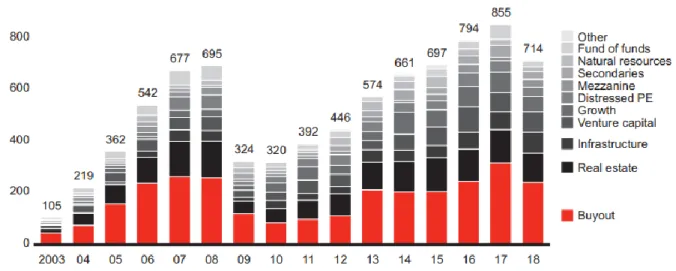
from traditional asset classes have led to Private Equity funds to attract a significant amount of capital from investors. In 2018, GPs raised $714bn from investors, increasing the total Private Equity capital raised since 2014 to $3.7tn9. The chart10 below shows the
evolution of fundraising in different investment strategies within the overall Private Equity universe.
Figure 1: Global PE Capital Raised (according to type of Fund)
One effect of this massive capital surge into Private Equity has been the significant rise of “dry powder” held by Private Equity funds. According to Bain & Co (2019), global Private Equity dry powder has been increasing since 2012 and reached a record high of $2tn at the end of 2018 ($695bn for Buyout funds). However, it is essential to note that around 67% of the dry powder of Private Equity funds has been raised over the last two years11. The chart12 below shows the evolution of dry powder held by Private Equity
funds over time.
9 Bain & Co (Global Private Equity Report pg.36, 2019) 10 Preqin
11 Bain & Co (Global Private Equity Report pg.36, 2019) 12 Preqin
15
Figure 2: Global PE Dry Powder (according to type of Fund)
Finally, due to this increase in dry powder, Private Equity firms are facing significant pressure to source and execute deals. This pressure to do deals has led to stiff competition amongst Private Equity firms, which has increased the valuation multiples of Private Equity led transactions. As can be observed in the chart below13, Private Equity firms cite
“High transaction multiples” as the most significant challenge they are facing right now.
Figure 3: Private Equity firms key concerns survey
16
II. Overview of Leveraged Buyouts
a. Description of LBOs
The basic idea behind a Leveraged Buyout (LBO) is that a financial sponsor (usually Private Equity firm) acquires a target company (OpCo) with a significant proportion of the purchase price financed with Debt, and uses the future cash flows of the target company to service this Debt.
The LBO transaction is structured in such a way that a holding company (HoldCo) is created, capital is injected into this HoldCo, and then the HoldCo purchases the shares of the target company. This method is known as the “KKR method” after the Private Equity firm that initiated such a transaction. On the other hand, in some cases, the HoldCo will only acquire the assets of the target company. This is known as the “Oppenheimer method” based on the Investment Bank that introduced this structure. The reasoning behind this type of structure where a HoldCo is used is that from an accounting perspective, it is liable to benefit from the effect of high financial gearing through “tax-consolidation” between the HoldCo and OpCo.
At the end of the holding period (exit), the remaining Net Debt is subtracted from the Enterprise Value of the OpCo, and the result of this is the Equity Value available to all Equity investors. Then, the Private Equity fund takes its share of the Equity Value and analyzes its return based on the initial amount of Equity it injected in the LBO transaction. According to Vernimmen (2017), the three main exit strategies for an LBO transaction include a sale to a trade buyer, sale to another financial sponsor and/or stock market floatation.
Sale to trade buyer: In most cases, this is an “ideal” situation as these strategic buyers are usually expecting synergies from the acquisition of the target company and therefore, can afford to pay a higher price. Moreover, this sends a signal that the target company now has “strategic value” and that this was a result of the improvements led by the Private
17
Equity firm in aspects such as operational changes, market share expansion, corporate governance initiatives etc.
Sale to another financial sponsor: These secondary LBOs are becoming more common (especially in France) and are commonly referred to as “secondary LBOs”.
Stock market floatation: If there are no trade buyers or financial sponsors willing to acquire the target company, the Private Equity firm resorts to taking the company public and gradually exiting its stake through selling its shares on the stock market. This scenario is common when the target company is huge and/or is already a market leader in this industry. The fact that the Private Equity firm cannot sell its entire stake immediately hurts the IRR of the investment. Moreover, the IPO valuation of a company does not include a control premium, resulting in a lower Exit Valuation. Finally, this type of exit might be more valuable to the target company’s senior management as their stock options get more liquidity, and they can sell at the optimum time.
b. Main players in an LBO transaction
Private Equity Fund (PE Fund):Given that LBO transactions are complicated and require specific expertise, a Private Equity firm initiates and leads an LBO transaction intending to achieve a certain level of return on its investment. Moreover, during the holding period of an investment, the Private Equity firm aims to improve the target company by taking initiatives that enhance its operating profile. Given the high level of risk involved in an LBO transaction, the required IRR is usually in the range of 20%-25%.
The Private Equity Fund mainly invests in the Equity of the holding company and becomes the controlling shareholder. Moreover, to reduce its risk exposure, the Private Equity Fund can invest alongside other funds and minority investors (co-investors such as LPs in the Private Equity Fund).
18
Target Company (OpCo):
The target company is the central focus of an LBO transaction. The foundation of a successful LBO transaction depends on the ability of the target company to generate sufficient cash-flows to service the Debt of the holding company used to acquire the OpCo. Moreover, the operating model of the ideal target company should have a clear emphasis on effective cash-conversion and minimum investment needs.
As a result of this emphasis on cash-flows in LBO transactions, companies that operate in industries that are relatively shielded from changes in the business cycle, have high barriers to entry and minimal substitution risk are preferred LBO candidates. Some examples of such industries include food, retail, building materials, real estate, cinema theatres etc.
While traditionally targets for Private Equity funds have been “cash-cows” from stable industries, there has been an increase in targeting companies that exhibit higher growth or are operating in sectors that could benefit from a consolidation focused investment strategy.
Debt Providers:
Debt financing is central to an LBO transaction and is mainly provided by a consortium of Banks, Hedge funds and Mezzanine funds. Given the complexity and riskiness of an LBO transaction, different tranches of debt are used to finance the purchase. These mainly include senior tranches such as traditional Bank Loans and more subordinated types of debt such as High-Yield Bonds and Mezzanine Financing. The different types of Debt financing tools appeal to the various risk appetites of Debt investors. Moreover, since different types of debt have different varieties of “covenants” attached to them, the Private Equity fund can optimize Debt financing in a way most suitable to the OpCo. In the majority of cases, most of the debt sits at the HoldCo level and is serviced through dividends paid by the OpCo to the HoldCo. Moreover, some types of Senior Debt can later be allocated to the OpCo level – this allocation is called “Debt pushdown.
19
As opposed to Equity holders, Debt providers are aiming for a fixed return on their investment and so they care more about the OpCo being able to service the debt even in a downside scenario, rather than focusing on what upside could result from an increase in the value of the OpCo.
Sellers at Entry:
According to Vernimmen (2017), around 50% of LBOs are carried out on family-owned companies. A significant reason for this is that by selling to Private Equity funds, families that own businesses can avoid dealing with complicated succession issues. Apart from this, in around 40% of LBO transactions, a large strategic buyer usually sells off a division that it deems non-core to its operations. Most of the large transactions fall under this category.
Finally, in some cases, there are “Public-to-Private” LBO transactions in which a listed company, which is generally undervalued (often to due limited liquidity), opts to become private and delist from the stock exchange.
III. Literature Review of Value Creation in Traditional Leveraged
Buyouts:
a. Michael Jensen (1989): Eclipse of the Public Corporation
In 1989, Michael Jensen wrote a paper titled “Eclipse of the Public Corporation” in which Jensen argued that the publicly held corporation had “outlived its usefulness” (Jensen, 1989) in a significant number of industries within the overall economy and that this organizational structure was being replaced by “the private corporation” through Leveraged Buyouts and “take-private” transactions. Jensen (1989) argued that this shift towards the privately-held corporate structure was a result of a source of value destruction in public corporations arising from “the conflict between owners and managers over free cash flow”.
20
Jensen (1989) attributed the rise of Private Equity and Leveraged Buyout transactions (particularly “Public-to-Private” transactions) in the 1970s and 1980s to the value destruction caused by the inappropriate allocation and use of capital by managers of public corporations.
Jensen (1989) argued that particularly in mature industries such as steel, tobacco and wood & paper products, the public corporation was not an effective method of organization. These mature industries are characterized by low long-term growth, “cash-cow” companies and minimal opportunities to invest cash in investments that generate a return at least equal to the cost of capital for the firm. As a result of these characteristics, managers in these industries are easily seduced to “waste cash flow through organizational slack or investments in unsound projects” (Jensen 1989) 14.
These value destructive decisions by management can be attributed to the age-old “principal-agent” problem, which is a result of the separation of ownership and management of a company. In theory, this problem should be mitigated by three major forces that are faced by public corporations: “Product Markets, Internal Control systems represented by the Board of Directors and the Capital Markets”15. However, according to
Jensen (1989), these forces have mostly failed to stop managers from taking value destructive decisions. First, with regards to the discipline enforced by-product markets, large and vibrant national markets such as those in major economies such as the US tend to create significant competitive advantages which competitors find hard to reverse. Second, the concept of a Supervisory Board of Directors has proved inefficient as these directors are usually “outsiders” and do not have an Equity stake in the company. This reduces their ability and willingness to monitor and discipline management properly. Finally, capital markets are the force that has maintained most of the discipline of public corporations. However, given the high purchase premiums paid in “Public-to-Private”
14 Pg.5 (Jensen, 1989) 15 Pg.6 (Jensen, 1989)
21
transactions, it can be argued that the management of public corporations can destroy a significant amount of value before a capital market correction occurs.
Jensen (1989) introduces the “LBO Association” (Buyout Private Equity Fund) as an organizational structure which can highly mitigate or even eliminate the classical “Principal-Agent” problem which is salient in the public corporation. Jensen (1989) illustrates that there are a variety of reasons due to which ownership by a Private Equity fund results in the resolution of the “Principal-Agent” conflict.
To start with, when the majority ownership of the company is in the hands of one owner (in this case the Private Equity fund), it is easier to monitor and discipline the management team, and therefore, there are fewer information asymmetries between investors and managers. Second, in the case of LBO focused Private Equity funds, a significant amount of Debt financing is used to fund the transaction. As a result of this, management has less cash available as it needs to meet interest and debt repayment schedules. According to Jensen (1989), the interest and debt repayment cash outflows act as “dividends” that management is forced to pay, and this result in management developing a cash-flow centric approach to business operations. Moreover, as management has less excess cash, the probability that this cash would be spent on projects that yield less than the company’s cost of capital (negative NPV projects) is reduced. Lastly, the Private Equity fund endeavours to better align the goals of investors with managers through incentives such as a significant Equity share, stock-options, warrants and carried interest.
According to Jensen (1989) due to these differences between Private Equity and Public ownership, the management teams of PE-backed companies make better use of free cash flow and overall better managerial decisions. Moreover, the businesses under Private Equity ownership have better growth rates, improved margins and better free cash flow generation through active working capital and capital expenditure management.
22
Although Jensen’s prediction in his 1989 paper has not entirely come about, i.e., the public corporation has not wholly been eclipsed, the relentless rise of Private Equity adds weight to Jensen’s argument (Jensen, 2007).
b. Gottschalg & Berg (2005): Dimensions of Value Generation in Buyouts
In 2005, Gottschalg & Berg wrote a paper focusing on a conceptual framework for analyzing value creation in Leveraged Buyouts. The introduced the idea of different value generation “levers” and specified how these levers were related to three dimensions of LBOs16:
1) The different phases of LBO transactions 2) How these levers cause value generation
3) Whether they originate intrinsically from the target company or are a result of the interaction between the target company and the Private Equity firm
We begin by explaining these three dimensions. Phases of Buyout Value Generation
Gottschalg & Berg (2005) breakdown Leveraged Buyouts into three phases: Acquisition Phase, Holding Phase, and Divestment Phase. The importance of these distinctions is to be able to identify “when value generation decisions are taken and during which phase value generation ultimately takes place” 17.
The first phase is the acquisition phase, which involves due diligence, business plan forecasts and negotiation with regards to the purchase price and other particularities. If the Buyout transaction is being initiated by the target company’s management (MBO), it is crucial at this stage to put forth the principles that would govern the interaction between the management and the financial sponsor. Moreover, the valuation of the
16 Pg.11 (Gottschalg & Berg, 2005) 17 Pg.11 (Gottschalg & Berg, 2005)
23
company is a fundamental value determinant at this stage. The Purchase price at which the Private Equity firm conducts the transaction would set a hurdle or “floor” on all subsequent valuations of the target company and would also represent a break-even point for the Private Equity firm. Also, during the final part of the acquisition stage, the Private Equity firm undertakes decisions the structure of the transaction, such as the degree of leverage used and the incentives given to management. Finally, it has been argued by Baker and Montgomery (1994) that a significant portion of value generation in LBO transactions is “front-loaded” and is a direct result of choices made during the acquisition phase of the deal.
After the target company has been acquired, the holding period begins. It is during this time that decisions about strategic direction, corporate governance and operational improvements are made. According to Gottschalg & Berg (2005), this is a very “iterative” phase during which the initial business plan is implemented through the planned operational improvements, and the business plan is continuously modified to evolving circumstances.
Finally, once the holding period ends, the divestment phase represents the final aspect of a Leveraged Buyout. In this phase, the Private Equity firm will determine the best route to exit the investment. Common exit routes include a sale to a strategic buyer, secondary LBO to another financial sponsor, and an IPO). In addition to this, the exit valuation will be negotiated with any buyer that shows an interest in acquiring the target company. Causes of Buyout Value Generation
Gottschalg & Berg (2005) start with the proposition that value generation in Leveraged Buyouts is mainly analyzed from the viewpoint of the Equity holders of the target company. This means that the value generation would be seen as an appreciation of the Equity value of the target company over the holding period of the LBO. As such, Gottschalg & Berg (2005) break down Equity value into four components: 18
24
Equity Value = Valuation Multiple * Revenues * Margin – Net Debt
Any change in Equity value has to stem from a change in at least one of these four components of Equity value. Following this proposition, Gottschalg & Berg (2005) introduce an important classification and breakdown value generation in two types: “value capturing” and “value creation”.
Value capturing is linked to the increase in Equity value solely due to changes in the target company’s valuation. In the equation above, this is represented by the “Valuation Multiple”. The company’s valuation multiple can change due to financial reasons (increased growth, improved EBITDA margin etc.) and additional factors such as the market optimism/pessimism prevalent in investors during a particular period (market timing). Also, valuations during the acquisition and divestment of a target company can be influenced during the negotiation process. Primarily, Value capturing refers to the type of value generation that occurs regardless of a change in the underlying financial performance of a business. Industry players often refer to such situations as instances of “Multiple Expansion/Contraction”, and these can be understood as a type of “arbitrage” situation where some party is willing to pay more/less for the same risk-adjusted cash flows.
As opposed to this, the second category of value generation, namely “value creation” is a result of a “fundamental change in the financial performance of the target organization”. Value creation is a result of a significant change in any of the other three components of Equity value and is linked to improvements in revenues, margins and/or working capital and capital expenditure requirements. Private Equity firms endeavour to generate value creation by focusing on operational efficiencies (improved margins), increasing market share (revenue growth) and reducing the fixed and current assets required to operate the business at the same capacity.
Starting with this distinction between “value capturing” and “value creation”, Porter (1985) and Stabell & Fjeldstad (1998) further sub-categorize these into “primary levers”
25
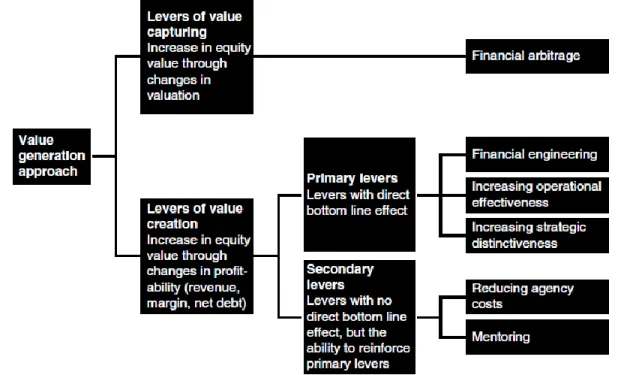
and “secondary levers”. The primary levers have a direct effect on value generation through improved financial performance and increased cash-flow production. On the other hand, secondary levers which do not have a direct impact on value creation, but these levers add weight to primary levers. There are two secondary levers, namely: reduction of agency costs and mentoring provided by new Equity investors (in the case of Buyouts – the Private Equity firm).
The figure below shows a breakdown of value generation and the different types of primary and secondary levers: 19
Figure 4: Value Creation Framework (Gottschalg & Berg 2005) Sources of Buyout Value Generation
According to Gottschalg & Berg (2005), the third dimension of different types of value generation can be “distinguished according to the degree to which they depend on specific characteristics of the Equity investors involved in the buyout.” 20 This dimension
can be represented by two opposing ends. On the one hand, would be cases of value
19 Pg.13 (Gottschalg & Berg, 2005) 20 Pg.13 (Gottschalg & Berg, 2005)
26
generation that cannot in the slightest be attributed to the actions or initiatives taken by the Equity investors in an LBO context. This type of value generation is termed “intrinsic value generation” by Gottschalg & Berg (2005), implying that this form of improvement in the portfolio company comes with no influence from the Private Equity firm. As opposed to this, we have what Gottschalg & Berg (2005) call “extrinsic value generation”. This refers to situations where value generation is a result of “specific expertise of the equity investors” which leads to “improvements in the financial performance of the portfolio company that would not have been possible with the skills previously available at the portfolio company itself”. 21
c. Gottschalg & Berg (2005): Levers of Value Generation in Buyouts
After illustrating the various dimensions of value generation in LBOs, Gottschalg & Berg (2005) move on to describing the multiple levers of value generation and allocate these to the specific dimensions highlighted earlier.
Lever of “value capturing”: Financial Arbitrage
As discussed in the previous section, value capturing is a result of financial arbitrage where “the ability to generate returns from differences in the valuation applied to a company between acquisition and divestment independent of changes in the underlying financial performance of the business” (“buy low – sell high” strategy). 22 Financial
arbitrage stems from four factors:
- Market valuation multiples for comparable companies:
The valuation multiples can be affected by the exogenous effect of change in public markets valuation multiples. This would depend on how correlated the valuation of the portfolio company is to changes in overall public market sentiment. Practitioners often refer to this type of financial arbitrage as “multiple riding”. This value capturing lever
21 Pg.13 (Gottschalg & Berg, 2005) 22 Pg.14 (Gottschalg & Berg, 2005)
27
does not affect the performance of the underlying business, is extrinsic to the company as it depends on the ability of the Private Equity firm to “time the market”, and it is determined during the acquisition and/or divestment phase of the investment process. - Private Information
It has been argued by DeAngelo (1986) and Jensen (1989a) that the management team of a buyout target company can take advantage of insider information in MBO situations, i.e. where the management team also invests an equity stake in the LBO transaction. According to DeAngelo (1986), Hite & Vetsuypens (1989) and Lowenstein (1985), in certain situations, the incumbent management team could manipulate forecasted earnings of the company to invest in the equity of the company at a lower purchase price. In such a scenario, the management team uses the inside information it has about the underlying company to its benefit and to the detriment of other shareholders of the company who do not have access to this information, are not participating in the LBO, and therefore, end up receiving a lower price for their Equity stake. According to Lee (1992), insider information is a crucial reason for the initiation of MBO (LBOs led by management teams in partnerships with Buyout funds).
- Varying expectations of future business and/or industry performance
According to Andres (1992), given the exposure Private Equity firms have with a wide variety of companies and management teams, they can build strong industry expertise. Fox & Marcus (1992) build on this and argue that this industry expertise allows Private Equity firms access to in-depth market information and increases their ability to interpret this information effectively. This can be a source of competitive advantage compared to other participants in the market when it comes to acquiring and/or divesting portfolio companies.
- Negotiation process during acquisition and divestment
According to Baker & Smith (1998) and Wright & Robbie (1996), financial arbitrage can be a result of the Private Equity firm have superior “deal-making” abilities which mainly
28
manifest during the acquisition and divestment phase of the LBO transaction. One source of such distinguished deal-making ability can be what practitioners call “proprietary deal-flow”. This is when a Private Equity firm bids on target companies with very little competition due to its differentiated sourcing efforts. Anders (1992) states that well-established Private Equity firms conduct regular market reviews and keep on top of any market developments. This, in turn, allows them to develop significant relationships with a critical network of potential target companies, which can result in privileged access to future transaction opportunities. This privileged access means that the acquisition price would be lower than if the Private Equity firm had to compete with other financial sponsors in a competitive bidding process. In addition to this, Private Equity firms can leverage this network to increase the divestment value of portfolio companies by identifying the most suitable strategic buyer. Finally, according to Butler (2001), the negotiation skills of buyout firms have a significant impact on the acquisition and divestment price of portfolio companies.
Levers of “value creation”
After having evaluated financial arbitrage as the driver behind “value capturing”, we move on to discussing the various levers that effect “value creation”. As a reminder, unlike financial arbitrage, levers of value creation are related to the improved business performance of the underlying portfolio companies. We will divide these levers into primary and secondary levers and start our discussion with the former.
Primary Levers Financial Engineering:
Financial engineering involves optimizing the capital structure of the underlying portfolio company and minimizing the post-tax cost of capital for the company. According to Anders (1992), the buyout firm’s financial engineering skills assist in optimizing the capital structure of the underlying portfolio company. In addition to financial engineering skills, buyouts firms typically have close relations with debt and
29
equity financing providers, and they enable the portfolio company to get access to financing at favourable terms. In addition to this, the increased leverage in buyout transactions results in a significant reduction in corporate tax and a drop in the post-tax cost of debt for the portfolio company. This is because the increase in debt results in a higher tax-deductible interest expense and provides a “tax shield”, increasing overall cash flows (Kaplan 1989a and Singh 1990).
However, it is essential to note that many researchers point out that the cost of capital is independent of the fact that a significant amount of debt is used to fund an LBO transaction. This is because in most situations, the tax shield offered by debt is offset by the higher cost of debt due to the higher risk of default as leverage increases. Rappaport (1992: 102) argues: “borrowing per se creates no value other than tax benefits. Value comes from the operational efficiencies debt inspires.” Finally, according to Baker and Smith (1998), as the buyout industry becomes crowded and the overall market matures, buyout firms are forced to increase the value of their portfolio companies with means other than financial engineering.
Increasing Operational Effectiveness:
Initiatives are taken by Private Equity firms to improve operational effectiveness. Such efforts typically aim at increasing the earnings margin and/or increasing the cash flow generated by the underlying portfolio company. These initiatives do not aim at altering the strategic positioning of the company; rather the focus in these steps is to recalibrate the existing resources and processes within the portfolio company. The two broad ways in which operational effectiveness is increased include reduction of costs and improving margins, and reducing the capital expenditure and working capital while removing managerial inefficiencies.
With regards to cost cutting and margin improvements, buyout firms immediately tighten corporate expense and try to find areas where cost improvements are feasible (Anders, 1992 & Kaplan 1989a). Typical cost-cutting initiatives include outsourcing
30
production overseas and take advantage of cheaper labour in developing countries and endeavouring to reduce corporate overheads by making the organizational structure less bureaucratic (Butler, 2001).
Apart from cost cutting measures, buyout firms try to reduce the amount of capital expenditure and working capital that is required to run the portfolio company. Typically working capital is the first area that is aggressively rationalized and more professional management of inventories and accounts receivables is brought to the table by the Private equity firm. During their research, Holthausen & Larcker (1996) discovered that portfolio companies of buyout firms typically have a lower amount of working capital requirements compared with their industry peers. From a capital expenditure standpoint, buyout firms usually disallow any investment programs that do not return a positive NPV and sell underused or unnecessary assets resulting in additional cash flow available to pay down debt. The buyout firm makes these cuts in capital expenditure while keeping in mind that such cuts should not affect the portfolio company’s ability to compete in the industry.
Finally, Anders (1992) illustrates that a critical role of buyouts in improving operational efficiencies in a company involves changing inefficient management teams. Jensen & Ruback (1983) propose that buyout firms are a vital vehicle in identifying companies that are underperforming due to an incompetent management team, and changing these management teams to “remove the cause of underperformance”.
Increasing Strategic Distinctiveness:
In addition to improving the portfolio company’s operations, the buyout firm can reconfigure the strategic direction of the company. This often involves decisions about entering new markets, launching new products, altering distribution channels and changing the marketing mix. As opposed to operational changes, which reallocate the company’s existing resources, a strategic change would result in “a substantial change in
31
the resource base of the company”. 23 According to Seth & Easterwood (1993), buyout
funds focus on reducing the overall complexity of their portfolio companies by removing activities that do not add to the core competitive advantage of the company. Moreover, further resources are only injected into initiatives that aim at improving or reinforcing the company’s main strategic position.
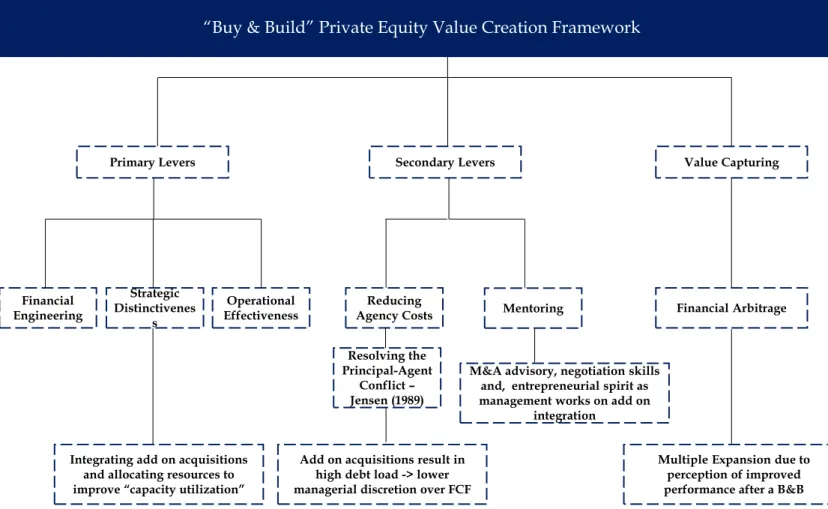
However, the changes in strategic direction that buyout funds encourage are not exclusively focused on downsizing peripheral activities. There is an increased focus on improving the growth of portfolio companies. As Butler (2001) argues, successful exits of LBOs that include a sale to a strategic buyer or an IPO requires that there be a significant potential for growth in the underlying company. Buyout firms improve the growth potential of their portfolio companies through internal growth initiatives such as launching new products, expanding to new geographies, and targeting unexplored customer niches. In addition to this, buyout firms pursue inorganic growth strategies for their portfolio companies where a “Buy & Build” approach seeks external growth through acquisitions of other smaller companies that provide access to new markets, improve resource efficiency and offer distinct competitive advantages such as access to unique distribution channels.
Secondary Levers
Secondary levers have an indirect effect on value creation and they influence financial performance through the primary levers. The two broad categories of secondary levers are: “reduction of agency costs” and “mentoring”.
Reducing agency costs
The reduction of agency costs in buyout scenarios has an indirect effect on the financial performance of the company as it facilitates the primary levers of value creation. According to research by Opler & Titman (1993), agency costs are an essential factor in leveraged buyout transactions. According to Gottschalg & Berg (2005), reduction of
32
agency costs has three major dimensions: reduction of agency costs of free cash flow, improving incentive alignment, and improving monitoring and controlling.
Leveraged buyouts can reduce agency costs of free cash flow by the use of significant amounts of debt to fund the transaction and thereby to limit the degree of discretion that management has with regards to the use of free cash flow. According to Jensen (1986), the “discipline of debt” forces managers to generate enough free cash flow to service interest and repayment schedules and discourages them from investing cash in value-destructive projects. In addition to this, managers are incentivized to ensure high free cash flow generation because if the debt is not serviced, the probability of bankruptcy increases, which can have significant reputational costs for management. Another effect of high leverage is that it involves financial lenders who have a substantial stake in monitoring the decisions made by management, and also, the maintenance covenants enforced by lenders keep a check on management. According to Thompson et al. (1992), debt providers have an advantage in monitoring companies due to the expertise lenders build up throughout their lending history.
Moving on, according to Cotter & Peck (2001) and Jensen (1986), buyout transactions improve the alignment of incentives between management and the Private Equity firm through a “carrot and stick” approach. Private Equity firms incentivize managers by offering them to significantly increase management’s stake in the company’s equity (the “carrot”), thereby increasing the “personal cost of inefficiency” 24 for the management
team. Also, according to Jensen and Meckling (1976), by participating the equity of the company, management is incentivized to take value-increasing decisions regarding operations and investments as an increase in the Equity value of the firm results in a direct gain for the management team. Apart from these “positive” incentives for the management teams of portfolio companies, the fact that management has a significant equity stake in the company means that they have a large amount of “un-diversifiable” risk that acts as “the stick” and incentivizes managers to work towards increasing the
33
Equity value of the company. In addition to increasing management’s equity ownership, Private equity firms also incentivize management through favourable pay-packages that are linked tightly to performance. Wright et al. (1994b) conducted empirical research which illustrated that management incentives were negatively correlated with failed MBOs.
In the end, LBO transactions by Private equity firms alter the governance dynamics of portfolio companies in a manner that makes it easier to monitor and control the company’s management, thereby, reducing the agency conflict. The governance structure improves because a large proportion of the company’s equity is concentrated in the hands of the Private Equity firm, which is an active investor and ensures a significant representation on the Board of the portfolio company. Also, professionals working in Private Equity funds are likely to have an advantage over passive equity investors in controlling and monitoring the decisions made by the management teams of portfolio companies. Since these Private Equity professionals are likely to have experienced numerous LBO investments in the past, their ability to monitor management teams is highly developed.
To sum up, the reduction of the agency conflict through the effects mentioned above is instrumental in enabling the success of the primary levers of value generation in LBO transactions. The determinants mentioned above reduce the inefficiencies caused by agency problems and incentivize management to take steps that improve the operational and strategic direction of the business and maximize its value. The various factors that reduce agency costs can be deemed secondary levers of value generation. These levers are primarily put in place during the initial acquisition phase.
Mentoring
Gottschalg & Berg (2005) define mentoring as “a particular form of parenting advantage”. Moreover, Goold et al. (1994) deem mentoring to be comparable to the effect that being a constituent division of a large conglomerate has. Gottschalg & Berg (2005) breakdown
34
mentoring into two components: “restoring an entrepreneurial spirit” and “advising and enabling portfolio companies”.
To start with, LBO transactions often involve the acquisition of “non-core” divisions of large conglomerate companies that have been the victim of significant inattention by the parent company. As a result, these companies have abandoned the pursuit of innovative strategies and develop risk-averse cultures in which entrepreneurial drive is stifled. Private Equity firms undertake a variety of initiatives to restore the entrepreneurial drive in the management teams of portfolio companies. Buyout funds closely liaise with management teams and encourage them to come up with innovative ideas that improve operational efficiencies. Moreover, the leaner governance structure and improved communication with investors in post LBO scenarios allow management teams to escape the highly bureaucratic structure of large corporations, and this makes it easy for them to implement their initiatives. Researchers such as Beaver (2001), Houlden (1990) and Samdani et al. (2001) describe this changed mindset of management teams as “LBO fever” or “adrenalin” which makes management highly willing to take any steps required to making the LBO a success.
IV. Measuring Value Creation
In this section, we shall define the various ways in which we can measure the amount of value creation in an LBO context. Moreover, we shall categorize different measures of value creation based on which stakeholders are being referred to. In terms of structure, we will begin by defining the traditional measures of value creation for the entire firm, after which we will look at value creation from the equity holders’ point of view (mainly the Private Equity firm). Finally, we will analyze value creation from the debt holders’ perspective.
Value Creation for the entire Firm
We will start off by elaborating on the traditional methods of measuring value creation for the entire firm.
35
ROCE - WACC
The spread between a firm’s “Return on Capital Employed” (ROCE) and the cost of capital for the firm is the traditional method of analyzing value creation form the point of view of all investors (Equity and Debt) for the firm. Moreover, this method of looking at value creation is academically sound.
The cost of capital is typically defined as the “Weighted Average Cost of Capital” (WACC). The principle foundation of corporate finance states that a project or firm can only create value if its return on invested capital is greater than its cost of capital. In cases where this return is lower than the cost of capital (ROCE < WACC), value is actually destroyed. The breakdown of ROCE and WACC is illustrated in the formulae below: 𝑅𝑂𝐶𝐸 = 𝑁𝑂𝑃𝐴𝑇 𝐶𝑎𝑝𝑖𝑡𝑎𝑙 𝐸𝑚𝑝𝑙𝑜𝑦𝑒𝑑
𝑁𝑂𝑃𝐴𝑇 = 𝐸𝐵𝐼𝑇 × (1 − 𝐸𝑓𝑓𝑒𝑐𝑡𝑖𝑣𝑒 𝑇𝑎𝑥 𝑅𝑎𝑡𝑒)
𝐶𝑎𝑝𝑖𝑡𝑎𝑙 𝐸𝑚𝑝𝑙𝑜𝑦𝑒𝑑 = 𝐹𝑖𝑥𝑒𝑑 𝐴𝑠𝑠𝑒𝑡𝑠 + 𝑊𝑜𝑟𝑘𝑖𝑛𝑔 𝐶𝑎𝑝𝑖𝑡𝑎𝑙 𝑅𝑒𝑞𝑢𝑖𝑟𝑒𝑚𝑒𝑛𝑡𝑠 (𝑊𝐶𝑅)𝑊𝐴𝐶𝐶 = 𝐶𝑂𝐸 ×
𝐸
𝐷 + 𝐸
+ 𝐶𝑂𝐷 × (1 − 𝐸𝑓𝑓𝑒𝑐𝑡𝑖𝑣𝑒 𝑇𝑎𝑥 𝑅𝑎𝑡𝑒) ×
𝐷
𝐷 + 𝐸
We now move on to defining some of the key variables mentioned in the breakdown above:
- COE: This refers to the firm’s “Cost of Equity”, which represents the required return for Equity holders given the riskiness of the firm’s cash flows. Practitioners calculate the Cost of Equity by using the CAPM model: 𝐶𝑜𝑠𝑡 𝑜𝑓 𝐸𝑞𝑢𝑖𝑡𝑦 = 𝑟𝑓+ 𝛽 × (𝑟𝑚− 𝑟𝑓). In this equation, the 𝑟𝑓 refers to the risk-free rate in the wider economy the business operates in. Typically analysts use the yield on 10-y government bonds as a proxy for this metric. Moreover, β (“Beta”) is a measure of the volatility of a stock and is used as a proxy to measure the inherent riskiness of a firm compared to the riskiness of the overall market.
36
Finally, (𝑟𝑚− 𝑟𝑓) refers to the “market risk premium” which is defined as the excess return investors can achieve by investing in equities vs risk-free bonds.
- COD: This refers to the firm’s “Cost of Debt”, which represents the required rate of return that Debt holders expect when lending funds to the business. This is usually determined by looking at comparable debt issuances (in terms of credit rating) and using their yield as a proxy for the firm’s cost of debt.
- E and D: These respectively refer to the “economic values” of Equity and Debt of the firm.
Limitations of ROCE – WACC
There are a number of limitations and things to keep in mind when looking at these measures of value creation for the firm. To start with, since ROCE is an accounting figure, management teams of firms can artificially increase this metric. There are numerous ways in which this can be done:
- Decreasing Capital Employed through off-balance sheet financing which would automatically boost ROCE.
- Temporarily reducing tax expense and D&A through “creative accounting” would also increase the NOPAT and thereby increase ROCE.
In order to account for the probability of “managed earnings” figures, it is important to look at the evolution of ROCE over time and be diligent about the firm’s accounting practices and if these have significantly changed at some point.
Breaking down the ROCE
Assuming that WACC is held constant, value creation becomes a function of increases in the ROCE. We now attempt to illustrate a breakdown of the various drivers that can potentially increase ROCE.
37
To start with, we can break down the Capital Employed portion of the ROCE formula into Fixed Assets and WCR. To analyze Fixed Assets, one can examine the evolution of a firm’s CAPEX spending (as a % of Revenue). Moreover, CAPEX can be further broken down into “Maintenance CAPEX” and “Growth CAPEX”. As discussed earlier, Private Equity firms reduce the capital requirements of their portfolio companies, divest fixed assets which are not considered to be essential to maintaining or improving the core competitive advantage of the firm, and only engage in CAPEX spending for positive NPV projects. As a result of these initiatives, Fixed Assets are reduced and/or earnings are increased with the same proportion of Fixed Assets, thereby boosting ROCE. In addition to this, Working Capital Requirements are driven by “Days of Turnover”, “Days of Payables”, and “Days of Receivables”. Private Equity firms liaise with the management teams of their portfolio companies in order to renegotiate customer and supplier contracts, and improve production and inventory efficiency in order to reduce the amount of capital required for the firm’s working capital cycle. This also increases ROCE as the Capital Employed decreases while the earnings are maintained.
After having analyzed the Capital Employed part of the ROCE formula, we can now breakdown the profitability numerator. In this case, we can separate the effects of revenue growth and cost reduction. From the revenue perspective, we can further categorize revenue growth into organic and inorganic (through M&A) growth. This allows us to identify the extent to which a “Buy-and-Build” strategy was effectively used by the Private Equity firm to grow the revenues of its portfolio company. From a cost perspective, we can split costs into fixed and variable costs and analyze how the operational improvements initiated by the Private Equity firm reduce the cost structure of the firm.
38
Value Creation for the Equity holders of the firm ROE - COE
From the point of view of the Equity holders of a firm, value is created when the Return on Equity is higher than the Cost of Equity (the return that shareholders require given the riskiness of the firm’s cash flows). Therefore, value creation for Equity holders can be measured by computing the spread between the Cost of Equity (calculated using CAPM) and the Return on Equity. The breakdown of Return on Equity (ROE) is given below:
𝑅𝑂𝐸 =
𝑁𝑒𝑡 𝑃𝑟𝑜𝑓𝑖𝑡
𝑇𝑜𝑡𝑎𝑙 𝐸𝑞𝑢𝑖𝑡𝑦
Moreover, the equation below illustrates the relationship between ROCE and ROE. As can be observed from this equation, the leverage effect boosts ROE for the same level of ROCE given that ROCE is higher than After-Tax Cost of Debt.
𝑅𝑂𝐸 = 𝑅𝑂𝐶𝐸 +
𝐷
𝐸
× (𝑅𝑂𝐶𝐸 − 𝑃𝑜𝑠𝑡 − 𝑇𝑎𝑥 𝐶𝑂𝐷)
Methods used by Practitioners: IRR and Cash-on-Cash Multiple
Most Private Equity professionals use the IRR and Cash-on-Cash metrics to analyze the viability of a future LBO transaction (ex-ante), as well as judging the actual performance of the investment post-exit. These metrics differ from the ROE, which is an accounting metric, and are focused on the cash flows relating to the investment.
In terms of definition, the IRR is the rate of return that makes the NPV of the investment equal to zero. On the other hand, the Cash-on-Cash multiple is simply the ratio of total cash inflows/outflows (from the standpoint of the Private Equity fund). It is important to note that, unlike the IRR, the Cash-on-Cash multiple does not take into account the effect of the “time value of money”. As a result of this, the Cash-on-Cash multiple will not be used as an evaluation tool for value creation.
39
In addition to this, the IRR metric is unsuitable for measuring value creation due to the following reasons:
- IRR ignores the Cost of Capital
- It is not possible to use the IRR as a metric to compare projects that have different durations
- IRR can give conflicting results when compared with the NPV analysis
- The IRR has a built-in assumption regarding the discount rate for the transaction being evaluated. However, in LBO scenarios, it is more accurate to calculate the spread between ROE and COE to determine a time-varying discount rate.
Despite the shortfalls of the IRR and Cash-on-Cash multiple, practitioners still use these metrics to evaluate investments because:
- These metrics are used throughout the industry and are used by Private Equity firms when they attempt to raise capital from investors for new funds. Also, the hurdle rate agreed with fund LPs is based on the IRR.
- The IRR is a useful tool to evaluate cash-flow generation in the context of a particular LBO investment. Moreover, the IRR can be decomposed and it can reveal the specific sources of cash-flow generation, allowing for a more detailed analysis of an LBO transaction.
Breaking down the IRR
The “Traditional Method” was posited by Engel (2011) and involves breaking down the IRR into three distinct effects: leverage effect operational improvement effect (further decomposed into FCF and EBITDA Enhancement Effect), and EBITDA multiple effect. - Leverage Effect: Acharya & Kehoe (2009) propose the following equation to distinguish between levered and unlevered IRR and isolate the effect that leverage has on the IRR of an LBO transaction.