HAL Id: hal-01636965
https://hal.archives-ouvertes.fr/hal-01636965
Submitted on 22 Nov 2017
HAL is a multi-disciplinary open access
archive for the deposit and dissemination of
sci-entific research documents, whether they are
pub-lished or not. The documents may come from
teaching and research institutions in France or
L’archive ouverte pluridisciplinaire HAL, est
destinée au dépôt et à la diffusion de documents
scientifiques de niveau recherche, publiés ou non,
émanant des établissements d’enseignement et de
recherche français ou étrangers, des laboratoires
Budget Allocation in Binary Opinion Dynamics
Susana Rey, Patricio Reyes, Alonso Silva
To cite this version:
Susana Rey, Patricio Reyes, Alonso Silva. Budget Allocation in Binary Opinion Dynamics. 3rd Spring
School on Networks co-located with (ChileCON 2017), Oct 2017, Pucon, Chile. �hal-01636965�
Budget Allocation in Binary Opinion Dynamics
Susana Iglesias Rey
∗1, Patricio Reyes
†2, and Alonso Silva
‡11
Nokia Bell Labs, Nokia Paris-Saclay, Route de Villejust, 91620 Nozay, France
2Technological Institute for Industrial Mathematics (ITMATI), University of Santiago de
Compostela, Santiago de Compostela, Spain
Abstract
In this article we study the allocation of a budget to promote an opinion in a group of agents. We assume that their opinion dynamics are based on the well-known voter model. We are interested in finding the most efficient use of a budget over time in order to manipulate a social network. We address the prob-lem using the theory of discounted Markov decision processes. Our contributions can be summarized as follows: (i) we introduce the discounted Markov de-cision process in our cases, (ii) we present the corre-sponding Bellman equations, and, (iii) we solve the Bellman equations via backward programming. This work is a step towards providing a solid formulation of the budget allocation in social networks.
1
Introduction
During the last decades a lot of research effort has been devoted to model the underlying process of opin-ion formatopin-ion of agents that interact through a social network. In this respect, DeGroot’s [1] or Friedkin-Johnsen’s [2] models are classic references. Another classic model is the voter model [3, 4] which consid-ers that each agent holds a binary opinion, 0 or 1,
∗Email: susana.iglesias [email protected] †Email: [email protected]
‡Email: [email protected] To whom
corre-spondence should be addressed.
and at each time step, each agent chooses one of its neighbors at random and adopts that opinion as its own. Other works, based on the voter model, in-corporate stubborn agents [5], and biased agents [6]. Moreover, the last few years there has been an in-creasing literature about manipulation of opinion in social networks [7, 8, 9].
In this work, we are interested in finding the most efficient use over time of a budget in order to ma-nipulate a social network. The idea is to promote an opinion by paying agents to supplant their true opinions. We model opinions as two values, 0 or 1, with 1 (0) representing supportive (non-supportive) opinion.
We frame the problem of designing sequential pay-ment strategies as a discounted Markov decision pro-cess (DMDP). DMDPs have been widely used to for-mulate many decision making problems in science and engineering (see, e.g., [10, 11, 12]). One of the main applications of DMDP models is the compu-tation of optimal decisions (i.e., actions) over time to maximize the expected reward (analogously, min-imize the expected cost).
First of all, we focus on a fully connected network where agents change their opinion following a voter model. We provide the correspondent Bellman equa-tions to solve this problem and we show through an example how to solve the stated problem in practice. We provide a structural characterization of the asso-ciated value function and the optimal payment
strat-egy. Then, we compute the optimal payment using dynamic backward programing.
2
Model definition
In order to find the optimal budget allocation on bi-nary opinion dynamics, we make extensive use of the theory of DMDPs. First, we adopt the voter model of opinion formation over a social network. Then, we define the DMDP and the corresponding Bellman equations to obtain the optimal strategy of budget allocation.
Consider an undirected social network G = (I, E), where I stands for the set of agents, indexed from 1 to n, and E ⊆ I × I is the set of edges. Each agent i∈ I has a binary initial opinion. Opinions take val-ues 0 or 1. If agent i has opinion 0 (analogously, 1) we label it as non-supporter (supporter ). For exam-ple, if agents are discussing about politics, 1 could be supporting a particular party and 0 not supporting it.
Moreover, we distinguish two cases, depending on whether the network is fully connected or not.
We start by studying the fully connected case. In each decision epoch, agents update their opinions fol-lowing a voter model sensitive to external payments. Let β ∈[0,1) be the discount factor, which represents the loss of reward in the future with respect to the current reward. A discounted Markov decision pro-cess (DMDP) is a 5-tuple(S,AS,P, R, β), where S is
a finite set of states, AS is a finite set of actions, P
is the set of transition probabilities and R is the set of rewards.
Therefore, the model is defined as follows:
1. Decision epochs: the set of decision epochs is defined as t = 1, 2, . . . , T . We consider a finite discrete-time system. At each decision epoch t we observe the state s and choose an action a. 2. States: the state space S of the DMDP consists
on the possible number of supporters, s ∈ N, s=∣{i ∈ I ∣ i is a supporter}∣.
3. Actions: the action space As is the set of
ac-tions available in state s (without loss of general-ity, actions are state independent). We consider that the actions a ∈ N are the possible number
of payments, a =∣{i ∈ I ∣ i receives a payment}∣, where the non-supporter agents have a cost cN S
for changing their opinion from non-supporter to supporter, and the supporter agents, a cost cS to hold their supporter opinion. We assume
that the cost of changing their opinion is higher than the cost of holding it, i.e., cN S > cS. We
consider a finite budget b. Notice that, because the actions are constrained by the budget, they are stationary.
4. Transition probabilities: if the DMDP in de-cision epoch t is at state s1, the probability
that it transitions to state s2 taking action a
is denoted pt(s1, s2, a). Due to the natural
in-dependence of agents transitions, we compute those probabilities as the product of the tran-sition probabilities of the agents. The evolution of one agent i ∈ I will be described by the voter model. Starting from any arbitrary initial labels, supporter (S) or non-supporter (NS), we con-sider two labeling functions fS(i) and fN S(i),
where fS(i) = 1 (fN S(i) = 1) means that agent
i is a supporter (non-supporter). At each de-cision epoch t, each node selects uniformly at random one of its neighbors opinion. For each node j ∈ I, the set of its neighbors is defined as N(j) = {k ∈ I ∣ {j,k} ∈ E}. Therefore, we define for one i ∈ I with zero-payment in decision epoch tthe labeling functions,
fSt+1(i) =⎧⎪⎪⎨⎪⎪ ⎩
1 with prob. ∣{j∈N (i)∣f
t S(j)=1}∣
∣N (i)∣ ,
0 with prob. ∣{j∈N (i)∣f
t S(j)=0}∣
∣N (i)∣ ,
fN St+1(i) = 1 − fSt+1(i)
Analogously, for one agent k ∈ I that receives a payment in decision epoch t we define:
fSt+1(k) =⎧⎪⎪⎨⎪⎪
⎩
1 with prob. 1, 0 with prob. 0, fN St+1(k) = 1 − fSt+1(k)
As we said, we assume that the graph is fully connected, therefore each agent can com-municate with every other agent. We de-note the set of non-supporter agents that
receive a payment as L = {i ∈ I ∣ non-supporter & receives a payment} and its cardinality as ℓ = ∣L∣. Respectively, the set of supporter agents that receive a payment as K = {i ∈ I ∣ supporter & receives a payment} and its cardinality as k =∣K∣. Notice that a = ℓ + k. Therefore the transition probabilities pt(s1, s2, a) can be computed as:
● If a > s2 then pt(s1, s2, a) = 0. ● If a < s2 then pt(s1, s2, a) = min{s1−k,s2−ℓ} ∑ i=max{0,s2−(n−s1)−k} (s1− k i ) ( s1 n) i (n− s1 n ) s1−k−i ⋅( n − s 1− ℓ s2− i −(ℓ + k)) ⋅(n − s 1 n ) n−s1−s2+i+k (s1 n) s2−i−(ℓ+k)
5. Reward: the instant reward in time t and state sis defined as rt(s) = ∑i∈Ig ⋅ s, where g denotes
the reward provided by one agent.
Let υβ be the value function of the above DMDP,
i.e., it is the supreme, over all possible budget alloca-tion strategies, of the expectaalloca-tion of the discounted reward starting from an initial budget b. Under these assumptions, the Bellman equations for all s ∈ S and initial budget b are:
υβ(s,b) = max a=ℓ+k∈AS, (ℓ⋅cN S+k⋅cS)≤b E ∞ ∑ t=0 βtrt(s) = max a=ℓ+k∈AS, (ℓ⋅cN S+k⋅cS)≤b {r0(s) + ∑ s′∈S βp1(s,s ′ , a) ⋅ υβ(s′, b − ℓ ⋅ cN S− k ⋅ cS+ r0(s))},
where the budget evolves as
b(t + 1) = b(t) + rt(s) − ℓ ⋅ cN S− k ⋅ cS.
Next, we present the second case where in each de-cision epoch agents update their opinions following a voter model in a network (not necessarily fully con-nected) that can be affected by external payments. As before, we design this problem as a DMDP where the set of actions are the possible external payments.
Therefore, let β ∈[0,1) be the discount factor, we consider, by a slight abuse of notation, the 5-tuple (S,AS,P, R, β) as before. Concretely, the elements
changed from the previous model:
1. Decision epochs: the set of decision epochs is defined as t = 1, 2, . . . , T .
2. States: the state space S of the DMDP, con-sists on all possible combinations of agents’ la-bels, non-supporter (0) or supporter (1), i.e., s∈{0,1}n.
3. Actions: the action space Asis the set of actions
available in state s (without loss of generality, ac-tions are state independent). An action means whether or not we give a payment to each of the agents, a ∈ {0,1}n, where a 0 (respectively 1)
in position i means we give no payment (pay-ment) to agent i ∈ I. We also define a vector of costs c ∈ Rn
+ whose element ci > 0 is the cost
of changing by one unit the opinion of agent i, in case agent i is non-supporter, or the cost of holding the opinion of agent i, in case agent i is a supporter.
4. Transition probabilities: as before, if the DMDP in decision epoch t is at state s1, the probability
that it transitions to state s2 taking action a is
expressed as pt(s1, s2, a) and can be computed
as:
● If∣a∣ > ∣s2∣ then pt(s1, s2, a) = 0.
● If∣a∣ < ∣s2∣ then pt(s1, s2, a) is equal to n
∏
i=1
I{ si= s′i}[I{si= supp}∣{j∈ N(i)/f
t S(j) = 1}∣ ∣N(i)∣ + I{si= non-supp}∣{ j∈ N(i)/ft N S(j) = 1}∣ ∣N(i)∣ ] + I{si≠ s′i}[I{si= supp∣{ j∈ N(i)/fSt(j) = 0}∣ ∣N(i)∣ + I{si= non-supp}∣{ j∈ N(i)/fN St (j) = 0}∣ ∣N(i)∣ ].
5. Reward: the instant reward in time t and state sis defined as rt(s) = gT⋅ s, where g is the vector of rewards whose element gi is the reward that
agent i ∈ I provides.
Let υβ be the value function of the above DMDP,
i.e., it is the supreme, over all possible budget alloca-tions strategies, of the expectation of the discounted reward starting from an initial budget b. Under these
assumptions the Bellman equations for all s ∈ S and initial budget b are:
υβ(s,b) = max a∈AS, cT⋅a≤b E ∞ ∑ t=0 βtrt(s) = maxa∈A S, cT⋅a≤b {r0(s) + ∑ s′∈S βp1(s,s′, a)υβ(s′, b − cT⋅ a + r0(s))},
where the budget evolves as b(t + 1) = b(t) − cT
⋅ a + R(st) and cT denotes the transpose of vector c.
3
Simulation results
We suppose that after a time T we will not obtain rewards for the supporter agents, so we are interested in the distribution of the DMDP in the time interval [0,T ]. We consider an undirected, fully connected social network G =(I,E) with n = 7 agents that form opinions with a voter model. In time t = 0, we assign at random an initial label to each agent. Solving the Bellman (fixed point) equations, given the model and the set of states and feasible actions, gives us the best strategy for each state to follow in the time interval. We take T = 6, β = 0.8, cN S= 10, cS = 5, B = 30 and
g= 8.
Some conclusions can be drawn from the simula-tions. The optimal payment strategy is to invest all our budget paying to the higher number of agents at time t = 0. Obviously, if all the network is non-supporter (respectively non-supporter), the budget will be allocated to change opinions (to hold opinions). However, the distribution of the budget differs for the rest of possible initial states as we show on Table 1.
Initial state Budget Allocation Payments to NS Payments to S s= 1 2 1 s= 2 2 2 s= 3 1 3 s= 4 1 4 s= 5 0 5 s= 6 0 6
Table 1: Budget allocation over the states.
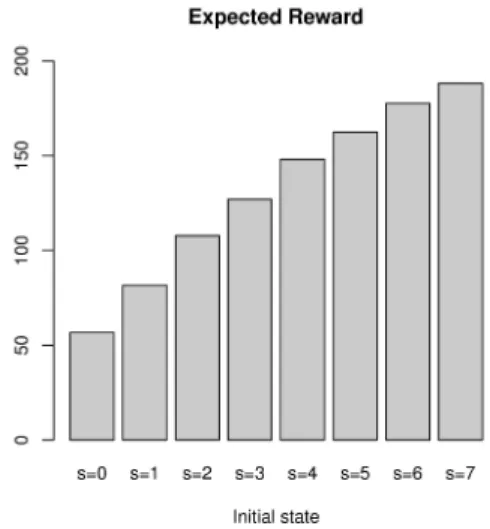
Given the budget allocation at time t = 0, we show in Figure 1 the expected reward obtained at time T for each state s ∈ S.
Figure 1: Expected reward at time T .
4
Conclusions
In this work, we have introduced the problem of budget allocation over time to manipulate a social network. We have developed a formulation of the discounted Markov decision process as well as the corresponding Bellman equations for the voter model of opinion formation. Using backward programming, we have obtained the optimal payment strategy for a small example of agents interacting trough a fully connected network. Many questions still remain to be answered. Future work would be devoted to improve the performance of our simulations in order to obtain the optimal strategy for larger networks and different topologies. Moreover, we intend to construct the DMDP model and the Bellman equa-tions for different models of opinion dynamics. This will lead to the mathematical characterization of the optimal policy for different network structures and opinion formation models. It will lead also to the
characterization of the most important agents (the agents with highest benefit-cost ratio) which should be related with its centrality as shown in previous results [9, 7].
Acknowledgements
The work of A. Silva and S. Iglesias Rey was partially carried out at LINCS (www.lincs.fr).
References
[1] M. H. Degroot, “Reaching a consensus,” Journal of the American Statistical Association, vol. 69, no. 345, pp. 118–121, 1974.
[2] N. E. Friedkin and E. C. Johnsen, “Social influ-ence networks and opinion change,” Advances in Group Processes, vol. 16, pp. 1–29, 1999. [3] P. Clifford and A. Sudbury, “A model for spatial
conflict,” Biometrika, vol. 60, no. 3, pp. 581–588, 1973.
[4] R. A. Holley and T. M. Liggett, “Ergodic theo-rems for weakly interacting infinite systems and the voter model,” The Annals of Probability, vol. 3, no. 4, pp. 643–663, 1975.
[5] E. Yildiz, A. Ozdaglar, D. Acemoglu, A. Saberi, and A. Scaglione, “Binary opinion dynamics with stubborn agents,” ACM Trans. Econ. Com-put., vol. 1, pp. 19:1–19:30, Dec. 2013.
[6] A. Mukhopadhyay, R. R. Mazumdar, and R. Roy, “Binary opinion dynamics with biased agents and agents with different degrees of stub-bornness,” in 2016 28th International Teletraffic Congress (ITC 28), vol. 1, pp. 261–269, Sept. 2016.
[7] S. Dhamal, W. Ben-Ameur, T. Chahed, and E. Altman, “Good versus Evil: A Framework for Optimal Investment Strategies for Compet-ing Camps in a Social Network,” ArXiv e-prints, June 2017, 1706.09297.
[8] M. F¨orster, A. Mauleon, and V. Vannetelbosch, “Trust and manipulation in Social networks,” Sept. 2013. Documents de travail du Centre d’Economie de la Sorbonne 2013.65 - ISSN : 1955-611X.
[9] A. Silva, “Opinion manipulation in social net-works,” in Network Games, Control, and Op-timization: Proceedings of NETGCOOP 2016, Avignon, France (S. Lasaulce, T. Jimenez, and E. Solan, eds.), pp. 187–198, Springer Interna-tional Publishing, 2017.
[10] E. Altman, Applications of Markov Decision Processes in Communication Networks, pp. 489– 536. Boston, MA: Springer US, 2002.
[11] N. Archak, V. Mirrokni, and S. Muthukrishnan, Budget Optimization for Online Campaigns with Positive Carryover Effects, pp. 86–99. Berlin, Heidelberg: Springer Berlin Heidelberg, 2012. [12] C. Boutilier and T. Lu, “Budget allocation
us-ing weakly coupled, constrained markov decision processes,” in Proceedings of the Thirty-Second Conference on Uncertainty in Artificial Intel-ligence, UAI’16, (Arlington, Virginia, United States), pp. 52–61, AUAI Press, 2016.