The Use of Knowledge-Intensive Business Services in SME Manufacturing Firms in Quebec :
Performance Diagnosis and Drivers of Innovation by Sector and Region
ABBREVIATED EDITION
Institut national de la recherche scientifique Centre - Urbanisation Culture Société
March 2012
The Use of Knowledge-Intensive Business Services in SME Manufacturing Firms in Quebec :
Performance Diagnosis and Drivers of Innovation by Sector and Region
ABBREVIATED EDITION
David Doloreux, Ph.D. Telfer School of Management University of Ottawa
Richard Shearmur, Ph.D.
Centre – Urbanisation Culture Société de l’INRS
Available at :
Institut national de la recherche scientifique Centre – Urbanisation Culture Société 385, Sherbrooke East Street
Montréal (Québec) H2X 1E3 Phone : (514) 499-4000 Fax : (514) 499-4065
www.ucs.inrs.ca
ISBN 978-2-89575-284-4
Legal deposit : - Bibliothèque et Archives nationales du Québec, 2012 - Bibliothèque et Archives Canada
Acknowledgements
The authors would like to thank the following persons for their participation or collaboration in this study:
The manufacturing firms in the province of Quebec that participated in the survey on the use of support services for innovation activities;
The partners: Canada Economic Development (CED), the program Regional Development Studies and Jean Laneville;
The member of the research follow-up committee. o Réjean Landry, Professor, University of Laval
Executive summary
Goal of the reportThis report, which has benefited from a financial contribution from Canada Economic Development’s Regional Development Study program, aims to explore the following questions:
To what extent does the use of knowledge-intensive business services (KIBS) contribute to innovation in manufacturing firms?
Do these services act alone or do they interact with each other? Are some services more associated with innovative activities than others?
Do services used differ according to the location of the manufacturing firms in relation to urban areas and major cities?
Are establishments that are located far from their service providers less innovative?
Method
A survey of 804 manufacturing establishments was carried out from April to June 2011 in the province of Quebec. The sample is representative of economic sectors (classified in four large manufacturing sectors) and of central and peripheral locations (classified by presence in urban or rural zones and by distance from major cities). The results of this survey have been compiled, geo-referenced, and analyzed with exploratory techniques (two-way tables, chi-squared distribution) and more advanced techniques (factorial analysis, classification analysis, simple regression analysis, multi-level analysis).
Results
A. Innovation and service utilization
1. There is a clear link between the use of external KIBS and innovation within manufacturing establishments. This link applies to all kinds of innovations (technological innovations involving new products or processes; or management innovations involving new approaches to management or marketing). However, the link is stronger when it comes to technological innovations. In addition, it appears that management innovations often come after technological innovations.
2. Technological innovations are strongly associated with the use of external services at each stage of the value chain, and, more specifically, with knowledge identification services (information on technology and patents) and knowledge validation (patent preparation).
3. Management innovations are strongly associated with management consulting and human resource services. Marketing innovations are strongly associated with the use of commercialization services.
4. In addition, technological innovations are associated with a wide range of services: For this type of innovation, the effect of one service seems to depend on the use of other services.
B. Geography of service utilization
1. There is no spatial variability in service utilization (nor in terms of innovation within the manufacturing establishments). This means that service utilization is as intensive in rural and peripheral regions as it is in metropolitan regions. This result supports MacPherson’s findings (2008), and most likely reflects the use of Internet and other forms of electronic communication.
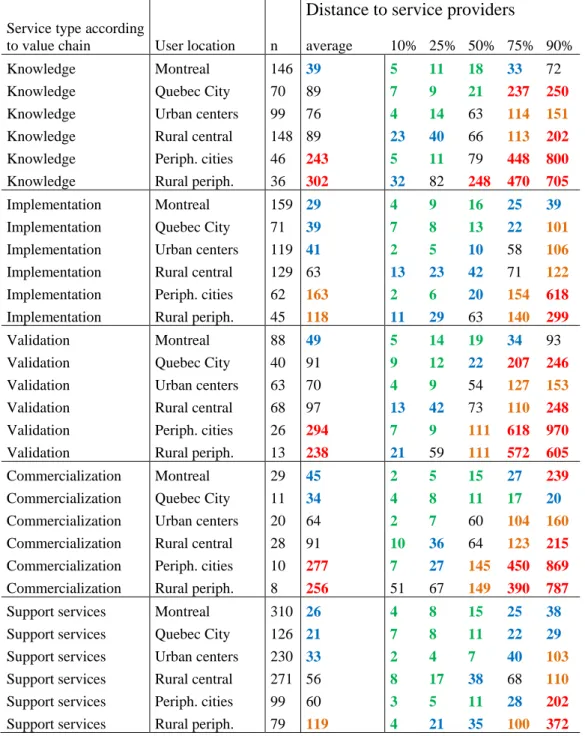
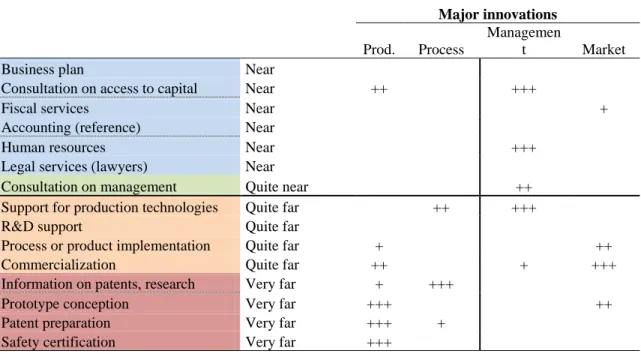
2. On average, the distance between service providers and users is greater for the most strategic services (that is, those most strongly associated with innovation, and also the least frequently used). This is consistent with central place theory, which posits that the most strategic services tend to be located in central areas, and that clients will travel great distances to reach them when necessary.
3. Users who travel the farthest to receive their services are not necessarily the most innovative, nor are the users of local services. In other words, there is no link between innovation and distance to service providers.
4. This last point leads us to the conclusion that users identify the best service providers, regardless of their geographic location within the province of Quebec. They then travel the necessary distance to reach the providers. The greater the distance between users and providers, the greater the importance of electronic communications.
5. In accordance with our previous findings, it is also necessary to highlight that face-to-face contacts with service providers does not increase the propensity to innovate. This leads to the conclusion that once a relation of trust and understanding has been
v
established between service users and providers (generally through initial face-to-face meetings at the users’ site), electronic communications become effective substitutes to routine face-to-face meetings.
C. Conclusions and implications
1. External services are strongly associated with innovation within manufacturing establishments, especially when it comes to technological innovations, and, to a lesser extent, with innovations related to management and marketing.
2. Regarding technological innovations, the use of different services throughout the value chain is strongly linked to innovation.
3. Even if manufacturing establishments in remote regions perceive that barriers inhibit their access to services (distance in particular), this does not appear to have an impact on their effective use of services.
4. Some establishments, especially in remote regions, but also in major cities like Quebec City, are located very far from their service providers. Mobility and physical accessibility between provider and user (in order to allow the first face-to-face meetings) is important.
5. KIBS are not part of territorial innovation systems. The distance between providers and users has no effect on the propensity to innovate. The challenge for innovation policy is to encourage the best possible matching between the needs of service users and the capacity of service providers. The goal is not to ensure a presence of local services.
Table of content
ACKNOWLEDGEMENTS ... III EXECUTIVE SUMMARY ... III LIST OF TABLES ... V
INTRODUCTION ... 1
Background and mandate ... 1
Research method ... 1
Report outline ... 2
SECTION I : LITERATURE REVIEW ... 3
1. SERVICES, INNOVATION, AND REGIONAL DEVELOPMENT ... 3
1.1 Knowledge-intensive business services (KIBS) ... 3
1.1.1 Definition and characteristics ...3
1.1.2 The links between KIBS activities and innovation ...5
1.2 Innovation systems and KIBS ... 6
1.3 Regional economic development and KIBS ... 8
1.4 KIBS utilization and innovation ... 11
1.4.1 The characteristics of businesses ...11
1.4.2 The stages of the innovation process: the value chain ...12
1.4.3 Manufacturing industries and technological regimes ...13
1.4.4 Innovation, services, and regions ...14
2. METHODOLOGY ... 16
2.1 Population and sample ... 16
2.2 Service types ... 16
2.3 Pavitt’s sectoral classification ... 17
2.4 Regional classification ... 18
2.5 Methods of analysis ... 19
SECTION II : EMPIRICAL RESULTS ... 21
3. INNOVATION AND SERVICES ... 21
3.1 Are there links between utilization and innovation? ... 21
3.2 Links between service utilization and manufacturing innovations ... 21
3.2.1 Does the use of many different services lead to more innovation? ...23
3.2.2 Does the use of different service combinations lead to more innovation? ...23
3.2.3 Do particular utilization profiles lead to more innovation? ...23
3.2.4 Does the utilization of certain individual services lead to innovation? ...24
3.4 Do the new observations on the links between services and innovation
really teach us something new? ... 27
3.5 Summary ... 28
4. GEOGRAPHY OF SERVICE UTILIZATION ... 29
4.1 Factors explaining distance between service users and providers ... 32
4.1.1 The effects of user location ... 32
4.1.2 Effects of users’ size ... 32
4.1.3 Other effects ... 32
4.1.4 Different services ... 32
4.2 Do firms located far from service providers innovate more? ... 35
5. DETERMINANTS OF SERVICE UTILIZATION ... 36
5.1 Determinants of service utilization ... 36
5.2 Determinants of frequency of service utilization ... 36
5.3 Determinants of the importance assigned to contact modes ... 38
5.3.1 Electronic communication ... 38
5.3.2 Face-to-face contacts at the users’ and providers’ sites ... 39
6. BARRIERS TO SERVICE UTILIZATION ... 41
CONCLUSIONS ET DISCUSSION ... 43
Services and innovation ... 43
Access to services ... 44
Local innovation systems ... 45
Implications of the study ... 46
v
List of tables
Table 1.A : Definitions of KIBS ... 4
Table 2.A : Service types according to their role in the value chain ... 17
Table 3.A : Individual services (added to the classic explanatory model) ... 24
Table 3.B : Comparison of the explanatory power of the different approaches ... 26
Table 4.A : Distance to service providers according to service type and user location ... 31
Table 4.B : Average distance between users and providers according to service type ... 34
Introduction
Background and mandate
This exploratory research project aims at understanding the supporting role of knowledge-intensive business services (KIBS) in the innovation activities of manufacturing firms. The project has three objectives:
To present a synthesis of knowledge on the use of services targeting the development and innovation capacity of manufacturing establishments;
To measure the extent of service utilization by manufacturing SMEs, the strengths of the links between service utilization and innovation, as well as the characteristics (notably business type, sector, intensity of utilization) explaining the variations of KIBS utilization;
To understand the regional variations of service utilization by manufacturing SMEs and to examine to what extent establishments located farther away from service providers are more or less innovative.
KIBS designate the activities of intermediary services that businesses integrate to their production activities (of either material goods or services), or that they integrate as autonomous services (OCDE, 2011). It should be noted, as we will emphasize later, that the core of our empirical analysis is based on the services received by the companies, and not on the nature or the sector of the service provider (Landry and Amara, 2010). The originality of this research, which combines theoretical reflections and empirical analyses, is its focus on the role of KIBS as knowledge vectors influencing the innovation capacity of manufacturing firms and regions. This project offers a major contribution because, until now, statistical or national surveys have not targeted this topic from the perspective of service users in the innovation process and have not explored the links between service utilization and the territorial dimensions of service utilization.
Research method
This study is based on a survey made with manufacturing establishments in Quebec on KIBS services supporting the manufacturing process. The survey was developed within the frame of this research project, and was funded by Canada Economic Development
(2010-2012) to 66%, with the balance (34%) payed by the research funds of this research team. The survey questionnaire was developed by Professors David Doloreux and Richard Shearmur, in collaboration with Professor Réjean Landry. The questionnaire is inspired by questionnaires on innovation used by the OECD, the European Union (Community Innovation Surveys), Statistic Canada (Surveys of Innovation), and the scientific literature on innovation and services. The methodology used in this research to capture the geographical dimension of service utilization is unique and surpasses common approaches often based on a more imprecise categorization of location (for example: local, regional, national, global).
A long version of this report is available on the website of INRS (www.inrs.ca). It includes a more exhaustive literature review, a description of the analysis methodology, as well as a set of preliminary analyses. It also includes the mid-term report, which provides descriptive tables, and an annex containing the questionnaire. This final report presents the main analyses and conclusions of the study. We invite readers to consult the other reports online for further information.
Report outline
This report is divided into three sections. The first is a literature review of major research on KIBS. It provides a definition and a description of KIBS’ role in the economy and their contribution to the innovation process. We will also highlight certain geographic dimensions relevant to KIBS analysis.
The second section presents the empirical findings. After having given a basic description of the results, we present the main empirical results more thoroughly (which constitute the core of the document); with a focus on the characteristics of manufacturing establishments using KIBS, the service types used, and the regional variations of service utilization in manufacturing SMEs. We also explore the links between the use of different types of services and innovation.
The third section presents the main findings and highlights the implications for innovation policy, in particular regarding the use of innovation-support services.
Section I : Literature review
1. SERVICES, INNOVATION, AND REGIONAL DEVELOPMENT 1.1 Knowledge-intensive business services (KIBS)
1.1.1 DEFINITION AND CHARACTERISTICS
The KIBS sector constitutes a service subsector and includes establishments whose primary activities depend on human capital, knowledge, and skills. KIBS’ final product is a consulting service and/or knowledge transfer. Other than being knowledge intensive, these services have the particularity of being intermediary services (i.e., services intended for businesses). According to the North American Industry Classification System (NAICS), the definition includes professional, scientific and technical services (NAICS 541). The main components of this subsector are: legal services (NAICS 5411); accounting and related services (NAICS 5412); architectural, engineering and related services (NAICS 5413); specialized design services (NAICS 5414); management, scientific and technical consulting services (NAICS 5416); scientific research and development services (NAICS 5417); advertising, public relations, and related services (NAICS 5418); and other professional, scientific and technical services (NAICS 5419).
Another way of defining KIBS is by looking at the functions of the services and see how they integrate into value chains (Landry and Amara, 2010; OECD, 2007). With this approach, services are not classified according to the service provider’s main sector of activity (in which some services might not correspond to the main activity identified by the NAICS code). They are rather classified according to the actual service received by the client, regardless of the provider’s main sector of activity. For example, an accounting service provided by a management consulting company will be identified as an accounting service (the function of the service) and not as a management consulting service (the main activity of the service provider). The industrial classification method is the most widely used for the different definitions of KIBS (Table 1.A). For this reason, we have chosen to use this system in our literature review.
Table 1.A : Definitions of KIBS
Source Definition of KIBS
Miles et al. (1995) “Services that involve economic activities which are intended to result in the creation, accumulation or dissemination of knowledge.” (p.18) Den Hertog (2000) “Private companies or organisations who rely heavily on professional
knowledge, i.e., knowledge or expertise related to a specific (technical) discipline or (technical) functional-domain to supply intermediate products and services that are knowledge based.” (p.505)
Bettencourt et al. (2002) “Enterprises whose primary value-added activities consist of the accumulation, creation or dissemination of knowledge for the purpose of developing a customised service or product solution to satisfy the client’s needs.” (p.100–101)
Toivenen (2006) “Expert companies that provide services to other companies and organisations.” (p.2)
Muller and Doloreux (2009)
“Service firms that are characterised by high knowledge intensity and services to other firms and organisations, services that are predominantly non-routine.” (p.65)
In general, experts agree that certain characteristics distinguish KIBS from other economic sectors:
Knowledge is the primary asset of KIBS (Schreyögg and Geiger, 2007);
The role of KIBS is to transfer knowledge and skills to user organizations (Leiponen, 2006);
KIBS combine various types of highly specialized knowledge, including codified and tacit knowledge, in order to create solutions for specific problems (Miles, 2008);
The production of KIBS requires frequent interactions and close cooperation between KIBS establishments and user organizations (Koch and Stahlecker, 2006);
The services KIBS provide are client-specific (Muller and Doloreux, 2009);
KIBS create value when they transform and convert knowledge at higher levels in order to increase their clients’ problem-solving capacity (Allee, 2008);
KIBS act as intermediaries between their clients’ tacit knowledge base and their pool of codified knowledge, which leads to exchanges of different types of knowledge (Toivenen, 2006);
5
The exchange of knowledge creates problem-solving processes in which KIBS transform information and knowledge into personalized solutions tailored to users’ needs (Tether and Hipp, 2002). It is often said that the final service is coproduced with clients because it emerges when the service providers and the service users interact (Daniels, 1985).
1.1.2 THE LINKS BETWEEN KIBS ACTIVITIES AND INNOVATION
Since the 1970s, the utilization of KIBS has been growing due to the increasingly complex situation that businesses confront in their production processes (Bryson et al, 2004). As Miles (2008) points out, KIBS play an important role both in the initial stages of development of new products and services, i.e., in R&D processes, and in the subsequent stages of the innovation life-cycle and commercialization. Indeed, confronted to a flurry of new production needs, businesses increasingly need to mobilize a wide range of skills and knowledge often exceeding their internal capacity. Access to KIBS is especially important, as businesses need to innovate and compete in international and even global markets.
Another factor that has been contributing to the growth of services is firms’ increasing specialization (Daniels, 1985). Since the 1970s, firms have been reducing their internal service departments and shifting their focus on production and on efforts to increase competitiveness. At the same time, the quality of external services has been improving as larger and more experienced service providers have emerged to respond to the new demand. Consequently, a symbiosis has developed between service users and providers attributable to the specialization possibilities opening up for both parties. Although this reasoning portrays manufacturing businesses as users, and service businesses as providers, these distinctions are becoming less relevant. Indeed, service businesses themselves can be important service users; and manufacturing businesses, for example IBM and Apple, can be important service providers. (Bryson et al, 2004).
Given this increasingly complex economic environment and the specialization opportunities it engenders, the business service sector is becoming particularly important for the economy as a whole and for innovation in particular. Innovation in itself can be strongly dependent on service utilization, which is what this report focuses on. The literature suggests – sometimes without providing empirical evidence – that KIBS play a major role in the innovation process (den Hertog, 2000; Muller et Zenker, 2001; Miles, 2008; Muller et Doloreux, 2009). KIBS have been portrayed as: sources of innovation when they intervene in the launching and development of the new innovation activities of organizations; as facilitators of innovation when they help
organizations at different stages of innovation; and as vectors of innovation when they contribute to the transfer of knowledge between or within organizations, industries, innovation networks, and clusters to apply knowledge in new contexts.
According to OECD’s description (2007; 18), KIBS offer the following services: i) renewal services that are directly related to innovation such as R&D and strategic management consulting; ii) routine services, such as accounting and taxation that help improve the maintenance and management of different business’ subsystems; iii) compliance services, such as legal services that help businesses deal with legal and regulatory issues; and iv) network services, such as production networks that facilitate knowledge exchange and resource distribution.
These different functions vary according to the needs of user organizations and to the logics by which businesses choose to internalize or externalize different functions. This testifies to the interactive nature of the relations between KIBS providers and users.
1.2 Innovation systems and KIBS
The innovation process within a business is influenced by factors internal to the firm as well as by external ones, the latter being shaped both by actors and activities taking place in proximity to the business, and by those located further away (Shearmur, 2011; Uyarra, 2010). The importance given to the external environment derives from the idea that innovation is an interactive and social process in which several economic actors collaborate in order to achieve an objective (Asheim and Gertler, 2005; Cooke et al., 2004). In this context, the external business environment can be seen as supporting businesses’ innovation activities.
Innovation is also conceptualized as a process grounded in proximity relations, in favourable conditions for interaction and in learning focussed on the exploration of new knowledge combinations and opportunities (Torre 2009; Boschma 2005). In other words, the nearby economic actors constitute a business’ environment. But this proximity is not necessarily spatial: in fact, the nature of this proximity is often social or organizational. Economic actors that know each other or work in similar structures will interact (thanks to this non-spatial proximity) even if they are not in physical proximity. However, authors (ex: Cooke et al, 2004; Wolfe, 2009) often argue that geographic proximity and spatial concentration stimulate interactive learning capacities by facilitating the relations between innovating businesses and the external factors needed for the innovation process.
7
There are numerous studies describing the spatial dimensions of innovation activities in different countries. These have generated important theoretical insights on the forms of regional development through innovation (Doloreux, 2004; Moulaert et Sekia, 2003). Among the different approaches to innovation processes and their spatial dimensions1, the regional innovation system is a privileged approach. Many governments and political bodies, such as OECD and the European Union, chose this analytical framework to develop policies in order to stimulate regional economic development through innovation. However, the problem with the concept of territorial innovation systems is that it portrays geographic proximity as a factor stimulating innovation, while research on proximity increasingly questions this idea. (Boschma, 2005; Shearmur, 2011).
An innovation system is defined – in non-spatial terms – by the relations between constitutive elements that generate, disseminate, and utilize knowledge (Lundvall, 2007). At the regional level, this approach highlights the role of geographic proximity between the innovative actors, as well as the importance of knowledge and locally generated learning processes. A regional innovation system is ideally comprised of a productive system, composed of businesses and clusters; and of a support system, composed of intermediate education and research organizations that generate, disseminate, exploit, and utilize knowledge. The interactions between local actors generate fluxes of knowledge that draw in external knowledge, which then becomes available locally. The concept of regional innovation system has frequently been used in innovation analysis within a territorial framework in spite of the doubts over this approach (Asheim and Gertler, 2005; Cooke et al., 2004; Doloreux, 2004).
The literature on innovation and regional development contains three perspectives that address the role of KIBS in regional innovation systems: i) KIBS as innovative organizations, i.e., when they function as innovative agents within the system; ii) KIBS as sources of external information among other sources, and iii) KIBS as knowledge facilitators and vectors supporting their users’ innovation processes and the knowledge transfers between organizations, industries, networks, and innovation systems and their clusters.
i) KIBS as innovative organizations: KIBS, like manufacturing firms, can be internally
innovative and introduce innovative strategies (Doloreux et al, 2010; Camacho et Rodriguez, 2008). In this context, the firm itself has to introduce the conditions and
1
elements that will help it develop the capacity to introduce or significantly improve a service, a new organizational practice or marketing method, or an already existing process.
ii) KIBS as sources of external information (among other sources): A firms’
innovation capacity depends on its sources of internal information (R&D capacity, use of advanced technologies, use of high value-added manufacturing practices) and its sources of external information (Amara and Landry, 2005). The internal sources include R&D employees, sales and marketing employees, and management employees; the market sources include clients, suppliers, competitors, and service firms, which include KIBS; the institutional sources include education and research establishments, and public and private research laboratories and institutes; finally, the other sources include conferences, trade fairs, scientific journals, trade or technical publications, and professional and industrial associations.
iii) KIBS as knowledge facilitators and vectors: Some KIBS activities have the
particularity of having knowledge as their main input and output (Toivenen, 2006; Gallouj, 2002). As we have seen, they perform multiple service activities such as consulting, engineering, and R&D; but also other activities such as legal services or accounting. However, one of their main contributions is to provide their clients with innovation support. In this context, KIBS act as innovation facilitators.
The empirical analyses presented in this paper focus on the roles of KIBS as ii) sources of external information and iii) facilitators.
1.3 Regional economic development and KIBS
The role of the service sector in national economies is gaining importance. It accounts for more than 70% of employment and value added in OECD economies (OECD, 2011). It is increasingly recognized that these services are “the engine of growth and job creation in all industrialized countries” (Conseil de la science et de la technologie, 2003: 2). Since the 1960s, we note a remarkable growth in the service sector in OECD countries. Within the service sector, employment levels and production in KIBS have well exceeded those of other services or less technology-intensive manufacturing activities (Shearmur, 2010).
What is the relation between regional economic development and KIBS? The KIBS phenomenon is in many ways connected to metropolitan areas where we observe high employment rates in the KIBS sector. Studies have also shown that, in spite of their footloose character, KIBS concentrate in urban areas and their number increases with
9
the size of the city (Chadwick et Glasson, 2008; Simmie et Strambach, 2006). Furthermore, we observe an important interregional disparity of KIBS concentration between metropolitan and non-metropolitan regions. This observation applies to the Europe (Chadwick et Glasson, 2008; Simmie et Strambach, 2006) and to North America (Shearmur et Doloreux, 2008).
From a theoretical perspective, and based on the literature on regional innovation, Simmie and Strambach (2006) describe three types of advantages related to the spatial concentration of KIBS in metropolitan areas. The first is linked to the production and distribution of knowledge and to individual and collective learning processes. To begin, geographic concentration would facilitate access to information and knowledge. Knowledge exchange, especially if implicit, could not take place without face-to-face encounters. In the service sector, local relations between service users and providers would, therefore, be necessary. In addition, Cooke and Leydesdorff (2006) suggest that business services are key components in local innovation systems; these services would contribute to local innovation system through the integration and dissemination of knowledge or specialized technological know-how.
The second advantage is linked to the opportunities found in metropolitan areas. These areas act as nodes of national and international knowledge transfer and sharing. In a metropolitan context, KIBS have various opportunities to use information and knowledge generated within the region and in remote regions. This is the reason why KIBS in metropolitan areas integrate more easily into the channels of national and international information and knowledge exchange (Bathelt. et al. 2004).
The third advantage of metropolitan areas is linked to the presence of economies of agglomeration. According to Malmberg (1997), access to markets and suppliers, to a qualified and diverse labour force, to specialized business services, and to a developed technological infrastructure is crucial for businesses, particularly for KIBS. This is because KIBS need to collect and process knowledge and input from the other organizations of their environment to be able to respond to their clients’ needs rapidly. Many studies have attempted to describe empirically the regional distribution and concentration of KIBS in national economies. For example, Chadwick and Glasson (2008) have analyzed the geographic distribution of KIBS in Great Britain. They have revealed the presence of a strong concentration of KIBS employment in the regions of London and Southeast England, which accounts for more than 30% of KIBS employment in Great Britain. In other regions, employment in the KIBS sector is less important than in other sectors, varying between 5 and 7%. However, it should be noted
that, between 1991-20012, job growth was higher in small municipalities (with less than 50 000 inhabitants) and in rural regions located within London’s sphere of influence. In the same period, job growth in KIBS in areas outside Greater London remained marginal.
In a comparative analysis, Simmie and Strambach (2006) have observed a concentration of KIBS in European metropolitan areas. However, they also highlight interregional differences in the distribution of KIBS in these urban economies: The most successful areas are the ones where KIBS have created interactions between different users in different institutional contexts (regional and national).
Shearmur and Doloreux (2008) have analyzed the distribution and regional concentration of KIBS in Canada. In past research, we provide a more nuanced picture of the geographic distribution of KIBS than the above-mentioned studies, and present three phenomena explaining the geographic distribution and growth of KIBS in Canada. Firstly, in tune with the above-mentioned studies, we show that KIBS are strongly concentrated in the main metropolitan regions, with eight agglomerations accounting for 61.5% of KIBS employment. KIBS are found there because of their need to access qualified (but not necessarily specialized) labour, and to benefit from being in proximity to diverse economic sectors. There are also KIBS that concentrate near their regional markets. These KIBS are located in the same region as their clients but not necessarily in, or near, the same locality. These KIBS look for specialized labour and interact regionally but not necessarily locally. Finally, some KIBS are present in the same localities as their clients. These KIBS are very specialized and support specialized sectors such as forestry, oil, and the maritime sector.
Very few studies examine the interactions between service users and providers. To our knowledge, only Alan MacPherson (1997; 2008) has addressed this question from a geographic perspective. Three key observations stem from his studies on KIBS users in the state of New York:
1) Service utilization is strongly associated with innovation. However, in the agglomeration of New York, innovative businesses draw their information from different places, and move towards service providers in order to innovate (after having acquired the need and the opportunity to innovate). In the rest of the state, the causality is inversed: the use of services brings innovation to the manufacturing firms (service providers present innovation opportunities to their clients).
2
11
2) The use of services, which in the beginning of the 1990s was strongly associated with urban areas (particularly in the proximity of New York), has been democratized to the extent that, by the mid-2010s, there was hardly any difference between the state’s peripheral regions and large urban centers. According to MacPherson (2008), this results from a higher awareness of the virtues of KIBS utilization and from the spread of electronic communication. 3) Consistent with the two first observations, innovations related to service
utilization was mainly a metropolitan phenomenon in the beginning of the 1990s, but it had spread to the whole state of New York by the end of the study, in 2005.
These geographic dimensions are important since KIBS are almost always studied in a metropolitan context, with the exceptions of Shearmur and Doloreux (2008), Cooke and Leydesdorff (2006), and MacPherson (1997; 2008). Because of their relative scarcity in small cities and regions outside metropolitan areas, and based on the common assumptions found in the literature on regional innovation, the lack of access to services may constitute a considerable obstacle for the manufacturing firms that wish to use KIBS to support their innovation activities. This brings us back to the issue of accessibility, to the effects of geography on service utilization, and to the role of KIBS in local and regional economies. Our study also aims to verify MacPherson’s (2008) static observations.
1.4 KIBS utilization and innovation
Relatively little is known about the impact of KIBS utilization on innovation performance. To our knowledge, other than a few sectoral studies (Martinez-Fernandez and Miles, 2011; Mas-Verdu et al., 2011; Martinez-Fernandez, 2010; Aslesen and Isaksen 2007; OCDE, 2007) and the above-mentioned contribution of MacPherson (1997; 2008), there are no comprehensive assessments or empirical surveys available. However, experts agree on the importance of KIBS as facilitators of innovation in the production system.
1.4.1 THE CHARACTERISTICS OF BUSINESSES
In this study, we emphasize the relation between the characteristics of businesses and service utilization. Until now, this important aspect has not been addressed in the scientific literature (Garcia-Quevado et Mas-Verdi, 2008). However, it is possible to make general observations. It is known that the internal characteristics of businesses play an important role in innovation. The hypothesis is that certain characteristics
influence businesses’ capacity to innovate and generate related spin-offs of technology utilization. For example, the size of the business (approximate indicator of the internal resources), group affiliation, years in operation, export activities (indicator of capacity to handle exportation and international contacts), R&D expenditure, and the modes and strategies used to organize innovation and the circulation of knowledge (Becheikh et al., 2005).
In this context, services can play two distinct roles:
1. Compensate for the internal capacity missing in a business. In other words, a business would seek external services in the absence of internal capacity. For example, a business without an internal R&D capacity would call for external R&D services in order to carry out R&D.
2. Complement or strengthen the existing internal capacity. For example, a business with internal R&D capacity would call for external services in order to validate their R&D activities.
1.4.2 THE STAGES OF THE INNOVATION PROCESS: THE VALUE CHAIN
Given the increasing complexity that businesses confront in the innovation process and in the innovation environment, KIBS provide crucial information and knowledge that businesses will use in the different stages of the innovation process.
From an innovation perspective, the stages of the innovation process and value chain are the following:
1. Research on potential innovations and on innovation methods. This stage covers the acquisition of information and knowledge. In this context, KIBS: “can help businesses differentiate the knowledge-based opportunities that have better potential from the ones with lower potential. This aid can be particularly significant for businesses that are averse to radical innovation (behavioural deficiency), that face information asymmetry (poor market information), and who have limited contacts with producers of knowledge (poor governance)” (Landry et Amara, 2010: 35).
2. Validation of new knowledge prior to entering markets and/or prior to making major process modifications. This stage corresponds to knowledge validation. In this context, KIBS can help businesses “decide whether they should invest based on evidence that investments will bring returns. At the knowledge-validation stage, businesses need to produce several types of concept proofs, some of
13
which are complementary.” KIBS can help businesses produce these proofs of concept because … “the businesses can be lacking expertise, equipment, and information about the requirements of different types of proofs of concepts” (Landry and Amara, 2010: 36).
3. Applying this new knowledge. This entails modifying the business’ operations, or beginning the production of a new product. This stage corresponds to implementation. In this context, KIBS can “help businesses exploit validated knowledge in order to develop or improve their products and processes” (Landry and Amara, 2010: 39).
Marketing the product and/or making it known on the market that the business produces better products at lower costs or in larger quantities. This stage corresponds to the marketing of new products. In this context, KIBS can help “businesses access often and very often capital, but they are less likely to help them often and very often with the scaling of innovation production, or to improve the management process, or to help businesses with marketing” (Landry et Amara, 2010: 40).
1.4.3 MANUFACTURING INDUSTRIES AND TECHNOLOGICAL REGIMES
From a sectoral perspective, each sector is characterized by different types of innovations (Malerba, 2007). In order to understand the interdependencies between sectoral dynamics and innovation, it is crucial to refer to the notion of technological regime.
The notion of technological regime describes businesses’ cognitive environment and tries to account for specific sectoral and technological conditions that influence the intensity and the quality of the innovation process. Breschi et al. (2000) characterize it with the combination of four fundamental factors:
1. The nature of the knowledge base relates to the type of knowledge mobilized in the businesses’ innovation activities.
2. The degree of innovation opportunity reflects the probability of innovation in a business based on the amount of money invested in R&D.
3. The appropriability of innovation takes into account the capacity of businesses to protect their innovations from imitation and of maximizing the profitability of their innovation activities.
4. The cumulativeness of innovation describes the probability linked to innovations in successive periods, the probability of innovating in time t+1 being dependent on the innovations of previous periods (or on all innovations accumulated in previous periods).
Keeping these basic notions in mind, each firm has its own way of using its knowledge base through the mobilization of codified, but also tacit, knowledge. In this way, firms create their technological trajectories based on knowledge that can be mobilized, on economic opportunities and constraints, and on the market conditions for innovation. As for the manufacturing sector, Pavitt (1984) applies a notion very similar to technological regimes in order to identify sectors that share similar innovation processes and conditions. We will use these notions to classify our observations in sectoral categories. This could be useful since we can assume that certain services are linked to certain trajectories. Indeed, each technological trajectory corresponds to a different innovation type, and each trajectory could, therefore, reflect a different way of using knowledge. (Malerba, 2007).
1.4.4 INNOVATION, SERVICES, AND REGIONS
The local innovation system approach suggests that innovation and service utilization is more frequent in metropolitan areas because of the physical proximity between service users and providers who are highly concentrated in these areas. However, the proximity approach (Torre, 2009, Boschma, 2005) and the empirical results of Shearmur (2011, 2012), Doloreux and Shearmur (2011), Shearmur and Doloreux (2008), and MacPherson (2008) call for caution. Indeed, the proximity approach shows that the collaboration and interaction needed for innovation does not necessarily have to be local. Nothing indicates that the absence of local service providers (or other elements of innovation) slows down innovation in local businesses. In addition, the empirical analyses cited above show that regional differences in terms of innovation probability are weak or non-existent. In certain sectors, and for certain innovation types, we can even observe an increased propensity to innovate outside metropolitan areas.
In short, even if there are more patent registrations in metropolitan areas, the capacity to introduce innovations, in general, is not stronger there than in other areas. This could be explained by the high level of specialization of businesses in metropolitan areas (where integrating businesses innovate by recombining standard input from less innovative businesses), and, concomitantly, by the increasing internalization of innovation
15
processes outside metropolitan areas. Moreover, MacPherson (2008) shows that there is no variation in service utilization between urban and peripheral businesses in the state of New York due to the latter’s increasing use of electronic communications.
We thus have two rather different conceptualizations of innovation and services. According to the local innovation system approach (Cooke et Leydesdorff, 2006), the presence of local services is important; and since accessible services are rare in peripheral areas, one could expect less service utilization, and, consequently, less innovation. According to the proximity approach (Boschma, 2005, Shearmur, 2011), innovation systems are not territorialized, at least not at the intra-provincial level. There is no a priori reason to believe that businesses in peripheral areas should not be as innovative as those in metropolitan areas since they use innovation factors (notably services) outside of their locality when necessary.
2. METHODOLOGY
2.1 Population and sample
In order to identify the population, we purchased the database from the Centre de Recherche Industrielle du Québec (CRIQ). The population targeted in this survey consists of all manufacturing establishments in the province of Quebec with five or more employees when CRIQ conducted its survey. The database generated a list of 8809 manufacturing establishments. These businesses were divided into four industrial subcategories (resource-intensive sectors, labour-intensive sectors, scale-intensive sectors, and science and specialized sectors) and five geographical regions (Montreal region, Quebec region, central regions, rural central regions, and peripheral regions)3 that could reveal differences and similarities in service utilization. These five regions upon which the sampling was based and for which representatively has been verified have been further subdivided in the analysis.
Following this, a representative sample of 2000 establishments was created from the list according to industrial group and region. The telephone interviews with the manufacturing firms were carried out by the polling firm INFRAS International. In all, 804 interviews were completed, with a response rate of 40.2% (804/2000).
2.2 Service types
We have identified different business services after consulting the scientific literature on innovation and services, and, particularly, a report by Landry and Amara (2010). We have compiled a list of fifteen services classified according to their role in the value chain (Table 2.A) (these are defined by the service received by the user, and not by the sector to which the provider belongs):
i) accounting services; ii) human resource management services; iii) consulting services for business plan preparation; iv) identification of technological and equipment requirements; v) identification of R&D needs; vi) consulting services for access to technology, patents, etc.; vii) assistance with prototype design or technological feasibility tests ; viii) consulting services for patent preparation; ix) certification of product or process safety; x) consulting services for implementing a process or bringing a product on line; xi) consulting services for accessing capital or financing; xii)
3
17
consulting services for improving management processes; xiii) consulting services for commercialization or marketing; xiv) services offered by lawyer or notary; xv) fiscal services.
Table 2.A : Service types according to their role in the value chain
Category Service type
Identification of high-value knowledge Identification of technological and equipment requirements Identification of R&D needs
Consulting services for access to technology, patents, etc. Knowledge validation Consulting services for business plan preparation
Assistance with prototype design or technological feasibility tests Consulting services for patent preparation
Certification of product or process safety
Implementation Consulting services for improving management processes
Consulting services for implementing a process or bringing a product on line Consulting services for accessing capital or financing
Fiscal services
Commercialization Consulting services for commercialization or marketing Support services/implementation Human resource management services
Services offered by lawyer or notary Accounting services
2.3 Pavitt’s sectoral classification
As with technological regimes (see 1.4.3), there are different sectoral typologies. For example, Lee and Has (1996) divide sectors based on knowledge intensity, R&D efforts, and proportion of qualified employees. The OECD (2005), on the other hand, uses a classification based on the intensity of R&D spending. In this report, we use the sectoral classification established by Pavitt (1984; Archibugi, 2001). Pavitt provides a typology of technological development trajectories in the manufacturing sectors. These are classified in five categories based on the conditions influencing the intensity and quality of the innovation process, on user profiles and demands, and on the appropriability of generated knowledge.
Pavitt’s sectoral classification distinguishes the following types of industries: i) traditional and resource intensive, ii) labour intensive, iii) scale intensive, iv) specialized, and v) science based.
Sectors characterized by firms that are either resource based or labour intensive include manufacturing firms in traditional sectors (wood, food, paper, textile and clothing). According to Pavitt, these are dependent on external sources to innovate. In the
scale-intensive sector, we find firms that manufacture primary and assembly materials as well as durable consumer goods. These firms, for example in the chemical or motor vehicle sectors, innovate using both internal and external resources. Sectors characterized by specialized suppliers and/or science-based firms include specialized firms that produce technologies sold to other firms (specialized suppliers); as well as hi-technology firms involved with R&D, patents, and tacit knowledge of new products and/or process development (science-based firms).
2.4 Regional classification
The regional classification used in this research is based on the works of Coffey, Polèse and Shearmur (see Shearmur and Polèse, 2007) and reflects similar approaches used by other researchers who analyze large countries (Desmet and Fafchamps, 2005). In the center of this breakdown, we have the main metropolitan areas of the province of Quebec: the agglomerations of Montreal, Quebec City, and Ottawa-Gatineau. By agglomeration we mean the employment area, as defined by Statistics Canada, which centers in the main municipality of each major city.
We also identify central areas that are fixed based on the distance one covers by driving outwards from the major cities for one, or one and a half hour (the limit is approximate given the spatial breakdown). These zones interact strongly4 with the major cities named above and have particular economic profiles: They are composed of many light-manufacturing industries (textile, plastic, machinery, furniture), of businesses in the tourism industry, and also firms in the primary sector, mostly agriculture or mining (for construction materials) (Shearmur et Hutton, 2011; Polèse et Shearmur, 2002; 2007). Within these central areas, we have identified central-urban agglomerations with populations of more than 10 000 as well as central-rural areas.
Finally, we identify peripheral regions, located more than one hour away from major cities. These correspond largely to regions known in the province of Quebec as ‘resource regions’. Their remoteness makes regular interactions with major cities costly and less frequent; but, as is the case for the central regions, this assumption has to be verified empirically. These areas are also sub-divided in peripheral urban and peripheral rural areas. Finalement, on distingue aussi les régions périphériques, celles situées à plus d’une heure ou une heure et demie d’une métropole. Celles-ci correspondent en gros à ce qu’on appelle les régions ressources au Québec. Leur éloignement rend l’interaction régulière avec la métropole plus onéreuse et moins
4 It should be noted that, to our knowledge, this strong interaction is presumed but not empirically verified. This study will allow us to empirically measure the interactions of service utilization in central areas and major cities.
19
fréquente, mais, tout comme pour les zones centrales, ce constat reste à être vérifié et qualifié empiriquement. Ces zones sont aussi, bien évidemment, subdivisées en zones rurales et en zones urbaines.
2.5 Methods of analysis
Various methods of analysis have been used in this report. A detailed description of the sampling methods can be found in the midterm-report (which also includes the questionnaire). Details of the methods and techniques are included in the long version of the report and will, therefore, not be repeated here. Likewise, a set of preliminary analyses that classifies innovations and services and creates profiles, is not included in this report. The complete set of analyses that were used to create these composite variables can be found in the long report. Some of the variables created from these analyses, however, are used in the regression analyses presented below.
Section II : Empirical results
3. INNOVATION AND SERVICES3.1 Are there links between utilization and innovation?
One of the first questions we asked was whether special relationships exist between different types of innovations or between different types of service utilization. For example, if an establishment introduces a new type of innovation such as a new process, will it necessarily lead it to introduce another innovation such as a new management practice? Similarly, will the use of a service to develop a prototype lead to the use of patent services?
In general, even though there are different innovation profiles, we have not identified very systematic relations. Introducing an innovation of type A does not necessarily result in the introduction of an innovation of type B. What is most striking is that many businesses introduce technological innovations (products or processes) without introducing other types of innovations, whereas management innovations (management or marketing) are almost always associated with at least one technological innovation. This is why we say that management innovations are often a consequence of technological innovations.
There are also different service utilization profiles. We observe that the vast majority of businesses use support services and that only 57 (7% of the sample) do not use any services at all. There are 213 establishments classified as having a high service utilization (which means that they use services throughout the value chain).
Juxtaposing these two classification systems (service use and innovation profile) sheds light on innovation and service use. A relatively large number of service users do not innovate, but almost no businesses that do not use service are innovators. It is therefore important to keep in mind throughout this analysis that service utilization is a necessary, but not a sufficient, factor of innovation.
3.2 Links between service utilization and manufacturing innovations
In this section, we ask to what extent service utilization explains innovation. However, we will also consider the classic factors presented in the literature as being associated with innovation: 1) distance to major and medium-sized cities; 2) Pavitt’s sectors; 3) a
firm’s number of employees; 4) R&D activities (percentage of employees assigned to R&D); 4) number of years in operation; and 5) the percentage of the turnover yielded by exportations.
We thus formulate the following question: While taking these classic explanatory factors into account, to what extent does the service utilization factor further contribute to the statistical explanation5 of innovation? We can consider three hypotheses:
1. Service utilization helps us better understand innovation within businesses. Service utilization is, therefore, an independent factor of innovation, even if the direction of the causality is not established (MacPherson, 2008).
2. Service utilization does not help us better understand innovation, but it clarifies how the classic factors act. In this case, service utilization is an element contributing to innovation, but it is not independent of other factors.
3. Service utilization does not help us better understand innovation, nor does it clarify the role of the classic factors. Therefore, we can say that there is no association between service utilization and innovation.
In order to verify these hypotheses, we propose four ways of measuring service utilization.
1. Based on the number of services used: We test the idea that the greater the variety of services used, the more businesses innovate.
2. Based on composite variables representing services that are often used together (see long report, Table 3.C): We test the idea that services do not act alone, but that there are ‘cocktails’ of services associated with innovation.
3. Based on variables representing nine profiles of businesses using services (see Long report, Table 3.D): This is another way of testing the idea of ‘cocktails’ of services associated with innovation.
5 We use the word “explanation” in the statistical sense: it should not be confused with causality. In fact, based on these analyses, were are not able to assert if it is the firms that already have the inclination to innovate who use services in the first place; or if it is service utilization that creates the inclination to innovate. Based on the literature review and on our understanding of the innovation process, even if there is a certain circularity in this association, we consider that the use of services – which brings expertise and new knowledge to businesses – is a causal factor of innovation; that is, of the introduction of a product or a new process on the market, or of the implementation of new marketing or management practices. However, MacPherson (2008) suggests that the nature of the causality could vary according to the geographic context.
23
4. Based on the fifteen service utilization variables representing the fifteen sectors: The underlying assumption of this approach is that each service acts independently of other services.
3.2.1 DOES THE USE OF MANY DIFFERENT SERVICES LEAD TO MORE INNOVATION? The use of many different services has a moderate effect on the probability of introducing a minor innovation, except when it comes to management innovations, where the impact is more significant.
By contrast, the use of four services or more strongly increases the probability of introducing a major innovation. In addition, for all four types of innovations, we see that innovations increase when a larger the number of services is used.
3.2.2 DOES THE USE OF DIFFERENT SERVICE COMBINATIONS LEAD TO MORE INNOVATION?
The use of different service combinations is not strongly associated with minor process innovations or marketing innovations, but it has a significant impact on minor production and management innovations. The more businesses introduce minor production innovations without introducing major ones, the less frequently they use patent preparation services or technological feasibility services, and the more frequently they use fiscal services. When it comes to minor management innovations, they are strongly associated with the use of a range of services covering the whole value chain, and to the use of management services and support services.
As for major innovations, they are strongly associated with the use of different combinations of services, notably technological innovations. All service combinations increase technological innovations other than combinations of fiscal and accounting services. We also observe that the introduction of radically new products is particularly associated with the use of a complete range of services, and with the use of patent registration services and technological feasibility services.
Unsurprisingly, major management innovations are tightly associated with management, finance, legal, and human resources services; whereas marketing innovations are strongly associated with the use of a complete range of services.
3.2.3 DO PARTICULAR UTILIZATION PROFILES LEAD TO MORE INNOVATION?
Service utilization profiles also have an important impact on innovation. Profiles with high service utilization (use of services on the entire value chain, or, on the entire value chain except support services) are the most strongly associated with innovation,
particularly with major innovations. The knowledge acquisition, implementation, and support services utilization profile is more associated with management innovations; while the validation, support and knowledge acquisition profile is associated with major innovations, except for product innovation.
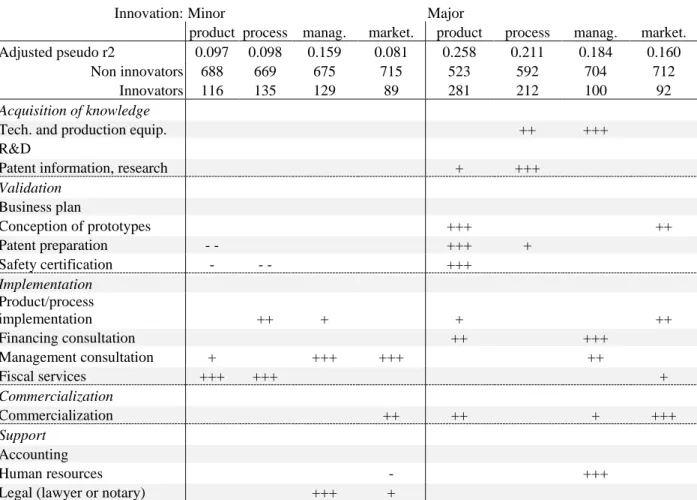
3.2.4 DOES THE UTILIZATION OF CERTAIN INDIVIDUAL SERVICES LEAD TO INNOVATION?
As for individual service utilization, we observe that major innovations are mostly associated with individual service utilization, although minor management and marketing innovations are also associated with individual utilization, but to a lesser extent. Only major innovations call for knowledge acquisition and validation services: Indeed, if an association exists at all between minor innovations and validation services, it is a negative association (Table 3.A).
Table 3.A : Individual services (added to the classic explanatory model)
Innovation: Minor Major
product process manag. market. product process manag. market. Adjusted pseudo r2 0.097 0.098 0.159 0.081 0.258 0.211 0.184 0.160
Non innovators 688 669 675 715 523 592 704 712 Innovators 116 135 129 89 281 212 100 92 Acquisition of knowledge
Tech. and production equip. ++ +++
R&D
Patent information, research + +++
Validation Business plan Conception of prototypes +++ ++ Patent preparation - - +++ + Safety certification - - - +++ Implementation Product/process implementation ++ + + ++ Financing consultation ++ +++ Management consultation + +++ +++ ++ Fiscal services +++ +++ + Commercialization Commercialization ++ ++ + +++ Support Accounting Human resources - +++
Legal (lawyer or notary) +++ +
Note: This table illustrates the link between each type of innovation and the utilization of the fifteen service types. ‘+’ indicates that the service is associated with more innovation, ‘-‘ indicates that it is associated with less innovation.
25
Implementation services are associated with major and minor innovations, but in different ways. While major innovations are associated with implementation and financing services, minor product innovations are associated with management consultation services and fiscal services. Major process innovations do not systematically require implementation services, while minor innovations require implementation and management consultation services. This implies that minor process innovations are imported from outside (hence, the need for consultation) while major process innovations are carried out internally (hence, the need for information, and the low use of validation, implementation, and support services).
Major management innovations are strongly associated with patent and technology services; and, less surprisingly, with management, human resources, and financial services. Likewise, marketing innovations are created jointly with commercialization consulting, but also with consulting on implementation of products or processes and prototype-design services. This opens the possibility that certain management and marketing innovations would be associated with, or follow, more technological innovations.
It thus appears that, within manufacturing firms, organizational innovations accompany (or are encouraged by) the introduction of technological innovations. This means that the apparent association between services of a more technological nature (patent information, conception of prototypes, etc.) and organizational innovations does not necessarily involve a causal relation (in either direction). Rather, the association entails that establishments use services to introduce new products or processes, which, in turn, creates the need for management and marketing innovations.Les innovations majeures de gestion sont fortement associées aux services d’acquisition de connaissances sur les brevets et les technologies, et, de manière moins surprenante, aux conseils en gestion, en ressources humaines et en finances. De même, les innovations en marketing se font, certes, de concert avec des conseils en commercialisation, mais aussi de concert avec des conseils sur la mise en œuvre de produits ou de procédés et d’aide à la conception de prototypes. Ceci laisse de nouveau entrevoir la possibilité que certaines innovations en gestion et en marketing soient associées à – ou se fassent à la suite – des innovations de nature plus technologique.