Contrib. Astron. Obs. Skalnat´e Pleso 50, 624 – 626, (2020) https://doi.org/10.31577/caosp.2020.50.2.624
Apsidal motion in the massive binary HD 152248
S. Rosu1, G. Rauw1, E. Gosset1, J. Manfroid1and P. Royer2 1Space sciences, Technologies and Astrophysics Research (STAR) Institute,Universit´e de Li`ege, All´ee du 6 aoˆut 19c, Bˆat B5c, 4000 Li`ege, Belgium, (E-mail: [email protected])
2 Instituut voor Sterrenkunde, KU Leuven, Celestijnenlaan 200D, Bus 2401,
3001 Leuven, Belgium
Received: September 29, 2019; Accepted: December 17, 2019
Abstract. The eccentric massive binary HD 152 248, hosting two very similar O7.5 III(f) stars, is the most emblematic eclipsing O-star binary in the very young and rich open cluster NGC 6231. Measuring the rate of apsidal motion in such a binary system gives insight into the internal structure and evolutionary state of the stars composing it.
Key words: stars: early-type – stars: individual (HD 152 248) – stars: massive – binaries: spectroscopic – binaries: eclipsing
1. Introduction
The majority of massive stars belong to binary systems. In double-line spec-troscopic eclipsing binaries, combining the photometric eclipses and the radial velocities obtained with spectroscopy allows to determine the masses and radii of the stars in a model-independent way. If the binary is eccentric and shows a significant apsidal motion, measuring this rate provides a diagnostic of the internal mass-distribution of the stars, which is otherwise difficult to constrain. It also offers a test of our understanding of stellar structure and evolution.
2. Methods and results
From a set of optical spectra of HD 152 248, we reconstruct the individual spectra of the stars and establish their radial velocities using a disentangling code. We analyse the reconstructed spectra with the CMFGEN model atmosphere code (Hillier & Miller, 1998) to determine stellar and wind properties of the system, notably effective temperatures Teff of 34 000 ± 1000 K and log g =
3.48 ± 0.10 (cgs) for both stars. We stress that the disentangling method in-troduces artefacts in the wings of broad lines. In addition, CMFGEN does not account for binarity. Hence, log g is underestimated and Teff is only an average
over the visible surface of the stars. The optical light curve of the binary is anal-ysed with the Nightfall binary star code (Wichmann, 2011) to constrain the Roche lobe filling factors of both stars to a value of 0.86 and derive an orbital
Apsidal motion in the massive binary HD 152248 625
inclination of (68.6+0.2−0.3)◦. Nightfall uses the Roche potential to describe the shape of the stars, accounts for reflection effects (mutual irradiation) and adopts a quadratic limb-darkening law. Absolute masses of 28.9+0.9−0.8 and 29.1+0.9−0.5M
are derived for the primary and secondary star respectively and mean stellar radii of 14.2 ± 0.4 R are obtained for both stars. Combining radial velocity
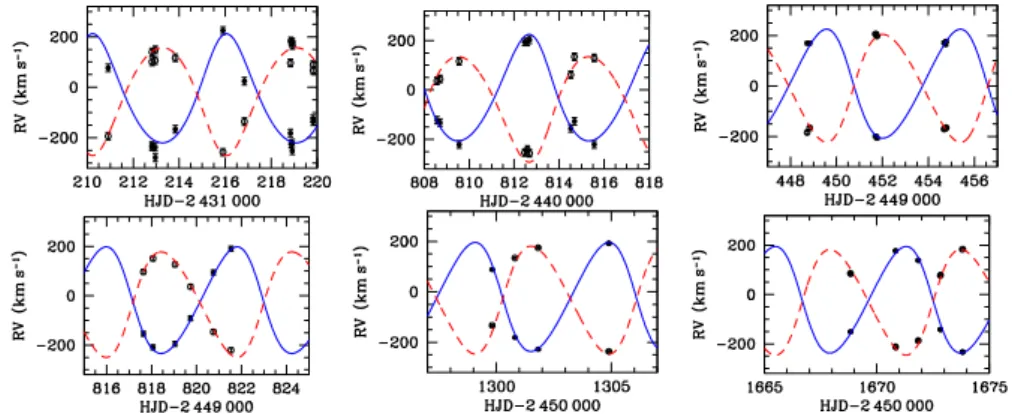
measurements spanning seven decades (see Fig. 1), we show that the system displays an apsidal motion at a rate of (1.750+0.350−0.315)◦yr−1.
Figure 1. Comparison between the measured RVs of the primary (filled dots) and secondary (open dots) and the RV curves obtained with the best-fit parameters. Top panels correspond, from left to right, to data from Struve (1944), Hill et al. (1974) and one epoch of data from Mayer et al. (2008). Bottom left panel yields one epoch of IUE data from Penny et al. (1999) while bottom middle and right panels correspond to RVs re-derived in this work (see Rosu et al. 2020, accepted).
3. Conclusion
The properties of HD 152 248 render the system an interesting target to study tidally induced apsidal motion from a theoretical point of view. As a next step, we will build stellar evolution models to determine a theoretical rate of apsidal motion, which could, by comparison with the observed rate, allow to constrain the internal mixing processes occurring inside the stars as well as to infer an age estimate for the binary system.
Acknowledgements. S. Rosu is supported by the FNRS (Fonds National de la Recherche Scientifique) – FNRS PhD grant.
References
Hill, G., Crawford, D.L., & Barnes, J.V. 1974, Astron. J., 79, 1271 Hillier, D.J., & Miller, D.L. 1998, Astrophys. J., 496, 407
626 S. Rosu, G. Rauw, E. Gosset, J. Manfroid and P. Royer
Mayer, P., Harmanec, P., Nesslinger, S., et al. 2008, Astron. Astrophys., 481, 183 Penny, L.R., Gies, D.R., & Bagnuolo, W.G.Jr. 1999, Astrophys. J., 518, 450
Rosu, S., Rauw, G., Conroy, K.E., Gosset, E., Manfroid, J., & Royer, P. 2020, Astron. Astrophys., 635, A145, DOI: 10.1051/0004-6361/201937285
Struve, O. 1944, Astrophys. J., 100, 189
Wichmann, R. 2011, Nightfall: Animated Views of Eclipsing Binary Stars, Astrophysics Source Code Library, record ascii:1106.016