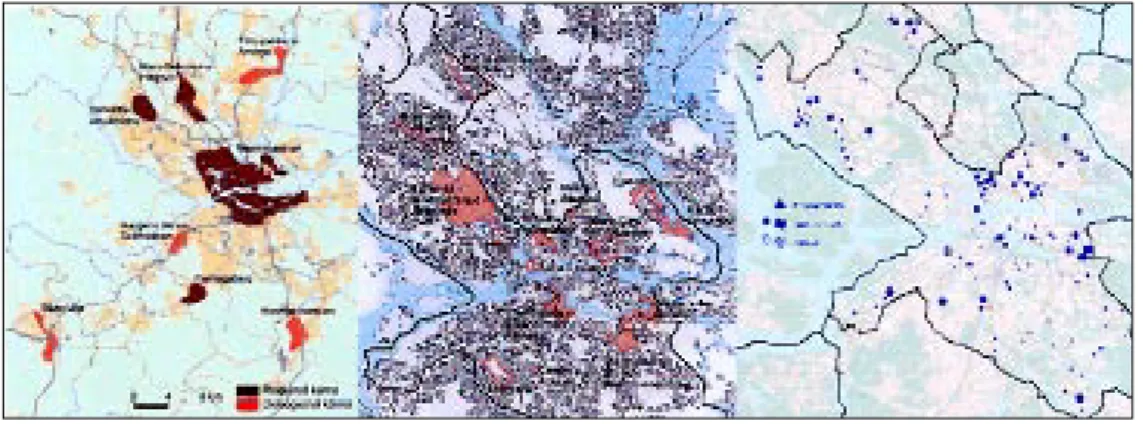
greenway in Hannover, Bielany Forest in Warsaw, users of green environment in the cities of Marseilles and Munich, “Castel Guido” organic farm in Rome, Park “Monceau” in Paris,
CHAPTER 4
Human issues
Members of Working group 1B :
Kristina Björnberg (co-chair), Bernard Duhem, Jean-Marie Halleux,
Philippe Hanocq, Karsten Jørgensen, Kimmo Lapintie, Gunilla
Lindholm (co-chair), Lucia Martincigh, Giovanni Scudo, Alexander
Ståhle, Klaus Wagner, Kestutis Zaleckis.
Human issues, introduction to thematic papers
Gunilla Lindholm
Landscape Architect, DrAgrDepartment of Landscape Planning, Swedish University of Agricultural Sciences, Alnarp , Sweden [email protected]
In everyday language there is not always made a difference between “green structure” and “nature”. This kind of mixing meanings complicates communication, even when “natural qualities” of the green structure are most important, which often is the case. “Green structures” are from one perspective a matrix, developing during ages through different land use and urban projects, from another perspective a part of the urban constructions. What was earlier a free growing edge of a farmland, could 50 years later be a framework, combined with gardens and play areas, to a residential area as a part of urban green structure.
What is here in short called “human issues” (concerning green structure in urban planning) includes a wide range of scientific and professional perspectives, each and together more or less necessary to understand the scope of “Green Structure and Urban Planning”. The following papers are to be seen as examples of some of these perspectives. They differ in purpose, method, contents and kind of results and show thereby the different approaches and competence available in the group. The intention with presenting these examples is not to analyse and separate “the knowledge on human issues concerning green structure” into completing sectors together forming “the whole”. Rather, the examples show a few of the islands in a large archipelago of relevant knowledge, examples from which you can get an impression of the width and the variation within this archipelago.
While the WG “Ecological issues” presents results from studies with mainly natural scientific methods, the WG “Human issues” has a more inclusive approach. Even including natural science, the “human angle” adds the task to understand this kind of thinking, in comparison with research within the social sciences and the humanities. Also added is the kind of professional thinking and experience-based know-how, which in practical planning works as a kind of filter for scientific and ideological input. The working-group has mainly consisted of researchers from professions-oriented academic environments, i. e. the members have experience from two positions, the discipline-oriented researcher’s and the holistic problem- oriented planning professional’s. The different theoretic and methodological approaches shown in the papers, give together an impression of the necessity of “mental mobility”, an ability to
change and move between viewpoints and scales, which is characteristic for the scope of “Green Structure and Urban Planning”. The “human issues” includes both the reasons on an everyday level (How is green structure beneficiary for human beings, especially urban citizens?) and on a philosophical level (How do we understand green structure and why?)
In this overview the choice has been to make short presentations of the following papers, concluding methods and results. As a guideline, each author’s field of research or professional occupation is added in brackets. Again, these are examples of approaches contributing to development of the concept “Green Structure and Urban Planning” to whom could be added several others, e. g. from sociology, ethnology and human geography, to mention some traditional fields of research, but also the coming networks for “urban studies”, mostly cross disciplinary, all relevant areas potentially paying attention to urban green structure. However, there is a substantial gap between the large amount of research fields regarding “human issues” and the very small amount of scholars actually taking the step to relate these fields of knowledge to the environmental tasks, including planning the development of cities.
The similarities and discrepancies between the regions and countries in Europe are not explicitly discussed in the papers. To some extent though, they have been mentioned during the working groups work. A significant example of different benefits of green structure is the role of thermal comfort (see Scudo). In the northern countries hedges and tree rows are often used as wind shelter, while in the southern parts of Europe, the shadowing function may be the most important. Also differences between various cultures, according to land owning and land use, recreational habits (see Werquin) and use of public space have been discussed as well as differences between urban and rural citizens, “indigenous” people and immigrants and not the least, contextual socio-economic structures.
Presentation of following papers
The urban green structure mirrors the relationship between man and nature, in history and contemporary. While urban citizens up until the 19:th century enjoyed refined and cultivated pieces of “domestic” nature within the towns, a great change in attitude took place in the 20:th century. For several more or less integrated reasons (leisure time, tourism, environmental consciousness, urban migration, functionalism) the dominating attitude changed into favouring “the natural”. Karsten Jorgensen outlines, in his paper “The Origins of Urban Green Structures”, historical roots of to-days ideas of “green structure”; public parks, park ways and park systems, nature in cities, garden cities and green belts, being earlier concepts, brought together in “green planning” from the 1960:ies, later supported by motives from landscape ecology and the international directives for biological diversity. (Garden history)
philosophical frameworks used in both planning and planning research. He point out that behind the common dichotomies (red/green, man-made/natural, etc.) there is a more fundamental dualism between rationality and unreason (metaphorically “the bird and the beast”) often neglected in planning discourse, although it is the very basis for the legitimacy of planning. He maintains that the dimension of unreason, the unmanageable and the uncontrollable in urban development, should be accepted, since no policies or communicative practices can be supposed to bridge the gap between reason and unreason. (Urban planning, Philosophy)
The ambition to reach general knowledge of environmental preferences and ideals is in this material handled in different ways. While Patrik Grahn et al in “Healthy environments” have used large statistic materials to learn how the use of parks is affected from the form and contents of them, and also linked medical statistics to peoples actual distance from home to nearest green area, Kestutis Zaleckis has used quite another approach in “The role of the green-structure in creation of preferred environment”. By discriminating between “green spaces” and “green structure” he describes the structuring activity as the very possibility to create preferred environments, meaning that the characteristics of preferred environments cannot be achieved by single objects but by the linking of parts forming the environments strived for. (Landscape architecture)
Related to the use of green space for recreation, Ann-Caroll Werquin has collected several studies and datas about Marseilles. Only a brief summary of this paper is in this book, showing how practises have changed in the last decades, and how mobility facilities allow people to use a large variety of spaces in the whole city region. Still, green areas are expected near to home: “Even if we do not use them, we want them to be there.” (Urban planning)
The environment’s physical influence on the human body is one of the issues studied to grasp the importance of climate control, by vegetation or by built constructions. Gianni Scudo present in “Thermal comfort” one in urban planning often forgotten variable and “thermal comfort indexes” as a for green structuring purposes important field of research. (Architecture)
Environmental preferences can be measured as the willingness to pay for a real estate or residential area. Jean-Marie Halleux shows in Valuing the green structure the possibilities with “The Hedonic Price Method”, a way to use economic valuation of environmental qualities. The paper categorizes two scale analyses: the residential property scale and the neighbourhood scale. At the neighbourhood scale, green equipments are related to both, aesthetic and recreational benefits. The paper also tackles the context issue, the cultural preferences issue and the importance of design. (Economic geography)
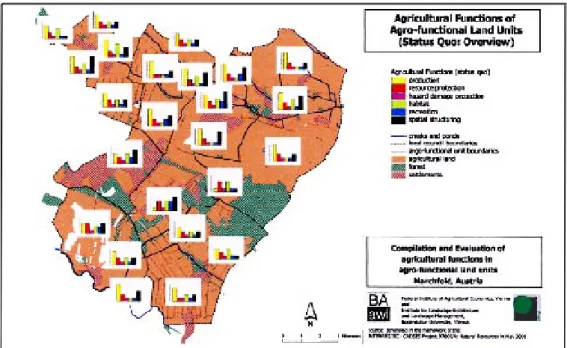
exploring potential possibilities within evaluating and combining the possible functions of agricultural land, especially in and near urban areas. The six studied functions are production, recreation, habitats, resource protection, hazard damage protection, and spatial structuring. (Land use planning)
In “The greenery in some French new towns”, by Bernard Duhem and Ann-Caroll Werquin, is evaluated the experiences from a period when green structure was a main topic as never else in France (a fact that coincide with most countries in Europe, ed. com.). Globally seen, the new town concept has been heavily criticized. However, it could be important to learn from this very spread and comparable experiments. Especially concerning green space adjacent to home environments, as well as green structure as a base for urban development (together with traffic and service structure), the new towns own qualities often unfair forgotten, due to frequent social problems in these areas. (Urban planning)
The values of urban green space is often hard to point out in an adequate way for urban planning purposes. Alexander Ståhle has been part of a pioneer project in Stockholm, Sweden, where large inventories and inquiries has been the foundation of a “Sociotop map”, used for describing the user values in a spatial form. In the same way as different biotopes are mapped for nature conservation purposes, the human use of public space is mapped as a tool for urban planners to consider this use as values in the urban environment. (Landscape planning)
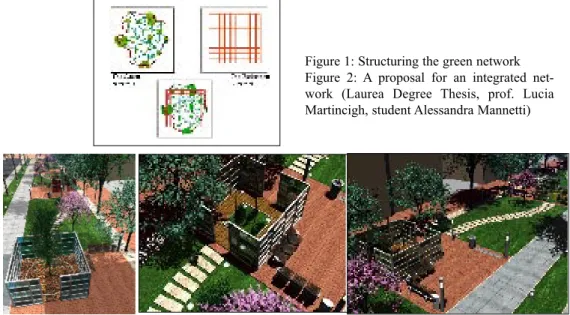
The function of green structure to promote sustainable mobility, is explored by Lucia Martincigh in “A green-network. The integration of the green structure and the non motorized transport modes´ network.” The paper concludes some general guidelines, useful to accomplish links and synergy effects by combining and integrating pedestrian network and green structure. This ambition demands accuracy in studying the local situations, understanding the advantages as well as the hindrances for this integration. To increase pedestrian mobility it is necessary with networks that are both comfortable and enjoyable.
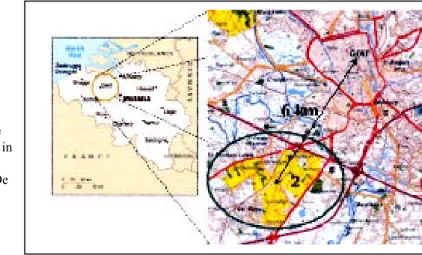
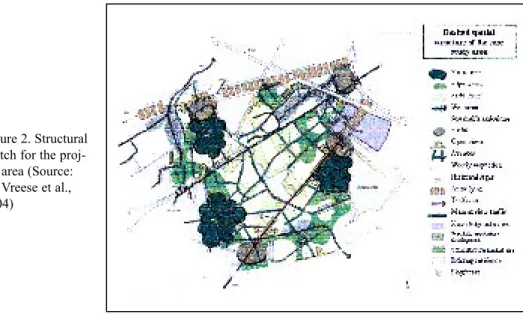
Finally, Philippe Hanocq’s paper “Practices in planning and design of urban green areas (Belgium)” contributes with outlining the professional/social situations where the discussion about alternative developments take place. If the above presentations are examples of various R&D works, Hanoque gives examples of projects in different scale, showing the width within what is counted as relevant facts and relevant values, depending on scale level and type of project: (1) Implementation of green areas through strategic planning at the global city scale; (2) A development project for a brand new neighbourhood based on the creation of a structuring green area; and (3) The design of a development project in an existing green area. The cases presented are processed in Belgian context, offering opportunities for comparing with the situation and professional habits in other countries. (Landscape Architecture/Urban Planning)
Reflection: Professional know-how versus scientific results – are
they compatible?
“Human issues” are, compared with “ecological issues”, rich in experience from hundreds of years of gardening as well as landscape planning for various human purposes. At the same time, the field is somewhat starving of inputs from the scientific world, a fact that complicates a general discussion on “Green Structure and Urban Planning”, regardless of local context, history and economy. Still, as the work in this Action has shown, there are many common aspects and themes, fruitful to discuss in international groups like this. One conclusion could be that it is important, in this situation, to point out the significance of the overview on a meta level, legitimating an input of Ethics and Rhetoric, to sort out the interesting similarities as well as discrepancies, concerning views and perspectives on green structure. This concerns not least the problem with a just consideration of arguments based on humanistic knowledge, compared to those based on natural scientific knowledge. This consideration could never be anything else than – a “human issue”.
The history of urban green structures
Karsten Jørgensen
Department of Land Use and Landscape Planning Agricultural University of Norway [email protected]
Introduction
Urban green structures have developed as an integrated concept in urban planning during the last few decades in Europe. Today this concept has the potential of becoming a general and legitimate part of all urban planning. This is a relatively recent phenomenon, it is therefore of interest to review its historical roots. As a background for analysis of future potentials of urban greenstructure, it is important to know where the ideas come from, and what lessons can be learnt from the earlier phases of this development.
The history of urban green structures is related to the history of garden art, and especially to the development of public parks in the 19th century. The public parks came, at least partially, as a reaction to the general urbanization and the poor living conditions resulting from this. The public parks were regarded as important factors both for public hygiene and for general moral, and “nature” was regarded as central in both cases. Today the urban greenstructures are valued both for their social, spatial and technical importance, but from a different point of view: they are important ecological factors; they are important for natural biotopes in the city. The concept of nature, and the ideas about its influence on people, has undergone a similar development, from a romantic, anthropomorphic, aesthetic view of nature to a biocentric, ecological view. In this paper, I will look at the development of the urban green structures from this point of view, and as a conclusion I will discuss some of the main ideological features of the early development, that may still be of some relevance today. It is obvious that the way urban green structures are regarded in society, is closely related to the concept of nature, or, more precisely, to the general attitude towards nature.
The rise of public parks
The history of garden art is generally a history of private gardens until the late 18th century, when the idea of the public park is born 1
. The earliest theoretical work in
which the public park (“Volksgarten”) is described and defined, is “Theorie der
Gartenkunst”, published 1779 – 1785 by Christian Cay Hirschfeld, a
Danish-German professor of Philosophy at the University of Kiel
2. His work was
influential and taken up by many who were closer to the practice of planning
urban green during the following decades. He obviously also hit the “zeitgeist”
quite well with his theories. This is illustrated by the development that followed:
during the 19th century, public parks were built in virtually all major cities, not
only on Europe, but also in America, and even a few in Japan
3.Also other
public arenas like newspapers and public organizations were developed during
this period, and the message from the French revolution in 1779 “freedom,
equality and brotherhood” challenged the ruling classes throughout Europe,
and enhanced the development towards more public parks, although not in
France in the first place. The definitions of a public park are many, here is the
functional aspect emphasized: a public park is open to the general public and
designed to meet their social needs and accommodate for their outdoor activities.
Hirschfeld describes the public park in his book, and develops a program for
its contents. He focuses on its potential value for the general well-being and
education of the people. The recreational purposes are emphasized and the
effects upon the working population of nature and of escaping the stressful
urban environments are described as being of great importance. He goes on
to describe the social values of a public garden: “The different classes will,
by here getting closer to each other, on the one hand obtain a more respectful
and modest attitude to each other, and on the other hand more friendliness and
explicit kindness to each other. Everyone will here get their unhindered right to
enjoy the nature.” He goes on to describe the need for a certain type of artworks in
the public parks: “Buildings with pictures from the history of the nation, statues
of dead heroes, and memorials of important deeds with instructive inscriptions
can be elegantly established in appropriate places with very favorable effects.”
What is important here is not the description of the physical lay-out of the
park, which more or less followed the predominant romantic landscape style,
but the explicit social and educational intentions behind the “Volksgarten” or
the public park. Hirschfeld states that all cities should have parks like this
in order to educate the general public to value the nature as well as national
heroes and their fellow citizens, also when they belong to a different social
class. And that “nature” plays an important role in this educational project.
Public parks in Europe
In Germany, The Englische Garten in Munich is among the earliest public parks in this sense of the word. It was commissioned by the rather unpopular Elector Carl Theodor in 1789 to reduce the dissatisfaction among people, probably as a direct result of the French Revolution, and in any case inspired by Hirschfelds work. The designer was Friedrich Ludwig von Sckell, who was one of the most influential
landscape gardeners of the time. The park is built on former military grounds and covers a large proportion of central Munich. The style is, as the name says, the English landscape style, and there are many references to Hirschfeld’s recommendations in the design. Also Peter Joseph Lenné picked up these ideas and referred to Hirschfeld in his text: “Uber die anlage einesVolksgarten bei der Stadt Magdeburg” after having designed the Klosterbergegarten, also one of the earliest public gardens in Germany of some size. The ideas were taken further by Gustav Meyer, Lenné’s pupil and later partner at the “Preussische Gartenlähranstalt” established by Lenné in 1826. Meyer also designed the Humboldthain and Treptower Park in Berlin around 1870. The English landscape style garden emerging in the early 18th century was in the first place related to the phase of Enlightenment; the irregularity was to reflect the principles of enlightened tolerance4. When the public parks were developed in the
19th century they were built in a similar style. The landscape style was intended to have the favorable effects that the people who strolled around in these close to nature-like surroundings, interspersed with monuments of different kinds, would experience themselves as liberated and independent members of civilized humanity etc. With inspiration from Rousseau’s nature romanticism, effects related to public health and moral was added to the intentions of the public parks.
Public parks generally were developed as a reaction to urbanization. Especially in England the industrialization had led to a drastic reduction of living conditions in cities. High disease and death rates forced through political reforms, and in 1833 the Select Committee on Public Walks was established, in order “to consider the best means of securing Open Spaces in the vicinity of populous towns as Public Walks and Places of Exercise, calculated to promote the Health and Comfort of the Inhabitants”. The committee concluded the same year in a report to the Parliament that there was a great need for public parks where the workers could walk with their families on their free day, in order to improve their health5. The landscape gardener and horticultural
writer John Claudius Loudon became the major advocate for public gardens early in the 19th century in England, e.g. in his “Encyclopedia of Gardening” from 1822 and in several other publications. Like Hirschfeld, he was engaged in the public parks’ influence on public hygiene and moral, but he also had an even greater vision: In 1829 he published “Hints on Breathing Places for the Metropolis, and for Country Towns and Villages, on fixed Principles” – which was no less than a green belt plan for London, introducing “breathing zones” for the metropolitan area6. This early attempt
to incorporate the public park idea into a greater vision of the urban development was never realized, but may have acted as an inspiration for next major step in this development. If we regard Hirschfeld’s theory and the first generation of “Volksgärten” as the first step, the second came with Frederick Law Olmsted’s planning of systems of interrelated parks in North America.
The development towards park systems
In England and elsewhere in Europe, the development of public parks continued throughout the 19th century. In Paris some parks belonging to the aristocracy before the revolution were turned into public parks after 1789. With the mid 19th century plans of Baron Haussmann (1809-1891) together with landscape architect J.P.Barillet-Deschamps (1824-73) and the engineer J.C.A. Alphand (1817-1891), parks like Bois de Boulogne, Parc des Buttes-Chaumont, Parc Monceau and Parc Montsouris became important elements in the modernization of the city, together with the so-called “Boulevards” broad streets with extensive plantings of trees 7. A major contribution in England was Joseph Paxton’s Birkenhead Park in Liverpool, developed in 1843-47 by the municipality of Liverpool, as a direct result of the Select Committee’s work. Frederick Law Olmsted was a young American, with a background as a journalist and “scientific farmer” in New York, employing principles published by Loudon in his “Gardeners Magazine” and other journals. Olmsted gave up scientific farming and traveled to Europe in 1850. There he arrived in Liverpool, and immediately became fascinated with the recently opened Birkenhead Park, and especially its social implications: “The poorest British peasant is as free to enjoy it ...as the British Queen.”, he wrote later. From 1855 to 1857 he was editor of a journal of literature and political commentary. He spent six months of this time living in Europe visiting many public parks8. In his writing he strongly argued for the value of such parks close to the
city, so that citizens could easily enjoy the green areas, lawns, trees, light and shade, shut out from the city, even when being almost in the city centre.
Olmsted and the American “Parkways”
In 1858 Olmsted won the competition for the design of Central Park together with Calvert Vaux. The development of Central Park was a major breakthrough for the development of public parks, not only in America, but also worldwide. It was immediately referred to by major writers on public parks9. The development of park
systems built in cities like New York, Boston and Chicago, put America up front as the main reference in the development of public parks10. A new development was
the separation of different types of traffic; in Central Park this is done by separating the pedestrian from the commercial traffic vertically, using the so-called “arches”; bridges or tunnels that enabled people to walk through the park without having to cross a carriageway in the same level. Olmsted and Vaux designed many more public parks, and in 1868 they were asked to make a park design for Buffalo. Olmsted was shown three alternative sites, and he suggested that the city bought all three, and said he would design a system of parks and interconnecting “parkways”. These parkways were defined by Olmsted as “broad thoroughfares planted with trees and designed with special reference to recreation as well as for common traffic,”11 and acted as
extensions of the park experience. Up to 70 meters in width, the parkways were much broader than the normal streets of the city and provided separate lanes for different
types and directions of traffic. Areas of turf planted with rows of overarching elms created park-like environments. Spacious circles marked junctures where parkways came together or where they encountered major city streets. Olmsted and Vaux referred to the Paris Boulevards developed under Haussmann, and they also visited Paris and met with Alphand, while working with the Buffalo project 12. In 1870 he
wrote what may be considered as a program for green structure planning:
“the duty of arranging new trunk routes of communication between it and the distant parts of the town existing and forecasted. These may be either narrow informal elongations of the park, varying say from two to five hundred feet in width, and radiating irregularly from it, or . . . formal parkways. They should be so planned and constructed as never to be noisy and seldom crowded… If possible, also, they should be branched or reticulated with other ways of a similar class, so that no part of the town should finally be many minutes’ walk from some one of them; and they should be made interesting by a process of planting and decoration, so that in necessarily passing through them, whether in going to or from the park, or to and from business, some substantial recreative advantage may be incidentally gained”13
Nature in cities
Parallel with the Buffalo project, Olmsted and Vaux also designed the Riverside Estate in Illinois, demonstrating the emphasis they put on the private green as being a part of the total green structure. The Riverside is a community of single-family housing with big gardens; roads and housing areas laid out according to the terrain. There are no right angle road crossings, a design principle creating more public land, and “private land with a public function: as transition area between private and public”. At the same time Olmsted and Vaux worked on the plan for the Niagara Falls State Reserve, where they not only preserved the natural qualities of the site, but also removed a factory and an amusement park and restored the natural scene. Later Olmsted designed the Emerald Necklace, a park system for Boston. Throughout his career Olmsted points towards future green structure planning; he was engaged in the Conservation Movement 14 and
the development of the National Parks, as well as with the City Beautiful Movement15,
that actually based much of its ideology on Olmsted’s work.
Garden cities and green belts
The Englishman Ebenezer Howard had studied Olmsted’s projects like the Riverside Estate and the Boston park system. He was skeptical to the speculation in properties he saw in these areas, but also very inspired by their green values. He had also studied the social experiments of Robert Owen in New Lanark, Scotland, and the garden village of George Cadbury 16 near Birmingham, and when he put together these experiences he wrote the book “Garden Cities of Tomorrow” 17 Howard’s theory prescribes a
should be “satellite” towns” around the “mother city”, and around each city there should be a green belt, in order to contain the city growth as well as providing a green environment for the city. Several “garden cities” were built in England and elsewhere with reference to this theory. In the second half of the 20th century Howard’s theory was accomplished to a higher degree, following Patrick Abercrombie’s “Greater London Plan of 194418.
The concept of nature that is being demonstrated in the green belt philosophy is more functional and technical than earlier ideas about nature’s good influence. Nature is related to specific roles or functions in the city. Green belt philosophy is quite close to green structure philosophy in this respect; it is the operational values of green areas that are in focus. The functional view is also expressed by other pioneers in urban planning, like Camillo Sitte, who published “Der Städtebau nach seinen künstlerischen Grundsätzen” (City Planning According to Its Artistic Principles) in 1889. Here he distinguishes between two functions of city green: the “decorative” and the “hygienic”19. Also Patrick Geddes engaged in the green and sustainable development of cities, he proposed among other things a park system for Dunfermline in 1904. He was also among the first to take the professional title of landscape architecture in Europe.
The influence of green belts and garden city planning had many interesting results around the globe, and in general they made people’s environment greener and more interesting. One such example is the park development in Stockholm during the 1940ies and 50ies. Holger Blom, who took over as head gardener in Stockholm in 1938, developed what he called a “Park Program”, inspired by both the Olmsted heritage and Le Corbusier’s “park in city”. The “Park Program” defined the parks as crucial urban elements, both for their climatic effects, their functional and social values, and their roles in preservation of cultural and natural monuments. He introduced the so-called “play-sculptures” and the results of this period have become famous as the “Stockholm style”. In Copenhagen the “Finger Plan” ensured access to green areas throughout the city. Similarly, the 1934 the plan for the Oslo-region put down principles for a network of green corridors that have had strong impacts on planning up till today.
Third and fourth generations of public parks
In the early 20th century athletic competition was taken up by the worker’s unions and organized sport was turned into a mass culture. Sports grounds and stadiums of different kinds became integrated parts of most public parks built during the first half of the 20th century, and in some cases even the main content. Famous examples are Stadtpark Hamburg from 1910 and Bos Park in Amsterdam from 1934. In Oslo, the “Vigelandsparken”, mainly a sculpture garden, built in the 1920ies and 30ies, also contains several sports grounds and swimming pools. Another major green area in Oslo, the Ekebergåsen, purchased by the municipality in the 1890ies to meet the needs
of the growing population of workers, is still today the arena of the Norway Cup, the world’s biggest football tournament. This phenomenon seems to be consistent enough to be named the “third generation” of public parks, following the two mentioned earlier in this paper.
A fourth type has emerged during the last few decades, where the focus is put on cultural or natural monuments, either historical or contemporary. This new type has sometimes been developed in connection with garden fairs or Olympics etc, like the park system of Barcelona, following the 1992 Olympic Games. In other cases it is based on an increased focus on management of cultural monuments. The most prominent examples of this new type of parks are the so-called “ecological parks” like the Naturpark Südgelände in Berlin and the Duisberg Süd development in Germany built in former industrial zones, where some of the rusting machines and buildings are silent witnesses of former activity. The contrasts created by the natural or sometimes more pastoral scenes framed by industrial relics are striking, and contains the underlying message that “nature heals the wounds of civilization”, maybe creating some kind of hope for a more ecological balanced urban life.
Green structure and urban planning
The Greenbelt and Public Park developments created a good basis for a more comprehensive green planning, and in the 1960ies the first attempts of a “green plan” were made, e.g. in the “Grünplanung Darmstadt” by Günter Grzimek 20. In
the 1980ies and 90ies we have seen new attempts in urban planning where ecology was taken more explicitly into account, e.g. focusing on biotopes and corridors for the movement of fauna and flora in the city, as well as on participation planning. Another idea was the use of the concept of “balancing interventions” to ensure a more ecologically sound development. In Berlin the “Grünordnungsplan” states that interventions that harm areas with a high ecological value, like a green garden or a lake, should be avoided. In cases where they have to be implemented, they should be “balanced” with a replacement of the harmed area.21 These ideas are related to
the concept of “ecological footprint”, which focuses on the total impact of human activities, measured by the quantity of “natural area” needed to “neutralize” a certain activity; e.g. to purify the pollution caused by the activity.
All these ideas contribute to the focus on nature and natural elements in the city. This is of course important, and there is, as we have seen, a long tradition for this focus in urban design. But the main problem for green structure planning today seems to be that greenery is still seen as an antithesis to urbanity, and green structure planning is thus difficult to integrate into urban planning. What is needed today is therefore a planning concept where the total green structure, private or public, is regarded as an integrated part of the urban fabric, and as a “tool” for urban development. A tool – not in the sense of an instrument to control the development, but the contrary: an uncontrollable ‘fait acompli’ that may enrich urbanity. A green structure may
contribute to the reconciliation of the split between the quest for control and the need for individual freedom that has haunted modernity throughout its history.
A renewed interest in the ideas of those who contributed to the history of public parks and greenbelts may bring back this focus in urban development. The urban planners may thus see how green areas have been regarded as crucial and integrated elements in the city from the rise of urban planning, and the green planners may see how the green structure of a city has a value beyond the ecological perspective. Nature is not only a part of our physical surroundings, and thus subject to physical and biological forces. The concept also reflects the way we categorize the world, and thus has a cultural dimension that goes much deeper than e.g. the historical value of a park. When Hirschfeld and his contemporaries suggested that nature in cities have a favorable effect on people’s moral, they may have had this in mind.
Notes :
1. Also in earlier times there have been examples of public urban green areas of different kinds; e.g. the medieval commons or the so-called pleasure gardens as well as the accessible promenades of royal parks in the 17th and 18th centuries; what was new in the 19th century, apart from the broad scale on which this was accomplished, was the fact that the public parks now were deliberately designed for the benefit of the general public, and to an increasing extent on publicly owned ground.
2. The Oxford Companion to Gardens, Oxford University Press 1986, p 457.
3. In Kyoto and Tokyo public parks were developed around 1870 on former imperial grounds, as a result of the opening towards the west during the Meiji Era.
4. See: Hermand, Jost: “Rousseau, Goethe, Humboldt: Their Influence on Later Advocates of the Nature Garden” in “Nature and Ideology” edited by Wolschke-Bulmahn, Joachim (Dumbarton Oaks 1997)
5. Nolin, Catharina: “Till stadsbornas nytta och förlustande – Den offentlige parken I Sverige under 1800-talet” p.33 (on public parks in Sweden in the 19th century)
6. This was 69 years before Ebenezer Howard’s famous Green Belt proposal. See Tom Turner’s article on this story on London Landscape Web http://www.londonlandscape.gre.ac.uk/ 1829.htm
7. The work in Paris was published in Alphand’s book “Les Promenades de Paris” 1867-73. An English “equivalent” of this book was “Parks, Promenades and Gardens of Paris, described and considered in relation to the wants of our own cities and of public and private gardens” published by William Robinson in 1869. Olmsted corresponded with Robinson, and was interested in his ideas about nature.
8. According to the head gardener in Englischer Garten in Munich, Olmsted visited this park no less than three times during this period.
9. E.g. Gustav Meyer in his ”Lehrbuch der schönen Gartenkunst” published 1860, lists as examples of public parks, Bois de Boulogne in Paris, Tiergarten in Berlin and Central Park in New York 10. In e.g. the 1914 volume of the leading Norwegian art journal “Kunst og Kultur” there is one issue on garden art with two articles about urban development and public parks in America – by landscape architect I.O.Nickelsen: “Byer med trær, lekepladser og blomster” and professor of history of art Harry Fett: “Amerikanske lekeplasser” clearly indicating America as the most interesting place in this field.
11. See (online) http://www.fredericklawolmsted.com/Lifeframe.htm
12. See (online) http://www.cr.nps.gov/history/online_books/mcclelland/mcclelland2b.htm Although Haussmann (and Alphand?) had even more ambitious visions of a system of interconnected
green areas than what was realized, e.g. a 250 meter wide greenway encircling the city, the main focus of the Paris development was to improve technical infrastructure.
13. From Olmsted’s pamphlet Public Parks and the Enlargement of Towns, 1870
14. Olmsted’s preliminary report to Yosemite Valley Commission has become famous for its contribution to the understanding of the conservation movement.
15. Frederick Law Olmsted was one of the founders of the movement in the 1890ies, and his son Frederick Law Olmsted Jr. led the movement through its peak years in the first decade of the 20th century.
16. Robert Owen developed a worker’s village in New Lanark in Scotland, and wrote about the ideal city looking like a park dispersed with houses early in the 19th century. George Cadbury developed the Bourneville garden village for workers in the Birmingham slum in the 1890ies, where a Village Trust was set up to avoid speculation.
17. The title of the 1898 edition was, interestingly:” To Morrow: A peaceful path to real reform”. It became a best-seller; within less than a year, “The Garden City Association” was established, and within ten years it had resulted in sufficient interest and economical support to start the building of Letchworth - the first garden city, designed by Howard’s friends and members of the Garden City Association, Raymond Unwin and Barry Parker. It was the second edition of the book in 1902 that got the famous title: “Garden cities of tomorrow”.
18. See Lucey, Norman, 1973, (online) http://www.rickmansworthherts.freeserve.co.uk/ howard1.htm#sna
19. These historical notions and their equivalents today are discussed in Lundgren, Alm, Elisabeth (2002): “Stadslandskapets obrukade ressurs” (The unused resource of the urban land-scape) Chalmers Tekniska Høgskola, Gøteborg
20. See “Grünplanung Darmstadt : Plan fyr den Ausbau eines Grynflæchensystems als Beitrag zum Bauleitplan der Stadt Darmstadt, abgeleitet aus dem Bestand, den Voraussetzungen und langfristigen Notwendigheiten” by Günter Grzimek, Darmstadt, Roether 1965. Also discussed by Winfrid Jerney in TOPOS 2003/08
21. See description of this in: Skärbäck E. Balanserad samhällsbyggnad, Stad och Land Nr. 147: 1997
References
:
Alm, Elisabeth, 2002. Stadslandskapets obrukade resurs, Chalmers Tekniska Högskola, Gøteborg
Berglund, Ulla, 1996. Perspektiv på stadens natur Kungliga Tekniska Högskolan, Stockholm Hauxner, Malene,1993. Fantasiens have Arkitektens forlag, København
Hermand, Jost, 1997. “Rousseau, Goethe, Humboldt: Their Influence on Later Advocates of the Nature Garden” in Nature and Ideology edited by Joachim Wolschke-Bulmahn, Dumbarton Oaks
Jellicoe, Geoffrey & Susan, 1986. The Oxford Companion to Gardens, Oxford University Press
Nolin, Catharina: Till stadsbornas nytta och förlustande – Den offentlige parken I Sverige under 1800-talet
The Bird and the Beast
Philosophical concepts and dichotomies in planning of the
urban green
Kimmo Lapintie
Urban Planning and Design Department of Architecture, Helsinki University of Technology, Finland kimmo.lapintie@hut.fi
1
Introduction
When green is made into an object in urban and regional planning, what is actually happening? Usually this is conceptualised as a technical, architectural, ecological or political problem, dealing with e.g. which concepts are useful for planners and other practitioners (green belts, green fingers, green structures, etc.), how do parks and green areas contribute to the cityscape, how should the urban green areas be managed, or what kind of policy measures should be applied to ensure equal distribution of recreational values or to prevent ecological damage. How could we justify, then, the use of philosophy in this context?
I will not argue that philosophy as a ‘basic’ discipline studying ontological, epistemological or ethical issues should provide a framework or foundation for more specific and more practical disciplines. I shall rather argue that there is a philosophy of sorts embedded in the most practical disciplines, such as planning, in the sense that they are using conceptual frameworks that are rooted in various historical discourses pervaded by philosophical concepts. Since these conceptualisations are only partly open and reflective, the role of philosophy (as a professional discipline addressing conceptual problems as well as problems of argumentation) is to provide both interpretation and criticique of these conceptual frameworks.
My intention in this paper is to follow some of the paths related to the concepts used in planning, in an attempt to point at some of the blind spots of planning thought, that is, problems systematically avoided by both planning theories and practice. I am thus particularly interested in where planning constructs an artificial comprehensiveness and consistency. These fables, as well as the openly presented ‘problems’, are suitable targets for philosophical analysis and critique, and they are also illustrative of the potential usefulness of philosophy in this context.
The discussion in this paper is based the theoretical work done in our project Governing Life in Helsinki University of Technology, which is funded by the Academy of Finland.
2
Dualisms and Totalitarisms
Judging from the most common concepts used in urban planning and design, these disciplines and practices seem to be no less dependent than other disciplines on some of the basic dualisms of western thought. Planning is itself often connected to rationality – not only by the advocates of the theories of rational-comprehensive planning1.,
but also by their critics who support the so-called communicative turn in planning2
References to Habermasian communicative rationality 3 reveal an attempt to maintain
the rational core in planning thought, although it is admitted to be more complicated in the dialogical, process view of planning. The same can be said of the concepts management and strategy widely used in contemporary planning discourse. They are both clearly related to the rational core: if we want to manage something, we want to keep or give it an order, or to prevent it from chaos. Strategic action is clearly rational and reasonable action aimed at certain objectives or at least it is a reasonable orientation in the current situation and the awareness of the different alternatives for action. Rationality is, thus, considered both useful and good, or even necessary for planning of the urban environment. And since the city is nowadays understood as part and parcel of its regional and even global environment, the traditional dichotomy between the ‘city of order’ and the surrounding ‘wilderness’ has disappeared, together with the crumbling of the ancient walls and city gates. But this does not mean that rationality would have lost its opposition. Without something to fight against, without non-rationality or unreason, planning would hardly make any sense. But what is this non-rationality for planning? Is it simply non-planned environment or development, as the understanding of the whole territory as the proper object of planning would suggest? If so, we would have to understand how this constitutes a threat to our communities and societies. This is one of the questions we have to keep in mind, since it belongs to the questions that, as I suggested above, have been systematically avoided by both planning theorists and practitioners. The reason for this is evident: If we would have to characterize the opposite of planned as something that is simply non-planned, but still should be managed by planning, planning would immediately start to seem totalitarian. The necessity of legitimation would follow: In what sense, against what kind of danger, is planning legitimate in this ever larger area of jurisprudence? What is the social or natural contract behind the planning reason? On the other hand, there is another dichotomy, more simple and concrete, yet equally dangerous in its implications. This is the dichotomy of red and green, the construction of buildings and infrastructure, on the one hand, and the natural environment, on the other. This pair of concepts has taken many forms, but the dualistic implication is evident in each case. When cities are growing, they are “taking over their surrounding natural areas”, “penetrating into virgin land”, or “destroying the last pieces of urban nature.” If the city is a rational artefact, a man-made object or structure, do the green and natural areas it potentially threatens represent nature, nature independent or distinct from human activity? The bedrock, the sea, the fertile soil, they have all been
there for thousands or millions of years, and they can only be destroyed, not usually constructed by human activity. Are we dealing with a man/nature dualism here? Some would immediately object that there is very little of the original nature left on our globe: Even the wilderness is often the object of some form of management. Conservation of natural areas is one of the key functions of planning. So if management and planning refer to rationality and the presence of man, nature is not the conceptual opposite of planning. Conversely, we could point out that nature is omnipresent in the most urban of the environments: there are hundreds of species in the concrete desert of the city, and the air, humidity and temperature of the city are all dependent on the natural features of the urban site. But this is not the point. The very fact that we keep using dichotomies like red/green, growth/green or planning/green structure reveals that there is an important dualism behind our way of thinking about natural and built-up areas. The natural areas, in spite of their being subjected to planning and green management, are never totally man-made, and the urban environment, in spite of the dozens of species that biologists are able to distinguish from our stoned stairs, is never totally nature. The opposites of our basic dualistic concepts can never be totally wiped out, either by rationalistic or by naturalistic totalisations. My interpretation is that we are not simply dealing with dualistic concept pairs, such as man/nature or rationality/irrationality, which would correspond to planning concepts such as red/green or planning/non-planning. We are rather concerned with a hidden dualism, which is in fact hidden behind apparent dualisms. The point of much of our activities is to try to ‘solve’ the ‘problems’ inherent in the apparent dualisms or controversies. This activity is of a totalising nature, since it attempts to hide the other, more crucial dualism – vainly, since the activity is itself based and motivated by the existence of this dualism. I shall discuss this original and crucial dualism metaphorically “The Bird and the Beast”. This is a reference, on the one hand, to Alfred Hitchcoch’s horror picture The Birds, and to Michel Foucault’s discussion of unreason and bestiality. Before that, however, let me give a short illustration of these ‘totalitarian dualisms’. What seems to be the motivation behind introducing conceptual dichotomies such as urban growth and green (as we have done in our GREENSCOM-project) or green structure and urban planning (as we have done in our COST-action)? There are clearly real and potential conflicts and controversies between the conservation of natural areas and habitats, on the one hand, and finding new sites for construction, on the other. Conservation has traditionally been seen as the weaker party, but its weight has become more significant as the environmental arguments and policies have won both local and global acceptance. This dichotomy, thus, seems to be the problem, the apparent dualism between growth and green, and it is supposed to be solved by concepts, arguments and policies that avoid taking sides. The concept of sustainability belongs to this category
of concepts, as it includes both development and thus construction, but also the long-term benefits of green areas for the citizens and the future economy of the city, as well as biodiversity. Sometimes even an economic concept, such as willingness-to-pay, might do. The objective of our research activity, in cases like this, seems to be to bridge the gap between the opposites of this apparent dualism, to communicate between them. But why is this dualism apparent, and what is the more fundamental dualism behind it? There are, in fact, two possible interpretations of this situation. Actually the word urban growth is itself a metaphor, giving an appearance of naturalness, unavoidability and productivity to human construction. It is a naturalisation of something that is in fact the result of political decision-making and deliberate human action, which does not simply ‘grow’. In a sense, then, the concept seems to be on a par with the concept of green, which is also growing. This has clearly been a rhetorical way of supporting urban growth. But this naturalness, despite its successful history, is no longer the concept that will communicate between the two. In fact, the reason why urban growth is naturalised is related to the argument that unmanaged urban growth is dangerous, that it needs planning. Growth is not here an integrating but a frightening dimension, a symptom of the existence of non-rationality and chaos. The communication between growth and green will thus be based on something else. It must be shown that there is a common rationality behind conservation and development, between construction of housing and construction of green areas, and between economy and ecology. And surely these arguments can be put forward: good green structure networks contribute to the long-term economic viability of cities, as well as to the real estate prices. Ecological management of green areas will save energy and money for the city administration 4, and giving people the possibility to take care of some common green areas 5 does the same. The problems seem to be
related to how these arguments can be explained to the citizens, or how could we measure the benefits and costs in the long run. The rest is simply political bargaining: How shall we finance the necessary measures and distribute the costs and benefits? This is only apparently easy, however, just because it is so easy. It does not represent the actual problem, nor does it even explain why such a problem has appeared. The actual and difficult conflicts between urban construction and the conservation of natural areas that we can see in many contemporary cities are not only based on problems of calculation or lack of argumentative skills. They are related to the fact that if rationality is the communicative bridge between growth and green, then it clearly cannot give any voice to its opposite, the non-reason, the unexplained, the unmanageable. The principle of rationality is that ‘whereof one cannot speak, thereof one must be silent’, as the early Wittgenstein put it 6. Non-rationality is certainly something that we cannot speak with, since our word represents our Logos, our reason. But even Wittgenstein in his young arrogance did not assume that what we can speak of is all there is7
3
Governing the Desire and the Will to Power
If we want to address this basic dualism between reason and its opposite, we are natu-rally led to the original Platonic distinction between the reason of the philosophers and the desire of the majority of people, so eloquently argued for in the Republic. For Plato, the desire (of children, women, slaves, and even the less worthy part of the free men) did not only desire, but it wanted to govern both the individual man and the state, although this would have had catastrophic consequences (432d). This will-to-power of the unworthy, governed and kept inside its proper borders, is not only interesting as an important tradition in Western political thought and as an object of the anti-totalitarian modern critiques.8 This will-to-power is also interesting, since it openly addresses the above-mentioned problem of legitimacy: If the unworthy have a will-to-power, they actually form the basic danger that legitimises the use of rational governance by the wise. The wise, on the other hand, are those who have access to true knowledge, and who are, in spite of the fact that they have thereby freed themselves from earthly desires, chosen to turn to their countrymen and govern them. Consequently, this con-ception also explains the necessity and persistence of this original dualism: since the rational men do not desire themselves, the rational state will need the unworthy, it will need their desiring and will-to-power, in order to function properly. Hence the ever-present coexistence of both the energy from desire and the legitimate governance of it. Now it would be interesting to compare this by now ‘politically incorrect’ feature of classical thought to the modern self-understanding of the planners’ role in society. The disinterested benevolence of the planning expert can easily find its roots in the phi-losopher-king, as well as the vested interests of the stakeholders will remind us of the desire and the will-to-power of the unworthy majority. But the pictures are not entire-ly equivalent. What is missing in the modern, politicalentire-ly correct conception of gover-nance, is the original and persistent dualism between the rationality of the governor and the unreason of the governed. If the classical ecology was based on the rational governance (logos) of the household (oikos) and its lesser members (women, slaves, children), the modern concept of ecology is a totalitarian concept: everything is sub-jected to the priority of the ecosystem. The rational governance of the oikos is project-ed onto the natural environment, which has now become the very model of rationality. But if nature is thus rationalized, the only place that remains for unreason is the human mind (as already with Plato) and the irrational forces of the mob, the unorganised multitude of the unwise people. But even here the dualism is hidden underneath a host of totalitarian concepts: social and cultural sustainability, communi-cative rationality, public interest, general will. These are all grand ideas and principles that no one can question or oppose, least of all from the point of view of individual or group desire. They are meant to communicate between the governor and the governed, but all they can do is to hide the original dualism. The point was, namely, that one cannot communicate with unreason. It can only be silenced, controlled or destroyed.
The disappearance of unreason from the intellectual landscape of Western thought has, however, attracted the interest of many philosophers and social theorists. An illuminating example is Michel Foucault’s analysis of the history of madness, which he deliberately wrote not as a history of mental illness but rather as the development and disappearance of unreason (déraison). In other words, he depicted madness-as-illness as only one moment in the history of silencing unreason, of taking from it the right to speak-for-itself. “The language of psychiatry, which is a monologue of reason about madness, has been established only on the basis of such a silence. I have not tried to write the history of that language, but rather the archaeology of that silence.”9
But can one really write an archaeology of silence? This problem was
imme-diately noticed by Jacques Derrida: “Is not an archaeology, even of silence, a
logic, that is, an organized language, a project, a sentence, a syntax, a work?”
10And further : “Since the revolution against reason, from the moment it is
articulated, can operate only within reason, it always has the limited scope of
what is called, precisely in the language of the department of internal affairs,
a disturbance.”
11If unreason, thus, cannot as a whole be given a legitimate
voice in the history and in society, then its role will necessarily be reduced to
a breaking of social order, to a problem one cannot understand, to a demand
one cannot justify, that is, to disturbance.
4
Designing a cage for the love-birds?
But if one cannot make science (logos) of unreason, could one perhaps show it(mimesis)? Indeed, we do have a whole genre of monster-images, representing the ever-present unmanageable and uncommunicable element of our metaphysics. These extend from the King Kong to Hitchcock’s The Birds, and they are usually based on a juxtaposition between scientific reason (and the respective management and exploitation) of our Western culture and a sudden appearance of the monster: a flock of violent birds, an enormous monkey or Godzilla, or even a group of people gone crazy, the mob. The Birds is emblematic in this respect: the film starts with two love-birds in a cage, and it ends with a Dystopia of a world that has made man a refugee in his ‘own’ city: There can be no communication, no negotiation between him and the destructive flock of birds.
While the contemporary film seems to be more interested in Dystopia, urban planning and design are still stuck with their Utopian tradition. The birth of modern planning was connected to the unmanageable growth of the industrial city, and it produced a host of ‘moral colonies’ of reason: the city beautiful, the garden city, the urban village, the functional city, the organic city, the ecological city (Lapintie 1996). In a sense, we have been designing cages for the love-birds, and tried our best to close our consciousness from the beast. But since urban design is inherently connected to mimesis, we may assume that this is not the end of the story.
We may now end these reflections by discussing what this conclusion means for urban planning and design practice. As I wrote in the beginning, the relevance of philosophical analysis in practical disciplines like planning and design is based on a critical reflection of the conceptual structure and the metaphysical and ontological assumptions behind these disciplines (and, of course, behind the concept of discipline itself). It is of course quite common for a practitioner to deny that there would be any need of such reflection, that what is needed is simply more data, more indicators, and more advanced tools for action. While there are undeniable merits in such a practical attitude, it is also evident that the unreflective practitioner is dangerously on his own if the cage is opened, and the birds decide to fly away.
notes :
1.The roots of the rational-comprehensive planning theory are not often discussed, since the theory is used as a common enemy against which its alternatives (such as incrementalism and communicative planning theories) are measured. Andreas Faludi (1987), however, gives the honour of formulating rational planning theory to Edward Banfield, in Meyerson & Banfield (1955). Faludi’s own formula-tion is given in Faludi (1974).
2. Healey (1996), Sager (1994) 3. Habermas (1984)
4. For this argument, see, e.g. Hough (1985).
5. I am referring to a case study from the Greenscom-project dealing with management contracts in the city of Utrecht.
6.Tractatus n:o 7. 7. Tractatus n:o 6.522
8. Karl Popper’s liberalist critique against Plato’s Utopianism (Popper 1971), against which he put forward his innocent-looking ‘piecemeal social engineering,’ is a case in point.
9. Foucault (1973), pp. x-xi. 10. Derrida (1985) p. 35. 11. Ibid. p. 36.
References :
Derrida, Jacques (1985) Writing and Difference. Routledge: Surray Faludi, Andreas, 1973, Planning Theory. Glasgow: Pergamon Press.
Faludi, Andreas, 1987, A Decision-Centred View of Environmental Planning. Exeter: Pergamon Press.
Flyvbjerg, Ben,t 2001, Making Social Science Matter. Why social inquiry fails and how it can succeed again. Cambridge: Cambridge University Press.
Foucault, Michel, 1973, Madness and Civilization. A History of Insanity in the Age of Reason. Vintage Books.
Habermas, Jürgen, 1984, The Theory of Communicative Action. Volume 1: Reason and the Rationalization of Society. Boston: Beacon.
Habermas, Jürgen, 1987a, The Theory of Communicative Action. Volume 2: Lifeworld and System: A Critique of Functionalist Reason. Boston: Beacon.
Healey, Patsy, 1996, The Communicative Turn in Planning Theory and Its Implications for Spatial Strategy Formation. Environment and Planning B: Planning and Design 1996, vol. 23, n:o 23, 217-234.
Lapintie, Kimmo, 1996, Paradise Lost. Rationality, Freedom and Ecology in the City. Housing & Enviroment n° 2, The Unit for Research into Housing and the Environment, The University of Tampere.
Meyerson, Martin & Banfield, Edward, 1955, Politics, Planning, and the Public Interest. London: Free Press, Collier-MacMillan Ltd
Popper, Karl, 1971, The Open Society and Its Enemies. Princeton. Sager, Tore, 1994, Communicative Planning Theory. Gateshead: Avebury.
Sokal, Alan, 1996a, Transgressing the Boundaries: Toward a Transformative Hermeneutics of Quantum Gravity. Social Text, n° 46/47, spring/summer 1996, ss. 217-252.
Wittgenstein, Ludwig, 1973, Tractatus Logico-Philosophicus. Padstow: Routledge & Kegan Paul.
Eight experienced qualities in urban open spaces
Patrik Grahn, Associate Professor in Landscape Architecture, Ulrika A Stigsdotter, Lecturer in Landscape Architecture,
Ann-Margreth Berggren-Bärring, Lecturer in Landscape Architecture,
All above at the Swedish University of Agricultural Sciences, Department of Landscape Planning, PO Box 58, S-230 53 Alnarp, Sweden
Introduction
When recreation areas today are analysed and described, for instance at the prospect of exploitation, it is clear from the political debate that the decision-makers have not been given a fair chance of assessing the importance of such areas to the town population (Grahn, 1991). The qualities in urban green areas are most often not appropriately accounted for in maps and documents, forming the basis for different kinds of decisions. When urban green areas are described, there are no values presented referring to people’s preferences, needs and /or health. This paper aims at understanding why certain parks are frequently visited, whereas other parks hardly attract anyone. We presume that the frequently used and preferred urban parks embrace qualities of certain importance and role, qualities in the shape of certain characteristics, having a more or less archetypical characteristic.
Background
Constantly we communicate with the world around us, but not only with words. The sur-rounding environment confronting us tells us how to behave, both by instinct and by conditioning. A high quality park must be able to communicate with the visitor on many levels, for example through sight, smell and hearing. Professionals in the sphere of architecture speak of the semiotics of buildings, maintaining that people quickly learn to read what the constructed environment has to say, for example, about power, sanctity, and value (Morris, 1971; Ras-mussen, 1986). In this case, it is primarily a question of conditioned behaviour. From early experiments, we know that man react by reflex to Gestalts (Schuster & Beisl, 1981), such ac circles and axes. Carl Gustav Jung (1964), the founder of the analytic psychology maintains that we also react by reflex to inherited symbols, archetypes, which we can find when in a more or less unconscious state, as in dreams. The archetypes show us how to relate to the world around us. More recent research by Ulrich (1984), Coss (1991), Öhman (2001), and others shows that there are inborn reflexes warning us of things that may jeopardize our safety, like spiders, snakes, and great heights. There may even exist inborn attitudes towards
odours and sounds. Moreover, man develops constancies (size, colour etc) very early in childhood to be able to perceive and understand the surrounding world (Atkinson et al 1996). Here, inborn reflexes and conditioned behaviour co-operate. Could it be, that man has inborn, or partly inborn concepts of experienced qualities in nature and in nature-like environments? Could it also be, that man has this kind of concepts of experienced qualities towards more cultural phenomena? And if so, is it possible that we as researchers in landscape architecture can detect these kinds of concepts, which could be a kind of archetypical concepts?
Human health and urban parks
For thousands of years there have been ideas to the effect that human health and well-being will be influenced in a positive way by his spending time in natural surroundings; wild nature as well as enclosed gardens (Knopf, 1987; Gerlach-Spriggs et al., 1998; Cooper Marcus & Barnes, 1999). Beneficial properties are attributed to natural daylight, fresh air and greenery. However, it was not until 1984 that the first report about the measurable effects of nature’s influence on health was published (Ulrich, 1984). This study was soon followed by others (Kaplan & Kaplan, 1989; Ulrich 1999; Grahn, 1993, 1994). An important aspect is the influ-ence of parks on human health. Parks enhance powers of concentration, lower stress levels and alleviate irritation (Grahn & Stigsdotter, 2003). A simple stroll in a park may strengthens the muscles, provide fresh air and daylight; all-important factors for a healthy life (Ibid.).
Research about the impact of the physical environment on people’s health and well-being was formerly carried out in isolation by different research disciplines, such as medicine, en-vironmental psychology, and in recent years landscape architecture. Now days a change can be noticed. Collaboration transcending professions and research boundaries takes place in Sweden as well as in other parts of the world (Stigsdotter & Grahn, 2003).
From a theoretical design and landscape architectural point of view it is important to show that one benefits from actually spending time in a natural environment or park, while also trying to find an answer to the questions of how and why one benefits. Are there better and worse nature/park environments, and in that case, what is it that constitutes the differences? Studies have shown that the design of the outdoor areas is of utmost importance, whether the health effects will appear or not. Examples can be seen in kindergartens (Grahn, 1996, 2003, Grahn et al 2000), in homes for old people (Grahn & Bengtsson, 2004, Ottosson & Grahn, 2004) and in institutions for sick people (Stigsdotter & Grahn, 2002, 2003, Ulrich 1999). From the studies cited in the sentence above, one can draw the conclusion that certain char-acteristics in the design seem to support the health effects.