HAL Id: hal-02333578
https://hal.archives-ouvertes.fr/hal-02333578v2
Submitted on 28 Oct 2019
HAL is a multi-disciplinary open access
archive for the deposit and dissemination of
sci-entific research documents, whether they are
pub-lished or not. The documents may come from
teaching and research institutions in France or
abroad, or from public or private research centers.
L’archive ouverte pluridisciplinaire HAL, est
destinée au dépôt et à la diffusion de documents
scientifiques de niveau recherche, publiés ou non,
émanant des établissements d’enseignement et de
recherche français ou étrangers, des laboratoires
publics ou privés.
CyprIoT: framework for modelling and controlling
network-based IoT applications
Imad Berrouyne, Mehdi Adda, Jean-Marie Mottu, Jean-Claude Royer,
Massimo Tisi
To cite this version:
Imad Berrouyne, Mehdi Adda, Jean-Marie Mottu, Jean-Claude Royer, Massimo Tisi. CyprIoT:
frame-work for modelling and controlling netframe-work-based IoT applications. the 34th ACM/SIGAPP
Sympo-sium, Apr 2019, Limassol, Cyprus. �10.1145/3297280�. �hal-02333578v2�
CyprIoT : Framework for Modelling and Controlling
Network-Based IoT Applications
Imad Berrouyne
1,3, Mehdi Adda
3, Jean-Marie Mottu
2, Jean-Claude Royer
1, Massimo Tisi
11Naomod Team, IMT Atlantique, LS2N (UMR CNRS 6004)
2Naomod Team, Universit´e de Nantes, LS2N (UMR CNRS 6004)
Nantes, France
3Mathematics, Computer Science and Engineering Dep. University of Quebec At Rimouski
Rimouski, QC G5L 3A1, Canada
ABSTRACT
Model-Driven Engineering (MDE) is a paradigm that favors using models to address software engineering problems. Very few attempts have been made to apply this paradigm to the Internet of Things (IoT). Most of the existing MDE ap-proaches focus on abstracting the heterogeneity of IoT things while neglecting network communication heterogeneity. In fact, few attempts target network-based IoT applications. In this paper, we propose a framework, called CyprIoT, to model and control network-based IoT applications using MDE tech-niques. Our approach relies on 1) Networking Language, to model a network of IoT things 2) Rule-Based Policy Lan-guage, to control and supervise the behavior of the modeled network 3) Code Generator, to interpret the model and gen-erate deployable network artifacts and 4) Plug-in System, to customize, enhance or implement expert knowledge into the generated artifacts.
KEYWORDS
Internet of Things, Model-Driven Engineering, Domain-Specific Language, Code Generation
ACM Reference Format:
Imad Berrouyne1,3, Mehdi Adda3, Jean-Marie Mottu2,
Jean-Claude Royer1, Massimo Tisi1. 2019. CyprIoT : Framework for
Modelling and Controlling Network-Based IoT Applications. In Proceedings of ACM Conference (Conference’17). ACM, New York, NY, USA, 10 pages. https://doi.org/10.1145/3297280.3297362
1
INTRODUCTION
The IoT is a modern paradigm disrupting the way how objects and people communicate. Prominent applications such as smarthomes [16] make the IoT more and more visible in our everyday life. It is expected to see even more IoT applications in the near future. According to Gartner, more than 8 billion connected IoT devices are already in use, and it is expected that this number will grow to 20.4 billion by 2020 [10].
Permission to make digital or hard copies of part or all of this work for personal or classroom use is granted without fee provided that copies are not made or distributed for profit or commercial advantage and that copies bear this notice and the full citation on the first page. Copyrights for third-party components of this work must be honored. For all other uses, contact the owner/author(s).
Conference’17, July 2017, Washington, DC, USA © 2019 Copyright held by the owner/author(s). ACM ISBN 978-1-4503-5933-7/19/04.
https://doi.org/10.1145/3297280.3297362
Even though the IoT generates a lot of hype, few engineer-ing models have been proposed to meet its requirements. The IoT brings about new engineering challenges due to a multi-faceted heterogeneity in the involved technologies. In a typical IoT application, many computing platforms, languages and communication protocols may be used. In addition, everyday a new IoT device emerges, with often non-standard features. Although this low-level heterogeneity seems problematic, it constitutes the differentiating factor between the IoT and the traditional internet. Indeed, many research studies [15, 34] suggest that it is even necessary to connect IoT things from different ranges.
Understandably, this heterogeneity requires more human resources and expertises at different levels. Most companies, often with limited human resources fail to consider those aspects in their IoT applications. This often results into flawed applications that may lead to large-scale network attacks such as Mirai and Persirai [31, 33] targeting numerous IoT things. As a matter of fact, for security experts [27], existing engineering models based on a quick-fix approach, have shown their limits w.r.t security. Moreover, the SANS Institute reports that almost 90% of security professionals affirm that changes to security controls are required when it comes to the IoT [25].
MDE is a promising paradigm having the potential to overcome such issues (i.e. platforms, languages and commu-nication heterogeneity and control mechanisms implementa-tion). Using abstractions, MDE eases and automates software engineering. It can help in designing robust and reliable IoT systems by abstracting features such as communication means and by providing model-based mechanisms for control. Using MDE, an engineer can design a complete IoT application in a unified manner using abstract concepts, thus glossing over the low-level details. Afterwards, a code generation procedure can interpret the model and generate the deployable code.
All the more so that recently MDE has successfully been applied to adaptive and distributed systems, by the Model @Runtime approach [6] as well as in model-driven security [3]. Moreover, it can also enable reasoning formally on large IoT models for various purposes such as security analysis and threat assessment [22].
In this paper we introduce a framework, called CyprIoT, for modelling and controlling a network-based IoT applica-tion [2]. By Modelling we refer to the ability to describe a
network of connected IoT things beside its concrete imple-mentation, while by Controlling, in the other hand, we refer to the ability to determine and supervise the behavior of the modeled network and devices beside their implementations. The proposed framework favors the separation of concerns by providing two separate languages, one for modelling a network of IoT things and the second to control it using Rule-Based Policies. It also provides a Plug-in System to offer a convenient means of implementing expert knowledge in the generated artifacts. Finally, a modular Code Generator is meant to generate the deployable code. The source code and the Xtext grammar1 of the concrete textual syntax of the languages are available on Github2. To the best of our
knowl-edge this is the first open-source model-based framework to target generic network-based IoT applications.
In this paper we propose to investigate the following re-search questions (RQs) :
∙ RQ1 : Can MDE help to design a Network-Based IoT application ?
∙ RQ2 : Can MDE help an IoT engineer to abstract low-level details and expertises ?
∙ RQ3 : Is MDE suitable to control a Network-Based IoT application using realistic scenarios ?
This paper is structured as follows. Section 2 presents a typical IoT usecase that will be used throughout the paper to illustrate our solutions. Section 3 & 4 provides our modelling solution based on a Domain-Specific Language (DSL) com-posed of a Networking Language and a Rule-Based Policy Language, Section 5 introduces our modular Code Generator that interprets a network model to produce deployable net-work artifacts. Section 6 provides an overview of the existing approaches. Finally, Sections 7 & 9 present the discussions and conclusion.
2
RUNNING CASE
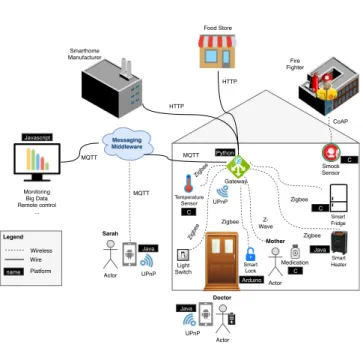
Figure 1 depicts a typical Smarthome (SH). This is a common network-based IoT application that will be used throughout the paper to illustrate the utility of our framework. No-tice that heterogeneous computing platforms (e.g., C, Java, Python) and communication protocols (e.g, MQTT, UPnP, Zigbee, HTTP, CoAP) are used.
The gateway is running a Python program on top of a Raspberry Pi equipped with a Zigbee chip [35]. The latter establishes a Point to Point (PtP) communication with other Zigbee-ready IoT things. The Temperature Sensor (TS) and the Smart Fridge (SF) are programmed using a standards-compliant C program. The Smart Lock (SL) is running on top of Arduino and the Smart Heating and Ventilation System (SHVS) is programmed using a Java program. All these IoT things are equipped with a Zigbee chip to communicate wirelessly with the gateway.
1https://www.eclipse.org/Xtext/ 2https://github.com/atlanmod/CyprIoT Messaging Middleware Actor Smart Heater Gateway Smart Lock Temperature Sensor Monitoring Big Data Remote control ... Wireless Wire Legend Sarah Actor Mother Smart Fridge Zigbee Zigbee Zigbee Zigbee MQTT MQTT MQTT Z-Wave Smock Sensor CoAP Fire Fighter Smarthome Manufacturer HTTP UPnP UPnP Actor Doctor UPnP HTTP Food Store name Platform Javascript C Python Arduino Java C Java C C Medication Light Switch Zigbee Java
Figure 1: Smarthome, usecase of an IoT application
Bob, the owner of the SH, has an Android phone that is running a Java app. Alice, his mother, is an elderly per-son. She suffers from a Parkinson disease and has to take medications every day on a regular basis.
The gateway also handles dynamic connections using Uni-versal Plug and Play (UPnP). When Bob is at home, his phone communication switches dynamically to connect lo-cally to the gateway using UPnP. An authorized doctor can also control the gateway to access the SH and treat Bob’s mother when Bob is away.
Additionally, the city requires a battery powered Fire and Smoke Sensor (FSS) in all SHs. Given its constrained re-sources, the FSS uses a standards-compliant C program and an energy-efficient communication on top of Constrained Ap-plication Protocol (CoAP). Furthermore, for security reasons, it should not be connected to the local network, so that in case of an outage in the local network, it can still notify the Fire Station (FS). The c i t y P o l i c y requires that when the sensed temperature reaches certain threshold, the system should automatically inform the local authorities.
To benefit from the SH manufacturer maintenance service, the gateway should post the telemetry data using Hypertext Transfer Protocol (HTTP), in case an intervention is needed. The m a n u f a c t u r e r P o l i c y requires that in case of a mal-function in the network, the gateway should automatically notify the manufacturer via a dedicated channel. We presume that the gateway holds a property containing the status of the network.
The gateway sends the sensors data to a private Publish and Subscribe (PubSub) messaging middleware accepting Message Queuing Telemetry Transport (MQTT). The gate-way translates the Zigbee data into MQTT or HTTP depend-ing on the receiver. Usdepend-ing his phone Bob can then control the SH remotely and monitor the activity of his mother.
CyprIoT : Framework for Modelling and Controlling Network-Based IoT ApplicationsConference’17, July 2017, Washington, DC, USA
To make our application ”smart”, we can draw the follow-ing simple or conditioned scenarios :
Scenario 1 : Bob needs to monitor his mother remotely. Scenario 2 : An outage in the network requires the inter-vention of the manufacturer.
Scenario 3 : The SH is on fire, local authorities need to be notified.
Scenario 4 (conditioned) : The smoke sensor notifies the firefighters when the temperature sensor is greater than a given value.
Scenario 5 (conditioned) : If an external phone tries to connect to the gateway using UPnP between 22:00 and 09:00, then reject its requests.
Scenario 6 (conditioned) : If the fridge contains less than 2 milk packs, then notify the food store to deliver new packs.
Scenario 7 (conditioned) : If Bob’s mother forgets to take her medications before 16:00, then email the doctor.
Scenario 8 (conditioned) : The food store does not deliver food as usual, even when the fridge is empty, this is because the presence sensor did not detect any activity for a while in the house, nobody is at home to take the delivery. Finally, to provide meaningful insights for Bob about the activity of its SH, all the sensed data is sent to a web-based analytics platform designed with Javascript.
In fact, a SH, as many network-based IoT applications, consists of 1) a network of heterogeneous things connected using heterogeneous protocols and 2) a set of smart scenar-ios and policies, defined by some entities, to determine or supervise the behavior of the network.
Further, the SH application along with these scenarios and policies will be modeled within CyprIoT framework. It is worth noting that, in such usecase authentication, privacy and trustworthiness are essential, however they are beyond the scope of this paper.
3
NETWORKING LANGUAGE
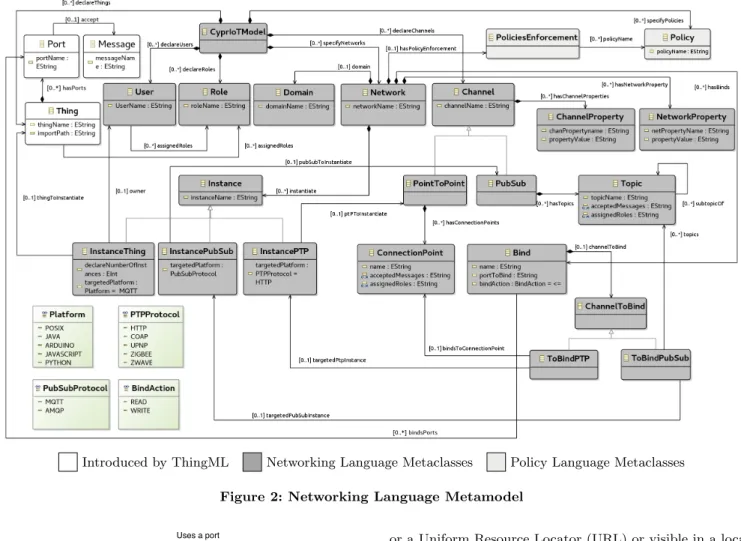
In this section we present our first main contribution of the paper, a Networking Language which consists of connecting various IoT things. Figure 2 depicts the metamodel of the proposed abstractions of the language. On another note, to clearly position our work w.r.t the state of the art, we attached the core concepts of the existing work (White) in this area. We also created a link with the Policy Language (Light Gray) that will be the subject of the next section.
Moreover, Listings 2 and 3 present the network model of the SH application local communications.
3.1
Thing
We assume that an IoT thing behavior is modeled using ThingML [17]. The latter provides a DSL to model an IoT thing behavior using a statechart. Each state has a transition specifying its next state. In addition, a thing can communicate with the outside world using a port. For instance, as shown in Figure 3, the TS uses a port in theSendTemperaturestate to disseminate its sensed data.
1 // User declaration 2 user Bob 3 user Alice 4 //Role declaration 5 role sensor 6 role actuator
7 // Import of ThingML models
8 thing homeGateway import ’gateway.thingml’ assigned sensor 9 thing temperatureSensor import ’temperature.thingml’ assigned sensor 10 thing smartFridge import ’fridge.thingml’ assigned sensor, actuator 11 thing smartHeater import ’heater.thingml’ assigned actuator 12 thing bobPhone import ’phone.thingml’ assigned sensor, actuator 13 thing smokeDetector import ’smocksensor.thingml’ assigned sensor 14 thing medicationBottle import ’medication.thingml’ assigned sensor
15 thing lightSwitch import UNKNOWN assigned actuator
16 // Import of Arduino code
17 thing smartLock import ’lockmodel.ino’ assigned sensor, actuator
Listing 1: Declaration of things
The Networking Language offers a means of designing a network in a readable fashion using high-level abstractions. Listing 1 depicts the declaration of the things in the SH usecase. For instance, the linething temperatureSensor import ”temperature.thingml”assigned sensor, imports the model (i.e ThingML statechart) of the TS.
Notice that thesmartLock sensor is sourced from a con-crete code (i.e Arduino code), while all other models are sourced from ThingML models. In fact, there are two ways to source the behavior of an IoT thing. The first way consists of loading a ThingML model describing the behavior in the form of a statechart. The second way consists of sourcing the behavior from a concrete source code (e.g., C, JAVA). The latter requires a step further that consists of converting the imported code into a ThingML model (See Section 5.2). That is because our framework needs to work only with ThingML models.
For the sake of interoperability, it is also possible to declare an IoT thing without sourcing it with a behavior, as it is the case for thelightSwitch actuator that is using the keyword
UNKNOWN, meaning that the behavior is not provided. If a communication is specified in the network model, ports of other things are configured to communicate with it. For instance, lightSwitch thing uses an unknown program that sends a message to thelightTopic. Thus, if another thing is configured to retrieve the information from thelightSwitch
sensor, then it will be configured to subscribe to thelightTopic.
3.2
Channel
The utility of achannel concept arises because of the need to assemble various IoT things without concerns about the concrete details of their communications such as the protocol or the message format. In addition, this also helps easing things collaboration.
We performed a bottom-up analysis on IoT data protocols. Then, we have drawn their commonalities that we reify in the concept ofchannel. Indeed, it is the medium that exists between two IoT things enabling a communication. We iden-tified two main channel types :channel:pubsubchannels and
Introduced by ThingML Networking Language Metaclasses Policy Language Metaclasses Figure 2: Networking Language Metamodel
Initiliaze Sensor Initialized SendTemperature TemperatureSent SenseTemperature TemperatureSensed RegulateSamplingRate Timeout Uses a port for sending
Figure 3: Temperature sensor statechart
channel:ptp. Other channels may also be found in some IoT applications, but they are quite little used.
The former type is often used when IoT things have to communicate in a decoupled manner and does not necessarily need to know each other, as it is the case withbobPhoneand thegatewaythat are communicating through MQTT. Those things only need to know the information about the broker that acts as an intermediary between them.
The latter type, in the other hand, is used when the IoT thing is accessible via a public interface, such as an IP address
or a Uniform Resource Locator (URL) or visible in a local network, so that another IoT thing can connect to it and get its data. In effect, this is the case for thesmartFridgeand thegateway, that are communicating through achannel:ptp, namely Zigbee.
As depicted in Figures 2 and 3, ThingML uses ports for external communications. Typically, two IoT things can com-municate only if they have compatible ports. In other words, they can understand each other only if they exchange the same type of messages. For instance, creating a bind from thetemperatureSensorto thesmartLockwill not work, as the
smartLock is not expected to understand the temperature messages, while connecting it to thesmartHeatershould work as it has a port that accepts this type of messages.
In our Networking Language, thechannelcan be typed, so that we can ensure ports compatibility. A warning is fired in the user interface whenever a channel is connecting incompat-ible ports, that way an engineer can prevent communication incompatibility bugs early in the engineering process. For in-stance, in Listing 2, presume that thetemperatureSensorsends a message of typetemperatureMessageto thesmartHeaterthat has a port accepting thetemperatureMessage, then to ensure a compatible communication, the intermediarytopicneeds to be typed with atemperatureMessage(Line 25 in Listing 2).
CyprIoT : Framework for Modelling and Controlling Network-Based IoT ApplicationsConference’17, July 2017, Washington, DC, USA
1 channel:ptp manufacturerChannel {
2 connectionPoint smartHomeState
3 }
4 channel:ptp foodStoreChannel {
5 connectionPoint isFoodMissing (foodMessage)
6 }
7 channel:ptp fireChannel {
8 connectionPoint fireNotification(fireSensorMessage)
9 }
10 channel:ptp zwaveHomeChannel {
11 connectionPoint medication (medicationMessage)
12 }
13 channel:ptp upnpHomeNodes {
14 connectionPoint anyUpnpDevice (upnpMessage)
15 }
16 channel:ptp gatewayChannel {
17 connectionPoint temperature (temperetureMessage)
18 connectionPoint lock (SmartLockMessage)
19 connectionPoint heater (heaterMessage)
20 connectionPoint fridge (smartFridgeMessage)
21 connectionPoint fridge (lightMessage) subtopicOf indoor
22 }
23 channel:pubsub broker {
24 topic indoor
25 topic temperatureTopic (temperetureMessage) subtopicOf indoor
26 topic lockTopic (stateMessage) subtopicOf indoor
27 topic heaterTopic (heaterMessage) subtopicOf indoor
28 topic fridgeTopic (fridgeMessage) subtopicOf indoor
29 topic medicationTopic (medicationMessage) subtopicOf indoor
30 topic lightTopic (lightMessage) subtopicOf indoor
31 }
Listing 2: Declaration of communication channels
3.3
Network
After declaring things and channels, a network can then be configured using the keywordnetwork. Listing 3 shows the configuration of the SH network. Thenetworkhas adomain
that is unique and serves as a global identifier for the network. For instance, in our running case we use the domain in the topic structure as the root topic of the channel. Thenetwork
also contains the instantiation of IoT things and channels as well as their bindings. The platform running aninstance
can also be declared. For instance, as stated in Line 7, thegatewaything is running on top of PYTHON, while the
privateBrokerchannel, in Line 15, is running on top ofMQTT. A thinginstancecan have anowner, that is the user holding all the privileges over the thing. This may be used by the Policy Language for control purposes (See Section 4). Abind
declaration connects a thing’s port to a PubSub or PtP channel, respectively through atopicor aconnectionPoint.
In many network-based IoT applications, data have to pass through an intermediary IoT thing before reaching its final destination. This is the case with thegateway, that forwards the sensed data to the privatebroker to be received by Bob via thechannel:pubsub. For this specific case, we propose the concept ofbridge. It can forward an existing communication (i.ebind) to atopicor a connectionPoint. Line 42-46 create a
bridgefor each of the sensed data that Bob should receive. On another note, it is also possible to enforce abridgeas a rule. This is discussed in Section 4.5.
1 network smarthomeNetwork {
2 // Domain of the network
3 domain fr.nantes.bobSmarthome
4 // Enforfing all policies
5 enforce cityPolicy, homePolicy, manufacturerPolicy, rolePolicy 6 // Instanciating IoT things
7 instance gateway:homeGateway owner Bob platform PYTHON
8 instance ts: temperatureSensor owner Bob platform CPOSIX
9 instance sl: smartLock owner Bob platform ARDUINO
10 instance sh: smartHeather owner Bob platform JAVA
11 instance sf: smartFridge owner Bob platform CPOSIX
12 instance mb: medicationBottle owner Alice platform CPOSIX
13 instance sp: bobPhone owner Bob platform JAVA
14 // Instanciating channels
15 instance privateBroker: broker platform MQTT
16 instance zigbeeHomeNodes: gatewayChannel platform ZIGBEE
17 instance zwaveHomeNodes: zwaveHomeChannel platform ZWAVE
18 instance zwaveHomeNodes: zwaveHomeNodes platform UPNP
19 instance manufacturerHttp: manufacturerChannel platform HTTP
20 instance foodstoreHttp: foodStoreChannel platform HTTP
21 instance firefighterCoap: fireChannel platform COAP
22 // Binding IoT things to their connectionPoints in the smarthome
23 bind ts.sensedData => zigbeeHomeNodes.temperature
24 bind sl.sensedData => zigbeeHomeNodes.lock
25 bind sh.sensedData => zigbeeHomeNodes.heater
26 bind sf.sensedData => zigbeeHomeNodes.fridge
27 bind mb.sensedData => zwaveHomeNodes.medication
28 // Binding all connectionPoints to the gateway in a star fashion
29 bind gateway.ZigbeePort <= zigbeeHomeNodes.*
30 bind gateway.ZwavePort <= zwaveHomeNodes.medication
31 bind gateway.UpnpPort <= zwaveHomeNodes.anyUpnpDevice
32 // Binding to the manufacturer connectionPoint
33 bind gateway.manufacturerPort => manufacturerHttp.
smartHomeState
34 // Binding to the foodStore connectionPoint
35 bind gateway.foodStorePort => foodstoreHttp.isFoodMissing 36 // Monitoring the smarthome from Bob’s phone
37 bind fridgeBind: sp.fridgeData <= privateBroker{fridgeTopic} 38 bind heaterBind: sp.heaterData <= privateBroker{heaterTopic} 39 bind lockBind: sp.lockData <= privateBroker{lockTopic} 40 bind temperatureBind: sp.temperatureData <= privateBroker{
temperatureTopic}
41 // Bridging data from the gateway to the private broker
42 bridge fridgeBind to privateBroker{fridgeTopic}
43 bridge heaterBind to privateBroker{heaterTopic}
44 bridge lockBind to privateBroker{lockTopic}
45 bridge temperatureBind to privateBroker{temperatureTopic}
46 bridge fridgeBind to privateBroker{fridgeTopic}
47 // Fire Fighter notification
48 instance sd: SmockDetector owner Bob platform CPOSIX
49 bind sd.fireFighterPort => firefighterCoap.fireNotification
50 }
Listing 3: Configuration of the Smarthome network (=> send, <= receive)
4
POLICY LANGUAGE
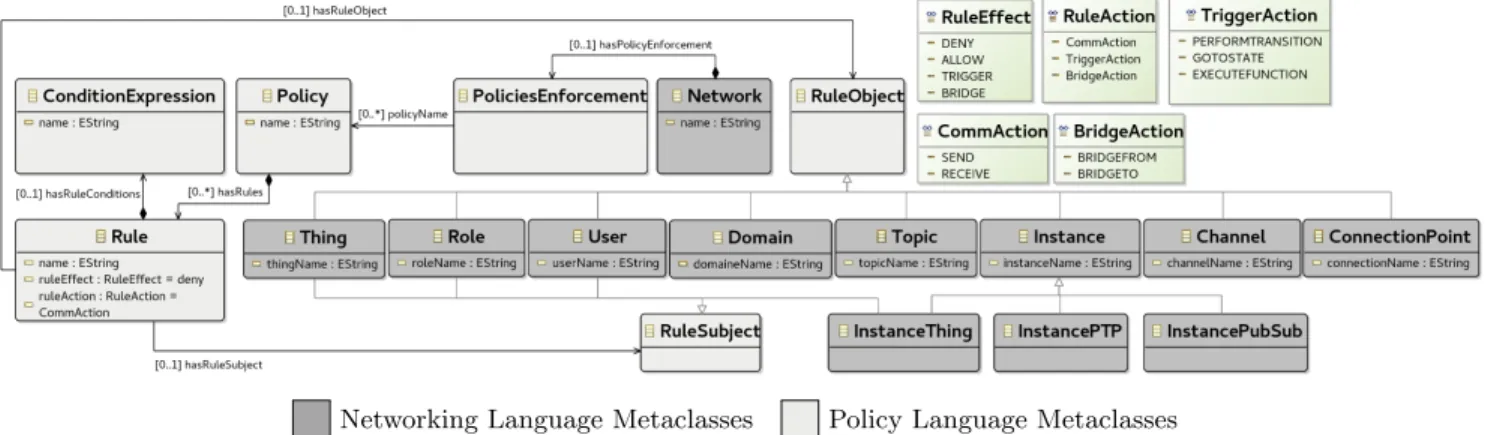
The second main contribution is a Policy Language which enables to control the modeled network. Figure 4 depicts the metamodel of the proposed abstractions. This section describes how a policy can be expressed. In Section 5 we will treat how it can be enforced.
4.1
Policy
Apolicycontains a set of rules that can be enforced by the Code Generator (CG). We presume that policies are similar to contracts. They ensure that the IoT application is behaving as expected from the perspective of a given entity such as the government, the SH owner or the manufacturer. Within
Networking Language Metaclasses Policy Language Metaclasses Figure 4: Policy Language Metamodel
our DSL, we presume that the policy can access the declared IoT thing’s internal behavior, modeled a priori.
Moreover, we permit the enforcement of many policies in the same network. For instance, in our running case, as shown in Listing 3 we enforce acityPolicy, ahomePolicyand amanufacturerPolicy. As of today, rule conflict management has not been investigated, although it is contemplated in our future work.
4.2
Rule Structure
Listing 4 depicts the syntax of a rule. It is composed of 5 elements - Subject, Effect, Action, Object and Condition(s). The latter is optional. Table 1 depicts different attributes of those elements and how they can be combined with each other.
1 rule <Subject> <Effect>:<Action> <Object> when <Condition>.
Listing 4: Rule syntax
4.3
Trigger
To implement some of the SH scenarios, we may need to trigger some actions under some conditions. This if often referred as the ”smart” dimension of the IoT. Our Policy Language allows defining such rules.
A trigger rule can activate two actionsTransitionthat per-forms the transition of a given state on a thing andGoToState
that instruct the thing to go to a specific state. Those actions can be conditioned by theCurrentStateof a subject thing, i.e. to be able to activate an action whenCurrentStateof a subject thing is of a given value, or byNextState, i.e. to be able to activate the action if is next state is of a given value.
For instance, in Line 15 of Listing 5 themedicationBottle
triggersGoToStateingatewayto email the doctor when the medication has not been taken. We presume that the email state in the gateway is a routine handling sending the email.
4.4
Permission
By default, we presume that unless a rule is allowing IoT things to communicate, all the communications are denied. A permission allow/deny a communication between two entities. When the subject is a user, it applies to all the things owned by this user. While when the subject is a role, it applies to all things being assigned this role.
In the SH application, we apply a basic role-based policy that allows sensors to send only, and actuators to receive only, as these are the normal communication actions they are supposed to achieve. Also, in Line 16 we deny commu-nicating any information to thehttpChannelchannel, i.e the food store, typically for asking for a new milk delivery, when thepresenceSensordoes not detect any activity for more than 1 day.
4.5
Bridge
A bridge rule enforces a behavior similar to the one described previously (See Section 3.3). However, it is not intended to forward an existing communication in thenetwork. Rather, it applies a forward globally on types such as a topic or aconnectionPoint. Then, if those types are used within the network, the bridge will be enforced. For instance, a bridge rule can specify that any information received by a given thing or topic, has to be received by a thing, or that any information received by a thing to be received by another thing too.
4.6
Control Types
The rules permit to apply two types of control :
∙ Communication Control: This consists of a Deny/Al-low of sending or receiving messages between two en-tities. The message content may be used for dynamic control, i.e controlling the message flow while the net-work application is running. For instance, we may deny sending a message when it takes certain value, in a PubSub communication this is known as content-based PubSub [28].
CyprIoT : Framework for Modelling and Controlling Network-Based IoT ApplicationsConference’17, July 2017, Washington, DC, USA Table 1: Rule Attributes
Subject Effect Action Object Conditions Control Type Thing
Thing Instance Role User
Trigger GoToStateTransition Thing CurrentStateNextState Thing Behavior
Thing Thing Instance
User Role
Allow Deny ReceiveSend
Domain Thing Role User Channel Topic ConnectionPoint Messages Property Communication Thing Thing Instance Topic ConnectionPoint Bridge FromTo Thing Thing Instance Topic ConnectionPoint CurrentState NextState Messages Communication
∙ Thing Behavior Control As stated earlier, the be-havior of a thing is modeled using a statechart. In that respect, those rules aim at controlling the behavior specified in this statechart. For instance, a rule can trigger that a given thingGoToStateA when another thing’sCurrentStateis B.
1 policy roleBasedPolicy {// Role−Based policy
2 rule sensor allow:send channel:gatewayChannel, broker
3 rule actuator allow:receive channel:gatewayChannel, broker
4 }
5 policy cityPolicy{// Scenarios 3 & 4 (In order)
6 rule temperatureSensor trigger:goToState
7 smokeDetector.notifyState when
8 property:currentTemperature>25
9 }
10 policy homePolicy{// Scenarios 5, 6, 7, 8 (In order)
11 rule homeGateway.UpnpPort deny:send bobPhone when
12 property:(bobPhone.id!=bobIDXXXX || bobPhone.id!=
aliceIDXXXX) and
13 property:(homeGateway.currentHour>22 && homeGateway. currentHour<9)
14 rule homeGateway trigger:goToState homeGateway.
notifyMilkState when message:homeGateway.milkPack<2
15 rule medicationBottle trigger:goToState homeGateway.emailState
when property:medicationBottle.medicationTaken==false and property:homeGateway.currentHour>16
16 rule homeGateway.askMilk deny:send channel:httpChannel when
17 message:homeGateway.milkPack<2 and
18 message:homeGateway.presenceSensor==false and
19 property:homeGateway.presenceDay>1
20 }
21 policy manufacturerPolicy{// Scenario 2
22 rule homeGateway trigger:goToState homeGateway.notifyState
when property:isNetworkWorking==false
23 }
Listing 5: Definition of policies
5
CODE GENERATION
Our last main contribution is a CG along with a plug-in system to leverage the network model designed with the DSL. It consists of generating deployable code implementing the network configuration as well as the enforced policies. In this section, we explain its main building blocks, how the network artifacts are generated and how it can be extended with expert knowledge.
IoT Application Artifacts Plugins Access Control Data consistency Etc... Code Generator Domain-specific language Policy language Networking language Interpret Produce ThingML models Import Concrete Code (e.g, Arduino) CG-Core Initiliaze
Phases LoadValidate Transform Generate Hook Network Generator Command Line Interface Plugins Loader
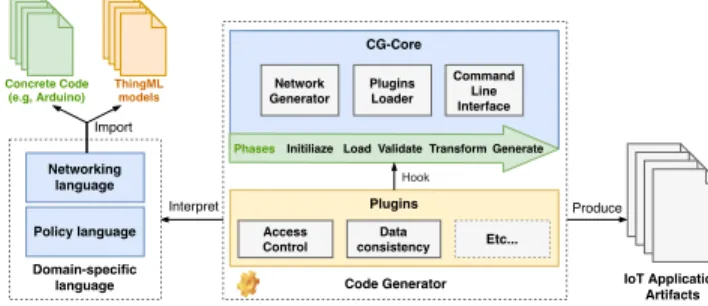
Figure 5: CyprIoT Framework building blocks
5.1
Architecture
Figure 5 depicts the main building blocks of CyprIoT frame-work. Our proposed DSL, composed of the Networking and Policy Languages, serves to express with high-level abstrac-tions the model of a network-based IoT application. This model is then interpreted by the CG that is responsible for producing deployable network artifacts.
The core of the CG (CG-Core) is composed of three modules- Network Generator NG), Plug-in Loader (CG-PL) and a Command Line Interface (CG-CLI).
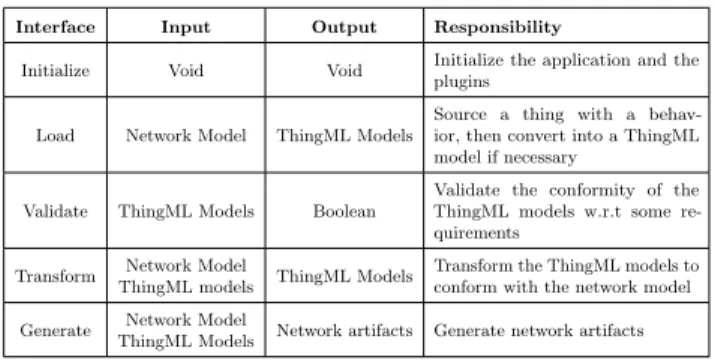
The CG-NG processes the network model following a se-quence of phases executed in order. Those phases are executed according to this specific order : Initialize, Load, Validate, Transform, Generate. Each phase has a responsibility that is depicted in table 2. The CG-NG module renders transformed ThingML models implementing what was specified in the network model. Then, using ThingML multi-platform code generator as a library, deployable code can be generated for any platform (e.g., Java,C). As of today, we concentrated our efforts into the five former phases, in the future we plan to add two more phases : Verify, to test and certify the confor-mity of the generated artifacts w.r.t the network model and Deploy, to automatically deploy the generated artifacts into a running network.
The CG-PL, is responsible of loading plug-ins that are hooked into CG-Core. In order to be recognized, a plug-in needs to be declared in a configuration file. This module is discussed in Section 5.3.
The CG-CLI offers a means to use our CG as a standalone application. It expects a declaration of the input network model along with some optional arguments. Then, based on those elements, the CG is executed to produce the IoT network artifacts.
This design choice (i.e Modular Design) is motivated by the need to ease extensibility an separation of concerns. Thus, our CG does not implement expert knowledge but offer mech-anisms to implement it by experts using plug-ins.
5.2
Model Loading
Our CG uses ThingML3, which is also an open source tool, to load and process the behavior of a thing.
Table 2: Code generator extension points
Interface Input Output Responsibility
Initialize Void Void Initialize the application and the plugins
Load Network Model ThingML Models
Source a thing with a behav-ior, then convert into a ThingML model if necessary
Validate ThingML Models Boolean
Validate the conformity of the ThingML models w.r.t some re-quirements
Transform Network Model
ThingML models ThingML Models
Transform the ThingML models to conform with the network model Generate Network Model
ThingML Models Network artifacts Generate network artifacts
It is possible to load a behavior from a concrete code, as long as its can be transformed into a ThingML format. A plug-in may be needed for that purpose.
As a proof-of-concept, we developed a simple plug-in that we hook to the Load phase. It loads an Arduino file, finds its external communication interfaces (e.g., MQTT Publish/Sub-scribe commands), then renders a ThingML file encapsulating the behavior intended in the concrete code, and abstracting its communication interfaces into ports so that they can be bound to any channel within the Networking Language, as it is the case for a model-based thing behavior. As of now, we can only identify the interfaces written in a certain format. This feature may enable interoperability with traditional approaches and will be extended in future work.
5.3
Plug-in System
Table 2 shows the available interfaces for plug-ins. Each interface corresponds to a phase, it accomplishes a specific task, and impose a specific input and output. A typical network-based IoT application may involve several expertises (e.g., Safety, Access Control, Data Consistency), the plug-in system aims at providing experts a way to create a plug-in implementing their concerns in the network artifacts. For instance, as a proof-of-concept, we implemented a simple plug-in to generate access control rules for a Mosquitto broker. We hook the plug-in to the Generate phase that provides us with the network model as well as the things’ internal behavior in a ThingML format, we leverage those inputs to produce a consistent access rules to be enforced in the broker.
6
RELATED WORK
ThingML [17] proposes a methodology for the IoT using established MDE techniques [24]. The language has shown its efficiency at abstracting hardware and programming lan-guages [23, 32]. The approach provides a DSL to design the IoT things’ internal behavior using statecharts and an exten-sible multi-platform code generation framework. The latter also provides a plug-in system to add a network client to IoT things. However, abstractions w.r.t communication are rather minimal in the DSL, simply consisting in declaring the used protocol and its attributes. In other words, the proposed lan-guage does not offer abstractions capturing network aspects
such the communication channel that can be used between IoT things.
Salihbegovic et. al [26] present a Visual Domain-Specific modelling Language (VDSML) based on a JavaScript editor. It aims at giving an IoT engineer a user interface to virtually design an IoT system. Only a set of predefined IoT things are available to use within the editor. The tool is able to generate a configuration file for IoT platforms, namely OpenHab [21]. However, the formal specification of the language such as the metamodel is missing. The language is not enough generic as only a limited set of IoT things can be modeled. By using a statechart-based solution in our framework, we can theoretically model any IoT thing behavior.
Node-red [19] is a flow-based visual tool that aims to connect various interfaces of IoT things. The tool focuses only on the connection of already-deployed IoT nodes. Its basic idea is to map the output of an IoT thing to the input of another, this mapping is made inside the platform running Node-red. Such method is useful only to create a ”mashup” [5, 18, 20] of existing services. The approach does not provide a model of the network. Controlling the behavior of an IoT thing as well as code generation are not provided. While our framework not only provides a model of the running network, but it is also capable of controlling the network using a Policy Language.
Fuch et. al [12] propose to program an IoT thing using a UML2 Activity Diagram (UAD). The behavior of an IoT thing is designed in the form of an activity. The latter is transformed into a script in order to be executed by an inter-preter running on the IoT thing. Activities can communicate between each with their input/output interfaces via a pro-totypical communication protocol. However, the approach focuses on the advantages of UADs to ease collaboration between IoT things and does not discuss the heterogeneity of their communications. Moreover, only one IoT thing platform (SUN Spot [29]) has been considered in their study.
Amrani et. al [1] introduce a DSL to design a network of IoT things. The language allows to declare the possible actions of an IoT thing. Those actions need to be mapped to concrete events in the target platform. The DSL is ac-companied by a rule-based policy language to trigger actions when certain conditions are met. The communication between IoT things is not conceptualized in the DSL metamodel, it consists of specifying a connection of an IoT thing to a spe-cific protocol, which creates a hard coupling between the abstract representation and the concrete representation. In our DSL, we aim at bypassing communication heterogeneity by abstracting commonalities of prominent IoT protocols in the concept of channel. Moreover, code generation is not discussed in their work.
Bertran et. al [4] present a tool based on the Sense/Com-pute/Control (SCC) paradigm [8]. It consists of a DSL, a generator of Java code, a simulator and a deployment frame-work. Although, the DSL abstracts the specification of an IoT thing, we still need to implement its behavior in Java after code generation. The framework assumes that IoT things are
CyprIoT : Framework for Modelling and Controlling Network-Based IoT ApplicationsConference’17, July 2017, Washington, DC, USA
capable of running Java, which is not the ideal choice in most IoT scenarios.
Glombitza et. al [14] provide an approach to model an IoT thing as a web service, so that it can interoperate with existing ones. Using a state machine based DSL, it is possible to compose these web services. The DSL comes with a code generator that generates C++ code. Communication hetero-geneity is not considered, it is assumed that a communication uses their own protocol [13].
Eclipse Vorto [9] provides a solution to abstract the thing capabilities into functions. A function consists of a set of attributes and a set of operations using the attributes. The functions are grouped inside a model to describe the behavior of the thing. Code generators for various platforms permit to produce code from this model. The solution also offers a repository to share and reuse models and code generators. Compared to ThingML, modeling the thing behavior is lim-ited, only few operations are achievable. Communication is not modeled.
Einarsson et. al [11] propose a DSL dedicated to design smarthomes applications. It describes the interaction of an IoT thing with cloud platforms. The authors assume that all IoT things communicate using a ”uniform communica-tion interface”. A model-to-text transformacommunica-tion is applied to the smarthome model to generate code. This procedure is not extrapolated. Moreover, only interactions with a cloud platform are considered, meaning that local home network communications are not covered.
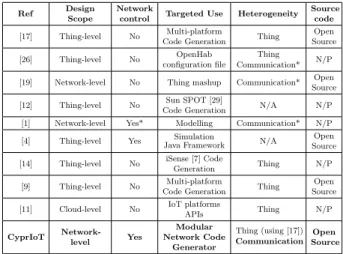
In table 3 we compare the existing MDE approaches for the IoT. The second column specifies the scope of their modeling solution, while the fifth column describes the kind of het-erogeneity covered. Many research studies has been tackling extensively the heterogeneity of IoT things. Their main con-tributions in that respect is by providing concepts to model the internal behavior of an IoT thing. The ability of design-ing and controlldesign-ing a network of IoT thdesign-ings is understudied, only a few of these approaches tackle the heterogeneity of communication, yet in a limited way.
7
DISCUSSIONS
According to our empiric experimentations, the approach has proven that we may need less time to generate a working network of IoT things, however we still need to evaluate this using measuring instruments. We remark that the generated network is less error-prone and more robust as they are the result of an automatic process.
The plug-in system eases the extensibility of the framework, features that are not provided by the core of our CG can be easily added. For instance a security layer may be added as a plug-in to enhance the security of the network.
Using CyprIoT, an IoT engineer needs to learn less low-level and hard skills to build a network-based IoT application. Abstracting the heterogeneity of the communication channels enables better collaboration of IoT things and offers better control over the communication by leveraging the rule-based Policy Language.
Table 3: Comparison of existing approaches
Ref Design Scope
Network
control Targeted Use Heterogeneity Source
code [17] Thing-level No Multi-platform
Code Generation Thing
Open Source [26] Thing-level No OpenHab configuration file Thing Communication* N/P [19] Network-level No Thing mashup Communication* Open Source [12] Thing-level No Sun SPOT [29]
Code Generation N/A N/P [1] Network-level Yes* Modelling Communication* N/P [4] Thing-level Yes Simulation
Java Framework N/A
Open Source [14] Thing-level No iSense [7] Code
Generation Thing N/P [9] Thing-level No Multi-platform
Code Generation Thing
Open Source [11] Cloud-level No IoT platforms
APIs Thing N/P CyprIoT Network-level Yes Modular Network Code Generator Thing (using [17]) Communication Open Source
N/A : Not Applicable — N/P : Not Provided — (*) Limited
Besides the usecase presented in this paper. Our approach may have other applications, for instance, it could be lever-aged for security in collaborative systems such as implement-ing an advanced access control [30] within the proposed Policy Language.
Some limitations may disprove our approach. In some specific cases we still need to look at the low-level details to understand how we can establish a reliable communication between two IoT things. We tested our approach only for few communication channels. This means that our approach is still not systematic. Also, only ThingML models were considered as source models, this was the most advanced DSL we could find to model a thing’s internal generically. Moreover, as of today, IoT things sourced from a concrete code may still need to have their interfaces written in a specific format in order to be used in the network model, which limits the possibilities of bindings.
8
CONCLUSION
An IoT network application involves heterogeneous comput-ing platforms and communication protocols. Commonly, each protocol is designed to fit a specific range of IoT things. We conducted this study to find means to connect heterogeneous IoT things as well as control mechanisms to design smart and realistic IoT applications in a unified manner. Thus, exempting IoT engineers from learning transversal skills and focus only on the business logic of their network-based IoT application.
MDE is a promising paradigm to tackle the ubiquitous heterogeneity in the IoT. In this paper, we showed that by abstracting the common concepts of similar technologies and separating the engineering knowledge from the technical knowledge, we exempt the developer from the need to look at the low-level details, that are time-consuming and provide less value compared with the logic of the whole network-based IoT application.
CyprIoT, the framework introduced in this paper, provides MDE instruments to develop network-based IoT applications. It consists of a readable Networking Language to enable modelling the IoT application globally, a Rule-Based Policy Language to control the modeled application and a modu-lar and extensible Code Generator to generate deployable network artifacts. The code generation process is divided into phases. Each phase has a specific responsibility to ease extensibility and separate concerns. In addition, a plug-in system is conceptualized to allow experts to implement their knowledge in the generated artifacts.
In future work, we aim to make the DSL more readable, expressive, and interoperable. We will also work on the verifi-cation of the generated artifacts and we envision easing their deployment. Finally, we will continue improving the overall architecture of the framework with better modularity.
9
ACKNOWLEDGEMENTS
We acknowledge the support of Institut Mines-T´el´ecom At-lantique and the Natural Sciences and Engineering Research Council of Canada (NSERC), 06351.
Cette recherche a ´et´e financ´ee par l’Institut Mines-T´el´ecom Atlantique et le Conseil de recherches en sciences naturelles et en g´enie du Canada (CRSNG), 06351.
REFERENCES
[1] Amrani, M., Gilson, F., Debieche, A., Englebert, V.: Towards user-centric dsls to manage iot systems. In: MODELSWARD. pp. 569–576 (2017)
[2] Atzori, L., Iera, A., Morabito, G.: The internet of things: A survey. Computer networks 54(15), 2787–2805 (2010)
[3] Basin, D., Clavel, M., Egea, M.: A decade of model-driven security. In: Proceedings of the 16th ACM symposium on Access control models and technologies. pp. 1–10. ACM (2011)
[4] Bertran, B., Bruneau, J., Cassou, D., Loriant, N., Balland, E., Consel, C.: Diasuite: A tool suite to develop sense/compute/con-trol applications. Science of Computer Programming 79, 39–51 (2014)
[5] Blackstock, M., Lea, R.: Iot mashups with the wotkit. In: Internet of Things (IOT), 2012 3rd International Conference on the. pp. 159–166. IEEE (2012)
[6] Blair, G., Bencomo, N., France, R.B.: Models@ run. time. Com-puter 42(10) (2009)
[7] Buschmann, C., Pfisterer, D.: isense: A modular hardware and software platform for wireless sensor networks. 6. Fachgespr¨ach Sensornetzwerke p. 15 (2007)
[8] Cassou, D., Balland, E., Consel, C., Lawall, J.: Leveraging software architectures to guide and verify the development of sense/com-pute/control applications. In: Proceedings of the 33rd Interna-tional Conference on Software Engineering. pp. 431–440. ACM (2011)
[9] Eclipse: Eclipse Vorto - IoT Toolset for standardized de-vice descriptions, http://www.eclipse.org/vorto/documentation/ overview/introduction.html
[10] Egham, U.: Gartner says 8.4 billion connected” things” will be in use in 2017, up 31 percent from 2016. Gartner, Inc 7 (2017) [11] Einarsson, A.F., Patreksson, P., Hamdaqa, M., Hamou-Lhadj, A.:
Smarthomeml: Towards a domain-specific modeling language for creating smart home applications. In: Internet of Things (ICIOT), 2017 IEEE International Congress on. pp. 82–88. IEEE (2017) [12] Fuchs, G., German, R.: Uml2 activity diagram based
program-ming of wireless sensor networks. In: Proceedings of the 2010 ICSE Workshop on Software Engineering for Sensor Network Applications. pp. 8–13. ACM (2010)
[13] Glombitza, N., Pfisterer, D., Fischer, S.: Integrating wireless sensor networks into web service-based business processes. In: Proceedings of the 4th international Workshop on Middleware
Tools, Services and Run-Time Support For Sensor Networks. pp. 25–30. ACM (2009)
[14] Glombitza, N., Pfisterer, D., Fischer, S.: Using state machines for a model driven development of web service-based sensor network applications. In: Proceedings of the 2010 ICSE Workshop on Software Engineering for Sensor Network Applications. pp. 2–7. ACM (2010)
[15] Gluhak, A., Krco, S., Nati, M., Pfisterer, D., Mitton, N., Razafind-ralambo, T.: A survey on facilities for experimental internet of things research. IEEE Communications Magazine 49(11), 58–67 (2011)
[16] Han, D.M., Lim, J.H.: Design and implementation of smart home energy management systems based on zigbee. IEEE Transactions on Consumer Electronics 56(3) (2010)
[17] Harrand, N., Fleurey, F., Morin, B., Husa, K.E.: Thingml: a language and code generation framework for heterogeneous targets. In: Proceedings of the ACM/IEEE 19th International Conference on Model Driven Engineering Languages and Systems. pp. 125– 135. ACM (2016)
[18] Heo, S., Woo, S., Im, J., Kim, D.: Iot-map: Iot mashup application platform for the flexible iot ecosystem. In: Internet of Things (IOT), 2015 5th International Conference on the. pp. 163–170.
IEEE (2015)
[19] IBM Emerging Technologies: Node-RED. A visual tool for wiring the Internet of Things (2016), http://nodered.org/
[20] Im, J., Kim, S., Kim, D.: Iot mashup as a service: cloud-based mashup service for the internet of things. In: Services Computing (SCC), 2013 IEEE International Conference on. pp. 462–469. IEEE (2013)
[21] Kreuzer, K., et al.: Openhab-empowering the smart home. Open-hab. org, Tech. Rep. (2013)
[22] Mavropoulos, O., Mouratidis, H., Fish, A., Panaousis, E.: Asto: A tool for security analysis of iot systems. In: Software Engineering Research, Management and Applications (SERA), 2017 IEEE 15th International Conference on. pp. 395–400. IEEE (2017) [23] Morin, B., Harrand, N., Fleurey, F.: Model-based software
en-gineering to tame the iot jungle. IEEE Software 34(1), 30–36 (2017)
[24] Mukerji, J., Miller, J.: Mda guide. Object Management Group (2003)
[25] Pescatore, J., Shpantzer, G.: Securing the internet of things survey. SANS Institute pp. 1–22 (2014)
[26] Salihbegovic, A., Eterovic, T., Kaljic, E., Ribic, S.: Design of a domain specific language and ide for internet of things applications. In: Information and Communication Technology, Electronics and Microelectronics (MIPRO), 2015 38th International Convention on. pp. 996–1001. IEEE (2015)
[27] Seralathan, Y., Oh, T.T., Jadhav, S., Myers, J., Jeong, J.P., Kim, Y.H., Kim, J.N.: Iot security vulnerability: A case study of a web camera. In: Advanced Communication Technology (ICACT), 2018 20th International Conference on. pp. 172–177. IEEE (2018) [28] Shen, H.: Content-based publish/subscribe systems. In: Handbook
of Peer-to-Peer Networking, pp. 1333–1366. Springer (2010) [29] Smith, R.B.: Spotworld and the sun spot. In: Proceedings of the
6th international conference on Information processing in sensor networks. pp. 565–566. ACM (2007)
[30] Tolone, W., Ahn, G.J., Pai, T., Hong, S.P.: Access control in collaborative systems. ACM Computing Surveys (CSUR) 37(1), 29–41 (2005)
[31] Trend Micro: TrendLabs Security Intelligence
BlogPer-sirai: New Internet of Things (IoT) Botnet Targets IP
Cameras - TrendLabs Security Intelligence Blog (2017),
http://blog.trendmicro.com/trendlabs-security-intelligence/ persirai-new-internet-things-iot-botnet-targets-ip-cameras/ [32] Vasilevskiy, A., Morin, B., Haugen, Ø., Evensen, P.: Agile
devel-opment of home automation system with thingml. In: Industrial Informatics (INDIN), 2016 IEEE 14th International Conference on. IEEE (2016)
[33] Woolf, N.: Ddos attack that disrupted internet was largest of its kind in history, experts say. The Guardian 26 (2016)
[34] Zhu, Q., Wang, R., Chen, Q., Liu, Y., Qin, W.: Iot gateway: Bridgingwireless sensor networks into internet of things. In: Em-bedded and Ubiquitous Computing (EUC), 2010 IEEE/IFIP 8th International Conference on. pp. 347–352. Ieee (2010)
[35] ZigBee, A.: Zigbee-2006 specification. http://www. zigbee. org/ (2006)