Open Access
Case report
Familial deletion 18p syndrome: case report
Bruno Maranda
1, Nicole Lemieux
2and Emmanuelle Lemyre*
1Address: 1Service de génétique médicale, Département de Pédiatrie, CHU Ste-Justine, Université de Montréal, Montréal, Canada and 2Département
de Pathologie, CHU Ste-Justine, Université de Montréal, Université de Montréal, Montréal, Canada Email: Bruno Maranda - [email protected]; Nicole Lemieux - [email protected]; Emmanuelle Lemyre* - [email protected]
* Corresponding author
Abstract
Background: Deletion 18p is a frequent deletion syndrome characterized by dysmorphic features,
growth deficiencies, and mental retardation with a poorer verbal performance. Until now, five families have been described with limited clinical description. We report transmission of deletion 18p from a mother to her two daughters and review the previous cases.
Case presentation: The proband is 12 years old and has short stature, dysmorphic features and
moderate mental retardation. Her sister is 9 years old and also has short stature and similar dysmorphic features. Her cognitive performance is within the borderline to mild mental retardation range. The mother also presents short stature. Psychological evaluation showed moderate mental retardation. Chromosome analysis from the sisters and their mother revealed the same chromosomal deletion: 46, XX, del(18)(p11.2). Previous familial cases were consistent regarding the transmission of mental retardation. Our family differs in this regard with variable cognitive impairment and does not display poorer verbal than non-verbal abilities. An exclusive maternal transmission is observed throughout those families. Women with del(18p) are fertile and seem to have a normal miscarriage rate.
Conclusion: Genetic counseling for these patients should take into account a greater range of
cognitive outcome than previously reported.
Background
Deletion of the short arm of chromosome 18, del(18p), is now a well established chromosomal aberration. It has been first described by the French geneticist Jean de Grouchy in 1963 [1]. Since then, more than one hundred have been reported [2].
Phenotypic manifestations of this deletion are very sparse at birth. The female to male ratio is 3:2 and birth weight averages 2600 g. The most frequent abnormalities consist of mild to moderate growth deficiency, mental
retarda-tion, microcephaly, ptosis, epicanthal folds, low nasal bridge, hypertelorism and large protruding ears. Holo-prosencephaly and clinodactyly of the fifth finger is observed in about 10% and 20% of the cases respectively. Recent evidences have suggested an association with growth hormone deficiency that responded well to hor-mone supplementation [3]. Mental retardation is mild to severe with an average intellectual quotient (IQ) between 45 and 50. There is a significant discrepancy between ver-bal and non-verver-bal performance, verver-bal performance Published: 14 July 2006
BMC Medical Genetics 2006, 7:60 doi:10.1186/1471-2350-7-60
Received: 04 March 2006 Accepted: 14 July 2006 This article is available from: http://www.biomedcentral.com/1471-2350/7/60
© 2006 Maranda et al; licensee BioMed Central Ltd.
This is an Open Access article distributed under the terms of the Creative Commons Attribution License (http://creativecommons.org/licenses/by/2.0), which permits unrestricted use, distribution, and reproduction in any medium, provided the original work is properly cited.
being more severely affected [2,4,5]. Dystonias are also reported [6].
Most cases of deletion 18p are supposed to originate from
de novo deletions, which accounts for 85% of cases [7].
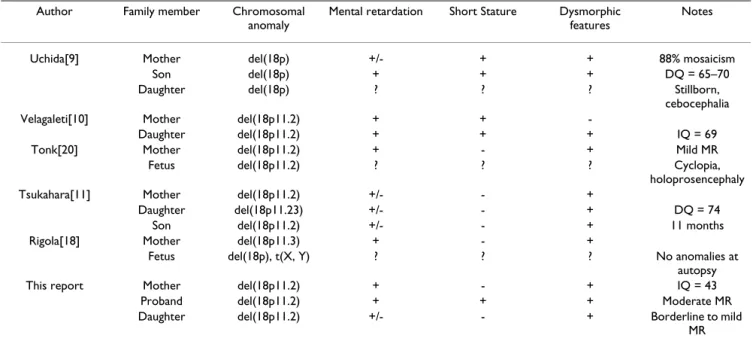
The remainder is suspected to come from unbalanced familial transmission of structural rearrangements. New cytogenetic techniques have shown one case of an unbal-anced subtelomeric translocation causing del(18p) [8]. Until now, there have been 5 reported families with trans-mission of del(18p) from a mother to a child (summa-rized in table 1). Here we report a familial transmission of del(18p) from a mother to her two daughters with varia-ble intellectual outcome and better verbal performance which differs from the classical del(18p) phenotype.
Case presentation
Proband
The proband is a girl now aged 12 years. Pregnancy was noticeable only on the basis of a placenta previa without complications. The mother was 22. Birth weight was 2950 g. The child was brought to medical attention at the age of 4 because of global developmental delay. Past medical history is positive for recurrent otitis media that caused moderate conductive hearing loss, which required tym-panostomy. She started a stimulation program at the age of 4 because of developmental delay. Cognitive perform-ance is in agreement with moderate mental retardation (IQ between 40 to 55) according to the Weschler intelli-gence scale for children, third edition (WISC-III). There is no difference between verbal and non-verbal functions.
Phenotypic manifestations are the following: weight is at the 50th centile, height at 3rd centile and head circumfer-ence at 50th centile. The face is rectangular, hair implanta-tion is low, the ears are large and protruding, the mouth is large with a prominent philtrum and a high-arched palate (Figure 1A). Small hands and clinodactyly of the fifth fin-gers were noted. Neurological examination is normal. Cerebral imaging revealed asymmetrical lateral ventricles without any associated lesion. Renal ultrasound was per-formed and revealed no abnormalities. Endocrine evalua-tion was also normal, including thyroid stimulating hormone and insulin-like growth factor 1. Immune func-tion was adequate with immunoglobulin A in normal range.
Second daughter
The second daughter is now aged 9. Pregnancy was une-ventful and birth weight was 3630 g. Early development was normal and she walked at 1 year of age. Psychological evaluation with a WISC-III test indicated that she has a non-verbal IQ in the mild mental retardation range (55 to 70) and a verbal IQ in the borderline range (70 to 85). However, this difference is not significant. Her global IQ is in the borderline range but close to mild mental retar-dation.
On examination, her weight is at the 25th percentile, height is at the 10th percentile and head circumference is at the 75th percentile. Phenotypical observation revealed the following features: low posterior hairline, large pro-truding ears, rectangular face, epicanthal folds, large
Table 1: 18p deletion: familial transmission cases.
Author Family member Chromosomal anomaly
Mental retardation Short Stature Dysmorphic features
Notes
Uchida[9] Mother del(18p) +/- + + 88% mosaicism
Son del(18p) + + + DQ = 65–70
Daughter del(18p) ? ? ? Stillborn,
cebocephalia Velagaleti[10] Mother del(18p11.2) + +
-Daughter del(18p11.2) + + + IQ = 69
Tonk[20] Mother del(18p11.2) + - + Mild MR
Fetus del(18p11.2) ? ? ? Cyclopia,
holoprosencephaly Tsukahara[11] Mother del(18p11.2) +/- - +
Daughter del(18p11.23) +/- - + DQ = 74
Son del(18p11.2) +/- - + 11 months
Rigola[18] Mother del(18p11.3) + - +
Fetus del(18p), t(X, Y) ? ? ? No anomalies at autopsy This report Mother del(18p11.2) + - + IQ = 43
Proband del(18p11.2) + + + Moderate MR Daughter del(18p11.2) +/- - + Borderline to mild
MR DQ, developmental quotient; IQ, intelligence quotient; MR, mental retardation.
mouth with prominent philtrum, high-arched palate and downturning corners of the mouth (Figure 1B). Small hands and clinodactyly of the fifth fingers were also present.
Like her sister, renal ultrasound, endocrine function and immune function were all normal.
Mother
The mother's history is noticeable for learning difficulties especially in mathematics. Her global IQ is 43 consistent with moderate mental retardation. There is a significant difference (p = 0,05) between verbal and non-verbal IQ, 52 and 42 respectively. She leads an active and independ-ent life. Her pubertal developmindepend-ent is described as normal with menarche at age 13. She had a miscarriage at 16 weeks of pregnancy before her two daughters. The mother does not complain of dystonia.
Her height is 157 cm, which is around the fifth percentile. She has a rectangular face, low posterior hairline, down-turning corners of mouth with prominent philtrum and a high-arched palate (Figure 1C). Unilateral ptosis is present. She showed clinodactyly of her fifth fingers as well. Immune and endocrine functions were normal. Cytogenetics
Chromosome analysis from peripheral blood lym-phocytes was carried out using GTG banding procedure on the whole family. The proband analysis revealed a 46, XX, del(18)(p11.2) complement in all 14 cells analyzed (Figure 1D). Fragile X syndrome was ruled out by polymerase chain reaction amplification. Proband's sister and mother revealed the same deletion (Figure 1E and 1F). Father's chromosomal analysis showed a 46, XY kary-otype. In the proband, further investigation using fluores-cence in situ hybridization (FISH) with 18p/18q subtelomeric probes on 20 mitosis was in agreement with cytogenetic results and showed a terminal deletion of 18p Phenotypical and chromosomal characteristics of the affected members of the family showing 18p deletion (arrow). Proband (A, D), sister (B, E) and mother (C, F)
Figure 1
Phenotypical and chromosomal characteristics of the affected members of the family showing 18p deletion (arrow). Proband (A, D), sister (B, E) and mother (C, F).
(Figure 2) with no hybridization of 18p subtelomeric probe on any other chromosome. Maternal grandfather's karyotype was normal but the maternal grandmother was unavailable.
Discussion
This paper presents the sixth family with transmission of an 18p deletion. Phenotypical features were quite similar
throughout the family and in accordance with the usual phenotype of del(18p). Short stature, low hairline, rectan-gular face, high-arched palate, prominent philtrum and clinodactyly of the fifth fingers were present throughout the family. The girls shared also large protruding ears, large mouth and small hands.
In situ hybridization. 18p (green) and 18q (red) with subtelomeric probes showing 18p deletion in the proband
Figure 2
Another feature consistent throughout the familial del(18p) cases is poor intellectual outcome. Uchida et al. [9], described a 88% mosaic mother for del(18p) with an IQ of 75. Her child also had a developmental delay, per-forming at 65–70% of normal. Velagaleti et al. [10], pre-sented a mother having an 18p11.2 deletion with mild mental retardation. Her daughter's psychosocial evalua-tion revealed a verbal IQ of 63 and a full scale IQ of 69 consistent with mild mental retardation. Tsukahara et al. [11], showed a Japanese woman also bearing del(18p11.2) who finished her junior high school. Her son presents a slight developmental delay at 11 months and her daughter has a DQ of 74 with significant speech delay placing them on the borderline intellectual func-tioning level.
We would like to underscore the fact that among the fam-ilies presented above, the intellectual outcome is relatively constant throughout the same family. The family we report here is in discrepancy with this statement. The mother and proband share moderate mental retardation while the youngest daughter has borderline to mild men-tal retardation. This represents a significant difference among members of the same family afflicted by an iden-tical chromosomal deletion. Such variability has been observed in other cases of familial deletions [12-14]. Even greater variability among family members with del(18p) is exemplified by the two holoprosencephaly cases. Men-tal retardation would have been expected in such cases of extreme brain dysmorphogenesis.
Del(18p) cases were associated with poorer verbal per-formance than non-verbal [2,4,5]. Our family equally dif-fers in this regard. The mother has better verbal abilities and the two daughters do not display differences between verbal and non-verbal abilities. Therefore, none of our family members with del(18p) present the previously described verbal difficulties.
The six families with del(18p) were maternally transmit-ted. No paternal transmission has been described to our knowledge although molecular characterization of 18p de
novo deletions showed an equal distribution of maternal
and paternal distributions [15]. However, it has been observed that women transmit unbalanced chromosomes aberrations more frequently than men [16]. Since no imprinting center is known on chromosome 18 [17], a deleterious paternal allele with del(18p) would be a sur-prising phenomenon. Whether this observation is simply a statistical bias because of the small numbers involved or has a real cytogenetic background that could affect male fertility is still unknown but demands consideration. Rigola et al. [18], discussed the fact that none of the cases published had a history of spontaneous abortions. This
report presents the first mother with del(18p) syndrome having a miscarriage. This event happened at the 16th week of her first pregnancy and no analysis was performed on the fetus. Among the 9 clinical pregnancies of these 6 women, one aborted spontaneously which is in agree-ment with the 10 to 15% rate of miscarriage in the general population. Fertility of women with del(18p) syndrome seems to be normal although gonadal failure has been previously reported among those patients [19].
Conclusion
This report sheds new lights on the familial del(18p) syn-drome. Cognitive performance may be more variable than previously suggested within the same family. Verbal abil-ities could be superior to non-verbal abilabil-ities in some individuals. These women are fertile with a miscarriage risk equivalent to the general population. Among the six del(18p) families described, exclusive maternal transmis-sion was seen. Genetic counseling for these patients should take into account these new data, especially in regard of a wider variability of intellectual outcomes and better verbal performance.
Competing interests
The author(s) declare that they have no competing inter-ests.
Authors' contributions
BM designed the study, collected data and drafted the manuscript.
NL performed cytogenetic analysis and revised the manu-script.
EL collected data, performed cytogenetic analysis and revised the manuscript.
Acknowledgements
Written consent was obtained from the patients or their relative for pub-lication of study.
References
1. Grouchy J, Lamy M, Thieffry S, Arthuis M: Dysmorphie complexe
avec oligophrénie: délétion des bras courts d'un chromo-some 17-18. C R Acad Sci (Paris) 1963, 257:3098-3102.
2. Jones KL: Deletion 18p syndrome. In Smith's recognizable patterns of human malformation 6th edition. Philadelphia , Elsevier Saunders; 2006:60-61.
3. Schober E, Scheibenreiter S, Frisch H: 18p monosomy with
GH-deficiency and empty sella: good response to GH- treat-ment. Clin Genet 1995, 47(5):254-256.
4. de Ravel TJ, Thiry P, Fryns JP: Follow-up of adult males with
chromosome 18p deletion. Eur J Med Genet 2005, 48(2):189-193.
5. Thompson RW, Peters JE, Smith SD: Intellectual, behavioral, and
linguistic characteristics of three children with 18p- syn-drome. J Dev Behav Pediatr 1986, 7(1):1-7.
6. Klein C, Page CE, LeWitt P, Gordon MF, de Leon D, Awaad Y, Breakefield XO, Brin MF, Ozelius LJ: Genetic analysis of three
patients with an 18p- syndrome and dystonia. Neurology 1999, 52(3):649-651.
Publish with BioMed Central and every scientist can read your work free of charge "BioMed Central will be the most significant development for disseminating the results of biomedical researc h in our lifetime."
Sir Paul Nurse, Cancer Research UK Your research papers will be:
available free of charge to the entire biomedical community peer reviewed and published immediately upon acceptance cited in PubMed and archived on PubMed Central yours — you keep the copyright
Submit your manuscript here:
http://www.biomedcentral.com/info/publishing_adv.asp
BioMedcentral 7. Spinner NB, Emanuel BS: Deletions and other structural
abnor-malities of the autosomes. In Emery and Rimoin's principles and
practice of medical genetics Volume 1. 4th / edition. Edited by: Rimoin DL, Emery AEH. London ; New York , Churchill Livingstone; 2002:1210-1211.
8. Horsley SW, Knight SJ, Nixon J, Huson S, Fitchett M, Boone RA, Hilton-Jones D, Flint J, Kearney L: Del(18p) shown to be a cryptic
translocation using a multiprobe FISH assay for subtelom-eric chromosome rearrangements. J Med Genet 1998, 35(9):722-726.
9. Uchida IA, McRae HC, Wang HC, Ray M: Familial short arm
defi-ciency of chromosome 18 concomitant with arhinencephaly and alopecia congenita. Am J Hum Genet 1965, 17(5):410-419.
10. Velagaleti GV, Harris S, Carpenter NJ, Coldwell J, Say B: Familial
deletion of chromosome 18 (p11.2). Ann Genet 1996, 39(4):201-204.
11. Tsukahara M, Imaizumi K, Fujita K, Tateishi H, Uchida M: Familial
Del(18p) syndrome. Am J Med Genet 2001, 99(1):67-69.
12. Pettenati MJ, Rao N, Johnson C, Hayworth R, Crandall K, Huff O, Thomas IT: Molecular cytogenetic analysis of a familial 8p23.1
deletion associated with minimal dysmorphic features, sei-zures, and mild mental retardation. Hum Genet 1992, 89(6):602-606.
13. Baker E, Hinton L, Callen DF, Haan EA, Dobbie A, Sutherland GR: A
familial cryptic subtelomeric deletion 12p with variable phe-notypic effect. Clin Genet 2002, 61(3):198-201.
14. Adeyinka A, Adams SA, Lorentz CP, Van Dyke DL, Jalal SM:
Subte-lomere deletions and translocations are frequently familial.
Am J Med Genet A 2005, 135(1):28-35.
15. Schaub RL, Reveles XT, Baillargeon J, Leach RJ, Cody JD: Molecular
characterization of 18p deletions: evidence for a breakpoint cluster. Genet Med 2002, 4(1):15-19.
16. Barber JC: Directly transmitted unbalanced chromosome
abnormalities and euchromatic variants. J Med Genet 2005, 42(8):609-629.
17. Morison IM, Reeve AE: A catalogue of imprinted genes and
par-ent-of-origin effects in humans and animals. Hum Mol Genet
1998, 7(10):1599-1609.
18. Rigola MA, Plaja A, Mediano C, Miro R, Egozcue J, Fuster C:
Charac-terization of a heritable partial monosomy 18p by molecular and cytogenetic analysis. Am J Med Genet 2001, 104(1):37-41.
19. Telvi L, Bernheim A, Ion A, Fouquet F, Le Bouc Y, Chaussain JL:
Gonadal dysgenesis in del(18p) syndrome. Am J Med Genet
1995, 57(4):598-600.
20. Tonk V, Krishna J: Case report: denovo inherited 18p deletion
in a mother-fetus pair with extremely variable expression, confirmed by fluorescence in situ hybridization (FISH) anal-ysis. Eur J Obstet Gynecol Reprod Biol 1997, 73(2):193-196.
Pre-publication history
The pre-publication history for this paper can be accessed here: