Université du Québec
Institut National de la Recherche Scientifique
Énergie Matériaux Télécommunications
Cramer-Rao Lower Bounds for Channel Parameters
Estimation over Turbo-Coded Wireless Transmissions
Préparé par
Achraf Methenni
Mémoire présenté pour l’obtention du grade de Maître ès Sciences (M.Sc.) en
Télécommunications
Examinateur Externe Prof. Fabrice Labeau
McGill University
Examinateur Interne et Président du
jury
Prof. Nahi Kandil54544545555555555555555555555555
UQAT
Directeur de Recherche Prof. Sofiène Affes
To Sadok, Imen and Haythem
To Zizou, Bibou, Ahmed and Yassine
Acknowledgements
I wish to thank Prof. Sofiène Affes for giving me the opportunity to work in his team, and for
guiding me throughout my MSc program. His remarks as well as his pertinent criticism led me
to the right path.
I want also to thank Mr. Faouzi Bellili for all his efforts, for being there for me, providing
me with valuable advices and providing the perfect example for me for my research career. A
special thanks to the external and internal jury members, Prof. Fabrice Labeau from McGill
University and Prof. Nahi Kandil from UQAT and adjunct professor at INRS-EMT who have
kindly accepted to assess my MSc thesis. I want to express my thanks and gratitude to all my
family, for their patience, and for all their encouragements.
Finally, I want to thank all my collegues and all the staff at INRS for providing a perfect
environment, and for making me feel as if I was surrounded by my family members...
Table des matières
Résumé 2
1 Introduction 12
2 System Model 19
3 Derivation of the Log-Likelihood Function (LLF) 24
3.1 LLF for BPSK and MSK signals : . . . 27
3.2 LLF for QPSK signals : . . . 28
3.3 LLF for square-QAM signals : . . . 30
4 Derivation of the CRLB Analytical Expressions 45
4.1 CRLB for coded SNR estimation [43] . . . 45
4.2.1 Empirical Evaluation of the CRLB . . . 56
5 Simulation Results 60
5.1 SNR estimation . . . 60
5.2 Phase and CFO estimation . . . 64
6 Conclusion 70
Conclusion 70
Table des figures
3.1 Construction of Gray-coded Square-QAM constellations . . . 34
3.2 Construction of Gray-coded Square-QAM constellations . . . 41
5.1 CA CRLBs for SNR estimation : 16-QAM, K=207. . . . 61
5.2 CA CRLBs for SNR estimation : BSK and MSK signals, K=207. . . . 62
5.3 CA CRLBs with different modulation orders : K = 207. . . . 63
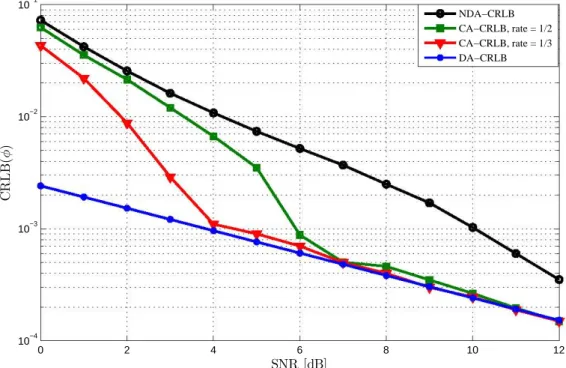
5.4 CA CRLBs for different coding rates : 16-QAM, K=207. . . . 64
5.5 CRLB for the phase and CFO estimation using 16-QAM symbols with K = 207 : (a) CRLB(ϕ), (b)CRLB(ν) . . . . 66
5.6 CRLB for the phase and CFO estimation for different modulation orders with K=207 symbols : (a)-CRLB(ϕ),(b)-CRLB(ν) . . . . 67
sym-INRS-ÉMT Mémoire de Maîtrise
5.8 CRLB for the phase : CRLB(ϕ) vs coding gain, for 16-QAM symbols, K=207. . 69
Résumé
La connaissance du rapport signal à bruit (RSB) est souvent nécessaire dans plusieurs
applica-tions en communicaapplica-tions sans fil. En effet, plusieurs techniques d’optimisation des ressources
ra-dio sont, de nos jours, basées sur la connaissance a priori de ce paramètre clé. A titre d’exemple,
les estimées du RSB sont typiquement utilisées en contrôle de puissance, modulations
adapta-tives et techniques de décodage [5, 16] :
– Contrôle de puissance : Avec la croissance rapide du nombre des utilisateurs, dans les réseaux
de communications sans fil, le contrôle de puissance de transmission est devenu une procédure
nécessaire pour minimiser l’interférence des utilisateurs. En effet, les émetteurs doivent ajuster
leur puissance de transmission selon les conditions de propagation afin de garder l’interférence
qui résulte de l’accès multiple au canal à un seuil permettant une qualité de service souhaitée.
INRS-ÉMT Mémoire de Maîtrise
puissance de transmission. Ceci permettra, entre autres, d’assurer une autonomie énergétique
plus élevée au niveau des stations mobiles (qui ne sont la plupart du temps pas reliées au
secteur).
– Dimensionnement des réseaux sans fil : La connaissance du RSB est aussi très utile pour les
opérateurs en vue de dimensionner les réseaux sans fil à déployer. Elle permet, par exemple,
en communications radio mobiles de déterminer à quel point la taille des cellules peut être
réduite afin d’augmenter le facteur de réutilisation des fréquences. Ceci permet en l’occurrence
d’augmenter la capacité totale du système.
– Handoff et allocation dynamique de ressources : Les procédures de handoff et allocation
adaptative des ressources sont étroitement liées. Le handoff réfère à l’opération de faire passer
un utilisateur de façon transparente d’une cellule à une autre. Ceci est dû essentiellement
à la mobilité des utilisateurs dans le réseau. L’allocation dynamique de ressources consiste
à optimiser l’exploitation des ressources du système selon les changements du trafic et du
niveau d’interférence. Plusieurs de ces opérations reposent sur la qualité de la liaison qui est
généralement caractérisée en fonction du RSB.
– Modulation adaptative : La technique de modulation adaptative consiste à changer, chez
l’émetteur, le type et/ou l’ordre de la modulation afin d’augmenter le débit effectif. Ce
gement dépend essentiellement du RSB de la liaison en question. En effet, si le niveau du
RSB est élevé, l’ordre de la modulation utilisé peut être augmenté tout en gardant le même
taux d’erreur binaire (TEB) de départ. Ceci permet, en outre, d’augmenter le débit de la
liaison étant donné que les modulations d’ordre supérieur permettent de transmettre plus de
“d’information binaire” par symbole. Cette stratégie est surtout utilisée en communications
OFDM (orthogonal frequency division multipluxing) où la connaissance a priori du RSB
joue un rôle primordial.
L’estimation du rapport signal sur bruit est aussi nécessaire dans plusieurs autres applications
telles que le codage turbo, l’égalisation, les antennes adaptatives, etc., mais nous ne pouvons
pas les détailler toutes, dans ce mémoire, par manque d’espace.
Dans ce contexte, malgré le fait que les premiers estimateurs du RSB remontent aux années
1960, ce problème a suscité une grande attention surtout durant ces deux dernières décennies.
Ceci est dû, en partie, au grand succès des systèmes radio mobiles cellulaires et, en partie,
aux avancées en microélectronique qui ont rendu réalisables des techniques d’estimation plus
complexes.
Les estimateurs du RSB sont généralement classés sous deux grandes catégories : autodidactes
in-INRS-ÉMT Mémoire de Maîtrise
connus par le récepteur. L’estimation du RSB repose alors uniquement sur les statistiques du
signal reçu. Les estimateurs qui appartiennent à cette catégorie sont appelés estimateurs NDA
(non-data aided). Ils requièrent souvent un grand nombre d’échantillons reçus pour obtenir des
estimées suffisamment précises du RSB. Les techniques NDA sont, par contre, plus appréciées
en pratique parce qu’elles n’affectent pas le débit effectif du système. Elles permettent, en effet,
une estimation en temps réel du paramètre en question et elles sont de ce fait aussi qualifiées
d’estimateurs “in service”. Les méthodes assistées nécessitent, par contre, la connaissance a
priori de la séquence transmise pour estimer le RSB. Elles sont connues en littérature sous le
nom d’estimateurs DA (data-aided). Il y a, en fait, deux types de techniques DA :
– Techniques TxDA : ces techniques nécessitent l’introduction d’une séquence de symboles
transmis qui est parfaitement connue par le récepteur. La fidélité de la séquence du message
utilisée pour l’estimation est garantie par le fait même qu’une copie conforme de cette
sé-quence est disponible à la réception. En pratique, de petites sésé-quences de données connues
(sé-quences pilotes) peuvent être insérées périodiquement dans un flux de données à transmettre.
Les procédures d’égalisation et de synchronisation utilisent aussi ce genre de séquences, dites
aussi séquences d’apprentissage. L’utilisation de telles séquences pour l’estimation du RSB
diminue le débit utile du système. Néanmoins, pour des systèmes utilisant déjà des séquences
pilotes pour la synchronisation ou l’égalisation, on peut utiliser ces mêmes séquences pour
l’estimation du RSB sans aucune pénalité supplémentaire. Notez ici que, puisqu’une
esti-mation TxDA ne peut être faite qu’en présence de la séquence pilote, l’utilisation de cette
méthode n’est pas adéquate dans les cas où une estimation continue du RSB est exigée.
– Technique RxDA : Ces méthodes reposent sur l’utilisation des symboles détectés. Ces derniers
remplacent alors la séquence des symboles pilotes pendant le processus d’estimation. Ces
algorithmes sont aussi appelés DD (decisison-directed). Ils souffrent des erreurs de détection
et leurs performances sont alors inférieures à celles des estimateurs TxDA. Cependant, ils
peuvent être utilisés dans le cas où une estimation continue du RSB est nécessaire. Ils sont
alors qualifiés d’estimateurs “in service”, tout comme les estimateurs NDA, et ils n’affectent
pas le débit du système.
Les approches non assistées ont l’avantage de ne pas affecter le débit global du système de
communications (haute efficacité spectrale). Néanmoins, elles présentent une performance très
pauvre dans le régime bas RSB, particulièrement pour des données de courte longueur. Pour
remédier à ce problème en préservant l’éfficacité spectrale, on a envisagé l’estimation codée pour
améliorer la performance de l’estimation dans ces conditons difficiles. Dans ce contexte, les turbo
INRS-ÉMT Mémoire de Maîtrise
décennies grâce à leur capacité impresionnante à opérer près de la limite de Shannon, même
dans des bas RSBs. Récemment, il a été montré que l’estimation du SNR peut être amériolée
substantiellement en exploitant l’information a priori délivrée pendant le processus de décodage
des données transmises. Dans les systèmes turbo-codés, par exemple, l’estimation codée peut
profiter de l’information souple (comme de l’information à priori) obtenue du décodeur souple
(entrée souple sortie souple). L’algorithme de décodage souple (dans le sens du minimum du
taux d’erreur binaire) est l’algorithme du maximum à posteriori, connu aussi sous le nom de
BCJR.
Cependant, l’implémentation de cet algorithme optimal requiert en elle-même la conaissance a
priori du RSB. C’est pourquoi l’effet de l’erreur d’estimation du RSB sur la performance des
systèmes turbo-codés a été le sujet de plusieurs études [16-18].
– Effet d’une erreur d’estimation du RSB sur la performance des turbo-codes :
Il a été trouvé, que dans le cas d’un système à modulation binaire (BPSK), la
surestima-tion jusqu’à plusieurs dB est tolérable en termes de performances de décodage, tandis que
la sous-estimation au-delà de 2 dB conduit à d’importantes erreurs de décodage. Dans le
cas d’un code turbo combiné avec des schémas de modulation d’ordre supérieur, comme la
modulation d’amplitude en quadrature (QAM), sa sensibilité à l’erreur d’estimation du RSB
s’est révélée être différente qu’avec BPSK. Le RSB estimé joue un rôle différent dans le calcul
de métriques binaires pour différents schémas de modulation, et conduit donc à des
perfor-mances de décodage différentes. Dans les systèmes modulés d’ordre élevé, la tolérance du
turbo code à une erreur d’estimation du RSB est considérablement réduite, particulièrement
à une surestimation [20].
D’autre part, la phase du canal et le résidu de la fréquence porteuse(RFP) sont considérés
comme paramètres clés dont la conaissance peut être exploitée à la réception pour atteindre
la meilleure performance possible du système. Pratiquement, toutes les publications sur les
turbo-codes font face à des systèmes idéaux où les problèmes de synchronisation ont été résolus
parfaitement. Ces hypothèses sont généralement impossibles à satisfaire dans la réalité. Tenir
compte de cet aspect est primordial car les turbo-codes s’avèrent être très sensibles aux erreurs
de phase et de résidu de fréquence.
– Effet d’un résidu de phase sur la performance des turbo-codes :
Un décalage de phase est inévitable dans les systèmes réels, principalement en raison de
l’estimation imparfaite du canal dans des environnements à évanouissement rapide. Le TEB
du code avec différents déphasages (supposés constants) ϕ ∈ [−π4,π4] a révélé qu’un
INRS-ÉMT Mémoire de Maîtrise
cependant, le taux d’erreurs binaire commence à se dégrader rapidement. Une des façons
d’améliorer le rendement du turbo code consiste donc à réduire la queue de la distribution
de l’erreur de phase. Ceci permet de substituer de larges erreurs qui sont moins probables
par de petites erreurs plus fréquentes.
Pour pouvoir évaluer la qualité de l’estimation de cette nouvelle classe d’estimateurs codés, la
borne de Cramér-Rao (BCR) est une borne fondamentale dans la théorie de l’estimation, vu
qu’elle établit la variance minimale que peut atteindre n’importe quel estimateur non biaisé du
paramètre considéré. Cette borne est aussi connue pour être atteignable assymptotiquement,
par l’estimateur du maximum de vraisemblance stochastique. Néanmoins, même dans le cas des
transmissions non codées, la structure complexe de la fonction de vraisemblance rend la tâche de
trouver une expression analytique pour la BCR stochastique très difficile, voire impossible, dans
le cas de symboles transmis aléatoirement, surtout dans les modulations d’ordre élevé. Pour celà,
elle est généralement évaluée (dans les transmissions codées et non codées) empiriquement[45].
Dans le contexte de l’estimation DA du RSB, l’expression analytique de BCR DA a été dérivée
dans [21]. Dans le cas non assisté, les expressions analytiques pour la BCR ont été dérivées aussi,
mais pour le cas des modulations BPSK et QPSK. Ce n’était que récemment qu’une expression
analytique a été établie dans le cas général des modulations QAM carrées [22, 23]. Dans les
systèmes codés, cependant, la fonction de vraisemblance devient encore plus compliquée. De ce
fait, développer une expression analytique de la BCR dans ce cas devient une tâche beaucoup
plus laborieuse. À présent, la BCR pour l’estimation du RSB à partir de transmissions codées
n’a été établie que dans le cas de la modulation BPSK dans [9].
En ce qui concerne la phase du canal et le résidu de la fréquence porteuse, ces bornes ont
été évaluées empiriquement dans le cas PSK et QAM dans [40]. Ce n’était que récemment
qu’une expression analytique de la BCR a été établie dans le cas non assisté (NDA) pour la
phase du canal et le résidu de fréquence dans [41], avec des signaux QAM carrés. Dans le
cas d’une transmission codée, la BCR a été établie par Noels grâce à une approche empirique
[42]. Motivés par ces facteurs, nous dérivons dans ce mémoire, pour la première fois[43, 44],
une expression analytique pour la BCR de l’estimation du RSB, de la phase du canal et du
résidu de la fréquence porteuse pour les modulations BPSK, MSK et QAM carrées. On établira
que ces nouvelles bornes analytiques coincident avec les BCRs empiriques qui ont été évaluées
précedemment.
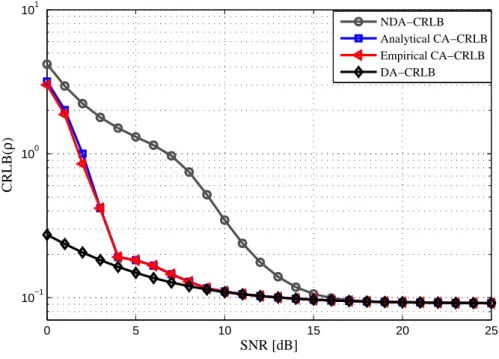
Nous montrerons que la BCR codée est inférieure à la BCR non assistée, particulièrement à des
moyens et bas RSBs, ce qui reflète l’amélioration considérable qu’apporterait potentiellement la
INRS-ÉMT Mémoire de Maîtrise
la BCR décroit quand l’ordre de modulation augmente et s’approche de plus en plus de la BCR
dans le cas Data Aided, spécialement à bas RSB, contrairement au cas de l’estimation NDA.
Nous étudierons en plus l’effet du taux de codage sur la BCR codée et nous établirons que plus
le taux de codage est petit (ce qui implique l’ajout de plus de bits de redondance au niveau
du codage et donc intuitivement une amélioration de la performance globale du système), plus
la BCR est inférieure et s’apporche de la DA BCR. Cet effet sera plus marqué à bas RSB. À
hauts RSB, toutes les bornes convergent.
Chapitre 1
Introduction
Modern wireless communication systems rely on the a priori knowledge of the propagation
conditions in order to enhance their capacity. In particular, the SNR, the channel phase and
the carrier frequency offset(CFO) are considered as key parameters whose a priori knowledge
can be exploited at both the receiver and the transmitter (through feedback), in order to reach
the desired enhanced/optimal performance (using various adaptive schemes). For instance, the
SNR level is a key measure of the channel quality [1] and it is, therefore required in multiple
ap-plications such as equalization [2, 3], adaptive modulation, link adaptation, and power control
INRS-ÉMT Mémoire de Maîtrise
categories : i) data-aided (DA) techniques in which the estimation process relies on a perfectly
known transmitted sequence, and ii) non-data-aided (NDA) techniques where the estimation
process is applied blindly using the received samples only.
Most interestingly, the NDA approaches share the advantage of not impinging on the whole
throughput of the system (high spectral efficiency). However, they usually exhibit very poor
estimation performance in the low SNR region especially in presence of short data records. To
circumvent this problem while being spectrally efficient, code-aided estimation can be envisaged
to substantially enhance the performance in these harsh operating conditions. In the same
context, turbo codes [6-8] have gained considerable attention during the last two decades thanks
to their impressive ability to operate in near-shannon limit even at very low SNR levels.
Very recently, it has been shown that the SNR (in [9-12]) and phase/CFO (in [24,25] and
[29-39]) estimation performance can be substantially enhanced by exploiting some priors1 that are
delivered during the decoding process of the transmitted bits. More specifically, it was shown
that code-aided (CA) estimation provides — over a wide range of practical SNRs — almost the
1. Note that in the code-aided estimation scheme the transmitted symbols are also completely unknown.
But, much information can be obtained about these symbols during the process of iterative decoding of both
the information and redundancy bits. This knowledge is then used during the estimation process as a prior
information.
same performance as in the ideal case where all the bits are perfectly a priori known (DA). In
turbo-coded systems, for instance, CA estimation schemes may rely on the soft information (as
priors) obtained from the soft-input soft-output (SISO) decoder. The optimal SISO algorithm [
in the sense of minimum bit error rate (BER)] to be used is the maximum a posteriori (MAP),
also known as the BCJR algorithm [13, 14]. Yet, the successful implementation of the MAP
decoder itself requires the a priori knowledge (i.e., estimation) of the SNR [14].
Therefore, the effect of the SNR mismatch on the performance of turbo-decoding has been the
subject of various studies [16-18]. It was found, in the particular case of BPSK signals, that
over-estimating the SNR by several dBs can be tolerated while insuring acceptable BER performance.
In contrast, under-estimation by more than 2 dB leads to significant decoding errors. In presence
of higher-order-modulated signals, the effect of SNR mismatch was also investigated in [20] and
found to be remarkably different from its counterpart in BPSK signalling. The estimated SNR
plays a different role in the calculation of the bit metrics for various modulation schemes, and
therefore leads to different decoding performances. The performance of turbo-coded systems,
transmitting higher-order-modulated signals, is typically more sensitive to over-estimating the
SNR [20].
INRS-ÉMT Mémoire de Maîtrise
in conjunction with a coherent detection scheme only. This means that the carrier phase and
carrier frequency offset (CFO) must be accurately acquired before proceeding to data decoding.
This is because turbo codes are known to be very sensitive to phase errors and even a small
mismatch in the carrier phase can lead to severe performance degradations. In fact, it has been
seen that the turbo code has a region of a relative sensitivity to phase error, outside of which,
the bit error rate (BER) starts to deteriorate quickly.
Accurate synchronization has always been challenging in turbo-coded systems, since they are
intended to operate at low signal-to-noise ratios (SNRs). Many SNR, phase and CFO estimators
suited for turbo-coded systems have been recently introduced in the open literature [9-12] and
[24,25,29-39]. The performance of such code aided SNR, CFO and phase estimators is usually
assessed in terms of their variances for which an absolute benchmark must be evaluated. The
Cramér-Rao lower bound (CRLB), a well known fundamental bound [27] in estimation theory,
meets this requirement since it sets the minimum achievable variance for all the unbiased
es-timators. Unlike other loose bounds, the CRLB is also known to be achieved, asymptotically,
by the stochastic maximum likelihood estimator. Yet, even in case of uncoded transmissions,
the complex structure of the likelihood function makes it extremely hard, if not impossible, to
derive analytical expressions for the stochastic2 CRLB, especially for higher-order modulations.
2. The stochastic designation is usually adopted to refer to the case of unknown and random transmitted
Therefore, it is usually evaluated (in both non-coded and coded systems) empirically[45].
Within the context of DA SNR estimation, the closed-form expressions for the DA CRLBs
were earlier derived in [21]. The analytical expressions for the exact NDA CRLBs were also
derived in the same work but only in the very special cases of BPSK and QPSK signals. It was
only recently that these analytical expressions have been generalized to arbitrary higher-order
square QAM modulations [22, 23]. In coded transmissions, however, the likelihood function
becomes even more complicated and hence developing the corresponding bounds in closed-form
expressions is a more challenging task. Thus, code-aided SNR estimators are usually compared
in performance to the DA CRLBs as has been recently done in [12, 15]. The latter may be
an accurate benchmark for BPSK signals but is actually an excessively optimistic3 bound in
presence of higher-order-modulated signals, especially at low SNR values. To date, the CRLB
for code-aware SNR estimation has been recently tackled in [9] but only for the very basic case
of BPSK-modulated signals. In the case of the phase and CFO estimation, the CRLBs for these
estimation were evaluated empirically for the uncoded PSK- and symmetric-QAM-modulated
signals in [40]. It was only recently that closed-form expressions for the stochastic CRLBs have
symbols. This is to be opposed to the deterministic CRLB when the symbols are unknown but deterministic. 3. The DA CRLBs are indeed the same for all the linearly-modulated signals [21], i.e., they wrongly reflect
INRS-ÉMT Mémoire de Maîtrise
been established in [41] for NDA carrier phase and CFO estimation, from general square
QAM-modulated signals. In coded transmissions, however, the likelihood function becomes even more
complicated and developing such bounds in closed form is therefore more challenging and
te-dious. Thus, the CRLB for phase and CFO estimation of coded linearly-modulated signals
was earlier tackled by Noels et al. in [42] through an empirical approach. Motivated by these
facts, we derive in this work, for the first time, the analytical expressions for the CRLBs of
SNR, channel phase and CFO estimates from coded BPSK-, MSK- and arbitrary
square-QAM-modulated signals. It will be seen that the new analytical CRLBs coincide with their empirical
counterparts derived in this report as well for a matter of validation.
The rest of this report is organized as follows. In chapter II, we introduce the system model.
In chapter III, we derive the explicit expression for the loglikelihood function for the different
transmissions. In chapter IV, we derive new analytical expressions for the corresponding CRLBs
and we propose, as well, another approach that allows the evaluation of the considered bounds
empirically. In chapter V, we present the simulation results of the newly derived bounds.
Fi-nally, we draw out some concluding remarks in chapter VI.
We also mention that some of the common notations will be used throughout this paper.
In-deed, vectors and matrices are represented in lower- and upper-case bold fonts, respectively.
Moreover, {.}T and {.}H denote the transpose and the Hermitian (transpose conjugate)
ope-rators, respectively. The operators ℜ{.} and ℑ{.}, |.| return, respectively, the real, imaginary
parts and the amplitude of any complex number whereas {.}∗ returns its conjugate. We also
denote by j the pure complex number that verifies j2 =−1. We will also denote the probability
mass function (PMF) for discrete random variables by P [.] and the probability density function
Chapitre 2
System Model
Consider a turbo-coded system where a binary sequence of information bits (grouped into
consecutive blocks containing Q bits each) is fed into a turbo encoder, of rate R, consisting
of two identical recursive systematic convolutional codes (RSCs) with generator polynomials
[g1, g2]. The two RSCs are concatenated in parallel via an interleaver of size L. The coded
bits are then fed into a puncturer which selects an appropriate combination of the parity bits,
from both encoders, in order to achieve the desired overall rate R. Each block of Q coded bits
(systematic and parity bits) is then interleaved with an outer interleaver, and then mapped
onto any Gray-coded constellation1. Finally, the obtained symbols are transmitted over the
wireless channel. The received signal is sampled at the output of the matched filter. Then by
assuming imperfect phase and frequency synchronization, the observed samples are modeled as
follows :
y(k) = S x(k)ej2πkϑ+ϕ+ w(k),
k = k0, 1, 2,· · · , k0+ K− 1, (2.1)
where, at time index k, x(k) is the transmitted coded symbol and y(k) is the corresponding
received sample. The noise components are modeled by a zero-mean circular complex Gaussian
random variable, with independent real and imaginary parts, each of variance σ2 (i.e., a total
noise power, N0, of N0 = 2σ2). The parameters S and K stand for the channel gain and the
total number of received samples, respectively. Without loss of generality, we further assume
that the energy of the transmitted symbols is normalized2 to one, i.e., E{|x(k)|2} = 1. Using
the multiple observations {y(k)}k0+K−1
k=k0 , the true SNR, ρ, that we wish to estimate, is defined
as ρ = E{S 2|x(k)|2} 2σ2 , (2.2) = S 2 2σ2. (2.3)
2. If the transmit energy, P , is not unitary, then it can be easily incorporated as an unknown scaling factor
INRS-ÉMT Mémoire de Maîtrise
From (2.3), it is seen that there are two unknown parameters which are involved in the derivation
of the SNR CRLBs, which are : S and σ2. Therefore, it is mathematically more convenient to
gather them in one signle parameter vector :
α(1) = [S σ2]. (2.4)
In addition, since using the decibel (dB) scale often provides easier interpretation of the
per-formance behaviour, we will henceforth consider the following parameter transformation :
g(α(1)) = 10 log10 ( S2 2σ2 ) . (2.5)
For mathematical convenience, we gather all the recorded data samples in a single vector :
y = [y(0), y(1),· · · , y(K − 1)]T. (2.6)
Notice that we used the index k = 0, 1, ...K−1 instead of k = k0, ...k0+K−1, when considering
the particular case of SNR estimation (represented by alpha(1), since it has no effect on the
CRLB of the SNR, even intuitively. The log-likelihood function of the system will be denoted as
Ly(α(1)) = ln
(
p(y; α(1)))where p(y; α(1)) is the pdf of the received vector y parameterized by
the unknown parameter vector α(1). As shown in [27], the CRLB for parameter transformations
is given by CRLB(ρ) = ∂g(α (1)) ∂α(1) I −1(α(1))∂g(α (1)) ∂α(1) T , (2.7) 21
where the derivative of the parameter transformation, ∂g(α(1))/∂α(1), is given by ∂g(α(1)) ∂α(1) = [ 20 ln(10)S −10 ln(10)σ2 ] , (2.8)
and I(α(1)) is the Fisher information matrix (FIM) defined as :
I(α(1))= − E { ∂2L y(α(1)) ∂S2 } − E { ∂2L y(α(1)) ∂S∂σ2 } − E { ∂2L y(α(1)) ∂σ2∂S } − E { ∂2L y(α(1)) ∂σ2 } . (2.9)
In (2.9), the statistical expectation E{.} is taken with respect to y. Usually, the analytical
derivation of the CRLB involves tedious algebraic manipulations. These consist in three major
steps : 1) derivation of the log-likelihood function (LLF), 2) derivation of the FIM elements and
then 3) derivation of the CRLB expression using (2.7). These three steps will be accomplished,
in this order, in the remainder of this report.
The parameters ϕ and ϑ stand for the phase distortion and the carrier frequency offset, both
to be estimated (seperately from the channel gain S and the noise variance σ2, respectively).
Both unknown parameters are gathered into one vector
α(2)=[ϕ ϑ]T. (2.10)
INRS-ÉMT Mémoire de Maîtrise
Now, suppose that we are able to produce an unbiased estimate, ˆα(2), of the vector α(2), from the
received vector y. Then the CRLB, verifying3the inequality E{[ ˆα(2)− α(2)]T[ ˆα(2)− α(2))]}≽
CRLB(α(2)), is given by :
CRLB(α(2)) = I−1(α(2)), (2.12)
where I(α(2)) is the Fisher information matrix (FIM) whose entries are given by :
[ I(α(2))] i,l=−Ey { ∂2L y(α(2)) ∂α(2)i ∂α(2)l } i, l = 1, 2 (2.13) where { αi(2) }
i=1,2 are the elements of the vector α (2).
3. Note that A≽ B for any two A and B square matrices means that A − B is positive semi-definite.
Chapitre 3
Derivation of the Log-Likelihood Function
(LLF)
To begin with, we assume that the symbols are drawn from any M − ary constellation whose
alphabet is denoted as C = {c0, c1,· · · , cM}. This is because, as will be seen shortly, the first
derivation steps are valid for linearly-modulated signals in general. However, we will later on
restrict ourselves to BPSK, MSK or square-QAM constellations and the reasons will be clearly
INRS-ÉMT Mémoire de Maîtrise
two notations :
cm ←→ ¯bm1 ¯bm2 · · · ¯bml · · ·¯bmlog2(M ) (3.1)
x(k)←→ bk1bk2· · · bkl · · · bklog
2(M ). (3.2)
to designate the mapping between the mth constellation point cm (respectively, the kth
trans-mitted symbol x(k)) and its associated bits (respectively, the kth conveyed bits). Due to the
large-size interleaver, the coded bits can be assumed independent. Such an assumption is
per-vasive in code-aided estimation [10, 24, 25, 28]. Consequently, the transmitted symbols (which
originate simply from a mapping of these independent bits) can also be considered as
inde-pendent yielding thereby :
p(y; α) =
k0+K∏−1 k=k0
p(y(k); α), (3.3)
where p(y(k); α) is the pdf of the individual received sample, y(k), which is given by :
p(y(k); α)=∑ c∈C P [x(k) = c]p(y(k); α|x(k) = c), = M ∑ m=0 P [x(k) = cm] 2πσ2 exp { |y(k)−Sϕ,ϑ cm|2 2σ2 } . (3.4) where Sϕ,ϑ = Sej2πkϑ+ϕ. (3.5) 25
and
α = [α(1) α(2)]. (3.6)
Now, in case of higher-order modulations where each constellation point represents more than
one bit (i.e., M > 2 or equivalently log2(M )>1) and again due to the independence of the coded
bits, the probability of each transmitted symbol, x(k), factors into the elementary probabilities
of the elementary bits it conveys :
P [x(k) = cm] = P [ bk1 = ¯bm1 ,· · · , bklog 2(M ) = ¯b m log2(M ) ] = log∏2(M ) l=1 P [bkl = ¯bml ]. (3.7)
We also define the so-called log-likelihood ratio (LLR) of the coded transmitted bit bkl as follows :
Ll(k) = ln ( P r[bk l = 1] P r[bk l = 0] ) . (3.8)
Then, using (3.8) and the fact that P [bkl = 0] + P [bkl = 1] = 1, the a priori probabilities of the
coded transmitted bits can be expressed as :
P [bkl = 1] = e Ll(k) 1 + eLl(k) = 1 2sech ( Ll(k) 2 ) eLl(k)2 , (3.9) and ( )
INRS-ÉMT Mémoire de Maîtrise
3.1
LLF for BPSK and MSK signals :
In BPSK transmissions, the constellation alphabet is given byC = {+1, −1}. In MSK
transmis-sions, however, the transmitted symbols are constructed recursively as x(k +1) = jx(k)(2bk−1)
where bk is the sequence of coded bits and x(k0) is the original value drawn from the set
{−1, −j, +1, +j}. The pdf of the received vector y parameterized by α is expressed as follows :
p(y; α)= k0+K∏−1 k=k0 ( P [x(k) = dk] 2πσ2 exp { −|y(k) − dkSϕ,ϑ|2 2σ2 } +P [x(k) =−dk] 2πσ2 exp { −|y(k) + dkSϕ,ϑ|2 2σ2 }) . (3.11) in which dk is given by : dk = 1 for BPSK jk−1k(k 0) for MSK. (3.12)
Then, we define the log-likelihood ratio (LLR) of the coded bits :
L(k) = ln ( P [bk = 1] P [bk = 0] ) . (3.13)
Note here that, for the sake of clarity, we use two different designations for the constellation
points, dk, in (3.12) and the actual transmitted bits, bk, in (3.13). Yet, statistically speaking,
they both have the same probabilities. That is to say : P [dk = 1] = P [bk = 1], P [dk =−1] =
P [bk = 0] in BPSK and P [dk = jk−1x(k0)] = P [bk = 1], P [dk = −jk−1x(k0)] = P [bk = −1] in
MSK. Injecting these results in (3.11) and after some algebraic manipulations, it can be shown
that the log-likelihood function of interest (after dropping terms independent of the parameters
gatherd in α) denoted by L(r)y (α) is expressed as follows :
L(r)y (α)=−K ln(σ2)− KS 2 2σ2 − 1 2σ2 k0+K∑−1 k=k0 |y(k)|2 + k0+K∑−1 k=k0 ln ( cosh ( ℜ(y(k)∗d kSϕ,ϑ) σ2 + L(k) 2 )) . (3.14)
3.2
LLF for QPSK signals :
We denote the constellation alphabet, C, of the QPSK constellation as C = {c0, c1, c2, c3}.
Therefore, the pdf of the received sample, y(k), is given by :
p(y(k); α)=∑ c∈C P [x(k) = c]p(y(k); α|x(k) = c), = 3 ∑ m=0 P [x(k) = cm] 2πσ2 exp { |y(k)−Sϕ,ϑ cm|2 2σ2 } . (3.15)
Without loss of generality, we assume that c0 = 1/
√
(2) + j/√(2) and that the constellation
INRS-ÉMT Mémoire de Maîtrise
c3 ←→ 01. Consequently, from (3.10) and (3.9), we obtain :
P [x(k) = c0] = eL1(k) 1 + eL1(k) eL2(k) 1 + eL2(k), (3.16) P [x(k) = c1] = eL1(k) 1 + eL1(k) 1 1 + eL2(k), (3.17) P [x(k) = c2] = 1 1 + eL1(k) 1 1 + eL2(k), (3.18) P [x(k) = c3] = 1 1 + eL1(k) eL2(k) 1 + eL2(k). (3.19)
Then, by using the fact that c1 = −c0, c2 = c∗0 and c3 = −c∗0, plugging (3.16) to (3.19) back
into (3.15), and after some algebraic manipulations, it can be shown that :
p(y(k); α) = 1 2πσ2 exp { −S2+|y(k)|2 2σ2 } ×Q1(k) cosh ( ℜ{y(k)∗S ϕ,ϑ} σ2 + L2(k) 2 ) ×Q2(k) cosh ( ℑ{y(k)∗S ϕ,ϑ} σ2 − L1(k) 2 ) , (3.20) where Ql(k) = 1 cosh(Ll(k)/2) (3.21)
Thus, the pdf of the received vector y is factorized as follows :
p(y; α)=Cy(α) k0+K∏−1 k=k0 Q1(k) cosh ( ℜ(y(k)∗S ϕ,ϑ) σ2 + L2(k) 2 ) × k0+K∏−1 k=k0 Q2(k) cosh ( ℑ(y(k)∗S ϕ,ϑ) σ2 − L1(k) 2 ) , (3.22) 29
where Cy(α)= 1 σ2K(2π)K exp { −KS2 2σ2 − 1 2σ2 k0+K∑−1 k=k0 |y(k)|2 } . (3.23)
By, taking the logarithm of (3.22) and dropping the constant terms involving Q1(k) and Q2(k)
(which do not depend on alpha), the LLF for QPSK signals develops as follows :
L(r)y (α)=−K ln(σ2)− KS 2 2σ2 − 1 2σ2 k0∑+K−1 k=k0 |y(k)|2+ k0∑+K−1 k=k0 ln ( cosh ( ℜ {y(k)∗d kSϕ,ϑ} σ2 + L2(k) 2 )) + k0∑+K−1 k=k0 ln ( cosh ( ℑ {y(k)∗d kSϕ,ϑ} σ2 + L1(k) 2 )) . (3.24)
3.3
LLF for square-QAM signals :
Denoting I(k) = ℜ{y(k)} and Q(k) = ℑ{y(k)}, it can be shown that in presence of M − ary
QAM-modulated signals, the pdf in (3.4) can be rewritten as follows :
p(y(k); α) = 1 2πσ2exp { −I(k)2+ Q(k)2 2σ2 } Dα(k), (3.25) in which Dα(k) = M ∑ m=1 Pm[xk] exp { −S2|cm| 2 2σ2 } × { }
INRS-ÉMT Mémoire de Maîtrise
where
Pm[xk] = P r{xk = cm} . (3.27)
Hence, the LLF (Ly(α) = ln{p(y; α)}) which is obtained from (3.3) as Ly(α) =
∑k0+K−1 k=k0 ln{p(y(k); α)}, develops into : Ly(α) =−K ln { 2πσ2}− k0+K∑−1 k=k0 I(k)2+ Q(k)2 2σ2 + k0+K∑−1 k=k0 ln{Dα(k)}. (3.28)
At this stage, it is still very tedious to derive analytical expressions for the considered CRLBs
without further developing the terms Dα(k) defined in (3.26). Actually, considering the special
case of square QAM-modulated signals (i.e., 4-, 16-, 64-QAM, etc.), and by exploring the
structure of the Gray mapping mechanism, we are able to factor Dα(k) into the product of two
analogous terms. In fact, when M = 22p for any p≥1 (i.e., square QAM constellations), we have C = {±(2i − 1)dp± j(2n − 1)dp}i,n=1,2,...,2p−1, where 2dp is the intersymbol distance in the I/Q
plane. The square QAM constellation energy is supposed to be normalized to one : ∑22p
m=1|cm| 2
22p = 1, (3.29)
from which the expression of dp is obtained as follows :
dp = 2p−1 √ 2p∑2p−1 m=1(2m− 1)2 . (3.30) 31
Now, by denoting ˜C = {(2i − 1)dp+ j(2n− 1)dp}2 p−1
i,n=1 the subset of the alphabet that consists
of the points which lie in the top-right quadrant of the constellation, one can write C = ˜C ∪
(− ˜C) ∪ ˜C∗∪ (− ˜C∗). Therefore (3.26) can be expressed as follows :
Dα(k)= ∑ ˜ cm∈ ˜C exp { −S2|˜cm|2 2σ2 } × ( P [xk= ˜cm] exp { ℜ {˜cmy∗(k)Sϕ,ϑ} σ2 } +P [xk =−˜cm] exp { ℜ {−˜cmy∗(k)Sϕ,ϑ} σ2 } +P [xk = ˜c∗m] exp { ℜ {˜c∗ my∗(k)Sϕ,ϑ} σ2 } +P [xk =−˜c∗m] exp { ℜ {−˜c∗ my∗(k)Sϕ,ϑ} σ2 }) . (3.31)
Another important detail that must be addressed, in order to further simplify the term Dα(k),
is the Gray mapping scheme of the constellation. We will show through a simple Gray-coding
mechanism how this structure can be used to factor Dα(k), linearizing thereby the LLF
expres-sion in (3.28). The procedure applies in the same way to all the possible Gray mapping schemes,
and the obtained final CRLB expressions are the same. First, combining (3.9) and (3.10) and
assuming that the symbol cm is transmitted during the kth time instant (i.e., x(k) = cm), we
obtain the following generic formula for each conveyed bit :
INRS-ÉMT Mémoire de Maîtrise
where ¯bml can be 0 or 1. Therefore, recalling that log2(M ) = 2p and injecting (3.32) in (3.7),
the symbol probabilities P [xk = cm] are given by :
P [x(k) = cm]= ( 2p ∏ l=1 1 2sech ( Ll(k) 2 )) | {z } βk × (2p ∏ l=1 e(2¯bml −1)Ll(k)2 ) | {z } ξk(cm) . (3.33)
Next, we describe a simple recursive algorithm that allows the construction of Gray-coded
square-QAM constellations. Some interesting properties of such constellations will be revealed
and carefully handled in order to factor the term Dα(k) in (3.31). In fact, starting from any
given 22(p−1)-QAM Gray-coded constellation, it is possible to build a 22p-QAM Gray-coded
constellation as follows :
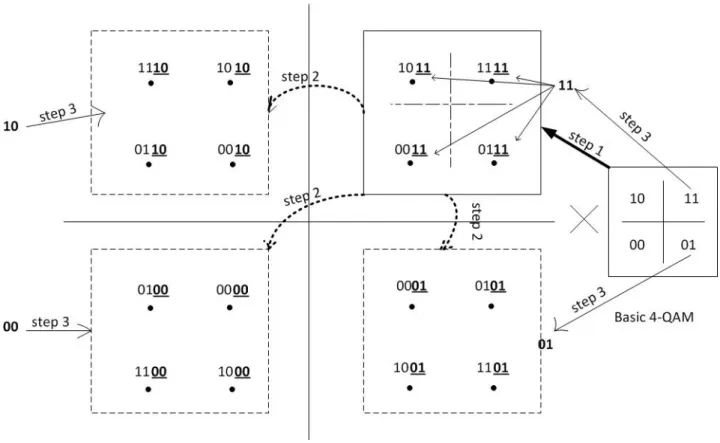
– step 1 : build the top right quadrant of the desired 22p-QAM constellation from all the points1
of the available 22(p−1)-QAM constellation.
– step 2 : build the other three quadrants of the new 22p-QAM constellation by symmetries
on : i) the x-axis (to obtain the bottom right quadrant), ii) on the y-axis (to obtain the top
left quadrant), iii) the center point (to obtain the bottom left quadrant). Yet, the points of
the original 22(p−1)-QAM constellation represent 2(p− 1) bits only. Therefore, each point of
1. The same points’ layout in the original 22(p−1)-QAM constellation is used, i.e., the constellation is placed
as is in the new quadrant.
Figure3.1 – Construction of Gray-coded Square-QAM constellations
the new 22p-QAM constellation that must represent 2p bits is still missing two of them.
– step 3 : add the two bits that appear in each quadrant of a basic Gray-coded QPSK
constel-lation to all the points that appear in the same quadrant of the new constelconstel-lation.
An example of constructing a Gray-coded 16-QAM constellation from a 4-QAM Gray-coded
one is illustrated in Fig. 3.1 Just as depicted in this figure and without loss of generality, we
will assume in the sequel that it is the two least significant bits (LSBs) that are always added
INRS-ÉMT Mémoire de Maîtrise
Then, due to symmetries in “step 2 ”, it can be seen that each set of four symbols ˜cm, ˜c∗m, −˜cm
and−˜c∗m have the same 2(p−1) most significant bits (MSBs), ¯bm
1¯bm2¯bm3 ...¯bm2p−3¯bm2p−2, for any given
symbol ˜cm from the top right quadrant of the 22p-QAM constellation (m = 1, 2,· · · , 22(p−1)).
Thus, if we consider these 2(p− 1) MSBs alone and we define
µk(cm), 2p∏−2
l=1
e(2¯bml −1)Ll(k)2 , ∀cm ∈ C, (3.34)
it can be immediately seen that :
µk(˜cm) = µk(−˜cm) = µk(˜c∗m) = µk(−˜c∗m), ∀˜cm ∈ ˜C. (3.35)
Now, considering the two remaining LSBs (¯bm2p−1 and ¯bm2p) and using the Gray-mapping depicted
in Fig. 3.1, it is seen that for any ˜cm ∈ ˜C we have ¯bm2p−1¯bm2p = 11. Moreover, these two bits are
respectively given by “00”, “01”, and “10” for − ˜C, ˜C∗, and − ˜C∗. Of course, these intermediate
results change according to the choice of the basic QPSK constellation involved in step 3. Yet,
we will explain later how this choice does not affect the final result. Then, upon using these
results along with (3.35), it follows from (3.33) that for any ˜cm ∈ ˜C, we have : P [x(k) = ˜cm]=βk µk(˜cm) e L2p−1(k) 2 e L2p(k) 2 , (3.36) P [x(k) = ˜c∗m]=βk µk(˜cm) e− L2p−1(k) 2 e L2p(k) 2 , (3.37) P [x(k) =−˜cm]=βk µk(˜cm) e− L2p−1(k) 2 e− L2p(k) 2 , (3.38) P [x(k) =−˜c∗m]=βk µk(˜cm) e L2p−1(k) 2 e− L2p(k) 2 . (3.39)
Therefore, plugging these probabilities back into (3.31) and using the identity ex + e−x =
2 cosh(x), it can be shown that :
Dα(k)=2βk ∑ ˜ cm∈ ˜C exp { −S2|˜cm|2 2σ2 } µk(˜cm)× [ cosh ( ℜ {˜cm y∗(k)Sϕ,ϑ} σ2 + L2p−1(k) 2 + L2p(k) 2 ) + cosh ( ℜ {˜c∗ m y∗(k)Sϕ,ϑ} σ2 + L2p−1(k) 2 − L2p(k) 2 )] . (3.40)
Furthermore, using the relashiship cosh(x) + cosh(y) = 2 cosh(x+y2 ) cosh(x−y2 ) along with the
two identities ˜cm+ ˜c∗m = 2ℜ{˜cm} and ˜cm− ˜c∗m = 2jℑ{˜cm}, (3.40) is rewritten as follows :
Dα(k)=4βk ∑ ˜ cm∈ ˜C [ exp { −S2| ˜cm|2 2σ2 } µk(˜cm)× cosh ( S ℜ{˜cm}ℜ { y∗(k)ej(2πkϑ+ϕ)} σ2 + L2p(k) 2 ) × ( S ℑ{˜c }ℑ{y∗(k)ej(2πkϑ+ϕ)} L (k))]
INRS-ÉMT Mémoire de Maîtrise
Recalling that ˜C = {(2i − 1)dp+ j(2n− 1)dp}2 p−1
i,n=1, the sum over ˜cm ∈ ˜C in (3.41) can be
written as a double sum over the counters i and n after replacing ˜cm by (2i−1)dp+ j(2n−1)dp.
Therefore, in order to factor Dα(k), the term µk(˜cm = (2i−1)dp+ j(2n−1)dp) must be factored
into two terms, one depending only on i and the other only on n. Here, we are actually dealing
with the remaining 2p− 2 MSBs, ¯bm
1¯bm2 ¯bm3 · · ·¯bm2p−3¯bm2p−2. Hence, since the two LSBs ¯bm2p−1 and
¯bm
2p are not involved in µk(˜cm) (and are the same2 for all ˜cm ∈ ˜Cp 3 they will be represented by “××” in (3.1), i.e. :
˜ cm ←→ ¯bm1¯b m 2 · · ·¯b m l · · ·¯b m 2p−5¯b m 2p−4 | {z } ¯ bm p ¯bm 2p−3¯b m 2p−2××. (3.42)
In addition, as highlighted in (3.42), it will prove very useful to represent the first 2p− 4 MSBs
by the shorthand notation ¯bm
p , i.e., ¯bmp , ¯bm1¯bm2 · · ·¯bml · · ·¯bm2p−5¯bm2p−4. For more convenience, we
will rather use the superscript (i, n) instead of m in (3.42) since ˜cm = (2i− 1)dp+ j(2n− 1)dp.
That is : ˜ cm ←→ ¯b(i,n)p ¯b (i,n) 2p−3¯b (i,n) 2p−2××. (3.43)
2. The values of these two LSBs are defined according to the top-right quadrant of the basic Gray-coded
QPSK constellation used in “step 3 ” during the recursive construction algorithm. For instance, in the example
depicted in Fig. 3.1, they will be “×× = 11”.
3. Actually ˜Cp= ˜C , but later on we have to make a difference between ˜C in a 22p-QAM and when considering
a 22(p−1)-QAM.
Using this mapping, all the points of the top-right quadrant of the obtained 22p-QAM
constel-lation are graphically represented in Fig. 3.2 where the bits ¯b(i,n)2p−1 and ¯b(i,n)2p are being assigned
their true values. Each symbol ˜cm in ˜Cp which has coordinates
(
(2i− 1)dp , (2n− 1)dp
)
in the
current 22p-QAM constellation (x− axis and y− axis in Fig. 3.2) has already different
coor-dinates (a′, b′) in the original 22(p−1)-QAM constellation (x′− axis and y′− axis in Fig. 3.2) ;
associated with a symbol cm′ = a′+ jb′ inCp−1. By inspecting Fig 3.2, it can be shown that
cm′ = (2i− 1 − 2p−1)dp+ j(2n− 1 − 2p−1)dp. (3.44)
Moreover, we have the follwong result :
cm′ ←→ ¯b(i,n)p ¯b (i,n) 2p−3¯b
(i,n)
2p−2. (3.45)
since the first 2p− 2 MSBs of each symbol ˜cm ∈ ˜Cp are obtained (during “step 1 ”) from the
whole bit sequence of the symbol cm′ associated to it in the original 22(p−1)-QAM constellation.
From (3.34), we have : µk,p(˜cm),γk (¯ b(i,n)p )exp { (2¯b(i,n)2p−3− 1)L2p−3(k)/2 } × exp { (2¯b(i,n)2p−2− 1)L2p−2(k)/2 } , (3.46) where −1)−2 { }
INRS-ÉMT Mémoire de Maîtrise
On the other hand, denoting the top-right quadrant of the original 22(p−1)-QAM constellation
by ˜Cp−1, it also holdsCp−1 = ˜Cp−1∪(− ˜Cp−1)∪ ˜Cp−1∗ ∪(− ˜Cp−1∗ ). Then, for some ˜cm′ ∈ Cp−1, we have
cm′ ∈ {˜cm′,−˜cm′, ˜c∗m′,−˜c∗m′}. In turn, the symbols cm′ themselves are obtained from a previous
Gray-coded 22(p−2)-QAM constellation by applying the same recursive construction algorithm.
Therefore, due to symmetries of “step 2 ” it follows that ˜cm′,−˜cm′, ˜c∗m′, and −˜c∗m′ have the same
2p−4 MSBs which are represented by ¯b(i,n)p . Consequently, according to the definition of (3.34),
we have γk
( ¯
b(i,n)p
)
= µk,p−1(˜cm′) thereby yielding the following recursive property :
µk,p(˜cm),µk,p−1(˜cm′) exp { (2¯b(i,n)2p−3− 1)L2p−3(k)/2 } × exp { (2¯b(i,n)2p−2− 1)L2p−2(k)/2 } . (3.48)
Actually one needs to express the bits ¯b(i,n)2p−3 and ¯b(i,n)2p−2 explicitly as function of i and n if µk,p(˜cm)
is to be factorized in terms of these two counters separately. This useful result is given by the
following lemma.
Lemma : The two bits ¯b(i,n)2p−3 and ¯b(i,n)2p−2 are expressed as :
¯b(i,n) 2p−2 = ⌊ i− 1 2p−2 ⌋ and ¯b(i,n)2p−3 = ⌊ n− 1 2p−2 ⌋ ∀ i, n = 1, 2, · · · , 2p−1. (3.49)
In (3.49), ⌊x⌋ is the floor function which returns the largest integer which is smaller than or
equal to x.
Thus, injecting (3.49) in (3.48), it follows : µk,p(˜cm),µk,p−1(˜cm′) exp {( 2⌊n− 1 2p−2 ⌋ − 1 ) L2p−3(k) 2 } × exp {( 2⌊i− 1 2p−2⌋ − 1 ) L2p−2(k) 2 } . (3.50)
Following the same reasoning from (3.42) through (3.49), µk,p−1(˜cm′) itself can be written in the
same recursive form of (3.50) by considering the recursive reconstruction of ˜Cp−1 (highlighted
in blue color in Fig 3.2) from the 22(p−2)-QAM constellation. Consequently, by repeating this
process down constellations, it can be shown that µk(˜cm) is factored into two independent terms
one depending on i only and the other on n only as follows :
µk(˜cm) = θk,2p(i)θk,2p−1(n). (3.51)
where the terms θk,2p(i) and θk,2p−1(n) are obtained recursively, for any p≥ 2, as follows :
θk,2p(i)=θk,2p−2 ( |2i − 1 − 2p−1| + 1 2 ) × exp {( 2⌊i− 1 2p−2⌋ − 1 ) L2p−2(k) 2 } , (3.52) θk,2p−1(n)=θk,2p−3 ( |2n − 1 − 2p−1| + 1 2 ) × exp {( 2⌊n− 1 2p−2 ⌋ − 1 ) L2p−3(k) 2 } , (3.53)
INRS-ÉMT Mémoire de Maîtrise
Figure3.2 – Construction of Gray-coded Square-QAM constellations
˜
Cp ={(2i − 1)dp+ j(2n− 1)dp}i,n=1,2,··· ,2p−1, the term Dα(k) is rewritten as follows :
Dα(k) = 4βk 2p−1 ∑ i=1 2p−1 ∑ n=1 [ exp { −S2((2i− 1)2+ (2n− 1)2)d2p 2σ2 } θk,2p(i) cosh ( S(2i− 1)dpu(k) σ2 + L2p(k) 2 ) × θk,2p−1(n) cosh ( S(2n− 1)dpv(k) σ2 − L2p−1(k) 2 )] (3.54)
where u(k) and v(k) are defined as u(k) =ℜ{y∗(k)ej(2πkϑ+ϕ)} and v(k) =ℑ{y∗(k)ej(2πkϑ+ϕ)}.
Finally, splitting the two sums, it can be shown that Dα(k) is factorized as follows :
Dα(k) = 4βk F2p,α(u(k))× F2p−1,α(v(k)), (3.55) where Fq,α(.) is given by : Fq,α(x) = 2∑p−1 i=1 θk,q(i) exp { −S 2(2i− 1)2d2 p 2σ2 } × cosh ( S(2i− 1)dpx σ2 + (−1) qLq(k) 2 ) , (3.56)
where the counter q is used, from now on, to refer to 2p or 2p− 1 depending on the context.
The factorization of Dα(k) in (3.55) will prove very useful in deriving the analytical expressions
INRS-ÉMT Mémoire de Maîtrise
arbitrary square-QAM constellation becomes as follows :
Ly(α)=− 1 2σ2 k0+K∑−1 k=k0 ( I(k)2+ Q(k)2 ) + k0∑+K−1 k=k0 ln{F2p,α(u(k))} + k0∑+K−1 k=k0 ln{F2p−1,α(v(k))}, (3.57)
involving thereby the sum of two analogous terms (the two last sums). Now, we further show that
U (k) and V (k) (whose realizations are u(k) and v(k), respectively) are two independent random
variables which are almost identically distributed (i.e., their pdfs have the same structure,
but are parameterized differently) . In fact, injecting (3.54) in (3.25) and using the fact that
I(k)2+ Q(k)2 = u(k)2+ v(k)2, it can be shown that p(y(k); α) factorized as follows :
p(y(k); α) = p(u(k); α)p(v(k); α), (3.58) where p(u(k); α) =√2βk,2p 2πσ2 exp { −u(k)2 2σ2 } F2p,α(u(k)), (3.59) p(v(k); α) =2β√k,2p−1 2πσ2 exp { −v(k)2 2σ2 } F2p−1,α(v(k)), (3.60) with βk,2p = 1 2p p ∏ l=1 sech ( L2l(k) 2 ) (3.61) βk,2p−1 = βk βk,2p . (3.62) 43
Moreover, we have p(u(k), v(k); α) = p(y(k)∗ej(2πkν+ϕ); α) since u(k) and v(k) are indeed the
real and imaginary parts of y(k)∗ej(2πkν+ϕ). Then, since ej(2πkν+ϕ)is assumed to be deterministic,
we have p(y(k)∗ej(2πkν+ϕ); α) = p(y(k); α). Therefore, using (3.58) we obtain :
p(u(k), v(k); α) = p(u(k); α)p(v(k); α). (3.63)
meaning that the joint distribution of U (k) and V (k) is factored and hence they are two
Chapitre 4
Derivation of the CRLB Analytical
Expressions
4.1
CRLB for coded SNR estimation [43]
We begin first by deriving the FIM elements using the LLF expressions obtained in the previous
section. We consider the case of square-QAM-modulated signals since it is the most general one.
Equivalent derivations can be applied in case of BPSK-, MSK- and QPSK-modulated-signals
to obtain the corresponding FIM elements. We will also detail the derivations for the first FIM
(3.57), we have the following result : Ey { ∂2ln(p(y; α(1))) ∂S2 } = K∑−1 k=0 E { ∂2ln(F 2p,α(1)(u(k))) ∂)S2 } + K∑−1 k=0 E { ∂2ln(F2p−1,α(1)(v(k))) ∂S2 } . (4.1)
As mentioned previously, the two terms in the right-hand side of (4.1) are analogous and they
can be derived in the same way, especially because the RVs U (k) and V (k) are almost identically
distributed. Thus, for ease of notations, we will henceforth use zq(k) to refer to u(k) when q = 2p
and to v(k) when q = 2p− 1, respectively. Using this generic notation and if we denote :
˙ Fq,α(1)(zq(k)), ∂Fq,α(1)(zq(k)) ∂S , ¨ Fq,α(1)(zq(k)), ∂2F q,α(1)(zq(k)) ∂S2 ,
it can be shown that :
E { ∂2ln(F q,α(1)(zq(k))) ∂S2 } =E { ¨ Fq,α(1)(zq(k)) Fq,α(1)(zq(k)) } −E { ˙ Fq,α(1)(zq(k))2 Fq,α(1)(zq(k))2 } .
The second expectation is obtained by integrating over the distribution of zq(k) obtained earlier
in (3.59) and (3.60) for q = 2p and q = 2p− 1, respectively :
E { ˙ Fq,α(1)(zq(k))2 Fq,α(1)(zq(k))2 } = ∫ +∞ −∞ ˙ Fq,α(1)(zq(k))2 Fq,α(1)(zq(k))2 p(zq(k), α(1))dzq(k) (4.2) ∫ ∞
INRS-ÉMT Mémoire de Maîtrise
We further simplify (4.2) by changing zq(k)/σ by t and using ρ = S2/2σ2 to obtain :
E { ˙ Fq,α(1)(zq(k))2 Fq,α(1)(zq(k))2 } = 2βk,qd 2 p σ2 ψk,q(ρ), (4.3) in which Ψk,q(ρ) is defined as : Ψk,q(ρ), 1 √ 2π ∫ +∞ −∞ λk,q(ρ, t)2 δk,q(ρ, t) e−t22 dt, (4.4)
where, by using ωk,q(i), θk,q(i) e−(2i−1) 2d2
pρ, the functions δ
k,q(., .) and λk,q(., .) are, respectively,
given by (4.5) and (4.6) : δk,q(ρ, t)= 2p−1 ∑ i=1 ωk,q(i)cosh (√ 2ρ(2i−1)dpt + (−1)qLq(k) 2 ) , (4.5) λk,q(ρ, t)= 2p−1 ∑ i=1 (2i−1)2ωk,q(i) [ t sinh(√2ρ (2i−1)dpt + (−1)qL q(k) 2 ) −dp(2i−1) √ 2ρ cosh(√2ρ(2i−1)dpt + (−1)qL q(k) 2 )] . (4.6)
In addition, after tedious algebraic manipulations, we show the following identity :
E { ¨ Fq,α(1)(zq(k)) Fq,α(1)(zq(k)) } = 0. (4.7)
Therefore, by using αk,q , 2βk,qd2pψk,q(ρ) and injecting (4.3) for q = 2p and q = 2p−1 in (4.24),
it follows : Ey { ∂2ln(p(y; α(1))) ∂S2 } =− 1 σ2 K∑−1 k=0 [ αk,2p+αk,2p−1 ] (4.8) 47
Equivalent algebraic manipulations lead to the following analytical expressions for the second
FIM diagonal element :
Ey { ∂2ln(p(y; α(1))) ∂σ22 } =K σ4 + 1 σ4 K−1∑ k=0 [ νk,2p+ νk,2p−1 ] , (4.9)
where νk,q (for q = 2p or 2p− 1) is given by :
νk,q= c(k)4,qρ 2 + 2 ( c(k)2,q− 2βk,qd2pΦq,k(ρ) ) − c(k) 0,q. (4.10)
The coefficients c(k)l,q are given by :
c(k)l,q = 2βk,qdlpcosh ( Lq(k)/2 )2∑p−1 i=1 θk,q(i)(2i− 1)l, (4.11)
and the function Φk,q(.) is defined as :
Φk,q(ρ), 1 √ 2π ∫ +∞ −∞ γ2 k,q(ρ, t) δk,q(ρ, t) e−t22dt (4.12)
with γk,q(., .) being given by :
γk,q(ρ, t)= 2∑p−1 i=1 (2i−1)2ωk,q(i) [ t sinh(√2ρ (2i−1)dpt + (−1)qLq(k) 2 ) −dp(2i−1) √ ρ 2cosh (√ 2ρ(2i−1)dpt + (−1)qL q(k) 2 )] . (4.13)
Equivalent derivations also yield the following expression for the off-diagonal element of I(α(1)) :
INRS-ÉMT Mémoire de Maîtrise
in which ηk,q , c (k)
2,q− 2d2p βk,q Ωk,q(ρ) with the function Ωk,q(.) being defined as :
Ωk,q(ρ), 1 √ 2π ∫ +∞ −∞ γq,ρ(t)λq,ρ(t) δq,ρ(t) e−t22dt (4.15)
Therefore, from (4.8), (4.9) and (4.14), the global Fisher information matrix decomposes into
the sum of elementary FIMs :
I(α(1)) =
K∑−1 k=0
Ik(α(1)) (4.16)
where {Ik(α(1))}Kk=0−1 is the FIM pertaining to the estimation of the SNR from the received
sample y(k) alone :
Ik(α(1)) = 1 σ4 σ2[αk,2p+αk,2p−1 ] S[ηk,2p+ ηk,2p−1 ] S[ηk,2p+ ηk,2p−1 ] −[ν2p,k+ ν2p−1,k+ 1 ] . (4.17)
This FIM expression in the general case of a coded-aided estimation corroborates the two
traditional extreme cases of completely NDA and completely DA estimations. Indeed, in the
former case, no a priori information about the bits is available at the receiver and, hence,
P [bkl = 1] = P [bkl = 0] = 1/2 meaning that LNDAl (k) = 0. In the latter case, however, the
bits are a priori perfectly known and, therefore, at the receiver side we have {P [bk
l = 1] =
1 hence P[bk
l = 0] = 0} or {P [bkl = 0] = 1 hence P[bkl = 1] = 0} and consequently the LLRs
verify : LDA
l (k) =±∞. Injecting LNDAl (k) and LDAl (k) in the entries of Ik(α), and recognizing