ANALYSIS OF THE SUPPORT PROVIDED TO STUD ENT-ATHLETES IN WALLONIA. THE CASE OF HIGHER EDUCATION
Cloes, M.1, Lenzen, B.2, Polis, A.1 1University of Liège, Belgium 2
University of Geneve, Switzerland
In this paper, the first aspect to keep in mind deals with the student-athletes’status. Indeed, the European culture is rather different than the North America’s one. US students, for example, have many advantages to become top athletes [1][2]. Those who are selected in school, college or
university teams are well supported by their institution. The NCCA (National Collegiate Athletic Association) is trying to limit the participation of the freshmen to the university competitions in order to provide them a better teaching context [3]. An overview of the situation of
student-athletes in 12 European countries [4] revealed that not all of them have developed a positive climate in favour of their student-athletes.
Today, even if the structures do not exist in all countries, everybody shares the opinion that top leve l sport requires a long term preparation. It means that promising youth are early and early enrolled in sport programmes. Their involvement in these activities also means that an adaptation of the athlete’s life organization must exist since the first steps of his/her specific training. As the success of sport careers is so hazardous, it is also necessary to guarantee the best school/academic preparation. Sport preparation as well as school/academic and social activities thus become concurrent aspects. Table 1 presents a model comparing the unfolding of three aspects previously mentioned: the schooling, the sport career and people that have an impact on athletes’ life. It appears that the development of the athlete’s career happens usually during the secondary education while the beginning of his/her top level activity happens during the higher education period.
Solutions must be proposed during these periods to help the athletes and their family to achieve the objectives which are thus fixed in the sport and school/academic domains. The organisation of these programmes was adapted according to the political interests and to the size of the budget that was allocated to sport. In several countries like France and United Kingdom or region like Flanders, special efforts have been envisaged since the middle of the nine ties in order to emphasize the need of an elite athlete status allowing special school programme and opportunities.
When facing the choice of pursuing their academic preparation in higher education or giving priority to sport, young adults are confronted to several dilemmas:
Table 1 – The developmental model of educational/athletic career (adapted from [5]) Age 10 15 20 25 30 35 Schooling Primary education Secondary education Higher
education Professional activity Sport
career Initiation Development Perfection Stoppage Psycho-social influence Parents Brothers and sisters Peers Peers Coach Parents Spouse/husband Coach Family Coach
(1) They have to cope with the pressure of their parents who generally consider that academic preparation can offer more opportunities of long term professional perspectives [6]. Some athletes stop their sport career to have more chances to achieve their graduation. Those athletes are not well considered by sport’s leaders who had invested much money for their athletic preparation during the previous years without receiving positive return.
(2) Higher education studies require more personal involvement of the students. In fact, the latter need more support of their parents and coaches as well as of the academic and sport institutions and their peers but they loose their references because of the modification of their previous context of life.
(3) The universities and colleges are farer than secondary level schools. Those who were not yet in a boarding SSP have to leave their home in order to spare time and manage sport and studies’ requirements. This increases the stress.
(4) Some freshmen become performing athletes and know success. That could allow them to consider that they must chose to leave their studies while other could encounter more concurrence because they are confronted to older athletes and will support with difficulty to loose a leading status.
When the student-athlete is involved in higher education, some problems appear due to the need of excellence in academic and sport domains. Training and competition periods will disturb the attendance to academic activities as the academic requirements can compete with sports planning. Six main categories of problems can be considered:
(1) The student-athletes need to develop competences in time management and that can be stressful [7]. Their schedule should be carefully timed.
(2) Lacking of free time, they do not have opportunities to establish social relationship outside of their direct environment [4].
(3) Student-athletes think less than their classmates to their academic career. They are less involved in professional experiences such students’ jobs [7].
(4) Top athletes who are confronted with academic failure can loose their motivation while they could have problems to overcome hardships such injuries [4]. Some of them have to
work with psychologists when facing that kind of situation [8].
(5) Students-athletes reported more problems than their classmates to study and to participate to students’ activities [9]. They are more tired even if they use the same proportion of time to non academic tasks.
(6) They would not be really well perceived by all the academic staff [10].
That introductory part underlines clearly that combining higher education and top level sport needs special support. Higher education student-athletes should receive more attention than younger athletes who have proportionally less school emphasis. At the beginning of the nineties, Flemish student-athletes considered that on an academic point of view, they would like to have more help concerning the absence to practical courses (62%) and to modify the schedules of their exams (34 to 36%)[11]. On the sport point of view, they were interested by a larger collaboration between academic and sports’ institutions (35%), the opportunity not to attend to some training activities (30%), to be involved in the preparation of their planning (20%) and to find some solutions to be able to study on training and competition sites (20%).
A recent action research based on supporting documentation, interviews, focus groups and participation in a long-standing voluntary support programme has been undertaken to improve the conditions of life of English student-athletes [10]. The authors interviewed 10 student-athletes and several other people involved in the staff of a university. A list of student-athletes needs was generated and became the focus of a collaborative research. Three topics were selected: (1) to
help the student-athletes to establish priorities on time management and goal setting and to organize their academic and training activities; (2) to develop a purposeful collaboration with academics, and; (3) to build a network allowing the student-athletes to share their experience with other elite people having experienced that situation. Through regular meetings, student-athletes and staff members were able to find solutions to refine the organization of the doub le achievement.
Since 25 years, Belgium is a federal state (to better understand, have a look on
http://www.cfwb.be/presentation/communaute/pg02b.html). Education and Sport are matters covered by the communities (http://www.cfwb.be/gb/presentation/communaute/pg001.html). There are huge differences between the policies developed by Flemish and French communities. Despite of some efforts, the situation of the French speaking athletes remains difficult, particularly for athletes who have to combine their sport and academic careers.
The present study was designed to compare the current situation of the student-athletes of the French community of Belgium (Wallonia) to that of their opponents from countries or regions that are often considered as examples. The study starts from the personal experience of the last author and the complaints of several Walloon athletes.
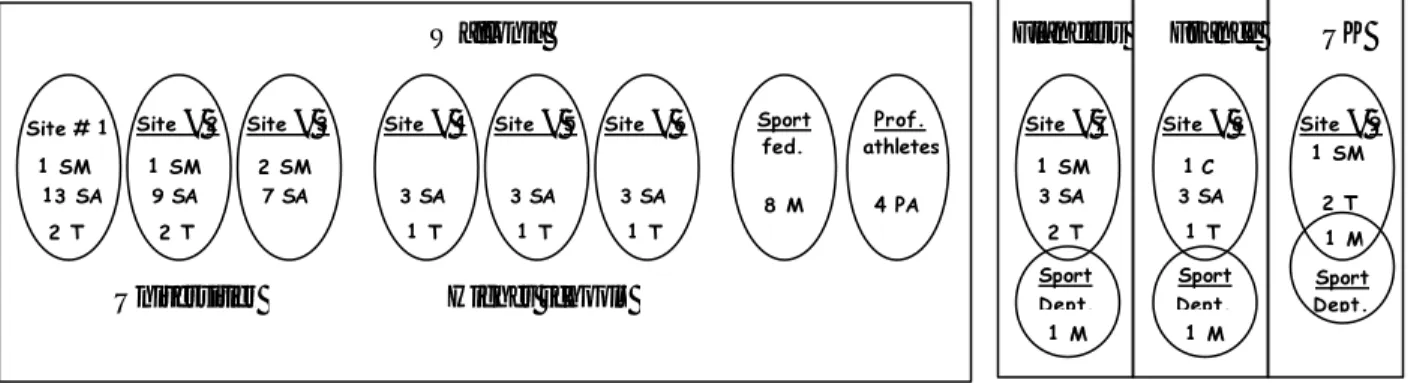
During 2003-2004 and 2004-2005 academic years, we collected qualitative data about six Walloon higher education sites cons idered as a macro-site, and in three independent sites located in three different European countries or regions: France, United Kingdom and Flanders. The same interviewer used semi-structured guides for face to face meetings (excluding French subjects who were interviewed by phone). University sport managers (SM), student-athletes (SA), tutors (T), coordinators (C), members of sport federation (M) and professional athletes (PA) were interviewed (Figure 1). Answers were recorded on audiotape and transcribed verbatim for further content analysis. Validity of the method was based on a triangulation laying on the comparison of the opinion of subjects who did not have the same role. Intra- and inter-analyst reliabilities were controlled and accepted (more than 86.3% of agreement).
In Wallonia, the situation of the student-athletes was analysed in three universities, sites 1, 2 and 3, and 3 and three colleges (« Hautes Ecoles »), sites 4, 5 and 6. In the universities, the manager(s) of the sport association (n=4), several student-athletes (n=29) and tutors (when they were existing, n=4) were interviewed. In each college, three student-athletes and one tutor were interviewed. Moreover, eight managers of sport federations and four professional athletes were integrated into the study in order to enrich the data. In the three sites that we analysed outside Wallonia, six subjects were systematically interviewed: the coordinator or the director of the elite student-athletes’ programme, three students-athletes, one tutor and one member of an involved sport federation. Note that in England, the sport federations were directly integrated within the university structure while they had only collaboration in both other universities (Figure 1).
Figure 1 – Description of the analyzed sites
Wallonia
Universities Higher schools
Site # 1 13 SA 1 SM 2 T Site # 2 9 SA 1 SM 2 T Site # 3 7 SA 2 SM Site # 4 3 SA 1 T Site # 5 3 SA 1 T Site # 6 3 SA 1 T Sport fed. 8 M 4 PA Prof. athletes France Site # 8 3 SA 1 C 1 T Sport Dept. 1 M Site # 7 3 SA 1 SM 2 T Sport Dept. 1 M Flanders Site # 9 1 SM 2 T Sport Dept. 1 M UK
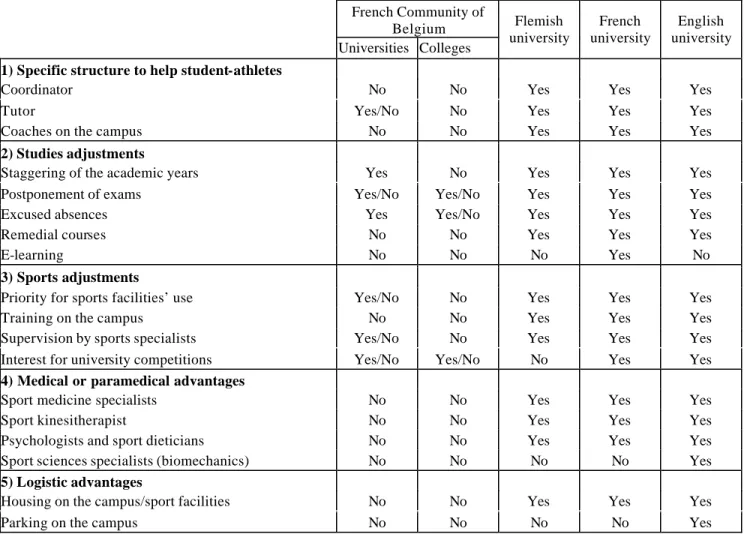
Table 2 illustrates the main findings. Five categories of support provided to the student-athletes were identified.
The first one dealt with the presence of a staff that can help the student-athletes in their complex life. Data showed that Belgian French speaking athletes can only find tutors in most of universities but also that the coaches were not allowed being on the campus and that no coordinator was identified. Moreover, some of them pointed out the lack on interest: « I’d like
more recognition; some teachers are not aware about the life that we have.” (ES 1/7, line 60).
The three other universities systematically offered these functions, underlining that students-athletes can find people who are appointed to specifically help them to meet the standards determined by the academic and sport authorities:
- “They don’t need support but flexibility in their studies which allows them to combine top level
sport and their studies.” (C 7/1, line 125)
- “We review the situation at the beginning of the school year, after the January and June’s
exams and, eventually, after exams organised in September.” (C 7/1, line 94)
From staggering of the academic year to E- learning, several studies adjustments are proposed to the student-athletes in higher education. In the French community of Belgium, a decree allows the student-athletes to stagger their academic programme as well in universities as in colleges. On the contrary, not all institutions help the athletes to postpone exams and to excuse some absences: “I was selected to participate to a tournament in Ireland but, due to an exam that
French Community of Belgium Universities Colleges Flemish university French university English university
1) Specific structure to help student-athletes
Coordinator No No Yes Yes Yes
Tutor Yes/No No Yes Yes Yes
Coaches on the campus No No Yes Yes Yes
2) Studies adjustments
Staggering of the academic years Yes No Yes Yes Yes
Postponement of exams Yes/No Yes/No Yes Yes Yes
Excused absences Yes Yes/No Yes Yes Yes
Remedial courses No No Yes Yes Yes
E-learning No No No Yes No
3) Sports adjustments
Priority for sports facilities’ use Yes/No No Yes Yes Yes
Training on the campus No No Yes Yes Yes
Supervision by sports specialists Yes/No No Yes Yes Yes
Interest for university competitions Yes/No Yes/No No Yes Yes
4) Medical or paramedical advantages
Sport medicine specialists No No Yes Yes Yes
Sport kinesitherapist No No Yes Yes Yes
Psychologists and sport dieticians No No Yes Yes Yes
Sport sciences specialists (biomechanics) No No No No Yes
5) Logistic advantages
Housing on the campus/sport facilities No No Yes Yes Yes
Parking on the campus No No No No Yes
Table 2 – Comparison of the support offered to higher education student-athletes in four European regions or countries
a teacher didn’t accept to transfer, I didn’t go.” (ES 1/5, line 14). The situation is more difficult
in the colleges even if the study requirements are lower than in the universities. In Flanders, France and UK, all of these adjustments are available and student-athletes can also receive remedial courses. However, E- learning is only proposed in the French university.
Sport adjustments are also expected to facilitate the training process. Again, the situation is not really supportive in the French speaking region of Belgium: “You must move so much
people to get a small thing that I organize all by myself now!” (ES 1/1, line 111). In fact,
student-athletes can never participate to training session on the campus even if they are allowed to use sometimes sport facilities for individual preparation (fitness training, for example). The interest toward university championships is low. On the contrary, an effort is carried out in each of the other countries or region to provide the best training conditions to the elite athletes who are following a programme at a university level: “When I was at secondary level school, I had 15
training hours weekly but now I can practice 25 hours because, here, one has many possibilities to train on the campus.” (ES 7/1, line 31).
If any neither medical nor paramedical supports are provided to the student-athletes in the French community of Belgium, their sport mates of the other universities benefit of that kind of valuable help: “I have some sessions with the psychologist when I have some problems with the
team or the coach; he counsels me. I have also sessions by the physiotherapist of the university.”
(ES 7/3, line 78). A specific support of sport science specialists was only pointed out in the English university: “They (university staff) analysed her position on her saddle because she
complained about the back.” (C 7/1, line 76).
The logistic advantages of the student-athletes seem to be a fundamental aspect. In fact, it is important to help the student-athletes to spare time providing them housing near the location of the academic and sport activities. In the English university, they have a priority to get a parking place on the campus allowing them to increase their mobility (and save time).
Findings showed clearly that athletes do not have the same chances across European countries to reach the top level when they want to combine their sport career with an effective academic preparation. Support that the society decides to allocate to its sport policy is a determining factor of the SSP’s effectiveness. When the public budget dedicated to sport represents a very low proportion, it could be more interesting to select the more promising athletes and offer them the best conditions rather than to open the door to a large number of candidates without provide them the ideal conditions.
This strategy means that the definition of a top athlete should be clearly stated and applied. Moreover, the sport policy must also be accepted by all structures that contribute to the success of the student-athletes. In France, UK and Flanders, there are close relationships between the academic institutions and sport organisations. It is not the same in Wallonia. We pointed out that sport leaders considered that the federations are not a key variable in the success of the student-athletes experience. Moreover, it appeared that there was no communication between higher education and the sport world as it was evidenced at secondary school level in some context [12]. Because there is not any organized coordination, academic person in charge and sporting counterparts seemed to consider that the others should take more care of the problems which the student-athletes encounter in their everyday life. One of the professional athletes who were interviewed considered that: “… the status of athlete doesn’t mean anything for people
(sport leader and academics), mentalities should be changed.” (PA 1, line 96). If the athletes
their situation was precarious and resumed studies by seeking programmes where they could find organizational facilities.
In conclusion, the authorities of Wallonia should urgently seek solutions aiming to better structuring the assistance of the top level athletes. Priority should be put on the development of a real sport policy integrating and involving all actors, setting operational goals and clear schedules. Moreover, research teams should be invited to provide scientific support to follow the initiatives and determine the effectiveness of the process. That kind of strategies need financial effort and the French speaking region’s authorities should finally decide if they consider that sport is an important matter for the development of the citizen, the problem of student-athletes being only one of those which should be envisaged in an overall perspective.
References
[4] De Knop, P., Wylleman, P., Van Hoecke, J. & Bollaert, L. (1999). Sport management – A European approach to the management of the combination of academics and elite- level sport. In S. Bailey (Ed.), Perspectives – The interdisciplinary series of Physical Education and Sport
Science. Vol. 1. School sport and competition. Oxford: Meyer & Meyer Sport. 49-62.
[12] Hug, P.-A. (2003). Evaluation de la filière gymnasiale sport-études du Canton de Vaud. Lausanne: Académie internationale des Sciences et Techniques du Sport.
[6] Koukieuris, K. (1991). Disengagement pf advanced and elite Greek male athletes from
organized competitive sport. International Review for the Sociology of Sport, 26, 289-306. [8] Lanning, W. (1982). The privileged few: special counselling needs of athletes. Journal of
Sport Psychology, 4, 19-23.
[10] Mc Kenna, J., & Dustan-Lewis, N., (2004). An action research approach to supporting elite student-athletes in higher education. European Physical Education Review,10, 2,179-198.
[3] Stansbury, S.R.(2004). Evaluating Academic Success in Student Athletes: A Literature
Review. Consulté sur Internet le 6 juin 2004 sur :
http://www.publications.villanova.edu/concept/2004/evaluating_academic_succes.pdf
[1] Underwood, C. (1984). The student athlete: Eligibility and academic integrity. East-Lansing,
MI: Michigan State University Press.
[2] Whitford, D.(1990). The student athlete: Myth or reality? College Magazine, 2, 37-41. [7] Wylleman, P., De Knop, P., De Martelaer, K.,& Teirlynck, P. (1991). Combining top- level sport and university studies: Problems, possible solutions and the need for an international
perspective. In FISU/CESU (Ed.), Proceedings of the XVI Universiade – FISU/CESU Conference (pp399-410). Sheffield, United Kingdom: Sheffield City Polytechnic.
[10] Wylleman, P., De Knop, P., Pluym, T. & Bogaerts, K. (1992). The top- level athlete in
secondary and higher education in Flanders. In UNISPORT (Ed.), Proceeding of the Olympic
Scientific Congress – Vol. 2 (p. PED 103). Malaga, Spain: Unisport.
[9] Wylleman, P., De Knop, P.,& Theeboon, M. (1993). Academic problems and achievements of
elite athletes at university (Elite athletes in higher education). Report of a session organized
during the FISU/CESU-Conference of the XVII Universiade, Buffalo, United States: University at
Buffalo, 09-11.07.93.
[5] Wylleman, P., & Lavallee, D. (2004). A developmental perspective on transitions faced by
athletes. In, M. Weis (Ed.), Developmental sport and exercise psychology: A lifespan perspective. Morgantown, WV: FIT. 507-527.
![Table 1 – The developmental model of educational/athletic career (adapted from [ 5 ]) Age 10 15 20 25 30 35 Schooling Primary education Secondary education Higher](https://thumb-eu.123doks.com/thumbv2/123doknet/5649347.136755/1.894.95.785.696.888/developmental-educational-athletic-schooling-primary-education-secondary-education.webp)