
HAL Id: hal-01563505
https://hal.archives-ouvertes.fr/hal-01563505
Submitted on 17 Jul 2017
HAL is a multi-disciplinary open access
archive for the deposit and dissemination of
sci-entific research documents, whether they are
pub-lished or not. The documents may come from
teaching and research institutions in France or
abroad, or from public or private research centers.
L’archive ouverte pluridisciplinaire HAL, est
destinée au dépôt et à la diffusion de documents
scientifiques de niveau recherche, publiés ou non,
émanant des établissements d’enseignement et de
recherche français ou étrangers, des laboratoires
publics ou privés.
SHREC’17 Track: 3D Hand Gesture Recognition Using
a Depth and Skeletal Dataset
Quentin de Smedt, Hazem Wannous, Jean-Philippe Vandeborre, Joris Guerry,
Bertrand Le Saux, David Filliat
To cite this version:
Quentin de Smedt, Hazem Wannous, Jean-Philippe Vandeborre, Joris Guerry, Bertrand Le Saux,
et al..
SHREC’17 Track: 3D Hand Gesture Recognition Using a Depth and Skeletal Dataset.
3DOR - 10th Eurographics Workshop on 3D Object Retrieval, Apr 2017, Lyon, France. pp.1-6,
�10.2312/3dor.20171049�. �hal-01563505�
SHREC’17 Track: 3D Hand Gesture Recognition Using a Depth and
Skeletal Dataset
Q. De Smedt1, H. Wannous2, J.-P. Vandeborre1, J. Guerry3, B. Le Saux3, D. Filliat4
1IMT Lille Douai, Univ. Lille, CNRS, UMR 9189 - CRIStAL - Centre de Recherche en Informatique Signal et Automatique de Lille, F-59000 Lille, France.
e-mail: {quentin.desmedt,jean-philippe.vandeborre}@imt-lille-douai.fr
2Univ. Lille, CNRS, Centrale Lille, IMT Lille Douai, UMR 9189 - CRIStAL - Centre de Recherche en Informatique Signal et Automatique de Lille, F-59000
Lille, France. e-mail: [email protected]
3ONERA The French Aerospace Lab, DTIM, F-91761 Palaiseau, France
e-mail: [email protected]
4ENSTA Paristech, U2IS, F-91762 Palaiseau, France
e-mail: [email protected]
Abstract
Hand gesture recognition is recently becoming one of the most attractive field of research in pattern recognition. The objective of this track is to evaluate the performance of recent recognition approaches using a challenging hand gesture dataset containing 14 gestures, performed by 28 participants executing the same gesture with two different numbers of fingers. Two research groups have participated to this track, the accuracy of their recognition algorithms have been evaluated and compared to three other state-of-the-art approaches.
Categories and Subject Descriptors(according to ACM CCS): I.3.5 [Computer Graphics]: Computational Geometry and Object Modeling—I.2.10 [Artificial Intelligence]: Vision and Scene Understanding—Shape
1. Introduction
Among human body parts, the hand is an effective and intuitive interaction tool in most Human-Computer Interaction (HCI) appli-cations. Using the hand gesture as a HCI modality introduces in-tuitive and easy-to-use interfaces for a wide range of applications in virtual and augmented reality systems, offer helps for hearing-impaired support and provides solutions for all environments using touch-less interfaces. However, the hand is an object with a com-plex topology and has many possibilities to perform the same ges-ture. For example, Feix et al. [FPS⇤09] summarize the grasping
taxonomies and found 17 different hand shapes to perform a grasp. Other gestures, as swipes, which are more defined by the hand mo-tion than its shape, are already commonly used in tactile HCI. This difference between useful gestures have to be taken into account in a hand gesture recognition algorithm. 3D hand gesture recogni-tion has been an active research field for the past 20 years, where various different approaches have been proposed.
Over the few past years, advances in commercial 3D depth sen-sors have substantially promoted the research of hand gesture de-tection and recognition. According to recent state-of-the-art, the approaches focus on 3D hand gesture recognition can be gathered into two main categories:static and dynamic hand gesture recogni-tion usingdepth images and/or hand skeletal data. In most of the static approaches, 3D depth information is used to extract hand
sil-houettes or simply hand areas in order to extract features from seg-mented hand region [KLTR13,RYMZ13,CDL13,WLC15,PB11]. However,dynamic methods exploit the temporal aspect of hand motion, by considering the gesture as a sequence of hand shapes [KZL12,ZYT13,MGO14]. Recently, the use of deep learning has changed the paradigm of many research fields in computer vision. Recognition algorithms using specific neural network — like Con-volutional Neural Network (CNN) – obtained previously unattain-able performance [EBG⇤14,NWTN16].
In this track, we present a new 3D dynamic hand gesture dataset which provides sequences of hand skeletal data in addition to the depth images. Such a dataset will facilitate the analysis of hand gestures and open new scientific axes to consider. Two methods have been registered for this track and will be presented in the next sections. These two methods are also compared to three state-of-the-art methods in terms of results.
2. Dataset
The dataset contains sequences of 14 hand gestures performed in two ways: using one finger and the whole hand. Each gesture is performed between 1 and 10 times by 28 participants in 2 ways, resulting in 2800 sequences. All participants are right handed. Se-quences are labeled following their gesture, the number of fingers
c 2017 The Author(s)
Q. De Smedt & H. Wannous & J.-P. Vandeborre & J. Guerry & B. Le Saux & D. Filliat / SHREC 2017
Figure 1: Depth and hand skeleton of the dataset. The hand skele-ton returned by the Intel RealSense camera contains 22 joints. The joints include: 1 for the center of the palm, 1 for the position of the wrist and 4 joints for each finger represent the tip, the 2 articula-tions and the base. All joints are represented in R3.
used, the performer and the trial. Each frame of sequences contains a depth image, the coordinates of 22 joints both in the 2D depth image space and in the 3D world space forming a full hand skele-ton (Fig.1). The Intel RealSense short range depth camera is used to collect our dataset. The depth images and hand skeletons were captured at 30 frames per second, with a resolution of the depth image of 640x480. The length of sample gestures ranges from 20 to 50 frames.
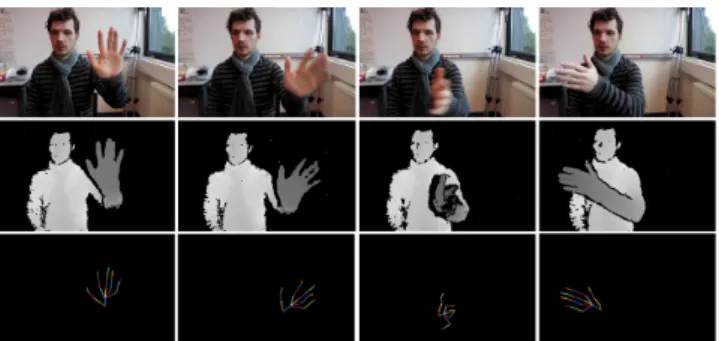
The list of the proposed gestures can be found in Table1and an example is given in Fig. 2. Most of them have been cho-sen to be close to the state-of-the-art, like the VIVA challenge’s dataset [OBT14]. Nevertheless, we removed the differentiation be-tween normal and scroll swipe as you can find it in our number-of-fingers approach. The same thing appears with the pair of ges-ture Pinch/Expand and Open/Close. In addition, we supplement this base with the gesture Grab because of its usefulness in the augmented reality applications, but also for its scientific chal-lenges related to the high potentially variation among perform-ers. We also add the gesture Shake, as it can be interesting for recognition algorithm to be able to differentiate gesture composed of other gestures (a shake gesture can be seen as a repetition of opposed swipe gestures). The dataset is available at http://www-rech.telecom-lille.fr/shrec2017-hand/.
Figure 2: Example of a swipe left gesture represented in color (top), depth map (middle) and skeletal data (bottom).
Table 1: List of the gestures included in the dataset. Gesture Label Tag name
Grab Fine G Expand Fine E Pinch Fine P Rotation CW Fine R-CW Rotation CCW Fine R-CCW Tap Coarse T Swipe Right Coarse S-R Swipe Left Coarse S-L Swipe Up Coarse S-U Swipe Down Coarse S-D Swipe X Coarse S-X Swipe V Coarse S-V Swipe + Coarse S-+ Shake Coarse Sh
3. Evaluation methodology
We emphasized the main challenges compared to existing hand ges-ture datasets: (1) Study the dynamic hand gesges-ture recognition us-ing depth and full hand skeleton; (2) Evaluate the effectiveness of recognition process in terms of coverage of the hand shape that depend on the number of fingers used. The same movement is per-formed with one or more fingers, and the sequence can be labeled according to 14 or 28 classes, depending on the gesture represented and the number of fingers used.
Indeed, labeling the sequences using the 14 gesture during the recognition process allows to judge if an algorithm can face the high coverage of hand shape while performing the same gesture with different number of fingers. In the other hand, we can use 28 gesture classes by grouping sequences following their type and the number of finger used to perform the gesture. In this manner, we will be able to evaluate the different methods on the task of fine-grained hand gesture recognition task.
The recognition accuracy will be computed on the proposed methods following 14 or 28 gesture classes as described above.
4. Methods
Two recognition methods have been registered to the track: • Skeleton-based Dynamic hand gesture recognition [DSWV16]
from IMT Lille Douai / University of Lille, France.
• Classify sequence by key frames with convolutional neural net-work from ONERA and ENSTA ParisTech, France.
These algorithms are detailed in the next subsection.
4.1. Skeleton-based Dynamic hand gesture recognition This method [DSWV16] is proposed by Quentin De Smedt, Hazem Wannous and Jean-Philippe Vandeborre, from IMT Lille Douai / University of Lille, France.
Using 3D hand skeletal data, as shown in Fig.1, a dynamic ges-ture can be seen as a time series of hand skeleton. It describes the
c 2017 The Author(s) Eurographics Proceedings c 2017 The Eurographics Association.
motion and the hand shapes along the gesture. For each frame t of the sequence, the position in the camera space of each joint i is represented by three coordinates i.e., ji(t) = [ xi(t) yi(t) zi(t) ].
In order to modelize the hand gesture, the approach uses different features computed from skeletal data.
Some gestures are defined almost only by the way the hand moves in space (e.g. swipes). To take this characteristic into ac-count, we compute a direction vector for each frame t of our se-quence using the position of the palm joint noted jpalm:
!d
dir(t) = jpalm(t) jpalm(t c)
jpalm(t) jpalm(t c) (1) where c a constant value chosen experimentally. We normalize the direction vector by dividing it by its norm. Finally, we create the direction matrix Mdirdescribing the hand motion in the sequence. It is of size Nf⇥ 3 and each line t is the row vector!ddir(t) .
The rotation of the wrist along the gesture describes also how the hand is moving into space. For each frame t, we compute the vector from the wrist node to the palm node to get the rotational information of the hand:
!drot(t) = jpalm(t) jwrist(t)
jpalm(t) jwrist(t) (2) Finally, we create the rotation matrix Mrotdescribing the rotation of the wrist along the sequence. It is of size Nf⇥ 3 and each line t is the row vector !drot(t).
To represent the hand shape, we divide the hand skeleton into nine tuples of five joints, named Shape of Connected Joints (SoCJ) according to the hand physical structure, presented in Figure3.
Figure 3: The nine tuples used to construct the SoCJ descriptors.
Fisher vector representation and classification. After feature ex-traction, we represent a hand gesture by three matrices of differ-ent descriptors, describing the direction of the movemdiffer-ent (Mdir), the rotation (Mrot) and the shape of the hand (MSoCJ) along the sequence. We use the statistical representation named Fisher Vec-tor (FV) in order to get our final descripVec-tor. FV coding method was firstly introduced for large-scale image classification. It can be considered as an extension of the Bag-Of-Word (BOW) method by going beyond count analysis.
For gesture classification, we use a supervised learning clas-sifier SVM with a linear kernel as it easily deals with our
high-dimensional representation. Further details are available in [DSWV16].
4.2. Classify sequence by key frames with convolutional neural network
This method is proposed by Joris Guerry, Bertrand Le Saux and David Filliat, from ONERA and ENSTA ParisTech, France.
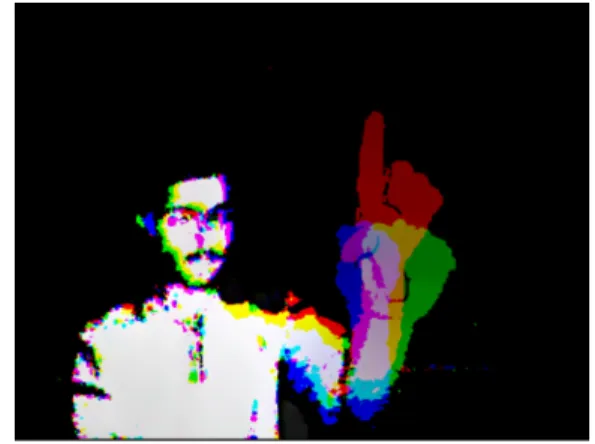
The approach is based on Convolutional Neural Networks (CNNs). This is why we sought an encoding that could adapt to the varying length of the sequences and that could be stored as a ten-sor. Intuitively, one can note it is possible to guess the gesture by just looking at subsets of images of the sequence. Based on this ob-servation we thought to simply concatenate depth images on each other: each channel representing a keyframe. An example is shown for three-keyframe concatenation in Figure4. The keyframes are picked regularly with a random variation up to three neighboring frames.
Figure 4: Three keyframe concatenation of a grab gesture.
The tensor previously defined is then processed by a CNN. Namely, we took a VGG11 network [SLJ⇤15] whose
parame-ters were initiated with weights resulting from ImageNet [KSH12] training.
1. We first learn to classify the 14 classes (giving much better re-sults than starting by 28 classes classification)
2. Then we use the same features until "conv5" layer to learn a second binary task : is the hand open or not ? (Which is directly related to the 28 classes problem : class28=2 ⇤ class14 d, whered corresponds to 1 if the hand is closed and 0 otherwise.) 3. We could then use the 14 classes predictions ("fc8_14" layer) and the binary predictions ("fc8_d" layer) to predict the 28 classes with a last fully connected layer.
4. Lastly, we get better results by removing the multi-task training (14 andd then 28) and just training on the 28 classes prediction.
5. Evaluation results
The proposed approaches are evaluated and compared to three state-of-the-art methods using depth images and skeletal data. We chose two depth-based descriptors: HOG2proposed by Ohn-Bar et
Q. De Smedt & H. Wannous & J.-P. Vandeborre & J. Guerry & B. Le Saux & D. Filliat / SHREC 2017
Figure 5: Confusion matrix (14 gesture classes) obtained by De Smedt et al. [DSWV16]
al. [OBT13] and HON4D proposed by Oreifej et al. [OL13]; and a skeleton-based method proposed by Devanne et al. [DWB⇤15]
originally presented for human action recognition.
The Table2analyzes the results obtained by the methods cited below using 14 and 28 gestures.
Table 2: Accuracy comparison 14 versus 28 gestures. Method 14 gestures (%) 28 gestures (%) Guerry et al. 82.90 71.90 De Smedt et al. [DSWV16] 88.24 81.90 Ohn-Bar et al. [OBT13] 83.85 76.53 Oreifej et al. [OL13] 78.53 74.03 Devanne et al. [DWB⇤15] 79.61 62.00
To better understand the behavior of the approaches according to the recognition per class, confusion matrices are also given.
6. Conclusion
In this paper, we have presented a dynamic hand gesture dataset, an evaluation methodology, proposed approaches and results for the SHREC 2017 track "3D Hand Gesture Recognition Using a Depth and Skeletal Dataset". The evaluation of proposed methods shows the promising way to perform hand gesture recognition with skeleton-based approach. Hand skeleton-based method has demon-strated superior results of 88.24% and 81.90% of accuracy respec-tively for 14 and 28 different gestures.
References
[CDL13] CHENG H., DAI Z., LIUZ.: Image-to-class dynamic time warping for 3d hand gesture recognition. In 2013 IEEE International Conference on Multimedia and Expo (ICME) (July 2013), pp. 1–6.
doi:10.1109/ICME.2013.6607524.1
Figure 6: Confusion matrix (14 gesture classes) obtained by Guerry et al.
[DSWV16] DE SMEDT Q., WANNOUS H., VANDEBORRE J.-P.: Skeleton-based dynamic hand gesture recognition. In IEEE International Conference on Computer Vision and Pattern Recognition (CVPR) Work-shops (June 2016).2,3,4,5
[DWB⇤15] DEVANNE M., WANNOUS H., BERRETTI S., PALA P.,
DAOUDIM., BIMBOA. D.: 3-d human action recognition by shape analysis of motion trajectories on riemannian manifold. IEEE Transac-tions on Cybernetics 45, 7 (July 2015), 1340–1352. doi:10.1109/ TCYB.2014.2350774.4
[EBG⇤14] ESCALERAS., BARÓX., GONZALEZJ., BAUTISTAM. A.,
MADADI M., REYES M., PONCE-LÓPEZ V., ESCALANTE H. J., SHOTTONJ., GUYONI.: Chalearn looking at people challenge 2014: Dataset and results. In Computer Vision - ECCV Workshops (2014), Springer, pp. 459–473.1
[FPS⇤09] FEIXT., PAWLIKR., SCHMIEDMAYERH.-B., ROMEROJ.,
KRAGICD.: A comprehensive grasp taxonomy. In Robotics, Science and Systems: Workshop on Understanding the Human Hand for Advancing Robotic Manipulation (2009), pp. 2–3.1
[KLTR13] KUZNETSOVA A., LEAL-TAIXÃL’ L., ROSENHAHN B.:
Real-time sign language recognition using a consumer depth camera. In IEEE International Conference on Computer Vision Workshops (IC-CVW) (Dec 2013), pp. 83–90.doi:10.1109/ICCVW.2013.18.1
[KSH12] KRIZHEVSKYA., SUTSKEVERI., HINTONG. E.: Imagenet
classification with deep convolutional neural networks. In Advances in neural information processing systems (2012), pp. 1097–1105.3
[KZL12] KURAKINA., ZHANGZ., LIUZ.: A real time system for dy-namic hand gesture recognition with a depth sensor. In 20th European Signal Processing Conference (EUSIPCO) (Aug 2012), pp. 1975–1979.
1
[MGO14] MONNIERC., GERMANS., OSTA.: A multi-scale boosted detector for efficient and robust gesture recognition. In Computer Vision - ECCV Workshops (2014), Springer, pp. 491–502.1
[NWTN16] NEVEROVA N., WOLF C., TAYLOR G. W., NEBOUT F.:
ModDrop: adaptive multi-modal gesture recognition. IEEE Transactions on Pattern Analysis and Machine Intelligence (Apr. 2016).1
[OBT13] OHN-BARE., TRIVEDIM. M.: Joint angles similarities and hog2 for action recognition. In IEEE International Conference on Com-puter Vision and Pattern Recognition (CVPR) Workshops - HAU3D (2013).4
c 2017 The Author(s) Eurographics Proceedings c 2017 The Eurographics Association.
Figure 7: Confusion matrix (28 gesture classes) obtained by De Smedt et al. [DSWV16].
Q. De Smedt & H. Wannous & J.-P. Vandeborre & J. Guerry & B. Le Saux & D. Filliat / SHREC 2017 [OBT14] OHN-BARE., TRIVEDIM. M.: Hand gesture recognition in
real time for automotive interfaces: A multimodal vision-based approach and evaluations. IEEE Transactions on Intelligent Transportation Sys-tems 15, 6 (2014), 2368–2377.2
[OL13] OREIFEJO., LIUZ.: Hon4d: Histogram of oriented 4d normals for activity recognition from depth sequences. In IEEE International Conference on Computer Vision and Pattern Recognition (CVPR) (June 2013).4
[PB11] PUGEAULTN., BOWDENR.: Spelling it out: Real-time asl fin-gerspelling recognition. In IEEE International Conference on Com-puter Vision Workshops (ICCV Workshops) (Nov 2011), pp. 1114–1119.
doi:10.1109/ICCVW.2011.6130290.1
[RYMZ13] RENZ., YUANJ., MENGJ., ZHANGZ.: Robust part-based hand gesture recognition using kinect sensor. IEEE Transactions on Mul-timedia 15, 5 (2013), 1110–1120.1
[SLJ⇤15] SZEGEDY C., LIU W., JIA Y., SERMANET P., REED S.,
ANGUELOVD., ERHAND., VANHOUCKEV., RABINOVICHA.: Going
deeper with convolutions. In The IEEE Conference on Computer Vision and Pattern Recognition (CVPR) (June 2015).3
[WLC15] WANGC., LIUZ., CHANS.-C.: Superpixel-based hand ges-ture recognition with kinect depth camera. IEEE Transactions on Multi-media 17, 1 (2015), 29–39.1
[ZYT13] ZHANGC., YANGX., TIANY.: Histogram of 3d facets: A characteristic descriptor for hand gesture recognition. In IEEE Confer-ence and Workshops on Automatic Face and Gesture Recognition (FG) (April 2013), pp. 1–8.doi:10.1109/FG.2013.6553754.1
c 2017 The Author(s) Eurographics Proceedings c 2017 The Eurographics Association.
![Figure 5: Confusion matrix (14 gesture classes) obtained by De Smedt et al. [DSWV16]](https://thumb-eu.123doks.com/thumbv2/123doknet/12572591.346006/5.892.69.437.113.412/figure-confusion-matrix-gesture-classes-obtained-smedt-dswv.webp)
![Figure 7: Confusion matrix (28 gesture classes) obtained by De Smedt et al. [DSWV16].](https://thumb-eu.123doks.com/thumbv2/123doknet/12572591.346006/6.892.106.791.127.572/figure-confusion-matrix-gesture-classes-obtained-smedt-dswv.webp)
