HAL Id: hal-01624697
https://hal-mines-paristech.archives-ouvertes.fr/hal-01624697
Submitted on 26 Oct 2017
HAL is a multi-disciplinary open access
archive for the deposit and dissemination of
sci-entific research documents, whether they are
pub-lished or not. The documents may come from
teaching and research institutions in France or
abroad, or from public or private research centers.
L’archive ouverte pluridisciplinaire HAL, est
destinée au dépôt et à la diffusion de documents
scientifiques de niveau recherche, publiés ou non,
émanant des établissements d’enseignement et de
recherche français ou étrangers, des laboratoires
publics ou privés.
Full field simulation of dynamic and post-dynamic
recrystallization in 304L steel
Ludovic Maire, Charbel Moussa, Nathalie Bozzolo, Daniel Pino Muñoz, Marc
Bernacki
To cite this version:
Ludovic Maire, Charbel Moussa, Nathalie Bozzolo, Daniel Pino Muñoz, Marc Bernacki. Full field
simulation of dynamic and post-dynamic recrystallization in 304L steel. Journées annuelles SF2M,
SF2M (Société Française de Métallurgie et des Matériaux), Oct 2017, Lyon, France. �hal-01624697�
Journées Annuelles SF2M 2017
Full field simulation of dynamic and post-dynamic recrystallization in 304L steel
Ludovic Maire, Charbel Moussa, Nathalie Bozzolo, Daniel Pino Muñoz,
Marc Bernacki
MINES ParisTech, PSL - Research University, CEMEF - Centre de mise en forme des matériaux,
CNRS UMR 7635, CS 10207 rue Claude Daunesse 06904 Sophia Antipolis Cedex, France.
Abstract
This paper describes a level-set framework for the full field modeling of dynamic and post-dynamic recrystallization in a 3D polycrystalline material submitted to large deformation. Topological evolutions are simulated based on a kinetic law linking the velocity of grain boundaries to the thermodynamic driving forces. Recrystallization is modeled by coupling a level-set approach to phenomenological laws describing strain hardening and nucleation. The proposed formalism enables to reach outstanding dynamic recrystallization computations in a front-capturing finite element framework comparatively to the state of art.
Introduction
During hot deformation, plasticity increases the dislocation density while dynamic recovery decreases the dislocation density in the microstructure. Globally, the dislocation density increases. When a critical dislocation density is locally reached, nucleation which is the appearance of new grains free of defects can occur. In parallel, grain boundary migration occurs due to stored energy gradients across interfaces and due to capillary effects. These mechanisms lead to the so-called dynamic recrystallization (DRX) mechanism. When plastic deformation stops, the material is still at high temperature, thus grain boundary migration is still active under the same thermodynamic driving forces. Furthermore, nucleation can also occur in the most hardened grains. These mechanisms appearing right after hot deformation lead to the so-called post-dynamic recrystallization process (PDRX). In the present work, a 3D finite element (FE) model based on the level-set (LS) method in the context of unstructured tetrahedral mesh is proposed to model the DRX and PDRX phenomena in austenitic stainless steel 304L submitted to large deformation and with relatively low computational costs. The LS approach coupled to a remesher provides an accurate tracking of interfaces (i.e. grain boundaries) all along the simulation while phenomenological laws are used for controlling nucleation, work hardening and recovery.
Constitutive laws of the model
Representation of the digital microstructure
The model is based on a LS description of the interfaces within a FE framework (Bernacki et al. 2008; Bernacki et al. 2009). First, grain interfaces are virtually generated by
using the Voronoï (Weaire, Kermode, and Wejchert 1986) or Laguerre-Voronoï (Fan et al. 2004) method. The virtual interfaces are then described into an unstructured FE mesh thanks to LS functions. Furthermore at the initial stage of the simulation, an energy field considered constant per grain is defined in the microstructure.
Grain boundary migration
At high temperatures, grain interfaces migrate driven by stored energy gradients across interfaces and by capillarity forces induced by grain boundary mean curvature. To simulate grain boundary migration, the strategy presented in (Scholtes et al. 2016) is adopted.
Strain hardening and recovery
The strain hardening and recovery mechanisms appearing during hot deformation can be modeled at different scales: at a local scale with crystal plasticity algorithms or at a higher scale with phenomenological laws. In this model, phenomenological laws are used in order to limit the computational cost of the 3D simulations. Considering NG grains in the microstructure, the averaged dislocation density field in each grain j noted 〈𝜌𝑗〉 is assumed to evolve according to the Yoshie-Laasraoui-Jonas law (Yoshie et al. 1987) :
where 𝜀̇𝑝𝑒𝑒𝑒 denotes the rate of effective plastic strain, K1
and K2 are two constants which represent respectively the strain hardening and dynamic recovery term. A superposed dot denotes differentiation with respect to time.
Nucleation mechanism
In the considered model, a nucleus can appear where the averaged dislocation density reaches a critical value noted 𝜌𝑐𝑐. Concerning the computing of 𝜌𝑐𝑐, a first approximation is made and an iterative calculation is done according to the following equation (Beltran, Huang, and Logé 2015):
where τ is the dislocation line energy, δ(𝜀)̇ is a strain rate dependent parameter, Mb is the grain boundary mobility and
ɣ
b is the grain boundary energy.When a new nucleus appears in the microstructure, its critical radius must be high enough so that the growth
Journées Annuelles SF2M 2017 driving force resulting from the difference in stored energy
with the neighborhood compensates for the shrinkage driving force induced by capillarity forces. This condition is approximated by the so-called Bailey-Hirsch criterion (Bailey and Hirsch 1962):
where ω > 1 is a safety factor ensuring that the created nucleus has the required driving force for growth.
The nucleation rate 𝑉̇, representing the volume of created nuclei per unit of time, is calculated according to a variant of the proportional nucleation model of Peczak and Luton (Peczak and Luton 1993):
where Kg is a probability coefficient related to the thermo-mechanical conditions (i.e. temperature and effective plastic strain rate) and φ represents the total boundary area (for necklace-type nucleation) or total volume (for bulk-type nucleation) of grains verifying 𝜌𝑖 >𝜌𝑐𝑐.
Simulation of a hot compression
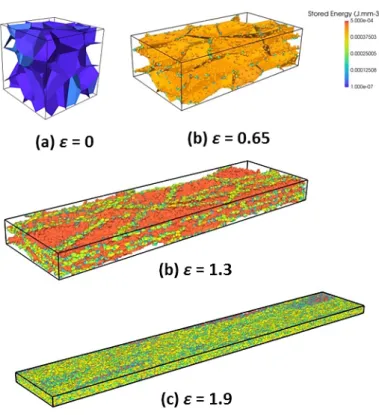
A simulation has been launched on 4*24 CPU processors using the above-described model. Results are presented on Fig. 1. The simulated process is a channel-die compression at 1000°C up to 1.90 strain, at a strain rate of 0.01s-1. The number of initial grains is 64 while the final number of grains is around 50.000. The final recrystallized grain radius predicted by the model is 6.1μm while experimental investigations have predicted 5μm at the same instant and in similar thermomechanical conditions (Beltran, Huang, and Logé 2015). The microstructure is recrystallized at 96% after 190s of process. The same framework is able to account for post-dynamic evolutions as well.
Figure 1. Simulation of a channel-die compression of the 304L steel at 1000°C and at a strain rate of 0.01s-1. Four different instants are represented: (a) ε = 0, (b) ε = 0.65, (c) ε = 1.3, (d) ε = 1.9. The initial number of grains is 64 and the final number of grains is around 50.000.
Acknowledgements
The authors thank the AREVA NP, ARCELORMITTAL, ASCOMETAL, AUBERT & DUVAL, CEA, SAFRAN, TIMET and TRANSVALOR companies and the ANR for their financial support through the DIGIMU consortium and ANR industrial Chair.
References
Bailey, J. E., and P. B. Hirsch. 1962. “The Recrystallization Process in Some Polycrystalline Metals.” Proceedings of the Royal Society A: Mathematical, Physical and Engineering Sciences 267 (1328): 11–30. doi:10.1098/rspa.1962.0080.
Beltran, O., K. Huang, and R.E. Logé. 2015. “A Mean Field Model of Dynamic and Post-Dynamic Recrystallization Predicting Kinetics, Grain Size and Flow Stress.” Computational Materials Science 102. Elsevier B.V.: 293–303. doi:10.1016/j.commatsci.2015.02.043.
Bernacki, M, H Resk, T Coupez, and R E Logé. 2009. “Finite Element Model of Primary Recrystallization in Polycrystalline Aggregates Using a Level Set Framework.” Modelling and Simulation in
Materials Science and Engineering 17 (6): 064006.
doi:10.1088/0965-0393/17/6/064006.
Bernacki, M., Y. Chastel, T. Coupez, and R.E. Logé. 2008. “Level Set Framework for the Numerical Modelling of Primary Recrystallization in Polycrystalline Materials.” Scripta Materialia 58 (12): 1129–32. doi:10.1016/j.scriptamat.2008.02.016.
Fan, Zhigang, Yugong Wu, Xuanhe Zhao, and Yuzhu Lu. 2004. “Simulation of Polycrystalline Structure with Voronoi Diagram in Laguerre Geometry Based on Random Closed Packing of Spheres.” Computational Materials Science 29 (3). Elsevier : 301–8. doi:10.1016/j.commatsci.2003.10.006.
Peczak, P., and M. J. Luton. 1993. “The Effect of Nucleation Models on Dynamic Recrystallization I. Homogeneous Stored Energy Distribution.” Philosophical Magazine Part B 68 (1). Taylor & Francis Group : 115–44. doi:10.1080/13642819308215285. Scholtes, Benjamin, Romain Boulais-sinou, Amico Settefrati, Daniel Pino
Muñoz, Isabelle Poitrault, Aurore Montouchet, Nathalie Bozzolo, and Marc Bernacki. 2016. “3D Level Set Modeling of Static Recrystallization Considering Stored Energy Fields.” Computational Materials Science.
Weaire, D., J. P. Kermode, and J. Wejchert. 1986. “On the Distribution of Cell Areas in a Voronoi Network.” Philosophical Magazine Part
B 53 (5). Taylor & Francis Group : L101–5.
doi:10.1080/13642818608240647.
Yoshie, Atsuhiko, Hirofumi Morikawa, Yasumitsu Onoe, and Kametaro Itoh. 1987. “Formulation of Static Recrystallization of Austenite Hot Rolling Process of Steel Plate.” Transactions ISIJ 27.