International migration and its regulation
State of the art report Cluster A1
Heinz Fassmann, Josef Kohlbacher and Ursula Reeger
ISR – Institute for Urban and Regional Research
Austrian Academy of Sciences
Wiebke Sievers
KMI - Commission for Migration and Integration Research
Austrian Academy of Sciences
INTRODUCTION
The main focus of cluster A1 is international migration as such. It does not deal with the causes and consequences of migration. Nor does it address the different dimensions of the integration process and the legal inclusion or exclusion of migrants. The process of migration, its conceptual delineation and the statistical recognition are in the centre of the A1-interests.
This overarching approach to migration implies that the issues addressed by the members of this cluster are of central interest to the whole network. These issues basically fall into five research questions: How can we define international migration and mobility; which phenomena of international migration and mobility have already been addressed and which have been neglected? What are the relevant theoretical paradigms in international migration research? Which regularities does international migration show in terms of structural aspects? What are the most important modes of regulation? Which new forms and patterns of migration have evolved in response to regulation? These five principal, to some extent broad, but necessary questions have guided the work of cluster A1. They correspond to five thematic areas:
• Thematic Area 1: International Migration: Concepts and Measurement, • Thematic Area 2: Changing Paradigms in Migration Theory,
• Thematic Area 3: Structural Aspects of International Migration, • Thematic Area 4: Modes of Regulation,
• Thematic Area 5: Migration Industry: Means and Routes of Migration.
These thematic areas supply the basic structure for this state of the art report. Based on contributions of the cluster members, this report has two aims: one is to reflect the wide range of research interests within the cluster. The other, more ambitious goal is to provide a wider overview of the state of the art in the different areas addressed within this cluster.
CHAPTER 1: INTERNATIONAL MIGRATION: CONCEPTS AND MEASUREMENT
Rob van der Erf, Michael Jandl and Ursula Reeger
1 Introduction
In the past, migration across borders has frequently been conceptualised as a distinct event, as a rule, taking place once in a migrant’s lifetime. Though it is questionable whether this conception ever did full justice to empirical reality, it increasingly becomes clear that in the present-day world processes related to economic globalisation also increase (the opportunities for) human mobility. Individuals tend to become less sedentary and once they move, they are increasingly likely to do so repeatedly (from settlement migration towards transnational mobility). Questions arising from this statement can be summarised as follows:
• How appropriate is our traditional concept of migration as a change of place of residence involving a certain distance for a minimum period of time?
• What are the links and the differences between mobility and migration? • Does our traditional understanding of migration stand up to reality?
There is no common concept of international migration, nor is there a common way of gathering data on this phenomenon. ‘Compared to some other areas of statistics, such as labour force data, there exists little international standardization of migration statistics. … The data reflect migration systems and the policies of national governments and so … it can be difficult to generate harmonized data’ (OECD 2002: 283). In the following we will try to provide an overview of both different concepts of international migration and data sources, two spheres that are closely connected. This overview encompasses three types of international migration, namely
- legal international migration, - illegal international migration and - asylum seekers,
as these types also reflect different ways of conceptualisation and measurement. Furthermore, the following elaborations are driven by research interests; that means that they concentrate on the validity and usefulness of concepts and statistical sources for empirical research on international migration in the social sciences.
2 Concepts and measurement: legal international migration
2.1 Concepts and definitions
Concepts and definitions of legal international migration are a dime a dozen: ‘As they result from distinct political, social, economic and cultural contexts, definitions of migration are highly varied in nature. This makes comparison difficult not only because statistical criteria differ, but because these differences reflect real variations in migration’s
social and economic significance, depending on the particular contexts’ (Castles 2000, cit. in IOM 2003: 8). Notwithstanding these contextual variations, there is a distinct trend towards harmonisation of concepts, chiefly pushed by international bodies and organisations that need comparative data, such as the UN, the OECD, the IOM or the EU. These therefore come up with concepts and definitions that aim to grasp ‘worldwide reality’ rather than only one particular context.
The two defining features of international migration are space and time. All definitions include these two variables but vary markedly in their specific use. Regarding space, the identification seems to be rather easy: international migration requires the crossing of an international border. However, this definition does not do full justice to migrants who cross more than one border or do so repeatedly. Nevertheless, there is more disagreement as to the minimum requirements concerning time. How long somebody has to stay to be counted as an immigrant still differs considerably from one country to another.
In the latest United Nations recommendation dating back to 1998 international migration is described as follows: ‘An international migrant is defined as any person who changes his or her country of usual residence. A person’s usual place of residence is that in which the person lives, that is to say, the country in which the person has a place to live where he or she normally spends the daily period of rest. Temporary travel abroad for purposes of recreation, holiday, business, medical treatment or religious pilgrimage does not entail a change in the country of usual residence’ (United Nations 1998: 17).
In view of a necessary time perspective, the UN argues for a period of one year, stating that ‘a long-term migrant should be defined as a person who moves to a country other than that of his or her usual residence for a period of at least a year (12 months) so that the country of destination effectively becomes his or her new country of usual residence. From the perspective of the country of departure the person will be a long-term emigrant and from that of the country of arrival the person will be a long-term immigrant’ (UNO 1998: 18). Short-term migration includes people, who ‘move to another country for a period of at least three months but less than a year’, except in cases where the movement to that country is for purposes of recreation, holiday, visits to friends and relatives, business, medical treatment or religious pilgrimage.
Up to now, the European Union has defined long as well as short-term migration along UN lines.1 Yet, recent developments as to the measurement of international migration in the EU point towards a future regulation on community statistics on migration, citizenship and asylum that will serve to fulfil the urgent need for ‘better statistics to improve estimates of the current population and projections of future population change’ (European Commission 2004). In the draft of this regulation, the term ‘usual residence’ is again based on the UN description (the place in which a person spends the daily period of rest). However, the text proposes a new definition of long-term migration that clearly distinguishes between immigration and emigration. ‘International immigration shall refer to the action by which a natural person establishes their usual residence in the territory of the Member State for a period that is, or is expected to be, of at least twelve months, having previously been usually resident in another Member State or third country. International emigration shall refer to the action by which a natural person, having previously been usually resident in the territory of the Member State, ceases to be usually resident in that Member State for a period that is, or is expected to be, of at least twelve months.’ This text is more precise in the way it describes sending and target countries by differentiating between member states and third countries. However, it does
not address a fundamental difference in the conceptualisation of ‘long-term migration’ in Europe, allowing both actual and intended stays of more than twelve months to be counted. In practice, this means that little will change in the way European countries currently measure immigration and emigration flows. The proposed regulation will thus only bring about a limited harmonisation of migration statistics and maintain confusion and incomparability between European countries.
Box 1: The social construction of migration
Heinz Fassmann
Migration is a real event. It involves leaving home, covering a significant geographical distance and living in the new place of residence for a minimum period of time or intending to stay there forever. These are, more or less, the defining features of a migrant and migration as an event. But how does this differ from spatial mobility? Usually, mobility is taken to be the overarching concept that includes migration. Nevertheless, the decision when a mobile person becomes a migrant is always a social construction.
A society that uses a narrow definition of migration generates fewer migrants and probably more temporary resident population, visitors, tourists, foreign students, guestworkers and other mobile groups coming and leaving. That these are perceived to be different and thus not categorised as migrants is closely related to the self-understanding of the respective society which in the above case only includes people who always have been and always will be part of it. This concept underlies German or Austrian self-understanding. The Germans perceive themselves as more or less direct descendants of Germanic tribes who settled in todays Germany in times immemorial. Germany and Austria have constructed their histories as ethnically continuous without any significant influence of migration. This explains why migrants coming from ‘outside’ these territories are categorised as guests or temporary resident population rather than as immigrants who intend to integrate themselves into the society which is per se difficult as they can never become descendants of the ‘first Germans’ or ‘first Austrians’.
Other societies, such as the United States, emphasise their long lasting history as immigration countries. They see themselves as ‘nations of migrants’ and as a consequence use a very broad definition of migration in their different statistics. That is why tourists entering the US have to pass immigration control; temporary resident population is labelled as non-immigrant migrant; and the census includes a question on ethnic origin, reflecting the fact that every member of this society is either a migrant or a descendant of a migrant. Migration here is thus not perceived as an event in an individual’s life but as a defining attribute of the whole society.
According to the OECD, there are two basic ways of defining immigration systems (OECD 2003: 288):
• ‘permanent residence’ type countries tend to focus on acceptances for permanent settlement as an indication of inflows and on the population of foreign-born as an indication of the stock of immigrants (Australia, Canada, the USA), thus the classic countries of immigration;
• ‘temporary permit’ type countries tend to have population registers and use these to focus on inflows and stocks of foreign citizens (as distinct from the foreign-born) (most OECD-countries, with the exception of France and the United Kingdom, that do not have population registers).
It is necessary to differentiate between migration and migrant population. Migration addresses the flow, the actual change of place of residence, whereas migrant population describes the stock of population that migrated in the past. The different definitions of the latter can be traced back to two basic concepts (OECD 2003: 287) that are closely related to the diverging histories of immigration systems and legislation on citizenship and naturalisation:
1. citizenship concept: foreign nationals (many European countries, Japan), including second and third generation members, keeping foreign citizenship, even if native-born,
2. place of birth concept: foreign-born population (Australia, Canada, New Zealand, USA2), including both foreign and national citizens.
As the OECD (2003: 287) points out, in some countries native-born foreign nationals are a non-existent group, ‘as legislation is such, that birth within the country usually entitles individuals to citizenship’.
Regarding the role of naturalisations in the stock of the immigrant population, we can again differentiate between two models (OECD 2003: 287):
1. Countries where foreigners can easily acquire nationality (France, Belgium) and where immigration therefore contributes to the growth of the native population; 2. Countries where naturalisation is rather difficult to achieve (Germany, Switzerland)
where immigration therefore implies the growth of the foreign population. Box 2: Some additional information on migration statistics and projects
Michael Jandl
The project Comparing national data-sources in the field of migration and integration (COMPSTAT), implemented in 2001/2002, was financed by DG-Research and coordinated by ICMPD and the European Centre for Social Welfare Policy and Research, Vienna, Austria. COMPSTAT was designed as an initial step in an effort to overcome the lack of comparable data in social and economic integration of migrants and their descendants in Europe. The main objectives were 1) to collect and analyse essential technical information on various sorts of micro-datasets and statistics regularly produced by public authorities; 2) to contribute to establishing comparability of these data in Europe and 3) to provide useful instruments for a comparative monitoring of integration processes in Europe.
Since COMPSTAT was designed as a pilot-study, it only included eight countries, namely Austria, Belgium, Germany, Hungary, Italy, the Netherlands, Norway and Switzerland, plus limited information on two EU candidate countries from Central and Eastern Europe (Czech Republic, Poland). In addition, EUROSTAT was invited to the project as an observer.
The final product of the COMPSTAT project is an internet-accessible, fully searchable database (www.compstat.org) containing meta-data on the details of about 325 individual datasets (all in all almost 500 individual datasets were screened) with relevance for cross-national studies on integration of immigrant minorities. The database provides general information on the datasets (institution responsible for data collection, the period of
2 The US Census Bureau uses the term foreign-born to refer to anyone who is not a US citizen at birth. This
includes naturalised US citizens, legal permanent residents (immigrants), temporary migrants (such as students), humanitarian migrants (such as refugees), and persons illegally present in the United States. Furthermore, the term native refers to anyone born in the United States or a US Island Area such, as Puerto Rico, or abroad of a US citizen parent (http://www.census.gov/population/www/socdemo/immigration.html).
coverage, sample sizes etc.) and all the variables and their possible values. Apart from collecting data, the project described the data systems of the countries involved, analysed the micro-data as to their quality, availability and comparability and evaluated the possibility of using them for comparative research. Using a range of formal, substantive and thematic criteria, the analyis of the available micro-data identified a variety of problems with regard to the data’s comparability and availability and discussed ways of improving the situation.
The project THESIM - Towards Harmonised European Statistics on International Migration intends to tackle the problem that international migration statistics are among the least reliable within the field of socio-economic and demographic data. This weakness was pointed out by international bodies, such as UNECE Geneva, as early as the 1970s. Yet only in 1990 EUROSTAT started to devote continuous attention to this problem. Their first initiative was to produce a report on harmonisation of international migration statistics in the then 12 EU member states. Henceforth, the international bodies concerned increased their co-operation in order to improve the situation, which, amongst others, led to an update of the UN recommendations for international migration statistics. Nevertheless, there still is no sufficiently reliable and minimally harmonised set of data. At the same time, the demand for such data is increasing. THESIM aims to support the implementation of a forthcoming EU regulation for community statistics on international migration.
In order to reach this objective, THESIM will: 1) compare definitions and concepts related to international migration; 2) analyse available data in order to see what the data already reveals and where the main problems are in terms of reliability and comparability; 3) integrate data on asylum with data on flows and stocks in order to get more reliable information on de facto international migration within each country; 4) describe and analyse all efforts done on bilateral and international levels in order to improve the situation and to identify the impact of low reliability and lack of comparability on policy implementation; 5) propose practical recommendations after discussion with all potential data providers and data users in migration policy development. The project includes all 25 EU Member States and runs from April 2004 to March 2005.
Finally, the project EMIN (European Migration Information Network) aimed to supply information on international migration for a wide group of users. It hoped to produce a database that would eventually hold registers and directories containing metadata on information sources for all types and aspects of migration in Europe. Initially funded by the European Union's Odysseus Programme, EMIN was based in the Migration Research Unit (MRU) at University College London (UCL). See: www.emin.geog.ucl.ac.uk.
2.2 Data Sources on legal international migration
Generally speaking, data on international migration are gathered at the national and in some cases local level, mostly by the national statistical offices that also process data provided by other administrative institutions.
Efforts to standardise statistics on international migration have a long history. It was more than 80 years ago that the International Labour Conference made first steps into this direction. Since then, the United Nations, in particular, have been trying again and again to bring together statisticians from all over the world in order to further progress towards comparable, high-quality migration statistics (IOM 2003: 294). But things have not moved very much in the past century, for the following reasons:
• there are no direct links between the United Nations Statistics Division and the respective government institutions at the national level;
• the UN-recommendations have been developed mostly by demographers, who see international migration as part of population change and not from a management perspective.
What are the main data sources of international migration today? Differentiated by place of collection, there are three different approaches to collecting data:
• in the countries of destination, • in the countries of origin and • while crossing the border,
with the first option being by far the most important. In addition, we can distinguish between official (administrative) and unofficial ‘data producers’.
Empirical research projects usually either draw on official data sources or use small numbers of narrative interviews, none of which are fully satisfying methods. Official data sources are very selective in their cognitive interest (which rarely concerns migration) and only provide a limited insight into a complex ‘reality’. On the other hand, while interviews allow for a more holistic approach, they can only ever cover a small sample. Furthermore, the criteria guiding the selection of suveyees are often unclear, if not dubious.
A well established method of measuring international migration is comparing the population register with the census. Based on the assumption that birth and death are statistically well defined demographic processes and that the census provides reliable data on the stock of population, this method allows estimating the change in population figures over a certain period of time that is not accounted for by births and deaths and is therefore interpreted to be the international migration balance. In concrete terms, this implies calculating the population at a given time (the population at a previous time plus the number of births minus the number of deaths) and comparing the result to the census data. The difference between these two numbers can be explained by two factors: statistical variation and international migration.
2.2.1 Statistics in the countries of destination Census data
Migration researchers mainly turn to census data to obtain information on the non-national population stock, generally identified on the basis of legal nationality (citizenship). Yet, this method does not provide any information on international migration. For second-generation foreigners, who might never have migrated, are counted as non-nationals, while naturalised persons, who have changed their place of residence, are counted as nationals. Some censuses do not even include a question on citizenship (Baltic States, Poland). Others also ask for ethnic origin (UK, USA, Canada, Czech Republic, Slovakia) (Poulain & Perrin 2001: 7). Due to its nature, no census covers international emigration.
Nevertheless, population censuses represent an important data source that can also be dissaggregated spatially up to a very large scale. Furthermore, some censuses provide information on immigration, e.g. when they ask for ‘the place of residence five years ago’ (Germany and Austria). However, the real plus of census data lies in the factual width of the information available as well as in their spatial depth. Censuses offer information on age, sex, education, religion, language, profession, housing condition, family and household structures and many other factors.
Census data could therefore also be of great support for research on international migration, if it was not for two main disadvantages:
• Censuses are only carried out once every ten years. Hence, the information is usually not up to date.
• Both the official character of censuses and their definition of the place of residence lead to the exclusion of certain people from the survey, i.e. those who stay on a temporary basis. This means that the data is useless for other than classical forms of migration, such as transnational mobility.
Sample surveys: microcensus
Another useful source for research on international migration are microcensuses that are carried out periodically in some countries, such as Germany and Austria, to supplement the census. These surveys consist of a fixed set of questions, on the one hand, and a variable set of questions on differing themes, on the other. As the fixed set contains a number of questions also aksed in the census, microcensuses bridge the long gaps between one census and the next.
The greatest disadvantages of the microcensus for research on international migration are, again, its official character and the sampling procedure. In Austria, the sample is determined in a two-stage procedure that randomly selects the surveyees from a housing register. This implies that the microcensus exludes anybody who lives in a shop, warehouse, on a building site or in a cellar of a building to be renovated. It thus has a bias towards the established foreign population.
This bias is further enhanced by the official character of this survey. The Austrian regulations, for example, state that the selected household must be notified in advance of the interview. Hence, any undocumented subtenants can leave the premises and will therefore go unmentioned.
Population registers and statistics on employees: whole population
Microcensuses and censuses are carried out by statistical offices every ten years and three months respectively, whereas population registers and statistics on employees are continuously updated and are carried out by different institutions.
A population register gathers demographic and administrative information on individuals living in a given place (Poulain & Perrin 2001: 9). The information is constantly updated (births, deaths, immigration, emigration). Problems occur, for example, in the case when an individual has several places of residence. Furthermore, there is no exchange of information between sending and receiving countries, which leads to a high number of undeclared emigrations (Poulain & Perrin 2001: 10).
The population register lies in the hands of the registration authorities, usually an administrative unit of the respective Ministry of Internal Affairs. By contrast, the statistics on employees are conducted by the Ministry of Employment and Social Affairs in Austria and by the Federal Office of Labour in Germany, to cite just two examples. While population registers keep record of all people living in a specific area, statistics on employees only include those who are legally present and allowed to work. Both data sources record nationality.
As they are continuously updated, population registers and statistics on employees are more apt to measure migration flows than the census or the microcensus. They therefore represent valuable data sources for the analysis of mobility. However, they also have disadvantages. First, they only register ‘legal cases’.3 Anyone staying in a country but
3 One exception is the population register in Spain that also includes illegal cases. This is mainly due to the
fact that here registered illegals do not have to fear expulsion or punishment, as this register is not interlinked with police data. On the contrary, there are positive incentives to register, including access to
not registered by the police or the competent authority respectively does not appear in the population register either. As long as these people are not conspicuous, not picked up by the police or caught as fare dodgers in public means of transport, they can live in the respective country of immigration for a very long time.
Almost the same holds true for the statistics on employees. Anyone who does not have an official work permit cannot be covered statistically. Yet, people working in private households, cleaning or doing the laundry can easily do so without permit. Furthermore, they are rarely found out since controls carried out by the labour market administration concentrate on ‘suspicious places’, most of all building sites.
Recent political measures aiming at the reduction of immigration might paradoxically lead to a further increase in the number of illegally resident and working foreigners not accounted for in the above statistics as those potential immigrants who are not deterred will come nonetheless and work on an illegalised basis.
Permit data: residence and work
The most important immigration countries, namely Australia, the United States and Canada, as well as some larger European countries, such as France and the United Kingdom, do not have population registers. They use permit data or in the case of the UK ‘landing cards’ to describe international immigration (OECD 2003: 286). In contrast to the statistics described above, these data only reflect movements of non-nationals of the respective country.
Non-official surveys
The deficits of official statistics as to the coverage of international migration have given rise to non-official alternatives that try to provide a more complete insight into the phenomenon. Surveys have been carried out to review official statistics and to get a rough idea of the illegalised labour market. These surveys are not representative because their selection procedures do not fulfil the principles of random sampling. Nevertheless, they are apt to complement official statistics and constitute a good point of departure for further research.
2.2.2 Border statistics
Border statistics record how many cars and passengers cross international borders. Moreover, they represent a source of information on so called ‘rejections’ since they register, amongst others, undocumented passengers who try to enter a foreign territory. However, these statistics are by no means sufficient for social science orientated research. While they help to describe and analyse flows on a macro level, they do not supply any information on the structure of mobility.
2.2.3 Data sources in the countries of origin
Experience shows that it is much easier and far more reliable to register immigrants than emigrants. Even when emigration required consent of the responsible municipality and landlord, statistics on emigration did not do justice to reality and they are still notoriously poor.
the health and school system and evidence of residence within subsequent legalising programmes. In
Official data on emigration
The cancellations at the registration office no longer seem to be a reliable source of information on the numbers of emigrants. Regular comparisons of updated population numbers and census results show that many people do not notify their home authorities of their change of residence. This does not always happen on purpose. In many cases these people believe that they will only temporarily leave their country of origin.
Surveys on the migration potential
There are also non-official data sources that provide information on the number and structure of people leaving a country. Usually, these are based on household surveys establishing the number of household members who are abroad as well as their links to the home country. Surveys on migration potentials use a similar procedure to estimate possible emigration in the near future, i.e. for up to five years. Longer-term estimates draw on demographic and economic forecasts of variations in population developments in potential countries of origin and destination and of income differences. These surveys and estimates are a delicate but important source of information for political decision makers.
3 Concepts and measurement: Asylum seekers and refugees
Another part of international migration is constituted by people crossing an international border and claiming asylum according to the Geneva Convention. The IOM defines asylum seekers as follows: ‘A person who has crossed an international border and has not yet received a decision on his/her claim for refugee status…’ (IOM 2003: 10). Persons who are approved as political refugees or who are allowed to stay in the host country for other reasons are no longer categorised as asylum seekers. Depending on their specific status, they enjoy either the same rights as the citizens of the respective country or at least a limited number of these rights.
Asylum statistics first and foremost serve policy purposes: they support the development and evaluation (monitoring) of asylum and interrelated policies (e.g. in the field of migration, housing, social security, etc.) in national and international contexts. However, they are also useful for scientific purposes. Thus statistical analyses can be used to study possible interdependencies between asylum flows and current or previous regular migration flows. In theory, statistics on asylum-seekers should aim to describe, as precisely as possible, the path of an asylum-seeker from the moment s/he crosses the border or submits an application abroad up to the definitive decision on the case. If possible, this should include characteristics such as nature of stay/residence permit, country of citizenship, country of birth, sex, date of birth, and household position. Moreover, apart from compiling these basic data, the statistics should also follow the cohorts of asylum seekers (i.e. those arriving in the same year) over the years, as it is highly improbable that the relevant institutions will decide on their claims in the year of their application.
However, in practice, asylum data leave a lot to be desired, in particular with regard to their availability, reliability and international comparability. It is hard to judge the results of asylum procedures in the various countries, as concepts, legislations and ways of calculating vary. So apart from the fact that asylum procedures as such should be the same within Europe, there is a strong need for harmonised asylum statistics.
Although the 1951 Geneva Convention and the 1967 New York Protocol are widely accepted, their interpretation is left to national legislations. These differ markedly as to the exact way to claim asylum, potential preliminary and the length of procedures,
provisions for appeal, and possibilities to stay in the country for those not qualifying for Geneva Convention status. Furthermore, there are various definitions of widely used concepts such as ‘manifestly unfounded claims’, ‘safe third countries’, and ‘safe countries of origin’.
Asylum seekers who are denied Geneva Convention status can be granted a lesser status that allows them to stay in the country, albeit with fewer rights and often for a limited period of time. If seen as a positive outcome of the asylum procedure, this status is usually called ‘subsidiary protection’. Otherwise, the respective claimant is ‘rejected without order to leave’. In practice, the distinction between these two concepts is not always very clear. Both may be granted for reasons of protection (i.e. when it would be irresponsible to send the applicant back to his or her home country based e.g. on the non-refoulement principle laid down in the Geneva Convention) or on humanitarian grounds (including family ties, grave illness, etc.). Most countries can also offer temporary humanitarian protection to a whole group of aliens without prior asylum procedures in case of a mass influx of displaced persons, as e.g. from former Yugoslavia a few years ago.
It goes without saying that the differences indicated above are reflected in the national statistics. If these do not per se impede international comparison, they should at least be taken into account.
Asylum statistics have to be differentiated from collected asylum data of which substantial parts are not published or made available otherwise. There are two possible reasons for this: either the respective country has political motives for not disclosing the data or it does not gather any data apart from the obligatory asylum statistics. The resulting lack of data explains why it is rather difficult to describe the whole asylum process in statistical terms – a task that is further exacerbated by the fact that the compilation of asylum statistics is often left to the responsible ministries or special agencies that do so for administrative rather than for statistical purposes.
Most countries do not collect even the most basic flow data on asylum. Different definitions of an applicant for asylum prevent international comparison. So does the fact that the information on decisions stems from different stages in the asylum process (preliminary procedure, first instance normal procedure, appeal). Furthermore, countries rarely gather more detailed demographic information on asylum-seekers (e.g. sex, age, marital status, and household composition), let alone longitudinal data on asylum procedures.
Similar to asylum statistics, refugee statistics firstly serve policy purposes: they support the development and evaluation (monitoring) of various policies relating to the (dynamics of the) refugee stock. In addition, they can be useful for scientific purposes: statistical analyses can be used to study the interdependencies between characteristics of the (dynamics of the) refugee stock and societal phenomena, such as employment, education, integration, and participation.
There are almost no stock statistics on refugees and in the rare cases where data of this kind are available, their credibility is limited. This might also explain why it is almost impossible to trace refugees in administrations or registers in the course of time.
Because of the many diverging ways of calculating recognition rates or percentages, these nationally defined figures can hardly be compared. Their adequate use as indicators in an international context therefore presupposes a description of their exact contents. However, the ideal solution to this problem would be an international agreement on a standard calculation method.
The recognition rate is a generally accepted measure that relates the number of accepted requests to the total number of requests. As is common practice with other demographic measures, the rate has to be related to a ‘risk population’. In case of the
recognition rate this should be the number of people who applied for asylum. Given that procedures are not necessarily completed within the year of application, a correct calculation requires a longitudinal approach, meaning that a cohort of asylum-seekers has to be monitored over time. However, in practice, most countries simply divide the number of positive decisions in a calendar year by the total number of asylum-related decisions. This way of calculation may easily lead to erroneous conclusions.
The statistics on international migration are usually only loosely linked to the statistics on asylum, particularly due to the differences between these two sources. Notwithstanding this difficulty, close(r) co-operation between the responsible administrative unit for asylum matters and the national statistical institute would not only improve the system of population accounting. It would also ensure that all possibilities of providing a more complete description of the asylum process in statistical terms are exploited.
Resuming the foregoing, it may be concluded that the institutions compiling statistical information on asylum and refugees primarily cater for national purposes. Indeed, if data are available, most of these statistics provide a more or less apt description of national fluctuations in the number, the composition, and the degree of recognition of asylum-seekers in the course of time, unless there were relevant changes in registration methods, definitions, policies, etc. However, a lot of work remains to be done as to the harmonisation of definitions before we can draw an analogous conclusion for their international comparability. Furthermore, there is a need for agreements on the variables to be included, the classifications to be used, the length of the time series, and the expected time span between collection and publication. Ideally, these agreements should facilitate a comprehensive (longitudinal) description of asylum processes in the various countries. For now, comparing international statistics on asylum and refugees is a rather hazardous job, especially with regard to data on the degree of recognition and on refugee stocks.
4 Concepts and measurement: Irregular migration
4.1 Conceptualising illegal migration
Most writers on illegal migration omit the question of what exactly is ‘illegal migration’, an ‘illegal immigrant’ or an ‘illegal border crossing’. A notable exception is Tapinos, who details six important categories of clandestinity (Tapinos 1999). This logical classification can be depicted in a two-dimensional table including illegal work as a further factor as shown in Table 1.4
4 The six categories of clandestinity are (from top left to lower right): 1) legal entry, legal residence but
illegal work; 2) legal entry but illegal residence and illegal work; 3) legal entry, no work but illegal residence; 4) illegal entry, legal(ised) residence but illegal work; 5) illegal entry, illegal residence and illegal work and 6) illegal entry, illegal residence but no work. The other two possible combinations – 7) legal entry, legal residence and no work and 8) illegal entry but legal(ised) residence and no work – do not amount to ‘clandestinity’. Moreover, it is assumed that legal work can only be carried out when residence is legal (or legalised) and therefore cannot lead to further combinations of ‘clandestinity’.
Table 1: Relevant categories of illegal migration
Residence legal Residence illegal Entry legal Work illegal Work illegal - No Work
Entry illegal Work illegal Work illegal - No Work
However, using the six identified relevant categories of illegality as a point of departure presents a number of practical problems. This starts with the fact that any person may change his or her status over time, sometimes more than once. For example, a person may enter a country legally, then overstay his or her visa and become illegal, subsequently be regularised and again be legal, and still later fall back into irregularity, becoming an illegal immigrant again. This also goes to show that illegal migration (in the broader sense) includes a wide variety of phenomena. It has therefore been suggested to limit the term ‘illegal migration’ to illegal border crossings and to use ‘irregular migration’ for a broader class of phenomena including illegal entries, legal entries with subsequent illegal residence (visa overstayers, etc.) and abuse of schemes for legal entry (i.e. ‘sham marriages’, ‘bogus students’, etc.).5 In addition, it should be noted that the term ‘irregular migration’ often encompasses asylum seekers, especially on the policy-making level, as they tend to use illegal means in order to reach their intended destination (see also Jandl 2004b). However, these terminological differentiations and clarifications are not (yet) commonly accepted. On the contrary, most researchers and writers still use the term ‘illegal migration’ to refer to a whole class of irregular migration phenomena. 6
4.2 Statistical data related to illegal migration
National authorities collect a great number of administrative (enforcement) data linked to illegal migration phenomena. In many cases, however, these data are not published and until very recently, no European-wide database on illegal migration trends has been publicly available. Nevertheless, from a policy perspective, it is clearly necessary to gain a clearer picture of the size, structure and dynamics of illegal and irregular migration across Member States. To this aim, the European Commission (especially DG JAI and Eurostat) has developed a data collection system (CIREFI7) that regularly compiles statistics on illegal migration provided by Member States. It was only in early 2004, however, that the European Commission, in its first Annual Report on Asylum and Migration8, published a sub-set of illegal migration data from its CIREFI database.
There are three main types of data linked to illegal migration and published from the CIREFI database9, namely statistics on
5 Finally, we could define ‘illegal residence’ as comprising only those residing illegally in a given country
but excluding those working illegally while residing legally in the country. Although the latter will often lead to a withdrawal of residency rights if found out (e.g. of tourists, students), this does not hold true for all cases (e.g. for family members of legal residents who do not (yet) hold work permits).
6 For example, within the institutions of the European Union, the term ‘illegal migration’ is generally used
to refer to the illegal entry and/or stay of international migrants who are citizens of third countries.
7 Centre for Information, Discussion and Exchange on the Crossing of Frontiers and Immigration. 8 The documents are available online at (29.4.2004):
http://europa.eu.int/comm/justice_home/doc_centre/asylum/statistical/doc_annual_report_2001_en.htm
9 The CIREFI monthly data collection includes two more categories of data on enforcement measures
1. refusals of entry (1997-2001)
2. apprehensions of aliens illegally present (1997-2001) 3. removed aliens (1997-2001).
Due to conceptual problems and poor data quality, these sources do not offer much help in estimating either flows or stocks of illegal migrants to (or within) the European Union. A recent review of the subject concluded that ‘the form and content of the statistical material published from the CIREFI database is wholly inadequate to capture levels and trends in illegal migration processes and is, hence, insufficient to properly address the question of the relationship between legal and illegal migration. Data on apprehended illegal migrants present do not distinguish between stocks and flows (nor do they distinguish between persons and events), data on refusals of entry do not distinguish between the reasons for refusals of entry and data on removals do not specify to which type and category of removals they refer.’ (Jandl 2004c)
4.3 Methods for estimating illegally resident foreign populations
4.3.1 ‘Residual’ estimation techniques
‘Residual’ estimation methods measure the differences between census data and other registries of immigrants. While this is a well established method of estimating the stock of undocumented immigrants in the US, it is only rarely used in European states because the censuses are thought to be seriously undercounting irregular migrants in Europe.
4.3.2 ‘Multiplier’ estimation techniques
Most statistical estimations of undocumented migrants are based on the ‘multiplier principle’. Basically, these methods presuppose that the size of the unknown variable to be estimated (such as the stock of undocumented migrants) has a stable relation to a variable that can be measured (such as the stock of the legally resident migrants), so the problem is redefined as finding the ‘right’ multiplier (Vogel 2002). One particular variant of multiplier methods consists in surveying ‘experts’ on the subject and adding up their estimations to an appropriate multiplier (survey methods). A pioneering study carried out in the Netherlands has used the capture-recapture method for estimating the size of the illegally resident population in Dutch cities (Van der Leun, Engbersen & Van der Heijden 1998). 4.3.3 Evidence based on regularisation data
Perhaps one of the best sources on illegal migration are regularisation figures. Before migrants are regularised, their status is, by definition, ‘irregular’. Usually, this involves irregular residence. However, regularisation can also include cases of irregular work, i.e. foreigners who take up work without permit (e.g. ‘working tourists’, family members of regular migrants or asylum-seekers).
facilitated aliens (by citizenship and type of border), see: UN Statistical Commission, UN Economic
Commission for Europe & Eurostat 2003. A sixth set of data published in the first Annual Report on Asylum and Migration serves to measure the implementation of the Dublin Convention, i.e. it includes information on Member State requests to another Member State to take back or to tacke charge of asylum applicants. However, these data refer to administrative requests and not to actual movement from one country to another.
4.3.4 Estimations based on the extent of illegal foreign employment
Some estimates infer the size of the illegal foreign population from estimates of the numbers of migrants working in the informal sector of a given country (i.e. the amount of illegal foreign employment). These, in turn, either draw on data on apprehended illegal foreign workers at worksites or use indirect estimation methods based on the amount of cash in circulation or the amount of electricity consumed. While there are no indications that the results of these calculations have bigger margins of error than those derived from other estimation techniques, the resulting estimates on illegal foreign residents display even greater variations than estimates derived through other methods.
4.3.5 Estimations based on the number of apprehended illegal aliens
Finally, a few remarks should be made on the value of data on illegal aliens apprehended within a country in the course of one year. As mentioned above, such data are sometimes available from Federal Police services as statistics distinct from those on persons apprehended when illegally crossing a border. However, there are two main problems with using such data for estimating stocks of aliens illegally present within a country at a given point in time: First, data on apprehended aliens illegally present in the country within the course of one year do not yield any information on the stocks of aliens illegally present at one point in time. And second, more than other apprehension statistics, such data very much depend on the intensity of law enforcement. To simplify, one could say that data on apprehensions can easily be ‘produced’: If higher numbers are desired, a few additional police raids on suspected work sites or living quarters of illegal foreign residents will do the trick.
4.4 Estimating illegal migration flows
The only methodology explicitly used for estimating flows of illegal immigrants to Europe is the projection of border apprehensions, using an estimated ratio of border apprehensions to (non-detected) illegal entries.10 While this method does have its validity (not least because of the lack of alternatives), three technical problems should be pointed out here. First and foremeost, much of the statistical material collected by border enforcement agencies is kept secret and only few countries in Europe regularly publish their border apprehension data.11
Second, border apprehension data usually refer to cases rather than to individuals. Thus, if an individual is apprehended more than once while trying to cross an international border illegally, he or she will be counted more than once in apprehension statistics.
Third, the estimations of the ‘correct’ multiplier vary. In the past, the most commonly used multiplier for the estimation of actual illegal crossings on the basis of apprehension figures has been two (‘two pass for each one caught’).12 In addition, analysts
10 See, for example, Heckmann & Wunderlich (2000: 167-182) who use an assumed ratio of one border
apprehension on two illegal entries into the EU. Widgren (2002) provides a more elaborate description of his methodology that works on the same ratio.
11 This is also true for the data on illegal migration collected by the Inter-governmental Consultations on
Asylum, Refugee and Migration Policies in Europe, North America and Australia (IGC).
12 Using a formal model for their estimation, Massey & Singer (1995) infer a probability of apprehension of
0.35 from a survey in 22 Mexican communities in Mexico and the US and the recorded apprehensions by the INS between 1965 and 1992 (Massey & Singer 1995).
have also resorted to ‘criminological’ methods based on the likely chances of being caught while attempting to cross a border illegally, arriving at similar multipliers.
To summarise the discussion, there are a number of conceptual problems associated with the estimation of illegal migration flows on the basis of border apprehension data. Nevertheless, the available material can and has been used – with all caveats raised in the preceding discussion in mind – for producing rough estimates on illegal migration flows (see Jandl 2003).
CHAPTER 2: MIGRATION THEORIES, HYPOTHESES AND PARADIGMS: AN OVERVIEW
Gustav Lebhart13
1 Introduction
The study of migration within social sciences is, as Castles (1993) pointed out, ‘strongly multidisciplinary in its theory and methodology’. Given the multifaceted nature of migration, it comes as no surprise that several disciplines have posited theoretical explanations for the nature, genesis and development of specific types of migration. The resulting variety of theoretical viewpoints has led Massey and his colleagues (1994) to synthesise theories based on empirical evidence with a view to formulating a comprehensive theoretical approach to international migration for the 21st century.
The following elaborations on migration theories can be found in well established literature. Only few approaches originate from lesser known migration research. This chapter aims to review migration theories, hypotheses and paradigms that have been proposed within the various disciplines and to provide a comparative analysis of their strengths and limitations.
2 Hypotheses and Paradigms on Migration
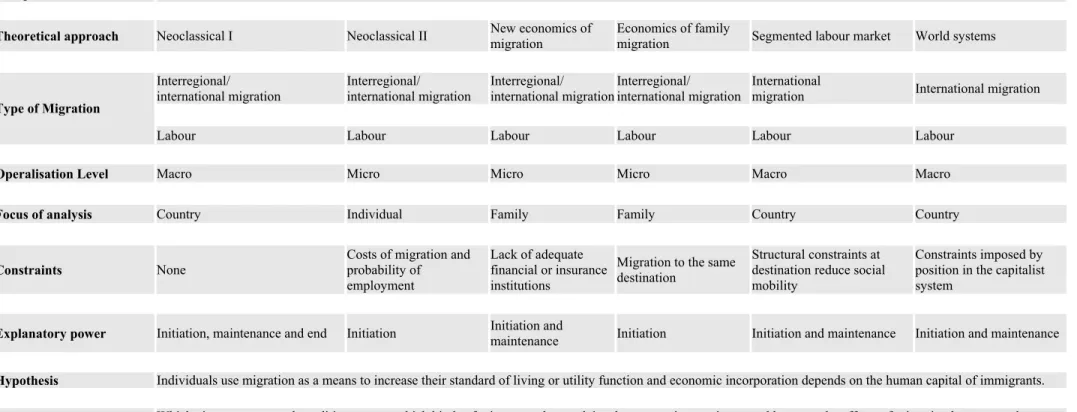
Economy and Migration
From the economic point of view the central questions are: which circumstances and conditions attract which kinds of migrants, what explains the propensity to migrate and how can the effects of migration be measured economically? While other disciplines wonder whether and how to evaluate positive and negative inputs or outcomes, economists and economic demographers often try to assess the fiscal and human capital costs and benefits of in- and out-migration. Economic research on migration focuses primarily on wage differences (Stark 1991; Alonso 1976; Cain 1976) and investigates the influence of structural changes within capital markets and service sectors (Brettell & Hollifield 2000; Sassen 1991; Malmberg 1992). This may be one of the reasons why this discipline covers many theoretical aspects (Borjas 1999; Huber & Espenshade 1997). Generally, all economic approaches assume that migration is mainly a result of rational choices.
The economic perspective regards migration as a mechanism to redistribute labour, especially focusing on international movements of economically active individuals. One of the oldest theoretical approaches that tries to explain the occurrence of labour migration is based on hypotheses by Adam Smith. He illustrated that labour migration is caused by differences in the supply of and demand for labour in different locations. Different researchers modified the classical approach developing the neoclassical theory of migration (Todaro 1976; Harris & Todaro 1970; Sjaarstad 1962). This macro-economic
13 Views expressed in this paper are those of the author and do not necessarily reflect those of Statistics
approach posits that people migrate to areas with a higher wage level. This is the basic ‘law of migration’ in regional economics. The micro-economic counterpart considers migrants to be rational actors who migrate due to cost-benefit calculations. Migrants are seen as choosing to move to wherever they can be most productive given their skills (Massey et al. 1993, 1994; Martin 1991). The neoclassical theory has some limitations as it does not take into account the international political and economic environment and its influence on individual decisions to migrate. These limitations have led to alternative economic approaches.
A variation of the neoclassical migration model has been proposed to take into account that a large part of migration consists of the movement of complete families and not just of workers (Massey et al. 1993; Stark 1991; Stark & Taylor 1989). The new economics on migration assumes that people act within families and households to maximise expected income but also to minimise risks to their economic well-being by diversifying the allocation of family labour. According to this approach, migration of family members to other countries, where employment conditions are to some extent independent of local economic conditions, can be seen as a form of insurance against deterioration. It similarly facilitates to obtain the capital needed to increase productivity in the community of origin. Therefore economic development within areas of origin does not necessarily reduce pressures for international migration. It can be assumed that the propensity of households to send family members abroad will increase if these do not share equitably in the income gains of other households (Massey et al. 1993 and 1994; Taylor 1992).
The theory of economics of family migration considers the effects of earnings differentials across space on family migration. This approach is quite realistic since one family member may anticipate gains in potential earnings while another expects losses in the place of destination. It was shown that the difference between the individual’s and the couple’s optimal strategy depends upon the degree of correlation in the gains from migration of the husband and wife (Mincer 1978). This approach was developed to analyse the constraints faced by migrants moving within advanced market-economy countries. Only in that context did it seem necessary to attach equal importance to the economic goals of husband and wife. Other researches analysed the selectivity of migration to show that the extent of income inequality between country of origin and destination influences the type of migrant (Taylor 1992).
In contrast, the dual labour market theory posits that international migration is a result of permanent demand for foreign labour. It emphasises that wages cannot respond freely to changes in the supply of workers in an established occupational hierarchy (Piore 1979; 1983). The main hypothesis guiding this approach is that such economic conditions preserve established occupational hierarchies by seeking unskilled workers and giving them access to the bottom of the labour market. An increase of wages at the bottom would not only change socially defined relationships between status and prestige within the labour market but also influence wage conditions at other levels. The central message emerging from this approach is that the importation of foreign workers avoids pressures in times of labour scarcity and provides upward mobility for local workers. This assertion is validated by the experience of the labour-importing European countries through recruitment programmes in the 1960s (Sassen 1997; Emmer 1993).
The world systems theory posits that migration can be traced back to institutional and sectoral imbalances between three geographically distinct zones (core, semi-periphery, periphery). Furthermore, this approach works on the assumption that international migration is facilitated by cultural, linguistic, administrative and communication links,
citing the mass influx from former colonies to the respective colonial powers as evidence for this thesis (Portes 1995; Sassen 1988, 1991; Petras 1981; Wallerstein 1974).
Sociology and Migration
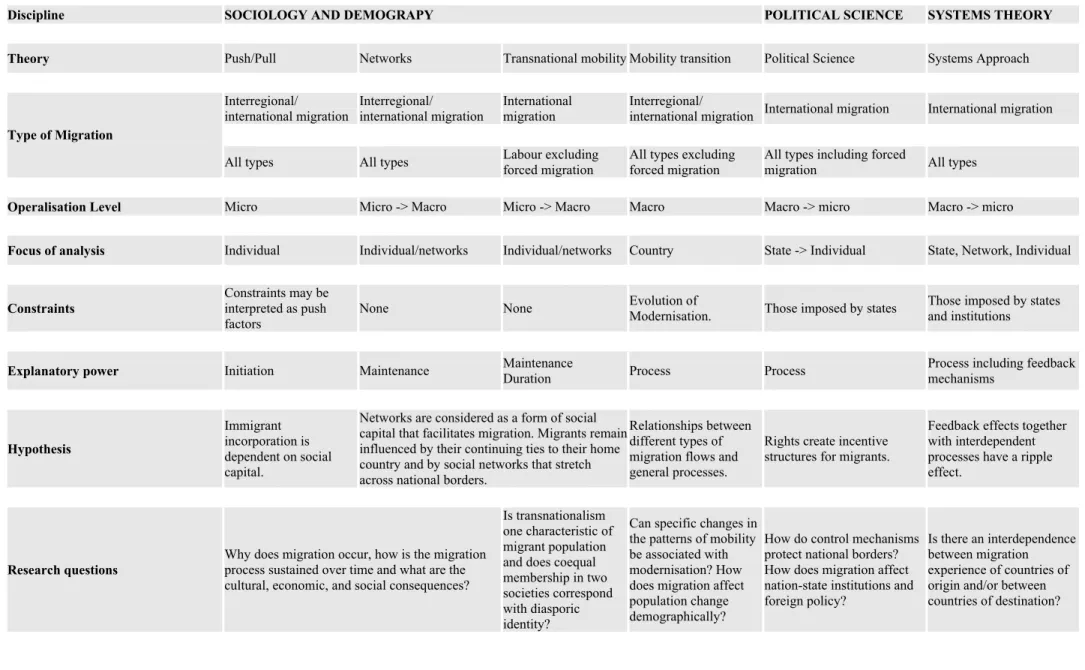
The central questions in sociology of migration are: Why does migration occur; how is the migration process sustained over time; and what are the cultural, economic, and social consequences of migration? The theoretical framework of sociology is substantially grounded in the classic work of social theory (Marx, Durkheim, Weber). Sociology of migration focuses on socio-demographic relations to understand the migration process and its impact on the host society. Sociology, like anthropology, studies social relations of migration and the relevance of social networks as initialising, sustaining and finishing factors in the migration process.
Economic factors are important in migration decisions but do not cover all events and considerations that can trigger migration (life threatening situations, climatic aspects, marriage market, etc.). The approach by Lee (1966) recognises that a wide range of factors have to be taken into account when explaining the decision to migrate. Lee’s approach built upon the work of Stouffer (1940 and 1960) who suggested that migration was a function of the relative perceived attractiveness of areas of origin and destination. In fact, distance continues to be an important factor reducing migration propensities or as the economic models would put it, increasing both the tangible and the intangible costs of migration. According to the pull-push approach migration is determined by both positive factors in areas of destination and negative factors in the place of origin or current residence. Consequently, the greater the perceived difference in the net forces of attraction in places of origin and destination, the more likely migration will take place. Lee argued that migrants who respond primarily to pull-factors in the place of destination tend to be positively selected, whether by age, education, skills or motivation. Those migrants responding primarily to push factors in the area of origin tend to be negatively selected. In addition, the former group is more likely to migrate voluntarily than the latter. An implication of this theory is therefore that emigration follows a bi-modal distribution according to certain characteristics (e.g. educational attainment).
Migration involves family members and not just workers as posited by economic theory. Family units may move simultaneously or in stages with one family member relocating first and others following. Family members of migrants are often dependent on already established networks in the country of destination to obtain jobs, accommodation or other types of support during an initial period of adaptation. Such a kinship between potential migrants in the country of origin and residents of the country of destination can reduce the costs of migration and lower the risks. The concept of a migration network encompasses all interpersonal ties that connect migrants, former migrants and non-migrants in areas of origin and destination. Network connections can therefore be considered as a form of social capital that people can draw upon to gain information as well as material or psychological support that facilitate both migration and the adaptation process (Portes 1995, Gurak & FeCases 1992, see box 3 below).
Box 3: The theory of migratory networks in migration studies
Natalia Kovaleva
Migratory networks are above all networks of relationship. They play a significant role in the organisation and the development of the migration processes. Analysis in terms of networks was elaborated by the Chicago school in the 1920s. Migrants’ networks became a subject of renewed interest when researchers sought to connect micro (individual decision factors) and macro (economic, politic and cultural opportunities) determinants of migration (Fawcett 1989, Light 1972 etc.)
Based on these ideas, Douglas Massey formulated the theory of ‘cumulatively caused’ migration; according to him, migrations create networks which then generate new migrations; whatever the reason for the first migration, the migratory process then becomes ‘progressively independent’ (Massey et al. 1989) from the original conditions; networks transform migration into a self-sufficient process, which supports immigration. Networks are ‘sets of interpersonal ties that link migrants, former migrants and non-migrants in origin and destination areas through the bonds of kinship, friendship and shared community origin’ (Massey 1988).
Networks promote the independence of migratory processes for several raisons: they permit the mobilisation of the funds necessary to pay for the trip, they provide information on the country of destination circulated through the network and spread to the potential migrants, and they facilitate the adaptation of the newcomer in the host country. At the same time, networks ensure that the migrants selected in the departure country fit the specific needs of the host country. Furthermore, they help to avoid legal constraints in the host countries, and influence the choice of destination. These network functions reduce the social, economic and emotional costs of migration (Faist 1997; Light 1993; Massey 1989).
To understand the mechanisms of migration processes, three levels of analysis are necessary: first, the structural level (political, economic and cultural structure of the countries of origin and destination), second the relational level (social network formation), and third the individual level (individual liberty to migrate or not) (Massey 1993; Faist 1997). This theory was used in the domain of immigrant entrepreneurship (Light et al. 1993; Ma Mung 1994). Ivan Light, for example, proved that migration networks are a competitive ethnic resource. They can stimulate the local economy by money transfers of new immigrants, or by purchase of housing and enterprises. Research analysing migration in terms of networks therefore goes beyond the push and pull theory and labour market supply and demand.
Transnationalism and Migration
Theories of transnationalism and migration basically focus on the way cultural and transnational connections shape migration processes and explore the impact of immigration on social relations. Core issues are the characteristics of migrants and whether coequal membership in two societies corresponds with diasporic identity. So how does this approach differ from existing theories?
Social scientists have long been interested in how international migrants are incorporated into countries of destination. In Austria, Germany and France, the expectation
that foreigners and migrants will assimilate over time is a central piece of “migration policy”. Similarly, migration scholars in the United States initially argued that, immigrants need to abandon their unique customs, mother tongue, cultural values and identities to move up the socioeconomic ladder in the country of destination (Elias & Scotson 1965; Park 1950). Although ‘remaining ethnic’ became more acceptable, most researchers assumed that the relevance of homeland ties would gradually fade. To be Turkish-German or Ex-Yugoslavian-Austrian would eventually reflect ethnic pride within a multicultural State rather than enduring relations to an ancestral land. Today scholars increasingly recognise that certain migrants and their descendants remain strongly influenced by their continuing ties to their home countries determined by social networks that stretch across national borders. They see migrants’ cross border ties as a variable and argue that to understand contemporary migration, the strength, influence, and impact of these ties must be empirically assessed. Generally, transnationalism implies that a return is not always for good. Scholars therefore call for a transnational perspective on migration (Fassmann 2002; Smith 1997; Basch, Glick-Schiller & Szanton-Blanc 1994; Bauböck 1994; Massey 1987).
The resulting analyses, in combination with other scholarship on transnational dynamics, are building toward a new paradigm that rejects the long-held notion that society and the nation state are one and the same. Transnational connections to a country of origin or to dispersed networks of family or sociocultural groups who share a common identity can occur at the same time and reinforce each other. By regarding boundaries of social life, it becomes clear that the incorporation of individuals into transnational spaces is not a contradictory social process. Summing up, mechanisms of transnationalism within migration processes need to be theorised and explored more deeply (Faist 1997, 1998; Portes 1996).
Demography (Geography) and Migration
The central questions of demographic research refer to the momentum of population dynamic. Essentially, births, deaths and migration are the major components of population change. Demographic research is often dependent on aggregated data and investigates patterns and directions of migration flows. Demographic studies on migration and their theoretical approaches, however, primarily use predictive models in order to find out which groups move and especially when they move. These demographic predictions are complemented by geographical studies that analyse the social and economic impact of migration on the regional structure in both sending and in receiving countries.
At a time when demographers argued that the path to modernisation brought with it specific patterns of demographic change (‘demographic transition’), Zelinsky (1971) noted that modernisation can also be associated with specific changes in the patterns of mobility. He thus posited the hypothesis of the ‘mobility transition’. One very valuable aspect of Zelinky’s mobility transition is that it considers explicitly the existence of different types of migration, namely: a) international migration, b) migration to the frontier areas of a country, c) rural-urban migration, urban-urban and intra-urban migration and e) a whole set of short-term types of mobility that he called ‘circulation’ (Zelinsky 1971).
According to this approach, these five migration types vary in relative importance over time but always coincide with a specific stage of demographic transition. Zelinsky’s model has several weaknesses which stem from basic assumptions made. First, it presupposes that mobility is non-existent or rare in pre-modern societies and second it assumes that the modernisation process is unilinear which means that societies move steadily towards ever higher levels of prosperity. To be fair that assumption also underlies
the theory of demographic transition. Generally, it is unlikely that both international and internal migration will change in similar ways in all development contexts.
Box 4: Transnationalism
Michael Collyer
Recent work on transnational migration poses a series of challenges to traditional approaches to migration theory. Since transnationalism provides explanations for economic, political, social and cultural aspects of the migration process it is appropriate to consider it separately from other theoretical approaches. There is still little agreement over exactly what constitutes transnational migration so it is too early to speak of a ‘theory’ of transnationalism as it relates to migration. Categorisations have referred to ‘narrow’ and ‘broad’ transnationalism to distinguish different types of transnational involvement (Itzigsohn, Cabral, Medina & Vazquez 1999) but there remains considerable debate (Vertovec 2004). Even so, much work in this field shares a certain number of insights into the migration process that are becoming increasingly influential in work in migration studies, informing a range of well-funded research programmes, taken as the subject for academic conferences and becoming increasingly widespread as the guiding principles behind PhD theses around the world.
The theoretical contribution of work on transnational migration consists in breaking down a series of false or unrealistic dichotomies inherent in existing migration theory. The most significant of these is between the product and process of migration. Previous theories can be broadly separated into those which explain the act of migrating and those which concentrate on ensuing processes of interaction with the migrant’s new society. No such distinction is made in work on transnationalism. For writers on transnationalism, international migration does not involve exchanging a developed web of relations in one country for a poorly developed set of relations in another but rather ‘stretches’ the economic, political, social and cultural interactions in which migrants were involved before migration so that they remain active following migration. Migrants are conceptualised as acting in a transnational social field (Basch et al. 1994) or a transnational social space (Faist 2000) which connects the country or region of origin with the destination and within which migrants interact with other migrants and non-migrants in both places.
Criticisms of the transnational approach are widespread. One of the most commonly expressed of these is the distinction between old and new approaches to migration. Concern is frequently expressed that migrant transnationalism is nothing new (Portes, Guarnizo & Landolt 1999) and certainly examples of what is today called transnationalism can be found throughout history. The counter argument is made that it may not be new but has grown significantly in recent decades due to encouragement from governments of countries of origin, keen to retain influence on the financial resources of emigrants, increasing tolerance of dual nationality by host governments and advances in communication and transport technologies which enable transnational ties to be maintained much more economically than in the recent past (Vertovec 2004). It has also been pointed out that while transnationalism may not be new it at least represents a new way of studying migration (Al-Ali & Koser 2002). This is one of a number of issues which must be resolved before the considerable contributions that transnationalism has to make can be fully incorporated into the existing body of migration theory.