Assessment of thermal overheating in free-running buildings in Cairo
Shady Attia1, Ahmed Mustafa2 and Manoj K. Singh3
1 Sustainable Building Design Lab, Dept. UEE, Applied Sciences, Université de Liège, Belgium,
email: [email protected];
2 LEMA, Dept. UEE, Applied Sciences, Université de Liège, Belgium,
email: [email protected];
3 Institute of Industrial Science, The University of Tokyo, 4-6-1, Komaba, Meguro-ku, Tokyo,
153-8505, Japan, email: [email protected]
Abstract: Assessing human health under climate change in hot climates is of particular importance in the
Middle East. Cairo is one of those cities that have an estimated 2018 population as high as 13 million, with a metropolitan population of 21 million, which makes it the largest city in Africa and the Middle East. In and around Cairo, many of the summer seasonal deaths are blamed on human discomfort due to anthropogenic climate change. High urban population density, urban heat island effect, cramped living conditions including housing, schools and prisons are all reasons to the increase of heat-related health problems in Cairo. Therefore, this initial study investigates and maps overheating in free-running residential buildings in Cairo. The study follows a combined, monitoring and observational assessment of the 2015 heat wave (19-day event) in Egypt. Using surface urban heat island maps, representative urban areas were determined and field measurements were carried out to assess indoor air temperatures and relative humidity. This was followed by observational field visits and interaction with local citizens to document the impacts and adaptation measures corresponding to overheating. The paper provides insights on indoor human discomfort with a focus on physical and non-physical heat stress reasons during climate extremes. The study provides initial insights on thermal comfort that can prompt local professionals and governments to address overheating and thermal stress in free-running residential buildings.
Keywords: city climate, heat wave, thermal comfort, heat stress, behavioural adaptation 1. Introduction
Overheating in buildings is expected to increase as global warming continues. Meanwhile, there has been an increasing amount of attention paid to the massive human health risk posed by overheating in free-running buildings. Carbon Brief’s analysis conducted by Pidcock and Pearce in 2017 indicate that 85% of 48% heat waves studied worldwide were found to have been made more likely to occur or more severe as a result of climate change. More importantly, scientists found that human-caused climate change has altered the likelihood or severity of an extreme weather event in 68% of cases studied (Pidcock and Pearce in 2017). Human-caused climate change in the city is directly related to the urban heat island effects. In fact, climate change and the urban heat island (UHI) effect interact in two ways. First, the warming climate will increase already higher temperatures in UHI areas. Second, the increased heat islands effects can magnify the presence of climate change by intensifying heat waves (EPA 2019).
Therefore, the impact of climate change on the internal summertime temperatures in Egypt’s buildings is likely to increase with the increase in the occurrence of extreme heat waves. Elevated temperatures in urban households are of particular concern and this may be exacerbated with the poor building construction quality (Attia et al. 2012). We believe
that this leads to heat-related problems ranging from thermal-discomfort and productivity-reduction to illness as well as death. High indoor temperature impairs the ability to recover from heat stress (Kovats et al. 2008) and increased sleep fragmentation (Buysee et al. 2010). Heat-related mortality is most pronounced among the elderly (Åström et al. 2011). In
August 2015, as per Ministry of health, Egypt temperatures soared to 47ᵒC (116F) and at least 105 people died in three days. Sixty died due to heatstroke only.
There are very few studies in Egypt that addressed thermal comfort in residential buildings, this include the work of Gado et al. (2009), Fahmy et al. (2009), Sheta et al. (2012) and Sedki et al. (2013). Gado et al. (2009) evaluated the effectiveness of natural ventilation strategies in relation to thermal comfort. However, their study was focused on social housing located in the New Al-Minya city of the Egyptian desert climatic region (hot and dry). Only three walk-up housing blocks were monitored for five days and simulated using ECOTECT. The study relied on Szokolay’s static comfort model and finally focused on investigating the effectiveness of passive cooling measures without a specific focus on comfort. Then, Fahmy et al. (2009b) investigated the outdoor-indoor thermal comfort in a multifamily residential building (only one room) during summer in Cairo. The study was theoretical, without field measurements, applied Fangers’ static model, and focused mainly on the outdoor comfort improvement measures using ENVI-met. Moreover, the work of Sheta et al. (2012) claimed to investigate the thermal behaviour of new construction in the New Cairo community in compliance with Egyptian regulations. The study was based on real weather data and investigated the influence of several energy conservation measures on comfort during the hottest week of the year using EnergyPlus. However, the study did not apply the Egyptian energy code (HBRC 2016), which defines static thermal comfort limits ranging between 21.8˚C to 30˚C. However, the authors relied on another static threshold (23˚C and 29˚C) based on the work of Robaa (2003). Unfortunately, the work of Robaa (2003) on human thermal comfort in Egypt was theoretical and did not involve indoor field measurements or surveys. The work of Sedki et al. (2013), investigated the effect of
orientation on thermal comfort in a residential building block in October 6th city in Greater Cairo. Based on monitored data of three apartments during a winter week the authors created a simulation model using IES-VE and assessed the comfort using ASHRAE 55
adaptive comfort model (2004). The study proofed that the three apartment’s occupant are discomfort able during 43-50% of the winter week (hours). Despite the importance of thermal comfort being acknowledged in literature, so far, only limited attention has been paid to thermal comfort research in free-running buildings in Egypt. Considering the overview of literature, it is clear that there no structured or large scale investigation on comfort conditions.
Therefore, this study assesses the thermal comfort conditions and overheating in free-running residential apartments across Greater Cairo. The paper aims at assessing the appropriateness of current adaptive and non-adaptive thermal comfort models during overheating conditions in dwellings. The study presents results and observations on the impacts of overheating on occupants as well as occupants behavioural adaptation characteristics. The work is an incremental contribution to a slowly advancing knowledge in the area with extreme climate.
2. Methodology
As a follow up of our literature review we developed research methodology (quantitative and qualitative) following a four stage approach. Firstly, we determined the measurement
locations based mapping the areas with the highest urban heat island effect potential in Cairo. Secondly, we installed a weather station in the city centre and distributed 32 data loggers to record the indoor air temperature and relative humidity in 32 randomly selected apartments. Thirdly, field observations and interviews took place with the selected apartment occupants to investigate the overheating impact and behavioural adaption measures. Fourthly, the measurement data were archived and cleaned to create thermal indoor assessments and calculate the overheating hours. The following sections provide further details on the research endeavour.
2.1. Geographical Mapping
In order to assess the thermal overheating at the city scale, we had to find representative residential apartments located in Cairo. Greater Cairo, the capital of Egypt is located in the south part of the Nile delta consisting of three main governorates Cairo, Giza, and Qalyubia with a total population as high as 13 million, with a metropolitan population of 21 million. The city was founded in 2,000 BC and since then evolved formally and informally resulting in a complex and historically layered city. According to a Ministry of Housing source 40% of all Greater Cairo residents live in informal housing, (Hafez 2014). The city climate intensifies segregation and inequalities between the various social classes, resulting in the intensification of low-income groups in the city centre and the immigration of middle and higher income groups to the peripheries (Roesler 2017). The climate of Cairo (Latitude: 30 08N, Longitude: 031 24E, Altitude 23m) is classified as tropical and subtropical desert climate (Bwh Köppen climate classification) and summers are hot (Köppen et al. 1930).
The selected apartments are located in different districts and governorates of Greater Cairo. Because Greater Cairo’s administration is divided between three governorates and more than 65 major districts, it was decided to select the apartments for measurements based on indicators found in literature (Fahmy et al. 2009ab and Shashua-Bar 2010). As shown in Table 1, we selected four major indicators associated with the UHI effects in cities. Using those criteria limited vast search scope to identify the streets with the highest UHI effects potential. Searched street canyons with extreme microclimate conditions allowed locating apartments in buildings situated in those street canyons.
Table 1. The four used indicators to identify the urban street with highest UHI effect potential Indicator Urban Density
[person/km2] Traffic [car/hour] at 17:00 Aspect ratio [coefficient] Tree Coverage [%] Threshold > 15.000 > 800 > 0.8 ≤ 30
Most street canyons have been extracted from Egyptian geographic information system data (GIS) and cadastral data (CAD). CAD is a vector data made available by the Egyptian General Survey Authority. GIS and CAD data provide information about urban densities and streets aspects ratio. With the help of the study of Taheri Shahraiyni et al. (2016), who calculated the surface urban heat island effect and the land surface temperature, we identified representative urban street canyons in Greater Cairo with the highest UHI effect potential. This was followed by field visit and field measurements for selected streets as described in the following section.
2.2. Field Measurements
Upon identification of representative street canyons with a high UHI affect potential, 40 streets were visited to validate the thresholds for the 4 selection indicators and complete
any missing information such as tree coverage or traffic density. Then, we launched a request through social media for volunteering individuals who reside in building apartments situated in the selected street canyons. Apartments should be operating in a free running mode without any air conditioning system. Finally, we located 32 volunteering individuals who are willing to host our data loggers and observational team.
Officially the 2015 summer heat wave took place from the first to nineteenth of August (19-day event) in Egypt (Mitchel 2016). However, the measurements were conducted in 32 different apartment buildings in Cairo from the 20th of July to the 20th of
August 2015 (30 days) to cover a larger range of measurements and compare the thermal comfort before and after the heat wave.
In each apartment, air temperature and relative humidity data loggers were installed in living rooms. The measurements taken in main living space of apartments are considered representative for each apartment, similarly to the work of Colton et al. (2014) and Lai et al. (2009). The instrumentation was placed in order to have recordings taken at living rooms directly oriented on the street canyon. The loggers were typically installed on walls and measurements were taken by the loggers every 30 minutes. The temperature and humidity were monitored by using HOBO U12-012 data logger. For outdoor temperature and humidity were monitored in a weather proof box on rooftops of buildings. Table 2 provides more details about the monitoring instrument.
During the apartment’s visits, portable equipment was also used to take temperature, relative humidity and point-in-time measurements at the street level. Moreover, one of the 32 apartments hosted a testo-480 measurement kit to measure temperature, humidity, air flow meter, pressure, degree of turbulence, heat radiation, CO2,
illumination intensity, PMV/PPD and WBGT. On the roof of the same apartment buildings, a HOBO U30 Weather Station was installed to create an external weather file.
Table 2. Details of instrument used for measurements
Parameter Instrument Make Range Accuracy
Temperature Humidity Climate measurement HOBO U12-012 HOBO U12-012 Testo 480 Onset USA Onset USA Testo Germany -20 ºC to 70 ºC 0 to 95% RH -200 to +1370 °C ± 0.35 °C (0-50 °C) ± 2.5% (10-90%) ±(0.3 °C + 0.1 % of mv) 2.3. Observational studies
Field measurements were followed by observational field visits and interviews conducted with local citizens that document the impacts and adaptation due overheating. Observational studies were conducted to investigate the heat wave event and collect data to determine probable impacts and adaptation measures. We could not find reliable epidemiological information on the mortality rates during the heat wave. Therefore, we created a team of 16 investigators who were paid to observe and interview occupants and their built environment. The 16 investigators are post-graduates from the Faculty of Social Works. They were grouped into teams of 2 and each team visited 4 apartments between the 1st and 18th of August 2015. They were briefed on the study purpose and asked to
characterise the street canyons, visited apartments and more importantly observe what happens in real life situations with a focus on physical and non-physical heat stress reasons. The observation log books were collected and analysed to provide an understanding of how
occupants behave during the heat wave. The experiment was conducted in accordance with the ethical standards in the Declaration of Helsinki.
2.4. Comfort assessment
The measurement results were collected to test them against several comfort models. We tested the impact of applying Fanger’s model (ISO 2005), Givoni’s model (with and without fans), ASHRAE 55 adaptive comfort model (2017) and EN 16798 (formerly 15251) adaptive comfort model (CEN 2015) on comfort, similar to the work of Attia et al. (2015 and 2019).
3. Results:
The results of the study are presented in this section following the 4 staged approach of the methodology.
3.1. Geographical Mapping
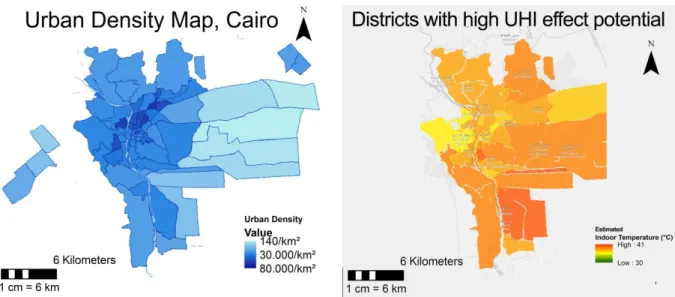
Figure 1a shows the urban density map of Greater Cairo and the district with an urban density above 15.000/km2. The distribution of districts with high UHI effect potential can be
found as well (Figure 1b). Figure 1 indicates that the highest urban density is found is informal planned districts along and closes to the Nile River in the centre. Accordingly, our selected street canyons are listed in Table 2. The range of street coverage values of all streets was 3% to a maximum of 28%. The aspect ratio of the 15 street canyons varied from 0.8 up to 1.8 and street traffic between 17:00 and 18:00 hours during working days was between 615 up to 1555 car/hour.
Figure 1a. the urban density map, b. estimated districts with high UHI effect potential based on Taheri Shahraiyni et al. (2016)
Table 2. the selected streets canyons with the highest UHI effect potential () District Street Name Apts. Traffic
[cars/hour ] Aspect Ratio [coefficient] Trees Coverage [%]
1 Rowd al Faraj Shobra 2 885 1.2 3
2 As Sabtiyyah Bolak al Gadida 1 725 1.1 21
3 Hadaiq al Qubbah Masr we al Sudan 2 1235 1.1 10
4 Al Abasiya Al Wayli / Al Gaysh 1 1405 1-1.2 20
5 Nasr city Abbas El-Akkad 3 1175 0.8-1 28
7 Imbaba Al Aqsur 2 765 1.3 22 8 Ard El Lwaa Ali Ibn Abi Taleb/
Teraat Al Magnoona
3
615
1.5 5
9 Bulaq Ad Dakrur Zenein Canal 3 635 1.8 17
10 Al Duqqi Mohi Al Din Abiy al Ezz 2 725 1.0 25
11 Al Gizaa King Faisal Street 2 1165 1.0 10
12 Al Gizaa Al Haram 3 1555 0.8-1 25
13* Basateen* Ahmed Zaki* 3 865 1-1.1 18
14 Dar as Salam Al Fayoumy 2 695 1.1 14
15 Al Qasr al Ayni Al Qasr al Ayni 1 750 0.8 28
* The weather station location
In this study, the residences were built ranged from 1965 to 2013. The basic building construction for all apartments is a reinforced-concrete post and beam structure with 0.15m thick brick infill walls without insulation. Windows are single glazed, transparent and have a 0.003m thick glass pane. The apartment’s characteristics are almost identical with similar physical properties as indicated in the previous study by Attia et al. (2012).
3.2. Field Measurements
The results of the field measurement can be found in Figure 2. The heat wave period is highlighted in red in Figure 2b. The indoor air temperature reached its maximum of 41.4 °C
at 19:30 by August the 7th. Relative humidity was not the primary reason of the overheating.
Figure 2c indicates that humidity levels reach 100% on some instances. Around half of the heat wave days had humidity levels exceeding 60%.
Figure 2. (a) District location over Cairo where the 15 street canyons were identified. (b) The measured outdoor air temperature in Cairo through 20 Jul to 20 Aug. The red line shows the 2015 heat wave; the light blue region is the outdoor air temperature covering 1980-2013 based on TMY file; and the dark blue line is the
outdoor mean daily temperature. (c) A scatter plot of the indoors measured daily air temperature against relative humidity levels for all days over the20 Jul to 20 Aug period. (d) Average measured outdoor air
temperature (blue) and (red) and indoor air temperature of the 32 apartments.
3.3. Observational studies
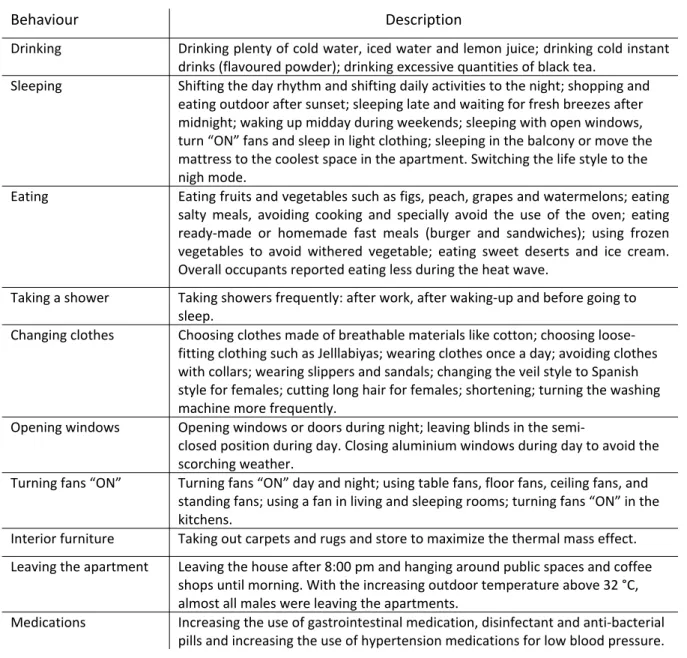
Of the 32 visited apartments, at least 55 study participants were observed using at least three adaptive behaviours throughout the study period. All apartments were occupied by single-family residences with an average of 4 to 6 occupants. All apartment occupants identified economic factors; ranging from lack of resources to buy air conditioners or pay for related electricity costs. A total of 12 apartments had at least 2 fans each and 20 had three fans or more. Twenty five apartments had shading protection in the form of external curtain or draperies, venetian blinds, drop-arms awnings, or folding-arm awning. At least, six of heat-adaptive behaviours, listed in Table, 3 were used by occupants. The most frequently used behaviours over the entire study period were ‘opening windows or doors’, turning fans “ON” and sleeping late i.e. 2:00 am in the morning.
Table 3. Heat-adaptive behaviours reported by the investigators in the log books during the heat wave
Behaviour Description
Drinking Drinking plenty of cold water, iced water and lemon juice; drinking cold instant drinks (flavoured powder); drinking excessive quantities of black tea.
Sleeping Shifting the day rhythm and shifting daily activities to the night; shopping and eating outdoor after sunset; sleeping late and waiting for fresh breezes after midnight; waking up midday during weekends; sleeping with open windows, turn “ON” fans and sleep in light clothing; sleeping in the balcony or move the mattress to the coolest space in the apartment. Switching the life style to the nigh mode.
Eating Eating fruits and vegetables such as figs, peach, grapes and watermelons; eating salty meals, avoiding cooking and specially avoid the use of the oven; eating ready-made or homemade fast meals (burger and sandwiches); using frozen vegetables to avoid withered vegetable; eating sweet deserts and ice cream. Overall occupants reported eating less during the heat wave.
Taking a shower Taking showers frequently: after work, after waking-up and before going to sleep.
Changing clothes Choosing clothes made of breathable materials like cotton; choosing loose-fitting clothing such as Jelllabiyas; wearing clothes once a day; avoiding clothes with collars; wearing slippers and sandals; changing the veil style to Spanish style for females; cutting long hair for females; shortening; turning the washing machine more frequently.
Opening windows Opening windows or doors during night; leaving blinds in the
semi-closed position during day. Closing aluminium windows during day to avoid the scorching weather.
Turning fans “ON” Turning fans “ON” day and night; using table fans, floor fans, ceiling fans, and standing fans; using a fan in living and sleeping rooms; turning fans “ON” in the kitchens.
Interior furniture Taking out carpets and rugs and store to maximize the thermal mass effect. Leaving the apartment Leaving the house after 8:00 pm and hanging around public spaces and coffee
shops until morning. With the increasing outdoor temperature above 32 °C, almost all males were leaving the apartments.
Medications Increasing the use of gastrointestinal medication, disinfectant and anti-bacterial pills and increasing the use of hypertension medications for low blood pressure.
Regarding the impacts of the heat wave, Table 4 summarizes the key observed impacts associated with the heat wave.
Table 4. Heat-related impacts reported by the investigators in the log books during the heat wave
Impact Description
Sweating Increasing sweat rate and water depletion. A relative humidity of 60% or more hampers sweat evaporation, which hinders the body's ability to cool itself. Sleeping Increase in difficulty to get adequate sleep; affecting the ability to fall asleep,
stay asleep and feel refreshed from sleep. Increase stress. Mobility Avoiding outdoor activities and reducing mobility.
Cognitive performance Reducing cognitive function (working memory and selective
attention/processing speed,), concentration and the ability to take decisions during the heat wave; Increasing the use of black tea and coffee to wake up in the morning and concentrate during the day. Students reported impossibility to study during the heat-wave.
Heat-related illness heat exhaustion, fatigue, dehydration, heat oedema, heat syncope, exfoliation and heat rash, diarrhoea (dairy products and fruits), hypertension (low blood pressure)
Physical environment Magnification of UHI effect resulting in higher night-time temperatures; stagnant atmospheric conditions and poor air quality; increase of flies.
3.4. Comfort assessment
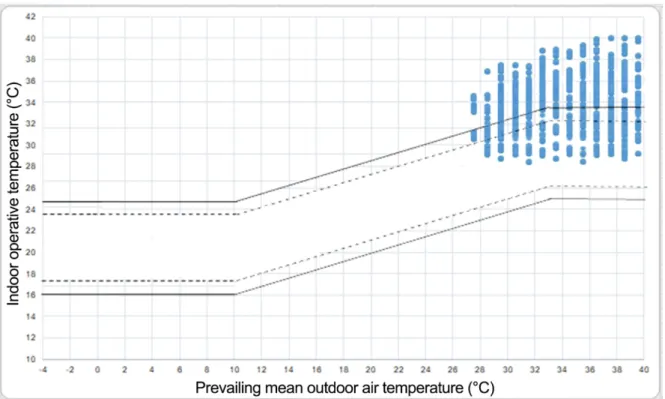
The measurement results were collected to test them against several comfort models. We tested the impact of applying Fanger’s model (1970), Givoni’s model (1998), ASHRAE 55 adaptive comfort model and EN 16798 adaptive comfort model on comfort, similar to the work of Attia et al. (2015). As shown in Figure 3 and 4, most of the hours (79%) of the heat wave period remained above the most adaptive comfort model’s (ASHRAE 55) thresholds. The result proves a very high overheating in a free-running residential building. Overheating is seen to occur in the 32 investigated apartments stretching all over Cairo.
Figure 3. Plot of the measured indoor temperatures in Cairo against four different thermal comfort models.
Figure 4. Operative temperate values distributions from the four-week recording periods in the heat wave of 2015, in Cairo through 20 Jul to 20 Aug, against the ASHRAE 55 adaptive comfort model. Only 21% of hours fall within the comfort range.
4. Discussion:
In this study, an analysis of thermal comfort was undertaken during the 2015 Egyptian heat wave. The aim of this study was to assess the thermal comfort in free-running conditions during extreme climate conditions in Cairo. The followings sections summarize and discuss the study findings:
32 free-running apartments were studied in 15 different representative streets in Cairo. All external walls are constructed of concrete post and column structure and fired redbrick (0.125 cm thickness) with conductivity (U-Value) of 2.5 W/m2 K.
In August 2015, the indoor temperature reached 41°C and indoor relative humidity
reached 92% indoors in Cairo’s free running residential buildings. During the heat wave the average indoor air temperature was 34 °C and around half of the days had
humidity levels exceeding 60%. Thus, apartments in Cairo have the tendency to overheat in summer making night-ventilation less effective.
Measurements prove that during 19 consecutive days of a heat wave; occupants suffered from heat stress and heat associated ailments. For example, occupants tend to suffer from physical impairments. Observation study documents and lists the heat wave impact on occupant’s behaviour and daily life routine.
Current adaptive comfort models are obsolete during extreme climates conditions in Cairo.
Present study created an inventory of behavioural adaptation measures undertaken by occupants during the heat wave. One of the most common heat-adaptive
behaviours of occupants is shifting their day to day activities to the night and to delay the sleeping timings. Using fans has a great role in mitigating overheating discomfort.
High temperature and high humidity are the principal drivers of human discomfort. Although the findings are not new, we believe that this work is important because it recognizes overheating and provides solid evidence that indoor temperatures exceeded all current upper-limits of adaptive comfort models. Furthermore, we built a unique methodology that combines GIS, measurements and field observations, which resulted in presenting hard evidence on comfort conditions in Cairene households during extreme summers. For this study, we selected the ASHRAE 55 adaptive comfort model (2017) because we consider it the best model that can tolerate high humidity limits of up to 80% or more (Attia et al. 2019). Future research should test other thermal comfort models including the compliance with the Egyptian energy efficiency code (HBRC 2016).
The overheating in Cairene households is critical to the human body and has a significant impact on occupant’s well-being, productivity, and satisfaction. Heat waves can impact human health causing increases in morbidity and mortality (Lomas et al. 2017). Although there is strong evidence linking extreme heat with excesses in mortality, there is less literature describing the impact on morbidity, including the impacts on specific age groups in free-running residential buildings during heat waves. This study also tried to focus on quantifying the physical heat stress and the social aspects by observing and documenting the heat wave related adaptive behaviours during extreme climatic conditions. However, we failed to provide an epidemiological analysis. Despite the significant increase of mortality rate in Cairo in 2015 (9.6 per 1,000 individuals) compared to 2014 and 2016 (9.0 per 1,000 individuals), it was difficult to get access to monthly mortality rates for Greater Cairo’s districts. In fact, we agree with Mitchel (2016) that a full epidemiological analysis is needed.
Observation logbooks indicate that the heat wave was physically uncomfortable and also psychologically stressful for most occupants. Occupants were struggling to buy air-conditioning or pay their electricity bills to escape the scorching heat. Almost all residents wished to have an air conditioning but pointed to their financial constraint. Already the 32 investigated households spent more than 8-14 % of their income on utilities, (natural gas for cooling and electricity for lighting and appliances), and indicated that utilities bills are a burden. Since energy poverty (or fuel poverty) is commonly defined as 10 % of total household income (Nussbaumer et al. 2012), this study findings indicates that most households suffer from energy poverty. In Egypt, this term is not well-known but most participants pointed to this without articulating is explicit as a source of mental stress during extreme days.
Finally, this study represents a step in the understanding of health impacts of thermal overheating in a hot climate city. We hope that this study will prompt debate about current thermal comfort standards and their appropriateness for assessing overheating of free-running buildings during climate extremes. Proposed methodology, which combines GIS, measurements and field observations, should be useful for assessing overheating risks in other buildings types. On the long term, the influence of anthropogenic climate change needs to be investigated similar to the work of Mahdy et al. (2015) and Lomas et al. (2012). On the short term, it is anticipated that the Egyptian government on the national and local level will react to these findings and seek to improve the quality of life and well-being of occupants in residential households. Currently, regulators fail to apply much pressure with
regard to bioclimatic design or efficiency standards (Attia et al. 2009 and 2012). Consequently, developers and house builders should receive incentives or abide by the regulatory requirement to provide passive measures for heat protection. Otherwise, economic improvements of the investigated households incomes will be associated with the proliferation of low-efficiency air conditioning units that threatens our ability to tackle climate change magnify the UHI effects in Cairene streets.
5. Conclusion:
Measurements in 15 different representative streets and 32 free-running apartments were performed to represent the indoor and outdoor climate in Cairo. The study provides a snapshot of thermal comfort during the 2015 Egyptian heat wave. The study is the first comprehensive study in Egypt that provides insights on the physical and non-physical observation regarding heat stress and heat associated complaints. For example, occupants tend to suffer from physical impairments. Observation study documents and lists the heat wave impact on occupant’s behaviour and daily life routine. The study proves that current adaptive comfort models are obsolete during extreme climates conditions in Cairo and there is a serious need for mitigating overheating discomfort. The study documents the heat wave consequences and provides an evidence based understanding of the severity of climate in Cairo.
6. Acknowledgement
The authors would like to thank the graduate students at Faculty of Social Works, at Helwan University for their valuable support. All apartment participants are thanked for taking part in the study. Also, we would like to acknowledge the Sustainable Building Design Lab for the use of monitoring equipment in this research and the valuable support during the experiments and the analysis of data.
7. References
ASHRAE. ANSI/ASHRAE Standard 55-Thermal Environmental Conditions for Human Occupancy., Atlanta, GA 30329: American Society of Heating, Refrigerating and Air-Conditioning 725 Engineers, Inc.; 2017. Åström, D.O., Bertil, F. and Joacim, R., 2011. Heat wave impact on morbidity and mortality in the elderly
population: a review of recent studies. Maturitas, 69(2), pp.99-105.
Attia, S., Lacombe, T., Rakotondramiarana, H. T., Garde, F., & Roshan, G. (2019). Analysis tool for bioclimatic design strategies in hot humid climates. Sustainable Cities and Society, 45, 8-24.Attia, S., Hamdy, M., & Ezzeldin, S. 2017. Twenty-year tracking of lighting savings and power density in the residential sector. Energy and Buildings, 154, 113-126.
Attia, S. and Carlucci, S., 2015. Impact of different thermal comfort models on zero energy residential buildings in hot climate. Energy and Buildings, 102, pp.117-128.
Attia, S., Evrard, A. and Gratia, E., 2012. Development of benchmark models for the Egyptian residential buildings sector. Applied Energy, 94, pp.270-284.
Attia, S.G.M. and De Herde, A., 2009. Bioclimatic architecture design strategies in Egypt. Sustainable Energy Technologies, 1(1).
Boeckmann, M. and Rohn, I., 2014. Is planned adaptation to heat reducing heat-related mortality and illness? A systematic review. BMC public health, 14(1), p.1112.Hendel, M., Azos-Diaz, K. and Tremeac, B., 2017. Behavioral adaptation to heat-related health risks in cities. Energy and Buildings, 152, pp.823-829. Buysee , D., R. Grunstein , J. Horne, and P. Lavie . 2010. “Can an Improvement in Sleep Positively Impact on
Health?” Sleep Medicine Reviews 14 (6). 405–410.
Carlucci, S., Bai, L., de Dear, R. and Yang, L., 2018. Review of adaptive thermal comfort models in built environmental regulatory documents. Building and Environment.
CEN/TC. Energy performance of buildings - Part 1: Indoor environmental input parameters for design and assessment of energy performance of buildings addressing indoor air quality, thermal environment, lighting and acoustics - Module M1-6 (EN 16798-1). Brussels: Technical Committee CEN/TC 156; 2015.
Colton, M.D., MacNaughton, P., Vallarino, J., Kane, J., Bennett-Fripp, M., Spengler, J.D. and Adamkiewicz, G., 2014. Indoor air quality in green vs conventional multifamily low-income housing. Environmental science & technology, 48(14), pp.7833-7841.
EPA, 2019, Climate Change and Heat Islands, US EPA, accessed: 11.01.2019, available from: https://www.epa.gov/heat-islands/climate-change-and-heat-islands
Fahmy, M. and Sharples, S., 2009a. On the development of an urban passive thermal comfort system in Cairo, Egypt. Building and Environment, 44(9), pp.1907-1916.
Fahmy, M., Sharples, S. and Eltrapolsi, A., 2009b, July. Dual stage simulations to study the microclimatic effects of trees on thermal comfort in a residential building, Cairo, Egypt. In 11th International IBPSA Conference. Glasgow, Scotland.
Gado, T. and Osman, M., 2009. Investigating natural ventilation inside walk-up housing blocks in the Egyptian desert climatic design region. International journal of ventilation, 8(2), pp.145-160.
Fanger, P. O. (1970). Thermal comfort. Analysis and applications in environmental engineering. Thermal comfort. Analysis and applications in environmental engineering.
Givoni, b. (1998) Climate Considerations in Building and Urban Design, Van Nostrand Reinhold, New York. Hafez, A. 2014. 40% of Greater Cairo citizens live in informal housing. Al Sherouk newspaper, 02.01.2014,
available from: http://www.shorouknews.com/news/view.aspx?cdate=02012014&id=15b11e41-cd96-4304-becf-a10b4b4aec95
HBRC. 2016, Egyptian Energy Efficiency Residential Building. Ministry of Housing. Egypt. 301.
ISO. Analytical determination and interpretation of thermal comfort using calculation of the PMV and PPD indices and local thermal comfort criteria. Ergonomics of the thermal environment. Geneva: International 651 Organization for Standards; 2005.
Köppen, W. and Geiger, R., 1930. Handbuch der klimatologie(Vol. 1). Berlin: Gebrüder Borntraeger.
Kovats , S., and S. Hajat . 2008. “Heat Stress and Public Health: A Critical Review.” Public and Environmental Health Research Unit (PEHRU), London School of Hygiene and Tropical Medicine, London WC1E 7HT, United Kingdom; 29 (9). 1–9.
Lai, A.C.K., Mui, K.W., Wong, L.T. and Law, L.Y., 2009. An evaluation model for indoor environmental quality (IEQ) acceptance in residential buildings. Energy and Buildings, 41(9), pp.930-936.
Limor Shashua-Bar, Ioannis X. Tsiros, Milo E. Hoffman, A modeling study for evaluating passive cooling scenarios in urban streets with trees. Case study: Athens, Greece, Building and Environment 45 (2010) Lomas, K.J. and Porritt, S.M., 2017. Overheating in buildings: lessons from research.
Lomas, K.J. and Giridharan, R., 2012. Thermal comfort standards, measured internal temperatures and thermal resilience to climate change of free-running buildings: A case-study of hospital wards. Building and Environment, 55, pp.57-72.
Mahdy, M.M. and Nikolopoulou, M., 2013. The cost of achieving thermal comfort via altering external walls specifications in Egypt; from construction to operation through different climate change scenarios. In Building Simulation Conference France.
Mitchell, D., 2016. Human influences on heat-related health indicators during the 2015 Egyptian heat wave. Bulletin of the American Meteorological Society, 97(12), pp.S70-S74.
Nussbaumer, P., Bazilian, M. and Modi, V., 2012. Measuring energy poverty: Focusing on what matters. Renewable and Sustainable Energy Reviews, 16(1), pp.231-243.
Pidcock, R., Pearce, R., 2017, Mapped: How climate change affects extreme weather around the world, available from: https://www.carbonbrief.org/mapped-how-climate-change-affects-extreme-weather-around-the-world
Robaa, S.M., 2003. Thermal human comfort in Egypt. JOURNAL OF METEOROLOGY-TROWBRIDGE THEN BRADFORD ON AVON-, 28(283), pp.359-371.
Roesler, S., 2017. The Urban Microclimate as Artefact: Reassessing Climate and Culture Studies in Architecture and Anthropology. Architectural Theory Review, 21(1), pp.73-88.
Sedki, A., Hamza, N. and Zaffagnini, T., 2013. Effect of Orientation on Indoor Thermal Neutrality in Winter Season in Hot Arid Climates Case Study: Residential Building in Greater Cairo. International Journal of Engineering and Technology, 5(6), p.712.
Sheta, W., Sharples, S. and Fotios, S., 2012. The Impact of Building Regulations on Thermal Behaviour of Dwellings in New Urban Settlements around Cairo. PLEA2012 - 28th Conference, Perú 7-9 November 2012.
Taheri Shahraiyni, H., Sodoudi, S., El-Zafarany, A., Abou El Seoud, T., Ashraf, H. and Krone, K., 2016. A comprehensive statistical study on daytime surface urban heat island during summer in urban areas, case study: Cairo and its new towns. Remote Sensing, 8(8), p.643.