O
pen
A
rchive
T
OULOUSE
A
rchive
O
uverte (
OATAO
)
OATAO is an open access repository that collects the work of Toulouse researchers and
makes it freely available over the web where possible.
This is an author-deposited version published in :
http://oatao.univ-toulouse.fr/
Eprints ID : 13875
To link to this article : DOI:10.1016/j.snb.2015.03.005
URL :
http://dx.doi.org/10.1016/j.snb.2015.03.005
To cite this version :
Sekli-Belaidi, Fadhila and Civélas, Aurélie and Castagnola,
Valentina and Tsopela, Aliki and Mazenq, Laurent and Gros, Pierre
and Launay, Jérôme and Temple-Boyer, Pierre PEDOT-modified
integrated microelectrodes for the detection of ascorbic acid,
dopamine and uric acid. (2015) Sensors and Actuators B: Chemical,
214. pp. 1-9. ISSN 0925-4005
Any correspondance concerning this service should be sent to the repository
administrator:
[email protected]
PEDOT-modified
integrated
microelectrodes
for
the
detection
of
ascorbic
acid,
dopamine
and
uric
acid
F.
Sekli
Belaidi
a,b,c,d,
A.
Civélas
a,b,
V.
Castagnola
a,b,
A.
Tsopela
a,b,
L.
Mazenq
a,b,
P.
Gros
c,d,
J.
Launay
a,b,
P.
Temple-Boyer
a,b,∗aCNRS,LAAS,7avenueducolonelRoche,F-31400Toulouse,France bUniversitédeToulouse,UPS,LAAS,F-31400Toulouse,France cUniversitédeToulouse,UPS,INPT,LGC,F-31062Toulouse,France dCNRS,LGC,F-31062Toulouse,France Keywords: Integratedmicroelectrode Electrochemicalmicrocell PEDOT Ascorbicacid Dopamine Uricacid
a
b
s
t
r
a
c
t
Integrated(Pt/PEDOT–Pt–Ag/AgCl)and(Au/PEDOT–Pt–Ag/AgCl)electrochemicalmicrocells(ElecCell) wereelaboratedforthedetectionofascorbicacid,dopamineanduricacidbydifferentialpulse voltam-metry.Specificattentionwasbroughttotheintegrationofpoly(3,4-ethylenedioxythiophene)(PEDOT) filmbyelectropolymerization.Goldandplatinumworkingmicroelectrodeswereinvestigatedwhile usingethylenedioxythiophene(EDOT)electrodepositionprocessesinwateroracetonitrilesolvents.For thethreeantioxidantspecies,best(multi-)detectionpropertieswereobtainedforacetonitrile-based PEDOTfilmsdepositedongoldworkingelectrode.Thus,usingintegrated(Au/PEDOT–Pt–Ag/AgCl) Elec-Cellmicrodevices,analyticalperformancesweredeterminedforascorbicacid,dopamineanduricacid, exhibitinghighselectivity(oxidationpotential:−40,150and280mV,respectively),linear concentra-tionrangefrom0.1to300mM,highsensitivities(0.85,1.65and3.06mA/mMcm2,respectively)andlow detectionlimit(0.2mM,0.1mMand0.05mM,respectively).
1. Introduction
During thelasttwo decades,theareaofsensorshasgreatly benefited from the development of micro/nanotechnologies in termofdesign,fabricationanddetectionperformances.Thiswas alsotrueforchemicalmicrosensorsandelectrochemicalanalysis forbiosensing applications.Consequently, integrated microelec-trodeshavebecomewell-acceptedtoolsforclinical,environmental, chemicaland pharmaceuticalapplicationswithhighspatialand temporalresolution[1,2].Indeed,theypresentmanyadvantages: specificity, highsensitivity,fastresponse time, small capacitive currents,enhancedmasstransport,lowohmicdropallowingtheir useinlowconductingandhighlyviscousmedia,aswellas versa-tility.Moreover,comparedtoultra-microelectrodes(UME)sealed intoglass-capillaries[3–6],theytakeadvantageofmassfabrication atlowcostthankstotheuseofsilicon-basedmicrotechnologies
[7–9],addressingmanybioanalyticalapplications[10–14]. Never-theless,torealizeasimpleandfunctionalelectrochemicalsensor,
∗ Correspondingauthorat:CNRS,LAAS,7avenueducolonelRoche,F-31400 Toulouse,France.Tel.:+33561336954.
E-mailaddress:[email protected](P.Temple-Boyer).
microfabricationstrategieshavetoaddresstheproblemsrelatedto theanalysisofrealsamples,emphasizingonsensitivity, selectiv-ity,stability,reproducibilityandreliability.Wehaveselectedthis approachtodevelopanintegratedelectrochemicalmicrosensorfor thesimultaneousdetectionofascorbicacid(AA),dopamine(Dop) anduricacid(UA)intheframeofantioxidantspeciesanalysis.
Thedetectionofthesethreeanalytesisofparticularinterestin clinical,chemical,pathology,foodanalysisandmanyotherfields
[15–17].AAisavitalvitaminpopularlyknownforitsantioxidant properties and is present in mammalian brain along with sev-eralneurotransmitteraminessuchasdopamine.Ascorbicacidhas beenusedforpreventionandtreatmentofcommoncold, men-talillness,infertilityandcancer[18].Dopamineisanimportant neurotransmitterformessagetransferincentralnervoussystem
[19].AbnormallevelsofDopleadtoneurologicaldisorderssuchas ParkinsonismandSchizophrenia[20].Meanwhile,uricacidisthe primaryfinalproductofpurinemetabolism.Theextreme abnor-malitiesofUAlevelsleadtosomediseases,suchashypertension, hyperuricaemia,goutandLesch-Nyandiseases[21].
Inrealbiologicalsamples,AA,DopandUAusuallycoexist,so thedevelopmentofaccurate,selectiveandsimultaneous determi-nationmethodsforthesethreeanalytesishighlydesiredespecially inbiomedicalchemistryandmedicaldiagnostics.AA,DopandUA http://dx.doi.org/10.1016/j.snb.2015.03.005
areelectroactivecompoundsandcanbedetectedusing electroan-alyticaltechniques.Unfortunately,withbareunmodifiedmetallic electrodes,theyareoxidizedatnearlysamepotentialsandtheir voltammetricresponsesoverlapmakestheirdiscriminationinreal samplesverydifficult[22,23].Besides,bareelectrodesoften suf-ferfromapronouncedfoulingaffectduetotheaccumulationof oxidizedproductsonelectrode surface.Furthermore,the modi-fiedelectrodemustbeinsensitivetointerferingchemicalspresent inbiological media.To overcomethis problem, many modifica-tionstrategieshavebeenadoptedtolowertheoverpotential,to increase detectionsensitivity and toimproveselectivity. In the frameofantioxidant detection,theyhaveledtotherealization of various modified (micro)electrodes based on quantum dots
[24],nanoparticles[25–27],carbonnanotubes[28–30],graphene
[25–27,29,31–33] and conductive polymers [28,34–36]. Among them,poly(3,4-ethylenedioxythiophene)(PEDOT)wasoneofthe widelyusedconductingpolymersforthedetectionofAA,Dopand UA[37–42].Ithasalowoxidationpotentialandmoderateband gapwithgoodstabilityandtransparencyintheoxidizedstate,high electricalconductivity[43],excellentthermalstability,intrinsically lowthermalconductivityandlowprice[44,45].Inparallel, elec-tropolymerizationisoneofthemethodsusedforthepreparation ofpolymerfilmwithgoodquality.Itallowsthereproducible for-mationoforganicpolymerfilmswithprecisespatialresolution. Moreover,filmthicknessesareeasilycontrolledbythedeposition chargeandthepolymerisdirectlyobtainedinhisconductingstate
[46].Thus,electrodepositionprotocolofPEDOTiseasiercompared toothersstrategiesofelectrodemodifications.Finally, ethylene-dioxythiophene(EDOT)isacommerciallyavailablemonomerthat eliminatessynthesissteps.
In theframe of thedetection of antioxidantspecies, PEDOT acts as a redox mediator responsible for oxidation catalysis. Sinceascorbicanduric acidsareintheiranionicform(HA−)at physiological pH,the occurringcatalytic mechanism is globally givenby[47]:
PEDOTox+HA−→ PEDOTred−+A
PEDOTred−→PEDOTox+H++2e−
Inthecaseofdopaminknowntobeinitscationicformat phys-iologicalpH,theglobalcatalyticmechanismis[37]:
PEDOTox+Dop→ PEDOTred+DoQ
PEDOTred→PEDOTox+2H++2e−
Our previous works illustrated that PEDOT deposited on hand-mademicroelectrodeshasgoodcatalyticpropertiesforthe electrochemicaloxidationof ascorbicanduric acidsandcanbe usedfortheirsimultaneousdetection[39].Thisworkgoesfurther towardstechnologicalintegrationandmassfabricationof PEDOT-basedmicroelectrodes,focusingonthreemaingoals:(i)tostudy the electropolymerization of PEDOT on thin-film-based micro-electrodes, (ii) to integrate fully PEDOT-based electrochemical microcells(ElecCell),and(iii)toanalyzePEDOT-basedElecCell per-formancesfortheselectivedetectionofantioxidantspecies.Thus, combiningtheadvantageousfeaturesofsilicon-based microtech-nologies [23,48] and catalytic properties of PEDOT [46], we presentedheretheanalyticperformances ofintegrated electro-chemicalmicrodevicesmodifiedwithPEDOTelectrodepositedin differentconditionsofpolymerizationforasimultaneousassayof AA,Dop,andUA.
2. Experimental 2.1. Chemicals
3,4-Ethylenedioxythiophene(EDOT)monomer,poly(sodium 4-styrenesulfonate)(NaPSS),ascorbicacid(AA),dopamine(Dop)and uricacid(UA)werepurchasedfromSigmaAldrich. Tetrabutylamm-onium perchlorate (TBAPC), potassium dihydrogenophosphate KH2PO4,di-potassiumhydrogenophosphateK2PHO4,sodium chlo-rideNaClandacetonitrileCH3CNwerepurchasedfromAcros.All reagentswereofanalyticalgradeandusedasreceived.Theaqueous solutionswerepreparedwithhigh-qualitywater(MilliQgradient A10system,Millipore,Bedford,MA).Highpurenitrogenwasused fordeaeration.
2.2. Materials
ElectrochemicalImpedanceSpectroscopy(EIS)measurements weremadein0.1MNaClsolutionbyapplyinga5mVRMSsine wavewithfrequenciesrangingfrom10Hzto10kHz.Scanning elec-tronmicroscopy(SEM)studieswerecarriedoutusingafocused ionbeam(FIB) HELIOS600iequipmentoperatingat 3kV. Sam-plesweremountedonadouble-sidedadhesivecarbonandoptical microscope imageswere then made using a Hirox Microscope (HI-SCOPEadvancedKH-3000).PEDOTelectropolymerizationand electrochemicalexperimentswereperformedusingaVMP3 poten-tiostat (Biologic) interfaced to a microcomputer and using the EC-Labsoftware.
2.3. Electrochemicalmicrocell(ElecCell)fabrication
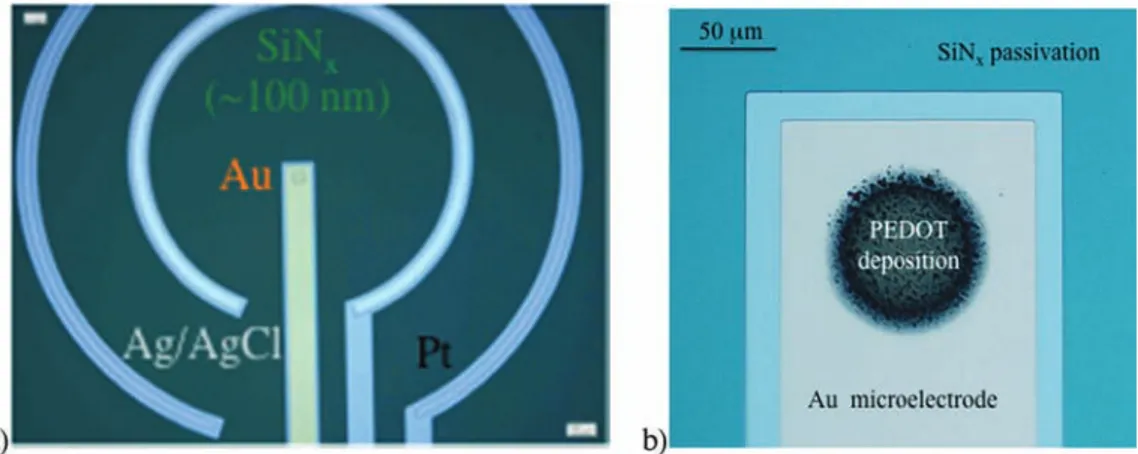
Integrated(Pt–Pt–Ag/AgCl)and(Au–Pt–Ag/AgCl) electrochem-ical microcells (ElecCell) were fabricatedon silicon chip using silicon-based microtechnologies (Fig. 1a) [23]. Oxidized silicon waferswereusedinordertoensureelectricalinsulationbetween thedifferentmicroelectrodes(oxidethickness:∼1mm).Then,the differentthin metallic layers weredeposited byevaporation in conventional physical vapour deposition(PVD) equipment, and patternedusingabilayerlift-offprocessinordertoimprove fab-ricationreproducibility.ThreePVDprocesseswereperformedina row:firstly,a200nmplatinumlayerwasdepositedona 20nm titanium underlayer in order to ensure platinum adhesion on siliconoxide,followedbya800nmgoldanda400nmsilver lay-ers. Finally,a biocompatible Si3N4 passivation layer(thickness: 100nm)wasdepositedatthewaferlevelandpatternedusing pho-tolithographytechniques[48].Accordingtothisfinalwafer-level passivationprocess,thedifferentmetallic layerswereinsulated electricallyandtheiractivesurfacesweredefinedprecisely.The goldandplatinumworkingmicroelectrodesweredefinedasdisks and theirelectroactive areawasapproximately 4.9×10⁻⁴mm2 (diameter: 25mm). In contrast, very large silver/silver chloride referencemicroelectrode(0.02mm2)andplatinumcounter micro-electrode(1mm2)werefabricated.Afterthesiliconwaferdicing, (Pt–Pt–Ag)and(Au–Pt–Ag)electrochemicalmicrocellswere man-ufacturedonsiliconchip(Fig.1a).Thewholechipwasthenplaced and gluedby an epoxyinsulating glue on a specificallycoated printedcircuit,wirebondedandpackagedatthesystemlevelusing asiliconeglop-topinordertobefullycompatiblewithliquidphase measurement.
Foreachmicrodevice,thesilver/silverchlorideAg/AgCl pseudo-reference was finally obtained by oxidizing the silver-based microelectrode in a 0.01M KCl solution. This was performed bylinearvoltammetry(potentialscan rate:1mV/sbetween0.1 and 0.25V/SCE) using a standard saturated calomel electrode (SCE) Hg/Hg2Cl2/KClsat as reference. Thus, (Pt–Pt–Ag/AgCl) and (Au–Pt–Ag/AgCl)ElecCellmicrodeviceswerefinallyrealized.
Fig.1. Opticalmicroscopeimagesof(a)theintegrated(Au-Pt-Ag/AgCl)electrochemicalmicrocell(ElecCell)deviceand(b)theelectrodepositedPEDOTfilmonthegold workingelectrode(solvent:acetonitrile)
2.4. PreparationandcharacterizationofPEDOTmodified electrode
PEDOT electropolymerization processes were carried out in organic,i.e.acetonitrile-based,orinorganic,i.e.water-based, solu-tions.
Fortheorganicacetonitrile-basedprocess,theintegrated work-ingmicroelectrodesurfacewasmodifiedinadeaeratedacetonitrile solutioncontaining2.5mMEDOTmonomerand0.1MTBAPCas supportingelectrolyte[39].Then,polymerizationwasperformed bycyclicvoltammetryatascanrateof250mV/sbetween0.88and 1.5V.
Fortheinorganicwater-basedprocess,electropolymerization experiment was performedfrom EDOT(0.1%W/V, 0.01M) and NaPSS(0.7%W/V)inaqueousdeaeratedsolutions.Such concentra-tionwaslowerthanEDOTsolubilityinwater(estimatedaround 15mM at 25◦C)to ensureits complete dissolving.Then, cyclic voltammetrywascarriedbetween−0.9and1.2Vatascanrate of25mV/s[49].
In bothcases, i.e.acetonitrileorwater solvents, theamount of PEDOTsynthesizedcorrespondedto thesameanodic charge of12mC/cm2.Aftertheelectropolymerization,themodified elec-trodeswererinsedwithacetonitrileand/ordeionizedwaterina rowtoremoveanyphysicallyadsorbedmonomer(Fig.1b). 2.5. ElectrochemicalexperimentsofPEDOT-basedElecCell integratedmicrodevice
For the quantitative determination of AA, Dop and UA, dif-ferential pulse voltammetry (DPV) was investigated since it is moresensitivethancyclicvoltammetry.Differentialpulse voltam-mogramswerecollectedinthepotentialrangebetween0.2and 0.4V, witha 50mVamplitude, a 6mVpotentialstep, a 119ms pulsetime,a 1sinterval timeand a6mV/spotentialscan rate. Integrated (Au/PEDOT–Pt–Ag/AgCl) and (Pt/PEDOT–Pt–Ag/AgCl) electrochemicalmicrocellswereusedfortheseDPVexperiments. For eachof them,goldor platinumPEDOT-modified microelec-trodes were used as workingelectrodes whereas the platinum and silver/silverchloridemicroelectrodes wereused ascounter andpseudo-referenceelectrodes,respectively.Allelectrochemical experimentswereperformedinaglasscellcontaining100mLof 0.1Mdeaeratedphosphatebuffersolution(PBS,pH=7.0)with dif-ferentconcentrationsofAA,Dop,andUA.Thestandardaddition methodwasappliedfordrawingthecalibrationcurvesforeach specie.Freshlyconcentrated solutionsofAA,Dop, andUAwere preparedandstoredat4◦C.Thenasmallknownconcentrationof desiredelementisincreasinglyaddedtoPBSsolutions.Currents
werethenplottedagainsttheaddedconcentrations.Thelimitof detectionwasestimatedforasignal-tonoise-ratioequaltothree. 3. Resultsanddiscussion
3.1. EffectofEDOTsolvent
Thesolventusedduringtheelectropolymerizationstephasa keyinfluenceontheconductingpolymersultimateproperties.It shouldleadtoahighelectricalconductivityandgood electrochem-icalstabilityagainstdecompositionathighpotentialsrequiredto oxidizethe monomer.Thus, electrosynthesisof PEDOTis often performedinorganicsolvent[37,39].Nevertheless,evenifwater hassomedrawbackssuchashighnucleophilicity,narrow poten-tialwindowforelectrochemicalstabilityandhighEDOToxidation potential(higherthantheacetonitrileone),itwasalsousedas sol-vent forPEDOTelectrodepositioneveniftheEDOTmonomeris slightlysolubleinaqueoussolution[49,50].Aboveallthese prob-lems,theselectionofwater asthesynthesismediumwouldbe self-evidentmerelyfromenvironmental,economicand biocom-patibilityreasons.
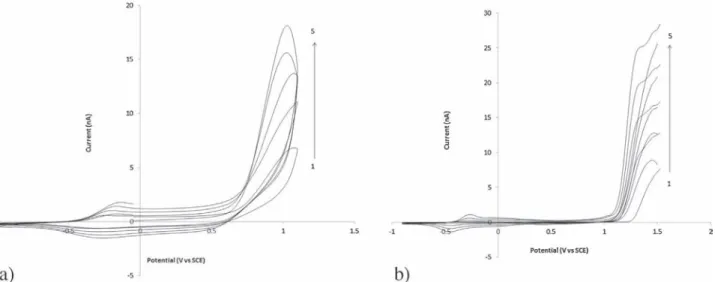
Fig.2aandbshowsthecyclicvoltammogramsrecordedduring PEDOTelectrogenerationonagoldintegratedmicroelectrode,in water-basedorinacetonitrile-basedsolutions,respectively. Simi-larelectrochemicalbehaviourswereobservedforbothsolvents.In water(Fig.2a),theEDOTmonomeroxidationstartsat0.6Vandthe anodiccurrentincreasesfromcycletocycleindicatingthepolymer growth.Then,thePEDOTredoxpropertiesareevidencedat−0.1V. Theelectropolymerizationpotentialdecreasewasattributedtothe strongelectrostaticinteractionsbetweenEDOT•+ cationradicals andPSS−species,facilitatingthepolymerizationprocess[51].
In acetonitrile (Fig. 2b), it is clearly visible that the EDOT monomeroxidationstarsat1.2Vwhereastheredoxpotentialof PEDOTisobtainedaround−0.25V.Itisknownthatpeaksposition ofthepolymerredoxactivityisrelativetop-dopingprocess,leads todifferencesinconductivityproperties[52],andmightindicate thatahighermolecularmasspolymerisobtainedwhen electrosyn-thesisis performed in organicmedium. Thus, even ifa similar anodicchargeof12mC/cm2waschosenforthePEDOTsynthesis, thisshouldalsoberesponsibleforsomethicknessandmorphology discrepanciesforthedifferentPEDOTlayers.
To have further information on PEDOT depositions, they were characterized by impedancemetry and scanning electron microscopy(SEM).Comparedtowatersolvent,acetonitrileleadsto lowerimpedancemodulusandthereforetohigherelectrical con-ductivity(datanot shown).Such differenceintermofelectrical conductivitymightbeexplainedbythedopinglevelofeachPEDOT
Fig.2.Cyclicvoltammogrammsofelectropolymerizationatgoldworkingmicroelectrodeindeaerated0.1mol/LTBAPCand2.5mmol/LEDOT(a)water-based(potentialscan rate:25mV/s)and(b)acetonitrile-basedsolutions(potentialscanrate:250mV/s).
film.Indeed,theuseofTBAPC,andespeciallytheperchlorateion ClO4−,aschargecompensationwasshowntogivePEDOTfilmswith higherdopinglevelandbetterstability[53].
Nevertheless,moresignificantresultswereobtainedbySEM.
Fig. 3a and b presents the different surface morphologies of PEDOTlayerselectrodepositedongoldmicroelectrodewhileusing waterandacetonitrilesolvents.Incontrasttowater-basedPEDOT that forms a cauliflower-type, compact structure, acetonitrile-based ones show a porous complex structure. To the best of ourknowledge,theeffectsofsolventonmorphologicalfeatures, andthecorrelationbetweenthemorphologyof electropolymer-izedfilmsandtheircatalyticpropertieswereneversystematically investigated.To explain thesignificantdifferencesbetweenthe morphologicalpropertiesofPEDOTfilmspreparedinwaterorin acetonitrile,wecanspeculatethatthesechangesareattributedto thedifferentintrinsic propertiesofeachsolventthatcontribute todifferentsolute–solventand/orpolymer–solvent interactions. Thebestsolventswerefoundtohavehighdipolemoments,low polarizabilityandhighcapacitytodonateelectrons[54]. Further-more,higherdielectricconstants(∼80forwatercomparedto∼36 foracetonitrile)leadtolowerelectropolymerizationrateandto morecompactfilms[55].Meanwhile,wecannotexcludethe fac-torthatthesolubilityofEDOToligomersproducedatinitialstages ofelectropolymerizationinbothsolventsmightberesponsibleof suchmorphologicalstructures[56].Certainly,inthevery begin-ningstageofpolymerization,oxidationofmonomersandcoupling ofradicalcationstakeplace.Whenthechainlengthofoligomers is highenough, theyprecipitate onto theelectrode, generating thefirstpolymernuclei.Atthispoint, thePEDOTdepositionon
theelectrodestarts,i.e.nucleationbegins,andsubsequentlythe propagationofpolymerchainsandpolymerprecipitationarethe mainprocesses.Inwater,thepresenceofpoly-styrenesulphonate (PSS),whichisagoodsolubilizingagentforbothEDOTmonomer and PEDOTpolymer, facilitates theformation ofrelatively long polymericchains onsolutionand consequentlysmootherfilms areobserved.Inacetonitrile,shortoligomersaredepositedonthe electrode,leadingtoahighnumberofnucleationcentres,which yield tomoreheterogeneous andvery roughfilmsas observed inSEM.Finally,sinceitwasshownthatthesurfacemorphology is influenced by thepolymerization potential[57], electropoly-merizationathigheroxidationpotential(1.2–1.5V)inacetonitrile shouldproducesrougherPEDOTfilms.
Themodifiedmicrodeviceswerethereforetestedinan equimo-larsolutionofAA,DopandUA1mmol/LpH7.0.Resultsareshown in Fig. 4. It is clear that the PEDOT grown in acetonitrilehas muchbetterperformancesthanthePEDOTgrowninwater. For acetonitrile-basedPEDOTlayers,theoxidationpeaksofAA,Dop andUAappearat−0.04,0.15and0.28V,respectively,andhigher sensitivitiesareevidenced.Forwater-basedones,oxidationofAA, DopandUAoccursatmorepositive potentials,i.e.0.125,0.335 and 0.45V, inducing lower sensitivities.Such resultsshouldbe associated tothe differences betweenPEDOTfilms in terms of structure, morphologyand electricalconductivity(asshown by SEMand impedancemetriccharacterizations, seebelow).Inthe caseofacetonitrile,rougherandmoreporousmorphologiesaswell ashigherelectricalconductivityprovidelargerelectroactive sur-face,fasterdiffusionphenomenainandoutthepolymernetwork, and betteraccessto electroactivesites,enhancingPEDOTfilms
Fig.3. Scanningelectronmicroscopy(SEM)picturesofPEDOTfilmsdepositedon(a)ongoldsurfaceusingwaterassolvent,(b)ongoldsurfaceusingacetonitrileassolvent and(c)onplatinumsurfacewhileusingacetonitrileassolvent
Fig.4.Differentialpulsevoltammograms(DPV)of(Au/PEDOT–Pt–Ag/AgCl)ElecCell in0.1MPBSpH7.0solutioncontaininganequimolarAA/Dop/UA(1mmol/L):PEDOT electrodepositedinacetonitrilesolution(plainline)orinaqueoussolution(dashed line).
Fig.5.Differentialpulsevoltammograms(DPV)of(Au–Pt–Ag/AgCl)(plainline)and (Pt–Pt–Ag/AgCl)(dashedline)ElecCellin0.1MPBSpH7.0solutioncontainingan equimolarAA/Dop/UAmixture(1mmol/L).
electrocatalytic properties and improving further antioxidant detectionproperties[47].
Finally, even if water was successfully developed and gave acceptable results, acetonitrile appears to be the best solvent forintegratingPEDOT-modifiedelectrochemicalmicrosensorsand
Fig.6.Differentialpulsevoltammograms(DPV)of(Au/PEDOT–Pt–Ag/AgCl)(plain line)and(Pt/PEDOT–Pt–Ag/AgCl)(dashedline)ElecCellin0.1MPBSpH7.0solution containinganequimolarAA/Dop/UAmixture(1mmol/L).
improving PEDOT-based detection performances of antioxidant speciesintermsofsensitivityandselectivity.
3.2. Effectofworkingelectrodenature
Asdescribed previously in section2.3, theintegrated work-ingmicroelectrodecanbemadefromplatinumorgold.Previous worksshowedthatthephysico-chemicalpropertiesoftheanode metallic material could determinethe natureand the strength of the bond between the electropolymerizedpolymer and the electrode,impactingitsresultingproperties[46].So,westudied the influence of the metal nature on the PEDOT-based detec-tionproperties.Inthisview,acetonitrilesolventwasusedforthe electrodepositionofPEDOTfilmsongoldandplatinumworking surfaces(seesection3.1).Then,theelectrochemicalperformances ofthePEDOT-modifiedworkingmicroelectrodeswereevaluated in an equimolarsolution of AA, Dop and UA 1mmol/L pH 7.0. For comparison, bare gold and platinum integrated microelec-trodeswerealsostudiedinthesameway.Resultsareshownin
Figs.5and6.
Forbare goldandplatinum microelectrodes,abadlydefined peakandlowcurrentvaluesareobserved(Fig.5).Such amperomet-ricresponseswererelatedtocompetitiveoxidationphenomena betweenAA,DopandUA.Indeed,bystudyingseparatelyeach ana-lyte(resultnotshown),theirrespectiveoxidationpotentialsappear at0.26,0.42and0.47Vongoldmicroelectrode,andat0.32,0.28 and0.52Vonplatinummicroelectrode,inagreementwithprevious results[22,23].
OnPEDOT-basedmicroelectrodesmadefromgoldorplatinum, threewell-definedoxidationpeaksareobservedcorrespondingto
Table1
Comparisonoftheanalyticalperformancesofdifferentelectrochemical,PEDOT-modified,electrodesforthesimultaneousdetectionofAA,Dop,andUA. Ref. EpvsSCE(mV) Limitofdetection(mM) Linearrange(mM)
AA Dop UA AA Dop UA AA Dop UA
[37] −50 150 365 – 1 1 – 1–30 1–20 [38] −80 120 275 7.4 – – 500–3500 20–80 20–130 [39] −94 – 308 2.5 – 1.5 5–300 – 2–600 [40] 100 250 320 – – – 100–500 100–500 100–500 [41] 3 210 360 10 1.5 2.7 20–1400 12–48 36–216 [42] 69 232 364 400 6 2 400–8000 6–75 2–40 Thiswork −40 150 280 0.2 0.1 0.05 0.5–300 0.2–300 0.1–300
theoxidationofAA,DopandUA,respectively(Fig.6).Compared tothebroad and overlapped amperometricresponsesobtained withbareelectrodes,allaboveresultsclearlyvalidatethecatalytic activityofPEDOTfortheelectrochemicaloxidationofAA,Dopand UAby loweringtheoxidation potentialandincreasingthe cur-rent[37,38,47]. Nevertheless,electrochemical performancesare stillslightlyloweronplatinumPEDOTmodifiedmicroelectrode: thepeakpotentialsareshiftedtomorepositivevalues,andmore preciselyat0.01,0.215and0.34V,respectively(comparedto−0.04, 0.15and0.28V,seesection3.1),andwithlowersensitivities. Ear-lier,bystudyingtheexperimentalconditionsofpolymerization,we haveobservedthatthemorphologicalpropertiesofPEDOTfilms determinetoalargeextentthecatalyticbehaviourfortheassayof AAandUA[39].So,thiselectrochemicalperformancesdiscrepancy couldbealsoduetotheelectrical,morphologicalandstructural propertiesoftheresultingpolymers.Indeed,through impedance-metriccharacterization,PEDOTsynthesizedongoldisconfirmedto havethehigherelectricalconductivitycomparedtoplatinumone. Thesedifferencescanbedueeithertotheintrinsicconductivities ortotheroughnessofPEDOTfilms[49].Furthermore,SEM charac-terizationsshowthatacetonitrile-basedPEDOTfilmsdepositedon platinumsurfaceshowlessporousstructurethanthosedeposited ongoldsurface(Fig.3bandc).Ontheotherhand,PEDOT adhe-sionisbestongoldsurfaceduetothestronginteractionsbetween goldandsulphuratoms[58,59].Thus,comparedtoplatinum-based ones, (Au/PEDOT–Pt–Ag/AgCl) ElecCell integrated microdevices are more suitable for the simultaneous electrochemical deter-mination of antioxidant species at millimolar concentration levels.
3.3. Analyticalperformances
Accordingtoourpreviousresultsandoptimizations(see sec-tions3.1and3.2),acetonitrile-basedPEDOTelectrodepositionwas performedongoldmicroelectrode.Sincesilicon-basedintegration enablesmassfabrication,theseinvestigationswereperformedfor fivedifferent(Au/PEDOT–Pt–Ag/AgCl)electrochemicalmicrocells.
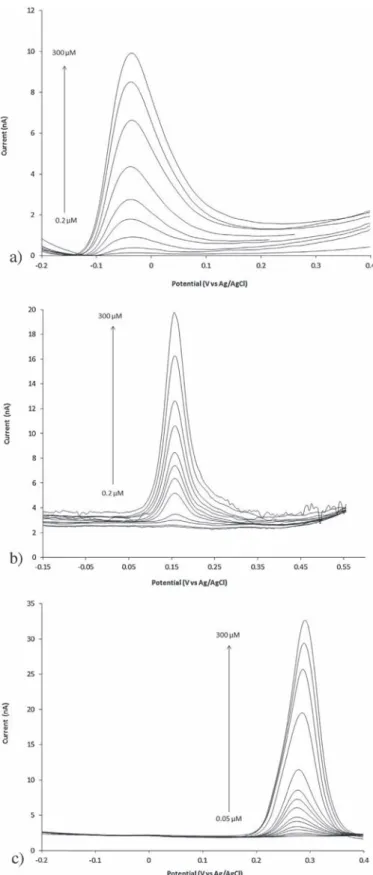
Fig.7a–crepresents theDPVresponsesofthePEDOT-modified microelectrodes to various concentrations of AA, Dop and UA, respectively. Calibration plots indicatean excellent linearity of the amperometric responses with AA, Dop and UA concentra-tions at−0.04, 0.15and 0.28V, respectively(Fig.8).ForAA, an excellent linear relationship (sensitivity: 0.85mA/mMcm2) was obtainedin theconcentration range from 0.5 to 300mM, with a limit of detection estimated at 0.2mM for a signal to noise ratio of 3. Then, the calibration for dopamin was also found tobe linear in therange of 0.2–300mM. In this case, a higher slope(1.65mA/mMcm2)valueandalimitofdetectionof0.1mM were evidenced. Finally, in the case of UA, a linear relation-ship was found again in the range of 0.1–300mM with a still higher sensitivity(3.06mA/mMcm2)and a limit of detection of 0.05mM.Alltheseanalyticalresponsescanberesumedasfollowing (R2>0.998):
Ascorbic acid detection (oxidation potential: −0.04V): j(mA/cm2)=24+0.85C
AA(mM);
Dopamine detection (oxidation potential: 0.15V): j(mA/cm2)=9.7+1.65C
Dop(mM);
Uric acid detection (oxidation potential: 0.28V): j(mA/cm2)=25+3.06C
UA(mM).
Intermofconcentrationranges,theseresultswerewellsuited totheassayoftheseanalytesinmedicalfields[60,61].Compared toworksreportedinliteratureforthesimultaneousdetermination ofAA,Dop,andUAonPEDOT-modifiedelectrodes,itisworthto notethatourresultswerebetterorcomparabletomostofthese
Fig.7.Differentialpulsevoltammogramsof(Au/PEDOT-Pt-Ag/AgCl)elecCellin 0.1MPBS(pH7.0) containingdifferentconcentrationsof(a)ascorbicacid,(b) dopamineand(c)uricacid.
electrodes(Table1),althoughanalyteswereusedinexcessformost ofthem.Finally,withtheintegratedelectrochemicalmicrodevice,it appearsthatasignificantimprovementinlimitsofdetectionwas obtainedcomparedtoourpreviousresults[39],makingitmore suitableforbiologicalanalysis.
Fig.8.Calibrationcurvesforthethreeanalytes:ascorbicacid,dopamineanduric acid.
3.4. Reproducibilityandstability
Thereproducibilityandstabilityofthesensorwereinvestigated bysensingstudies.Ternarymixtureofanequimolarsolutionof AA,DopandUA100mMwasusedforthereproducible examina-tionsoffivedifferent(Au/PEDOT–Pt–Ag/AgCl)ElecCell.Therelative standarddeviation(RSD)wasfoundtobelowerthan4.2%forAA, 4.5%forDopand3.2%forUA,suggestingthattheElecCell technol-ogyreproducibilitywassufficientlygoodtodealwithcalibration. Thestabilityofoursensorswasexaminedinternarymixtureafter beingstoredtwoweeksinairorinphosphatebuffersolution(PBS). Thus,PEDOTmodifiedmicrodevicesretained90%oftheirinitial sensitivitiestothedifferentantioxidantspeciesstudies(datanot shown).
4. Conclusion
We have developed fully integrated, PEDOT-based, electro-chemical microcells (ElecCell) allowing the selective detection of ascorbic acid, dopamine and uric acid in aqueous media. PEDOThasbeensuccessfullysynthesizedonintegratedgoldand platinum microelectrodeswhile usingwater andacetonitrileas solvent.AccordingtoDPVcharacterization,resultsshowimproved detectionperformancesintermofsensitivityandselectivityfor electrodeposited PEDOTlayers, emphasizing good resultsusing waterassolvent,betterresultsusingacetonitrileassolventand best results on gold surfaces compared to platinum ones. For this last and best case, detection properties of ascorbic acid, dopamineanduricacidwerestudied,exhibitingwell-separated oxidationphenomena(oxidationpotential:−0.04,0.15and0.28V, respectively), linear current variations, high sensitivities (0.85, 1.65 and3.06mA/mMcm2,respectively)andlow detectionlimit (0.2mM,0.1mMand0.05mM,respectively).Asaresult,theElecCell technologicalplatformisadaptedtothemassfabricationof PEDOT-modifiedelectrochemicaldevices fortheanalysisofantioxidant species.Itwasappliedtomodelsolutionsuptonow,butshouldbe extendedtorealsamplesofbloodseraand/orurinesintheframe ofclinicaldiagnosisand/orenvironmentalapplications.
Acknowledgements
TheauthorswouldliketothankProfessorMauriceComtat(LGC, Toulouse)for helpfuldiscussionsandadvices. Thetechnological
realizationsandassociatedresearchworkswerepartlysupported bytheFrenchRENATECHnetwork.
References
[1]V. Beni, D.W.M. Arrigan, Microelectrode arrays and microfabricated devicesinelectrochemicalstripping analysis,Curr. Anal. Chem.4(2008) 229–241.
[2]O.A.Sadik,A.O.Aluoch,A.Zhou,Statusofbiomolecularrecognitionusing elec-trochemicaltechniques,Biosens.Bioelectron.24(2009)2749–2765.
[3]J.W.Schultze,V.Tsakova,Electrochemicalmicrosystemtechnologies:from fundamentalresearch to technical systems, Electrochim. Acta 44 (1999) 3605–3627.
[4]C. Amatore, S. Arbault, C. Bouton, K. Coffi, J.C. Drapier, H. Ghandour, Y. Tong, Monitoring in real time with a microelectrode the release of reactive oxygen and nitrogen species by a single macrophage stimula-tionbyitsmembranemechanicaldepolarization,ChemBioChem7(2006) 653–661.
[5]A.Ruffien-Ciszak, P.Gros, M.Comtat,A.M.Schmitt,E. Questel,C. Casas, D.Redoules,Explorationoftheglobalantioxidantcapacityofthestratum corneum by cyclic voltammetry, J. Pharm. Biomed. Analysis 40 (2006) 162–167.
[6]J.G.Roberts,J.V.Toups,E.Eyualem,G.S.McCarty,L.A.Sombers,Insituelectrode calibrationstrategyforvoltammetricmeasurementsinvivo,Anal.Chem.85 (2013)11568–11575.
[7]R.S.Pai, K.M. Walsh, M.M. Crain,T.J. Roussel, D.J. Jackson,R.P. Baldwin, R.S.Keynton,J.F.Naber,Fully integratedthree-dimensionalelectrodesfor electrochemicaldetectionin microchips:fabrication,characterization and applications,Anal.Chem.81(2009)4762–4769.
[8]Y.P.Chen,Y.Zhao,J.Chu,S.Y.Liu,W.W.Li,G.Liu,Y.C.Tian,Y.Xiong,H.Q.Yu, Fabricationandcharacterizationofaninnovativesolid-statemicroelectrode, Electrochim.Acta55(2010)5984–5989.
[9]K.Dawson,A.Wahl,S.Barry,C.Barrett,N.Sassiat,Fully-integratedon-chip nano-electrochemicaldevicesforelectroanalyticalapplications,Electrochim. Acta115(2014)239–246.
[10]N.Pereira-Rodriguez,Y.Sakai,T.Fujii,Cell-basedmicrofluidicbiochipforthe electrochemicalreal-timemonitoringofglucoseandoxygen,Sens.Actuators B132(2008)608–613.
[11]M.Miyashita,N.Ito,S.Ikeda,T.Murayama,K.Oguma,J.Kimura,Development ofurineglucosemeterbasedonmicro-planaramperometricbiosensorandits clinicalapplicationforself-monitoringofurineglucose,Biosens.Bioelectron. 24(2009)1336–1340.
[12]S.BenAmor,E.Vanhove,F.SékliBelaïdi,S.Charlot,D.Colin,M.Rigoulet,A. Devin,J.Launay,P.Temple-Boyer,S.Arbault,Enhanceddetectionofhydrogen peroxidewithplatinizedmicroelectrodearraysforanalysesofmitochondria activities,Electrochim.Acta126(2014)171–178.
[13]O.Frey,P.D.vanderWal,S.Spieth,O.Brett,K.Seidl,O.Paul,P.Ruther,R. Zengerle,N.F.deRooij,Biosensormicroprobeswithintegratedmicrofluidic channelsforbi-directionalneurochemicaldetection,J.NeuralEng.8(2011) 1–9.
[14]A.Altuna,L.MenendezdelaPrida,E.Bellistri,G.Gabriel,A.Guilera,J.Berganzo, R.Vila,L.J.Fernandez,SU-8basedmicroprobeswithintegratedplanar elec-trodesforenhancedneuraldepthrecording,Biosens.Bioelectron.37(2012) 1–5.
[15]J.Dawson,P.Jeemon,L.Hetherington,C.Judd,C.Hastie,C.Schulz,W.Sloan,S. Muir,A.Jardine,G.McInnes,D.Morrison,A.F.Dominiczak,S.Padmanabhan,M. Walters,Serumuricacidlevel,longitudinalbloodpressure,renalfunction,and long-termmortalityintreatedhypertensivepatients,Hypertension62(2013) 105–111.
[16]S.S.Rodriguez,K.A.Salazar,N.A.Jara,M.A.Garcia-Robles,F.Perez,L.E.Ferrada, E.Luciano,F.Martinez,F.J.Nualart,Superoxide-dependentuptakeofvitaminC inhumangliomacells,J.Neurochem.127(2013)793–804.
[17]S.D.Cekic,A.Cetinkaya,A.N.Avan,R.Apak,Correlationoftotalantioxidant capacitywithreactiveoxygenspecies(ROS)consumptionmeasuredby oxida-tiveconversion,J.Agric.FoodChem.61(2013)5260–5270.
[18]O.Orrigoni,M.C.DeTullio,Ascorbicacid:muchmorethanjustanantioxidant, Biochim.Biophys.Acta1569(2002)1–9.
[19]R.M.Wightman,L.J.May,A.C.Michael,Detectionofdopaminedynamicsinthe brain,Anal.Chem.60(1988)769A–793A.
[20]C.Martin,TheParkinson’spuzzle:newdevelopmentsinourunderstandingof Parkinson’sdiseasehavegeneratedanumberofpromisingnewtreatmentsfor thisdisablingcondition,Chem.Britain34(1998)40–42.
[21]V.V.S.EswaraDutt,H.A.Mottola,Determinationofuricacidatthemicrogram levelbyakineticprocedurebasedonapseudo-inductionperiod,Anal.Chem. 46(1974)1777–1781.
[22]H.Etnet,M.Knoll,Electrochemicalcharacterizationofuricacidandascorbic acidataplatinumelectrode,Anal.Chim.Acta449(2001)129–134.
[23]C.Christophe,F.SékliBelaïdi,J.Launay,P.Gros,E.Questel,P.Temple-Boyer, Elaborationofintegratedmicroelectrodesforthedetectionofantioxidant species,Sens.ActuatorsB77(2013)350–356.
[24]M.Roushani,M.Shamsipur,H.R.Rajabi,Highlyselectivedetectionofdopamine inthepresenceofascorbicacidanduricacidusingthioglycolicacidcapped CdTequantumdotsmodified electrode,J. Electroanal.Chem.712 (2014) 19–24.
[25]B.Kaur,T.Pandiyan,B.Satpati,R.Srivastava,Simultaneousandsensitive deter-minationofascorbicacid,dopamine,uricacid,andtryptophanwithsilver nanoparticules-decoratedreducedgrapheneoxidemodifiedelectrode,Colloid Surf.B111(2013)97–106.
[26]X.Wang,M.Wu,W.Tang,Y.Zhu,L.Wang,P.He,Y.Fang,Simultaneous elec-trochemicaldeterminationofascorbicacid,dopamineanduricacidusinga palladiumnanoparticle/graphene/chitosanmodifiedelectrode,J.Electroanal. Chem.695(2013)10–16.
[27]T.Q.Xu,Q.L.Fhang,J.N.Zheng,Z.Y.Lv,J.Wei,A.J.Wang,J.J.Feng,Simultaneous determinationofdopamineanduricacidinthepresenceofascorbicacidusing Ptnanoparticlessupportedonreducedgrapheneoxide,Electrochim.Acta115 (2014)109–115.
[28]E. dePieriTroiani,E.R.Pereira-Filho, R. CensiFaria,Chemometric strate-giestodevelopananocompositeelectrodeforsimultaneousdetermination of ascorbic acid, dopamine, and uric acid, Electroanalysis 23 (2011) 2822–2831.
[29]H.Li,Y.Wang,D.Ye,J.Luo,B.Su,S.Zhang,J.Kong,Anelectrochemicalsensorfor simultaneouslydeterminationofascorbicacid,dopamine,uricacidand trypto-phanbasedonMWNTsbridgedmesocellulargraphenefoamnanocomposite, Talanta127(2014)255–261.
[30]J.Zhan,Z.Zhu,J.Zhu,K.Li,S.Hua,Selectivedeterminationofdopamine,ascorbic acidanduricacidatSDS-MWCNTsmodifiedglassycarbonelectrode,Int.J. Electrochem.Soc.9(2014)1264–1272.
[31]P.Manivel,M.Dhakshnamoorthy,A.Balamurugan,N.Ponpandian,D. Man-galaraj, C. Viswanathan, Conducting polyaniline-graphene oxide fibrous nanocomposites: preparation, characterization and simultaneous electro-chemicaldetectionofascorbicacid,dopamineanduricacid,RSCAdv.3(2013) 14428–14437.
[32]J.Du,R.Yue,F.Ren,Z.Yao,F.Jiang,P.Yang,Y.Du,Novelgrapheneflowers mod-ifiedcarbonfibersforsimultaneousdeterminationofascorbicacid,dopamine anduricacid,Biosens.Bioelectron.53(2014)220–224.
[33]D. Wu,Y. Li,Y.Zhang,P.Wang, Q.Wei,B.Du,Sensitiveelectrochemical sensorforsimultaneousdeterminationofdopamine,ascorbicacid,anduric acidenhancedbyamino-groupfunctionalizedmesoporousFe3O4@graphene sheets,Electrochim.Acta116(2014)244–249.
[34]Y.Li,X.Lin,Simultaneouselectroanalysisofdopamine,ascorbicacidanduric acidbypoly(vinylalcohol)covalentlymodifiedglassycarbonelectrode,Sens. ActuatorsB115(2006)134–139.
[35]M.Mazloum-Ardakani,M.A.Sheikh-Mohseni,A.Benvidi, Electropolymeriza-tionofthinfilmconductingpolymeranditsapplicationforsimultaneous determinationofascorbicacid,dopamineanduricacid,Electroanalysis23 (2011)2822–2831.
[36]J.Samseya,R.Srinivasan,Y.T.Chang,C.W.Tsao,V.S.Vasantha,Fabrication and characterisation of high performance polypyrrole modified microar-ray sensorforascorbic aciddetermination, Anal.Chim.Acta 793 (2013) 11–18.
[37]S.S.Kumar,J.Mathiyarasu,K.L.N.Phani,V.Yegnaraman,Simultaneous deter-minationofdopamineandascorbicacidonpoly(34-ethylenedioxythiophene) modified glassy carbon electrode, J. Solid State Electrochem. 10 (2006) 905–913.
[38]J. Mathiyarasu,S. Senthilkumar, K.L.N. Phani, V. Yegnaraman,PEDOT-Au nanocomposite film for electrochemical sensing, Mater. Lett. 62 (2008) 571–573.
[39]F.SekliBelaidi,P.Temple-Boyer,P.Gros,Voltammetricmicrosensorusing PEDOTmodifiedgoldelectrodeforthesimultaneousassayofascorbicanduric acids,J.Electroanal.Chem.647(2010)159–168.
[40]K.C. Lin, C.Y. Yin, S.M. Chen, Simultaneous determination of AA, DA, and UA based on bipolymers by electropolymerization of luminol and 3,4-ethylenedioxythiophene monomers, Int. J. Electrochem. Sci. 6 (2011) 3951–3965.
[41]S.Yu,C.Luo,L.Wang,H.Peng,Z.Zhu,Poly(3 4-ethylenedioxythiophene)-modified Ni/silicon microchannel plate electrode for the simultaneous determinationofascorbicacid,dopamineanduricacid,Analyst138(2013) 1149–1155.
[42]K.C.Lin,J.Y.Huang,S.M.Chen,Simultaneousdeterminationofascorbicacid, dopamine,uricacidandhydrogenperoxidebasedonco-immobilizationof PEDOTandFADusingmulti-walledcarbonnanotubes,Anal.Methods6(2014) 8321–8327.
[43]L.B.Groenendaal,F.Jonas,D.Freitag,H.Pielartzik,J.R.Reynolds, Poly(3,4-ethylenedioxythiophene)anditsderivatives:past,present,andfuture,Adv. Mater.12(2000)481–494.
[44]R.Jolly,S.Pairis,C.Petrescu,Comparativeageingofthreeelectroconductive polymers,J.Chim.Phys.95(1998)1400–1405.
[45]K.Lerch,F.Jonas,M.Linke,PropertiesandapplicationsofBaytron(PEDT),J. Chim.Phys.95(1998)1506–1509.
[46]J.Roncali,A.Yassar,F.Garnier,Electrosynthesisofhighlyconducting poly(3-methylthiophene)thinfilms,J.Chem.Soc.Chem.Commun.9(1988)581–582.
[47]C.P.Andrieux,J.M.Dumas-Bouchiat,J.M.Savéant,Kineticsofelectrochemical reactionsmediatedbyredoxpolymersfilms,J.Electranal.Chem.169(1984) 9–21.
[48]E.Vanhove,A.Tsopéla,L.Bouscayrol,A.Desmoulin,J.Launay,P.Temple-Boyer, Finalcappingpassivationlayersforlong-lifemicrosensorsinrealfluids,Sens. ActuatorsB178(2013)350–358.
[49]V.Castagnola,C.Bayon,E.Descamps,C.Bergaud,Morphologyandconductivity ofPEDOTlayersproducedbydifferentelectrochemicalroutes,Synth.Metals 189(2014)7–16.
[50]E. Tamburri, S.Orlanducci, F. Toschi,M.L. Terranova,D. Passeri, Growth mechanisms,morphologyandelectroactivityofPEDOTlayersproducedby dif-ferentelectrochemicalroutesinaqueousmedium,Synth.Metals159(2009) 406–414.
[51]J.Bobacka,A.Lewenstam,A.Ivaska,Electrochemicalimpedancespectroscopy ofoxidizedpoly(34-ethylenedioxythiophene)filmelectrodesinaqueous solu-tions,J.Electroanal.Chem.489(2000)17–27.
[52]L.Pigani,B.Zanfrognini,R.Seeber,PEDOT-modifiedmicroelectrodes, prepara-tion,characterisationandanalyticalperformances,Electroanalysis24(2012) 1340–1347.
[53]J.C.Gustafsson,B.Ledberg,O.Inganäs,Insituspectroscopicinvestigations ofelectrochromismandiontransportinapoly(34-ethylendioxythiophene) electrodeinasolidstateelectrochemicalcell,SolidStateIonics69(1994) 145–152.
[54]T.F.Otero,I.Cantero,H.Grande,Solventeffectsonthechargestorageabilityin polypyrrole,Electrochim.Acta44(1999)2053–2059.
[55]R.Kiefer,G.A.Bowmaker,R.P.Cooney,P.A.Kilmartin,J.Travas-Sejdic,Cation drivenactuation forfreestandingPEDOTfilmspreparedfrompropylene carbonate electrolytescontainingTBACF3SO3,Electrochim.Acta53(2008) 2593–2599.
[56]H.J.Ahonen,J.Lukkari,T.Hellstrom,J.Mattila,J.Kankare,Characterisationof poly(34-ethylenedioxythiophene)filmspolymerisedinaqueousmedia,Synth. Metals119(2001)119–120.
[57]S.Patra,K.Parai,N.Munichandraiah,Scanningelectronmicroscopystudiesof PEDOTpreparedbyvariouselectrochemicalroutes,Synth.Metals158(2008) 430–435.
[58]G.E.Poirier,M.J.Tarlov,Molecularorderingandgoldmigrationobservedin butanethiolself-assembledmonolayersusingscanningtunnellingmicroscopy, J.Phys.Chem.A99(1995)10966–10970.
[59]Y.C.Yang,Y.P.Yen,L.Y.Yan,S.L.Yau,K.Itaya,Elucidationofthedeposition pro-cessesandspatialstructuresofalkanethiolandarylthiolmoleculesadsorbed onPt(111)electrodeswithinsituscanningtunnellingmicroscopy,Langmuir 20(2004)10030–10037.
[60]P.Boulanger,J.,Polonovski,F.,Tayeau,P.MandelandG.Biserte,Biochimie Médicale,8thEdition,Masson,Paris,1971.
[61]M.C.Polidori,W.Stahl,O.Eichler,I.Niestroj,H.Sies,Profilesofantioxidantsin humanplasma,FreeRadic.Biol.Med.30(2001)456–462.
Biographies
FadhilaSekliBelaïdiwasbornonFebruary221980.ShereceivedherMaster’s Degreeinprocessandenvironmentalengineeringfromthe“InstitutNationaldes SciencesAppliquéesdeToulouse”(France)in2006.Shejoinedthe“Laboratoire deGénieChimique”(LGC)fromtheUniversityofToulouse(France)in2007.She isworkingonthedevelopmentofelectrochemicalmicrosensorsforchemicaland biochemicaldetection.
AurélieCivélaswasborninAix-en-Provence,France,onJanuary121989.Shejoined the“Laboratoired’Analyseetd’ArchitecturedesSystèmes”(LAAS)ofthe“Centre NationaldelaRechercheScientifique”(CNRS)ofToulousein2012foraoneyear trainingcourse.Sheworkedonthedevelopmentofelectrochemicalmicrosensors forchemicalandbiochemicaldetection.Shereceivedthedegreeinelectronic Engi-neeringfromthein“Chimie-Physique–Electronique”school(Lyon–France)in2014. ValentinaCastagnolawasborninBologna,Italyin1986.Shereceivedthemaster degreeinphotochemistryandmaterialchemistryfromtheUniversityofBologna,in 2011.Shejoinedthe“Laboratoired’Analyseetd’ArchitecturedesSystèmes”ofthe “CentreNationaldelaRechercheScientifique”(LAAS-CNRS),in2011asPhDStudent. Sheiscarryingoutherexperimentalresearchconcerningimplantablemicrodevices fortherecordingoftheneuralactivity.
A.TsopelawasborninAthens,Greecein1988.Shereceivedthemasterdegree inchemicalengineeringfromtheNationalTechnicalUniversityofAthens(NTUA -Greece),in2011.Shejoinedthe“Laboratoired’Analyseetd’Architecturedes Sys-tèmes”ofthe“CentreNationaldelaRechercheScientifique”(LAAS-CNRS),in2011 asPhDStudent.Sheiscarryingoutherexperimentalresearchinthedevelopment ofmicrosensorswithenvironmentalapplications.
LaurentMazenqwasbornonMay30,1982.HejoinedtheLaboratoired’Architecture etd’AnalysedesSystèmesoftheFrenchCentreNationaldelaRechercheScientifique (LAAS-CNRS)in2002.Sincethen,hehasbeenworkingonphotolithographyandon micro/nanotechnologiesprocessrealization.
PierreGroswasbornin1970.Hegraduatedinphysicalchemistryin1992and receivedhisPhDdegreeinChemicalEngineeringin1996attheUniversityPaul SabatierinToulouse.HeisnowProfessorinElectroanalyticalEngineeringinthe ChemicalEngineeringLaboratory(Toulouse-France).Heiscurrentlyworkingonthe developmentofelectrochemical(bio)sensors.
JérômeLaunaywasbornonMarch11,1975.Hereceivedthedegreein elec-tronicengineeringfromtheInstitutNationaldesSciencesAppliquéesdeToulouse” (France)in1998.Hejoinedthe“Laboratoired’Analyseetd’Architecturedes Sys-tèmes”fromtheFrench“CentreNationaldelaRechercheScientifique”(LAAS-CNRS) in1998andreceivedthePhDdegreefromthe“InstitutNationaldesSciences AppliquéesdeToulouse”(France)in2001.In2002,hebecamelectureratthe
UniversityofToulouse(France).Hisresearchactivitiesincludethedevelopment ofelectrochemicalmicrosensorsforthedetectioninliquidphase.
Pierre Temple-Boyer was born onOctober 25, 1966. He received his Engi-neer’sDegreeinelectronicengineeringfromthe“EcoleSupérieured’Electricité” (Paris–France)in 1990and his Master’sDegree inmicroelectronics from the
UniversityofToulouse (France)in1992.Hejoinedthe“Laboratoired’Analyse etd’ArchitecturedesSystèmes”(LAAS)fromtheFrench“CentreNationaldela RechercheScientifique”(CNRS)in1992andreceivedthePhDdegreefromthe “Insti-tutNationaldesSciencesAppliquéesdeToulouse”(France)in1995.Sincethen,as aCNRSresearcher,hehasworkedatLAASonthedevelopmentofphysicaland chemicalmicrosensors.