HAL Id: hal-02317915
https://hal.archives-ouvertes.fr/hal-02317915
Submitted on 20 Oct 2019
HAL is a multi-disciplinary open access
archive for the deposit and dissemination of
sci-entific research documents, whether they are
pub-lished or not. The documents may come from
teaching and research institutions in France or
abroad, or from public or private research centers.
L’archive ouverte pluridisciplinaire HAL, est
destinée au dépôt et à la diffusion de documents
scientifiques de niveau recherche, publiés ou non,
émanant des établissements d’enseignement et de
recherche français ou étrangers, des laboratoires
publics ou privés.
Industrial Services Characterization for Bidding Process
Delphine Guillon, Eric Villeneuve, Christophe Merlo, Élise Vareilles, Michel
Aldanondo
To cite this version:
Delphine Guillon, Eric Villeneuve, Christophe Merlo, Élise Vareilles, Michel Aldanondo.
In-dustrial Services Characterization for Bidding Process.
MIM 2019 - 9th IFAC Conference on
Manufacturing Modelling, Management and Control, Aug 2019, Berlin, Germany.
pp.295-300,
�10.1016/j.ifacol.2019.11.187�. �hal-02317915�
Industrial Services Characterization for
Bidding Process
D. Guillon∗,∗∗ E. Villeneuve∗ C. Merlo∗∗∗ E. Vareilles∗∗ M. Aldanondo∗∗
∗Univ. Bordeaux, ESTIA Institute of Technology, F-64210 Bidart,
France (e-mail: {d.guillon, e.villeneuve}@estia.fr)
∗∗Centre G´enie Industriel, Universit´e de Toulouse, IMT Mines Albi
(e-mail: {elise.vareilles, michel.aldanondo}@mines-albi.fr)
∗∗∗Univ. Bordeaux, ESTIA Institute of Technology, IMS, UMR 5218,
F-64210 Bidart, France (e-mail: [email protected])
Abstract: When responding to call for tenders, many bidding companies offer services. This paper focuses on how to model industrial services during the bidding process to be able to easily develop them. A product offer configuration model is presented, then a reflection about the extension of this model to service offers is conducted. A study of the literature about service definition is dealt and services characteristics are identified. Their impact on the product offer model is analyzed and new characteristics are introduced. This work makes possible to propose a typology to adapt the product offer model to services. Copyright c 2019 IFAC
Keywords: Knowledge management in production, Decision-support for human operators, Pricing and outsourcing, Industrial services, Offer modelling, Bidding process
1. INTRODUCTION
In the era of Industry 4.0, when responding to call for tenders, bidders have to cope with an increasingly complex environment, bringing together the well known problem-atic of customization and new challenges (digitalization, Big Data, etc.). To remain competitive, companies define offers that must be: in conformity with the customers re-quirements; attractive in terms of suggested solution, cost and time; and realizable in terms of delivery process, al-located resources and incurred risks. Thus, the OPERA1
project aims at proposing a decision support system that will help bidders to elaborate offers by exploiting their knowledge and good practices. The OPERA project in-volves four companies with different types of activities and offers. According to the many interviews dealt with them, it has been identified that the most elements of an offer are built by reusing known elements, already defined and characterized in previous offers. The development of offers therefore corresponds mostly to a routine design situation (Chandrasekaran, 1990), or even configuration (Mittal and Frayman, 1989).
Two kinds of companies are involved in the OPERA project: two are manufacturing companies and two are consulting firms. Thus, we distinguish product offers, which require the development of a product, and ser-vice offers, which require the development of a serser-vice. Many papers discuss about product configuration, and joint configuration of a product and the associated delivery process (Abeille et al., 2010; Robin et al., 2010; Sylla et al., 2017). In Guillon et al. (2017), we have proposed a
1 Learn more about the OPERA project:
https://research-gi.mines-albi.fr/display/OPERA
generic model for product offer elaboration, which allows to configure a product and its delivery process, using in-formation characterizing the context of the offer. However, the representation of service offers using this product-centered model is a key question. While Felfernig et al. (2014) emphasize the value of configuring services, there are few details describing how to apply it. Yet, the service market is growing (Chae, 2012) and industrial needs are significant.
The work carried out through the OPERA project aims at extending the generic product offer configuration model to service offers. In this paper, we consider and analyze some key characteristics that will help to choose the relevant modeling approach for proposing a service offer model. Services and products being very different in nature (Gr¨onroos, 2000), this model extension is not obvious. Among the notable differences, the presence or absence of a Bill Of Materials (BOM) seems particularly critical. For a product, the bidder must always configure a set of physical components. Considering a service, a reflection emerges about the existence of such a BOM and, if it exists, on its definition and representation. The diversity of industrial services could imply a service typology associated with a generic model typology. This article proposes to identify and discuss the characteristics allowing to set up a service typology. Such a typology may influence the way a service is modeled and represented.
Since this work is related to the OPERA project, this arti-cle will only focus on business-to-business (B2B) services in an industrial framework. These services cover, among others, the following ones: thermal calculation studies, or-ganizational consulting, training, maintenance or rental of
industrial equipment. The software edition is out of scope because software is commonly considered as a product. This paper is structured as follows. Section 2 presents the product offer generic model we intend to extend to service offers. Section 3 is dedicated to a literature review about service definition and description. Section 4 introduces a comparison between product and service offers issued from the OPERA feedbacks. Section 5 lays down service characteristics resulting both from literature and feedback, to define the bases of a service typology. Finally section 6 concludes this article and presents some perspectives.
2. GENERIC PRODUCT OFFER MODEL
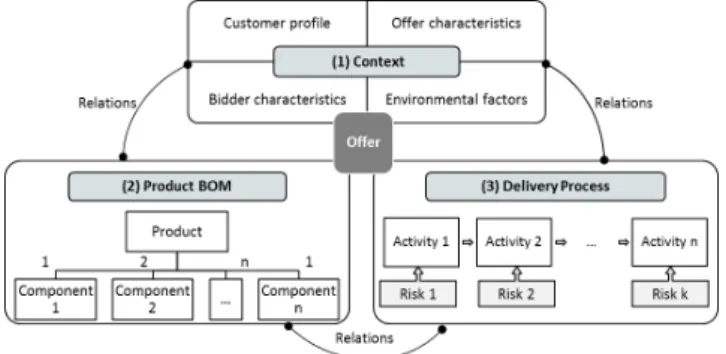
This section introduces the generic product offer config-uration model which will be extended to service offers. Many product models have been proposed in the last decades in order to help designers during all development phases, coupled or not with process models (Eckert et al., 2017) in order to manage design during all development steps. Several models are based on Function-Behaviour-Structure approach (Roucoules et al., 2006), where func-tions and structures are represented with a tree decom-position: functions into sub-functions and product into sets of components then components. System engineering as defined by INCOSE (2015) (International Council of Systems Engineering) proposes several views of the prod-uct, considered as a system, and defines several SYSML diagrams. At architectural design step, the product (or sys-tem) can be represented by applying the same mechanism of decomposition of block into sub-blocks. Other represen-tations may participate to the definition of the context, requirements (Faulconbridge and Ryan, 2003), interactions between blocks, etc, according to the different steps of the chosen design process (Mehnni et al., 2014). Elaborating an offer occurs before any design process starts, so existing product models propose too much details for the purpose of bidders: knowing that an existing solution can be reused is more important than the detailed characterization of this solution. The bidder must choose, among a set of known components, the key ones that fit the customer’s needs (Mittal and Frayman, 1989), in order to generate a BOM, which corresponds to configuration approach. In Guillon et al. (2017), a first open offer configuration model for products has been proposed (Fig. 1). To define a relevant offer and to be able to do case-based reasoning on passed cases, the bidder has to characterized (1) the offer context, (2) the product BOM, and (3) the product delivery process. Indicators (which are the evaluation parameters of the offer) characterize the product and the delivery process. These can be financial indicators (cost, price, margin), time-related indicators (delay, load, duration), but also confidence indicators (Sylla et al., 2017), depending on the bidder company. In this work, the product offer model is exploited with a constraint satisfaction problem (CSP) approach (Montanari, 1974).
(1) Context Four types of data characterize the context of the offer. They describe the customer profile, the offer characteristics, the bidder characteristics and the environ-mental factors.
Fig. 1. Model of product offer
(2) Product To describe the product, the bidder can choose between two approaches: a functional description of the needs, expectations and functions or a hierarchical description of the components. In both cases, we propose that the bidder configure the product BOM (Aldanondo and Vareilles, 2008).
(3) Delivery process Whether the bidder has chosen a functional description or a hierarchical description of the components, it is important to define the delivery process, described as a set of operations to be performed to produce and deliver the product.
As part of the OPERA project, the configuration of the delivery process is based on a generic process consisting of the following operations: studies, manufacturing and delivery. The delivery process is not defined in detail because the study is done at pre-sale stage and therefore does not require to deepen this point. When defining the delivery process the objective is to identify the following key activities: evaluate process costs, provide a relevant delivery date, and identify key risks on the project. The results of these key activities allow to elaborate the offer. This section has introduced the generic product offer model. The possibility of extending this generic model to service offers will now be explored.
3. SERVICE : DEFINITIONS AND DESCRIPTIONS
In recent years, the tertiary sector has become increasingly important: the global economy has shifted from a product-oriented vision to a service-product-oriented one and in most developed countries, the majority of revenues come from services (Chae, 2012). Today the development of services is such that tertiary sector companies are increasingly responding to calls for tenders. This section is dedicated to existing work on the definition and description of services.
3.1 Service definitions
Service as a process In Gr¨onroos (2000) and Carlborg and Kindstr¨om (2014), a service is a process consisting of several activities more or less intangible. The activities often result from interactions between the customer and employees and/or physical resources or goods and/or sys-tems of the service provider. Instead of trying to define what a service is, Gr¨onroos proposes to define the charac-teristics of a service: main one is to characterize a service as processes composed of activities or series of activities
rather than components. He defines a service as a process, as opposed to a product that is a thing.
Service as a performance Services are also sometimes defined as performances (Lovelock and Gummesson, 2004; Parasuraman et al., 1985; Zeithaml et al., 1985). In this case the description of the goal to be satisfied (the result) is more important than the resources or the process to be employed for (the means).
Service as a multi dimension concept According to Bullinger et al. (2003), a service is characterized by three different dimensions: (1) a structure dimension, which determines the capacity and willingness to provide the service in question, (2) a process dimension, and (3) a result dimension.
These definitions highlight interesting and varied aspects in the service definition which we will rely on later. 3.2 Service descriptions
The value of service configuration is the same as for product configuration: finding the balance between cus-tomization, to meet the varied needs of customers, and the benefits of standardization (Felfernig et al., 2014). The interest of the mass configuration applied to services has also been discussed (Heiskala et al., 2005). After listing benefits and challenges of mass configuration for services, the authors conclude that the benefits are the same as for the products. Yet the results on mass customization for goods may not be directly applicable to services (Felfernig et al., 2014). This subsection aims to explore this problem from the literature review.
Service decomposition into elements Several authors dis-cuss the service decomposition into elements. In Carlborg and Kindstr¨om (2014) and Goldstein et al. (2002), a ser-vice is described as ”a combination of physical and non-physical elements integrated into various customer-specific configuration”. They specify that the components are a combination of processes, human and material skills. Service family In Ki Moon et al. (2009), the concept of service families is explored. The authors propose to extend the methods used on the product families to the service families. A service family is defined as a set of services based on common processes, activities, objects, and features. A service is composed of a set of service modules, themselves composed of a set of service components.
Service modularity In Løkkegaard et al. (2016), the in-terest of modular services, which have the same advan-tages as modular products, is highlighted. In B¨ottcher and Klingner (2011), the authors propose a method for decomposing a B2B service into modules, and define a service module as follows: ”A service module offers a well-defined functionality via interfaces described precisely. A service module can be used to decompose and can itself be part of a higher level service module”. This definition is very close to the component definition for a product. They add: ”This decomposition allows a specific configuration for a given client because the client can assemble a service offer from a set of given service modules”. This definition
is similar to product configuration, where a customer can assemble their product from a set of given components. However, this last model is not directly applicable to our case study because our aim is to model services whether they are modular or not. Process, element, and modular approaches suggest that a service might be represented by a tree structure.
4. PRODUCT OFFER VERSUS SERVICE OFFER
During the bidding process, the work focuses on the evaluation of deliverable cost, and in some cases, on the workload identification and the delivery time estimation. For a product offer, the bidder seeks mainly to put a cost on the product by using the BOM. In addition, the technical choices made on significant components may be of interest to the customer. For a service offer, the bidder mainly evaluates a cost for a process, and no longer on product components. The resources used in the delivery process are valued: mainly human resources, but also material occasionally. For example, equipment procurement and travel costs are related to the delivery process. Unlike a product where costs related to raw materials and components are important, for services, these costs are often negligible (except for maintenance-like services, where physical components are purchased for the customer). In addition, structuring a service offer often depends on the customer’s request for costing, unlike product offers where the nomenclature is intrinsic to the product family and independent from the customer preferences. Then for services, structuring work packages can be very different from one customer to another, for a similar work. The application to a service of the product offer model presented in Fig. 1 raises several questions. (1) Context First, the context of the offer, as described in section 2, remains unchanged. Whether for a product or a service, the bidder must characterize the context to elaborate the most relevant offer for the customer. (2) Product or Service Then, the description of the product proposed by the bidder is difficult to adjust for a service. Indeed, as mentioned above, the existence of a service nomenclature is questioned. As seen in 3.1, some authors define a service as a process. As a consequence, the bidder may develop the delivery process in order to describe the proposed service. In the product offer model, this would mean that the product modeling would become weak. Two possibilities exist: nothing would replace the product modeling part and the service is modeled only by the delivery process part; or we replace product modeling part by a WBS (Work Breakdown Structure), as in project management. We therefore have to determine whether product modeling part should be deleted or adapted to services. If the adaptation is chosen, it is necessary to identify a formalism allowing to describe a service and the information that characterized it, as for example WBS formalism for a process-centered description. This formal-ism must also consider representations such as service as a performance, and allow decomposition or modularity. (3) Delivery process Then, as said before, the delivery process part is particularly important for a service. The choice of resources and the proper identification of the
duration of each task are essential. The service offer model will therefore include a process and risk descriptions, surely more detailed than for product offers.
Section 5 lays down the characteristics of a service offer to identify criteria for a future service typology. The analysis of these characteristics will allow studying more differences between products and services. If the product configuration cannot be directly applied to the service configuration, listing the characteristics that distinguish a product from a service should help to understand how to extend the product offer model. The literature review presented here mainly comes from marketing, which is an area where the concept of service has been widely studied.
5. CHARACTERISTICS IMPACTING THE SERVICE OFFER MODEL
The service is often opposed to the product in the lit-erature (Edvardsson et al., 2005). If defining a service is difficult, it is possible to list its main characteristics, often opposed to those of the products. Historically, four characteristics have been identified: Intangibility, Hetero-geneity, Inseparability (non-separability of production and consumption) and Perishability. These four characteristics are often grouped under the term IHIP. Although these features are often used in the literature, they have also been criticized in recent years (Edvardsson et al., 2005; Lovelock and Gummesson, 2004). Indeed, it seems that IHIP characteristics can not be applied to all types of ser-vices. Lovelock and Gummesson (2004), therefore, propose either:
(1) to abandon the product / service distinction and to stop declaring them as two different domains, (2) to find a new paradigm for defining services, (3) to work on typologies of services.
Option 1 is not applicable in configuration. Indeed, as mentioned above, it is impossible to treat products and services identically because we can not define all types of services with a physical nomenclature. Option 2 is the option retained by the authors. They propose to characterize a service by the absence of ownership transfer. This characteristic and its possible impact on our model will be discussed in the following. Finally, option 3 seems best suited to configure services. Indeed, we think that we can define a typology of services, i.e. a generic model for developing offers associated to each type of service. We therefore propose to discuss about characteristics which are necessary to establish such a typology of services. IHIP characteristics and absence of ownership transfer will be discussed in 5.1 in order to identify if they are able to differentiate a product from a service, but also to differentiate different types of services. Then we will propose new characteristics in 5.2.
5.1 Characteristics from literature review
In this subsection, we present IHIP characteristics and ownership transfer. We discuss their limits, then we ques-tion their impacts on the offer model.
Intangibility Intangibility is the first characteristic of a service, the most cited, but above all the most critical, and
the one from which all others derive (Bateson, 1979). This intangibility is defined as opposed to products tangibility, i.e. palpable and material (Shostack, 1977). Indeed, an intellectual service is intangible. This characteristic is essential because it impacts the key element of product offer configuration: the nomenclature. For a product, the bidder has to describe the characteristics of a tangible good and identify the components of a physical BOM. For a service, the service descriptors remain to be identified. This intangibility generates difficulty for the bidder to define a price for the service. Nevertheless, if a service is broken down into activities such as a WBS or elements following a batch decomposition, an intangible and not a physical nomenclature could be present.
Heterogeneity Heterogeneity concerns the potential for high variability in service performance. The service het-erogeneity is due to human resources, as opposed to the machine repeatability. The quality and essence of a service can vary from one stakeholder to another and from one customer to another. The service performance for the same worker can also vary from day to day. This characteristic therefore leads to a standardization difficulty (Zeithaml et al., 1985). This characteristic has a strong impact on the delivered service quality, but has a very low impact on a generic offer model since human resources are always defined.
Inseparability The characteristic of inseparability has several aspects, all related but with subtle differences. First, by definition, inseparability means that the produc-tion and the consumpproduc-tion of the service are simultane-ous (Parasuraman et al., 1985; Edvardsson et al., 2005; Lovelock and Gummesson, 2004). The involvement of the customer in the delivery process (e.g. in training) results from inseparability (Heiskala et al., 2005). Gr¨onroos (2000) adds that the added value of a service is the result of customer-supplier interactions, as opposed to the product, where value added is created within the factory. In the case of a service offer related to a calculation study, customers will provide specifications to the bidder at the beginning, and then they will be involved only at the end of the process for collecting the service deliverable provided by the bidder. This inseparability concept is not verified in this case. The training is, to some extent, produced and consumed at the same time since the training is part of both production by the worker and consumption by customers. Customers intervene directly in the service pro-duction because they are involved in the delivery process: they are present (and essential) during the training. The inseparability characteristic is verified in this situation. This characteristic does not inherently change the offer model. The part (3) Delivery process modeling will include activities involving the customer.
Perishability Perishability means that services cannot be retained. If the resource is not used at a time t, it cannot be retrieved or used later. A service has immediate con-sumption, unlike some products that may be used several years after delivery. Services have an ephemeral duration and cannot be stored. A rental service for example, is not lasting because the customer enjoys the service for a lim-ited time, unlike the purchase of a product, where the cus-tomer enjoys the property durability. Service companies
therefore often have a problem of synchronizing customer demand and their capacity (Zeithaml et al., 1985). This characteristic has no impact on the offer model.
Ownership transfer Lovelock and Gummesson (2004) propose to characterize the service by the absence of ownership transfer. For all the industrial services we have in mind, it seems this characteristics is applicable to all of them. It seems to be a very good one to distinguish services from products. But this characteristic has no impact on the offer model we propose.
Only intangibility has a direct impact on the generic offer model and will be selected as a criterion for establishing a typology of services. The characteristics of heterogeneity, inseparability, perishability and ownership transfer have no impact on the offer model. However, other features can differentiate services for bidding responses. In the following section, we propose some new characteristics, based on our observations during collaborations with industrial partners specialized in the production of services.
5.2 Identification of new characteristics
Obligation of means or results The customer’s require-ments may relate only to the result of the delivery process (the deliverable), or only to the progress of the delivery process. In the first case (obligation of result), we are getting closer to the customer’s expectations in the case of products. No matter how it was manufactured and assem-bled, the customer’s first expectation is about the product itself. This is the case, for example, for calculations studies. It does not matter to the customer that the study was done in one country or another, focus is on the fact that the calculations are done and that the report is clear and usable. In the second case (obligation of means), the cus-tomer is interested in the progress of the delivery process itself. For example, for training, duration, location and qualifications of the teacher are criteria that will interest the potential customer. If the customer is interested in the process progress, it will be better defined by the bidder. Indeed, while in the first case the process is defined only for the supplier, in the second case more attention must be paid to the process activities that interest the customer. The service offer model will have to be able to model an offer according to these two points of view.
Occurrence aspect The temporal aspect of a service (project progress) is important. The service can take place once or iteratively. For example, the customer may be calling for tender for a single design study on a given part, or for getting a pool of engineers able to do as many calculations as necessary during a given duration. This characteristic can impact the (3) Delivery process modeling part, because this one can be more complex, with several sub-processes or the same process repeated several times.
Uncertainty The bidder may commit himself to per-form services with an identified level of uncertainty. This uncertainty can be on three types. It may be temporal uncertainty: in the case of maintenance for example, the bidder may commit himself for a given period to intervene in case of a predefined problem. He may have identified a
range of activities, possible processes to perform, but does not know exactly how many times or when he will have to intervene. The second type of uncertainty can be related to resources: an estimated resource may be out of office when it is needed for acting. Finally, the uncertainty can be on the activities to be carried out. This uncertainty has a strong impact on the generic offer model. (2) Service modeling part and (3) Delivery process modeling part are impacted. In the case of temporal uncertainty, we can imagine that one or more processes are defined, and that the uncertainty relies on the number of repetitions and the duration of each process. In the case of resource uncertainty, the generic offer model is not modified but risk is impacted. Finally, in the case of a structural uncertainty, both (2) Service and (3) Delivery process modeling parts can be impacted.
5.3 Synthesis
To conclude, the three proposed characteristics have an impact on the elements that must be described for generat-ing an offer, as well as the intangibility characteristic from literature review. Therefore, the modeling of a service by a structural representation correlated to the delivery process is not only possible but necessary. But their impact influ-ences this modeling. We show that we need a structural representation to be able to describe: e.g. a service as a process composed of activities and sub-activities; or a set of service. In this case mechanism of decomposition is like product decomposition ones. We show also that even if the service modeling is “light”, it is necessary to associate a description of the delivery process. This delivery process is strongly impacted by these highlighted characteristics: e.g. in some situations the level of granularity of the modeling must be very detailed; in some others, only activities dealing with the customer must be detailed. Moreover, some situations require to define specific parameters such as resources characteristics or duration.
6. CONCLUSION
This paper looks at industrial services in response to calls for tenders. A product offer configuration model is described, then the question of extending this model to service offers is studied. In the product offer model, (1) Context modeling and (3) Delivery process modeling are relevant for service offers. (2) Product modeling as a nomenclature is questioned. Four service characteristics from the literature (intangibility, heterogeneity, insepara-bility and perishainsepara-bility) are analyzed. It is demonstrated that only intangibility has a direct impact on the offer modeling. As it is not enough to build a new typology of services, new characteristics are proposed (relative to customer expectation, temporal aspect and uncertainty), and their identification allows to identify the first bases for extending the described product offer model to ser-vice offers. Subsequently, a global typology of industrial services based on these characteristics will be proposed in future work, as well as a global model for integrating both product offers and service offers. Finally, the work, presented in this article, considers only aspects related to B2B services. However, it seems appropriate to extend this work to other types of services in the near future to propose a global typology of services.
ACKNOWLEDGEMENTS
The work presented in the paper is funded by the French ANR (project n◦CE10-0010). We thank all partners of the OPERA project for their involvement.
REFERENCES
Abeille, J., Coudert, T., Vareilles, E., Geneste, L., Al-danondo, M., and Roux, T. (2010). Formalization of an integrated system/project design framework: First models and processes. In Proceedings of the First In-ternational Conference on Complex System Design & Management CSDM, 207–217. Springer Berlin Heidel-berg.
Aldanondo, M. and Vareilles, E. (2008). Configuration for mass customization: How to extend product config-uration towards requirements and process configconfig-uration. Journal of Intelligent Manufacturing, 19(5), 521–535. doi:10.1007/s10845-008-0135-z.
Bateson, J.E. (1979). Why we need services marketing. Division of Research, Graduate School of Business Ad-ministration, Harvard University.
B¨ottcher, M. and Klingner, S. (2011). Providing a method for composing modular B2B services. Journal of Busi-ness & Industrial Marketing, 26(5), 320–331. doi: 10.1108/08858621111144389.
Bullinger, H.J., F¨ahnrich, K.P., and Meiren, T. (2003). Service engineering - Methodical development of new service products. International Journal of Produc-tion Economics, 85(3), 275–287. doi:10.1016/S0925-5273(03)00116-6.
Carlborg, P. and Kindstr¨om, D. (2014). Service process modularization and modular strategies. Journal of Business & Industrial Marketing, 29(4), 313–323. doi: 10.1108/JBIM-08-2013-0170.
Chae, B.K. (2012). An evolutionary framework for service innovation: Insights of complexity theory for service science. International Journal of Production Economics, 135(2), 813–822. doi:10.1016/j.ijpe.2011.10.015. Chandrasekaran, B. (1990). Design problem solving: A
task analysis. AI magazine, 11(4), 59.
Eckert, C.M., Wynn, D.C., Maier, J.F., Albers, A., Bur-sac, N., Xin Chen, H.L., Clarkson, P.J., Gericke, K., Gladysz, B., and Shapiro, D. (2017). On the integration of product and process models in engineering design. Design Science, 3.
Edvardsson, B., Gustafsson, A., and Roos, I. (2005). Service portraits in service research: a critical review, volume 16. doi:10.1108/09564230510587177.
Faulconbridge, R.I. and Ryan, M.J. (2003). Managing complex technical projects: A systems engineering ap-proach. Artech House, Norwood, MA.
Felfernig, A., Hotz, L., Bagley, C., and Tiihonen, J. (2014). Knowledge-Based Configuration: From Research to Business Cases. doi:10.1016/C2011-0-69705-4. Goldstein, S.M., Johnston, R., Duffy, J., and Rao, J.
(2002). The service concept: The missing link in service design research? Journal of Operations Management, 20(2), 121–134. doi:10.1016/S0272-6963(01)00090-0. Gr¨onroos, C. (2000). Service management and marketing:
customer management in service competition. John Wiley & Sons.
Guillon, D., Sylla, A., Vareilles, E., Aldanondo, M., Villeneuve, E., Merlo, C., Coudert, T., and Geneste, L. (2017). Customer supplier relation: towards a constraint-based model for bids. In Industrial Engineer-ing and EngineerEngineer-ing Management. SEngineer-ingapore.
Heiskala, M., Paloheimo, K.S., and Tiihonen, J. (2005). Mass Customisation of Services : Benefits and Chal-lenges of Configurable Services. Frontiers of e-Business Research (FeBR), 206–221.
INCOSE (2015). Systems engineering handbook: a guide for system life cycle processes and activities. John Wiley and Sons, San Diego, CA.
Ki Moon, S., Simpson, T.W., Shu, J., and Kumara, S.R. (2009). Service representation for capturing and reusing design knowledge in product and service fam-ilies using object-oriented concepts and an ontology. Journal of Engineering Design, 20(4), 413–431. doi: 10.1080/09544820903151723.
Løkkegaard, M., Mortensen, N.H., and McAloone, T.C. (2016). Towards a framework for modular service design synthesis. Research in Engineering Design, 27(3), 237– 249. doi:10.1007/s00163-016-0215-6.
Lovelock, C. and Gummesson, E. (2004). Whither Services Marketing? Journal of Service Research, 7(1), 20–41. Mehnni, F., Choley, J., Penas, O., and Plateaux,
R.and Hammadi, M. (2014). A sysml-based method-ology for mechatronic systems architectural design. Ad-vanced Engineering Informatics, 28, 218–231.
Mittal, S. and Frayman, F. (1989). Towards a generic model of configuraton tasks. International Joint Con-ference on Artificial Intelligence - IJCAI’89, 1395–1401. Montanari, U. (1974). Networks of constraints: Fundamen-tal properties and applications to picture processing. Information Sciences, 7(Supplement C), 95 – 132. doi: https://doi.org/10.1016/0020-0255(74)90008-5.
Parasuraman, A., Zeithaml, V.A., and Berry, L.L. (1985). A Conceptual Model of Service Quality and Its Implica-tions for Future Research. Journal of Marketing, 49(4), 41–50.
Robin, V., Merlo, C., Pol, G., and Girard, P. (2010). Management of a design system in a collaborative design environment using pegase. Modelling and Management of Engineering Processes, 189–200.
Roucoules, L., Noel, F., Teissandier, D.and Lombard, M., Debarbouille, G., Girard, P., Merlo, C., and Eynard, B. (2006). Ippop: an opensource collaborative design plat-form to link product, design process and industrial or-ganisation information. In 6th International Conference on Integrated Design and Manufacturing in Mechanical Engineering. Grenoble, France.
Shostack, G.L. (1977). Breaking free from product mar-keting. The Journal of Marketing, 41(2), 73–80. doi: 10.2307/1250637.
Sylla, A., Vareilles, E., Aldanondo, M., Coudert, T., Geneste, L., and Kirytopoulos, K. (2017). Cus-tomer/Supplier Relationship: reducing Uncertainties in Commercial Offers thanks to Readiness, Risk and Confidence Considerations. In Advances on Mechan-ics, Design Engineering and Manufacturing, 1115–1122. Springer.
Zeithaml, V., Parasuraman, A., and Berry, L. (1985). Problems and strategies in services marketing. The Journal of Marketing, 49(2), 33–46.