HAL Id: hal-01528461
https://hal.archives-ouvertes.fr/hal-01528461
Submitted on 1 Jun 2017
HAL is a multi-disciplinary open access
archive for the deposit and dissemination of
sci-entific research documents, whether they are
pub-lished or not. The documents may come from
teaching and research institutions in France or
abroad, or from public or private research centers.
L’archive ouverte pluridisciplinaire HAL, est
destinée au dépôt et à la diffusion de documents
scientifiques de niveau recherche, publiés ou non,
émanant des établissements d’enseignement et de
recherche français ou étrangers, des laboratoires
publics ou privés.
Energy-efficiency-aware upgrade of network capacity
Wilfried Yoro, Mamdouh El Tabach, Taoufik En-Najjary, Azeddine Gati,
Tijani Chahed
To cite this version:
Wilfried Yoro, Mamdouh El Tabach, Taoufik En-Najjary, Azeddine Gati, Tijani Chahed.
Energy-efficiency-aware upgrade of network capacity. IEEE WCNC, Mar 2017, San Francisco, United States.
pp.1 - 6, �10.1109/WCNC.2017.7925952�. �hal-01528461�
Energy-efficiency-aware Upgrade of Network
Capacity
Wilfried Yoro
∗, Mamdouh El Tabach
∗, Taoufik En-Najjary
∗, Azeddine Gati
∗, Tijani Chahed
† ∗Orange Labs, Chatillon, France†Institut Mines-Telecom, Telecom SudParis, UMR CNRS 5157 SAMOVAR, Evry, France
Email:{wilfried.yoro, mamdouh.eltabach, taoufik.ennajjary, azeddine.gati}@orange.com
Abstract—Energy efficiency of a network, defined as the
num-ber of bits transmitted per unit of consumed energy, increases with the traffic load for a constant network capacity. This comes from the fact that energy is composed of two components: a fixed one, consumed by the network regardless of the traffic load, and a variable one, which depends on the traffic load. And so, when traffic load increases, the fixed component gets amortized. However, a network upgrade, namely adding more equipment in the network to fit traffic increase, comes typically with a higher increase in capacity than traffic, at least for a while after the upgrade, as traffic previsions are based on relatively long term projections. Thus, the power consumption of the network would increase faster than the traffic, and energy efficiency would then decrease. We investigate in this work the conditions under which a network upgrade does not deteriorate its energy efficiency. We consider two ways of upgrading a network: either by adding equipment with the same technology or by deploying equipment with another technology, typically more recent and more efficient. We discuss in both cases the number of equipment to be added so that to preserve the network’s energy performance.
Index Terms—Energy efficiency, Network densification,
Wire-less network
I. INTRODUCTION
Internet traffic is growing exponentially over years, mainly due to the democratization of smartphones and tablets and the increase of content. According to Cisco [1], overall IP traffic will grow at a compound annual growth rate (CAGR) of 23
percent from 2014 to 2019. To face this situation, Internet
providers upgrade their networks so as to keep up and/or improve the users Quality of Experience (QoE).
Energy efficiency of a network is defined as the number of transmitted bits per unit of consumed energy. At constant network capacity, energy efficiency increases with the traffic load of the network. This is due to the fact that the energy consumption of a network consists of two components: a fixed one, consumed by the network infrastructure regardless of the traffic, and a variable one, which is proportional to the traffic load. When the traffic increases, the fixed component of energy gets amortized, and hence the network’s energy efficiency gets improved.
When the network is upgraded, new equipment are added in order to fit traffic increase, based on long term previsions. This typically comes with a higher increase in capacity than traffic, at least for a while after the upgrade operation. Thus, the power consumption of the network could increase faster than the
traffic, and energy efficiency could decrease consequently. So, the energy efficiency of the network has upward and downward trends, that is, it decreases after an upgrade then increases with traffic load until the next upgrade operation.
A network upgrade improves the energy efficiency of the network when it is operated at full load. In fact, newer technologies are typically more energy efficient than older ones as they come with better software, algorithms, etc. On the field however, the network is not operated at full load, i.e., maximum capacity, and so the newer technologies are not necessarily more energy efficient. For instance, deploying a 4G network along side with the existing 3G network may result in a less efficient network since the traffic is shared between the two technologies.
Several works in the literature investigated the network upgrade topic (we will report on some of them in section II). These works introduce different techniques for networks densification, but there is still work to do on how to prevent a capacity upgrade from degrading the energy performance of the network. This paper is a contribution in that direction.
We specifically focus on the two ways mostly used for upgrading the network capacity: either by adding equipment with the same technology, for instance adding 4G sites in a 4G network, or by deploying equipment with another technology, typically more recent and more efficient, for instance adding LTE-A sites in a LTE network. In each case, we determine the number of equipment to be added so as the upgrade preserves the network’s energy efficiency.
The remainder of this paper is organized as follows. In section II, we review some literature related to densification of networks. In section III, we introduce our models for assessing the energy efficiency of a mobile access network. In section IV, we discuss the impact of different techniques of network upgrade on the energy efficiency. Section V shows some applications of our model, run on a real dataset taken from an operational European network. Section VI eventually concludes the paper.
II. RELATED WORK
In [2], Mugume et al. investigate with stochastic geometry tools the impact of small cells deployed by users on the spectral and energy efficiency of mobile networks. The authors define three scenarios according to the ratio of networks’ base
stations versus users’ base stations. The authors recommend to densify the network so as to avoid a low value of that ratio. Yunas et al. [3] propose a new approach for network densification. The authors state that the majority of data traffic, approximately65 − 70% is generated by indoor users.
Therefore, it is more spectral and energy efficient to densify the network with indoor small cells mainly, while maintaining some outdoor coverage for high-speed outdoor users. The authors propose the distributed antenna system (DAS) for outdoor hotspots coverage.
According to Andrews et al. in [4], densification of wireless networks for enabling data rate increase by spatial reuse is reaching a fundamental limit. Even though the standard path loss model shows that the SINR becomes density-independent starting from a given value of density, when considering the dual slope path loss model instead, the authors come out with a SINR decreasing monotonically with density in dense networks. There is therefore a densification limit.
Litjens et al. in [5] assess the energy efficiency improvement of future mobile networks. The energy efficiency of mobile networks in 2010 and 2020 are compared, considering all rel-evant scenarios aspects. The results show an energy efficiency improvement factor of about 793 in 2020 over 2010.
III. MODELING THE ENERGY PER BIT.
A. Modeling the energy-per-bit of the network
The energy-per-bit of the network, which we denote byα, is
the amount of energy consumed by the network per transmitted bit. Let∆t denote the observation time of the network’s traffic
and energy consumption; ∆t = t2− t1, with t1 and t2 the
initial and final instants of observation, respectively.
α(R, C) = Rt2 t1 P (t)dt PN i=1vi (1) withR the mean traffic rate (in units of (Mega)bits per
sec-ond),C the network capacity (also in (Mega)bits per second), vithe traffic volume of servicei (in units of (Giga)bits), N the
number of services in the network andP (t) the instantaneous
power consumption of the network, which consists, as stated earlier, of a constant component (independent of the load) and a variable one (load-dependent).
According to [6], the power model of a network equipment is a linear function of its traffic rate, as depicted in Fig. 1. We deduce that:
P (t) = P0+ ρ(t)(Pmax− P0) (2)
where P0 is the network’s idle power, ρ(t) = R(t)C is the
network’s load at timet and Pmaxis the network’s maximum
power. In addition, N X i=1 vi= R × ∆t (3) So, α(R, C) = 1 ∆t Rt2 t1 P0+ ρ(t)(Pmax− P0)dt R (4)
Fig. 1. Power model of a network’s equipment.
. α(R, C) = P0 R + ρ Pmax− P0 R (5) where ρ = 1 ∆t Rt2
t1 ρ(t)dt, the mean load over ∆t.
Moreover,
ρ = R
C (6)
And so, Eqn. (5) becomes,
α(R, C) = P0 R +
Pmax− P0
C (7)
B. Evolution of the network’s energy efficiency with the traffic rate
As stated earlier, the network’s energy efficiency typically increases proportionally to the traffic rate R, when the
num-ber of equipment is constant, i.e., when the network is not upgraded. This intuition is mathematically proved, as follows.
∂α(R, C) ∂R = −
P0
R2 (8)
The network energy-per-bit decreases with the traffic rate as ∂α(R,C)R < 0.
And so, a traffic rate increase improves the network energy efficiency as long as this increase does not call for a network upgrade. When a network upgrade is however operated, this rule might be upset, and we study next the impact of an upgrade on the energy efficiency of the network.
IV. UPGRADE OF THE NETWORK
As stated above, we consider in this investigation that a network upgrade can be achieved either by adding new equipment with the same technology or by replacing existing equipment by newer ones, implementing more recent and typically more energy-efficient technologies.
A. Upgrading the network with the same technology
The network’s capacity and power consumption are function of the number of equipment, denoted by K. Upgrading the
network can improve its energy efficiency if the energy-per-bit (inverse of the energy efficiency) of the network is not an increasing function of the number of equipment, i.e., the derivative of the energy-per-bit (α) with respect to K should
not be positive. We then study the sign of the derivative of the energy-per-bit in order to determine the limit value of the number of equipment, i.e., the value of K, beyond
Fig. 2. Sign of the derivative of the energy-per-bit
which the derivative is positive. When the number of network’s equipment is lower than this limit value, the network upgrade is able to preserve the network’s energy performance.
From Eqn. (7), the derivative ofα with respect to K is: ∂α(R, C) ∂K = 1 R ∂P0 ∂K + ∂Pmax ∂K − ∂P0 ∂K C − (Pmax− P0)∂K∂C C2 (9) In the case the network’s capacity is a linear function of the number of equipmentK, the variation of the
energy-per-bit versus the number of equipment is a parabola, as depicted in Fig. 2. The limit value ofK corresponds to the number of
equipment for which the derivative ofα is equal to zero.
B. Upgrading the network with a new technology
We consider in this section that the network upgrade results from a new technology, denoted byT . The network’s capacity
and power consumption are function of the deployed technol-ogy. We keep the same reasoning as with the case of upgrading the network with the same technology. Energy efficiency varies with the technology as follows,
∂α(R, C) ∂T = 1 R ∂P0 ∂T + ∂Pmax ∂T − ∂P0 ∂T C − (Pmax− P0)∂C∂T C2 (10) The derivative of the capacity or power versus the technol-ogy T indicates the increase of the capacity or power when
the new technology is deployed in the network. Here too, we study the sign of the derivative and find the limit value of the number of network’s equipment.
It is worth to note that unlike the network upgrade with the same technology case, where the parabola is always opened upward, since ∂P0
∂K is always positive because the idle power
consumption of the network increases with the number of network’s equipment, in the case of a network upgrade with a new technology, the parabola can open upward or downward since ∂P0
∂T can be positive or negative as the new technology
can increase or decrease the idle power of the network. When the parabola opens downward, i.e., when the new technology decreases the idle power of the network, there is no limit value of K beyond which the derivative of the
energy-per-bit is always positive, this means that it is always possible to upgrade the network while preserving its energy efficiency
when the new technology decreases the network’s idle power. When the parabola opens upward, there is a limit value ofK
beyond which the network upgrade cannot preserve the energy efficiency, since the derivative is always positive beyond this value.
V. APPLICATIONS TO4GACCESS NETWORK We consider a real, operational 4G access network com-posed of 10000 eNodeBs and an average traffic rate of 10
Gbps. Tab. I summarizes the parameters of the network’s equipment. Column 3 gives the typical mean values of the
maximum power, idle power and capacity of an eNodeB. We consider that the uplink represents 20% of the total traffic,
based on [7] and on measurements carried out on the above-mentioned real operator network, and13% of the total power
consumption [6], [8].
A. Energy efficiency of a mobile access network
Let us consider that the network’s equipment have the same mean capacity and mean power. Then, the total mean capacity of the network is the mean capacity of an equipment multiplied by the number of equipment in the network. It applies also to the total power of the network. Hence, Pmax = KPmaxbs ,
P0 = KP0bs and C = KCbs where Pmaxbs , P0bs and Cbs
are respectively the mean maximum power, idle power and capacity of a single base station. The network capacity is then a linear function of the number of network equipment
K. In the sequel, we use the terms base station and site
interchangeably.
The energy-per-bit of the network is (after simplification of Eqn. (7)), α(R, K) = P bs max− P0bs Cbs + P bs 0 K R (11)
Eqn. (11) shows that the energy efficiency of the network (inverse of the energy-per-bit) is proportional to the traffic and inversely proportional to the number of sites. But the network’s energy efficiency cannot be increased indefinitely as the traffic should not exceed a threshold Rthreshold, at a
constant network’s capacity. We have from Eqn. (6):
Rthreshold= KCbsρthreshold (12)
with ρthreshold a given network load threshold obeying to
operational constraints.
Eqns. (11) and (12) yield the lower bound of the network energy-per-bit at a constant number of sites, termedαmin.
αmin= Pbs max− P0bs Cbs + Pbs 0 Cbsρ threshold (13) Letz denote the proportion of traffic increase. The capacity
upgrade does not degrade the network energy efficiency if:
Kf − Ki
Ki
≤ z (14)
where Kf andKi are respectively the number of sites in the
TABLE I ENODEBPARAMETERS
Parameters Definition Typical values
K Number of network equipment Pbs
max(W att) Maximum power 528
Pbs
0 (W att) Idle power 333
Cbs
(M bps) Base station capacity 72 DL, 12 UL
R Traffic rate
Eqn. (14) results from the resolution of α(Rf, Kf) ≤
α(Ri, Ki), i.e., the energy-per-bit of the upgraded network
should be lower than or equal to the energy-per-bit of the initial network. Hence, the maximum number of sites that can be added in the network in order to preserve its energy efficiency is proportional to the traffic increasez. As a result, if
there is no traffic increase, i.e.,z = 0, the operator should not
add LTE sites in the network otherwise its energy efficiency would be degraded. However to keep up with a traffic increase, the operator should add at most z% of new LTE sites in his
network. It is worth to note that this limit does not take into consideration spectral efficiency constraints, and it is up to the network designer to consider both our results along with other network constraints in the upgrade policy.
The access network has different characteristics in the uplink and downlink, so all the above expressions should be considered separately in both directions. The network we investigated has an uplink-energy-per-bit of 200 µJ/bit, i.e.,
the uplink radio resources consume on average 200 µJ per
transmitted bit. According to [6], the observed traffic for uploading a 5-MB photo to Facebook in normal quality using a smartphone with Wifi and 4G technologies is about1.1 MB,
because Facebook compresses photos heavily in user browser before sending them to Facebook servers. Uploading a 5-MB photo to Facebook in normal quality costs about 0.5 Wh. If
the operator sets the maximum acceptable load of the network to50%, then this cost can be reduced to 0.02 Wh, since the
lower bound on the uplink energy-per-bit would be9.3 µJ/bit,
that is, 96% of energy gain. Hence, using the network even
only at half of its capacity allows significant energy savings, unlike the actual operation of networks which are most of the time under-loaded, about10% on average for the investigated
network.
The results are similar in the downlink direction.
B. LTE network swap
We discuss in this section the conditions under which a swap operation does not degrade the energy efficiency of the net-work. A swap consists in replacing the sites of the network by newer, more efficient ones. We propose to investigate the swap of LTE sites by LTE-A sites. Typically the energy efficiency of network’s equipment improves with the technology. Thus, an LTE base station is less energy efficient than an LTE-A base station at full operating load. But in practice, networks are typically underloaded, and so an LTE-A network is not necessarily more energy efficient than an LTE network. Hence
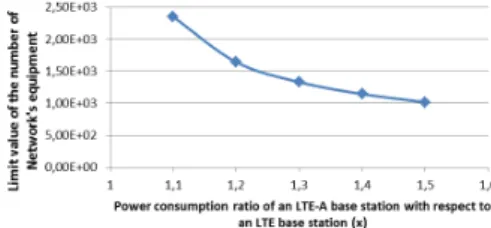
Fig. 3. Limit value of the number of network’s equipment
Fig. 4. Energy efficiency of the upgraded network (LTE-A network)
the need to study the conditions for a swap operation not to degrade the network energy efficiency.
Letx denote the power consumption ratio of an LTE-A site
versus an LTE site. We consider values ofx between 0.5 and 1.5 depending on the network configuration. When x = 1,
then an LTE-A site consumes as much power as an LTE site.
1) Replacing LTE sites by an equal number of LTE-A sites:
Let us consider first a simple scenario where the network operator makes a swap operation consisting in replacing the LTE sites by an equal number of LTE-A sites, at constant traffic.
The study of the sign of the derivative of the energy-per-bit shows that when an LTE-A site does not consume more power than an LTE site, the swap operation increases the capacity of the network without deteriorating its energy efficiency. In fact, replacing the LTE sites by less energy-consuming LTE-A sites, at constant traffic, can only improve the energy efficiency of the network.
If an LTE-A site consumes more power than an LTE site, the study of the sign of the derivative of the energy-per-bit shows that the swap operation increases the network’s capacity but decreases its energy efficiency, although an LTE-A site is more energy-efficient than an LTE site at full operating load. In fact, replacing the LTE sites by more energy-consuming LTE-A sites, at constant traffic, can only degrade the energy efficiency of the network. This result is corroborated by Fig. 3 which shows that the number of network’s equipment (10000) is greater than the limit values.
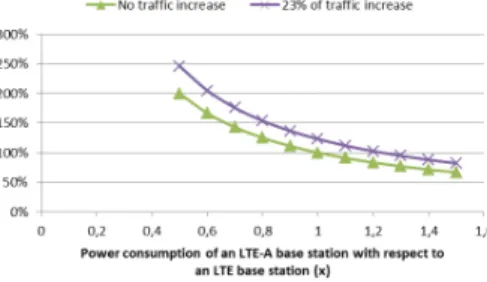
Fig. 4 shows the energy efficiency (inverse of the energy-per-bit) of the upgraded network (LTE-A network), as a function ofx, the power consumption ratio of an LTE-A site
versus an LTE site. We note clearly that the LTE-A technology degrades the energy performance of the network when an
LTE-Fig. 5. Maximum number of sites in the upgraded network (LTE-A sites) to avoid degrading the network’s energy efficiency
A site consumes more power than an LTE site, since the LTE-A network’s energy efficiency is lower than the LTE network’s energy efficiency forx > 1.
2) Replacing LTE sites by a different number of LTE-A sites: We now turn to a more general swap operation
where the LTE sites are no longer necessarily replaced by an equal number of LTE-A sites. We propose to determine the maximum number of LTE-A sites needed to replace the LTE sites in order to preserve the network energy performance.
Lety denote the ratio of capacity increase of an LTE-A site
versus an LTE site, withy > 1. Let Ki denote the number of
sites in the initial network (composed of LTE sites only), and
Kf the number of sites in the upgraded network (composed
of LTE-A sites only). The swap does not degrade the network energy efficiency if:
Kf(x, y) ≤ (1 + z)( Ki x + ( 1 x− 1 y)( Pbs max Pbs 0 − 1) Ri Cbs) (15) withx > 0, y > 1.
Eqn. (15) comes from the resolution of α(Rf, Kf) ≤
α(Ri, Ki), i.e., the energy-per-bit of the upgraded network
should be lower than or equal to the energy-per-bit of the initial network.
Fig. 5 shows the maximum number of sites in the upgraded network, i.e., the LTE-A network that does not degrade the energy performance of the network, as a function of x, the
power consumption ratio of an LTE-A site versus an LTE site. We consider a scenario with no traffic increase, i.e.,Rf = Ri,
and another one with23% traffic increase (according to Cisco
[1]), i.e.,Rf = 1.23Ri. We sety = 10 as LTE-A is supposed
to increase the theoretical LTE base station’s throughput by a factor of 10. It is worth to note, in line with Eqn. (15), that
the maximum number of LTE-A sites is proportional to the traffic increase, as depicted in Fig. 5.
We notice in the figure that when there is no traffic increase and when an LTE-A site consumes more power than an LTE site (x > 1), the number of sites in the upgraded network
(LTE-A sites) must be lower than the number of sites in the initial network (LTE sites), which confirms our previous results when we were replacing the LTE sites by an equal number of LTE-A sites.
Please note that replacing the LTE sites by a lower number of LTE-A sites would not result in coverage holes in the
network since the LTE-A sites may transmit at higher power and thus have higher coverage.
C. Right mix between LTE and LTE-A sites
In this section we propose to determine the right proportion of LTE sites in an upgraded network, composed of LTE and LTE-A sites, in order to preserve its energy efficiency, unlike the previous case where we were considering a swap operation, consisting in replacing all the LTE sites by new LTE-A ones. This investigation is useful since it corresponds to what happens most of the time when a network is upgraded. The challenge is then to know the right mix between these technologies in order to not deteriorate the energy efficiency of the upgraded network.
By resolving the inequality α(Rf, Kf) ≤ α(Ri, Ki), i.e.,
the energy-per-bit of the upgraded network should be lower than or equal to the energy-per-bit of the initial network, we get: (1 − x)(1 − y)KfCbsP0bs zRi θ2+ (((xKf z − Ki) 1 − y Ri +(1 − x)yKf zRi )CbsP0bs+ (y − x)(Pmaxbs − P0bs))θ + ((xKf z − Ki) yCbsPbs 0 Ri + (x − y)(Pmaxbs − P0bs)) ≤ 0 (16) whereθ is the proportion of LTE sites in the upgraded network.
Let us consider the scenario where an operator would like to upgrade its LTE network by replacing some of LTE sites by LTE-A equipment but keeping the same number of equipment in the upgraded network as in the initial one, i.e., Kf = Ki.
We first consider the simple case when there is no traffic increase, i.e., Rf = Ri. The operator would like to know the
right proportion of LTE sites so that the energy efficiency of the upgraded network (composed of LTE and LTE-A sites) is not lower than the one of the initial network (composed of LTE sites only).
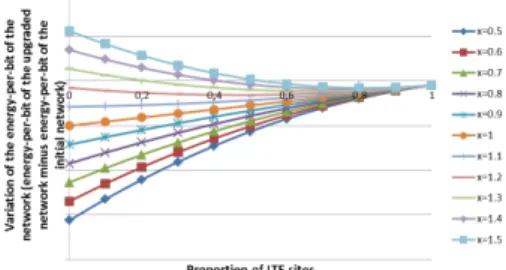
Fig. 6 shows that when an LTE-A site does not consume more power than an LTE site (x ≤ 1), the network is more
energy efficient whatever the proportion θ of LTE sites in the
upgraded network. This means that the operator may add any proportion of LTE-A sites in the upgraded network. This result is logical given that replacing an LTE site by a less energy-consuming LTE-A site at constant traffic can only improve the network’s energy efficiency. However when an LTE-A site consumes more power, i.e., x > 1, the only way to preserve
the energy efficiency of the network is whenθ = 1, i.e., when
the network is not upgraded. This result is also logical since replacing an LTE site by a more energy-consuming LTE-A site at constant traffic can only degrade the network’s energy efficiency.
Let us consider now an upgrade due to a traffic increase. We consider23% traffic increase in line with Cisco previsions [1],
thus z = 0.23. We observe in Fig. 7 that whatever the power
consumption of an LTE-A site, the operator can upgrade its network while preserving the network’s energy performance,
Fig. 6. Right proportions of LTE sites in the upgraded network, case with no traffic increase
Fig. 7. Right proportions of LTE sites in the upgraded network, case with 23% traffic increase
unlike the upgrade without traffic increase (previous scenario) where we found that when x > 1, i.e., when an LTE-A site
consumes more power than an LTE site, not upgrading the network is the only way to preserve its energy efficiency. In addition, our model gives the exact value of the proportion of the LTE sites. For instance, in the case where an LTE-A site consumes0.4 more energy than an LTE site, i.e., x = 1.4, the
operator should keep at least40% of LTE sites in the upgraded
network, given 23% of traffic increase.
VI. CONCLUSION
We investigated in this work the conditions for a network upgrade not to deteriorate the energy efficiency. We considered two techniques for network upgrade: either by adding sites with the same technology or by adding sites implementing another technology, typically more recent and more efficient. In both cases, we derived the number of equipment to be added so as to preserve the network’s energy performance. We showed that when the new technology decreases the idle power component of the network, a network upgrade can always improve or at least keep the energy efficiency of the network. In addition, we showed that a network loaded even at only half of its capacity allows significant energy savings, on the order of 95% for a photo upload on Facebook, for
the network considered in this work. Given that operated networks are typically under-loaded, operators should closely consider techniques for adapting the network’s capacity to its load. Eventually, we discussed the right mix between sites implementing different technologies in the network, from an energy efficiency point of view.
In the future, we would like to consider the following perspectives.
First, it is worth to note that the numerical applications contained in this paper are limited to a mobile network whose capacity is a linear function in the number of radio sites, or which can be approximated as such. Further investigations will tackle the case of mobile networks that do not fit this linearity condition.
Second, we considered in this work the most used tech-niques for upgrading the capacity of the network, either by adding sites with the same technology or by adding sites implementing another technology. However there exists other ways of upgrading network capacity, for instance by software upgrade. The impact of these types of network upgrade on our model will be also investigated.
Last, we applied our model to a macro network composed of LTE and LTE-A sites. It may be worthy to investigate the impact of other network topologies, for instance a Heteroge-neous Network (HetNet) comprising micro sites, as well as the impact of our model on the QoS performance of the network.
ACKNOWLEDGMENT
Under the framework of Celtic-Plus, the studies of the SooGREEN project have been partially funded by the French Directorate General for Enterprise (DGE).
REFERENCES
[1] Cisco, Cisco Visual Networking Index: Forecast and Methodology, 2014
2019. Cisco, 2015.
[2] E. Mugume and D. K. C. So, “Spectral and energy efficiency analysis of dense small cell networks,” in 2015 IEEE 81st Vehicular Technology
Conference (VTC Spring), Institute of Electrical and Electronics
Engi-neers (IEEE), may 2015.
[3] S. F. Yunas, M. Valkama, and J. Niemel¨a, “Spectral and energy efficiency of ultra-dense networks under different deployment strategies,” IEEE
Communications Magazine, vol. 53, no. 1, pp. 90–100, 2015.
[4] J. G. Andrews, X. Zhang, G. D. Durgin, and A. K. Gupta, “Are we approaching the fundamental limits of wireless network densification?,”
arXiv preprint arXiv:1512.00413, 2015.
[5] R. Litjens, Y. Toh, H. Zhang, and O. Blume, “Assessment of the energy efficiency enhancement of future mobile networks,” in 2014 IEEE
Wireless Communications and Networking Conference (WCNC), Institute
of Electrical & Electronics Engineers (IEEE), apr 2014.
[6] F. Jalali, C. Gray, A. Vishwanath, R. Ayre, T. Alpcan, K. Hinton, and R. S. Tucker, “Energy consumption of photo sharing in online social networks,” in 2014 14th IEEE/ACM International Symposium on Cluster, Cloud and
Grid Computing, Institute of Electrical & Electronics Engineers (IEEE),
may 2014.
[7] Ericsson, “Ericsson mobility report,” November 2012.
[8] A. Vishwanath, F. Jalali, R. Ayre, T. Alpcan, K. Hinton, and R. S. Tucker, “Energy consumption of interactive cloud-based document processing applications,” in 2013 IEEE International Conference on Communications