An updated model of the hot nitrogen atom kinetics
and thermospheric nitric oxide
J.-C. G6mrd
Laboratoire de Physique Atmosph6rique et Plan6taire, Institut d'Astrophysique, Universit6 de Liege, Liege, •elgium
D. V. Bisik1o and V. I. Shematovich
Institute of Astronomy of the Academy of Sciences, Moscow J.W. Duff
Spectral Sciences, Inc., Burlington, Massachusetts
Abstract. New observations and reanalysis of previous measurements suggest an
upward revision
of the measured
thermospheric
nitric oxide density. Our previous
model
of NO production
by fast N( 4 •q) atom
collisions
with 02 has been
updated.
It
includes
the effect of soft solar X rays, Auger electrons,
and a detailed treatment of
N2 dissociative
ionization channels. In addition, new calculations
indicate that the
transfer
of translational
energy
in N + N2 collisions
is less
efficient
than in the hard
sphere
approximation.
This result leads to reevaluation
of the energy
dependent
relaxation cross section and to an upward revision of the reacting efficiency of
collisions
of N with 02 to form nitric oxide. The calculated peak NO density
increases
by a factor of •- 2 when the effect of superthermal
nitrogen atoms is
included.
The model
response
of the N(4S) energy
distribution
function
and NO
density
to solar cycle variations
is presented.
The NO density
at 110 km changes
from 5.4 x 10⁷ to 1.3 x 10
s cm
-• when the solar F10.7
index varies
from 70 to 245,
but its response
depends
on the magnitude
of the soft X ray increase
with solar
activity.
1. Introduction
Reaction
of nonthermal
ground state N(4S) atoms
with O2 was suggested as a possible source of nitric ox-
ide molecules in the atmosphere [Solomon, 1983]. Hot
nitrogen atoms are produced by exothermic photochem- ical processes in the thermosphere so that, at steady state, their distribution function departs substantially
from Maxwellian at energies above •- 0.3 eV [$hema- tovich et al., 1991, 1992]. These superthermal atoms
react with O 2 to form NO at an energy dependent rate considerably faster than at thermal equilibrium for gas
temperatures encountered in the thermosphere [Duff et
al., 1994]. Gdrard
et al. [1991, 1995]
demonstrated
that
this process is, indeed, an additional source of thermo- spheric nitric oxide in the sunlit atmosphere. The de- pendence of the efficiency of the fast N source of NO
on solar activity was discussed
by Gdrard
et al. [1993].
Several recent studies [Barth et al., 1988; Siskind et al., 1990, 1995; Gdrard et al., 1995] have also pointed outCopyright 1997 by the American Geophysical Union. Paper number 96JA02868.
0148-0227/97/96JA-02868509.00
the critical role played in the lower thermosphere by solar soft X rays as a source of N 2 ionization and dis- sociation, leading to the production of atomic nitrogen
in the N(4S) ground
state and metastable
N(2D) state,
both precursors of the formation of nitric oxide by re- action with 02. Unfortunately, large uncertainties exist about the solar cycle dependence of the soft X ray flux
(A < 100
.•) [Tobiska,
1991;
Siskind
et al., 1995].
Ionization of N2 by this part of the solar spectrum pro- duces energetic photo electrons which, in turn, produce further ionization and dissociation. In particular, N2 ionization by solar radiation at wavelength less than
31 A eject Auger photoelectrons with energy about
360 eV.
Recent observations of nitric oxide column density
[Clancy et al., 1992] and number density maximum
at 110 km ISiskind et al., 1995, Barth et al., 1996]
and new correction factors introduced to account for
self-absorption effects in satellite NO measurements by
resonance
scattering
[Eparvier and Barth, 1992] have
lead to an upward revision of previously estimated NO peak densities. These new data suggest a need to revise the NO photochemistry and reevaluate the role of fast N and energetic photoelectrons as a source of thermal and nonthermal nitrogen atoms.
286 GERARD ET AL.: HOT NITROGEN AND THERMOSPHERIC NO
New features have been added to the kinetic model which is used to calculate the energy distribution func-
tion of fast N(45) atoms: (1) Additional sources of hot
N(45) atoms
have
been
included.
The contribution
of
fast N(45) atoms created by dissociative ionization of
N2 by XUV solar photons and high-energy photoelec- tons has been considered. The energy distribution of
the nascent
N(45) atoms
is calculated
using
available
laboratory data. (2) The broadening of the energy dis-
tribution function of the nascent fast N atoms produced
by exothermic processes has been considered. (3) Fi-
nally, and more importantly, new information has re- cently become available concerning the efficiency of the
reaction
of superthermal
Nf(4$) reaction
with O 2 to
form NO and its competitive thermalization process,that is, nonreactive (elastic and inelastic)collisions with
ambient molecules. These calculations indicate that
the reactive fraction of fast N(as) atoms is significantly
larger than used in previous versions of this model and
leads
to an upward
revision
of the Nf( 4 $) q- O2 source
of nitric oxide.
In addition, revisions of the photochemical code based
on the work of Siskind et a/.[1995] have been made. They include (1) the extension of the solar soft X ray
flux down
to 11 A, (2) the consideration
of the produc-
tion of energetic Auger electrons by photoionization of N2, 02, and O and by fast photoelectron impact, and
(3) the detailed treatment of the various energetic chan-
nels in the dissociative ionization of N2. Photoelectrons produced in this process may carry up to 800 eV kinetic
energy.
In this study, we describe updates made recently to
the photochemical (section 2.1) and new features of the fast N kinetic model (section 2.2) incorporating new
processes or revised cross sections. In particular, we present a new calculation of the relaxation cross section of fast N atoms in N2 and its implication in the reac-
tion efficiency
of Nf(4$) with O2 (section
2.3). Section
4 discusses the results of the new nitrogen atom distri- bution function and its impact on the NO density at low and high solar activity levels.2. Hot N(4S) Photochemistry
and
Kinetics Models and Their Updates
The model calculations were made using the following procedure:1.) The detailed processes of XUV and soft X ray ab-
sorption and the subsequent kinetics of fast photoelec- trons are calculated using the kinetic model described
by Shematovich et at. [1991, 1992]. This model in-
cludes excitation, dissociation, and direct, dissociative and Auger ionization processes induced by the photon and electron fluxes. For the photoelectron flux calcu- lations, we use an energy grid extending from thermal energies up to 1000 eV, and we consider energy deposi-
tion of the cascade electrons.
2.) The output of the previous step, including the
frequencies of XUV and soft X ray photon and fast pho- toelectron impact processes on the thermospheric gases
is used by the one-dimensional chemical-diffusive odd
nitrogen model [Girard and Taieb, 1986; Girard et at., 1991]. Vertical steady state profiles of the odd nitro-
gen constituents are calculated by this code. They are
hereafter
referred
to as the standard
case
(no hot N(45)
contribution).
3.) Production rates and initial kinetic energy distri-
bution functions
of hot N(4S) are calculated
in steps
a
and b by appropriate codes: i at step a for N2 dissocia- tion and dissociative ionization by photons and photo- electrons; ii at step b for exothermic chemical reactions
(3). These values are provided to the hot N(as) kinetics
code [$hematovich
et at., 1991, 1992] which calculates
the relaxation of hot atoms by elastic collisions with the ambient atmospheric gases and by reactive colli- sions with 02. This kinetic model provides the steady
state energy
distribution
functions
of N(45) at differ-
ent altitudes and the height dependent fraction of hot
N(45) reacting
with 02 (reaction
efficiency).
4.) Using the reaction efficiency and the total produc-
tion rate of hot N(as), the odd nitrogen
species
profiles
are calculated by the photochemical code. These pro-
files show the influence of hot N(as) on the NO concen-
tration in the lower thermosphere. These profiles are
referred to hereafter as hot N cases. 2.1. Photo chemical Model
The hot N(45) photochemistry in the lower thermo- sphere is driven by the solar EUV flux in the differ-
ent wavelength
intervals
(soft
X rays
below
the 50 •,
XUV below
250/•, and EUV below
1100/•). Fast
pho-
toelectrons
(with energies
less
than 1000 eV) formed
by
photoionization of N2 also play a significant role in theionization and dissociation of N2. In comparison to our
previous
studies
[Gdrard
et at., 1993, 19950]
, we have
extended the soft X ray flux down to 11 A using the
experimental data by Donnatty and Pope [1973]. The
suggestion that this wavelength range can play a role in the odd nitrogen photochemistry was made by Siskind
et at. [1995]. This extension
leads
to additional
sources
of hot N( 4 $) atoms and high energy electrons producedby N2 dissociative ionization and Auger ionization pro-
cesses.' N2 + hy (soft X ray)
{ +e•
_•N2++
--+ ••2+)*
q-
ev q-
eAug
q-
ev
N + + N(45) q-ev
(1)N2+e. (E< 1000eV)
{ '
N•
(N2) +
+ +e.+e
+ *
t
+,
N2++ t
+
+, + Aug (2)
!
N + + N(4S,
2D, 2p) + e•, + e
The updated model also includes the Auger ioniza- tion of atomic and molecular oxygen. The considera-
tion of K-shell ionization
[Moddeman
et at., 1971]
leads
dition to the secondary photoelectron. Consequently,
the electron impact dissociation and ionization rates of
N2 increase in the lower thermosphere, leading to addi-
tional production of odd nitrogen.
The partial cross sections for N2, 02, and O for solar
flux
down
to 18 ]t were
adopted
from
Conway
[1989]
and are very close to those published by Richards et al.[1994].
For
the 11-17
• interval,
values
from
Siskind
et
al. [1995]
were
adopted.
Other cross
sections
for photon
and electron impact and chemical rate coefficients are
identical
to the previous
versions
of the model
[Shernao
tovich et al., 1991, 1992]. In particular, the branchingratio
of the N(2D) production
by electron
impact
disso-
ciation of N2 and by chemical processes are the same as
in the work
of G•rard et al. [1993,
1995]. As previously,
the rate coefficient
for N(2D) quenching
by atomic
oxy-
gen
is 6.7 x 10
-13 cm
-3 s -i, the most
recent
laboratory
determination
of this important quantity [Fell et al.,
1990]. Molecular and eddy vertical transport are con- sidered for NO and N(4S) as described by Gdrard and Taieb [1986], and photochemical equilibrium is assumedfor N(2D), ions,
and electrons.
2.2. Hot N(4S) Kinetics Model
Theoretical
studies [ Whipple, 1974; Sharma et al.,
1996] of the kinetics of bimolecular chemical reactionsindicate that the products of exothermic reactions have energy distributions different from the thermal ones.
This fact leads to additional broadening of the initial
energy distribution functions of the reaction products
[Sharrna
et al., 1996] and, consequently,
can influence
the kinetics of the reaction products. This effect was not considered in our previous studies. In this work, this additional broadening is taken into consideration in
the calculation
of the N( 4 S) energy
distribution
func-
tion (EDF). The analytical solution for the initial EDF of the reaction products is known only for a few simple
cases when the reaction cross sections are independent of energy. In the revised model, we consider four main
exothermic
chemical
sources
of Nf( 4 S):
NO
+ + e •
N(45) + O
+ 2.75eV
O + + N: •
NO
+ + N(45) + 1.09eV
N + + 02 -*
02
+ + N(4S) + 1.72eV
N (2D) + 0 ---, 0 + N (45)
+ 2.38eV
All these sources have strongly energy dependent cross
sections
IRees, 1989]. A numerical
Monte Carlo model
was developed to calculate the initial energy distribu-
tion functions
of the hot N( 4 S) atoms.
This code
pro-
vides
the initial hot N(4S) distribution
function
for
given cross sections and exothermic reaction energy re-leases. In our previous studies, only direct photon and
electron impact dissociation of N2 was considered as the
main
direct
source
of hot N(4
S) atoms.
In this
work,
we
also
consider
additional
production
of hot N(4S) by dis-
sociative ionization of N2 by XUV photons and by highenergy electrons. The energy distributions
of N(4S)
produced by photons are derived from the experimen-
tal studies
by Gardner
and Samson
[1975].
The EDF of
N(4S) produced
by electron
impact
was adopted
from
Locht
et al. [1992]
and Van Zyl and Stephen
[1994].
The influence
of hot N(4S) on the odd nitrogen
pho-
tochemistry strongly depends on the rates of two pro-cesses: (1) the reaction of hot nitrogen with 02 to pro- duce NO, and (2) the cooling of the hot particles in
relaxation
(elastic
and inelastic)
collisions
with the am-
bient gases (N2, 02, and O). In this model, we use theenergy
dependent
cross
section
for reaction
of hot N( 4 S)
with 02 by Polak et al. [1984],
which is consistent
with
recent
results
by Duff et al. [1994]. The situation
con-
cerning the total relaxation sections is more complex. In previous studies, we used gasdynamical estimates of
the elastic cross sections deduced from the consider- ation of diffusive processes. The possibility that the
cross sections are smaller for high-energy collisions was
considered by decreasing its value by an arbitrary fac-
tor. In this work, we present new calculations of the
relaxation cross section of N(4S) in N 2 and apply these
new energy dependent values to the calculation of the
N(4S) energy
distribution.
2.3. Energy Dependent N(4S) Relaxation Cross Sections The most uncertain quantity in predicting the con-
tribution
of fast N(4S) atoms
to NO formation
is the
cross section for relaxation of the translationally hot atoms by collisions with the ambient atmosphere. Al- though there are several theoretical examples of therelaxation of fast atoms in atomic collisions [Yee and Dal#arno, 1985; Tharamel et al., 1995], little is known about the relaxation of fast atoms in molecular colli- sions (i.e., where internal degrees of freedom of the col- liding partner may be important). Previous estimates
of relaxation cross sections for N+N2 based on diffusion
coefficients
[Morgan
and Schiff, 1964]
have ranged
from
10 •2 to 35 •2 [Shematovich
et al., 1991,
1992].
In
order to assess the effect of internal degrees of freedom
and provide a better description of the relaxation of fast N(4S) atoms by molecular N2, the quasi-classical tra-
jectory
(QCT) method
[ Truhlar
and Muckerman,
1979]
is used to compute the translational energy dependence of the energy transfer cross sections and the final N2
vibrational/rotational state distributions. The interac-
tion energy for the N+N2 collisions is represented by
a London-Erying-Polanyi-Sato semiempirical potential
energy surface with parameters chosen such that the
barrier to reaction
is approximately
correct
[Lagarul
et
al., 1987]. Although the accuracy of the potential en- ergy surface for energy transfer calculations is currentlyunknown, the results should provide a semiquantit a- tive description of the relaxation process. The final
vibrational and rotational distributions are obtained
using the standard histogram method as modified by
LaBudde
and Bernstein
[1973]
for symmetrical
diatomic
molecules. Calculations
by Pattengill [1975] on the
Ar+N2 system have shown that method I of Labudde
288 GERARD ET AL.: HOT NITROGEN AND THERMOSPHERIC NO
energy transfer. For the present study, the dominant
inelastic process is translational to rotational (T • R)
energy transfer. Numerous studies on rotational energy
transfer in atom-molecule collisions have established the
validity of classical mechanics for calculating energy
transfer cross
sections
[LaBudde
and Bernstein,
1973;
Pattengill, 1975]. Standard Monte Carlo techniques areused to compute the energy transfer cross sections as a function of the initial translational energy ET and the initial N2 vibrational-rotational states which are se-
lected from a 500 K Boltzmann distribution.
The differential translational energy transfer cross
section daT[dET,, which describes the cross section for
atoms with initial translational energy E T collisionally relaxing to a final translational energy ET,, is a well defined classical quantity for E T, • ET. At ET, -- ET there is a nonintegrable singularity, which prohibits a purely classical calculation of the translational energy transfer cross section because of the large impact pa- rameter contribution to the elastic scattering cross sec- tio ael. Hov•ver, the influence of large impact parame- ter scattering on the total cross section can be estimated by calculating the total cross section for N+N2 using the
Massey-Mohr
formula [Massey
and Mohr, 193•; Bern-
stein et al., 1963] including the Landau-Lifshitz cor-
rection factor. The parameters for the attractive long- range interaction, which is the dominant factor in de- termining the total cross section, are calculated from
well-known
formulas
for dispersion
forces
[Hirschfelder
et al., 1954]. In summary, the energy transfer crosssection for ET, -- ET is estimated from the long-range interaction using the Massey-Mohr equation, while the QCT method is used for ET, • ET.
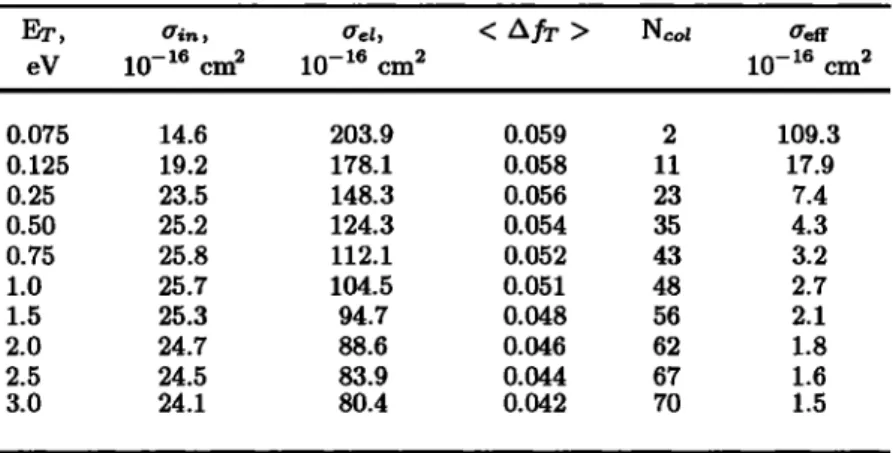
The results of relaxation calculations are sum•narized
in Table I for a range of initial translational energies (in the laboratory coordinate system) from 0.075 to 3 eV.
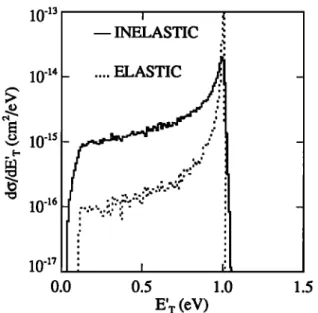
Although the inelastic T • R cross section ain only
comprises approximately 1/8 to 1/4 of the total cross section (see Table 1), Figure I indicates that inelastic
processes
are the dominant
mechanism
for N(as) relax-
ation. Elastic
scattering
is ineffective
in N(4S) relax-
ation, making an important contribution only for ET,• ET (large impact parameter processes). The effi-
ciency of transferring translation energy is illustrated by
considering the average fraction of translational energy transferred per collision AfT, which is approximately 5% as shown in Table 1. The QCT result is signifi- cantly smaller than the value of 44% predicted by a
hard sphere
model assuming
isotropic
scattering
[Libby,
1947],
which
was used
by Logan
and McElroy [1977]
in
a study of energetic
O atoms and Solomon
[1983]
in an
estimate of the significance of fast N atoms oh odd nitro- gen chemistry. Although the final translational energy distribution function illustrated in Figure i could be used directly in the kinetic model, a simpler approach
is to estimate an effective relaxation cross section based
on the total cross section and average translational en- ergy transferred per collision.
The effective relaxation cross section can be calcu-
lated by first estimating the average number of colli- sions necessary to relax atoms of initial energy ET to an average final energy corresponding to a translational temperature of 500 K. This is done by using the aver- age fraction of translational energy transferred during a N+N2 collision, listed in Table 1, as a function of energy. Since the transfer of translational energy is rather ineffi-
cient (approximately 5% as shown in Table 1), as many as 70 collisions are necessary to relax a 3 eV N(as) atom
to a final energy of -• 0.06 eV, a collisional efficiency
similar to vibrational relaxation. The thermalization cross section is then estimated as the total cross sec-
tion per collision. The energy dependence of these esti- mated cross sections, which are a factor of 5-25 smaller
than the gas
kinetic
value
of 3.5 x 10
-x5 cm
2 and are
now
comparable
to the N(45)-l-O:•
reaction
cross
section
[Duff et al., 1994], are given in Table 1. The influence
of the significantly smaller relaxation cross sections on
the formation of NO is discussed in section 3.
The possible enhancement of NO removal rate by fast
N(45) atoms
deserves
some
comment.
It is generally
accepted that the N-t-NO reaction rate in the temper- ature range of 196-3152 K is temperature independent
with a value
of 3.4 x 10
-xx cm
s s -x [Lee
et al., 1978;
Michael and Lira, 1992]. These measurements almostcertainly indicate that in this temperature range the reaction occurs on the ground state potential energy
surface (PES) with little or no barrier. However, it has been shown that for the N-t-NO reaction there exists
Table 1. Relaxation
Cross
Sections
for Fast N( 4 S) Atoms
ET , ai,• , a•i , < AfT • NeV 10- •a cm • 10- •a cm • O'eft 10 -• cm 2 0.075 14.6 203.9 0.059 2 0.125 19.2 178.1 0.058 11 0.25 23.5 148.3 0.056 23 0.50 25.2 124.3 0.054 35 0.75 25.8 112.1 0.052 43 1.0 25.7 104.5 0.051 48 1.5 25.3 94.7 0.048 56 2.0 24.7 88.6 0.046 62 2.5 24.5 83.9 0.044 67 3.0 24.1 80.4 0.042 70 109.3 17.9 7.4 4.3 3.2 2.7 2.1 1.8 1.6 1.5
o 10-1•
10 46
-- INELASTIC
0.5 1.0 1.5
E', (eV)
Figure 1. Inelastic (solid line) and elastic (dashed line)
components of the differential translation energy trans- fer cross section at an initial translation energy of i eV.
an excited state PES with a barrier of approximately
0.6 eV [Walch and Jaffe, 1987]. Although not impor-
tant for thermal rate constants, this excited state PES could make a significant contribution to the energy de- pendent rate constant needed for the nonthermal trans- lational energy encountered in the present work. Work
in progress (J. W. Duff and R. D. Sharma, manuscript in preparation, 1996) indicates an increase of approxi- mately 20% in energy-independent N+NO reaction rate
constant
of 3.4x 10
-11 cm
a s -1 at aN(aS)translational
energy of i eV increasing to approximately a factor of 2 at an energy of 1.5 eV. The importance of nonthermal effects in the N+NO reaction on NO production can beestimated
by considering
the N(4S) EDF (see
Figure
3)
at 110 kin. The most important effect of the increasedN+NO reaction rate due to nonthermal effects and ex-
cited state PES occurs for energies greater than i eV,
where
less
than 50% of the NO production
from N(4S)
occurs. Thus an increase of up to a factor of 2 at en- ergies greater than i eV would at most decrease the total NO number density by 25% at 110 km where theN( 2 D)+O 2 reaction is also a source of NO. As altitude
increases, the effect of fast N+NO collisions becomes less important. A more quantitative estimate of the importance of nonthermal effects due to the N+NO re- action requires using the energy dependent N+NO re- action rate constant directly in the calculation of the
N( 4 S) distribution.
3. Results and Discussion
All the calculations are made for the equatorial lower
thermosphere, low (Fla7 = 71) and high (F10.7 = 245)
solar activity conditions and quiet geomagnetic condi- tions. The major constituent and temperature vertical
distribution are provided by the MSIS-86 model [Hedin, 1987]. The extreme ultraviolet solar irradiances are
taken from Tobiska [1991] ajusted to the adequate F1o. 7
value. In addition to the solar EUV flux, we include a
soft
X ray component
from
18 to 50 •. It is taken
from
the solar reference spectrum for solar minimum con-ditions labeled SC21REFW [Hinteregger et al., 1981].
Using the baseline solar minimum reference spectrum, we scale the dependence on solar activity conditions on the basis of the integral energy fluxes for this wave- length interval provided by Tobiska's model. The soft
X ray flux is further
extended
down
to 11 • by using
Donnelly and pope's [1973] data. The spectrum in the
interval
11-17/i was only measured
for moderate
solar
activity (F10.7=143). For different solar activity levels,we scale these values linearly with the F10.7 index. We also conduct some additional runs illustrating the model sensitivity to poorly defined model parameters such as
elastic cross sections and the value of the solar soft X ray flux.
As mentioned before, at the first step of the model calculation, we evaluate the frequencies of solar EUV, XUV, and soft X ray and photoelectron interaction with the ambient atmospheric gas. Figure 2 illustrates the relative importance of different processes for the high solar activity case. Curves A, B, and C corre- spond to the ratio of the photo electron efficiency ratio
P - Pe/Pi where Pi is the photoionization rate due to
direct photon interaction and Pe is the photoelectron
contribution.
As a check of the validity of our photionization model, these results may be compared with previous work on the effect of secondary ionization by photoelectrons.
Torr and Torr [1979] found that photoelectron impact
ionization increased the ionization rate by • 30% be-
tween 150 and 250 km. Richards and Torr [1988] gave
200 _
180 :'1 \
A: O2ionization
..[
• •. D•.
C: N2ionization
_-
-
160
140
f
,.,
[
]
'-4.
-
120[-
/
,/ '.•,...
-•
100
•A ""-'-'i'•"', -'
80 ... , ... • ... 0.1 1 10 100PHOToELECTRON EFFIC•NCY RATIO
Figure 2. Photoelectron
efficiency
ratio R = Pi/Pe
for different
processes.
Curve A indicates:
O2 ioniza-
tion; curve B indicates O ionization; curve C indicatesN2 ionization, and curve D indicates N2 dissociation.
These values
are calculated
for a high solar activity
(F10.7 = 243) and overhead Sun.290 GERARD ET AL.: HOT NITROGEN AND THERMOSPHERIC NO
an expression
for R for O + and N• with a value
of 2.5
at 120 km. Calculations by Buonsanto et al. [1992]
for winter conditions at Millstone Hill give R _• 8 for
N•
+ at 100 km. The sensitivity
of this ratio to the ion-
ization cross sections and EUV solar flux was recentlydiscussed
in detail by Titheridge
[1996]
and compared
to earlier calculations. Our results in Figure 2 show the same altitude dependence with slightly larger val- ues below 120 km because of the higher solar activ- ity and smaller solar zenith angle than in Titheridge's calculations. Another important quantity for the N- NO photo chemistry is the total dissociation rate of N2. Figure 2 illustrates that, as for ionization of N2 and O, secondary photoelectrons substantially increase the production rate of nitrogen atoms. The dip near 110 km corresponds to the altitude of maximum photodissocia-
tion
efficiency
by the
solar
CIII (977
]k) line
[see
G&ard
et al., 1993, Figure la]. This process has no counter-part in N2 ionization for which the ratio R decreases steadily with altitude. It is seen that at altitudes be- low 130 kin, the role of the high-energy photoelectron becomes dominant. At lower altitudes, the relative in- fluence of electrons generated by soft X ray ionization increases, which leads to an increase of the photoelec- tron efficiency ratios, especially for
The relaxation of the initial energy distribution func-
tion of hot N(4S) produced by N2 dissociation and dis-
sociative ionization by photon and photoelectron fluxes
(calculated at step a) and due to exothermic chemical reactions (3) (calculated at step b) was studied in the ki-
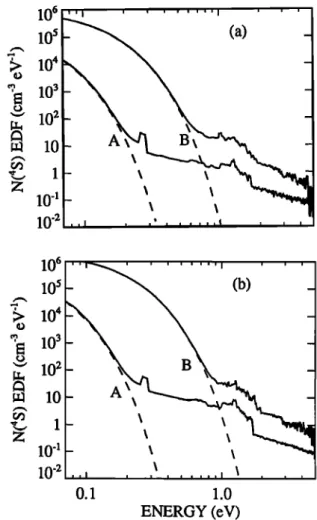
netic model. The calculated steady state energy distri-
bution functions are presented in Figure 3 (solid curves) for 110 and 140 km (curves A and B, respectively) and
compared with the local Maxwellian distribution func-
tions (dashed curves). The results are presented for low
solar activity in Figure 3a and are presented for high solar activity in Figure 3b. The peaks in the nonther- mal curves are physically significant as they are formed by EUV photon absorption and chemical sources of hot particles. The broadening of the initial energy distribu-
tions
of hot N(4S) formed
in chemical
reactions
leads
to
some additional smoothing of the steady state function in the range of chemical reaction energy release. Fig- ure 3 shows that the steady state energy distributionfunctions
of hot N(4S) remain
in nonequilibrium
at all
altitudes for both levels of solar activity. There are indications that the nonthermal fraction of the energydistribution functions can influence the characteristics
of the NO IR emission spectra [$harma et al., 1993; Armstrong et al. , 1994].
The fraction of hot N(4S) reacting with 02, that
is, the reaction efficiency may be calculated using the steady state EDF. This quantity strongly depends on the values of the reaction cross sections and the energy dependent cross sections in elastic and inelastic colli-
sions
of hot N(4S) with the atmospheric
constituents.
The energy dependent cross section for reaction of hotN(4S) with O2 was
calculated
by different
groups
[Polak
et al., 1984; Duff et al., 1994] and is in a good agree-
ment. Therefore we adopt Polak et al.'s curve in our
,-, lO
s
•>o
104
'• lOS
t• 102
10 -1 10 -2 0.1 1.0 ENERGY (eV)Figure 3. Steady state energy distribution function
of N(4S) at 110 km (curve A) and 140 km (curve
B). Solid lines show the calculated energy distribu- tion function (EDF), and dashed curves are the local Maxwellian EDFs for gas temperatures of 209 K (curve A) and 575 K (curve B). (a) Low solar activity case (F•0.7 = 71). (b) High solar activity case (F•0.7 = 245)
model, and we assume that it is known with sufficient accuracy. Measurements of the energy dependence of
the elastic
cross
sections
of hot N(4S) are not avail-
able for O2 and O. In our previous studies, we used the model of energy independent hard spheres with values deduced from the consideration of diffusive processes[Mo•yan
and Schiff, 1964]. The height
profile
of the re-
action efficiency for this case is presented in Figure 4. In this study, we use the energy dependent effective cross
section for collisional relaxation of hot N(4S) with N2
described in section 2.3. The reaction efficiency for the case when the elastic cross sections have hard sphere
values and the N-N2 collisions are taken from Table 1
is presented in Figure 4 as well. To evaluate the sen- sitivity of the model to the relaxation cross sections, we also calculate the reaction efficiency when all elastic cross sections are energy dependent in the same man-
ner as calculated for N-N2 collisions. It is seen that
the consideration of the energy dependence of the re- laxation cross sections leads to a significant increasing of the reaction efficiency and hence to an enhanced hot
200, 180 - , 160 - 140 - 120 - lOO - 80 o.oo I I I I I I , I I I 0.05 0.10 0.15 0.20 0.25 0.', REACTION EFFICIENCY •o
Figure 4. Altitude
dependence
of the Nf(4S)+O2 re-
action efficiency for high solar activity and different models of elastic cross sections: curve A, hard sphereapproximation
(eel = 10
-15 cm2), curve
B, hard sphere
approximation
for Nf(4S)+O2
collisions
and
energy
de-
pendent
cross
section
for Nf(4S) + N2, and curve
C,
energy
dependent
cross
section
for collision
of Nf(4S)
with 02, O, and N2.N(4S) effect
on the odd nitrogen
photochemistry.
The
altitude profile of the reaction efficiency only weakly de- pends on the level of solar activity. Therefore only the case of high solar activity is presented here.Using
the distribution
of hot N( 4 S) described
before,
we calculate the influence of these nonthermal N atoms
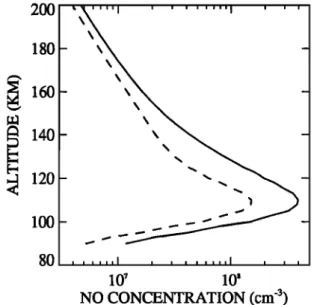
on the nitric oxide density in the lower thermosphere. The results of these calculations are presented in Fig- ure 5 for low and high solar activity conditions. The dashed curves correspond to the standard cases, and the solid curves correspond to hot N cases. The revi- sions of the photochemical model lead to an increase of the the NO densities in comparison with our previous
studies
[G•rard et al., 1993, 1995].
The presence
of hot
N(4S) also leads to a very significant increase of theNO densities. The hot N cases shown in Figure 5 are
calculated for the case when the elastic cross sections of
the hot N( 4 S)-N2, 02, and O collisions
include
the en-
ergy dependence from Table 1. This run corresponds to larger values of the reaction efficiency, that is to curve C in Figure 4. The NO peak densities for the curves presented in Figure 5 are also listed in Table 2.The results given in Table 2 show that the inclusion into the model of the soft X ray flux extension down
to 11 •, and the Auger
and dissociative
ionization
lead
to an increase of the standard case NO peak densities up to 369[ for maximum solar activity. The main rea-son for the highe•r NO densities is the increase of the
N2 ionization rate due to production of more energetic photoelectrons in the lower thermosphere. The addi-
tion of hot N(4S) into the model leads
to a significant
2OO 180 160- 140 120 - 100- 80 10 • A \ \ \ \ \ \ \ J 10 7 10 8
NO CONCENTRATION
(cm
'3)
Figure 5. Nitric oxide density profiles for low (curves A) and high (curves B) solar activity levels. Dashed
lines show the values for the standard NO photochem-
istry (no fast N); solid lines are for the hot N cases.
additional increase of the NO densities. For both low
and high solar activities, this effect gives a more than twofold increase in comparison with the standard case.
A .few additional runs have been conducted to check
the sensitivity of the model to different uncertain pa-
rameters. To assess the influence of the elastic cross
sections, we calculate the NO height profiles for high solar activity for the three different cross-sections ap- proaches described before. We find that the NO peak density increases by 29% in comparison with the stan- dard case for the simplest case of the hard sphere ap- proximation. For the intermediate case, the increase is 92% and 136% for the energy dependent relaxation cross section. It is likely that the latter case is more justified as the existence of an elastic cross section en- ergy dependence for N-N2 collisions is based on physical arguments developed before. The consideration of the energy dependence of the N-O2 relaxation cross sec- tions, not presently available, will improve the model, but it is clear that it will not significantly modify the values of the calculated NO increase, but it will remain
between 92% and 136%.
We also investigate the sensitivity of the model to the value of the XUV and soft X ray solar fluxes. As
Table 2. Calculated Nitric Oxide Peak Density Solar Activity Previous Standard* Standard
Solmin 1.3(7) 2.3(7)
Sohx 3.0(7) 5.3(7)
Note that 1.3 (7) should
read 1.3 x 10
z. Units are per
cubic centimeter.
292 GERARD ET AL.: HOT NITROGEN AND THERMOSPHERIC NO mentioned before, previous runs use the values of these
fluxes derived from observations. There are indications
that the soft X ray flux may exhibit larger variations
with solar activity than Tobiska's[1991] values ISiskind et al., 1995]. Therefore we conducted a run using the
same scaling factor of the soft X ray flux as used by
Siskind et al. [1995] to fit the calculated NO densities
to the high values of nitric oxide obtained in microwave
measurements by Clancy et al. [1992]. For the interval 18-50 A, we increase the baseline values of SC21REFW
by a scaling
factor
of 100, and in interval
11-17 •, the
measured value was increased by a factor 75. The NO density profiles for the standard case and for the casewith hot N(4S) contribution are presented in Figure 6.
For the standard case, the NO peak density is about
1.5 x 10
s cm
-3, and for the hot N case,
the NO peak
density
about 4.0 x 10
s cm
-3.
4. Summary
The production and steady state density of thermo- spheric nitric oxide have been reexamined after revision and updates of the photochemical and hot N kinetic models. The soft X ray solar flux has been extended
down
to 11 •. In addition
to the direct
increase,
Auger
photoelectons produced with high energy contribute tofurther ionization and dissociation of N2 which subse-
quently produce NO. The photoelectron efficiency ratio indicates that fast electrons play a dominant role in the
dissociation and ionization of N2 in the lower thermo-
sphere in agreement with the conclusions of other recent studies. These photochemical updates to the model
based on the work by Siskind et al. [1995] produce
an increase in the calculated NO density in comparison
with our earlier version.
Significant improvements to the hot N kinetic calcu- lation also produce a substantial increase in the NO
production
by collisions
of Nf(4S) with 02. The initial
energy
distribution
of the nonthermal
N(4S) atoms
cre-
ated by exothermic processes have been calculated using
a Monte Carlo code. In addition, hot N production by
N2 dissociative ionization has been considered. Even
more importantly, a new calculation indicates that the
relaxation
cross
section
of N f(4$) with N2 is strongly
energy dependent. At nonthermal energies, it is sub-
stantially smaller than the hard sphere approximation
value
previously
used,
and,
consequently,
the N(4S)
dis-
tribution function has a larger high-energy componentthan previously
thought.
These
changes
to the N1(4S)
model produce an additional twofold increase in the NOpeak density. If scaling factors larger than those in To-
biska's
[1991]
solar flux model are applied,
NO densi-
ties as high as 4 x 10 s cm -• are reached. Since suchvalues exceed the observed NO densities. However, it must be kept in mind that the values calculated here are for equatorial steady state conditions. They must be considered as upper limits in comparison to the ac- tual densities which undergo a diurnal variation. These results, nevertheless, indicate that the N atoms are a major source of thermospheric nitric oxide.
Acknowledgments. We thank R. Locht for valuable discussions and B. Van Zyl and J. Ajello for communicating laboratory results before publication. J.-C. Gi.•rard is sup-
ported by the National Fund for Scientific Research (FNRS).
J. W. Duff acknowledges support from the Internal Research and Dexelopment program at Spectral Sciences, Inc. This research was partly funded by FRFC grant 2.4539.93 and by
the Russian Foundation for Fundamental Research (RFFR grant 96-02-16389).
The Editor thanks D.W. Rusch and D.E. Siskind for their
assistance in evaluating this paper.
2øø
180L
160-
140-
120-
100 - 80 10' 10'NO CONCENTRATION
(cm
-3)
Figure 6. Nitric oxide density profiles for high solar activity conditions using the scaled version of the soft X ray solar flux. Dashed line is for the standard NO chemistry; solid line is for the hot N case.References
Armstrong, P.S., S.J. Lipson, J.A. Dodd, J.R. Lowell, W.A. M. Blumberg, and R.M. Nadile, Highly rotationally ex-
cited NO (v,J) in the thermosphere from CIRRIS 1A limb
radiance measurements, Geophys. Res. Lett., 21, 2425,
1994.
Barth, C.A., W.K. Tobisl•, D.E. Siskind, and D.D. Cleary, Solar-terrestrial coupling: Low-latitude thermospheric nitric oxide, Geophys. Res. Left., 15, 92, 1988.
Barth, C.A., C.B. Farmer, D.E. Siskind, and J.P. Perich,
ATMOS observations of nitric oxide in the thermosphere and lower mesosphere, J. Geophys. Res., 101, 12,489,
1996.
Bernstein, R. B., A. Dalgarno, H. Massey, and I. C. Perci- val, Thermal scattering of atoms by homonuclear diatomic molecules, Proc. R. Soc. London A, 27•, 427-442, 1963. Buonsanto, M.J., S.C. Solomon, and W.K. Tobisk•, Com-
parison of measured and modeled solar EUV flux and its effect on the E- F1 region ionosphere, J. Geophys. Res.,
97, 10,513, 1992.
Clancy, R. I., D. W. Rusch, and D. O. Muhleman, A mi-
crowave measurement of high levels of thermospheric ni- tric oxide, Geophys. Res. Left., 19, 261, 1992.
Conway, R.A., Photoabsorption and photoionization cross section of O, O2 and N2 for photoelectron production cal-
ments, Rep. 6155, Nav. Res. Lab., Washington, D.C.,
1989.
Donnelly,
R.F., and J.H. Pope,
The 1-3000
• solar
flux for
a moderate level of solar activity for use in modeling the
ionosphere and upper atmosphere, Tech. Rep. ERL 276,
Natl. Oceanic and Atmos. Admin., Silver Spring, Md.,
1973.
Duff, J.W., F. Bien, and D.E. Paulsen, Classical dynamics
of the N(as)-•-O2(X 3 •-•g) _.• NO(X 2II)-•-O(3p) reaction, Geophys. Res. Loll., 21, 2043, 1994.
Eparvier, F.J., and C.A. Barth, Self absorption theory ap- plied to rocket measurements of the nitric oxide (1, 0) 7
band in the daytime thermosphere, J. Geophys. Res., 97, 13,723, 1992.
Fell, C.. J.I. Steinreid,
and S. Miller, Quenching
of N(2D)
by O(•P),
J. Chem.
Phys.,
92,
4768,
1990.
Gardner, J.L., and J.A.R. Samson, Photoion and photo-
electron spectroscopy of CO and N2, J. Chem. Phys., 62, 1447, 1975.
G4rard, J.-C., and C. Taieb, The E-region electron density
diurnal asymmetry at Saint-Santin: Observations and role
of nitric oxide, J. Atmos. Terr. Phys., J8, 471, 1986. G4rard, J.C., V.I. Shematovich, and D.V. Bisil•1o, Non-
thermal nitrogen atoms in the Earth's thermosphere, 2, A source of nitric oxide, Geophys. Res. Loll., 18, 1695,
1991.
G4rard, J.C., V.I. Shematovich, and D.V. Bisikalo, Effect of hot N(45) atoms on the NO solar cycle variation in the lower thermosphere, J. Geophys. Res., 98, 11,581, 1993. G4rard, J.C.. V.I. Shematovich, and D.V. Bisikalo, The role
of fast N(S) atoms and energetic photoelectrons on the
distribution of NO in the thermosphere, in The Upper Mesosphere and Lower Thermosphere: A review of exper- iment and fheory, Geophys. Monogr. Set., vol. 87, 235, AGU, Washington, D.C., 1995.
Hedin, A., MSIS-86 thermospheric model, J. Geophys. Res., 92, 4649, 1987.
Hinteregger, H.E., K. Fukui, and B.R. Gibson, Observa-
tional reference and model data on solar EUV from mea-
surements on AE-E, Geophys. Res. Leff., 8, 1147, 1981 Hirschfelder, J.O., C.F. Curtiss, and R. B. Bird, Molecular
Theory of Gases and Liquids, 1219 pp., John Wiley, New York, 1954.
LaBudde, R.A., and R.B. Bernstein, Classical study of ro-
tational excitation of a rigid rotor: Li+-•-H2, II, Corre-
spondence with quantal results, J. Chem. Phys., 59,3687,
1973.
Lagank, A., E. Garcia, and L. Ciccarelli, Deactivation of vibrationally excited nitrogen molecules by collision with nitrogen atoms, J. Phys. Chem., 91, 312-314, 1987. Lee, J.H., J.V. Michael, W.A. Payne, and L.J. Stief, Abso-
lute rate of the reaction of N(4S) with NO form 196-400 K with DF-RF techniques, J. Chem. Phys. 69, 3069, 1978. Libby, W.F., Chemistry of energetic atoms produced by nu-
clear reactions, J. Am. Chem. Soc., 69,2523, 1947. Locht, R., W. Denzer, E. R'fihl, and H. Baumg•irtel, Pho-
toionization mass spectrometry of kinetic energy-selected ions: The translational energy distribution of N+/N2 in the inner-shell ionization energy range, Chem. Phys., 160, 477, 1992.
Logan, J.A. and M.B. McElroy, Distribution functions for energetic oxygen atoms in the Earth's lower atmosphere, Planet. Space Sci., 25, 117-122, 1977.
Massey, H.S.W., and C.B.O. Mohr, Free paths and transport phenomena in gases and the quantum theory of collisions, I I, The determination of the laws of force between atoms and molecules, Proc. R. Soc. London A, 144, 188-205,
1934.
Michael, J.V., and K.P. Lim, Rate constants for the N20 reaction system: Thermal decomposition of N20; N + NO -• N2 + O; and implications for O + N2 --• NO + O,
J. Chem. Phys., 97, 3228, 1992.
Moddeman, W.E., T.A. Carlson, M.O. Krause, B.P. Pullen,
W.E. Bull, and G.K. Schweitzer, Determination of the K-
LL Auger spectra of N2, 02, CO, NO, H20, and CO2,
Chem. Phys., 55, 2317, 1971.
Morgan, J.E., and H.J Schiff, Diffusion coefficients of O and
N atoms in inert gases, Can. J. Phys., •7, 300, 1964.
Pattengill, M.D., A comparison of classical trajectory and exact quantal cross sections for rotationally inelastic Ar-
N2 collisions, Chem. Phys. Loft., 36, 25-28, 1975.
Polak, L.S., M.Y. Goldenberg, and A.A. Levitsky, Compu-
tational Methods in Chemical Kinetics, Nauka, Moscow,
1984.
Rees, M.H., Physics and chemistry of the upper atmosphere, Cambridge Univ. Press, New York, 1989.
Richards, P.G., and D.G. Torr, Ratios of photoelectron to EUV ionization rates for seronomic studies, J. Geophys. Res., 93, 4060, 1988.
Richards, P.G., J.A. Fennelly, and D.G. Torr, EUVAC: A
solar EUV flux model for seronomic calculations, J. Geo- phys. Res., 99, 8981, 1994
Sharma, R.D., Y. Sun, and A. Dalgarno, Highly rotation-
aly excited nitric oxide in the terrestrial thermosphere,
Geophys. Res. Loft., 20, 2043, 1993
Sharma, R.D., V.A. Kharchenko, Y. Sun, and A. Dalgarno, Energy distribution of fast nitrogen atoms in the night- time terrestrial thermosphere, J. Geophys. Res., 101, 275,
1996.
Shematovich, V.I., D.V. Bisikalo, and J.C. G•rard, Non thermal nitrogen atoms in the Earth's thermosphere, 1, Kinetics of hot N(4S), Geophys. Res. Left., 18, 1691,
1991.
Shematovich, V.I., D.V. Bisikalo, and J.C. G4rard, The thermospheric odd nitrogen photochemistry: Role of non- thermal N(4S) atoms, Ann. Geophys., 10, 792, 1992.
Siskind, D.E., C.A. Barth, and D.D. Cleary, The possible
effect of solar soft X rays on thermospheric nitric oxide, J. Geophys. Res., 95, 4311, 1990.
Siskind, D.E., D.J. Strickland, R.R. Meier, T. Majeed, and F.G. Eparvier, On the relationship between the solar soft
X ray flux and thermospheric nitric oxide: An update with
an improved photoelectron model, J. Geophys. Res., 100, 19,687, 1995.
Solomon, S., The possible effects of translationally excited nitrogen atoms on lower thermospheric odd nitrogen, Pla- net. Space Sci., 31, 135, 1983.
Tharamel, J., V. Kharchenko, and A. Dalgarno, Thermal- ization of fast atoms in an oxygen atmosphere: Quantum calculations of energy transition rates in elastic collisions
(abstract), Eos Trans. AGU, 76 (•6),Fall Meet. Suppl.
F438, 1995.
Titheridge, J.E., Direct allowance for the effect of photo- electrons in ionospheric modeling, J. Geophys. Res., 101, 357, 1996.
Tobiska, W.K., Revised solar extreme ultraviolet flux model, J. Atmos. Terr. Phys., 53, 1005, 1991.
Torr, D.G., and M.R. Torr, Chemistry of the thermosphere and ionosphere, J. Atmos. Terr. Phys., •1, 797, 1979. Truhlar, D.G., and J.T. Muckerman, Reactive scattering
cross sections, III, Quasiclassical and semiclassical meth- ods, in Atom-Molecule Collision Theory, edited by R. B. Bernstein, pp. 505-566, Plenum, New York, 1979. Van Zyl, B., and T.M. Stephen, Dissociative ionization of
H2, N2, and O2 by electron impact, Phys. Rev. A, 50, 3164, 1994.
294 GERARD ET AL.: HOT NITROGEN AND THERMOSPHERIC NO
Walch, S.P., and R.L. Jaffe, Calculated potential surfaces for the reactions: O -9 N2 -* NO -90 and N -9 O2 -* NO -9 0, J. Ghem. Phys., $6, 6946, 1987.
Whipple, E.G., Jr., Theory of reaction product velocity dis- tributions, J. Ghem. Phys., 60, 1345, 1974.
Yee,
J. H., and
A. Dal•garno,
Energy
transfer
of O(•S) atoms
in collision with O(•P) atoms, Planet. Space Sci., 33, 825, 1985.
Moscow 109017, Russia. (e-mail: bisikalo•inasan.rssi.ru; shematov•inasan.rssi.ru)
J.W. Duff, Spectral Sciences, Inc., 99 S. Bedford, Burling- ton, MA 01803. (e-mail: duff•spectral. com)
J.-C. G•rard, Laboratoire de Physique Atmosph4rique et Plan/•taire, Institut d'Astrophysique, Universit• de Lit•ge, 5, avenue de Cointe, B-4000 Lit•ge, Belgium. (e-mail: gerard•ast ro. ulg. ac. be )
D. V. Bisikalo and V. I. Shematovich, Institute of Astron-