i
Université de Montréal
Synthesis of (S)-cEt-LNA
par
Juan Carlos Salinas Hernandez
Département de Chimie Faculté des Arts et des Sciences
Mémoire présenté à la Faculté des Études Supérieures et postdoctorales en vue de l’obtention du grade de Maître ès Sciences (M.Sc.)
en Chimie
April 2014
ii
iii
Résumé
Nucleoside (S)-cEt-LNA a été synthétisé par trois voies différentes à partir de la 5-méthyluridine qui est commercialement disponible. Le chemin le plus court comprend une méthylation diastéréosélective d'un aldéhyde, et une cyclisation 5-exo-tet d'un éther par déplacement SN2.
Mots-clés: (S)-cEt-LNA, technologie antisens, nucleoside.
Abstract
(S)-cEt-LNA nucleoside was synthesized by three different routes starting from commercially available 5-methyluridine. The shortest route includes a diastereoselective methylation of an aldehyde, and a 5-exo-tet cylization of an ether via SN2 displacement.
iv
Table of Contents
1 Chapter One – Introduction ... 1
1.1 DNA and RNA structure ... 1
1.2 DNA transcription ... 3
1.3 RNA processing ... 4
1.4 Protein synthesis – Translation ... 5
2 Chapter Two – Antisense technology ... 7
2.1 History... 7
2.2 Molecular mechanism of action ... 7
2.2.1 RNA cleavage ... 8
2.2.2 Non RNA cleavage ... 9
2.3 ASO modification ... 10
3 Chapter Three – Synthesis of (S)-cEt-LNA ... 14
3.1 Original synthesis of (S)-cEt-LNA ... 14
3.2 Retrosynthetic analysis of (S)-cEt-LNA ... 17
3.3 First Generation Synthesis ... 19
3.4 Second Generation Synthesis ... 22
3.5 Third Generation Synthesis... 25
3.6 Fourth Generation Synthesis ... 28
3.7 Synopsis ... 37
4 Conclusions ... 39
5 Experimental Procedures ... 40
5.1 General Experimental ... 40
5.2 Experimental Section ... 41
5.2.1 First Generation Synthesis ... 41
v
5.2.3 Third Generation Synthesis... 57 5.2.4 Fourth Generation Synthesis ... 72 6 Bibliography ... i
vi
Table of Figures
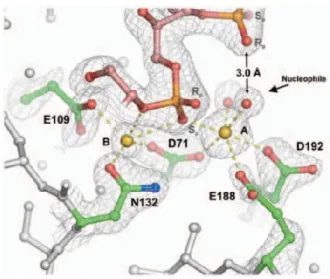
Figure 1. a) Generic nucleic acid double strand. b) Minor and major groove of helix formed by double strand nucleic acids. ... 2 Figure 2. RNA processing ... 5 Figure 3. Translation process ... 6 Figure 4. RNase H active site6.The active site RNase in complex with the RNA/DNA hybrid.
Active-site residues are shown in green; the RNA strand in pink, orange, and red; and the magnesium ions as yellow spheres. The water molecule positioned to attack the scissile phosphate is indicated. Metal-ion coordination is shown as dashed yellow lines. ... 8 Figure 5. a) Generations of ASOs. b) North and South type conformation. c) Example of Gap
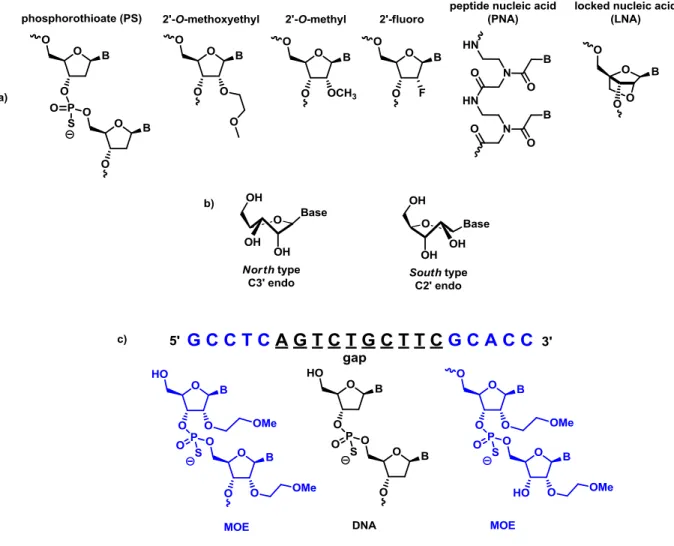
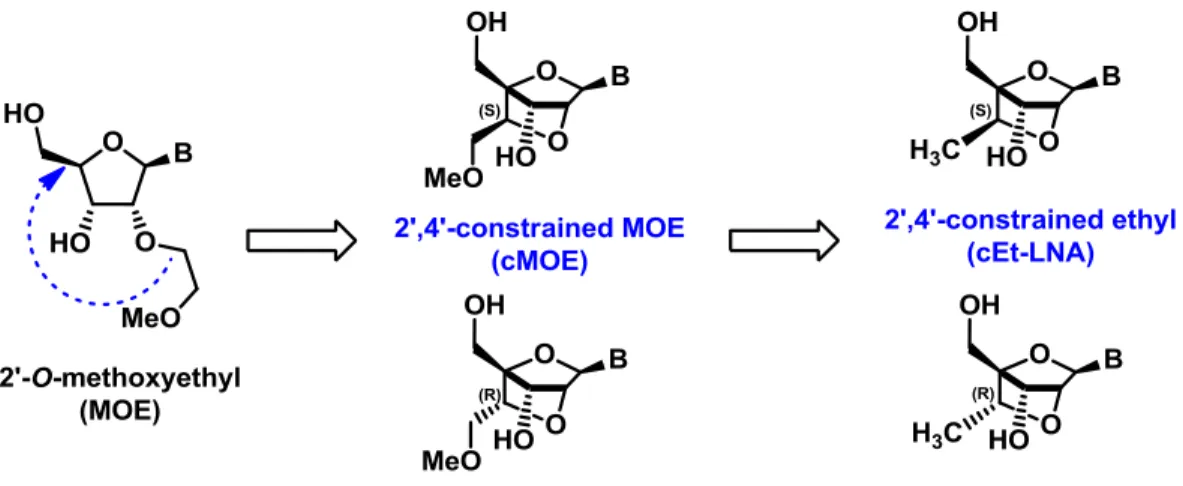
design oligonucleotide with MOE. ... 11 Figure 6. cMOE and cEt-LNA nucleosides ... 14 Figure 7. Proposed Cram chelate model for the diastereoselective methyl and hydride
additions. ... 23 Figure 8. Conformational equilibrium. Coupling constant J1’2’ and percentage of north-type
vii
Table of Schemes
Scheme 1. Original synthesis of (S)-cEt-LNA. ... 16
Scheme 2. Retrosynthetic analysis of (S)-cEt-LNA ... 17
Scheme 3. Retrosynthetic analysis of anhydronucleoside key intermediate 5. ... 19
Scheme 4. Synthesis of key intermediate 5. ... 20
Scheme 5. Synthesis of intermediate alcohol 12. ... 23
Scheme 6. Synthesis of 3'-benzyl-(S)-cEt-LNA 16 and oxetane 14. ... 24
Scheme 7. Synthesis of diol 18... 25
Scheme 8. Synthesis of intermediate 24. ... 26
Scheme 9. Synthesis of 3'-naphthyl-(S)-cEt-LNA 30. ... 27
Scheme 10. Synthesis of compound 32. ... 28
viii
Table of Tables
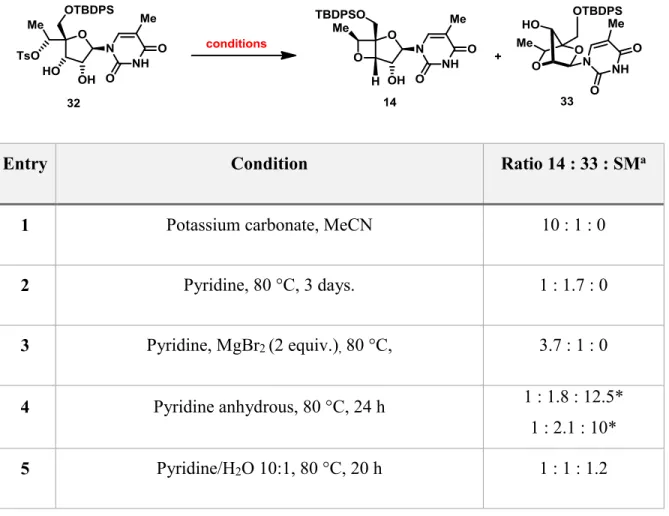
Table I. Screening conditions for 5-exo-tet-cylization ... 30 Table II. Number of steps, yields and final products of the four synthesis. ... 38
ix
Abbreviations
ASO Antisense Oligonucleosides
Bn benzyl
calc’d calculated
CSA camphorsulfonic acid
d doublet DBU 1,8-diazabicycloundec-7-ene DCM dichloromethane dd doublet of doublets DDQ 2,3-dichloro-5,6-dicyanobenzoquinone DIPEA N,N-diisopropylethylamine DMAP 4-dimethylaminopyiridine DMF dimethylformamide DMI 1,3-Dimethyl-2-imidazolidinone DMP Dess-Martin periodinane DMPU 1,3-Dimethyl-3,4,5,6-tetrahydro-2(1H)-pyrimidinone DMSO dimethylsulfoxide DMTr 4,4’-dimethoxytrityl eq (equiv.) equivalent
ESI electrospray ionization
x
g gram
h hour
HMPA hexamethylphosphoramide
HRMS high resolution mass spectrometry
Hz Hertz
ImH imidazole
IR Infrared spectroscopy
J coupling constant
LRMS Low resolution mass spectrometry
m multiplet Me methyl MeCN acetonitrile min minutes mL mililiters mmol millimole Ms methanesulphonyl Nap naphthylidene
NMR nuclear magnetic resonance
Piv pivaloyl
ppm parts per million
py pyridine
q quartet
xi
s singlet
SDS solvent delivery system
t triplet
TBAF tetra-n-butylammonium fluoride TBANO2 tetra-n-butylammonium nitrite
TBAOH tetra-n-butylammonium hydroxide TBDPS tert-butyldiphenylsilyl
TBS tert-butyldimethylsilyl
TES triethylsilyl
TFA trifluoroacetic acid
THF tetrahydrofuran
TLC thin layer chromatography TMP 2,2,6,6-tetramethylpiperidine
Tr trityl
Ts p-toluenesulfonyl
xii
Acknowledgements
I would first like to thank my family for the continuous support they have given me throughout my life.
I am heartily thankful to my supervisor Professor Steven Hanessian for giving me an opportunity to pursue a M.Sc. program and for his encouragement, guidance and support throughout all my studies.
I would like to thank past and present members of the Hanessian group for their help in my chemistry and life.
1
1 Chapter One – Introduction
1.1 DNA and RNA structure
The nucleotides are the monomers of the polymeric macromolecules called nucleic acids. Each nucleotide is composed of three parts: the sugar backbone, the nitrogenous base and a phosphate residue. The sugar present in the nucleic acids is a pentose, which depending on the substitution at the position 2', can be D-ribose (-CH-OH) or D-deoxyribose (-CH2-) (Figure 1a). In DNA the
deoxyribose is the constituent sugar of the nucleic acid, while in RNA, ribose is the sugar present in the nucleic acid.
In both DNA and RNA, the pentose is substituted by a phosphate group as a linker to form a chain that constitutes the backbone of the nucleic acid. The phosphate bond is formed between the 3'-OH of one pentose to the 5'-OH of another pentose, thus forming a phosphodiester bond. In the anomeric position of each sugar (1'), there is a nitrogenated heterocycle called “nucleobase”, which is cis (β face) to the hydroxymethyl group at the 5' position. The nucleobases are classified as purines and pyrimidines. Purines consist of a five-membered and a six-membered nitrogen-containing ring, fused together; part of this family are adenine and guanidine. On the other hand pyrimidines, such as cytosine, thymine and uracil, have a six-membered nitrogen ring. Adenine, guanidine and cytosine are found in both DNA and RNA. Uracil is found exclusively in RNA. 5-Methyl uracil, thymidine, is present only in DNA.
2
Figure 1. a) Generic nucleic acid double strand. b) Minor and major groove of helix formed by double strand nucleic acids.
Thanks to the X-ray diffraction pattern analysis data taken in the 50’s1 and to chemical analysis,
it was demonstrated that the amount of adenine (A) is always the same as the amount of thymine (T). Similarly, the amount of guanine (G) is always equal to the amount of cytosine (C). It was concluded that DNA was a double strand, where the nucleobases of each chain forms hydrogen bonds with its other chain counterparts. Further studies on the helical structure of DNA concluded that exclusively the pairs cytosine-guanine and adenine-thymine were always present along the double strand. This complementary behavior dictates that each strand of the DNA is exactly like the other one but linked in an opposite direction.1a
The interactions between the different nucleobases are unique. The pair guanine-adenine forms three hydrogen bonds, while the pair cytosine-thymine only shows two hydrogen bonds. As result, DNA with higher percentage of G-A becomes more stable. As the hydrogen bond is a non-covalent bond, it is possible to separate the double strand. This process is reversible in
3
solution; however, it is necessary to heat the DNA. The temperature at which fifty percent of the molecules of DNA are separated in 2 single strands, is called “the melting temperature (Tm)”. This value is an indicator for measuring the stability of DNA and its derivates. Several techniques have been developed for the measurement of the Tm. One of the most common is based on measuring the absorption of UV light by the nucleobases present in DNA, which exhibit a maximal absorption at 260 nm. Complementary pairs of nucleobases interact with each other pair of nucleobases by stacking of their pi-cloud electrons and by formation of hydrogen bonds. When the DNA is unwound to form two single strands, the stacking is weakened thus increasing the absorption of light in a phenomena called hyperchomicity.
The duplex formed by two strands of DNA or two strands of RNA assumes a right-handed helix where the nucleobases are stacked in the inner part of the helix and the sugar-phosphate polymer is installed in the exterior of the helix. The RNA and DNA duplex present a difference in the size and shape of the grooves formed by the helix (Figure 1b). The DNA forms a type B helix where the major groove is wider than the minor groove. The RNA duplex shows a more compact and stable helical structure, with a major groove smaller than in DNA duplex.
1.2 DNA transcription
Transcription is the process of copying the genetic information found in the double-stranded DNA into a single stranded RNA, which is complementary to the segment of DNA from which it was copied. In order to begin the transcription process, it is necessary to have the four 5'-triphosphate nucleosides (C, U, G, A), magnesium (II) and RNA polymerase (RNAp). RNAp is an enzymatic complex formed by several enzyme subunits. RNAp recognizes specific
4
sequences in DNA (promoters) to start the transcription process. When the RNAp binds to the double-stranded DNA, it is necessary to unwrap a sequence consisting of about 14 base pairs. The gap formed will move through the DNA, opening and closing the double strand on its way. The RNA synthesis starts inside this transcription bubble where each new nucleoside that joins the chain, is chosen following the complementary base on DNA. The process of RNA synthesis continues until the DNA encodes a sequence (transcriptor terminator) that forms a loop in the RNA that helps to dissociate the RNAp transcription complex, and releases the new RNA strand (primary transcript).
1.3 RNA processing
In eukaryotic cells, the RNA obtained from the transcription (primary transcript) stills needs to undergo some changes in its structure in order to be able to transmit the stored genetic information. The first transformation of the primary transcript is addressed by imparting stability of the newly synthesized RNA strand towards nucleases, which are enzymes that cleave the phosphodiester bond. This is achieved by capping at the 5' position with 7-methylguanosine linked through a 5'-5' triphosphate bond (Figure 2).2 Other modifications include the
methylation of the 2'-OH of the first and second ribose units in the strand, and the addition of a long tail (between 100 and 200) of adenine ribonucleotides known as poly(A) at the 3' end of RNA.3
5
Figure 2. RNA processing
The next step is the splicing of the stabilized RNA (Figure 2) where some sequences, known as introns, are deleted. The amount of sequences removed as introns depends on each specie, but at the end all the remaining parts that codify for a gene (exons) are joined, forming the final mRNA responsible of translate the genetic message.
1.4 Protein synthesis – Translation
The synthesis of proteins (translation) is carried out in the rough endoplasmic reticulum (RER) and performed within the ribosome, which is a large macromolecular complex made by both RNA and proteins. The amino acids that will form part of the protein are carried to the ribosome by transfer RNA (tRNA), a kind of RNA that is bonded to an amino acid and is able to recognize sequences of mRNA. The way to interpret the information is by reading the sequences of nucleosides in groups of three (triads), which are called codons. Each codon is responsible of codifying for a specific amino acid, although one amino acid can be codified by different codons.
6
The translation process begins when the first molecule of tRNA interacts with the mRNA detecting the initiation codon and binding in presence of the ribosome (Figure 3). With the ribosome reading the information and moving through the mRNA from the 5' to the 3' end, a second molecule of tRNA recognizes the next codon and brings the corresponding amino acid to the complex. The two amino acids react by forming a peptide bond, while the ribosome moves to the next codon, adding more amino acids and releasing the now empty tRNA. The rate of protein synthesis in eukaryotes can reach up to 14 to 18 amino acids/second per ribosome4. The
process continues until a codon is reached which does not codify for an amino acid (stop codon). That last codon is recognized by a protein called “releasing factor”, which helps the protein synthetized to be expelled from the complex finishing the translation process.
7
2 Chapter Two – Antisense technology
2.1 History
In 1978 Stephenson and Zamecnik5 working with chick embryo fibroblast cells infected with
Rous sarcoma virus (RVS), achieved the inhibition of the production of the virus with a synthesized oligodeoxynucleotide. In the primary structure of the RVS there are identical sequences of nucleosides next to the 5' cap and poly(A) 3' end. The 21-nucleoside sequence was the target of the study applying a synthetically prepared ribonucleoside, complementary to a segment of the target sequence. The 13 nucleotide sequence d(AATGGTAAAATGG) was bonded to the target sequence, blocking the normal functioning of the virus by competitive hybridization.
Together with many subsequent studies, it was realized that using the RNA as a target, it would be possible to treat different diseases related to the malfunction of RNA, or to block the translation process in the cell. The complementary nucleotide chain is called “antisense” because it has a sequence of bases complementary to the sense of the message in RNA (5' to 3'). Binding to the target RNA is the general mechanism of action of all the antisense oligonucleotides (ASO).
2.2 Molecular mechanism of action
The multiple types of RNAs and their multiple roles in the cell have become a growing area of interest with therapeutic potential in recent years. This includes the historically important
8
mRNA, the small nuclear RNA (smRNA) that plays key roles in the splicing process and the less studied microRNA which seems to act as a natural gene regulator. Thus, the RNA molecule in general is a very attractive target in the development of new kinds of therapies for the treatment of diverse diseases.
2.2.1 RNA cleavage
The destruction of the RNA chain by a family of enzymes called RNase H is the most direct approach to inactivate its biological function. These enzymes found in mammals recognize the RNA-DNA duplex and hydrolyze the phosphodiester bond in the RNA and release the intact DNA strain.
Figure 4. RNase H active site6.The active site RNase in complex with the RNA/DNA hybrid.
Active-site residues are shown in green; the RNA strand in pink, orange, and red; and the magnesium ions as yellow spheres. The water molecule positioned to attack the scissile phosphate is indicated. Metal-ion coordination is shown as dashed yellow lines.
9
This happens when the enzyme recognizes7 both, the RNA and the DNA strands. The duplex
fits in two grooves in the enzyme structure with the 2’-OH of five consecutive nucleotides of the RNA strand interacting with one groove in the active site of the enzyme.6 Different active–
site residues of the enzyme like carboxylate and amino groups form hydrogen bonds with the 3’ and 5’ sides of the phosphate bond to be cleaved (Figure 4). In the active site is also found two Mg2+ ions, chelated by four carboxylate groups and two molecules of water. One of the
molecules of water attacks the phosphate linkage, assisted by one oxygen of the phosphate group that orients the attack and serves as a general base for deprotonation. After the attack, the other metallic ion stabilizes the 3’-OH group from the cleaved phosphodiester bond. The use of a designed ASO, that binds a RNA target in order to destroy and therefore supress the function on the cell, has been the subject of hundreds of studies.8 Depending on the structure of the
nucleotides that form the ASO, the duplex ASO-RNA can support the RNase H activity resulting in the hydrolysis of the RNA target. Surprisingly, some modifications focussing on increasing the metabolic stability and increasing the affinity towards the target RNA, resulted in a loss of RNase H activity9, thus forcing the use of ASO hybrids composed by sections that support the
RNase activity and others sections that provide the affinity to the complementary RNA.
2.2.2 Non RNA cleavage
Antisense oligonucleosides (ASOs) can be designed to work as competitive antagonists, binding to specific sequences in RNA and interrupting the normal interactions with proteins, enzymes, or other factors in the cell. One of the processes that can be affected is the maturation of RNA primary transcript, a fundamental step to obtain different functional RNAs such as mRNA and
10
tRNA. Inhibition of 5’ capping on RNA may be performed by designing an ASO capable of binding to the 3’ end of the primary transcript. However, to date there is no report of this approach in antisense technology. Another fundamental step in RNA processing is the splicing. Therefore, if an ASO is bound to a sequence in RNA that had to be spliced, a barrier will be imposed and the splicing suppressed. Promising approaches focussed on interrupting or modifying the RNA splicing process have been reported, for example, the use of ASOs by Kole, proved to be efficient in the correction of an aberrant splicing in mutated RNA, restoring the correct splicing site.10 ASOs designed to bind with high affinity to the 3’-splice sites in murine
pre mRNA exhibit good activity in deletion of specific exons, resulting in the inhibition of mRNA production and suppression of protein synthesis.11
2.3 ASO modification
Obtaining a higher resistance against the degradative action of nucleases was the first challenge in the ASO design. Replacing a non-bridging oxygen in the phosphodiester linkage by a sulfur atom gave as result a high resistance of the new modified nucleotides12 toward action of
hydrolases. This new type of nucleosides received the name of phosphothioate (PS) nucleosides (Figure 5a). When the RNA-PS nucleotide duplex is formed, attack of the RNase occurs, which hydrolyzes the RNA strand and releases the PS nucleotide, blocking the production of the protein. The first use of an PS oligonucleotide was reported by Matsukura,13 where
oligonucleotides containing the phosphotioate modification showed inhibition in vitro against human immunodeficiency virus (HIV). Although PS oligonucleotides present a slightly similar
11
affinity for the RNA compared to natural nucleic acids,14 they exhibit tendency towards
non-specific interaction with certain proteins15 causing undesired effects in the body.
Figure 5. a) Generations of ASOs. b) North and South type conformation. c) Example of Gap design oligonucleotide with MOE.
The next generation of ASOs was designed to increase both the affinity with the RNA, and the nuclease resistance. Between all kinds of reported modifications, two types of ASOs have been widely studied. Methylation of the 2’-OH of pentose gives rise to the 2’-O-methyl nucleoside (Figure 5a). This modification blocks the possibility of self-hydrolysis of the phosphodiester
12
linkage by attack of the 2’-OH. The 2’-O-methoxyethyl (MOE) nucleosides together with the PS backbone modification established the most studied second generation of ASOs.16 The
methoxyethyl group assumes a rigid conformation due to the gauche effect between the two oxygen atoms. The MOE group also forms hydrogen bonds with a molecule of water that acts as a protecting shield of the phosphodiester bond which results in an increased resistance against nucleases.17
Together with the 2’-fluoro modification (Figure 5a), the 2’-O-alkyl modification confers to the nucleoside a north type conformation (Figure 5b) that shortens the distance between the 3’-5’ phosphate bonds, generating, a more compact structure that assumes a type A helix conformation, increasing the affinity of the ASO to the RNA.
The second generation modifications resulted in a decrease in the toxicity associated with the first generation of ASOs,18 but also presented some difficulties in the design of new
oligonucleotides, being incompatible with the action of the RNase and the RNA cleavage mechanism. This limitation was overcome by the use of a “gap” design9 (Figure 5c), which uses
2’-O-alkyl nucleosides in the 3’ and 5’ end of the chain, and a central DNA region of PS nucleosides. In the gap design, the modified nucleosides located at the ends of the ASO increase the affinity for the RNA, and the PS internal chain supports the action of the RNase H for the cleavage of the target RNA. The success of the second generation of ASOs was shown by the approval in January 2013 of the gap designed oligonucleotide KYNAMRO™ by the FDA, a medicine for the treatment of homozygous familial hypercholesterolemia.19
The third generation of ASOs contain different modifications on the carbon backbone. One of the more drastic changes was found in the peptide nucleic acid (PNA) (Figure 5a). Designed
13
with a pseudopeptide backbone, consisting of N-(2-aminoethyl)-glycine, this PNA shows great affinity to RNA and DNA. Due to its pseudopeptidic structure, PNA is resistant to degradation of nucleases and proteases, but they are not compatible with the RNase mechanism of action. This stability makes the PNA a good candidate for its use in the disruption of RNA processing, by the translation inhibition20 and splicing modulation mechanisms.21
Locked nucleic acid (LNA)22 is a restricted analog of 2’-OMe nucleoside, where the 2’ hydroxyl
group methyl is tethered to the 4’-carbon (Figure 5a). The resulting bicyclic structure confers to the molecule a north type conformation that presents an improved stacking between the nucleobases compared to the RNA duplex.23 Studies modifying the position of LNA in gap
designed oligonucleotides, concluded that a gap of at least 8-DNA nucleosides is necessary to induce efficient RNase cleavage.24 Further studies have shown the successful use of a LNA-gap
14
3 Chapter Three – Synthesis of (S)-cEt-LNA
3.1 Original synthesis of (S)-cEt-LNA
In 2010 Seth et al. reported the synthesis of a new generation of modified nucleosides.26 The
2’,4’-constrained MOE (cMOE) (Figure 6) was designed to combine the reduced toxicity of MOE nucleotides, with the great affinity showed by LNA nucleosides. To achieve the desired properties, the methoxyethyl group found in MOE was restricted covalently to the 4’ position forming a bicyclic structure as in LNA. Both (R) and (S)-cMOE isomers, showed high resistance against nuclease attack but when tested in vivo, cMOE ASOs exhibited a considerably diminution in activity compared to LNA ASOs.27 The reduced activity was attributed to the
steric hindrance generated by the terminal O-methyl group, so it was hypothesized that the removal of the methoxy end, will restore the biological activity.
Figure 6. cMOE and cEt-LNA nucleosides
15
Given the previous results, both isomers of the 2’,4’-constrained ethyl LNA (cEt-LNA) (Figure 6) were synthetized an tested. The cEt-LNA can be seen as a 6’-methylated analog of LNA, or a cMOE without the methoxy chain at 6’ position. When introduced in ASOs, they presented no hepatotoxicity in mice expressed as a measure of the transaminases level. The thermal and nuclease stability of ASOs containing (S)-cEt-LNA were also studied. The results showed that oligonucleotides containing (S)-cEt-LNA present higher stability than those containing LNA.28
Exposure of a 10-mer poly T DNA oligomer with two (S)-cEt-LNA modifications at the 3’ end to snake venom phosphodiesterase, revealed that the LNA oligomer was completely hydrolyzed in 1290 min while the (S)-cEt-LNA modified chains were >70% intact.
The original synthesis of (S)-cEt-LNA started from the commercially available diacetone D-allofuranose (Scheme 1). Protection of the free alcohol with 2-naphthyl bromide provided 1 in quantitative yield. Hydrolysis of the exo-acetal in 1, cleavage of the diol to furnish the aldehyde, and aldol reaction with formaldehyde afforded 2 in 66% yield over 3 steps. Selective protection of the diol moiety in 2, gave 3 in addition to bis silylated products. Oxidation of the primary alcohol under the Swern conditions, and treatment of the resulting aldehyde with MeMgBr, produced 4 in a ratio of 10:1 of the desired (S)-alcohol. A sequential oxidation/reduction led to 5 as a single isomer. Mesylation of the secondary alcohol in 5 followed by acetolysis furnished 6 in 90% yield over two steps. Vorbrüggen reaction of the diacetate 6 installed the 5-methyluridine moiety at the anomeric position of the sugar. Cleavage of the 2’-OAc, and intramolecular displacement of the mesylate group gave bicyclic nucleoside 7. Finally, cleavage of the 3’-ONap protecting group gave the 5’-TBDPSO-(S)-cEt-LNA in 14 steps and 22% overall yield.
16
17
3.2 Retrosynthetic analysis of (S)-cEt-LNA
It was envisaged that the 2',6'-ether bridge in (S)-cEt-LNA can be formed via SN2 displacement
of an appropriate leaving group by the 2' alcohol of the nucleoside A (Scheme 2). This approach has been successfully applied in the synthesis of complex nucleosides bearing the protected 3’-OH.29 In our case, we face a 4-exo-tet vs. 5-exo-tet cyclization both favored by Baldwin rules,30
but the formation of the 4-member ring was expected to be less favored due to the ring strain generated in the oxetane product. With this strategy in mind, the selective addition of a methyl group to the corresponding aldehyde to obtaining the (R)-alcohol B, required particular attention. The desired configuration would be achieved during the inversion in the SN2
displacement.
Scheme 2. Retrosynthetic analysis of (S)-cEt-LNA
The free alcohol on the α-face of the nucleoside can be obtained via protection-deprotection sequence on C. The compound C can be easily obtained from 5-methyluridine.
18
As the main objective of the project was to develop a synthetic route that provides (S)-cEt-LNA in large scale with a reduced number of synthetic steps, and an improved overall yield compared to the original route, we decided to use 5-methyluridine ($4.33 per mmol) as starting material vs. diacetone D-allofuranose ($16.8 per mmol). Furthermore this approach avoids the introduction of the 5-methyluracil moiety late in the synthesis.
19
3.3 First Generation Synthesis
The first objective towards (S)-cEt-LNA consisted in obtaining the key intermediate 5 (Scheme 3), which takes advantage of the inherent functionality of the molecule in order to avoid the use of multiple protecting groups. The formation of a 2-5' anhydronucleoside as a key intermediate gives a dual protection to the 5' OH and the 3-NH of the nucleobase.
Scheme 3. Retrosynthetic analysis of anhydronucleoside key intermediate 5.
Starting from 5-methyluridine, protection of the cis-2',3' diol as a cyclohexylidene acetal provided 1 in 96% yield (Scheme 4). Oxidation of the primary alcohol using Dess-Martin periodinane31 followed by cross-aldol reaction with formaldehyde and one-pot reduction
following the Moffatt protocol32 gave diol 2 in 51% yield. Treatment of the diol with triflic
anhydride in pyridine afforded bistriflate nucleoside that was subsequently treated with DBU, resulting in the displacement of the 5'-OTf, to give anhydronucleoside triflate 3. Different conditions were used such as H2O/THF, LiOH/H2O2, TBAOH, NaOH/THF, focused on
displacing the remaining triflate in order to obtain the alcohol, the acetate or directly the aldehyde via a Korblum oxidation.33 They proved to be unsuccessful leading to the opening of
20
the anhydro bridge. A known reaction in carbohydrate chemistry consists in the displacement of triflates by nitrite salts forming an alcohol with an inverted configuration.34 In our system,
the use of NaNO2 in DMF provided the corresponding alcohol 4 in low yield. However, when
the nitrite source was replaced by TBANO2 in THF, alcohol 4 was obtained in 85% yield.
Oxidation with DMP gave aldehyde 5 in 85 % yield.
Scheme 4. Synthesis of key intermediate 5.
An alternative route to the key intermediate 5 was performed through the treatment of 2 with TBDPSCl affording the protected of the β-5’-alcohol in 68% yield. The regioselective protection of the α-5’-hydroxymethyl vs. the β-5’-hydroxymethyl could also be achieved by using bulky such as Tosyl, TBS, TBDPS and Tr.
21
With 6 in hands, we proceeded to install a triflate on the remaining 5’-hydroxymethyl group, followed by a DBU mediated displacement to yield 7. Silyl ether cleavage by TBAF and DMP oxidation afforded the key intermediate 5. Interestingly, when the mesyl group is used instead of the triflate as leaving group in 6, the displacement to produce 7 did not work.
With compound 5 in hand, we tried adding different methyl sources like MeMgBr, MeLi, Me2CuLi and AlMe3, but they all gave low yields and poor diastereoselectivity. Additionally,
the opening of the anhydro bridge led to by-products, showing signs of its labile character. Analyzing the conformation of the molecule it was suspected that due to the anhydro bridge the molecule will be in a non-favorable conformation for the desired attack from the 2'-OH in a
22
3.4 Second Generation Synthesis
The second approach consisted of a protection-deprotection sequence to differentiate between the α and β-5’-hydroxymethyl groups in 2 (Scheme 5). This is based on the higher reactivity of the hydroxymethyl on the α-face of the sugar due to favorable steric reasons. The first attempt to protect the α-hydroxymethyl alcohol was using standard benzylation conditions (BnBr, NaH), but the basic conditions produced mixtures of the desired product and a side-products derived from the benzylation at N-3 of the nucleobase. A better selection of the protecting group led to the use of trityl chloride to obtain 8 in 70% yield. Introduction of TBDPS group for the protection of the remaining alcohol gave compound 9. Cleavage of the trityl group under acidic conditions, was followed by oxidation with Dess-Martin periodinane (DMP) to the corresponding aldehyde. Diasteroselective methylation with AlMe3 in toluene gave 11 in 68%
yield as a single isomer. The relative configuration of compound 11 could not be fully established at that point. However, by comparison with known C5’-OPiv analog it was thought to be the (S)-alcohol. In order to invert the configuration of the alcohol we used an oxidation-reduction sequence of the ketone, starting with the use of DMP on nucleoside 11, then oxidation-reduction of the crude mixture with LiAlH4 at -78 °C to afford 12 as a single isomer.
23
Scheme 5. Synthesis of intermediate alcohol 12.
The observed selectivity in the methylation to obtain 11 can be explained using the Cram chelate model, where the addition of AlMe3 takes place through a chelated state between the oxygen of
the aldehyde and the oxygen of the furanose ring (Figure 7). Due to the steric hindrance created by the 5'-OTBDPS it would be expected that the methyl group would be delivered on the si face of the aldehyde, via a AlMe3-dimer.35 In the case of the oxidation-reduction sequence with
LiAlH4 to form 12, the same steric assistance and chelate formation would provide the selective
transfer of the hydride on the si face of the methyl ketone.
Figure 7. Proposed Cram chelate model for the diastereoselective methyl and hydride additions.
24
The next alternative was to invert the 6’-OH group via the mesylate 13 (Scheme 6). Cleavage of the cyclohexylidene acetal under acidic conditions gave the diol 13 in 52% yield over two steps (Scheme 6). At this point, the first attempt to directly cyclize diol 13 to obtain the (S)-cEt-LNA, led to the four membered oxetane ring 14 from the 4-exo-tet cyclization mode in 90% yield. The structure of 14 was correlated with the 5'-OH pivaloyl analog provided by Isis Pharmaceuticals. With the aim to complete the synthesis, it was decided to use a detour by protecting the diol moiety in 13 as a benzylidene acetal. Selective reductive cleavage36 of the
diastereomeric mixture of acetals in 15 was achieved by treatment with TiCl4/NaBH3CN to
furnish the 2'-OH free nucleoside, which then, readily cyclized under basic conditions to give 16. Different attempts to cleave of the benzyl ether on 16 via hydrogenolysis were unsuccessful (Pd(OH)2, Pd/C). When harsher conditions were employed (Pd(OH)2, ammonium formate), the
nucleobase underwent double bond reduction as reported previously.37
25
3.5 Third Generation Synthesis
Due to the challenges presented with the removal of the benzyl group in 16, it was decided to use a similar strategy by protecting the 2',3' diol with a more labile protecting group. The chosen group was the naphthylidene acetal, which in principle should show the same regioselectivity during the reductive cleavage just as the benzylidene acetal did. First, protection of the vicinal diol in 5-methyluridine with commercially available 2-naphthaldehyde, resulted in low yield and poor conversion. Therefore, it was decided to use the more reactive naphthaldehyde dimethyl acetal. The naphthylidene dimethyl acetal is not commercially available, so it was prepared starting from 2-naphthaldehyde38 and used without further purification. The reaction
of 5-methyluridine with naphthaldehyde dimethyl acetal catalyzed by CSA proceeded smoothly in 85% yield furnishing a mixture of diasteroisomers at the acetal carbon atom of 17 (Scheme 7). Unfortunately, the sequence of oxidation/aldol reaction/ reduction to produce 18 was not only low yielding but also had solubility issues.
Scheme 7. Synthesis of diol 18.
Reductive cleavage of the acetal at the 2' position in 17 gave 19 in 94% yield (Scheme 8). Double protection of the primary and secondary alcohols in 19 with TBSCl and subsequent cleavage of
26
the silyl group on 5'-OH gave nucleoside 20. The use of the same sequence for the synthesis of 2, was employed on 20 furnishing the 6’-hydroxymethyl analog 21 in 48% yield over two steps. This time, the use of trityl chloride proved to be effective to get compound 22, which then followed the same sequence of protecting groups used during the first approach, affording compound 24 in 54% over three steps. Transformation of compound 22 into 24 can be done in a one pot procedure in 69% yield.
Scheme 8. Synthesis of intermediate 24.
The aldehyde obtained from oxidation of 24 was treated with AlMe3 to give the secondary
alcohol 25 which was readily mesylated to obtain nucleoside 26 (Scheme 9). Deprotection of the 2'-OH and cyclization under basic conditions furnished compound 27, whose 1H NMR did
27
group on 25 gave the undesired (S)-isomer at 6’-position. Therefore, it was necessary to oxidize to the corresponding ketone with DMP and reduce with LiAlH4 to obtain the (R)-isomer. In the
study of the fourth generation synthesis, we found that the use of cuprates instead of AlMe3
provided the (R)-alcohol as major product. Applying these conditions to the aldehyde obtained from oxidation of 24, led to formation of alcohol 28 in 44% yield over two steps. With compound 28 in hand, mesylate 29 was prepared, then displaced by the 2’-alcohol after cleavage of the 2'-OTBS in 29 and treated with K2CO3 in MeOH. The 1H and 13C NMR for compound
30 matched with the one reported by Isis Pharmaceuticals.37
28
3.6 Fourth Generation Synthesis
The last generation synthesis was focussed on optimizing and reducing the number of total steps, in addition to improving the selectivity in the key steps of the synthesis using the knowledge obtained from the previous syntheses. During the first generation approach, the protection of the diol in 5-methyluridine was accomplished by the use of cyclohexanone as solvent which forced us to purify the product by flash chromatography in order to remove large excess of unreacted ketone. In order to improve the efficiency of this process, it was changed to cyclohexanone dimethyl acetal in 1,2-dichloroethane. This reaction furnished protected 5-methyluridine with a purity up to 95%, allowing its use in the subsequent step without further purification. Oxidation of the crude alcohol with DMP, followed by aldol condensation with formaldehyde and reduction with sodium borohydride afforded 2 in 62% yield (Scheme 10).
29
Transformation of 2 into 10 was previously accomplished in three steps with a purification between each step (Scheme 5). In the current approach, the number of purifications was reduced without significantly sacrificing the yield, adopting a one-pot procedure to protect the α-5’-hydroxymethyl group with TBSCl at 0 °C followed by adding an excess of TBDPSCl. The reaction mixture containing the TBS/TBDPS-nucleoside and other silylated products was then diluted with methanol and treated with TFA to cleave the more acid sensitive TBS group, thus giving 10 as product after purification by flash chromatography. All the remaining fractions containing other silylated products were concentrated, dissolved in anhydrous THF, and treated with TBAF recovering 2 as product that was eventually recycled.
In the search to obtain alcohol 12 without the oxidation/reduction sequence, it was found that the system MeLi/CuI in Et2O affords the desired (R)-alcohol as a major product. The change of
solvent (Scheme 10) from Et2O to the safer MTBE, led surprisingly to increased selectivity,
giving (R)-alcohol in a ratio up to 8:1 in 51% yield over 2 steps. Standard conditions for O-tosylation of 12, provided nucleoside 31 which was then treated with a mixture of HCl/MeOH/THF to remove the cyclohexylidene acetal affording diol 32 in good yield.
With diol 32 in hand, several conditions to favor the formation of the 5-membered ring tetrahydrofuran over the 4-membered ring oxetane were studied (Table I). In entry 2-6, the use of pyridine showed a selectivity towards the five-membered ring, albeit requiring long reaction times or a sealed tube to complete the reaction. The use of magnesium bromide or water as co-solvent decreased the selectivity of the reaction. Driven by the promising results obtained with pyridine, different compounds bearing the pyridine scaffold such as 2,2’-bipyridine, quinoline, phenanthridine, and 1,10-phenanthroline were screened (entry 7-11), obtaining the best ratio with the latter (entry 11).
30
Employing common amine bases such as DBU, NEt3, DIPEA, imidazole or TMP (entry 12-18)
gave low selectivity towards the 5-exo-tet cyclization product 33. Bicyclic guanidines (entry 19-23), that in principle present dual activation through hydrogen bonding39, were also tested
providing the oxetane 14 as product. The five and six-member ring cyclic amidines in entry 24 and 25 were not effective in performing the desired selective cyclization producing a complex mixture in the case of entry 24. Similarly, bases such BEMP and N-methylmorpholine produced 14 as major product (entry 26 and 27). Other less conventional conditions including salts, basic alumina, molecular sieves, and silica gel did not give satisfactory results with exception of the last, where a reasonable ratio of the desired compound was obtained albeit with low conversion. Table I. Screening conditions for 5-exo-tet-cylization
Entry Condition Ratio 14 : 33 : SMa
1 Potassium carbonate, MeCN 10 : 1 : 0
2 Pyridine, 80 °C, 3 days. 1 : 1.7 : 0
3 Pyridine, MgBr2 (2 equiv.), 80 °C, 3.7 : 1 : 0
4 Pyridine anhydrous, 80 °C, 24 h 1 : 1.8 : 12.5*
1 : 2.1 : 10*
31
6 Pyridine anhydrous, sealed tube, 120 °C, 20 h 1 : 1.6 : 0
7 2,6-lutidine (3 equiv.), toluene reflux, 24 h 2 : 1 : 0
8
(2 equiv.), toluene, 80 °C, 20 h 1 : 1 : 22
9
Base (
(2 equiv.), toluene, 80 °C, 20 h2h 1 : 0.9 : 5.610 (2 equiv.), toluene, 80 °C, 20 h 1 : 1.5 : 5.1 11 (2 equiv.), toluene, 80 °C, 20 h 1 : 2 : 2.6 12 DBU, dioxane 3.8 : 1 : 0 13
DBU (2 equiv.), toluene, 80 °C, 24 h
3.5 : 1 : 5
14 Triethylamine (2 equiv.), DMSO, 80 °C, 24 h 1.3 : 1 : 0.3
15 DIPEA (5 equiv.), toluene, 80 °C, 48 h 5 : 1 : 1
16 Imidazole (2 equiv.), toluene, 80 °C, 24 h 1 : 1 : 0
32
18 (2 equiv.), toluene reflux, 48 h
2 : 1 : 0 19 (2 equiv.), toluene, 80 °C, 24 h 5 : 1 : 0 20 (2 equiv.), toluene, 80 °C, 24 h 6.6 : 1 : 0 21 (2 equiv.), toluene, 80 °C, 24 h 6.6 : 1 : 0 22 (2 equiv.), toluene, 80 °C, 24 h 1.2 : 1 : 1.3 23 (2 equiv.), toluene, 80 °C, 24 h 2.3 : 1 : 12.5 24
(1.5 equiv.), toluene, 80 °C, 24 h Decomposition
33 26 , Toluene, rt, 36 h >20 : 1 : 0 27 (2 equiv.), toluene, 80 °C, 20 h 7 : 1 : 0 28 MgBr2 (2 equiv.), toluene, 80 °C, 20 h 6 : 1 : 0.8
29 LiBr (2 equiv.), toluene, 80 °C, 20 h 6.2 : 1 : 1.6
30 TBAOAc (2 equiv.), toluene, 80 °C, 20 h 3.4 : 1 : 0
31 Molecular sieves, toluene, 80 °C, 24 h 8.5 : 1 : 14*
32 Basic alumina, toluene, 80 °C, 20 h 1 : 1 : 4
33 Silica gel, toluene, 80 °C, 20 h 1 : 2.5 : 30*
34 DMF, 80 °C, 24 h 1.8 : 1 : 7.4* 35 , toluene, 80 °C, 24 h No Rxn 36 , 80 °C, 24 h 1 : 2.1 :11* 37 DMSO, 80 °C, 24 h 1 : 2.7 : 1 1 : 2.6 : 5.7 (duplicate) 38 (2 equiv.), toluene, 80 °C, 20 h No Rxn
34 39 (2 equiv.), toluene, 80 °C, 20 h No Rxn 40 (2 equiv.), toluene, 80 °C, 20 h No Rxn 41 (2 equiv.), toluene, 80 °C, 20 h No Rxn 42 100 °C, 20 h 1 : 1 : 14* 43 HMPA, 100 °C, 20 h 1 : 3.5 : 0 1 : 3.6 : 0 (duplicate) 44 DMPU, 100 °C, 20 h 1 : 1.1 : 0 45 DMI, 100 °C, 20 h 1 : 0.78 : 0 46 Water, 90 °C, 20 h 1 : 2.4 : 4.7 47 Pyridine, 110 °C, 36 hb 1 : 1 : 0
All ratios were measured by 1H NMR. SM refers to the amount of starting material unreacted
measured by 1H NMR. a2-naphthylsulfonate was installed as leaving group instead of
p-toluenesulfonyl. (*) = low conversion.
With the current results, it was realized that the use of base would not produce selectively the desired compound. Even if the 5-membered ring product was the most thermodynamically favorable. Therefore, it was necessary to find new conditions that would allow a conformational change in the molecule from the S-type to an N-type. (Figure 8)
35
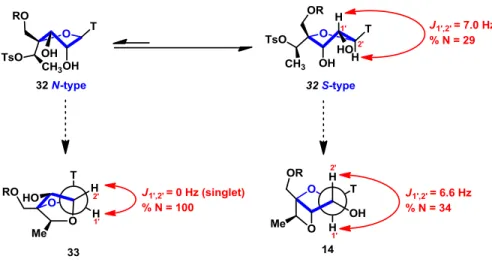
Figure 8. Conformational equilibrium. Coupling constant J1’2’ and percentage of north-type
conformation of selected nucleosides.
Calculating the coupling constants J1’2’ of compounds 32, 14, and 33, it was possible to
determine the conformation expressed as a percentage of the north type conformation40 in
solution (CDCl3). In the cEt-LNA (33), the anomeric signal appears as a singlet, which means
that 100 % of the population of 33 molecule is in a northern type conformation (Figure 8). The starting material of the cyclization (32) is in a 29% of N-type which compared with the 34% of the undesired oxetane 14, showed how the conformational equilibrium in Figure 8 is strongly displaced towards S-type conformation. In order to try to change the natural conformation of the molecule and favor the N-type conformation, it was decided to try the cyclization in solvents with different polarities that could influence the conformational equilibrium. Experimentation began with the use of non-protic polar solvents such as DME and DMF. The first solvent gave no conversion, and DMF favored the formation of the oxetane product (Table 1, entries 34 and 35). When 1-methyl-2-pyrrolidinone and DMSO were employed as solvents (entry 36 and 37), a better selectivity was achieved without the use of any base. However, when other solvents such as sulfoxides and sulfones (entry 38 to 42), no improvement in the reaction selectivity was
36
obtained. The use of HMPA as solvent, afforded a 3.6 : 1 ratio favouring the desired product. Other common solvents such as DMPU and DMI did not show improvement compared to the result obtained with HMPA (entry 44 and 45). Applying the better conditions for the cyclization found in entry 43 to a larger scale, produce 33 in 50% isolated yield.
Another option that was worth studying is the work developed by Tan where 5'-protected nucleosides can be either silylated at 2' or 3'-alcohol by using the appropriate catalyst.41
Following Tan’s conditions, selective protection of the 3’-OH in 14 to subsequently cyclize to obtain the 3’-OTES-(S)-cEt-LNA was tried (scheme 11). Independent of the conditions used, only the 2'-OTES protected nucleoside 34 was obtained. Surprisingly, when 14 was treated with an excess of TESOTf, 34 was obtained as sole product. Different conditions were tried to introduce a TBS group in the remaining 3'-OH, but probably due to the steric hindrance, it was not possible to obtain the product forcing us to abandon this approach.
37
3.7 Synopsis
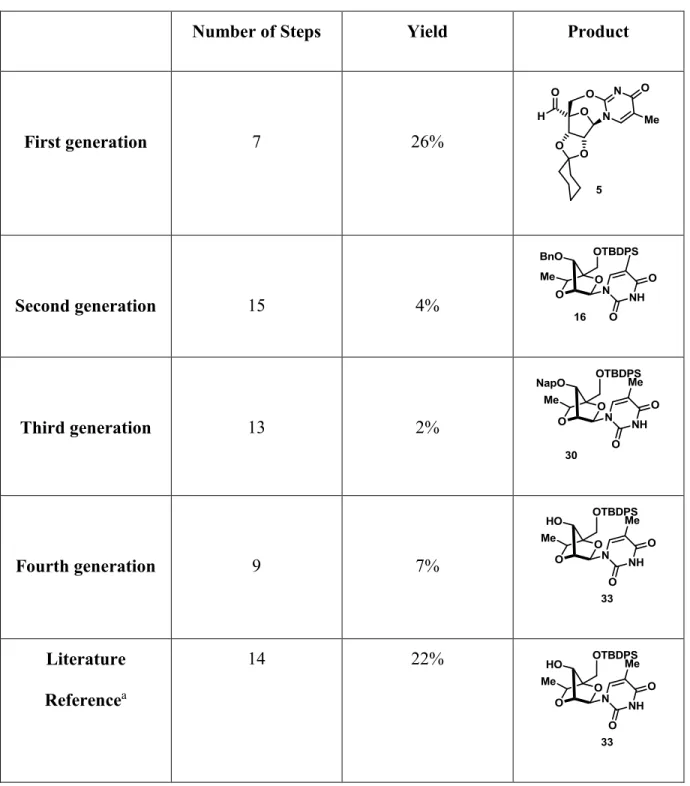
The comparative yields obtained for each one of the reported synthesis are shown in Table II. The first generation did not afford the final product, instead, 5 was obtained in 7 steps and 26% yield. Alkylation of aldehyde 5 proved to be difficult giving a complex mixture under different conditions, forcing us to abandon this approach.
The second generation synthesis produced 3’-benzyl-(S)-cEt-LNA 16 in 4% yield. The need of an oxidation/reduction sequence in order to obtain the desired isomer 12 as a single product reduced the efficiency of the route. Also, the protection of the 3’-alcohol proved to be necessary to avoid the formation of the undesired oxetane product.
The third generation synthesis produced 3’-naphthyl-(S)-cEt-LNA 30 in 2% yield. The use of a cuprate as a methyl source provides the alcohol 28 with the desired configuration. However, it was still required to protect the 3’-alcohol as a 2-methylnaphthyl ether, which not only allowed the exclusive formation of the 5-membered ring, but also gave an easily cleavable protecting group compared to the benzyl ether in 16. This approach involves 13 steps and warrants further improvement in overall yield.
The fourth generation affords the desired product in 7% yield in 9 linear steps. The key step of this route is the cyclization of 32 in HMPA that affords the (S)-cEt-LNA with the 3’-OH free. The use of inexpensive reagents in the synthesis and the reduced number of steps, make the fourth generation synthesis in an interesting option for a future scalable production.
38
Table II. Number of steps, yields and final products of the four synthesis.
Number of Steps Yield Product
First generation 7 26% Second generation 15 4% Third generation 13 2% Fourth generation 9 7% Literature Referencea 14 22%
39
4 Conclusions
The synthesis of 5’-O-TBDPS-(S)-cEt-LNA was achieved in 9 steps with 7 % overall yield.
The combined use of 5-methyluridine as starting material and readily available and reasonably priced reagents provides an option for a scalable route to (S)-cEt-LNA.
40
5 Experimental Procedures
5.1 General Experimental
All non-aqueous reactions were run in oven (120 °C) or flame-dried glassware under a positive pressure of argon, with exclusion of moisture from reagents and glassware, using standard techniques for manipulating air-sensitive compounds, unless otherwise stated. Anhydrous tetrahydrofuran, diethyl ether, toluene, and dichloromethane were obtained by passing these solvents through activated columns of alumina, while all other solvents were used as received from chemical suppliers. Reagents were purchased and used without further purification. Yields refer to chromatographically and spectroscopically (1H NMR) homogeneous material, unless
otherwise stated. Reactions were monitored by thin-layer chromatography (TLC) carried out on 0.25 mm silica plates (SIL 60, G-25, UV254) that were visualized using a UV lamp (254 nm) and developed with an aqueous solution of ceric ammonium molybdate, or an ethanolic solution of p-anisaldehyde. Flash chromatography42 was performed using SiliaFlash® P60 40-63 μm
(230-400 mesh) silica gel and all column dimensions are reported as height × diameter in centimeters. NMR spectra were recorded on Bruker AV-300, ARX-400, or AV-400 instruments, calibrated using residual undeuterated solvent as an internal reference (CHCl3, δ = 7.26 ppm),
and reported in parts per million relative to tetramethylsilane (TMS δ = 0.00 ppm) as follows: chemical shift (multiplicity, coupling constant (Hz), integration). The following abbreviations were used to explain multiplicities: s = singlet, d = doublet, t = triplet, q = quartet, m = multiplet, br = broad, dd = doublet of doublets, dt = doublet of triplets. High resolution mass spectra (HRMS) were recorded at the Centre Régional de Spectrométrie de Masse de l’Université de Montréal on an Agilent LC-MSD TOF mass spectrometer by electrospray ionization time of
41
flight reflectron experiments. Specific rotation measurements were recorded on a Perkin-Elmer 343 Polarimeter and are reported in units of deg·cm3·g-1·dm-1.
5.2 Experimental Section
5.2.1 First Generation Synthesis
(1-((3a'R,4'R,6'R,6a'R)-4'-(hydroxymethyl)tetrahydrospiro[cyclohexane-1,2'-furo[3,4-d]-[1,3]dioxol]-6'-yl)-5-methylpyrimidine-2,4(1H,3H)-dione) (1). 5-Methylurdine (5.01 g, 19.4 mmol) was added to a stirred solution of cyclohexanone (30 mL) and p-toluenesulfonic acid (0.51 g, 2.5 mmol). The reaction mixture was heated to 50 °C for 40 h, cooled to room temperature, then directly purified by flash chromatography (20 × 5.5 cm, 1:1 EtOAc/hexanes) to give nucleoside 1 as a white foam (6.37 g, 96 %) Rf = 0.10 (EtOAc). 1H and 13C NMR data
42
1-((3a'S,6'R,6a'R)-4',4'-bis(hydroxymethyl)tetrahydrospiro[cyclohexane-1,2'-furo[3,4-d]-[1,3]dioxol]-6'-yl)-5-methylpyrimidine-2,4(1H,3H)-dione) (2). Dess-Martin periodinane (1.8 g, 4.3 mmol) and sodium bicarbonate (1.00 g, 11.9 mmol) were added to a stirred solution of 1 (1.12 g, 3.30 mmol) in dichloromethane (15 mL). After stirring at room temperature for 3 h, ethyl acetate (10 mL) and a 10 % (w/v) solution of Na2S2O3 were added and stirred until a clear
organic phase was obtained. The layers were separated and the aqueous layer was extracted with EtOAc (4 × 5 mL). The combined organic extracts were concentrated under reduced pressure. The residue was dissolved in THF (15 mL), and stirred with a 37 % aqueous solution of formaldehyde (4.0 mL, 54 mmol), and 1 M NaOH (6 mL, 6 mmol). After 12 h, the reaction mixture was cooled to 0 °C and sodium borohydride (0.50 g, 13 mmol) was added. The cooling bath was removed and the reaction was allowed to warm to room temperature over a 3 h period. The reaction mixture was neutralized via the addition of 1 M HCl, and the resulting solution was extracted with dichloromethane (5 × 10 mL). The combined organic extracts were dried over Na2SO4, filtered, and concentrated under reduced pressure. The residue was purified by
flash chromatography (15 × 3.5 cm, 9:1 EtOAc/hexanes) to give nucleoside 2 as a white foam (620 mg, 51% over 2 steps) Rf = 0.20 (4:1 EtOAc/hexanes). 1H and 13C NMR data match
43
((3aS,4S,12R,12aR)-9-methyl-8-oxo-3a,4,5,8,12,12a-hexahydrospiro[4,12-epoxy[1,3]diox-olo[4,5-e]pyrimido[2,1-b][1,3]oxazocine-2,1'-cyclohexan]-4-yl)methyl trifluoromethane-sulfonate (3). Pyridine (1.40 mL, 17.2 mmol) and trifluoromethanesulfonic anhydride (1.70 mL, 10.1 mmol) were added to stirred solution of 2 (1.55 g, 4.21 mmol) in dichloromethane (22 mL) at 0 °C. After 1 h, water (5 mL) was added and the resulting mixture was stirred for 10 min. The layers were separated and the organic layer was washed with 0.5 M HCl (3 × 20 mL) and water (10 mL). The organic extracts were dried over Na2SO4, filtered and concentrated under
reduced pressure. The residue was purified by flash chromatography (14 × 5 cm, 2:8 EtOAc/hexanes) to give bistriflate nucleoside as a white foam (2.39 g, 90%); Rf = 0.87 (EtOAc).
DBU (0.38 mL, 2.5 mmol) was added to a stirred solution of bistriflate nucleoside (0.53 mg, 0.84 mmol) in dry MeCN (6 mL) at room temperature. After stirring for 10 min; dichloromethane (15 mL) was added and the organic solution was washed with 0.5 M HCl (5 mL) and water (5 mL). The organic extracts were dried over Na2SO4, filtered and concentrated
under reduced pressure. The residue was purified by flash chromatography (8 × 3 cm, EtOAc) to give nucleoside 3 as a white foam (340 mg, 83 %) Rf = 0.28 (EtOAc); 1H NMR (400 MHz,
CDCl3) δ 7.19 (s, 1H), 5.42 (s, 1H), 5.03 – 4.93 (m, 2H), 4.81 (d, J = 11.2 Hz, 1H), 4.68 (d, J =
11.1 Hz, 1H), 4.55 (d, J = 12.6 Hz, 1H), 4.20 (d, J = 12.8 Hz, 1H), 2.00 (s, 3H), 1.86 – 1.33 (m, 10H).; 13C NMR (101 MHz, CDCl
3) δ 156.0, 137.2, 115.6, 98.3, 88.2, 86.1, 81.9, 74.9, 72.9,
44
(3aS,4R,12R,12aR)-4-(hydroxymethyl)-9-methyl-4,5,12,12a-tetrahydrospiro[4,12-epoxy-[1,3]dioxolo[4,5-e]pyrimido[2,1-b][1,3]oxazocine-2,1'-cyclohexan]-8(3aH)-one (4). Tetrabutylammonium nitrite (400 mg, 1.38 mmol) was added to a stirred solution of 3 (0.11 g, 0.24 mmol) in THF (5 mL) at room temperature. After 20 h, water (10 mL) and dichloromethane (5 mL) were added, the layers were separated and the resulting solution was extracted with dichloromethane (5 × 5 mL). The combined organic extracts were dried over Na2SO4, filtered,
and concentrated under reduced pressure. The residue was purified by flash chromatography (14 × 2 cm, 5 % MeOH/EtOAc) to give nucleoside 4 as a white foam (71 mg, 85%) Rf = 0.10
5% MeOH/EtOAc); 1H NMR (300 MHz, 1:1 MeOH-d
4/CDCl3) δ 7.19 (s, 1H), 5.36 (s, 1H),
4.93 (q, J = 5.6 Hz, 2H), 4.66 (d, J = 12.9 Hz, 1H), 4.18 (d, J = 12.9 Hz, 1H), 4.00 (d, J = 12.1 Hz, 1H), 3.85 (d, J = 12.1 Hz, 1H), 3.01 (s, 1H), 1.98 (s, 3H), 1.79 – 1.32 (m, 10H); 13C NMR
(75 MHz, 1:1 MeOH-d4/CDCl3) δ 172.8, 157.1, 139.0, 119.3, 114.0, 97.87, 90.6, 85.5, 81.3,
76.8, 59.9, 35.4, 33.8, 24.5, 23.4, 23.2, 12.4. HRMS (ESI) calc’d for C17H23N2O6 [M+H]+ m/z
= 351.1551, found 351.1556; calc’d for C17H22N2NaO6 [M+Na]+ m/z = 373.137, found 373.136.
(3aS,4R,12R,12aR)-9-methyl-8-oxo-3a,4,5,8,12,12a-hexahydrospiro[4,12-epoxy[1,3]di-oxolo[4,5-e]pyrimido[2,1-b][1,3]oxazocine-2,1'-cyclohexane]-4-carbaldehyde (5). Dess Martin periodinane (60 mg, 0.14 mmol) and sodium bicarbonate (20 mg, 0.23 mmol) were added to a stirred solution of nucleoside 4 (32 mg, 0.091 mmol) in dichloromethane (1 mL). After 2 h, ethyl acetate (2 mL) and 10 % (w/v) solution of Na2S2O3 were added and stirred until a clear
45
organic phase was obtained. The layers were separated and the aqueous layer was extracted with EtOAc (4 × 2 mL). The combined organic extracts were dried over Na2SO4, filtered, and
concentrated under reduced pressure. The residue was purified by flash chromatography ( 8 × 1 cm, 1:1 acetone/dichloromethane) to give nucleoside 5 as a white powder (27 mg, 85% over 2 steps) Rf = 0.17 (1:1 acetone/dichloromethane); 1H NMR (300 MHz, 1:1 MeOH-d4/CDCl3) δ
5.31 (d, J = 4.3 Hz, 1H), 4.78 – 4.64 (m, J = 5.7 Hz, 3H), 4.58 – 4.41 (m, J = 18.4, 12.8 Hz, 1H), 4.22 (s, 4H), 4.10 – 3.96 (m, 1H), 3.23 (s, 1H), 3.15 (d, J = 5.6 Hz, 2H), 3.13 – 3.07 (m, 1H), 1.74 (s, 3H), 1.57 – 0.94 (m, 10H). 13C NMR (75 MHz, 1:1 MeOH-d 4/CDCl3) δ 172.83, 172.80, 157.14, 138.85, 119.46, 119.40, 113.99, 113.86, 98.20, 98.07, 96.30, 96.11, 91.67, 91.52, 85.47, 85.18, 81.95, 81.85, 81.61, 77.16, 74.54, 74.42, 55.31, 54.73, 35.61, 35.56, 33.86, 33.75, 24.60, 23.70, 23.57, 23.39, 23.29, 12.62. 1-((3a'S,4'S,6'R,6a'R)-4'-(((tert-butyldiphenylsilyl)oxy)methyl)-4'-(hydroxymethyl)tetra-
hydrospiro[cyclohexane-1,2'-furo[3,4-d][1,3]dioxol]-6'-yl)-5-methylpyrimidine-2,4-(1H,3H)-dione (6): tert-Butyldiphenylsilyl chloride (0.24 mL, 0.92 mmol) and imidazole (62 mg, 0.92 mmol) were added to a stirred, 0 °C solution of nucleoside 2 (0.30 g, 0.83 mmol) in DMF (4 mL). After 6 h, 1 M HCl (10 mL) was added to the reaction mixture, the layers were separated and the resulting solution was extracted with Et2O (3 × 15 mL). The combined organic
46
was purified by flash chromatography (14 × 3 cm, 3:7 EtOAc/hexanes) to give nucleoside 6 as a white foam (343 mg, 68%) Rf = 0.34 (4:6 EtOAc/hexanes); 1H NMR (400 MHz, CDCl3) δ
8.56 (s, 1H), 7.74 – 7.62 (m, 4H), 7.48 – 7.34 (m, 6H), 7.09 (s, 1H), 5.25 – 5.16 (m, 2H), 4.96 (d, J = 5.9 Hz, 1H), 4.01 – 3.90 (m, 3H), 3.68 (d, J = 10.7 Hz, 1H), 3.37 (dd, J = 7.8, 4.0 Hz, 1H), 1.92 (s, 3H), 1.73 – 1.31 (m, 10H), 1.06 (s, 9H); 13C NMR (101 MHz, CDCl
3) δ 163.6,
150.5, 139.5, 135.8, 133.3, 129.9, 127.8, 127.8, 115.0, 111.2, 96.6, 89.2, 82.0, 81.1, 65.8, 63.80, 36.9, 34.5, 26.9, 25.0, 24.0, 23.5, 19.4, 12.5; LRMS (ESI) calc’d for C33H42N2O7NaSi [M+Na]+
m/z = 629.27, found 629.3.
(3aS,4S,12R,12aR)-4-(((tert-butyldiphenylsilyl)oxy)methyl)-9-methyl-4,5,12,12a-tetrahy- drospiro[4,12-epoxy[1,3]dioxolo[4,5-e]pyrimido[2,1-b][1,3]oxazocine-2,1'-cyclohexan]-8-(3aH)-one) (7). Pyridine (0.80 mL, 10 mmol) and trifluoromethanesulfonic anhydride (0.90 mL, 5.3 mmol) were added to a stirred solution of 6 (0.29 g, 0.47 mmol) in dichloromethane (4 mL) at 0 °C. After 40 min, water (2 mL) and dichloromethane (10 mL) were added and stirred for 10 min. The layers were separated and the organic layer was washed with 0.5 M HCl (3 × 5 mL) and water (5 mL). The organic extracts were dried over Na2SO4, filtered and concentrated under
reduced pressure. The residue was purified by flash chromatography (10 × 3 cm, 2:8 EtOAc/hexanes) to give nucleoside 6a as a white foam (329 mg, 93%) Rf = 0.53 (4:6
EtOAc/hexanes); 1H NMR (400 MHz, CDCl
47 (m, 6H), 6.97 (s, 1H), 5.32 (d, J = 2.6 Hz, 1H), 5.17 (dd, J = 6.4, 2.6 Hz, 1H), 4.97 (d, J = 9.8 Hz, 1H), 4.90 (d, J = 5.3 Hz, 1H), 4.83 (d, J = 9.8 Hz, 1H), 1.94 (s, 3H), 1.75 – 1.25 (m, 12H), 1.08 (s, 9H); 13C NMR (101 MHz, CDCl 3) δ 164.1, 150.6, 138.7, 135.9, 135.8, 133.1, 132.9, 129.9, 127.9, 127.8, 115.5, 111.8, 94.4, 87.7, 83.7, 81.4, 75.3, 62.5, 35.7, 33.9, 26.9, 25.0, 23.9, 23.5, 19.3, 12.3; LRMS (ESI) calc’d for C34H41F3N2O9NaSSi [M+Na]+ m/z = 761.22, found
761.1. DBU (0.13 mL, 0.87 mmol) was added to a stirred solution of 6a (0.33 g, 0.44 mmol) in dry MeCN (2 mL) at room temperature. After 10 min, dichloromethane (5 mL) was added and the resulting solution was washed with 0.5 M HCl (2 × 2 mL) and water (2 mL). The organic extracts were dried over Na2SO4, filtered and concentrated under reduced pressure. The residue
was purified by flash chromatography (10 × 3 cm, EtOAc) to give nucleoside 7 as a white foam (260 mg, 99%) Rf = 0.32 (EtOAc); 1H NMR (400 MHz, CDCl3) δ 7.71 – 7.59 (m, 4H), 7.49 – 7.35 (m, 6H), 7.16 (s, 1H), 5.29 (s, 1H), 4.93 (dd, J = 14.4, 5.6 Hz, 2H), 4.72 (d, J = 12.7 Hz, 1H), 4.18 (d, J = 12.7 Hz, 1H), 4.07 (d, J = 10.7 Hz, 1H), 3.73 (d, J = 10.7 Hz, 1H), 1.99 (s, 3H), 1.68 – 1.47 (m, 10H), 1.05 (s, 9H).; 13C NMR (101 MHz, CDCl 3) δ 172.0, 156.8, 137.5, 135.7, 135.6, 132.6, 132.5, 130.1, 128.0, 127.9, 120.3, 114.5, 98.4, 91.0, 85.9, 81.8, 62.0, 36.0, 34.5, 26.8, 25.0, 23.9, 23.8, 19.3, 13.6; LRMS (ESI) calc’d for C33H40N2O6Si [M+H]+ m/z = 589.27,
48
5.2.2 Second Generation Synthesis
1-((3a'S,4'S,6'R,6a'R)-4'-(hydroxymethyl)-4'-((trityloxy)methyl)tetrahydrospiro[cyclo-hexane-1,2'-furo[3,4-d][1,3]dioxol]-6'-yl)-5-me-thylpyrimidine-2,4(1H,3H)-dione (8). Trityl chloride (4.53 g, 16.2 mmol), 4-dimethylaminopyridine (0.14 g, 1.1 mmol) and triethylamine (3.00 mL, 21.5 mmol) were added to a stirred solution of nucleoside 2 (3.98 g, 10.8 mmol) in anhydrous DMF (55 mL). After 12 h, EtOAc (50 mL) and 1 M HCl (50 mL) were added. The layers were separated and the aqueous layer was extracted with EtOAc (3 × 50 mL). The combined organic extracts were dried over Na2SO4, filtered and concentrated under
reduced pressure. The residue was purified by flash chromatography (20 × 4 cm, 4:6 EtOAc/hexanes) to give nucleoside 8 as a white foam (4.69 g, 71%) Rf = 0.20 (2:3
EtOAc/hexanes); 1H NMR (400 MHz, CDCl 3) δ 9.45 (s, 1H), 7.55 – 7.43 (m, 6H), 7.34 – 7.27 (m, J = 8.4, 6.4 Hz, 6H), 7.25 – 7.15 (m, J = 7.2 Hz, 3H), 5.38 (d, J = 4.4 Hz, 1H), 5.20 – 5.13 (m, J = 6.3, 4.3 Hz, 1H), 5.01 (d, J = 6.3 Hz, 1H), 3.93 – 3.82 (m, 2H), 3.47 – 3.35 (m, 2H), 3.20 (d, J = 9.9 Hz, 1H), 1.90 (s, 3H), 1.69 – 1.29 (m, 10H); 13C NMR (101 MHz, CDCl 3) δ 164.0, 150.7, 143.8, 139.2, 128.8, 127.9, 127.2, 115.0, 111.2, 95.6, 88.9, 87.1, 82.4, 81.1, 65.6, 63.3, 36.6, 34.4, 25.0, 23.9, 23.6, 12.4; [α]D25 = ˗2 (10 mg/mL, CH2Cl2).
49
1-((3a'S,4'R,6'R,6a'R)-4'-(((tert-butyldiphenylsilyl)oxy)methyl)-4'-((trityloxy)methyl)- tetrahydrospiro[cyclohexane-1,2'-furo[3,4-d][1,3]dioxol]-6'-yl)-5-ethylpyrimidine-2,4-(1H,3H)-dione (9). tert-Butyldiphenylsilyl chloride (6.2 mL, 24 mmol) and imidazole (1.51 g, 22.2 mmol) were added to a stirred solution of nucleoside 8 (10.4 g, 17.1 mmol) in anhydrous dichloromethane (150 mL). After 24 h, 1 M HCl (50 mL) was added to the reaction, the layers were separated and the resulting solution was extracted with dichloromethane (3 × 40 mL). The combined organic extracts were dried over Na2SO4, filtered and concentrated under reduced
pressure. The residue was purified by flash chromatography (15 × 4 cm, 1:4 EtOAc/hexanes) to give nucleoside 9 as a white foam (12.5 g, 90%), Rf = 0.60 (2:3 EtOAc/hexanes); 1H NMR (400
MHz, CDCl3) δ 8.80 (s, 1H), 7.72 – 7.63 (m, 4H), 7.54 – 7.24 (m, 21H), 6.02 (s, 1H), 4.85 (s, 2H), 4.12 (d, J = 11.1 Hz, 1H), 3.78 (d, J = 11.0 Hz, 1H), 3.53 (d, J = 9.7 Hz, 1H), 3.15 (d, J = 9.7 Hz, 1H), 1.78 – 1.33 (m, 13H), 1.14 (s, 9H); 13C NMR (101 MHz, CDCl 3) δ 163.8, 150.3, 143.8, 135.9, 135.7, 135.5, 132.9, 132.4, 130.2, 130.2, 128.7, 128.1, 128.1, 127.9, 127.1, 114.9, 111.3, 89.8, 88.1, 86.9, 83.9, 81.5, 67.2, 62.4, 36.9, 34.9, 27.2, 25.0, 23.9, 23.7, 19.5, 12.1; HRMS (ESI) calc’d for C52H56N2O7Si [M+H]+ m/z = 871.3749, found 871.37506.
50
1-((3a'S,4'R,6'R,6a'R)-4'-(((tert-butyldiphenylsilyl)oxy)methyl)-4'-(hydroxymethyl)tetra-
hydrospiro[cyclohexane-1,2'-furo[3,4-d][1,3]dioxol]-6'-yl)-5-methylpyrimidine-2,4-(1H,3H)-dione (10). Trifluoroacetic acid (0.83 mL, 11 mmol) was added in three portions, with 1 minute stirring between additions them to a stirred solution of nucleoside 9 (0.91 mg, 1.1 mmol) in dichloromethane (7.5 mL). After 10 min, the reaction mixture was neutralized via addition of a saturated sodium bicarbonate solution. The layers were separated and the aqueous layer was extracted with dichloromethane (4 × 5 mL). The combined organic extracts were dried over Na2SO4, filtered and concentrated under reduced pressure. The residue was purified
by flash chromatography (16 × 3 cm, 3:7 EtOAc:hexanes) to give nucleoside 10 as a white foam (625 mg, 95% based on recovered starting material). Rf = 0.35 (1:1 EtOAc/hexanes); 1H
NMR (400 MHz, CDCl3) δ 9.32 (s, 1H), 7.68 – 7.60 (m, 4H), 7.46 – 7.32 (m, 6H), 7.28 (s, 1H), 6.02 (s, 1H), 4.87 (s, 2H), 4.01 (d, J = 11.2 Hz, 1H), 3.95 (d, J = 11.1 Hz, 1H), 3.82 (d, J = 12.1 Hz, 1H), 3.73 (d, J = 12.0 Hz, 1H), 2.35 (s, 1H), 1.89 – 1.81 (m, 2H), 1.71 – 1.51 (m, 9H), 1.45 – 1.35 (m, 2H), 1.10 (s, 9H); 13C NMR (101 MHz, CDCl 3) δ 163.9, 150.4, 136.2, 135.6, 135.3, 132.9, 132.4, 130.1, 130.0, 127.9, 127.9, 115.7, 111.4, 90.4, 88.3, 84.1, 81.4, 66.2, 62.8, 36.4, 34.3, 27.1, 24.9, 24.1, 23.6, 19.4, 11.9; HRMS (ESI) calc’d for C33H43N2O7Si [M+H]+ m/z =