SHAPE AND TOPOLOGY OPTIMIZATION
FOR ELECTRO-MECHANICAL
ENERGY CONVERTERS
Erin Kuci
Doctoral thesis
University of Liège, Liège, Belgium, 2018
Shape and Topology Optimization for
electro-mechanical energy
Shape and Topology Optimization for
electro-mechanical energy
converters
Doctoral Dissertation presented by
Erin Kuci
in partial fulfillment of the requirements for the degree of
Doctor of Philosophy in Engineering Sciences
Aerospace and Mechanical Engineering Department University of Liège, Liège, Belgium
Thesis committee:
Prof. Olivier Bruls (Committee president) University of Liège, Belgium Prof. Pierre Duysinx (Advisor) University of Liège, Belgium Prof. Christophe Geuzaine (Co-advisor) University of Liège, Belgium
Prof. Michael Bruyneel University of Liège, Belgium
Scientific director, GDTech SA
Prof. Bruno Dehez UC Louvain, Belgium
Prof. Johan Gyselinck UL Bruxelles, Belgium
Prof. Guillaume Parent Université d’Artois, France
Prof. Krister Svanberg Royal Institute of Technology, Sweden Prof. Martin Philip Bendsoe Danish Technical University, Denmark
Author contact information:
Erin Kuci
Automotive Engineering Research Group
Aerospace and Mechanical Engineering Department University of Liège
Quartier Polytech 1,
Avenue de la Découverte, 13A, B52, 4000 Liège, Belgium
Email: [email protected] Phone: +32 4 3664638
Funding:
This work was supported in part by the Walloon Region of Belgium under grant RW-1217703 (WBGreen FEDO), the Belgian Science Policy under grant IAP P7/02 and grant PIT7508 (ATAC-HP).
Abstract
The sustained growth of the industrial sector requires high-efficiency electro-me-chanical energy converters, in particular electrical rotating machines, at the lowest possible cost. The use of modern power electronics converters at all levels of elec-trical power applications, involves, on the other hand, switching components with very low switching times and always increasing current levels. Passive components in these devices (busbars, inductors, transformers) must be designed to be com-pact without compromising their performance (e.g. power losses, electromagnetic interference/compatibility). Automated design optimization methods, in particu-lar shape and topology optimization, used so far mostly in the field of structural engineering, offer a major step evolution in the design of such electro-mechanical and electric energy converters. The objective of this thesis is to provide engineers and practitioners of the field with appropriate methods which allow to carry out such design tasks by numerical optimization in an efficient way, and to extend the design capabilities to electro-mechanical converters.
This thesis exploits a computer aided design (CAD) representation of indus-trial systems and the finite element method (FEM) to solve the partial differential equations (PDEs) that govern their behavior under certain physical conditions. This thesis addresses three main subjects. First, the sensitivity analysis of elec-tromagnetic PDEs solution is revisited in view of being used with gradient-based methods. Classical scalar formulations are extended to a general rigorous frame-work, and expressed analytically prior to discretization, to treat the vector case. Secondly, an iterative solver is designed so as to solve efficiently the large-scale linear systems arising from the design problem. Third, the design improvement capabilities are extended by developing an integrated and unified formalism for simultaneous shape and topology optimization of a system.
Résumé
La croissance soutenue du secteur industriel exige des convertisseurs d’énergie électromécaniques à haut rendement, en particulier des machines électriques tour-nantes, au coût le plus bas possible. L’utilisation de convertisseurs d’électronique de puissance modernes à tous les niveaux d’applications de conversion de puissance électrique implique d’autre part des composants de commutation avec des temps de commutation très courts et des niveaux de courant toujours plus élevés. Les com-posants passifs de ces dispositifs (busbars, bobines, transformateurs) doivent être conçus pour être compacts sans compromettre leurs performances (telles que les pertes de puissance, interférences/compatibilité électromagnétiques). Les méth-odes automatisées de conception optimale, en particulier l’optimisation de forme et l’optimisation de la topologie, utilisées jusqu’à présent principalement dans le do-maine de l’ingénierie structurelle, offrent une évolution majeure dans la conception de tels convertisseurs d’énergie électromécanique et électrique. L’objectif de cette thèse est de fournir aux ingénieurs et aux praticiens du domaine des méthodes appropriées qui permettent d’effectuer de telles tâches de conception par optimi-sation numérique de manière efficace, et d’étendre les capacités de conception aux convertisseurs électromécaniques.
Cette thèse exploite une représentation assistée par ordinateur (CAO) de sys-tèmes industriels et la méthode des éléments finis (FEM) pour résoudre les équa-tions aux dérivées partielles (EDP) qui régissent leur comportement dans certaines conditions physiques. Cette thèse aborde trois sujets principaux. Dans un premier temps, l’analyse de sensibilité de la solution d’EDP électromagnétique est revue de manière à être utilisée avec des méthodes basées sur le gradient. Les formulations scalaires classiques sont étendues à un cadre général rigoureux, et exprimées analy-tiquement avant la discrétisation, pour traiter le cas vectoriel. Deuxièmement, un solveur itératif est conçu de manière à résoudre efficacement les systèmes linéaires de grande taille résultant du problème de conception. Troisièmement, les capac-ités de la conception sont étendues en développant un formalisme intégré et unifié pour l’optimisation simultanée de la forme et de la topologie d’un système.
Acknowledgements
First of all, I wish to thank both Professor P. Duysinx and Professor C. Geuzaine for the opportunity they gave me to do research in excellent conditions and with great freedom in the Department of Aerospace and Mechanical Engineering as well as in the Department of Electrical Engineering of the University of Liège. I am very grateful to you for introducing me to the world of scientific research, each with your personal approach, and for your guidance, your support as well as your advice.
I thank Professors O. Bruls, M. Bruyneel, B. Dehez, J. Gyselinck, G. Parent, K. Svanberg and M.P. Bendsøe for their participation in the examination committee and for the review of this manuscript.
In addition I want to warmly thank all the present and former colleagues of both the Department of Aerospace and Mechanical Engineering as well as the Department of Electrical Engineering I worked with for the last four years for their valuable friendship and for excellent working atmosphere. In particular, I want to thank Patrick Dular as well as François Henrotte for their help at any time. I learned so much from your experience and your advice. In the same way, I also sincerely thank professor Krister Svanberg for welcoming me to KTH and for the fruitful discussions that were the starting point of my research.
I gratefully acknowledge the Walloon Region of Belgium under grant RW-1217703 (WBGreen FEDO), the Belgian Science Policy under grant IAP P7/02 and grant PIT7508 (ATAC-HP) which all supported parts of the thesis.
Finally, I want to thank my sister and parents who shared my daily life during the realization of this thesis and who are the most affective and enriching family one could hope for.
Erin Kuci, April 2018. v
Overview
Industrial design issues can in general be formulated mathematically as optimiza-tion problems aiming at achieving specific performance criteria while handling a number of technical design constraints within predefined limits. Therefore, au-tomated design optimization methods have been developed since the early 1970’s mainly in the field of structural engineering. They provide engineers with adapted procedures in which computers greatly help in the search for the optimal design of systems.
With the development of computers, numerical models have expanded along the years in a quasi exponential fashion. In particular, the one and two-dimensional models of the first ages of CAD have now been massively replaced by three-dimen-sional models which offer a much better representation of reality in many cases. Numerical models of industrial devices nowadays may have typically several mil-lions of discretized state variables and a computation time of several hours or even days. Optimization based on such models requires solving them repeatedly (sev-eral tens or hundreds of times), which is not practicable at this time. Two paths must therefore be followed to make optimization available to industrial design: (1) direct models can be made faster; (2) the number of model evaluations needed by optimization algorithms can be reduced. Both paths correspond to very active research fields in engineering and applied mathematics. This work focuses on the latter and is organized along a number of complementary axes:
1. We focus on two particular optimization problems: shape optimization and topology optimization. The former uses selected geometrical parameters of the CAD description as optimization design variables, whereas with the lat-ter, the design variables, which are called densities, represent the presence or absence of material at each point of the region where it is applied. However, there is nowadays an increasing interest in combining both methods, so as to determine the CAD configuration while optimizing, at the same time, the material usage of the system. We have therefore developed a tool which
handles appropriately the two representations, and allows hence to carry out an optimization in an extended design space involving shape and topology design variables.
2. The physical behavior of the optimized system is governed by a PDE model, possibly nonlinear, discretized by means of, e.g., the finite element method (FEM). The performance functions of the optimization problem are therefore a function of the physical problem solution and their evaluation is hence time consuming since it requires solving repeatedly the PDEs for a sequence of ge-ometries of the system. The solution of such complex optimization problems is obtained with methods developed in the field of nonlinear mathematical programming since the early 1960’s. In structural optimization the state-of-the-art solvers are the so called sequential convex programming approach with the two famous methods: the method of moving asymptotes (MMA) by Svanberg [1987] and the convex linearization (CONLIN) method by Fleury [1989]. Industrial design issues are formulated however as optimization prob-lems which involve, in realistic cases, a high dimensional design space with often a number of constraints of same order of magnitude as the number of design variables. The computational effort involved in solving such problems becomes comparable to the effort involved in solving the PDEs, hence mak-ing the method prohibitively expensive for handlmak-ing the largest industrial design problems. This work aims at revisiting the classical solvers so as to obtain the optimal solution in an affordable time.
3. In the context of the gradient-based optimization method, the concept of sen-sitivity is pivotal and must account for the implicit variation of performance functions, as well as the solution of the PDEs with respect to the design vari-ables. However, its calculation can be time consuming, especially if a naive approach based on finite differences is implemented, since it requires solv-ing the time-consumsolv-ing and possibly nonlinear PDEs anew for each slightly modified geometry as the design variables are perturbed. Much effort has been devoted over the years to the derivation of efficient methods for sen-sitivity calculation, mostly in the area of structural mechanics, which take benefit, in their most successful approaches, from the structure of the op-timization problem. The calculation of sensitivity becomes however rather complex for other disciplines, such as electromagnetic applications, which involve an unknown vector field. We have therefore developed systematic tools to handle the unknown vector field, and recover, in addition, the previ-ously obtained sensitivity by other authors as particular cases. We have also extended the sensitivity calculation of problems with time-harmonic PDEs. We have integrated the corresponding gradient-based automated optimization tool to the open-source software GetDP ( Dular et al. [1998]), and Gmsh ( Geuzaine and Remacle [2009]) through the ONELAB interface which can be downloaded from the following website: http://onelab.info. The proposed framework al-lows for an optimization in an extended shape and topology design space, with
Overview ix
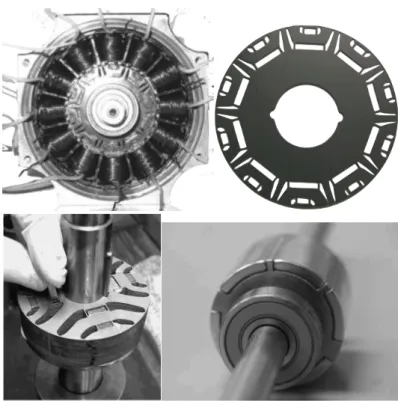
an efficient gradient-based optimization algorithm. The tool has been devoted to successfully determine the geometry of electro-mechanical energy converters of great industrial relevance: electrical rotating machines, Fig. O1, and multiplanar busbars, Fig. O2, so as to minimize the torque ripple of the former while ensur-ing the mechanical resistance of the rotor submitted to centrifugal forces, and to minimize the mismatch of impedances which occurs in the latter.
Figure O1: Top: A prototype of a fractional 12-slot and permanent-magnet (PM)
assisted synchronous reluctance machine is considered, left, as well as its rotor, right, with laminations in which are inserted the PMs. This type of machine exhibits high torque ripple(Pictures from Boglietti et al. [2014]) Bottom: Several pragmatic approaches have been implemented to reduce cogging torque, right, as well as the torque ripple, left, by means of laminations with small PMs added so as to saturate the steel bridge and to increase the power factor of the considered electrical machine are considered. However these designs lead in general to a decrease of the average torque and do not take into account the strength of the structure. Both aspects can be combined in an automated design. (Pictures from Bianchi et al. [2009], left, and Bianchi and Bolognani [2002], right.)
Figure O2: A classical connection of a power converter with an electrical motor,
left, is considered. The power converter involves switching components, e.g. IGBT and a multi-layer busbar, right, to replace the cable wiring. The design of the busbar can greatly benefit from automated design techniques so as to determine a geometry of the plates that exhibits a low stray inductance, e.g. by widening conductive sections, in a shape optimization approach, or alternatively by filling at most a given volume fraction of the available domain, in a topology optimization approach, e.g. for minimizing the mismatch of currents that goes through the power switches. (Pictures from Guichon et al. [2006])
Overview xi
Outline
The manuscript is organized as follows. In Chapter 1, we review state-of-the-art techniques for the subjects that are the foundation of our research: (1) shape, topology and combined shape and topology optimizations; (2) the sensitivity analysis of performance functions in the context of such constrained optimization problems which involve PDEs; and (3) the numerical techniques used to solve the optimization problem. In Chapter 2, we detail our contributions. They have been the topics of several publications which are appended in their original published form at the end of the thesis:
1. A framework to express analytically sensitivity analysis of systems governed by PDEs with respect to design variables which control the shape of the systems, based on the Lie derivative (Appendix A);
2. A suitably preconditioned iterative solver to handle the large-scale problems which involve at least as many design variables as constraints (Appendix C) 3. A strategy to perform simultaneous shape and density based topology opti-mization following the previously developed sensitivity as well as an adequate mapping for handling the complex interactions between the material distri-bution of topology and the geometry modifications of shape optimization (Appendix D);
4. The extension of the Lie derivative in the time-harmonic domain in order to tackle more involved applications, such as eddy-current problems (Ap-pendix B).
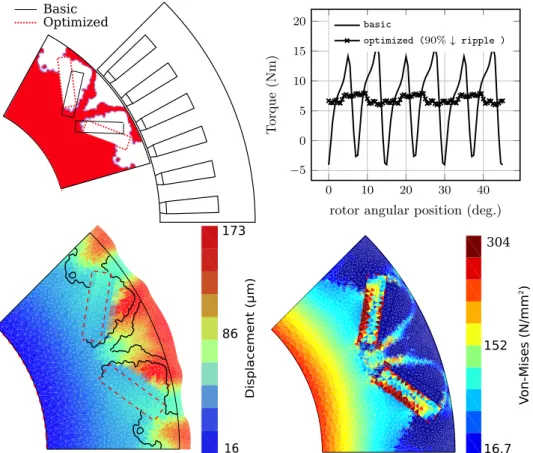
In Chapter 3, we provide numerical applications representative of industrial prac-tice. The first showcase deals with the simultaneous shape and topology opti-mization of the rotor layout of an interior permanent-magnet machine in order to smooth the torque profile with respect to the angular positions of the rotor, while ensuring its mechanical strength. The second showcase considers the optimal de-sign of a three dimensional multiplanar busbar so as to minimize the impedance mismatch. Finally, conclusions as well as our perspectives are presented in the last Chapter.
Contents
Abstract i Acknowledgements v Overview vii 1 State-of-the-Art 1 1.1 Shape optimization . . . 1 1.2 Topology optimization . . . 41.3 Sensitivity analysis of problems governed by PDEs . . . 7
1.4 Gradient-based optimization methods . . . 9
1.5 Combined shape and topology optimization . . . 10
2 Personal contributions 15 2.1 General formulae for sensitivity in electro-mechanical problems . . 15
2.2 An efficient iterative linear solver for MMA subproblems in a high dimensional design space . . . 18
2.3 Optimization in mixed shape and topology design spaces . . . 19
3 Application examples – towards industrial designs 21 3.1 Torque ripple minimization of a PMSM . . . 22
3.2 Simultaneous shape and topology optimization for torque perfor-mance and centrifugal resistance . . . 25 3.3 Impedance mismatch reduction in 3D multi-layer high voltage busbars 29
Conclusions and Outlook 33
Bibliography 37
List of publications and communications 51
A Paper I: Design sensitivity analysis for shape optimization based
on the Lie derivative 53
A.1 Introduction . . . 54 A.2 Optimization problem . . . 55 A.3 Design sensitivity analysis . . . 56 A.4 Lie derivative formula sheet . . . 61 A.5 Design velocity field computation . . . 63 A.6 Application to magnetostatics . . . 64 A.7 Application to linear elastostatics . . . 67 A.8 Conclusion and perspectives . . . 73
B Paper II: Three-dimensional Topology Optimization of a Planar
Multilayer Busbar 75
B.1 Introduction . . . 76 B.2 Description of the physical model . . . 78 B.3 Topology optimization problem . . . 80 B.4 Sensitivity Analysis . . . 81 B.5 Numerical example . . . 85 B.6 Conclusion and perspectives . . . 86
C Paper III: Efficient iterative solver for MMA subproblems in
topology optimization with stress constraints 87
C.1 Introduction . . . 88 C.2 Sequential convex programming approach . . . 92 C.3 Newton-like interior point solver . . . 95 Partial Cholesky based preconditioner . . . 98 C.4 Sparse approximation of the preconditioner . . . 104 C.5 Spectral-based permutations of the system matrix . . . 106 C.6 Numerical examples . . . 107
D Paper IV: Combination of Shape and Topology Optimization
based on the Lie Derivative 113
D.1 Introduction . . . 114 D.2 Optimization in mixed shape and topology spaces . . . 116 D.3 Shape and topology parameter spaces . . . 118 D.4 Sensitivity Analysis . . . 120 D.5 Application to the design of a PMSM . . . 125
Chapter
1
State-of-the-Art
1.1. Shape optimization
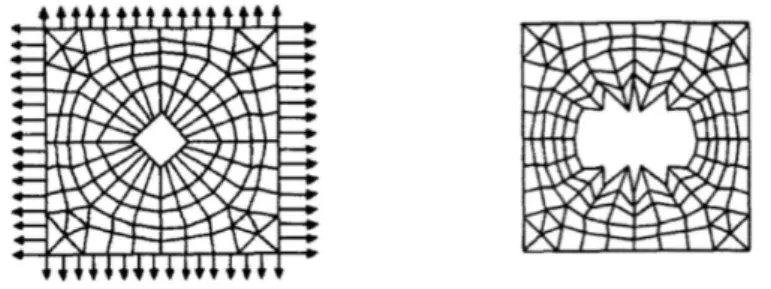
Shape optimization has been an active research area that one often traces back to the seminal work of Zienkiewicz and Campbell [1973]. In early works of shape optimization, as summarized in Bletzinger et al. [2010], the design variables were selected among the nodal coordinates of the finite element mesh. However, the quality of the mesh of the structure undergoing shape optimization was deterio-rated throughout the optimization process, resulting in a dramatic loss of accuracy of the numerical method, as reported in Haftka and Grandhi [1986], see Fig 1.1.
Figure 1.1: The structural shape optimization of a plate with a hole is considered.
The design variables are set as the nodal coordinates of the finite element mesh in order to maximize the maximum Von-Mises stress which appears in the vicinity of the hole. Their variation brings distortion throughout the successive boundary updates. (Pictures from Haftka and Grandhi [1986])
As summarized in Olhoff et al. [1991], an efficient representation of shape op-timization avoids the one-to-one dependence between the design variables and the finite element mesh by using a CAD model description of the geometry. Polyno-mial or rational representations of the boundaries have been used early on, e.g.
1
Bezier or B-spline in Braibant and Fleury [1984], or NURBS in Beckers [1991]. The design variables were selected among the geometrical parameters of the model such as the control points that govern the shape of the geometric entities of the structural boundaries. This approach naturally provided a consistency between the design and CAD models, see Fig. 1.2.
The latter parameterization has been followed in the context of the optimization of electrical rotating machines, in which design variables are set classically as the thickness of permanent magnets (PMs) of a permanent-magnet synchronous machine (PMSM), their position, the slot opening, the width of rotor yoke, the angle of one pole magnet, see for instance Kim et al. [2008], or Kioumarsi et al. [2006]. Shape optimization has also been successfully applied to determine either the stator shoes that minimize cogging torque, e.g. Choi et al. [2011], or the rotor pole designs in interior permanent-magnet (IPM) motors to obtain a sinusoidal flux density distribution in the air-gap, as in Choi et al. [2012]. In this context, a multi-phase level-set model represents the various material properties of the objects in the rotor, e.g. Lim et al. [2012]. A classical level set based shape optimization that determines the radial component of the air gap flux density waveform has also been used, as in De La Ree and Boules [1992], Borghi et al. [1999] and more recently by Dajaku and Gerling [2012], or Oh et al. [2013].
The geometry of a multi-layer busbar has also been determined by a shape optimization, generally coupled with a circuit-based model of the busbar. The method aims at minimizing the inductance of the busbar by reducing the com-mutation loop size, e.g. by rearranging the layers disposition as in Buschendorf et al. [2013], Chen et al. [2012] or Chen et al. [2014], widening conductive sections as in Wen and Xiao [2012], or Khan et al. [2014], using symmetrical busbars, as in Burtovoy and Galkin [2012], or Caponet et al. [2002], and the output current can be balanced, as in Pasterczyk et al. [2005].
1.1. Shape optimization
1
3Figure 1.2: Top: The structural shape optimization of support beam which
car-ries the floor in the fuselage of a civil aircraft is considered. The design variables are set as the control points of the splines that represent the holes, and deter-mined so as to minimize the volume of the structure under a prescribed maximum deflection and maximum Von-Mises stress. (Pictures from Olhoff et al. [1991]) Middle: A synchronous permanent-magnet electric machine is considered. The design variables are selected as the control points of splines are determined so as to make the induction field in the airgap sinusoidal. (Pictures from Kim et al. [2007a]). Bottom: A multi-layer busbar is considered. A circular hole is intro-duced in the CAD and its radius is determined so as to minimize the inductance of the busbar. (Pictures from Khan et al. [2014])
1
Shape optimization often implies drastic changes of the structural geometry as the design variables change and one requires hence mesh adaptations so as to maintain a certain level of FEM solution accuracy, which in turn affects the con-vergence of the optimization algorithm. As reported in Zhang et al. [1995], the mesh topology is slightly modified as an a-priori refinement indicator is validated. In the early days, when automatic mesh generators were not available, a Lapla-cian smoothing was classically used to determine the location of inner nodes from one optimization iteration to the next. In a more general setting, shape modi-fications are reflected by means of a velocity field, for which various automatic generation methods have been proposed in the literature, using either a geomet-rical constructive approach such as the isoparametric mapping by Botkin [1982], Imam [1982], Braibant and Fleury [1984], Yang and Botkin [1987], or an auxiliary structure, such as the boundary displacement method by Choi [1987], Choi and Yao [1987], Yao and Choi [1989] or the fictitious load method by Belegundu and Rajan [1988], or Zhang and Belegundu [1992], or more recently a method based on NURBS with distortion control by Silva and Bittencourt [2007].
Alternatively, some researches have tried to formulate shape optimization by in-troducing different numerical methods and parameterizations so as to circumvent the technical difficulties linked to the variation of the spatial discretization. Ap-proaches based on a fixed mesh, such as the fictitious domain method of Daňková and Haslinger [1996] or the projection methods by Norato et al. [2004] and more recently the Eulerian shape optimization of Kim and Chang [2005] are among successful approaches. Non-conventional mesh-free methods have also been ap-plied to shape optimization in 2D and 3D geometries, e.g. Kim et al. [2002], and a T-Spline finite element method by Ha et al. [2010] is based on the isogeometric analysis developed by Hughes et al. [2005].
1.2. Topology optimization
Topology optimization was first successfully solved in structural mechanics in the late 1980’s by Bendsøe and Kikuchi [1988] who proposed to formulate the problem as the presence or not of a specific anisotropic porous material at each point of the region where it is applied. The method was therefore able to introduce, or remove, holes and blocks of material, changing the shape topology and exploring new, and oftentimes unexpected, possibilities to the design of the systems under consideration. The material properties of the early approach resulted from ho-mogenization theory. The Simplified Isotropic Material with Penalization (SIMP) model was proposed later on by Bendsøe [1989] in order to overcome some of the weak points of the design method based on homogenization. Instead of consider-ing each element of a discretized design space as a region of material composed by a microstructure, the SIMP approach considers the design variables as a density field, defined on the fixed region. The computation mesh is hence kept constant throughout the optimization and identical to the finite element discretization of the design domain for both state variables and the density field, thus avoiding any mesh distortion and/or the use of mesh adaptation techniques.
1.2. Topology optimization
1
5While the development of topology optimization is outstanding in the field of structural engineering, which has historically pioneered its development, with many industrial applications, as summarized in Rozvany [2001], Eschenauer and Olhoff [2001] or Sigmund and Maute [2013], it is also sensible in the field of electromagnetic design. As discussed in Bendsøe and Sigmund [1999], many in-terpolation schemes relating the density design variables to the material properties have been proposed for structural density based methods. The electromagnetic domain received at first attention from Dyck and Lowther [1996], and the satura-tion of ferromagnetic materials were also taken into account in Dyck and Lowther [1997]. The authors present a geometric mapping between the steel proportion and the magnetic permeability.
The SIMP based topology optimization, in particular, has been successfully applied to the design of electrical machines, e.g. by Wang et al. [2004], Choi et al. [2011], Im et al. [2003], or Lee and Wang [2012], while the general ho-mogenization approach seems to have been almost exclusive to Yoo et al. [2001]. The design of busbars, e.g. including the temperature effects, has been investi-gated by Puigdellivol et al. [2017], while the interactions with fluids is studied by Iga et al. [2009] or Matsumori et al. [2013] and the electromagnetic behavior by Puigdellivol et al. [2016], see Fig. 1.3. More focused applications have also been treated in a number of studies: the design of piezoelectric transducers by Silva et al. [1997], perpendicular magnetic recording head by Okamoto et al. [2005], dielectric waveguide filters by Byun and Park [2007], ultrasonic wave transducers by Kim et al. [2007b], micro fluid mixers by Aage et al. [2008], acoustic devices by Dühring et al. [2008], photonic bandgap fibers by Dühring et al. [2010] and photonic crystals by Borel et al. [2005].
In any optimized system it is crucial to control the structural stress state so as to ensure the mechanical robustness of the optimized structure. However such problems are challenging from a computational point of view, since local crite-ria like stresses are in general considered in each finite element of the mesh, and hence lead to large-scale problems with possibly as many design constraints as finite elements in the mesh. The solution of such problems can therefore require a computational effort comparable to the effort spent on the solution of the physical problem itself. Furthermore, in the context of a density based topology optimiza-tion, the solution of the optimization problem with stress constraints comes to some degenerated subdomains, as discussed in Cheng and Jiang [1992]. These are hardly reached by mathematical programming algorithms based on KKT which are not applicable in that case. The latter problem is addressed as the singularity problem and can be alleviated by introducing a relaxation of the stress constraints, such as the ϵ-relaxation proposed by Cheng and Guo [1997].
The stress constraints have been included in the density based topology opti-mization problems mainly after the seminal work by Duysinx and Bendsøe [1998]. Based on the study of rank-2 microstructures, they suggested a macroscopic fail-ure model for porous materials. The computational effort of the former approach has been reduced by Duysinx and Sigmund [1998] who proposed to account for
1
the local stress state by using an aggregated and integrated constraint approx-imating the maximum stress through the p-norm or p-mean for instance. An effective algorithm has also been proposed by Le et al. [2010] to handle the stress constraints. An alternative technique to the ϵ-relaxation, the qp-relaxation, has also been proposed by Bruggi [2008].
Figure 1.3: Top: The support beam presented in Fig. 1.2 is redesigned so as to
maximize the stiffness of the beam while filling at most a given volume fraction of the available domain. The optimal design is determined without requiring any a-priori guess. Middle: The design of the rotor of a switched reluctance machine (SRM), initially completely filled with steel, left, is determined by a density based topology optimization to lower the torque ripples of the machine. The resulting design, right, results in a lighter rotor and exhibits a low torque ripple. (Pictures from Lee et al. [2010]). Bottom: A busbar, i.e. a thick strip of copper which interconnects the power switching devices, T1 and T2 to other electronic components, is considered. The copper distribution is determined in both plates so as to minimize the overall inductance. (Pictures from Puigdellivol et al. [2016]).
1.3. Sensitivity analysis of problems governed by PDEs
1
71.3. Sensitivity analysis of problems governed by PDEs
Both shape and topology optimization approaches can be formulated mathemati-cally as an optimization problem which aims at determining a set of design vari-ables. These describe the geometry using either existing boundaries or alterna-tively a material distribution. The problem minimizes a cost function, subjected to inequalities, ensuring the manufacturability or the feasibility of the design. The PDEs that govern the physical behavior of the system are included as constraints in a standard statement of the optimization problem. For a given geometrical con-figuration (i.e. design variables), their solution is obtained in general by means of FEM discretization. This is used to evaluate the performance functions. There is therefore an implicit and nonlinear dependence of both the performance functions and the solution of the PDEs in the design variables. Furthermore, the repeti-tion of these evaluarepeti-tions for successive configurarepeti-tions of the design variables is, in general, expensive from a computational point of view, especially for large-scale applications.
The sensitivity of the optimization problem, i.e. the derivative of each per-formance function with respect to each design variable, is therefore calculated so as to make use of gradient-based optimization algorithms. The solution to the design optimization problem is generally solved through a recursive approach in which a sequence of explicit subproblems are solved efficiently through tailored mathematical programming algorithms, such as dual or primal-dual solvers. This leads to fewer function evaluations, and hence, in our case, limits the required number of solutions of the finite element physical problem. The main difficulty in the calculation of sensitivity lies in the differentiation of the PDEs with respect to design variables which modify the boundaries of the system.
Two approaches have emerged over the years for the calculation of this sensi-tivity, called shape sensitivity. The first one acts as an analytical differentiation at the level of the variational formulation of the problem, as summarized in Arora and Haug [1979], whereas the second approach differentiates the discretized alge-braic system, as in Adelman and Haftka [1986]. An approach that works at the software level and consists in direct differentiations of the computer code itself, as in Griewank et al. [1996], or Bischof et al. [1996], and more recently Farrell et al. [2013] may be attempted for explicit geometrical representation. However, they cannot be extended to systems described by a CAD model with spatial discretiza-tions that are modified as the optimization unfolds.
In the continuous context, prior to discretization, the variation of the integral quantity, such as the residual related to the physics of the problem, with respect to a design variable that controls the material density distribution can be expressed explicitly, in general, by means of the total derivative, as suggested by e.g. Kyung K. Choi [2005]. However, the variation of the integral quantity with respect to a design variable that brings modifications in the boundaries of the system is more delicate to express, and requires extra terms to account for the implicit dependency of the integral quantity in the continuous flow of geometrical modification.
1
The shape sensitivity problem has been treated through the velocity method, as introduced in Sokolowski and Zolesio [1992], and more recently in Delfour and Zolésio [2011]. This approach uses the variation of the shape design variable as the parameter of a family of mappings describing a smooth geometrical transformation of the domain, with no tearing nor overlapping, that brings the boundaries of the domain from their unperturbed position to their perturbed position. The mapping with the scalar parameter taking values in a neighborhood of zero and playing the role of a pseudo time variable, determines therefore a flow on the Euclidian space characterized by a velocity field.
The velocity method has been applied successively to elasticity problems where the solution of the physical problem is a scalar field, e.g. Allaire et al. [2004], Dems and Mroz [1984], or Haug and Arora [1979]. Following this approach, analytical formulas have also been proposed in other disciplines such as electromagnetics, based on classical vector analysis, as in Biedinger and Lemoine [1997], Koh et al. [1993], or Park et al. [1993]. However, these works have been exclusively devoted to problems expressed in terms of a scalar unknown field, leaving aside the problem of handling the complex behavior of a vector field under the transformation that brings a modification of the system boundaries.
There exist several geometrical objects that have three components in an Eu-clidean space, but behaving differently under the one parameter family of map-pings. We have to deal with circulation densities, (e.g. the magnetic vector po-tential or the magnetic field), and flux densities (e.g. the flux density and the current density). Although genuine vector fields, circulation densities and flux densities can be indiscriminately regarded as vector fields in an Euclidean space, their shape derivative are different under the geometrical transformation and they must therefore be carefully distinguished when evaluating the shape derivative of an expression involving such objets.
To handle the shape derivative of vector fields, one can refer to a more general theoretical framework based on the exterior calculus, e.g. as in Frankel [2011], well established so far in mathematical modeling and analysis of PDEs, e.g. Hermann et al. [1964], Henrotte [2004], borrowed from differential geometry, and in par-ticular the concept of Lie derivative. These material derivatives have been used more recently by Hiptmair and Li [2013] in order to overcome the limitations and the tedious calculations of the vector analysis approach, classically used for the scalar field. Hiptmair and Li [2017] have applied this approach to the sensitivity calculation of a linear acoustic problem and also an electromagnetic scattering boundary integral equation.
Similarly to the physical problem, the sensitivity analysis can be time-consum-ing, since it involves, in conventional approaches, the solution of either one linear system obtained by differentiating the PDEs of the physical problem for each of the design variables (the so-called direct approach), or for each performance func-tion (the adjoint approach). However, only the right-hand side of the addifunc-tional linear systems needs be evaluated (the system matrix being already known) and
1.4. Gradient-based optimization methods
1
9a substantial gain in computation time is obtained compared to a finite difference evaluation of sensitivity, which requires solving from scratch a second, possibly time-consuming, system for each design variable.
1.4. Gradient-based optimization methods
In this context, optimization algorithms relying on sensitivity of the optimiza-tion problem, often referred to as gradient-based algorithms, necessitate a small number of function evaluations, and hence, limit the required number of solutions of the physical problem compared to heuristic approaches, such as genetic algo-rithms. It should be noted that the latter have been used to estimate an optimized design in either shape or topology optimization problems, e.g. Balamurugan et al. [2008] or Wang et al. [2006], and also in Canyurt and Hajela [2007], without any information about the sensitivity of the problem. They can naturally handle dis-crete problems, and are therefore particularly well suited for topology optimization problems with design variables, allowed to be either 0 or 1. However, as reported in Rozvany [2009], the solution of the discrete problem quickly turns out to be intractable for large-scale problems. In particular, a large number of function evaluations, and hence a large number of PDE solutions are required to reach the solution.
Optimality criteria (OC) methods were proposed early on by Prager and Taylor [1968] to determine the optimal solution of the design problem. In this approach, the design space includes both the design variables and the Lagrange multipliers handling the constraints. Starting from the Karush-Kuhn-Tucker (KKT) opti-mality conditions, iterative update relations are derived for the variables. The optimality conditions are treated as additional constraints and are satisfied at the stationary point, as in NS Khot and Venkayya [1979]. This approach has been essentially applied for the solution of topology optimization problems based on a global design criterion, such as the compliance or maximization of fundamental eigenfrequencies, as in Olhoff [1970], Bendsøe and Kikuchi [1988], or Rozvany and Zhou [1991]. Their application to larger problems becomes numerically inefficient. Among general nonlinear problems based on gradient methods, interior point (IP) methods together with sequential quadratic programming (SQP), e.g. Gill et al. [2015], are considered nowadays as the most powerful solvers, as it has been studied in Dolan and Moré [2002] or Benson et al. [2003]. They have been suc-cessfully applied to solve the design problem in Orozco and Ghattas [1997], Stolpe and Svanberg [2003], Dreyer et al. [2000] and Maar and Schulz [2000].
However, both interior point and SQP methods require the computation of the Hessian, which is time consuming for realistic industrial problems. In addi-tion, they have difficulties to deal with nonlinear problems which are non-convex. Many different ways of handling the lack of convexity of the problems have been proposed, through the modification of the KKT system, in order to ensure the existence of a solution. Among them, the diagonal shift can be applied to the
Ja-1
cobian of the KKT system to make the resulting system positive definite. A more reliable technique consists in using a quasi-Newton method to approximate the Hessian of the system, as in Nocedal [1980]. Inertia controlling methods based on a modified LDL decomposition method have also been introduced, e.g. in Forsgren [2002].
Sequential approximation schemes combined with mathematical programming exploit gradient-based algorithms to reach the optimal solution of the design prob-lem with multiple constrained probprob-lems. It has been shown by Schmit [1960] that it is better to approximate the original problem by a sequence of convex optimiza-tion subproblems. Their evaluaoptimiza-tion, and hence the evaluaoptimiza-tion of sensitivity and second order derivative, is then very efficient compared to the original model as they do not require any FEM solution.
The approximations have a large influence on the efficiency of the solution of the optimization problem. These are in general convex to have a unique solu-tion for the subproblem and to ensure a conservative behavior so as to guarantee a steadily feasible and monotonous sequence of minimizers. Moreover, they are separable and lead to an advantageous solution through the dual maximization method. Various approximations relying on different intermediate linearization variables are available in the literature. Efficient optimization algorithms were proposed in combination with particular approximations: the Convex Lineariza-tion (CONLIN) algorithm by Fleury [1989], the Method of Moving Asymptotes (MMA) by Svanberg [1987], the Globally Convergent Method of Moving Asymp-totes (GCMMA) by Svanberg [1995], Sequential Quadratic Programming (SQP) algorithms by Schittkowski [1986].
To solve the subproblems, Fleury [1993] proposed to use a dual formulation. Exploiting the Lagrange maximization, the primal constrained minimization prob-lem, associated to a large number of variables, is replaced by a dual quasi-uncon-strained maximization problem with a limited number of variables, the nonzero Lagrange multiplier associated to the active constraints.
Second-order methods such as SQP, or interior point methods, can advanta-geously be used to solve the approximation subproblem, without having to handle the issues that naturally arise from the lack of convexity for general nonlinear problems.
1.5. Combined shape and topology optimization
The design variables upon which density based topology optimization acts, which are called densities, represent the presence or absence of material at each point of the region where it is applied, whereas the design variables of a state-of-the-art shape optimization are the geometrical parameters of a CAD description. These densities are substantial quantities. This means that they are attached to matter while, on the other hand, shape optimization implies ongoing changes of the model geometry.
1.5. Combined shape and topology optimization
1
11Although the implementation of the topology approach with a fixed spatial discretization is simple and numerically stable, it leads to layouts with jagged boundaries which have to be smoothed in an extra postprocessing procedure, as in Bletzinger and Maute [1997]. Moreover, in many practical design problems, the explicit representation of the boundaries of the system undergoing optimization is necessary to be able to model the problem with localized boundary effects. In all cases the explicit interface is necessary when interpreting the final design.
Several strategies intended to handle the complex interactions between shape and topology optimizations, have been developed so far, each with their own pa-rameterizations, and also to overcome the shortcomings of standard density based topology optimization.
Among existing methods, adaptive topology optimization has been performed by Bletzinger and Maute [1997] to form an explicit interface between the solid and void regions which arise throughout a structural density based topology op-timization, see Fig. 1.4. More recently, a similar paradigm has been followed by Christiansen et al. [2014], who has adapted to topology optimization, the de-formable simplicial complex (DSC) method, introduced by Misztal et al. [2014] to simulate fluids accurately. Here, both the design and the analysis models rely on the same spatial discretization. The DSC deformation is therefore used to adapt the mesh after the movement of the interface, such that it is well formed, and involves a series of mesh operations, e.g. Laplacian smoothing, edge flip, vertex insertion and vertex removal, which are quite artificial.
In addition, topological derivatives, as in Eschenauer et al. [1994], are used to change the topology of the domain by creating new holes. The interface between void and solid regions is represented explicitly as one or more closed piecewise linear curves and is smoothed by determining the positions of the nodes belong-ing only to that interface, e.g. by means of a simple shape optimization with a prescribed maximum variations between the optimized and the current configura-tions.
Level Set methods, which were originally proposed by Osher and Sethian [1988] for numerically tracking free boundaries, are among alternative approaches to den-sity based topology optimization. In this context, the geometry is represented as the zero Level Set of functions and are propagated through the solution of Hamil-ton-Jacobi type equations. This approach, which allows to easily handle large shape modifications without requiring a CAD representation, has been first ap-plied to structural optimization by Allaire et al. [2002] and Wang et al. [2003], but also in electromagnetic design of electrical rotating machines, see Fig. 2.1. The review of various applications tackled by the level set method is provided in van Dijk et al. [2013]. The method can advantageously be carried out in a fixed mesh. Furthermore, the topological complexity of classical CAD based shape optimiza-tion is reduced since geometric entities, such as holes, can be merged or removed without degenerating the model, but unfortunately cannot be created, except if the method is combined with a topological derivative (see for instance Novotny
1
Figure 1.4: An adaptive successive structural topology and thickness
optimiza-tion of a cantilever beam is considered. Top: The analysis model uses the density distribution from the density model. The structure with boundaries defined by one (or even more) isolines between the void and solid regions of the density model are discretized with a finer mesh in the analysis model while a separate regular constant grid is used to discretize the density model. Middle: A simple sizing op-timization is used to further smooth the thickness of the isolines, with a prescribed small variation between the optimized and the initial configurations. Bottom: The mesh of the analysis model is adapted in order to reduce the finite element error on the system response. (Pictures from Bletzinger and Maute [1997])
et al. [2003]). The use of a Level Set representation of the geometry makes it diffi-cult to take into account geometries with sharp angles (see for instance Kalameh et al. [2016] or Duboeuf and Béchet [2017]). It limits hence the range of systems that can be optimized.
The Level Set method is able to perform topology optimization if the number of holes of the initial design is sufficiently large and converges to configurations which strongly depend on the initial level sets distribution. It should be noted that using the level set method, a stress criterion can be integrated into the design of industrial systems. Stress constraints were treated in this context, allowing hence to get rid of the singularity problem involved when resorting to the density based
1.5. Combined shape and topology optimization
1
13optimization, and therefore do not require any relaxation strategy. This problem has been analyzed, e.g. in Van Miegroet and Duysinx [2007], Allaire and Jouve [2008] and more recently James et al. [2012], who performed the minimization of the stress state in solid-void structures.
Figure 1.5: Left: The structural topology optimization of a cantilever beam
is carried out with a Level Set method so as to have an explicit description of the geometry. The optimization history, however, strongly depends on the initial number of Level Sets. (Figures from Allaire et al. [2002]) Right: The approach has also been applied to the electromagnetic design of e.g. the stator of an interior permanent-magnet rotating motor, so as to minimize the torque ripple. (Figures from Kwack et al. [2010]).
1
Topology and shape optimizations have also been coupled in the context of packaging, see Fig. 1.6. The non-overlapping constraints between two different packaged items is a key issue and it has been expressed in the early work of Qian and Ananthasuresh [2004], as the distance between two circles approximating the components. However, the rough approximation of an item by a circle is not suffi-cient anymore when the item has a complex shape, especially concave. The Finite Circle Method (FCM) has been proposed by Zhang and Zhang [2009] to circum-vent the limitations and it has been further used by Zhu et al. [2009]. In Zhu et al. [2009], the interactions between the movement of the components and the material density of the support have been synchronized through the combination of predefined density points in the support followed by a series of boolean mesh operations in order to maintain a mesh of good quality as optimization unfolds. However, the mesh manipulations are the center of the method while they should be just a mean to an end. Alternatively, Qian and Ananthasuresh [2004] used a material interpolation model which handles the movement as a physical variation of the material properties. The integration of this approach remains however quite cumbersome in industrial systems. In both approaches, a fixed mesh with prede-fined density points is used throughout the optimization. In Zhu et al. [2009], the distances between the element centroid and the density points controls the distri-bution of material density, and the method is made mesh independent by limiting the modification of the material density only inside predefined mesh patches.
Figure 1.6: The integrated layout approach aims at determining the optimal
position of the rectangular shape components through the solution of a shape optimization while a density based topology optimization is carried out to optimize the material usage of the support. (Pictures from Zhu et al. [2009])
Chapter
2
Personal contributions
Our contributions to advance the state-of-the-art overviewed in Chapter 1 deal with (1) the generalization of the calculation of shape sensitivities, to the nonlin-ear electro-mechanical case, in 2D and 3D, by means of an explicit Lie derivation of the variational formulations for both static and time-harmonic problems; (2) the adaptation of the interior point method for the solution of the large-scale convex approximations sequences obtained when solving the topology optimization prob-lems with local restrictions; (3) the appropriate combination of the representation of a CAD-based shape optimization with a density based topology optimization to perform a joint shape-topology optimization. The corresponding algorithms are integrated to the open-source software GetDP ( Dular et al. [1998]), and Gmsh ( Geuzaine and Remacle [2009]) through the ONELAB interface which can be downloaded from the following website: http://onelab.info. The next three sections present a summary of our main contributions to these three areas.
2.1. General formulae for sensitivity in electro-mechanical
problems
Our first contribution provides engineers with a general and a comprehensive the-oretical framework to perform the shape optimization of systems governed by PDEs, min τ f0(τ , z †) s.t. fj(τ , z†)≤ 0, j = 1, . . . , m τimin≤ τi ≤ τimax, i = 1, . . . , n r(τ , z†, z′) = 0, ∀z′ ∈ Zz0, (2.1)
which aims at determining the design variable set τ , whose variation brings a geometrical modification of the optimized system boundaries. It is stated as the optimization of the objective function f0 while ensuring some design constraints
fj ≤ 0. The PDEs are here expressed in terms of a state variable z and the design
2
variable set τ . They are stated in a weak formulation, obtained by, e.g., a Galerkin linearization approach and they are written in a generic form through a residual r(τ , z†, z′), where z† is the physical solution.
Our contribution, in particular, extends the calculation of sensitivity, so far mostly derived for equilibrium equations arising in structural mechanics, to other disciplines such as electromagnetics. Thus, following the approach of Zolesio’s velocity method, we express in a unified framework the sensitivity of any perfor-mance function (i.e. any function fj of the solution of the PDE problem). One
can further express the derivative of the state variables of the PDEs that involve either scalar or vector unknown fields. To this end we rely to the Lie derivative, i.e. the derivative of that performance function along the flow representing the continuous shape modification of the geometrical model induced by the variation of the considered design variable.
Contrary to previous work in the field, the purpose of our work is however, not to give a complete mathematical derivation of differential geometry concepts, but rather to provide engineers and practitioners in the field of optimization with a useful formula sheet, so as to derive formulas for new problems more easily. We introduce therefore a hybrid formalism which sticks with standard vector and tensor analysis notations, to express the sensitivity of the physical problem, with vector calculus like notations, in both a direct and an adjoint approach.
Following our formalism, we generalize equivalently in 2D and 3D the methods proposed so far in electromagnetics, e.g. in Park et al. [1993], that were limited to scalar unknown fields, i.e. to scalar potential 3D formulations or 2D electro-magnetic problems. In addition, we offer the possibility to treat linear elasticity in this same context and recover the state-of-the-art results. We have validated all the analytical formulas derived in nonlinear magnetostatics and in linear elas-ticity with the finite difference approach and we conducted a deep investigation of the convergence of the computed sensitivity with mesh refinement using first and second order finite elements. The theoretical results pave the way towards real-life applications, typically industrial perspectives, such as eddy-current problems, and multi-physics problems.
Let us consider, for demonstration purposes, the magnetic vector potential A formulation of a magnetostatics problem excited by a current density J with a nonlinear material law H(B), on a bounded domain Ω, with boundaries controlled by a design variable τ . The problem is written in a variational form through a residual, r(τ, A†, A′)≡ ∫ Ω(τ ) ( H(B†)· B′− J · A′ ) dΩ = 0, ∀A′∈ Z0 A, (2.2)
where A† is the solution of the nonlinear magnetostatic problem, B† = curl A†
and B′= curl A′.
2.1. Sensitivity formulae in electro-mechanical problems
2
17an Euclidean space, but which behave differently under the geometrical trans-formation of the domain. Such objects are the circulation densities (also called 1-forms), e.g. A or H. These quantities make sense when integrated over a curve. Flux densities (2-forms), e.g. B or J , are quantities that make sense when in-tegrated over a surface. Furthermore, a material law like H(B) converts a field quantity, B, into another field quantity, H, and contains therefore a geometrical conversion operator, called Hodge operator, that depends on the metric which has a non-vanishing Lie derivative when the system deforms. The implicit Hodge op-erator must be accounted for when evaluating the Lie derivative of a material law. Although genuine vector fields, classically adopted in state-of-the-art methods of sensitivity calculation, these objects are indiscriminately regarded as vector fields in an Euclidean space. So their Lie derivatives are different under the geometrical transformation of the domain and they must therefore be carefully distinguished when evaluating the Lie derivative of an expression involving such objets.
It follows from above that the derivative of the residual at equilibrium, with respect to the design variable τ , is obtained by applying the Lie derivative, and yields the linear system to be solved to obtain the Lie derivative of A† along the
velocity field v, i.e. LvA†. It comes ∫ Ω(τ ) ν∂ curl LvA†· curl A′ dΩ + [ ∫ Ω(τ ) ( ν∂((∇v)TB†− B†div v)· B′ (2.3) + (∇v) νB†· B′− (J div v − (∇v)TJ )· A′ ) dΩ]= 0, ∀A′ ∈ ZA0.
The obtained formula has a rather large number of terms, which can however be reused from the finite element solution. The first term in (2.3) involves the tangent stiffness matrix, ν∂, which is already known from the computation of A†.
The bracketed terms, on the other hand, make up the partial derivative term that accounts for the explicit dependency (i.e. holding the field argument, A†,
constant) of the residual on the variation of τ .
The velocity field, v, that represents the shape modification, must be deter-mined for the computation of LvA† in (2.3). We have therefore proposed a prac-tical and efficient method for the numerical generation of the velocity field based on the parametrization of the geometric model of the domain, and integrated into a finite element code, see Geuzaine and Remacle [2009] and Dular et al. [1999]. On a practical level, our approach makes use of the freedom in the definition of the velocity field to derive a method to limit the support of the volume integrals, as in (2.3), to a one layer thick layer of finite elements on both sides of the surfaces involved in the shape variation.
We start with a mesh of the initial CAD model for which each boundary node is represented by its parametric coordinates on the underlying curves or surfaces. After (small) perturbation of the CAD model, assuming that the perturbation of the parametric representation of the boundaries is also small, we relocate the initial mesh on the new CAD representation by freezing the node parameters. This
2
approach is very efficient when the mesh generation algorithms are based on the parametric representation of CAD entities, as is the case for Gmsh Geuzaine and Remacle [2009].
Figure 2.1: A plate with an elliptic hole γτ is considered. The design variable τ is
the major axis of the ellipse. After a finite perturbation δτ , the mesh nodes lying on the surface γτ are relocalized on γτ +δτ thanks to the CAD parametrization
of the ellipse. The velocity field is approximated by finite difference of the node positions before and after the perturbation. (Figures from Kuci et al. [2017]).
This first contribution has been published in Computer Methods in Applied Mechanics and Engineering, Kuci et al. [2017], and is reproduced in Appendix A. The extension to time-harmonic variational formulations governing the behavior of dynamic linear electromagnetic systems is presented in Appendix B and it has been submitted for publication in the journal Structural and Multidisciplinary Optimization.
In that article we apply the derived sensitivity formulas to the optimal design of a three-dimensional planar multi-layer busbar through a density based topology optimization. This paper proposes an approach to minimize the mismatch between the complex currents that go through the electronic power switching components of the busbar, while filling at most a given volume fraction of the available domain.
2.2. An efficient iterative linear solver for MMA
subproblems in a high dimensional design space
Our second contribution aims at offering a tailored iterative solver which finds efficiently the solution of a sequence of convex and separable large-scale optimiza-tion problems submitted to local restricoptimiza-tions. These are associated to each point of the region where topology optimization is applied, involving thus at least as many constraints as design variables.
2.3. Optimization in mixed shape and topology design spaces
2
19point solvers are classically used to determine the solution of such problems. However, the dimensionality of the dual space tends to grow drastically, while the interior point method involves the assembly and the solution of a sequence of dense and large-scale linearized KKT systems. In each case, the computational effort involved in their repeated solutions becomes comparable to the effort in-volved in repeated solutions of the PDEs, thus dominating the computational cost of the whole optimization iterative process. Both approaches require hence some adaptations.
We first realize the replacement of the direct linear solver of the interior point method with an iterative method, e.g. preconditioned conjugate gradient (PCG), so as to solve the optimization problem in a CPU time comparable to the global design criterion problem, the so-called compliance problem. We design the precon-ditionner as an approximated Cholesky factorization of only a few KKT matrix columns, rather than the whole matrix, selected so as to exhibit good spectral properties. Furthermore, our preconditioner requires memory bounded by the size of the problem rather then the number of nonzero entries of the system matrix, as it is the case of classical incomplete Cholesky factorizations or approximate inverse preconditioners. The preconditioner avoids any excessive storage as the system matrix is only used to perform multiplication with a vector.
We further improve the effectiveness of the approach, on a second hand, by advantageously reducing the density of the system matrix through the truncation of the smallest entries of the sensitivity matrix. The truncation can be motivated by the St Venant principle and leads thus to a sparse preconditioner.
We applied successfully the interior point method based on both precondition-ers to two of the most classical topology optimization benchmarks with stress constraints: the two bar truss as well as the L-shape. The computational cost of the overall solver tends to grow as O(N2)instead of O(N3), with N the number
of finite elements.
This second contribution has been submitted for publication in International Journal for Numerical Methods in Engineering and is reproduced in Appendix C.
2.3. Optimization in mixed shape and topology design
spaces
Our third set of contributions aims at presenting a unified framework for the si-multaneous application of shape and topology optimization in industrial design problems, based on the sensitivity analysis presented in Kuci et al. [2017]. The topology optimization design variables, which are called densities, are by essence substantial quantities. This means that they are attached to matter while, on the other hand, shape optimization implies ongoing changes of the model geometry. We have therefore combined appropriately the two representations to ensure a consistent parameter space as the joint shape-topology optimization process
un-2
folds.
As we have summarized in Section 1.5, only little work about joint shape-topology optimization has been reported so far in the literature. In the context of packaging, for instance, the position (see Zhu et al. [2009]) and shape, (see Zhang et al. [2012]) of the packaged items are determined by a shape optimization process while, at the same time, the protective material usage is minimized by means of a density based topology optimization, see for instance Qian and Ananthasuresh [2004], or Zhang et al. [2011], so as to, e.g., minimize the overall volume of the package. An alternative approach with a fixed mesh is also possible. A level set representation of the component boundaries is used, instead of a CAD represen-tation as in Osher and Sethian [1988], and the model is solved with an extended finite element method (XFEM), see Zhang et al. [2012].
We obtain the solution of the joint optimization problem by a gradient-based sequential convex programming approach, called Method of the Moving Asymp-totes (MMA). Analytical sensitivities have been used in the past for analysis based on XFEM, see for instance Zhang et al. [2012], but, as far as FEM based analysis are concerned, a semi-analytic approach is used in general and it is reported for linear elasticity problems only. Building on the same methodology as in Kuci et al. [2017], we derive the sensitivity with respect to densities in a unified fashion, with the velocity method, by means of an explicit Lie differentiation of the FEM terms.
The method is applied to the torque ripple minimization in an interior per-manent-magnet machine, with a limiting constraint on the weight of the optimal design.
Chapter
3
Application examples –
towards industrial designs
Torque ripple in electrical rotating machines comes along with mechanical vibra-tions and acoustic noise, see for instance Tang et al. [2005]. Noise generation is generally important to minimize in all environments, while vibrations can mechan-ically damage the electrical machine itself (especially bearings), and can adversely influence on the driven machinery, reducing its life-time and reliability. It is therefore desired to reduce torque ripple as much as possible.
The use of modern power electronics converters at all levels of electrical power applications involves switching components with very low switching times and always increasing current levels, which bring parasite stray inductances and ca-pacitances. Thus, laminated busbars, i.e. a thick strip of copper or aluminum, interconnect the power switching devices to other electronic components in power converters. Impedance asymmetry can appear and hence lead to current imbalance between the outputs of the busbar, especially during transients of the switching power devices, see for instance Ohi et al. [1999]. So, the main challenge lies in defining the appropriate topology of the device to make them compact, light or inexpensive without compromising their performances (e.g. power losses, electro-magnetic compatibility and interference).
To tackle these issues, we use here the complete automated framework devel-oped for shape and topology optimization. At the end of this project, we are able to determine optimal designs of an interior permanent-magnet (IPM) machine (see Appendix D) as well as a planar multi-layer busbar (see Appendix B). In addition, a smooth CAD model of the optimized systems is obtained from the finite element representation of the density field. The geometrical model can hence be used in later design stages. We provide here qualitative results rather than quantitative results, leaving aside the mathematics since they are included in the articles.
All the numerical simulations have been performed using the open-source soft-ware GetDP ( Dular et al. [1998]), Gmsh ( Geuzaine and Remacle [2009]) and our Python-based implementation of MMA ( Svanberg [1987]).
3
3.1. Torque ripple minimization of a PMSM
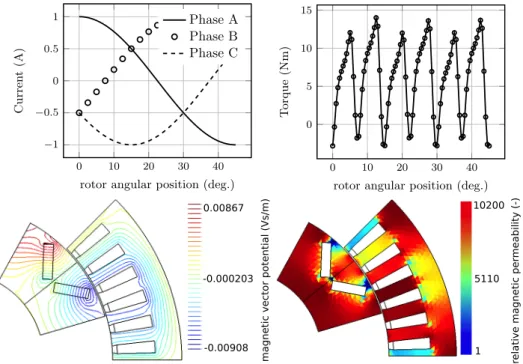
A 3-phase interior permanent-magnet synchronous machine (PMSM) fed by a sinusoidal current is considered. We describe the geometry of the PMSM by a two dimensional CAD model. The PMSM behavior is modeled as a nonlinear magnetostatic formulation written in terms of the magnetic vector potential, see Fig. 3.1. These kinds of machines exhibit magnetic saturation (which occur in steel parts) and suffer from a high level of torque ripple which should be reduced as much as possible, while keeping the average torque above or equal to the nominal torque of the machine.
0 10 20 30 40 −1 −0.5 0 0.5 1
rotor angular position (deg.)
Curren t (A) Phase A Phase B Phase C 0 10 20 30 40 0 5 10 15
rotor angular position (deg.)
T orque (Nm) 0.00867 -0.000203 -0.00908 magne tic v ec tor p otenti a l (Vs /m) 10200 5110 1 relati ve ma gnetic per me a bil ity ( -)
Figure 3.1: A 3-phase interior permanent-magnet (IPM) machine fed by a
si-nusoidal current, top left, and modeled by a nonlinear magnetostatic formulation in terms of the magnetic vector potential A, isovalues shown in bottom left, is considered. The magnetic permeability map at a given rotor position, bottom right, indicates a magnetic saturation (blue) in many regions of the steel parts where the induction flux is high. The torque ripple, top right, is particularly high for this type of machines. It should be reduced as much as possible.