Review
Human-rover interactions and swarm algorithms of
mobile robots in an open and crowded environment: a
survey
Maxime Vaidis1,† , Martin J.-D. Otis∗1,†
1 University of Quebec at Chicoutimi, LAR.i Lab, Saguenay, Canada
* Correspondence: [email protected] † These authors contributed equally to this work.
Abstract: As a result of extensive research in the field of mobile robots (rovers) and swarms, a number of 1
algorithms exist to assist them for executing a mission in the three levels of software architecture: strategic 2
(interaction loop level), tactic (planning) and operational (sensing, control and actuation). They allow them 3
to achieve their goals while adapting to their environment through a multitude of methods designed for each 4
situation. For this reason, a literature review of the latest research conducted in previous years is required to 5
identify new research trends in human-swarm interaction applied to help humans in hazardous environment such 6
as militarized zone. In this paper, we will present some interesting algorithms for interactive and autonomous 7
mobile robots acting in swarms in an open and crowded environment. A discussion will focus on comparing 8
different algorithms and their advantages and disadvantages. 9
Keywords: Swarm mobile robots; human-swarm interaction; autonomous rovers 10
1. Introduction 11
The study of mobile robots swarm has reached a high level of maturity including human-swarm interaction 12
(HSI) [1]. A swarm improves complex task execution when decentralized sensing is required compared to a 13
single robot, for example in applications such as field exploration, search for a target, surveillance or rescue. This 14
is possible because of their number as well as their group intelligence which allows distributing tasks between 15
robots in the swarm. The fact that each robot communicates with each other both for decision making and for 16
sharing information about their perceived environment, allows the robustness of the actions of the swarm. This 17
communication also helps the detection of a problem on a robot along and allows the swarm to adapt to the 18
situation either by helping the robot in difficulty, or by replacing it with an operational robot. Depending on 19
its level of autonomy, the swarm can perform more or less complex tasks. Most of modern mobile swarms are 20
controlled by one or more operators. They must follow the evolution of robots, and influencing their performance 21
if necessary, usually by assigning them a different goal to achieve. The implementation of more automated 22
robot swarm faces many problems. One of them, and not the last, is to find an optimal balance between the 23
individual command of a robot and the overall performance of the swarm. The robot must have enough liberty 24
for being capable of doing his actions, but it must comply with aims of the swarm. Another important problem 25
is the planning of the trajectory. The swarm must ensure that each robot which composed it is moving to the 26
right direction and avoids obstacles present on the road. Literature, for this subject, is massive for the simple 27
robotics systems. There are many types of planning suggested: a local and an overall. The local one works on the 28
assumption that the robot doesn’t have all the information between his position and the one of its aim. Therefore, 29
it must progress towards the aim with the information he is detecting as it progresses. In contrast to, the overall 30
planning is only possible if the robot knows its entire environment between its position and the targeted one. The 31
first planning is often preferred because the environment in which robots are progressing is variable. A large 32
number of algorithms for simple robotic systems exist for this purpose; most of them are inspired by the animal 33
or physical world such as genetic algorithms or potential fields. There is currently no literature review presenting 34
algorithms used for moving swarms of mobile robots. This review will therefore aim to fill the information gap 35
on trajectory planning concepts for robot swarms by identifying key issues and future work. Firstly, we will 36
introduce our article selection methodology for our review in Section II, and secondly, we will present in detail in 37
section III the concept of robots swarm, specifically the objectives that they are asked to fill. Section IV will 38
focus on the interaction media between a human and a swarm of robots. In this context we will try to answer the 39
following questions: 40
1. Which media are currently used to control a swarm of robots ? 41
2. What are the constraints of use of each of the supports ? 42
3. How does interaction support influence the relationship between the robot swarm and humans ? 43
4. How does this support influence the level of autonomy of the swarm ? 44
Taxonomy of these interaction supports will be presented in section IV as well as the answer to the questions 45
above. A discussion will present our conclusion. Section V will focus on the different algorithms used by mobile 46
robot swarms in an open and cluttered environment. We will try to answer the following questions: 47
1. What are the existing algorithms ? 48
2. In what ways does the algorithm used influence the performance of the swarm ? 49
3. In which contexts can each algorithm be used ? 50
4. What level of autonomy does the algorithm offer to the swarm ? 51
5. Which constraints of use does the algorithm impose on the swarm ? 52
We will propose taxonomy of these algorithms as well as a discussion detailing our conclusions. Finally, 53
we will conclude our discussions on the remaining problems and issues which have to be resolved and future 54
research to be carried out. 55
2. Methodology 56
2.1. Database Searches 57
We have carried out an in-depth two-step search on swarms of mobile robots, both on the means of 58
interaction between these and the operator, as well as the various algorithms that can exist to make them evolve 59
in an open and cluttered environment. Firstly, we did some research based on the Scopus database for articles 60
related to the domains of the swarms of robots. We used keywords such as ’swarm interaction human’, ’human 61
swarm mobile robot interaction’, ’swarm robot interaction human’, ’mobile swarm intelligence’, ’swarm motion 62
planning’,’swarm outdoor’. Secondly, we manually kept the articles which are about our subject. 63
2.2. Criteria of inclusion and exclusion 64
Our selection criteria for scientific articles are based on the definition of a swarm of robots given in the 65
previous chapter. Indeed, we only selected swarms of robots completely or in mobile parts on the ground. We 66
will not consider drone swarms because many of their characteristics are different compared to mobile swarms of 67
robots. For instance, due to less power autonomy and weight load of sensors, they need different strategies to 68
pursue their goals. We have read the selected articles and those deal with either interaction between a human and 69
a swarm, or algorithms making them evolve in an open and environment cluttered environment. After applying 70
these criteria, we found 12 articles concerning the human-swarm interaction and 60 articles concerning the use of 71
algorithms which can evolve a swarm in an open environment with obstacles. These articles will be analyzed and 72
discussed in this survey. 73
3. Swarm of Robots 74
3.1. Definition and proprieties of a swarm 75
Unlike most existing robotic systems, swarm robotics bear a very large number of robots and promote scaling, 76
which implies that the swarm must work regardless of its size (from a certain minimum size). Their number varies 77
from fifty to a hundred robots. Favored forms of communication are the use of local communications, infrared or 78
wireless. Moreover, each robot composing the swarm has a simple individual performance are almost identical 79
to each other and for most of the swarms, its control is done in decentralized mode. For swarm systems in 80
decentralized mode, the individual performance of each robot is asynchronous, which means that the sequence of 81
their perception-decision-action loop (sensing, processing, until servomotor actions) is performed independently 82
of other robots. They do not have a global knowledge of the system in which they cooperate. 83
These various characteristics of the swarms of robots allow them to have certain properties compared to 84
simpler and less complex robotic systems: 85
Unit replacement : 86
Each robotic unit making up the swarm is easier to reproduce and replace if there is a problem (a 87
hardware failure, a bog, battery failure, etc.). 88
Swarm adaptation : 89
The swarm is able to adapt in a better way compared to an external disturbance due to its environment. 90
This flexibility implies a capacity to propose solutions adapted to the tasks which have to be carried 91
out. 92
Complex tasks : 93
It can also perform more complex tasks thanks to its multiple computing units that compose it. 94
Redundancy : 95
The redundancy of perceived information promotes the stability and robustness of the system. This 96
implies the capacity of the swarm to continue to function despite the failures of certain individuals 97
composing it and/or the changes that may occur in the environment. 98
3.2. Targets searched 99
The design and manufacturing of a robots swarm must, before anything else, be made as a function of the 100
utilization of it. The swarm must be adapted to the task it does, otherwise the aim may not be achieved. Through 101
the reading of these articles, we have arranged into three categories: (1) navigation and trajectory, (2) task to do 102
and (3) maintains the structure of the swarm aimed for the conception of these swarms. 103
3.2.1. Navigation and trajectory 104
This category is the one that the majority of swarms of mobile robots must accomplish. It comes into two 105
subcategories: 106
• exploration and avoidance of collision and 107
• reach a targeted position given by an operator or by the swarm itself. 108
We will detail in Section V the existing algorithms for achieving this objective. 109
3.2.2. Tasks to do 110
One of the advantages of robots swarms is that they can do many tasks faster by dividing the work. 111
Seven tasks done by swarm are presented in this paragraph and papers which are doing these tasks are 112
listed: 113
Localisation of the target : 114
Husnawati and al. [2] have developed a robot swarm to identify a gas leak. Aniketh and al. [3] set 115
up a swarm to find people who needed help. The literature review by Senanayake and al. [4] and 116
Saeedi and al. [5] describes most of algorithms which can locate a target. Garzn and al. [6] created 117
a swarm capable of detecting a chemical source or radiation source, particularly for mines. Fricke 118
and al. [7] have drawn on immune system T cells to develop a target search algorithm that can be 119
applied to robot swarms. Zhang and al. [8] have developed a swarm capable of assisting a hunter in 120
locating a target for hunting. 121
Surveillance of a region : 122
Hacohen and al. [9] have created a swarm capable of intercepting targets which are not desirable in 123
a surveyed zone. In [8], the robot swarm also allows the survey of the zone with the aim of finding 124
prey for hunt. 125
Rescue : 126
In [3], the swarm can locate a person in order to warn the emergency services so as to step in. The 127
possibility of location offered by [4] and [5] also helps warning emergency services if a person in 128
danger is found. Gutierrez and al. [10] propose a humanitarian swarm platform of multifunctional 129
robots (land, sea, air) that help rescuing people in danger during natural disasters. 130
Follow-up of a target : 131
The literary review [4] describes the existing algorithms for the follow-up of a target by a robot 132
swarm. 133
Prevention and detection of a forest fire : 134
The literary review [5] proposes a robot swarm which is capable of detecting and warning the 135
emergency services in case of forest fire. 136
Maintenance of installation : 137
The literary review [5] also proposes a robots swarm which can ensure the maintenance of the 138
installation. 139
Transport of material / cooperation : 140
Contreras-Cruz and al. [11] have created a swarm of mobile robots that can transport objects in 141
warehouses. Ardakani and al. [12] offer a swarm of robots capable of transporting plastic plates. 142
Sun and al. [13] have also developed a swarm of robots that can carry objects in a warehouse. 143
3.2.3. Maintains the structure of the swarm 144
The structure of the swarm considers its geometric formation in the space under some constraints such as 145
battery level, geometry of the environment while exploring different zones, signal strength to share wireless data, 146
etc. Then, we can fond these constraints to maintain the structure of the swarm: 147
Adapt the size of the swarm : 148
Zelenka and al. [14] propose an algorithm capable of adapting the size of a robots swarm during 149
the exploration of a zone. When there are too many robots in the swarm located in a same zone of 150
proximity, they can take the decision of exploring another zone. 151
Data sharing : 152
Dang and al. [16] have chosen as strategy as its swarm of robots to share all the data concerning 153
their environment between them to make some exploration of ground. 154
Coordination of the swarm : 155
In[11], the use of an algorithm of colony of artificial bees allows maintaining the cohesion of the 156
swarm. Bandyopadhyay and al. [17] have created an algorithm using the properties of the chains of 157
Markov to make sure of the stability of them swarms. Araki and al. [18] leans on an algorithm of 158
optimization of movement of a swarm of robot taking into account the environment of the mobile 159
and flying robots, load of their remaining battery as well as their objective to achieve. Hattori and al. 160
[19] present an algorithm of estimation of position for mobile robots to maintain their formation 161
during their movement. Luo and al. [20] use an algorithm of movement of a swarm of robots in 162
which robots find a way with comparisons with the others and move forward according to some 163
random movements. Das and al. [21] proposes an improvement of the algorithm Particle swarm 164
optimization to maintain the coordination of the swarm. Bandyopadhyay and al. [22] using a 165
probabilistic approach to lead the swarm of mobile robots. Liu and al. [23] present a swarm of 166
mobile robots capable of adapting to its environment by ensuring that robots agree with each other 167
thanks to the data collected on their environment. Poundmaker and al. [24] are based on an algorithm 168
that keeps the formation of the swarm of robots thanks to the position of the leader and the position 169
of the robots relative to each other. Wallar and al. [25] use the combination of potential fields and 170
probabilistic methods to maintain this coordination. Kim and al. [26] created a Firefly algorithm to 171
satisfy this objective. Chang and Al [27] have developed an algorithm capable of maintaining the 172
formation of a swarm of mobile robots subjected to strong disturbances due to wind. 173
Energy optimization : 174
Jabbarpour and al. [28] based on an improved ant colony algorithm to optimize the energy 175
consumption of a mobile robot swarm. As mentioned earlier, Araki and al. [18] also uses an 176
energy optimization algorithm for its swarm. 177
3.3. Conclusion 178
As we have seen, swarms of robots can have many purposes depending on their ability to achieve a task. 179
All of these tasks and actions can be done if the swarm is able to move itself into the environment of its mission. 180
In order to do these, the swarm needs algorithms to plan it path and move. The next sections will present many 181
algorithms developed to achieve these goals, according to the type of the swarm. We will do a taxonomy to sort 182
them and compare them between each other. 183
4. Ways of interactions for human being-swarm 184
The interaction between a human and a swarm can pose many problems and issues. Indeed, there are many 185
obstacles that can prevent the swarm from achieving the human objective: 186
The human objective : 187
This must be attainable by the swarm according to its capabilities. If the target is too complex for 188
the swarm functionalities, it will not be achieved. 189
The means of communication : 190
In order to communicate their objectives, the operator must use an appropriate means of bidirectional 191
communication enabling both operator and swarm to be understood. 192
The travel environment : 193
Depending on the environment, the difficulties to move a swarm will have different. In outdoor sites, 194
weather conditions and fields of deployment are the main challenges to overpass. In indoor areas or 195
building, communication between the swarm and operator can be very difficult due to the loss of 196
communication signals. The difficulty also increases if the operator does not have a line of sight on 197
the swarm, but control it through a graphical interface giving him the essential information. 198
The level of autonomy of the swarm : 199
if the swarm is very dependent to the operator decision, the operator must constantly observe the 200
evolution of the swarm and guides the swarm in his task. With a swarm with a high level of autonomy, 201
this would not be the case. An optimal operational shared autonomy between swarm and an operator 202
depends on the mission and environment complexity. An operator should only submit commands at 203
a strategic level. Of course, a complex mission could require to submit command at a tactical level. 204
The strategy chosen will influence the number of robots deployed. 205
The number of robots composing the swarm : 206
as more robots is composing the swarm, more difficult it becomes for the operator to control the 207
swarm behavior considering all constraints such as battery level, the current state of the mission and 208
what has been accomplished in the mission. 209
4.1. Swarm Interaction Taxonomy 210
In this section, we will present the studies that have been conducted for this purpose. Figure 1shows a 211
possible taxonomy for these different means of interaction depending on the support used. In this figure, hybrid 212
method is possible such as using Augmented Reality to see the swarm, Haptic to control the structure of the 213
swarm and electrocardiogram to control, as an example, the velocity and orientation of the swarm. 214
In their article, Bowley and al. [29] propose to control a swarm of robots from a phone or tablet with their 215
touch screen. It has several functions that can be used thanks to the finger movements (touching or removing 216
Way to interact
Ecran Sans écran
Portable Fixe Geste Sans geste
Ecran tactile Google Glass Montre connectée Interface graphique Caméra Jostick Myogram me Gant Yeux Haptique Voix EMG Ceinture connectée Vêtement connecté EEG Main/Bras Way to interact Screen Without screen
Wearable Fixed Gesture Without gesture
Hand/
arm Eyes
Touch
screen Google glass / Augmented
reality
Smart watch
Graphic
interface Camera Smart belt
Smart
clothing Voice EEG EMG
Gloves Myogramme Jostick Haptic
Figure 1. Taxonomy of interaction support for mobile robots swarm
fingers, scanning the screen, enlarge or reduce with two fingers, etc.). With this interface, it uses an algorithm to 217
influence the behavior of the swarm through several attractive or repulsive beacons: 218
The attractive Beacon : 219
It attracts the robot swarm towards its position. 220
The obstacle beacon : 221
It emits repulsive force so that the robots avoid going to its zone and thus avoid collision with the 222
obstacle. 223
Recall Beacon : 224
Similar to attractive Beacon. It is used in an emergency or at the end of a test exercise. 225
The management beacon : 226
It is supposed to lead the swarm towards its objective. 227
The Beacon circle : 228
It is a mix between the attractive Beacon, the obstacle Beacon and the management. It’s used for 229
zone control. 230
Dividing or multiplying Beacon : 231
It is used to change the perception of the environment of robots in an area in order to change their 232
behavior accordingly. 233
Each of the beacons located on the screen has a modifiable influence radius. Simulations have been carried 234
out to validate the operation of this concept, which allows the behavior of a swarm of robots to be intrinsically 235
modified. 236
Crandall and al. [30] have developed an interface that allows an operator to interact directly with a swarm 237
of modeled mobile robots following a bee colony. Thus, the goal of the swarm is to find quality sites to collect 238
resources. Each robot behaves like a bee. It can enter different states: exploration, observation, pause, evaluation 239
and dancing as a message. Each bee will initially explore an area at random. If she encounters a potential site, 240
she will evaluate it and go back to the colony to dance more or less according to the quality of the site. Then she 241
rests before starting the cycle again. Observers watch bees dance to visit potentially interesting sites. If many 242
bees have detected a good site, the colony will exploit it. Initially, the authors of the article performed computer 243
simulations of a bee colony. Subsequently, they wanted to improve the safety and speed of bee exploration. To do 244
so, they allowed an operator to place beacons to guide bees in their tasks, and then they evaluated the impact of 245
this interaction on the robot swarm. From this experience, they were able to define several categories of control 246
on the swarm: 247
Parametric control : 248
It can be achieved by exciting or inhibiting the behavior of bees in their exploration whether by 249
specifying a direction of research or altering their speed. 250
Association control : 251
The operator can directly control one robot of the swarm, which will then influence the overall 252
swarm. 253
Environmental monitoring : 254
This is done by placing attractive or repulsive beacons in the bee environment. 255
Strategic control : 256
It is to ensure that the swarm changes the allocation of these own objectives in order to select the best 257
strategy to adopt. In this case, it would be to reassess the quality of a site after a certain operating 258
time. 259
In conclusion, the authors admit that these methods of influence work well if the operator knows exactly 260
how to give the tasks to be carried out by the swarm and accepts the sharing of control with it. 261
Kim and al. [31] have developed a swarm of mobile robots capable of tracking people’s movement. The 262
system consists of three steps: (1) sequence of operation, (2) receiving/sending messages and (3) approximate 263
location of robots. This interaction takes place through a connected watch and a connected belt. The swarm is 264
composed of a leader who receives orders from the watch via a Bluetooth Low Energy (BLE) communication. 265
The belt is used to assess the distance between the person and the swarm through infrared communication. The 266
leader then sends instructions to the other robots by radio and infrared communication. The authors created the 267
communication protocol for this swarm in order to keep it in formation. This system works for a small number of 268
robots. Indeed, the authors tested their system with real mobile robots and realized that communication becomes 269
noisy if the number of robots is high. The user can choose the formation of the swarm when moving according to 270
several prefixed patterns. 271
In order to interact in various ways with a swarm of robots, Ferrer [32] makes an enumeration of various 272
physical supports existing for this purpose. First of all, he takes a gesture taxonomy from the existing hand to 273
be able to apply it to a swarm of mobile robots. This gesture recognition is done via a camera that associates 274
the gesture with a command to be made for the swarm. Of course, hand gesture could also be executed with an 275
electrocardiogram (EMG) such as with an eight-channel armband [33]. In his paper, Mendes and al. described 276
how they can obtain better results by selecting the best feature reduction process of EMG signals data before the 277
classification of gestures. Then another method of communication with the swarm is presented. Several studies 278
have been carried out on the interaction between a swarm and a human via the haptic, especially with the aim of 279
obtaining feedback from others than visual information in order to help the operator in his control. The operator 280
uses some haptic sensors which send some feedback to him. It no longer only makes the human being an external 281
operator of the swarm, but rather a special member of the swarm. Both methods are hard enough to put in work 282
and cannot allow to interact with a large swarm. Subsequently, a presentation of various means of interaction by 283
augmented reality is presented. Finally, Ferrer concludes on portable tools on a human that can act as a support 284
for interaction between a swarm and an operator. First, a gesture recognition can be done by a armband that can 285
recognize the gestures of the fingers, hand and wrist thanks to the muscles of the forearm. The armband used was 286
a Myo armband by Thalmic Labs. With each of these gestures, we can associate a command with the swarm. 287
Then, always for gesture recognition, it is possible to use the Leap Motion [62] to detect the movement of the 288
fingers via infrared light. It identifies the gestures of the fingers, their movements and their spatial coordinates if 289
necessary. It is a precise tool that can provide a wide range of control for an operator. The last physical support 290
presented is a vest for video game players acting as a connected garment. It is equipped with haptic devices that 291
allow the user to feel in immersion in a chosen environment. Ferrer concludes by comparing the advantages and 292
disadvantages of different media of interaction. 293
In their work, Mc Donald and al. [34] developed a method of interaction with a swarm of mobile robots 294
based on haptic. The purpose of the robot swarm is to carry out patrols and encircle buildings at the request of 295
an operator. When robots encircle a building, they are represented by virtual force fields which then allow the 296
formation of the swarm to be represented by a flexible virtual ring. The operator can perform three types of 297
handling when the robots are in encirclement mode: 298
Shape exploration mode : 299
The haptic tool allows the operator to feel the shape of the swarm without changing it. This is 300
possible because of the virtual force field is created by mobile robots. 301
Shape manipulation mode : 302
This mode allows the operator to modify the formation of the swarm by means of the haptic remote 303
control which changes the shape of the virtual ring. 304
Spacing mode : 305
In normal mode, the spacing between each robot is identical. This mode allows the operator to 306
change these values. The operator also has actions to perform during the patrol of mobile robots. 307
Near travel mode : 308
This mode activates if the swarm has selected its target position to be reached and it is not in 309
encirclement mode. Its purpose is to allow the operator to reach the target position faster. 310
Shape exploration mode : 311
During the work of the swarm, the operator may choose to feel the formation chosen by it without 312
modifying it. 313
Mc Donald and al. were able to simulate their systems in order to validate them and test the effects of this 314
physical medium on the performance of the operator’s controls on the swarm of mobile robots. 315
Kapellman and al. [35] suggest using as physical support as Goolge Glass. These allow an operator to guide 316
a swarm of robots for the transportation of an object. One of the robots is appointed as being the leader of the 317
swarm. It is him whom the operator can influence. It will act as an intermediate objective which the other robots 318
are going to recognize and follow. The operator has the possibility of choosing the leader among the robots of 319
the swarm. He can also check the state of each robot by selecting him and communicate orders via Bluetooth: 320
Start the task of the robot : 321
It is the basic behavior of the robot that is activated. 322
Become the leader : 323
Movement of the robot can be directly controlled by the operator (go ahead, back, turn right/left, 324
stop). 325
Overdrive mode : 326
The robot must ignore all commands from a remote control other than glasses. 327
Disconnection : 328
Via connection. 329
These instructions can be given by the voice command or by touching the glasses. This support could be 330
tested with a real swarm of mobile robots. The authors conclude that this medium allows the operator to have 331
free hands to perform other actions. It was also demonstrated that interaction allows for dynamic selection of the 332
target to reach. 333
In their work, Mondada and al. [36] decided to process Control operator’s EEG signal so that it can select a 334
swarm’s robot to control it. It is based on the stationary state of the potential evoked by vision (Steady-State 335
visually evoked Potential: SSVEP). This detection will be done by flashing light on each robot, allowing to 336
know whether the selected robot is the one the operator wants. For this, an EEG acquisition helmet is placed 337
on the operator’s head. Three parameters are important to extract the SSVEP signal from the EEG: the flashing 338
frequency of the lights, the color of the lights and the distance to the stimulus. The authors used existing literature 339
to select the ranges of parameters to be tested. The blinking frequencies were chosen according to [63] study. 340
The distance between the target and the operator was chosen according to [64] study. For the color of the LED, 341
the authors decided to make their own selection because the scientific community is not able to give the best 342
one (there is some debate between white, red, green and blue). Several tests were conducted with individuals. 343
The results indicate that the success rate varies greatly from person to person (on average 75% success with a 344
standard deviation around 15% of success depending on the frequencies used). The authors stress that the more 345
trained operators are in this process, the better the results will be. This method also has a delay of several seconds 346
in the recognition of the signal, as does gesture recognition by image or voice. The main disadvantages are the 347
uncontrollable factors for a real application such as the personal attitude of the different operators, the distance 348
from the robots, the brightness, etc. 349
In their article, Setter and al. [37] based on the haptic in order to get feedback about the swarm of mobile 350
robots. The swarm used is made up of a leading robot and other followers robots that maintain a given formation. 351
The operator can control the speed of the leader, which can influence the behavior of the swarm. This is done 352
through a haptic device. The feedback given by the force of the haptic device indicates to the operator whether 353
his control is good or bad for the swarm, that is to say whether the speed of the following robots is more or less 354
different from that of the leading robot. This information allows the operator to adjust the leader’s speed. The 355
authors have successfully experimented their systems with a real swarm of mobile robots. 356
Podevijn and al. [38] have developed a gesture recognition interface capable of ordering a swarm of mobile 357
robots. A Microsoft Kinect RGB-D sensor is used for body tracking and to identify the gestures of the user 358
This interface allows the operator to dedicate himself fully to the management of his swarm. The contribution is 359
to have a simple command interpreted by the swarm of decentralized robots but also to allow it to make some 360
feedback. Since a swarm is too difficult to command directly, the authors decided to subdivide it into several 361
sub-swarms. The following commands are used by the operator: 362
• Direct: the operator can guide a sub-swarm to a target position. 363
• Stop: the sub-swarm stops. 364
• Division: creation of new sub-swarms. 365
• Merger: gathering of two sub-swarms. 366
• Selection: the operator chooses the sub-swarm with which he wants to interact. 367
Each of these controls is associated with a gesture of the operator’s arms. Eighteen participants were able to 368
test this interface with a real swarm of mobile robots. 369
Kolling and al. [39] provide a 2D graphical interface, which is optimized to display only important 370
information for the operator, to simulate interaction with a swarm of mobile robots. The robots move following 371
Voronoï graphs based on [65], in the environment to be explored. For each new information retrieved, they 372
must return to a departure station that will update the swarm movement card. The operator can visualize these 373
movements from its interface and interact with a mouse on the swarm via a few commands: stop, go to a zone, 374
appointment point, deployment, random movement, update data, leave a zone. It can also use other means of 375
control, such as a robot selection rectangle, which then defines a sub-swarm obedient to different commands of 376
the swarm in general, but also places a Beacon that attracts robots to its area. 377
Diana and al. [40] use a joystick made of modeling paste as a physical medium for interaction. This allows 378
the operator to control the formation of the robot swarm. It uses modeling paste to define the desired formation 379
for its swarm. A camera takes the form and compares it to a library to perform the reconnaissance. Once this 380
is done, the information is sent to the swarm who performs the desired formation using a method based on 381
minimizing the energy of the system during its displacement. Simulations were carried out with a real swarm of 382
mobile robots. 383
Alessandro and al. [41] have developed a human-swarm interaction based on the recognition of hand 384
gestures. For this, the authors based themselves on 13 gestures and collected 70,000 images of those by cameras 385
representing the position of all the fingers of the hand. These data were used to train a vector support machine 386
that will perform the classification of the 13 gestures by affecting a probability of belonging to a category to the 387
gesture to be recognized. Every swarm robot has a camera on them. They move around the operator to improve 388
their point of view and facilitate gesture recognition. The robots then share the information obtained by their 389
classification and the swarm makes a decision afterwards. 390
4.2. Discussion 391
Table 1shows a summary of the various interaction media. Through these various articles, we have been 392
able to observe the diversity of the interaction between human and swarms. These have several advantages and 393
disadvantages depending on their nature. One of the advantages that we find quite often is to be able to control 394
the formation of the swarm in order to adapt it to its changing environment. Despite this control, the operator 395
must always be able to explicitly give a target to the swarm. There is no interaction support that can do this 396
implicitly. This has an impact on the autonomy of the swarm, which certainly remains at a fairly high level but 397
Table 1. Summary of the various supports of interaction. Part 1. Papers Way of
interaction
Type of interaction
Interaction context Swarm autonomy Advantages Usage constraints
Qin and al. [29] Touch screen on the phone or tablet Beacon to influence the swarm Change behavior of the swarm to easily
explore areas
The swarm needs only a target to work
Change global behavior of the swarm without complex commands
Not allow selecting robots separately Crandall and al. [30] Graphic interface Change parameters of a swarm algorithm Change behavior of the swarm to easily
explore areas
The swarm needs only a target to work
Allow us to have a deep control on the swarm behavior
Need knowledge about the algorithm
to use it correctly. Not allow selecting robots separately Kim and al. [31] Smart watch/belt Command send to the leader
Control the form of swarm during his
motion
The swarm control his motion and the
form ordered
The operator controls the swarm’s
form
Not possible to control the motion of the swarm and to
select one robot separately Ferrer [32] Hand gestures by camera/ haptic/ Myo band/ connected vest Command to control the swarm form Feel the feedback of the swarm
Control the form of swarm during his
motion
The swarm control his motion and the
form ordered
The operator controls the swarm’s form and have some
feedback
The operator should see the swarm and each of his gesture could be interpreted as a command Mc Donald and al. [34] Haptic Control the form of the swarm and change it if needed
Control the form of swarm during his
motion
The swarm needs only a target to work
Many people can control the state of
the swarm at the same time
The operator can’t see the swarm. He
can only feel feedback provide by the swarm Kapellman and al. [35] Google glass Command send to the leader Allow us to guide the swarm during the transportation of
objects
The swarm needs a regular monitoring to achieve his target
The operator can select any robots and can send many orders to the leader
The operator should follow the swarm during his motion. He also should see it Mondada and al. [36] EEG signal Select one robot by thought and vision Allow us to select a robot in order to perform a task The selection depends of the operator
The operator doesn’t need to do gesture to interact with the
swarm
This method is difficult to apply and
needs learning (depend of the operator) Setter and al. [37] Haptic Command send to the leader Allow us to control the behavior of the swarm through the
leader
The swarm needs a regular monitoring to achieve his target
The operator can change behavior of the swarm through
one robot
The operator should follow the swarm during his motion. He also should see it Podevijn and al. [38] Gestures recognition Control the swarm form
The operator can give order by selecting one or
several robots
The swarm follows the choice of the
operator
The operator can guide the swarm like
he wants
The operator should check the behavior
of the swarm constantly Kolling and al. [39] Graphic interface Give order to the swarm (shape and target)
Change shape of the swarm during his
motion to easily explore areas
The swarm needs only a target to work
The operator can select any robot and
give him several orders
The operator should follow the swarm during his motion. He also should see it
Diana and al.[40] Joystick and camera Control the form of the swarm Allow us to select the form of the
swarm
The swarm follows the choice of the
operator
The operator can select any form for
the swarm
Quite some time is required before a command is executed by the swarm Alessandro and al. [41] Gestures recognition Decision taken by the swarm
Give some orders to robots by gestures
The swarm follows the choice of the
operator
The operator can select any form for
the swarm
The operator should see the swarm and
make an exact gesture to give an
cannot be completely autonomous in its decision-making. Its autonomy is limited to planning its displacement 398
and mastering its deployment training. The following section will be devoted to algorithms that can perform 399
these actions. 400
5. Algorithms to motion a swarm in an open environment with obstacles 401
There are many challenges in moving swarms of robots, especially if their environment is crowded. Because 402
of this uncertain environment, uncertainties may arise when operating mobile robots. These may be due to 403
vagueness of sensor measurements, lack of environmental knowledge and lack of control of external disturbances 404
on robots. It all depends on the setting up of the swarm as well as the type of environment in which they operate. 405
One of the big challenges today is to allow robots to operate in an environment without having to adapt the 406
environment for robots, that is, robots are self-sufficient to carry out the mission. In these circumstances, ensuring 407
the performance of a task under the conditions of safety and efficiency requires consideration of the environment 408
as it can be perceived by embedded sensors. In addition, the swarm must be equipped with algorithms enabling it 409
to move and be able to perform the tasks it must perform. This section will be devoted to the presentation of 410
existing algorithms for this purpose. We will describe them and discuss their effectiveness. We will also present 411
a taxonomy of these swarm algorithms inFigure 2. 412 Algorithme pour essaim de robots mobiles Centralisé Décentralisé Distribué Non-distribué
Déterministe Probabiliste Heuristique
Déterministe Probabiliste Heuristique Déterministe
Mobile robots swarm algorithms
Centralized Decentralized
Deterministic Probabilistic Heuristic
Deterministic Probabilistic Heuristic Deterministic
Undistributed Distributed
Figure 2. Taxonomy algorithm for mobile robots swarm
5.1. Centralized swarm 413
A centralized swarm is a swarm controlled by a leader, which can be a robot of the swarm or a distant 414
server which sends command to the robots. The leader can also be a human operator sending the commands to 415
the swarm. In this section, we will present all the algorithms developed for this kind of swarm. 416
5.1.1. Deterministic algorithm 417
Vaidis and Otis [47] create a swarm which is capable of adapting it shape according to the displacement 418
of a group of migrants. The main purpose of this swarm is to protect these people from an attack when there 419
are moving. The swarm is commanded by a leader which analyze the situation and send some commands to all 420
robots. The algorithm used to control the position of each robot is divided into three steps. The first step is to find 421
the position around the people each robots will have to reach. The position of people is processed and allow the 422
swarm to create a convex hull around them. Each robot have a position to reach on this convex hull, where these 423
positions are uniformly distributed according to the number of robots. Then, a path planning algorithm is used to 424
compute the path of each robot in order to reach their position targeted. The path planning used a Vector Field 425
Histogram (VFH) method [78] to detect obstacles and bypass them. The last step is an algorithm which takes 426
the result of the VFH algorithm, and convert it into a motor command for each robot. This last algorithm used 427
a fuzzy logic to find the good command according to the target position and the obstacle avoidance. With all 428
these three parts, the leader is able to control all the robots and move them around the group of migrants. Vaidis 429
and Otis also used a state detection algorithm in order to detect some issues with robots. This algorithm used a 430
Convolutional Neural Network (CNN) to process the data coming from an Inertial Measurement Unit (IMU). 431
The data of the IMU are converted into a picture, then these pictures are analyzed by the CNN to find the state of 432
the robots. Four states where studied: normal state, fallen state, skid state and collision state. The result shown a 433
good performance of the detection compared to other methods used. The goal of this detection is to find an issue 434
on one robot, and then replace it by another one of the swarm to do the task he can’t do anymore. The swarm was 435
tested into an indoor environment with real robots. 436
Qin and al. [42] Developed an algorithm in 3 stages which can make this mission for a marine swarm of 437
robots: assignment of the objectives, the planning of the trajectory and order of engines. An operator is necessary 438
to oversee the swarm. This one can send simple orders to robots as for example the objective to achieve. The first 439
stage tries to position robots with regard to the others. A central point is located and their position is defined by 440
the variation of their distance face to face of this point. Then, the algorithm tries to define the best orientation 441
and the speed to be given for robots. To avoid collisions between robots or with obstacles, a method of the fields 442
of potential is applied. It gives the desired orientation value and speed for the movement of each robot. Robots 443
are controlled by a Lyapunov function [66].Simulations were conducted to validate the algorithm in different 444
situations. They are able to deal with different kinds of barriers and do optimization, computation and analysis in 445
real time. The formation of the swarm is not maintained but this does not prevent it from achieving its objectives. 446
Araki and al. [18] offer a system capable of directing robots that can fly and move on the ground call 447
Crazyflie. This flying car is composed of two wheels, a ball caster, a motor for the wheels and four motors for the 448
rotors used as a quadcopter. The weight of the platform is around 41 g. The swarm takes into account the energy 449
consumption of each of the robots to carry out their displacement. Two algorithms share this task: one performs 450
the path planning for the swarm, the other optimizes the solutions found by the first. Trajectory planning is based 451
on a graph of the robot environment. A travel energy cost function for each robot is defined and will need to be 452
minimized. The cost of travel varies whether the robot is on the ground or flying in the air. Algorithm A* based 453
on [67] is used to find a solution to the displacement problem. Several paths are considered and the optimization 454
of the problem is then carried out according to the energy consumed by the robots as well as the non-collision 455
constraints. This path planning is computed according to a cost function calculated for each edge of the map, 456
based on the work due to the displacement of the flying car. The cost function c(ei)of one edge eiis presented in 457 Equation 1. 458 c(ei) =µ W Wmax + (1 − µ) t tmax , 0 ≤ µ ≤ 1 (1)
Wmaxand tmaxare the maximum possible energy and time of any edge in the graph. W is the work due to 459
the displacement of the flying car calculate according if the car is flying or driving with the distance between the 460
edges, it power consumption and it velocity in both cases. Power consumption is calculated in real time and a 461
threshold is used to indicate the power is low and limit the displacement of the robot. The parameter µ is used 462
to tune the planner according with weight energy and time in the cost function. Simulations and experiments 463
have been carried out and have shown that robots consume much less energy by driving rather than by flying, but 464
the flying mode is quicker than the driving one. Because of this, author’s argument that flying can serve as a 465
high-cost and high-speed transport option, while driving serves as a low-cost and low-speed option. The robots 466
were also able to travel without collisions. 467
Wei and al. [43] use the principle of the graphs of Voronoï [65] to be able to move their swarm of mobile 468
robots. These have to reach a platform where they will have to make their tasks. Their environment is cut in cells 469
of polygonal shape which the center of these are is placed in their centroid (Centroidal Voronoi Tessalation [68]). 470
The algorithm acts in several steps: 471
• The target of robots is defined. 472
• The system initializes its parameters with the aim of computation. 473
• The diagram of Voronoi is generated and cells are computed. 474
• The error of position of every robot is evaluated. 475
• If this one is bearable, the algorithm pursues its execution. Otherwise he begins again from the beginning 476
by updating the position of the robot. 477
• the robot performs the given trajectory. If the target is reached, the robot performs its task. Otherwise the 478
next iteration is done to plan its next move. 479
Each robot is represented with a rectangular prism in order to simplify the recognition of collisions. Several 480
simulations were performed by varying several parameters such as the number of robots used or the error 481
tolerance threshold. They show that as the number of robots increases, the time the algorithm iterates increases. 482
Vatamaniuk and al. [44] offer an algorithm capable of representing the swarm of mobile robots with a 483
convex envelope. Each robot is represented by a small circle of a fixed radius. The algorithm consists of six steps: 484
• Analysis of the shape of the desired convex envelope and assignment of the coordinates to be attained on it; 485
• Placing possible passage points on the contour of the convex envelope to allow robots to cross it without 486
collisions; 487
• Added two normal equidistant points to the convex envelope in relation to each final coordinate point or in 488
relation to each point at the crossing points; 489
• final coordinates are assigned to each robot on the convex envelope; 490
• Track planning for robots: they must successively reach the nearest normal points in order to rationalize 491
their final objective and 492
• Setting a deadline to avoid collisions between robots. It depends on the distance between the moving robot 493
and the near one, as well as its speed. Once all the delay problems have been resolved, the order is sent to 494
each of the robots. 495
This algorithm is interesting for several reasons. First of all, the computation time is very low, which allows 496
the swarm to move in real time. In addition, the trajectories are all segments which simplify the movement of 497
robots. They change directions up to three times during their trip, saving the battery. Simulations show that 498
algorithm performance is acceptable up to 100 robots in the swarm. 499
Garzon and al. [6] have developed an algorithm that can help a swarm of mobile robots explore an area. 500
Exploration takes place in different spiral forms of robot movement. Their goal is to find a signal from a Beacon, 501
which is used to simulate mines or chemical source detections. Each robot has an area around them where they 502
can detect obstacles or listen to the transmission of information. The algorithm optimizes the movement of robots 503
to cover as much ground as possible with this area. The spirals made will move the robot from the center of 504
the area to be explored to its periphery in a square or rectangular shape. The robot sends a signal every 100 505
ms to detect the Beacon if it obtains a response, it measures the strength of the signal in order to evaluate the 506
transmitting distance. Experimentations were conducted with three robots each covering a specific area. Several 507
beacons were placed in them for the robots to detect. Comparison between the different strategies used has been 508
successful. 509
Liu and al. [23] have developed a mobile robot swarm control system that can be operated by an operator. He 510
sends orders to the group leader. The leader communicates and executes tasks to the entire swarm. Path planning 511
is done by minimizing a defined cost function for each robot. It takes into account the distance between the robot 512
and an obstacle and the distance between the robot and the rest of the swarm. The stability of the formation of the 513
swarm is controlled through a function of Lyapunov-Krasovskii [69]. Simulations were conducted to validate the 514
operation of the system in obstacle configurations and by changing several parameters. They have shown that the 515
swarm is well able to move without collisions and by maintaining training through redundancy of information. 516
Radu-Emil Precup and al. [46] have also created a trajectory planning system for mobile robots that can 517
adapt to load levels of robots. The authors consider a finite number of mobile robot composing the swarm. At the 518
beginning of the algorithm, their initial position is known. At each iteration, they will move a certain distance in 519
a straight line to their objective. The goal of the algorithm is to minimize the distance traveled for each robot as 520
well as avoid collisions. To do this, four optimization variables are introduced into the computation: 521
• One which minimizes the Euclidean distance between the position of each robot specific to the same 522
population at each iteration; 523
• Another which maximizes the distance between robots of the same population and the nearest robot of 524
another population in order to avoid collisions; 525
• The third and fourth variables are used to maximize the distance between the trajectories of each of the 526
robots in X and Y to avoid a collision and 527
• A fifth penalty variable can be added in certain situations that need to be avoided. 528
The algorithm works in five steps: first it initializes the optimization parameters, the robot population and 529
the maximum number of iterations. Then, it performs the unconstrained solution search on the robots during 530
the maximum 20% of iterations. The third step is to add to the calculations the stresses on the robots for an 531
additional 40% of the computation. The next step refines the result obtained under a threshold set by the user. 532
The last step verifies by simulation that the results obtained are correct and validate them. 533
Sun and al. [13] developed an autonomous team of robots capable of coordinating to deliver boxes of goods 534
on fixed stations in a warehouse. The robot is of a size of 50 by 50 cm possessing a weight of 60 kg as well as an 535
holonomic command. He is equipped with lidar, odometry and inertial measurement unit sensors. The position 536
of every robot is found by the law of Monte Carlo via the previous sensors. Robots synchronize together via 537
local wireless communication. This swarm possesses eight types of behaviors: 538
Follow-up points of reference : the robot reunites them one after the other until it reaches its target 539
position. If it is the case, another target will be allocated to her and it will begin again this action. 540
Avoiding : the robot bypasses the obstacle in its path and will continue to follow its landmarks. 541
Exchange : if there is a frontal collision, the two robots will bypass each other and then continue to track 542
the marker afterwards. 543
Passing through : if a side collision occurs, the robot continues its way while the other waits for it to 544
pass in front of it. Subsequently, it conducts the benchmark tracking. 545
Docking : the robot has reached its target and is placed in its intended location. 546
Waiting for a safe distance : the robot expects another robot and keeps a safe distance from it. When 547
the other robot leaves the area, he resumes his normal activities. 548
Waiting to get through : following a side collision, the robot is waiting for the time the other robot 549
passes in front of it. Then it continues its activities. 550
Waiting for docking : the robot must wait for another robot to finish mooring at the same dock. 551
All these behaviors allow the swarm to organize and carry out their tasks. The advantage of this algorithm 552
is that it does not require a computational time to do trajectory planning such as Roads maps. It can work 553
specifically in confined environments with obstacles. 554
5.1.2. Discussion 555
Table 2shows a comparison of the previous algorithms. Deterministic algorithms are not widely used to 556
move mobile robot swarms to the outside environment. This is because they have several inherent disadvantages 557
to their design. Algorithms can meet different uses for the swarm of robots as long as the objective is clear. Their 558
level of centralized swarm autonomy is less than the decentralized swarms of robots. This is due to the fact that 559
the leader of the centralized swarm has to give commands to each of the robots in the swarm. Without these 560
commands, the robots will not be able to achieve the task of the swarm. In a decentralized swarm of robots, 561
each robot communicate with each other and then distribute the tasks between each other. This prevents some 562
issues due to miscommunication between the leader and the swarm, and also allow the swarm to do difficult tasks. 563
Nevertheless, centralized swarms can perform very well simple tasks because of their ease of implementation. 564
5.1.3. Probabilistic algorithms 565
Husnawati and al. [2] use a combination of three algorithms to set up a swarm of mobile robots capable of 566
detecting gas leaks. The authors propose to use as an algorithm: 567
Blurred logic to control robots : 568
Each robot has three infrared sensors (front, left and right). The values of these are leveraged into 569
the system to allow the robot to control its speed when an obstacle is present. 570
Table 2. Comparison of the different deterministic algorithm for centralized swarm. Skills Vaidis and Otis [47] Qin and al.[42] Araki and al.[18] Wei and al. [43] Vatamaniuk and al. [44] Garzon and al. [6] Liu and al. [23] Radu-Emil Precup and al. [46] Sun and al. [13]
Swarm with leader X X
Local intercommunication X
Motion in outdoor environment X X X X
Static obstacles avoidance X X X X X X X X X
Dynamic obstacle avoidance X X X X
Control of the swarm form X X X
Map of the environment X X X X X X X X X
Storing the different motion X X
Different types of robots used X
Simulated X X X X X X X X
Real-life experience X X X X
Swarm Optimization (PSO) particle algorithm : 571
Optimize the trajectory planning of robots. If a gas leak is detected by a robot, the algorithm will 572
lead the robot to its source. Otherwise the robots move freely in the area to be explored. 573
Algorithm support vector machines (SVM) : 574
Used to detect a gas leak using MQ3 (Alcohol Vapor) and MQ5 (LPG, Natural Gas, Town Gas) 575
sensors. 576
The combination of these algorithms allows to boost the performance of robots to locate a gas leak. 577
Hacohen and al. [9] have developed a probabilistic navigation algorithm for mobile robots. The positions 578
of all objects are considered as random variables. The purpose of the algorithm is to focus on the probability 579
of localization of different objects (robots, obstacles, targets). Objects can have a different geometry of a point 580
(circle/disc of a fixed radius), which changes their probability of location. In addition, priority values can also be 581
attached to targets, which further changes their localization probability. To move robots, the algorithm performs 582
several iterations. At each iteration, a probability map of the location of objects is updated. A gradient descent of 583
the map probabilities is carried out to direct the robots towards their objective. Simulations have shown that this 584
solution can be applied to real-time problems. 585
Bandyopadhyay and al. [22] propose a new way to plan the movement of a very large swarm of mobile 586
robots by keeping a precise formation (Probabilistic Swarm Guidance using inhomogeneous Markov Chains). 587
A heterogeneous matrix of Markov with a desired stationary distribution is implemented using feedback based 588
on Hellinger’s distance. This matrix satisfies the travel constraints, minimizes the cost of transitions at each 589
moment and distributes the number of robots where it lacks. Simulations were conducted to compare algorithm 590
performance with others. It turns out that it reduces the transition costs by 16 compared to a homogeneous 591
Markov chain algorithm (HMC). Experimentations were also conducted with three to five quadrotors. In their 592
other work, Bandyopadhyay and al. [17] improved the robot control part by adding an algorithm based on the 593
Voronoï graph algorithm. It has been successfully tested. 594
In their work, Nurmaini and al. [48] have developed a fuzzy logic algorithm that allows a swarm to move. 595
The robots are equipped with three infrared sensors used for obstacle detection. A CCD camera is used for 596
experimenting and allows to see the position of the robots and their orientation. Each robot can be identified 597
by its color (in the tests: red, green, blue). All this information is given at the input of the blurred logic block 598
which sends out the engine speed (in translation and rotation) for each robot. This allows them to reach the target 599
position they have received. 600
Finally, Chang and al. [27] have developed a trajectory planning algorithm for swarms of robots subject to 601
disturbance flows. Their objective is to find the source of the flow and lead the swarm. First, the authors look at 602
the mathematical representation of a chemical plume and these characteristics. Then the problem of going back 603
to the source is posed. The swarm is made up of a finite number of mobile robots. A marker is defined and the 604
speed of each robot can be found in it. Once this is done, the trajectory planning takes place in three steps: 605
• Measuring the turbulence of the flow over a small period of time; 606
• Estimate based on probability of distance to source: the speed of the different robots is then defined for the 607
trajectory planning and 608
• Moving robots for a short period of time. 609
Simulations confirmed the validity of this algorithm based on blue crabs. The waiting time between each 610
decision-making has a great importance on the behavior of robots. The bigger it is, the more robots will go 611
directly in the right direction to find the source. 612
5.1.4. Discussion 613
Table 3shows a comparison of the previous explained algorithms. Probabilistic algorithms of centralized 614
swarms rely little on the use of maps to locate themselves. They mainly use distance sensor data to learn about 615
their environment and can plan their route. They are not very good at avoiding dynamic obstacles or controlling 616
swarm formation. 617
Table 3. Comparison of different probabilistic algorithm for centralised swarm.
Skills Husnawati and
al. [2] Hacohen and al. [9] Bandyopadhyay and al. [17][22] Nurmaini and al. [48]
Chang and al. [27]
Swarm with leader Local communication between robots
Motion in outdoor environment X X X X
Static obstacle avoidance X X X X X
Dynamic obstacle avoidance X
Control of the swarm form X X
Map of the environment X X
Storing the different motion Different types of robots used
Simulated X X X X
Real-life experience X X X
5.1.5. Heuristic Algorithms 618
Sharma and al. [49] use a new Lyapunov function acting as a field of artificial potential to control a swarm 619
of mobile robots. Their contributions relate to: 620
• Avoidance of a swarm of moving obstacles; 621
• Design of a heterogeneous robotic system in a closed environment with obstacles and 622
• Control laws for the non-linear heterogeneous robotic system and invariant according to its accelerations. 623
The swarm of mobile robots should therefore be able to avoid the other swarm of obstacles. The artificial 624
potential field represents the energy of the system and the forces generated by it or on it. The goal is to minimize 625
this function. The result is a translation and rotational control for the swarm robots. Simulations were made to 626
validate the functioning of the algorithm. 627
Roy and al. [50] compare two algorithms so that their swarm of mobile robots can move around avoiding 628
obstacles: bacterial foraging and particle Swarm Optimization. Functions designating the purpose to be achieved 629
and the obstacles to be avoided are defined. Another function defining time errors is then set from the previous 630
two. The purpose of both algorithms is to minimize this function. To do this, the swarm must first move in a 631
coordinated way, that is, each robot must have about the same average speed as well as the same average direction. 632
The control of the swarm must then be defined autonomously. Simulations show that the first algorithm is more 633
concerned with maintaining the formation of the swarm, while the second will optimize its movement. 634
In their work, Jann and al. [51] use the D*lite algorithm [74] to get a mobile robot swarm through an 635
obstacle field. Several checkpoints are defined in the obstacle zone and the robots must go through one of them. 636
Once it has passed, it goes into closed mode and no robots are allowed to return to it. The algorithm already 637
possesses information on the map and then updates itself when moving the robots. A cost function is defined 638
based on the cost of moving the robot between two nodes of the map, as well as the heuristic cost of travel. 639
The purpose of the algorithm is to minimize this function. Several simulations were carried out with different 640
changing parameters: the number of vehicles, static or dynamic obstacles. In all cases, the robots were able to 641
reach their objective without hindrance. Trajectory planning is highly dependent on the disposition of obstacles 642
as well as the grid used. 643
Devi and al. [52] using gorilla behavior to create an algorithm for moving a swarm of mobile robots. In this 644
algorithm, three behaviors are possible: 645
Action of climbing/moving : the gorilla will move to an elevation position that will allow it to have an 646
overview of its environment. 647
Observation of an easier path : once the gorilla has reached a peak, it observes the surroundings in 648
order to find a higher point to reach it. 649
Jumping : the gorilla changes position by rotating forward or backward to the new higher point of view. 650
In the algorithm, the highest point to be reached is assimilated to the target position that the robots will 651
have to reach. The robots will perform each iteration of the algorithm (three steps). However the path obtained 652
will not be optimal. This is why the authors decided to link their algorithm to the open vehicle routing problem 653
(OVRP). Simulations validated the operation of this algorithm. 654
Zhang and al. [8] have developed in their work an algorithm based on the model of a simplified virtual 655
force for moving a swarm of mobile robots to help with hunting. This model prevents obstacles and robots from 656
colliding with each other. The purpose of this algorithm is to evenly distribute robots on a circle around a target. 657
The robots follow the contour of the circle and stand one by one at the coordinates assigned to them. Several 658
simulations were carried out in environments with or without obstacles to verify the proper functioning of the 659
algorithm. The advantage of this method is that it avoids local minimum problems. 660
Caska and al. [45] use an algorithm whose purpose is to compute the number of drones and mobile robots 661
composing a swarm in order to cover all the landmarks of a surveillance zone, but also to plan their trajectory 662
optimally. As a first step, the algorithm defines coordinated points to be reached for vehicles on the ground and 663
for drones. Then it calculates the greatest distance to travel between the previous points, taking into account the 664
climb or descent of a slope. A computation of the energy consumption is then carried out to determine whether 665
the vehicle and the drone can carry out the distance without any problems. If so, a drone and vehicle will suffice. 666
Otherwise the algorithm proposes to increase the number of vehicles and drones until the energy consumption is 667
sufficient to carry out the journeys. The authors assume that each robot and drone can travel three kilometers at 668
full load. A genetic algorithm was also used to compute the optimal solution to this problem. 669
Wallar and al. [25] propose to combine two types of algorithms in order to move a swarm of mobile robots 670
in a congested and dynamic environment: Roadmaps Probabilistic and potential fields. The roadmaps are used 671
to carry out an overall planning of the path of the swarm to its target position. The global trajectory search is 672
chosen by the potential field algorithm that allows mobile robots to avoid collisions with obstacles or with other 673
robots. Simulations have demonstrated the validity of this combination of algorithms. It can work for a hundred 674
robots and at least fifty dynamic obstacles. 675
Agrawal and al. [53] have developed an algorithm based on ant colonies so that the mobile robot swarm 676
can move without collisions. This algorithm makes it possible to find the shortest path between the swarm and 677
the desired target. It is based on the deposit of pheromones and the probability that one robot will choose one 678
path over another. The algorithm will browse the map ahead for robots following several trajectories. The shorter 679
a trajectory, the more pheromone deposition will be important, which will increase the probability that this path 680
will be chosen. In the end, this path will be chosen to lead the robot. Each path found for these will be added as 681
you go on the obstacle map. Simulations were performed to validate the functioning of the algorithm. 682
Vicmudo and al. [54] using genetic algorithms to direct their swarm of underwater robots. They initialize 683
the algorithm with random positions as the starting population. The chromosomes used to contain all the robot’s 684
movement coordinates. When the initial population changes, the chromosomes will be sorted according to 685
the sum of the distances they will contain to get to the target. If this distance is too great, the chromosome 686
will be removed. If two robots were to have the same position during the algorithm, a penalty is given to the 687



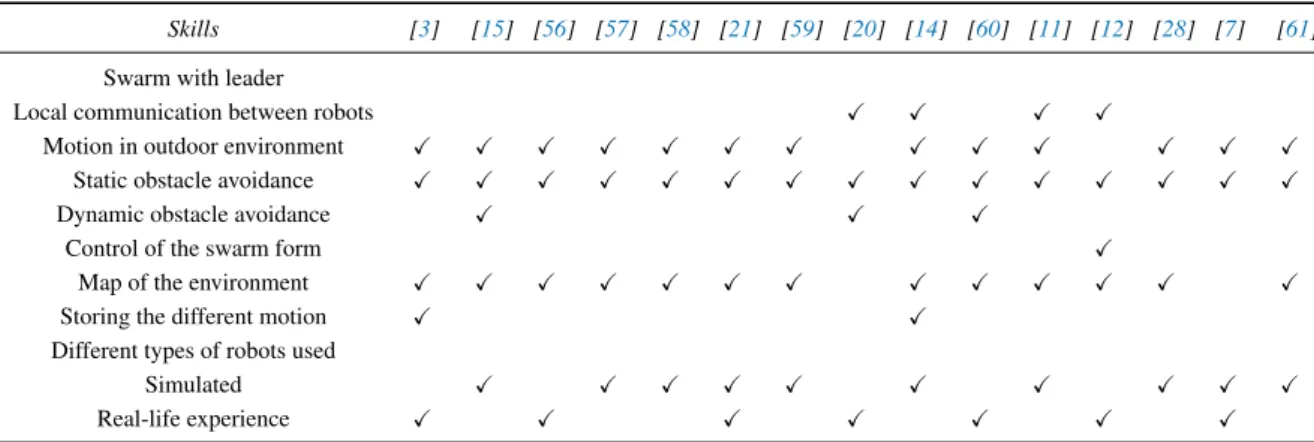
![Table 2. Comparison of the different deterministic algorithm for centralized swarm. Skills Vaidis and Otis [47] Qinand al.[42] Arakiand al.[18] Wei and al](https://thumb-eu.123doks.com/thumbv2/123doknet/7470570.222787/15.892.117.779.161.420/comparison-different-deterministic-algorithm-centralized-skills-vaidis-arakiand.webp)