STRENGTHENING LOCAL INNOVATIONS IN RICE PROCESSING THROUGH VIDEO IN BENIN
Authors:
Zossou E.*a, Van Mele P.α, Vodouhe D. S.β, Lebailly P.* * Gembloux Agro-Bio Tech, Université de Liège, Belgium α
Learning and Innovation Systems Program, AfricaRice, Benin. Current address: Agro-Insight, Gent, Belgium
β Faculté des Sciences Agronomiques de l’Université d’Abomey-Calavi, Bénin a
corresponding author email: [email protected] Abstract
In Africa, rice processing provides employment for many rural people. A survey on local rice processing methods in the north, central and south of Benin shows that local rice is often parboiled before milling. Parboiling is a transformation process that enhances the quality of rice. This important income generating activity is exclusively done by women from rice producing communities. In Benin, the traditional parboiling method is still prevailing and does not lead to quality rice. To address this, an improved rice parboiling technology was developed. AfricaRice subsequently developed a video where rural women explain how to use this improved technology. Four NGOs in central Benin publicly screened the video in 80 villages. After women watched the video, they started using the improved parboiler equipment individually or collectively. Women who didn’t have the financial support to buy the improved equipment understood its principle and developed creative solutions based on the idea of pre-cooking paddy with steam. Video watching also made women pay attention to reducing the loss of steam and to use local resources innovatively to conserve energy. Women also improved the quality of their parboiled rice by removing dirt, properly washing rice and drying rice on tarpaulins. On the other hand, in the north and south of Benin where there were no public video screenings, the traditional rice parboiling method is still predominant. This study shows the potential of farmer-to-farmer video to improve farmers’ practices and their attitudes to work collectively in agro-processing and marketing.
1- Introduction
To achieve sustainable agriculture, the capacity of rural people to innovate has to be strengthened (Hall et al., 2001), calling for changes in the inefficient traditional public extension systems (Rivera & Zijp, 2002).
To strengthen rural learning the Africa Rice Center (AfricaRice) has developed a series of farmer-to-farmer videos according to the zooming-in zooming-out (ZIZO) approach (Van Mele, 2006). The video "Cashing in with parboiled rice" was developed in collaboration with rice processors in Benin who had earlier been involved in developing and testing the improved rice parboiling technology. Rice parboiling (pre-cooking paddy) is an optional step that enhances rice nutritional value and reduces its breakage rate at milling. Four local NGOs organized public screenings of the parboiling video followed by facilitated group discussions in 80 villages in central Benin in late 2006.
In this paper, we analyze the effectiveness of video as rural learning approach in comparison with control areas (the north and south of Benin) and we discuss the challenges of such videos in strengthening innovations among service providers and rural entrepreneurs.
2- Methodology
Field surveys were conducted from 2007 to 2010 in three agro-ecological areas in Benin where rice production is important: the north, center and south. The surveys covered 12 villages in central Benin where the video had been shown in late 2006 by four local NGOs and 6 control villages in the north and 6 control villages in the south of Benin where no intervention had taken place. A total of 360 rice processors were interviewed. The villages and the rice processors were randomly selected. NGO staff and local artisans were also interviewed. Both quantitative and qualitative methodologies were used, including focus group discussions, participant observation, photography, semi-structured and structured interviews. Quantitative data were analyzed using logistic binomial regressions models, Kruskal Wallis and Chi-square tests. Incomes are estimated through recall method and considered as the cash received by processors through selling parboiled rice.
3- Results and discussions
3-1 Rice parboiling as key rice processing activity in Benin
In Benin women are more responsible for rice processing (78% of surveyed processors) than men. In the study areas, 62% of the rice processed per year is parboiled. This activity generates per year on average $US 7658 (SE=4879) in the north, $US 1600 (SE=3649) in the center and only $US 110 (SE=68) in the south, significantly different with the Kruskal Wallis test (p<0.01, Chi-square = 269.03).Rice parboiling is cultural in the north (farmers have two cropping seasons and paddy is available throughout the year) and in the center, while it is not a common practice in the south of Benin.
About 72% of the surveyed processors still parboils in the traditional way whereby paddy is pre-cooked in an aluminium pot in a small amount of water. By doing so, the paddy on top may not be entirely steamed while the one at the bottom is entirely cooked, resulting in a very heterogeneous product at milling.
The improved parboiling equipment consists of a perforated vat that is placed on top of a large aluminium pot containing water. The equipment can be made with local
materials. The principle behind this improved technology is to pre-cook the paddy with steam without the paddy being in contact with the water.
3-2 Exposure to new technology
The improved equipment is more known in the center (100%) than in the south (16%) and the north (15%) (Table 1). The majority of rice processors surveyed in the center learnt about the improved technology through video.
Table 1: Percentage of processors who learnt about the improved parboiler through different exposures Area Conventional training Video Information from colleagues No information on the technology North (n=120) 8 0 7 85 Center (n=120) 3 78 19 0 South (n=120) 11 0 5 84 3-2-1 Technological innovations
In central Benin, 26% and 62% of the surveyed processors frequently use the improved technology individually and in groups, respectively. In the north only 2 women out of those 8 who received conventional training parboiled in group and none in the south.
About 53% of those who had watched the video but did not have an individual access to the equipment innovated creatively with local resources, significantly different from 12% and 0% of those who learnt through training in the north and south Benin, respectively (Kruskal Wallis test, p<0.01, Chi-square= 87.64). Likewise, Gandhi et al. (2008) revealed that video increased the adoption of certain practices seven-fold over a classic training approach.
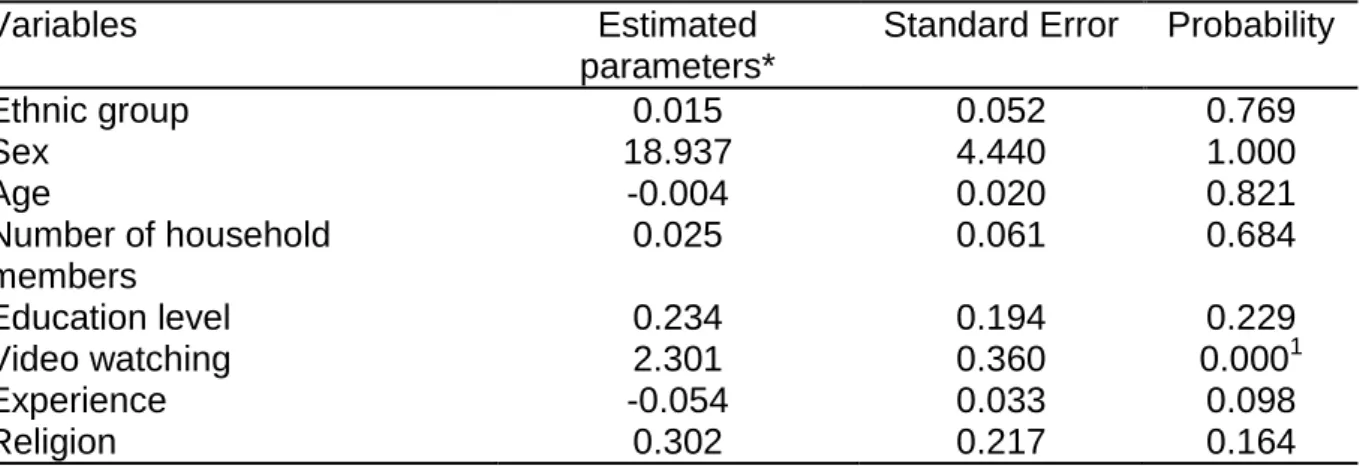
The logistic model (Table 2) shows only one significant variable, video watching (p <0.01) that increased the probability of innovating (use of adapted perforated base, local sieve and basket) by understanding the principle and need of pre-cooking paddy with steam.
Table 2: Factors likely to influence technological innovations by women rice processors in Benin (n=360)
Variables Estimated
parameters*
Standard Error Probability
Ethnic group 0.015 0.052 0.769 Sex 18.937 4.440 1.000 Age -0.004 0.020 0.821 Number of household members 0.025 0.061 0.684 Education level 0.234 0.194 0.229 Video watching 2.301 0.360 0.0001 Experience -0.054 0.033 0.098 Religion 0.302 0.217 0.164
Rice parboiling for sale 0.317 0.505 0.531 *Logistic binomial regression model;
1
significant at the 1%
Video screening also made women pay attention to reducing the loss of steam and using local resources innovatively to conserve energy during parboiling. They applied cloth, cassava flour or clay at the junction between the perforated vat and the aluminium pot.
Sustainable agriculture must take into account farmers’ creativity to adapt basic principles of new technologies to local realities. Farmer-to-farmer videos are ideally suited to illustrate these principles and to expose rural people to new ideas and practices and to encourage them to create their own innovations (Zossou et al., 2009a).
Apart from enhancing women’s creativity, the video influenced women’s behaviour to deliver good quality rice by improving rice handling practices: 92% in video villages compared to 7% in control villages.
3-2-2 Entrepreneurial mindset
Rice processors who learnt the improved technology through video parboiled significantly more rice for sale (90%) compared to those who didn’t watch the video (56%) (Chi square = 36.15, p < 0.01).
Currently, in central Benin larger quantities of parboiled rice can be found in local markets. The rice is also of better quality and fetches a 31% higher price than before video screening.
In central Benin about 16% of the rice processors who watched the video began to sell their parboiling services to NGOs and traders to increase their profit and 33% left their primary activity to take up rice production and parboiling which they considered more profitable. From those trained in the conventional way only one woman started to sell her parboiling services.
3-2-3 Social capital and institutional changes
Three variables significantly affect the probability of rice processors being organised in groups, namely video watching, parboiling rice for sale and the number of dependents in the household (p < 0.01).
Table 3: Factors likely to influence the organisation of women rice processors in groups (n=360)
Variables Estimated
parameters*
Standard Error Probability
Ethnic group 0,034 0,072 0,634 Sex 17,897 4,275 0,997 Age 0,033 0,025 0,185 Household members -0,302 0,089 0,0011 Education level 0,259 0,256 0,312 Video watching 4,096 0,458 0,0001 Experience 0,003 0,034 0,940 Religion 0,124 0,305 0,685
Parboiling rice for sale 1,683 0,640 0,0091
*Logistic binomial regression model; 1
The negative estimated parameter for household members implies that the more household members there are, the less likely women are to parboil rice in groups, probably because they use family labour. The influence is higher for video watching than for the two other significant variables. Target group interviews confirmed that after watching the videos, rice processors discussed the possibility to work in groups with the NGO facilitators. They then started parboiling rice in groups to solicit funds from microfinance institutions, buy paddy on credit, package and label their products. Apart from working in groups, video also motivated women to formulate group-based requests for training on improved stoves in order to reduce the use of fire wood during parboiling.
In video villages, local NGOs impressed by the rice processors entrepreneurial spirit and the improved quality of rice, helped them to strengthen their marketing capacities (processing, packaging, labelling and commercialization). They also started to facilitate rice processors’ access to informal credit providers (97% in video villages compared to only 21% in control villages), who proved more responsive. Rice producers who attended video shows became more willing to sell rice on credit to rice processors (Zossou et al., 2010). Video-mediated learning strengthened the social capital among rice processors and improved the trust between actors in the rice value chain, a key weakness of markets in Africa (Fafchamps, 2004).
4- Conclusion
This study shows that the use of farmer-to-farmer video triggered many technological, behavioural and institutional changes among rice processors and others in the rice sector. Video-mediated learning has allowed a wide dissemination of the improved rice parboiling technology and significantly more rice processors who watched the video used the technology and innovated. Public video screenings helped to overcome participant selection bias and information ownership that is prevalent in classic training approaches (Zossou et al., 2009b). Well-made, high quality videos showing functional technologies and their underlying principles can help a good part of the audience to adopt and adapt these technologies, and it can do so much easier and probably cheaper than face-to-face extension. Facilitated public video screenings also positively influenced women’s social capital and led to increased trust between rice value chain actors. Ways to ensure that the videos are distributed as widely as possible need further exploration.
Bibliography
Fafchamps, M. (2004) Social Capital and Development. University of Oxford, Department of Economics, Discussion paper series, 1-26.
Gandhi, R., Veeraraghavan, R., Toyama, K. and Ramprasad, V. (2008) Digital Green: Participatory Video and Mediated Instruction for Agricultural Extension. Los Angeles: USC Annenberg School for Communication,
http://www.africangreenrevolutionconference.com/papers/Microsoft_Digitalgreen_ictd _update.pdf (accessed 21 May 2009).
Hall, A.J., Sivamohan, M.V.K., Clark, N., Taylor, S. and Bockett, G. (2001) Why research partnerships really matter: innovation theory, institutional arrangements and implications for developing new technology for the poor. World Development 29(5), 783–797.
Rivera, W.M. and Zijp, W. (2002) Contracting for Agricultural Extension. International Case Studies and Emerging Practices. Wallingford: CABI Publishing.
Van Mele, P. (2006) Zooming-in, Zooming-out: A Novel Method to Scale up Local Innovations and Sustainable Technologies. International Journal of Agricultural Sustainability 4(2), 131-142.
Zossou, E., Van Mele, P., Vodouhe, S.D. and Wanvoeke, J. (2009a) The power of video to trigger innovation: Rice processing in central Benin. International Journal of
Agricultural Sustainability 7(2), 119–129.
Zossou, E., Van Mele, P., Vodouhe, S.D. and Wanvoeke, J. (2009b) Comparing farmer-to-farmer video with workshops to train rural women in improved rice parboiling in central Benin. The Journal of Agricultural Education and Extension 15(4), 329–339.
Zossou, E. Van Mele, P., Vodouhe, S.D. and Wanvoeke, J.(2010) Women groups formed in response to public video screenings on rice processing in Benin. International Journal of Agricultural Sustainability, 8(4), 271-278.