Science Arts & Métiers (SAM)
is an open access repository that collects the work of Arts et Métiers Institute of
Technology researchers and makes it freely available over the web where possible.
This is an author-deposited version published in:
https://sam.ensam.eu
Handle ID: .
http://hdl.handle.net/10985/7596
To cite this version :
Carole BOUCHARD, Jieun KIM, Jean-François OMHOVER, Améziane AOUSSAT - Cognitive
Designers Activity Study, Formalization, Modelling, and Computation - CIRP Journal of
Manufacturing Science and Technology - Vol. 3, n°3, p.218–226 - 2010
Any correspondence concerning this service should be sent to the repository
Administrator :
[email protected]
Cognitive Designers Activity Study, Formalization, Modelling, and Computation
in the Inspirational Phase
C. Bouchard, J.E. Kim, J.F. Omhover and A. Aoussat
Products Design and Innovation Laboratory (LCPI), Arts et Metiers ParisTech, 151 boulevard de l’Hôpital, 75013, Paris, France
{carole.bouchard, jieun.kim, jean-francois.omhover, améziane.aoussat} @ paris.ensam.fr
Abstract
This paper refers to a research project that we are conducting about the formalization of the designer's cognitive activity in order to develop new computational tools to support the early design process. These tools are especially focused on the inspirational phase of design. We first formalized the cognitive processes of the designers dedicated to our specific phase, and identified some routine parts where computational tools could be useful in order to enrich the traditional design process. The computation of design rules in the early phases of design needs to establish specific formalizations that can be implemented by algorithms. After modelling designers' cognitive processes, we explored the main information systems they use and completed them by an investigation about Content-Based Image Retrieval systems (CBIR). Our research consisted then in establishing specific formalizations in order to cope with recent technologies that could improve the precision and efficiency with which designers can access inspirational images.
Keywords:
Inspirational process, Case study, Conjoint Trends Analysis, CTA method
1 INTRODUCTION
This paper describes a research project to model the cognitive processes of designers in order to develop computational tools for the earliest phases of design. The formalization and explicitation of designers' cognitive processes are becoming a strategic topic for many scientific communities including design science, cognitive psychology, computer science, and artificial intelligence. This growing interest is partly due to pressure from industry where the shortening of development delays and the increasing variability of the offerings expected by the consumer require a formalization and a digitalization of the earliest phases of the design process.
In this context, three research areas are now well established and tend to develop new models and tools that will help to progressively digitize the early design process:
the formalization of the cognitive design process with the extraction of design knowledge, rules and skills; the translation of design rules into design algorithms; the development of software tools that will be used by
the designers themselves and the other trades involved in the early collaborative design process. Following this, we first investigated the cognitive activity of designers and focused on the inspirational phase. These cognitive processes were formalized as a design method named the Conjoint Trends Analysis (CTA) method. The CTA method [1] is a recent method which has been molded to the information gathering process in industrial design, taking into account the task-based requirements and the cognitive and affective processing of designers.
Our original work focused on the identification and use of various domains of influence (nature, arts, industrial sectors, sociological end values) in order to enrich the design solution space.
Finally, the CTA method enables the identification of formal trends in attributes (shape, color, textures) linked to particular environments in order to use them in the early design of new products. This makes it possible to enrich and to inspire the designers and the design team when designing products. It is positioned in the earliest phases of the design process.
2 COGNITIVE DESIGNERS ACTIVITY, FORMALI- ZATION AND MODELLING
2.1 The information phase in the early stages of design: the inspirational process
The design process reduces abstraction through the use of various successive levels of representation which integrate more and more constraints. It can be seen as an information processing activity that includes informative, generative, evaluative and deductive stages. The informative phase is a crucial. First, it enables the completion of design problems which are by nature ill- defined and ill-structured [2-3] and so refers to semantically impoverished tasks.
Designers use a large variety of sources coming from different areas such as comparable designs, other types of design, images of art, beings, objects and phenomena from nature and everyday life. Sources of inspiration are an essential base in design thinking, as definitions of context, triggers for idea generation [4], and anchors for structuring designers’ mental representations of designs. In favorable contexts, designers built trend boards in order to structure their inspiration sources. Trend boards offer a visual and sensorial channel of inspiration and communication for design research and development, which could be considered to be more logical and empathic within a design context than only verb-centric approaches [5]. They are usually a collection of images compiled with the intention of communicating or provoking a trend or ambience during the product design process.
As a routine part of the creative process, product (DB) in various ways: one by one browsing, keywords or designers search for and collect materials that they find image feature specification, automatic image feature inspirational. They get their inspiration in their personal extraction, or finally providing an example from which lives and through a more focused way in their features will be compared by similarity to those of other professional lives, in various sources like specialized images. The technologies used come from a range of magazines, bibliographies, material from exhibitions and
the web.
scientific knowledge bases from artificial intelligence and computer vision applications, including statistics, pattern
2.2 The Conjoint Trends Analysis (CTA) method recognition, and signal processing. Searches must rely on
The information phase of the cognitive design activity was metadata such as captions or keywords. These keywords can be generated by a human or automatically extracted studied and formalised in order to define the Conjoint from the web.
Trends Analysis (CTA) method [1]. As shown in Figure 1,
the CTA method is composed of three steps: gathering/ CBIR systems tend to turn towards specific categories of categorizing images and keywords; ambience definition; end-users working in areas where creative thinking is and pallets composition. The CTA method enables the
identification of attributes linked to particular datasets
needed, like industrial design or architecture. On the other hand, specific databases are increasingly developed in (e.g., common properties of images in a database) so that those domains, which do not yet integrate the they can be used to inspire designers in the early stages
of design for new product.
sophisticated technologies from CBIR. Multi-Dimensional Scaling seems to be a good way to interactively display sets of products arranged according to semantic axis. Besides, the use of a folksonomy for gathering
progressively relevant expert material for building the ontology seems to be a promising way to bridge high and low level information.
3.1 Supporting design by Content Based Image CBIR
Retrieval (CBIR)
systems are applied in the context of huge
Figure 1: The Conjoint Trends Analysis (CTA) method
databases where the question arising is how to find the right image. This is particularly difficult when dealing with design information. Indeed, the design activity is specific The CTA results are trend boards that represent in the way that design information covers various levels of sociological, chromatic, textural, formal, ergonomic, and
technological trends. The trend boards communicate identified homogeneity in terms of style and consumers’
abstraction of the information. However the main majority of commercial and academic systems still focus on low- level features. This difficulty is increased when dealing sociological values. They are mainly based on visual with images that have a multi-dimensional and subjective information, and come from the frequent occurrence of nature as is the case in the context of industrial design. certain properties within a dataset. From this analysis, One major current problem in CBIR is to link visual images and relevant words are selected and formalized content with semantic content to bridge the semantic gap under a form of ambiences. Ambiences are typical between low-level content and higher-level concepts. The representations where the emotional impact is intended to semantic gap is the lack of coincidence between the be higher. Global and discrete design elements are then
extracted from these ambiences under a form of pallets. These design elements are used for the generation of
information that one can extract from the visual data and the interpretation that the same data has for a user in the same situation [6]. To close the problem of the semantic new design solutions. gap, some CBIR systems automatically generate Therefore, trend boards offer a relatively exhaustive additional search terms by conceptual similarity with the representation of the references usually used by the original terms, as identified through term co-occurrence in designers for their composition and play an important role
in stimulating idea generation while anchoring contextual matter [4]. They reinforce the link and semiotic coherence between the consumers end values, functionalities in any domains of influence, and product attributes such as form, color, texture, and usability principles. Another purpose of the trends analysis is to define user-convenient principles and solutions that can be integrated in future products.
a corpus or through the use of an ontology. In the field of CBIR, many papers mention the reduction of the semantic gap, but they often do not refer to semantic adjectives and are more based on concepts like car. However their architecture is often interesting insofar as these systems could also integrate semantic adjectives.
A study [7] showed that indexing concepts by keywords in image indexing systems is much more appropriate with Indeed designers often have to provide new designs human similarity perception than low level features and using insufficient information about consumers. Trend provides good retrieval performance. Naphade et al [8] boards show ambiences including people in context. suggest that matching semantics might be achieved by Contexts are decisive in the attribution of a signification to
the object.
employing top-down as well as bottom-up techniques. In order to support the top-down method, it will be important to develop semantic nets that link higher-level concepts
that are evoked by visual images. Existing systems 3 CONTENT–BASED IMAGE RETRIEVAL (CBIR)
APPROACH
Content-Based Image Retrieval (CBIR) is a technology that in principle helps organize digital picture archives by
frequently use about ten adjectives and at the best about several thousand of images in the DB. About the system architecture, we encounter often the combination of a filter and of a direct re-classification to images. When their visual content (colors, shapes, or textures) [6]. User several users enter the same information, the system queries are mainly based on image example, region of performs a re-classification of the images. The feedback interest, or concept keyword. The search process mainly systems using a weighting system adjusting the consists of query formulation, specification of which
images to retrieve from the system from the database
importance between the features that seem interesting. A remaining problem is the changing nature of the user’s
perception of a semantic adjective in the time. So the feedback system has to be well developed, with a simple and efficient interaction with the user. The system should also enable the user to add information by entering new terms and new evaluations of the results.
3.2 Towards Kansei-Based Image Retrieval (KBIR) Future CBIR systems should correlate high-level dimensions like concepts, semantics and emotions with low-level dimensions. The connection of low-level and high-level dimensions is very subjective and variable from person to person. Consequently, the previous systems are often based on a strong interaction between the end- users and the system itself, using images and semantic adjectives. It is frequently done with the intervention of the end-users thanks to learning systems using neural networks [9-11], or genetic algorithms [12].
Some studies were already led in this way, but not dedicated to the field of design [8-9,12-16]. The advantage of Kansei Engineering methods is that they focus more on the viewer rather than on the image [17], and similarity measures derived from kansei indexing come from inner experience, rather than visual similarity. These methods enable the designer to assess evoked feelings on the basis of impression words including frequently semantic adjectives (urban, romantic, aggressive, and so on) or emotional adjectives (amused, astonished) describing the viewer in front of a specific image. It is, however, difficult to develop competitive systems able to search and classify images from semantic adjectives because their appreciation may be altered by an inter-individual subjectivity. Tanaka et al. investigated which regions and features of images are most attractive, contributing so to human Kansei [18] in [17]. An increasing attractiveness seems to be correlated with size effects (attractiveness increases with size) or color effects (warmer, highly chromatic and high values colours). Hayashi et al. [18] in [11] attempted to train a neural network to predict Kansei with impression words evoked by outdoor scenery images. The best results were obtained for visual words such as spring or clear. It was emphasized that the mapping of human impressions with physical features is not one to one and that any retrieval system must retrieve multiple images, allowing the user to choose the best one. The results of this study showed a statistically significant superiority of the Kansei Based Retrieval systems over the random retrieval.
4 A CASE STUDY: THE TRENDS SYSTEM
On the base of research and industrial projects, we started to formalize and structure design information into specific formats. Especially in the TRENDS European project, we aimed to raise a new formalization of design information which can improve designers’ access to web- based resources, and help designers to find appropriate materials and identify design trends in those materials.
4.1 Towards a new formalization of design
information
We expected that the TRENDS system would enable us to elaborate the field of image search, including content– based image retrieval and Kansei Based Image Retrieval (KBIR). Finally, the Trends Analysis (CTA) method would be partially digitalized and implemented by the computational tool which integrates semantic processing and image contents.
This computational tool should reduce retrieval time and provide a certain completeness of the retrieval results in expanding the corpus of images from different sectors of influence; enhancing creativity with more or less open
image retrieval; and facilitating idea generations using key harmony rule of design.
In the TRENDS project, the data collection was carried out on the basis of fictional scenarios and extraction of design information from previous projects which have used the CTA method.
Figure 2: Design knowledge extraction by manual annotation [19]
First, we validated a list of sectors of influence in car design (see Table 1). This table shows sectors of influence identified in 1997 and in 2006. Interestingly, 70% of the sectors of influence have not been changed. This implies that we could integrate some routine parts of sectors of influence in the data database of the TRENDS system.
Rank 1997 (40 designers) 2006 (30 designers)
1 Car design Car design
2 Aircrafts, aeronautics Architecture 3 Architecture Interior design &
furniture 4 Interior design &
furniture Fashion
5 Hi-Fi Boat
6 Product design Aircraft
7 Fashion Sport goods
8 Animals Product design
9 Plants Cinema & commercials 10 Science Fiction Nature&
urban ambiances 11 Virtual reality Transportation
12 Fine arts Music
13 Cinema Fine arts
14 Music Luxury brands
15 Travels Animals
16 Food Packaging &
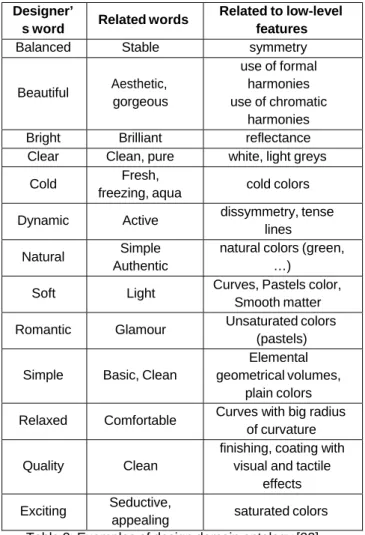
advertising Table 1: Sectors of influence in car design [20-21] Second, we identified that designers employed different type of design information and they consists of different levels: high-level (values, semantic words, analogy, and style), middle-level (sector name, context, and function), and low-level information (color, form, and texture). These levels of information can be seen as the position of an axis going from abstract (high-level information) to concrete (low-level information). The structure of design information enabled the construction of a design domain ontology. Table 2 shows some examples in the field of Image retrieval.
Designer’
s word Related words
Related to low-level features
Balanced Stable symmetry
Beautiful Aesthetic, gorgeous use of formal harmonies use of chromatic harmonies Bright Brilliant reflectance Clear Clean, pure white, light greys
Cold Fresh,
freezing, aqua cold colors Dynamic Active dissymmetry, tense
lines Natural Simple
Authentic
natural colors (green, …)
Soft Light Curves, Pastels color, Smooth matter Romantic Glamour Unsaturated colors
(pastels) Simple Basic, Clean
Elemental geometrical volumes,
plain colors Relaxed Comfortable Curves with big radius
of curvature Quality Clean
finishing, coating with visual and tactile
effects Exciting Seductive,
appealing saturated colors
Powerful solid, strong, robust, sturdy, performance,
vigorous, sportive, big, dynamic, maxi, thick, speed, sport, aerodynamics, aggressive, secure, heavy, muscular, brawny, hefty, muscular, powerful, sinewy, herculean, athlete, potency, potent
Aggressive violent, pleasing, imposing, speed,
irritated, stressed, choleric, sport, brutal, provoking, dangerous, sharp, angular, daring, belligerent, imperious, energetic, fast pushy, pushing
Chic knack, classy, elegant, pretty, refined,
purified, exceptional, smoothness, design, style, product, fashion, stylish, high style, fine style, noble, best , style, dressed, glossy, satiny, sleek, silken, silky, silk like, slick, satin, aesthetic
This combination yielded a more flexible structure of information and it was more suited to design information. Therefore, the developers of the TRENDS project used
these data filtering models and rules to develop the design domain ontology and the Bag of Words [36]. Those two method could be used in
independently or complementary.
applications
Figure 3: Examples of semantic queries ‘Chic’ under two conditions : without the BoW (left) and without the BoW
(right)
Fourth, we formalized the cognitive processes of designers wherein designers mentally or explicitly categorize images sources. Those categorizations were
initially based on the distribution of colors on the chromatic circle according components. Further, we Table 2: Examples of design domain ontology [22] integrated the aesthetic harmony rule of image which is a
core expertise of designers. In order to support this Third, an important part of the result concerned a phase, the TRENDS system is supposed to provide a definition of a semantic model which can be easily new way to retrieve images according to similarities of implemented in data mining and integrated design images corresponding to harmony rule of design and expertise. The methods used were a combination of categorize them in a smart way (pallet generation design domain ontology (See Table 2) and Bags of Words process).
(BoW) (See Table 3). In particular, the BoW helps 4.2 Functionalities of the TRENDS system significantly increase the relevance of semantic queries.
For example, if we enter the word ‘chic’, we get some Finally, the TRENDS system proposes two groups of images answering to this term. Using both the design functionalities: image retrieval and desig advanced domain ontology and the BoW, the system shows three
times more images than using design domain ontology alone (See Figure 4).
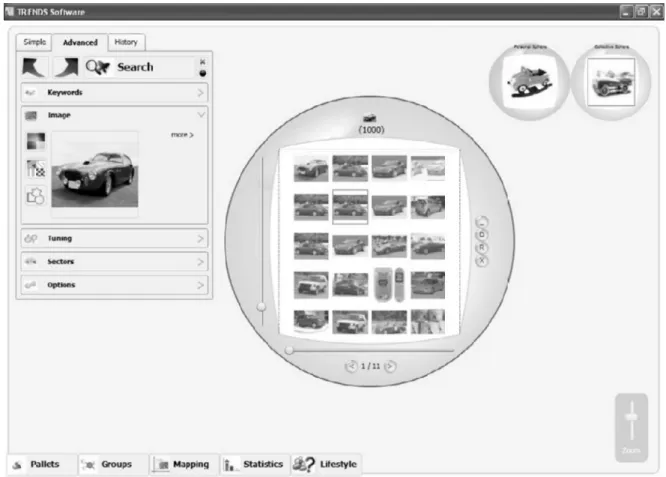
functionalities. Figure 4 shows a global interface of the TRENDS system.
Regarding the image retrieval functionalities, the system searches the information, but not from the overall web. The information from the web is filtered according to the listed sectors of influence of the designers (See Table 1): for instance car design, advertising, architecture, arts, etc. First, the image retrieval functionalities consisted of: - random search: an open search, providing serendipity and so favouring creativity;
- semantic search: the user semantic adjectives or concepts;
inputs some keywords, - search with an image example: the user selects an image as a query, similar images can be found in the database based on similarity rules between the global descriptors of the image content related to shape, colour or texture dimensions;
-relevance feedback: when the results are sometimes not so c nvincing after the initial query, we could give the relevance feedback (positive or negative)
refine the search;
manually to Table 3: Examples of Bag of Words [23-24] In addition, some options enable the designer to select
that the designers have to manage. We can also apply interesting display functions, like a slideshow for instance. Second, design advanced functionalities consist of:
This function enables the designer to link and arrange the words with the images. Some images do not possess semantic descriptors by default. Others are overlapped when they have the same description. The designers can - grouping: to automatically display subsets of images also achieve the complete mapping manually.
grouped by specific harmony rules. This function is
required because it would be difficult for the end-user to -statistics: to apply statistics related to a word or an have a complete view of the content of the sphere, image. The system promises quantitative information wherein search results are displayed; about the representativeness level of a word or an image - pallets function: to generate a pallet of specific in the sectors;
harmonies linked to low-level information between - life style: a bookmark oriented towards specific websites colours, shapes, and textures; which propose information about sociological changes, -semantic mapping: to generate automatically a first values and lifestyles evolutions. This function was a version of semantic mapping with a text search; request of the designers themselves.
Figure 4: A global interface of the TRENDS system 5 CONCLUSION
This paper presented a study we led about modelling the cognitive processes of the designers in order to develop computational tools for the earliest phases of design. We focused this study on the inspirational phase of the
that enable the designer to link low-level descriptors with high-level descriptors.
Cognitive models enabled the designer to identify some routines that could partly be implemented by algorithms and bring an added value to the traditional process. design process, where designers have to deal with a
large amount of information. Cognitive models here gave birth to the Conjoint Trends Analysis (ATC).
After practicing this method in several projects in the field
6 ACKNOWLEDGMENTS
The authors are grateful to the European Commission for of automotive design, some computer support tools were funding TRENDS project (FP6 IST 2005-27916) and foreseen in order to enrich the information gathering. express their gratitude to all partners of TRENDS We intended to partly digitize the ATC method which consortium for their contribution. http://www.trendsproject.org
corresponds to the informational part of design activity. Two ways were combined at the same time, which were
presented in this paper previously: the elaboration of 7 REFERENCES
ontological data tables and bag of words which were [1] Bouchard, C., Christofol, H., Roussel, B., Aoussat, related to more or less abstract concepts, which both A., 1999, Identification and integration of product were used to be implemented by algorithms. The design
rules so elaborated are based on particular formalizations
design trends into industrial design, ICED’99, 12th International Conference on Engineering Design, 2: 1147-1151.
[2] Restrepo, J., 2004, Information processing in design, Delft University Press, the Netherlands, ISBN 90-407-2552-7.
[3] Simon, H. A., 1969, The science of the artificial, Cambridge, Mass, the MIT Press.
[4] Eckert, C., Stracey, M.K., 2000, Sources of Inspiration: A language of design, Design Studies, 21: 99-112.
[5] McDonagh, D., Denton, H., 2005, Exploring the degree to which individual students share a common perception of specific trend boards: observations relating to teaching, learning and team- based design, Design Studies, 26: 35-53.
[6] Datta, R., Joshi, D., Li J., Wang, J. Z., 2006, Image retrieval: ideas, influences and trends of the new age, Penn state University technical report CSE 06- 00.
[7] Cox, I.J., Ghosn, J., Miller, M.L., Papathomas, T.V., Yianilos, P.N., 1997, Hidden annotation in content based image retrieval. Proceeding of IEEE Workshop on Content-Based Access of Image and Video Libraries, 76-81.
[8] Naphade, M.R., Huang, T.S., 2002, Extracting semantics from audio-visual content: the final frontier in multimedia retrieval, Neural Networks, IEEE Transactions, 13(4):793–810.
[9] Bianchi-Berthouze, N., Hayashi, T., 2002, Subjective interpretation of complex data: requirements for supporting kansei mining process, International workshop on multimedia data mining, MDM’02, ACM-SIG KDD.
[10] Bianchi–Berthouze, N., Hayashi, T., 2003, Subjective interpretation of complex data: requirements for supporting kansei mining process, Lecture notes in computer science, ISSN 0302- 9743.
[11] Tsutsumi, K., 2003, A Development of the Building Kansei Information Retrieval System, Proceedings the International Conference on Computing in Civil and Building Engineering, 174–181.
[12] Kato, S., 2001, An image retrieval method based on a genetic algorithm controlled by user’s mind", Journal of the Communications Research laboratory, 48(2).
[13] Tanaka, S., Inoue, M., Ishiwaka, M., Inoue, S., 1997, A Method For Extracting. and. Analyzing. "Kansei" Factors From Pictures, IEEE Workshop on Multimedia signal processing, 251-256.
[14] Colombo, C., Del Bimbo, A., Pala, P., 1999, Semantics in visual information retrieval. IEEE Multimedia, 6(3):38–53.
[15] Black, J.A., Kahol, K., Kuchi, P., Fahmy, G.F., Panchanathan, S., 2003, Characterizing the high- level content of natural images using lexical basis functions, Proceedings of the SPIE-The International Society for Optical Engineering, 378–391.
[16] Black J.A., Kahol, K., Priyamvada, T., Kuchi, P., Panchanathan, S., 2004, Indexing natural images fir retrieval based on kansei factors, Stereoscopic Displays and Virtual Reality Systems XI, Proceedings of the SPIE, 5292: 363–375.
[18] Hayashi, T., Hagiwara, M., 1997, An image retrieval system to estimate impression words from images using a neural network, IEEE International Conference on Systems, Man, and Cybernetics- Computational Cybernetics and Simulation, IEEE, New York, NY, 1:150-105.
[17] Tanaka, S., Inoue, M., Ishiwaka, M., Inoue, S., 1997, A Method for Extracting. And. Analising. "Kansei" Factors from Pictures, IEEE Workshop on Multimedia signal processing, 251-256.
[19] Mougenot, C., Watanabe, K., Bouchard C., Aoussat A., 2010, Kansei Information Processing in Product Design: Exploring designers' activity, KEER 2010, Kansei Engineering and Emotion Research, ISBN: 978-4-9905104-0-4.
[20] Bouchard, C., Omhover, J.F., Mougenot, C., Aoussat, A., Westerman, S.J., 2008, TRENDS: A Content-Based Information retrieval system for designers, Design Computing and Cognition, DCC’08, J.S. Gero and A. Goel (eds), 593–611. [21] Kongprasert, N., Brissaud, D., Bouchard, C.,
Aoussat, A., Butdee, S., 2010, Contribution to the mapping of customer's requirements and process parameters, KEER 2010, Kansei Engineering and Emotion Research, ISBN: 978-4-9905104-0-4. [22] Bouchard, C., Kim, J., Aoussat, A., 2009, Kansei
Information Processing In Design, proceeding of IASDR.
[23] Bouchard C., Mantelet F., Ziakovic D., Setchi R., Tang Q., Aoussat, A., 2007, Building A Design Ontology Based On The Conjoint Trends Analysis, I*Prom Virtual Conference.
[24] Bouchard, C., Mougenot, C., Omhover, J.F., Mantelet, F., Setchi, R., Tang, Q., Aoussat, A., 2007, Building A Domain Ontology For Designers: Towards A Kansei Based Ontology, I*Prom Virtual Conference.
![Figure 2: Design knowledge extraction by manual annotation [19]](https://thumb-eu.123doks.com/thumbv2/123doknet/7287760.208068/4.892.498.826.201.405/figure-design-knowledge-extraction-manual-annotation.webp)