Congrès SHF : «HydroES 2016», Grenoble 16-17 March 2016- Savatier, Erpicum et al – Aerating weir at Lom Pangar dam
AERATING WEIR AT LOM PANGAR DAM
Seuil de réoxygénation du barrage de Lom Pangar
Jérémy Savatier11, Michel Lino1, Sébastien Erpicum2, Michel Pirotton2, Stéphane Descloux3, Christophe Daux4, Georges Gwet5, Alphonse Emadak5
1
ISL Ingénierie, [email protected] , [email protected] 2
Université de Liège, [email protected] , [email protected] 3
EDF - CIH, [email protected] 4
Tractebel Engineering, [email protected]
5Electricity Development Corporation, [email protected], [email protected]
ABSTRACT
Lom Pangar is a new dam under construction in Cameroun. Its aim is mainly flow regulation of the Sanaga River in order to improve and secure hydropower production of downstream facilities. To reduce impact on water quality and especially on dissolved oxygen for 25 to 100 m3/s discharge, an aerating weir is going to be implemented downstream of the dam for at least the 10 first years of the dam exploitation. After site selection, preliminary studies have conducted to chose a rockfill stepped weir for technical reasons including availability of materials on the dam work site and easier decommissioning. According to literature, nappe flow is the flow regime providing most effective aeration for this type of structure and application of formulae to the discharge range and geometry of the project leads to choose 50 cm high steps to create this flow regime. The proposed solution has been tested using a 1:1 scale physical model, with the following geometry: 3 m high and 15° downstream slope. Dissolved oxygen concentration has been measured in the upstream reservoir, in the downstream collecting channel and on several steps. Aeration efficiency has been measured and the physical model has been able to validate and optimize the weir design in order to reach the water aeration objectives and limit hydraulic impacts. The works are planned beginning 2017 and water aeration will be monitored.
KEY WORDS
Water quality, stepped spillway, site selection, predesign, physical model, river works.
RESUME
Lom Pangar est un barrage neuf actuellement en construction au Cameroun dont l’objectif principal est la régularisation du régime hydrologique pour l’amélioration et la sécurisation de la production hydroélectriques des centrales situées à l’aval sur la Sanaga. Pour réduire l’impact sur la qualité de l’eau et en particulier sur l’oxygène dissous pour les débits de 25 à 100 m3/s, un seuil de réoxygénation va être implanté en aval du barrage pour au moins les 10 premières années d’exploitation. Après la sélection du site d’implantation, les études préliminaires ont permis de choisir une solution de type seuil en enrochements à parement aval en gradin, pour des raisons techniques comprennant la disponibilité de matériaux et la facilité de déconstruction. D’après la litérature, l’écoulement en nappe est le régime permettant la meilleure aération pour ce type de seuil et l’application des formules aux débits et à la géométrie prévue conduit à retenir des marches de 50 cm de hauteur. La solution prévue a été testée sur modèle physique à l’échelle 1 :1 avec une géométrie de 3 m de hauteur et une pente de 15° du parement aval. La concentration en oxygène dissous a été mesurée dans le réservoir amont, dans le canal de collecte et sur plusieurs marches. L’efficacité d’oxygénation a été mesurée et le modèle physique a permis de valider et d’optimiser la conception du seuil afin d’atteindre les objectif d’oxygénation et de limiter les impacts hydrauliques. Les travaux sont prévus début 2017 et la teneur en oxygène de l’eau sera suivie.
MOTS-CLEFS
Qualité de l’eau, seuil en marches d’escaliers, selection de sites d’implantation, prédesign, modélisation physique, travaux en rivière.
1
Congrès SHF : «HydroES 2016», Grenoble 16-17 March 2016- Savatier, Erpicum et al – Aerating weir at Lom Pangar dam
1. INTRODUCTION AND OBJECTIVES
Lom Pangar is a new dam under construction in Cameroun. Its aim is mainly flow regulation of the Sanaga River in order to improve and secure hydropower production of downstream facilities.
To reduce impact on water quality and especially on dissolved oxygen, an aerating weir is going to be implemented downstream of the dam for at least the 10 first years of the dam exploitation. It will be use for the 25-100 m3/s flowrate corresponding to hydropower restitution from lower intakes in the reservoir. The goal of the aerating weir is to reach the best aeration efficiency (oxygen saturation) for 25 m3/s and 50 m3/s, which will be the most frequent flowrate restitution.
In the case presented in this paper, minimum targeted downstream oxygen concentration Cd is 5 mg/l and
upstream oxygen concentration Cu can be assumed equal to 0. On site water temperature varies between 20
and 30°C. Corresponding oxygen saturation concentration Cs at atmospheric pressure varies between
9.09 mg/l (20°C) and 7.6 mg/l (30°C). Regarding the aerating structure design, the objective is thus to reach aeration efficiency at 20°C E20 equal to at least 0.55 (0.66 at 30°C), with E defined as
1 1 d u s u C C E C C r − = = − − (1)
2. PRELIMINARY STUDIES AND SITE SELECTION
Among 4 sites preselected based on geological, environmental, socio-economic and cost criteria, the most upstream one has been selected as:
- it enables water aeration on a longer section of the river,
- it is located close to the dam site with therefore easier monitoring conditions and sanitary impacts and easier management of professional dam staff.
As the global cost (building cost and impact on hydropower production of the dam plant) is about the same for the different sites, it was not considered for site selection..
Two different solutions for the structure have been considered during the preliminary design stage: a weir with one or two vertical chutes and a stepped spillway. This first analysis concluded that stepped weir is better for technical reasons including availability of materials on the dam work site and easier decommissioning. The structure was originaly planned to be made of rockfill and masonry in surface.
In case of a stepped spillway, nappe flow is the flow regime providing most effective aeration (Baylar et al., 2007). Application of formulae from the literature to the discharge range and geometry of the project leads to choose 50 cm high steps to create this flow regime.
Given these geometric parameters, the aeration efficiency E20 of the system has been assessed using the
formula proposed by Baylar et al. (2007) and Essery et al. (1978). For a prototype discharge varying from 25 to 100 m³/s, E20 values predicted by Essery et al. (1978) equation range from 0.52 to 0.67, respectively. An
almost constant value of 0.75 is predicted by Baylar et al. (2007) equation, whatever the discharge. As some of the present project characteristics fall outside the range of parameters considered in the above-mentioned researches, the proposed solution has been validated using a physical model.
3. PHYSICAL MODEL
The final aerating structure geometry considered for the physical model study is as follows: 3 m high and 157 m wide weir with a smooth upstream face inclined by 26.5°, a 3-m long horizontal broad crest and a downstream face made of six 50-cm high and 1.87 m long steps (15° slope).
To validate this design, a physical model has been built and operated at the Laboratory of Engineering Hydraulics (HECE) of the University of Liege. The model scale was the prototype scale (1:1 scale factor) in order to avoid scale effects on the oxygen transfer mechanisms and thanks to the limited chute of the prototype.
Congrès SHF : «HydroES 2016», Grenoble 16-17 March 2016- Savatier, Erpicum et al – Aerating weir at Lom Pangar dam
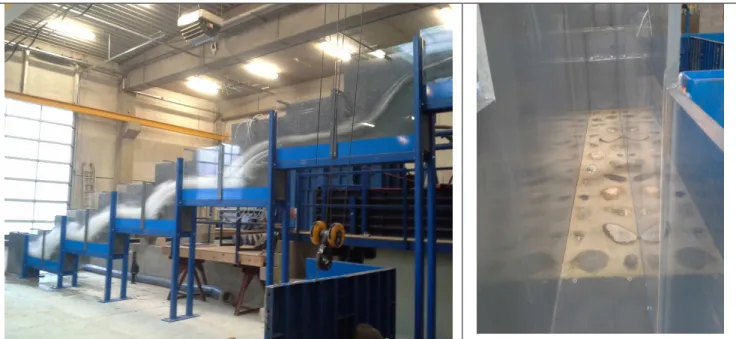
The model focuses on a limited section of the aerating weir (2D vertical model – Fig. 1). Its width of 20 cm has been chosen considering available water volume and discharge. Smooth lateral walls in Plexiglass and PVC have been used to limit side effects.
To study the aeration process on the weir, it is necessary to remove the oxygen from the upstream water. As the water supply system of the laboratory is a closed loop, it is necessary to remove the dissolved oxygen from the water stored in the reservoir and the duration of a test is directly linked to the available water volume and to the discharge. Chemical dissolved oxygen removal technique has been applied. Given the limited width of the model and the available water volume, it has been possible to perform tens of minutes long tests with 4 successive discharge levels (25, 50, 75 and 100 m³/s on the prototype). The maximum discharge in the physical model was 127.5 l/s.
Figure 1: View of the physical model
During a test, the upstream discharge has been measured using an electromagnetic discharge meter on the supply pipe. Dissolved oxygen concentration has been measured continuously in the upstream reservoir, in the downstream collecting channel and on several steps using 6 optical oximeters.
Mean global aeration efficiency E20 measured on the model (3 tests) is given in Table 1. These results
show that oxygen concentrations higher than the minimum target value are reached downstream of the proposed structure in the range of relevant discharges.
Prototype discharge (m³/s) Model discharge (m³/s/m) E20,mean (-) 25 0.159 0.74 50 0.318 0.69 75 0.478 0.66 100 0.637 0.62
Table 1: Mean global aeration efficiency measured on the model
4. FINAL DESIGN AND WORKS PLANNING
At least 6 steps are necessary to reach the target aeration efficiency for 100 m3/s discharge. In order to limit the hydraulic impact upstream on a bridge and a track, the weir crest is therefore levelled 3 m above the downstream water level for this discharge.
Congrès SHF : «HydroES 2016», Grenoble 16-17 March 2016- Savatier, Erpicum et al – Aerating weir at Lom Pangar dam For 25 and 50 m3/s discharges, the downstream water level is lower and therefore 7 steps are active, enabling aeration efficiency improvement of about 0.1.
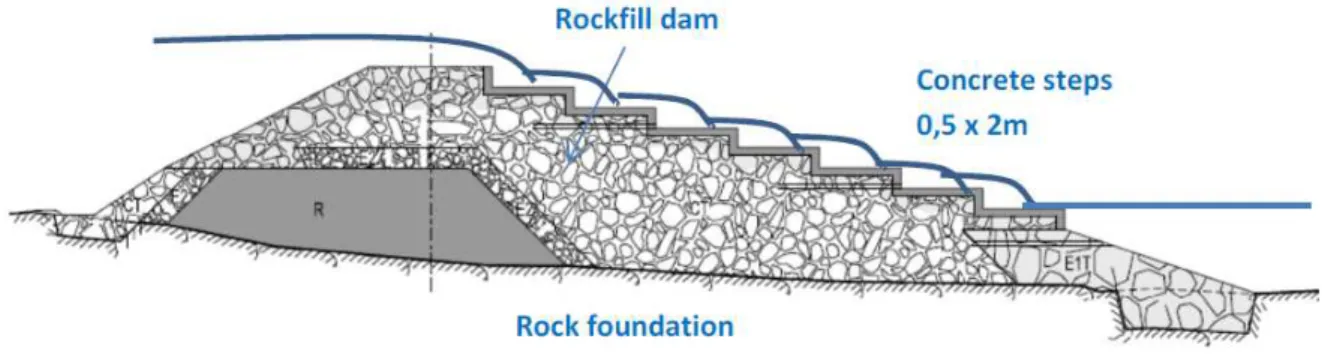
Steps have been lengthened to 2 m (instead of 1.86 m on the physical model), allowing also aeration efficiency improvement thanks to a longer time of air bubles into water.
The final design of the aeration weir consist in a rockfill weir with concret steps and concrete-rockfill crest and upstream and downstream faces.
Figure 2 :. Final project of the aeration weir
The first partial filling of the reservoir is presently ongoing. The construction of the structure is planned during the next low flow period, between January and April 2017, for the second filling of the reservoir when the lower dam outlet will be activated and low water quality is expected.
5. CONCLUSION
The stepped weir structure enables high aerating efficiency while being quite low cost and easy to build. To our knowledge, such a solution has never been implemented yet downstream of a dam with a purpose of re-aeration.
Once built, water quality will be monitored downstream the dam and downstream the aerating weir, and effective in-site aeration efficiency will be checked.
6. ACKNOWLEDGMENTS
This work was conducted in collaboration with the Cebedeau, an expert center for water treatment and management in Belgium.
REFERENCES
Baylar, A., Bagatur, T., Emiroglu, M.E. (2007). Prediction of oxygen content of nappe, transition and skimming flow regimes in stepped-channel chutes. J. Environ. Eng. Sci. 6, 201–208.
Essery, I.T.S., Tebbutt, T.H.Y., Rajaratnam, S.K. (1978). Design of spillways for re-aeration of polluted waters. Construction Industry Research and Information Association, Report 72, London, UK.