UNIVERSITÉ DE SHERBROOKE Faculté d’éducation
The evolution of fourth year BEALS students’ beliefs and practices when teaching ESL related to formative assessment
par
Alexandre Alves Mesquita Thèse présenté à la Faculté d’éducation
en vue de l’obtention du grade de Philosophiae Doctor (Ph.D.)
Doctorat en éducation
Août 2018
UNIVERSITÉ DE SHERBROOKE Faculté d’éducation
The evolution of fourth year BEALS students’ beliefs and practices when teaching ESL related to formative assessment
par
Alexandre Alves Mesquita a été évalué par un jury composé des personnes suivantes:
Professor Enrique Correa Molina Président du jury
Professor Lynn Thomas Directrice de recherche
Professor Marilyn Steinbach Codirectrice de recherche
Professor Isabelle Nizet Membre du jury interne
Professor Christopher Deluca Membre du jury externe
Professor Beverly Baker Membre du jury externe
Abstract
This qualitative exploratory study investigates the evolution of pre-service teachers’ beliefs and practices of formative assessment when teaching English as a Second language (ESL) in Québec through the scope of three main elements: their prior beliefs (Calderhead, 1988; Levin, 2015; Lortie, 1975; Pajares, 1992), their practicum experiences and their formal courses (Beck & Kosnik, 2000; Britzman, 2003; DeLuca, Chavez, Bellara & Cao, 2013; DeLuca & Lam, 2014; Grossman, Valencia & Hamel, 1997). The data was collected with 6 pre-service ESL teachers in three phases using the following methods: (a) at the beginning of the fourth year through an open-ended questionnaire (based on James and Pedder’s (2006) 30-item questionnaire) and semi-structured interviews (Bogdan & Biklen, 2007); (b) while on practicum through stimulated recall interviews and narratives (Connelly & Clandinin, 1990; Lichman, 2006); and (c) at the end of the fourth year through open-ended questionnaires and semi-structured interviews. Based on the findings, fourth-year pre-service ESL teachers’ beliefs and practices related to formative assessment evolve according to following elements: prior beliefs; associate teachers’ and university supervisors’ roles and support; university courses; and personal reflections on their own learning. The findings of this study further our understanding of the impacts of pre-service ESL teachers’ beliefs on how they construct their knowledge about formative assessment throughout their teacher education programme. It also highlights the need for teacher educators, associate teachers and university supervisors to take pre-service teachers’ beliefs and prior experiences into consideration in order to provide pre-service teachers with meaningful and adequate preparation for their future professional roles.
Résumé
Cette étude examine comment les futurs enseignants d’anglais langue seconde apprennent à évaluer de façon formative à travers le champ d’application de trois éléments principaux : leurs croyances (Calderhead, 1988; Levin, 2015; Lortie, 1975; Pajares, 1992), les stages et les cours de méthodologies d’enseignement (Beck & Kosnik, 2000; Britzman, 2003; DeLuca et al., 2013; DeLuca & Lam, 2014; Grossman, Valencia & Hamel, 1997). Les données ont été recueillies avec six participants par les méthodes suivantes: questionnaires ouverts (Dörnyei, 2010), des interviews semi-structurées (Bogdan & Biklen, 2007); rappel stimulé et récits (Connelly & Clandinin, 1990; Lichman, 2006). Les résultats indiquent que les croyances et pratiques d’enseignement et d’évaluation formative de leurs enseignants associés affecte le développement professionnel des futurs enseignants en raison du fait qu’ils adoptent différentes approches d’enseignement et d’évaluation par rapport à celles apprises dans leur programme. D’autres résultats inclus : manque de capacité à l’auto-évaluation des connaissances de l’évaluation – les futurs enseignants nécessitaient de soutien et de structures à travers de questions guidées afin de réaliser et d’articuler ce qu’ils savent (ses connaissances acquis pendant leur programme de formation); et, développement de leurs capacités et compétences à travers des réflexions sur ce qui est arrivé quand ils ont évalué les élèves.
TABLE OF CONTENTS
Abstract ... 4
ACKNOWLEDGEMENTS ... 11
INTRODUCTION ... 12
CHAPTER 1 – RESEARCH CONTEXT AND PROBLEM ... 17
1. TEACHER EDUCATION PROGRAMMES ... 17
1.1 Teacher Education Programmes before the mid-1980s ... 18
1.2 Teacher Education Programmes after the mid-1980s ... 19
2. THE ASSESSMENT PROCESS IN TEACHER EDUCATION PROGRAMMES ... 27
2.1 Assessment Literacy ... 27
2.3 Teaching Methods Courses ... 31
2.4 Formal Evaluation Courses ... 31
2.5 Beliefs and Practices about Assessment and Formative Assessment ... 32
3. THE QUEBEC EDUCATION SYSTEM... 34
3.1 The Competency-Based Approach (CBA) ... 35
3.2 The MEES Teacher Education Programme Requirements: The Twelve Professional Competencies ... 42
4. BECOMING AN ESL TEACHER AT THE UNIVERSITÉ DE SHERBROOKE: THE BEALS PROGRAMME ... 43
4.1 BEALS Formal Evaluation and Teaching Methods Courses ... 43
4.2 BEALS Field Experience ... 45
4.3 BEALS Pre-service ESL Teachers’ Beliefs and Practices related to Formative Assessment ... 46
5. RESEARCH QUESTION ... 48
CHAPTER 2 – THEORETICAL FRAMEWORK ... 51
1. THE ROLE OF TEACHER EDUCATION PROGRAMMES IN PRE-SERVICE TEACHERS’ PROFESSIONAL DEVELOPMENT ... 51
1.1 Teacher Knowledge, Professional Knowledge and Personal Knowledge ... 52
1.2 The Role of Beliefs in Pre-Service Teachers’ Professional Development ... 56
1.3 Beliefs related to Assessment ... 63
2. RESEARCH OBJECTIVES ... 71
CHAPTER 3 – RESEARCH METHODOLOGY ... 73
1.1 Methodological Approach ... 73
1.2 Research Context and Research Sample ... 74
2. DATA COLLECTION TOOLS ... 76
2.1 Questionnaires ... 76
2.2 Semi-Structured Interviews ... 79
2.3 Narratives ... 82
2.4 Stimulated Recall ... 85
3. DATA ANALYSIS PROCEDURE ... 87
3.1 Beginning of Fourth Year ... 87
3.2 While on Practicum ... 89
3.3 End of Fourth Year ... 90
CHAPTER 4 – RESULTS ... 98
1. RESULTS ... 98
1.1 Pre-service ESL Teachers’ Initial Beliefs related to Formative Assessment ... 98
1.2 Pre-service ESL Teachers’ Beliefs and Practices Related to Formative Assessment During their Practicum ... 119
1.3 Pre-service Teachers’ Beliefs and Practices at the End of their Fourth Year ... 127
CHAPTER 5 – DISCUSSION OF THE RESULTS ... 145
1.1 The Evolution of Pre-Service ESL Teachers’ Beliefs and Practices Related to Formative Assessment ... 145
1.2 Pre-service Teachers’ Beliefs and Stated Formative Assessment Practices ... 146
2. THE ELEMENTS THAT INFLUENCED THE EVOLUTION OF PRE-SERVICE ESL TEACHERS’ BELIEFS AND PRACTICES RELATED TO FORMATIVE ASSESSMENT ... 163
2.1 Prior Beliefs ... 163
2.2 Associate Teachers’ Role and Support ... 177
2.3 Supervisor’s Role and Support ... 181
2.4 Pre-service Teachers’ Fourth-year Teaching Methods Course ... 184
2.5 Reflections ... 187
CONCLUSION ... 194
1. SUMMARY OF THE RESULTS ... 194
2. LIMITATIONS ... 197
3. FURTHER RESEARCH ... 199
3.1 Pre-Service and In-Service Teachers’ Beliefs and Practices Related to Assessment . 199 3.2 Teacher Education Courses that Develop Assessment Literacy ... 199
4. RECOMMENDATIONS ... 200
4.1 Identifying Pre-Service Teachers’ Prior Beliefs ... 200
4.2 Increasing the Support Given to Associate Teachers and University Supervisors ... 201
5. EDUCATIONAL IMPORTANCE OF THE STUDY ... 201
LIST OF TABLES
Table 1: Summary of the theoretical framework used....……….………... 71
Table 2: Participants and teaching contexts....….……….……….. 76
Table 3: Data collection tools and goals….…..……….…………. 94
Table 4: Data analysis procedure and goals……… 97
Table 5: Category 1 – Assessment as a tool to make learning explicit (items 1, 4, 10, 11 and 18) ……….….……..….…...100
Table 6: Category 1 – Assessment as a tool to make learning explicit (items 20, 21, 22, 25, 27 and 28)………..………...100
Table 7: Category 2 – Assessment as a tool to promote learning autonomy (items 6, 9, 13, 14, 15 and 16)………...….105
Table 8: Category 2 – Assessment as a tool to promote learning autonomy (items 17, 19, 24, 26, 29 and 30)…...………....105
Table 9: Category 3 – Assessment as a way of measuring performance goals ………..…109
Table 10: The evolution of pre-service teachers’ beliefs and practices related to formative assessment………...192
Table 11: The main elements and impacts that influence the evolution of pre-service teachers’ beliefs and practices related to formative assessment……….………….193
LIST OF FIGURES
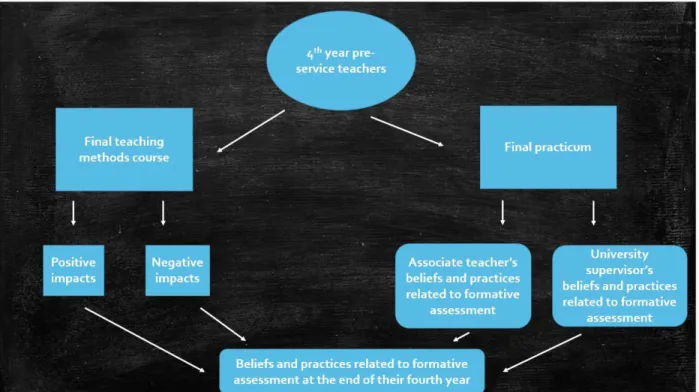
Figure 1. Conceptual map of BEALS pre-service teachers’ assessment literacy ……… 47
Figure 2. Conceptual map of BEALS fourth year pre-service ESL teachers’ beliefs and practices in relation to formative assessment ……….…... 48
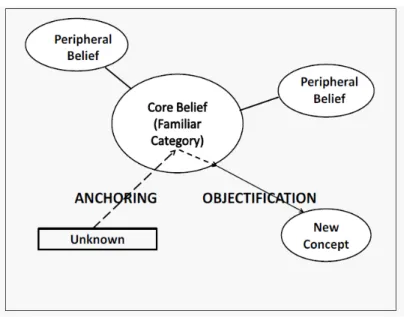
Figure 3. Schematic representation of Moscovici’s appropriation process ………. 61
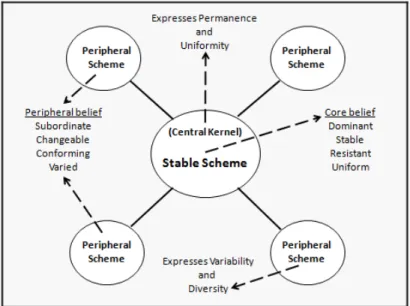
Figure 4. Schematic representation of the central kernel theory ………...………….…. 62
ACKNOWLEDGEMENTS
Firstly, I would like to express my gratitude to my advisor Professor Lynn Thomas for her continuous support throughout my Ph.D. studies and career, for her patience, motivation, and immense knowledge. Her guidance helped me in the research and writing process of this thesis. In addition, her advice on both research as well as on my career have been priceless. I could not have completed my studies if it was not for her amazing guidance.
I would also like to thank my co-advisor, Professor Marilyn Steinbach not only for her excellent comments, support and encouragement throughout my Ph.D. studies, but also for the hard questions which gave me the incentive to widen my research from various perspectives. I thank my friends Édmar Avila, Filipe Nunes, André de Costa, Rafael Almeida, Alexandre Fuchs and Nolan Bazinet for the stimulating discussions that also helped my research progress. Also, I thank my friends Ciro Mendes, Danilo Barcelos, Fernando Borges for the encouragement and support despite the distance. In particular, I am forever grateful to my professor Sérgio Raimundo Elias da Silva at the Universidade Federal de Ouro Preto for enlightening me with my first look at research when I was still an undergraduate student. In addition, I would like to thank my Master’s advisor Maria-Helena Vieira-Abrahão for guiding me through my research and contributing greatly to my professional development.
Last but not least, I would like to thank my family: my parents, my brothers Euro and Lucas and my sister Patricia and my dearest girlfriend and partner Emilie L. Garant for supporting me throughout the writing process of this thesis and my life in general.
INTRODUCTION
In the last half century, many reforms in education based on constructivist approaches to teaching and learning in countries around the world such as Canada, the United Kingdom and the United States, have led to revisions in teacher education programmes in order to improve the quality of their programmes and to provide pre-service teachers with the most appropriate preparation (Bullock, 2011; Cochran-Smith, 2003; Darling-Hammond, 2006; Kosnik & Beck, 2009). More specifically, these reforms have included changes in the way teachers are expected to teach and assess, and, within this new reality, teachers are now required to be diagnosticians and planners, possessing a great deal of knowledge of the learning process, as well as be equipped with different teaching tools, in order to ensure successful learning for their students (Darling-Hammond, 2006).
In terms of the assessment process, research indicates that teachers should not only assess their students’ learning by using different assessment tools but also keep track of student progress through formative assessment practices such as portfolios, peer/self- assessments and observations (DeLuca & Klinger, 2010). Although many authors mention that formative assessment can have positive impacts on educational outcomes (Black & Wiliam, 1998; Lee & Coniam, 2013; Popham, 2000; Stiggins, 2002), these authors also claim that formative assessment cannot be implemented successfully in existing learning programmes in schools (such as the Quebec education programme) without a radical redefinition of the roles and responsibilities assigned to teachers and learners in learning and assessment. In order to fulfill such needs, teacher education programmes have increased practicum hours and have created formal evaluation courses and added more teaching methods courses. However, as shown in this study, simply providing teachers with more courses or practicum hours is not necessarily the best solution for ensuring that novice teachers are well-prepared for the challenges of implementing an assessment for learning approach.
Moreover, studies have shown that as pre-service teachers begin their teacher education programmes, they bring with them a series of general conceptions1 on teaching and learning that can work as filters, thereby blocking out programme experiences that are cognitively incompatible with their prior beliefs (Calderhead, 1996; Freeman & Johnson, 1998; Holt-Reynolds, 1992; Wideen, Mayer-Smith & Moon, 1998). In relation to pre-service teachers’ assessment preparation (often referred to as their assessment literacy), as Dixon, Hawe and Parr (2011) state, in order to
truly promote students’ learning, teachers (and pre-service teachers) must receive detailed preparation and guidance including clear examples of how to assess their pupils using traditional/summative and formative practices. According to the authors, that is mainly due to the influence of teachers’ beliefs on how teachers interpret the roles they and their students play in assessment practices. Therefore, for many years, many researchers have recommended that teacher educators take pre-service teachers’ beliefs into consideration while preparing and teaching their courses in order to provide pre-service teachers with meaningful preparation (Borg, 2003; Hollingsworth, 1989).
In terms of providing pre-service teachers with opportunities to develop their abilities to teach and assess learning, research has shown the importance of increasing pre-service teachers’ practicum hours (Beck & Kosnik, 2000; Margolis, 2007; Turnbull, 2005), and the importance of formal evaluation courses as efficient elements in developing these abilities (Allen & Flippo, 2002; DeLuca & Klinger, 2010; Graham, 2005). Based on the fact that many teacher education programmes in North America are only one year long, Quebec teacher education programmes would seem adequate due to the number of opportunities pre-service teachers have to develop their assessment skills because they are offered opportunities to put their knowledge into practice repeatedly throughout four years. Although the BEALS2 teacher education programme provides a
four-year teacher preparation including 900 hours of practicum, a formal evaluation course, and five teaching methods classes that also include assessment, we have noticed through the analysis of our students’ assignments, discussions with associate teachers, university supervisors and other teacher educators for the last five years, that pre-service English as a second language (ESL) teachers from the Université de Sherbrooke still graduate relying on their own beliefs about assessment to assess pupils, possibly without an awareness of how these beliefs could impact their practices. This study will investigate what beliefs related to formative assessment pre-service ESL teachers at one Quebec university have and their impacts on process of learning to teach. It will also determine which elements are missing in their preparation that would allow teacher educators to improve their teacher education programmes.
The main issue here is that without knowing how to assess their pupils with the right and necessary tools, pre-service ESL teachers will rely on traditional assessment (such as tests) that
2 BEALS stands for Baccalauréat d’enseignement d’anglais langue seconde which means Bachelor in teaching English as a second language.
are not consistently the most effective way to assess their students’ learning. In addition, without proper preparation and understanding their own beliefs, pre-service ESL teachers could also end up basing their assessment practices on prior beliefs and assumptions that do not necessarily match the requirements of the context they will teach in, which could frustrate their pupils and themselves. For example, in Quebec’s current educational system, pre-service ESL teachers are required to assess their students’ oral interaction competency (Gouvernement du Québec, 2001b). However, one of the tools most commonly used to assess this competency by many associate teachers (and replicated by their student teachers) is the use of individual oral presentations (which do not promote interactions).
One possible reason for such phenomena could be attributed to the interaction/conflict between theories and practices pre-service teachers are exposed to during their teacher education programme with their prior experiences and beliefs. During their university coursework, pre-service teachers are expected to learn about the concepts of assessment, the requirements that they are expected to follow. Finally, pre-service teachers also learn by observing their professors use their own assessment tools and systems. While on practicum, pre-service teachers will also be in contact with their associate teachers’ beliefs and practices related to formative assessment which might differ from the theories and approaches promoted by university professors. According to Tang, Lee and Chun (2012), exploring and understanding pre-service teachers’ practices on their practica is probably the best way of knowing more about how pre-service teachers’ beliefs and knowledge develop. For that reason, this study will focus on pre-service ESL teachers’ fourth year of teacher education, the year in which they have their longest teaching practicum.
In the first chapter, we will discuss how pre-service teachers learn about practices related to formative assessment in their teacher education programmes, more specifically throughout the last year of one ESL teacher education programme in Quebec. In order to understand this context we will briefly outline teacher education up until the 1980’s, and then go on to discuss in greater detail how pre-service teachers are prepared in current programmes, focusing on one programme at the Université de Sherbrooke, where this study took place. Moreover, we will examine in particular detail the process by which ESL teachers learn to evaluate formatively throughout their four years in the programme at the Université de Sherbrooke. Finally, the research question and sub-questions will be presented, along with a discussion of how this study will lead to some responses to these questions.
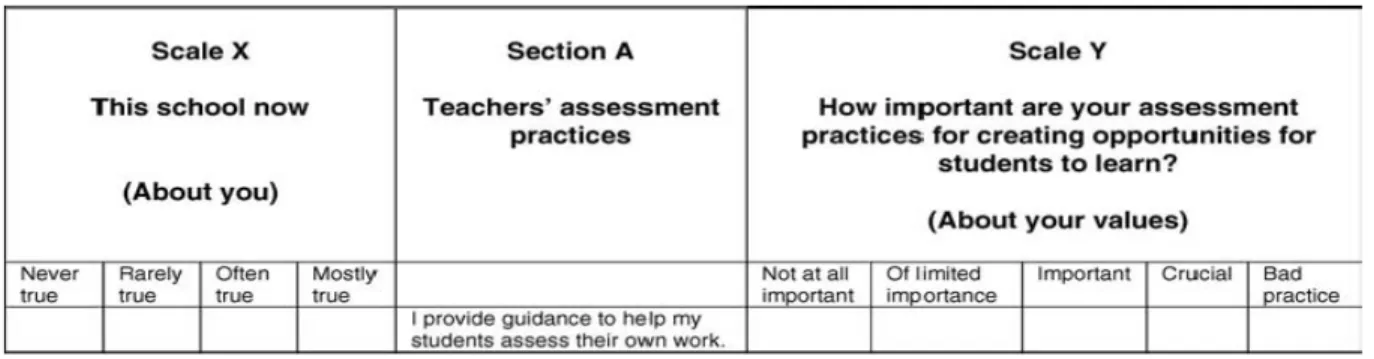
In the second chapter, we will build the conceptual framework by discussing theoretical models in three main areas: (a) professional development for pre-service teachers; (b) the role of beliefs in teacher education; and (c) assessment literacy. These models are included because they form the basis for the data collection methods that will be used. For instance, in the section that explores professional development, we have chosen to include two models, one developed by Altet (2008) and the other by Vanhulle (2009a) because they provide an overview of how pre-service teachers acquire knowledge. In the following section, we will discuss in more detail the role of teachers’ beliefs in shaping their learning-to-teach process. In the assessment literacy section, we will discuss the importance of providing pre-service teachers with adequate preparation to perform assessment tasks. In the same section, we will discuss two models (Cowie & Bell 1999; James & Pedder, 2006) that will be used to identify pre-service teachers’ beliefs and practices about assessment. Finally, the chapter will conclude with a presentation of the research objectives.
In the third chapter, we will discuss the research methodology by presenting this study’s participants and a review of how the chosen data collection tools have been used by other researchers to identify teachers’ beliefs and how the collected data was analyzed.
In the fourth chapter, we will present our results found through our data collection. In the first part of the chapter, we will present our findings based on the analysis of our participants’ initial questionnaire and their first semi-structured interview. In the second part of the chapter, we will present our findings obtained through the analysis of our participants’ narratives and stimulated recall sessions, which were collected during the practicum. In the third and final section of chapter four, we will identify our participants’ beliefs and practices related to formative assessment identified at the end of their teacher education programme according to the analysis of our second questionnaire and final semi-structured interview.
In the fifth chapter, through the lens of Altet’s (2008) professional development paradigms and approach to practicum and Vanhulle’s (2009a) professional development model, we will respond to our research question by discussing how our participants’ formative assessment beliefs and practices related to formative assessment evolved. In the second part of the chapter, we will examine the main elements that we have identified that influenced the evolution of our participants’ beliefs and stated practices.
CHAPTER 1 – RESEARCH CONTEXT AND PROBLEM
1. TEACHER EDUCATION PROGRAMMES
Among the challenges faced by pre-service teachers in their teacher education programmes, Darling-Hammond (2006) mentions three main ones that significantly complicate their learning-to-teach process. Firstly, pre-service teachers need to consider teaching from a different perspective than the one they have held for many years. That is, they are no longer students in the classroom. Secondly, pre-service teachers must not only learn to think like teachers but also to act like teachers. And finally, they must understand and learn to meet institutional goals, education policies and regulations. For the sake of helping pre-service teachers overcome these challenges and improve their preparation, many teacher education programmes have adapted and changed several elements based on empirical research and on ministerial requirements. However, despite these changes and improvements, several researchers contend that initial teacher education still has little influence on pre-service teachers’ classroom practices (Bullock, 2011; Cochran-Smith, 2003; Kosnik & Beck, 2009).
In order to explain our research problem and context, this chapter is divided into three main sections. In the first section, we present an overview of how teacher education programmes have evolved by focusing on the main elements that influence pre-service teachers’ learning-to-teach process. In the second section, we will focus on how pre-service learning-to-teachers learn to assess in their teacher education programmes through formal evaluation courses and teaching methods courses. In the same section, we will also discuss the importance of preparing pre-service teachers to formatively assess their pupils, as well as the impacts of their beliefs on their teaching tasks. In the third section, we will first of all present an overview of the current Quebec education system and how it has evolved since its initial implementation, by mainly focusing on how teachers (and pre-service teachers) are expected to assess their pupils’ learning. Secondly, we will present how pre-service ESL teachers learn to teach and assess at the Université de Sherbrooke by describing the university’s formal evaluation and teaching methods courses and its field experiences (practica). Finally, we will present our research question and sub-questions.
1.1 Teacher Education Programmes before the mid-1980s3
Until the mid-1980s, one of the main problems of teacher education programmes was the fact that it focused on providing pre-service teachers with knowledge about teaching instead of on how the pre-service teachers could actually develop their competencies to teach (Carter, 1990; Wideen et al., 1998). Under this traditional approach, many teacher education programmes in North America consisted of an assortment of isolated courses coupled with field experiences in which pre-service teachers were expected to make connections between the theories learned in those courses with their practices (Britzman, 2003; Johnson, 2009; Korthagen, 2001; Russell, 1988). As a consequence, as Zeichner and Tabachnick (1981) point out, following this traditional teacher education approach, the knowledge taught in their courses ended up being “washed out by school experience” (p. 7). In other words, when pre-service teachers were faced with a school milieu that prevented them from applying the knowledge they learned in their university coursework, they would tend to neglect the knowledge acquired in their coursework and favour what they learned in the classroom. Thus, one of the main criticisms levelled at teacher education programmes has to do with this gap between theory and practice (Dillon & O’Connor, 2011; Falkenberg, 2010; Smits, 2010).
1.1.1 Linking theory and practice.
Although much has been studied about bridging pre-service teachers’ gap between theories acquired in their university coursework and their practica (field experiences), Freeman and Johnson (1998) assert that numerous language teacher education programmes still operate under the conception that pre-service ESL teachers must firstly be provided with knowledge about language learning and language teaching; secondly, be exposed to a variety of practices and methodologies; and thirdly, be given field experiences in which they are expected to autonomously apply the theories they have learned in classroom settings. Thus, if pre-service teachers are not able to make links between these newly acquired theories on practice while on their field
3 The authors and researchers that appear on sections 1.1 and 1.2 have either written articles or conducted empirical studies that reviewed how teacher education programmes were operated at a certain period of time or were used to shape and influence these same programmes.
experiences, a gap is created. According to Dillon and O’Connor (2011), this gap comes from the fact that:
[T]he guidelines for teaching offered in teacher education courses seem abstract to students, even if couched in applied ways, and thus difficult to integrate well in students’ learning since students have limited teaching experience upon which to interpret and integrate the guidelines. In addition, when students are immersed in the “practice” of student teaching, they often feel that the guidelines offered in their program (those few that they may be able to remember!) are insufficient in the face of the enormous complexity of the classroom. (p. 118)
Another possible reason for this gap lies in the lack of support teacher educators receive in terms of integrating theory and practice in their professional learning as teacher educators (Korthagen, 2001; Russell & Korthagen, 1995; Wilson, 1990). By not being aware of the reality pre-service teachers face while on practicum, some teacher educators could end up teaching theories that are not adequate or realistic for the classroom context, which would give pre-service teachers the impression that their teacher education programmes failed to prepare them to become teachers. 1.2 Teacher Education Programmes after the mid-1980s
After educational reform movements that began in the 1980s, teacher education programmes focused on how to bridge the gap between the theories advocated in their programmes and pre-service teachers’ practices (Cochran-Smith, 2005; Korthagen & Kessels, 1999). More specific to second language teaching programmes, with the appearance of the communicative approach to language teaching in the 1980s, other significant changes and improvements were made to the way pre-service teachers learned how to teach and assess within second language teacher education programmes. In other words, since with communicative approach, language learning no longer focuses just on memorizing words and verbs but rather on communication; teachers are now required to learn and develop new teaching and assessment methods that promote this new approach.
1.2.1 A communicative approach to language teaching.
Based on the communicative competence model developed by Hymes (1972), the communicative approach, which is the approach currently promoted in Quebec ESL programmes, focuses on learner-centred instruction that promotes pedagogical task-based activities emphasizing function instead of form (Brown, 2000; Fleming, Bangou & Fellus, 2011; Howatt & Widdowson, 2004). In addition, the focus of communicative competence in second language education is:
… on how learning the L2 [second language] is not just a matter of learning grammatical structures, but also the ability to master the rules of use for the target language in social contexts in reference to a normative or native-like standard. In this approach, the communicative function of language holds a place as important as that of structure. (Fleming et al., 2011, p. 41)
For instance, within this approach, pre-service ESL teachers are expected to learn in their teacher education programmes how to teach a second language by using different student-centred and project-based activities that promote communication in diverse contexts. However, leveraging this communicative profile requires an appropriate model for second language teacher education. In other words, pre-service teachers must be provided with explicit examples of how to implement the communicative approach in their classroom settings; otherwise, they could end up teaching using traditional activities (teacher-centered) that do not necessarily promote communication or culture, such as drills, dictations and fill-in-the blanks exercises.
However, providing teachers with adequate preparation is not only dependent upon providing them with explicit examples of how to teach. Therefore, after the mid-1980’s, researchers began to promote the idea of acknowledging pre-service teachers themselves as being a central element in understanding and improving English language teacher education (Crandall, 2000; Darling-Hammond, 2006; Freeman & Johnson, 1998).
1.2.2 Pre-service teachers’ new roles
According to Freeman and Johnson (1998) and Daly (2009), owing to changes in the conceptions of how language teachers learn to teach, teacher educators have come to recognize that pre-service teachers are not “empty vessels waiting to be filled with theoretical and pedagogical skills; they are individuals who enter teacher education programmes with prior experiences, personal values, and beliefs that inform their knowledge about teaching and shape what they do in their classroom” (Freeman & Johnson, 1998, p. 401). Thus, in order to strengthen and improve educational practices, teacher educators must acknowledge the importance of prior knowledge as a powerful factor in the learning-to-teach process and as an element that will shape the teacher’s knowledge base.
According to Fleming et al. (2011), a teacher’s knowledge base is defined as the “result of the tensions between prior beliefs, the knowledge acquired through reflective practice, and the institutional contexts in which one works” (p. 43). Therefore, among the elements that several researchers acknowledge as being responsible for shaping pre-service ESL teachers’ learning-to-teach process, the main ones are: pre-service learning-to-teachers’ prior beliefs; their field experiences; and learning through reflection.
1.2.3 Pre-service teachers’ prior beliefs
One of the most important elements that shapes pre-service ESL teachers’ learning-to-teach and professional development in their learning-to-teacher education programmes is their prior beliefs. As previously mentioned, as pre-service teachers begin their teacher education programmes, they bring with themselves beliefs about the teaching and learning process that could filter or block programme experiences that differ from these beliefs (Borg, 2011; Buehl & Beck, 2015; Calderhead, 1996; Freeman & Johnson, 1998; Wideen, et al., 1998). Furthermore, these beliefs seem to be developed during what Lortie (1975) called the apprenticeship of observation, which refers to the knowledge built through the many years pre-service teachers spend as students at school, by observing their own teachers. For example, some of these prior beliefs can be notions of how to be an effective teacher (Calderhead, 1988; Pajares, 1992; Smith & Strahan, 1997), and,
regarding the assessment process, how they should assess and correct their pupils based on the related techniques they were exposed to as students and/or their own preferences.
According to Borg (2003) and Hollingsworth (1989), acknowledging pre-service teachers’ prior beliefs is essential in terms of providing pre-service teachers with a meaningful teacher education programme. For instance, Pu (2012) conducted a study to investigate how pre-service ESL teachers think, know and believe when it comes to teaching English learners. Among his findings, Pu (2012) was indeed able to identify pre-service ESL teachers’ “knowledge and disposition development and transformative actions towards teaching English learners, as well as existing gaps (e.g. misinterpretations of the use of home language) in their understandings” (p. 12). In addition, Pu (2012) concluded that studying pre-service teachers’ perceptions of teaching helps teacher educators answer questions such as: “what knowledge, skills, and disposition have preservice teachers developed towards teaching Els [English language learners]? What are the existing misunderstandings/incomplete understandings? How can teacher educators modify the course to fill the gap?” (p. 15). In other words, when planning and teaching their classes, teacher educators should take into account pre-service teachers’ prior beliefs and, for instance, discuss possible impacts of these beliefs on pre-service teachers’ practices. Otherwise, if pre-service teachers’ beliefs are not challenged, pre-service teachers could rely on their previous experiences of teaching and learning languages and this new knowledge could end up being ignored (Henrichsen, 2010; Tillema, 1998; Vanderwoude, 2012) or “washed out” by field experiences (Zeichner & Tabachnick, 1981).
1.2.4 Field experiences
After the mid-1980’s, in order to improve the quality of their teacher education programmes and to try to bridge the gap between theory and practice, many teacher education programmes increased the amount of the field experience offered to their pre-service teachers (Goodman, 1985; Huling, 1998). According to many authors, pre-service teachers’ field experience is one of the most relevant elements that shapes pre-service teachers’ learning-to-teach process and their professional development (Britzman, 2003; Le Cornu, 2009; Margolis, 2007; Tang, 2003; Turnbull, 2005; Walkington, 2005). In many teacher education programmes, these
opportunities take the form of practica4. During these field experiences, pre-service teachers are expected to be able to test the theories and methods they have learned during their courses and to reflect on their practices in a real classroom context. In addition, according to Bullock (2011), pre-service teachers tend to place higher importance on their field experiences than on their course work. However, simply providing pre-service teachers with these experiences does not guarantee the quality of teacher education programmes, and supervising them should not be reduced to a mere checklist of desired behaviors (Nolan & Hoover, 2004). Therefore, as other authors point out, among other elements, there are two actors that have an important role on how pre-service teachers learn to teach while on practicum: their associate teacher and their university supervisor (Beck & Kosnik, 2000; Tang, 2003; Zeichner, 1996).
1.2.4.1 The associate teacher.
Associate teacher, also known as cooperating teacher or mentor teacher, is the term attributed to teachers who accept to have student teachers in their classrooms (Beck & Kosnik, 2000). According to many researchers, the support associate teachers provide can have either positive or negative impacts on pre-service ESL teachers’ learning-to-teach process (Beck & Kosnik, 2000; Clarke, Triggs & Nielsen, 2014; Hollingsworth, 1989; Zeichner, 2005). For instance, if unaware of their responsibilities, associate teachers might believe that their role is only to focus on transmitting techniques and tips associated with what they believe to be effective practices (Zeichner, 2005). Furthermore, while on practicum, pre-service teachers also tend to mirror their associate teachers’ practices when they are not sure how to teach and evaluate, or to default to their associate teachers’ expectations. However, as other authors state, some associate teachers do provide adequate support by encouraging pre-service teachers to question their practices and to develop alternative ones (Beck & Kosnik, 2000) by giving them the freedom to try out some of their own ideas (Hollingsworth, 1989), and by promoting team teaching between pre-service teachers (Feiman-Nemser & Beasley, 1997).
4 Other examples of field experiences include assisting teachers, administering assessments, tutoring individual students, or teaching in small and large group settings.
1.2.4.2 The university supervisor
While on practicum, pre-service teachers also receive the support of a university staff member: the supervisor. Ideally, this support would consist of helping pre-service teachers to reflect on and come up with solutions to their problems on their own, to identify how their beliefs influence their practices, and to become aware of how their associate teachers’ beliefs and practices are influencing their own. Furthermore, Turunen and Tuovila (2012) state that practicum supervisors should also help pre-service teachers make links between the theories taught in their university coursework and their practices.
However, similar to what happens with associate teachers, many university supervisors may be unsure of how they should approach pre-service teachers to provide the best teacher preparation (Le Cornu, 2009; Zeichner, 1996). In fact, in many programmes, university supervisors tend to be temporary staff (such as retired teachers, and graduate students) who might have little connection to or knowledge about the rest of the teacher education programme (Zeichner, 1996). For instance, Kissau and Algozzine (2013) found in their research that practicum supervisors who were unaware of the content taught in L2 methodology courses, besides struggling to recommend new teaching strategies, were unable to determine whether their student teachers applied what they had learned. As a consequence, without adequate support and a clear awareness of their own role, university supervisors could end up inhibiting pre-service teachers from making connections between the theory learned in their teacher education programmes and their classroom contexts, and ultimately, compromise pre-service teachers’ professional development (Graham, 1997, 2005; Koerner, Rust & Baumgartner, 2002; LaBoskey & Richert, 2002; Zeichner, 2002). In contrast, as Russell (2017) states, practicum supervisors who want to improve the quality of learning in the practicum “may wish to focus their attention on an epistemology of practice and promoting learning from experience during their interactions with those whom they supervise” (p. 194). In other words, practicum supervisors should make links between the theory pre-service teachers learned in their on-campus courses with the practicum experiences. Therefore, it is important for teacher educators to better support university supervisors in terms of determining their own role so that they can provide the most adequate support while pre-service teachers are on practicum.
1.2.4.3 Beliefs and practices
While the literature acknowledges that beliefs act as a filter when it comes to the learning-to-teach process (Hollinsworth, 1989; Pajares, 1992), many authors also recommend studying the relationship between teachers’ beliefs and actions (practices) as they might not necessarily support each other (Basturkmen, 2012; Pajares, 1992). Accordingly, Basturkmen (2012) suggests that the relationship between teachers’ beliefs and actions should be interactive, given that “beliefs drive actions but experiences and reflection on actions can lead to changes in or additions to beliefs themselves” (p. 283). In other words, pre-service teachers’ beliefs are likely to change/evolve through teaching experiences and reflections. For instance, in Barahona’s (2014) study, the author concluded that pre-service ESL teachers’ beliefs were
… shaped and reshaped as they engaged in the activity of learning to teach English: from their previous experiences as language learners, their experiences as learners at university, and then engaging in actual teaching. Pre-service teachers use their beliefs about teaching and language teaching to direct their actions, which in the end they developed into concepts about language teaching and learning. (p. 120)
In another study, Nias, Southworth and Campbell (1992) investigated how teachers’ beliefs and practices evolved over time. These authors found that some of the possible ways included meetings and small group activities promoting discussion between the participants, as they:
… could enhance individuals’ professional learning, develop their sense of interdependence and likemindedness and help to ensure that they understood or accepted the framework of belief and action within which everyone worked. Such events also provided opportunities for the exchange of perspectives, knowledge and skills, thus ensuring that individuals learnt more about one another’s practice. They gave them a chance to discover or reaffirm, through laughter and mutual support, that they liked one another or valued one another’s contributions to the whole and so provided a secure context for challenge, debate and mutual critique. (Nias et al., 1992, p. 166)
Therefore, providing pre-service teachers with opportunities to reflect on their practices, teacher educators are more likely to help pre-service teachers become aware of the impacts of their own beliefs on their practices. This is important because if their beliefs are not challenged, pre-service teachers could end up simply reproducing their associate teachers’ practices or basing their practice on their own prior experiences as pupils, without knowing or questioning which elements they may still need to improve in terms of their professional development. For that reason, another essential element that needs to be studied is how reflection is promoted in pre-service teachers’ teacher education programmes.
1.2.5 Learning through reflection
Another important element that also began to be considered in teacher education programmes after the mid-1980’s was learning to teach by becoming a reflective practitioner (Calderhead, 1988; Korthagen & Vasalos, 2005; Schön, 1983, 1987; Wallace, 1996). According to Korthagen and Wubbels (2001), pre-service teachers learn to teach in teacher education programmes based on their acquisition of knowledge, attitudes and skills through their observation of and participation in teaching situations, and based on systematic reflection on these situations with the support of associate teachers and practicum supervisors. Ward and McCotter (2004) classify pre-service teachers’ reflections into four levels: routine, technical, dialogic and critical/transformational. With the first level, pre-service teachers tend not to focus on problems or make changes in their practices apart from blaming problems on others or on a lack of time or resources. In terms of the technical level, pre-service teachers would use reflections to solve a problem without questioning its nature. In the third level (dialogic), pre-service teachers would focus on others’ perspectives and on the learning process in the long term. Finally, in the critical/transformational level, which is a level rarely reached by pre-service teachers when reflecting on their own teaching, pre-service teachers question fundamental assumptions and purpose in more in depth. According to Hagevik, Aydeniz, and Rowell (2012), pre-service teachers’ reflections are usually limited to the first levels. However, the authors did find in their study that pre-service teachers were able to reach the higher levels of reflection by being involved in research, such as doing action research. Furthermore, by promoting reflection, teacher education programmes enable pre-service teachers to analyze, discuss, evaluate and change their own
practices; encourage them to take greater ownership of their own professional growth and professional autonomy; and help them develop their own theories of educational practice, by understanding and developing a principled basis for their own classroom work (Calderhead & Gates, 1993). However, if pre-service teachers are not offered opportunities to reflect on their beliefs and the impact of those beliefs on their practices, they will not be able to make links between the theories taught in their university coursework and their practices, which could lead to knowledge taught in their courses being washed out by school experience and mismatch between beliefs and practices, as previously mentioned.
Among the changes that were made in many teacher education programmes after the education reforms throughout the previous decades, some focused on the way teachers and pre-service teachers are expected to assess their pupils’ learning (Darling-Hammond, 2006). As a consequence, teacher educators were expected to make changes in order to match such demands (Black & Wiliam, 1998; DeLuca & Klinger, 2010). Therefore, in the next section, we will discuss how pre-service teachers are prepared to perform such assessment tasks.
2. THE ASSESSMENT PROCESS IN TEACHER EDUCATION PROGRAMMES
Today’s teachers (and pre-service teachers) are expected not only to assess their pupils’ learning by using different assessment instruments but also to use these instruments to support their teaching and measure their pupils’ development (DeLuca & Klinger, 2010). In addition, good classroom assessment allows teachers to gather precise information about students’ achievements, provide feedback to students and parents, and regulate further instruction, while ineffective assessment could compromise students’ learning (DeLuca & Klinger, 2010). In order to understand the importance of providing pre-service teachers with adequate assessment preparation, we must define an important term found in the literature: assessment literacy.
2.1 Assessment Literacy
Assessment literacy is the term used to describe “the possession of knowledge about the basic principles of sound assessment practice, including terminology, the development and use of
assessment methodologies and techniques, familiarity with standards of quality in assessment...and familiarity with alternatives to traditional measurements of learning” (Paterno, 2001, p. 3). Another definition is provided by Stiggins (1995), who states that assessment-literate individuals are people who know “the difference between sound and unsound assessments … [and are] not intimidated by the sometimes mysterious and always daunting technical world of assessment” (p. 240). In addition, someone who is assessment literate is able to understand which assessment methods to use to gather dependable information on student achievement and communicate assessment results effectively, whether using report card grades, test scores, portfolios, or face-to-face discussion. Before describing how pre-service ESL teachers are prepared to evaluate and assess students’ learning in their teacher education programmes, it is important to define two important terms for understanding our study: evaluation and assessment.
2.1.1 Evaluation
According to evaluation experts, the term evaluation can be defined as a complex process that is usually individual and personal, and that involves determining the value of an object (or person) at a given moment (Laurier et al., 2005). In addition, Worthen, Sanders and Fitzpatrick (1997) state that:
… evaluation uses inquiry and judgement methods, including (1) determining methods standards for judging quality and deciding whether those standards should be relative or absolute, (2) collecting relevant information, and (3) applying the standards to determine value, quality, effectiveness, or significance. It leads to recommendations intended to optimize the evaluation object in relation to its intended purpose(s). (p. 5)
More specific to the classroom context, the evaluation process is characterized by a person (teacher) who has to judge the extent or quality of the learning acquired by a pupil, particularly when making a decision about this individual (Laurier et al., 2005). In addition, Crooks (1988) states that evaluation is carried out through activities (such as formal teacher-made tests, oral questions asked of students, and curriculum-embedded tests) that students undertake as part of their educational programmes.
2.1.2 Assessment
In reference to students’ learning, over the years, the term “assessment” has progressively replaced “evaluation” (Allal & Mottier Lopez, 2005; Scallon, 2004). According to different authors, the etymology of the word “assessment” can be traced back to the Latin assidere, meaning “to sit by”, and within a classroom context, this would be in terms of being sure that the student’s answer really means what it appears to (Scallon, 2004; Wiggins, 1989). Among the different definitions found in the literature, assessment can be defined as:
… the process of gathering and discussing information from multiple and diverse sources in order to develop a deep understanding of what students know, understand and can do with their knowledge as a result of their educational experiences; the process culminates when assessment results are used to improve subsequent learning. (Huba & Freed, 2000, p. 8)
Therefore, one of the key elements that pre-service teachers should learn during their teacher education programmes is not just how to assess in the traditional summative (assessment of learning) sense of issuing a mark, but how to assess in a genuinely formative way (assessment for learning). This brings us to the issue of formative assessment.
2.2 Formative Assessment
Before discussing the importance of formative assessment in today’s education systems across the world in terms of assessing students’ learning, it is important to define and characterize the term. According to Black, Harrison, Lee, Marshall and Wiliam (2004), formative assessment can be defined as:
[A]ny assessment for which the first priority in its design and practice is to serve the purpose of promoting pupils’ learning. It thus differs from assessment designed primarily to serve the purposes of accountability, or of ranking, or of certifying competence. An assessment activity can help learning if it provides information to be used as feedback,
by teachers and by their pupils in assessing themselves and each other, to modify the teaching and learning activities in which they are engaged. Such assessment becomes ‘‘formative assessment’’ when the evidence is actually used to adapt the teaching work to meet learning needs. (p. 2)
Among the possibilities of classroom practices that promote formative assessment, Allal and Mottier Lopez (2005) mention direct teacher observation, exchanges among students (reciprocal assessment) at various points during an activity, and class discussions (p. 5). In this type of assessment, students’ errors are considered as integral parts of the learning process, not as a sign of weakness (Durand & Chouinard, 2006). According to Mavrommatis (1997), classroom assessment consists of “all the processes used by teachers for collecting information and for making interpretations and decisions based on this information on a daily basis in the classroom in order to improve teaching and learning” (p. 381). However, as Mavrommatis (1997) states, all teachers do not share this definition. To some, classroom assessment is the “summative mark that is used as the basis of school records”, while to others, it is “the diagnostic and formative impact of assessment on children’s learning”, or finally “the checking of children’s daily work” (Mavrommatis, 1997, p. 382). Despite the term’s different definitions, as Mavrommatis (1997) points out, research shows that in practice, teachers either follow their intuition when it comes to classroom assessment or are not aware that classroom assessment is happening in the class. Moreover, Mavrommatis (1997) concludes that the main problem behind implementing structured assessment techniques can be traced to inadequate assessment training.
Since teachers are now expected to make use of different teaching and assessment tools that ensure successful learning for their pupils (Darling-Hammond, 2006; DeLuca & Klinger, 2010), by researching pre-service ESL teachers’ beliefs and practices related to formative assessment we will also be able to see how these pre-service teachers were prepared to assess and will be able to identify the strengths and weaknesses of their programme. Thus, in order to develop pre-service teachers’ assessment literacy, some teacher education programmes provide pre-service teachers with formal evaluation courses and teaching methods courses.
2.3 Teaching Methods Courses
In teacher education programmes, pre-service ESL teachers also learn to assess in their teaching methods courses. The apparent advantages of teaching methods courses include giving pre-service teachers new ways of thinking about teaching and learning, hence pedagogically developing their ways of acting as and being teachers (Ball, 1992), enabling pre-service teachers to change their perception of practices (Grossman, Valencia & Hamel, 1997), and promoting change in pre-service teachers’ beliefs and practices (Agee, 1997; Clift & Brady, 2005; Graham, 1997; 2005; Wolf, Hill & Ballentine, 1999). In these courses, pre-service ESL teachers are expected to learn to assess by making connections between planning, teaching and assessing pupils. If pre-service teachers are able to learn how to make such connections, teaching methods courses will indeed help pre-service teachers learn to evaluate.
However, teaching methods courses might also have a negative impact on pre-service ESL teachers’ learning-to-teach process. If pre-service teachers consider their methods courses as an end in themselves, the complexity of the pedagogical activities studied in these courses can boil down to mere technical solutions for implementing classroom practices (Britzman, 2003). In other words, if these courses are seen only as sources of teaching tools and techniques, both pre-service teachers’ prior knowledge and beliefs will be repressed and teaching methods courses will only serve to help pre-service teachers go through the lessons they must teach. Therefore, despite the fact that teaching methods courses might help pre-service teachers learn to teach and evaluate, their presence in second language teacher education programmes does not guarantee effective teacher preparation. It is also important to consider how these courses integrate pre-service teachers’ prior beliefs into the content being taught.
2.4 Formal Evaluation Courses
Despite the fact that teacher education programmes increased their requirements for developing assessment literacy, many authors point out that only a few institutions throughout North America have formalized assessment education courses (DeLuca & Klinger, 2010; Stiggins, 2004; Volante & Fazio, 2011;). According to DeLuca et al. (2013), formal assessment courses are
extremely relevant as they complement field-based teaching experience and help pre-service teachers develop their assessment literacy. However, as Mertler (2003) states, in order to be genuinely valuable, these courses must take into consideration the reality of classrooms and assessment practices should be seen as an integral part of the teaching process. Thus, the fact that an institution offers a formal assessment course does not guarantee that pre-service teachers will truly develop their assessment literacy. According to Fazio and Volante (2007), faculties of education should conduct a systematic gap analysis of their pre-service teachers in order to identify possible disconnections between the intended assessment curriculum and what pre-service teachers actually learn. If content taught in formal evaluation courses does not match the reality witnessed by teachers (and pre-service teachers), the knowledge learned from practice comes into competition with the knowledge learned in university courses and student teachers are faced with the dilemma of making a choice. However, it is important to mention here that sometimes this choice is a non-choice, as many pre-service teachers believe that they must automatically follow their associate teachers’ instructions in order to succeed in the practicum.
2.5 Beliefs and Practices about Assessment and Formative Assessment
In the same way that teachers’ practices are influenced by their beliefs, Bliem and Davinroy (1997) suggest that teachers’ evaluative practices are affected by their beliefs. To illustrate this relation, Sikka, Nath and Cohen (2007) conducted an exploratory study aimed at investigating the beliefs and assessment practices of four secondary teachers. Among their results, the researchers found that despite the fact that all participants had extensive assessment knowledge and used different types of assessment approaches, all of them also claimed that they needed to improve their learning probably due to their lack of practice (Sikka et al., 2007). In addition, these researchers also found mismatches between the participants’ beliefs and their assessment practices, which could lead to severe consequences. For instance, as these authors state, if teachers believe that multiple choice tests are not relevant in terms of instructional decision-making, but still implement them in their classrooms, they could end up suffering from low self-esteem, which can lead to burnout. Thus, if teachers (and pre-service teachers) are not aware of how to use different assessment instruments in their class, they could end up relying on traditional assessment tools that do not match their beliefs. Therefore, when preparing teachers to assess their pupils’ learning,
teacher educators, associate teachers and university supervisors should not only give examples of how to use different types of assessment in the classroom, but also challenge pre-service teachers’ beliefs and practices. By having their beliefs and practices identified, pre-service teachers will be aware of their own beliefs and the consequences these beliefs could have on their practices, and finally, they will be able to identify possible gaps in their professional development.
In relation to formative assessment practices, although teachers have been required to use formative assessment, studies seem to show that teachers have not been adequately prepared to consciously implement such practices. For instance, in a study conducted in Quebec, Thomas, Deaudelin, Desjardins and Dezutter (2011) investigated the formative evaluation practices of 13 experienced elementary school teachers. Among their findings, Thomas et al. (2011) found that the participants were using formative evaluation practices in their classrooms informally and spontaneously, but that they were not necessarily clear about why they were doing this. The researchers concluded that there is a need for professional development on formative evaluation practices, given that some of their participants were not able to “articulate their understanding of a procedure or problem and the necessary learning processes to carry out the procedure or solve the problem” (Thomas et al., 2011, p. 394). For this reason, we believe that more studies are necessary to investigate how both practicing teachers and pre-service teachers understand the reasons and procedures for using formative assessment to support student learning.
Although the literature on formative assessment acknowledges the benefits of formative assessment for student outcomes and attitudes, there is a lack of studies conducted on the influence of teacher’s beliefs on their formative assessment practices (Brookhart, Moss, & Long, 2009; Carless, 2005; Shepard, 2000; Song & Koh, 2010). However, one study that does illustrate such impacts is that of Song and Koh (2010), which investigated the relationship between teachers’ beliefs about student learning and their formative assessment practices. In their study, Song and Koh (2010) found that teachers’ use of formal or informal summative assessment prevailed over their formative assessment practices which could be attributed to a lack of training in formative assessment practices. One of the limitations of Song and Koh’s (2010) study was the fact that the authors did not actually see the participants’ formative assessment practice. As previously mentioned, when it comes to investigating teachers’ beliefs, the literature suggests seeing the
participants in action, as their stated beliefs and practice could differ (Pajares, 1992). However, Song and Koh’s (2010) findings highlight the necessity of further studies on the level of assessment training in pre-service and in-service courses in order to investigate the impacts of such programmes on teachers’ formative assessment practices.
As we can see, all the above-mentioned studies’ findings corroborate the effects of beliefs as filters on newly acquired knowledge (Calderhead, 1996; Freeman & Johnson, 1998; Holt-Reynolds, 1992; Wideen, et al., 1998) and the importance of studying their impacts on assessment literacy. Thus, after having presented some of the main elements that influence how pre-service ESL teachers learn to teach and assess during their teacher education programmes, in the next section we will describe the specific context of the present study, namely the Quebec Education System and the BEALS programme.
3. THE QUEBEC EDUCATION SYSTEM
The current education system in Quebec began to be set in motion by the Ministère de l’Éducation, Enseignement supérieur (MEES)5 at the end of the 1990s, when the provincial
government invited citizens and educational institutions to participate in the Estates General on Education in order to take stock of the state of Quebec’s education system (Gouvernement du Québec, 2001a). After examining several experts’ reports, in 1997 the MEES published a document entitled L’école, tout un program (Gouvernement du Québec, 1997) which contained the general guidelines for the education reform that was expected to be implemented in the province in 2000, beginning at the elementary level. Thus, in 2001, the MEES published a document entitled Program de formation de l’école québécoise (PFÉQ) (Gouvernement du Québec, 2001a)6, thereby adopting a competency-based approach (CBA) that focused on essential learning, as well as reorganizing education levels into cycles in order to provide better pedagogical support and better evaluation of students’ learning (Gouvernement du Québec, 2001a). Thus, before describing how students’ learning is evaluated and assessed under the CBA, it is necessary to explain some of its main concepts and ideas as found in the literature.
5 It is important to mention here that before 2015, the term in use was rather MELS (which stands for Ministère d’Éducation du Loisir et du Sport), and prior to 2005, it was MEQ (Ministère d’Éducation du Québec). 6 In 2006, a new version was also released.
3.1 The Competency-Based Approach (CBA)
According to assessment specialists, many researchers and theorists have attempted to define and explain the concept of competency, which is central to understanding Quebec’s educational system (Fontaine, Savoie-Zajc & Cadieux, 2013; Laurier, Tousignant & Morissette, 2005; Scallon, 2004; Tardif, 2006). Some of the definitions of competency found in the literature, include that of Scallon (2004), who sees competency as “the capacity, a potential (unobservable) or a permanent characteristic of a person” (p. 105) and “an ability that is revealed when a person is placed in a group of problem-situations (several complex tasks with similarities)7” (p. 106). The
MEES’s guidelines also give an official definition of competencies along with some of their main features:
The Quebec Education Program defines a competency as a set of behaviours based on the effective mobilization and use of a range of resources. Set of behaviours refers to the capacity to use appropriately a variety of resources, both internal and external, in particular, learnings acquired in school or in everyday life. One aim of a competency-based program is to ensure that students’ learning serve as tools for both action and thought, which is a form of action. Unlike a skill, which may be applied in isolation, a competency makes use of several resources and is itself used in fairly complex contexts. (Gouvernement du Québec, 2001a, p. 4)
In addition, in the same guidelines we find that, within this new approach, teaching is organized in terms of competencies in order to make learning meaningful. Accordingly, besides being required to organize their teaching based on competencies, teachers also needed to base their assessment practices on competencies using various sets of official documents.
3.1.1 The Assessment process in Quebec’s competency-based approach
According to the Gouvernement du Québec’s (2001a) guidelines, assessment under Quebec’s CBA was expected to be an integral part of the learning process and teachers were
expected to “guide and support students’ learning and assess the development of the competencies” (p. 9). The same guidelines also mentioned tools (grids, reflection sheets and anecdotal notes) teachers could use in order to assess the development of the competencies. Since this document did not actually include examples of how teachers could use those tools or how to assess in the context of the CBA, many teachers relied on their traditional assessment tools up until the first assessment framework was published.
As one might expect in any newly implemented education system anywhere, Quebec’s began to publish different guidelines with changes and updates in order to improve the teaching and learning process. Thus, in the next sub-section we will present the most important ones related to the evaluation and assessment of students’ learning.
3.1.1.1 MEES supporting documents
The first supporting document intended to improve Quebec’s CBA was published in 2002 and entitled L’évaluation des apprentissages au préscolaire et au primaire (Gouvernement du Québec, 2002a). This document had the purpose of helping education professionals with their evaluation practices by providing guidelines to support their actions. The document also includes explanations and examples of classroom-based evaluation practices, the assessment means and tools that could be used, and different ways of communicating with parents and students. However, since this document did not provide actual examples of report cards or how teachers should differentiate their pedagogical approaches, many teachers might have been left confused and not sure of how to proceed (Durand & Chouinard, 2006).
The same year, the MEES also published a document entitled Les échelles des niveaux de compétences (Gouvernement du Québec, 2002b) describing how the competencies were expected to be developed at the elementary level. According to Durand and Chouinard (2006), these scales were created to support teachers’ pedagogical actions related to students’ learning and the evaluation of their competencies. Despite the hard work that was put into developing them, these scales lacked consistency from one level to another and failed to integrate competencies into