HAL Id: hal-00764289
https://hal.inria.fr/hal-00764289
Submitted on 12 Dec 2012
HAL is a multi-disciplinary open access
archive for the deposit and dissemination of
sci-entific research documents, whether they are
pub-lished or not. The documents may come from
teaching and research institutions in France or
abroad, or from public or private research centers.
L’archive ouverte pluridisciplinaire HAL, est
destinée au dépôt et à la diffusion de documents
scientifiques de niveau recherche, publiés ou non,
émanant des établissements d’enseignement et de
recherche français ou étrangers, des laboratoires
publics ou privés.
Scaling-up Knowledge for a Cognizant Robot
Thomas Degris, Joseph Modayil
To cite this version:
Thomas Degris, Joseph Modayil. Scaling-up Knowledge for a Cognizant Robot. AAAI Spring
Sym-posium on Designing Intelligent Robots: Reintegrating AI., Mar 2012, Stanford, United States.
�hal-00764289�
Scaling-up Knowledge for a Cognizant Robot
Thomas Degris
∗, Joseph Modayil
†∗
Flowers, INRIA, 351 cours de la libration, 33405 Talence Cedex, France
†RLAI, University of Alberta, Edmonton, AB, Canada, T6G 2E8
Abstract
This paper takes a new approach to the old adage that knowl-edge is the key for artificial intelligence. A cognizant robot is a robot with a deep and immediately accessible ing of its interaction with the environment—an understand-ing the robot can use to flexibly adapt to novel situations. Such a robot will need a vast amount of situated, revisable, and expressive knowledge to display flexible intelligent be-haviors. Instead of relying on human-provided knowledge, we propose that an arbitrary robot can autonomously acquire pertinent knowledge directly from everyday interaction with the environment. We show how existing ideas in reinforce-ment learning can enable a robot to maintain and improve its knowledge. The robot performs a continual learning process that scales-up knowledge acquisition to cover a large number of facts, skills and predictions. This knowledge has seman-tics that are grounded in sensorimotor experience. We see the approach of developing more cognizant robots as a necessary key step towards broadly competent robots.
Knowledge: a Bottleneck for Cognizant Robots
Any robot with a closed-loop control has some awareness of its environment. In 1948, Walter’s robot tortoises Elmer and Elsie could respond to their environment by avoiding obstacles or moving towards a light (Walter, 1950). More recently, robot vacuum cleaners detect dirty areas and spend more time cleaning them. Some are able to build maps of their local space. Autonomous cars are able to take appro-priate action to react to changing traffic conditions (Urmson et al., 2008).
In comparison, most animals can be considered more cog-nizant than modern robots in many ways. First, even simple animals such as fruit flies, cockroaches and spiders are able to adapt their behavior to their environment through learning from everyday experience (Greenspan and van Swinderen, 2004). Second, animals can learn to anticipate what is go-ing to happen next, as it has been demonstrated with dogs, pigeons, and insects (Pearce, 1997). Third, animals demon-strate a deep understanding of their sensorimotor experience by exhibiting complex behaviors. Cats can detect what is un-usual in their environment and exhibit curiosity-driven be-havior. Crows, bees, and rats can successfully remember
lo-Copyright c 2012, Association for the Advancement of Artificial
Intelligence (www.aaai.org). All rights reserved.
cations and navigate between them. Fourth, some animals use a large number of diverse sensorimotor signals from the world. Mammals, for example, are able to take advantage of smell, sight, hearing, taste and touch, along with temper-ature, acceleration, hair movements and also their internal senses such as pain, hunger, fatigue, guts, and propriocep-tion. In addition, they interact with their environment using a large number and variety of muscles and actuators.
To demonstrate comparable awareness of their environ-ment, a cognizant robot would need to have lots of immedi-ate knowledge. For instance, a reaction as basic as flinching in response to a moving object involves knowledge in the form of a ready to use flinching skill, and also, perhaps, a prediction of the trajectory of the object. Competent naviga-tion involves a wide-range of knowledge about the topology and characteristics of the environment, as well as skills rang-ing from obstacle avoidance to plannrang-ing a new route when a path is unexpectedly blocked. Detecting novelty and exhibit-ing curiosity-driven behaviour also involves knowledge: us-ing existus-ing knowledge to contextualize newly observed sen-sorimotor data, and a repertoire of behaviors to assess the nature of the novelty. The more knowledge to which a robot has immediate access, the more the robot can be cognizant.
The bottleneck in developing such robots is the lack of methods that are able to acquire and maintain a large quan-tity of immediately usable knowledge. A traditional ap-proach is to manually provide the robot with knowledge about its environment in the form of models, skills, and fea-tures. But such methods are problematic for at least two reasons. One, scaling-up knowledge is difficult if it re-quires manual interventions for every modification. Two, such knowledge will be necessarily incomplete or inaccu-rate in an open environment. Moreover, knowledge is often encoded in a form that cannot be autonomously updated by the robot (e.g. hand-coded or learned-but-fixed features and skills).
As a solution to this bottleneck, we consider Horde: a conceptually simple architecture that was introduced re-cently (Sutton et al., 2011). Horde proposes a theoretically sound formalism for representing knowledge. Horde allows a robot to learn autonomously from its everyday interaction with its environment. Horde is able to maintain and acquire a large number of situated, revisable, and expressive pieces of knowledge that are exploitable by a cognizant robot. To
Robot
Environment
Observation
Action
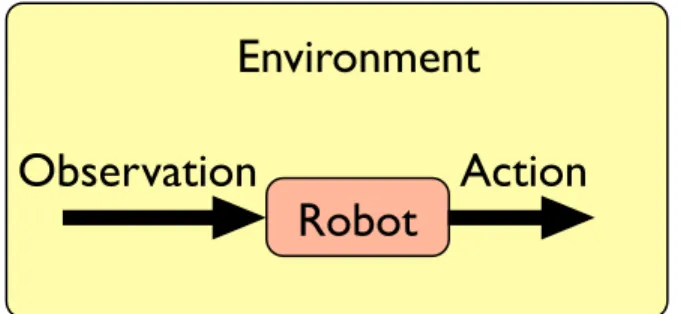
Figure 1: The robot is a situated agent that can only learn from its sensorimotor interaction stream of observations and actions.
reap these benefits, the robot should have an abundance of experience and the ability to autonomously explore its envi-ronment.
Defining Knowledge for a Cognizant Robot
To make our discussion about knowledge more concrete, we start by defining the interaction between the robot and its environment. We assume that this interaction is divided into discrete time steps. Despite the fact that this assump-tion does not characterize robots using analog electronics for their behavior (e.g. Walter’s robot tortoises), it is a re-quirement for working with digital computers. Ideally, the length of these time steps should be as small as possible so that the robot has a short reaction time. Note that time steps do not need to be of constant length.
The environment for robots is the physical world, a large space with essentially unlimited forms of variation. At every time t, the robot receives a new observation ot∈ O from its
environment (where O is a real vector space). The observa-tion otrepresents the latest information available on all the
sensors of the robot. Not all elements of otmay have been
updated because sensors can have different update times. In response, the robot sends back an action at∈ A where A is
also a real vector space. An action includes all the parame-ters for the different actuators available to the robot, includ-ing voltage on motors, parameters for pattern generators or colors on LEDs. Observations and actions are the only in-formation exchanged between a robot and its environment, as illustrated in Figure 1; they do not constitute knowledge.
The first element of knowledge that we formalize is an update functionU : X × A × O → X defined as
xt← U (xt−1, at−1, ot),
where X is the space of state of the agent. At a time step t, the function U takes the current state of the agent xt−1, the
latest observation otand the last action at−1to produce an
updated state xt. We do not restrict the state of the agent,
which can be the current value of variables in a procedure or the weights of a feature vector for a learning algorithm.
A second element of knowledge is the behavior of the robot in the world, represented as a policy b(at|xt) defining
the probability density of executing at time t the action at
given its current state xt. We allow both U and b to depend
on time but we do not include time indices for clarity.
Consequently, the goal of developing a cognizant robot requires the definition of only these two elements of knowl-edge: an internal state update function and a behavior pol-icy. A robot will demonstrate a deep understanding of its environment by extracting information from observations to adequately update its internal state, so that the behavior pol-icy will efficiently output adapted actions. Other elements of knowledge support the construction of these two functions.
Another important element of knowledge are skills. In-dependently of the robot’s current behavior, we would like to represent the knowledge of being able to achieve some goals. We can formalize skills as policies π(a|x). Similarly to the option framework, we can also define a termination function C : X → [0, 1] that, given the state of the agent, defines the probability of terminating a policy, maybe when a goal is achieved (Sutton et al., 1999). For a mobile robot, a useful skill such as “going back to the docking station” would be represented by a policy that the robot could fol-low to go back to its docking station and the skill would terminate either when the robot observes it has successfully connected or after a time out.
Given a policy and a termination function, another ele-ment of knowledge are the predictions about observable sig-nals. An observable signal z is any function of the observa-tions or the state of the agent. If the current time is t, we are interested in predicting the value zT at the time T (where
T > t) given the current state xtof the agent. These
pre-dictions can be conditional on a skill, such as a prediction of the value zT if a policy π is started from the current time t
and terminated at time T . An example of such prediction for a mobile robot would be knowledge such as: if I go back to the docking station starting from now and until termination, will I observe being connected to it?
Another form of predictions frequently used for knowl-edge, most notably in reinforcement learning, is the empiri-cal return gt, that is the prediction of the sum of an
observ-able signal z all along the way while executing a skill:
gt= T
X
k=t
zk. (1)
Such knowledge can represent predictions such as: what is the number of time steps required to go back to the docking station? What is the total amount of energy required to reach the docking station?
A last element of knowledge commonly used is features. Part of the state of the agent can be a feature vector φtthat
is updated every time step. φt can include elements from
the past experience of the robot, data extracted from sen-sors (e.g. edge detection from image, word recognized from audio) or other elements computed from observations, ac-tions or more generally from the internal representation of the robot.
In summary, these elements comprise the robot’s immedi-ate knowledge: the robot’s updimmedi-ate function, behavior, skills, predictions, and features. These are not the only compu-tational elements within the robot: slower timescale pro-cesses that may be present include planning and long-term memories. To be used by a cognizant robot, the results of
these slower processes should eventually be made available as a form of immediate knowledge. Aspects of immediate knowledge can be identified in all mechanical robots, vary-ing from Walter’s tortoises, to map-buildvary-ing vacuums, to Shakey the robot. Analogues can also be identified in ani-mals as described in the previous section.
The immediate knowledge forms the basis by which a cognizant robot can demonstrate the depth of its understand-ing of the environment. By requirunderstand-ing that the knowledge be demonstrable, we ensure that different approaches can be compared using clearly specified performance measures.
Cognizance: Situated, Revisable, Expressive
Knowledge
Ideally, a cognizant robot’s immediate knowledge would have several desirable properties, namely being situated, re-visable, and expressive. These properties have largely been studied by different communities. To be situated is of pri-mary importance for the robotics community who desire knowledge that pertains directly to the robot’s interaction stream. To be revisable is of primary importance for the on-line machine learning community, who desire knowledge to have clear performance measures and mechanisms for in-cremental adaptation. To be expressive is of primary im-portance for the knowledge representation community, who desire knowledge that can be used flexibly to accomplish a wide range of tasks. As we describe below, requiring a sys-tem to possess all three properties suggests a substantially different approach from when these properties of knowledge are pursued in isolation.
Situated
Knowledge is situated if it pertains to the robot’s stream of interaction with the environment. Many approaches to knowledge are not situated, including scraping information from the web, manually constructing knowledge bases, and mathematical theories. However, the need to be situated has been long understood in robotics (Brooks, 1986).
Imagine that a program accesses the Internet, scans a large (unstructured) knowledge database, and gets the factoid “A robot can walk on a sandy beach”. Such knowledge can-not be used to infer what sensor values would arise from walking on a beach, nor to construct a gait for walking on the beach. There also remains a fundamental and difficult problem of associating the words “beach” and “sand” to the robot’s immediate knowledge. Before making use of these non-immediate forms of knowledge, a robot needs a founda-tion of immediate knowledge that provides situated seman-tics for these terms.
Unlike forms of knowledge acquired from third parties, knowledge about sensorimotor interaction is tightly coupled to the current environment and physical embodiment of the robot. For instance, the response of a wheel motor to a volt-age not only depends on the specification of the motor but potentially also on its age, its temperature, the shape and materials of the wheel, also most certainly on the kind of floor the wheel is on, the shape and weight of the robot. The amount of this information that is observable by the robot
and taken into account will comprise how aware the robot is of its wheel response.
Revisable
Knowledge is revisable if it has an observable performance measure and the robot can modify the knowledge to improve its performance. Situated knowledge is ideally suited for re-vision, but the immediate knowledge in many robots relies on constructs whose semantics are not defined in the robot’s interaction stream. Often, the robot is externally evaluated by the robot developer, but the robot cannot evaluate its own performance. In principle, even a robot vacuum cleaner could measure its success in cleaning the floor. Did the floor get brighter after cleaning? Did the dust-bin get heavier? Perhaps the robot vacuum cleaner could modify its behav-ior to spend more time in places that are more rewarding (have more dirt).
Knowledge is often considered to be static, as opposed to revisable. The static approach is appropriate for knowledge that has a clear logical notion of falsehood as is the case for knowledge about mathematics, events in the past, and the common knowledge within communication protocols. The fact that 2+2 is equal to 4 is always true, independent of the environment and the local condition of the robot. This is true also for historical events: “It rained in Edmonton on June 2, 2008”. However, it is not appropriate for knowledge to be incapable of change when it pertains to the future.
A direct consequence of having an observable perfor-mance metric is that a robot should use its experience to revise its immediate knowledge. One might argue against this, by arguing that specifications for particular sensors are accessible to the robot designer. The designer can know a laboratory-calibrated function for converting from infrared reflection sensor readings to a distance between the sensor and an obstacle. But the specifications will never consider all the possible cases that the robot will encounter: the re-sponse of individual sensors might vary within a manufac-turing batch, the response will also depend on the color and material on the wall, and the response might vary with more or less opaque walls. Such uncertainty is true for many sen-sors: how does an accelerometer respond to uneven ground? How does a laser range-finder respond to rain, fog, snow, mud and reflected mirages? A robot interacting in an open environment will eventually run into conditions that were not anticipated by the robot’s designer. A robot needs the ability to incorporate new observed data with its existing knowledge, and this requires knowledge to be in a form that permits revision.
Expressive
The expressive power of a form of knowledge representation limits how flexibly the robot can achieve its objectives. Hav-ing expressive power is crucial for demonstratHav-ing compe-tent behavior with limited resources. Expressivity constrains both how well a robot can generalize to novel situations, and the robot’s ability to predict selected consequences of per-forming a temporally extended policy.
Expressive knowledge should enable a robot to general-ize to novel situations. Since a robot never has access to the
state of the physical world, the robot always has to gener-alize from past experience, but can never be certain in its generalizations. For any given task, some features will be relevant while many others will not, and the features that are relevant might vary over time. For example, navigating empty hallways at night will present a substantially different set of challenges from performing the same navigation task in the day when the hallways are filled with people.
Another aspect of expressive power is the ability to make predictions of temporally extended behavior. Many learning approaches focus on building a one-timestep dynamical sys-tem model of the robot’s interaction. Using these models for temporally-extended planning requires substantial computa-tion. In addition to their computational cost, they still may not make available the information the robot actually needs at the moment - for example, whether enough battery power remains to go back to the recharging station. Temporally ex-tended predictions can also form a powerful method of ab-straction. For example, if a robot can both predict the onset of collisions under various policies and how much time is required to come to a complete stop, then the robot can use this information to develop a skill for moving while avoiding collisions.
The Horde for Scaling-up Knowledge
Horde, proposed by Sutton et al. (2011), is an architec-ture for maintaining knowledge using reinforcement learn-ing methods (Sutton and Barto, 1998). To learn policies and predictions, we need an idealized representation of the world of the robot to define objective functions. Horde assumes an underlying Markov Decision Process (MDP) which provides the dynamics of the world. The state of the world at time t is denoted st∈ S.
By definition, the MDP representing the world satisfies the Markov assumption, namely that the next state does not depend on previous states, it depends only on the current state and the current action. This assumption may seem un-realistic for robots, as observations from the environment are an incomplete description of the world. Actually, this assumption is weak because it is only about the dynamics of the environment, not the robot. All the methods used in the Horde use function approximation. With this approach, Horde does not assume having access to the state of the envi-ronment. In practice, the main advantage of this formalism is the absence of strong assumptions about the data avail-able to the robot, while still enabling mathematical proofs of convergence (with additional assumptions).
Horde introduces the concept of general value functions to formally define a prediction. A general value function is an expectation defined as:
V (st) = Eπ,C[Rt+ ZT|st] .
Here Rtis a random variable that corresponds to the
empiri-cal return gtas defined in Eq. 1 and ZT is a random variable
representing the value of the signal zT at time T , where T is
termination with respect to C.
Whereas a general value function V is defined given a MDP, Horde learns an approximate value function ˜V defined
as the linear combination: ˜
V = vTφ,
where v is a weight vector and φ is a feature vector. Horde uses gradient TD methods (Sutton et al., 2009) to learn the weights v given a general value function because these methods have a per-time-step complexity that is linear in the size of the feature vector φ.
In addition to learning predictions, Horde can also learn policies. The task for the policy is defined by a reward function. A policy is learned using the Greedy-GQ algo-rithm (Maei and Sutton, 2010), which approximates a gen-eral action-value functionwith a linear function of the fea-tures. The complexity per-time-step of Greedy-GQ is also linear with the size of the feature vector.
The key idea of the Horde architecture to scale-up knowl-edge acquisition by learning in parallel many predictions and policies online, all from a single stream of experience. Indeed, Horde consists of independent demons, each learn-ing a different prediction or policy uslearn-ing an independent weight vector. Demons are able to learn about policies not currently followed by the robot using off-policy learning.
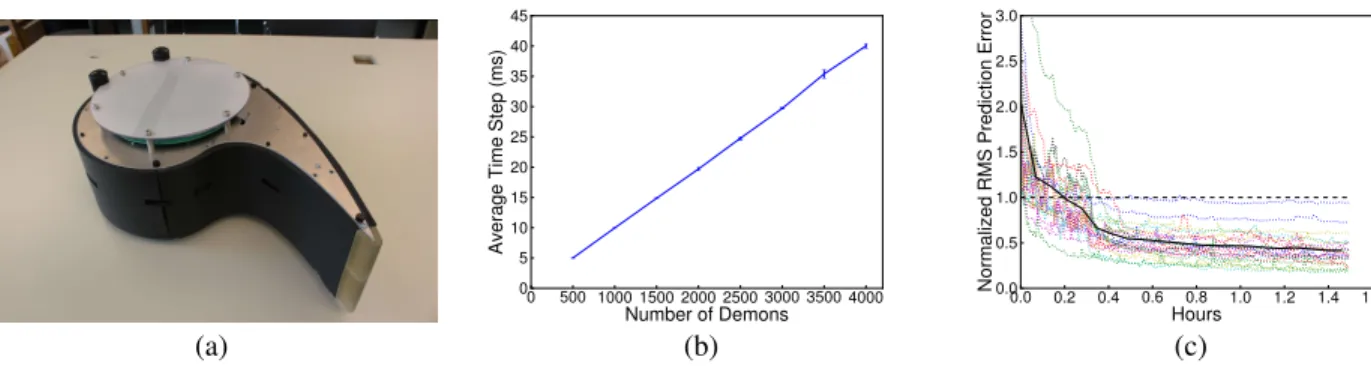
We implemented Horde on the Critterbot, a comma-shaped robot with a wide-range of low-level sensors (see Figure 2.a). These sensors include an accelerometer, infra-red distance sensors, infra-infra-red photodiodes, thermal sensors, a magnetometer, a gyroscope and ambient light sensors. Ad-ditional sensors provide information on the system bus volt-age and motor velocity, current and temperature. The robot can move using three motors controlling omni-directional wheels. Sensor readings are generated every 10ms.
Figure 2.b shows the time (in ms) required for an update cycle with respect to the number of demons. The update cy-cle includes updating the current prediction given the latest feature vector and updating the weight vector. As expected, the update cycle grows linearly with the number of demons. Figure 2.c, an early result, shows the normalized predic-tion error of 20 demons, that is the difference between the prediction and observed empirical return on a separate eval-uation set, normalized for each demon by the standard de-viation of the returns in the evaluation set. The behavior re-peatedly selects a random action from a set of 7 predefined actions for a randomized duration while running in a wooden pen. Sensor readings were sampled at 10ms. Each demon is learning to predict the value of some sensor (one of the IR sensors, a motor speed, or a motor current), after following a constant action policy (for one of the 7 actions) with a spon-taneous termination (with probabilities of 1, 0.5, 0.1, 0.05, or 0.01 spanning timescales from 10ms to 1s). These questions provide a sample of the sorts of knowledge that a robot might want to have about its experience. From the graph, we can observe that the prediction error decreases substantially in the first thirty minutes, with all the learned predictions even-tually performing better than the best constant prediction. Moreover, the learning has no divergence problems, special feature selection, or parameter tweaking for individual pre-dictions. With additional experience, learning continues to reduce the prediction error but slowly and with some vari-ability.
0 500 1000 1500 2000 2500 3000 3500 4000 Number of Demons 0 5 10 15 20 25 30 35 40 45
Average Time Step (ms)
0.0 0.2 0.4 0.6 0.8 1.0 1.2 1.4 1.6 Hours 0.0 0.5 1.0 1.5 2.0 2.5 3.0
Normalized RMS Prediction Error
(a) (b) (c)
Figure 2: A robot learning many pieces of knowledge. (a) The robot. (b) The time requirement scales linearly with the available computation, with timescales that are reasonable for robots. (c) Learning many predictions in parallel about different poli-cies with substantial reductions in error in 30 minutes, and improving with additional experience. The prediction error is the measured difference between predictions and empirical returns on a separate evaluation run. For each question, the root-mean-square error is normalized by the sample standard deviation over the evaluation set. Thus, normalized errors below 1 indicate the portion of the variance in the empirical returns that the robot is able to predict.
Horde learns knowledge that is situated: predictions are a function of the feature vector of the robot and the predictions are about the sensors of the robot (or its internal state). Poli-cies are defined as functions of the feature vector of the robot as well. Horde learns knowledge that is revisable: predic-tions and policies are defined using a weight vector updated in real-time from the sensorimotor stream. Finally, Horde learns knowledge that is expressive: predictions are condi-tional on policies that can be arbitrarily complex and tempo-rally extended.
Future Directions: What are Demons For?
Though the idea of using TD methods to acquire knowledge might seem unusual at first glance, we have demonstrated that this approach yields empirical knowledge that can be learned accurately and flexibly with practical amounts of training experience. Although we demonstrated this ap-proach on a research robot, the same method can be applied directly to robots with more complex sensory and motor systems. Moreover, as we discuss below, the demons have several possible uses in modifying the behaviour and state-update function: for novelty-detection, as partial models for planning, for feature selection, or to develop new features.
First, demons can be used for detecting novelty. Each piece of knowledge maintained by a demon represents an expectation of the robot of its environment. When the senso-rimotor stream does not match the predictions, the discrep-ancy can be detected and the robot can modify its behavior to express surprise, to assess the newly discovered novelty— an idea with connections to encouraging a curiosity-drive, or even to change its update function to imprint on the nov-elty. A robot that is able to respond to novelty on any on its sensors can be considered more cognizant than a robot that would not.
Second, demons can be used for planning. Each predic-tion demon is a partial model of the consequences of fol-lowing an option, and multiple demons could be considered jointly to enable temporally extended planning. As a slow
process, planning could use multiple partial models to up-date the behavior policy of the robot. The ability to flexibly reason with partial models would provide a compelling dis-criminative alternative for tasks where generative Bayesian models are commonly used.
Third, demons can be used for feature selection. In Horde, all demons compute a general value function with a shared feature vector. As the demons have different predictive tasks, this provides a selection pressure on the features to be rel-evant for many tasks. Examining the reliance across all the demons on each feature can help to determine what features to change or remove as part of a representation discovery process. In short, a feature used by many demons predicting different signals may be more informational and valuable compared to a feature only used by only a few demons.
Fourth, demons can be used as features themselves. Pre-dictive state representations and TD networks have been shown to be more general for knowledge representation than other concurrent approach such as POMDP or nth-order
Markov models (Singh et al., 2004). In such setting, the prediction of a demon can be used directly as a feature for other demons (including itself). Demons connected together in this manner could define a TD network that is able to rep-resent abstract concepts built from the sensorimotor stream. The argument we propose in this paper, that knowledge is important and that it should be closely related to sen-sorimotor experience, has been acknowledged for a long time in the robotics community. The novel contribution of the Horde is to provide a combination of features that en-able a robot to efficiently learn a broad set of competencies. 1. Horde is the first architecture able to represent abstract temporally-extended knowledge within a well-defined math-ematical framework that supports learning under function approximation (an incomplete representation of the environ-ment). 2. Horde is scalable: the computational and memory requirements grow linearly with the number of demons, all demons always learn from one single common sensorimotor stream but are able to efficiently learn about different ways
of behaving. 3. Demons are easy to create and delete to build more abstract knowledge. Finally, this paper is about devel-oping low-level knowledge and abstractions from low-level knowledge on a robot, and it is not obvious precisely how this supports high-level deliberative tasks like reading and playing chess.
Conclusion
This paper describes a roadmap for building a cognizant robot. We have defined a cognizant robot as one that pos-sesses vast amounts of situated, revisable and expressive knowledge. We have argued that such knowledge ought to be learned for scalability and for maintaining accuracy in an open environment. We have described a framework for ac-quiring knowledge that is conceptually simple and scalable in practice. Our results so far show that this approach scales well, and updates in real-time. Thus our approach to build knowledge for a cognizant robot is concrete, implemented, and works. In some ways, it is surprising that we can use re-inforcement learning methods for acquiring a broad array of knowledge. Although there are still many open questions for future research, we believe working towards more cognizant robots will provide a firm foundation for more abstract cog-nition.
References
Brooks, R. A. (1986). A robust layered control system for a mobile robot. IEEE Trans. on Robotics and Automation, RA-2(1):14–23.
Greenspan, R. J. and van Swinderen, B. (2004). Cognitive consonance: complex brain functions in the fruit fly and its relatives. TRENDS in Neurosciences, 27(12):707–711. Maei, H. R. and Sutton, R. S. (2010). GQ(λ): A general gra-dient algorithm for temporal-difference prediction learning with eligibility traces. In Proceedings of the Third Confer-ence on Artificial General IntelligConfer-ence.
Pearce, J. (1997). Animal Learning and Cognition: an In-troduction. Psychology Press.
Singh, S., James, M., and Rudary, M. (2004). Predictive state representations: A new theory for modeling dynamical systems. In Proceedings of the 20th conference on Uncer-tainty in artificial intelligence, pages 512–519. AUAI Press. Sutton, R. and Barto, A. (1998). Reinforcement Learning: An Introduction. MIT Press.
Sutton, R., Precup, D., and Singh, S. (1999). Between mdps and semi-mdps: A framework for temporal abstraction in reinforcement learning. Artificial intelligence, 112(1):181– 211.
Sutton, R. S., Maei, H. R., Precup, D., Bhatnagar, S., Silver, D., Szepesv´ari, C., and Wiewiora, E. (2009). Fast gradient-descent methods for temporal-difference learning with lin-ear function approximation. In Proceedings of the 26th In-ternational Conference on Machine Learning.
Sutton, R. S., Modayil, J., Delp, M., Degris, T., Pilarski, P. M., and Precup, D. (2011). Horde: A scalable real-time ar-chitecture for learning knowledge from unsupervised senso-rimotor interaction. In Proceedings of the 10th International
Conference on Autonomous Agents and Multiagent Systems (AAMAS).
Urmson, C., Anhalt, J., Bagnell, D., et al. (2008). Au-tonomous driving in urban environments: Boss and the ur-ban challenge. Journal of Field Robotics, 25(8):425–466. Walter, W. G. (1950). An electro-mechanical animal. Di-alectica, 4(3):206–213.