HAL Id: hal-03088317
https://hal.archives-ouvertes.fr/hal-03088317
Submitted on 26 Dec 2020
HAL is a multi-disciplinary open access
archive for the deposit and dissemination of
sci-entific research documents, whether they are
pub-lished or not. The documents may come from
teaching and research institutions in France or
abroad, or from public or private research centers.
L’archive ouverte pluridisciplinaire HAL, est
destinée au dépôt et à la diffusion de documents
scientifiques de niveau recherche, publiés ou non,
émanant des établissements d’enseignement et de
recherche français ou étrangers, des laboratoires
publics ou privés.
Distributed under a Creative Commons Attribution - NonCommercial - NoDerivatives| 4.0
International License
The TPM: Workflow of the Manual and Automatic
TPM Provisioning Processes
Aleksandar Milenkoski
To cite this version:
Aleksandar Milenkoski. The TPM: Workflow of the Manual and Automatic TPM Provisioning
Pro-cesses. [Technical Report] ERNW Enno Rey Netzwerke GmbH. 2019. �hal-03088317�
The TPM: Workflow of the Manual and Automatic TPM
Provisioning Processes
Aleksandar Milenkoski) [email protected]
This work is part of the Windows Insight series. This series aims to assist efforts on analysing inner working principles, functionalities, and properties of the Microsoft Windows operating system. For general inquiries contact Aleksandar Milenkoski ([email protected]) or Dominik Phillips ([email protected]). For inquiries on this work contact the corresponding author ()).
The content of this work has been created in the course of the project named ’Studie zu Systemaufbau, Protokollierung, Härtung und Sicherheitsfunktionen in Windows 10 (SiSyPHuS Win10)’ (ger.) - ’Study of system design, logging, hard-ening, and security functions in Windows 10’ (eng.). This project has been contracted by the German Federal Office for Information Security (ger., Bundesamt für Sicherheit in der Informationstechnik - BSI).
Required Reading
In addition to referenced work, related work focussing on the Trusted Platform Module (TPM), part of the Win-dows Insight series, are relevant for understanding concepts and terms mentioned in this document.
Technology Domain
The operating system in focus is Windows 10, build 1607, 64-bit, long-term servicing branch (LTSB). The TPM standard in focus is version 2.0.
1 Introduction
The TPM is a standard for a secure cryptoprocessor developed by the Trusted Computing Group (TCG). The TPM implements in hardware three roots of trust ([Tru16a], Section 9.4): root of trust for measurement (RTM), root of trust for storage (RTS), and root of trust for reporting (RTR).
The RTM is typically the CPU executing an implicitly trusted, immutable code that initiates the integrity mea-surement process in firmware context. Integrity meamea-surement typically consists of calculating hash values of relevant data. These values are stored for later comparison with previously measured hash values of the same data, such that a mismatch indicates data corruption.
Due to its immutability, the trusted code executed by the CPU is also referred to as the static root of trust for measurement (SRTM), or the core root of trust for measurement (CRTM). The SRTM is a set of instructions measuring itself and other firmware content, and storing these measurements in the TPM ([Joh13], Section 1). Although the SRTM itself can be stored in the TPM, it is typically stored in the platform’s Boot Block, part of the platform’s firmware ([Tru17], Section 2.3.3.1).
amilenkoski.client.ernw.net 2019-05-21 11:52:47
The RTS is the TPM’s memory, which is shielded from external access. The TPM has volatile and non-volatile memory, structured into registers. An example are the platform configuration registers (PCRs), which are used for storing integrity measurement data. A typical TPM has 24 PCRs, such that each PCR is uniquely identified by an integer number with a value between 0 and 23, known as the PCR’s index.
The RTS provides secure storage of data and protection of objects stored outside the TPM (e.g., keys, arbitrary files), where the root of this protection is the RTS ([Tru16a], Section 23). The protection of external objects is structured as a hierarchy of protected objects, such that the root of this hierarchy is a TPM key named the storage root key (SRK). TPM keys are encryption keys stored in a format understandable by the TPM. The SRK is created by the TPM, stored in the TPM’s non-volatile memory, and its private part never leaves the TPM. The SRK protects a given object by encrypting the object’s sensitive area (e.g., a key’s private part) using a symmetric encryption key derived from the private part of the SRK ([Tru16a], Section 22.3). This is known as wrapping. Among other objects, the SRK may wrap TPM keys of any type, for example, signing keys (keys used for digitally signing data), or storage keys. Storage keys are TPM keys that themselves can wrap other keys or any object, thus constructing a hierarchy of protected objects with multiple parent-child relationships, with a root in the TPM (i.e., the SRK, see [Tru16a], Section 23.1).
The RTR is the TPM and is implemented as the TPM’s functionality of reporting contents stored in the RTS (e.g., values of PCRs or the TPM’s audit logs, see [Tru16a], Section 9.4.3) to external entities (e.g., remote attestation servers). The identity of the RTR (i.e., of the TPM) is determined by the TPM’s endorsement key (EK). The EK is a TPM key generated in TPM context such that its private part never leaves the TPM. The EK is typically, however, not necessarily, installed on the TPM at platform manufacturing time, in its non-volatile memory. The EK is unique for each TPM. This makes the EK a key uniquely identifying the TPM it is stored on, and therefore, the platform the TPM is installed on.
Due to privacy concerns, EKs are not used directly for platform identification. TPM keys known as attestation identity keys (AIKs) are used for this purpose. AIKs are TPM signing keys, exclusively used for signing data originating from the TPM (e.g., values of PCRs). For example, a certificate authority (CA) can verify that a key originates from the TPM and then certify it, only after it has verified the signature of the signing AIK. This AIK itself has to be certified.
The TPM is a passive device executing commands submitted to it, and returning relevant data (e.g., status codes). We refer to these commands as TPM commands. In their raw form, a TPM command is a sequence of bytes stored in a TPM command buffer. This buffer has a command-specific layout defined in the Trusted Platform Module Library, Part 3: Commands [Tru16c]. Each TPM command is uniquely identified by an integer value, known as the TPM command code (see [Tru16b], Section 6.5.2).
Some TPM commands and functionalities are protected such that they can be executed only if a proof of own-ership of the TPM is provided. This proof is in the form of an authorization value. There are three types of TPM authorization values: platform authorization, endorsement authorization, and owner authorization value. Among other things, the first value is used for authorizing operations for managing the TPM performed by the platform’s firmware (e.g., resetting of authorization values), the second for authorizing EK-related operations (e.g., creation of an EK), and the third for authorizing operations for managing the TPM, a subset of the TPM management operations available to the platform’s firmware ([Tru16a], Section 13).
In order to protect itself from dictionary attacks, where an attacker tries different authorization values until one succeeds, the TPM implements a lockout mechanism. The TPM counts the number of TPM authorization failures over a time period, and when a given threshold is reached, it locks (i.e., it stops processing commands and authorization attempts). TPM lockout can be reset by providing an authorization value, known as lockout authorization ([Tru16a], Section 13.7).
The owner, endorsement, and lockout authorization values are set during a process of taking the ownership of the TPM ([Tru16a], Section 13.8.1). This process is the core activity of the TPM provisioning process, which initializes and prepares the TPM for use. TPM provisioning may be triggered manually by a user, or automatically by the operating system installed on the platform where the TPM being provisioned is deployed.
2 TPM Provisioning
In this section, we describe the implementation of the TPM provisioning process in Windows 10. We first define the term TPM provisioning in order to set the scope of this work. Under TPM provisioning, we understand activities storing data in the TPM device, where the stored data is a requirement for the device to be used. This includes: authorization values, the EK, and the SRK. The generation and storage of authorization values, the EK, and the SRK, are in the focus of this work.
The TPM 2.0 Library Specification, Part 1, level 00, revision 01.38 ([Tru16a], Section 13.8.1) refers to the pro-cess of storing the owner, endorsement, and lockout authorization values in the TPM as ”taking ownership” of the TPM. In the context of Windows, the owner authorization value (OwnerAuth) represents the core authoriza-tion value for managing the TPM, required for most TPM management activities. Windows uses this value for managing the TPM and unlocking the TPM if in a locked state. This is the use of both the owner and lockout authorization values as specified in the TPM 2.0 Library Specification.
In addition to OwnerAuth, Windows uses the authorization values EndorsementAuth (the endorsement autho-rization value) and StorageOwnerAuth.The EndorsementAuth is used in Windows context as specified in the TPM 2.0 Library Specification (e.g., for the generation of a new EK). To the contrary, StorageOwnerAuth is not defined as an authorization value in this specification. In Windows context, StorageOwnerAuth is used for storing keys in the TPM’s storage hierarchy. We observed that the values of EndorsementAuth and StorageOwnerAuth are zeroed-out by default.1 Therefore, the generation and storage of EndorsementAuth and StorageOwnerAuth is not in the focus of this work.
2.1 Workflow
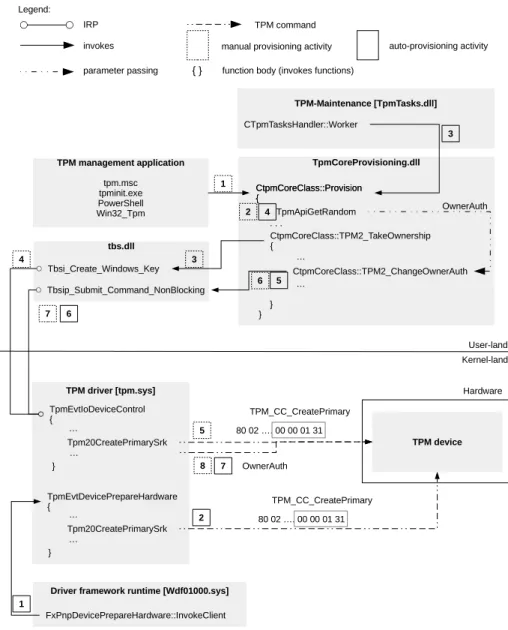
Figure 1 depicts the workflow of the TPM provisioning process in scenarios where the TPM is manually and auto-provisioned. In Figure 1, numbers encapsulated in boxes with dashed lines mark activities that are part of the manual TPM provisioning process in the order they occur. Numbers encapsulated in boxes with full lines mark activities that are part of the TPM auto-provisioning process in the order they occur. In Section 2.1.1 and Section 2.1.2, we discuss the workflow of the TPM manual and auto-provisioning process, respectively.
2.1.1 Manual Provisioning
The TPM is provisioned manually by a user triggering the provisioning process after the TPM has been cleared. Clearing the TPM is a process involving the deletion of authorization values and other data (e.g., the SRK) stored in the TPM’s memory (see [Tru16c], Section 24.6 for more details). In Windows, the TPM may be cleared, for example, using the Clear-Tpm PowerShell cmdlet.
The TPM provisioning process can be triggered manually by using the TPM management utility (executable: tpm.msc), the TPM initialization wizard (executable: tpminit.exe), or executing the Initialize-Tpm PowerShell cmdlet. Alternatively, a user may invoke the Provision function of the Win32_Tpm class that is part of the TPM’s Windows Management Instrumentation (WMI) interface. In Figure 1, we refer to the TPM management utility, the TPM initialization wizard, PowerShell, and any user application instantiating the Win32_Tpm class as TPM management applications.
We triggered the TPM provisioning process manually using all TPM management applications mentioned above. With the windbg debugger, we observed that all of them invoke the CtpmCoreClass::Provision function imple-mented in the %SystemRoot%\System32\TpmCoreProvisioning.dll library file (1 in Figure 1). This function first invokes TpmApiGetRandom (2 in Figure 1). TpmApiGetRandom generates a new random owner authorization value, which we verified as discussed next.
We first enabled storing of the owner authorization value, generated as part of the TPM provisioning process, at
1The values of EndorsementAuth and StorageOwnerAuth are stored in the system’s registry at the keys
TPM management application tpm.msc tpminit.exe PowerShell Win32_Tpm Legend: IRP invokes Kernel-land TpmCoreProvisioning.dll . . . } } tbs.dll TPM driver [tpm.sys] TPM device CtpmCoreClass::Provision { Tbsi_Create_Windows_Key Tbsip_Submit_Command_NonBlocking TpmEvtIoDeviceControl { Tpm20CreatePrimarySrk 80 02 …. 00 00 01 31 TPM_CC_CreatePrimary TpmApiGetRandom CtpmCoreClass::TPM2_ChangeOwnerAuth OwnerAuth … OwnerAuth } 1 3 4 5 2 6 7 8 … TpmEvtDevicePrepareHardware { Tpm20CreatePrimarySrk } … … 80 02 …. 00 00 01 31 TPM_CC_CreatePrimary
Driver framework runtime [Wdf01000.sys]
FxPnpDevicePrepareHardware::InvokeClient 1 CtpmCoreClass::Provision { TPM-Maintenance [TpmTasks.dll] CTpmTasksHandler::Worker 3 4 5 … … 6 7 TPM command
manual provisioning activity auto-provisioning activity { } function body (invokes functions)
Hardware CtpmCoreClass::TPM2_TakeOwnership { 2 parameter passing User-land
Figure 1: The TPM provisioning process
the registry key HKEY_LOCAL_MACHINE SYSTEM\CurrentControlSet\Services\TPM\WMI\Admin\OwnerAuth Full.2
We then triggered the TPM provisioning process and analyzed the execution of CtpmCoreClass::Provision using the windbg debugger.
The random value generated by TpmApiGetRandom is encoded using the Base64 algorithm3 and passed as the
second parameter of CtpmCoreClass::TPM2_TakeOwnership (see Figure 1). Figure 2 depicts the value of this parameter. The Base64-encoded random value is then passed as the third parameter of CtpmSettingsReader-Writer::WriteStringSetting (not depicted in Figure 1). Figure 3 depicts the value of this parameter.
CtpmSettingsReaderWriter::WriteStringSetting stores the value of its third parameter in the registry, at the reg-istry key specified in its first and fifth parameter. We observed that CtpmSettingsReaderWriter::WriteStringSetting writes the Base64-encoded random value generated by TpmApiGetRandom in the registry at the key HKEY_LO-CAL_MACHINE\SYSTEM\CurrentControlSet\Services\TPM\WMI\Admin\OwnerAuth Full (see Figure 4). This shows
2https://blogs.technet.microsoft.com/dubaisec/2017/02/28/tpm-owner-password/ [Retrieved: 22/9/2017] 3https://tools.ietf.org/html/rfc4648 [Retrieved: 22/9/2017]
Figure 2: A random value generated by the TpmApiGetRandom (Base64-encoded)
Figure 3: The third parameter of CtpmSettingsReaderWriter::WriteStringSetting
that the value generated by TpmApiGetRandom is the new owner authorization value.
Figure 4: The first and fifth parameter of CtpmSettingsReaderWriter::WriteStringSetting
TpmApiGetRandom generates random values using a software-implemented provider of the Cryptography API: Next Generation (CNG) library. TpmApiGetRandom uses the BcryptOpenAlgorithmProvider to load the default provider for the CNG algorithm RNG.4 This is indicated by the NULL value of the second, and the RNG value of third, parameter of BcryptOpenAlgorithmProvider.5 We depict these values as pseudo-code generated by the IDA disassembler in Figure 5. We developed a simple application invoking BcryptOpenAlgorithmProvider with the same parameters as those depicted in Figure 5 and we observed that a software-implemented CNG provider was loaded.
After TpmApiGetRandom generates the new owner authorization value, CtpmCoreClass::TPM2_TakeOwnership is executed. This function first triggers the generation of a new SRK by invoking Tbsi_Create_Windows_Key, imple-mented in tbs.dll (3 in Figure 1). This function issues an I/O request packet (IRP) containing a TPM command to the TPM driver tpm.sys (4 in Figure 1). The driver handles incoming IRPs in its function TpmEvtIoDeviceControl. It handles an IRP containing request for generation of a new SRK by invoking Tpm20CreatePrimarySrk. This function constructs a TPM command byte sequence and submits it to the TPM (5 in Figure 1). Figure 6 depicts a part of this sequence, which we displayed using the windbg debugger.
The sub-sequence 80 02 is a constant value defined as TPM_ST_SESSIONS in the Trusted Platform Module Li-brary Part 2: Structures, family 2.0, level 00, revision 01.38 ([Tru16b], Table 19). The sub-sequence 00 00 01 57 is the size of the TPM command, defined as an integer of a fixed length of 4 bytes ([Tru16c], Section 24.1.1). The sub-sequence 00 00 01 31 is the TPM command code TPM_CC_CreatePrimary, which is defined in the Trusted Platform Module Library Part 2: Structures, family 2.0, level 00, revision 01.38 ([Tru16b], Section 6.5.2). As spec-ified in the Trusted Platform Module Library Part 3: Commands, family 2.0, level 00, revision 01.38 ([Tru16c],
4https://msdn.microsoft.com/de-de/library/windows/desktop/aa375534(v=vs.85).aspx [Retrieved: 22/9/2017]
5See the documentation of BcryptOpenAlgorithmProvider for descriptions of its second and third parameter: https://msdn.microsoft.com/
Figure 5: BCryptOpenAlgorithmProvider in TpmApiGetRandom
Figure 6: A TPM command sequence for generating an SRK
Section 24.1.1), this command code is a unique identifier of the TPM command TPM2_CreatePrimary. This com-mand is used for creating an SRK or an EK. An SRK is generated in TPM-context and its private part never leaves the TPM ([Tru16c], Section 24.1.10). After it is generated, the public part of the SRK is stored in the system’s registry at the key HKEY_LOCAL_MACHINE\SYSTEM\CurrentControlSet\Services\TPM\WMI\Admin\SRKPub. Through static analysis, we observed that an EK is generated in a conceptually identical manner as an SRK (e.g., by invoking the function Tpm20CreatePrimaryEk implemented in the TPM driver and executing the TPM_CC_-CreatePrimary command, not depicted in Figure 1). We were unable to dynamically observe an actual generation of an EK. This is because the TPM installed on the platform we worked on was already provisioned with an EK at manufacture time. Once stored in the TPM’s memory, an EK cannot be removed by clearing the TPM ([Tru16c], Section 24.6).
After an SRK is created, the Base64-encoded random value generated by TpmApiGetRandom (i.e., the new owner authorization value, OwnerAuth in Figure 1) is passed to CtpmCoreClass::TPM2_TakeOwnership and written to the TPM by the function issuing multiple IRPs to the tpm.sys driver. These IRPs contain TPM commands and the new owner authorization value. CtpmCoreClass::TPM2_TakeOwnership issues the IRPs by invoking Tbsip_-Submit_Command_NonBlocking, implemented in tbs.dll (6 in Figure 1). Tbsip_Tbsip_-Submit_Command_NonBlocking, a variant of Tbsip_Submit_Command, submits IRPs to the TPM driver (7 in Figure 1). The driver handles the IRPs issued by CtpmCoreClass::TPM2_TakeOwnership in TpmEvtIoDeviceControl and submits the TPM commands to the TPM device (8 in Figure 1) for storing the new owner authorization value.
2.1.2 Auto-provisioning
The TPM auto-provisioning process is similar to the manual, with the major difference of how the tasks of gener-ating a new SRK and an owner authorization value are triggered. We cleared the TPM by executing the Clear-Tpm PowerShell cmdlet and enabled TPM auto- provisioning by executing the Enable-TpmAutoProvisioning cmdlet. We also enabled storing of the owner authorization value at the registry key HKEY_LOCAL_MACHINE\SYSTEM\ CurrentControlSet\Services\TPM\WMI\Admin\OwnerAuth Full. We then restarted the operating system.
We observed that the function Tpm20CreatePrimarySrk is executed in kernel context during system booting. This function triggers the generation of a new SRK. Tpm20CreatePrimarySrk is invoked within a thread created by the TpmEvtDevicePrepareHardware function of the TPM driver tpm.sys.
TpmEvtDevicePrepareHardware is invoked as part of the initialization procedures performed by the Windows ker-nel; that is, it is invoked by FxPnpDevicePrepareHardware::InvokeClient, implemented in the Driver Framework Runtime driver Wdf01000.sys (1 in Figure 1). This driver is part of the Windows Driver Frameworks platform and
acts as a filter driver for the TPM driver tpm.sys.6 Filter drivers are drivers that extent the functionalities of other drivers (e.g., perform system-related initialization tasks) and are part of their driver stacks when specific requests need to be handled.7
As described in Section 2.1.1, Tpm20CreatePrimarySrk triggers the generation of a new SRK by issuing the TPM2_CreatePrimary TPM command. This command is uniquely identified by the command code TPM_CC_-CreatePrimary (2 in Figure 1).
As mentioned in Section 2.1.1, we were unable to observe a generation of an EK. This is because the TPM installed on the platform we worked on was already provisioned with an EK at manufacture time. However, through static code analysis, we observed that an EK is generated in a conceptually identical manner as an SRK.
When analyzing the manual TPM provisioning process, we observed that the new owner authorization value is generated in user-land and passed to the TPM driver tpm.sys in the form of an IRP (see Section 2.1.1). Based on this observation, we identifed the context in which a new owner authorization value is generated as part of the TPM auto-provisioning process by monitoring the HKEY_LOCAL_MACHINE\SYSTEM\CurrentControlSet\Services\ TPM\WMI\Admin\OwnerAuth Full registry key each time an IRP is handled by the TPM driver. We achieved this by executing the windbg command bp tpm!TpmEvtIoDeviceControl ”!reg querykey \\REGISTRY\\MACHINE\\SYSTEM\\ CurrentControlSet\\Services\\TPM\\WMI\\Admin\\; !process -1 0; g”. This command sets a breakpoint at the func-tion of the TPM driver handling incoming IRPs - TpmEvtIoDeviceControl (see Secfunc-tion 2.1.1). It also displays the value of the OwnerAuthFull registry key, as well as information on the user process issuing an IRP (if any). Any change in the value of this key indicates the IRP passing a new owner authorization value to the TPM.
We identified the user process named ”Host Process for Windows Tasks” (executable: taskhostw.exe) as the processing issuing the IRP that passes a new owner authorization value to the TPM. Figure 7 depicts the output of the windbg debugger identifying taskhostw.exe; that is, it depicts the change in the value of the OwnerAuthFull registry key. In Figure 7, the value starting with ElE is the old owner authorization value, the value starting with YAq is the new owner authorization value, and the Image field contains the name of the executable issuing the IRP that passes a new owner authorization value to the TPM.
Figure 7: taskhostw.exe changing the OwnerAuthFull registry key
The taskhostw.exe executables executes scheduled tasks. Using the Task Scheduler utility (executable: taskschd. msc), we discovered the task named Tpm-Maintenance. This task is configured to execute at every system startup. We exported information about Tpm-Maintenance into an XML format using the Task Scheduler. We observed that the task executes functions of a component object model (COM) object that is an instance of the class with an ID 5014B7C8-934E-4262-9816-887FA745A6C4. Figure 8 depicts the snippet of the XML file contain-ing information about Tpm-Maintenance (i.e., about the ID of the instantiated COM class, ClassId in Figure 8). By exploring the contents of the registry key HKEY_CLASESS_ROOT\CLSID\{5014B7C8-934E-4262- 9816-887FA74 5A6C4}\InprocServer32\, we observed that the COM class with an ID 5014B7C8- 934E-4262-9816-887FA745A6C4 is implemented in the %SystemRoot%\System32\TpmTasks.dll library file. We analyzed the implementation of
6https://msdn.microsoft.com/en-us/library/windows/hardware/ff557565(v=vs.85).aspx [Retrieved: 22/9/2017] 7https://docs.microsoft.com/en-us/windows-hardware/drivers/kernel/filter-drivers [Retrieved: 22/9/2017]
Figure 8: The TPM-Maintenance task
this file using the IDA disassembler observing that at every system startup, it creates a thread executing the function CtpmTasksHandler::Worker. This function invokes CtpmCoreClass::Provision, implemented in the Tpm-CoreProvisioning.dll library file (3 in Figure 1).
As described in Section 2.1.1, the generation of a new owner authorization value takes places in CtpmCore-Class::Provision. The TPM auto-provisioning process continues as follows: a new owner authorization value is generated by TpmApiGetRandom (4 in Figure 1, see Section 2.1.1); this value is submitted to the TPM driver tpm.sys (5 and 6 in Figure 1, see Section 2.1.1); and the TPM driver stores the new owner authorization value in the TPM device (7 in Figure 1, see Section 2.1.1).
In addition to those mentioned above, the Tpm-Maintenance task performs other activities. For example, if an AIK (see Section 1) named Windows AIK is not present, it triggers the generation of a new AIK by invoking CwindowsAIK::CreateWindowsAIK (not depicted in Figure 1). An AIK is generated in scenarios where the TPM is manually or automatically provisioned.
CwindowsAIK::CreateWindowsAIK is implemented in TbsCoreProvisioning.dll. The public key of the new AIK is written to the system’s registry, at HKEY_LOCAL_MACHINE\SYSTEM\CurrentControlSet\Services\TPM\WMI\ WindowsAIKPub. Figure 9 depicts the generation of an AIK in the form of a pseudo-code generated by the IDA disassembler. CwindowsAIK::CreateWindowsAIK uses the CNG library to load the Platform Cryptographic Provider (i.e., the TPM, NcryptOpenStorageProvider and Microsoft Platform Crypto Provider in Figure 9),8and generate the AIK named Windows AIK using the TPM (NCryptCreatePersistedKey and Windows AIK in Figure 9);9 that is, the AIK is generated in TPM context. The presence of an AIK is not a requirement for the TPM device to be used. Therefore, the detailed analysis of the AIK generation process is out of the scope of this work.
Figure 9: Generation of an AIK
8https://msdn.microsoft.com/de-de/library/windows/desktop/aa376286(v=vs.85).aspx [Retrieved: 22/9/2017] 9https://msdn.microsoft.com/de-de/library/windows/desktop/aa376247(v=vs.85).aspx [Retrieved: 22/9/2017]
References
[Joh13] John Butterworth, Corey Kallenberg, Xeno Kovah, and Amy Herzog. Problems with the Static Root
of Trust for Measurement. 2013.
https://media.blackhat.com/us-13/US-13-Butterworth-BIOS-Security-WP.pdf.
[Tru16a] Trusted Computing Group (TCG). Trusted Platform Module Library Part 1: Architecture. 2016. https: //trustedcomputinggroup.org/wp-content/uploads/TPM-Rev-2.0-Part-1-Architecture-01.38.pdf. [Tru16b] Trusted Computing Group (TCG). Trusted Platform Module Library Part 2: Structures. 2016. Family
2.0, Level 00, Revision 01.38; https://trustedcomputinggroup.org/wp-content/uploads/TPM-Rev-2.0-Part-2-Structures-01.38.pdf.
[Tru16c] Trusted Computing Group (TCG). Trusted Platform Module Library Part 3: Commands. 2016. Family 2.0, Level 00, Revision 01.38; https://trustedcomputinggroup.org/wp-content/uploads/TPM-Rev-2.0-Part-3-Commands-01.38.pdf.
[Tru17] Trusted Computing Group (TCG). TCG PC Client Platform Firmware Profile Specification. 2017.
Family 2.0, Level 00, Revision 00.21; https://trustedcomputinggroup.org/wp-content/uploads/PC-ClientSpecific_Platform_Profile_for_TPM_2p0_Systems_v21.pdf.