HAL Id: hal-01169491
https://hal.inria.fr/hal-01169491v4
Submitted on 12 Jun 2018HAL is a multi-disciplinary open access archive for the deposit and dissemination of sci-entific research documents, whether they are pub-lished or not. The documents may come from teaching and research institutions in France or
L’archive ouverte pluridisciplinaire HAL, est destinée au dépôt et à la diffusion de documents scientifiques de niveau recherche, publiés ou non, émanant des établissements d’enseignement et de recherche français ou étrangers, des laboratoires
Jens Gustedt
To cite this version:
ISRN INRIA/RR--8751--FR+ENG
RESEARCH
REPORT
N° 8751
June 2015Jens Gustedt
RESEARCH CENTRE NANCY – GRAND EST
Jens Gustedt Project-Team Camus
Research Report n° 8751 — version 4 — initial version June 2015 — revised version June 2018 — 48 pages
addition of a handful of directives and a naming scheme transforming traditional translation units into modules. The change to the C language is minimal since we only add one feature, composed identifiers, to the core language.
Our modules can import other modules as long as the import graph remains acyclic and a module can refer to its own identifiers and those of the imported modules through freely chosen abbreviations. Other than traditional C’s #include, our import directive ensures complete encapsulation between modules.
The abbreviation scheme allows to seamlessly replace an imported module by another one with equivalent interface. In addition to the export of symbols, we provide parameterized code injection through the import of “snippets”. This implements a mechanism that allows for code reuse, similar to X macros or templates.
Additional features of our proposal are a simple dynamic module initialization scheme, a structured approach to the C library and a migration path for existing software projects. The whole approach is validated by a formal description of a translation procedure from
Modular C to common C and a proof of the correctness of that procedure. Thereby we are
able to show that the class of stable programs can effectively be expressed in Modular C and that the gain of modularity is not thwarted by a loss of expressiveness. Here stable programs have a restriction on the C macro facilities that can be used. Most importantly, they may not use the##operator or similar tricks to create new identifiers, and they have to be careful when using the same identifier for a macro and a function.
Our approach is implemented and used successfully and efficiently in several projects. Interfaces can easily be provided both ways, to interface existing projects for Modular C or to interface Modular C libraries with other programming languages
Résumé : Nous proposons une extension au langage de programmation C, nommé C modulaire. Elle consiste en ajoutant une poignée de directives et d’un schéma
de nommage à transformer des unités de traduction traditionnelles en module. La modification au language-même est minimale, car nous y ajoutons une seul nouvelle caractéristique, les identifiants composés. Nos modules peuvent importer autre mod-ules tant que la relation d’import reste acyclique et un module peut référer à ses propres identifiants et ceux des modules importés à l’aide d’abréviations librement choisis. Autre que l’includetraditionel, notre directive d’importassure l’encapsulation complète entre modules. Le schema d’abréviation permet de facilement remplacer un module importé par un autre qui réalise le même interface. En plus à l’export de symboles nous fournissons l’injection de code paramétrer par l’importation de
snippets. Ceci implante un mécanisme de réutilisation de code, similaire au X-macro
outemplate. Des outils supplémentaires que propose notre approche sont un schéma d’initialisation, un approche structuré à la bibliothèque standard de C et un chemin de migration pour des projets de logiciel existants.
1 Introduction
Since decades, C is one of most widely used programming languages, see [2], and is used successfully for large software projects that are ubiquitous in modern computing devices of all scales. For many programmers, software projects and commercial enterprises C has advantages (relative simplicity, faithfulness to modern architectures, backward and forward compatibility) that largely outweigh its shortcomings.
Among these shortcomings, is a lack of some closely related features: encapsulation, reusability and composability. Most importantly, C misses to encapsulate different translation units (TU) properly: all symbols that are part of the interface of a software unit such as functions are shared between all TU that are linked together into an executable.
The common practice to cope with that difficulty is the introduction of naming con-ventions. Usually software units (referred as modules in the following) are attributed a name prefix that is used for all data types and functions that constitute the application programming interface (API). Often such naming conventions (and more generally coding styles) are perceived as a burden. They require a lot of self-discipline and experience, and C is missing features that would support or ease their application.
A lot of examples for “encapsulation by convention” are already present in the C standard itself. To apprehend the difficulty let us try to make a complete list of the conventions that the C standard enforces in view of the encapsulation of its own library.
It reserves the prefixes str,mem and wcs (for string and byte functions), mtx_, cnd_,tss_andthrd_(for the thread interfaces),isandto(for character classification and conversion),E(for error codes), FE_(for the floating point environment),PRI andSCN(for IO formats),LC_(for locales),atomic_andmemory_(for atomic types and functions),TIME_(for time zones),SIG(for signals). In addition it also reserves prefix-suffix combinations[u]int.*_t(for integer types) and[U]INT_.*{MAX|MIN|C}(for integer macros), and the long list of names of C standard functions (for use as external symbols).
We propose a new tool, Modular C, that generalizes this approach by systematically adding name prefixes to the symbols that are exported by a translation unit. A number of simple rules and compiler directives are provided to facilitate the usage of this modular naming structure and helps to assemble software projects seamlessly and efficiently.
Overview
This paper is organized as follows. In the continuation of this introduction we will attempt to make our point about the shortcomings that we try to tackle, namely lack of encapsulation, reusability and composability. Then we will argue why C needs a specific approach to overcome these deficiencies and summarize our contributions. Section 2 will then introduce our main concept, a modestly improved naming scheme for identifiers that are exported by a module. Import of features from other modules, Section 3, is then organized simpler and stricter than in common C. As a result, the modular organization of projects is simplified and consistent module initialization can
be guaranteed. Reuse of small software components (“snippets”) is then introduced in Section 4. All this leads to a formal description of a translation procedure from Modular
C to common C, that can be proven to be correct, Section 5. The presentation of our
new approach is completed by providing a structured view of the C library, Section 6, and by discussing the transition to Modular C in terms of a reference implementation and migration paths for existing projects, Section 7.
Note: An online reference manual can be found here: http://cmod.gforge.inria.fr/ doxygen/index.html. The terminology used in this paper is based on the ISO C stan-dard [8]. In particular, we refer to the concept of a conforming program as it is defined there.
1.1 Lack of encapsulation
The example of C’s handling of its own library API already shows all weaknesses of the current approach:
It is intrusive: Other software projects that include C library headers just have to cope with the naming choices that have been made. If my module declares functionstop orstripit might be in conflict with functions inctype.horstring.h. Such problem might only become visible much later when the C standard evolves, or when my program is linked against a new implementation of the C library.
It is inconsistent: Reserved names may include underscores or not. They may only be reserved if their prefix is followed by uppercase, or if followed by a suffix such as_t ... Some of the reserved names arestruct,unionorenumtags, some are just plain identifiers.
It is illegible: The rules are difficult to apprehend and to memorize. They form an superfluous hurdle for beginners and occasional programmers with the C program-ming language.
It is ever growing: The C standard evolves from version to version (as most software interfaces) and adds constraints to the above list.
It is incomplete: The C standard headers define naming components, namelystruct fields, that are not protected by the above rules. User provided macros can thereby interact badly with the internals of thestructof an included header. E.g the identifier tv_seccould be used as a macro, although thetime.hheader uses it as astructfield. For the latter, no “official” rule forbids an application module to define a macrotv_sec which could badly interact withstruct timespecfromtime.h. A conflict here may only appear when a third party project attempts to combine that module with some timing code. Other potential conflicts concern identifiers that are used as parameter names for function prototypes or forinlinefunctions. A parameter namedstringcould interact with another macro definition. Such a definition could come from another completely independent module or from a future version and implementation of the C standard library that introduces it instrings.h.
Other commonly used interfaces such as the POSIX operating system API add to that Babylonian disorder by reserving other prefixes (such aspthread_for threads)
or suffixes (_t fortypedef) or by using the same name as astructtag and a function (stat). All of this makes the usage of the C library quite tedious, but occasionally is also at the origin of errors in implementations of the C library itself: avoiding the pollution of the application name space requires a continuous struggle with feature macros and include guards.
Besides these problems of name space pollution for shared identifiers, C offers some tools for encapsulation on which we will build for our approach. First, a whole set of features (types, macros, named constants) are per default not visible outside a given TU: they have what the C standard coins no “linkage”, see below. A second mechanism to hide global data and function objects from other TU is to declare them with “internal linkage” by using thestaticstorage class.
1.2 Lack of reusability
In addition to these issues about mutual identifier space pollution, C fails to provide the necessary infrastructure for painless code reuse. Common strategies to ensure reusability are:
Type-agnostic functions: The C standard itself defines generic interfaces for searching and sorting (bsearchandqsort) that take data as pointers tovoidand comparison functions asint (*)(void const*, void const*). This does not lead to real source code sharing but basically only switches off the type system to apply the same type agnostic binary to different application types.
Macros: Complicated software systems such as the Linux kernel1 or the Boost prepro-cessor library2 define parameterized data structures such as lists through a set of macros. The major drawback of this approach is that it quickly leads to code that is difficult to read, to apprehend, to maintain and to interface, and that may lead to replication of side effects.
X macros: This consists of writing small parameterized code snippets in.cfiles. These provide e.g. function definitions that can be repetitively included into other source. Parameterization of such code is effected by defining some specific macros before the include and undefining them right after, see [12]. Boost3 partly exploits that technique. This approach is probably the most readable of the three (the file contains normal C code) and also is the safest of the three techniques listed here. Nevertheless it has not found much use in the field. It is syntactical odd and disruptive on the user side. Preprocessor#define,#includeand#undefare leaked in the implementation part of the user code. The need to provide separate declarations and definitions doubles the maintenance overhead.
1http://kernelnewbies.org/FAQ/LinkedLists
2http://www.boost.org/doc/libs/1_57_0/libs/preprocessor/doc/index.html
1.3 Limited composability
C’s strategy to compose different TU into functional programs is twofold. First, linkage ensures that several compiled object files can be stitched together along commonly known features, so-called external symbols. These are data or function objects that are provided by exactly one TU and that can be used by all others. They are only identified by their name, no other property such as type or size is in general enforced. A second level then consists in the use of#includedirectives that ensure that necessary definitions of types, macros and named constants are shared and that all the commonly used symbols have the same interpretation throughout the different TU.
This mechanism has several weaknesses, in particular almost all consistency checks are left to the user or to external tools.structanduniontypes and members, macros and named constants have “no linkage”. The equivalence between a description of a feature in a header file and its instantiation is not guaranteed and is difficult to enforce from within the language. Linking TU with contradicting specifications for the same symbol result in “undefined behavior”, that is, there is no guarantee to obtain a diagnostic or that the link fails, and bugged executable can be generated.
1.4 C needs a specific approach
In contrast to most other programming languages that are commonly in use, modern C has the advantage of a rigid, static type system and an unambiguous declaration syntax that, in principle, can still be parsed linearly in one pass. To our opinion, this relative simplicity of the language should not be wasted by approaches that address complex features of other languages, such as dynamic types, inheritance or implicit typing. Therefore we try to stay as closely as possible to the existing lexical and semantic properties of C.
Many approaches have been proposed over the years to improve the composability of C projects, but seemingly few of them have resulted in tangible improvements for programming in C on the language level. In particular, none of them seem to improve modularity, that is to provide better encapsulation and reusability in addition to composability. Starting with Unix’make[5], many build systems, tools for component composition (e.g.Knit[11]) or regrouping [1], header file generation [7], and package management (e.g.dpgk[4]) have been proposed. Integrated development environ-ments (e.g. eclipse [9]) and sophisticated editors (e.g.emacs[14]) help programmers to reference declarations across several TU. Most of these tools need some additional specification (makefiles, project specification, dependency or group description, linker files, ...) to declare the connection between different TU. These usually have to be provided in addition to the source code itself. Complementary to that, in the present paper we try to develop a language feature that helps for the modularization of C code. In fact many of the tools from the above categories can be used to implement the system that we present, and not surprisingly our reference implementation uses some of them.
Existing approaches that address modularity on the language level can be split into two main categories. The first are rule sets that are provided by coding style and
enforcement strategies. They are used to restrain possible use of language constructs for information hiding, and thus to control the mutual impact that different modules may have. Most prominent among the coding styles is probably the Linux coding style [15]. Such coding rules then can be made sound and effectively enforceable as has been shown by [13]: they provide a set of four rules and operational semantics for a sufficiently large subset of C that allows them to check consistency and to identify bugs in large C projects.
To our opinion these rule based approaches are only going half the way. They don’t give the necessary tools for real encapsulation or code reuse and they leave the burden of naming conventions to the programmer. Our own approach here extends and improves such rule sets and should be compatible with most common practice. It is in particular compatible with the rules of [13], so all proven properties of that approach also apply to ours.
As another approach many new “C-like” compiled programming languages have been defined over the years. Most prominent among these are certainly C++, Objective-C and Java that in the advent of the concept of object oriented programming provided better encapsulation and code reuse. Whereas these languages have found a large distribution, they were only able to take a partial share in the software market. All three have the disadvantage that they are much more complex than C. They add multiple language constructs to a core that is similar to C, but provide no (or tedious) migration paths for existing software, infrastructure or developers.
Recently there have been efforts to provide a common modular framework for all three language siblings C, C++ and Objective-C, see [6]. Whereas that proposal tackles and solves problems with the include hierarchy it seems to add an extra layer of semantic complexity. Most importantly it does not address nor solve one of the major problems that we have identified above: the lack of mutual encapsulation of TU of any of the target languages.
Google’s Go (also sometimes referred as Golang) has gone a different path by introducing a new programming language, see [10], that addresses most if not all of the issues that we mention above. Here, we are particularly interested in itsimport
feature that has been one of the seeds of this work.
But unfortunately also, by design Go is a rupture. C on the other hand owes much of its success to the fact that it cautiously watches to be backward and forward compatible: standard conforming code that worked 10 or 20 years ago still works today and will most likely still work as many years from now. For many, switching to a new programming language is not an option and this proposal here is intended to help to improve the C programming language with respect to the issues that we raised. The strong emphasis on compatibility still has allowed C to evolve constantly. As major new features C11 [8] integrated threads to the C library and atomics and type generic functions to the core language. Our proposal inscribes itself in that steady and constructive line of improvements that have been added to C.
The presented proposal for “Modular C” shares a lot of ideas with the ones mentioned above, but is meant to be much simpler. It is designed to be compatible with C’s core language and with the common coding practice in the C community. It only targets that one language, C, and its support library, alone. The other two languages targeted
by [6] have their own proper features and problems concerning modularization and a mixed discussion easily misses language specific features and opportunities. On the other hand, compared to the other two, C has a specific default, its lack of language infrastructure for consistent code reuse that must be improved.
1.5 Our contributions
Modular C adds one main language feature (composed identifiers) and a handful of
directives that provide an extension of the C language with the following properties:
Encapsulation: We ensure encapsulation by introducing a unique composed module name for each TU that is used to prefix identifiers for export. This creates unique global identifiers that will never enter in conflict with any identifier of another module, or with local identifiers of its own, such as function or macro parameters or block scope variables. Thereby by default the import of a module will not pollute the name space of the importer, nor interfere with parameter lists.
Declaration by definition: Generally, any identifier in a module will be defined (and thereby declared) exactly once. No additional declarations in header files or forward declarations forstructtypes are necessary.
Brevity: An abbreviation feature for module names systematically avoids the use of long prefixed identifiers that are necessary for naming conventions.
Completeness: The naming scheme using composed identifiers applies to all file scope identifiers, that are objects, functions, enumeration constants, types and macros.
Separation: Implementation and interface of a module are mostly specified through standard language features. The separation between the two is oriented along the C notion of external versus internal linkage. For aninlinefunction, the module that defines it also provides its “instantiation”. Type declarations and macro definitions that are to be exported have to be placed in code sections that are identified with a declarationdirective.
Code Reuse: We export functionality to other modules in two different ways:
by interface definition and declaration as described above, similar to what is usually provided through a C header file,
by sharing of code snippets, similar to X macros or C++’s templates. The latter allows to create parameterized data structures or functions, easily.
Code repetition: Theforeachanddodirectives allow simple code repetition at compile time. This is e.g. useful to instantiate a number of functions for a list of values.
Acyclic dependency: Import of modules is is not from source but uses a compiled object file. This enforces that the import relation between modules defines a directed acyclic graph. It can be updated automatically by tools such as POSIX’makeand we are able to provide infrastructure for orderly startup and shutdown of modules according to the import dependency.
Interchangeability: The abbreviation feature allows easy interchange of software com-ponents that fulfill the same interface contract.
Optimization: Our approach allows for the full set of optimizations that the C compiler provides. It eases the use ofinlinefunctions and can be made compatible with link time optimization.
C library structure: We provide a more comprehensive and structured approach to the C library.
Extendability: Our approach does not interfere with other extensions of C, such as OpenMP or OpenCL.
Migration path: We propose a migration path for existing software to the module model. Legacy interfaces through traditional header files can still be used for external users of modules.
2 All is about naming
In its simplest form, our proposal just formalizes a common approach that is used for C projects. It uses a name prefix (themodulename) to specify the membership to a module and to access other software components, see Listing 1 for an example. A C module chooses itself a composed name, and may then be imported by other modules through that name. This new import feature combines linking and#include and therefore guarantees consistent use of all features according to their definition throughout a whole software project.
The module name may be deduced implicitly from the source file name or, alter-natively, it can also be specified explicitly in amoduledirective. Names of imported modules may be deduced implicitly just by using their features, or, alternatively, they can also be specified explicitly in animportdirective. E.g we could add the following to Listing 1 to make these names explicit:
#pragma CMOD separator ::
#pragma CMOD module p r o j:: s t r u c t s :: l i s t
#pragma CMOD import . .::element
#pragma CMOD import C::i o
This sets the module prefix to be composed of three identifier elements, namely proj,structsandlist. Syntactically, the components of identifiers are separated by a token, the separator, that may (with some restrictions) be chosen for each module. Here theseparator directive uses the Unicode character ::, but this could e.g. also be C++’s traditional namespace separator::or some other locale imposed character. The significance of the composition of such module names will be explained later in Section 3. For brevity we will omit allseparatordirectives from other code samples. The only additions of Modular C to the code are directives and composed identifiers, no keywords or constructions are added to the core language itself. We have chosen to use the prefix#pragma CMODfor lines that contain directives, but this choice by itself is not essential for the feasibility of our approach.
In the above, all file scope identifiers of the module are visible to the outside with the prefix. E.g., our module implements a function initthat is externally visi-ble asproj::structs::list::init. If the imported moduleproj::structs::elementin turn
Listing 1 A module that exports two symbols and a type. The module name,
proj::structs::listsay, is supposed to be deduced from the file name. A type
proj::structs::elementis implicitly imported and the usage of it supposes that it
has a membervar.
1 /* The f o l l o w i n g d e c l a r a t i o n s are exported */
2 #pragma CMOD d e c l a r a t i o n 3 4 /* Ex po rt s p r o j:: s t r u c t s :: l i s t ::head */ 5 s t r u c t head { 6 /* I m p l i c i t l y imports p r o j:: s t r u c t s ::element . */ 7 p r o j::s t r u c t s::element* f i r s t ; 8 p r o j::s t r u c t s::element* l a s t; 9 } ; 10
11 /* From here only exported i f e x t e r n a l l i n k a g e . */
12 #pragma CMOD d e f i n i t i o n 13 14 void s a y _ h e l l o(void ) { 15 C::i o::puts (" H e l l o world ") ; 16 } 17 s t a t i c unsigned count;
18 s t a t i c void say_goodbye(void ) {
19 C::i o:: p r i n t f (" on e x i t we see %u ", count) ; 20 } 21 head* i n i t(head* h) { 22 i f (h) *h = (head) { 0 } ; 23 r e t u r n h; 24 }
25 /* Ex po rt s p r o j:: s t r u c t s :: l i s t ::top , no c o n f l i c t with ctype . h */
26 double top(head* h) {
27 /* Expects p r o j:: s t r u c t s ::element to have a member ` ` v a l ' ' . */
28 r e t u r n h−>f i r s t .v a l; 29 }
provides a symbolinit, our module can access that one through the universal name proj::structs::element::init, and no naming conflict occurs between the two modules.
Similar to C++’s strategy, all composed identifiers are mangled during compilation such that no naming conflict with other modules or standard headers can occur. Such mangling needs the notion of reserved identifiers. These are identifiers that no application code is allowed to use. For our purpose it is sufficient to target a particular subset of C’s reserved identifiers:
Definition 2.1 An identifier that starts with an underscore and is followed either by a second underscore or by a capital letter is strictly reserved.
C reserves these for internal use of the compiler implementation and for future lan-guage extensions, such as had been done by introducing_Boolin C99 and_Static_assert in C11. Identifier starting with an underscore, followed either by a second underscore or by a capital letter are strictly reserved.
Rule 2.2 A module may not define any strictly reserved identifier or use it as a component of a composed name.
As stated above, the C library then reserves a lot more identifiers for features that are interfaced via the different standard header files.
Definition 2.3 An identifier is reserved if it is strictly reserved, a keyword, or used to name a feature of the C library.
Observe that we allow the use of “normal” identifiers that might also be used by the C library. In fact, there are two reasons for that. First, we want to ensure that Modular
C modules may seamlessly compile with any future version of the C library. Then, we
want to be able to propose different versions of C library functions in modules with equivalent interfaces, as e.g. a strict C library version ofprintf,C::io:: printf, and an augmented versionPOSIX::io:: printf.
Rule 2.4 A module may freely use any identifier that is not strictly reserved as a compo-nent of a composed name.
This rule also applies to keywords (with some caution) and library function names. Also, the identifier mainloses its special meaning when used in a module. Instead, optionally one or several entry points are declared via directives:
#pragma CMOD entry u n i t _ t e s t
This declares a semantic similar to traditional main. In “backwards compatibility mode” the identifier main is used as if such an entry directive formain would be present. The functionunit_testmust have a prototype that is equivalent to one of the following:
RT u n i t _ t e s t(void ) ;
RT u n i t _ t e s t(i n t argc, char *argv[argc+ 1 ] ) ;
RT u n i t _ t e s t(i n t argc, char const *argv[argc+ 1 ] ) ;
RT u n i t _ t e s t(i n t ( *argc) , char * ( *argv) [argc+ 1 ] ) ;
and whereRTis eitherintorvoid. Any valid identifier with a suitable prototype can be chosen as entry point. This also includes the module-local identifiermain, or function names from other modules.
2.1 Exported features
A traditional C header file can provide access to a number of different features: constants, types, macros, objects and functions. To simplify the life of the user of C modules and to ease encapsulation we have the simple rule:
Property 2.5 All the exported features of a moduleMcorrespond to a composed identifier M::LwhereLis not strictly reserved.
In particular this means that all types are named with composed identifiers and that no exported feature uses a name that does not start with the module’s name.
In the following paragraph we go a bit into detail how Property 2.5 is assured. C already has a convention that regulates the export of symbols, namely the linkage of identifiers: only identifiers of functions and global variables have linkage. Other identifiers, e.g. tags,⁴ typedefidentifiers or macro names don’t interact with those from other TU. Further, C distinguishes internal (declared with the keywordstatic) and external linkage. If not specified otherwise, Modular C just follows and enforces this concept.
Property 2.6 A module exports all its identifiers that have external linkage.
E.g., the module of Listing 1 exportsproj::structs::list::say_hello, but the identifiers proj::structs::list::say_goodbyeandproj::structs::list::countare not exported since they are declaredstatic. In addition it uses the imported identifiersC::io:: putsand C::io:: printffrom the moduleC::io.
On the proper language level (after preprocessign) C has a rigid static type system: identifiers can only be used after they have been declared, that is if sufficient type information has been associated to an identifier to formalize if it is itself atypedef, a tag, a named constant, a variable or a function. Within the same scope, this type association may not be changed. Using an identifier not according to its definition is a “constraint violation” and usually leads to an abortion of the compilation process.
For data objects, functions and tag types C also distinguishes declarations and
definitions. A declaration only provides information about an identifier such as type
and size, expected function arguments or the fact that a type with that tag exists. A definition additionally “instantiates” a feature. For data it reserves storage of the appropriate size, initializes it and identifies the object with its name. For a function it implements the function and provides a symbol in the symbol table of the binary file. For a tag type it fixes the kind (struct,unionorenum) and the internal structure of the type.
In traditional C, header files (.h) usually contain declarations, whereas TU (.c) usually contain definitions.
C has a “one definition rule”, that stipulates that any data or function object and any tag type must have exactly one definition. For Modular C we have an extension of this rule:
Rule 2.7 The definition of an identifier also serves as its unique declaration.
The first advantage that we obtain from this is that we don’t have to separate a header (".h"file) from the code of the translation unit.
4For C, tagnames ofstruct,unionandenumform their own “name space”. These constructs
are the only ones that result in a new type that is created. Other than the name suggest, a
Property 2.8 Identifiers are imported with the type of their definition.
So far we can easily decide for global variables and functions if they are visible by exporters or not. If they are declaredstaticthey are local to the module, otherwise they are exported. Other identifiers (types, macros and named constants) are not exported unless we say so, explicitly. By that we maintain the encapsulation that C provides for these features. Nevertheless, we have to add a mechanism for those features that are part of the module’s interface:
Rule 2.9 Identifiers without external linkage are exported iff they are in a declaration section.
This can be done by placing adeclarationdirective in the source as shown. All code after a such a directive, before the nextdefinitiondirective, should only be declarations or definitions similar to the ones found in a traditional header file. So typically, such declaration sections only consist of type declarations (typedef,struct,unionorenum) and definitions of macros. Similar to C++, Modular C overcomes the distinction between tag name space from an identifier name space.
Property 2.10 Allstruct,unionorenumdeclarations give rise totypedefthat are im-plicitly inserted.
E.g., for Listing 1 we can assume that thestructdeclaration itself is preceded by
typedef s t r u c t head head;
to declare the tag name and identifier at the same time. This means in particular, that the identifierheadcannot be reused in file-scope to refer to a different entity than thestructheadtype.⁵
Definition 2.11 Atypedefof an identifierIDis canonical if is of the form typedef { s t r u c t | union |enum} ID ID;
Property 2.12 All tagged struct,unionorenumdeclarations are accompanied by an appropriate canonicaltypedef.
2.2 Avoiding identifier clashes
The functiontopthat is defined at the end of Listing 1 shows another feature. If is only visible asproj::structs::list::topto the outside. So no naming conflict can occur with C library headerctype.hwhich reserves the prefixto. Generally, this feature allows us to reuse all reserved names of the C library, locally, and in general to decide freely on names inside a project. They will never conflict with names of other projects, as long as the chosen module names differ.
This makes it easier to provide extensions to the C library, e.g., the POSIX standard extends C by adding features to C library functions such asprintf, much as it reads in traditional C. Within Modular C any extension can do that freely, if it uses its own module name space. Importers may use the two different versions of such functions simultaneously as long as they use prefixed names, such asC::io:: printf
andPOSIX::io:: printf.
For the C library itself, this approach is more flexible, too. Currently, the C library already has several groups of functions that provide the same functionality for different base types, such as thefabs/cabsorstrlen/wcslenfunctions. In the case offabs, there are even two “functions” with the same name, one that is provided bymath.hand the other that is included bytgmath.h
With our approach, the C library can provide different modules to implement interfaces to real and complex floating point functions. We introduce six modules C::real:: float,C::real:: double, ...,C:: complex ::ldoublefor the type specific functions frommath.h. Any of these modules has a function that locally is namedabsand that replacesfabsf,fabs, ...cabsl. The type generic functionfabsfromtgmath.hcan be superseded by an identifierabsinC::maththat interfaces all the above and analogous functions for integer types with a type generic macro.
1 #pragma CMOD module C::math
2 3 #pragma CMOD d e c l a r a t i o n 4 /* Ex po rt s a type g e n e r i c abs f o r 5 a r i t h m e t i c base types . */ 6 # d e f i n e abs ( X ) _Generic ( ( X ) +0 , \ 7 f l o a t : C::r e a l:: f l o a t ::abs , \ 8 double : C::r e a l::double::abs , \ 9 /* more cases */ \ 10 ) (X)
To finish this part we summarize what it means for a type or an identifier to be exported by a module.
Definition 2.13 A type definition or forward declaration is exported by a moduleMiff it is found in adeclarationsection. If the type is astruct,enumoruniontype with tag nameX, it is exported with tag nameM::X.
Definition 2.14 A file scope identifierXis exported by a moduleMas composed identifier M::Xiff one of the following conditions holds:
Xis an object or function that is defined with external linkage.M::Xthen refers to the same object and has the same type asX.
Xis declared or defined in adeclarationsection.
– Xis an object or function that is defined with internal linkage. For each importing moduleN,M::Xthen refers to a specific object or function inNwith internal linkage and has the same type, storage class, definition and initialization (if any) asX.
– It is an enumeration constant. Then,M::Xis an enumeration constant of the same value asX.
– Xis a macro. Then,M::Xis a macro with an expansion identical to the one ofX.
– Xis the tag name of a struct, unionor enumtype.M::X then is an alias to the corresponding type with tag nameM::X.
Property 2.5 also ensures that imported macros, as they have composed names, do not conflict with local identifiers:
Property 2.15 No imported macro will replace internal identifiers such as variable or function names, tags,structorunionmembers, named constants or function parameters.
2.3 Abbreviations
So far the gain we have achieved with our approach is that we avoid code duplication for identifiers with external linkage, reflected in Rule 2.7, and that we are better able to encapsulate functions that represent similar features. Otherwise the grammatical complexity of the code that this allows to write is similar to the traditional prefix convention for C identifiers. Listing 2 introduces another functionality, abbreviations. These identifiers (on the left side of the=, above) are local names that are only valid inside the particular module. Here, they may replace the composed name on the right side. By themselves, these abbreviations are not exported to other modules.
The name of every imported module and of the module itself can be abbreviated. This feature is inspired by a similar feature of the Go programming language. With
#pragma CMOD import elem = . .::element
we introduce a shortcut for refering to the identifiers of the imported module. The symbolproj::structs::element::initcan now be referred aselem::init.
Property 2.16 Features can be accessed with two component names asabbrev::name whereabbrevis a short prefix that is chosen in amoduleorimportdirective andname is the local name given by the module that defines the feature.
In the example above, theimportdirective
#pragma CMOD import p r i n t f = i o:: p r i n t f
allows to refer to the C library IO function asprintf, without prefix. This gains modu-larity. To partially or fully replace C’s IO module by POSIX’, we just have to replace the corresponding import directives. For a partial replacement ofprintfwe could use:
#pragma CMOD import p r i n t f = POSIX::i o:: p r i n t f
For a full replacement of the wholeiomodule we could use:
#pragma CMOD import i o = POSIX::i o
Provided that the function prototypes are compatible, no other code change is neces-sary.
Listing 2 The module of Listing 1 with abbreviations.
1 #pragma CMOD module head = p r o j:: s t r u c t s :: l i s t 2 #pragma CMOD import elem = . .::element
3 #pragma CMOD import i o = C::i o 4 #pragma CMOD import p r i n t f = i o:: p r i n t f 5 #pragma CMOD import puts = i o::puts 6
7 /* The f o l l o w i n g d e c l a r a t i o n s are exported */
8 #pragma CMOD d e c l a r a t i o n 9 10 /* Ex po rt s p r o j:: s t r u c t s :: l i s t */ 11 s t r u c t head { 12 elem* f i r s t ; 13 elem* l a s t; 14 } ; 15
16 /* From here on , only exported i f
17 e x t e r n a l l i n k a g e . */ 18 #pragma CMOD d e f i n i t i o n 19 20 void s a y _ h e l l o(void ) { 21 puts (" H e l l o world ") ; 22 } 23 s t a t i c unsigned count;
24 s t a t i c void say_goodbye(void ) {
25 p r i n t f (" on e x i t we see %u ", count) ; 26 } 27 head* i n i t(head* h) { 28 i f (h) *h = (head) { 0 } ; 29 r e t u r n h; 30 } 31 /* Ex po rt s p r o j:: s t r u c t s :: l i s t ::top , 32 no c o n f l i c t with ctype . h */
33 double top(head* h) { 34 r e t u r n h−>f i r s t .v a l; 35 }
Rule 2.17 An abbreviation must not conflict with other local identifiers. In particular, no twoimportdirectives may use the same abbreviation.
2.4 The module name
Inside the module, all names exported by it are usually referenced through their short name, e.g.,initas we introduced it above. But the nameproj::structs::list::init
could equally be used. There is one particular composed identifier of special interest, the module name itself. This identifier, can freely be used to put emphasis on one particular feature that is central for the module. For a first example, let us suppose that our “element” module exports astructtype:
1 #pragma CMOD module p r o j:: s t r u c t s ::element 2 #pragma CMOD d e c l a r a t i o n 3 /* Ex po rt s p r o j:: s t r u c t s ::element */ 4 s t r u c t p r o j::s t r u c t s::element { 5 double data; 6 p r o j::s t r u c t s::element* next; 7 } ;
With an abbreviationelemthe code simplifies:
1 #pragma CMOD module elem= p r o j:: s t r u c t s ::element 2 #pragma CMOD d e c l a r a t i o n 3 /* Ex po rt s p r o j:: s t r u c t s ::element */ 4 s t r u c t elem { 5 double data; 6 elem* next; 7 } ;
As Listing 2 has shown, using the module name for thestructdeclaration then eases the use of thatstructby the importer, here through the same abbreviationelem. Property 2.18 The composite name of a moduleM can be referred to by the abbreviation given by animportormoduledirective.
Similar holds for the name of the module in Listing 2 itself. The structure that had been exported asproj::structs::list::headin Listing 1 is now accessible asproj::structs::list,
thereby reflecting the idea that this is the main data type this module is about. All users of thelistmodule can easily use an “object centered” syntax to access the data type and its functions:
1 #pragma CMOD module a n o t h e r _ p r o j e c t::d o i t 2 #pragma CMOD import l i s t = p r o j:: s t r u c t s :: l i s t 3 4 l i s t* pop_or_push(l i s t* l , double a) { 5 i f (l && l−>data == a) { 6 l = l i s t::pop(l) ; 7 } e l s e { 8 l = l i s t::i n s e r t (l , a) ; 9 } 10 r e t u r n l; 11 }
In the example above the module name proj::structs::list is now abbreviated ashead. Thus the definition that is internally visible as structhead is exported as
structproj::structs::list. Our module can export identifiers in an “object oriented” scheme: it exportsproj::structs::listfor the type name andproj::structs::list::init andproj::structs::list::topas functions that act on this type.
This use of the module name is not limited to types. E.g., a function can be in the center of interest of a module: a moduleC::lib:: rand that interfaces the C library functionrandasC::lib:: randmay export the functionsrandasC::lib:: rand ::setand the macroRAND_MAXasC::lib:: rand :: MAX.
1 #pragma CMOD module rand = C:: l i b ::rand 2 #pragma CMOD d e c l a r a t i o n
3 i n t rand ( void ) ;
4 i n t s e t(unsigned i n t seed) ; 5 # d e f i n e MAX C:: l i b ::RAND_MAX
Another example could be to add integral and derivatives to a numerical function:
1 #pragma CMOD module func = p r o j::func 2 double func(double x) { . . . }
3 double func::d e r i v(double x) { . . . }
4 double func::i n t e g(double low, double high) { }
2.5 Composing names on a finer granularity
Modular C uses a second character that separates identifier components.
1 #pragma CMOD composer
2 # d e f i n e macro0 ( ) macro1 (" empty ") 3 # d e f i n e macro1 ( S ) macro2 ( 5 , S )
4 # d e f i n e macro2 (N , S ) /* do something with N and S */
This provides a simple tool to parameterize local names that share some properties. This avoids to force a particular choice of naming convention to the importer. If an importer chooses e.g. a “long dash” – as composer, the above can be accessed as macro–0,macro–1andmacro–2.
More importantly, this scheme will also be used to compose certain identifiers when they are imported from so-called “snippets”, see below.
2.6 Mangling
To be able to set up some formal proofs for the validity of our approach, see Section 5, we have to specify how we will ensure that all file scope identifiers are encapsulated. Definition 2.19 LetSthe source character set of a C platform, ::/∈ S, andbS= S ∪ { :: }.
1. An identifierN∈ S∗ is valid for a platform if it complies to a length restriction that the platform may impose.
2. A stringÒN= N0 :: N2· · · :: Nn−1∈ bS∗is a valid composed identifier ifN0, . . . , Nn−1∈
S∗are valid identifiers. Such a valid composed identifier is reserved if either n= 1
andN0 is reserved or ifn> 1and any of theN0, . . . , Nn−1is strictly reserved.
3. A function f :(S ∪ { :: })∗7→ S∗is a valid mangling if it is injective and if the image under f of any non-reserved valid composed identifier is not a reserved identifier.
Observe that this definition allows that composed names with two or more parts may contain identifiers such asint,printfetc. that would otherwise be reserved by the core language or the library. It also disallows that a mangling accidentally maps a composed identifier to one that would be used by the C library.
For languages such as C++, many different functions have traditionally been used for mangling. In contrast to the requirement in 3 they usually map to reserved identifiers. This is because they have to ensure that non-reserved names that are defined elsewhere withextern"C"binding cannot clash with mangled names. Modular
C implements complete encapsulation and has no mechanism to introduce “unmangled”
names, so we don’t need such a property, here.
On the other hand, we only require a mangling to map to non-reserved names because it makes our proofs simpler. Even in our reference implementation we use a derivation of such a function that is often used for C++ name mangling. It maps the identifiersNi as of the definition to a concatenation of stringsMi = `iNi where
`i is the length of Ni, prefixed and postfixed by _ZN2_C and E, respectively. E.g. C::real:: double ::minv is mapped to _ZN2_C1C4real6double4minvE. By construction this function is injective. The prefix_ZNensures it can effectively identified by the tools of our platform as a composed identifier. Identifiers with such a prefix are in fact strictly reserved and could theoretically clash with other internal identifiers of the platform. Any implementation of Modular C that uses reserved identifiers for mangling should ensure that this is not the case, and in particular that the mangling does not produce identifiers that are used by its C library. Equally, any mangling should ensure that none of the identifier patters that are listed in Section 7.31 of the C standard, “Future library directions”, are in the image of f.
Definition 2.20 For a conforming C sourceP and a mangling f, the mangled source
f(P)is the source file that results from a replacement of all non-reserved identifiers N in file scope that are not keywords by f(N).
Definition 2.21 For a conforming moduleM and a mangling f, the mangled module
f(M)is the C source file that results form the application of the following:
1. remove the snippet, if any,
2. replace all abbreviations by the corresponding composed identifiers,
3. prefix all non-composed file scope identifiers by the module name,
3 The import graph
The composed name of a module also determines some of the other modules that it imports, its parent modules.
Property 3.1 A module implicitly imports all modules that have a name that is a prefix of its name.
E.g., implicitly by its naming, moduleproj::structs::listimportsprojandproj::structs. Then, with theimportdirective it explicitly importsproj::structs::element.
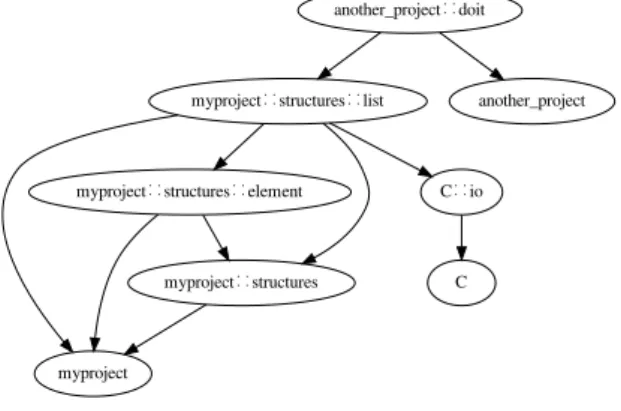
Consider another_project::doitfrom above as an example. It gives rise to the di-rected import graph that is depicted in Figure 1. Explicit or implicit imports define a
myproject∷structures∷list myproject∷structures myproject myproject∷structures∷element C∷io another_project∷doit another_project C
Figure 1 The import dependency graph of the example module
directed import relationship between the modules of a given project, its import graph. The import graph of a specific moduleAis the subgraph of the import graph of the project that contains all modules thatAimports.
Property 3.2 The import graph is transitive, that is if moduleAimportsBit imports also all modules thatBimports.
Claiming full transitivity of imports differs from Go’s strategy. There, an import of a moduleBonly provides the necessary information to use all interfaces ofBand not more. This would be a possibility for C, too, that information could be directly stored in the compiled object ofB, much similar as Go does this.
We have not adopted such a restricted approach for several reasons. First, it is difficult to implement. It would necessitate to write or integrate a full parser for the language into our front end, whereas the approach presented here is mostly text replacement of composed identifiers. Modular C can mostly be implemented with scripting as provided by the POSIX utilitysed, see Section 7.1, below. Keeping track of the contents of the import graph would add a lot of complexity to the implementation of Modular C and probably worsen compile times substantially.
Second, forcing transitivity ensures that our approach is consistent with the rules of [13] for modularity and information hiding: their “Rule 3” that forbids “vertical
dependency” for imported features is equivalent to claim that no module can be
imported before any of its dependencies.
Then, Go’s main motivation for its restrictive strategy comes from observing the large compile time overhead that C++ include hierarchies impose on software projects: there, include files tend to be monolithic, they include a large number of other files themselves, and the language is difficult to parse. In particular, declarations of recursive templates can incur an exponential computational overhead at compile time, and this overhead occurs for every TU in a project uses such a type.
This situation is not at all comparable for C because C has no syntax constructs for recursive declarations. C compilers nowadays are able to parse C headers extremely fast. Their bottleneck usually is code generation and optimization, and so the problem that has been observed for C++ does not apply to C.
We will see below, how oursnippetfeature that provides functionalities that are similar to C++templatecan avoid the pitfall of exponential expansion for every TU.
3.1 Import is binary
As already mentioned, the import feature is not expected to work source to source. Property 3.3 The import of a module uses a compiled object.
For our reference implementation we chose the POSIX archive file format to store some textual information along with the object file.
With that property a software project only has to provide the compiled objects of its modules to its clients. This then enables them to link and execute executables that use that module. But since all interface information is present in the compiled object, they also may compile their own code that would use such a module. In that sense, any binary distribution of modules is, with our model, also a development distribution.
As a direct consequence we have the following rule: Rule 3.4 The import graph for any module must be acyclic.
This property is easily checked by build tools such as POSIX’ make. It also has the advantage that on a source level we have no need for include guards or similar mechanism that deal with cyclic dependencies.
Lemma 3.5 There is a topological sort of the import graph.
Later, in several places we will assume that one such topological sort among all the possible ones is given and fixed.
Lemma 3.6 All exported symbols of all modules of the import graph are accessible. The reason behind this rule is simple: a modulea::b::cthat appends a new naming componentcto an existing modulea::bis supposed to extend that module. To extend it,
Listing 3 A module with an initialization function.
1 #pragma CMOD module p r o j::something 2 #pragma CMOD import thrd = C::thrd ;
3 #pragma CMOD import mtx = thrd::mtx ; 4 5 #pragma CMOD s t a r t u p s t a r t 6 7 # i f n d e f thrd::NO_THREADS 8 mtx b k l; 9 void s t a r t(void ) { 10 mtx::i n i t(&bkl, mtx::r e c u r s i v e) ; 11 } 12 # e l s e 13 void s t a r t(void ) { 14 // empty 15 } 16 # e n d i f
it potentially needs all identifiers that are exported bya::b, and
it must not provide conflicting definitions for objects that are already defined there. In particular the identifiera::b::ccould already have a definition or declaration in the parent modulea::b.
The syntax for importing other modules makes no reference to a source file name for a module, in particular it is not fixed what the separator character for the external file name representation would be. Such a detail is left to the implementation. Our reference implementation separates file name components with a hyphen, e.g. the source file name for theC::iomodule isC-io.X.
3.2 Module initialization and cleanup
The strict dependency relation between modules given by the import graph also lets us provide secondary features, module initialization and cleanup. Such features may be helpful for file scope objects that need to be initialized dynamically; C does not allow to call functions to initialize statically allocated objects. This feature is achieved by astartupdirective:
#pragma CMOD s t a r t u p s t a r t void s t a r t(void ) { . . . }
If such a directive is given, the function is guaranteed to be executed before accessing any symbol (variable or function) of the module, and after all suchstartupfunctions are executed for all imported modules. Such a function must have a prototype as indicated in the example.
Property 3.7 The functions listed instartupdirectives of all modules of a program are executed before theentryfunction, and this in an order that is consistent with the import graph.
Consider Listing 3 as an example. Here a module that needs a global mutex variable bklto regulate access to some of its functions initializes that mutex with a non-default propertymtx::recursive. If e.g., the moduleC::thrd::mtxwould need by itself a similar form of initialization, such an initialization is done before. By that the call tomtx::init is always guaranteed to operate in a well defined context.⁶
Our approach has two main advantages over the techniques that are currently available for C or C++. The C standard already offers the typeonce_flagthat can be used to launch a function dynamically, when the first use of an object occurs. That dynamic check is repeated at each execution of that same code. The presence of a conditional function call can inhibit some optimization opportunities.
Our approach has only an overhead at startup of the application, where all the startupfunctions are called once and for all. Thereafter, during the execution of the program itself there is no overhead at all and an application has the guaranty to start all its operations in a well defined state.⁷
Our approach is also different from the approach in C++. There, statically allocated objects can be initialized dynamically with a function, but the execution order of these initializations is not prescribed by the standard. Thus C++ makes it quite difficult to provide a consistent initialization of static objects, as soon as there are dependencies between them.
To complement this approach for initialization we also propose two other interfaces, named after the C library functionsatexitandat_quick_exitthat they use under the hood.
#pragma CMOD a t e x i t module_atexit
#pragma CMOD a t _ q u i c k _ e x i t module_at_quick_exit void module_atexit(void ) ;
void module_at_quick_exit(void ) ;
These are executed when the program terminates.
Property 3.8 The functions named inatexitandat_quick_exitdirectives of all modules of a program are are inserted asexitandquick_exithandlers before theentryfunction (as if inserted with theatexitandat_quick_exitstandard library functions). The insertion is such, that the functions are executed in inverse order of the correspondingstartup
functions.
6All of this is only done conditionally,C::thrd::NO_THREADSwill be explained in Section 6.3.
7If an application has to perform an expensive initialization that would be too costly to
4 Code sharing
C’s#includedirective is not only a tool to share interfaces between TU, but can also be used to share almost any form of C code. To provide the same expressiveness in Modular C we have to provide mechanisms for that, too.
A first mechanism that C natively supports are inline functions, that is functions for which the function body is made visible to any importer. The next section briefly describes how Modular C uses and facilitates this feature. Then we introduce and develop a feature coined code snippets that is meant to replace inclusion of arbitrary C code.
4.1 Inline functions
In traditional C, classifying a function withinlineensures that it can be placed in a header file without creating symbol definition conflicts between different TU. This feature is intended to ease optimization, because the code of such a function can then be integrated in place (inlined) by its users. Thus optimization techniques such as special case analysis and constant propagation can be applied to the body of the inlined function.
The engineering of inline functions is a bit tedious in traditional C. They have to be moved to a header file (to be visible by others) and a special “instantiation” has to be provided in one TU (to emit the external symbol). Modular C avoids such code movements and additions:
Property 4.1 A function definition withinlinespecifier is made visible to all importers.
4.2 Snippets
We propose an additional formalism to share code that will give rise to different functions (macros, types, constants ...) in the context of the importer. The main property of asnippetdirective is that the code that follows after it is not compiled within the containing module but it is only injected into a module that imports it explicitly, much as the traditional X macro strategy would do.
Property 4.2 Other than for the replacement of some identifiers specified below, all code that follows asnippetdirective is injected as is at the point of an explicitimportdirective.
Compared to C++ templates, the replaced identifiers play the role of template parameters. But in contrast to that, a snippet only provides a textual injection of code into the importer where the identifiers in question are textually rewritten as specified.
Let us start with a simple moduleC:: snippet ::initwhose only purpose is to share code for a uniforminitfunction with the importer.
1 #pragma CMOD module i n i t = C::snippet:: i n i t 2
3 /* A l l code h e r e a f t e r i s i n t e g r a t e d by the importer . */
5 T* i n i t(T* x) {
6 i f (x) *x = (T) { 0 } ; 7 r e t u r n x;
8 }
Thesnippetdirective introduces a local name, here T, that stands for the name of the importing module. It is the first case of an identifier inside the snippet that is rewritten before the snippet code is injected into its target.
As we have seen in Section 2.4 above, such a module name may represent a type, but may also represent a function, macro, etc or no particular feature at all. On the right hand side of the =the coder of the snippet may specify what (and if) some particular property is expected from the importing module.
In the example,Tshould clearly be a type. Here, the indicationcompleteon the right requests that this module name corresponds to a complete type.⁸ The function that is defined tests if its argumentx is a valid pointer and then initializes the object with the zero-initialized compound literal.
Property 4.3 The identifier (if any) that is specified in thesnippetdirective is replaced by the name of the importing module before insertion.
Since all the code after asnippetdirective forms the snippet, there can only be one such directive:
Rule 4.4 There may be at most onesnippetdirective in the source of a module.
Listing 4 shows an example for three different ways to import snippets. For the first, moduleC:: snippet ::initis imported without an abbreviation. All the symbols from the snippet are injected into the importer. Here, this is just one function,init. It is now visible as a member of this module, namely asproj::structs::toto::init. The identifier Tstands for the name of the importer and so the function has the prototype:
p r o j::s t r u c t s::t o t o* p r o j::s t r u c t s::t o t o::i n i t(p r o j::s t r u c t s::t o t o* ) ;
The mechanism for the two otherimportdirectives that actually have abbreviations are described below.
4.3 Conflicting names in snippets
Generally, importing snippets as described so far may lead to naming conflicts if two different imported snippets use the same local identifier to name two different features. This can be mitigated by using the abbreviation feature of Section 2.3. Identifiers that originate from a named import receive that prefix as an additional name component, separated by the composer. For the second import in Listing 4, the moduleC:: snippet ::allochas the abbreviationbare. All symbols that are injected from the its snippet will be prefixed by that.
8For C, a type is complete, if it permits to define a variable. Incomplete types are e.g.void,
Listing 4 A module that imports code snippets for two functions and a specialized type.
1 #pragma CMOD module t o t o = p r o j:: s t r u c t s ::t o t o 2 3 #pragma CMOD d e c l a r a t i o n 4 s t r u c t t o t o { 5 C::s i z e counter; 6 /* your f a v o r i t e data */ 7 } ; 8 # d e f i n e barei n i t i n i t 9 10 #pragma CMOD d e f i n i t i o n 11 /* Import three s n i p p e t s . */
12 #pragma CMOD import C::snippet:: i n i t 13 /* A snippet imported with an abbrevation . */
14 #pragma CMOD import bare = C::snippet:: a l l o c 15 /* A snippet with 3 s l o t s t h a t are f i l l e d . */
16 #pragma CMOD d e f i l l vec::s i z e = 23 17 #pragma CMOD f i l l vec::vType = vec23 18 #pragma CMOD f i l l vec::bType = t o t o
19 #pragma CMOD import vec = C::tmpl::v e c t o r 20 21 s t a t i c C::s i z e _Atomic running = 0 ; 22 t o t o* a l l o c(void ) { 23 t o t o* x = barea l l o c( ) ; 24 i f (x) x→counter = running+ + ; 25 r e t u r n x; 26 } 27 vec23 myState = { 4 7 1 1 , } ;
It is implemented in a similar way asC:: snippet ::init, see Listing 5, but provides two snippet symbolsinitandalloc. The first is only declared, the second is also defined. Note that the moduleC:: snippet ::allocdoes not know much about the context in which the snippet functionallocwill be placed by the import mechanism. It formulates an interface contract forinitand enforces that the name of the importing module must be a complete type and that it must implement a functioninitwith the specified prototype. Also note that this second part of the interface contract does not need special syntax. A standard C declaration of a function prototype is sufficient for its specification.
Because we have given an abbreviation when importing this module, the importer changes the imported identifiers tobareinitandbarealloc, respectively. If it weren’t
for the#define, there would be four functions. But with the define,proj::structs::toto::bareinit
is replaced byproj::structs::toto::initand effectively theallocsnippet will use the latter for its implementation ofbarealloc.
Listing 5 A snippet module for a simple allocation function.
1 #pragma CMOD module a l l o c = C::snippet::a l l o c 2 #pragma CMOD import l i b = C:: l i b
3
4 /* I n t e g r a t e as−i s to the importer . */
5 #pragma CMOD snippet T = complete 6 7 #pragma CMOD d e c l a r a t i o n 8 extern T* i n i t(T* ) ; 9 10 #pragma CMOD d e f i n i t i o n 11 T* a l l o c(void ) { 12 r e t u r n i n i t(l i b::malloc ( s i z e o f (T) ) ) ; 13 }
Up to now the two imports that we discussed have had the effect of the following four declarations.
# d e f i n e p r o j:: s t r u c t s ::t o t o::barei n i t proj::s t r u c t s::toto:: i n i t
p r o j::s t r u c t s::t o t o* p r o j::s t r u c t s::t o t o::barea l l o c(void ) ;
p r o j::s t r u c t s::t o t o* p r o j::s t r u c t s::t o t o::i n i t(p r o j::s t r u c t s::t o t o* ) ;
p r o j::s t r u c t s::t o t o* p r o j::s t r u c t s::t o t o::a l l o c(void ) ;
Observe that the function allocthat is defined by the module itself may even use barealloc, internally. No naming conflict occurs.
Property 4.5 Snippets can be imported several times into the same moduleMif each
importuses a different abbreviation.
4.4 Slots
As we have seen in the last example, namingimports and redefining some prefixed names can be used to parameterize snippets.⁹ By that snippets can even be imported several times with different prefixes and different definitions for some of their identi-fiers. But this mechanism is cumbersome, does not scale very well and lacks automatic verification.
To ease the parameterization of snippets there is a third mechanism withslot,fill anddefilldirectives, see Listing 6 for an example. Here, the snippet is parameterized with three identifiers, its slots. Aslotdirective names a snippet-local identifier, that will be replaced as specified when the snippet is inserted. E.g Listing 6 has slotbType. On the importing side, Listing 4, this slot is filled with the identifiertoto. It is important to note that this mechanism replaces one identifier (the slot) by another (the fill).
9Here it the functioninitserved as a parameter tobare