HAL Id: tel-01891855
https://pastel.archives-ouvertes.fr/tel-01891855
Submitted on 10 Oct 2018HAL is a multi-disciplinary open access archive for the deposit and dissemination of sci-entific research documents, whether they are pub-lished or not. The documents may come from teaching and research institutions in France or abroad, or from public or private research centers.
L’archive ouverte pluridisciplinaire HAL, est destinée au dépôt et à la diffusion de documents scientifiques de niveau recherche, publiés ou non, émanant des établissements d’enseignement et de recherche français ou étrangers, des laboratoires publics ou privés.
Channel Allocation in Mobile Wireless Networks
Roni Shigueta
To cite this version:
Roni Shigueta. Channel Allocation in Mobile Wireless Networks. Library and information sci-ences. Université Paris-Saclay; Pontifícia universidade católica do Paraná, 2018. English. �NNT : 2018SACLX037�. �tel-01891855�
NNT
:
2018SA
CLX037
networks
Th `ese de doctorat de l’Universit ´e Paris-Saclay et de Pontifical Catholic University of Parana pr ´epar ´ee `a ´Ecole Polytechnique Ecole doctorale n◦580 Sciences et technologies de l’information et de la communication (STIC) Sp ´ecialit ´e de doctorat : R ´eseaux, information et communications
Th `ese pr ´esent ´ee et soutenue `a Paris, le 13 juillet 2018, par
M. R
ONISHIGUETA
Composition du Jury :
Artur ZIVIANI
Senior Researcher, Laboratory for Scientific Computing (LNCC) Pr ´esident Marcelo DIAS DE AMORIM
Research Director, Sorbonne Universit ´e (LIP6) Rapporteur Yacine GHAMRI-DOUDANE
Professor, University of La Rochelle (ENSIIE) Rapporteur Hakima CHAOUCHI
Professor, Telecom Sud Paris (Institut Mines Telecom) Examinateur Nadjib ACHIR
Maˆıtre de Conf ´erence, Universit ´e Paris 13 (L2TI) Examinateur Aline CARNEIRO VIANA
Research Scientist , Universit ´e Paris-Saclay (INRIA) Directeur de th `ese Mauro FONSECA
Professor, UTFPR (CPGEI) Co-directeur de th `ese Marcelo PELLENZ
Roni Francis Shigueta: Channel Allocation in Mobile Wireless Networks,
s u p e r v i s o r s: Aline Carneiro Viana Mauro Fonseca Marcelo Pellenz l o c at i o n: Palaiseau, France
R É S U M É E N F R A N Ç A I S
L’utilisation intensive des services de données mobiles a de plus en plus augmenté la consommation de ressources sur les réseaux sans fil tels que processeur, mémoire, buffer, and spec-tre de fréquences. La ressource principale utilisée pour la com-munication sans fil et le plus rare est le spectre de fréquence.
À mesure que le trafic de données augmente brusquement, de nouvelles bandes du spectre de fréquences ne sont pas disponibles dans la même proportion, ce qui rend le spectre de fréquence de plus en plus rare et saturé.
Plusieurs propositions ont été présentées pour optimiser l’allocation des canaux de fréquences afin d’atténuer les interférences entre
les liaisons proches qui transmettent des données. Beaucoup d’entre eux utilisent un critère unique, tels que l´interférence et l´occupation de canaux, et ne considèrent pas un ensemble de caractéristiques le comportement de l’utilisateur pour guider le processus d’allocation de canaux.
Les utilisateurs ont des cycles de routine et un comporte-ment social. Ils passent au travail, à l’école, utilisent leurs ap-pareils mobiles générant du trafic de données, et rencontrent des amis formant des groupes. Ces caractéristiques peuvent être explorées pour optimiser le processus d’allocation des canaux. Dans ce contexte, cette thèse présente une stratégie d’allocation de canaux pour les réseaux sans fil, basée sur le comportement de l’utilisateur.
Notre contribution principale consiste à considérer certaines caractéristiques du comportement de l’utilisateur, telles que la mobilité, le trafic et la popularité dans le processus d’allocation des canaux. De cette façon, nous priorisons l’allocation de canaux pour les nœuds qui resteront dans le réseau dans une fenêtre de temps future, avec un trafic plus élevé dans le réseau, et avec plus de popularité.
Nous adoptons une approche distribuée qui permet de lim-iter le nombre de messages échangés dans le réseau tout en répondant rapidement aux changements de la topologie du réseau. Nous avons adopté un modèle d’interférence à deux sauts. Dans ce modèle, deux liens sont considérés comme inter-férant s’ils sont à deux sauts éloignés l’un de l’autre.
Une interface est responsable de l’échange de messages de con-trôle, tels que les messages Hello, l’interaction et le routage. L’autre interface est chargée d’envoyer les paquets de données et de changer de canal en fonction de l’algorithme d’attribution de canal.
Dans notre stratégie, les nœuds de réseau échangent péri-odiquement des informations sur les canaux disponibles et la mobilité (position et vitesse), en utilisant des messages Hello. Un nœud voisin reçoit les messages Hello et vérifie la stabilité de la topologie. La stabilité est importante pour qu’un nœud détecte tous ses voisins. La topologie est considérée comme sta-ble si elle ne change pas après l’échange consécutif de deux messages Hello.
Si la topologie n’est pas stable, les nœuds continue à recevoir des messages Hello jusqu’à ce qu’il devienne stable. Si la topolo-gie est stable, le nœud obtient une liste de canaux communs. Cette liste est obtenue à partir de l’intersection entre les canaux obtenus à partir du message Hello pour chaque lien et la liste des canaux locaux. Cette liste contient les canaux qui peuvent être sélectionnés par l’algorithme d’allocation des canaux.
L’algorithme commande les liens d’un nœud en fonction de la priorité de chaque lien et sélectionne un canal qui interfère moins avec ses voisins par deux sauts. La priorité de chaque lien est fonction de la mobilité, du trafic et de la popularité du nœud voisin appartenant au lien.
En séquence, un nœud notifie les canaux alloués dans ses liens et leur priorité aux nœuds voisins. Cette notification est effectuée à l’aide de messages d’interaction. Un nœud voisin reçoit un message d’interaction et compare sa priorité locale à la priorité contenue dans le message d’interaction. Si la priorité du message est plus petite, le nœud ignore le message. Si la pri-orité est supérieure, le nœud accepte l’attribution de canal du nœud voisin au lien qui a reçu le message d’interaction, com-mande ses liens en fonction de ses priorités et alloue un canal qui interfère moins avec les canaux contenus dans le message d´interaction (moins interférer avec deux sauts).
Dans notre évaluation des performances, nous considérons des scénarios dans des réseaux ad hoc et véhiculaires, et nous utilisons des modèles de mobilité synthétique, tels que SLAW et Manhattan Grid, et l’ensemble de données de traces de ville de Cologne, Allemagne.
Dans les scénarios, nous comparons notre mécanisme avec différents types d’approches, un centralisé (nommé TABU), un aléatoire (nommé RANDOM), un avec la plus grande distance spectrale (appelé LD), et un avec un seul canal (appelé SC).
Nous évaluons les métriques telles que le débit agrégé, le débit de livraison des paquets et le délai de bout en bout. Les simulations envisageant un scénario ad hoc avec un routage mono diffusion montrent que notre stratégie présente des amélio-rations en termes de débit de l’ordre de 14,81% par rapport à RANDOM et de 16,28% par rapport à l’allocation de canal LD. Dans le scénario véhicule, notre stratégie montre des gains de taux de livraison de paquets de l’ordre de 11,65% et de 17,18% par rapport aux méthodes RANDOM et SC, respectivement. Dans les deux scénarios, la performance de notre stratégie est proche de la recherche de la limite supérieure de l’approche centralisée de TABU, mais avec des frais généraux moins élevés.
I dedicate this thesis to God, for the faith that keeps me alive,
to my family
who knew how to understand my absence, my friends and all the people
P U B L I C AT I O N S
PUBLISHED
• Roni Francis Shigueta, Aline Carneiro Viana, Mauro Fon-seca. ‘’A Mobility-Aware Channel Allocation Strategy for Clustered Ad hoc Network”. IEEE 85th Vehicular Technol-ogy Conference (VTC), 2017. Sydney, Australia.
• Roni Francis Shigueta, Aline Carneiro Viana, Mauro Fon-seca.” User Behavior-Aware Channel Allocation Scheme for Mobile Ad hoc Networks”. IEEE 35th International Per-formance Computing and Communications Conference, 2016. Las Vegas, United States.
• Roni Francis Shigueta, Aline Carneiro Viana, Mauro Fon-seca, Artur Ziviani, and Anelise Munaretto.”’A Strategy for Opportunistic Cognitive Channel Allocation in Wire-less Internet of Things”. IFIP WireWire-less Days, 2014. Rio de Janeiro, Brazil.
Our greatest weakness lies in giving up. The most certain way to succeed is always to try just one more time. — Thomas A. Edison [1]
A C K N O W L E D G M E N T S
I would like to thank PUC/PR and INRIA by the reception dur-ing the development period of this thesis. I would like to thank the PUC/PR and INRIA colleagues for their help and cooper-ation and to all the people who contributed directly and indi-rectly with this work. Special thanks to my family and friends, for the moral and emotional support, without which I was noth-ing. Finally, I am deeply grateful to Mauro Fonseca, and Aline Viana for their supervision, advice, patience, and inspiration.
To all my thanks.
C O N T E N T S
1 i n t r o d u c t i o n 1
1.1 Context and Motivation 1
1.2 Problem Statement 3
1.2.1 Can the frequency spectrum be better al-located according to the user behavior? 3
1.2.2 Can a channel allocation mechanism be easily deployable? 4
1.3 Contribution of this thesis 4
1.4 Organization 6
2 b a c k g r o u n d a n d r e l at e d w o r k 7
2.1 Wireless Channel Allocation: The Background 7
2.1.1 Criteria to channel allocation 8
2.1.2 Approaches in Channel Allocation 11
2.1.3 Techniques used to model and solve the channel allocation problem 12
2.1.4 Interference models 15
2.1.5 Mobility model 18
2.2 Wireless Channel Allocation: The Related Work 21
2.2.1 Related Work in Ad Hoc network 21
2.2.2 Related Work in VANET network 25
2.3 Conclusion 29
3 c h a n n e l a l l o c at i o n s t r at e g y i n a d h o c n e t w o r k s 31
3.1 Formulation of the problem 31
3.1.1 Channel model 31
3.1.2 Network model 32
3.1.3 Interference model 33
3.1.4 Problem Statement 33
3.2 The Channel Allocation Mechanism 34
3.2.1 State1 (Scheduler) 35
3.2.2 State2 (Topology Manager) 36
3.2.3 State3 (Allocation Mechanism) 37
3.2.4 State4 (InteractionMechanism) 45
3.3 Computational Complexity Analysis of the Algo-rithm 47
3.4 Evaluation Scenarios 49
3.4.1 Scenario1: Grid topology 49
3.4.2 Scenario2: SLAW mobility model 56
3.5 Conclusion 62
4 c h a n n e l a l l o c at i o n s t r at e g y i n v e h i c u l a r n e t w o r k s 65
4.1 Formulation of the problem 65
4.1.1 Channel model 65
4.1.2 Network and interference model 66
4.1.3 Problem Statement 66
4.2 The Channel Allocation Mechanism 66
4.3 Performance Evaluation 68
4.3.1 Scenario1: Manhattan Grid Scenario 69
4.3.2 Scenario2: Traces of the Cologne City with DTN protocol 72
4.4 Conclusion 77
5 c o n c l u s i o n s a n d f u t u r e h o r i z o n s 79
5.1 Summary of the Thesis 79
5.2 Future Horizons 80
L I S T O F F I G U R E S
Figure 1 Growth of connected IoT devices 1
Figure 2 Growth of mobile data traffic in the world 2
Figure 3 Criteria, approaches, and techniques used in channel allocation 8
Figure 4 Hidden terminal problem 9
Figure 5 Communication and conflict graph 14
Figure 6 Interference models 15
Figure 7 Interference model at 2 hops 17
Figure 8 Mobility models 19
Figure 9 Channels overlapping in Wireless Fidelity (WIFI) spectrum [98] 32
Figure 10 State machine 34
Figure 11 Sending Hello message 35
Figure 12 Hello message 36
Figure 13 Example of network graph 37
Figure 14 Example of velocity vector 41
Figure 15 Example of link priority 43
Figure 16 Allocated channels 44
Figure 17 Example of Interaction message 45
Figure 18 Node receiving anInteraction message 46
Figure 19 Node B recalculating channels 47
Figure 20 Aggregated throughput, packet delivery rate, and end-to-end delay in grid topol-ogy 52
Figure 21 Aggregated throughput, number of chan-nels and number of flows 54
Figure 22 End-to-end delay, packet delivery rate, and number of flows 55
Figure 23 Aggregated throughput, packet delivery rate, and mobility 56
Figure 24 Network topology for SLAW mobility model 58
Figure 25 Aggregated throughput and overhead in SLAW 59
Figure 26 Spectral distance and packet delivery rate in SLAW 60
Figure 27 End-to-end delay and mobility in SLAW 61
Figure 28 Throughput and packet delivery rate ac-cording to the number of nodes 62
Figure 30 Packet delivery rate, end-to-end delay, and hops count in Manhattan Grid 71
Figure 31 Density of vehicles at 6:00 a.m. and 7:00 a.m. in Cologne 74
Figure 32 Packet delivery rate, end-to-end delay, and hops count in VDTN 75
Figure 33 TABU, MobiCA, RANDOM and SPRAY AND WAIT in DTN scenario 76
L I S T O F TA B L E S
Table 1 Criteria to channel allocation 11
Table 2 Approaches in channel allocation 12
Table 3 Techniques used to solve the channel al-location problem 15
Table 4 Comparison among related work in ad hoc networks. 24
Table 5 Comparison among MobiCA and related work. 28
Table 6 Interference factor in 802.11b/g spectrum channels 32
Table 7 Terms used in the equations 39
Table 8 Scenario configuration parameters for Cologne city mobility model 50
Table 9 Scenario configuration parameters for SLAW mobility model 58
Table 10 Configuration parameters for Manhattan Grid Scenario 70
Table 11 Configuration parameters for Cologne city scenario 73
Table 12 DTN configuration parameters 73
Listings xvii
L I S T I N G S
A C R O N Y M S
ACO Ant Colony Optimization
AP Access Point
AU Application Unit
BER Bit Error Rate
BLP Binary Linear Program CBR Constant Bit Rate
CCC Common Control Channel
CCH Control Channel
CDMA Code Division Multiple Access
CSMA/CA Carrier Sense Multiple Access with Collision Avoidance
CQ Channel Quality
CTS Clear to Send
DCAS Distributed Channel Assignment Scheme
DSCA Dynamic Service Channel Allocation DSRC Dedicated Short-Range Communication
DTN Delay-Tolerant Networking
EA Evolutionary Algorithm EP EPIDEMIC
FTP File Transfer Protocol GA Genetic Algorithm
GPS Global Positioning System
IoT Internet of Things
LD Largest Distance MAC Media Access Control
MANET Mobile Ad hoc Network
M2M Machine-to-Machine
MILP Mixed-Integer Linear Programming
MIMO Multiple Input Multiple Output
MobiCA Mobility-aware Channel Allocation
MOCoPo Measuring and Modelling Congestion and Pollution NCCC No Common Control Channel
ND Not Defined
NS Network Simulator
OBU On Board Unit
OFDM Orthogonal Frequency Division Multiplexing
OFDMA Orthogonal Frequency Division Multiple Access
P2P Peer to Peer
QoS Quality of Service
RF Radio Frequency
RSU Road Side Unit
RTS Request to Send SC Single Channel
SCH Service Channel
SLAW Self-similar Least Action Walk
a c r o n y m s xix
SNR Signal-to-Noise Ratio SW SPRAY AND WAIT
TDMA Time Division Multiple Access
VANET Vehicular Ad Hoc Network
VDTN Vehicular Delay-Tolerant Networking
VoIP Voice over Internet Protocol
1
I N T R O D U C T I O N1.1 c o n t e x t a n d m o t i vat i o n
The popularization of mobile devices (laptops, smartphones, and tablets) and the growing use of services (web, e-mail, video on demand, and social networks) over the wireless network have increasingly consumed frequency spectrum resources.
According to [2], the global number of smartphone users
grew from 1.57 billion in 2014 to 2.32 billion in 2017 (growth of 47.7%), and it is forecasted to grow to 2.87 billion in 2020. With this growth, the number of mobile Internet users surpassed desktop ones: e.g., mobile devices represent 52.7% of global Internet connections [3] and 75.1% of Internet connections in
USA. This growth in smartphone connections is followed by Machine-to-Machine (M2M) and Internet of Things (IoT) con-nections, which are increasingly saturating the frequency spec-trum.
Figure 1shows the growth of connected IoT devices [2] .
Figure 1: Growth of connected IoT devices [2]
As we can see, the growth of installedIoTdevices is
exponen-tial and the forecast for 2025 is 75 billions in connected devices. In addition to the increased use of smartphones and IoT de-vices installed in the network, we have the development of mo-bile applications and their increasing consumption. According to ERICSSON Mobility report [4], the growth of mobile data
traffic is exponential and as can be seen in Figure 2, it was of 50% between Q3 2015 and Q3 2016.
Figure 2: Growth of mobile data traffic in the world [4]
The burst of mobile network traffic increasingly consumes resources, such as processor, memory, buffer, power, and spec-trum. Contrarily to processor, memory, buffer, and power, the spectrum is more difficult to be scalable. Spectrum is a limited resource, with high concurrency, and with strong regulation. In this context, we concentrate our focus on the spectrum resource, more specifically in channel allocation.
Besides that, another challenge to be considered is the im-pact that user behavior brings to the network usage and con-sequently, to the channel allocation management. Users have routine-based and social behavior, what translates into the es-tablishment of clusters or communities [5]. In addition, their
1.2 problem statement 3
mobility results in many connections/disconnections, requiring a quick and optimal channel allocation management.
In this context, the purpose of this thesis is to present a strat-egy that leverages characteristics of user behavior for channel allocation in both, ad hoc and vehicular networks.
1.2 p r o b l e m s tat e m e n t
1.2.1 Can the frequency spectrum be better allocated according to the user behavior?
Considering the large number of devices, the growing number of network services, and the mobility of people, the network connections are increasingly subject to intermittency, having transient characteristics that are dictated by people’s social be-havior.
Although many studies address channel allocation, they con-sider only aspects such as interference, traffic, and channel oc-cupation and often in isolation. In this way, they are oblivious to behaviors inherent of users. We advocate that user behavior knowledge can be taken into account while reducing the impact of disconnectivity, densification, and traffic overload in channel allocation. Users have several characteristics that define their behavior, such as mobility, points of interest, popularity, gen-erated traffic, energy level, applications running, and so on. In our work, we concentrate in three characteristics: mobility, traf-fic, and node popularity.
1.2.1.1 Mobility
Users move between points of interest by connecting and dis-connecting their devices across several different networks through-out their journey. Vehicles communicate with each other using ad hoc connections or a Road Side Unit (RSU), and the high speed of vehicles degrades quickly the signal. In this way, if there is no mechanism to prioritize the channel allocation in the network, many devices that are leaving, that have connec-tions with high intermittency or low time of permanence in the network can allocate channels of higher quality. On the other hand, devices with a higher time of permanence allocate the channels with lower quality, underutilizing network resources.
1.2.1.2 Traffic
Another issue regarding user behavior is the generated traffic. The resulting signal from the generated traffic may cause in-terference on the neighboring links if they are using the same channel. High traffic links (such as backbone links) may expe-rience interference from neighboring link´s traffic or have to share the same channel with other links. In this case, the perfor-mance of the high traffic links decreases if an efficient channel selection mechanism is not used. In addition, links with lower traffic can allocate channels with high quality, underutilizing the use of the channel.
1.2.1.3 Popularity
Finally, people have a social behavior and have the tendency to live in communities or clusters. Clusters with highly popular people naturally attract more people, resulting in higher den-sity if compared with clusters having less or no popular people. Nodes more popular can act as influential spreader that propa-gates information to a large portion of the network. In this way, it is possible to prioritize the channel allocation for the most popular nodes.
1.2.2 Can a channel allocation mechanism be easily deployable?
Many references in the literature present solutions for channel allocation related to physical parameters requiring the devel-opment of new hardware or the adaptation of the Media Ac-cess Control (MAC) layer. Thus, the development of a hardware-independent solution allows its use with existing standards, simplifying thus its deployment.
1.3 c o n t r i b u t i o n o f t h i s t h e s i s
This thesis presents a channel allocation mechanism for wire-less networks that leverage user behavior knowledge. We con-sider three characteristics of user behavior: node mobility, traf-fic generated, and node popularity. The contribution of this the-sis conthe-sists of the following characteristics:
• Our strategy allows allocating channels of higher quality (i.e., with less interference) for the nodes that have the longest time of permanence in the network. In this way,
1.3 contribution of this thesis 5
nodes who tend to leave the network in a future time win-dow do not allocate the best network channels, saving net-work resources.
• Devices with higher traffic on the network have a higher channel allocation priority over devices with lower traffic. This allows to reduce the contention on high traffic links and increases the network performance.
• Our mechanism allows clusters, formed due to mobility and the popularity of devices, to receive channels with less interference. Besides, the links created by the devices within a cluster can receive different channels, allowing the parallel communication of devices within a cluster (intra-cluster communication).
• We use a distributed approach, limited to two hops, which allows estimating the interference in the neighborhood of a node, without the need to know the entire topology of the network. That allows reducing the number of mes-sages exchanged in the network and consequently, the overhead.
• Our proposal is based on Carrier Sense Multiple Access with Collision Avoidance (CSMA/CA), maintaining com-patibility with current networks, being hardware indepen-dent and easy to implement. Many proposals in the liter-ature are based on Time Division Multiple Access (TDMA) and require hardware modification.
• In our simulations, we use several synthetic mobility mod-els or trace-based datasets, describing mobility of hand-held devices or vehicles.
We analyze the channel allocation regarding the following scenarios:
– Ad hoc mobility networks: we use the IEEE 802.11b/g/n/ac spectrum, considering the interference of the adja-cent channels and a mobility model that represents the behavior of the user´s movement.
– Vehicular networks: we use the IEEE 802.11p spec-trum in a scenario considering the Manhattan Grid mobility model. In addition, we consider a Delay-Tolerant Networking (DTN) scenario using the traces dataset of the vehicles in the city of Cologne, Ger-many.
1.4 o r g a n i z at i o n
This thesis is organized in the following chapters:
• Chapter 2 presents the background and related work in channel allocation process. In this chapter, we present the main criteria, approaches, and techniques found in the literature to solve the channel allocation problem, some interference and mobility models and traces dataset. In addition, we address the related work in channel alloca-tion for Ad Hoc and Vehicular Ad Hoc Network (VANET)s networks.
• Chapter 3 presents the formulation of the problem, the channel allocation mechanism, and the performance eval-uation in ad hoc network. In our evaleval-uation, we consider two scenarios, one based on a grid topology and the other based on Self-similar Least Action Walk (SLAW) mobility model.
• Chapter 4addresses our channel allocation strategy in ve-hicular ad hoc network. We present the formulation of the problem, the channel allocation mechanism, and the per-formance evaluation considering two scenarios, one based on a synthetic model (Manhattan grid) and other based on traces (Cologne dataset with DTNprotocol).
• Finally, Chapter 5 presents our conclusions and future horizons.
2
B A C K G R O U N D A N D R E L AT E D W O R KThis chapter presents the background and the related work in Ad hoc and VANET networks. In background, we present how the channel allocation problem is addressed, some interference and mobility models and traces dataset used in network simula-tion. In related work we compare our strategy with different so-lutions proposed in the literature, considering different aspects of channel allocation such as interference, mobility, traffic, and popularity.
2.1 w i r e l e s s c h a n n e l a l l o c at i o n: t h e b a c k g r o u n d
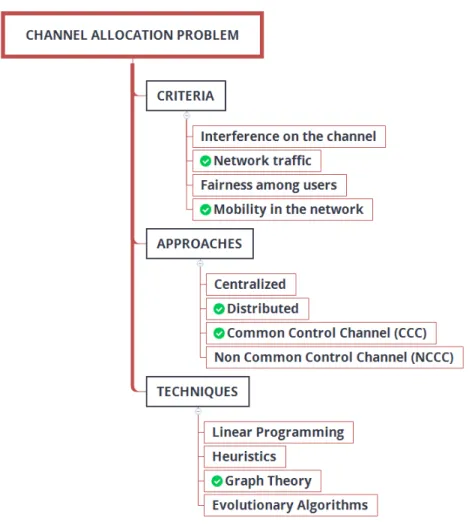
The process for solving the channel allocation problem usually involves three parts. In the first are defined the criteria to chan-nel allocation. The criteria represent the factors to be considered in the channel allocation process, such as, occupation or inter-ference on channel, traffic in the links, mobility, or fairness. In the second part are defined the approaches to be adopted, e.g., centralized or distributed, and with/without control channel. In the third part is defined the technique used to model and solve the channel allocation problem.
Some of the techniques may be simple. For example, a node locally monitors the occupation of the channels in its transmis-sion radius and selects the channel with lower occupation. In this case, if several nodes select the same channel with lower occupation, they compete to the channel at the time of trans-mission.
Other techniques may be more complex because they involve different channel allocation criteria associated simultaneously, or a larger volume of data processing. In the last case, for ex-ample, the adoption of heuristic or evolutionary algorithms can be more efficient to find a feasible solution to solve the problem.
Figure 3 shows the parts that represent the process for solv-ing the channel allocation problem and which will be detailed in the next subsection. The check mark (in green) indicates the criteria, approaches and the techniques that we will use in our proposal of channel allocation.
Figure 3: Criteria, approaches, and techniques used to solve the chan-nel allocation problem
2.1.1 Criteria to channel allocation
Although there are several types of criteria used in channel al-location, they can be used with more or less emphasis depend-ing on the type of optimization sought in the network. In this subsection, we address some criteria such as based on channel interference, network traffic, fairness, and user mobility.
2.1.1.1 Selection criterion based on channel interference
In this criterion, the channels are periodically scanned and the least used or less interfering channel is selected. The use of the channel is represented by the signal level or the number of frames transported by a channel.
The criterion based on channel interference is used by both operation modes: infrastructure and ad hoc. In infrastructure
2.1 wireless channel allocation:the background 9
mode, an Access Point (AP) is used to scan the channels,
eval-uate their use or the interference level and allocate the best channel, as shown in [6] and [7].
In ad hoc networks, the channel allocation is not performed by a central unit, as an AP. Instead, the decisions of channel
allocation are made by the nodes independently, selecting the less interfering channel.
Most ad hoc networks operate as a cluster. A cluster is a set of nodes consisting of a cluster head (responsible for allocating resources) and cluster members (that determine the boundary of the cluster). The cluster head usually is elected dynamically by the cluster members. In the work presented by [8], the
clus-ter head is represented by a channel coordinator that continu-ously monitor the power level in all channels. If the load on the channel increases beyond the capacity, the channel coordinator change to an additional channel with the lowest power level measurement.
The problem of the channel allocation considering only the monitoring and selection of channels with less activity/interfer-ence is that a device receives the signals only from others de-vices within its communication range. They do not detect the interference at 2 hops (interference among neighboring links). For example, in Figure 4, the AP receives beacons of device1. Device3 receives beacons of device2. Since APdoes not see de-vice3 (and vice versa), the channel allocation mechanism can allocate the same channel to the two links (AP-device1 and device2-device3). This will cause interference between the two links and this problem is known as hidden terminal problem.
Figure 4: Hidden terminal problem
To mitigate the hidden terminal problem, [9] proposed a
pro-posal, the client that is under the transmission range of several
APs is associated to anAPthat has a channel with fewer users.
2.1.1.2 Selection criterion based on network traffic
The solution proposed by [9] is known as traffic-agnostic and
the channel allocation process occurs without to consider the traffic in the links. Thus, a non-interfering channel can be al-located to an inactive link (without traffic), underutilizing the channel. A channel allocation mechanism using traffic as se-lection criterion allows allocating non-interfering channels (or with lower interference level) to links with higher traffic. Thus, shared channels may be allocated to links with lower traffic load. Several authors in the literature have proposed channel allocation mechanisms considering the traffic as a decision cri-terion, as presented in [10], [11], [12], and [13].
2.1.1.3 Selection criterion based on fairness
In the selection criterion based on fairness, the objective is to allocate channels or increase the network performance in a fair way. In [14] is proposed a method to maximize the network
throughput and, at the same time, to enhance fairness. In [15]
is presented a mechanism for maximizing the use of per-flow bandwidth with fairness. In [16], the authors present a
strat-egy to maximize the minimal channel gain to achieve relative fairness.
2.1.1.4 Selection criterion based on user mobility
The channel allocation related to user mobility has been stud-ied mainly in cellular systems. In [17] and [18], the authors
pro-pose mobility-aware resource allocation schemes for femtocell networks. The objective is to associate the best spectrum set of frequency/time while considering the user’s mobility.
In [19] and [20] the authors present strategies for cognitive
andVANET networks. In [19], the channels change when a node
joins or leaves the network. In [20], the nodes use the relative
velocity of nodes to determine the cluster centroid and the po-sition of the nodes. The nearest node of the cluster centroid is designed as the cluster head and allocates the channels for cluster members.
Table 1 summarizes the criteria previously seen and which are addressed in the literature.
2.1 wireless channel allocation:the background 11
Table 1: Criteria to channel allocation.
c r i t e r i o n o b j e c t i v e s r e f e r e n c e s Interference Allocate less interfering channel [6], [7], [8], [9]
Traffic Protect links with higher traffic [10], [11], [12], [13]
Fairness Fair channel allocation [14] , [15], [16]
Mobility Allocation according to mobility [17], [18], [19], [20]
2.1.2 Approaches in Channel Allocation
In channel allocation, the approaches can be classified as cen-tralized or distributed and with common control channel or without common control channel.
2.1.2.1 Centralized and Distributed Approach
In a centralized approach, a central unit is responsible for the channel allocation for each node/link in the network. In the literature, several authors have used a centralized approach to the channel allocation in wireless networks, as presented in [21],
[22], [23], and [24].
In the distributed approach, the decision about channel al-location is taken locally in a manner fast, adaptative, but not always optimally. The distributed approach has been used in several types of networks. In [25] and [26] are presented
dis-tributed channel allocation mechanisms for IEEE 802.11 net-works and in [27] and [28] for cognitive radio networks.
2.1.2.2 Common Control Channel and Not Common Control Chan-nel
The Common Control Channel (CCC) is a dedicated channel which allows maintaining a minimum connectivity among nodes and to exchange control messages.
Several previous works in the literature, such as in [29], [30],
[31], and [28], address the channel allocation problem using a
dedicated CCC. In that cases, the network nodes use two faces, one operating as CCC interface and other as data inter-face, simplifying the coordination process between the nodes.
Others works, such as [32] and [33], do not use a CCC in
channel allocation process. In [32], for example, is used a single
interface and the channels with less occupancy are selected. The information about the channel is passed to all other devices
Table 2: Approaches in channel allocation.
a p p r oa c h d e s c r i p t i o n r e f e r e n c e s Centralized Central unit allocates channel [21], [22], [23], [24]
Distributed Any node can allocate channel [25], [26], [27], [28]
CCC Control channel shared [29], [30], [31], [28]
Not CCC
No control channel shared [32] , [33]
through the channel that is being shared by control and data plane.
Table 2 summarizes the approaches used in the channel allo-cation process.
2.1.3 Techniques used to model and solve the channel allocation problem
In this subsection, we address some techniques used to model and solve the channel allocation problem, such as linear pro-gramming, heuristics, evolutionary algorithms, and graph the-ory.
2.1.3.1 Linear programming
Linear Programming is a technique very used in channel allo-cation in wireless networks. Usually, the channel alloallo-cation is described as an NP-hard problem, meaning that the optimal solution grows exponentially with the size of the network. To simplify the resolution of the problem, the channel allocation mechanism can be modeled as a Binary Linear Program (BLP) that can be solved in polynomial time [34]. Several authors
ad-dress the channel allocation problem as a linear programming problem as in [35], [36], [37]. A survey about techniques based
on Linear Programming for resource allocation in wireless net-works can be found in [38].
2.1.3.2 Heuristics
In problems involving linear programming, it is common the difficulty of quickly finding a feasible solution in computational time. A heuristic method allows finding a near-optimal solution quickly in cases where an exhaustive search is impractical. In
2.1 wireless channel allocation:the background 13
a heuristic method, the algorithm is interactive and in each in-teraction, it searches a good solution, as, the channels with less interference level. Several heuristics techniques are presented in the literature to solve the channel allocation problem.
In [39] and [40] is used Simulated Annealing. In [41], [42],
and [43] are proposed Greedy heuristic. In [44] and [45] are
presented TABU heuristic.
TABU heuristic [46] starts with an initial solution according
to some criterion (e.g., less interfering channels) and at each it-eration, the best solution in the neighborhood is sought. Each selected solution is stored in a list (TABU list) and it is not allowed to repeat moves that lead to an already selected solu-tion. The list remains in memory for a certain amount of time or number of interactions. The final result is expected to be a global optimum or the nearest solution. In our work, we com-pared our channel allocation strategy with TABU heuristic.
2.1.3.3 Evolutionary Algorithms
Evolutionary Algorithm (EA) is a term used to describe population-based stochastic search algorithms that in some sense mimic natural evolution [47].
Several authors in the literature address the channel alloca-tion using evolualloca-tionary algorithms. In [48], Genetic Algorithm
(GA) is applied to channel allocation in OFDMA system. In [49],
authors propose an algorithm based on ant colony intelligence to solve the problem of channel allocation in Peer to Peer (P2P) links. In [50], authors present a particle swarm optimization
method to assign conflict free channel in mobile wireless net-works. In [51], neural network is used for dynamic channel
allo-cation in mobile multimedia networks, considering the handoff and traffic mobility.
Although the Evolutionary algorithm is a technique widely used in channel allocation, it is an extensive topic that is not part of our scope. Surveys about Evolutionary algorithms are presented by [52], [53], and [54].
2.1.3.4 Graph theory
In Graph theory, the network is represented as a graph where the vertices correspond to the mobile devices (nodes) and the edges correspond to the links between devices. This type of graph is known as communication graph. A technique widely used to solve problems of channel allocation based on a graph
is graph coloring. In this technique, the objective is to assign a minimum set of different colors (one corresponding to each available channel) for the edges of a graph in a manner that two adjacent nodes do not use the same color (channel). This technique is addressed in [55], [56], and [57].
A derivation of communication graph that is used to cap-ture the interference among concurrent transmissions within the same interference range is known as conflict graph [45].
In conflict graph, each vertice represents a communication link (and no more a device as in communication graph) and the objective is to allocate a different or less interfering channel for each vertice of the graph.
Figure 5illustrates a communication and conflict graph.
(a) Communication graph.
(b) Conflict graph.
Figure 5: Communication and conflict graph.
In Figure 5b, the vertice AB in a conflict graph represents the link between the node A and B in the communication graph (Figure 5a). The vertices BC, CD, and DE (Figure 5b) represent the links between the nodes B and C, C and D, D and E ( Fig-ure 5a), respectively. The vertice AB in conflict graph interferes with the vertices BC, and CD, but not with DE. Thus, the objec-tive is to allocate a different or less interfering channel for each vertice of the graph which interferes with each other.
In our work, we represent the network as a communication graph with the objective of allocating a less interfering channel for edges (links) at 2 hops. For this, we adopt an interference model at 2 hops that will be addressed in the next subsection.
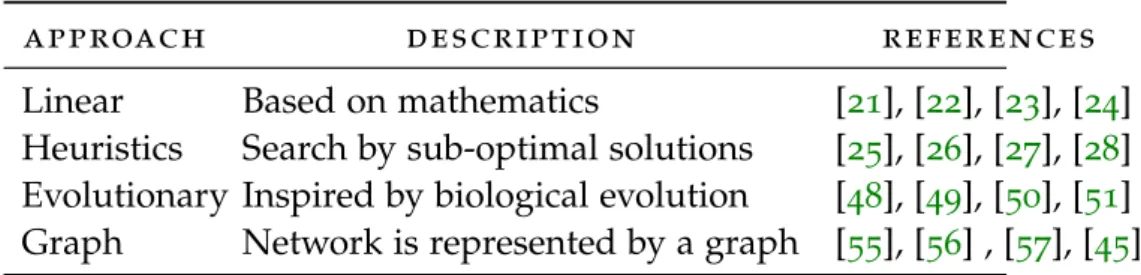
Table 3 summarizes some techniques used to solve the chan-nel allocation problem.
2.1 wireless channel allocation:the background 15
Table 3: Techniques used to solve the channel allocation problem.
a p p r oa c h d e s c r i p t i o n r e f e r e n c e s Linear Based on mathematics [21], [22], [23], [24]
Heuristics Search by sub-optimal solutions [25], [26], [27], [28]
Evolutionary Inspired by biological evolution [48], [49], [50], [51]
Graph Network is represented by a graph [55], [56] , [57], [45]
2.1.4 Interference models
As one of the objectives of channel allocation is to mitigate net-work interference, this subsection presents some interference models that are commonly used in the channel allocation pro-cess. Interference mitigation allows optimizing network perfor-mance as it improves channel conditions.
Figure 6 shows some interference models presented in the literature.
Figure 6: Interference models
2.1.4.1 Interference temperature model
The interference temperature was recommended by Federal Com-munication Commission (FCC) [58] as a metric to quantify and
manage the interference so that it remains at acceptable lev-els at the receiver. It is a measure of the Radio Frequency (RF) power of the transmitters or sources of noise that is present in the receiving antenna [59].
The interference temperature model is widely used in chan-nel allocation in cognitive radio networks where the level of
in-terference caused by an unlicensed transmitter must be below an interference threshold on a licensed neighbor node.
2.1.4.2 Protocol model
The protocol model is based on the relative positions of the nodes when they are transmitting. In this model, the transmis-sion is successfully received when [60]:
|Xk−Xj| > (1 + 4)|Xi−Xj| (1)
and
|Xk−Xj| 6 Rc (2)
where:
Xi position of the node i
Xj position of the node j
Xk position of the node k when it transmits on the same channel as i and j
Rc communication range
4 guard band to prevent a neighboring node to use the same channel
2.1.4.3 Capture model
The capture model [61] is a binary interference model (two links
interfere totally or not with each other), used by the Network Simulator (NS)-2.
It uses three threshold values: reception, capture, and detec-tion of carrier. In this model, a packet is successfully received if the power received on a link and the Signal-to-Noise Ratio (SNR) on the packet are higher than the threshold of reception and the threshold of capture, respectively. The channel will be con-sidered busy if the power received is higher than threshold of detection of carrier.
In [61] is demonstrated that for the isotropic path loss (when
all nodes use the same transmission power) the capture model is equivalent to the protocol model.
2.1.4.4 Physical model
The physical model [62] (also known as
Signal-to-Interference-plus-Noise-Ratio (SINR) model) is based onSINR and Bit Error Rate (BER). If the SINR value is high enough, greater than the acceptable SINR threshold (antenna gain), the packet is trans-mitted with a high probability of success.
2.1 wireless channel allocation:the background 17
2.1.4.5 Interference model at 2 hops
In the interference model at 2 hops, two links are considered interfering if they are at most 2 hops away from each other and they use the same channel. This model can be used to predict if a channel allocated to a link will interfere or not at neighbors until 2 hops.
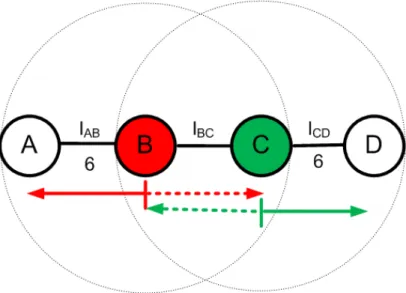
Figure 7shows an example of the interference among links in the interference model at 2 hops. In the example, node B sends data to node A (through link lAB) using the channel 6. When
node B sends data to node A, the signal also propagates in the direction of node C (right dashed red arrow) and it interferes in the transmission of node C to node D (link lCD) due to the use
of the same channel than link lAB. In the transmission between
node C and node D, the signal also propagates in direction of node B (left dashed green arrow), causing interference in the transmission of node B.
In theFigure 7, link lBC is a neighbor at 1 hop of the link lAB
and link lCD is a neighbor at 2-hops of the link lAB.
Figure 7: Interference model at 2 hops
In our work, we consider the interference model at 2 hops because while the others models only measure the interference generated by the 1 hop neighbors, the interference model at 2 hops is able to estimate the interference generated by the neigh-bors of the node that is receiving the packet (neighneigh-bors at 2 hops).
Thus, the initial objective in our strategy is to allocate a chan-nel to a link in a manner that the chanchan-nel is different (or less
interfering) of its neighbors at 2 hops. In this way, the exchange of control messages on the network is limited to 2 hops away.
The use of the interference model at 2 hops allows defining a Channel Quality (CQ) metric, based on the number of neighbors at 2 hops using the same channel. This metric is given by [63]:
CQ = 1/(1 + Ii,c) (3)
where:
Ii,c is the number of neighbors at 2 hops from a node i
using the channel c
A smaller number of occurrences of neighbors at 2 hops us-ing the same channel results in a lower interference level and in a higher channel quality.
2.1.5 Mobility model
Mobility models [64] represent the movement of devices
de-scribing how the position, velocity and the connectivity chang-ing over the time.
The mobility models can be classified according to their move-ment dependency characteristics as [65]: random models,
tem-poral and spatial dependency models, geographic restriction models, and hybrid models.
In random models, the velocity of a mobile node is a mem-oryless random process, i.e., the velocity at the current time is independent of the previous time. The behavior of the node can be extreme, such as sudden stop, accelerate or sharp turn. Random models, do not represent real life scenarios where the speed of vehicles and pedestrians will accelerate incrementally and the direction change is smooth.
In temporal dependency, the current velocity of a mobile de-pends on its previous velocity. Unlike random models, in tem-poral dependency, the velocities of a node at different time slots are correlated.
In spatial dependency, the movement pattern of a mobile node may be influenced by an another node, as for example, in scenarios of battlefield communications. In spatial dependency, the mobility of various nodes is correlated.
In geographic restriction, the nodes move in a pseudo-random way on predefined pathways and others characteristics, as ob-stacles and light traffic, can be integrated into the model.
Some models can present more than one dependency (hybrid models). For example, Manhattan Mobility Model [66] presents
2.1 wireless channel allocation:the background 19
temporal dependency and geographic restriction. Freeway mo-bility model [67] presents temporal and spatial dependency
and geographic restriction.
Another mobility model based on social context is the SLAW
[5]. The social context are typically common gathering places
where most people visit during their daily lives such as stu-dent unions, dormitory, street mall and restaurants. SLAW was created from real Global Positioning System (GPS) traces col-lected from social context of five outdoor sites (two campuses, a metro, Disney World and a state fair scenario) in U.S.
SLAW considers some fundamental statistical properties of human mobility: 1) straight line trips without directional change or pause have a truncated power-law distribution; 2) people mostly move only within their own confined areas of mobil-ity and different people have different mobilmobil-ity areas; 3) times elapsed between two successive contacts of the same person can be modeled by a truncated power law distribution; 4) way-points of humans can be modeled by fractal way-points (people are more attracted to more popular places); 5) people more likely visit destinations nearer to their current waypoint when visit-ing multiple destinations in succession.
Figure 8shows some examples of mobility models.
Traces are used to analyze the mobility patterns in real life sit-uations allowing to extract new mobility models. They present accurate information, registering the user’s movement for a long duration of time. Some traces datasets available for anal-ysis of mobility are: San Francisco cab, Geolife GPS trajectory,
Measuring and Modelling Congestion and Pollution (MOCoPo), and city of Cologne.
San Francisco dataset [68] containsGPScoordinates of
approx-imately 500 taxis collected over 30 days in the San Francisco Bay area.
Geolife dataset [69] was created by collecting the trajectory
of 182 users in a period of over five years. The dataset contains 17,621 trajectories with a total of about 1,2 million kilometers and a total duration of 48,000+ hours. The trajectory in the dataset is represented by a sequence of time-stamped points, each of which contains the information of latitude, longitude, and altitude.
MOCoPo [70] is a French project aiming to improve the
mod-eling of congestion and pollutant in urban highways in the Grenoble city. The highways were filmed by three high-definition cameras for several hours and the videos were processed to be transformed into trajectories. The dataset of trajectories is com-posed of 619 vehicles in a 60-minute time window with an in-terval of 0.1 s between each trajectory.
Cologne dataset [71] was created, aimed at reproducing, with
the highest level of realism possible, car traffic in the greater ur-ban area of the city of Cologne, in German. The dataset covers a region of 400 square kilometers for a period of 24 hours in a typical working day, and comprises more than 700.000 individ-ual car trips.
A food survey on trace-based mobility modeling is presented by [72].
In our work, we consider for ad hoc networks, the SLAW
bility model, that capture several characteristics of human mo-bility behavior. For VANETs, we consider the Manhattan Grid mobility model and the traces dataset of the city of Cologne, Germany.
2.2 wireless channel allocation:the related work 21
2.2 w i r e l e s s c h a n n e l a l l o c at i o n: t h e r e l at e d w o r k
2.2.1 Related Work in Ad Hoc network
An ad hoc network is a dynamic network where the nodes can communicate directly with each other. Operating in ad hoc mode allows all wireless devices within the range of each other to discover and communicate in peer-to-peer fashion [73].
In the literature, several authors address the channel alloca-tion problem in ad hoc networks.
In [74], the authors propose a distributed channel allocation
strategy using a conflict graph. In the strategy, each node is initialized with a random channel number. This strategy has the limitation that the nodes do not have priority in the channel allocation process.
In [75], the authors present a meta-heuristic based on Ant
Colony Optimization (ACO). The network is modeled as a graph where each node represents a cluster and the edges corresponds to the links among cluster. The prioritization of the channel al-location occurs in nodes that have the higher number of neigh-bors (node degree). In the work, the mobility and the data traf-fic in the nodes are ignored, and MAC layer is not defined.
In [76], the authors propose a channel assignment scheme
based on Orthogonal Frequency Division Multiple Access (OFDMA).
In the scheme, the nodes hear the signals in all channels and then compare the received signal power with a predetermined threshold. This strategy only considers the local interference being susceptible to interference from hidden terminals.
In [77] is proposed a channel allocation method based on the
power level. The method associates different power values to different channels, calculates the transmit power between the nodes and then selects the corresponding channel to the link. In this method, the channels are allocated considering only the power level according to the distance between the nodes.
In [78], the authors present a scheme based on polling where
each cluster head learns the traffic pattern of its cluster mem-bers and coordinates the transmissions to avoid collisions. This scheme does not consider the node mobility in the channel al-location process and at each cluster is allocated only a shared channel.
In [79] is proposed an energy efficient multichannel MAC
the access to a control window, and the winner can select a communication channel. The limitation of this protocol is that the channel allocation is only based on contention in the control window.
In [80], the authors present a scheme of channel allocation
considering the conflicts of channels. In the work are used con-trol and data channels, and the data channels are assigned ran-domly. If two senders assign the same channel concurrently to their receivers, then they are required to re-assign the schedul-ing of the transmission. This scheme selects the channels ran-domly and it does not consider any other criterion for channel allocation.
In [8], the authors propose a scheme in which a cluster head
monitors the power level in all channels. This scheme has the limitation of only detecting the interference in the transmitter, and not in the receptor node. Although the scheme considers the traffic, it does not consider the node mobility in the channel allocation process.
In [81], the authors present a centralized MAC protocol for
channel allocation and cooperative load balancing. In the pro-tocol, the channel selection is based on the power level, and it does not consider the node mobility. Besides that, the node only detects the local interference.
In [82] is proposed a centralized model for channel allocation
in cluster-based Mobile Ad hoc Network (MANET)s. The
chan-nel controllers (cluster head) regularly scan the signal level and select the channel with the lower value. However, the detection of the interference is limited to the local nodes.
In [83] is proposed a centralized hybrid Code Division
Mul-tiple Access (CDMA) and TDMA scheme based on learning au-tomata. TDMA is used in intra-cluster communication, and the
TDMA slot is proportional to the traffic load. CDMA is used in inter-cluster communication. The scheme does not consider the node mobility in the channel allocation process.
In [84] is proposed a distributed load-aware channel hopping
protocol for mobile ad hoc networks. In the work, the nodes dy-namically adjust their channel schedules based on their traffic load. To perform a transmission is chosen a channel hopping sequence. The protocol does not consider the node mobility in the channel allocation process.
In [85] is proposed a load balancing and a centralized
chan-nel assignment mechanism for cluster-based MANET in hetero-geneous networks. The cluster head evaluates the occupation
2.2 wireless channel allocation:the related work 23
in all channels and selects the one with less occupation, but it does not consider the node mobility in the channel allocation process.
2.2.1.1 Comparison among related work in ad hoc network
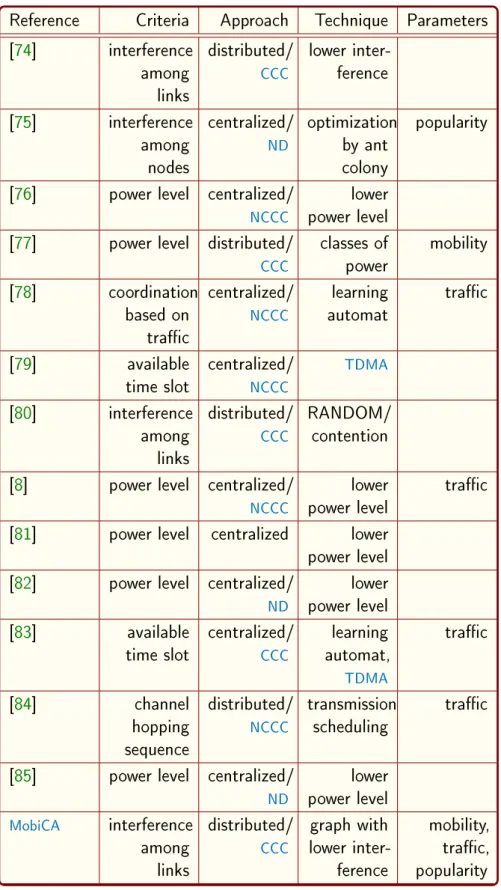
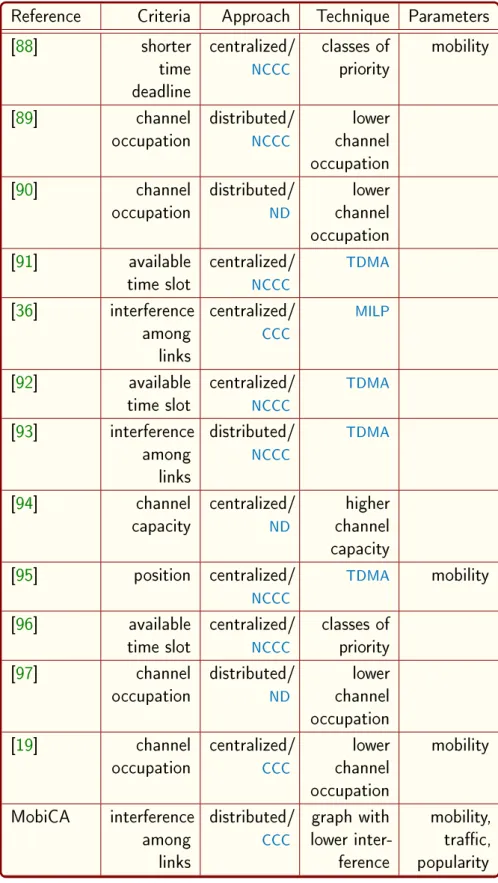
Table 4 shows the comparison among related work in ad hoc networks and our channel allocation mechanism, named Mobility-aware Channel Allocation (MobiCA).
The table has the following attributes:
• Reference: identification of the related work.
• Criteria: corresponds to the criteria for channel allocation. • Approach: represents the type of approach (centralized or
distributed, with or without common control channel). • Technique: is the technique used to solve the channel
al-location problem. Some techniques are elementary, for ex-ample, consider the highestSINRor the lowest power and other more complex as Learning Automat.
• Parameters: are the attributes used to guide the channel allocation process.
In Table 4, the interference among links represents the ference among communication links inside a cluster. The inter-ference among nodes represents the interinter-ference among cluster heads. This is due to each node in the graph to represent a cluster head.
Many works in the literature, such as [76], [77], [8], [81], [82],
and [85], use physical parameters (e.g., signal power level) as
criteria for channel allocation and the technique more used is to select the channel with lower power level.
The limitation of measuring physical parameters locally and using them as a decision criterion for channel allocation is to restrict the detection of interference at 1-hop. Thus, the node remains susceptible to interference at 2 hops (as seen in subsec-tion 2.1.1.1).
According toTable 4, most authors use a centralized approach in a cluster head. In this way, all decision of the channel allo-cation in the cluster depends on a centralized controller. Some works ([74], [77], [80], and [84]) present a distributed channel
allocation, in a manner that, the channel allocation decision is taken by nodes independently.
Table 4: Comparison among related work in ad hoc networks
Reference Criteria Approach Technique Parameters [74] interference among links distributed/ CCC lower inter-ference [75] interference among nodes centralized/ ND optimization by ant colony popularity [76] power level centralized/
NCCC
lower power level [77] power level distributed/
CCC classes of power mobility [78] coordination based on tra c centralized/ NCCC learning automat tra c [79] available
time slot centralized/NCCC
TDMA [80] interference among links distributed/ CCC RANDOM/ contention [8] power level centralized/
NCCC
lower
power level tra c [81] power level centralized lower
power level [82] power level centralized/
ND
lower power level [83] available
time slot centralized/CCC
learning automat, TDMA tra c [84] channel hopping sequence distributed/ NCCC transmission scheduling tra c [85] power level centralized/
ND lower power level MobiCA interference among links distributed/ CCC graph with lower inter-ference mobility, tra c, popularity
2.2 wireless channel allocation:the related work 25
Some works, such as [79] and [83], use a channel allocation
mechanism based on TDMA where the criterion is to select a available time slot.
Some authors, such as [78], [8], [83], and [84] use the
traf-fic information to guide the channel allocation process. This allows prioritizing the channel allocation in links with higher activity, by selecting a less interfering channel, decreasing the contention in those links.
Few references in ad hoc networks use the mobility ([77]) or
node popularity ([75]) to guide the channel allocation process.
Finally,Table 4shows that parameters of mobility, traffic, and node popularity of the previous works are considered sepa-rately in the channel allocation process. In our work (MobiCA),
we adopt a distributed approach, limiting the exchange of con-trol messages at 2 hops and we use the parameters of mobility, traffic, and node popularity simultaneously to guide the chan-nel allocation process.
2.2.2 Related Work in VANET network
VANETis a vehicular network which has an architecture consist-ing of three components [86], [87]: RSU, On Board Unit (OBU),
and Application Unit (AU).
RSU is a device fixed along the road side or in dedicated loca-tions equipped with one network device based on IEEE 802.11p standard or other network devices for communication within the network infrastructure.RSU allows extending the communi-cation range by distributing the information to other vehicles and by sending the information to other RSU. It acts as an infor-mation source allowing notify vehicles about accidents, work zone, congestion, road problems, etc. In addition, RSU allows vehicles to have access to the Internet.
OBU is a device mounted on-board in a vehicle, used to ex-change information with RSUs or otherOBUs.
AU is the device within the vehicle that runs the applications and uses the communication capabilities of the OBU. AUcan be
connected to the OBU through a wireless or wired connection and may reside with theOBUin the same box.
In the literature, several authors propose channel allocation for vehicular networks.
In [88], the authors propose a centralized channel access scheme
for vehicular ad hoc networks, considering the time (deadline) that the vehicles are going to leave the RSU range. The scheme
prioritizes the mobility and emergency services in the channel allocation process, but it does not consider the network traffic.
In [89], the authors present a channel allocation mechanism
that selects the channels with lower usage, and it does not con-sider the mobility and traffic in the channel allocation process.
In [90], the authors present a cognitive scheme for dynamic
channel allocation in the adjacent band of Dedicated Short-Range Communication (DSRC). The scheme only uses the channel oc-cupation as a criterion of channel allocation.
In [91] is presented a channel allocation mechanism forVANETs
using TDMA. The scheme is cluster-based where the cluster members request a time slot to the cluster head. In this mech-anism, the vehicles do not have priority, and the channels are allocated according to the request of the time slot.
In [36] is proposed a channel allocation mechanism for
cog-nitive VANET that represents the links between vehicles in a conflict graph and formulates the channel allocation problem as a Mixed-Integer Linear Programming (MILP) problem. The mechanism does not consider others parameters as traffic and mobility in the channel allocation.
In [92], the authors present a cluster-based multi-channel scheme
using IEEE 802.11p. In communication intra-cluster is used a non-competition scheme based on TDMA that select a available time slot to the OBU.
In [93], the authors propose a Distributed Channel
Assign-ment Scheme (DCAS) using IEEE 802.11p standard considering a highway scenario. DCASis based onTDMAand to avoid inter-ference among links are selected different time slots for links at 2hops and the channel allocation priority is only for emergency messages.
In [94], the authors present a Dynamic Service Channel
Allo-cation (DSCA) mechanism for vehicular network. The objective is to assign a Service Channel (SCH) for each vehicle using
ac-cess categories to improve the network throughput. The mecha-nism uses the historical of service announcement messages sent by vehicles and selects the highest capacity channel but, it does not prioritize the node that will use the channel.
In [95], the authors propose a channel allocation scheme based
on node position forVANETs. In the scheme, each cluster selects a node as a coordinator, responsible forTDMA slots assignment inside the cluster, in a manner that, vehicles at starting position can get more bandwidth when compared to the end position (near the edge of the cluster). Although the scheme uses the
2.2 wireless channel allocation:the related work 27
node mobility, it does not consider the traffic as a criterion of channel allocation.
In [96] is proposed anRSUcentric channel allocation protocol
to minimize channel allocation time and overhead. The RSU di-vides the region into clusters, and the channel in each cluster is divided into time slots. A time slot is allotted to a vehicle con-sidering only the priority of the service type and availability of the channel.
In [97], the author presents an adaptive multi-channel
alloca-tion mechanism that selects opportunistically a service channel among all six service channels of the IEEE 802.11p standard. The channel selection is only based on the channel occupation, and it does not consider others parameters and the node prior-ity.
In [19], the authors present a mobility-aware OBU protocol,
where the changing of the channel due spatial mobility occurs when the node joins or leave the network. In the work, other parameters as traffic or node priority are not considered.
2.2.2.1 Comparison among related work in VANET network
Table 5shows the comparison among the related work inVANETs
and our channel allocation mechanism (MobiCA). In Table 5, we can observe that:
• In the literature, most of the work use an approach central-ized in the RSU, and they do not use a common control channel. In this last case, the authors use part of Control Channel (CCH) time to notify the neighbors about the channel to use.
• Most of the techniques consist of selecting a channel with the lower occupation or using aTDMA scheme.
• In VANETs, some works consider only the mobility pa-rameter for channel allocation, and sometimes only at the edge of the network. They do not consider other parame-ters as traffic or popularity, to guide the channel allocation process.
Our work differs from previous ones because we do not use a
TDMA-based channel allocation scheme. In some previous work
([91], [88], [93], [95], [96]), using a single network interface
re-quires time synchronization mechanisms (e.g., based onTDMA) for use of the interface as control or data interface. This in-creases the complexity and requires hardware modification. In
Table 5: Comparison among related work in VANETs networks
Reference Criteria Approach Technique Parameters [88] shorter time deadline centralized/ NCCC classes of priority mobility [89] channel occupation distributed/NCCC lower channel occupation [90] channel occupation distributed/ND lower channel occupation [91] available
time slot centralized/NCCC
TDMA [36] interference among links centralized/ CCC MILP [92] available
time slot centralized/NCCC
TDMA [93] interference among links distributed/ NCCC TDMA [94] channel capacity centralized/ND higher channel capacity [95] position centralized/ NCCC TDMA mobility [96] available
time slot centralized/NCCC
classes of priority [97] channel occupation distributed/ND lower channel occupation [19] channel occupation centralized/CCC lower channel occupation mobility MobiCA interference among links distributed/ CCC graph with lower inter-ference mobility, tra c, popularity
2.3 conclusion 29
our approach, we use two network interfaces, one for control operations and other to transmit/receive data, not requiring time synchronization mechanisms and hardware modifications. In addition, we consider the profile of mobility, traffic history, and node popularity to allocate the channel, and not only the power level, the number of users, or messages on the channel.
2.3 c o n c l u s i o n
In this chapter, we presented some criteria, approaches, and techniques used to solve the channel allocation problem in wire-less networks. Many of the criteria presented in the literature are used in isolation, they are subject to the hidden terminal problem and only change the channel when a node joins or leaves the network.
In scenarios where the topology and density of the network are constantly changing, a distributed approach is more rec-ommended because it allows channel allocation to be made quickly, adaptively, although not always optimally.
In addition, the use of the same channel for the exchange of control and data messages presents a greater complexity of implementation due to the necessity of clock synchronization mechanisms.
The literature presents several techniques used to solve the channel allocation problem. As channel allocation is described as a hard NP problem, the linear programming technique is often simplified for a BLP, which requires that several assump-tions be made to be solved in polynomial time.
For scenarios where the exhaustive search is impractical, heuris-tic methods are used to find a solution near to the optimal, quickly.
Evolutionary Algorithms search for solutions by performing the evaluation of populations based on natural evolution. Its main disadvantage is the time to find an optimal solution with the risk of finding a minimal local solution.
Another widely used technique for channel allocation is based on graph coloring technique, where two adjacent nodes receive a different channel.
One variation of the graph-based technique is the use of con-flict graphs. This technique allows capturing the interference among competing transmissions that are in the same interfer-ence range. We use a technique based on communication graph considering the interference at 2 hops. We use this technique
be-cause we do not need to use physical parameters such as (SNR)
or (SINR) and is possible to estimate the interference among links at 2 hops, avoiding the hidden terminal problem.
We also discussed some interference models that are used in the channel allocation process. Many of these models use phys-ical parameters of the network such as received power, signal-to-noise ratio, and bit error rate. In addition, they only allow estimating the interference generated by neighboring nodes at 1-hop, while in our work we use a model that allows estimation of interference at 2 hops.
We have seen that mobility models represent the behavior of the node movement in function of different temporal, spatial, and geographical conditions. The models can be extracted from traces dataset that store information about node mobility in real life situations.
We compared the works in the literature and observed that the criterion more used in channel allocation is the power level and channel occupation. Although some works consider others parameters for channel allocation, they use them in an isolated manner. In ad hoc networks the parameter more used is the traffic, while in VANET is the mobility. In our work, we use a
distributed approach with a common channel, considering the mobility, traffic, and node popularity simultaneously, to guide the channel allocation process. In the next chapter, we present our channel allocation strategy for ad hoc network.
![Figure 1 shows the growth of connected IoT devices [ 2 ] .](https://thumb-eu.123doks.com/thumbv2/123doknet/2655902.60216/23.892.194.595.651.1025/figure-shows-growth-connected-iot-devices.webp)