O
pen
A
rchive
T
OULOUSE
A
rchive
O
uverte (
OATAO
)
OATAO is an open access repository that collects the work of Toulouse researchers and
makes it freely available over the web where possible.
This is an author-deposited version published in :
http://oatao.univ-toulouse.fr/
Eprints ID : 16651
To link to this article : DOI:10.1016/j.electacta.2016.02.013
URL :
http://dx.doi.org/10.1016/j.electacta.2016.02.013
To cite this version :
Nègre, Léo and Daffos, Barbara and Turq,
Viviane and Taberna, Pierre-Louis and Simon, Patrice
Ionogel-based solid-state supercapacitor operating over a wide range of
temperature. (2016) Electrochimica Acta, vol. 206. pp. 490-495.
ISSN 0013-4686
Any correspondence concerning this service should be sent to the repository
administrator:
[email protected]
Ionogel-based
solid-state
supercapacitor
operating
over
a
wide
range
of
temperature
L.
Negre
a,b,
B.
Daffos
a,b,
V.
Turq
a,
P.L.
Taberna
a,b,
P.
Simon
a,b,*
aCIRIMAT,UniversitédeToulouse,CNRS,UT3,118routedeNarbonne,31062ToulouseCedex,France bRéseausurleStockageElectrochimiquedel’Energie(RS2E),FRCNRS3459,FranceABSTRACT
Aninorganicgelpolymerelectrolytebasedontheconfinementofanionicliquidmixture(1:1byweight ormolarratio)ofN-methyl-N-propylpiperidiniumbis(fluorosulfonyl)imide(PIP13FSI)and N-butyl-N-methylpyrrolidiniumbis(fluorosulfonyl)imide(PYR14FSI)intoaSiO2matrixpreparedfromasol-gel
methodwaspreparedandfurtherusedaselectrolyteinanallsolid-statesupercapacitor.Thesynthetized ionogelexhibitsahighionicconductivityoverawidetemperaturerange(from0.2mScm!1at!40"Cup
to10mScm!1at60"C).Theionogel-basedsupercapacitorusingtwoactivatedcarbonelectrodescanbe
operatedover3Vcellvoltagewindow.Moreoverthisallsolid-supercapacitorshowsacapacitanceupto 90Fg!1atroomtemperature.Theseencouragingresultsshowtheinterestofdevelopingsuchdevices,
includingnon-toxicandsaferelectrolytes,packagingissuesandflexibledevicesdevelopment.
1.Introduction
Electrochemicaldoublelayercapacitors(EDLCs),alsoknownas supercapacitors, storeenergy by ion electrosorption onporous electrodes,mostlyactivatedcarbons[1].ThekeyfeatureofEDLCs compared to Li-ion batteries is their highpower delivery (full chargeordischargedcanbeachievedwithinfewsecondsortensof seconds) and high cyclability. Despite abounding research on pseudocapacitive materials with promising performance [2–4], conventionalEDLCsusinghighsurfaceareacarbonelectrodesand non-aqueousliquidelectrolytesrepresentthestateoftheart[5]. However, thecurrent liquid electrolytesusedin supercapacitor devices sufferfromseveral drawbacks.Conventional supercapa-citorsemploytheuseofsolvent-basedelectrolyteswhichallowion conduction at sub-zerotemperatures, e.g NEt4BF4 in propylene
carbonate (PC)or acetonitrile (AN). Nevertheless,theseorganic solventsreducethevoltagewindowofthedeviceandANcanpose securityissuesduetoitsflammabilityandlowflashpointof2"C.
Electrolyteleaks,whichcanoccurbecauseofinternalgasrelease,is also animportantconcern.Since themaximumspecific energy increases with squared of the voltage window (EmaxðinWhÞ¼1
2&CðinFÞ&DV2maxðinVÞ
.
[1]),thetypeofelectrolyteused is important indetermining theenergydensity andsafety ofa device.Astrategytotackletheseissuesistoreplaceliquidbysolid
–orgelified–electrolytes.Severalmaterialshavebeenutilizedas solidpolymerelectrolytes,suchasNafion[6], poly(etheretherke-tone)[7],polybenzimidazole[8],poly(methylmethacrylate) [9]
andpoly(ethyleneoxide)[10]arepromisingcandidatesofferingas welleasyassembly,lowcost,andflexiblepackaging.However,the operatingvoltageislimitedtolessthan2Vbecauseoftheuseof protonor proton-like conductingpolymers[11].More recently, ionogels,whicharesolidorquasi-solidelectrolytesbasedonthe trappingofroomtemperatureionicliquids(RTILs)inasilicamatrix havebeenproposed[12–14]becausetheycanreachhighvoltage, up to 4V [15]. However, based on ionic liquid salt, the ionic conductivityat low temperatureis still anissuefor developing solid-state supercapacitors operating with a wide range of temperature.
Inthispaper,weproposetodevelopasolid-stateelectrolyte basedonaionicliquidmixturetrappedintoaninorganicsilica network. Following previous work [16], we used an mixture composed of (1:1 by weight or molar ratio) N-methyl-N-propylpiperidinium bis(fluorosulfonyl) imide(PIP13-FSI) and N-butyl-N-methylpyrrolidinium bis(fluorosulfonyl) imide (PYR14-FSI).Inthesemixtures,cationshavethesamemolecularweight andthesamenumberofatomsofthesamenature,withtheonly differencebeingtheircationmolecularstructure:afive-member (piperidinium)orsix-member(pyrrolidinium) heterocycle.Asa result,theincreasingdisorderandasymmetryamongthecations hinderslatticeformation,thustoloweringthemeltingpointwhile maintaininggoodmiscibilityandconductivity[17].Theliquidstate ofthisILmixturecanbemaintainedattemperaturesseveraltens
*Correspondingauthor.
E-mailaddress:[email protected](P.Simon).
ofdegreeslowerthantheindividualILs.Ionicliquidmixture-based ionogelhavebeendesignedforenlargingtheoperating tempera-ture range of these solid state electrolytes, thus offering new opportunitiesforsolid-statesupercapacitors.
2.Experimental
Ionogel synthesis procedure was described elsewhere [14]. Basically,asolidionogel-basedelectrolytewassynthetizedusing two different sol-gel agents: TMOS (TetraMethyl Ortho Silicate 98%,fromSigma–Aldrich)andTEOS(TetraEthylOrthoSilicate98%, fromSigma–Aldrich)underacidicconditions(Methanoicacid98%, fromVWR).TheTEOS:TMOS:MAvolumetric ratiowas 2:2:5.All reactantsweremixedtogetherundermoderatestirring(300rpm) at40"Cduring18min.Thesecondstepwastheadditionof60%by
volumeof ionic liquidmixture(PIP13-FSI):(PYR14-FSI):50:50 in weight.Comparedtoourpreviouswork using1-ethyl-3-methyl imidazolium bis(trifluoromethanesulfonylimide) EMITFSI-based ionogel[14],ILcontentwasdecreasedfrom70%downto60%vol toimprovethemechanicalpropertiesofthegel.Then,theresulting solutionwascastedinsealedcylindricalcontainersandkeptfor 24hoursatroomtemperatureforgelationandthendriedat50"C
during4 days.Allthecells used forconductivitymeasurement wereassembledina
MBraüngloveboxoperatingunderargonatmosphere(O2and
H2Ocontents lower than 0.1ppm) toavoid any contamination.
Samplespreparedforfurthermechanicalcharacterizationswere injectedintostainlesssteelmolds,whichensuredgood reproduc-ibilityofmeasurements.
2.1.Supercapacitorcellassembly
Activematerialwasmadeof95wt%ofPICACTIFSC,astandard highspecificsurfaceareaactivatedcarbon(2300m2g!1)[18],and
5wt%ofPTFE(60wt%PTFEinwaterDuPontNemours,France)[19]. Carbonelectrodesweredriedoutinavacuumovenduring2hours then 250
m
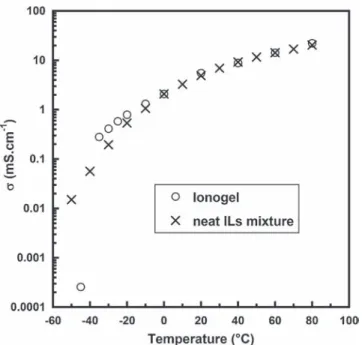
L of silane-ILmixture was spread ontoan electrode whichwaslaidinanappropriatemould,thenanotherelectrodeFig.1.ConductivityvariationversustemperatureofneatIlsmixture(PIP13-PYR14/ FSI)andionogelbetween!50"Cand80"C.Conductivitieswerecalculatedfrom
high frequency intercept with real axis of the Nyquist plotsobtained from ElectrochemicalImpedanceSpectroscopy(EIS)measurements.
wasdepositedontothesurfaceoftheliquidSilane-ILsmixture.The gel formation was obtained following procedure previously described. The resulting Carbon-Ionogel-Carbon sandwich was placed between two gold current collectors in a RHD cell for furtherelectrochemicaltests.Thistechniqueoffersawaytowork
with a large amount of active material (from few mg up to 15mgcm!2).
Electrochemicaltestswerecarried outusingan Autolab PG-STAT128N(Metrohm,Switzerland).ARHDCell(RHD,Germany) wasusedforprecisecontrolofthecelltemperaturefrom!40"Cto
+60"C.Prioranymeasurement,thecellwasmaintainedattheset
temperature for 2h until equilibration. After sandwiching the samplesbetweentwogoldcurrentcollectors,ionicconductivity measurementsoftheionogelwereperformedbyElectrochemical ImpedanceSpectroscopy(EIS)for each temperature;a biascell voltageof0Vwithafrequencyrangefrom25kHzdownto0.01Hz wereapplied.Conductivitieswerecalculatedfromhighfrequency interceptwiththerealaxisoftheNyquistPlots.Allelectrochemical testsof the supercapacitors wereperformed withan electrode massloadingof5mgcm!2.
Mechanical characterizations of theionogel wereconducted using an UltraNanoHardness Tester from CSM Instruments (Switzerland).Young’smodulusEandhardnessHandpercentage of elastic recovery were measured with a modified Berkovich three-sidedpyramiddiamondindenter.Themaximalnormalforce was 200
m
N; the maximum force was keptduring 60s before discharge.Theloadingratewas400m
Nmin!1andthemaximumpenetrationdepthwas12
m
m(valuelowerthanthetenthofthe sample thickness (1.5mm) thus the mechanical answer of the substratewasneglected).ThePoissonratioofthehybridcoatings wastakenatamediumvalueofy
=0.3(valuebetweenthePoisson ratioofamorphoussilica(0.17)andthatofconventionalpolymeric materials(0.5)).Experimentswereperformedatambient temper-ature.InallCSMnano-indentationtests,atotalofthreeindents wereaveragedtodeterminethemeanYoung'smodulusand nano-hardness.Theanalysis proceduresuggestedbyOliver andPharr[20]wereusedtocalculatethehardnessandelasticmodulus. 3.Resultsanddiscussions
3.1.Ionogelconductivity
Fig.1shows thechangeof theionogelandneat ILsmixture conductivitieswithtemperature(Arrheniusplot) between80"C
and!50"C.AscanbeseeninFig. 1,theionogelconductivityisclose
tothatof theneatIL mixturein the!20"C +60"C temperature
Fig.3. CyclicVoltammetryofan ionogel-basedsupercapacitorusingactivated carbonelectrodes,at5mVs!1atvarioustemperatures(from
!40to60"C).
Fig.4.EISplotof(A)supercapacitorusingtwocarbonglasselectrodesandanionogelsoakedseparatorbetween1MHzand200Hz(B)supercapacitorusingtwoactivated carbonelectrodesandanionogelsoakedseparatorbetween1MHzand0.1Hz.BiasVoltage:0V.Signalamplitude:5mVRMS.
Table1
Gravimetricandarealcapacitancecalculatedfromthe5mVs!1CVsduringthe
dischargeatdifferenttemperatures.
Temperature !40"C !20"C 0"C 20"C 40"C 60"C
Gravimetriccapacitance(Fg!1) 34 68 89 91 94 96
range,whichevidencesasmallimpactofthepresenceofthesilica matrix.Theroomtemperatureconductivity(20"C)wasmeasured
at5.5mScm!1forboththeneatILmixtureandtheionogel,which
iscomparabletoconventionalpropylenecarbonate-basedliquid electrolytes[21]andmatcheswiththestandardsneededforuseas electrolytein supercapacitordevices. However,for temperature below!20"C,thelimitedmobilityoftheelectrolyteduetothe
confinementeffectinsidethesilicamatrixisassumedtolimitthe conductivity.A conductivity upto0.2 mS.cm!1was still
main-tained at !40"C. Such high conductivity values at such low
temperature,toourknowledge,haveneverbeenreportedinthe literature for ionogel electrolyte. Nevertheless, these kind of electrolytes have been intended to suit to mechanical stress experiencesinceagoodmechanicalstabilityhastobe.Mechanical
tests were carried out using a nano-indentation technique to assessthemechanicalpropertiesofasmadeionogels.
3.2.Mechanicalcharacterizations
Mechanical properties of ionogels were measured by nano-indentation.Fig.2showstheloadasafunctionofthepenetration depth plotfor a 1.5mm-thick ionogelpellet usinga Berkovitch indenter.IonogelsexhibitratherlowvaluesofbothVickersHardness (0.11' 0.02MPa) and elastic modulus (0.935'0.114 MPa) as comparedto other gelelectrolytes: 26MPafor PMMA [22] and 35–50MPaforPVdF-basedpolymer[23].Theelasticcontributionto theloadingcanbeobtainedfromFig.2,bysubtractingtheplastic displacement to the total displacement normalized to the total
Fig.5.EISPlotofionogel-basedsupercapacitoratdifferenttemperature(a)!40"C,!20"Cand0"C(b)20"C,40"Cand60"C.Biasvoltage:0V.Signalamplitude:150mVRMS.
Fig.6.Evolutionofcapacitanceversuspotentialscanrateofionogel-basedsupercapacitorwithin3Vatdifferenttemperatures(A)!40"C,!20"Cand0"C(B)20"C,40"Cand
displacement.Anelasticrecoveryof45%wasmeasured,thathasto becomparedto14%forpureTEOSandTMOSsilicagel.Thetrapped ionicliquidisactingasaplasticizerintheresultingionogel. 3.3.Ionogelassolid-stateelectrolyteforsupercapacitor
An all-solid supercapacitor was assembled using porous PICACTIF activated carbon based electrodes stacked with the ionogelaselectrolyte(seeexperimental).InFig.3arepresented CyclicVoltammogramsobtained(CV)at5mVs!1between0and
3Vatvarioustemperatures(from!40to60"C).Downto!20"C
theelectrochemicalsignaturesarequietdecentsincea rectangu-lar-shape characteristicwas achievedwhich was expectedfora capacitive behaviour based on charging/discharging of the electricaldoublelayer.
Aspecificcapacitanceof91Fg!1(pergramofactivatedcarbon)
havebeenobtainedat20"Cwithacellvoltageof3V,whichisvery
similar to that was measured in conventional organic liquid electrolyte [19]. Table 1 summarizes gravimetric and areal capacitancescalculatedfromtheCVsatapotential scanrateof 5mVs!1between0and3Vfrom!40to60"C.
Asobservedinthistable,thecapacitivebehaviouriskeptdown totemperatureaslowas!20"C;withonly25%capacitancelossat
!20"C.TheseresultsareconsistentwithFig.1thatshowedthat
ionogelionicconductivitywasstilldecent(0.2mScm!1)atsuch
lowtemperature.At!40"C,thecrystallizationoftheILconfinedin
pores of thecarbon structure is assumed to occur. Despite an electrochemicalkineticsmainlycontrolledbyohmicdrop,40%of thecapacitanceobtainedat20"Cwaspreserved.Interestinglythe
electrochemicalbehaviourofall-solidsupercapacitorwasfoundto beveryclosetoliquid-basedsupercapacitors.Suchperformance couldbeexplainbyawettingcarbonmicroporebytheILthatcan movefreelywiththesiliciumnetwork.Tocheckthehypothese,we carriedouttodesignanadditionalexperimentusinganon-porous carbon(carbonglass)forcomparisonprupose.
Intheexperiment,an(EMITFSI)-basedionogelsoakedseparator wasusedtoobservethecarbon/ionogelinterface;EISmeasurements were madeeach30minbetween 1MHz–200Hz to measurethe change of theimpedance with time. Fig. 4A shows thesoaked separatorbetweentwocarbonglasselectrodes.Sameexperiment wasconductedwithtwoactivatedcarbonelectrodeplacedbetween thesameseparatorsoakedwithionogel(Fig.4B).
While the impedance is kept constant for the non porous electrode(Fig.4B),therealpartoftheimpedanceincreaseswith timewhenusingporouscarbonelectrode.Thisisassumedtobe linked tothehydrophobicityof thecarbonwhichattracts ionic liquid (hydrophobic) from the silica host network (which is hydrophilic)intothecarbonpores;besides,capillarityforcecan alsocontributetoattractILinthepores.Thisbehaviourallowsa (partial) filling of the carbon microporous structure with ions leadingtosuchhighcapacitance.
In Fig.5 arepresentedtheNyquist plotsof acarbon-carbon ((PIP13-FSI)0.5(PYR14-FSI)0.5) ionogelbased supercapacitorata biascellvoltageof0V.
In the 20"C ! 60"C temperature range (Fig. 5A), the high
frequencyseriesresistance,whichistheionicbulkresistance,was measured at 20
V
cm2 for thewholecell at roomtemperature(20"C), which is comparable to our previous work [14]. As
expected,whenthetemperatureincreasesfrom0"Cupto60"C,
thehighfrequencyresistancedecreasesfrom52to9.2
V
cm2.Thesharp increase of the imaginary partof theimpedance at low frequencies ischaracteristic ofthesystem capacitivebehaviour. Evenfor sub-zerotemperatures,EIS measurementsstill showa capacitivebehaviour,despitethepresenceofagrowingsemi-circle athighfrequency,attributedtotheonsetofgelationthatisrelated
to decreased mobility of the electrolyte ions at such low temperatures.
Fig.6showsthechangeofthearealandgravimetriccapacitance (derivedfromtheslopeoftheQ-Vcurveduringcelldischarge)of theactivatedcarbonelectrodesversusthepotentialscanrateat various temperatures. The capacitance of the ionogel-based supercapacitor decreases with increasing scan rate, since the ohmicdropincreaseswiththescan rate. Temperatureplaysan importantrole,sincealreadymentionedseriesresistanceincrease at low temperaturewhile a fastdecrease of thecapacitance is observedathigherscanrate.
Inhere,itwasexpectedsincecapacitancelimitationispurely due to ohmicdrop. The effective accessible surface is strongly dependentonthescanrate[17].
4.Conclusion
Thepresentpaperpresentssomeresultsobtainedwitha carbon-carbonsolid-statesupercapacitorusing((PIP13-FSI)0.5(PYR14-FSI) 0.5)-basedionogelasbothelectrolyteandseparator.Thankstohigh ionicconductivityoftheionogel,ionsfromthegelareabletofulfil porosityofthecarbonelectrodesleadingtosuchhighcapacitance (95Fg!1at room temperature). Anall solid supercapacitor with
attractiveareal capacitance up to 100mFcm!2 per electrodeat
!40"Cfor5mVs!1scanrateupto 3Vcellvoltagecouldbewas
assembled.Suchdevicescouldefficientlymatchmultiplecriteria (high capacitance, good power density and high cell potential window)neededforsolidsupercapacitorapplications.
References
[1]P.Simon,Y.Gogotsi,Materialsforelectrochemicalcapacitors,Nat.Mater.7 (2008)845–854.
[2]P.Simon,Y.Gogotsi,B.Dunn,WhereDoBatteriesEndandSupercapacitors Begin,Science343(2014)1210–1211.
[3]V.Augustyn,P.Simon,B.Dunn,Pseudocapacitiveoxidematerialsforhigh-rate electrochemicalenergystorage,EnergyEnviron.Sci.7(2014)1597. [4]T.Brousse,P.-L.Taberna,O.Crosnier,R.Dugas,P.Guillemet,Y.Scudeller,etal.,
Long-termcyclingbehaviorofasymmetricactivatedcarbon/MnO2aqueous electrochemicalsupercapacitor,J.PowerSources173(2007)633–641. [5]J.R.Miller,P.Simon,MaterialsScience:ElectrochemicalCapacitorsforEnergy
Management,Science321(2008)651–652.
[6]B.C.Kim,J.S.Kwon,J.M.Ko,J.H.Park,C.O.Too,G.G.Wallace,Preparationand enhancedstabilityofflexiblesupercapacitorpreparedfromNafion/polyaniline nanofiber,Synth.Met.160(2010)94–98.
[7]P.Sivaraman,V.R.Hande,V.S.Mishra,C.S.Rao,A.B.Samui,All-solid supercapacitorbasedonpolyanilineandsulfonatedpoly(etheretherketone), J.PowerSources.124(2003)351–354.
[8]D.Rathod,M.Vijay,N.Islam,R.Kannan,U.Kharul,S.Kurungot,etal.,Designof anallsolid-statesupercapacitorbasedonphosphoricaciddoped
polybenzimidazole(PBI)electrolyte,J.Appl.Electrochem.39(2009)1097– 1103.
[9]M.Schroeder,P.Isken,M.Winter,S.Passerini,A.Lex-Balducci,A.Balducci,An InvestigationontheUseofaMethacrylate-BasedGelPolymerElectrolytein HighPowerDevices,J.Electrochem.Soc.160(2013)A1753–A1758. [10]C.V.SubbaReddy,G.P.Wu,C.X.Zhao,Q.Y.Zhu,W.Chen,R.R.Kalluru,
CharacterizationofSBA-15doped(PEO+LiClO4)polymerelectrolytesfor electrochemicalapplications,J.Non-Cryst.Solids353(2007)440–445. [11]A.A.Łatoszy!nska,G.Z. _Zukowska,I.A.Rutkowska,P.-L.Taberna,P.Simon,P.J.
Kulesza,etal.,Non-aqueousgelpolymerelectrolytewithphosphoricacid esteranditsapplicationforquasisolid-statesupercapacitors,J.PowerSources 274(2015)1147–1154.
[12] D.Membreno,L.Smith,K.-S.Shin,C.O.Chui,B.Dunn,Ahigh-energy-density quasi-solid-statecarbonnanotubeelectrochemicaldouble-layercapacitor withionogelelectrolyte,Transl.Mater.Res.2(2015)015001.
[13]M.Brachet,T.Brousse,J.LeBideau,AllSolid-StateSymmetricalActivated CarbonElectrochemicalDoubleLayerCapacitorsDesignedwithIonogel Electrolyte,ECSElectrochem.Lett.3(2014)A112–A115.
[14]L.Negre,B.Daffos,P.L.Taberna,P.Simon,Solvent-FreeElectrolytesfor ElectricalDoubleLayerCapacitors,J.Electrochem.Soc.162(2015)A5037– A5040.
[15]M.Armand,F.Endres,D.R.MacFarlane,H.Ohno,B.Scrosati,Ionic-liquid materialsfortheelectrochemicalchallengesofthefuture,Nat.Mater.8(2009) 621–629.
[16]R.Lin,P.-L.Taberna,S.Fantini,V.Presser,C.R.Pérez,F.Malbosc,etal., CapacitiveEnergyStoragefrom!50to100"CUsinganIonicLiquidElectrolyte, J.Phys.Chem.Lett.2(2011)2396–2401.
[17]W.-Y.Tsai,R.Lin,S.Murali,L.Zhang,J.K.McDonough,R.S.Ruoff,etal., Outstandingperformanceofactivatedgraphenebasedsupercapacitorsin ionicliquidelectrolytefrom!50to80"C,NanoEnergy2(2013)403–411.
[18]P.L.Taberna,P.Simon,J.F.Fauvarque,ElectrochemicalCharacteristicsand ImpedanceSpectroscopyStudiesofCarbon-CarbonSupercapacitors,J. Electrochem.Soc.150(2003)A292.
[19]J.Gamby,P.L.Taberna,P.Simon,J.F.Fauvarque,M.Chesneau,Studiesand characterisationsofvariousactivatedcarbonsusedforcarbon/carbon supercapacitors,J.PowerSources101(2001)109–116.
[20]W.C.Oliver,G.M.Pharr,Animprovedtechniquefordetermininghardnessand elasticmodulususingloadanddisplacementsensingindentation experiments,J.Mater.Res.7(1992)1564–1583.
[21]M.Ue,Conductivitiesandionassociationofquaternaryammonium tetrafluoroboratesinpropylenecarbonate,ElectrochimicaActa39(1994) 2083–2087.
[22]S.M.Zebarjad,S.A.Sajjadi,T.E.Sdrabadi,S.A.Sajjadi,A.Yaghmaei,B.Naderi,A StudyonMechanicalPropertiesofPMMA/HydroxyapatiteNanocomposite, Engineering03(2011)795–801.
[23]B.Mohammadi,A.A.Yousefi,S.M.Bellah,Effectoftensilestrainrateand elongationoncrystallinestructureandpiezoelectricpropertiesofPVDFthin films,Polym.Test.26(2007)42–50.