HAL Id: hal-00918590
https://hal.archives-ouvertes.fr/hal-00918590
Submitted on 13 Dec 2013
HAL is a multi-disciplinary open access
archive for the deposit and dissemination of
sci-entific research documents, whether they are
pub-lished or not. The documents may come from
teaching and research institutions in France or
abroad, or from public or private research centers.
L’archive ouverte pluridisciplinaire HAL, est
destinée au dépôt et à la diffusion de documents
scientifiques de niveau recherche, publiés ou non,
émanant des établissements d’enseignement et de
recherche français ou étrangers, des laboratoires
publics ou privés.
Filtered Comparison for Oracle in ModelTransformation
Testing
Olivier Finot, Jean-Marie Mottu, Gerson Sunyé, J. Christian Attiogbe
To cite this version:
Olivier Finot, Jean-Marie Mottu, Gerson Sunyé, J. Christian Attiogbe. Filtered Comparison for
Oracle in ModelTransformation Testing. ICTSS 2012 Ph.D. Workshop, Nov 2012, Aalborg, Denmark.
pp.1601-0590. �hal-00918590�
Olivier Finot (PhD Student),
Jean-Marie Mottu, Gerson Sunyé, and Christian Attiogbe (Advisors)
LINA CNRS UMR 6241 University of Nantes 2, rue de la Houssinière F-44322 Nantes Cedex, France [email protected]
Abstract. Focusing on one part of a produced output helps in improv-ing model transformation testimprov-ing
1
Introduction
Models are becoming a key element in software engineering. With Model Driven Engineering, they are the heart of the development process. They are used to describe a system at some state of its development, and they evolve with transformations. Model transformations can be chained, up to the production of executable code.
However, any error in a transformation of such a chain will be spread to the resulting code. But while testing the produced code might detect the bug, finding its origin will be difficult. Therefore, it would be useful to check the chain’s development by verifying the transformations. Several contributions have already been published on the verification of model transformation. Our goal is to pursue research on this field and im-prove existing methods to test model transformations. More specifically, we focus on the problem of the definition of a test oracle.
In Section 2, we present our proposal for the definition of a partial oracle for the test of model transformations1. Then, in Section 3 we discuss
current and future work. Finally we conclude in Section 4.
2
Partial Oracle for Model Transformation
Testing
Model transformations are automated to be highly reused. If we want to reuse a piece of software, we have to trust it. We can not have any errors in something we will reuse numerous times. We use test to ensure the correctness of a model transformation w.r.t. its specification.
The tester provides a valid input model, then she executes the transfor-mation under test over this input model. Finally the test oracle controls the output model produced by the SUT’s execution.
2
Fig. 1.Example Min
, of Hierarchical State Machine
(a) Variant Mout
1 with
only One Final State
(b) Variant Mout
2 with
Two Final States
Fig. 2.Possible Results for the Flattening of Min
While several studies discuss the generation and selection of input mod-els [1] [2] [3] [4], the oracle is seldom considered [5] [6].
Building test oracles, we face the transformation’s output complexity. In some cases, the transformation’s specification might allow several valid variants of a given output; the transformation here has polymorphic out-puts. For example if we consider a program running an operation on a Finite State Machine (FSM) in order to flatten it, the input of this pro-gram is transformed into another FSM expressing the same behavior without using any composite state. We can transform the input model presented in Figure 1 into the output model depicted in Figure 2(a). With such state machines, the number of final states is not limited to only one. Thus, the FSM presented in Figure 2(b) is also a correct output for the flattening of the FSM presented in Figure 1.
While the implementation of such a transformation is deterministic, the specification allows several variants. The developer implements only one of these variants. However, when building an oracle, the tester must not consider the transformation’s implementation, since she might be influenced by the errors made by the developer. Thus, she has to design an oracle that checks that the produced output of the Transformation Under Test is one of the possible variants.
The classical approach to build an oracle for model transformation test-ing, is to compare the produced output model with a reference one. The reference output model is the output model expected for the correct transformation of the input. Applying this approach to model transfor-mations with polymorphic outputs would mean having the tester define one reference output model for each of the variants and then compare the produced output model to all of them. If the produced output model is identical to one of the reference output models, the test passes; other-wise it fails. Applying this classical approach to polymorphic outputs is time- and effort-consuming for the tester. She has to manually define all the reference outputs, and run the comparisons.
In [7], we propose a more efficient approach to build an oracle to test model transformations with polymorphic outputs. We notice that in the
change from one variant to the other. In the example of the Figure 2, this is the case for the initial and simple states as well as for the transitions between them, they belong to the common part of the variants; the other elements form the variable part.
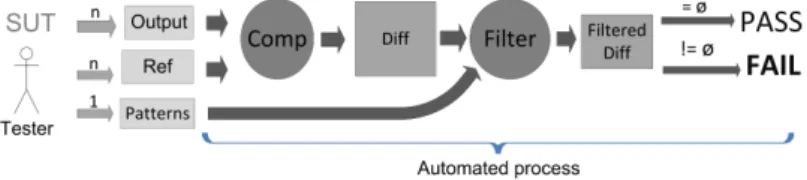
Our idea is to build an oracle focussing on this common part. Since by definition, the common part is identical in all the variants, this oracle will only need one reference output model as oracle data. The produced output model is compared to the reference one. The result of this com-parison is then filtered in order to eliminate any difference concerning the variable part of the output model. If the filtered result of the comparison is empty, the common parts of both the produced and reference out-put model are identical, the test passes. Otherwise, the produced outout-put model contains errors, an then the test fails.
Figure 3 summarizes our approach. We provide as oracle data the refer-ence output model as well as patterns. In order to eliminate the differ-ences about the variable part, we need to know which elements belong to this variable part. We define these elements according to their types (e.g. their meta-classes). The patterns we provide are meta-model ex-cerpts defining the variable part of the transformation’s output, they are defined only once for all the test cases of a given transformation.
Fig. 3.Our Approach to Build a Partial Oracle
In our approach, we focus on controlling one part the produced output, producing a partial verdict. Nevertheless, a partial verdict is already a good piece of information. We are able to detect errors in the produced output model using only one reference output model, whereas the clas-sical approach requires to define as many reference output models as correct variants of the output model.
3
Ongoing Work
To ensure the complete correctness of a model transformation with poly-morphic outputs, the next step after the proposition of our approach is to be able to control the variable part of the produced output. Whereas for the common part we use a reference output model, the idea here is to work directly on the produced output model. The tester starts by checking that the expected elements for this variable part are present in the model (in Figure 2, transitions from the states B and C towards final states). Then she ensures that there is nothing else in the variable part (no other instance of the meta-model fragments used for the filter). We discussed in Section 3 an approach aimed at partially controlling the polymorphic outputs of a model transformation. However, we believe
4
that the approach is not limited to these particular model transforma-tions. Having a partial verdict could be interesting for other programs as well.
The larger the handled models become, the harder it is for the tester to define a reference output model. It is time and effort consuming for the tester to manually define a large and often complicated model. With our approach, she could use a partial reference output model to obtain a partial verdict about a part of the produced output model.
Our approach could be useful even outside the scope of model transfor-mation testing. Models as well as graphs or databases can be seen as a particular kind of complex outputs. Complex outputs are not just big sets with many properties, these properties are organised and structured. Polymorphic outputs can also be seen as complex data, the complexity coming in this case from the numerous variants of a given output. Our approach allows the tester to efficiently control part of a program’s complex output and obtain a partial verdict. She only needs a partial reference output and a definition of the part she would not be interested in. The partial reference output could either be manually defined, or obtained through another version of the system under test in the case of regression testing.
4
Conclusion
The topic of this PhD is about test in a model driven engineering environ-ment. Our first contribution is the proposition of an efficient approach to build a partial oracle controlling the common part of polymorphic outputs. We are currently working on controlling the remaining, variable part. Also while the proposed approach was defined to control the poly-morphic outputs of a model transformation, it can be applied in other cases either inside our outside the scope of model driven engineering.
References
1. Sen, S., Baudry, B., Mottu, J.M.: On combining multi-formalism knowledge to select models for model transformation testing. In: ICST. (2008) 328–337
2. Fleurey, F., Baudry, B., Muller, P.A., Le Traon, Y.: Qualifying input test data for model transformations. SOSYM (2009)
3. Mottu, J.M., Sen, S., Tisi, M., Cabot, J.: Static analysis of model transformations for effective test generation. In: ISSRE. (2012) 4. González, C.A., Cabot, J.: Atltest: A white-box test generation
ap-proach for ATL transformations. In: MoDELS. (2012) 449–464 5. Mottu, J.M., Baudry, B., Le Traon, Y.: Model transformation testing
: oracle issue. In: MoDeVVa. (2008)
6. Cariou, E., Belloir, N., Barbier, F., Djemam, N.: OCL contracts for the verification of model transformations. ECEASST (2009)
7. Finot, O., Mottu, J.M., Sunye, G., Attiogbe, C.: Comparaison de modèles filtrée pour le test de transformations de modèles. In: Con-férence en IngénieriE du Logiciel CIEL. (2012)