HAL Id: tel-01206251
https://hal.archives-ouvertes.fr/tel-01206251
Submitted on 28 Sep 2015HAL is a multi-disciplinary open access archive for the deposit and dissemination of sci-entific research documents, whether they are pub-lished or not. The documents may come from teaching and research institutions in France or abroad, or from public or private research centers.
L’archive ouverte pluridisciplinaire HAL, est destinée au dépôt et à la diffusion de documents scientifiques de niveau recherche, publiés ou non, émanant des établissements d’enseignement et de recherche français ou étrangers, des laboratoires publics ou privés.
Contextual Connectivity in Multi-Access Architectures
Siwar Ben Hadj Said
To cite this version:
Siwar Ben Hadj Said. Contextual Connectivity in Multi-Access Architectures. Networking and Inter-net Architecture [cs.NI]. Télécom Bretagne; Université de Rennes 1, 2014. English. �tel-01206251�
!"#$%%
&
'
&
!
("
"
$ & ) % * ) + , - . % ! ) /0%!1 2 + 3 4 2 # " + 5 (! 6 ) !" * 7 &8 9 . : * . 8 0 . 0 . : /* 1 * 7 " ) ) . : * . 8 " 4 . " 4 . : /0 , 1 * 7 % ) # . : * . % ;& ). # . # /0 , 1 7 # # . 0 % . $ 0$" % (" . . : / ' ) 1 * 7 : - < ) . * ) . %$. # . # / ' ) 1 * 7 5 (! . : * . # ) 4 . 0 . : /# " 1 7 < = . % 0 4 . 3 4 2 . 0 . : /% 1!
" # $ % & ' ( ( ) () % " *( + ,( ( %( -*, . / " 0 1 / !2 " 3 4 , 5 ( % 6 ( 7 ! + ' $ + 8 ( * + * + 9 -' ( . 6 ! % 4 % + ' $ + 8 ( 1 + 1 + 9 -* )) . 6 , % : + ' $ + , ); %+ : + : -* )) . 6 :! : + ! ! + # *# , )! ) + + 9 - % . 6 9 < = % + ' $ %( + ,#+ : + : - % . 6 3 4 + ' $ + : % 4 1 + * + 9 - !2 . % 6 = > + # 1( + 9:?0 1 / + * + 9 - .Acknowledgements
This thesis work would not have been possible without the inspiration and encour-agement of many people.
I would like first of all to thank the jury members, Prof. Abderrahim Benslimane, Prof. Sami Tabbane, Dr. Thierry Turletti, Prof. Farouk Kamoun and Prof. Cesar Viho for their time spent in reviewing my dissertation.
I am truly grateful to my PhD advisor, Prof. Jean-Marie Bonnin for his help and guidance during my PhD studies. I would like to express my sincere gratitude to my PhD supervisor, Dr. Karine Guillouard, for her remarkable supervision and invaluable feedback. Her sincere devotion to her research and supporting attitude have turned my PhD experience with her fruitful and worthwhile.
I would like to thank all my colleagues at Orange Labs. I am particularly appre-ciative of my colleagues Meryem Ouzzif and Hanane Alabdellaouy, for their support, warm company and encouragement during the tough time of this thesis.
A special gratitude and love goes to my family and parents in-law for their support. I thank also my parents for their abiding love. Finally I want to express my deepest love and thanks to my loving husband, Monem, for his constant support, understanding, and encouragement during my research journey.
Abstract
Managing the network connectivity in multi-access architectures becomes a criti-cal issue as these architectures should be able to interwork between heterogeneous technologies and to face the new ecosystem challenges. The 3GPP standards body proposed the multi-access 3GPP system that aims at providing ubiquitous network connectivity. This proposal has many benefits but it brings also a lot of challenges for network operators. In fact, within this system, network mechanisms such as mobility management and security mechanisms are designed to be activated in a systematic manner leading to rising network operating costs. For instance, the location update mechanism is always performed even for static devices. However, network operators face the challenge to host several categories of subscribers such as static subscribers, subscribers with high mobility, subscribers requiring high security level, subscribers satisfied with just low security level, subscribers requiring high/low bandwidth, etc. This thesis includes three main contributions. In the first contribution, we ana-lyze the current approaches in multi-access 3GPP system. The aim of such a study is to analyze whether the current network connectivity management approaches could face the challenges imposed by the new ecosystem. We started our study by de-composing the network connectivity into several network services. Particularly, our work addresses the mobility and security services. Through network usage scenar-ios, we showed that security and mobility mechanisms in the access network can be bypassed in certain cases. In addition, we specified a number of requirements for multi-access architectures to face the new ecosystem challenges.
In the second contribution, we concentrate on proposing a Context-Aware Con-nectivity Management (CACM) module for multi-access architectures. This module is able to manage and interwork between heterogeneous access technologies in an efficient manner. It selects and activates network mechanisms in accordance with the contextual information.
In the third contribution, we propose two concrete applications of the proposed model: (i) adaptive data traffic protection service and (ii) adaptive session continuity service. For the first, we setup a test bed that reproduces the untrusted non-3GPP
iv Abstract access in which we implemented a mechanism that activates/deactivates the encryp-tion and integrity protecencryp-tion mechanisms within the IPsec tunnel according to the flow requirements. For the second application, we proposed an OpenFlow-based control plane for the LTE/EPC architecture to ensure adaptive session continuity service.
Keywords: network connectivity management, fixed and mobile convergence, context-awareness, security, mobility management, computer networking, adaptive networks
R´
esum´
e
La gestion de la connectivit´e r´eseau dans les architectures multi-acc`es devient une question primordiale parce que ces architectures devraient ˆetre en mesure de faire inter-fonctionner des technologies h´et´erog`enes et de faire face aux d´efis impos´es par le nouveau ´ecosyst`eme. L’organisme de normalisation 3GPP a propos´e un syst`eme 3GPP multi-acc`es qui vise `a fournir une connectivit´e r´eseau omnipr´esente. Cette proposition a indubitablement des avantages, mais apporte ´egalement plusieurs d´efis aux op´erateurs de r´eseau. En effet, dans ce syst`eme, les m´ecanismes de r´eseau, telles que les m´ecanismes de gestion de la mobilit´e et de s´ecurit´e sont con¸cus pour ˆetre activ´es d’une mani`ere syst´ematique augmentant ainsi le coˆut d’exploitation du r´eseau. Par exemple, le m´ecanisme de la mise `a jour de la localisation est toujours activ´e, mˆeme lorsque les terminaux ne sont pas mobiles. Cependant, les op´erateurs de r´eseaux doivent relever le d´efi d’accueillir plusieurs cat´egories d’abonn´es tels que des abonn´es non-mobiles, des abonn´es `a forte mobilit´e, des abonn´es qui demande un niveau de s´ecurit´e ´elev´e, des abonn´es qui sont satisfait avec un niveau de s´ecurit´e faible, des abonn´es demandant une large/faible bande passante, etc.
Cette th`ese contient principalement trois contributions. Dans la premi`ere contri-bution, nous analysons des approches actuelles dans le syst`eme 3GPP multi-acc`es. Le but d’une telle ´etude est d’analyser si les approches actuelles de gestion de la con-nectivit´e r´eseau pourraient faire face aux d´efis impos´es par le nouveau ´ecosyst`eme. Nous avons commenc´e notre ´etude par la d´ecomposition de la connectivit´e r´eseau en services. En particulier, notre travail porte sur les services de mobilit´e et de s´ecurit´e. Grˆace `a des sc´enarios d’usage du r´eseau, nous avons montr´e que les m´ecanismes de mobilit´e et de s´ecurit´e dans le r´eseau d’acc`es peuvent ˆetre contourn´es dans certains cas. En outre, nous avons sp´ecifi´e un certain nombre d’exigences sur les architectures multi-acc`es pour faire face aux nouveaux d´efis impos´es par l’´ecosyst`eme.
Dans la deuxi`eme contribution, nous proposons un module de gestion de la con-nectivit´e (CACM) pour les architectures multi-acc`es. Ce module est sensible au contexte des abonn´es. Il est capable de g´erer et de faire inter-fonctionner les acc`es h´et´erog`enes d’une mani`ere efficace. Il s´electionne et active les m´ecanismes du r´eseau
vi R´esum´e en conformit´e avec les informations contextuelles.
Dans la troisi`eme contribution, nous proposons deux applications concr`etes du mod`ele propos´e : (i) l’adaptation du service de protection du trafic des donn´es et (ii) l’adaptation du service de continuit´e de session. Pour la premi`ere, nous mettons en place un banc d’essai qui reproduit l’acc`es non-3GPP non s´ecuris´e dans lequel nous avons impl´ement´e un m´ecanisme qui active/d´esactive les m´ecanismes de chiffrement et de protection de l’int´egrit´e dans le tunnel IPsec selon les exigences des flux applicatifs. Pour la deuxi`eme application, nous avons propos´e un plan de contrˆole bas´e sur le protocole OpenFlow pour l’architecture LTE/EPC afin d’assurer un service de continuit´e de session adaptatif.
Mots cl´es: gestion de la connectivit´e r´eseau, convergence fixe et mobile, sensi-bilit´e aux contextes, securit´e, gestion de la mosensi-bilit´e, r´eseaux informatiques, r´eseaux adaptatifs
Contents
Acknowledgements i
Abstract iii
R´esum´e v
Contents vii
List of Figures xiii
List of Tables xv
1 Introduction 1
1.1 General Context . . . 1
1.2 Objectives and Contributions . . . 3
1.3 Outline of the Dissertation. . . 5
2 Background 7 2.1 Introduction. . . 7
2.2 Network services . . . 7
2.2.1 Security services . . . 8
2.2.1.1 Identification and Authentication . . . 8
2.2.1.2 Access Control . . . 9
2.2.1.3 Data Traffic Protection (DTP) . . . 10
2.2.1.4 Privacy . . . 10
2.2.2 Mobility Services . . . 10
2.2.2.1 Session Continuity . . . 11
2.2.2.2 Nomadism . . . 11
2.2.2.3 Reachability . . . 12
2.3 Access Network Architectures . . . 12
2.3.1 Generic Access Network Model . . . 12
viii CONTENTS
2.3.2.1 xDSL access . . . 14
2.3.2.2 WLAN access . . . 15
2.3.3 Mobile access networks . . . 21
2.3.3.1 UMTS access . . . 21
2.3.3.2 LTE/EPC access . . . 22
2.3.4 Multi-Access 3GPP system . . . 25
2.3.5 Discussion . . . 28
2.4 Conclusion . . . 31
3 Network Connectivity Analysis in Multi-Access Context 33 3.1 Introduction. . . 33
3.2 Ecosystem Challenges . . . 33
3.2.1 Evolving communication devices . . . 34
3.2.2 New Application profiles . . . 35
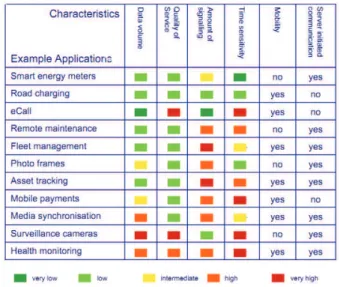
3.2.3 Subscriber behaviors . . . 37
3.3 Network Usage Scenarios . . . 38
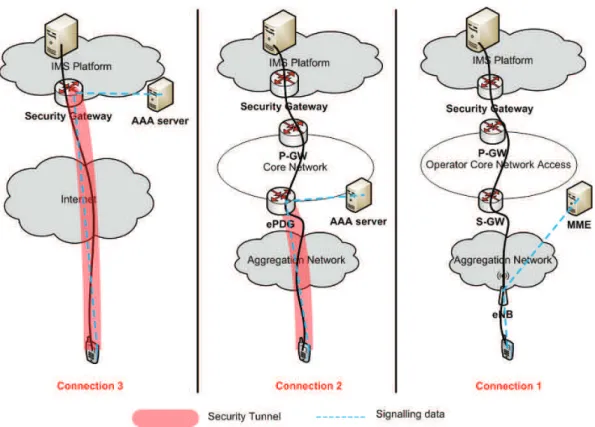
3.3.1 Scenario A: Application requirement . . . 38
3.3.1.1 Description . . . 38
3.3.1.2 Analysis . . . 40
3.3.2 Scenario B: Simultaneous use of multiple accesses . . . 45
3.3.2.1 Description . . . 45
3.3.2.2 Analysis . . . 46
3.3.3 Scenario C: Always-On Applications . . . 47
3.3.3.1 Description . . . 47
3.3.3.2 Analysis . . . 47
3.3.4 Scenario D: Resiliency and Load balancing . . . 50
3.3.4.1 Description . . . 50
3.3.4.2 Analysis . . . 51
3.4 Problem statement and Related Work . . . 53
3.4.1 Challenge 1: Adaptive Security . . . 55
3.4.2 Challenge 2: Adaptive Mobility management . . . 57
3.4.3 European Projects . . . 58
3.5 Conclusion . . . 59
4 Security Analysis in LTE/EPC Access 61 4.1 Introduction. . . 61
4.2 System Model, Parameters and Methodology . . . 61
4.2.1 System Model. . . 61
4.2.2 Traffic Model . . . 62
CONTENTS ix
4.3 Security Cost Formulation . . . 63
4.3.1 Identification and Authentication service cost . . . 63
4.3.1.1 Signaling Cost . . . 66
4.3.1.2 Processing Cost . . . 66
4.3.2 Access control service cost . . . 67
4.3.2.1 Signaling Cost . . . 68
4.3.2.2 Processing Cost . . . 69
4.3.3 Data Traffic Protection service cost. . . 69
4.3.3.1 Signaling cost . . . 70
4.3.3.2 Processing cost . . . 70
4.3.3.3 Data Protection Cost . . . 71
4.3.4 Privacy service cost . . . 74
4.3.4.1 Signaling Cost . . . 75
4.3.4.2 Processing Cost . . . 76
4.4 Numerical Results and Discussions . . . 77
4.4.1 Assumptions and Default Values . . . 77
4.4.2 Discussions . . . 79
4.5 Conclusion . . . 85
5 Context-Aware Connectivity Management (CACM) Model 87 5.1 Introduction. . . 87
5.2 Architecture Requirements. . . 87
5.2.1 Context-aware connectivity (Req 1) . . . 88
5.2.2 Adaptive network connectivity (Req 2). . . 88
5.2.3 Network-side adaptation decision (Req 3) . . . 90
5.2.4 Unified connectivity management (Req 4) . . . 91
5.2.5 Flexible use of network resources (Req 5) . . . 91
5.3 Context-Aware Connectivity Management (CACM) Architecture . . 91
5.3.1 Overview . . . 91
5.3.2 Context Management Subsystem (ContextMS) . . . 94
5.3.3 Security Manager. . . 95
5.3.4 Mobility Manager . . . 98
5.4 Qualitative Evaluation . . . 100
5.5 Conclusion . . . 104
6 Implementing Adaptive DTP service in non-3GPP access 107 6.1 Introduction. . . 107
6.2 Motivation . . . 107
6.3 Adaptive DTP service specificification . . . 109
x CONTENTS
6.3.2 Adaptive DTP service in trusted access . . . 110
6.3.2.1 Network connectivity establishment . . . 110
6.3.2.2 DTP service adjustment mechanism . . . 112
6.3.3 Adaptive DTP service in untrusted access . . . 113
6.3.3.1 Network connectivity establishment . . . 113
6.3.3.2 DTP service adjustment mechanism . . . 115
6.4 Adaptive DTP service Validation . . . 115
6.4.1 Test bed detailed description . . . 115
6.4.1.1 Access Router . . . 116
6.4.1.2 AAA server . . . 117
6.4.1.3 Access Point . . . 117
6.4.1.4 Client . . . 117
6.4.2 Adaptive DTP implementation in untrusted access . . . 118
6.4.3 Evaluations . . . 119
6.5 Implementation Challenges . . . 123
6.6 Conclusion . . . 123
7 Implementing Adaptive Mobility Services in LTE/EPC Access 125 7.1 Introduction. . . 125
7.2 Motivation . . . 126
7.3 SDN and OpenFlow . . . 127
7.4 OF-based LTE/EPC architecture . . . 129
7.4.1 Architecture Description . . . 129
7.4.2 Session Management Procedures . . . 132
7.4.2.1 Initial attachment procedure . . . 132
7.4.2.2 Data Plane establishment procedure . . . 133
7.5 Adaptive Mobility Services . . . 135
7.5.1 Session Continuity service . . . 135
7.5.1.1 Resiliency in OF-based LTE/EPC architecture . . . 136
7.5.1.2 Load Balancing in OF-based LTE/EPC architecture 137 7.5.2 Reachability service . . . 137
7.6 Implementation challenges . . . 138
7.7 Preliminary evaluation . . . 139
7.7.1 Signaling Cost Formulation . . . 140
7.7.1.1 3GPP LTE/EPC architecture . . . 140
7.7.1.2 OF-based LTE/EPC architecture . . . 143
7.7.2 Numerical results and discussions . . . 144
7.8 Related Work . . . 146
CONTENTS xi
8 Conclusion and Perspectives 149
8.1 Thesis summary and contributions . . . 149
8.2 Perspectives . . . 151
A List of publications 155
B Acronyms 157
C R´esum´e en Fran¸cais 161
C.1 Probl´ematique . . . 161
C.2 Objective et contributions . . . 164
List of Figures
2.1 Generic Access Network Model . . . 13
2.2 xDSL architecture . . . 14
2.3 WLAN architecture . . . 16
2.4 WLAN architecture with IEEE 802.1x access control . . . 18
2.5 WLAN architecture with web access control . . . 20
2.6 UMTS architecture . . . 21
2.7 EPS architecture . . . 23
2.8 Multi-Access 3GPP System . . . 26
3.1 Ecosystem . . . 34
3.2 Machine-Type Communication examples . . . 36
3.3 IMS registration and authentication . . . 39
3.4 Possible Connections in Scenario A . . . 40
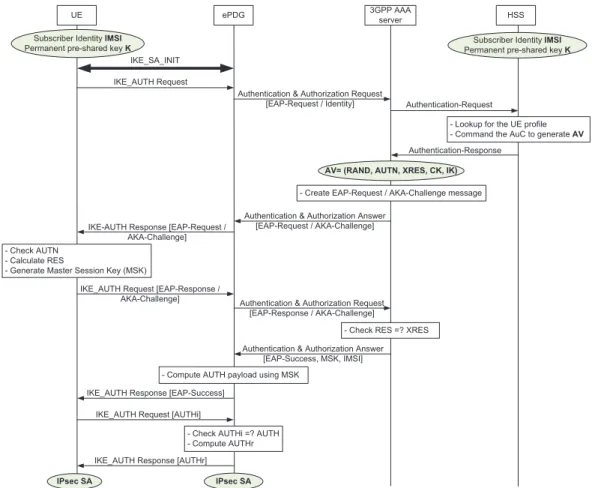
3.5 Authentication procedure in Untrusted non-3GPP access. . . 42
3.6 Scenario B. . . 45
3.7 LTE/EPC data plane . . . 47
3.8 Initial attachment procedure. . . 48
3.9 Access bearer setup and release procedures . . . 49
3.10 Scenario D. . . 50
3.11 3GPP restoration procedure after an SGW failure. . . 51
3.12 LTE/EPC data plane with load balancing. . . 53
4.1 System model . . . 62
4.2 The authentication procedure in LTE/EPC access . . . 66
4.3 The access control procedure in LTE/EPC access . . . 68
4.4 The UE download procedure . . . 68
4.5 The Data Traffic Protection setup . . . 70
4.6 A protected PDCP message . . . 72
4.7 A protected packet with the ESP protocol . . . 72
xiv LIST OF FIGURES
4.9 The signaling traffic protection . . . 75
4.10 The subscriber identity protection . . . 75
4.11 Security services setup costs . . . 79
4.12 SLS and PLS in Scenario 1 . . . 81
4.13 SLS and PLS in Scenario 2 . . . 82
4.14 DPC in Scenario 2 . . . 83
4.15 SLS and PLS in Scenario 3 . . . 84
5.1 Context-Aware Connectivity Management Model . . . 92
5.2 Security Manager . . . 97
5.3 Mobility Manager. . . 99
6.1 Architecture to be tested . . . 108
6.2 Test bed functional architecture. . . 109
6.3 Connectivity Establishment flow chart . . . 111
6.4 Adaptive DTP service in trusted access . . . 113
6.5 Connectivity Establishment flow chart . . . 114
6.6 Adaptive DTP service in untrusted access . . . 115
6.7 Adapting the DTP service for HTTP/HTTPS traffic . . . 119
6.8 D-ITG architecture . . . 120
6.9 D-ITG integration in the test bed. . . 120
6.10 Bitrate in Untrusted access . . . 121
6.11 Packet Loss in Untrusted access. . . 122
6.12 SNORT impact on subscriber Bitrate. . . 122
7.1 Mobility Manager in LTE/EPC access.. . . 126
7.2 GTP tunnels in EPC. . . 127
7.3 SDN architecture . . . 128
7.4 OpenFlow switch . . . 128
7.5 LTE/EPC architecture. . . 130
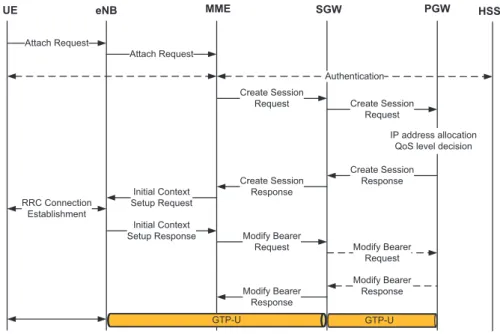
7.6 Initial attachment procedure. . . 132
7.7 Data plane establishment. . . 133
7.8 Access Bearer Setup procedure when the S1 and S5 are maintained. 134 7.9 Restoration procedure in OF-based architecture. . . 136
7.10 LTE/EPC Data plane . . . 137
7.11 System model. . . 140
7.12 The impact of the subscribers number on the SC . . . 144
7.13 The impact of session arrival on the SC . . . 145
7.14 Mevico proposal . . . 146
List of Tables
2.1 Security services and mechanisms. . . 8
2.2 Mobility services and mechanisms. . . 11
2.3 Security services in multi-access 3GPP system. . . 27
2.4 Network services comparison between Fixed and Mobile Accesses . . 30
4.1 The security messages and their sizes . . . 64
4.2 Processing-related Notation . . . 65
4.3 Transmission-related Notation. . . 65
4.4 Default Values . . . 78
4.5 Signaling Load Saving. . . 80
4.6 Processing Load Saving. . . 80
5.1 Context Categories . . . 89
5.2 Context Elements and Possible actions . . . 90
5.3 Possible Security Levels. . . 96
5.4 Possible Mobility Profiles. . . 99
5.5 Scenario A - Comparison between multi-access 3GPP system and the CACM approaches. . . 100
5.6 Scenario B - Comparison between multi-access 3GPP system and the CACM approaches. . . 101
5.7 Scenario C - Comparison between multi-access 3GPP system and the CACM approaches. . . 102
5.8 Scenario D - Comparison between multi-access 3GPP system and the CACM approaches. . . 102
5.9 Requirements and how they are addressed in the CACM model . . . 103
6.1 Network Interfaces in the AR VM. . . 116
6.2 Table in MySQL database. . . 118
7.1 The 3GPP LTE/EPC data plane management messages and sizes. . 141
Chapter 1
Introduction
1.1
General Context
Annual Cisco Visual Networking Index Forecast expects an exponential increase in data traffic until 2017 [Cis13]. This significant growth will be driven by new applications (e.g. smart meter, online gaming, multimedia services, etc.), variety of connected devices (e.g. Smart Phones, tablets, sensors, connected cars, smart cities, etc.), and also the ubiquitous of high bandwidth access networks.
A recent study predicts that network operators risk an ”end of profit” sometime before mid 2015 [Tel11]. In fact, this study shows that despite the data traffic growth, the total network cost will exceed the total revenue very soon, if nothing is done before. This finding may be explained by the fact that existing access network architectures are ill-equipped to cope with the dual challenge of sustained data demand and falling revenues [Tel11]. Indeed, the cost to build, upgrade or operate the network is becoming too high while network operator’ revenues are decreasing exponentially [PMJ13]. In the light of these predictions, network operators are invited to revisit the design and capabilities of their architectures with a twofold objective of reducing expenses and introducing new revenue generating services.
Moreover, network operators state that the coexistence of different architectures raises several problems such as the scalability issue, the functional redundancy, the complexity of network management, and the difficulty to inter-work between het-erogeneous access points. For this reason, standard bodies such as BBF and 3GPP are seeking a new architecture that is able to interconnect heterogeneous access networks including fixed access networks (Wimax, WiFi, xDSL, etc.) and mobile access networks (3G, LTE, etc.)[3GP10a] [BBF12b]. As network operators expand their architectures to cover an ever greater proportion of subscribers, the number of connections grows and the OPEX and CAPEX required to maintain this growing network infrastructure increase.
2 Introduction With traditional connectivity management, network mechanisms such as mobil-ity management, QoS control and securmobil-ity mechanisms are designed to be activated in a systematic manner leading to the rise of network operating costs. For instance, location update is always performed even for static devices. However, network op-erators face the challenge to host several categories of subscribers such as static subscribers, subscribers with high mobility, subscribers with small amount of data, etc.
Traditional connectivity is not aware of several contextual information such as subscriber’s location, device type, running application, network status, time of the day, etc. For instance, it does not take into consideration that the mobile subscriber will probably not move during a given session (84% of subscribers are either static or nomadic during a session and 16% of subscribers are mobile users [TRKN09]). In addition, a recent study [PSBD11] shows that a large fraction of subscribers have limited mobility. Moreover, it was established in the same study that the subscriber mobility is predictable. Note that some statistics show that users spend more than 60% of their time at home or at work.
In this context, network operators should investigate new solutions to address the new ecosystem in a cost-efficient manner. In other words, network connectivity should be tailored to the subscriber context, application real needs and network status.
Traditional network connectivity in access networks are pre-configured to have systematic behavior. They are designed to activate the same network mechanisms in all situations and cannot be dynamically adapted, for instance, to emerging situa-tional constraints. This static limitation is due to the absence of two main features, namely (i) modularity, and (ii) context-awareness.
• modularity: network connectivity needs to be decomposed into a given number of network services. Each network service requires the activation of specific network mechanisms. For example, the reachability service is one of the net-work services and is defined as the ability of the netnet-work operator to keep the user reachable for any incoming sessions. In case this service is activated, the network operator should update the user data path whenever the user change the access point. Therefore, the location update, the tunnel update and the IP address allocation mechanisms are all necessary for the reachability service. • context-awareness: network connectivity needs to be aware of any contextual information and adapts its behavior accordingly. The contextual informa-tion includes any type of data that can be useful for improving and adjusting the network connectivity. Example of contextual information are user pro-file, mobility pattern (static/nomadic, low/high mobility), device type, session requirements, network status, etc.
1.2 Objectives and Contributions 3 Since network connectivity in access network is not modular and context-aware, network operators often end up activating several network mechanisms, within a given network connectivity, that the subscribers may not need. The following exam-ples underline the need for modularity and context-awareness features:
• The end-user devices which are foreseen to be used in the future have highly augmented capabilities. The capabilities include not only different radio in-terfaces which enable different wireless connectivity, but also processing and storage capabilities. Indeed, the Annual Cisco VNI Forecast expects that, by 2017, mobile networks will host 8.6 billion handheld devices and 1.7 billion machine-to-machine (M2M) connections (e.g. sensors for medical applications, tracking systems in shipping, GPS systems in cars, etc.) [Cis13]. However, the same network mechanism does not fit all kinds of devices. Therefore, the net-work connectivity should include several netnet-work mechanisms and selects the adequate mechanism for each situation.
• With the variety of applications running over mobile as well as fixed access networks, the requirements in terms of network services (e.g. mobility manage-ment, QoS control, and security services) differ strongly. For instance, a static camera that surveys the street and uploads video periodically does not need the mobility management service. In addition, sessions that are already se-cured (e.g. SSL sessions established between medical sensors and their server, VPN sessions established between the traveling employees’ laptops and the corporate intranet, etc.) need neither confidentiality nor integrity protection at the access network. Avoiding the session protection at the access level may bring down the packet process cost within network equipment; leading thereby to maximize resource utilization.
Hence, the modularity and context-awareness of network connectivity worth to be studied in greater depth.
1.2
Objectives and Contributions
This work was carried out within the ”Multi Access Convergence Architecture (MCA)” team in ”Convergent Multi-services Architecture networks (CMA)” lab-oratory of Orange Labs. The research topic of lablab-oratory is centered around the access network architectures. The team works on fixed and mobile convergence, mobility management and network function virtualization aspects.
Our ultimate goal is to design an architecture that automatically adapts the network connectivity to the contextual information of each user. Depending on con-textual information, this adjustment includes the activation/deactivation of network
4 Introduction mechanisms such as mobility management, QoS management, and security mecha-nisms. In other words, a given network mechanism is activated only when the user and/or the operator really requires its presence. This architecture should not offer functional redundancy, allow the flexible use of network resources and facilitate the interworking between heterogeneous access points.
The key challenge of this work is to make the network connectivity aware of re-quired contextual information and to adapt its behavior accordingly. For instance, knowing that the launched data flow is already secured such as an IPsec flow, en-cryption and integrity protection mechanisms are considered redundant at the access network level and should be deactivated for such type of flow.
The contributions of this thesis fall into three primary fields: current approaches analysis, performance optimization and architecture design. Relevant to the first, our work is an attempt to analyze the current approaches in multi-access architec-tures. The aim of such a study is to analyze whether the current network connectivity management approaches could face the challenges imposed by the new ecosystem. We started our study by decomposing the network connectivity into three groups of network services: namely security, mobility management and QoS control services. Particularly, our work addresses the mobility and security services in multi-access 3GPP systems where the related mechanisms are systematically activated for each subscriber in all situations. Through network usage scenarios, we showed that se-curity and mobility mechanisms in the access network can be bypassed in certain cases. In addition, we specified a number of requirements for the multi-access archi-tectures to face the ecosystem challenges. Through analytical studies, we evaluated the security costs in LTE/EPC architecture, and showed how much network op-erator can save in terms of signaling, processing and transmission costs when the security mechanisms are deactivated for a given number of subscribers.
Second, relevant to performance optimization, this thesis offers a new connecti-vity management model that addresses the challenge of providing the user with the adequate network services. In our model, the network connectivity is decomposed into several network services. This effort attempts to fill an important research gap as the majority of the efforts in the literature focus on implementing and activat-ing more and more network mechanisms (e.g. implementactivat-ing mobility protocols in fixed accesses) and ignore that the systematic activation of these mechanisms for all subscribers increases network operator costs.
Third, relevant to architecture design, we proposed a Context-Aware Connecti-vity Management (CACM) module that should be introduced in multi-access archi-tectures. This module is able to manage and inter-work between heterogeneous ac-cess technologies in an efficient manner. It selects and activates network mechanisms in accordance with the contextual information. The incorporation of context-aware network control functionality within our connectivity management module provides
1.3 Outline of the Dissertation 5 value-added capability to decide the adequate network mechanisms to be activated in each situation; thereby decreasing the costs for network operators and, at the same time, provides subscriber with an adequate Quality of Experience (QoE). We proposed examples of implementation for two types of network services: (i) Data Traffic Protection and (ii) Session Continuity. For the first, we setup a test bed that reproduces the untrusted non-3GPP access in which we implemented a mecha-nism that activates/deactivates the encryption and integrity protection mechamecha-nisms within the IPsec tunnel according to the flow requirements. For the second, we pro-posed an OpenFlow-based control plane for the LTE/EPC architecture to manage the mobility services in a flexible manner.
1.3
Outline of the Dissertation
The chapters of this report can be grouped into two parts:
• Part I: includes Chapter 2, 3, and 4. It reviews the current approaches of net-work connectivity management and analyses its readiness for the new ecosys-tem.
• Part II: includes Chapter 5, 6, and 7. It proposes a new model for the network connectivity management in multi-access architectures. In addition, it provides examples of implementation of two adaptive network services namely Data Traffic Protection and Session Continuity services.
The report is structured as follows:
Chapter2introduces mainly the basic background of our work. After presenting the considered network services and the related network mechanisms, it focuses on reviewing the connectivity management models in different category of access networks.
Chapter 3 presents the new ecosystem that access networks should address. Through several network usage scenarios, we analyze the network connectivity man-agement in multi-access 3GPP systems and underline the main requirements for future access networks. This qualitative analysis shows that a new model of connec-tivity management is needed to suit future network usages. This chapter ends by outlining the related works.
Chapter4is dedicated to analyze the security services provided by the LTE access and evaluate the related signaling, processing and transmission costs. Through several scenarios, we showed that any added security service introduces additional signaling, processing or transmission loads.
Chapter5recalls the architecture requirements that were highlighted in previous chapters. Then, it introduces our vision of the connectivity management in
multi-6 Introduction access architectures. After that, we revisit the network usage scenarios of Chapter3
to evaluate and compare the proposed model to the connectivity management model in multi-access 3GPP systems.
Chapter 6 proposes to demonstrate the feasibility of the proposed connectivity model via a test bed reproducing non-3GPP accesses. This chapter focus on the Data Traffic Protection (DTP) service. First, it proposes a mechanism that adapts DTP service to the application flow requirements in untrusted non-3GPP accesses. This mechanism ensures the DTP service for clear traffic only. Then, a test bed is set up to validate the proposed mechanism and highlight the related implementation challenges.
Chapter 7 proposes a theoretical implementation of adaptive mobility services in LTE/EPC architecture. It proposes a new control plane based on the OpenFlow (OF) protocol that adapts the Session Continuity service according to network status and application requirements. For example, when the current SGW is overloaded, the delay-tolerant data flows such as FTP flows are temporary transferred to another SGW. This reduces the overload on the SGW and ensures, therefore, the session continuity for the delay-sensitive as well as delay-tolerant data flows. The proposed control plane can be extended to ensures the Reachability service.
Finally, Chapter8concludes this report and provides an outlook on perspectives and future work.
Chapter 2
Background
2.1
Introduction
Fixed and mobile access networks are increasingly converging towards common IP-based core network. Providing effective network resource management in such com-plex heterogeneous environment requires unified, adaptive and scalable connectivity management solution to integrate and co-ordinate network mechanisms of different access technologies.
The scope of this chapter is to analyze the network connectivity management in the current access networks and identify the main network services. We define a network service as ”the set of mechanisms that a network operator implements to address a specific subscriber need”. For instance, protecting the data traffic is considered as a service ensured for the subscriber. Several network mechanisms are implemented and activated to ensure these services. For example, the data traffic protection service is ensured via the encryption and integrity protection mechanisms. We start by providing a list of the network services that we considered during this research work namely security and mobility services. Then, we describe different access networks while identifying how the security and mobility services are ensured in each access. By studying different types of access networks, we are able to shed light on the question of how similar or different they are in terms of the ensured network services.
2.2
Network services
The network connectivity analysis in several access networks shows that it is basically formed of three groups of network services namely Quality-of-Service (QoS), security and mobility services. Among the exhaustive list of the identified network services, we are mainly interested in security and mobility-related services. In this section,
8 Background we give an outline of the considered network services as well as the corresponding network mechanisms.
2.2.1 Security services
RFC 4949 [Shi07] defines a security service as ”a processing or communication service that is provided by a system to give a specific kind of protection to system resources”. Therefore, the security services may be defined as ”the set of network mechanisms that are activated by the network operator to avoid potential attacks such as user’s identity theft, man-in-the-middle, and denial of service”. Network security services may be implemented by several security mechanisms as shown in Table2.1. In the following, we address an outline of the main security services.
Security Services Network Mechanisms Identification & Authentication
Login-password
Identifier-Challenge/Response Identifier-Certificate
Access Control Profil-based Access Control Data traffic protection Ciphering
Integrity Protection Privacy Temporary Identifier
Signaling exchange protection Table 2.1: Security services and mechanisms.
2.2.1.1 Identification and Authentication
Identification service is crucial as it helps access providers to identify who is using their network. Several kinds of identity exists:
• Subscription identity: is allocated to the subscriber by the access network provider upon signing a subscription contract. It serves to identify subscribers when they request network resources. Based on the subscription identity, the access network provider determines the subscriber profile and identify the ser-vices to which he subscribed. The type of the subscription identity that shall be presented to an access network varies according to the authentication mech-anism that was implemented in this access. For instance, the login represents the subscription identity in the login-password authentication mechanism.
2.2 Network services 9 • Device identity: is a piece of data that identify the device and is specific to
vendors.
• Session identity: is a piece of data that is used in access network to identify a session (e.g. HTTP session) or a series of related message exchanges. It is different from the subscription and device identities. The sessions are typically short-lived as they expire after a preset time of inactivity which may be minutes or hours. Therefore, the session identity may become invalid after the session tear down.
The Authentication service consists in validating the identity presented by the user. The user must provide evidence to prove its identity to access the network. This proof can be a certificate or a response to a challenge. For security reasons, the authentication should be mutual in the access network, i.e., not only the user’s identity is verified by the network but also the network credibility is checked by the user.
There are mainly three kinds of authentication mechanisms: pre-shared key authen-tication, mutual public key authenauthen-tication, and tunneled authentication (i.e. first, the security authority is authenticated using its certificate, establishes encrypted channel with the subscriber and then authenticates the subscriber using the pre-shared secret).
2.2.1.2 Access Control
The Access Control service prevents either the unauthorized use of the network resources or the use of network resources in unauthorized manner. Therefore, it ensures two main properties:
• Authorized network resource usage: in general, the access network is intended to be used only by authorized subscribers.
• Appropriate network resource usage: once authorized, the subscriber is able to use network resources according to the restrictions provided in his profile and to network resource availability.
The resources can be bandwidth that supports a certain level of QoS (e.g.,latency and jitter), or an IP address that ensures the user reachability. The access control service should include two functions:
• Authorization: is intended to verify whether the subscriber has permission to use network resources.
• Admission control: is intended to control the manner with which the network is used. The purpose of this mechanism is to protect the network from overload
10 Background and congestion situations. Therefore, the network resources availability should be checked before accepting user resource request.
2.2.1.3 Data Traffic Protection (DTP)
The Data Traffic Protection (DTP) service prevents the disclosure and modification of data packets during their trip from the sender to the receiver. The data traffic protection is ensured with the ciphering and integrity protection mechanisms. The ciphering mechanism make the user communication unintelligible to a third-party. The integrity protection mechanism guarantees that any alteration of the original message by an unauthorized party will be notable at the receiver side.
2.2.1.4 Privacy
The access provider tends to maintain some basic information about subscribers such as subscription identities, devices identities, subscriber locations, etc. From privacy viewpoint, those information should be protected from other parties. In general, access providers should keep confidential the following information:
• Identity confidentiality: is defined as the act of keeping confidential the sub-scriber’s identity. The identity privacy becomes crucial as it prevents identity theft, and therefore user impersonation attacks.
• Location confidentiality: is defined as the act of keeping confidential sub-scriber’s locations. In fact, an intruder may observe and analyze location update messages sent by the subscriber each time he moves to a new access. This could lead to the disclosure of the subscriber location and therefore to privacy violations.
2.2.2 Mobility Services
The ITU-T (International Telecommunication Union - Telecommunication) defines the mobility as ”the ability for the user, or other mobile entities, to communicate and access services irrespective of changes of the location or technical environment” [Uni06]. Therefore, we define the mobility service as ”the set of network mechanisms that are activated by the network operator to deliver the same networked services (e.g. voice call, file download, etc.), with their particular personalization, among alternative devices or access technologies”. The mobility service also means the ability to receive services independently of the user location.
The concept of mobility includes the seamless continuity of the session, even when crossing network borders. This means that a process of handover or seamless handover is taking place among different access points. The mobility also includes
2.2 Network services 11 the nomadism aspect where users exit completely the previous session and logs on in the new access point, starting a session afresh. Moreover, the mobility includes the reachability aspect where the network operator maintains the user location up-to-date. The user location may be published in a global database such as DNS server, and it shall be available for serving incoming sessions such incoming VoIP call.
Mobility Services Network Mechanisms
Session Continuity Handover, Context Transfer, Data forwarding
Nomadism Context Transfer
Reachability Location update, Tunnel update, IP address allocation
Table 2.2: Mobility services and mechanisms.
2.2.2.1 Session Continuity
The Session Continuity service is defined as the ability of the network operator to maintain ongoing sessions for a moving object. The Handover mechanism is needed to keep the session continuity when the user move from one access point to another. This mechanism updates the user data path inside the access network by updating data tunnels/bearers and temporarily forwarding data traffic between the previous and current access points/gateways. There are two types of Handover: Seamless (i.e. the session continuity is preserved without any impact on the perceived communication quality) and Hard (i.e. preserve the session continuity with some impact of the perceived communication quality such as extra delay). The handover mechanisms may trigger the Context Transfer and Data Forwarding mechanisms. Forwarding can be for example accomplished by tunnels between network equipment (e.g. Proxy Mobile IP (PMIP) protocol [GLD+08]) or controlled traffic redirection
(e.g. OpenFlow [Ope]). 2.2.2.2 Nomadism
The Nomadism service is defined as the ability to provide network services irre-spective of environment changes of a moving object. When changing the network access point, the user’s session is completely stopped and then started again, i.e., the session continuity is not preserved. The network operator may allocate different user identifiers/addresses when the user moves from one access point to another. The Nomadism service requires the presence of the user profile at the new access
12 Background point. Therefore, a Context Transfer mechanism is required to retrieve the user profile from the previous access network or from the home database.
2.2.2.3 Reachability
The Reachability service is defined as the ability of the network operator to keep the user reachable for any incoming sessions. The network operator may update the user data path whenever the user change the access point. The IP address allocation mechanism is required to enable applications or other devices to reach the subscriber device. The Tunnel update mechanism is required to keep the user data path updated. Maintaining the data path for each user even when there is no active data sessions is consuming in terms of device energy and network resources. Therefore, a power saving mode was introduced in Mobile access networks where the network resources are released for inactive users. Generally, when the device enters the power saving mode, it sends less signaling messages such as location update messages. Therefore, the Location update mechanism is required to keep the network operator up-to-date with the user location. It includes user registration, location update and paging procedures. First, the user registers his device to the location registry. The network assigns a permanent IP address through which any application can reach the subscriber regardless of its location. Then, the location update procedure is required to be able to find the user location when needed.
2.3
Access Network Architectures
The Access Network (AN) is a set of functions that ensure the data traffic delivery between the user and the corresponding application or network service provider. In the literature, the ANs are classified into Fixed access network (F-AN) and Mo-bile access network (M-AN) categories. The M-AN differs from the F-AN in that the mobility service is natively ensured in M-AN. Lately, the multi-access network category appeared in order to ensure the convergence between heterogeneous access networks. In this section, we examine the differences and similarities in the current AN architectures. Generally, ANs offering the same network services adhere to the same architectural model. First, a generic model for the AN architecture is given. Then, examples of the different AN categories are provided. Each time, we map the AN architecture to our generic model to identify where and how network services are performed.
2.3.1 Generic Access Network Model
A typical access network is divided into Control Plane (AN-CP) and Transfer Plane (AN-TP) as shown in Figure2.1. The AN-CP consists of network entities that are
2.3 Access Network Architectures 13 involved in the network connectivity establishment, control, charging and termina-tion procedures. The AN-TP, by contrast, consists of network entities that process and forward user data traffic. Generally, this separation makes it possible to central-ize the control entities while distributing the network entities involved in the data traffic forwarding.
Access Technology
Network Service Provider:
VISP, Corporate Intranet
Application Service Provider:
Content Delivery Network, IMS platform, SaaS
Control Plane
Transfer Plane
Aggregation Network Core Network Access
Point
Network Access Gateway
Control Funtion 1 ... Control Funtion N
Network Service Gateway Application or Network Service Provider IP core User
Figure 2.1: Generic Access Network Model
Basically, the AN-TP is divided into aggregation network and core network do-mains. The aggregation network encompasses the elements of the access network from the network interface of the user’s device to the Network Access Gateway. This network typically aggregates traffic coming from multiple Access Points and depends on the access technology in use. The core network represent the center core of the access network. The switching, routing or tunneling functions are the main functions contained herein to enable the proper distribution of the data traffic.
The Packet Data Networks (PDNs) includes Application Service Providers (ASP) and Network Service Providers (NSPs). The ASP and NSP definitions were given in [BBF03]. The NSP provides access to the Internet. It includes Virtual Internet Service Providers (VISPs) and Corporate Intranets. The NSP authenticates and allocates IP address to their subscribers. The access network provider may act as a wholesale Internet provider especially in case of the VISP case. The ASP provides services to the subscriber application (e.g. gaming, IP telephony, Video on Demand, etc.). It includes the Content Delivery Network (CDN), IMS platform, Software-as-a-Service, etc. The ASP does not handle the IP address allocation.
The AN-TP includes the following logical entities:
• Access Point (AP): represents the first contact of the user’s terminal with the access network. It aggregates traffic from the users that are in the some AP coverage.
14 Background from multiple APs. This gateway ensures the basic network services such as authentication, access control, IP address allocation and charging.
• Network Service Gateway (NSGw): terminates the AN-TP and gives access to the other Packet Data Networks (PDNs). This gateway may be enabled with the added-value network services such as anchoring user session for mobility purpose, enforcing policies for better QoS and filtering user traffic.
2.3.2 Fixed access networks
2.3.2.1 xDSL access
The basic DSL architecture was specified in TR-059 [BBF03] and later updated by TR-101 [BBF06], TR-134 [BBF12a], and TR-203 [BBF12b]. The xDSL architec-tural model is depicted in Figure 2.2. The aggregation network in xDSL accesses is based on the Digital Subscriber Line (DSL) access technology. The DSL technology enables high-speed data rate over the existing copper telephone wires that connect subscriber’s homes or offices to their access network provider. The core network is based on the IP protocol and consists of routers.
The Residential Gateway (RG) is the equipment that connects the user devices
RG DSLAM BNG
PC
TV Telephone
internet Fixed services platform:
IP telephony, IPTV
Mobile access network AAA server Home Edge Router Policy Server Control Plane Transfer Plane
Aggregation Network Core Network NAGw
PDN Network
AP NSGw
DHCP server
Figure 2.2: xDSL architecture
to the xDSL access. The xDSL access just authenticates the RG and provides an ”Always-ON” connection. The subscriber devices in home such as Computers and Smartphones share the same xDSL connection. A local authentication may take place between the subscriber device and the RG.
The xDSL Transfer Plane is made up of two main entities:
• Digital Subscriber Line Access Multiplexer (DSLAM): aggregates the data traffic coming from several subscribers onto a single high-capacity uplink (ATM
2.3 Access Network Architectures 15 or Gigabit Ethernet backhaul) to the xDSL core network. The DSLAM acts as the AP in our generic access model.
• Broadband Network Gateway (BNG): aggregates data traffic issuing from sev-eral DSLAMs. The BNG acts as the NAGw entity as it ensures the basic network services such as relaying the authentication exchanges and DHCP re-quests/replies between the device and the control plane. According to [BBF03], the BNG also performs the QoS mechanisms such as packet classification and scheduling.
• Edge Router: corresponds to our NSGw entity as it gives access to other PDNs. However, the Edge Router provides no added-value services.
The xDSL control plane (xDSL-CP) is responsible for user authentication, access control and IP address allocation. It includes the following logical entities:
• Authentication, Authorization and Accounting (AAA) server: authenticates the subscriber’s credentials and validates the users access policies. The ex-change between the AAA server and the BNG is based on RADIUS [RWRS00] or Diameter [FALZ12] protocol.
• DHCP server: is responsible for IP address allocation [Dro97].
• Policy Server: was introduced by TR-134 [BBF12a] to provide broadband network services based on policies. This policies may be activated in the BNG dynamically and/or statically.
The subscriber authentication in the xDSL access can be explicit through the use of login/password method. In that case, the credential are stored in the RG. The BNG uses the received Login parameter as the username in the RADIUS or Diameter authentication request. The subscriber authentication can be implicit based on the Line ID wherein the DSLAM inserts this identifier in the user DHCP request message (i.e. the DHCP Option 82 information). Therefore, the BNG uses the Line ID as the username in the authentication request.
2.3.2.2 WLAN access
Nowadays, the Wi-Fi access is becoming more and more ubiquitous. In fact, fixed broadband operators encourage their subscribers to share their private Wi-Fi (i.e. community Wi-Fi schemes). In addition, the number of users demanding Wi-Fi access in shops, cafes, and hotels is increasing. Moreover, Wireless Internet Ser-vice Providers (WISPs) are new types of operator that grants Internet access and location-based services using public Hotspots. Therefore, the Wi-Fi coverage is overlapping and the Wi-Fi access points are owned by various operators.
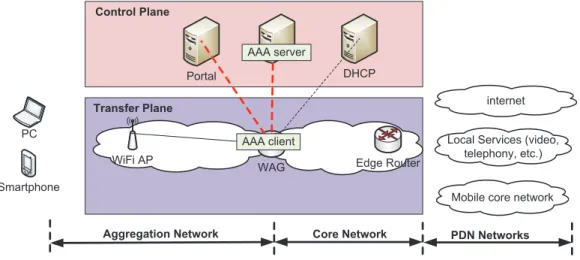
16 Background Where the IEEE standardization bodies focus on specifying the set of medium access control (MAC) and physical layer (PHY), they did not extend the standard-ization work to the WLAN organic architecture. This gives WiFi service providers the freedom to design the best architecture for their access network. We analyzed several WLAN architecture proposals [Cis10], [AL12] [Iri13] and come up with the most recurrent architectural model. The main difference between these proposals consists in the authentication and access control mechanisms. First, we describe the WLAN architecture with an open access (see Figure2.3). After that, we describe the most implemented authentication and access control mechanisms in WLAN accesses.
WAG PC
internet
Mobile core network DHCP
Edge Router
Control Plane
Transfer Plane
Aggregation Network Core Network NAGw
PDN Networks AP
WiFi AP
Smartphone
Local Services (video, telephony, etc.)
NSGw
Figure 2.3: WLAN architecture The WLAN Transport Plane (WLAN-TP) includes:
• Wi-Fi Access Point (WAP): represents the first point of contact of the user with the WLAN network. It represents the boundary between the wireless coverage and the wired backbone. Depending on security configuration, WAP may behave differently. For instance, an open WAP with no security configuration serves any user within its coverage area as long as the maximum number of users that it can serve simultaneously is not reached. In protected Wi-Fi access networks, the WAP acts as a gatekeeper. In this case, it opens the door only for data traffic related to authenticated and authorized users. Otherwise, the WAP rejects user association request as long as the authentication procedure fails. Two possible security configurations for a protected Wi-Fi access will be described in the following.
• WLAN Access Gateway (WAG): represents the first hop router in WLAN networks. It aggregates traffic issuing from multiple WAPs. The WAG
cor-2.3 Access Network Architectures 17 responds to our NAGw as it provides the basic connectivity functions such as packet routing, IP address allocation and access control. It also relays the authentication exchanges between the user device and the authentication entities.
• Edge Router: corresponds to our NSGw entity as it gives access to other PDNs. However, the Edge Router provides no added-value services.
Generally, the user association in WLAN access includes the following main phases: Discovery: represents the first phase in the association procedure in WLAN. Upon exchanging the security capabilities, the user device and the WAP agree on security parameters such as the authentication method to be used, the confidentiality and integrity protection algorithms, and the cryptographic key management approach. At the end of this phase, the user device is just associated to the WAP and needs to be authenticated and authorized before getting the complete access to WLAN network.
Authentication: validates the user identity before authorizing access. The web portal-based access and the IEEE 802.1x are the most familiar authentication mechanisms.
Key Management: consists in activating the confidentiality and integrity protec-tion services at the WLAN-TP and more precisely at the Radio level. During this phase, a 4-way handshake between the user device and the WAP takes place. The aim of this exchange is to establish fresh security keys to protect link-layer frames. Data Transfer: represents the last phase of the association procedure. During this phase, the user device is allowed to send data traffic through the corresponding WAP. In case the confidentiality and integrity protection services are activated, the user device and the WAP run the confidentiality and integrity protection algorithms during data traffic delivery.
To enable seamless user authentication and strong access control in WLAN access, the IEEE 802.11i amendment [IEE04] proposed the IEEE 802.1x protocol. On the other side, the Web portal-based access continues to be demanded by WISPs because it requires no special application setup nor security credentials configuration in the user device. Unlike the web portal-based access, the IEEE 802.1x ensures confidentiality and integrity protection services at the transfer plane. In the following we gives more details about these two authentication mechanisms. IEEE 802.1x Authentication
Security implementation in WLAN access is undoubtedly continuously improving. The Wired Equivalent Privacy (WEP) was the first security algorithm specified in IEEE 802.11 standards. The aim of this algorithm was to provide a level of security
18 Background comparable to that of wired network [IEE97]. WEP ensures the confidentiality protection for subscriber’s messages. However, the secret key (WEP key) of the WAP should be manually configured in each device connecting to this WAP. Security analysis showed that security implementation in the original IEEE 802.11 is vulnerable to several attacks capable of WEP key cracking [BBO08]. To overcome this security weakness, the WiFi alliance introduced the WiFi Protected Access (WPA) as a replacement of WEP. WPA was just an intermediary version of the security implementation in WLAN. Finally, IEEE 802.11i [IEE04] was proposed as an amendment of the original IEEE 802.11 and is referred to as Robust Security Network (RSN). It adopted the IEEE 802.1X protocol to ensure port-based access control.
The 802.1x introduces three main functional entities in WLAN architecture: • Supplicant: represents the party that needs to be authenticated.
• Authenticator : is defined as the gatekeeper of the access network. It dele-gates the authentication service to the authentication server and waits for its approval to open the access for the subscriber.
• Authentication Server (AS): is defined as the entity that provides authenti-cation service to the authenticator. Therefore, the AS task is to check the supplicant credentials and to send the supplicant rights to the authenticator.
WAG PC
internet
Mobile core network DHCP
Edge Router
Control Plane
Transfer Plane
Aggregation Network Core Network PDN Networks
WiFi AP Smartphone
Local Services (video, telephony, etc.) Supplicant Authenticator Authentication server AAA server AAA proxy AAA client
Figure 2.4: WLAN architecture with IEEE 802.1x access control
To adopt the 802.1x access control, the WLAN control plane should include a AAA server (Figure2.4). In addition, the supplicant, the authenticator and the AS functions should be integrated within user device, WAP and AAA server entities, respectively. The communication between the AS and the authenticator is based
2.3 Access Network Architectures 19 on the AAA protocol such as RADIUS and Diameter. Therefore, the WAP should include AAA client. Moreover, a AAA proxy can be implemented in the router in order to relay the WAP-AS exchanges.
Upon a successful authentication, the AS may generate and forward crypto-graphic keys associated with the authenticated user device to the WAP. Therefore, the 802.1x Authentication mechanism can be used only in a trusted WiFi network (i.e. tusted WAP). The user device is not allowed to get an IP address unless it is successfully authenticated by the AS.
The authentication exchange between the AS and the supplicant relies on the Ex-tensible Authentication Protocol (EAP) [ABV+04]. As a generic authentication
framework, EAP supports multiple authentication methods, called EAP methods, such as EAP-MD5-challenge (based on pre-shared secret), EAP-TLS (based on cer-tificates) and, EAP-AKA (based on the smartcards). In addition, EAP messages may be carried over either data link layer protocols like PPP and 802.1X or net-work layer protocols such as PANA, IKEv2 and DHCP. The number of messages exchanged during an authentication procedure depends on the selected authenti-cation method. The IEEE 802.1X has adopted five EAP methods as the official authentication methods namely TLS, SIM, AKA, LEAP and EAP-TTLS. Among these methods, we give a brief overview of EAP-TLS, EAP-AKA and EAP-TTLS.
• EAP-Transport Layer Security (TLS): is a mutual authentication method where the supplicant and the server use certificates as credentials. A Public Key Infrastructure (PKI) is required for the smooth running of the method. However, the disadvantages of PKI infrastructures reside in their expensive cost and implementation complexity. Generally, access network providers use the vendor certificate associated with the MAC address at the user side and provide the AS with a certificate. Upon a successful authentication, session key is generated at both sides (supplicant and AS).
• EAP-Authentication and Key Agreement (AKA): is a well-known mutual au-thentication method. Likewise the authentication mechanism used in the 3GPP cellular access, it is based on a pre-shared key authentication method. The pre-shared key is delivered to the subscriber through the USIM card. The same key is stored in the access provider database.
• EAP-Tunneled Transport Layer Security (TTLS): is a hybrid authentication mechanism based on the use of pre-shared secret and certificates. The AS au-thenticates itself to the user using its certificate. Then, a tunnel is established between the user device and the AS to secure the authentication exchanges. The user uses a pre-shared secret authentication method to authenticate itself
20 Background to the AS.
The IEEE 802.1x authentication provides a greatly enhanced user experience because it allows the seamless authentication of users (i.e. without the need for user intervention).
Web authentication
The Web portal-based access is another authentication method that continues to be demanded by WISPs because it needs no specific application to be installed at the user device.
The portal-based access control requires two basic entities namely Portal server and AAA server (Figure 2.5). The Portal server provides free portal services and web-based authentication. This server also retrieves the user credentials and send them to the AAA server. In fact, after attaching to the WAP, the user opens the web browser (i.e. an HTTP request). The WAG redirects the HTTP request to the Portal server which sends to the user an authentication page to enter his credentials (login and password). Then, the Portal server retrieves the user credential and transfers them to the AAA server through the WAG.
WAG PC
internet
Mobile core network DHCP
Edge Router
Control Plane
Transfer Plane
Aggregation Network Core Network PDN Networks
WiFi AP
Smartphone
Portal
Local Services (video, telephony, etc.) AAA client
AAA server
Figure 2.5: WLAN architecture with web access control
With this authentication method, a public IP address should be manually con-figured at the user side or obtained from the DHCP server before the authentication procedure. With this IP address, the unauthenticated user can only connect to the Portal server and use free local services. The WAG should implement the HTTP redirect mechanism in order to redirect the unauthenticated HTTP request to the portal server. After authentication, the user is allowed to connect to the internet. Although the web authentication is the most familiar mechanism found in untrusted WiFi network such public hotspots, it presents some limitations. For instance, the
2.3 Access Network Architectures 21 captive portals require the presence of a web browser at the user device side. More-over, users need to open the web browser and authenticate themselves before running any other applications. Finally, terminals that have Wi-Fi and a TCP/IP stack but do not have a web browser such as game consoles cannot use this mechanism.
2.3.3 Mobile access networks
Over the last few decades, we have witnessed the emergence of several wireless accesses which cover various requirements. The cellular access represents the first category of mobile access networks. The Global System for Mobile communication (GSM) [ETS97] was the first standard developed for the cellular access. Initially, the GSM was dedicated for voice traffic. The General Packet Radio Service (GPRS) extends the GSM capabilities to support the IP packet transfer. One decade later, the Universal Mobile Telecommunication System (UMTS) [3GP 9] was introduced as an evolution of the GSM access combined with the GPRS access. It provides a better data rate on the radio interface. One more decade later, the Long Term Evolution/Evolved Packet Core (LTE/EPC) architecture [3GP11b] appeared as the solution that will increase the capacity and the speed of cellular accesses. In the following, we present the UMTS and LTE architectures.
2.3.3.1 UMTS access
SGSN
internet
Mobile Operator services
IMS platform GGSN
Control Plane
Transfer Plane
Aggregation Network Core Network NAGw PDN Networks AP NSGw NodeB UE RNC HLR NodeB MSC / VLR CS Core Network GMSC PS Core Network
Figure 2.6: UMTS architecture
The UMTS architecture as was provided in Release 9 [3GP 9] is depicted in Figure2.6. The aggregation network includes two main entities: Node B (NB) and Radio Network Controller (RNC). The NB corresponds to the AP in our generic model as it connects the user device to the UMTS network. The RNC controls a
22 Background pool of NBs by managing the radio resources and inter-NB mobility. Moreover, the data encryption is terminated at the RNC.
The UMTS core network is divided into two parts: the Circuit Switched Core Network (CS CN) for voice calls and SMS and the Packet Switched Core Network (PS CN) for data traffic. The CS CN is composed of Mobile service Switching Center (MSC) and Gateway Mobile Switching Center (MSC) entities. The MSC and G-MSC are responsible for setting up and releasing end-to-end connection, routing voice calls and SMS, handling mobility and call traffic charging. A Visitor Location Register (VLR) may be co-located with the MSC. Similarly, the Serving GPRS Support Node (SGSN) and Gateway GPRS Support Node (GGSN) are responsible for data path setup and mobility management in the PS CN.
The UMTS control plane includes the Home Location Register (HLR) where the subscribers profiles are stored. The subscriber location is always updated in the HLR entity.
The GGSN and the G-MSC corresponds to the NSGw in our generic model. The GGSN is the first IP router. It is responsible for IP address allocation and QoS enforcing. In addition, the GGSN acts as a data anchor point for inter-SGSN mobility.
The SGSN and the MSC/VLR represents the NAGw entity in our generic model. The SGSN or the VLR performs the authentication and the access control functions interacts for this objective with the HLR database. Also, the SGSN/VLR carries out the privacy function and stores the user security keys. The SGSN acts as a data anchor for mobility between RNCs.
The User Equipment (UE) represents the subscriber in UMTS access. It consists of a smart card called Universal Integrated Circuit Card (UICC) and a terminal called Mobile Equipment (ME). UICC houses the UMTS Subscriber Identity Module (USIM application). In general, UICC is known as the USIM card. The subscriber identity and the corresponding cryptographic key are contained in the USIM card. 2.3.3.2 LTE/EPC access
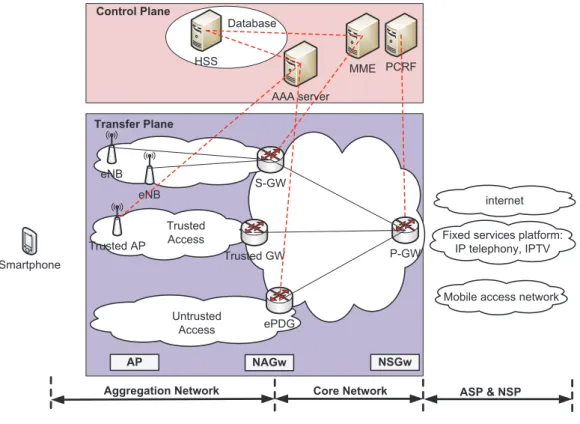
The LTE/EPC architecture (see Figure 2.7) is an IP-based access network that was introduced by 3GPP in Release 8. Similarly to UMTS, the network operator delivers to each subscriber a USIM card that includes the subscriber identity and the permanent security key.
The LTE/EPC aggregation network consists of several eNodeBs (eNB) and is called the Radio access network (RAN). The Core Network (CN) is called Evolved Packet Core (EPC) and consists of three main entities namely Mobility Management Entity (MME), Serving Gateway (S-GW) and PDN Gateway (P-GW)[3GP11b].