HAL Id: hal-03117362
https://hal.archives-ouvertes.fr/hal-03117362
Submitted on 21 Jan 2021
HAL is a multi-disciplinary open access
archive for the deposit and dissemination of
sci-entific research documents, whether they are
pub-lished or not. The documents may come from
teaching and research institutions in France or
abroad, or from public or private research centers.
L’archive ouverte pluridisciplinaire HAL, est
destinée au dépôt et à la diffusion de documents
scientifiques de niveau recherche, publiés ou non,
émanant des établissements d’enseignement et de
recherche français ou étrangers, des laboratoires
publics ou privés.
Distributed under a Creative Commons Attribution - NonCommercial - NoDerivatives| 4.0
International License
Virtual Secure Mode: Communication Interfaces
Aleksandar Milenkoski
To cite this version:
Aleksandar Milenkoski. Virtual Secure Mode: Communication Interfaces. [Technical Report] ERNW
Enno Rey Netzwerke GmbH. 2019. �hal-03117362�
Virtual Secure Mode: Communication Interfaces
Aleksandar Milenkoski
This work is part of the Windows Insight series. This series aims to assist efforts on analysing inner working principles, functionalities, and properties of the Microsoft Windows operating system. For general inquiries contact Aleksandar Milenkoski ([email protected]) or Dominik Phillips ([email protected]). For inquiries on this work contact the corresponding author ()).
The content of this work has been created in the course of the project named ’Studie zu Systemaufbau, Protokollierung, Härtung und Sicherheitsfunktionen in Windows 10 (SiSyPHuS Win10)’ (ger.) - ’Study of system design, logging, hard-ening, and security functions in Windows 10’ (eng.). This project has been contracted by the German Federal Office for Information Security (ger., Bundesamt für Sicherheit in der Informationstechnik - BSI).
Required Reading
In addition to referenced work, related work focussing on Windows Architecture and Virtual Secure Mode (VSM), part of the Windows Insight series, are relevant for understanding concepts and terms mentioned in this docu-ment.
Technology Domain
The operating system in focus is Windows 10, build 1607, 64-bit, long-term servicing branch (LTSB).
1 Introduction
A VSM-enabled Windows environment implements multiple communication interfaces:
• Isolated User Mode (IUM) system calls: Interface between IUM applications and the secure kernel, where the secure kernel provides services to IUM applications (Section 2);
• normal-mode services: Interface between the secure and the normal kernel, where the normal kernel provides services to the secure kernel (Section 5);
• secure services: Interface between the secure and the normal kernel, where the secure kernel provides services to the normal kernel (Section 4); and
• hypercalls: Interface between the normal and the secure kernel, and the hypervisor, where the hypervisor provides services to the normal and the secure kernel (Section 3).
In addition to the interfaces mentioned above, there is the traditional non-VSM-specific system call interface enabling communication between user applications and the normal kernel. Section 2 focuses on the execution path of IUM system calls, comparing it with that of traditional system calls.
amilenkoski.client.ernw.net 2019-05-22 13:24:46
2 IUM System Calls
IUM system calls implement services that the secure kernel exposes to IUM applications. This includes critical system services enabling the operation of IUM applications, such as memory management services.
The execution path of IUM system calls is conceptually identical to that of traditional system calls. An IUM application executes IUM system calls by invoking functions implemented in the IUMDLL.dll library file. These functions have names starting with Ium and implement execution context switching between IUM applications and the secure kernel. Figure 1 depicts the implementation of the IumPostMailbox IUM system call in IUMDLL.dll. For comparison purposes, Figure 2 depicts the implementation of the traditional system call
NtCreateUserPro-cess in the NTDLL.dll library file.
Figure 1: Implementation of IumPostMailbox in IUMDLL.dll
Figure 2: Implementation of NtCreateUserProcess in NTDLL.dll
Same as traditional system calls, each IUM system call can be uniquely identified by a system service index. Indexes specifying IUM system calls have the highest bit set. An example is 0x800000A, a system service index specifying the IumPostMailbox IUM system call (see line 3 in Figure 1). Once the system service index is set, the syscall instruction switches the execution context to the secure kernel (see line 4 in Figure 1 and line 8 in Figure 2).
Once the execution context is switched to the secure kernel, it invokes the KiSystemCall64 routine. The address of this function is stored in the model-specific register (MSR) 0xC0000082 when the ShvlpInitProcessor function is invoked (see Figure 3). This function is invoked during the initialization of the secure kernel. For comparison purposes, Figure 4 depicts the use of the model-specific register (MSR) 0xC0000082 for the same purpose in the context of traditional system calls. The KiInitializeBootStructures is invoked during the initialization of the normal kernel.
Figure 3: MSR 0xC0000082 storing KiSystemCall64 (secure kernel)
KiSystemCall64 routes invocations of a given IUM system call to the corresponding handler function
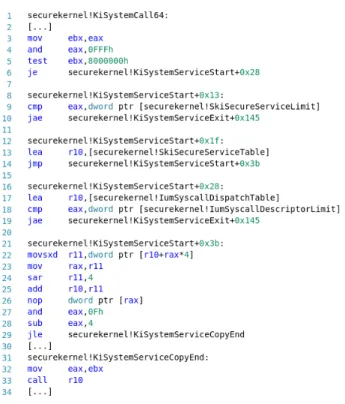
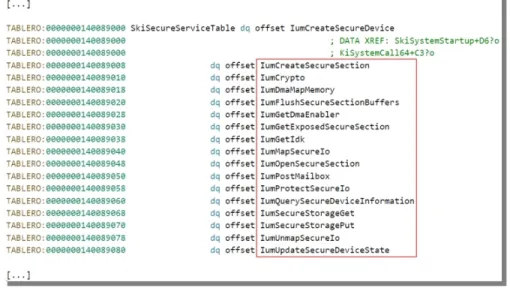
implement-ing the actual service functionality. Figure 5 depicts the implementation of KiSystemCall64. This function first evaluates whether the highest bit of the system service index is set (see line 5 in Figure 5). If set, KiSystemCall64 loads the address of the kernel structure SkiSecureServiceTable (see line 13 in Figure 5). This structure is an array of functions implementing the service functionalities of IUM system calls. Figure 6 depicts the imple-mentation of SkiSecureServiceTable. After loadingSkiSecureServiceTable, KiSystemCall64 executes the handler
Figure 4: MSR 0xC0000082 storing KiSystemCall64 (normal kernel)
Figure 5: The implementation of KiSystemCall64
function indexed by the system service index identifying the invoked IUM system call (see line 22 and line 33 in Figure 5).
If the highest bit of the system service index is not set, that is, if the evaluation at line 5 in Figure 5 fails, the
KiSystemCall64 routes an invocation of a normal-mode service. Section 5 discusses normal-mode services.
Since only IUM applications may invoke IUM system calls, the conditions for instantiating IUM applications by third parties apply also to invoking IUM system calls by these parties.
3 Hypercalls
Hypercalls implement services that the hypervisor exposes to partitions. This involves critical system services enabling the operation of virtual systems, such as memory management services. The hypercalls implemented by the Hyper-V hypervisor are listed in ([Mic17], Appendix A). Each Hyper-V hypercall can be uniquely identified by an identification number, referred to as a call code.
Partitions can invoke hypercalls only from kernel-mode. In a VSM-enabled Windows environment, this includes the execution context of the normal and the secure kernel. The winhv and winhvr drivers implement wrapper functions enabling the straightforward invocation of hypercalls. For example, the functions implement as-signment of call codes and management of hypercall input and output values. The activities that need to be performed for a Hyper-V hypercall to be executed are documented in ([Mic17], Section 3).
Figure 6: The implementation of SkiSecureServiceTable
A crucial prerequisite for Hyper-V hypercalls to be invoked is the existence of the hypercall page in the context of the partition. A hypercall page is a memory page that stores code for invoking hypercalls as per the Hyper-V specification. This page is exposed by the hypervisor to each partition. During the initialization process, each partition reserves a memory page and stores its guest physical address (GPA) in the MSR 0x40000001 ([Mic17], Section 3.13). Hyper-V then populates this page with code. A populated hypercall page cannot be modified in order to prevent unauthorized modifications of the code stored in it. Figure 7 depicts the contents of a MSR
0x40000001.
Figure 7: The contents of a MSR 0x40000001
When the hypercall page is loaded in the context of a partition, the kernel running in the partition can invoke hypercalls. This typically involves activities such as loading the hypercall page, allocating memory buffers for hypercall input and output values, and setting these values. Finally, the code stored in the hypercall page is executed so that the execution context is switched to the hypervisor. For example, the WinHvpHypercall function of the winhvr driver results in the execution of code stored in the hypercall page.
Figure 8 depicts the contents of a hypercall page accessed in the WinHvpHypercall function. It contains page-aligned code for invoking hypercalls, padded with “no operation” (nop) instructions. The page contains several sets of instructions ending with the instruction sequence “vmcall ret”. The vmcall instruction is implemented in Intel processors and it switches execution context to the hypervisor.
The sets of instructions stored in the hypercall page can be understood as trampolines for abstracting the switching of execution context to the hypervisor in different scenarios. These trampolines accommodate the execution of any hypercall, and of the hypercalls with call codes 0x11 and 0x12, on both 32-bit and 64-bit plat-forms. The instructions preceding the vmcall instructions (if any) save the contents of the eax, or the rcx, register and store a hypercall call code in this register. The eax, or the rcx, register stores a hypercall call code on 32-bit and 64-bit platforms, respectively. The use of specific registers for storing hypercall input and output values, as well as call codes, is documented in ([Mic17], Section 3.7) and ([Mic17], Section 3.8).
Figure 8: The contents of a hypercall page
rcx, register are used for invoking the hypercalls with call codes 0x11 and 0x12. These hypercalls are used for
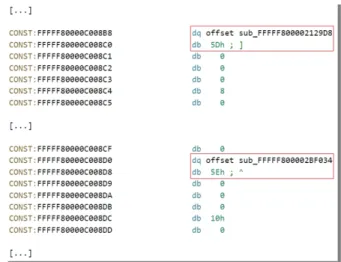
invoking normal-mode and secure services. Section 4 and Section 5 discuss these services. The first set of instructions, containing only the “vmcall ret” instruction sequence, is used for invoking any other hypercall. When the vmcall instruction is executed, the execution context is switched to Hyper-V. The hypervisor then performs access control checks. If a given hypercall is protected by access control, the partition invoking it has to possess the required privilege ([Mic17], Section 3.11). If the hypercall is to be executed, Hyper-V loads an array that contains entries of a fixed size. Each entry is indexed by a hypercall call code and contains a pointer to a function implementing the functionality of the hypercall identified by the call code. Hyper-V then executes the function indexed by the call code of the invoked hypercall. After this, the execution context is switched back to the kernel that has invoked the hypercall. Figure 9 depicts a portion of the array containing functions implementing hypercall functionalities indexed by call codes (see, for example, sub_FFFFF800002129D8 [function] and 5Dh [call code] in Figure 9). This array is implemented as part of hvix64.exe.
4 Secure Services
The secure kernel exposes services to the normal kernel, referred to as secure services in this work. They implement security-critical kernel operations that are executed in the secure, isolated environment. For a secure service to be invoked by the normal kernel, the kernel has to switch from Virtual Trust Level (VTL) 0 to VTL 1. This process is known as VTL call. In its essence, a VTL call is an execution context switch from a lower to a higher VTL. ([Mic17], Section 15.6.1) provides details on the VTL call process.
VTL calls are performed by the normal kernel issuing a hypercall with call code 0x11 – the HvCallVtlCall hy-percall ([Mic17], Section 17). The normal kernel issues HvCallVtlCall by invoking the function chain
VslpEnterI-umSecureMode → HvlSwitchToVsmVtl1 → HvlpVsmVtlCallVa. The VslpEnterIVslpEnterI-umSecureMode function is invoked in
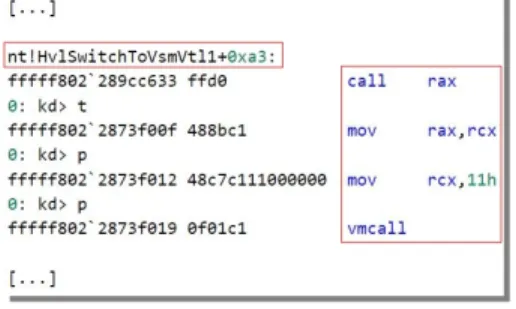
the functions implemented as part of the normal kernel that require a secure service. HvlpVsmVtlCallVa is a variable storing a function referencing the trampoline of the hypercall page for invoking the hypercall with call code 0x11. Figure 10 depicts this trampoline executed in the HvlSwitchToVsmVtl1 function.
Figure 10: Issuing a VTL call
Each secure service can be uniquely identified by an identification number, referred to as secure service call number (SSCN). In the context of the normal kernel, a SSCN is specified as the second parameter of
VslpEn-terIumSecureMode. The SSCN is then passed to the secure kernel as part of a data structure stored in the rdx
register when a VTL call is issued. This structure is referred to as the VTL call data structure in this work. The table presented in the section ‘Secure Services’ of the Appendix lists the functions implemented as part of the normal kernel (column ‘Function’) that invoke secure services identified by SSCNs (column ‘ SSCN’).
In addition to secure services, a VTL call supports the specification of other operations that can be executed by the secure kernel. Each operation is uniquely identified by an operation code, which is stored in the VTL call data structure. The operations are:
• managing the execution of a thread relevant to the secure kernel (operation code – 0x0): Section 5 dis-cusses more on this topic;
• invocation of a secure service (operation code – 0x01);
• flushing the transaction lookaside buffer (TLB) (operation code – 0x02): With respect to the design of VSM, the flushing of the TLB is considered a security-critical activity and is therefore executed in the secure environment. The TLB is involved in translations between virtual and physical addresses.
Figure 11 depicts the contents of the VTL call data structure when a VTL call is issued. In Figure 11, 0x01 is an operation code, indicating invocation of a secure service, and 0xD1 is a SSCN.
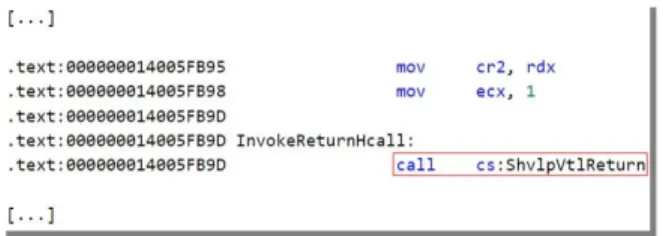
In the context of the secure kernel, a VTL call is processed in the function IumInvokeSecureService, invoked by the SkCallNormalMode function. IumInvokeSecureService extracts the SSCN from the VTL call data structure and invokes the function(s) implementing the actual secure service identified by the SSCN. The secure kernel then continues the execution of SkCallNormalMode. This function invokes the trampoline of the hypercall page for invoking the hypercall with call code 0x12. This is done for returning relevant data to the normal kernel and switching the execution context back to VTL 0. The hypercall with call code 0x12 is the HvCallVtlReturn hypercall ([Mic17], Section 17). It is used for switching from a higher to a lower VTL. This process is opposite to a VTL
Figure 11: Contents of the VTL call data structure
call and is referred to as VTL return. ([Mic17], Section 15.7.1) provides details on the VTL return process. In
SkCallNormalMode, the trampoline for invoking HvCallVtlReturn is stored in the ShvlpVtlReturn variable (see
Fig-ure 12). This variable is populated during the initialization of the secFig-ure kernel, in the ShvlpInitializeVsmCodeArea function.
Figure 12: Execution of the HvCallVtlReturn hypercall in SkCallNormalMode
5 Normal-mode Services
The normal kernel exposes services to the secure kernel, referred to as normal-mode services in this work. These services implement kernel operations that are not implemented by the secure kernel, however, are nec-essary for this kernel or the IUM applications that it hosts to function. The secure kernel implements only a limited set of security-critical functionalities. This is because this kernel is designed to expose a minimal in-terface. It has a significantly smaller codebase than the one of the normal kernel. This reduces the risk of breaches due to design or implementation errors.
Example normal-mode services include semaphore and process management, and registry and filesystem in-put/output. The traditional system calls implemented as part of the normal kernel are invoked as normal-mode services by the secure kernel.
In the context of the secure kernel, normal-mode services that are implemented as system calls in the normal kernel, are invoked by executing functions with names starting with Nt or Zw. These functions may be invoked by IUM applications requesting kernel functionalities or the secure kernel itself. The functions with names starting with Zw invoke the KiServiceInternal function. The system service index is stored in the eax register. Figure 13 depicts the invocation of KiServiceInternal by the function ZwTerminateProcess such that the system service index is 0x2C. This is the index of the NtTerminateProcess system call implemented in the normal kernel.
KiServiceInternal invokes KiSystemServiceStart, a code segment of the KiSystemCall64 function (see Figure 5,
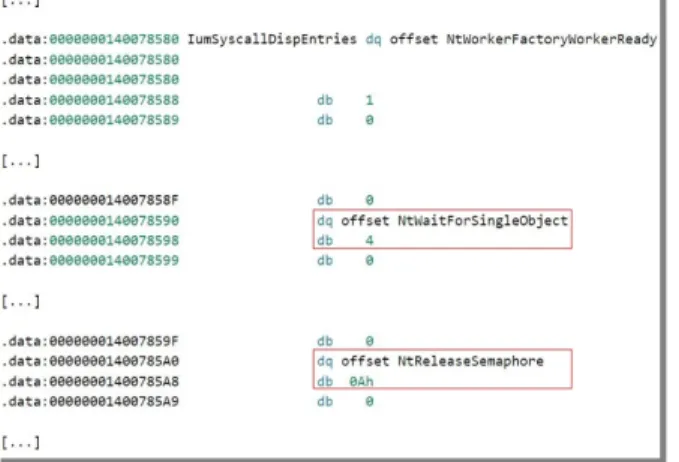
Section 2). In KiSystemServiceStart, the secure kernel loads the variable IumSyscallDispatchTable (which is dif-ferent than the one in the normal kernel). This is because the highest bit of the system service index is set (see line 17 in Figure 5). IumSyscallDispatchTable potentially contains pointers to functions implemented as part of the IumSyscallDispEntries array. IumSyscallDispEntries stores pointers to functions with prefix Nt, indexed by a system service index. Figure 14 depicts a portion of the contents of IumSyscallDispEntries.
Figure 13: ZwTerminateProcess invoking KiServiceInternal
Figure 14: Contents of IumSyscallDispEntries
After loading IumSyscallDispatchTable, KiSystemServiceStart invokes the function with prefix Nt indexed by the system service index stored in the eax register. The functions with prefix Nt invoke stubs for executing normal-mode services. These stubs are implemented in functions with names starting with Nk. For example, NtSetEvent invokes NkSetEvent.
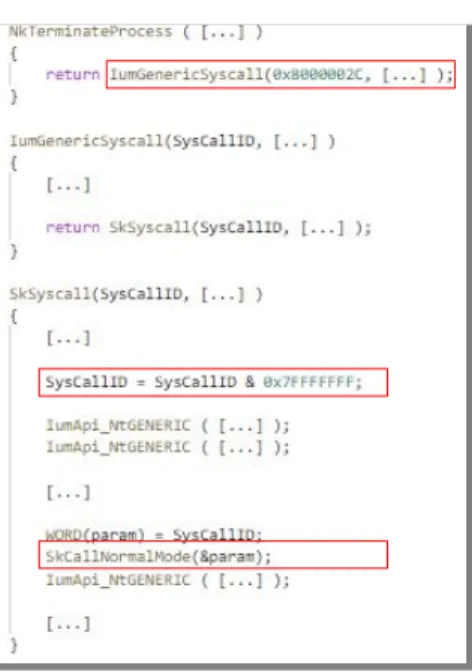
Figure 15 depicts the process of executing normal-mode services by functions with prefix Nk. Figure 15 depicts the concrete example of NkTerminateProcess executing the system call NtTerminateProcess as a normal-mode service. NkTerminateProcess invokes IumGenericSyscall such that the first parameter is a system service in-dex with the highest bit set. NkTerminateProcess sets the first parameter of IumGenericSyscall to 0x8000002C.
0X2C is the system service index of the NtTerminateProcess system call implemented in the normal kernel. Ium-GenericSyscall invokes SkSyscall such that its first parameter is the system service index (SysCallID in Figure 15). SkSyscall sets the highest bit of the system service index to 0 (SysCallID&0x7FFFFFFF in Figure 15). The system
service index is then passed to the SkCallNormalMode function as part of a data structure (param in Figure 15).
SkCallNormalMode executes a VTL return; that is, it switches from VTL 1 to VTL 0 (see Section 4). SkCallNor-malMode passes the data structure provided by SkSyscall to VTL 0 (param in Figure 15). This structure is referred
to as the VTL return data structure in this work. SkCallNormalMode executes a VTL return by invoking the hy-percall with call code 0x12 (see Section 4).
In the context of the normal kernel, normal-mode services requested by IUM applications or by the secure kernel are handled in the VslpEnterIumSecureMode function. The VslpDispatchIumSyscall function, invoked by
VslpEnterIumSecureMode, executes normal-mode services implemented as system calls in the normal kernel.
The PsDispatchIumService function, invoked by VslpEnterIumSecureMode, executes other normal-mode services.
VslpDispatchIumSyscall and PsDispatchIumService are executed in the context of worker threads. These threads
act as agents of entities running in the secure environment for executing normal-mode services. Normal-mode services requested by the secure kernel are executed in the context of a thread owned by the Secure System process. Normal-mode services requested by IUM applications are executed in the context of threads owned by these applications. Figure 16 depicts the invocation of VslpDispatchIumSyscall in the context of threads owned
Figure 15: Executing normal-mode services by functions with prefix Nk (NkTerminateProcess)
by the Secure System process ([1] in Figure 16) and the BioIso.exe IUM application ([2] in Figure 16). Next, the operation of the worker thread owned by BioIso.exe is discussed.
Figure 16: Invocation of VslpDispatchIumSyscall
The thread enters the VslpEnterIumSecureMode function. This function issues VTL calls in a loop, by executing the hypercall with call code 0x11. These VTL calls are issued by invoking HvlSwitchToVsmVtl1, such that the SSCN is set to 0 and the operation code is set to 0x0 (see Section 4). At a given point in time, the data returned from the VTL call contains either a system service index or a normal-mode service code. Normal-mode service codes are used for uniquely identifying normal-mode services that are not implemented as system calls in the normal kernel.
If the returned data contains a system service index, the VslpDispatchIumSyscall function invokes the corre-sponding system service routine. If the returned data contains a normal-mode service code, the
PsDispatchI-umService function invokes the corresponding normal service. PsDispatchIPsDispatchI-umService implements multiple
con-dition blocks for invoking specific functions for a given normal service code.
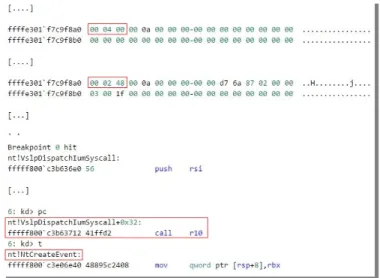
Figure 17 depicts the presence of a system service index in the data returned from a VTL call issued in
VslpEn-terIumSecureMode. The system service index 0x48, which specifies the NtCreateEvent system call, results in VslpDispatchIumSyscall invoking the NtCreateEvent system service routine. This routine is implemented in the
normal kernel.
Figure 17: VslpDispatchIumSyscall invoking the NtCreateEvent system call
Once a normal-mode service is handled in VslpDispatchIumSyscall or PsDispatchIumService, the loop issuing VTL calls with operation code 0x0 is continued. At some point, the worker threads owned by BioIso.exe is put to sleep and terminated.
Appendix
Secure Services
Function SSCN DbgkCopyProcessDebugPort 0xB HvlCollectLivedump 0xE9 HvlInitializeProcessor 0x2 HvlNotifyDebugDeviceAvailable 0xF0 HvlpGetSecurePageList 0x802 HvlPrepareForRootCrashdump 0xEC HvlPrepareForSecureHibernate 0xEB HvlpStartSecurePageListIteration 0x800 KeBalanceSetManager 0xD1 KeCopyPrivilegedPage 0xE4 KeRequestTerminationThread 0x8 KeReservePrivilegedPages 0xD2 KeSecureProcess 0x6 KeSetPagePrivilege 0xE6/0xE3/0xE5 KeUnsecureProcess 0x1B MiApplyDynamicRelocations 0xD3 MiFlushEntireTbDueToAttributeChange 0x0 NtDebugActiveProcess 0xB NtRemoveProcessDebug 0xB PopAllocateHiberContext 0x1F PspInitPhase3 0x3 PspUserThreadStartup 0x0 VslAbortLiveDump 0x28 VslCloseSecureHandle 0x1B VslConfigureDynamicMemory 0x21 VslConnectSwInterrupt 0x22 VslCreateSecureAllocation 0x13 VslCreateSecureImageSection 0x16 VslCreateSecureProcess 0x5 VslCreateSecureThread 0x7 VslEnableOnDemandDebugWithResponse 0x10 VslEndSecurePageIteration 0x801 VslExchangeEntropy 0x1E VslFastFlushSecureRangeList 0xE1 VslFillSecureAllocation 0x14 VslFinalizeLiveDumpInSk 0x27/0x28 VslFinalizeSecureImageHash 0x17 VslFinishSecureImageValidation 0x18 VslFlushSecureAddressSpace 0xE0 VslFreeSecureHibernateResources 0x20 VslGetNestedPageProtectionFlags 0xE7 VslGetOnDemandDebugChallenge 0xF VslGetSecurePebAddress 0xC0 VslGetSecureTebAddress 0xC VslGetSetSecureContext 0xE VslIsTrustletRunning 0x12 VslIumEfiRuntimeService 0xE8 VslIumEtwEnableCallback 0xD4 VslLiveDumpQuerySecondaryDataSize 0x23 VslMakeCodeCatalog 0x15 VslNotifyShutdown 0xEE VslpAddLiveDumpBufferChunk 0x25 VslpConnectedStandbyPoCallback 0x29 VslpConnectedStandbyWnfCallback 0x29 VslpIumPhase0Initialize 0xD0 VslpIumPhase4Initialize 0x1 VslpKsrEnterIumSecureMode 0xF1 VslPrepareSecureImageRelocations 0x19 VslpSetupLiveDumpBuffer 0x26 VslQuerySecureKernelProfileInformation 0x2A VslRegisterLogPages 0xEA VslRegisterSecureSystemProcess 0x4 VslRelocateImage 0x1A VslReportBugCheckProgress 0xED VslRetrieveMailbox 0x11 VslRundownSecureProcess 0xA VslSetupLiveDumpBufferInSk 0x24/0x28 VslSlowFlushSecureRangeList 0xE2 VslTerminateSecureThread 0x9 VslTransferSecureImageVersionResource 0x1D VslValidateDynamicCodePages 0x1C VslValidateSecureImagePages 0xC1References
[Mic17] Microsoft. Hypervisor Top Level Functional Specification. 2017. Version 5.0b; https://docs.microsoft. com/en-us/virtualization/hyper-v-on-windows/reference/tlfs.