HAL Id: hal-01631590
https://hal.archives-ouvertes.fr/hal-01631590
Submitted on 8 Nov 2019
HAL is a multi-disciplinary open access
archive for the deposit and dissemination of
sci-entific research documents, whether they are
pub-lished or not. The documents may come from
teaching and research institutions in France or
abroad, or from public or private research centers.
L’archive ouverte pluridisciplinaire HAL, est
destinée au dépôt et à la diffusion de documents
scientifiques de niveau recherche, publiés ou non,
émanant des établissements d’enseignement et de
recherche français ou étrangers, des laboratoires
publics ou privés.
Use of co-grinding as a solvent-free solid state method to
synthesize dibenzophenazines
Leslie Carlier, Michel Baron, Alain Chamayou, Guy Couarraze
To cite this version:
Leslie Carlier, Michel Baron, Alain Chamayou, Guy Couarraze. Use of co-grinding as a solvent-free
solid state method to synthesize dibenzophenazines. Tetrahedron Letters, Elsevier, 2011, 52 (36), p.
4686-4689. �10.1016/j.tetlet.2011.07.003�. �hal-01631590�
Use of co-grinding as a solvent-free solid state method to synthesize
dibenzophenazines
Leslie Carlier
a,⇑
, Michel Baron
a, Alain Chamayou
a, Guy Couarraze
baEcole des Mines d’Albi-Carmaux, FRE CNRS 3213, Laboratoire RAPSODEE, PRES Université de Toulouse, Campus Jarlard, Route de Teillet, 81013 ALBI Albi CT Cedex09, France bUniversité Paris-Sud 11, UMR CNRS 8612, Laboratoire de Physique Pharmaceutique, Rue Jean Baptiste Clément, 92296 Châtenay Malabry Cedex, France
Keywords: Solid-phase synthesis Green chemistry Dibenzophenazines Pyrido-quinoxaline Organic mechanochemistry
a b s t r a c t
Many synthetic methods exist for dibenzoquinoxalines but only a few for dibenzophenazines and their aza derivatives and even less are ‘green’. Some dibenzophenazines and dibenzopyridoquinoxaline have been efficiently obtained with good to excellent yield by a very simple method which does not require use of solvent or catalyst. Solid phase synthesis using co-grinding presents thus many advantages in developing greener synthetic organic pathways.
Introduction
The overall reduction of solvent use is a key goal in the chemical
industry, where more sustainable processes are needed and
espe-cially in the pharmaceutical industry in which solvent and process
greenness scoring methods are used for evaluating fine chemical
and drug production. It has become clear that the producers have
to reduce waste drastically. Environmental restrictions continue
to increase making unavoidable the use of greener chemistry.
Nowadays, a high percentage of the active pharmaceutical
ingredients produced are heterocyclic, with a majority of being
nitrogen heterocycles. Many such ingredients mimic the structure
of biologically active molecules like pyrimidine or purine bases of
nucleic acids, the main constituents of which are nitrogen
hetero-cycles. Natural products, such as aspergillic acid
1,2(antibiotic
iso-lated from Aspergillus flavus efficient on gram positive bacteria)
and echinomycin
3(antibiotic very efficient on gram-positive
bacte-ria like Streptococcus constituted of two quinoxaline rings) can also
be placed in this category. In fact, several quinoxaline based
molecules obtained synthetically showed biological activities
4–6in particular antitumor
7–9and antibacterial.
10,11Some quinoxaline based molecules such as dibenzophenazines
have other applications. They can be chemical moieties of
mesoge-neous liquid crystals (polymers)
12,13and some pyridophenazines
can be used as ligands for Re(I)
14with the complexes having
inter-esting luminescence properties.
For all these reasons, aromatic diaza compounds were chosen as
a synthetic target. These molecules are classically synthesized by a
solvent route in refluxing ethanol or acetic acid for several hours. A
plethora of methods exist and most of them that increase the yield
rely on the use of catalysts like common Lewis acids, I
2,
15gal-lium(III) triflate,
16or sulfated titania.
17Other procedures do not
use any catalyst but need microwave heating.
18The aim of this
work is to present another sustainable synthetic model.
Co-grind-⇑
Corresponding author. Fax: +33 0563493025. E-mail address:[email protected](L. Carlier).R'
NH
2NH
2+
R
O O
R
N
N
R'
R
R
+ 2 H
20
eq (1)
R'
NH
2NH
2+
eq (2)
O
O
R
1R
1N
N
R'
R
1R
1eq (3)
NH
2NH
2+
R
O O
R
NH
N
NH
HN
R
R R
or
+ 2 H
2O
+ 2 H
2O
ing with a vibrating ball-mill is used and allowed to avoid solvent
use and, in some cases, purification steps.
19–22This solid-state
synthetic pathway has been developed for only a few organic
molecules.
23,24Benzo[b]phenazine formation has been described
by Zefirov
25starting from unsubstituted reactants.
Solid phase components with high melting points are required
in order to avoid liquid formation during grinding (a phase change
may introduce other non-desirable products). The main advantage
with this kind of process is that the compounds do not need to be
soluble in any solvent to allow reaction.
In this Letter, reactions at atmospheric pressure and room
tem-perature in order to obtain diaza heterocycles, such as perimidines,
quinoxalines, dibenzophenazines, or dibenzopyrazines by a
green-er route are presented.
Results and discussion
The reaction of a 1,2 or 1,3-dione with a 1,2 or 1,3-diamine
clas-sically leads to some perimidines,
26quinoxalines,
18or
phena-zines
25according to the equations in
Scheme 1
. A new approach
using solid–solid and solvent-free process was applied to these
well-known syntheses.
Concerning the reactions described in
Scheme 1
, the diamines
used are described in
Table 1
with their melting points. In
Scheme
1
(Eqs. 1 and 3), the 1,3-dione was 1,3-diphenyl-1,3-propanedione
(mp: 178–179
!C).
Some trials with the diamines were performed using
pyrocate-chol (mp = 101
!C) as the potential precursor of the 1,2-dione after
in-situ oxidation.
Table 1
Dibenzophenazines and aza analog observed
Entry 1,2-Dione Mp (!C) Aromatic 1,2-diamines Mp (!C) Product observed Transformation yielda Mp (!C)
1
O
O
209–210NH
2NH
2 60–63 – – – 2O
O
209–210H
2N
NH
2N
N
178–179 N N N N 2,3-dihydrodibenzo[f,h]quinoxaline-2,3-dicarbonitrile NR – 3O
O
209–210NH
2NH
2 87–89 1 2 3 4 5 6 7 8 9 10 11 12 N N 11-methyldibenzo[a,c]phenazine 95% 218–220 4O
O
209–210NH
2NH
2 100–103 2 1 3 4 5 6 7 8 9 10 11 12 N N dibenzo[a,c]phenazine >99% 224 5O
O
209–210H
2N
H
2N
NH
2NH
2 176–180 1 2 3 4 5 6 7 8 9 10 11 12 N N 11' 10' 9' 12' N N 8' 7' 6' 5' 4' 3' 2' 1' 11,11'-bidibenzo[a,c]phenazine 48% ND 6O
O
209–210N
NH
2NH
2 114–116 2 1 3 4 5 6 7 8 9 10 11 12 N NN dibenzo[f,h]pyrido[3,2-b]quinoxaline 88% 218In the literature, the selected 1,2-dione is usually benzil. In this
work, phenanthrene-9,10-dione has been chosen for its higher
thermal stability and higher melting point (209–210
!C) despite a
lower electrophilic character of the carbonyl carbon.
27The general procedure used for the experiments is developed in
the Note section.
28Only the reactions in which the
phenanthrene-9,10-dione and aromatic 1,2-diamines were involved, gave positive
results (
Scheme 1
, Eq. 2) leading to the formation of phenazine
derivatives. The results are summarized in
Table 1
.
29All products
were characterized by
1H NMR, IR, and UV spectroscopy. IR spectra
show the disappearance of the characteristic bands of primary
amines (a symmetrical doublet around 3350 cm
!1of medium
intensity) and of ketone (1674 cm
!1of very strong intensity due
to C@O stretching vibration and reveals the presence of an
ortho-quinone). All the desired compounds present the characteristic
bands of the phenazine structure that are observed at 3500–
3150 cm
!1(N–H stretching vibration) and 3070–3050 cm
!1(C–H
stretching vibration).
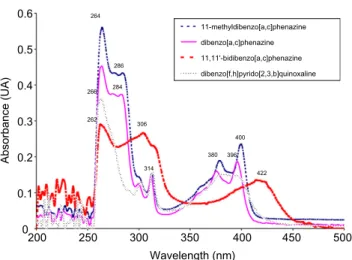
The UV spectra show mainly three bands. A red shift is observed
for the 11,11
0-bidibenzo[a,c]phenazine and can be explained by the
increase in conjugation in the product (
Fig. 1
).
The synthesis of benzodiazepines is not energetically favored
since the 6-member rings are more stable and easier to synthesize.
In the same way, even if a 1:1 molar ratio of reactants was used in
entry 5, only the totally cyclized product was observed.
Only the aromatic o-diamines allow us to obtain the quoted
products. In entry 2, none of the products is observed because
the diamine is not aromatic and the cyano group is strongly
elec-tron-withdrawing which disabled the nitrogen doublets.
In entry 4, an excellent yield was observed with a pure crude
product according to GC–MS and
1H NMR spectra. The presence
of another substituent group on the aromatic nucleus of the
dia-mine decreases the yield. The use of a pyrido electron acceptor
het-erocycle as the o-diamino aromatic reagent lowers the electronic
density of the amino groups and the yield of the reaction is
de-creased. The same phenomenon is found in entry 5.
Electron-donating groups favored the formation of the
dibenzo[a,c]phenazine to give quantitative yields. In contrast,
elec-tron-withdrawing groups gave slightly lower yields. In addition,
the reactant biphenyl-3,3
0,4,4
0-tetraamine or 3,3
0-diaminobenzi-dine and the product have very low solubility. This method thus
gave us access to molecules with very low solubilities.
Further analyses were performed with the
11-meth-yldibenzo[a,c]phenazine. XRD analysis and comparison between
products obtained by the classical solvent way (EtOH reflux then
evaporation under reduced pressure) and by grinding have allowed
us to determine that the product obtained by co-grinding is
hy-drated and is a pseudo-polymorph since the XRD shows some
dif-ferences between the products (hydrated and non-hydrated)
(
Fig. 2
).
Conclusion
We successfully developed a simple, efficient, and eco-friendly
synthetic pathway, which allows the use of poorly soluble
mole-cules and gives direct access to hydrates, which have a different
crystalline structure. This is particularly interesting since the
pseu-do-polymorphs, like salts, can modify the bioavailability of a
phar-maceutical product. Another synthetic step is thus avoided. This is
the first time that these dibenzophenazines were obtained in good
yield with a solvent-free method.
In conclusion, a green, atom-economical, and efficient approach
to the synthesis of pyrazines has been developed. This method can
be used as a quick screening synthesis method giving access to
new compounds sometimes not accessible directly with another
synthetic way.
The sample size allows initial pharmacological, biological,
chemical, and physical characterization of the product.
Acknowledgments
The authors thank Eric Deydier and Catherine Audin for the
1H
NMR spectra and Céline Boachon for the DSC–TGA experiments.
References and notes
1. White, E. C.; Hill, J. H. J. Bacteriol. 1943 , 45, 433–443. 2. Jones, H.; Rake, G.; Hamre, D. M. J. Bacteriol. 1943 , 45, 461–469.
3. Dell, A.; Williams, D. H.; Morris, H. R.; Smith, G. A.; Feeney, J.; Roberts, G. C. K. J. Am. Chem. Soc.1975 , 97, 2497–2502.
4. Gavara, L.; Saugues, E.; Alves, G.; Debiton, E.; Anizon, F.; Moreau, P. Eur. J. Med. Chem.2010, 45, 5520–5526.
5. Sakata, G.; Makino, K.; Kurasawa, Y. Heterocycles 1988, 27, 2481–2515. 6. Bhosale, R. S.; Sarda, S. R.; Ardhapure, S. S.; Jadhav, W. N.; Bhusare, S. R.; Pawar,
R. P. Tetrahedron Lett. 2005 , 46, 7183–7186.
7. Renault, J.; Baron, M.; Mailliet, P.; Giorgi-Renault, S.; Paoletti, C.; Cros, S. Eur. J. Med. Chem.1981, 16, 545–550.
8. He, W.; Myers, M. R.; Hanney, B.; Spada, A. P.; Bilder, G.; Galzcinski, H.; Amin, D.; Needle, S.; Page, K.; Jayyosi, Z.; Perrone, M. H. Bioorg. Med. Chem. Lett. 2003 , 13, 3097–3100.
9. El-Dean, A. M. K.; Geies, A. A. Heterocycl. Commun. 1998, 4, 367–374. 10. Silva, R. S.; Pinto, M. D. C. F.; Goulart, M. O.; de Souza Filho, J. D.; Neves, I., Jr.;
Lourenco, M. C. S.; Pinto, A. V. Eur. J. Med. Chem. 2009, 44, 2334–2337. 11. Glazer, E.; Chappel, L. J. Med. Chem. 1982, 25, 766–769.
12. Babuin, J.; Foster, J.; Williams, V. E. Tetrahedron Lett. 2003 , 44, 7003–7005. 13. Gautrot, J. E.; Hodge, P. Polymer 2007, 48, 7065–7077.
14. Yeo, B. R.; Hallett, A. J.; Kariuki, B. M.; Pope, S. J. Polyhedron 2010, 29, 1088– 1094.
15. More, S. V.; Sastry, M.; Wang, C.; Yao, C. Tetrahedron Lett. 2005 , 46, 6345–6348. 16. Cai, J.; Zou, J.; Pan, X.; Zhang, W. Tetrahedron Lett. 2008, 49, 7386–7390.
0
0.1
0.2
0.3
0.4
0.5
0.6
200
250
300
350
400
450
500
Wavelength (nm)
Absorbance (UA)
11-methyldibenzo[a,c]phenazine dibenzo[a,c]phenazine 11,11'-bidibenzo[a,c]phenazine dibenzo[f,h]pyrido[2,3,b]quinoxaline 264 262 266 306 314 380 400 422 396 286 284Figure 1. UV absorbance spectra for the phenazine derivatives.
0,00E+00 5,00E+03 1,00E+04 1,50E+04 2,00E+04 2,50E+04 3,00E+04 3,50E+04 4,00E+04 10 15 20 25 30 35 40 Angle (2theta) Intensité (UA) water-free with water
Figure 2. Comparison by XRD analysis of hydrated and non-hydrated 11-methyldibenzo[a,c]phenazine.
17. Krishnakumar, B.; Velmurugan, R.; Jothivel, S.; Swaminathan, M. Catal. Commun.2010, 11, 997–1002.
18. Zhao, Z.; Wisnoski, D. D.; Wolkenberg, S. E.; Leister, W. H.; Wang, Y.; Lindsley, C. W. Tetrahedron Lett. 2004, 45, 4873–4876.
19. Kaupp, G. In Organic Solid State Reactions: 2005; pp 95–183. 20. Kaupp, G. CrystEngComm 2006 , 8, 794–804.
21. Kaupp, G.; Schmeyers, J.; Boy, J. Tetrahedron 2000, 56, 6899–6911. 22. Kaupp, G.; Schmeyers, J.; Boy, J. Chemosphere 2001, 43, 55–61. 23. Kaupp, G. CrystEngComm 2009, 11, 388–403.
24. Rodriguez, B.; Bruckmann, A.; Rantanen, T.; Bolm, C. Adv. Synth. Catal. 2007, 349, 2213–2233.
25. Zefirov, N. S.; Sereda, G. A.; Volkov, V. P.; Tkachenko, S. E.; Zyk, N. V. Chem. Heterocycl. Compd.1996 , 32, 577–579.
26. Yavari, I.; Mostafavi, H.; Tahmassebi, D.; Hekmat-Shoar, R. Monatsh. Chem. 1997, 128, 675–679.
27. Muddasir, H.; Lu, P.; Wang, Z. M.; Yang, S.-M.; Yang, B.; Wang, C.-L.; Ma, Y. G. Chem. Res. Chinese universities2009, 25, 950–956.
28. General procedure: reactions are carried out in a vibrating ball-mill Pulverisette 0 (Fritsch, Germany) in 4 h with an agate single ball. The reactants were introduced in equimolar ratio and in solid state (powder, flakes, etc.) under atmospheric conditions (air at room temperature and pressure). The total mass introduced in the ball-mill was 2 g, the vibration frequency was 50 Hz, and the vibration amplitude was 2.5 mm. All chemicals were purchased from Aldrich and were used without any additional treatment (the purities of the reactants are technical grade and comprise of between 95% and 97% for each compound).
1H NMR (200 MHz) spectra were recorded on a BRUKER Advance 200
spectrometer with (CD3)2SO as the solvent which was obtained from
Euriso-top"and tetramethylsilane (TMS) as the internal standard at 298 K. GC–MS
spectra were obtained with a Q5050A Shimadzu spectrometer with CH2Cl2as
the solvent and in EI mode. The injector temperature was 280!C and this of the detector: 300!C. The column flow was 1.4 mL/min. We used the following temperature program: 140!C for 4 min then go to 160 !C by 30 !C/min for 4 min and go to 270!C by 30 !C/min and stay 20 min.
Melting points were obtained on a Netzsch thermal Analysis system STA409. The study was made from 30!C to 500 !C with a step of 5! C/min.
UV spectra were recorded on HP8452A Diode Array spectrophotometer in precision cell made of quartz suprasil"with DMSO as the solvent with an
approximate concentration of 3 " 10!3g/L.
A Fourier Transform Infrared (FTIR) spectrometer from Perkin Elmer model series 2000 was used in order to make the acquisition of the IR spectra in KBr Pellets.
For microanalysis: a thermoquest NA2100 elemental analyzer was used. This model was equipped with an autosampler AS2000.
XRD experiments were carried out on a X’Pert Pro system from Panalytical. To determine if the reactions occurred, 1H NMR was used as an analytical
technique and DSC–TGA for melting point measurements.
29. Data for 11-methyldibenzo[a,c]phenazine: yield (1.78 g, 95%), all the analyses were purchased on the crude product. Mp: 218–220!C1H NMR d
H(200 MHz;
(CD3)2SO; Me4Si): 9.30 ppm (2H, d, 7.4 Hz, 4-H and 5-H), 8.83 ppm (2H, d, 8 Hz,
1-H and 8-H), 8.27 ppm (1H, d, 8.6 Hz, 9-H), 8.16 ppm (1H, s, 12-H), 7.98– 7.81 ppm (5H, m, 2-H, 3-H, 6-H and 7-H), 2.69 ppm (3H, s, 11-Me) MS–EI m/z: 294(M, 100%), 147(37), 146(21), 295(M+1, 19), 133(15), 293(M!1, 11).
m
(KBr)/cm!1:3374 (N–H, w), 3060 and 3037 (C–H, sharp doublet, w); UV (DMSO):
maxima observed at 264, 286, 314, 380, 400 nm. Anal. Calcd for C21H14N2: C,
85.69; H, 4.79; N, 9.52. Found: C, 85.90 ± 0,12; H, 4.74 ± 0,09; N, 9.36 ± 0,06. Data for Dibenzo[a,c]phenazine: yield (1.77 g, >99%). Mp: 224!C. All the analyses were performed on the crude product. 1H NMR d
H(200 MHz;
(CD3)2SO; Me4Si): 9.34 ppm (2H, dd, 7.6 Hz, 1.8 Hz, 4-H and 5-H), 8.86 ppm
(2H, dd, 7.7 Hz, 1.4 Hz, 1-H and 8-H), 8.4 ppm (2H, dd, 3.4 Hz, 6.6 Hz, 9-H and 12-H), 8.04 ppm (2H, dd, 3.4 Hz, 6.6 Hz, 10-H and 11-H), 7.99–7.83 ppm (4H, m, 2-H, 3-H, 6-H and 7-H) MS–EI m/z: 280(M, 100%), 140(47), 281(M+1, 21),
126(12);
m
(KBr)/cm!1: 3380 (N–H, br, w), 3059 and 3031 (C–H, sharp doublet,w); UV (DMSO): maxima observed at 264, 284, 314, 378, 396 nm. Anal. Calcd for C20H12N2: C, 85.69; H, 4.31; N, 9.99. Found: C, 85.78 ± 0,15; H, 4.31 ± 0,11;
N, 9.91 ± 0,13.
Data for 11,110-bidibenzo[a,c]phenazine:yield (0.61 g, 48%), Mp: not observed. For analysis, the pure product was obtained after a chromatographic column with toluene/dioxane 3:1 as the eluent. The product is difficult to solubilize and DMF was used as a solvent for the column deposit to limit this one.1H
NMR dH(200 MHz; (CD3)2SO; Me4Si): 9.53–9.26 ppm (4H, m, 4-H, 5-H and 40-H,
50-H), 8.85 ppm (4H, d, 7 Hz, 1-H and 10-H, 8-H and 80-H), 8.61–8.26 ppm (4H,
m, 9-H and 90-H, 12-H and 120-H), 8.00–7.80 ppm (10H, m, 2-H and 20-H, 3-H
and 30-H). The GC–MS measurements gave us none result of MS);
m
(KBr)/cm!1:3381 (N–H, br, w), 3071 and 3023 (C–H, sharp doublet, w); UV (DMSO): maxima observed at 266, 306, 422 nm. Anal. Calcd for C40H22N4: C, 86.00; H,
3.97; N, 10.03. Found: C, 86.29 ± 0.49; H, 3.88 ± 0,30; N, 9.82 ± 0.48. Data for dibenzo[f,h]pyrido[2,3-b]quinoxaline:yield (1.63 g, 88%) Mp: 213!C. For analysis, the pure product was obtained after a chromatographic column with toluene/dioxane 3:1 as the eluent. The product is difficult to solubilize and DMF was used as a solvent for the column deposit to limit this one. The product after elimination of the column solvent was washed with water to eliminate any DMF traces and after that filtrated and dried. 1H NMR d
H(200 MHz; (CD3)2SO; Me4Si): 9.37 ppm (1H, dd, 4.1 Hz, 1.8 Hz, 10-H), 9.34–9.24 ppm (2H, m, 4-H and 5-H), 8.84 ppm (1H, d, 8.4 Hz, 12-H), 8.80 ppm (2H, dd, 8.5 Hz, 1.8 Hz, 8-H and 1-H), 8.03 ppm (1H, dd, 8.5 Hz, 4.0 Hz, 11-H), 7.98–7.82 ppm (4H, m, 2-H, 3-H, 6-H and 7-H). MS–EI m/z: 281(M,100%), 280(M!1, 26), 282(M+1, 21), 140(20).
m
(KBr)/cm!1: 3426 (N–H, br, w), 3071 and 3021 (C–H,sharp doublet, w); UV (DMSO): maxima observed at 262, 314, 390 nm. Anal. Calcd for C19H11N3: C, 81.12; H, 3.94; N, 14.94. Found: C, 81.75 ± 0,88; H,