Table of Contents
Acronyms ... i
-Introduction- ... 1
-Methodology- ... 1
-Challenges & Opportunities for Agriculture in Saint Lucia- ... 2
High Food Import Dependence/ Agribusiness Import Replacement ... 2
Weak Performance in Traditional Markets/ New Market Opportunities ... 3
Natural Disasters & Environmental Degradation/ Climate-Smart Agriculture ... 4
Ageing Farmer Population/Active Youth & Women Engagement and Employment ... 5
Low Productivity/ Avenues for Innovation and Value Creation ... 5
Food and Nutrition Insecurity/ Food Business Opportunities ... 7
-Situation and Context- ... 7
-Needs/Requests for Technical Cooperation- ... 10
-IICA Country Strategy Instruments of Action- ... 11
Follow-up, Monitoring and Evaluation of the ICS ... 14
Accountability ... 14
-Annex A: Stakeholders Consulted- ... 15
-Annex B: IICA Strategy in Saint Lucia-... 16
- i -
Acronyms
Acronyms: Technical Terms
ACP African, Caribbean and Pacific
CAFY Caribbean Agriculture Forum for Youth
CANROP Caribbean Network of Rural Women Producers SIDS Small Island Developing States
ECD Eastern Caribbean Dollars ECS Eastern Caribbean States
GDP Gross Domestic Product
MOU Memorandum of Understanding
MTP Medium Term Plan
USD United States Dollar
Acronyms: Institutions, Groups and Businesses
CARDI Caribbean Agricultural Research and Development Institute CARE Centre for Adolescent Renewal and Education
CONACYT National Council for Science and Technology
CRESIAP Regional Centre for Integrated Services in Protected Agriculture CUFUPRO National Coordinator of Producer Organizations
CFL Consolidated Foods Limited CXC Caribbean Examination Council
FAO United Nations Food and Agriculture Organization IICA Inter-American Institute for Cooperation on Agriculture IFAD International Fund for Agricultural Development
MAFPFCRD Ministry of Agriculture, Food Production, Fisheries, Cooperatives and Rural Development
MOSDEST Ministry of Sustainable Development, Energy, Science and Technology MTHCI Ministry of Tourism, Heritage and Creative Industries
OECS Organization of Eastern Caribbean States SLAFY Saint Lucia Agriculture Forum for Youth
SLNRWP Saint Lucia Network of Rural Women Producers
UNECLAC United Nations Economic Commission for Latin America and the Caribbean
Acronyms: Development Initiatives/Mechanisms
APP Agricultural Policy Programme
AusAID Australian Agency for International Development
BAM Banana Accompanying Measures
EDF European Development Fund
FonTC Technical Cooperation Fund
HOOPSS Helping Out Our Primary and Secondary Schools NICE National Incentive to Create Employment
SSDF St Lucia Social Development Fund
UNDP GEF United Nations Development Program Global Environment Fund YAEP Youth Agricultural Entrepreneurship Project
-1-
-Introduction-
The overall organization of IICA’s hemispheric, regional, multinational and national work is fully reflected in a technical cooperation strategy for each country. The IICA Country Strategy is based on the strategic objectives and institutional functions and contributions of the Medium Term Plan 2014 – 2018 (MTP 2014-2018) which is the precise and operational expression of the Institute’s cross-thematic and multi-level work in each of its member countries.
In Saint Lucia, IICA will continue to support the construction of medium and long-term visions, enabling the country to achieve its development goals, while respecting its decisions and political, ideological and cultural positions. By adopting this approach, the Institute recognizes the diversity of its member countries and promotes differentiated cooperation that responds to the guiding principles, standards and needs of each one. This allows the countries of the Americas to take advantage of the opportunities they have available.
IICA’s Saint Lucia Country Strategy 2014 -2018 will be implemented through a systematic, participatory, and organized approach to maximize the impact of development interventions in the agricultural and rural sectors in the country. In constructing these strategies, IICA takes into account not only the international vision of the global or hemispheric phenomena or trends related to agriculture and rural life, but also the baseline studies of the countries and the results of national discussions to identify cooperation needs at all levels of work. It is expected that IICA’s strategies will contribute to better coordination with the stakeholders of agricultural chains and rural areas, and to building consensus regarding IICA’s technical cooperation delivered through projects and rapid response actions, including the goals related to obtaining external resources. Thus, IICA’s country strategies encompass all the Institute’s planning and actions at the different levels, mainly in the form of programmed projects.
-Methodology-
The process of developing the IICA country strategy involved an intensive analysis of existing agricultural documents, statistics and policies (Annex A), coupled with extensive consultations with all stakeholders in the agriculture and rural sectors (see Annex A) to arrive at a list of demands for the country for which IICA will allocate resources to meet their set goals and objectives. IICA has always promoted the participatory approach to its development interventions and as a result has constant engagement with stakeholders in the agricultural and rural milieu. The Office engaged in a process of meetings with producer organizations, youth and women organizations, rural service provider agencies, private sector entities involved in agriculture, individual farmers and other agri-entrepreneurs, government ministries, and partner international organizations.
Invariably, there are a large number of demands stemming from the various sub-sectors in the agricultural sector; from the need for access roads and other critical infrastructure,
-2-
capacity building, local and export market development, agricultural standards, access to water harvesting, arable land, land preparation services, and laboratory services among others. For the purposes of the IICA Country Strategy 2014–2018, and in keeping with the strategic objectives and resources of the Institute, the following areas of intervention have been prioritized for the next four-year term:
Value Chain Development of Select High Value Agri-Industries of Strategic Importance;
Building Resilience of the Agricultural Sector to Climate Change;
Protected Agriculture;
Integrated Soil and Water Resource Management;
Agricultural Health and Food Safety as relates to Trade Facilitation;
Strengthening Institutional and Technical Capacity of the Agricultural and Rural Sectors.
-Challenges & Opportunities for Agriculture in Saint Lucia-
While the current global economic context presents a number of challenges to agriculture and rural development in a Small Island Developing State like Saint Lucia, opportunities also emerge. These opportunities require that the country be in a state of readiness to profit from/capitalize on them. Some of the challenges facing agriculture in Saint Lucia are intrinsic, such as its small size and the scarcity of exploitable natural resources. However, many of the mare significant challenges however, stem from Saint Lucia’s insertion into the global economy and its vulnerability to natural disasters and external economic shocks.
High Food Import Dependence/ Agribusiness Import Replacement
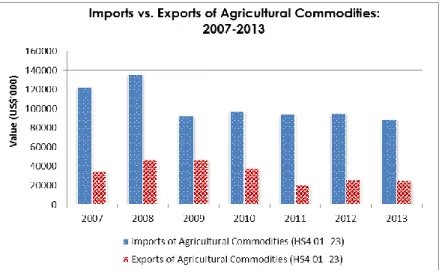
The food import bill has been constantly increasing over the last decade and the current trend of rising global prices for agricultural commodities and inputs means that the country at least in the near future will continue to lose valuable foreign exchange through food imports (Figure 1). The total food import bill amounted to EC$$359.2 million in 2013 - only a 0.3% decline over 2012l.
Under ideal conditions, rising global prices for agricultural commodities would be beneficial to local producers who would boost their price competitiveness as a result, since for the most part they do not benefit from economies of scale due to the small scale of their enterprises, but rising global prices has been accompanied by rising fuel/energy costs which has increased local production costs and consequently has caused increases in local food prices.
Notwithstanding, the country experienced a modest growth in the agricultural sector in 2013 of 0.3% due mainly to growth in the banana crop sector. Purchases in non-traditional crops by local buyers showed marked increases in 2012, increasing by 97.5%
-3- in 2012 over the previous
years for supermarkets1, but the impact to the sector was offset by significant reductions in commodity prices which saw only a 2% increase in revenue generated.
Agriculture needs a wide-ranging process of innovation that will develop new production, institutional, organizational and knowledge paradigms for meeting the challenges of competitiveness, inclusion and sustainability. Efforts are ongoing to arrest this
decline which inevitably adds to the food import bill, as hotels import when they cannot reliably acquire their products locally.
Weak Performance in Traditional Markets/ New Market Opportunities
Rehabilitation efforts saw an 85% increase in banana exports in 2012 but volumes still hover about 10% of the total peak export volumes that the island has achieved in the past. Bananas contribution to total GDP declined from 2.19% in 2008 to 0.85% in 2012. Although the last two decades has seen major contraction of the banana industry, bananas remain the main export crop of the country. The last few years have been characterized by a constant decline in loose bananas on the world market, which has dealt a devastating blow to many small producers who have been attempting to weather the changes in the industry. Two of the largest international banana corporations, Chiquita and FyFFES has recently announced that they are exploring the possibly of a merger which would make them the largest banana company in the world. Such a merger would allow for greater cost efficiencies and allow them to be even more competitive, a situation which could ultimately spell disaster for the local banana industry if measures are not taken to ensure their survival.
The growth of emerging economies such as India and China is precipitating changes in the global supply and demand dynamics for agricultural commodities which can be beneficial to Saint Lucia and its regional counterparts. This is particularly true in the case
1 Hotel purchases have contracted over the last two years at a rate of approximately 13%.
Fig 1: Import and Export of Agricultural Commodities (HS4 01-23): 2007-2013
-4-
of aquaculture where China is consuming more and more its fresh water products such as shrimp and tilapia and is looking to its close Asian neighbours to meet its shortfall due to the close proximity. This means that in the near future, the high demand for such products in the United States will not be able to be sustained by Asian countries as is the case right now, and thus there is an opportunity for the fledging aquaculture industry to expand and export to our northern neighbour. Aquaculture is emerging as a major area of interest but demand for the products still far outstrips supply. Participating in his could be beneficial to the agricultural sector and especially to the rural economy in Saint Lucia. Notwithstanding the myriad of challenges facing the agriculture in Saint Lucia, the sector remains a critical pillar in the developments efforts of the country and opportunities are being exploited to assure its growth and expansion. Recently, Saint Lucia and its Organization of Eastern Caribbean States (OECS) counterparts became a fully integrated economic union with freedom of movement, labour and trade. This literally translates into a larger available market for local agri-entrepreneurs. The ongoing dialogue aimed at addressing the problem of cabotage among the CARICOM members when address will increase opportunities to expand trade especially in fresh agricultural produce such as plantain, bananas and root crops, to countries with high demand for these produce such as Barbados, Trinidad and Tobago and Antigua and Barbuda. This will be especially beneficial to many former banana farmers who diversified to plantain production after their expulsion from the banana industry.
Natural Disasters & Environmental Degradation/ Climate-Smart Agriculture
The impacts of natural disasters have produced mixed performance in the agricultural sector over the last five years. In 2009, Saint Lucia experienced its worst drought in forty years, which was followed in the same year with Hurricane Tomas, which left 100% damage to the agriculture sector and tens of millions of dollars in damage in its wake. The natural disaster in 2010 caused a 63.5% decline in banana exports in 2011. Further, Saint Lucia was again hit by what has been christened the ‘Christmas Day Trough’ which brought excessive rain and caused enormous damage to agricultural infrastructure. These events have slowed down the rate of expansion of the sector and have caused a rethinking of the agricultural strategy by policy makers. Agriculture’s contribution to GDP was 3.1% in 2013 only 0.1% higher than the previous year. The country is currently still attempting to recover from the damages occasioned by this storm. All indications are that such unpredictability of seasons and natural events will continue for the foreseeable future and development efforts should be directed towards building resilience of the agriculture and rural sectors.
Further, climate change has brought about erratic patterns on local weather which has a number of important impacts. There is no longer any reliable predictability of the wet and dry seasons which is one of the main determining factors in determining types of crops and planting seasons for local farmers. This has caused serve losses to local farmer, who plant at inopportune times as a result. Another important impact is that of extreme droughts alternated by extreme rainfall events. In the last five years, Saint Lucia has
-5-
experienced two major droughts and three main rainfall events, one of which, Hurricane Tomas in 2010, brought an estimated rainfall return of 1 in 180 years, causing total destruction of the agricultural sector and tens of millions of dollars in damages.
Reducing the vulnerability of the agriculture sector and rural economies to natural disasters as well as external economic shock is a focus for Saint Lucia in making agriculture more climate-smart. Building on past efforts of identifying suitable strategies for incorporating adaptation and mitigation strategies into
Ageing Farmer Population/Active Youth & Women Engagement and Employment
The aging farming population continues to be of concern to local authorities since the average farmer is near 60 years in age.
Opportunities for youth in agriculture are numerous given comparatively high saturation in other productive sectors, as well as the growing knowledge and innovation/technology intensity of agribusinesses which attracts youth. Further, in Saint Lucia there are initiatives that offer a platform for interventions; namely:
The Saint Lucia Agriculture Forum for Youth (SLAFY) with whom IICA has been collaborating in actively creating avenues for youth engagement in agriculture and employment.
The Youth Agricultural Entrepreneurship Programme (YEAP) which will function as a facilitation programme to adequately address the aging farming population problem by supporting youth entry into commercial agriculture through training, land, equipment and inputs acquisition.
Low Productivity/ Avenues for Innovation and Value Creation
The challenge of low productivity directly impacts food security, but also has a direct correlation with competiveness of the local agricultural sector. This is exacerbated by a production culture based on the high input model of the banana years, which has already contributed to the acidification and fertility-loss of most of the major agricultural lands in the country. This situation is inevitably one of the contributing factors to the low productivity of agricultural enterprises in the island. In addition to low soil productivity, many agri-enterprises complain of low labour productivity and the corresponding high cost of labour impacts on profitability and restricts farm expansion. Agricultural productivity is also negatively impacted by the use of outdated technologies and low rates of capital investment in agri-enterprises.
Enhancing agricultural productivity through capacity building and innovation is a critical need. The Government of Saint Lucia has recognized that growth and expansion of the agriculture and rural sectors has to be predicated upon a fully organized agricultural sector. Efforts to facilitate improved productivity have included:
-6-
Attempts are being made to promote and pursue a number of policy initiatives to strengthen the policy framework to facilitate growth in the agricultural sector. Although the National Agricultural Policy 2 and the National Agricultural Diversification Strategy 3 still form the basis for agricultural development interventions, two key policy initiatives are being pursued. The Sale of Produce Act seeks to facilitate the licensing, regulation and control of trade of agricultural produce in the country, with the main aim of stemming the perennial problem of praedial larceny. In addition to the Sale of Produce Act, the Agriculture and Fisheries Incentives Act seeks to harmonize the agricultural concessions regime to increase the ease of investment in the agricultural sector. Recognizing the threat to the environment and especially water resources that poorly practiced agriculture can pose, this Act takes the very important first step of utilizing agricultural concessions to afford protection to water courses in that, only enterprises who practice agriculture at a predetermined minimum distance from a water course will qualify for concessions.
The strategic alliances with IICA and the Government of the Federal Republic of Mexico is assisting the agricultural sector to overcome the problems of low productivity with the introduction of new protected agriculture technologies and building of local technical capacities to manage the new technology. In 2013 IICA supported the establishment of 2,720 m2 of protected agriculture space for the production of vegetables and also to serve as a training facility for farmers and agricultural technicians in the new technology. The Regional Training Programme sponsored by the Government of Federal Republic of Mexico and facilitated by IICA, is training agricultural technicians in a number of agricultural disciplines to improve service delivery to the agricultural sector.
The programme of work under the European Union-funded Banana Accompanying Measures (BAM) is also directly targeting productivity. Therein the Government has also launched a Youth Agricultural Entrepreneurship Programme (YEAP) which is expected to boost both livestock and crop production in the coming years. Under the European Union Banana Accompanying Measures (BAM) programme, the laboratory and select critical agriculture infrastructure are being renovated and/or built to improve service delivery to the agriculture sector. Also, the BAM will provide funding for
The continues to support the country in its efforts to mitigate the negative impact of the decline in the banana industry and, the diagnostic capabilities for pests and diseases, soil and Veterinary issues of the Ministry of Agriculture, Lands, Fisheries, Cooperatives and Rural Development will be improved through the refurbishment, expansion and equipping of its laboratory facilities. The BAM will also provide counterpart funding to the Caribbean Development Bank funded, Youth
2 MAFPFCRD. 2006. National Agricultural Policy.
-7-
Agricultural Enterprise Project which aims to develop an appropriate response to the aging farming population problem.
Food and Nutrition Insecurity/ Food Business Opportunities
The high incidence of non-communicable diseases, particularly diabetes and hypertension, has forced local authorities to revisit the food and nutrition status of the country alongside its sister CARICOM territories. The issue of agriculture health and food safety is also gaining impetus in the country led by a growing middle class. This new thrust has seen a slow but consistent and promising shift towards the consumption of locally manufactured agriculture products. This has been particularly evident in the rapid growth of local poultry subsector and the emergence of small but growing organic movement. This inward-looking focus augers well for local farmers and agro-processors who for many years have suffered from the preferences of imported products to locally produced products.
Initiatives which can be leveraged in developing opportunities include:
In an attempt to expand the market for local produce, the Government of Saint Lucia with the support of the Food and Agricultural Organization and the Government of Brazil, is seeking to improve the nutrition in schools through the restructuring and expansion of the School Feeding Programme.
Also, in bid to protect agricultural land resources to guarantee food security, the FAO is providing assistance to the Government of Saint Lucia to develop an Agricultural Land Bank. The Government of Saint Lucia has also embarked on a Farm Labour Support Programme through its National Initiative to Create Employment Programme, which trains young persons in crop and livestock management and provides their labour to farms which were heavily impacted by the Christmas Eve Trough, as an incentive aimed at reducing their cost of operations and allowing to returning to their original pre-Trough production levels.
These main areas of focus will be linked to the major opportunities of: a larger market for local agricultural produce and skilled and unskilled labour as a result of the full integration of the countries of the Eastern Caribbean States into an economic union; growing trend of health consciousness of local populace who see locally produced fresh food products as safer than imported products which are believed to contain higher levels of agrochemicals; growth in demand for agricultural commodities in emerging markets of India and China which is causing increase reliance on Latina American and the Caribbean to meet demand shortfalls in the North American markets; and, strategic alliances with the European Union and the Food and Agriculture Organization who are providing much needed financing for agricultural and rural development interventions.
-8-
Saint Lucia continues to grapple with the effects of the drastic decline in the banana industry which has had a significant negative impact on the national economy with rural areas being the most heavily impacted. The efforts at diversification of the agricultural sector which started nearly two decades ago continue, but the results have been slow and were additionally hampered by the onset of the global financial crisis which has contributed to sluggish growth in the economies of Saint Lucia’s major trading partners and a protracted recession in many Caribbean countries. Saint Lucia, like many of its Caribbean neighbours, is currently struggling to reign in exceedingly high fiscal deficits which have limited its borrowing capacity and, in turn, has significantly reduced public sector investment in the agriculture and rural economy.
The Government of Saint Lucia is currently embarking on a number of initiatives to help boost productivity and growth in the agricultural sector. They have embarked on an initiative in collaboration with the Government of Mexico and IICA which has seen the establishment of 2,720 m2 of protected agriculture space for the production of vegetables and also to serve as a training facility for farmers and agricultural technicians in the new technology. This new technology can overcome many of the deficiencies that are currently being experienced by greenhouse farmers on the island and should lead to increases in productivity and production of vegetable crops in the coming years. The government has also launched a Youth Agricultural Entrepreneurship Programme (YEAP) which is expected to boost both livestock and crop production in the coming years. Under the European Union Banana Accompanying Measures (BAM) programme, the laboratory and select critical agriculture infrastructure are being renovated and/or built to improve service delivery to the agriculture sector.
-International Vision and Hemispheric Trends in Agriculture and Rural
Life-
The advances in information and communication technologies in the last three decades has led to a globalization of events which impact even the most remote rural communities. The traditional relationships which defined agriculture and the rural milieu have been drastically transformed and have given rise to new challenges for attaining developmental goals. Recent joint reports by the Food and Agriculture Organization of the United Nations (FAO), the Economic Commission for Latin America and the Caribbean (ECLAC) and IICA repeatedly identify four challenges associated with agriculture; these challenges call for urgent attention and recognition of the role that this sector plays in the development and well-being of nations, in fighting poverty and inequality and in achieving environmental sustainability and food security.
IICA's frame of activity, set forth in the 2010-2020 Strategic Plan, presents these challenges as four strategic objectives: productivity and competitiveness; rural inclusion; adaptation of agriculture to climate change and integrated natural resources management (sustainability); and food and nutrition security. Two other challenges not explicitly given in the Strategic Plan, but pointedly discussed in the 2011 and 2013 meetings of the
-9-
Agricultural Ministers, and therefore understood to be priorities for IICA's work, involve innovation and integrated management of water resources.
In a development context, these challenges are central to building a more robust agri-food system:
The challenge of productivity and competiveness is reflected in the view that the coming decades will be marked by greater demand for agricultural products, especially foodstuffs. Innovative alternatives to current production models will be needed to meet this challenge fully and sustainably. Not only do productivity levels need to improve, but the region's agriculture also faces a problem of competitiveness on increasingly dynamic markets, with rivals from other parts of the world, the advance of trade integration, changes in the structure and interworking of agricultural chains, more multinational investment in such production factors as land and water, and the emergence of new public regulations and “private standards” that condition trade in agricultural and agri-food products. The challenge of expanding agricultural production is not only hampered by low productivity, but land use conflict especially those concerning the livestock sector versus residential and industrial interests is becoming more and more common, and in many cases agriculture has ended up on the losing end. Many of the areas with the most valuable arable lands are used for alternative uses. In Saint Lucia, this has created a surge in land speculation which has seen astronomical increases in land prices in the last two decades, as well as expanded conversion of these areas to residential zones.
The challenge of sustainability is of particular importance to the Caribbean Region because of the growing frequency of catastrophic climate events such as droughts, floods, changes in rainfall patterns and new pests and diseases, all of which jeopardize productivity and call for integrated risk management as a tool for making agricultural activities less vulnerable. Agriculture needs two essential processes for responding to these issues: mitigation and adaptation.
The challenge of inclusion pertains mainly to the issue of poverty. Data from ECLAC shows that agriculture remains the primary economic activity accessible for the 164 million Latin Americans who still live in poverty (27.9 % of the population). The great majority of these people live in rural areas and indigenous communities; but increasing urban poverty and indigence highlights additional opportunities for agriculture. It is important to note this because inclusion applies to all population groups. It implies positive actions to recognize the role of women, young people and the indigenous populations in agriculture and rural territories, and to strengthen their participation in the economy and development by means of interventions that will guarantee their rights and empower them. It will be critically important to raise the profile of agriculture and the important role played by producers, to make this activity attractive to young people. Moreover, the contribution of rural women to family farming and food security needs to be recognized more fully.
-10-
The challenge of food and nutrition security remains central to the actions of many governments in Latin America and the Caribbean. According to the FAO, there are currently 842 million people in the world who are undernourished or suffer from chronic hunger – 47 million of which are in LAC. This region will need to feed a population of nearly 1.3 billion people by the year 2050. The countries of the hemisphere hold the shared aspiration of achieving food and nutrition security for all, and they reiterated this intention at the 32nd General Assembly of the OAS (Cochabamba, Bolivia 2012); broadly recognizing that agriculture must play a leading role in its fulfillment. Doing so will require overcoming the challenge of innovation in the agriculture. Agricultural innovation is a catalyst for growth and positive change. Promoting innovation is vitally important to increase and intensify production and to improve productivity, boost income, reduce poverty and inequality, lessen the environmental impact of the agricultural sector, respond to natural disasters, broaden access to new technologies, adapt to climate change and, consequently, achieve food security and the best possible quality of life for our peoples. However, safeguarding everyone's right to food does not depend on actions by the agricultural sector alone. Gaining physical and economic access to high-quality food and using it well depends on many factors that lie beyond the realm of the agri-food sector.
Lastly, the challenge of the integrated management of water resources, although an emerging issue in many countries is key to achieving agriculture and rural development. Achieving more productive and sustainable agriculture depends largely on the sector's ability to manage water and other natural resources well and thus efficiently utilizing them to produce food. This, in turn, requires a new type of agriculture that uses water more responsibly. The American hemisphere possesses relatively abundant water resources. The region is endowed with great environmental, social, economic and political wealth and diversity, equipping it to identify water management models that can be shared among the countries to improve their public policies and investment plans and to build up their systems for innovation in sustainable water management.
-Needs/Requests for Technical Cooperation-
The needs of the country are based on ongoing or planned actions to overcome the challenges to the development of agriculture and rural milieu in the country described above. Specific areas for intervention are identified through a continuous consultative and participatory process outlined above, various stakeholders in the agriculture and rural sectors so that the technical cooperation actions are reflective of specific needs and support ongoing and/or future planned actions.
It is important to understand these challenges as opportunities to demonstrate agriculture's potential in the hemisphere and the sector's promising circumstances today. The countries will need modern, dynamic institutional frameworks to seize these
-11-
opportunities: farmers need to transform their organizational skills; the private sector needs to be more involved; and local stakeholders need to be engaged. New technical and scientific know-how needs to be developed, adapted and put to use, and new leaders and a new brand of professionals need to be trained in order to build up a 21st-century agricultural sector.
The activities will be aligned to take advantage of national, regional, and international opportunities. Key strategic opportunities are the existence of funding from the European Union for agriculture infrastructure for laboratory facilities for the agricultural sector, and financial support for a youth agricultural entrepreneurial project and the integration of the countries of the Eastern Caribbean States into a single economic market has opened up additional opportunities for regional trade.
-IICA Country Strategy Instruments of Action-
The IICA’s country strategy for Saint Lucia (Annex B) represents the framework for implementation of its technical cooperation actions. The specific technical cooperation actions for Saint Lucia will be implemented through a four year project (see attached) with the general objective of strengthening the institutional and managerial capacities of the agriculture and rural service provider agencies to enhance productivity and efficiency of agribusinesses and diversify the rural income base. The success of the technical cooperation actions for Saint Lucia will be contingent upon the participation of all stakeholders in the agriculture and rural sectors. The central idea is to build on the gains of previous years and work to towards the modernization of these sectors so that the sustainability of the development interventions is ensured.
In order to maximize the efficiency and potential of its work, IICA will adopt a “results-based management” approach. The idea is for its technical cooperation to lead the hemisphere as a whole, and each of the member countries in particular, toward the transformations necessary for meeting the four strategic objectives defined in the Strategic Plan. IICA sees “Transformations” as those results that have a direct impact on achieving strategic or development objectives. These transformations are substantial changes that occur as a consequence of the intervention of many stakeholders, including IICA. They are accomplished as a consequence of national decisions, and they are the responsibility of the country; therefore, the Institute can only offer specific “contributions” (Annex C). A contribution allows for a change to be made in some issue or situation, and as explained above, it occurs thanks to direct intervention by IICA. It is built on and understood through the generation of tangible and intangible products and services (deliverables) that IICA provides directly to its Member States as international public goods, and through concrete solutions “on the ground.”
In IICA’s Mid Term Plan 2014 -2018, it proposes to use four instruments of action to carry out its technical cooperation function and deliver on the demands of the country. These are the following:
-12-
Flagship Projects will serve as the “backbone” for delivering IICA’s technical cooperation,
and will aim to achieve the 11 institutional contributions proposed for the 2014-2018 period related to competitiveness, sustainability and inclusion; IICA will implement four Flagship Projects under the following themes: Productivity and Sustainability of Family
Farming for Food Security and the Rural Economy; Competitiveness and Sustainability of Agricultural Chains for Food Security and Economic Development; Inclusion in Agriculture and Rural Areas; Resilience and comprehensive management of environmental risk for agricultural production .
1. Projects financed with external resources are instruments financed entirely with external funds and designed or implemented to complement and expand IICA’s actions under this MTP ;
2. Rapid Response Actions (RRA) are designed to respond to specific requests and opportunities that arise in a country or in a group of countries prompted by political, social or economic changes, environmental emergencies or other emerging issues;
3. Technical Cooperation Fund (FonCT) is a mechanism which will be used to finance pre-investment initiatives, formulate projects aimed at securing external resources and to mobilize new financial resources complementary to the Regular Fund.
As can be gleaned above, there are a large number of challenges facing the agriculture and rural milieu in Saint Lucia. Although many of the needs for technical cooperation coincide with actions that IICA routinely undertakes, some demands do not fall within IICAs mandate, case in point are the requests for technical cooperation for support to the fisheries industry and the need for road and research infrastructure. In the Caribbean, CARDI has the mandate for research and works closely with the Institute in its development interventions. It must also be mentioned that the interventions made by the Institute in response to the requests from the country will also be based on resource availability. Notwithstanding, the requests made for technical cooperation from IICA will be can be accommodated under the four flagship projects in addition projects funded with external resources.
In addition, the request from national authorities for feasibility assessments for the rehabilitation of the coffee industry will be explored through a RRA instrument if the proposal is successful in the approval process. Annex E shows the demands for technical cooperation made on the Institute for the period 2014 to 2018 and the corresponding instrument of action where the demand will be addressed, as well as a description of the proposed high level activity and some of the key expected outcomes.
The bulk of the demands for technical cooperation in Saint Lucia will fall under the Flagship Project: Productivity and Sustainability of Family Farming for Food Security and
the Rural Economy, which will seek build the capacity of public and private sector
agriculture and rural service provider agencies to improve service delivery their clients. The main demands to be met under this flagship project are the following: the promotion of innovation and new technologies for productivity enhancement of vegetable crops through protected agriculture and other related technologies; the engagement of youth in
-13-
productive agriculture to mitigate the ageing farming population and ensure food and nutrition security for the country; support associative processes which builds managerial and operational capacities of producer organizations and other agriculture and rural community based organizations which provides services to the agricultural sector; the lack of adequate baseline information on the real contribution of agriculture to the economy hampers the ability to attract investment and as such, a study has been requested to determine the true contribution of agriculture to the Saint Lucian economy to remedy this deficiency.
The emerging issue of climate change has become a critical component in development interventions and inevitably agricultural policies and strategies have to be reviewed to ensure that the pertinent climate proofing is achieved. The country demands for support to reduce the vulnerability of the agriculture and rural sectors will be dealt with under the Flagship Project: Resilience and Comprehensive Management of Environmental Risk for
Agricultural Production. The efforts here will be focused on multi agency cooperation to
build institutional and farmer capacities to promote climate smart agriculture and reduce vulnerability t natural disasters while at the same time building resilience in rural communities. This will be achieved through interventions geared towards integrated soils and water management with emphasis on irrigation, water harvesting technologies, soil amelioration and conservation techniques and reduction of pollution of waterways from organic and non-organic agricultural pollutants.
The country demands for the development of select value chains will be addressed through the Flagship Project: Competitiveness and Sustainability of Agricultural Chains
for Food Security and Economic Development. The actions under this project will focus
on strengthening the capacities of chain actors to manage the value chains by developing and strengthening business skills, information, communication and knowledge management within agri-food chains and support for stakeholder mechanisms to supervise the operations of their respective agri-food value chains. This is expected to boost local demand and supply and facilitate exports of agricultural commodities and their derivatives.
A key demand of the country is for technical cooperation support in working with vulnerable groups such as youth and women within the dynamics of rural economies. These demands will be addressed under the Flagship Project: Inclusion in Agriculture
and Rural Areas. The support here will be focused on building youth and women
leadership especially within the context of community based organizations and specifically on strengthening existing mechanisms such as the Saint Lucia Agriculture Forum for Youth (SLAFY) and the Saint Network for Rural Women Producers (SLNRWP), which engage youth and women in agriculture and other aspects of the rural economy. The main focus will be improving governance and inclusion of rural youth and women in
-14-
decision making and into mainstream economic activities in rural communities particularly agriculture, agro-processing and rural tourism.
Some of the country demands are to be financed in part from external sources. The 10th
European Development Fund ‘Caribbean Action under the Programme entitled ‘Agriculture Policy Programme with focus on the Caribbean and Pacific’, currently being
implemented jointly by IICA, CARDI and the CARICOM Secretariat will compliment and support technical cooperation actions under the Competitiveness and Sustainability of Agricultural Chains for Food Security and Economic Development Flagship Project and will seek to promote the development of value chains of select agri-food chains in Saint Lucia. The demands for the strengthening of Agricultural Health and Food Safety (AHFS) coordinating mechanisms, systems and processes to facilitate trade will be addressed in large part under the European Union’s , “Support to the Caribbean Forum of ACP States
in the implementation of commitments undertaken under the Economic Partnership Agreement (EPA): Sanitary and Phytosanitary (SPS) Measures”. The actions here will be
complimentary to some of the actions being undertaken under the Resilience and Comprehensive Management of Environmental Risk for Agricultural Production Flagship Project.
Follow-up, Monitoring and Evaluation of the ICS
As stated in the 2014-2018 MTOP, IICA will focus its work in a result oriented management approach, in which it will be necessary to count with a planning, programming, monitoring and evaluation system. To do this, the IICA Office in Saint Lucia will adopt a strategy of monitoring and comprehensive evaluation.
Accountability
IICA is an organization committed to accountability. The Institute’s work is organized conceptually as a chain of outcome actions; with this structure, IICA can faithfully honour its commitment to accountability and to keeping its principals informed of what has actually been achieved compared with what was initially planned. All of the Institute’s technical cooperation actions will be carried out in strict compliance with its internal regulations and its fundamental values, particularly those of transparency and accountability.
-15-
-Annex A: Stakeholders
Consulted-Public and Private Sector Agriculture and Rural Development Agencies/Institutions Consulted during the Development of the IICA Country Strategy 2014 - 2018
No. Agency/Institution
1. Ministry of Agriculture, Food Production, Fisheries, Cooperatives and Rural Development 2. Ministry of Commerce, Business Development, Investment and Consumer Affairs
3. Ministry of Education, Human Resource Development and Labour
4. Ministry of Social Transformation, Local Government and Community Empowerment 5. Mille Fleur Honey Producers Cooperative Limited
6. Saint Lucia Ruminants Cooperative Society Limited 7. Saint Lucia Pineapple Cooperative Society Limited 8. National Pineapple Dialogue Platform
9. Sandals Hotels Group
10. Saint Lucia Agriculture Forum for Youth (SLAFY)
11. Saint Lucia Network of Rural Women Producers (SLNRWP) 12. Consolidated Foods Limited
13. Bellevue Farmers’ Cooperative Society Limited 14. Embassy of the Federal Republic of Mexico 15. Greens for Life Producers Association 16. Babonneau Agroprocessing Plant
17. Eastern Farmers’ Cooperative Society Limited 18. Black Bay Farmers’ Cooperative Society Limited 19. Australian Agency for International Development
20. Global Environmental Fund/United Nations Development Programme 21. Saint Lucia Bureau of Standards
22. Organization of Eastern Caribbean States Secretariat
23. National Coordinator- Food and Agriculture Organization of the United Nations 24. Private Farmers and Agroprocessors
Governmental Documents Consulted in the Elaboration of the IICA Country Strategy 2014 – 2018.
No. Documents
1. Annual Agriculture Review 2012 2. Economic and Social Review 2013
3. Saint Lucia 2014 – 2015 Budget Summary 4. National Strategic Plan Booklet 2006
5. Agriculture and Fisheries Act No. 13 of 2014 6. National Food Production Action Plan
7. Minister for Agriculture Budget Summary 2013 -2014 8. Central Statics Office- Government of Saint Lucia 9. National Agricultural Diversification Strategy 2000
-16-
-Annex B: IICA Strategy in Saint Lucia-
Project: Ensuring the Sustainability of Food and Nutrition Security and Rural Incomes through Capacity building of the Productive and Associative Agricultural Base in Saint Lucia
General Objective:
To Strengthen the Institutional and Managerial Capacities of the Agriculture and Rural Service Provider Agencies to Enhance Productivity and Efficiency of Agribusinesses and Diversify the Rural Income Base.
Background:
Saint Lucia is a Small Island Developing State (SIDS) with a surface area of 640 square kilometers and a population of approximately 170,000 according to the 2010 national census. During the last decade agriculture’s contribution to GDP has steadily declined from a contribution 6.26% in 2000 to 3.1% in 2013. The decline in the performance of the agricultural sector can be attributed mostly to the removal of the preferential trade arrangements for bananas provided by the European Union to its former colonies in Africa, the Caribbean and the Pacific regions. In response to the social dislocation and increased rural unemployment caused declines in the banana industry, the European Union provided a number of grants to assisted affected ACP countries to diversify their agriculture sector based on monoculture, and to boost economic activity in rural communities through social and economic interventions.
Over the last two decades, two programmes have been implemented, the Stabilization of Exports (STABEX) and the Special Framework of Assistance (SFA). Currently a third programme, the Banana Accompanying Measures (BAM) is being implemented in a number of territories including Saint Lucia. These programmes have not had the desired impact and although some successes have been recorded in the agricultural sector, namely expansion in vegetable and livestock production, as well as an emerging agro-processing sector, agriculture still lags significantly behind tourism and services in its contribution to GDP. This is of enormous consequence because agriculture is still the main economic activity in many rural communities and growth in the rural economy is dependent on growth in the agriculture sector.
The current policy of the government is to seek ways and means to spur economic activity in the rural communities through the introduction of agriculture related ventures, such as Agrotourism, rural tourism, promotion of alternative energy sources and fuels, such as wind farming, micro hydroelectric dams, and bio fuels. These activities by all accounts are still relatively new and as such only impact a small number of persons among the thousands displaced by the decline in the banana industry. Currently, efforts’ are also being directed to the building of technical capacity in the agricultural sector, the
-17-
introduction of new technologies to boost farm productivity and the building of critical agro-infrastructure to strengthen production, marketing and distribution channels, in a bid to create an enabling environment to attract greater private sector investment in the agriculture sector.
Targeted Development Challenges:
The last four years of agriculture and rural development in Saint Lucia can be considered to be of mixed performance. Whereas a number of new challenges have emerged, new opportunities have also arisen for the sector. The Caribbean is considered as the geographical location with the second highest vulnerability natural disasters in the world. Saint Lucia in the last four years have experienced two major droughts, one major Hurricane and one Trough, all of which occasioned astronomical losses to the agricultural and rural sectors of the country and severely hampered the economic diversification efforts of the country.
The decline in the banana industry as a result of the removal of trade preferences which had protected the island main export from external competition for decades has led to high unemployment especially among youth and women and social dislocation in many rural areas. Low agricultural productivity remains a major concern and is a major limiting factor to competitiveness of agribusinesses on the island. In addition, the trend of increasing global prices for agricultural commodities have exploded the food import bill which continues its upward trend, while the increasing cost of agricultural inputs and energy increases local production which already suffers from a lack of economies of scale. The many challenging impacting the agricultural and rural sector finds their full manifestation at the level of the family farm which can be described as the basic unit of the rural economy, therefore development interventions must take into account the particularities of the family farm and its incorporation into formal production, marketing, distribution and organizational frameworks of the country.
Although the diversification efforts aimed at the rural economy has not performed as quickly as was initially anticipated, some important gains have been realized. Local poultry, pork, egg and vegetable production has increasing in recent years. The rising costs of imports presents additional opportunities for expansion of the local agricultural production into crops which at one time may have been uncompetitive to produce. There is constant growth in the agro-processing sector and many cottage industries are now enjoying increased accessibility and consumption in local markets for their products. The agro-processing sector is particularly important because the majority of the agribusinesses and owned and operated by women. The increasing awareness of agricultural health and food safety (AHFS) issues by the local populace has had a dual effect. On the one hand national AHFS systems needs to be strengthen and/or developed to boost export readiness and facilitate regional and international trade. On the other hand, local confidence of agricultural produce in the country is growing along with consumption as there is the growing belief that the local food sources are safer and
-18-
possess less food additives than imported agricultural products.
In lieu of the above, the current national efforts at agricultural development are focused on the development of value chains for high value agro-industries of strategic food security importance; building resilience of the agricultural sector to climate change; introduction of modern technologies to increase productivity especially protected agriculture; integrated soil and water resource management; agricultural health and food safety as relates to trade facilitation; and, the strengthening of institutional and technical capacity of the agricultural and rural sectors for improved service delivery.
The IICA Country Strategy 2014-2018 is designed within the broader framework of IICA’s Medium Term Plan 2014 – 2018 to support the national authorities in addressing the major constraints to its national priorities for the attainment of agriculture and rural development.
Implementation Strategy:
The project will be implemented using a participatory approach with stakeholders in the agriculture sector, rural communities and partner agencies. The Ministry of Agriculture, Food Production, Fisheries, Cooperatives and Rural Development will remain the main partner in the implementation of the technical cooperation actions under the IICA Country Strategy. Strategic alliances have already been established and will continue with the Ministry of Sustainable Development, Energy, Science and Technology, the Ministry of Education, Human Resource Development and Labour, the Ministry of Commerce, Business Development, Investment and Consumer Affairs and the Ministry of Social Transformation, Local Government and Community Empowerment. The existing National Implementation Mechanism, a committee chaired by the Ministry of Agriculture and includes representatives IICA and CARDI as well as a number of key public and private agricultural agencies will act as the steering committee for the implementation of actions under the country strategy. The IICA Office in Saint Lucia will be the main implementing agency for the Country Strategy.
The annual accountability seminars will serve as review forums to get feedback on the progress of the actions and allow for recommendations for proposed changes and to take corrective actions where any actions may be deemed as no longer necessary or require modification. The IICA Office in Saint Lucia will serve as liaison between the leaders of the various Flagship Projects and the Project Coordinators of the project financed with external resources.
Major Risk Factors for the IICA Country Strategy
Political changes within the country which causes changes priorities;
Changes in agricultural policies and strategies;
Dependence on the outcomes of other complimentary flagship projects and projects funded with external resources;
-19-
- Annex C -
The Medium Term Plan (MTP) 2014 – 2018 of the Inter-American Institute for Cooperation on Agriculture sets out the core areas under which its technical cooperation actions for Saint Lucia will be executed over the next four years. This 2014-2018 MTP proposes a renewed vision for providing cooperation services at the hemispheric, regional, multinational and national levels, harnessing IICA's competitive and comparative advantages to attain greater outcomes for the benefit of all its Member States. The Institute's main strength lies in its technical capacities and its stable presence in the hemisphere, through both its Headquarters and its offices in the countries. As a result, its plans and its outcomes come together in the form of findings, public goods and practical, timely and high-quality responses at all four geographic levels, and above all in what could be called “on-the-ground solutions.”
The MTP is built around the four strategic objectives outlined in IICA’s 2010-2020 Strategic Plan. These strategic objectives are framed in a manner to allow the Institute to effectively respond to the major challenges facing agriculture and the rural milieu in Latin America and the Caribbean. The four strategic objectives are as follows:
Strategic objective 1: To improve the productivity and competitiveness of the agricultural sector.
Strategic objective 2: To strengthen agriculture’s contribution to the development of territories and the well-being of the rural population.
Strategic objective 3: To improve agriculture’s capacity to mitigate and adapt to climate change and make better use of natural resources.
Strategic objective 4: To improve agriculture’s contribution to food security.
Two other challenges not explicitly given in the Strategic Plan, but are considered emerging issues and have been raised as priorities at in the 2011 and 2013 ministerial meetings involve innovation and integrated management of water resources. In the case of the latter, IICA has incorporated the issue of water into its agenda as a result of the impact it has on all links in agricultural production and rural territories.
The MTP 2014-2018 specifies eleven (11) Contributions which IICA will focus on in the delivery of its technical assistance agenda to Saint Lucia during the next four years. The country priorities will be aligned to specific Contributions which IICA will support through the methodologies and strategy proposed in the IICA Country Strategy, duly approved and endorsed by the national authorities. The eleven Contributions are as follows:
A Strengthening the capabilities of the Member States at the national, regional, multinational and hemispheric levels to establish public policies and institutional frameworks in order to make agriculture more productive and competitive,
-20-
improve management of rural territories, adapt to and mitigate the impact of climate change, and promote food and nutritional security.
B Implementing, through public and private institutions, technological, institutional and business innovations aimed at boosting the productivity and competitiveness of agriculture and the production of basic foodstuffs of high nutritional quality.
C Increasing the capabilities of the public and private sector to ensure agricultural health and food safety and thereby improve productivity, competitiveness and food security.
D Strengthening the business and associative capabilities of the different stakeholders in the agricultural production chains.
E Increasing the capacity for area-based social management among stakeholders in rural territories, especially those involved in family agriculture, in order to improve food security and rural well-being.
F Enhancing the capabilities of different stakeholders of the agricultural production chains and rural territories in the integrated management of water and sustainable use of soil for agriculture.
G Increasing the capacity of public and private institutions to promote and implement measures for adapting agriculture to climate change and mitigating its effects, as well as promoting integrated risk management in agriculture. H Improving the efficacy and efficiency of food and nutritional security programs in
the Member States.
I Ensuring that producers and consumers benefit from a greater use of native species, promising crops and native genetic resources with food potential. J Improving institutional capacity to address losses of food and raw materials
throughout the agricultural chains.
K Strengthening the Member States’ capacity for consensus and participation in international forums and other mechanisms for the exchange of knowledge and mobilization of sizable resources for inter-American agriculture.